 Transcranial magnetic stimulation and transcranial direct current stimulation for psychiatric disorders in children and adolescents: an umbrella review of meta-analyses of clinical trials
Abstract
Objective: Non-invasive brain stimulation, including repetitive transcranial magnetic stimulation (rTMS) and transcranial direct current stimulation (tDCS), shows promise for psychiatric disorders in adults, but evidence in children and adolescents remains limited. The objective of this review was to evaluate the efficacy and safety of non-invasive brain stimulation for treating psychiatric disorders in children and adolescents.
Methods: An umbrella review with a pre-registered International Prospective Register of Systematic Reviews protocol (CRD42023477743) was conducted. Meta-analyses were identified using MeSH-based searches in Embase, PubMed, PsycINFO, and Cochrane up to October 30, 2023. The PICO strategy guided study selection. Study quality was assessed using A Measurement Tool to Assess Systematic Reviews, version 2, and evidence certainty was rated with GRADEpro.
Results: Of 757 records screened, five meta-analyses, including 49 clinical trials and 2,105 participants, after excluding overlapped samples, met the inclusion criteria: four investigating rTMS for depression and one investigating transcranial direct current stimulation for attention-deficit hyperactivity disorder. Among the four meta-analyses on repetitive transcranial magnetic stimulation for depression, three had similar PICO criteria, and we prioritized the most recent with the largest number of trials and patients for formal evaluation. One meta-analysis (low quality) reported significant improvement in depressive symptoms at 2 (mean difference = 4.68/GRADE = low) and 4 (mean difference = 5.53/GRADE = low) weeks post-rTMS, with a positive response rate (OR = 3.99/GRADE = very low) and minimal adverse effects. Another (critically low quality) found significant symptom improvement in first-episode depression using 10 Hz stimulation on the left dorsolateral prefrontal cortex (standardized mean difference = 1.63/GRADE = low), 1 Hz stimulation on right dorsolateral prefrontal cortex (standardized mean difference = 1.22/GRADE = high), and remission rates (= 1.35/GRADE = moderate). The dropout rate was low, with no serious adverse events reported. A third (low quality) reported symptom improvement in attention-deficit hyperactivity disorder with transcranial direct current stimulation (standardized mean difference = 0.363/GRADE = very low).
Conclusion: Non-invasive brain stimulation appears to be a safe and effective treatment for psychiatric disorders in children and adolescents, but further high-quality randomized controlled trials are needed for clinical validation.
Systematic review registration: PROSPERO, CRD42023477743
Non-invasive brain stimulation; rTMS; tDCS; child; adolescent
Introduction
Psychiatric disorders are a major cause of disability worldwide.1 Serious mental illness – including schizophrenia, major depressive disorders, and bipolar disorder – affects more than 340 million people around the world2 (Supplementary Table S1). In children and adolescents, the burden of mental disorders reaches estimated prevalences of 3% in those aged < 5 years and 11% in those aged 5-19 years.1 In the 5-19 year age range, the leading disorders are anxiety disorders (3.22%), attention-deficit/hyperactivity disorder (ADHD) (2.62%), conduct disorders (2.27%), idiopathic developmental intellectual disability (2.16%), and depressive disorders (1.32%).1 The COVID-19 pandemic exacerbated the worldwide prevalence and burden of mental illness.3 Substance use, problematic use of social media, and domestic violence appear to have accelerated, resulting in pernicious effects on adolescents4 and concerns regarding online activities.5 In fact, studies have highlighted strong links between the pandemic and heightened anxiety, depression, and other psychological issues.5 There are considerable limitations in the clinical effectiveness, tolerability, and accessibility of conventional pharmacological and psychotherapeutic treatments, including side effects and increased suicidal thoughts and behaviors with antidepressant treatment.6 Although many children and adolescents benefit from psychotherapeutic and behavioral interventions, access to high-quality, evidence-based interventions remains limited in many public mental health systems due to structural and socioeconomic barriers.7 The increasing interest in non-invasive brain stimulation (NIBS) interventions in youth is based on the assumption that these techniques are safe, tolerable, appealing to families, and clinically effective.
The most common forms of NIBS are transcranial electric stimulation and transcranial magnetic stimulation (TMS).8 These interventions, based on modulation of neural circuits, are generally safe and well-tolerated.8 Used in research and clinical practice, transcranial electric stimulation involves methods of applying non-invasive current to the brain.9,10 Transcranial direct current stimulation (tDCS), the most common method of transcranial electric stimulation in clinical contexts, injects low-intensity electrical current (usually 1-2 mA) through electrodes placed on the scalp, producing non-focal stimulation.11 The excitatory (anodal) and inhibitory (cathodal) effects of tDCS on the motor cortex are attributed to its ability to modulate synaptic transmission – anodal stimulation facilitates, while cathodal inhibits – resulting in increased or decreased electrical activity in cortical neurons, respectively.12 However, TMS uses a focused magnetic field to induce a secondary electrical current in the brain, which can produce excitatory or inhibitory effects depending on the stimulation protocol.11,13 High-frequency TMS protocols (> 5 Hz) are used to produce excitatory effects, while low-frequency TMS protocols (between 0.2-1 Hz) are used to produce inhibitory effects.13 In theta-burst, a specific form of repetitive TMS (rTMS), bursts of 3 50-HzTMS pulses are repeated every 200 ms. In intermittent theta-burst stimulation, a 2 s train of theta-burst stimulation is repeated every 10 s, producing an excitatory effect.13,14 However, continuous theta-burst stimulation, which is a train of uninterrupted theta-burst stimulation, produces inhibitory effects.13,14
NIBS modalities have emerged as a safe and effective treatment for various psychiatric disorders, particularly in children and adolescents. Research has consistently shown that rTMS and tDCS are well-tolerated and have no serious adverse events.15 The safety profile of these treatments is excellent, with only mild and transient side effects being reported, such as headaches or slight discomfort at the application site. Serious complications, such as seizures, are exceedingly rare, further reinforcing the reliability and safety of NIBS in clinical practice.11,16
While ample literature supports the use of NIBS in adults, studies involving children and adolescents have shown promising results, requiring more robust research in this population. Umbrella reviews offer a high level of evidence synthesis and have been crucial for expanding knowledge and guiding clinical application.17 Given that no umbrella review has been published on NIBS for psychiatric disorders in children and adolescents, we aimed to consolidate the best available evidence in this area on its effectiveness and safety, including evidence on adverse effects.
Methods
Literature review
A systematic search was performed of the Embase, PubMed, PsycINFO, Web of Science, and Cochrane databases from inception until October 30, 2023. The PICO strategy18 was used to define the research question (Is NIBS an effective treatment of psychiatric disorders in children and adolescents in comparison with pharmacological, non-pharmacological, or placebo therapies?). The search strategy was based on a combination of terms representing: 1) psychiatric disorders (based on ICD-10 and DSM-5 classification), 2) interventions (rTMS/tDCS), 3) population (adolescents/children), and 4) publication type (review). Psychiatric disorders were selected according to clinical relevance and prevalence. Although definitions of adolescence vary,19 in this review the authors of the meta-analyses and original articles considered individuals up to 18 or 24 years old as “adolescents.” For the primary search strategy, all search terms were determined and adjusted for the EMBASE search (Supplementary Box S1) and were then adapted for the other databases (PubMed, PsycINFO, Web of Science, and Cochrane). The complete search strategy is available in Supplementary Box S1. Gray literature and the bibliography of the selected articles were also screened. This umbrella review was conducted according to a pre-registered protocol (International Prospective Register of Systematic Reviews CRD42023477743) and followed the Preferred Reporting Items for Systematic reviews and Meta-Analyses 2020 statement.20
Outcomes
The primary objective of this umbrella review was to provide an evidence synthesis about the efficacy of rTMS and tDCS for treating children and adolescents with psychiatric disorders. Thus, we extracted information about: 1) changes in baseline and endpoint symptom scores on validated tools for each mental disorder, 2) the response rate, and 3) the remission rate (RR). The secondary objective was to investigate possible adverse effects and the tolerability of rTMS and tDCS in children and adolescents, for which we extracted information on adverse effects and their incidence, as well as information on the dropout rate.
Eligibility criteria
We used the following inclusion criteria: 1) meta-analyses of clinical trials; 2) meta-analyses reporting the efficacy of rTMS or tDCS in autism spectrum disorder, tic disorders, mental deficiency, speech disorder, language disability, dyslexia, dyscalculia, Rett syndrome, ADHD, conduct disorder, separation anxiety, generalized anxiety disorder, body dysmorphic disorder, social phobia, selective mutism, depression, obsessive compulsive disorder, schizophrenia, bipolar disorder, phobia, eating disorder, or substance abuse; 3) articles written in English, Portuguese, or Spanish; 4) when two or more meta-analyses involved the same population, the meta-analysis with the largest number of trials was used. Meta-analyses evaluating only patients older than 18 years old were excluded. Eligibility was assessed by two researchers (JMS and LVR) who independently decided to include or exclude each study. Rayyan software was used to assess the articles and guarantee blinded decisions.21 Disagreements were resolved by consensus whenever possible or by the decision of a third researcher (ARB).
Data selection and extraction
The following information was extracted from each article: 1) meta-analysis characteristics (author, publication year, DOI, disorder, intervention, control group, number of clinical trials, sample size); 2) demographic characteristics (mean age and range, percentage of women, ethnicity); 3) rTMS/tDCS parameters (intensity in mA [tDCS] or percentage of the resting motor threshold [rTMS], pulses per session, number of sessions, total pulses, number of trains per day, session duration, seconds/train, seconds/interval, treatment frequency, treatment duration, and follow up period); 4) instruments used to assess symptoms; and 5) outcomes (score changes from baseline to endpoint, response rate, RR, description and incidence of adverse effects, and dropout rate).
Data quality and confidence assessment
The quality of each study was assessed by two independent researchers (JMS and LVR), and disagreements were resolved by consensus. A Measurement Tool to Assess Systematic Reviews, version 2 (AMSTAR-2) was used to assess the quality of the systematic reviews, classifying them as one of four quality levels: high (no or one non-critical weakness), moderate (more than one non-critical weakness), low (one critical flaw with or without non-critical weaknesses), or critically low (more than one critical flaw with or without non-critical weaknesses).22
The certainty of evidence was assessed using the Grading of Recommendations Assessment, Development and Evaluation (GRADE) approach, rating the quality of evidence as: high (further research is very unlikely to change our confidence in the effect estimate), moderate (further research is likely to have an important impact on our confidence in the effect estimate and may change the estimate), low (further research is very likely to have an important impact on our confidence in the effect estimate and is likely to change the estimate), and very low (any effect estimate is very uncertain).23
Results
Search results
Of the initial 871 records, we retained five meta-analyses (Figure 1) that included 49 clinical trials and 2,105 participants, after excluding overlapped samples (Supplementary Table S2). The meta-analyses focused on rTMS for depressive disorders (n=4)24-27 and tDCS for ADHD (n=1).28

Preferred Reporting Items for Systematic reviews and Meta-Analyses 2020 flow diagram. MA = meta-analysis.
Outcomes
Efficacy and response rate – Depression
Four studies assessed the effectiveness of adjunctive rTMS in patients with depression,24-27 all of which showed improved symptom severity (Supplementary Table S3). The PICO strategy was similar in three of the four studies,24,25,27 so GRADEpro was applied to the most recent, which had the largest number of trials and participants24 (Supplementary Table S2). Cao et al.,24 which was a low-quality study according to AMSTAR-2, found greater depressive symptom improvement in individuals aged 8-24 years at 2 weeks (mean difference [MD] = 4.68/GRADE = low) and 4 weeks (mean difference = 5.53/GRADE = low) after rTMS + antidepressant treatment compared to sham rTMS + antidepressants. Moreover, there was a positive response rate (odds ratio = 3.99, CI [2.73-5.85]/GRADE = very low). Furthermore, younger age was associated with a more significant decrease in depression scores, which is compatible with Sigrist et al.27 This review included only randomized controlled trials, which improved the quality of evidence. Sigrist et al.27 used aggregated and patient-level data to analyze efficacy, response rate, and moderators of treatment.27 Aggregated data showed significant improvement after rTMS in patients aged 12-21 years in all studies, as well as in studies that considered only left dorsolateral prefrontal cortex (DLPFC) high-frequency TMS (Hedge’s g = 2.03, 95%CI 1.45-2.60, standard error = 0.29, p < 0.001; and Hedge’s g = 1.98, 95%CI 1.25-2.70, standard error = 0.37, p < 0.001, respectively).27 Certain patient- and trial-level data were associated with efficacy as well as response. Age was the most consistent factor, with younger individuals being more likely to have greater treatment response and reduced depression severity. Furthermore, depression severity was a significant moderator of pre- to post-treatment changes after rTMS: individuals with higher baseline depression scores had greater symptom improvement following rTMS treatment.27 Although this finding suggests potential benefits for more severe cases in that specific context, it contrasts with other studies reporting that greater baseline severity is associated with lower overall response and RR.29 Thus, the relationship between baseline depression severity and the effectiveness of rTMS remains complex and may vary depending on population characteristics and outcome measures.30 Only one clinical trial addressed the efficacy of TBS,31 but standard rTMS was associated with greater treatment response. Qiu et al.25 (n=240, k = 13), a high quality meta-analysis according to the AMSTAR-2 checklist, found greater symptom improvement in patients aged 10-25 years (Hedge’s g = 1.37, 95%CI 0.85-1.90; I2 = 99.40%; p < 0.001) after adjunctive high-frequency rTMS over the prefrontal cortex treatment than after sham stimulation + antidepressants. Furthermore, the reported RR varied from 13 to 44%, and response rates ranged from 33 to 56%. Thus, the RR in children and adolescents appears to be better than in adults (18% and 22%, respectively), which is compatible with the hypothesis that younger age is associated with better results.
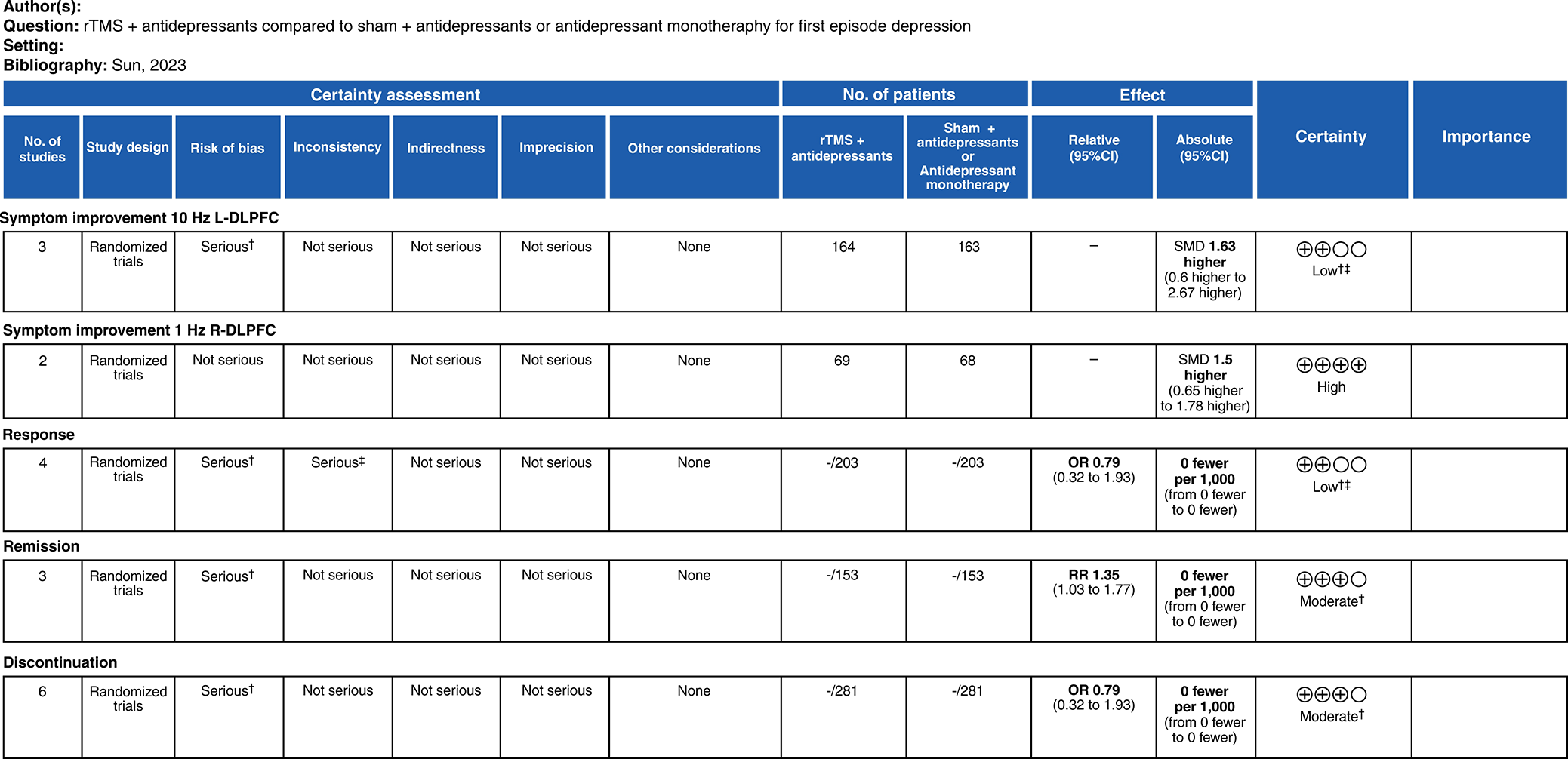
However, Sun et al.26 performed the first meta-analysis of adolescents aged 12-18 years with first-episode major depressive disorders, in contrast with most studies, which have assessed patients with treatment-resistant depression. In comparison to sham stimulation + antidepressants or antidepressant monotherapy, there was greater symptom improvement over a 2-6 week follow-up period with rTMS + antidepressant treatment consisting of 10 Hz stimulation on the left DLPFC (standardized MD [SMD] = 1.63/GRADE = low) and 1 Hz stimulation on the right DLPFC (SMD = 1.22/GRADE = high), in addition to a lower RR (= 1.35/GRADE = moderate). No differences were found in response rate (RR = 0.79/GRADE = low). Furthermore, 4 out of 5 studies assessing neurocognitive function found improvement after rTMS. However, the results should be considered with caution due to the very low methodological quality according to AMSTAR-2.
Efficacy and response rate – ADHD
Brauer et al.28 (n=318, k = 14) performed a meta-analysis assessing the efficacy of tDCS monotherapy or adjunctive treatment with ADHD medications to treat patients with ADHD. The result showed small but significant overall symptom improvement after tDCS treatment (SMD = 0.363/GRADE = very low) compared to sham stimulation (Supplementary Table S3). Another subgroup analysis showed improvement in immediate inattention and impulsivity in children/adolescents, but no significant differences in hyperactivity, which could be explained by the small number of studies that assessed hyperactivity in isolation (n=3). Follow-up varied from 3 days to 2 months (Supplementary Table S4), and the analysis showed persistent differences in overall symptoms between groups. Thus, the meta-analysis suggests immediate effects that persisted to follow-up periods. However, this meta-analysis was classified as low quality according to AMSTAR-2 (Supplementary Table S2).
Safety and tolerability – Depression
Of the four studies assessing depression and rTMS,24-27 three assessed tolerability and safety in children and adolescents24-26 (Supplementary Table S3). The dropout rate and adverse effects in active stimulation groups were qualitatively or statistically similar to the sham groups (Supplementary Table S3). Cao et al.24 found low adverse reaction rates (odds ratio = 0.64/GRADE = very low) and no serious side effects. The adverse event rate in Qiu et al.25 could not be obtained due to a lack of information. However, according to descriptive analysis, rTMS was safe and had a low dropout rate (0.04, 95%CI 0.02-0.09; I2 = 0; p = 1). Of the 165 patients in the meta-analysis, 63% reported treatment-related pain (scalp, neck, and eye), which is compatible with previous studies and might be explained by incidental stimulation of the facial nerve. Nausea, vomiting, muscle twitching, and muscle aches were also reported. Psychiatric disorders were less commonly reported in six patients from one study: insomnia (two), panic attacks (two), and suicidal ideation (two). Seizure, the most severe and concerning potential side effect, was not reported.
However, Sun et al.26 found a low all-cause dropout rate (RR = 0.79/GRADE = moderate) with no serious adverse events and no significant differences in adverse effects between active and control groups (headache: RR = 3.07 [0.70-13.37], I 2 = 0, p = 0.14; loss of appetite: RR = 0.43 [0.07-2.88], I 2 = 0, p = 0.39; dizziness: RR = 1.30 [0.14-12.29], I2 = 29, p = 0.82; nausea: RR = 0.26 [0.03-2.24], I 2 = 0, p = 0.22).
Safety and tolerability – ADHD
Because Brauer et al.28 did not assess the tolerability of tDCS, the dropout rate could not be obtained. However, they found statistically significant data, assessing the risk ratio for itching (RR = 0.87, 95%CI 0.48-1.56, p = 0.634), tingling (RR = 0.679, 95%CI 0.33-1.4, p = 0.297), and headache (RR = 0.84, 95%CI 0.14-5.07, p = 0.847). Furthermore, no severe adverse effects were reported for tDCS in ADHD (Supplementary Table S3).
Discussion
Although many NIBS techniques are already considered safe and effective for adults with a variety of psychiatric disorders,32 the literature on their use in children and adolescents is still limited. To our knowledge, this is the first umbrella review to assess the efficacy of NIBS for psychiatric disorders in children and adolescents. Our results suggest that: 1) rTMS and tDCS are safe and well tolerated in children and adolescents, with no severe adverse events reported; 2) adjunctive rTMS is effective an effective treatment for depression and first-episode depression; 3) tDCS effectively improves ADHD symptoms; 4) caution is required when interpreting the data since most of the studies had low levels of evidence; and 5) further robust studies are needed to support the clinical use of neuromodulation for treatment in children and adolescents.
Body of evidence
Our review demonstrated an important limitation in the available literature on NIBS in pediatric populations: a lack of meta-analyses addressing a wide variety of combinations between neuromodulation techniques and psychiatric disorders. Of the 757 initially screened references, only five meta-analyses met the inclusion criteria, four of which investigated TMS for depression and one investigated tDCS for ADHD. According to AMSTAR-2 criteria, one of the five studies was classified as high quality,25 two were classified as low quality24,28 and two were classified as critically low quality.26,27 The GRADE ratings ranged from very low to high. The assessments for each condition are shown in Figures 2, 3, and 4. No meta-analysis has addressed other relevant combinations, such as TMS or tDCS for anxiety, obsessive-compulsive disorder, or autism. This gap highlights the need for future studies on neuromodulation techniques in different psychiatric contexts to expand the evidence on the safety and efficacy of these interventions.

Cao et al.24 GRADE assessment. OR = odds ratio; rTMS = repetitive transcranial magnetic stimulation; SMD = standardized mean difference. † Only two of the 18 reviewed studies had a low risk of bias. ‡ Wide variance of point estimates across studies. § Minimal or no overlap of CIs. || 95%CI overlap indicated no effect.

Sun et al.26 GRADE assessment. L-DLPFC = left dorsolateral prefrontal cortex; OR = odds ratio; R-DLPFC = right DLPFC; RR = remission rate; rTMS = repetitive transcranial magnetic stimulation; SMD = standardized mean difference. † The trial blinding used for one study was incorrect. ‡ Meta-analytic results presented a serious inconsistency when I 2 values were greater than 50% or p < 0.1 in the Q statistics.

GRADE assessment of Brauer et al.28 ADHD = attention-deficit/hyperactivity disorder; tDCS = transcranial direct current stimulation; SMD = standardized mean difference. † Heterogeneous results. ‡ Small sample. § Egger’s test indicated publication bias (p = 0.005).
The efficacy and safety of transcranial magnetic stimulation for depression
Major depressive disorder is the most studied condition to have shown improvement with TMS. Since 2008, when TMS was first approved for adults with depression, the Food and Drug Administration has been expanding treatment modalities.33 TMS has been extensively studied in adults, demonstrating robust efficacy, especially for treatment-resistant depression.34 The number of studies involving children and adolescents is growing, and preliminary findings suggest that TMS may be a promising intervention for depression in younger populations. Recently, the Food and Drug Administration approved TMS as an adjunctive treatment for adolescents aged 15-21 years old with depression, which is an important step in its dissemination. Although the mechanisms of TMS are not fully understood, its antidepressant effects are believed to be secondary to its modulation of neuroplasticity and the resulting changes in brain connectivity, with the DLPFC appearing to be the best place to engage in top-down control of other important cerebral regions, such as the amygdala.35,36 All four meta-analyses found that rTMS is an effective intervention for depression in adolescents with different profiles, including those with resistant and first-episode depression.24-27 Thus, our findings were consistent with the current literature and our previous hypothesis that TMS sessions are effective for depressive symptoms. One key point is the potential benefit of earlier intervention. Most research on adults has focused on refractory depression after multiple treatment failures.34 In contrast, initiating TMS earlier in the course of illness, including during the first depressive episodes, could lead to better outcomes.24,26,27 However, most studies have included mixed samples of first-episode and multi-episode major depressive disorder, making it difficult to isolate the specific effects of early intervention. Moreover, while this raises the possibility of longer-term benefits such as reduced relapse risk, the current evidence is insufficient to confirm whether early TMS treatment leads to sustained remission or lower recurrence rates. Further longitudinal studies are needed to clarify the long-term outcomes of early rTMS intervention in youth. It has also been proposed that TMS reduces suicidality in children and adolescents with major depressive disorder,25 although the exact mechanisms remain unclear and may be related to the alleviation of depressive symptoms. This hypothesis is compatible with previous studies in adults,37 indicating that TMS could be a promising treatment for suicidal ideation among adolescents. A recent meta-analysis found that rTMS significantly reduces depressive symptoms, resulting in a greater reduction in SMD than electroconvulsive therapy and ketamine treatment.38 They also suggested that rTMS should be strongly considered for treatment-resistant depression in youth, given its efficacy and side effect profile.38 According to the included studies, TMS is well tolerated in adolescents, with mild and transient adverse events, such as headache and discomfort at the application site, which is compatible with previous studies in adults.39 No serious adverse events such as seizures were reported, corroborating the method’s safety profile in pediatric populations. Studies have reported low dropout rates due to side effects, reinforcing TMS’ potential as a safe therapy. This favorable safety profile encourages further research in this area, particularly large-scale randomized controlled trials, to better assess long-term outcomes and optimize treatment protocols.
The efficacy and safety of transcranial direct current stimulation for attention-deficit/hyperactivity disorder
Although the mechanisms by which tDCS could interfere in ADHD are not completely understood, it is supposed that anodal stimulation of the prefrontal and inferior frontal cortex could improve symptom severity and neuropsychological functioning by modulating dysfunctional activation in these brain regions.40 Previous studies in adults have shown cognitive symptom improvement.41 tDCS over the inferior frontal cortex and left DLPFC has shown positive effects on hyperactivity symptoms and neurocognitive performance,28,42-44 generally immediately after treatment, although no significant effects were found in the largest randomized controlled trial45 or in longer follow-up periods. The only meta-analysis included in the current review, Brauer et al.,28 found significant improvement in overall symptoms after tDCS treatment.28 Subgroup analyses showed immediate improvement in inattention and impulsivity, although no significant differences were observed in hyperactivity. These results suggest that tDCS may be more effective for certain ADHD symptom domains, but heterogeneity in stimulation parameters and study quality limit definitive conclusions. Consistent with the current literature in adults, tDCS also presented a favorable safety profile.46,47 Mild adverse events, such as tingling and slight discomfort, were reported, with no evidence of serious side effects or dropouts attributed to the intervention. However, due to the lack of long-term studies, the lasting effects of tDCS in pediatric populations remain unknown.
Non-invasive brain stimulation techniques for other psychiatric disorders
Although we found no meta-analyses of other combinations of psychiatric disorders and NIBS techniques that met the inclusion criteria, preliminary evidence suggests that NIBS is efficacious and tolerable in various contexts. In ADHD, several clinical trials have reported symptom improvement with rTMS targeting the right DLPFC of youngsters.48,49 Regarding autism spectrum disorder, a meta-analysis showed significant cognitive improvement and mild-to-moderate behavioral improvement with low-frequency rTMS, but limitations, such as a lack of sham-controlled trials, small sample sizes, the inclusion of older adults, and protocol heterogeneity reduce the reliability of findings.50 Other studies have reported reduced irritability and improved sleep quality.51-53 Furthermore, in children and adolescents with autism spectrum disorder, tDCS has been reported to improve behavior and functional outcomes, even in severe cases like benzodiazepine-resistant catatonia.54-56 In schizophrenia, most studies are case reports documenting improvements in hallucinations, agitation, and global functioning after TMS.57-59 A double-blind, sham-controlled trial also indicated that tDCS was well-tolerated in childhood-onset cases, but the small sample size limited the study’s power.60 For Tourette’s syndrome and tic disorders, clinical trials and case reports have demonstrated significant reductions in tic severity and comorbid obsessive-compulsive symptoms.61-63 In summary, while promising, the evidence for NIBS in pediatric populations with other psychiatric disorders remains preliminary and will require more rigorous and standardized research.
Study limitations and weaknesses
These results should be interpreted in light of some limitations. First, the small sample of meta-analyses reflects the scarcity of robust evidence on NIBS in pediatric populations. Regarding rTMS in depression, overlapping datasets and PICOS strategies could have quantitatively overestimated the amount of evidence. Furthermore, the heterogeneity of the included studies makes it difficult to generalize the results, leading to a low mean AMSTAR score. Only one of the four reviews on depression was of high quality,25 while the others were low (n=1)24 or critically low (n=2).26,27 The age of patients varied from 8 to 25 years, depending on the study. The rTMS parameters varied in cortical target (left DLPFC, right DLPFC, bi-hemispheric DLPFC), frequency (50 Hz, 10 Hz, 1 Hz), and other characteristics related to stimulation protocols (Supplementary Table S4). Furthermore, there is a lack of representative data from different geographical and cultural populations. Most of the included studies were conducted in specific contexts, particularly China, which limits the generalizability of the results to other regions and populations. Cao et al.24 included only randomized controlled trials in their review, which improved the quality of evidence due the use of sham stimulation in the control group to exclude placebo effect. However, all of their randomized controlled trials were conducted in China, and 17 of the 18 studies had a moderate or high risk of bias. Qiu et al.’s meta-analysis,25 rated as high quality according to the AMSTAR-2 checklist, included several clinical trials that found no significant difference between the rTMS and sham groups, which was associated with a large placebo effect. Other limitations included the small number of clinical trials, small sample size, inconsistent symptom severity rating scales, and high heterogeneity. Furthermore, all of the studies but one were self-controlled – that is, the participants served as their own controls by comparing pre- and post-intervention outcomes – rather than using a sham-controlled design. In Sigrist et al.,27 a very low-quality meta-analysis according to AMSTAR-2 criteria, the clinical trials had small sample sizes and large standard errors, and publication bias was strongly suggested. Moreover, the studies were very heterogeneous regarding rTMS protocols, and only two out of 10 studies were double-blind, randomized, and sham-controlled. In Sun et al.,26 the only meta-analysis to exclusively assess first episode depression, the limitations included a small sample size (562), a short follow-up period (2-6 weeks), and the fact that all clinical trials included only Chinese adolescents, which hampers generalization to other populations. Furthermore, the meta-analysis was considered very low quality according to AMSTAR-2 criteria. All of these limitations reduced the certainty of evidence, which ranged from very low to high according to GRADE, that rTMS is an efficacious treatment for depression in children and adolescents.
However, only one meta-analysis assessed tDCS in ADHD patients.28 The first limitation was its low quality according to AMSTAR-2 criteria. Furthermore, the small sample size (n=133), the small number of studies (eight), and study heterogeneity make it difficult to properly interpret the results. Another point to be considered is the high number of crossover studies included in the analysis (7 of 8), which can confound interpretation of the differences due to the long-term tDCS effect hypothesis.
Other general limitations regarding rTMS and tDCS should be pointed out. A recent review emphasized the influence of the placebo effect in pharmacological and neurostimulation interventions for mental disorders,64 showing that unreliable ratings, baseline symptom severity inflation, sampling bias, and other nonspecific beneficial effects resulting from participation in trials could mimic therapeutic response.65-67 Moreover, the lack of randomized controlled trials comparing active stimulation to sham stimulation affects study quality. Although sham conditions are often employed, active sham – designed to mimic the sensory experience of real stimulation, such as tingling in tDCS or clicking sounds in rTMS, without delivering a therapeutic dose – is generally not used. Instead, many studies use sham protocols with only partial sensory mimicry, the effectiveness of which in maintaining participant blinding is unclear. In contrast to active sham, these non-active or partially active sham conditions may allow participants to distinguish between real and placebo stimulation, thereby increasing the risk of unblinding and introducing bias into the results.68 A limitation specific to tDCS is that only a small selection of certified tDCS devices are available and, apart from the basic functions required for tDCS, their features differ.69 This, combined with the heterogeneous protocols,70 hampers generalization of the findings. Furthermore, in the meta-analyses included in this review, safety was generally assessed as a secondary outcome, and information about the method of adverse event reporting – whether through passive self-report or active clinician-led assessment using structured instruments – was rarely specified. This lack of detail limits the ability to draw firm conclusions about the true incidence and nature of adverse effects associated with rTMS and tDCS in youth.
Finally, another critical point is the lack of long-term studies on the sustained effects of both rTMS and tDCS in children and adolescents. Most of the analyses involved only short-term outcomes, limiting our understanding of these interventions’ effects in terms of safety and lasting efficacy. This limitation is particularly relevant in pediatric populations, whose brains are still developing and may respond differently to neuromodulation.
In conclusion, notwithstanding some limitations, current evidence supports the effectiveness and safety of rTMS for depression and tDCS for ADHD in children and adolescents. However, the scarcity of studies on other combinations of neuromodulation techniques and psychiatric disorders limits our understanding of the therapeutic potential of NIBS in pediatric populations. In addition, the included studies’ methodological limitations the reinforce the need for more rigorous future research, with more standardized protocols, longer follow-up duration, and more representative samples. Further studies should also explore how these interventions can be adapted for other psychiatric disorders, expanding therapeutic options for young people with mental health conditions. In view of the need to develop new therapeutic strategies for psychiatric disorders, it is expected that neuromodulation, especially non-invasive techniques like rTMS and tDCS, will become increasingly researched and applied.
Supplementary Materials
Supplementary Material
Acknowledgements
This research received funding from Fundação de Amparo à Pesquisa do Estado de São Paulo (grants 2023/10454-0 and 2022/03266-0).
PEC has received research support from the Agency for Healthcare Research and Quality, the National Institutes of Health, the National Science Foundation, the Brain and Behavior Research Foundation, and the Mayo Clinic Foundation.
Data availability statement
This study is based on previously published data. All sources and datasets analyzed are cited in the references section. The datasets analyzed can be found in the supplementary material.
References
- 1 GBD 2019 Diseases and Injuries Collaborators. Global burden of 369 diseases and injuries in 204 countries and territories 1990-2019: a systematic analysis for the Global Burden of Disease Study 2019. Lancet. 2020;396:1204-22.
- 2 GBD 2017 Disease and Injury Incidence and Prevalence Collaborators. Global regional and national incidence prevalence and years lived with disability for 354 diseases and injuries for 195 countries and territories 1990-2017: a systematic analysis for the Global Burden of Disease Study 2017. Lancet. 2018;392:1789-858.
- 3 Damiano RF, Guedes BF, de Rocca CC, de Pádua Serafim A, Castro LHM, Munhoz CD, et al. Cognitive decline following acute viral infections: literature review and projections for post-COVID-19. Eur Arch Psychiatry Clin Neurosci. 2022;272:139-54.
- 4 Wang G, Zhang Y, Zhao J, Zhang J, Jiang F. Mitigate the effects of home confinement on children during the COVID-19 outbreak. Lancet. 2020;395:945-7.
- 5 Jones EAK, Mitra AK, Bhuiyan AR. Impact of COVID-19 on mental health in adolescents: a systematic review. Int J Environ Res Public Health. 2021;18:2470.
- 6 Hammad TA, Laughren T, Racoosin J. Suicidality in pediatric patients treated with antidepressant drugs. Arch Gen Psychiatry. 2006;63:332-9.
- 7 Hansen AS, Telléus GK, Mohr-Jensen C, Lauritsen MB. Parent-perceived barriers to accessing services for their child’s mental health problems. Child Adolesc Psychiatry Ment Health. 2021;15:4.
- 8 Sá KN, Baptista RF, Shirahige L, Razza LB, Nogueira M, Coura MHF, et al. Evidence-based umbrella review of non-invasive brain stimulation in anxiety disorders. Eur J Psychiatry. 2023;37:167-81.
- 9 Guleyupoglu B, Schestatsky P, Edwards D, Fregni F, Bikson M. Classification of methods in transcranial electrical stimulation (tES) and evolving strategy from historical approaches to contemporary innovations. J Neurosci Methods. 2013;219:297-311.
- 10 Tallent J, Woodhead A, Frazer AK, Hill J, Kidgell DJ, Howatson G. Corticospinal and spinal adaptations to motor skill and resistance training: Potential mechanisms and implications for motor rehabilitation and athletic development. Eur J Appl Physiol. 2021;121:707-19.
- 11 Brunoni AR, Sampaio-Junior B, Moffa AH, Aparício LV, Gordon P, Klein I, et al. Noninvasive brain stimulation in psychiatric disorders: a primer. Braz J Psychiatry. 2019;41:70-81.
- 12 Brunoni AR, Nitsche MA, Bolognini N, Bikson M, Wagner T, Merabet L, et al. Clinical research with transcranial direct current stimulation (tDCS): challenges and future directions. Brain Stimul. 2012;5:175-95.
- 13 Hallett M. Transcranial magnetic stimulation: a primer. Neuron. 2007;55:187-99.
- 14 Huang YZ, Edwards MJ, Rounis E, Bhatia KP, Rothwell JC. Theta burst stimulation of the human motor cortex. Neuron. 2005;45:201-6.
- 15 Krishnan C, Santos L, Peterson MD, Ehinger M. Safety of noninvasive brain stimulation in children and adolescents. Brain Stimul. 2015;8:76-87.
- 16 Croarkin PE, Wall CA, Lee J. Applications of transcranial magnetic stimulation (TMS) in child and adolescent psychiatry. Int Rev Psychiatry. 2011;23:445-53.
- 17 Aromataris E, Fernandez R, Godfrey CM, Holly C, Khalil H, Tungpunkom P. Summarizing systematic reviews: methodological development conduct and reporting of an umbrella review approach. Int J Evid Based Healthc. 2015;13:132-40.
- 18 da Costa Santos CM, de Mattos Pimenta CA, Nobre MRC. The PICO strategy for the research question construction and evidence search. Rev Lat Am Enfermagem. 2007;15:508-11.
- 19 Sawyer SM, Azzopardi PS, Wickremarathne D, Patton GC. The age of adolescence. Lancet Child Adolesc Health. 2018;2:223-8.
- 20 Page MJ, McKenzie JE, Bossuyt PM, Boutron I, Hoffmann TC, Mulrow CD, et al. The PRISMA 2020 statement: an updated guideline for reporting systematic reviews. BMJ. 2021;372:n71.
- 21 Ouzzani M, Hammady H, Fedorowicz Z, Elmagarmid A. Rayyan-a web and mobile app for systematic reviews. Syst Rev. 2016;5:210.
- 22 Shea BJ, Reeves BC, Wells G, Thuku M, Hamel C, Moran J, et al. AMSTAR 2: a critical appraisal tool for systematic reviews that include randomised or non-randomised studies of healthcare interventions or both. BMJ. 2017;358:j4008.
- 23 Guyatt GH, Oxman AD, Vist GE, Kunz R, Falck-Ytter Y, Alonso-Coello P, et al. GRADE: an emerging consensus on rating quality of evidence and strength of recommendations. BMJ. 2008;336:924-6.
- 24 Cao P, Li Y, An B, Ye L, Xu Z. Efficacy and safety of repetitive transcranial magnetic stimulation combined with antidepressants in children and adolescents with depression: a systematic review and meta-analysis. J Affect Disord. 2023;336:25-34.
- 25 Qiu H, Liang K, Lu L, Gao Y, Li H, Hu X, et al. Efficacy and safety of repetitive transcranial magnetic stimulation in children and adolescents with depression: a systematic review and preliminary meta-analysis. J Affect Disord. 2023;320:305-12.
- 26 Sun CH, Mai JX, Shi ZM, Zheng W, Jiang WL, Li ZZ, et al. Adjunctive repetitive transcranial magnetic stimulation for adolescents with first-episode major depressive disorder: a meta-analysis. Front Psychiatry. 2023;14:1200738.
- 27 Sigrist C, Vöckel J, MacMaster FP, Farzan F, Croarkin PE, Galletly C, et al. Transcranial magnetic stimulation in the treatment of adolescent depression: a systematic review and meta-analysis of aggregated and individual-patient data from uncontrolled studies. Eur Child Adolesc Psychiatry. 2022;31:1501-25.
- 28 Brauer H, Breitling-Ziegler C, Moliadze V, Galling B, Prehn-Kristensen A. Transcranial direct current stimulation in attention-deficit/hyperactivity disorder: a meta-analysis of clinical efficacy outcomes. Prog Brain Res. 2021;264:91-116.
- 29 Sackeim HA, Aaronson ST, Carpenter LL, Hutton TM, Mina M, Pages K, et al. Clinical outcomes in a large registry of patients with major depressive disorder treated with transcranial magnetic stimulation. J Affect Disord. 2020;277:65-74.
- 30 Li H, Cui L, Li J, Liu Y, Chen Y. Comparative efficacy and acceptability of neuromodulation procedures in the treatment of treatment-resistant depression: a network meta-analysis of randomized controlled trials. J Affect Disord. 2021;287:115-24.
- 31 Dhami P, Knyahnytska Y, Atluri S, Lee J, Courtney DB, Croarkin PE, et al. Feasibility and clinical efects of theta burst stimulation in youth with major depressive disorders: an open- label trial. J Afect Disord. 2019;258:66-73.
- 32 Rosson S, de Filippis R, Croatto G, Collantoni E, Pallottino S, Guinart D, et al. Brain stimulation and other biological non-pharmacological interventions in mental disorders: an umbrella review. Neurosci Biobehav Rev. 2022;139:104743.
- 33 Cohen SL, Bikson M, Badran BW, George MS. A visual and narrative timeline of US FDA milestones for Transcranial Magnetic Stimulation (TMS) devices. Brain Stimul. 2022;15:73-5.
- 34 Lefaucheur JP, André-Obadia N, Antal A, Ayache SS, Baeken C, Benninger DH, et al. Evidence-based guidelines on the therapeutic use of repetitive transcranial magnetic stimulation (rTMS). Clin Neurophysiol. 2014;125:2150-206.
- 35 Eshel N, Keller CJ, Wu W, Jiang J, Mills-Finnerty C, Huemer J, et al. Global connectivity and local excitability changes underlie antidepressant effects of repetitive transcranial magnetic stimulation. Neuropsychopharmacology. 2020;45:1018-25.
- 36 Breda V, Freire R. Repetitive transcranial magnetic stimulation (rTMS) in major depression. Adv Exp Med Biol. 2024;1456:145-59.
- 37 Chen GW, Hsu TW, Ching PY, Pan CC, Chou PH, Chu CS. Efficacy and tolerability of repetitive transcranial magnetic stimulation on suicidal ideation: a systemic review and meta-analysis. Front Psychiatry. 2022;13:884390.
- 38 Faries E, Mabe LA, Franzen RL, Murtaza S, Nathani K, Ahmed B, et al. Interventional approaches to treatment resistant depression (DTR) in children and adolescents: a systematic review and meta-analysis. J Affect Disord. 2024;367:519-29.
- 39 Fitzgerald PB, George MS, Pridmore S. The evidence is in: repetitive transcranial magnetic stimulation is an effective safe and well-tolerated treatment for patients with major depressive disorder. Aust N Z J Psychiatry. 2022;56:745-51.
- 40 Dedoncker J, Brunoni AR, Baeken C, Vanderhasselt MA. A systematic review and meta-analysis of the effects of transcranial direct current stimulation (tDCS) over the dorsolateral prefrontal cortex in healthy and neuropsychiatric samples: influence of stimulation parameters. Brain Stimul. 2016;9:501-17.
- 41 Salehinejad MA, Wischnewski M, Nejati V, Vicario CM, Nitsche MA. Correction: transcranial direct current stimulation in attention-deficit hyperactivity disorder: a meta-analysis of neuropsychological deficits. PLoS One. 2019;14:e0221613.
- 42 Soff C, Sotnikova A, Christiansen H, Becker K, Siniatchkin M. Transcranial direct current stimulation improves clinical symptoms in adolescents with attention deficit hyperactivity disorder. J Neural Transm (Vienna). 2017;124:133-44.
- 43 Bandeira ID, Guimarães RSQ, Jagersbacher JG, Barretto TL, de Jesus-Silva JR, Santos SN, et al. Transcranial direct current stimulation in children and adolescents with attention-deficit/hyperactivity disorder (ADHD): a pilot study: a pilot study. J Child Neurol. 2016;31:918-24.
- 44 Klomjai W, Siripornpanich V, Aneksan B, Vimolratana O, Permpoonputtana K, Tretriluxana J, et al. Effects of cathodal transcranial direct current stimulation on inhibitory and attention control in children and adolescents with attention-deficit hyperactivity disorder: a pilot randomized sham-controlled crossover study. J Psychiatr Res. 2022;150:130-41.
- 45 Westwood SJ, Criaud M, Lam SL, Lukito S, Wallace-Hanlon S, Kowalczyk OS, et al. Transcranial direct current stimulation (tDCS) combined with cognitive training in adolescent boys with ADHD: a double-blind randomised sham-controlled trial. Psychol Med. 2023;53:497-512.
- 46 Leffa DT, Grevet EH, Bau CHD, Schneider M, Ferrazza CP, da Silva RF, et al. Transcranial direct current stimulation vs sham for the treatment of inattention in adults with attention-deficit/hyperactivity disorder: the TUNED randomized clinical trial: the TUNED randomized clinical trial. JAMA Psychiatry. 2022;79:847-56.
- 47 Cosmo C, DiBiasi M, Lima V, Grecco LC, Muszkat M, Philip NS, et al. A systematic review of transcranial direct current stimulation effects in attention-deficit/hyperactivity disorder. J Affect Disord. 2020;276:1-13.
- 48 Nagy NAS, Amin GR, Khalil SA, Mahmoud DAM, Elkholy H, Shohdy M. The therapeutic role of repetitive transcranial magnetic stimulation in children with attention deficit/hyperactivity disorder in Egypt a randomized sham controlled clinical trial. Middle East Curr Psychiatr. 2022;29:1.
- 49 Cao P, Xing J, Cao Y, Cheng Q, Sun X, Kang Q, et al. Clinical effects of repetitive transcranial magnetic stimulation combined with atomoxetine in the treatment of attention-deficit hyperactivity disorder. Neuropsychiatr Dis Treat. 2018;14:3231-40.
- 50 Smith JR, DiSalvo M, Green A, Ceranoglu TA, Anteraper SA, Croarkin P, et al. Treatment response of transcranial magnetic stimulation in intellectually capable youth and young adults with autism spectrum disorder: a systematic review and meta-analysis. Neuropsychol Rev. 2023;33:834-55.
- 51 Baruth JM, Casanova MF, El-Baz A, Horrell T, Mathai G, Sears L, et al. Low-frequency repetitive Transcranial Magnetic Stimulation (rTMS) modulates evoked-gamma frequency oscillations in Autism Spectrum Disorder (ASD). J Neurother. 2010;14:179-94.
- 52 Gao L, Wang C, Song XR, Tian L, Qu ZY, Han Y, et al. The sensory abnormality mediated partially the efficacy of repetitive transcranial magnetic stimulation on treating comorbid sleep disorder in autism spectrum disorder children. Front Psychiatry. 2021;12:820598.
- 53 Ezedinma U, Swierkowski P, Fjaagesund S. Outcomes from individual alpha frequency guided repetitive transcranial magnetic stimulation in children with autism spectrum disorder – a retrospective chart review. Child Psychiatry Hum Dev. 2024;55:1010-9.
- 54 Schneider HD, Hopp JP. The use of the bilingual aphasia test for assessment and transcranial direct current stimulation to modulate language acquisition in minimally verbal children with autism. Clin Linguist Phon. 2011;25:640-54.
- 55 Costanzo F, Menghini D, Casula L, Amendola A, Mazzone L, Valeri G, et al. Transcranial direct current stimulation treatment in an adolescent with autism and drug-resistant catatonia. Brain Stimul. 2015;8:1233-5.
- 56 Amatachaya A, Auvichayapat N, Patjanasoontorn N, Suphakunpinyo C, Ngernyam N, Aree-Uea B, et al. Effect of anodal transcranial direct current stimulation on autism: a randomized double-blind crossover trial. Behav Neurol. 2014;2014:173073.
- 57 Fitzgerald PB, Benitez J, Daskalakis JZ, De Castella A, Kulkarni J. The treatment of recurring auditory hallucinations in schizophrenia with rTMS. World J. Biol. Psychiatry. 2006;7:119-22.
- 58 Bodén R, Nilsson J, Walles I, Larsson E, Kristiansen I, Fällmar D, et al. Suppressing visual hallucinations in an adolescent by occipital transcranial magnetic stimulation: a single-case experimental research design. Neuropsychol Rehabil. 2023;33:346-55.
- 59 Jardri R, Lucas B, Delevoye-Turrell Y, Delmaire C, Delion P, Thomas P, et al. An 11-year-old boy with drug-resistant schizophrenia treated with temporo-parietal rTMS. Mol Psychiatry. 2007;12:320.
- 60 Mattai A, Miller R, Weisinger B, Greenstein D, Bakalar J, Tossell J, et al. Tolerability of transcranial direct current stimulation in childhood-onset schizophrenia. Brain Stimul. 2011;4:275-80.
- 61 Kahl CK, Kirton A, Pringsheim T, Croarkin PE, Zewdie E, Swansburg R, et al. Bilateral transcranial magnetic stimulation of the supplementary motor area in children with Tourette syndrome. Dev Med Child Neurol. 2021;63:808-15.
- 62 Kwon HJ, Lim WS, Lim MH, Lee SJ, Hyun JK, Chae JH, et al. 1-Hz low frequency repetitive transcranial magnetic stimulation in children with Tourette’s syndrome. Neurosci Lett. 2011;492:1-4.
- 63 Le K, Liu L, Sun M, Hu L, Xiao N. Transcranial magnetic stimulation at 1 Hertz improves clinical symptoms in children with Tourette syndrome for at least 6 months. J Clin Neurosci. 2013;20:257-62.
- 64 Huneke NTM, Amin J, Baldwin DS, Bellato A, Brandt V, Chamberlain SR, et al. Placebo effects in randomized trials of pharmacological and neurostimulation interventions for mental disorders: an umbrella review. Mol Psychiatry. 2024;29:3915-25.
- 65 Jones BDM, Razza LB, Weissman CR, Karbi J, Vine T, Mulsant LS, et al. Magnitude of the placebo response across treatment modalities used for treatment-resistant depression in adults: a systematic review and meta-analysis. JAMA Netw Open. 2021;4:e2125531.
- 66 Miller FG, Rosenstein DL. The nature and power of the placebo effect. J Clin Epidemiol. 2006;59:331-5.
- 67 Ashar YK, Chang LJ, Wager TD. Brain mechanisms of the placebo effect: an affective appraisal account. Annu Rev Clin Psychol. 2017;13:73-98.
- 68 Rossi S, Hallett M, Rossini PM, Pascual-Leone A; Safety of TMS Consensus Group. Safety ethical considerations and application guidelines for the use of transcranial magnetic stimulation in clinical practice and research. Clin Neurophysiol. 2009;120:2008-39.
- 69 Woods AJ, Antal A, Bikson M, Boggio PS, Brunoni AR, Celnik P, et al. A technical guide to tDCS and related non-invasive brain stimulation tools. Clin Neurophysiol. 2016;127:1031-48.
- 70 Polanía R, Nitsche MA, Ruff CC. Studying and modifying brain function with non-invasive brain stimulation. Nat Neurosci. 2018;21:174-87.
-
How to cite this article:
Santos JM, Rodrigues LV, da Silva PHR, Razza LB, Croarkin PE, Brunoni AR. Transcranial magnetic stimulation and transcranial direct current stimulation for psychiatric disorders in children and adolescents: an umbrella review of meta-analyses of clinical trials. Braz J Psychiatry. 2026;48:e20254219. Epub 2025 Sep 29. http://doi.org/10.47626/1516-4446-2025-4219
Edited by
-
Handling Editor:
Natan Gosmann