 Brazilian Psychiatric Association guidelines for the treatment of panic disorder: an overview of systematic reviews
Abstract
Objective: To develop national, evidence-based treatment guidelines for panic disorder (PD) in Brazil through an overview of systematic reviews.
Methods: We searched PubMed, SciELO, and Cochrane for systematic reviews (with or without meta-analyses) of randomized controlled trials on PD (with or without agoraphobia) from 2004 to 2024. We assessed review quality with A MeaSurement Tool to Assess Systematic Reviews, version 2 (AMSTAR 2), and graded the certainty of evidence for each outcome with the Grading of Recommendations, Assessment, Development and Evaluation (GRADE) approach. Using the PICO framework, we extracted response, remission, and dropout rates.
Results: We identified 202 records; 84 met eligibility criteria, and nine were included (AMSTAR 2: high). Response, remission, and dropout risk were classified with GRADE. Selective serotonin reuptake inhibitors (SSRIs), serotonin-norepinephrine reuptake inhibitors (SNRIs), tricyclic antidepressants (TCAs), monoamine oxidase inhibitors, cognitive-behavioral therapy (CBT), and behavior therapy showed the most favorable profiles for efficacy and tolerability. Combining psychotherapy with antidepressants was also effective. Benzodiazepines demonstrated short-term efficacy and tolerability but are not recommended as first-line treatment due to dependency and long-term risk concerns.
Conclusion: SSRIs, SNRIs, TCAs, and CBT can be recommended as first-line interventions for PD. Concomitant therapy may offer additional benefits. Future studies should prioritize long-term outcomes and strategies to minimize bias.
Systematic review registration: PROSPERO CRD420251002430
Panic disorder; panic attacks; anxiety disorders; treatment; guidelines
Introduction
Panic disorder (PD) is a disabling anxiety disorder marked by recurrent, unexpected panic attacks (PA) – brief surges of intense fear that peak within minutes and involve physiological and cognitive symptoms such as palpitations, chest pain, dizziness, shortness of breath, and fears of losing control or dying.1 Persistent worry about additional attacks and avoidance of certain situations may lead to agoraphobia.1-3 PD commonly co-occurs with depression, generalized anxiety disorder, and substance use disorders, contributing to higher healthcare utilization, functional impairment, and elevated suicide risk, underscoring its public-health significance.1-3
The global prevalence of anxiety disorders – after adjusting for methodological differences – is 7.3%, ranging from 5.3% in African regions to 10.4% in Euro/Anglo regions.4 In a survey of 142,949 adults from 25 high-, middle-, and lower-middle-income countries, 13.2% reported lifetime PA, while the cross-national lifetime prevalence of PD was 1.7%; among individuals with lifetime PD, 80.4% had at least one comorbid mental disorder.5 Across countries, PD affects approximately 1.7-4.7% of adults,6 with estimates up to 4.7% in the United States.7 In Brazil, the prevalence of anxiety disorders is 19.9-27.4%,8 and the prevalence of PD is estimated at 1.1-3.6%.9,10
PD was introduced in DSM-III in 1980 after evidence showed imipramine reduced PAs.11 Early pharmacotherapies included monoamine oxidase inhibitors (MAOIs) and tricyclic antidepressants (TCAs), but adverse effects – dietary restrictions with MAOIs and tolerability issues with TCAs – limited their use. High-potency benzodiazepines offered short-term safety but poorer long-term outcomes. Current guidelines generally recommend selective serotonin reuptake inhibitors (SSRIs) as first-line treatment due to their tolerability. Contemporary care employs psychological and pharmacological approaches, alone or in combination.11-19
Although several international guidelines address the treatment of PD,14-19 Brazil has lacked an official, evidence-based national guideline. Existing national recommendations cover PD diagnosis,20 generalized anxiety disorder,21 and social anxiety disorder,22 but no formal treatment guideline for PD had been established. This manuscript presents Brazil’s first national guideline, commissioned by the Brazilian Psychiatric Association, based on an overview of systematic reviews to inform evidence-based clinical decision-making for PD.
Methods
Study design
This study is an overview of systematic reviews and follows the Preferred Reporting Items for Systematic reviews and Meta-Analyses (PRISMA) statement.
Eligibility criteria
We included systematic reviews, with or without meta-analyses, of randomized controlled trials comparing treatments for PD with or without agoraphobia, published from 2004 to 2024. Only reviews appraised as High quality on A MeaSurement Tool to Assess Systematic Reviews, version 2 (AMSTAR 2)23 were eligible. This restriction to recent, high-quality evidence was intended to reflect current methodological standards and to enable comparison of newer and older pharmacological and non-pharmacological interventions. We considered studies of adults (≥ 18 years) of any sex. Diagnoses followed DSM-III-R, DSM-IV, DSM-5, or ICD-10. We excluded non-systematic reviews, umbrella reviews, correctional studies, cohort studies, case reports, editorials, and any article with an AMSTAR 2 rating below high.23
Information sources
We searched PubMed (Medline), SciELO, and Cochrane using relevant subject headings (“panic disorder” AND “treatment”).
Search strategy
Medical Subject Headings and free terms included: “panic disorder” OR “panic attacks” AND “treat*” OR “therapy*,” “panic disorder” AND “treatment” NOT “case report,” “panic disorder” AND “pharmacotherapy” OR “panic disorder” AND “psychotherapy,” “panic disorder” AND “treat*,” “panic disorder” AND “treat*” AND “systematic review” OR “meta-analysis.” Searches covered January 1, 2004, through December 31, 2024, with no language restrictions. The last search was performed on January 3, 2025, by DLV and LAVG. Full details are provided in the Supplementary Material.
Selection and data collection process
Two review authors (DLV, LAVG) independently screened titles/abstracts and full texts. Disagreements were resolved by discussion or consultation with a third review author (LB).
We identified 202 records. After removing duplicates (n=16) and other ineligible records (n=24), 162 records were screened. We excluded 42 at title/abstract screening and sought 120 full-text reports; 38 were excluded at this stage. We assessed 82 items for eligibility, of which 74 were excluded. Following AMSTAR 2 appraisal,23 nine articles met inclusion criteria (high). Reasons for exclusion are listed in Supplementary Table S1. Data were extracted from included reviews, and the flow of study selection is shown in Figure 1. The introduction, methods, and discussion were supplemented with 26 additional citations drawn from the bibliographies of included publications.
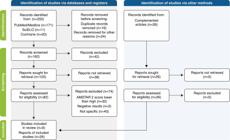
Preferred Reporting Items for Systematic reviews and Meta-Analyses study selection flowchart. AMSTAR 2 = A MeaSurement Tool to Assess Systematic Reviews, version 2.
Data items (outcomes) and effect measures
Data were organized according to the PICO (Patient/Population, Intervention, Comparator, Outcome) framework. Primary outcomes were response, remission, and all-cause dropout, while secondary outcomes varied by review. Effectiveness was summarized using odds ratio, risk ratio, standardized mean difference, rankings from network meta-analysis, and the surface under the cumulative ranking curve.
Assessment of methodological quality and certainty of evidence
We appraised the methodological quality of the included systematic reviews and meta-analyses with AMSTAR 2,23 including only those rated high. Recommended treatments and the certainty of evidence were summarized using the Grading of Recommendations, Assessment, Development and Evaluation (GRADE) approach.
Synthesis methods
Supplementary Table S1 lists excluded articles. Domain-level AMSTAR 2 judgments are shown in Supplementary Table S2. For the included articles, Supplementary Tables S3, S4, and S5 compile key data: references, PICO items, AMSTAR 2 ratings, and pertinent notes. For evidence selection, we included only reviews rated high on AMSTAR 2.23 Strength of recommendations and certainty of evidence were assessed with GRADE.
Study registry
This study was registered with the International Prospective Register of Systematic Reviews (PROSPERO) under registry code CRD420251002430.
Results
Figure 1 shows the study selection flowchart. Treatment recommendations and certainty of evidence appear in Tables 1 and 2. Study characteristics are provided in Supplementary Tables S3, S4, and S5.
Response
Antidepressants with demonstrated efficacy for PD include SSRIs (escitalopram, citalopram, fluoxetine, fluvoxamine, paroxetine, and sertraline), the serotonin-norepinephrine reuptake inhibitor (SNRI) venlafaxine, TCAs (clomipramine and imipramine), and MAOIs (moclobemide and tranylcypromine).2,11,13,24
Bighelli et al.11 reported an antidepressant number needed to treat for benefit of 7, meaning seven patients must be treated for one additional responder. Based on GRADE across response, remission, and dropout, the recommended hierarchy for response is SSRIs and SNRIs (high), TCAs (moderate), and MAOIs (moderate).2,11,13,24
Benzodiazepines – alprazolam, clonazepam, and diazepam – showed moderate certainty of evidence for response, but trials evaluated only short-term use. Because of dependence and long-term risk, use should be limited to the short term.24-26
Psychotherapies assessed for PD included cognitive-behavioral therapy (CBT), behavior therapy (BT), third-wave (3W) CBT, psychodynamic therapies (PDT), supportive psychotherapy (SP), physiological therapies (PT), cognitive therapy (CT), psychoeducation (PE), and interpersonal therapy (IPT). Evidence for a better chance of response was: CBT (moderate), BT (moderate), 3W CBT (low), PDT (low), SP (low), PT (moderate), CT (low), PE (very low), and IPT (very low).1,13,26-30
For combined therapy, evidence supported TCA + CBT (moderate), TCA + BT (low), SSRI + CBT (moderate), TCA + PDT (very low), BDZ + BT (low), BDZ + CBT (low), and SSRI + PDT (very low).13,26,27
Remission
For remission, medications with hierarchical evidence were SSRIs (high), SNRIs (high), TCAs (moderate), BDZ (moderate), and MAOIs (moderate).2,11,13,24,25 Among psychotherapies, evidence was observed for CBT (moderate), BT (low), 3W CBT (moderate), PDT (low), SP (low), PT (low), and CT (low); there were no data for PE or IPT.1,13,27,30
For medication-psychotherapy combinations, evidence supported TCA + CBT (moderate), TCA + BT (moderate), SSRI + CBT (low), and TCA + PDT (low). There were no data for BDZ + BT, BDZ + CBT, TCA + SP, or SSRI + PDT.13,27
Dropouts for any reason
For this outcome, we considered all-cause dropout as a proxy for tolerability/acceptability. Treatments associated with a reduced chance of dropout were SSRIs (moderate), SNRIs (moderate), TCAs (moderate), MAOIs (moderate), BDZ (moderate), CBT (moderate), BT (low), 3W CBT (moderate), PDT (moderate), SP (very low), PE (moderate), and IPT (low).1,2,11,24,25,27-30 For combinations, TCAs + CBT (low), TCAs + BT (very low), and BDZ + BT (low) showed benefit.13,26 There were no data for PT, CT, SSRI + CBT, TCA + PDT, BDZ + CBT, TCA + SP, or SSRI + PDT.
Time of treatment
Because the evidence is derived from clinical trials, follow-up was limited. Outcomes were assessed at 3-28 weeks,11,13,24 with the acute phase typically occurring at 8-12 weeks.13 We recommend a treatment period of 12-24 months.
Not recommended treatments
We found no supporting evidence for buspirone,2,31 repetitive transcranial magnetic stimulation,32 valerian,33 passiflora,34 and CBT with virtual reality exposure therapy.35
Discussion
The evidence base for PD is heterogeneous, largely because many studies assessed multiple anxiety disorders concurrently, applied varying diagnostic criteria, or did not exclude comorbid conditions. Different instruments and analytic approaches further complicate comparisons. In this overview, we focused exclusively on PD and did not pool overlapping results given discrepancies in assessments, statistical methods, and sample sizes. When multiple independent studies supported an intervention, we treated the aggregate as evidence of efficacy.
In order to ensure methodological rigor, we used AMSTAR 2, which led to the exclusion of most identified reviews. Even among the included reviews, few outcomes were graded as high or moderate certainty; many were low or very low. We therefore emphasized the strongest available evidence across the three primary outcomes: response, remission, and all-cause dropout. We also summarized commonly recommended treatments lacking evidence and provided dosing ranges for medications.
AMSTAR 2 helped verify review quality; we then evaluated the findings reported in those reviews. Recommendations are presented to guide clinical decision-making, while acknowledging clinician discretion. We organized options by evidence tier: first line (best evidence across response, remission, and retention), second line (intermediate evidence), and third line (lowest evidence). The included reviews generally accounted for heterogeneity and risk of bias in drawing conclusions about efficacy, in accordance with AMSTAR 2 criteria. Reviews that did not adequately address these issues did not achieve a high rating.
The best evidence – by GRADE, considering all previously described variables – supports these options. The efficacy of combined therapy pairing antidepressants with CBT or BT was also demonstrated. Importantly, several assessments include overlapping clinical trials, which yield comparable outcomes.
We did not assess costs because the underlying studies are international and may not reflect the Brazilian context. Expenses vary by patients’ socioeconomic circumstances, care setting (public system, health insurance, or private), and local availability of services. Accordingly, we provide multiple options to support individualized treatment.
This study has limitations: a restricted time window (2004-2024); reliance on secondary data from prior reviews; absence of cost-effectiveness evidence; limited long-term outcome data; and the exclusion of many studies due to low AMSTAR 2 ratings. Strengths include a comprehensive search strategy, a national treatment focus, and the use of a rigorous tool to appraise review quality.
In conclusion, the most supported alternatives at present are CBT, BT, SSRIs, SNRIs, TCAs, and MAOIs. Combined therapy is a viable, evidence-based option. BDZs showed efficacy and acceptable safety only in the short term. Future research should evaluate long-term outcomes of maintenance or continuation strategies and report the risk of bias, particularly selection and reporting biases.
Acknowledgements
This work was supported by the Brazilian Psychiatric Association. We thank Andrea de Abreu Feijó de Mello (ORCID 0000-0001-8498-7751, aafeijomello@icloud.com) and Marcello Feijó de Mello (ORCID 0000-0002-0475-4729, mf-mello@uol.com.br) for reviewing the final version.
Data availability statement
Data that support this study are available in the body of the paper and/or supplementary materials.
References
- 1 Pompoli A, Furukawa TA, Efthimiou O, Imai H, Tajika A, Salanti G. Dismantling cognitive-behaviour therapy for panic disorder: a systematic review and component network meta-analysis. Psychol Med. 2018;48:1945-53.
- 2 Guaiana G, Meader N, Barbui C, Davies SJ, Furukawa TA, Imai H, et al. Pharmacological treatments in panic disorder in adults: a network meta-analysis. Cochrane Database Syst Rev. 2023;11:CD012729.
- 3 Jayasankar P, Satish S, Suchandra HH, Manjunatha N, Rao GN, Gururaj G, et al. Panic disorder: epidemiology, disability, and treatment gap from nationally representative general population of India. Indian J Psychiatry. 2023;65:1249-53.
- 4 Baxter AJ, Scott KM, Vos T, Whiteford HA. Global prevalence of anxiety disorders: a systematic review and meta-regression. Psychol Med. 2012;43:897-910.
- 5 de Jonge P, Roest AM, Lim CCW, Florescu SE, Bromet EJ, Stein DJ, et al. Cross-national epidemiology of panic disorder and panic attacks in the world mental health surveys. Depress Anxiety. 2016;33:1155-77.
- 6 Politis S, Bellos S, Hadjulis M, Gournellis R, Petrikis P, Ploumpidis D, et al. Epidemiology of panic disorder and subthreshold panic symptoms in the Greek general population. Psychiatriki. 2020;31:201-15.
- 7 Aljadani A, Alshammari K, Alshammari M, Alshammari S, Alhuwaydi A, AbouZed M, et al. Prevalence and predictive factors of panic disorder among adults in Saudi Arabia: a cross-sectional study. J Epidemiol Glob Health. 2024;14:730-9.
- 8 França MH, Barreto SM, Pereira FG, Andrade LHSG, Paiva MCA, Viana MC. Mental disorders and employment status in the São Paulo Metropolitan Area, Brazil: gender differences and use of health services. Cad Saude Publica. 2017;33:e00154116.
- 9 Andrade LH, Mangolini VI, Wang Y-P. Epidemiologia dos transtornos de ansiedade em regiões do Brasil. Rev Med. 2019;98:415-22.
- 10 da Costa CO, Branco JC, Vieira IS, Souza LDM, da Silva RA. Prevalência de ansiedade e fatores associados em adultos. J Bras Psiquiatr. 2019;68:92-100.
- 11 Bighelli I, Castellazzi M, Cipriani A, Girlanda F, Guaiana G, Koesters M, et al. Antidepressants versus placebo for panic disorder in adults. Cochrane Database Syst Rev. 2018;4:CD010676.
- 12 Furukawa TA, Watanabe N, Churchill R. Psychotherapy plus antidepressant for panic disorder with or without agoraphobia. Br J Psychiatry. 2018;188:305-12.
- 13 Furukawa TA, Watanabe N, Churchill R. Combined psychotherapy plus antidepressants for panic disorder with or without agoraphobia. Cochrane Database Syst Rev. 2007;2007:CD004364.
- 14 National Institute for Health and Care Excellence (NICE). Generalised anxiety disorder and panic disorder in adults: management. NICE Clinical Guidelines, No. 113. London: NICE;2020.
- 15 Raju NN, Naga Pavan Kumar KSVR, Nihal G. Clinical practice guidelines for assessment and management of anxiety and panic disorders in emergency setting. Indian J Psychiatry. 2023;65:181-5.
- 16 Domschke K, Seuling PD, Schiele MA, Bandelow B, Batelaan NM, Bokma WA, et al. The definition of treatment resistance in anxiety disorders: a Delphi method‐based consensus guideline. World Psychiatry. 2024;23:113-23.
- 17 Zwanzger P, Singewald N, Bandelow B. [Pharmacotherapy of anxiety disorders-Guideline-conform treatment and new developments]. Nervenarzt. 2021;92:433-40.
- 18 Bandelow B, Werner AM, Kopp I, Rudolf S, Wiltink J, Beutel ME. The German Guidelines for the treatment of anxiety disorders: first revision. Eur Arch Psychiatry Clin Neurosci. 2021;272:571-82.
- 19 Brakoulias V. Commentary on RANZCP clinical practice guidelines for the treatment of panic disorder, social anxiety disorder and generalised anxiety disorder. Aust N Z J Psychiatry. 2019;53:81-2.
- 20 Levitan MN, Chagas MH, Linares IM, Crippa JA, Terra MB, Giglio AT, et al. Brazilian Medical Association guidelines for the diagnosis and differential diagnosis of panic disorder. Braz J Psychiatry. 2013;35:406-15.
- 21 Baldacara L, Paschoal AB, Pinto AF, Loureiro FF, Antonio GLAV, Veiga DL, et al. Brazilian Psychiatric Association treatment guidelines for generalized anxiety disorder: perspectives on pharmacological and psychotherapeutic approaches. Braz J Psychiatry. 2024;46:e20233235.
-
22 Baldaçara L, Almeida TM, dos Santos DC, Paschoal AB, Pinto AF, Antonio LAVG, et al. Brazilian psychiatric association guidelines for the treatment of social anxiety disorder. Braz J Psychiatry. 2024 Nov 11. doi: 10.47626/1516-4446-2024-3878 Online ahead of print.
» 10.47626/1516-4446-2024-3878 - 23 Shea BJ, Reeves BC, Wells G, Thuku M, Hamel C, Moran J, et al. AMSTAR 2: a critical appraisal tool for systematic reviews that include randomised or non-randomised studies of healthcare interventions, or both. BMJ. 2017;358:j4008.
- 24 Bighelli I, Trespidi C, Castellazzi M, Cipriani A, Furukawa TA, Girlanda F, et al. Antidepressants and benzodiazepines for panic disorder in adults. Cochrane Database Syst Rev. 2016;9:CD011567.
- 25 Breilmann J, Girlanda F, Guaiana G, Barbui C, Cipriani A, Castellazzi M, et al. Benzodiazepines versus placebo for panic disorder in adults. Cochrane Database Syst Rev. 2019;3:CD010677.
-
26 Watanabe N, Churchill R, Furukawa TA. Combined psychotherapy plus benzodiazepines for panic disorder. Cochrane Database Syst Rev. 2009 Jan 21:(1):CD005335. doi: 10.1002/14651858.CD005335.pub2
» 10.1002/14651858.CD005335.pub2 - 27 Imai H, Tajika A, Chen P, Pompoli A, Furukawa TA. Psychological therapies versus pharmacological interventions for panic disorder with or without agoraphobia in adults. Cochrane Database Syst Rev. 2016;10:CD011170.
- 28 Papola D, Ostuzzi G, Tedeschi F, Gastaldon C, Purgato M, Del Giovane C, et al. CBT treatment delivery formats for panic disorder: a systematic review and network meta-analysis of randomised controlled trials. Psychol Med. 2022;53:614-24.
- 29 Papola D, Ostuzzi G, Tedeschi F, Gastaldon C, Purgato M, Del Giovane C, et al. Comparative efficacy and acceptability of psychotherapies for panic disorder with or without agoraphobia: systematic review and network meta-analysis of randomised controlled trials. Br J Psychiatry. 2021;221:507-19.
- 30 Pompoli A, Furukawa TA, Imai H, Tajika A, Efthimiou O, Salanti G. Psychological therapies for panic disorder with or without agoraphobia in adults: a network meta-analysis. Cochrane Database Syst Rev. 2016;4:CD011004.
- 31 Imai H, Tajika A, Chen P, Pompoli A, Guaiana G, Castellazzi M, et al. Azapirones versus placebo for panic disorder in adults. Cochrane Database Syst Rev. 2014;2014:CD010828.
- 32 Li H, Wang J, Li C, Xiao Z. Repetitive transcranial magnetic stimulation (rTMS) for panic disorder in adults. Cochrane Database Syst Rev. 2014;2014:CD009083.
- 33 Miyasaka LS, Atallah ÁN, Soares BGO. Valerian for anxiety disorders. Cochrane Database Syst Rev. 2006;CD004515.
- 34 Miyasaka LS, Atallah ÁN, Soares BGO. Passiflora for anxiety disorder. Cochrane Database Syst Rev. 2007;CD004518.
- 35 Schröder D, Wrona KJ, Müller F, Heinemann S, Fischer F, Dockweiler C. Impact of virtual reality applications in the treatment of anxiety disorders: a systematic review and meta-analysis of randomized-controlled trials. J Behav Ther Exp Psychiatry. 2023;81:101893.
-
How to cite this article:
Baldaçara L, Veiga DL, Gaiotto LAV, Paschoal AB, Pinto AF, Almeida TM, et al. Brazilian Psychiatric Association guidelines for the treatment of panic disorder: an overview of systematic reviews. Braz J Psychiatry. 2026;48:e20254349.http://doi.org/10.47626/1516-4446-2025-4349
Edited by
-
Handling Editor:
Laiana Quagliato