 Which key factors can promote effectiveness of water allocation negotiation and its agreements?
ABSTRACT
Water use agreements are designed to prevent, mitigate, or resolve conflicts related to these resources. Negotiations build agreements, so it is necessary to analyze the effectiveness of both negotiations and agreements. This paper considers key factors that contribute to the effectiveness of negotiations and their agreements in water resource arenas, such as the negotiated water allocation process which has been applied to critical reservoirs in Brazil. Two water systems in the Paraíba River Basin were analyzed. The results indicate that water systems with greater relevance for the negotiating state and stakeholders' presence in the negotiations tend to result in more effective agreements. While negotiated water allocations are valuable tools for participatory planning at the local level, institutional fragilities may undermine the process and hinder the fulfillment of agreed commitments.
Keywords:
Water management; Semi-arid; Planning; Monitoring; Conflict resolution
RESUMO
Acordos pelo uso da água são estabelecidos para evitar, minimizar ou resolver conflitos relacionados a estes recursos. As negociações materializam os acordos, tornando-se importante analisar a efetividade tanto das negociações como dos acordos. Este artigo considera fatores-chave que colaboram para alcançar a efetividade das negociações e seus acordos em arenas de recursos hídricos, como o processo de alocação negociada de água que tem sido aplicado em reservatórios críticos no Brasil. Foram analisados dois sistemas hídricos na Bacia Hidrográfica do Rio Paraíba. Os resultados indicam que sistemas hídricos com maior relevância para o estado negociador e a presença das partes interessadas nas negociações tendem a resultar em acordos mais efetivos. Apesar das alocações negociadas serem uma ferramenta muito importante para o planejamento participativo em nível local, fragilidades institucionais podem enfraquecer o processo e fazer com que eles não cumpram os compromissos estabelecidos.
Palavras-chave:
Gestão hídrica; Semiárido; Planejamento; Monitoramento; Resolução de conflitos
INTRODUCTION
Water is distributed unevenly across regions. Its scarcity results from a combination of political, social, climatic, and economic factors. It has been understood that one major cause of water scarcity and conflicts is the large gap between supply and demand (Rossi & Santos, 2018; Nunes & Ribeiro, 2021). However, water conflicts are complex and involve multiple factors. These include divergent interests among stakeholders, power imbalances, resource allocation disputes, decision-making processes, and weak governance (Hasan et al., 2025). Socioeconomic drivers such as population growth, economic development, and political instability can also intensify these conflicts (Dinko, 2022; Sultana et al., 2019).
A conflict arises when one or more parties perceive their interests as being in opposing (United Nations Development Programme, 2014; Pignatelli, 2010). Given the diversity of actors, interests, and values involved, resolving water conflicts requires a clear understanding of their nature (Pedrosa, 2021). Although natural resource scarcity is an obvious cause, water conflicts also stem from the lack or failure of social resources. These include the rules and institutions designed to manage disputes and prevent conflicts (Silva & Ribeiro, 2022).
Water governance refers to the practices, policies, and processes that support decision-making (Organization for Economic Co-operation and Development, 2015). It also involves power networks that connect different actors, based on their interests and the issues under negotiation. Achieving good water governance is essential for the effective management of water resources (Rivero et al., 2020). Water management refers to the process of managing conflicts between different visions and interests (Wolf, 2008). Therefore, implementing procedures to minimize or prevent these disputes is essential (Nunes & Ribeiro, 2021). Water management is the operationalization of water governance (Observatório de Governança das Águas, 2019). It includes negotiation arenas and the agreements that result from them, reflecting a model of participatory management.
Many negotiation processes have led to agreements that established rules and priorities for water use, helping to reduce existing conflicts. International examples include: the Niger River Basin Agreement, the Plata Basin Treaty (between Argentina, Bolivia, Brazil, Uruguay, and Paraguay), the Washington Treaty (between Canada and the United States), the Albufeira Convention (between Portugal and Spain) (Amorim et al., 2016; Silva et al., 2024), among others. In Brazil, national-level agreements include normative acts for managing the São Marcos River Basin (shared by Goiás and Minas Gerais) and the Piancó-Piranhas-Açú River Basin (shared by Paraíba and Rio Grande do Norte) (Silva et al., 2024). These national acts focused on regulating water flows at the state borders.
The development of negotiations and agreements fosters the creation of debates and consensus that contribute to reducing disputes (Talozi et al., 2019; Lima, 2022). While extensive research exists on water agreements in transboundary basins (United Nations Development Programme, 2014), knowledge about conflicts in local water systems remains limited (Studart et al., 2021).
In Brazil, National Water and Basic Sanitation Agency (ANA), responsible for managing water bodies under federal jurisdiction, has created mechanisms for addressing water use under scarcity conditions (Lima, 2022). Among the governance initiatives adopted are negotiated water allocations, along with their corresponding regulatory acts. These acts are formal agreements resulting from the negotiation process. However, simply establishing an agreement does not guarantee cooperation or conflict resolution (Pignatelli, 2010; Hussein et al., 2023). The implementation of these negotiations and agreements must be monitored to ensure their effectiveness (Lima, 2022).
In this article, we argue that negotiation and agreements are interdependent. It also highlights key factors that promote their effectiveness. This research aims to analyze this interdependence and assess the effectiveness of negotiated water allocation processes and their regulatory acts in two water systems in Paraíba State: the Poções–Epitácio Pessoa Water System (PEPWS), which operates at a regional scale, and the Sumé Water System (SWS), which functions at a more local scale.
Negotiated water allocations and regulatory acts
Negotiated water allocations are annual meetings designed to plan the management of water resources in local systems, serving as an important tool for water governance (Silva & Ribeiro, 2025). The National Water Resources Council (Brasil, 2012) defines them as: “[…] a set of actions, involving various actors in the process, aimed at defining the quantities of water to be allocated for different uses [...], compatible with water availability”. The negotiated water allocation is a participatory and decentralized tool for the democratic management of water resources (Silva & Ribeiro, 2022).
The practice of negotiated water allocation began in 1994 in the Jaguaribe River Basin, in the state of Ceará. It was driven by conflicts caused by the transfer of water to the metropolitan region of Fortaleza during the 1993 water crisis (Aquino et al., 2019; Silva et al., 2019). The process later expanded to the entire state of Ceará. Initially, the allocations had no defined structure. However, the process was shaped gradually, based on experiences (Aquino et al., 2019). Based on this successful initiative, in 2015, ANA began implementing negotiated allocations in critical federally managed reservoirs. ANA adopted some concepts developed in Ceará. These include the management agency’s role in proposing scenarios, public participation in negotiations, and organizing annual meetings after the rainy season.
ANA created the Coordination of Regulatory Acts and Water Allocation (COMAR) to standardize and establish guidelines for holding these meetings. The Water Allocation Act, with a one-year planning horizon, formalizes the decisions made during the negotiation process. ANA also publishes monthly monitoring reports detailing the conditions of the water system and compliance with its commitments.
In addition to the annual Water Allocation Acts and monthly reports, a Regulatory Act is also established. This act defines general rules based on lessons learned from previous negotiated water allocations. The Regulatory Act supports the balance between competing water demands. It also sets guidelines for the use of both surface and groundwater resources (Agência Nacional de Água e Saneamento, 2024). Unlike the Water Allocation Act, which has a one-year time frame, the Regulatory Acts has a long-term scope. Both tools are discussed and negotiated with water users, governance institutions, and other stakeholders before approval.
Effectiveness of negotiations and agreements
Negotiations are discussions among parties seeking a mutually beneficial solution. These negotiations result in agreements between the involved stakeholders (Giordano & Wolf, 2003; Brochmann & Hensel, 2011; Lima, 2022). In the context of Brazil’s water resources, an example of a negotiation arena is the Negotiated Water Allocation meetings. These meetings aim to determine the allocation of water flows, enabling the participatory operation of reservoirs (Pinheiro et al., 2011; Carvalho et al., 2024). Therefore, this arena plays a strategic role in local-level planning.
The results of negotiated water allocations are formalized in two types of documents. The first is the Water Allocation Act, which records the water volumes allocated to each user and the commitments established. The second is the Regulatory Acts, which define general rules and limits for the water flows allocated to users. These negotiations and agreements (both Water Allocation and Regulatory Acts) are considered effective when they meet established criteria and lead to positive outcomes (Lima, 2022). According to the literature, several key factors can enhance the effectiveness of negotiations and agreements. When such factors are present, outcomes tend to be more positive. Tables 1 and 2 present these key factors.
Other factors may be considered when analyzing agreements and negotiations in the context of existing conflicts (Studart et al., 2021), including the role of the mediator (Mason & Blank, 2013) and participant characteristics such as emotions, psychological profiles, and knowledge about the problem (Nogueira, 2006). However, this was not the purpose of this study. The objective here was to analyze factors associated with other structural aspects of negotiations and agreements.
STUDY AREA
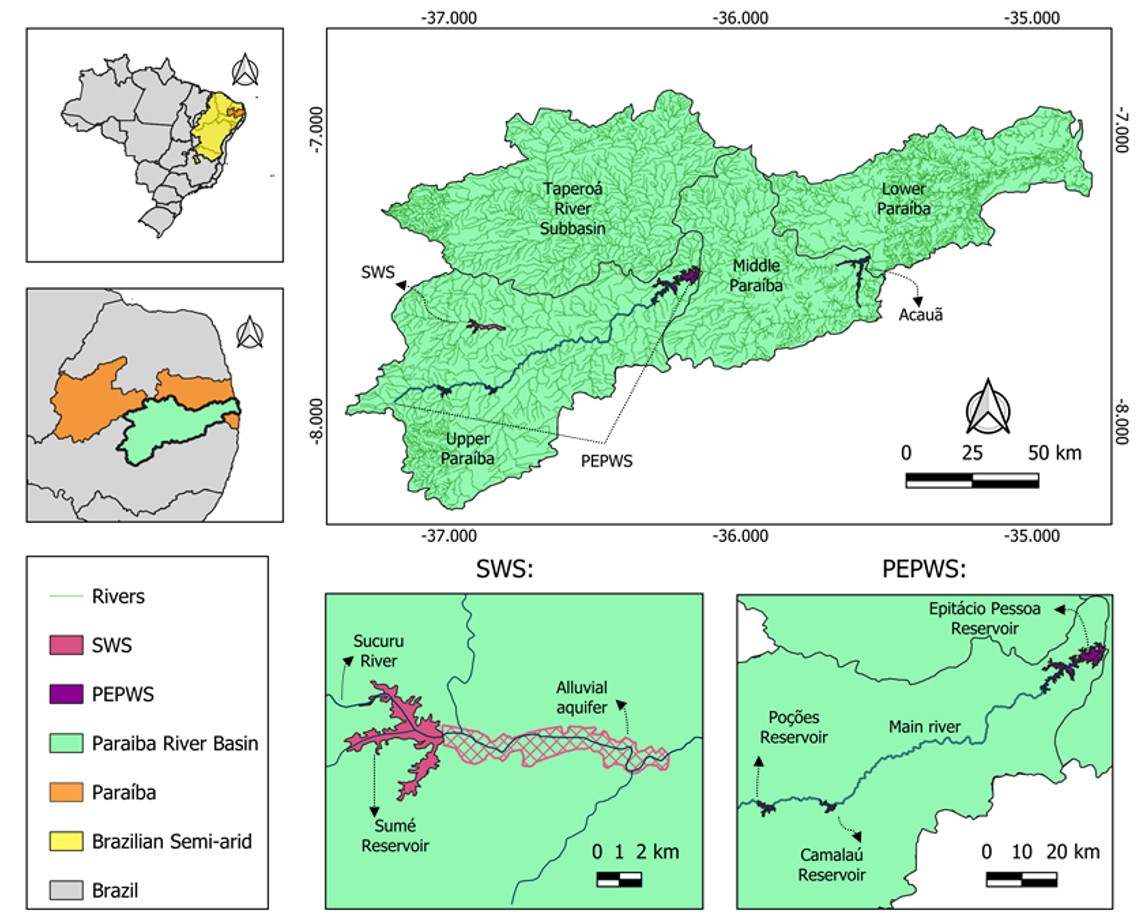
In this study, we analyzed the negotiations and agreements in two water systems: Poções-Epitácio Pessoa and Sumé. The Poções-Epitácio Pessoa Water System (PEPWS) is composed of three reservoirs (Poções, Camalaú, and Epitácio Pessoa) and the parts of the Paraíba River that connect them. The Sumé Water System (SWS) comprises the Sumé reservoir, the downstream portion of the Sucuru River, and the alluvial aquifer downstream. Both systems are located on the Upper Course of the Paraíba River (Figure 1) in a semi-arid region characterized by low and spatially heterogeneous rainfall and high annual evaporation rates (Studart et al., 2021).
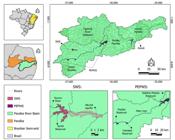
Location map of the Paraíba River Basin and the Poções-Epitácio Pessoa (PEPWS) and Sumé Water Systems (SWS).
The Poções, Camalaú, and Epitácio Pessoa reservoirs have capacities of 29.86 hm3, 46 hm3, and 466 hm3, respectively. The PEPWS is used for multiple uses and it has received water from the São Francisco River Integration Project (PISF) since 2017. These reservoirs supply water to more than 20 municipalities. This system has experienced two major water crises due to conflicts between water supply and irrigation: from 1997 to 2003 (Rêgo et al., 2012) and during 2012–2017 (Rêgo et al., 2017; Silva & Ribeiro, 2025). In April 2017, the Epitácio Pessoa Reservoir reached its lowest historical volume (11.97 hm3), corresponding to 2.9% of its capacity. The crisis was only mitigated by the accelerated construction of the PISF, which allowed water to reach the reservoirs.
In the SWS, the Sumé Reservoir has a capacity of 37.09 hm3. The Water Allocation Act authorizes irrigation in this water system and releases a flow responsible for recharging wells in the alluvial aquifer downstream of the reservoir. This indicates a hydrological connection between surface water and groundwater, unlike the PEPWS.
Both systems include water bodies under federal and state jurisdiction. The Poções, Epitácio Pessoa, and Sumé reservoirs were built with federal funding, so the managing agency is ANA. The Camalaú Reservoir was built with funding from the state of Paraíba, so the managing agency is Paraíba State Water Management Executive Agency (AESA). The Paraíba River is entirely within the state of Paraíba, so it is state-owned. The same applies to the groundwater of the SWS, which is always under the domain of the federal states.
Four of five water management instruments established by Law No. 9,433/1997 have been implemented in Paraiba River Basin (basin plan, water permits, raw water charges, water resources information system). Only the water quality classification of water bodies has not been implemented in this basin. There is Directive No. 205/1988, which establishes the predominant use classes in the basin; however, this study predates the Brazilian water policy and no longer reflects the current reality. An updated classification is currently under development. The basin plan is also undergoing revision. Furthermore, responsibility for charging for water use in water systems with federal resources (such as PEPWS and SWS) was transferred from ANA to AESA (ANA Resolution No. 98/2021).
While the PEPWS receives water from the PISF and supplies approximately seven hundred thousand people (Silva, 2022), the SWS is responsible for supplying only the municipality of Sumé (seventeen thousand inhabitants) and irrigation around the reservoir.
Table 3 shows the average annual uses and demands for the two water systems. In PEPSW, the uses are: public supply, irrigation, and fishing (this is a non-consumptive use, i.e., no water is withdrawn to carry out the activity). The PEPWS also has discharges to the Acauã Reservoir, located after the Epitácio Pessoa Reservoir. In SWS, the uses are: urban and rural public supply, irrigation, other uses in the surrounding area, and water withdrawal by tanker trucks.
The main stakeholders in the allocation of PEPWS are: irrigation associations, municipal governments, fishing communities, and sanitation companies. The sanitation providers are the Paraíba Water and Sewage Company (CAGEPA) and the Pernambuco Sanitation Company (COMPESA). CAGEPA holds the concession to supply the municipalities served by this system. COMPESA withdraws water from the Paraíba River upstream from the Epitácio Pessoa Reservoir, for the Alto Capibaribe Adductor. This adductor is a branch of the PISF that will supply the Pernambuco hinterland.
The stakeholders involved in the SWS include several actors. CAGEPA supplies water to the municipality of Sumé. The Sumé municipal government provides water to rural areas. Additionally, irrigators and river dwellers are also involved. Some institutions participate in both systems (SWS and PEPWS). These include management agency (ANA and AESA), as well as the National Department of Works Against Droughts (DNOCS) and the Paraíba River Basin Committee (CBH-PB).
This research analyzes the effectiveness of negotiations and agreements in two different water systems. Although the same management agency manages both systems, they have distinct characteristics. These differences include physical aspects, such as size and whether the water source is surface or groundwater. They also include social aspects, such as the number and type of actors involved, and how these actors influence water system planning. The aim is to identify how the effectiveness of negotiations and agreements may vary under different circumstances.
METHODOLOGY
Key factors (Tables 1 and 2) were analyzed to assess the effectiveness of negotiations and agreements regarding the negotiated water allocation process. This means that the stronger the presence of these key factors, the greater the chance of effectiveness and, consequently, more positive effects. Our research is based on the methodology proposed by Lima (2022), but we have introduced new sources that connect the key factors to negotiation effectiveness. Additionally, we have added a new key factor titled “Power distribution among local actors.” It is important to clarify that the key factor “Rivers of high value to the negotiating state” concerns water systems that include reservoirs. These reservoirs dam the rivers and may hold varying degrees of significance for the negotiating parties.
Our analysis covers the period from 2019 to 2024. This timeframe was chosen because negotiated water allocations in both systems began in 2019. Table 4 presents key characteristics of the meetings held in each system. These include the date and format of the meetings, as well as the number of participants present.
Participant observation (Valladares, 2007) was used during the water allocation meetings to record the discussions. Like the others involved in the process, the researchers introduced themselves at the beginning of the meetings. However, all statements made by the participants occurred spontaneously, without any interruption. According to Becker (1958), statements made on one’s own initiative are more reliable than those elicited by the observer. In this study, the researchers used these statements as evidence of the event. They were then verified and related to other events linked to each key factor (Tables 1 and 2).
In some cases, more than one meeting was held per year. In the first meeting, the participants discussed compliance with the agreements and water scenarios for the upcoming year. In the second meeting, the participants defined the allocated flows and formalized the Water Allocation Act. In the 2022-2023 planning period, a third meeting was held at PEPWS to adjust the Water Allocation Act following the release of water from PISF.
Additionally, we have utilized the Water Allocations Acts and the allocation monitoring reports (Agência Nacional de Água e Saneamento, 2024) for all these years. The Regulatory Acts for the Poções-Epitácio Pessoa System (Resolution ANA/AESA No. 126/2022) and the Sumé System (Resolution ANA/AESA No. 118/2022) were also used as support material (Brasil, 2022a, 2022b). Table 5 presents the documents used for the analysis of both water systems. The negotiated water allocation meetings provided valuable insights into water systems and the relationships among the various actors in water governance.
We categorized the key factors using the methodology proposed by Lima (2022). This approach combines the Likert Scale, adapted by Neto et al. (2018), with the OECD Traffic Light System (Organization for Economic Co-operation and Development, 2018). Table 6 illustrates the procedure for classifying the key factors. To classify the key factors, we observed whether there were failures in meeting the key factor and how much these failures impacted the process’s effectiveness. The more flaws there are, the greater the negative impact on the process’s effectiveness. Thus, the methodology of this work was based on searching for arguments that would justify classifying to each of the key factors.
Classification of the key factors that can promote the Effectiveness of Agreements and Negotiations.
RESULTS AND DISCUSSION
We analyzed the connection between key factors to promote effectiveness, assessing the interdependence between negotiations and agreements. Figure 2 presents the results for the water systems and the connection between the key factors. The Supplementary Material explains each connection.

Degree of fulfillment of the key factors for the effectiveness of negotiations and agreements in the (A) PEPWS; (B) SWS.
We highlight two key factors in the negotiation process: “Rivers of high value to the negotiating state” and “Stakeholder participation.” Each of these factors is linked to four other elements that contribute to the effectiveness of agreements. As a result, water systems that are more important to the negotiating state, combined with active stakeholders’ involvement, are more likely to lead to successful agreements.
Effectiveness of negotiations and agreements in the PEPSW
The PEPWS is a high-value area for the state of Paraiba, as it supplies water to 23 municipalities, including Campina Grande, the state’s second-largest city. In addition, this system is critical, as it faces real and current issues, struggling with the operation of the PISF and the growing need to meet new demands, such as shrimp farming. The discussions surrounding water allocations are highly contentious, with the quantity of water and its distribution being the primary focus. However, the amount of available water is significantly impacted by its quality (Van Vliet et al., 2021), a topic that is rarely addressed in these allocation discussions.
Tensions have already arisen over requests from users and the river basin committee to authorize water use rights for tanks used in aquaculture in the Epitácio Pessoa Reservoir, which could lead to water pollution. AESA, the state management agency, denied the request. Several comments have expressed dissatisfaction regarding the minimal participation of CAGEPA, the company responsible for the public water supply. The company was absent from the 2023 meeting and had limited involvement in previous meetings, which has hindered the strengthening of relationships. In that same year, we noticed the absence of representatives from COMPESA. These tensions, along with the absence of some key actors, make it challenging to strengthen relationships.
In terms of stakeholder participation, the PEPWS allocations have an average of 37 participants per annual meeting. These include key actors, such as irrigators, researchers, and representatives from the private sector. The first meeting had more participants (98), possibly due to stakeholders’ curiosity about the process or a desire to solve water system problems. Furthermore, in-person meetings had more participants than virtual meetings. The virtual format possibly distances stakeholders. It may be due to the difficulty some actors have in using virtual platforms for meetings or the limitations of virtual invitations.
The negotiations take local needs into account, and flow rates are set based on demand. Although the Poções and Camalaú reservoirs are not discussed as extensively as the Epitácio Pessoa Reservoir, the agreements define distinct water flows for each, tailored to their specific conditions and demands. However, it is important to note that the decisions regarding the smaller reservoirs are often made without the significant presence of stakeholders who depend on these reservoirs, such as irrigators and municipalities.
When analyzing power distribution, Brazilian law prioritizes public water supply and livestock watering during periods of water scarcity. As a result, CAGEPA tends to adopt an avoidance stance, believing that conflicts should not affect it as a priority user. In contrast, because irrigation is the first activity to face restrictions during water rationing, irrigators often take a more active and competitive role in negotiating water allocations.
Regarding the agreements, water allocations are regulated by Resolution No. 46/2020 and follow the guidelines of the Regulatory Act (Resolution ANA/AESA No. 126/2022), which defines the conditions of use. Together, these two mechanisms provide clear and flexible regulation (Brasil, 2022a).
In the 2024 allocation, a fish farmer reported the installation of fish tanks upstream of the Epitácio Pessoa Reservoir, an activity prohibited in that area. However, waste from these fish tanks flows into the reservoir, while local fish farmers are barred from doing the same. This creates an unequal distribution of benefits within the water system.
The agreements are monitored through reservoir volumes and implementation of commitments to assess the status of the water system. However, some commitments have not been fulfilled, for example, CAGEPA’s failure to modify the water intake infrastructure at the Acauã Reservoir (downstream), and AESA’s delay in conducting studies to reduce macrophytes in the Camalaú Reservoir. No sanctions are established for non-compliance with these agreements.
Negotiated allocations are a process that combines different conflict resolution methods (Silva & Ribeiro, 2022), and in PEPWS, they can mitigate the existing conflicts. ANA mediator facilitates the exchange of information among the actors and discusses water availability and possible storage volume scenarios. The participants very easily accept the scenarios presented by ANA, without suggesting any changes. According to Mayer (2000), accommodation occurs when participants accept the interests of other groups without proposing more favorable scenarios.
The exchange of information among the actors occurs through a Water Allocation Monitoring Commission, which oversees the allocation process throughout the year. Representatives from universities, managing agencies, river basin committees, and users participate in this Water Allocation Monitoring Commission. However, there are no meetings to discuss the progress of the allocations, which can weaken the monitoring process.
Effectiveness of negotiations and agreements in the SWS
The SWS, located on the Sucuru River (a river that flows into the Paraíba River), is the main water source for seventeen thousand inhabitants of Sumé city. The city also utilizes the Integrated Congo System (SI Congo) as an alternative source of supply. Although undervalued by the state of Paraíba, the SWS plays a critical role in local water security. It has still not recovered from the last water crisis, and the region continues to face ongoing issues. While discussions about the SWS often focus on water quantity and management, water quality remains a more pressing but frequently overlooked issue. In particular, the contamination of alluvial aquifers by domestic effluents has raised concerns (Pontes Filho, 2018).
Some proposals, such as using the Sumé Reservoir exclusively for irrigation and relying on the Congo Water Supply System (SI Congo) for water supply, stalled due to CAGEPA's limited participation. In contrast, the municipal government of Sumé adopted a stance of active cooperation, which occurs when seeking shared benefits and joint actions (Wolf, 2007; Grünwald et al., 2020). In the SWS, there is a close relationship between AESA and the irrigators to collaborate to attempt to clean the Sucuru River bed. However, the irrigators did not support the effort, blocking its implementation and demonstrating a low level of commitment in this case.
In this system, negotiations and agreements take local demands into account. Flow allocations are set based on regional demands and legal priorities. The negotiated allocation of the SWS, planned for July 2024, was attended only by ANA mediator and a few researchers. The meeting could not proceed due to the absence of key stakeholders, including AESA, revealing the need for their active involvement. This absence suggests a form of avoidance characterized by a low commitment to shared interests. It may be seen as passive avoidance, where participants withdraw without engagement, or hopeless avoidance, where they deny having the power to influence the outcome (Mayer, 2000). It can also be viewed as silent cooperation, where actors avoid official involvement (Grünwald et al., 2020).
In past years, water allocation negotiations included non-state actors. The same issue with CAGEPA's role in the PEPWS also appears in the SWS, where avoidance is linked to the priorities set by Brazil's Water Policy.
Regarding the effectiveness of the agreements, allocations, and regulatory acts, these mechanisms have clear and flexible criteria, as mentioned earlier. This flexibility allows for alternatives in scenarios with modifications. In 2021, the SWS was in a “green” hydrological state, allowing for the allocation of water for irrigation. However, the water could not be released due to the lack of coordination among irrigators to clear the river's course. On the other hand, the public water supply remained unaffected, revealing the existence of no equitable benefits among users within the system.
Some commitments made during the negotiations have not been fulfilled. For example, CAGEPA does not adjust the system's infrastructure, and DNOCS does not develop the dam's safety plan. Additionally, the regularization of uses around this system has not been done. For Pedrosa (2021), failure to comply with actions breaks the bonds of trust and hinders the construction of agreements.
As in the PEPWS, the river basin committee has a more indirect role, where the committee members claim their interests (mainly as irrigators). In both, CBH-PB acts only to publicize and facilitate the meetings. According to Silva & Ribeiro (2022), although ANA acts as a mediator for negotiated allocations, there is an inconsistency with Law No. 9,433/1997. Because this Law designates river basin committees as the primary mediators of conflicts. This prescribed role is not fulfilled in either of the systems analyzed.
On the other hand, there are cases in which the basin committee directly assumes the allocation. One example is the Jaburu/Jenipapo Reservoir, located in the Longá River Basin (Piauí), where allocation decisions are made within the committee itself. In this situation, the water allocation term is formalized through an annual resolution of the committee (Brasil, 2021). A similar situation occurs in the allocations of the state of Ceará, where the scenarios and flows must be approved in plenary by the committee (Estácio et al., 2022). These actions could be applied in CBH-PB, as they bring CBH closer to allocations and are relevant in conflict mediation.
The Water Allocation Monitoring Commission has shortcomings because it lacks the participation of all representatives in the meetings, which prevents the formation of implementable agreements (Lima, 2022) and the exchange of information among actors.
Connections between key factors
We considered four types of relationships to understand the connections between negotiations and agreements, illustrated in Figure 3. Relationships I and II occur, respectively, when effective negotiations result in effective agreements and when failures in negotiations hurt the agreements. Relationship III occurs when, despite effective negotiations, the agreements contain elements that hinder their effectiveness. In relationship IV, failures in the negotiation may not affect the agreement's effectiveness, as some elements contribute to making the agreement effective. Here, we analyzed the individual connections between the key factors to understand the relationships between the two water systems.
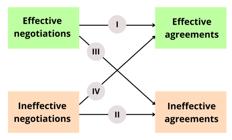
In both the PEPWS and SWS, half of the connections can be characterized as relationship IV. In this relationship, the factors found to be less capable of promoting effective negotiations are associated with factors more capable of promoting effective agreements. For example, in the PEPWS, failures such as the limited discussion surrounding the Camalaú and Poções reservoirs did not significantly impact the construction of agreements that considered local needs. Although the opponents were not very close, the exchange of information among the actors was not negatively impacted. In the SWS, for example, despite challenges in stakeholder participation, local issues were incorporated into the agreements, and a certain degree of information sharing was maintained.
In PEPWS, some interactions follow Relationship I, where positive outcomes in key negotiation dimensions contribute to more effective agreements. It is evident in the positive conflict resolution mechanisms, driven by the system’s strategic importance to the state and the involvement of non-state actors in the negotiations.
In both water systems, relationship II is observed. In these cases, the shortcomings in negotiation are reflected in the ineffectiveness of the agreements. This pattern is evident when power asymmetries result in an inequitable distribution of benefits. An example is the prioritization of urban water supply under Brazil’s Water Resources Policy. It favors sanitation services over irrigation, thereby making it challenging to propose allocating the Sumé Reservoir exclusively for irrigation.
In the SWS, the connections in relationship III are more present than in the PEPWS. This means that even with more positive results in some key factors of effective negotiations, this is not reflected in more effective agreements. This result demonstrates a more significant gap between the factors that induce good negotiations (through negotiated water allocations) and those that induce good agreements (through water allocation acts).
Dual ownership can hinder negotiated water allocation by adding complexity to the governance system, as coordination between management agencies is required. It presents challenges, especially when addressing the system's local needs. According to Tantoh & Simatele (2018), local institutions (such as AESA, in our case) have greater knowledge of the system, its problems, and local stakeholders. Furthermore, they exert influence on the social mobilization involved in these processes. However, in the PEPWS, ANA seeks to overcome these challenges by participating in reconnaissance and inspection activities at the Epitácio Pessoa Reservoir.
We also observed that PEPWS had a higher number of meeting participants than SWS. This may be attributed to the size of the water system and the number of stakeholders involved. Furthermore, in both water systems, we observed a higher number of participants in the first meeting and in-person meetings. This may be related to the initial curiosity about the process and, possibly, a loss of trust over the years. Regarding the meeting format, virtual meetings may create a greater distance for stakeholders to interact and engage with the process.
Overall, these findings highlight the need for tailored governance approaches to improve water resource planning at the local level. Even systems within the same river basin present divergent conditions, indicating that management instruments such as negotiated water allocation must be adapted to the specificities of each system. We observed that the SWS demonstrates greater governance challenges, particularly for the performance of managing agencies and the river basin committee. Although the latter is legally empowered to mediate water conflicts under Law No. 9,433/1997, it has not effectively fulfilled this role in either case.
CONCLUSION
Negotiated water allocations are a participatory mechanism for managing and operating water systems in Brazil. They can help mitigate existing conflicts or prevent them from spreading. Evaluating the effectiveness of this process enabled us to identify key factors in two different water systems and pinpoint existing failures. Water systems with high value for the negotiating state and strong stakeholder participation in negotiations tend to result in more effective agreements, as seen in the PEPWS.
Brazilian water legislation influences negotiated water allocations by prioritizing water use for public supply and livestock watering, which leads to accommodation by sanitation companies. Another weakness identified was the non-fulfillment of agreements and commitments made, which undermines trust and poses a threat.
As the water management agency (ANA) is responsible for organizing the negotiated allocations, there is a mismatch with the current water legislation, which delegates the function of arbitrating existing conflicts to the river basin committee. The Basin Committee also presents weaknesses when acting indirectly in the negotiated water allocations, with its representatives pleading for their interests. The committee could have a more direct role in voting on the proposed scenarios in plenary, as occurs in other cases of negotiated allocation in Brazil.
From the cases analyzed, negotiations and agreements can be correlated or not. Failures in negotiations may or may not impact the agreement's effectiveness. This leads us to conclude that certain negotiation factors influence agreements more than others. These, therefore, carry greater weight than others. That is why we could find relationships III and IV in this research.
We recommend that future studies use the effectiveness methodology proposed in this paper to assess negotiation processes and agreements in other water systems. This could identify whether other relationships would stand out between the effectiveness of negotiations and their agreements.
DATA AVAILABILITY STATEMENT
Research data is available in the body of the article.
Supplementary Material
Supplementary material accompanies this paper.
Table S1
This material is available as part of the online article from https://doi.org/10.1590/2318-0331.302520250065
ACKNOWLEDGEMENTS
This research has received funding from CNPq (National Council of Scientific and Technological Development) and FAPESQ-PB (Paraíba State Research Support Foundation), within the projects EXTREMOS, SUMÉ, INCT ONSEAdapta, and PELD-RIPA. CNPq provides a master´s scholarship to the first author.
REFERENCES
-
Agência Nacional de Água e Saneamento – ANA. (2024). Boletim de acompanhamento de alocação de água. Brasília. Retrieved in 2024, November 26, from https://www.gov.br/ana/pt-br/assuntos/regulacao-e-fiscalizacao/alocacao-de-agua-e-marcos-regulatorios/alocacao-de-agua/sume_04-2024.pdf
» https://www.gov.br/ana/pt-br/assuntos/regulacao-e-fiscalizacao/alocacao-de-agua-e-marcos-regulatorios/alocacao-de-agua/sume_04-2024.pdf -
Amorim, A. L., Ribeiro, M. M. R., & Braga, C. F. C. (2016). Conflitos em bacias hidrográficas compartilhadas: o caso da bacia do rio Piranhas-Açu/PB-RN. Revista Brasileira de Recursos Hídricos, 21(1), 36-45. http://doi.org/10.21168/rbrh.v21n1.p36-45
» http://doi.org/10.21168/rbrh.v21n1.p36-45 - Aquino, S. H. S., Silva, S. M. O., & Silva, D. C. (2019). Alocação participativa das águas no Ceará: incertezas, deslocamentos e disputas. In F. A. Souza Filho, S. M. O. Silva, R. M. Formiga-Johnsson, D. R. Nelson, A. Nauditt, & L. Ribbe (Eds.), Adapta: gestão adaptativa do risco climático de seca (Cap. 32, pp. 531-540). Fortaleza: Expressão Gráfica.
-
Becker, H. S. (1958). Problems of inference and proof in participant observation. American Sociological Review, 23(6), 652-660. http://doi.org/10.2307/2089053
» http://doi.org/10.2307/2089053 -
Brasil. Conselho Nacional de Recursos Hídricos – CNRH. (2012, 24 de agosto). Resolução nº 141, de 10 de julho de 2012. Estabelece critérios e diretrizes para implementação dos instrumentos de outorga de direito de uso de recursos hídricos e de enquadramento dos corpos de água em classes, segundo os usos preponderantes da água, em rios intermitentes e efêmeros, e dá outras providências. Diário Oficial [da] República Federativa do Brasil, Brasília. Retrieved in 2024, November 30, from https://www.ceivap.org.br/conteudo/resolucao141.pdf
» https://www.ceivap.org.br/conteudo/resolucao141.pdf -
Brasil. Comitê da Bacia Hidrográfica da Serra da Ibiapaba – CBHSI. (2021). Resolução nº 05/2021, de 23 de junho de 2021. Aprova a vazão de uso do Sistema hídrico Jaburu I – 2021/2022, da bacia hidrográfica da Serra da Ibiapaba. Diário Oficial [da] República Federativa do Brasil, Brasília. Retrieved in 2025, February 13, from https://www.gov.br/ana/pt-br/assuntos/regulacao-e-fiscalizacao/alocacao-de-agua-e-marcos-regulatorios/alocacao-de-agua/Resoluo05.2021CBHSIAprovaavazodeAlocaodegua2021.2022dosistemahdricoJaburuIdaBaciaHidrogrficadaSerradaIbiapaba23.06.2021.pdf
» https://www.gov.br/ana/pt-br/assuntos/regulacao-e-fiscalizacao/alocacao-de-agua-e-marcos-regulatorios/alocacao-de-agua/Resoluo05.2021CBHSIAprovaavazodeAlocaodegua2021.2022dosistemahdricoJaburuIdaBaciaHidrogrficadaSerradaIbiapaba23.06.2021.pdf - Brasil. Agência Nacional de Águas e Saneamento Básico – ANA. (2022a, 29 de julho). Resolução Conjunta ANA/AESA nº 126, de 26 de julho de 2022. Diário Oficial [da] República Federativa do Brasil, Brasília.
- Brasil. Agência Nacional de Águas e Saneamento Básico – ANA. (2022b, 20 de abril). Resolução Conjunta ANA/AESA nº 118, de 18 de abril de 2022. Dispõe sobre condições de uso dos recursos hídricos no sistema hídrico Sumé, localizado no Estado da Paraíba. Diário Oficial [da] República Federativa do Brasil, Brasília.
-
Brochmann, M., & Hensel, P. R. (2011). The effectiveness of negotiations over international river claims. International Studies Quarterly, 55(3), 859-882. http://doi.org/10.1111/j.1468-2478.2011.00670.x
» http://doi.org/10.1111/j.1468-2478.2011.00670.x -
Carvalho, T. M. N., Souza Filho, F. A., & Brito, M. M. (2024). Unveiling water allocation dynamics: a text analysis of 25 years of stakeholder meetings. Environmental Research Letters, 19(4), 044066. http://doi.org/10.1088/1748-9326/ad37cd
» http://doi.org/10.1088/1748-9326/ad37cd -
Chilima, J. S., Blakley, J., Diaz, H. P., & Bharadwaj, L. (2021). Understanding water use conflicts to advance collaborative planning: lessons learned from Lake Diefenbaker, Canada. Water, 13(13), 1756. http://doi.org/10.3390/w13131756
» http://doi.org/10.3390/w13131756 -
Denoon, R. T. P., Paisley, R. K., Chaisemartin, M., & Henshaw, T. W. (2020). Engaging non-state actors in the negotiation and implementation of international watercourse agreements: experiences and lessons learned from Canada. Water International, 45(4), 311-328. http://doi.org/10.1080/02508060.2020.1734757
» http://doi.org/10.1080/02508060.2020.1734757 -
Dinko, K. H. (2022). Scale matters: a spatiotemporal analysis of freshwater conflicts from 1900-2019. Water Resources Management, 36(1), 219-233. http://doi.org/10.1007/s11269-021-03023-x
» http://doi.org/10.1007/s11269-021-03023-x - Estácio, A. B. S., Rocha, M. A. M., Oliveira, M. C., Silva, S. M. O., Souza Filho, F. A., & Studart, T. M. C. (2022). Priority of water allocation during drought periods: the case of Jaguaribe Metropolitan inter-basin water transfer in semiarid Brazil. Sustainability, 14(11), 6876.
-
Giordano, M. A., & Wolf, A. T. (2003). Sharing waters: Post-Rio international water management. Natural Resources Forum, 27(2), 163-171. http://doi.org/10.1111/1477-8947.00051
» http://doi.org/10.1111/1477-8947.00051 -
Giordano, M., Drieschova, A., Duncan, J. A., Sayama, Y., Stefano, L., & Wolf, A. T. (2013). A review of the evolution and state of transboundary freshwater treaties. International Environmental Agreement: Politics, Law and Economics, 14(3), 245-264. http://doi.org/10.1007/s10784-013-9211-8
» http://doi.org/10.1007/s10784-013-9211-8 -
Grünwald, R., Feng, Y., & Wang, W. (2020). Reconceptualization of the Transboundary Water Interaction Nexus (TWINS): approaches, opportunities and challenges. Water International, 45(5), 458-478. http://doi.org/10.1080/02508060.2020.1780854
» http://doi.org/10.1080/02508060.2020.1780854 -
Haefner, A. (2016). Negotiating for water resources: bridging transboundary river basins. New York: Routledge.. http://doi.org/10.4324/9781315619446
» http://doi.org/10.4324/9781315619446 -
Hasan, Q. M., Salar, S. G., Raman, D., Campbell, S., & Palani, I. Q. (2023). When the law is unclear: challenges and opportunities for data and information exchange in the Tigris-Euphrates and Indus river basins. Water Policy, 25(8), 780-796. http://doi.org/10.2166/wp.2023.261
» http://doi.org/10.2166/wp.2023.261 -
Hasan, M. H., Hossain, M. J., & Nipa, S. A. (2025). Navigating water discord: a review of water conflicts in the common resource management system in coastal areas. Frontiers in Water, 6, 1405601. http://doi.org/10.3389/frwa.2024.1405601
» http://doi.org/10.3389/frwa.2024.1405601 -
Horbulyk, T. (2017). Water Policy in Canada. In S. Renzetti, & D. P. Dupont (Eds.), Water policy and governance in Canada (pp. 29-43). Cham: Springer.. http://doi.org/10.1007/978-3-319-42806-2_3
» http://doi.org/10.1007/978-3-319-42806-2_3 -
Hussein, H., Poplawsky, M., & Mohapatra, T. (2023). The political context of change in transboundary freshwater agreements. Environmental Science & Policy, 149, 103572. http://doi.org/10.1016/j.envsci.2023.103572
» http://doi.org/10.1016/j.envsci.2023.103572 -
Laurenceau, M., Molle, F., & Grau, M. (2020). Reducing water withdrawals: the negotiation and implementation of environmental policy in the Durance River Basin, France. Water Policy, 22(6), 1217-1236. http://doi.org/10.2166/wp.2020.112
» http://doi.org/10.2166/wp.2020.112 - Lima, D. D. F. (2022). Robustez da governança da água e efetividade das negociações e acordos em distintas escalas (Tese de doutorado). Universidade Federal de Campina Grande, Campina Grande.
-
Lu, S., Zhu, G., & Dai, J. (2023). Promoting effect of adaptive interaction based on random neighbors to cooperation in the spatial prisoner’s dilemma game. Applied Mathematics and Computation, 450, 127960. http://doi.org/10.1016/j.amc.2023.127960
» http://doi.org/10.1016/j.amc.2023.127960 - Mason, S. J. A., & Blank, D. (2013). Mediating water use conflicts in peace processes Zurich: Center for Security Studies.
- Mayer, B. (2000). The dynamics of conflict resolution: a practitioner’s guide. San Francisco: John Wiley & Sons.
-
Mitchell, S. M., & Zawahri, N. A. (2015). The effectiveness of treaty design in addressing water disputes. Journal of Peace Research, 52(2), 187-200. http://doi.org/10.1177/0022343314559623
» http://doi.org/10.1177/0022343314559623 -
Mutahara, M., Warner, J., & Khan, M. S. A. (2019). Analyzing the coexistence of conflict and cooperation in a regional delta management system: Tidal River Management (TRM) in the Bangladesh delta. Environmental Policy and Governance, 29(5), 326. http://doi.org/10.1002/eet.1863
» http://doi.org/10.1002/eet.1863 -
Neto, S., Camkin, J., Fenemor, A., Tan, P. L., Baptista, J. M., Ribeiro, M., Schulze, R., Stuart-Hill, S., Spray, C., & Elfithri, R. (2018). OECD principles on water governance in practice: an assessment of existing frameworks in Europe, Asia-Pacific, Africa and South America. Water International, 43(1), 60-89. http://doi.org/10.1080/02508060.2018.1402650
» http://doi.org/10.1080/02508060.2018.1402650 - Nogueira, G. M. F. (2006). Conflito e negociação em recursos hídricos: uma abordagem comportamental das decisões (Tese de doutorado). Universidade Federal de Campina Grande, Campina Grande.
-
Nunes, T. H. C., & Ribeiro, M. M. R. (2021). Conflitos de segunda ordem no Eixo Leste do Projeto de Integração do Rio São Francisco: análise por meio da metodologia da Cadeia Causal. Engenharia Sanitaria e Ambiental, 26(4), 627-637. http://doi.org/10.1590/s1413-415220190367
» http://doi.org/10.1590/s1413-415220190367 - Observatório de Governança das Águas – OGA. (2019). Protocolo de monitoramento de governança das águas São Paulo: OGA.
-
Offutt, A. (2022). Mixing waters: stakeholder influence in transboundary water conflict and cooperation. Water International, 47(4), 583-609. http://doi.org/10.1080/02508060.2022.2059322
» http://doi.org/10.1080/02508060.2022.2059322 - Organization for Economic Co-operation and Development – OECD. (2015). Principles on water governance. Paris: OECD Water Governance Programme.
- Organization for Economic Co-operation and Development – OECD. (2018). Water governance indicator framework. Paris: OECD Water Governance Programme.
- Pedrosa, V. A. (2021). Gestão de conflitos: construindo pactos pelo uso da água Brasília: ANA.
-
Petersen-Perlman, J. D., Veilleux, J. C., & Wolf, A. T. (2017). International water conflict and cooperation: challenges and opportunities. Water International, 42(2), 105-120. http://doi.org/10.1080/02508060.2017.1276041
» http://doi.org/10.1080/02508060.2017.1276041 - Pignatelli, M. (2010). Os conflitos étnicos e interculturais Lisboa: ISCSP.
-
Pinheiro, M. I. T., Campos, J. N. B., & Studart, T. M. C. (2011). Conflitos por águas e alocação negociada: o caso do vale dos Carás no Ceará. Revista de Administração Pública, 45(6), 1655-1672. http://doi.org/10.1590/S0034-76122011000600003
» http://doi.org/10.1590/S0034-76122011000600003 - Pontes Filho, J. D. A. (2018). Da recarga não gerenciada à recarga gerenciada: estratégia para aquífero aluvial no semiárido brasileiro (Dissertação de mestrado). Universidade Federal de Campina Grande, Campina Grande.
- Rêgo, J. C., Galvão, C. O., & Albuquerque, J. P. T. (2012). Considerações sobre a gestão dos recursos hídricos do Açude Epitácio Pessoa – Boqueirão na Bacia Hidrográfica do Rio Paraíba em cenário de vindouros anos secos. In Anais do XI Simpósio de Recursos Hídricos do Nordeste, João Pessoa, Brasil.
- Rêgo, J. C., Galvão, C. O., Albuquerque, J. P. T., Ribeiro, M. M. R., & Nunes, T. H. C. (2017). A gestão de recursos hídricos e a transposição de águas do Rio São Francisco para o Açude Epitácio Pessoa - Boqueirão. In Anais do XXII Simpósio Brasileiro de Recursos Hídricos, Florianópolis, Brasil.
-
Rivero, N. P. P., Morais, D. C., & Pereira, L. S. (2020). Assessment of actions to tackle the shortages of water in La Paz, Bolivia. Water Policy, 22(2), 177-192. http://doi.org/10.2166/wp.2020.087
» http://doi.org/10.2166/wp.2020.087 -
Rossi, R. A., & Santos, E. (2018). Conflito e regulação das águas no Brasil: a experiência do Salitre. Caderno CRH, 31(82), 151-167. http://doi.org/10.9771/ccrh.v31i82.20195
» http://doi.org/10.9771/ccrh.v31i82.20195 -
Schmeier, S., & Shubber, Z. (2018). Anchoring water diplomacy: the legal nature of international river basin organizations. Journal of Hydrology, 567(1), 114-120. http://doi.org/10.1016/j.jhydrol.2018.09.054
» http://doi.org/10.1016/j.jhydrol.2018.09.054 - Silva, D. C., Aquino, S. H. S., Silva, S. M. O., & Souza Filho, F. A. (2019). Diagnóstico institucional da alocação negociada de água no Estado do Ceará: aplicação do framework de Elinor Ostrom. In F. A. Souza Filho, S. M. O. Silva, R. M. Formiga-Johnsson, D. R. Nelson, A. Nauditt, & L. Ribbe (Eds.), Adapta: gestão adaptativa do risco climático de seca (Cap. 31, pp. 513-530). Fortaleza: Expressão Gráfica.
- Silva, M. B. M. (2022). Análise de múltiplos aspectos da governança da água em sistemas hídricos locais (Dissertação de mestrado). Universidade Federal de Campina Grande, Campina Grande.
-
Silva, M. B. M., & Ribeiro, M. M. R. (2022). Alocação e governança da água como mecanismos de resolução de conflitos. Engenharia Sanitaria e Ambiental, 27(3), 533-540. http://doi.org/10.1590/s1413-415220210072
» http://doi.org/10.1590/s1413-415220210072 - Silva, M. B. M. D., Amorim, A. L. D., & Ribeiro, M. M. R. (2024). A atuação do sistema nacional de gerenciamento de recursos hídricos e do Ministério Público em conflitos pelo uso da água em uma bacia hidrográfica compartilhada. In G. Alvarez, C. G. Pazó, & L. B. Oliveira (Eds.), Relações, conflitos socioambientais e respostas multidirecionais: contribuições interdisciplinares (Cap. 9, pp. 170-194). Porto Seguro: UFSB.
- Silva, M. B. M., & Ribeiro, M. M. R. (2025). Identifying socio-ecological dynamics in water systems through adaptive cycles. Hydrological Sciences Journal, 70, 805-817.
-
Studart, T. M. C., Campos, J. N. B., Souza Filho, F. A., Pinheiro, M. I. T., & Barros, L. S. (2021). Turbulent waters in Northeast Brazil: a typology of water governance-related conflicts. Environmental Science & Policy, 126, 99-110. http://doi.org/10.1016/j.envsci.2021.09.014
» http://doi.org/10.1016/j.envsci.2021.09.014 -
Sultana, P., Thompson, P. M., Paudel, N. S., Pariyar, M., & Rahman, M. (2019). Transforming local natural resource conflicts to cooperation in a changing climate: bangladesh and Nepal lessons. Climate Policy, 19(sup1), S94-S106. http://doi.org/10.1080/14693062.2018.1527678
» http://doi.org/10.1080/14693062.2018.1527678 -
Talozi, S., Altz-Stamm, A., Hussein, H., & Reich, P. (2019). What constitutes an equitable water share? A reassessment of equitable apportionment in the Jordan–Israel water agreement 25 years later. Water Policy, 21(5), 911-933. http://doi.org/10.2166/wp.2019.143
» http://doi.org/10.2166/wp.2019.143 -
Tantoh, H. B., & Simatele, D. (2018). Complexity and uncertainty in water resource governance in Northwest Cameroon: reconnoitring the challenges and potential of community-based water resource management. Land Use Policy, 75, 237-251. http://doi.org/10.1016/j.landusepol.2018.03.044
» http://doi.org/10.1016/j.landusepol.2018.03.044 -
Tir, J., & Stinnett, D. M. (2011). The institutional design of riparian treaties: the role of river issues. The Journal of Conflict Resolution, 55(4), 606-631. http://doi.org/10.1177/0022002710393917
» http://doi.org/10.1177/0022002710393917 - United Nations Development Programme – UNDP. Cap-Net. (2014). International Network for Capacity Building in Integrated Water Resources Management. Conflict resolution and negotiation skills for integrated water resources management: training manual New York: UNDP.
-
Valladares, L. (2007). Os dez mandamentos da observação participante. Revista Brasileira de Ciências Sociais, 22(63), 153-155. http://doi.org/10.1590/S0102-69092007000100012
» http://doi.org/10.1590/S0102-69092007000100012 -
Van Vliet, M. T. H. V., Jones, E. R., Florke, M., Franssen, W. H. P., Hanasaki, N., Wada, Y., & Yearsley, J. R. (2021). Global water scarcity including surface water quality and expansions of clean water technologies. Environmental Research Letters, 16(2), 024020. http://doi.org/10.1088/1748-9326/abbfc3
» http://doi.org/10.1088/1748-9326/abbfc3 -
Wolf, A. T. (2007). Shared waters: conflict and cooperation. Annual Review of Environment and Resources, 32(1), 241-269. http://doi.org/10.1146/annurev.energy.32.041006.101434
» http://doi.org/10.1146/annurev.energy.32.041006.101434 - Wolf, A. T. (2008). Healing the enlightenment rift: rationality, spirituality, and shared waters. Journal of International Affairs, 61, 51-73.
-
Zareie, S., Bozorg-Haddad, O., & Loáiciga, H. A. (2021). A state-of-the-art review of water diplomacy. Environment, Development and Sustainability, 23(2), 2337-2357. http://doi.org/10.1007/s10668-020-00677-2
» http://doi.org/10.1007/s10668-020-00677-2
Edited by
-
Editor-in-Chief:
Adilson Pinheiro
-
Associated Editor:
Rosa Maria Formiga-Johnsson