 Associated factors with adverse maternal outcomes in high risk, pregnant women without COVID-19 hospitalized at a maternity hospital in the Northeast of Brazil: a cohort study
Abstract
Objectives: to evaluate maternal outcomes among pregnant women without COVID-19 hospitalized in a high risk obstetric unit and to identify associated factors with adverse maternal outcomes (AMO).
Methods: this prospective observational cohort study was conducted from December 2019 to December 2020 and included all pregnant women hospitalized in the high risk unit of the Instituto de Saúde Elpídio de Almeida, in Campina Grande, Brazil. Biological, sociodemographic, obstetric, clinical, and diagnostic variables were analyzed. The dependent variable was adverse maternal outcome (near miss and maternal death). Logistic regression was used to assess associations, adopting a significance level of p<0.05.
Results: among 494 pregnant women included, 6.1% experienced AMO (23 near miss cases and 7 maternal deaths). Significant associations were found between AMO and HELLP syndrome (OR=11.09; 95%CI=3.63-33.89), second half of pregnancy bleeding (OR=5.18; 95%CI=1.50-17.82), and pre existing maternal medical conditions (OR=3.11; 95%CI=1.20-8.05).
Conclusions: adverse maternal outcomes were strongly associated with HELLP syndrome, bleeding in the second half of pregnancy, and pre existing maternal comorbidities. Preventive strategies should prioritize risk stratification, prophylaxis with aspirin and calcium for susceptible pregnant women, and timely management of hypertensive and hemorrhagic complications, including the reduction of unnecessary cesarean sections.
Key words
Maternal mortality; Near miss; HELLP syndrome; Postpartum hemorrhage; High risk pregnancy
Resumo
Objetivos: avaliar os desfechos maternos em gestantes não-COVID-19 internadas em unidade de alto risco e identificar fatores associados ao desfecho materno adverso (DMA).
Métodos: estudo de coorte prospectivo e observacional realizado entre dezembro de 2019 e dezembro de 2020, incluindo todas as gestantes internadas na unidade de alto risco do Instituto de Saúde Elpídio de Almeida, Campina Grande (PB). Foram analisadas variáveis biológicas, sociodemográficas, obstétricas, clínicas e diagnósticas. O desfecho materno adverso (near miss e morte materna) foi a variável dependente. As associações foram avaliadas por regressão logística, adotando-se p<0,05.
Resultados: entre 494 gestantes incluídas, 6,1% apresentaram DMA (23 casos de near miss e sete óbitos). Houve associação significativa entre DMA e síndrome HELLP (OR=11,09; IC95%=3,63-33,89), sangramento na segunda metade da gestação (OR=5,18; IC95%=1,50-17,82) e condições médicas preexistentes (OR=3,11; IC95%=1,20-8,05).
Conclusões: o DMA foi fortemente associado à síndrome HELLP, ao sangramento na segunda metade da gravidez e às comorbidades maternas prévias. Estratégias preventivas devem priorizar o rastreamento de risco, a profilaxia com aspirina e cálcio em gestantes suscetíveis e o manejo oportuno das complicações hipertensivas e hemorrágicas, incluindo a redução de cesarianas desnecessárias.
Palavras-chave
Mortalidade materna; Near miss; Síndrome HELLP; Hemorragia pós parto; Gravidez de alto risco
Introduction
Maternal mortality remains a major public health problem and a sensitive indicator of the obstetric care quality and social inequalities.1 Maternal death is defined as death that occurs during pregnancy, childbirth, or up to 42 days after childbirth and that may result from any cause related to or aggravated by pregnancy.2
Globally, it is estimated that more than 90% of maternal deaths are preventable, concentrated in low and middle income countries, where gaps in accessing to and response from health services persist.1 In Brazil, the leading causes of maternal mortality are hypertensive disorders of pregnancy, postpartum hemorrhage (PPH), infection, and complications from unsafe abortion, all of which are potentially preventable.3
Severe maternal morbidity, in turn, represents the clinical spectrum preceding maternal death and provides valuable information about the quality of care provided. Since 2009, the World Health Organization (WHO) has proposed the concept of maternal near miss (MNM), defined as a woman who nearly died but survived a complication that occurred during pregnancy, childbirth, or up to 42 days after the end of pregnancy. 2,4 Thus, pregnancy complications can be understood as a continuum ranging from high-risk conditions to cases of near miss and maternal death.
In 2011, WHO established clinical, laboratorial, and management criteria for the MNM diagnosis, which became the international standard for monitoring the quality of obstetric care.5 Subsequently, the concept of adverse maternal outcome (AMO) emerged, which integrates near-miss cases and maternal deaths, allowing a broader assessment of life-threatening conditions.6 Recent studies indicate that the analysis of AMO cases helps identify gaps in care and guide prevention and surveillance strategies.7,8
The risk factors most associated with maternal morbidity and mortality include advanced maternal age, pre-existing medical conditions, hypertensive syndromes, hemorrhage, and sepsis. The distribution of these events varies according to socioeconomic context and the responsiveness on health services. In middle income countries, hypertensive syndromes and bleeding in the second half of pregnancy are the leading causes of near miss and maternal death.9
More recently, WHO began using the concept of AMO, in which cases of MNM are added to those of maternal death.10 Knowledge on the clinical characteristics of women experiencing AMO, the treatment administered, their outcomes is particularly relevant, as it enables the planning of health care, contributing to the reduction of the risk of serious complications and death.
In Brazil, although there have been advances in prenatal care coverage, significant regional inequalities persist. The Northeast region, and especially the State of Paraíba, has one of the highest maternal mortality rates in the country.11 Despite this, there is a scarcity of prospective studies evaluating high-risk pregnant women in public maternity hospitals, hindering the planning of preventive measures and the improvement of the obstetric care network.
Considering this gap, the present study aimed to identify associated factors with adverse maternal outcomes among pregnant women hospitalized in a high-risk unit at a university maternity hospital in the Northeast of Brazil, thereby contributing to strengthening maternal morbidity surveillance and improve the quality of care.
Methods
A prospective, observational hospital-based cohort study was conducted at the Instituto de Saúde Elpídio de Almeida (ISEA), a public referral maternity hospital for high-risk pregnancies located in Campina Grande, Paraíba, in the Northeast of Brazil. ISEA handles approximately 600 childbirths per month and operates the only high-risk obstetric unit in the metropolitan region, with 20 hospital beds destinated to manage clinical and obstetric complications.
The study was approved on March 4, 2020, by the Research Ethics Committee of the Hospital Universitário Alcides Carneiro da Universidade Federal de Campina Grande / HUAC - UFCG (CAAE 28605319.5.0000.5182; Opinion No. 3,898,899). All participants signed an informed consent form; for minors, a consent form and the consent of the legal guardian were also obtained. All pregnant women hospitalized at the high-risk unit during the study period were considered eligible, regardless of the reason for hospitalization. The following were excluded:
-
1. pregnant women who died within 1 hour of admission;
-
2. cases with a clinical or laboratorial diagnosis of COVID-19;
-
3. patients unable to be interviewed due to severe clinical condition;
-
4. incomplete medical records preventing the extraction of essential variables.
Daily, the main investigator and four trained interviewers approached eligible patients during weekly infirmary ward rounds. After obtaining the consent, data were collected from hospital medical records, prenatal records, and structured interviews with the patients.
The following maternal variables were investigated: biological variables at admission [maternal age (years) and body mass index (BMI) (kg/m2)]; demographic variables (ethnicity/skin color, per capita family income, schooling level, place of residence and birth, marital status, occupation, and employment status); obstetric variables (number of pregnancies, parity, antenatal care attendance, number of visits); clinical variables (comorbidities); and hospitalization data (length of stay, gestational age at delivery, mode of delivery, admission/readmission to the ICU, maternal complications, and maternal outcomes [hospital discharge, adverse maternal outcome, hospital transfer, loss to follow-up], in addition to the criteria used for the diagnosis of maternal near miss).
The primary outcome was adverse maternal outcome (AMO), defined as the occurrence of a maternal near miss (MNM) or maternal death. MNM was identified according to WHO criteria.2
Statistical analysis was performed using the MedCalc program (version 22.023, MedCalc Software Ltd., Ostend, Belgium). Categorical variables were described by absolute and relative frequencies. Numerical variables were described by means and standard deviations or medians and interquartile ranges, depending on the data distribution assessed by the Shapiro-Wilk test. In the univariate analysis, Pearson’s chi-square test or Fisher’s exact test was used. Variables with p<0.20 were included in the multiple binary logistic regression model. Model fit was assessed using the Hosmer-Lemeshow test, and discriminatory power using the Receiver Operating Characteristic (ROC) curve. A significance level of p<0.05 was adopted in all analyses.
Results
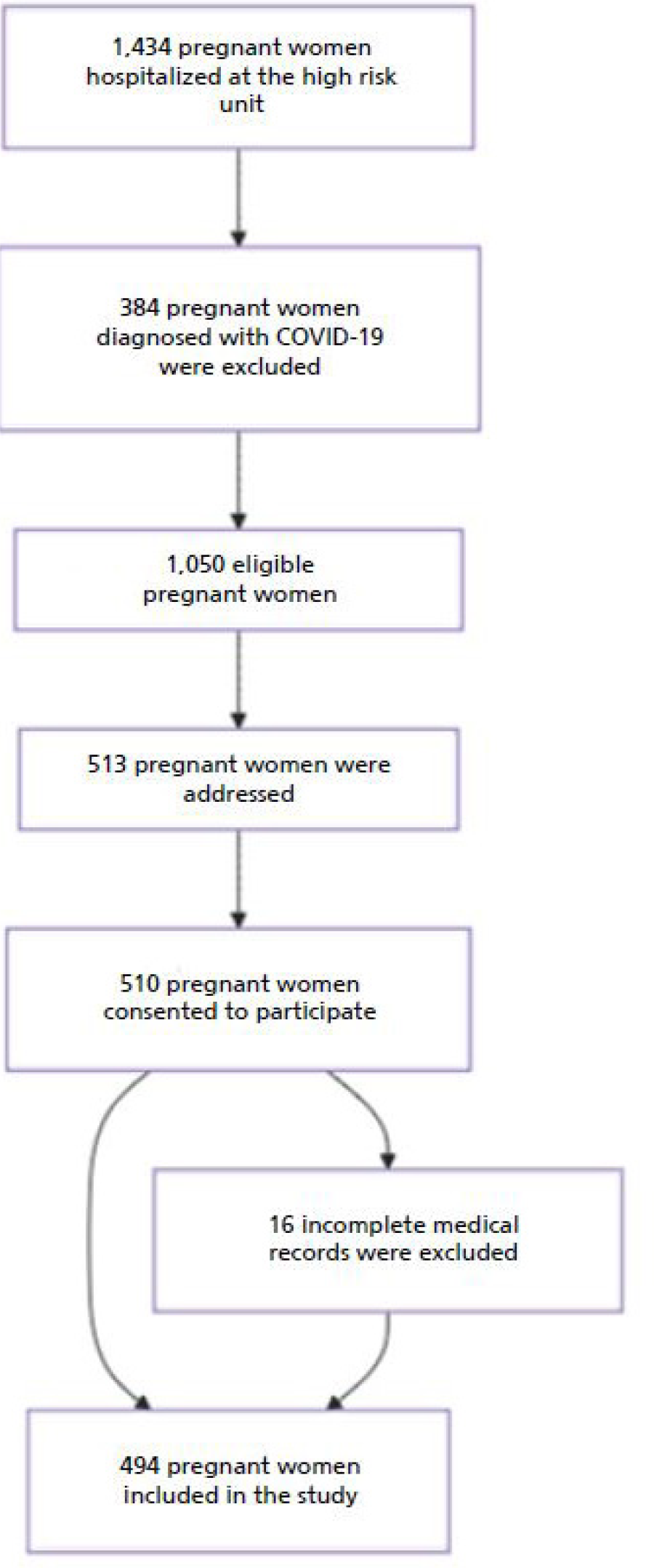
During the study period, 1,434 pregnant women were hospitalized at the high-risk unit. After excluding 384 women with a clinical or laboratorial diagnosis of COVID-19, 1,050 remained eligible. Of these, 513 were approached by the research team, 510 consented to participate, and after excluding 16 incomplete medical records, 494 pregnant women comprised the final sample analyzed (Figure 1).
Biological, sociodemographic, and obstetric characteristics are described in Table 1. Age ranged from 14 to 46 years, with a mean of 27.6±7.4 years; 19.5% of the participants were 35 years of age or older. The mean BMI was 29.8±6.2 kg/m2, with obesity observed in 45.6% of the pregnant women. The majority self-identified as mixed race (63.2%), had completed high school, and had a low per capita family income. Regarding reproductive history, 68.4% were multiparous, 61.7% had at least one previous childbirth, and 26.5% reported pregnancy losses. Prenatal care coverage was high (97.1%), with a median of 7 consultations.
Admission diagnoses and comorbidities are presented in Table 2. Hypertensive syndromes were the most frequent diagnosis, present in 50.2% of the women. Infectious complications occurred in 31.2% of the pregnant women, diabetes in 28.7%, and bleeding in the second half of pregnancy in 4.3%. Pre-existing medical conditions were identified in 11.5% of the participants, including heart disease, chronic kidney disease, and systemic lupus erythematosus.
Clinical course and maternal outcomes are detailed in Table 3. The average length of hospitalization was 7.7±7.9 days. Among women who delivered during the study, cesarean section was predominant (85.4%), and the median gestational age at delivery was 36 weeks (IQR 34-38). Admission to the intensive care unit occurred in 7.3% of the participants, and 1.4% required readmission. The main maternal complications were HELLP syndrome (3.4%), placental abruption (1.6%), postpartum hemorrhage (1.2%), and sepsis (0.8%). There were seven maternal deaths (1.4%) and 23 near-miss cases (4.7%), resulting in an overall rate of adverse maternal outcomes of 6.1% (30/494).
In the bivariate analysis, presented in Table 4, HELLP syndrome, bleeding in the second half of pregnancy, and pre-existing medical conditions showed a significant association with adverse maternal outcomes. In the adjusted logistic regression model, these variables maintained an independent association: HELLP syndrome (adjusted OR=11.09; 95%CI=3.63-33.89; p<0.001), bleeding in the second half of pregnancy (adjusted OR=5.18; 95%CI=1.50-17.82; p=0.009), and pre-existing comorbidities (adjusted OR=3.11; 95%CI=1.20-8.05; p=0.019). The model demonstrated good fit according to the Hosmer-Lemeshow test and moderate discriminatory power (AUC=0.68), correctly classifying 94.1% of the cases. Variables without significant association are listed in Supplementary Table 1.
Bivariate and multivariate analyses of associated factors with adverse maternal outcomes (AMO).
Variables analyzed that did not show a significant association with adverse maternal outcome (AMO).
Discussion
The incidence of adverse maternal outcomes (AMO) observed in this study (6.1%), comprising near-miss cases and deaths, confirms the persistence of serious events among high-risk pregnant women treated in tertiary care facilities and is consistent with reports from middle income countries.1,9 The use of World Health Organization criteria for identifying near misses reinforces the validity and comparability of the findings.2,5
Among the factors evaluated, HELLP syndrome showed the strongest association with AMO, remaining an independent predictor after adjustment. This finding is consistent with the pathophysiology of the syndrome, characterized by hemolysis, hepatic dysfunction, and thrombocytopenia, conditions that favor rapid clinical deterioration and an increased risk of severe complications.12,13 The strong magnitude of the observed association reinforces the importance of early recognition of hypertensive syndromes and standardized care protocols for timely management.
Bleeding in the second half of pregnancy also remained associated with AMO, reflecting the high maternal risk of conditions such as placenta previa, placenta accreta, and placental abruption, widely recognized as major causes of severe maternal morbidity.9 Recent WHO guidelines and multicenter studies demonstrate that structured interventions for managing hemorrhage can reduce serious outcomes when applied systematically.14-16
Pre-existing comorbidities constituted another factor independently associated with AMO. International and national evidence shows that chronic maternal diseases-such as heart disease, kidney disease, and autoimmune disorders-significantly increase the risk of adverse outcomes during pregnancy and the puerperium period.17-20 This finding reinforces the need for integration between high-risk prenatal care, specialized clinical support, and timely access to tertiary care services.
The absence of an association between AMO and maternal age, obesity, or the number of prenatal consultations may reflect on the clinical homogeneity of the study population, composed predominantly of high-risk pregnant women, as well as the limitations of the number of consultations as an indicator of quality of care, as previously discussed in the Brazilian analyses.11 The observed pattern is consistent with reviews showing the persistence of hypertensive and hemorrhagic complications as determinants of maternal morbidity and mortality, especially in middle income countries.18-21 WHO (2023) warns that >90% of maternal deaths still occur in resource limited settings and are potentially preventable with the effective implementation of guidelines.1
This study has limitations. It was conducted at a single public referral maternity hospital, which may limit the generalizability of the findings. Data collection was partially based on clinical records, which are subject to incompleteness. Furthermore, it was not possible to contact all eligible patients due to logistical limitations: some were not in their hospital beds at the time of the researchers’ visits, others were undergoing procedures, had been referred for pregnancy termination, or were not in a clinical condition to respond to the interview. Another point to consider is that no prior sample size calculation was performed, since the study was census like within the defined period, including all accessible admissions, with the aim of maximizing statistical power and adequately representing the profile of the patients treated. Despite these limitations, the prospective design, the application of standardized WHO near-miss criteria, and systematic data collection lend robustness and internal validity to the findings.
In summary, the results reinforce that hypertensive and hemorrhagic complications, as well as pre-existing comorbidities, remain relevant determinants of severe maternal morbidity. These findings can guide care and surveillance strategies aimed at preventing complications and strengthening obstetric care in similar settings.
HELLP syndrome, bleeding in the second half of pregnancy, and pre-existing comorbidities were the main independent determinants of adverse maternal outcomes in this cohort of high-risk pregnant women. These findings reinforce the central role of hypertensive and hemorrhagic complications and chronic diseases in the progression to severe maternal morbidity and highlight the need for rigorous care protocols, early recognition, and timely clinical response. The study contributes to the establishment of care priorities in highly complex settings and may inform strategies to reduce potentially fatal events in referral maternity hospitals.
Acknowledgments
The authors acknowledge the technical support provided by the ChatGPT language model (OpenAI), used solely as an editorial support tool, with no influence on the scientific content.
We would like to thank the Conselho Nacional de Desenvolvimento Científico e Tecnológico (CNPq) (National Council for Scientific and Technological Development) for partially funding this study through undergraduate research grants.
Data availability
The entire dataset supporting the results of this study has been published in the article itself.
References
-
1 World Health Organization (WHO). Trends in maternal mortality 2000 to 2023: estimates by WHO, UNICEF, UNFPA, World Bank Group and UNDESA/Population Division. Geneva: WHO; 2025. [Internet]. [access in 2025 Abr 11]. Available from: https://www.who.int/publications/i/item/9789240108462
» https://www.who.int/publications/i/item/9789240108462 -
2 World Health Organization (WHO). Evaluating the quality of care for severe pregnancy complications: the WHO near-miss approach for maternal health. Geneva: WHO; 2011. [access in 2025 Abr 11]. Available from: https://www.who.int/publications/i/item/9789241502221
» https://www.who.int/publications/i/item/9789241502221 -
3 Instituto Fernandes Figueira / Fundação Oswaldo Cruz (IFF/Fiocruz). Causas de morte materna. Morte materna e os 10 passos do cuidado obstétrico. [Internet]. [access in 2025 Abr 11]. Available from: https://portaldeboaspraticas.iff.fiocruz.br/causasdemorte/materna/
» https://portaldeboaspraticas.iff.fiocruz.br/causasdemorte/materna/ - 4 Firoz T, Romero CLT, Leung C, Souza JP, Tunçalp Ö. Global and regional estimates of maternal near miss: a systematic review, meta-analysis and experiences with application. BMJ Glob Health. 2022; 7 (4): e007077.
- 5 Alkema L, Chou D, Hogan D, Zhang S, Moller AB, Gemmill A, et al Global, regional, and national levels and trends in maternal mortality between 1990 and 2015, with scenario-based projections to 2030: a systematic analysis by the UN maternal mortality estimation inter-agency group. Lancet. 2016 Jan; 387 (10017): 462-74.
- 6 International Federation of Gynecology and Obstetrics (FIGO). Good clinical practice advice: maternal near miss and severe maternal morbidity. Int J Gynaecol Obstet. 2021; 152 (S1): 15-22.
- 7 Mendes LMC, Barbosa NG, Pinheiro AKB, Gozzo TO, Gomes-Sponholz FA. Maternal near miss: the voices of health service survivors: a metasynthesis. BMC Pregnancy Childbirth. 2025; 25 (1): 414.
- 8 Cunha ACMC, Katz L, Amorim AFC, Coutinho IC, Souza AS, Katz S, et al Clinical, epidemiological and laboratory characteristics of cases of Covid-19-related maternal near miss and death in northeastern Brazil: a cohort study. J Matern Fetal Neonatal Med. 2023; 36 (2): e2260056.
- 9 Heitkamp A, Meulenbroek A, Roosmalen JV, Gebhardt S, Vollmer L, Vries JI, et al Maternal mortality: near-miss events in middle-income countries - a systematic review. Bull World Health Organ. 2021; 99 (10): 693-707.
- 10 Woldeyes WS, Asefa D, Muleta G. Incidence and determinants of severe maternal outcome. BMC Pregnancy Childbirth. 2018;18 (1): 255.
-
11 Ministério da Saúde (BR). Ministério da Saúde lança nova estratégia para reduzir mortalidade materna na Paraíba. [Internet]. [access in 2026 Jan 5]. Available from: https://www.gov.br/saude/pt-br/assuntos/noticias-para-os-estados/paraiba/2024/setembro/ministerio-da-saude-lanca-nova-estrategia-para-reduzir-mortalidade-materna-na-paraiba
» https://www.gov.br/saude/pt-br/assuntos/noticias-para-os-estados/paraiba/2024/setembro/ministerio-da-saude-lanca-nova-estrategia-para-reduzir-mortalidade-materna-na-paraiba - 12 Sibai BM. Diagnosis, controversies, and management of HELLP syndrome. Obstet Gynecol. 2004; 103 (5 Pt 1): 981-91.
- 13 Abildgaard U, Heimdal K. Pathogenesis of HELLP syndrome: a review. Eur J Obstet Gynecol Reprod Biol. 2013; 166 (2):117-23.
-
14 World Health Organization (WHO). WHO recommendations on the assessment of postpartum blood loss and use of a treatment bundle for postpartum haemorrhage. Geneva: WHO; 2023. [Internet]. [access in 2025 Abr 11]. Available from: https://www.who.int/publications/i/item/9789240085398
» https://www.who.int/publications/i/item/9789240085398 - 15 E-MOTIVE Collaboration Group. Early detection and a treatment-bundle strategy for postpartum haemorrhage. Lancet Glob Health. 2023; 11: e1503-e1514.
- 16 Mousa HA, Blum J, Abou El Senoun G, Shakur H, Alfirevic Z. Treatment for primary postpartum haemorrhage. Cochrane Database Syst Rev. 2014; 2014 (2): CD003249.
- 17 Wolfson C, Angelson JT, Forrest AD, Michos ED, Ahmed S, Aina-Mumuney A, Creanga AA. Comorbidities and pregnancy-related risk factors in severe maternal morbidity. Healthcare (Basel). 2025; 13 (18): 2351.
- 18 Du R, Ali MM, Sung Y, Pandit AA, Payakachat N, Ounpraseuth ST, et al Maternal comorbidity index and severe maternal morbidity among Medicaid covered pregnant women in a US Southern rural state. J Matern Fetal Neonatal Med. 2023; 36 (1): 2167073.
- 19 Main EK, Leonard SA, Menard MK. Association of maternal comorbidity with severe maternal morbidity: a cohort study of California mothers delivering between 1997 and 2014. Ann Intern Med. 2020; 173 (11 Suppl.): S11-S18.
- 20 Magalhães DMDS, Bernardes JM, Ruiz-Frutos C, Gómez-Salgado, Calderon IMP, Dias A. Predictive factors for severe maternal morbidity in Brazil: a case-control study. Healthcare (Basel). 2021; 9 (3): 335.
-
21 World Health Organization (WHO). Consolidated guidelines for the prevention, diagnosis and treatment of postpartum haemorrhage. Geneva: WHO; 2025. [Internet]. [access in 2025 Out 6]. Available from: https://www.who.int/publications/i/item/9789240115637
» https://www.who.int/publications/i/item/9789240115637
-
Associated Editor:
Alex Sandro Souza