 Effects of saline stress and salicylic acid on germination and vigor of 'Biquinho' and 'Bode' pepper cultivars
ABSTRACT
Salinity can impair seed germination and seedling development. Understanding plant tolerance to salinity and exploring alternatives to mitigate its adverse effects, such as the use of salicylic acid (SA), may enhance plant establishment in saline environments. This study aimed to evaluate seed germination and seedling development of the 'Biquinho’ and ‘Bode’ cultivars of Capsicum chinense Jacquin under different sodium chloride (NaCl) concentrations, with SA tested as a potential alleviator of salt stress. Treatments followed a 5 × 2 factorial design, with five salinity levels (0, 30, 60, 90, and 120 mM NaCl, corresponding to 0, 3.31, 5.71, 7.84, and 9.68 dS m⁻1, respectively) combined with the presence or absence of SA. Evaluated parameters included the number of normal and abnormal seedlings, ungerminated seeds, root and shoot length, and total dry mass. Salinity reduced seed germination and seedling development in both cultivars. The 'Biquinho' pepper exhibited tolerance up to 30 mM NaCl, as shown by stable total dry mass and greater root growth in the presence of SA up to 60 mM NaCl. In contrast, the 'Bode' pepper was not tolerant to salinity during germination or seedling development, and SA did not mitigate its reduced germination percentage or shorter shoot length.
Key words:
Capsicum chinense; Sodium chloride; Abiotic stress; Seedling growth inhibition; Stress mitigation.
INTRODUCTION
Pepper plants, important members of the Solanaceae family and the Capsicum genus, are cultivated worldwide. Owing to their ornamental appeal and gastronomic value, several Capsicum species are used for both decorative and culinary purposes (Honório et al., 2024). Their versatility extends across industries, including food production, pharmaceuticals, cosmetics, defense, and ornamental horticulture (Gomes et al., 2019).
Pepper cultivation also benefits small-scale farmers by generating employment and income, as evidenced by widespread adoption throughout Brazil (Magalhães et al., 2023). Recently, the ornamental potential of this genus has gained renewed interest, placing pepper plants among the expanding market of ornamental crops (Cavalcanti et al., 2024).
Capsicum species are highly valued for their diverse fruit colors and shapes, which enhance their ornamental importance (Gomes et al., 2025). Among Brazil’s domesticated species, Capsicum chinense Jacquin stands out. The ‘Biquinho’ pepper is one of the most popular cultivars, recognized for its small, teardrop-shaped fruits and mild, slightly sweet flavor (Mendes et al., 2024). The ‘Bode’ pepper, in contrast, is known for its distinct aroma, with immature fruits sold fresh and mature fruits mainly used in pickles and sauces (Jesus et al., 2020).
Despite their global importance, pepper crops are affected by environmental stresses that limit productivity. Among these, soil salinity is a major constraint. Increased irrigation water salinity reduces seed emergence, plant growth, and biomass accumulation in Capsicum (Sá et al., 2019; Urías-Salazar et al., 2023). Salinity stress is one of the greatest challenges to sustainable agriculture, demanding strategies to mitigate its negative effects. This study explores alternatives to alleviate salt stress in horticultural species, with a focus on Capsicum peppers, which hold increasing economic and ornamental value.
Soil salinity is one of the most damaging environmental stresses, as it lowers soil osmotic potential, reduces water absorption by roots, and ultimately restricts plant water uptake (Pachepsky et al., 2024). Its effects vary with the crop’s phenological stage, salinity intensity, and exposure duration. Germination and early seedling growth are particularly sensitive phases in most crops (Ellouzi et al., 2023). High salt concentrations during germination can delay or prevent the process and may even cause embryo death (Santos et al., 2020).
Mitigating salt stress is therefore essential to enable the safe use of saline water in agriculture. Exogenous application of plant growth regulators, particularly salicylic acid (SA), has emerged as a promising strategy. SA alleviates the adverse effects of salinity, enhances stress tolerance, and improves crop resilience-a field of growing interest in recent years (Teixeira et al., 2024; Youssef et al., 2025).
Salicylic acid, an important antioxidant derived from secondary plant metabolism, plays a key role in signaling and activating plant defense responses to biotic and abiotic stresses (Yang; Zhou; Chu, 2023). Recent studies demonstrate that exogenous SA application can mitigate salt stress by improving seed germination and early seedling growth in crops such as pumpkin (Guirra et al., 2022), pitaya (Carvalho et al., 2022), barley (Ellouzi et al., 2023; Youssef et al., 2025), and melon (Silva et al., 2024).
Based on the above, this study aimed to evaluate seed germination and seedling growth of the Capsicum chinense Jacquin cultivars ‘Biquinho’ and ‘Bode’ under different sodium chloride (NaCl) concentrations, with salicylic acid tested as a potential alleviator of salt stress.
MATERIAL AND METHODS
The study was conducted at the Vegetable Seeds Laboratory, Department of Plant Production, Faculty of Agricultural and Veterinary Sciences (UNESP/FCAV), Jaboticabal Campus, São Paulo, Brazil. Seeds of the red ‘Biquinho’ pepper and the yellow ‘Bode’ pepper were obtained from a commercial cultivar.
The experiment followed a completely randomized design in a 5 × 2 factorial scheme. Treatments consisted of five salinity levels-0 (distilled water), 30, 60, 90, and 120 mM NaCl (corresponding to 0, 3.31, 5.71, 7.84, and 9.68 dS m⁻1, respectively), adapted from Silva et al. (2021), Urías-Salazar et al. (2023), Sá et al. (2019)-combined with the absence (immersion in distilled water) or presence (immersion in a 1.0 mM salicylic acid solution) of salicylic acid (SA). Each treatment included four replicates of 100 seeds, with each plot represented by one acrylic “Gerbox” box.
Seeds were immersed in 200 mL of distilled water or 1.0 mM SA solution (Teixeira et al., 2024) for eight hours, according to treatment. After immersion, they were rinsed with distilled water to remove excess SA. Saline solutions were prepared by dissolving NaCl in distilled water, with electrical conductivity measured using a portable conductivity meter. After pre-treatment, seeds were transferred for germination.
Sowing was carried out in acrylic boxes (11 × 11 × 3 cm, Gerbox®) with lids, containing two sheets of paper moistened with solution according to treatment, in an amount equivalent to 2.5 times the dry mass of the paper (Brasil, 2009). The boxes were placed in Biological Oxygen Demand (B.O.D.) germination chambers under alternating conditions of 30 °C for 16 h with light and 20 °C for 8 h in the dark (Brasil, 2009).
Evaluations were performed 14 days after sowing (Brasil, 2009). The number of normal seedlings (with developed shoot and root), abnormal seedlings (with roots but without shoots), and ungerminated seeds were recorded, and percentages were then calculated. For up to 10 normal seedlings per plot, shoot length (cm) and longest root length (cm) were measured with a millimeter ruler. Total dry mass (shoot + root) of all seedlings per plot was determined after drying in a forced-air oven at 70 °C to constant weight, followed by weighing on a precision balance (0.001 g).
Statistical analyses were performed using the software of Barbosa and Maldonado Junior (2015). Data were first tested for normality and homogeneity of variance. When the effect of SA pre-treatment was significant, means were compared using Tukey’s test at a 5% probability level. For significant salinity effects, polynomial regression analysis was applied to assess variable responses to increasing salinity levels.
RESULTS AND DISCUSSION
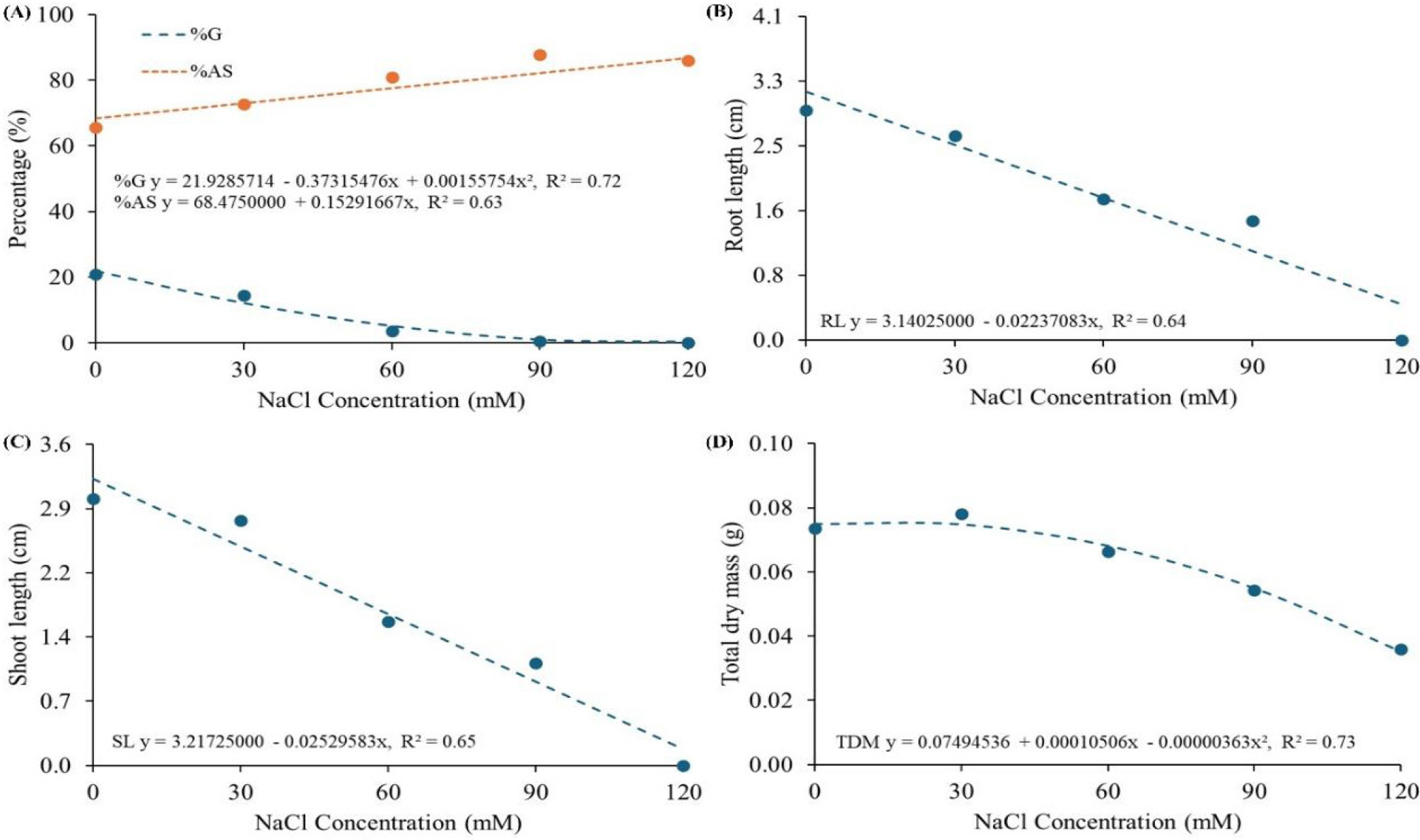
For both cultivars, significant differences among salinity levels were observed for the evaluated traits (Figures 1 and 2), except for the percentage of ungerminated seeds, which averaged 6.4% for ‘Biquinho’ and 14.4% for ‘Bode’. High concentrations of soluble salts, particularly NaCl, negatively affected germination due to the release of toxic ions (Na⁺ and Cl⁻). These ions interfere with the mobilization of nutrient reserves, a process essential for embryo survival and proper early seedling development (Nóbrega et al., 2020; Youssef et al., 2025).

Germination (%G) and abnormal seedlings (%AS) (A), root length (B), shoot length (C), and total dry mass (D) of 'Biquinho' pepper (Capsicum chinense Jacq) subjected to salicylic acid (SA) pretreatment or not, and sown under different NaCl concentrations

Germination (%G) and abnormal seedlings (%AS) (A), root length (B), shoot length (C), and total dry mass (D) of 'Bode' pepper (Capsicum chinense Jacq) subjected to salicylic acid (SA) pretreatment or not, and sown under different NaCl concentrations
In ‘Biquinho’ pepper, the interaction between salinity and salicylic acid was significant only for root length, while no significant interaction was observed for the other evaluated traits. In ‘Bode’ pepper, no significant interaction between salinity and salicylic acid was detected for any of the studied characteristics.
For ‘Biquinho’, germination percentage showed little variation between the control and 30 mM NaCl (3.31 dS m⁻1), with 77% and 78%, respectively (Figure 1A). However, germination declined sharply at higher concentrations: 55% at 60 mM (5.71 dS m⁻1), 24% at 90 mM (7.84 dS m⁻1), and only 5% at 120 mM (9.68 dS m⁻1). These results indicate that ‘Biquinho’ pepper tolerates salinity up to 30 mM NaCl (3.31 dS m⁻1) during seed germination.
The ‘Biquinho’ pepper exhibited greater salinity tolerance than other species of the genus, including Capsicum annuum (‘Doce Comprida’), Capsicum frutescens (‘Malagueta’), and Capsicum chinense (‘De Bico’) (Sá et al., 2019). According to the authors, increased water salinity reduced emergence, growth, and biomass accumulation in these species, which tolerated salinity levels of only 1.78, 2.71, and 1.55 dS m⁻1, respectively, during their early developmental stages. These results agree with those reported by Urías-Salazar et al. (2023), who observed that Capsicum species are highly susceptible to soil salinity stress.
For ‘Bode’, germination percentage also declined with increasing salinity (Figure 2A). However, the decrease was less pronounced than in ‘Biquinho’, as germination was already low in the absence of NaCl (22%) and decreased gradually with higher concentrations: 12%, 5%, 1%, and 0.3% at 30, 60, 90, and 120 mM, respectively. These results demonstrate that this cultivar is not tolerant to salinity at the tested concentrations. The low germination observed even without NaCl suggests possible seed dormancy, a common trait in C. chinense species (Medeiros et al., 2020).
This study found that ‘Biquinho’ pepper tolerates salinity levels up to 30 mM NaCl (3.31 dS m⁻1). In contrast, ‘Bode’ pepper exhibited growth reduction across all NaCl concentrations, highlighting variability in salinity responses among Capsicum species. A similar response was reported for Capsicum frutescens (‘Malagueta’), which showed moderate salinity tolerance during germination, withstanding levels up to 3.19 dS m⁻1 (Silva et al., 2021). In comparison, Capsicum annuum (‘Jalapeño’) displayed higher tolerance, enduring salinity levels up to 7.5 dS m⁻1; however, concentrations beyond this threshold were lethal for the species (Urías-Salazar et al., 2023).
In a study on the tolerance of three pepper species (Capsicum annuum ‘Doce Comprida’, Capsicum frutescens ‘Malagueta’, and Capsicum chinense ‘Biquinho’) irrigated with saline water (0.6, 1.2, 1.8, 2.4, and 3.0 dS m⁻1), Sá et al. (2019) reported that increasing irrigation water salinity reduced emergence, growth, and biomass accumulation in all three species. The peppers tolerated electrical conductivity levels up to 1.78, 2.71, and 1.55 dS m⁻1 for C. annuum ‘Doce Comprida’, C. frutescens ‘Malagueta’, and C. chinense ‘Biquinho’, respectively, during early development. Among them, C. frutescens was the most tolerant to salinity, whereas C. chinense was the most sensitive. Notably, the concentrations tested by Sá et al. (2019) were lower than the lowest salinity level evaluated in the present study.
For ‘Biquinho’ pepper, the percentage of abnormal seedlings increased with salinity, from 17% in the control to 17%, 41%, 70%, and 84% at 30, 60, 90, and 120 mM NaCl, respectively (Figure 1A). ‘Bode’ pepper showed a similar pattern, with abnormal seedlings increasing from 68% in the control to 73%, 77%, 82%, and 86% at 30, 60, 90, and 120 mM NaCl, respectively (Figure 2A).
In both cultivars, the percentage of abnormal seedlings-characterized by root development without shoots-was high (Figures 1A and 2A). These seedlings might have produced shoots if allowed more time under germination conditions, since evaluations were performed 14 days after sowing following the recommendations of Brasil (2009). However, Brasil (2009) provides guidelines only at the genus level (Capsicum), and C. chinense, including the cultivars ‘Biquinho’ and ‘Bode’, may require a longer germination period. Nevertheless, the increase in abnormal seedlings with salinity demonstrates that salt stress interferes with normal seedling development.
For both cultivars, increasing salinity also reduced mean root length (Figures 1B and 2B) and shoot length (Figures 1C and 2C), as further illustrated in Figure 3. Elevated salt concentrations may have compromised osmotic balance in the roots, altering membrane permeability and cell stability, which in turn reduced root growth, as similarly reported by Soares et al. (2024) in lettuce (Lactuca sativa) seeds of organic and conventional origin.

General aspect of ‘Biquinho’ and ‘Bode’ pepper seedlings (Capsicum chinense Jacq) under absence (A) and presence (P) of salicylic acid at salinity levels of 0, 30, 60, 90, and 120 mM of NaCl
Regarding the effect of salicylic acid, no differences were observed in ‘Biquinho’ pepper between its absence and presence for the evaluated traits. In ‘Bode’ pepper, higher germination percentage and greater shoot length were recorded in the absence of salicylic acid, while no differences were found for the other traits (Table 1).
Germination (G), abnormal seedlings (AS), non-germinated seeds (NGS), root length (RL), shoot length (SL), and total dry mass (TDM) of ‘Biquinho’ and ‘Bode’ pepper (Capsicum chinense Jacq.) subjected or not to salicylic acid (SA) pretreatment and sown under different NaCl concentrations. Jaboticabal, SP, 2024
A compound widely studied for its ability to mitigate the harmful effects of salinity on plants is the exogenous application of salicylic acid (SA) during seed treatment (Carvalho et al., 2022; Ellouzi et al., 2023; Guirra et al., 2022; Youssef et al., 2025). This phenolic compound plays an essential role in seed germination and plant growth, acting as a signaling molecule that activates genes involved in defense against biotic and abiotic stresses (Kachroo et al., 2022; Yu et al., 2022). For example, applying 5 mM SA as a pre-germination treatment in Capsicum annuum (‘Piquín’) improved germination performance (Cano-González et al., 2021).
In this study, however, SA was largely ineffective in reducing the adverse effects of sodium chloride (NaCl) on most traits evaluated in both pepper cultivars. Similarly, seed soaking with SA failed to alleviate salinity-induced reductions in emergence and early growth of the watermelon cultivar ‘Crimson Sweet’ (Nóbrega et al., 2020). According to the authors, the limited effectiveness of SA may result from poor absorption by seeds. Capsicum chinense seeds possess a relatively thick, low-permeability tegument, in which phenolic compounds contribute to impermeability. While the soaking conditions used here were adequate for evaluating treatment effects, future studies could explore longer soaking durations, elevated temperatures, surfactants, or seed scarification to enhance SA uptake in Capsicum seeds.
Positive effects of SA have been reported in other vegetables. In pumpkin seeds (‘Baiana Tropical’), applying 30 mg L⁻1 SA improved germination and early seedling growth under saline stress (Guirra et al., 2022). Similarly, pre-treating melon seeds with 50 μM SA mitigated the effects of water salinity and stimulated seedling vigor (Silva et al., 2024). These benefits are attributed to SA’s role in modulating secondary metabolism and promoting the synthesis of metabolites that alleviate osmotic stress caused by abiotic factors.
For ‘Biquinho’ pepper, root length was greater with SA application at concentrations up to 60 mM NaCl (Figure 1B), indicating that SA helped mitigate salinity’s negative effects on root development. In contrast, Fátima et al. (2023) reported that SA applied at 1.5-4.5 mM was ineffective in reducing salt stress in melon ‘Gaúcho,’ particularly for gas exchange, chlorophyll fluorescence, and growth under hydroponic conditions.
Responses to exogenous SA also vary with concentration, as different levels can either promote or inhibit plant growth depending on the species and organ (Li; Sun; Liu, 2022). Thus, the limited response of the peppers in this study to SA application as a salinity mitigator may be associated with the concentration used.
CONCLUSIONS
-
1. Salinity reduced germination, growth, and development of ‘Biquinho’ and ‘Bode’ pepper seedlings;
-
2. ‘Biquinho’ pepper showed moderate tolerance to NaCl concentrations up to 30 mM, and root length was greater with salicylic acid under salinity up to 60 mM;
-
3. ‘Bode’ pepper was sensitive to all NaCl concentrations tested. Salicylic acid did not mitigate salinity effects and was associated with reduced germination percentage and shoot length.
ACKNOWLEDGMENTS
To the Conselho Nacional de Desenvolvimento Científico e Tecnológico (CNPq, Brazil) for granting a research productivity scholarship to the last author (Process n° 317010/2021-2).
Data Availability
Research data are available upon request to the corresponding author
REFERENCES
- BARBOSA, J. C.; MALDONADO JÚNIOR, W. AgroEstat: sistema para análises estatísticas de ensaios agronômicos. versão 1.1.0.711. Jaboticabal: UNESP, 2015. 396 p.
- BRASIL. Ministério da Agricultura, Pecuária e Abastecimento. Regras para análise de sementes Brasília, DF: Mapa/ACS, 2009. 395 p.
-
CANO-GONZÁLEZ, M. A. et al Physiological potential of piquin pepper seeds in response to pregermination treatments. Ciência e Agrotecnologia, v. 45, e019521, 2021. DOI: http://dx.doi.org/10.1590/1413-7054202145019521
» http://dx.doi.org/10.1590/1413-7054202145019521 -
CARVALHO, S. M. C. et al Pre-germination treatments in pitaya (Hylocereus spp.) seeds to attenuate salt stress. Revista Ciência Agronômica, v. 53, e20218121, 2022. DOI: https://doi.org/10.5935/1806-6690.20220011
» https://doi.org/10.5935/1806-6690.20220011 -
CAVALCANTI, T. F. M. et al Ornamental peppers: there is some accounting for taste. Ornamental Horticulture, v. 30, e242724, 2024. DOI: https://doi.org/10.1590/2447-536X.v30.e242724
» https://doi.org/10.1590/2447-536X.v30.e242724 -
ELLOUZI, H. et al Seed priming with salicylic acid alleviates salt stress toxicity in barley by suppressing ROS accumulation and improving antioxidant defense systems, compared to haloand gibberellin priming. Antioxidants, v. 12, e1779, 2023. DOI: https://doi.org/10.3390/antiox12091779
» https://doi.org/10.3390/antiox12091779 -
FÁTIMA, R. T. et al Salicylic acid does not relieve salt stress on gas exchange, chlorophyll fluorescence, and hydroponic melon growth. Brazilian Journal of Biology, v. 83, e274595, 2023. DOI: https://doi.org/10.1590/1519-6984.274595
» https://doi.org/10.1590/1519-6984.274595 -
GOMES, F. S. et al Genetic inheritance of ornamental components in pepper plants (Capsicum annuum L.). Acta Scientiarum. Agronomy, v. 47, e69200, 2025. DOI: https://doi.org/10.4025/actasciagron.v47i1.69200
» https://doi.org/10.4025/actasciagron.v47i1.69200 -
GOMES, G. P. et al Combinations of distance measures and clustering algorithms in pepper germplasm characterization. Horticultura Brasileira, v. 37, n. 2, p. 172-179, 2019. DOI: https://doi.org/10.1590/S0102-053620190207
» https://doi.org/10.1590/S0102-053620190207 -
GUIRRA, K. S. et al Pretreatment of seeds with plant regulators attenuates salt stress in pumpkin: effects on germination and initial seedling development. Revista Ciência Agronômica, v. 53, e20217946, 2022. DOI: https://doi.org/10.5935/1806-6690.20220011
» https://doi.org/10.5935/1806-6690.20220011 -
HONÓRIO, I. C. G. et al Utilização de Paclobutrazol em testes de vigor e germinação em sementes de pimenta. Revista Caderno Pedagógico, v. 21, n. 12, p. 1-11, 2024. DOI: https://doi.org/10.54033/cadpedv21n12-198
» https://doi.org/10.54033/cadpedv21n12-198 -
JESUS, G. C. R. et al Qualidade e produtividade de variedades botâncias de pimenta (Capsicum chinense) fora da região Amazônica, seu centro de diversificação. Brazilian Journal of Development, v. 6, n. 5, p. 32378-32389, 2020. DOI: https://doi.org/10.34117/bjdv6n5-618
» https://doi.org/10.34117/bjdv6n5-618 -
KACHROO, A. et al Systemic acquired resistance-associated transport and metabolic regulation of salicylic acid and glycerol-3-phosphate. Essays Bioche, v. 66, n. 5, p. 673-681, 2022. DOI: https://doi.org/10.1042/ebc20210098
» https://doi.org/10.1042/ebc20210098 -
LI, A.; SUN, X.; LIU, L. Action of salicylic acid on plant growth. Frontiers in Plant Science, v. 13, e878076, 2022. DOI: https://doi.org/10.3389/fpls.2022.878076
» https://doi.org/10.3389/fpls.2022.878076 -
MAGALHÃES, L. et al. Comércio e uso de pimenteiras (Capsicum spp., Solanaceae) no município de Floriano (PI). Revista Acta Ambiental Catarinense, v. 20, n. 1, p. 1-14, 26 dez. 2023. DOI: https://doi.org/10.24021/raac.v20i1.6435
» https://doi.org/10.24021/raac.v20i1.6435 -
MEDEIROS, A. D. et al Relationship between internal morphology and physiological quality of pepper seeds during fruit maturation and storage. Agronomy Journal, v. 112, p. 25-35, 2020. DOI: https://doi.org/10.1002/agj2.20071
» https://doi.org/10.1002/agj2.20071 - MENDES, E. C. et al Avaliação agronômica de mudas de pimenta biquinho (Capsicum chinense) em diferentes substratos. Revista GeTeC, v. 15, p. 154-165, 2024.
-
NÓBREGA, J. S. et al Emergência e crescimento inicial de melancia submetida a salinidade e doses de ácido salicílico. Revista Desafios, v. 7, n. 2, p. 162-171, 2020. DOI: https://doi.org/10.20873/uftv7-8169
» https://doi.org/10.20873/uftv7-8169 -
PACHEPSKY, Y. et al The osmotic potential of soil solutions in salt tolerance studies: following M. Th. Van Genuchten’s innovation. Vadose Zone Journal, v. 23, e20299, 2024. DOI: https://doi.org/10.1002/vzj2.20299
» https://doi.org/10.1002/vzj2.20299 -
SÁ, F. V. S. et al Initial development and tolerance of pepper species to salinity stress. Revista Caatinga, v. 32, n. 3, p. 826-833, 2019. DOI: https://doi.org/10.1590/1983-21252019v32n327rc
» https://doi.org/10.1590/1983-21252019v32n327rc - SANTOS, A. S. et al Potencial da técnica do osmocondicionamento de sementes como estratégia para minimizar os efeitos da salinidade. Meio Ambiente (Brasil), v. 2, n. 2, p. 56-61, 2020.
-
SILVA, J. C. et al Germinação e crescimento inicial de pimenta submetida ao estresse salino e substratos em região semiárida. Revista Brasileira de Agricultura Irrigada, v. 15, p. 26-35, 2021. DOI: http://dx.doi.org/10.7127/rbai.v1501197
» http://dx.doi.org/10.7127/rbai.v1501197 -
SILVA, J. E. S. B. et al Pre-germination treatments of melon seeds for the production of seedlings irrigated with biosaline water. Brazilian Journal of Biology, v. 84, e257314, 2024. DOI: https://doi.org/10.1590/1519-6984.257314
» https://doi.org/10.1590/1519-6984.257314 -
SOARES, L. G. J. et al Estresse salino e tratamento com ácido salicílico em sementes de alface (Lactuca sativa L.) de origem orgânica e convencional. Luminária, v. 26, n. 1, p. 12-21, 2024. DOI: https://doi.org/10.33871/23594373.2024.26.01.8841
» https://doi.org/10.33871/23594373.2024.26.01.8841 -
TEIXEIRA, M. I. O. et al Efeito do ácido salicílico na germinação de Pityrocarpa moniliformis Benth. em meio salino. Agropecuária Científica no Semiárido, v. 20, n. 2, p. 172-175, 2024. DOI: http://dx.doi.org/10.30969/acsa.v20i2.1453
» http://dx.doi.org/10.30969/acsa.v20i2.1453 -
URÍAS-SALAZAR, A, A. et al Lethal dose 50 of NaCl and ethyl methanesulfonate in jalapeño pepper (Capsicum annuum L.) seedlings and tolerance to salinity. Ciência e Agrotecnologia, v. 47, e015722, 2023. DOI: http://dx.doi.org/10.1590/1413-7054202347015722
» http://dx.doi.org/10.1590/1413-7054202347015722 -
YANG, W.; ZHOU, Z.; CHU, Z. Emerging roles of salicylic acid in plant saline stress tolerance. International Journal of Molecular Sciences, v. 24, n. 4, p. 3388, 2023. DOI: https://doi.org/10.3390/ijms24043388
» https://doi.org/10.3390/ijms24043388 -
YU, K. et al The kelch-f-box protein small and glossy leaves 1 (SAGL1) negatively influences salicylic acid biosynthesis in Arabidopsis thaliana by promoting the turn-over of transcription factor systemic acquired resistance deficient 1 (SARD1). New Phytol, v. 235, n. 3, p. 885-897, 2022. DOI: https://doi.org/10.1111/nph.18197
» https://doi.org/10.1111/nph.18197 -
YOUSSEF, R. B. et al Salicylic acid seed priming: a key frontier in conferring salt stress tolerance in barley seed germination and seedling growth. Agronomy, v. 15, n. 1, p. 154, 2025. DOI: https://doi.org/10.3390/agronomy15010154
» https://doi.org/10.3390/agronomy15010154
-
Editor-in-Chief:
Prof. Alek Sandro Dutra - alekdutra@ufc.br