 Factors affecting the technologies adoption intensity and effect in milk production in Minas Gerais, Brazil
ABSTRACT
Brazilian milk production has increased over the last decade, mainly due to the adoption of technologies and yield gains. However, huge technological heterogeneity persists among farmers. This paper adopts a beta regression model to evaluate the factors influencing the intensity of adoption of milk production technologies by 271 dairy farms in Minas Gerais, the major milk-producing state in Brazil. The dependent variable is an index that measures the intensity of adoption of the most updated technologies in the milk production system. The set of technologies comprises all stages of the milk production system include feeding management, herd management, environmental management and controls, equipment, and facilities. The explanatory variables refer to farmer and farm characteristics, access to information and milk commercialisation channels. The results suggest that the adoption of technologies is positively influenced by access to information through radio, magazines, the Internet, field days and rural extension service. In addition, risk-taking behaviour of farmers and dependence on the supply chain also foster the adoption of technologies. Multiple correspondence analysis demonstrates the positive association of intensity technology adoption and milk productivity indicators. The results have implications for diffusion and technology-transfer programmes through policies or strategies by the industry and collective actions.
Keywords:
Dairy farms; Diffusion of technology; Technology transfer; Technology adoption.
INTRODUCTION
Milk production is economic and socially important for Brazil. The evolution of dairy cattle production has been positive, but there is still an opportunity for yield gain and a reduction in the heterogeneity regarding the adoption of technologies (Simões; Reis; Avelar, 2017). Even in the same micro-region with similar climate conditions, the average production can be different. In Minas Gerais, the Brazilian state with the highest milk production - accounting for 27% of total Brazilian production (IBGE, 2020) - the Patrocínio municipality presents an average production of 5,541 l/cow/year, while the neighbouring municipality of Monte Carmelo produces on average 3,627 l/cow/year (IBGE, 2020). The adoption of technologies adapted to the farmer’s profile is essential to achieve yield and economic gains (Ferrazza et al., 2020).
The adoption of technology is influenced by a set of specific factors that can accelerate, delay or even make adoption unfeasible, regardless of the technology’s specificities. In agriculture, a set of characteristics related to the farm and production system, the individual and the organisational and institutional environment explain the adoption of technologies (Kansanga et al., 2021; Souza Filho et al., 2011). Empirical studies applied to the adoption of technologies in milk production have reported this association in Brazil (Reis et al., 2017), Mexico (Martínez-García; Dorward; Rehman, 2016), Kenya (Maina et al., 2020), Ethiopia (Dehinenet et al., 2014), India (Burkitbayeva; Janssen; Swinnen, 2020), New Zealand (Yang; Sharp, 2017), Ireland (Läpple et al., 2017), European countries (Naspetti et al., 2017) and high-income countries (Niles et al., 2019).
Different ways of measuring the adoption of technologies at the farm level or regions have been developed and used in technical-scientific studies. Most of the studies on the factors explaining the adoption of technology consider the binary metric for a specific technology classified as novel or recommended (Dehinenet et al., 2014; Gachango; Andersen; Pedersen, 2014; Mwanga et al., 2019). Other studies have employed an index to measure the technology adoption level at the farm level or for a given region (Jain; Arora; Raju, 2009; Peiris; Abeynayake; Perera, 2012). Only a few studies have embraced different production system dimensions. For example, De Mori et al. (2020) examined intermediate technological levels and their relative importance to increase technical efficiency and to improve product quality.
Public policies that aim to foster the adoption of technologies can be developed and implemented by understanding the factors that drive technology adoption towards more sustainable production and yield gains, as well as the dependence of technology adoption and the performance indicators of milk production at the farm level. This study analysed the factors that influence the intensity of adoption of a set of technologies and its association with milk productivity in the state of Minas Gerais, Southeast Brazil.
MATERIALS AND METHODS
Sample description and set of technologies
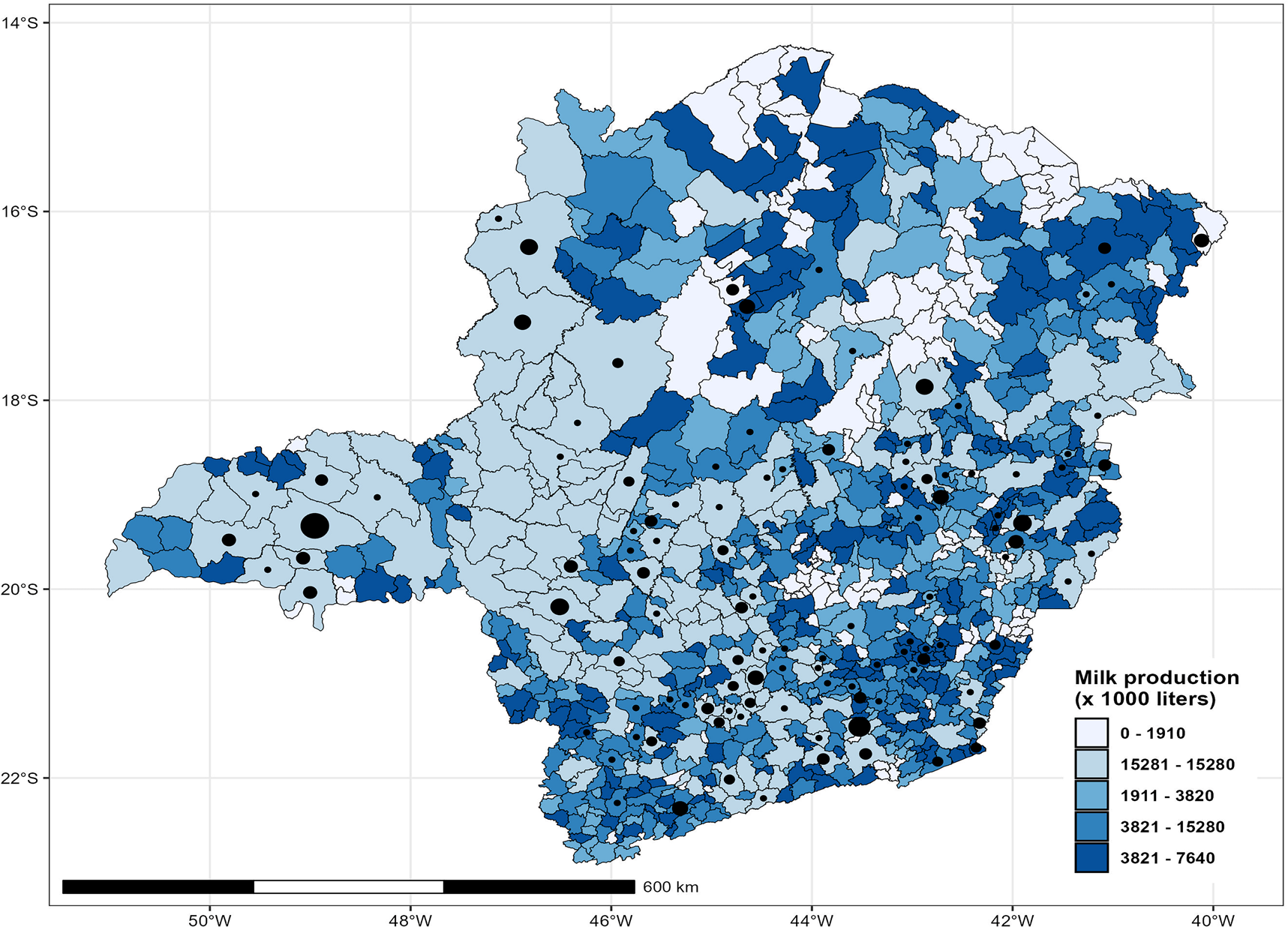
The sample comprised 271 dairy farms in 111 municipalities in traditional milk production regions of Minas Gerais, Brazil (Figure 1). The interviews were carried out with the support of technicians trained by the Balde Cheio Programme, coordinated by Embrapa (Novo et al., 2013). This training programme for rural extension technicians in milk production technologies provides a strong network of researchers, technicians and dairy farmers. The sample was distributed as follows: 9.2% of famers were new participants in this network, 25.8% had participated for 1 year, 22.1% had participated for 2 years, 11.1% had participated for 3 years and 31.8% had participated for 4 years or more. A structured questionnaire based on the agricultural technology adoption literature guided data collection on the milk production technologies, farmer and farm characteristics, access to information and commercialisation channels.
Measure of the intensity of technology adoption
The Technological Update Index (TUI), described in detail by De Mori, Batalha and Alfranca (2016) and De Mori et al. (2020), is used to measure the technology adoption level. The index applied to milk production system ranges from 0 to 1. A value close to 0 indicates a milk production system with a low production input and poor management technologies: milk production takes place with elementary management techniques and rudimentary infrastructure. A value close to 1 indicates a milk production system with a high level of updated technologies: this system adopts state-of-the-art technologies for productivity with sustainability gains and adequate infrastructure.
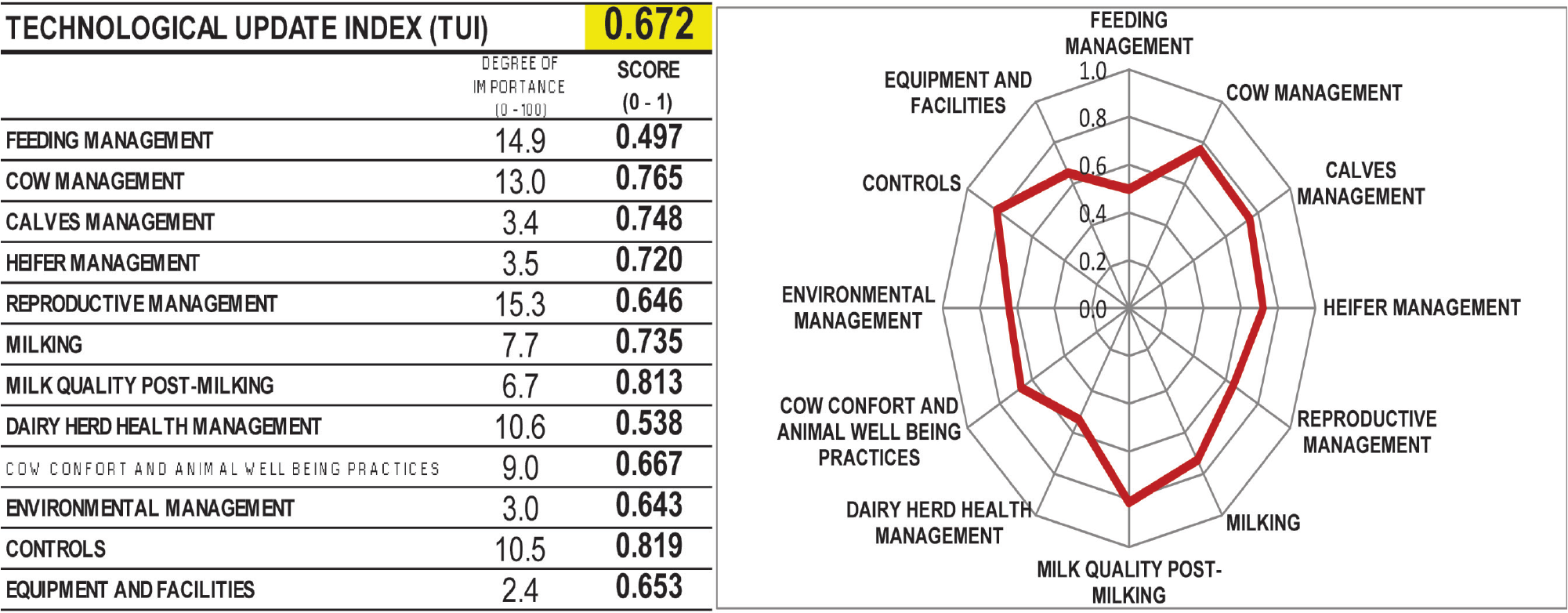
The TUI comprises a set of technologies of all stages of the milk production system (Table 1). The technologies are normalised and aggregated into sub-indexes. Based on a set of weights defined through the analytic hierarchy process, the sub-indexes are integrated to obtain the TUI:
where, Xi is the normalised variable, wi is the weight, and I is 1, …, n.
The sample had an average TUI of 0.4899, ranging from 0.1202 to 0.7258. Figure 2 provides an example of the TUI for one of the sampled farms.

Model description
The linear regression model analyzes a dependent variable in relation to explanatory variables. However, when the dependent variable is within a limited range (0,1), this model can generate inconsistencies such as values greater than 1 or less than 0. A Beta regression model is an alternative (Ferrari and Cribari-Neto 2004). It allows the dependent variable (y) to be in the range between 0 and 1. Here, the dependent variable is the TUI, described by De Mori et al. (2020). The Beta distribution follows,
wherein p>0,q>0 and Γ(⋅) is the gamma function. However, it is preferable to model the mean of the dependent variable. Hence, a distribution parameterisation such as p=µφ and q=(1-µ)φ is used, that is,
It follows,
wherein μ is the mean of dependent variable and ϕ is the precision parameter. For a fixed value of μ, the larger ϕ the smaller the variance of y. The mean µ is related to the independent variables (x) through a link function (ɡ) that ensures the modeled mean remains in the range (0,1). The link function used is the logit, that follows,
wherein xi denotes the vector of independent variables and β refers to the vector of parameters. Therefore,
The parameter estimation is obtained through the maximum likelihood method. The R software version 4.0.2 was used for the estimations. It is hypothesised that the higher the intensity of updated technology adoption, the higher the milk production performance. The association between the intensity of adoption of milk production technologies (TUI) and milk production performance was investigated with multiple correspondence analysis (MCA). The TUI was categorised as follows: (1) TUI ≤ 0.45, low-intensity adoption of updated technologies; (2) 0.45 < TUI ≤ 0.55, medium-intensity adoption of updated technologies, and; (3) TUI > 0.55, high-intensity adoption of updated technologies. First, Pearson’s chi-square (χ2) test was performed to verify the association between the TUI categories and the categories of each variable for milk production performance. The performance variables were categorised into three classes: (1) low, (2) medium and (3) high. They consider the efficiency of the milk production system and land use as a percentage of lactating dairy cows considering the total herd, average daily milk production per animal in the herd, the percentage of lactating dairy cows, the average daily milk production per lactating cow, and milk production per hectare of forage. MCA starts from a matrix of data represented by a contingency table and results in a twodimensional map that displays the rows and columns of the matrix as points in a vector space. The distances between the points result from the association between the variables. Inertia is used to assess the strength of the association between categories and the contribution to the variation in the data.
Description of the variables and hypothesis
Table 2 describes the variables used in the beta regression model, statistics and hypothesis. Table 3 describes the variables and statistics used in MCA.
Description of the variables in used in the beta regression model, descriptive statistics and hypothesis
RESULTS AND DISCUSSION
Table 4 shows the estimated results. The likelihood ratio test rejected the hypothesis that all model coefficients, except the intercept, are equal to 0 (χ2 = 140.38; p = 0.000). The diagnostic plot of residuals did not show a detectable pattern and meets the beta regression assumptions for residual independence and constant variance. The estimated McFadden pseudo-R2 was 0.3984.
Access to information is a necessary condition for a farmer to identify and make decisions on the use of technology (Yang; Sharp, 2017). A lack of information can delay or constrain technology diffusion. The information can be accessed in different ways. Radio, magazines and the Internet spread information in a summarised, fast and impersonal way to reach the greatest number of farmers. On the other hand, field days demonstrate technologies and provide an opportunity to share information and experiences through personal interactions among farmers and experts (social capital). Table 3 shows that the greater the access to technical information through radio, magazines, the Internet and field days, the higher the TUI. Each additional field day increases the TUI by 0.016. Technical information accessed through radio, magazines and the Internet increases the TUI by 0.022, 0.053 and 0.032, respectively. However, information accessed through neighbours decreases the TUI by 0.035. One possible explanation for this decline is that neighbours do not demonstrate superior agricultural and managerial skills. A lack of specific technical knowledge and skills can constrain the adoption of some agricultural management and production practices (Niles et al., 2019).
Specific technical knowledge can be provided by rural extension services. The EXTENSION variable was statistically significant. Each additional year receiving technical advisory increases the TUI by 0.022. This result highlights the importance of technical guidance in a milk production system: it should be customised, detailed, appropriate for the specific farmer profiles and continued over time. Rural extension service technicians are trained on agronomic and management concepts, which serve as the foundation of milk production technologies. They are expected to have a systemic view of milk production and to adapt their communication to farmers. This background offered by the Balde Cheio Programme allows technicians to adapt technology introduction to the specific regional conditions and farmer profiles. Thus, besides a technology transfer function, rural extension technicians support knowledge construction in farmers through learningby-doing and learning-by-interacting, improving social capital. There is increased adoption of technologies by farmers who are assisted by technicians, a phenomenon that positively influences the economic return as well as a famer’s autonomy and empowerment and the engagement of their family (Novo et al., 2013).
Risk propensity is a behavioural characteristic of the individual that influences the intensity adoption of updated technology. The RISK variable was statistically significant, indicating that risk-taking by a farmer is associated with a higher TUI. This result corroborates findings that receptivity and a positive attitude towards technology are important for technology adoption (Niles et al., 2019).
Finally, the reliance on a supply chain for milk production - represented by the variable INDUSTRY - positively and significantly affects the intensity technology adoption. Selling most of the produced milk to industry, whether cooperatives or private dairy factories, is associated with a higher TUI.
Other independent variables (COOP, EXPERIENCE, SCHOOL, SCALE and CREDIT) were not statistically significant. The effect of participation in formally organised entities, such as agricultural cooperatives (Zhang et al., 2020), in the adoption of technologies sometimes frustrates expectations. A possible explanation is that production technologies are easily accessed through other channels, or that these organisations have not developed adequate mechanisms to support the appropriation of more up-to-date production technologies.
Regarding the effect of schooling in fostering technology adoption, Dehinenet et al. (2014) and Zhang et al. (2020) also found no statistically significant effect. In addition, the farmers in the sample had 18 years of experience, which could explain why schooling does not significantly affect the adoption of milk production techniques.
Dehinenet et al. (2014), Niles et al. (2019) and Zhang et al. (2020) found that the size of farms and access to credit have little or no influence on the adoption of production technologies. These results can be explained by considering technologies that are not susceptible to the effects of economies of scale in production (e.g. those that do not require great investments in machinery and facilities). Most of the technologies that comprise the TUI are related to management, specifically aimed at reducing production inefficiencies. The production factors are adjusted to the production capacity and profile of the farmer. For example, in breeding management, calving and daily milk production records are used to remove cows with low production or open dry cows. This adaptation can generate financial resources that are reinvested in the production system, reducing the demand for credit. In addition, many practices do not depend on the farm size to be adopted, such as the preventive vaccination procedure.
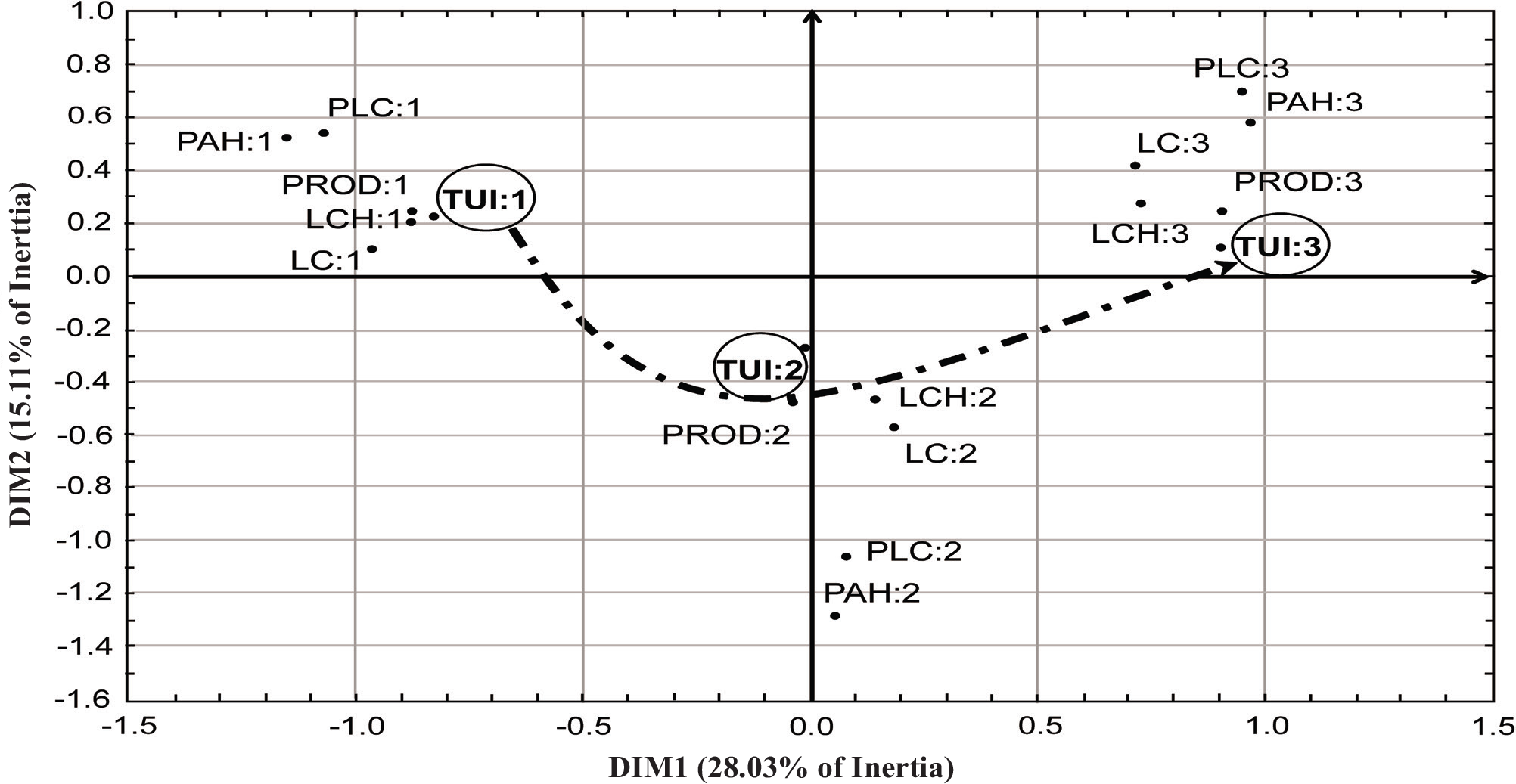
The adoption of agricultural technologies has long been associated to yield gains and an increase in farm income (Feder; Just; Zilberman, 1985). The MCA results indicate a positive association between technology adoption and high milk production performance (Figure 3).

Two-dimensional map (DIM1 and DIM2) generated by multiple correspondence analysis (MCA), showing the categories of dairy farms with low (TUI:1), medium (TUI:2) and high levels of technological adoption (TUI:3) associated with categories of low (1), medium (2) and high (3) levels of performance of milk production
The high-intensity adoption of updated technologies (TUI:3) is related to a high percentage of lactating dairy cows (LC:3 and LCH:3, considering the herd) and high production of milk per cow (PLC:3), per animal in the herd (PAH:3) and per hectare (PROD:3). Low-intensity adoption of technologies (TUI:1) is associated with low milk production performance (LC:1; LCH:1: PLC:1; PAH:1; PROD:1). The MCA results corroborate the findings of Khanal, Gillespie and Macdonald (2010), who found that adopters of a set of technologies and management practices achieve higher milk production per cow compared with non-adopters. The results should be interpreted with caution because the technologies are often adopted as packages and there is complementarity among them. Interactions regarding cause and effect require additional analysis.
CONCLUSIONS
The intensity of the adoption of milk production technologies is positively influenced by access to information through different channels, such as radio, magazines and the Internet, as well as technology demonstrations, learning-by doing and learning-byinteraction provided by field days and rural extension services. Neighbours as a source of information have a negative influence on the adoption of technologies. In addition, risk-taking behaviour by farmers and dependence on the supply chain positively affect the adoption of milk production technologies. High-intensity adoption of technologies is associated with better milk production performance. The results provide information to guide actions on diffusion and technology transfer programmes to foster the adoption of milk production technologies, both through public policies and strategies in the productive sector. An important limitation of this study is the cross-sectional data analysis: caution is needed when attempting to generalise the findings.
The research data are available from the corresponding author upon reasonable request
REFERENCES
- BURKITBAYEVA, S.; JANSSEN, E.; SWINNEN, J. Technology adoption, vertical coordination in value chains, and FDI in developing countries: panel evidence from the dairy sector in India (Punjab). Review of Industrial Organization, v. 57, n. 2, p. 433-479, 2020.
- DE MORI, C. et al Índice de atualização tecnológica para propriedades leiteiras: IAT-Leite. São Carlos, SP: Embrapa Pecuária Sudeste, 2020. 18 p.
- DE MORI, C.; BATALHA, M. O.; ALFRANCA, O. A model for measuring technology capability in the agrifood industry companies. British Food Journal, v. 118, n. 6, p. 1422-1461, 2016.
- DEHINENET, G. et al Factors influencing adoption of dairy technology on small holder dairy farmers in selected zones of Amhara and Oromia national regional States, Ethiopia. Discourse Journal of Agriculture and Food Sciences, v. 2, n. 5, p. 126-135, 2014.
- FEDER, G.; JUST, R. E.; ZILBERMAN, D. Adoption of agricultural innovations in developing countries: a survey. Economic Development and Cultural Change, v. 33, n. 2, p. 255-298, 1985.
- FERRARI, S.; CRIBARI-NETO, F. Beta regression for modelling rates and proportions. Journal of Applied Statistics, v. 31, n. 7, p. 799-815, 2004.
- FERRAZZA, R. A. et al Association between technical and economic performance indexes and dairy farm profitability. Revista Brasileira de Zootecnia, v. 49, e20180116, 2020.
- GACHANGO, F. G.; ANDERSEN, L. M.; PEDERSEN, S. M. Adoption of milk cooling technology among smallholder dairy farmers in Kenya. Tropical Animal Health and Production, v. 46, n. 1, p. 179-184, 2014.
- IBGE. Pesquisa da Pecuária Municipal 2019 Rio de Janeiro, 2020. 12 p.
- JAIN, R.; ARORA, A.; RAJU, S. S. A novel adoption index of selected agricultural technologies: linkages with infrastructure and productivity. Agricultural Economics Research Review, v. 22, n. 1, p. 109-120, 2009.
- KANSANGA, M. M. et al Determinants of smallholder farmers’ adoption of short-term and long-term sustainable land management practices. Renewable Agriculture and Food Systems, v. 36, p. 265-277, 2021.
- KHANAL, A. R.; GILLESPIE, J.; MACDONALD, J. Adoption of technology, management practices, and production systems in US milk production. Journal of Dairy Science, v. 93, n. 12, p. 6012-602, 2010.
- LÄPPLE, D. et al Sustainable technology adoption: a spatial analysis of the Irish dairy sector. European Review of Agricultural Economics, v. 44, n. 5, p. 810-835, 2017.
- MAINA, K. W. et al Socio-economic determinants and impact of adopting climate-smart brachiaria grass among dairy farmers in eastern and western regions of Kenya. Heliyon, v. 6, n. 6, e04335, 2020.
- MARTÍNEZ-GARCÍA, C.; DORWARD, P.; REHMAN, T. Factors influencing adoption of crop and forage related and animal husbandry technologies by small-scale dairy farmers in Central Mexico. Experimental Agriculture, v. 52, n. 1, p. 87-109, 2016.
- MWANGA, G. et al Multi-country investigation of factors influencing breeding decisions by smallholder dairy farmers in sub-Saharan Africa. Tropical Animal Health and Production, v. 51, n. 2, p. 395-409, 2019.
- NASPETTI, S. et al Determinants of the acceptance of sustainable production strategies among dairy farmers: development and testing of a modified technology acceptance model. Sustainability, v. 9, n. 10, p. 1805, 2017.
- NILES, M. T. et al A review of determinants for dairy farmer decision making on manure management strategies in high-income countries. Environmental Research Letters, v. 14, n. 5, e053004, 2019.
- NOVO, A. M. et al Feasibility and competitiveness of intensive smallholder dairy farming in Brazil in comparison with soya and sugarcane: case study of the Balde Cheio Programme. Agricultural Systems, v. 121, p. 63-72, 2013.
- PEIRIS, T. D. G. J.; ABEYNAYAKE, N. R.; PERERA, M. S. Socio-economic factors affecting the technology adoption level of sugarcane in rainfed sector in Sevenagala. Journal of Food and Agriculture, v. 2, n. 2, p. 22-27, 2012.
- REIS, E. M. B. et al Identificação de pontos fracos e fortes associados à qualidade do leite em propriedade leiteiras de agricultura familiar. PUBVET, v. 11, p. 840-946, 2017.
- SIMÕES, A. R. P.; REIS, J. D.; AVELAR, P. S. The technological heterogeneity of dairy farming in Minas Gerais. Revista Agrarian, v. 10, n. 37, p. 261-269, 2017.
- SOUZA FILHO, H. M. et al Condicionantes da adoção de inovações tecnológicas na agricultura. Cadernos de Ciência & Tecnologia, v. 28, n. 1, p. 223-255, 2011.
- YANG, W.; SHARP, B. Spatial dependence and determinants of dairy farmers’ adoption of best management practices for water protection in New Zealand. Environmental Management, v. 59, n. 4, p. 594-603, 2017.
- ZHANG, S. et al The effect of cooperative Sichuan, China. China Economic Review, v. 62, n. 8, membership on agricultural technology adoption in e101334, 2020.
-
Editor-in-Chief:
Eng. Agronômo. Manoel Barbosa Filho - manoel.filho@ufc.br