 Characterisation of the lignocellulosic properties of pruning waste from tree species with the potential for furniture production in Acaraú, Ceará
ABSTRACT
The aim of this study was to characterise the lignocellulosic fractions of pruning waste from tree species showing potential for furniture production in Acaraú, Ceará. The experiment was conducted in a completely randomised, split-plot design, with the plots corresponding to two water regimes (irrigated for one year and irrigated for three years) and the sub-plots to eight tree species, with three replications. The chemical attributes were determined after seven years. Except for the insoluble lignin content, there was a significant effect from the different species in terms of the chemical properties of the wood. The results for the lignocellulosic fractions show the possibility of developing technological ways of adding value to these waste products, especially considering their lignin content. The different species also showed potential for use in producing cellulose pulp, with the exception of Handroanthus impetiginosus due to its high ash content. The results of this study offer new perspectives for future research into the use of forestry waste.
Key words:
Chemical characterisation; Native; Exotic
INTRODUCTION
The state of Ceará is regionally important for the production of wooden furniture, with more than 300 companies directly generating over 3,000 jobs (De Arruda Coelho, 2022). However, raw materials in the form of wood mainly come from other parts of the country, resulting in additional logistical costs for the furniture industry as well higher production costs.
As one alternative for dealing with this situation, the introduction of different tree species, both exotic and native, with the potential for providing wood for the local furniture industry, has been studied in the irrigated perimeter of Baixo Acaraú in Ceará. Reforestation using native species can potentially restore areas that were once occupied by forests and reduce the pressure for deforestation in areas of native forest. (Sist, 2021).
One result of this strategy is the waste generated from lignocellulosic fractions by such processes as pruning and tree-felling that could be used by the furniture industry as raw material.
Wood is characterised as a material consisting essentially of biopolymers (cellulose, hemicellulose, and lignin) organised in a complex three-dimensional structure whose physical and mechanical properties are mainly determined by the cellulose, hemicellulose and lignin that make up the cell wall and maintain its integrity (Shi et al, 2022).
Lignin is the second largest component of plant cell walls, making it the second most important renewable natural resource after cellulose (Chen et al, 2020). Its significance is further enhanced by the fact that it is the most important biopolymer with aromatic rings and active hydroxyls in its structure, and is largely composed of three basic units: guaiacyl, syringyl, and p-hydroxyphenyl (Yuan et al, 2023).
Like other biorenewable polymers, lignin offers several advantages, including its antioxidant and antimicrobial properties, its abundance as a by-product of industrial waste, and its biodegradability. In addition, lignin improves resistance in the cell walls of cellulosic materials, protecting the cell wall from biochemical stress and inhibiting the enzymatic degradation of other components. Compared to cellulose, hemicellulose, and other polysaccharides, lignin is reported to be resistant to most types of biological attack (Doherty et al., 2011). In this respect, Mattos (2017) notes in particular that lignocellulosic biomass, available in the form of agricultural and agro-industrial waste, stands out as an interesting alternative for the development of new materials.
The most common natural biopolymer in the environment is cellulose, with an estimated annual production of one trillion tonnes. Cellulose is a polymer made up of glucose molecules connected by β-1,4 glycosidic bonds (Yan et al, 2023). Because it is renewable, non-toxic, biocompatible, chemically and thermally stable, of low-cost, and has versatile physical and mechanical properties, cellulose is the basis for studies aimed at developing substitutes for petroleum-based polymers, the production of thickeners and emulsion stabilisers for the food industry, and the production of plastic or paper packaging and moulded pulp for the chemical industry, for medicine, cosmetics, construction, etc (Aziz et al, 2022).
Hemicellulose is a heterogeneous group of polysaccharides with degrees of polymerisation well below those of cellulose (80 to 200), and a chemical composition that varies depending on the plant species, type of cell, location in the plant, and stage of development. The most common sugars in the composition of hemicellulose are pyranose, furanose, d-xylose, d-mannose, d-glucose, d-galactosyl, and l-arabinose, as well as galacturonic acid and glucuronic acid. Hemicellulose is used in the production of various materials for the chemical, food and medical industries, such as films, hydrogels, and emulsifiers (Rao et al, 2023).
Lignocellulosic fibres have recently emerged as an economic and ecological alternative for use as reinforcements and fillers in composites with virgin or recycled polymers (Mattos, 2017). Several authors have discussed the potential application of lignin, such as its use in panels with antifungal properties (Zhang et al. 2015). In their study, Peng and Chen (2011) also synthesised lignin-based hydrogels using lignin with polyurethane ionomers to study the release of ammonium sulphate. They found that these hydrogels could potentially be used as coating materials to produce a controlled-release fertiliser with various agricultural applications.
The aim of this study was to chemically characterise the lignocellulosic fractions of pruning waste from species being tested in the furniture industry, with a view to evaluating possible ways of adding value, particularly for the lignin.
MATERIAL AND METHODS
The study evaluated the wood from branches of the following tree species (SIGEN: AF46C91): Acacia mangium Willd, Anadenanthera colubrina var. cebil (Griseb.) Altschu, Casuarina equisetifolia L. ex J. R. Forst. & G. Forst, Handroanthus impetiginosus (Mart. ex DC.) Mattos), and Colubrina glandulosa subsp. reitzii (M.C.Johnst.) Borhidi); and from seven-year-old eucalyptus clones: GG 680 (Eucalyptus urophylla x Eucalyptus grandis), VE 38 (Eucalyptus urophylla x Eucalyptus camaldulensis), and VE 41 (Eucalyptus urophylla x Eucalyptus grandis). The wood was collected from an experimental area run by Embrapa Tropical Agroindustry, in an area of the Baixo Acaraú Irrigated Perimeter bordering the district of Marco, Ceará, located at 3°06'02" S and 40°04'05" W, at an altitude of 56 metres. According to the Köppen classification, the climate in the region is type Aw' (tropical rainy). There is a marked change between the rainy season (January to May) and the dry season (June to December). The average annual rainfall varies around 900 mm, with an average annual temperature of 28.1 ºC, average annual relative humidity of 70%, average annual evaporation of 1600 mm, sunshine of 2,650 h/yr, and average wind speed of 3.0 m/s (DNOCS, 2016). The soil in the experimental area was classified as a quartzarenic Neosol (EMBRAPA, 2013), with the following characteristics in the 0 to 50 cm layer: textural class, sand; soil moisture at 0.03 MPa, 4.38%; moisture at 1.5 MPa, 2.95%; pH, 6.1; EC, 0.19 dS.m-1; organic matter, 9.0 g. Kg-1; P, 19.9 mg dm-3; and 14.65, 6.45, 1.05, 3.35 and 5.4 mmolc.dm-3 of Ca2+, Mg2+, K+, Na+, and H++Al3+, respectively.
The experiment was set up in an area that was divided into two sub-areas (plots), one in which irrigation was suspended after the first 12 months (one-year irrigation regime) and the other in which irrigation was suspended after three years (three-year irrigation regime). During the first 12 months the entire area was irrigated daily by micro-sprinkler with an irrigation depth of 2.7 mm.day-1. Following this period, the irrigation frequency in the three-year regime was changed to two days and the irrigation depth to 5 mm.day-1.
The species were planted in experimental sub-plots measuring 6 x 28 m, comprising three rows of 15 plants/row, with the first and third rows considered borders together with the first and last plants in the central row. A spacing of three metres was used between rows and two metres between plants.
Three trees were selected per sub-plot, each with a good phenotypic profile, and branches of different diameters were collected from each plant to form a composite sample for chemical characterisation of the wood.
The branches were ground in a knife mill under laboratory conditions and passed through a 20-mesh sieve. The chemical attributes of the wood were extractives (TAPPI. T204 cm-97, 1997), ash (TAPPI. T211 om-02, 2002), insoluble lignin (TAPPI. T 222 om-22, 2002), alpha-cellulose (TAPPI. T203 cm-99, 2009), and hemicellulose, obtained from the difference between the holocellulose and alpha-cellulose content. The holocellulose content was determined using the method described by Yokoyama et al. (2002).
The lignin in the samples of Acacia mangium, Anadenanthera colubrina, Casuarina equisetifolia, Colubrina glandulosa, GG 680, VE 41, and VE 38 was extracted using the acetosolv method, as described by Leitão et al (2019). The samples were pre-treated in a steam explosion reactor at 168 °C for 10 min. The acetossolv extraction took place in a high-pressure reactor at 190 °C for 26 min, using 1 L of a 75% aqueous solution of commercial ethyl alcohol with 0.5% sulphuric acid per 100 g of sample. This stage results in a black liquor, which is centrifuged at 700 rpm to extract the remaining solids, and the liquid phase filtered twice in a filter press of 8-μm filter paper to obtain the acetosolv lignin.
The Fourier transform infrared (FTIR) spectra of the lignin samples were obtained using a Spectrum Two FT-IR spectrophotometer (PerkinElmer) employing KBr pellets with a sample concentration of 5% (w/w). The spectra were obtained at wavelengths between 4000 and 400 cm-1 at a resolution of 1 cm-1 using the arithmetic mean of 32 readings. The FTIR data was processed and analysed using the Origin v9.4 software.
A thermogravimetric analysis of the lignin samples was carried out using an STA 6000 thermal analyser (PerkinElmer). All the measurements were taken in a nitrogen atmosphere at a gas flow rate of 50 mL.min-1, heating from 30 °C to 900 °C at a heating rate of 10 °C.min-1. Sample weights of approximately 10 mg were used.
The experiment was conducted in a completely randomised, split-plot design, with the plots corresponding to the two water regimes (one year of irrigation and three years of irrigation) and the subplots corresponding to the eight species. Three plants were selected and distributed over three replications.
The data were submitted to analysis of variance to check for isolated effects and interaction between the factors, and the mean values were compared by Scott-Knott test (p < 0.05). The statistical analyses were carried out using the Analysis of Variance for Balanced Data (SISVAR) software, developed by Ferreira (2008).
RESULTS AND DISCUSSION
Statistical analysis of the water regimes and species
A completely randomised design was used to check for variations in the chemical characteristics of the wood using two water regimes and eight different species. For this purpose, the ash content, total extractives, insoluble lignin, hemicellulose and alpha-cellulose of the samples were determined.
Changing the irrigation regime from 12 to 36 months did not significantly affect the chemical composition of the eight materials under evaluation (Table 1). This suggests that an irrigation strategy of up to 12 months is effective in maintaining the chemical quality of the wood while saving water. Similar results were found by Barbosa et al. (2014) studying a six-year hybrid of E. urophylla x E. grandis., and by Moulin et al. (2015), who, after 6 and 12 months, assessed the composition of two eucalyptus clones, with and without irrigation, and found significant differences in the extractive content.
Summary of the analysis of variance and coefficient of variation (CV) for pruning ash (PASH), total extractives (TOT EXT), insoluble lignin (INS LIG), hemicellulose (HEMI), and alpha-cellulose (ALPHA) in five tree species and three eucalyptus clones grown under two water regimes (irrigated for 1 year and irrigated for 3 years) seven years after planting, Acaraú, Ceará, 2019
Species had a significant effect on the chemical properties of the wood, except for the insoluble lignin content (Table 1). The ratio between the main chemical constituents of the wood varies between genera, between species, and within any one tree, and is also affected by variations in the microclimate, soil, rainfall, fertiliser and age of the tree, among others (GOMIDE and COLODETTE, 2007). Differences in chemical composition between different clones and tree species have also been observed by other authors (MOULIN, 2015; HOUSSAIN, 2023).
Chemical characterisation of the wood
Each of the species under study had a high ash content regardless of the water regime, with the exception of Casuarina equisetifolia (0.93%). Handroanthus impetiginosus had the highest ash content (2.28%) of all the species under study (Table 2). Medeiros Neto et al. (2012) found an ash content of 0.87% in Handroanthus impetiginosus, well above the average found in the present study. Villaseñor Araiza and Rutiaga Quinõnes (2000) found an ash content of 0.5% for sapwood and 1.5% for heartwood in Casuarina equisetifolia, similar to the values found in the present study. In the energy sector, ash values below 1% are considered ideal (SANTOS et al., 2011), and only Casuarina equisetifolia showed no values above this limit. High levels of minerals in the wood result in a high percentage of ash in the charcoal, which is detrimental when the charcoal is used in steelmaking (ANDRADE, 1993). In the cellulose sector, the range accepted by industry varies from 0.2% - 1.1% (FOELKEL, 2011), with only Casuarina equisetifolia and the VE - 38 clone meeting this criterion. Chaves et al. (2013) state that the ash content is inversely related to the calorific value, since, when burning biomass, volatile materials evaporate quickly, reducing the residence time of the fuel in the combustion unit, and potentially contributing to low energy efficiency.
Mean values for pruning ash (PASH), total extractives (TOT EXT), insoluble lignin (INS LIG), hemicellulose (HEMI) and alpha-cellulose (ALPHA) in five tree species and three eucalyptus clones seven years after planting, Acaraú - Ceará, 2019
Mean values followed by the same letter in a column do not differ by Scott-Knott test at a level of 5%
Handroanthus impetiginosus and Acacia mangium had the highest extractive content, 2.56% and 2.32% respectively, differing statistically from the other species (Table 2). However, for energy purposes, the total extractive content is below that considered suitable for the sector, around 4.5% to 6.5% (TRUGILHO et al., 2001). The total extractives have a high calorific value and are positively correlated with the gravimetric charcoal yield (SANTOS et al., 2011). The low values for extractives, especially in the eucalyptus clones, is of great importance in cellulose production since a high level of total extractives is detrimental to the process. During the production process, the extractives can agglomerate, and form pitch deposits, which reduces the useful life of the equipment, increases alkali consumption, and lowers the quality of the final product by reducing the absorbency of the pulp (SILVESTRE, 1999; D'ALMEIDA et al., 2013; COLODETTE; GOMES, 2015). For the eucalyptus clones, the extractive content is within the range reported by other authors, between 1.09% and 4.28% (FERREIRA et al., 2006; GOMIDE et al., 2005; TOLFO et al., 2005; SÃO TEAGO, 2012). For Handroanthus impetiginosus, the extractive content is lower than that found by Medeiros Neto et al. (2014), who recorded a content of 6.88%. Paschoal Neto et al. (2005), studying 7-year-old Acacia mangium, obtained an extractive content of 4.06%, which is higher than the value found in the present study. However, the discrepancy between these results may be due to differences in the extraction methods or the types of solvents used.
The lignin content found in Casuarina equisetifolia (26.04%) is in line with the levels proposed by Vidal and Da Hora (2011) for conifers, ranging from 19% to 33%, and is also in line with the lignin content found for the other species under study (23.79% to 27.73%), where the authors propose levels in hardwoods that range from 13% to 31%.
In the energy sector, the values for insoluble lignin found in the present study are considered intermediate (23.79% to 27.73%) according to Trugilho et al. (2001). The sector requires high values for this compound, as it has a positive correlation with higher calorific values, gravimetric charcoal yield, and the fixed carbon content (BRITO and BARRICHELO, 1977; VITAL et al., 1994; SANTOS et al., 2011).
In addition, the lignin content found in the present study is acceptable to the pulp and paper sector, as falls within the 27.1% to 31.3% range (JARDIM et al., 2017). However, as mentioned above, the high ash content of Handroanthus impetiginosus (2.28%) makes it impossible to use (Table 2); it does however have the potential for use in the production of other nobler forms of cellulose with higher added value, such as microfibrils and nanocrystals, given that the ash content did not hamper production of these materials from palm oil waste (Marques et al., 2020; Souza et al., 2016). Furthermore, it is worth noting that the lowest possible lignin content is best for cellulose production as it facilitates wood pulping (GOMES et al., 2008).
Characterisation of the lignin
Fourier transform infrared spectroscopy (FTIR) was used to determine qualitatively the monomeric composition of the lignin. The polymeric structure of lignin is made up of three monomers whose basic difference lies in the absence or presence of methoxy group(s) (-OCH3) linked in the ortho position of the aromatic lignin rings. A p-hydroxyphenyl (H) unit is one which has no methoxy group attached to the aromatic ring. A guaiacyl unit (G) has only one methoxy group, while a syringyl unit (S) has two methoxy groups. The presence of these groups on the aromatic ring can hinder the application of lignin by occupying reactive sites on the ring. However, it depends on whether the application requires reactions in the aromatic rings, such as the application of phenolic resins of the lignin-phenol-formaldehyde type (PINHEIRO et al., 2017).
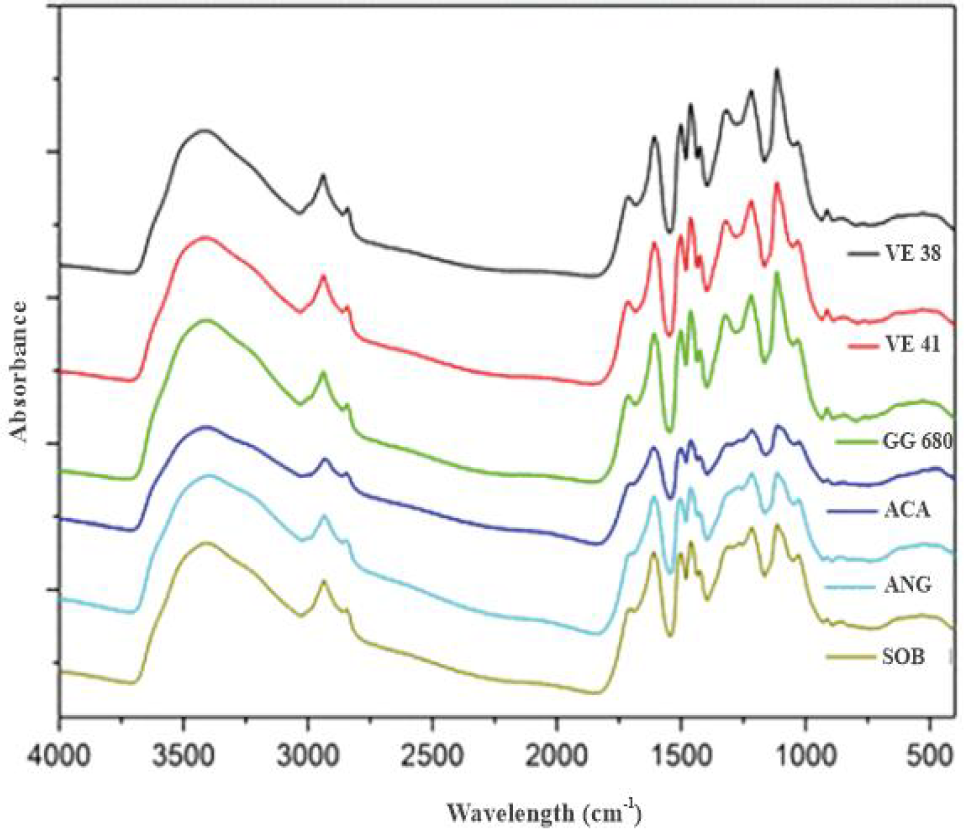
The FTIR spectra (Figure 1) showed that the wood lignins in the present study were made up of G (guaiacyl) and S (syringyl) units (Faix, 1991). The shoulder at 1268 cm-1 corresponds to the vibrations of the aromatic rings of the G units from stretching of the C=O bonds. Furthermore, the signal at 1218 cm-1 is typical of lignin made up of G units. The band at 855 cm-1 confirms the presence of G units via the out-of-plane vibrations of the C-H bonds. In addition, the signals at 1325 and 1116 cm-1 indicate the presence of S units.
FTIR spectra of acetosolv lignins from VE 38, VE 41, GG 680, ACA (Acacia mangium), AND (Anadenanthera colubrina), and COL (Colubrina glandulosa)
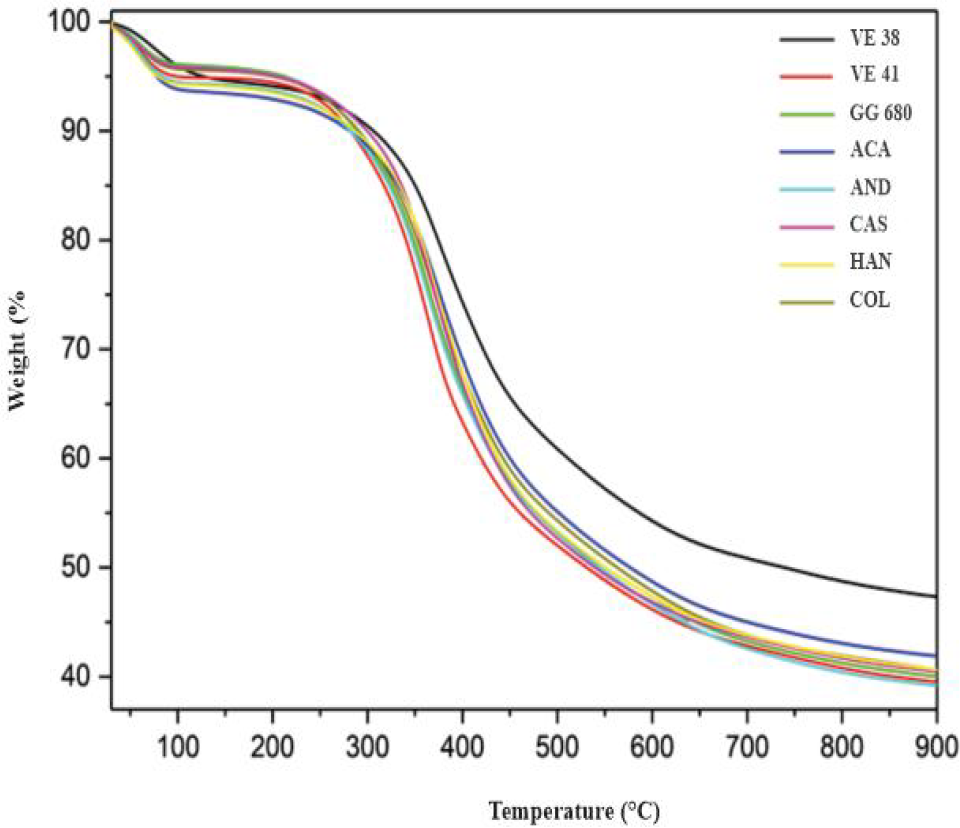
In addition, thermogravimetric analysis and differential thermogravimetry (TGA/dTG) were used to determine the thermal stability of the lignins. Thermal stability is an important parameter for lignin, as some applications require the use of temperature. The TGA spectra (Figure 2) showed two thermal events typical of lignins. The first event under 100 °C is related to the possible presence of moisture or low molecular weight structures.
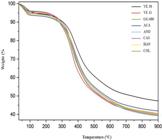
TGA analysis of the acetosolv lignins from VE 38, VE 41, GG 680, ACA (acacia mangium), AND (Anadenanthera colubrina), CAS (Casuarina equisetifolia), HAN (Handroanthus impetiginosus), and COL (Colubrina glandulosa)
The second event is related to the thermal degradation of the lignin structure. The samples showed good thermal stability (Table 3) starting at temperatures greater than 200 °C (Tonset) with the maximum degradation temperature (Tmax) occurring around 360 °C, which is a typical lignin event.
Initial degradation temperature (Tonset), maximum degradation temperature (Tmax), and char yield at 900°C for the lignins under study
ACA (Acacia mangium); AND (Anadenanthera colubrina); CAS (Casuarina equisetifolia); HAN (Handroanthus impetiginosus); COL (Colubrina glandulosa)
Char yield (CY) is the amount of material remaining at the end of combustion, and is related to the ability of the material to retard or extinguish flames during combustion. The use of lignins with this characteristic when preparing new materials may afford the materials flame retardant properties. Materials with a CY greater than 26% are considered self-extinguishing (KREVELEN, 1975); as shown in Table 3, the lignins in the present study have a CY of more than 26%. The abovementioned characteristics of the lignins make them possible candidates for technological application, however a more in-depth study of other characteristics, such as molecular weight, is required.
The following uses have been applied to lignin: the production of phenolic resin, in animal feed, use as dispersants, in biocomposites, as additives, and in the formation of polymer blends, surfactants, thickeners, fine chemicals, ceramic products, pesticides, as additives in concrete and cement, and many others (VISHTAL; KRASLAWSKI, 2011).
Lignin can be used in the chemical industry in more noble applications, such as in cosmetic formulations (VINARDELL et al., 2008), as a substitute for phenol in the production of phenol-formaldehyde resins, as a precursor for carbon-based materials (activated carbon) (DUVAL; LAWOKO, 2014), as adsorbents (DUVAL; LAWOKO, 2014), as a copolyol in the synthesis of polyurethanes (BERNARDINI et al., 2015), etc.
The greater hemicellulose content (32.34% to 34.10%) and good percentage of alpha-cellulose (36.20% to 37.98%) that result in a high level of holocellulose (68.54% to 72.08%) in Casuarina equisetifolia and the eucalyptus clones, make these species suitable for the production of cellulose pulp. The holocellulose content is in the same range as found in older wood in Eucalyptus urophylla x Eucalyptus grandis hybrids. For example, Ferreira et al. (2006) found values of 64.4% in 7-year-old trees, Alencar et al. (2001) obtained a content of 67.54% after six years, and Gomide et al. (2005), from 64.5% to 70.2% after seven years.
CONCLUSIONS
-
The results show that the strategy of using irrigation during the initial 12 months only was sufficient for maintaining the quality of the wood in terms of its chemical composition;
-
On the other hand, the analysis of the chemical composition and subsequent extraction of lignin acetossolv from the resulting materials allows a positive assessment of the potential for utilising the waste from cultivated forest species in the state of Ceará to produce both chipboard panelling from the lignocellulosic fibres and resins based on the lignin produced by these materials.
ACKNOWLEDGEMENTS
The authors would like to thank the Coordenação de Aperfeiçoamento de Pessoal de Nível Superior (CAPES) for the award of a scholarship. Thanks also go to Embrapa Agroindústria Tropical, the Agência de Desenvolvimento do Estado do Ceará (ADECE), the Banco do Nordeste do Brasil (BNB) and the Universidade Federal do Ceará for their financial support. The authors would also like to thank the other partners in this Project, Embrapa Floresta, Departamento Nacional de Obras Contra as Secas (DNOCS), Sindicato das Indústrias de Móveis do Ceará (Sindmóveis), Sindicato da Indústria de Serrarias, Carpintarias, Tonoarias, Madeira Laminada e Compensada do Ceará (Sindserrarias), Instituto de Desenvolvimento Industrial do Ceará (INDI), and Fabricantes Associados de Marco (FAMA).
REFERENCES
-
ALBUQUERQUE, M E P, SOARES, A K L, NETO, F P M, PINHEIRO, F G C, SANTAELLA, S T, ROSA, M de F, OLIVEIRA, D L V de, RICARDO, N M P, LEITÃO, R C. Produção de Resinas Ligno-Fenol-Formaldeído a Partir do Bagaço da Cana-de-açúcar. Fortaleza: Embrapa Agroindústria Tropical, 2019. 9 p. (Embrapa Agroindústria Tropical. Comunicado técnico, 255). Disponível em: <https://www.infoteca.cnptia.embrapa.br/bitstream/doc/1112150/1/CT255.pdf>. Acesso em:22 set. 2023.
» https://www.infoteca.cnptia.embrapa.br/bitstream/doc/1112150/1/CT255.pdf -
ALENCAR, G. S. B.; BARRICHELO, L. E. G.; SILVA JUNIOR, F. G. Qualidade da madeira de híbrido de Eucalyptus grandis x E. urophylla e seleção precoce In: CONGRESSO ANUAL. ABTCP - ASSOCIAÇÃO BRASILEIRA TÉCNICA DE CELULOSE E PAPEL, 34., 2001. 6 p., 2001. Artigo.. Disponível em: < http://www.celso-foelkel.com.br/artigos/outros/26_selecao%20precoce%20em%20e.urograndis%20para%20qualidade%20madeira.pdf >. Acesso em: 06 setembro 2019.
» http://www.celso-foelkel.com.br/artigos/outros/26_selecao%20precoce%20em%20e.urograndis%20para%20qualidade%20madeira.pdf - ANDRADE, A. M. Efeitos da fertilização mineral e da calagem na produção e na qualidade da madeira e do carvão de eucalipto 1993. 105 p. Tese (Doutorado em Ciência Florestal) - Universidade Federal de Viçosa, Viçosa, 1993.
- AZIZ, T., FARID, A., HAQ, F., KIRAN, M., ULLAH, A., ZHANG, K., ... & AL JAOUNI, S. K. A review on the modification of cellulose and its applications. Polymers, v. 14, n. 15, p. 3206, 2022.
- BARBOSA, B. M. et al Efeito da fertilização na qualidade da madeira de Eucalyptus spp. Scientia Forestalis, v. 42, n. 101, p. 29-39, 2014.
- BERNARDINI, J. et al Optimizing the lignin based synthesis of flexible polyurethane foams employing reactive liquefying agents. Polym Int, v. 64, n. 9, p. 1235-1244, 2015.
- BRITO, J. O.; BARRICHELO, L. E. G. Correlação entre características físicas e químicas da madeira e a produção de carvão vegetal: 1 - densidade e o teor de lignina da madeira de eucalipto. IPEF, n.14, p. 9-20, 1977.
- CHAVES, A. M. B. et al Características energéticas da madeira e carvão vegetal de clones de Eucalyptus spp. Enciclopédia Biosfera, Centro Científico Conhecer, n.17; p. 533-542, 2013.
- CHEN, H., GNANASEKAR, P., NAIR, S. S., XU, W., CHAUHAN, P., & YAN, N. Lignin as a key component in lignin-containing cellulose nanofibrils for enhancing the performance of polymeric diphenylmethane diisocyanate wood adhesives. ACS Sustainable Chemistry & Engineering, v. 8, n. 46, p. 17165-17176, 2020.
- COLODETTE, J. L.; GOMES, F. J. B. Branqueamento de polpa celulósica: da produção da polpa marrom ao produto acabado 1. ed. Viçosa, MG: UFV, 2015. 816 p.
- D’ALMEIDA, M. L. O. et al Composição química da madeira e matérias-primas fibrosas São Paulo: Senai, 2013. 352 p.
-
DE ARRUDA COELHO, Maria Izolda Cela et al. DIAGNÓSTICO DO ARRANJO PRODUTIVO LOCAL DE MÓVEIS DE MARCO - CEARÁ. 2022. Disponível em: <https://www.sedet.ce.gov.br/wp-content/uploads/sites/15/2022/09/Projeto-APL-Diagnostico-APL-de-Moveis-Marco-Versao-Final.Digital.pdf>. Acesso em 12 de setembro de 2023.
» https://www.sedet.ce.gov.br/wp-content/uploads/sites/15/2022/09/Projeto-APL-Diagnostico-APL-de-Moveis-Marco-Versao-Final.Digital.pdf -
DNOCS, 2016. Disponível em:<http://www.dnocs.gov.br/~dnocs/doc/canais/perimetros_irrigados/ce/baixo_acarau.html>. Acesso em: 23 março 2018.
» http://www.dnocs.gov.br/~dnocs/doc/canais/perimetros_irrigados/ce/baixo_acarau.html - DOHERTY, W. O. S.; MOUSAVIOUN, P.; FELLOWS, C.M. Value-adding to cellulosic ethanol: lignin polymers. Ind Crops Prod, v. 33, n. 2, p. 259-276, 2011.
- DUVAL, A.; LAWOKO, M. A review on lignin-based polymeric, micro-and nano-structured materials. Reactive and Functional Polymers, v. 85, p. 78-96, 2014.
- EMBRAPA. Centro Nacional de Pesquisas de Solos. Sistema Brasileiro de Classificação de solos. 3. Ed. Brasília, DF: Embrapa Produção de Informação, 2013. 353p.
- FAIX, O. Classification of lignins from different botanical origins by FT-IR spectroscopy. Holzforschung-International Journal of the Biology, Chemistry, Physics and Technology of Wood, v. 45, n. s1, p. 21-28, 1991.
- FERREIRA, C. R. et al Avaliação tecnológica de clones de eucalipto: parte 1 - qualidade da madeira para produção de celulose Kraft. Scientia Forestalis, n. 70, p. 161-170, abr. 2006.
- FERREIRA, D. F. SISVAR: um programa para análises e ensino de estatística. Revista Symposium, v. 35 n. 6, p. 36-41, 2008.
-
FOELKEL, C. Os eucaliptos e os elementos não processuais na fabricação de celulose Kraft. 122 p. 2011. Disponível em: <http://www.eucalyptus.com.br/eucaliptos/PT24_ElementosNproces.pdf> Acesso em: 30 abril 2016.
» http://www.eucalyptus.com.br/eucaliptos/PT24_ElementosNproces.pdf - GOMES, F. J. B. et al. Influência do teor e da relação S/G da lignina da madeira no desempenho da polpaçao kraft. O Papel, v. 12, p. 95-105, 2008
- GOMIDE, J. L. et al Caracterização tecnológica, para produção de celulose, da nova geração de clones de Eucalyptus do Brasil. Revista Árvore, v.29, n.1, p.129-137, 2005.
- GOMIDE, J. L.; COLODETTE, J. L. Qualidade da madeira. In: BORÉM, A. Biotecnologia florestal 1. ed. Viçosa-MG: 2007. p. 25-54.
- HOSSAIN, M. J., GHOSH, R. K., DAS, A. K., NATH, S. C., ISLAM, M. R., AKHTER, S., & RAHMAN, M. S. Investigation of the chemical profiles of seven wood species for their potential applications. Wood Material Science & Engineering, v. 18, n. 2, p. 650-655, 2023.
- JARDIM, J. M. et al. Avaliação da qualidade e desempenho de clones de eucalipto na produção de celulose. O papel, v. 78, n. 11, p. 122-129, 2017.
- KREVELEN, D. W. Some basic aspects of flame resistance of polymeric materials. Polymer, v. 16, n. 8, p. 615-620, 1975.
- MARQUES, F. P. et al. Steam explosion pretreatment to obtain eco-friendly building blocks from oil palm mesocarp fiber. Industrial Crops and Products, v. 143, p. 111907, 2020.
- MATTOS, A. L. A. Valorização de resíduos lignocelulósicos da biomassa regional com potencial para obtenção de compósitos poliméricos 2017. 126p. Dissertação (Doutorado em Ciências e Engenharia de Materiais) - Universidade Federal do Rio Grande do Norte (UFRN), 2017.
- MEDEIROS NETO, P. N. et al. Características físico-químicas e energéticas de duas espécies de ocorrência no semiárido brasileiro. Ciência Florestal, v. 22, n. 3, p. 579-588, 2012.
- MEDEIROS NETO, P. N.; OLIVEIRA, E.; PAES, J. B. Relationship between the characteristics of wood and charcoal of two Caatinga tree species. Floresta e Ambiente, v. 21, n. 4, p. 484-493, 2014.
- MOULIN, J. C., ARANTES, M. D. C., VIDAURRE, G. B., PAES, J. B., & CARNEIRO, A. D. C. O. Efeito do espaçamento, da idade e da irrigação nos componentes químicos da madeira de eucalipto. Revista Árvore, v. 39, p. 199-208, 2015.
-
PASCHOAL NETO, C. et al. Química da madeira de Eucalyptus globulus: especificidades e impacto nos processos de cozimentos e de branqueamento. Disponível em: <http://www.tecnicelpa.com>. Acesso em: 12 dezembro 2017.
» http://www.tecnicelpa.com - PENG, Z.; CHEN. F. Synthesis and properties of lignin-based polyurethane hydrogels, International Journal of Polymeric Materials and Polymeric Biomaterials, v. 60, p. 674-683, 2011.
- PINHEIRO, F. G. C., SOARES, A. K. L., SLANTAELA, S. T., e Silva, L. M. A., CANUTO, K. M., CÁCERES, C. A., ROSA, M. F, FEITOSA, J. P. A., LEITÃO, R. C. Optimization of the acetosolv extraction of lignin from sugarcane bagasse for phenolic resin production. Industrial Crops and Products, v. 96, p. 80-90, 2017.
- RAO, J., LV, Z., CHEN, G., & PENG, F. Hemicellulose: Structure, chemical modification, and application. Progress in Polymer Science, p. 101675, 2023.
- SANTOS, R. C. et al Correlações entre os parâmetros de qualidade da madeira e do carvão vegetal de clones de eucalipto. Scientia Forestalis, v. 39, n. 90, p. 221-230, jun. 2011.
- SÃO TEAGO, G. B. Qualidade das madeiras de acácia e eucalipto provenientes de cultivo misto visando a produção de celulose. 2012. 111 p. Dissertação (Mestrado em Ciências Florestais). Universidade Federal do Espírito Santo, Jerônimo Monteiro, 2012.
- SHI, J., LIU, X., XIA, C., LENG, W., & LI, W. Visualization of wood cell structure during cellulose purification via high resolution X-ray CT and spectroscopy. Industrial Crops and Products, v. 189, p. 115869, 2022.
- SILVESTRE, A. J. D. et al Chemical composition of pitch deposits from an ECF Eucalyptus globulus bleached Kraft pulp mill: its relationship with wood extractives and additives in process streams. Appita Journal, v. 52, n. 5, p. 375-381, 1999.
- SIST, P., PIPONIOT, C., KANASHIRO, M., PENA-CLAROS, M., PUTZ, F.E., SCHULZE, M. et al 2021 Sustainability of Brazilian forest concessions. For. Ecol. Manag. 496, 119440.
- SOUZA, N. F., PINHEIRO, J. A., SANTA BRÍGIDA, A. I., MORAIS, J. P. S., & de Freitas Rosa, M. Fibrous residues of palm oil as a source of green chemical building blocks. Industrial Crops and Products, v. 94, p. 480-489, 2016.
-
TAPPI.T 203 cm-99: Alpha-, betaand gamma-cellulose in pulp, 2009. Disponível em: <http://imisrise.tappi.org/TAPPI/Products/01/T/0104T203.aspx>. Acesso em: 12 agosto 2019.
» http://imisrise.tappi.org/TAPPI/Products/01/T/0104T203.aspx -
TAPPI.T 204 cm-97: Solvent extractives of wood and pulp, 1997. Disponível em: <http://www.tappi.org/content/sarg/t204.pdf>. Acesso em: 12 agosto 2019.
» http://www.tappi.org/content/sarg/t204.pdf -
TAPPI.T 211 om-02: Ash in wood, pulp, paper and paperboard: combustion at 525 °C, 2002. Disponível em: <https://ipstesting.com/find-a-test/tappitestmethods/tappi-t-211-ash-test-525c/>. Acesso em: 12 agosto 2019.
» https://ipstesting.com/find-a-test/tappitestmethods/tappi-t-211-ash-test-525c/ -
TAPPI.T 222 om-22: Acid-insoluble lignin in wood and pulp, 2002. Disponível em: <http://www.tappi.org/content/SARG/T222.pdf>. Acesso em: 12 agosto 2019.
» http://www.tappi.org/content/SARG/T222.pdf - TOLFO, A. L. T. et al Parâmetros genéticos para caracteres de crescimento, de produção e tecnológicos da madeira em clones de Eucalyptus spp. Scientia Forestalis, n. 67, p.101-110, 2005.
- TRUGILHO, P. F. et al Avaliação de clones de Eucalyptus para produção de carvão vegetal. Cerne, v. 7, n. 2, p. 104-114, 2001.
- VIDAL, A. C. F.; DA HORA, A. B. Perspectivas do setor de biomassa de madeira para a geração de energia. BNDES Setorial, Rio de Janeiro, n. 33, p. 261-314, mar. 2011.
- VILLASEÑOR ARAIZA, J. C.; RUTIAGA QUIÑONES, J. G. La madera de Casuarina equisetifolia L., química e índices de calidad de pulpa. Madera y Bosques, v. 6, n. 1, p. 29-40, 2016
- VINARDELL, M. P.; UGARTONDO, V.; MITJANS, M. et al Potential applications of antioxidant lignins from different sources. Industrial Crops and Products, v. 27, n. 2, p. 220-223, 2008.
- VISHTAL, A.; KRASLAWSKI, A. Challenges in industrial applications of technical lignins. Bioresource, v. 6, n. 3, p. 3547-3568, 2011.
- VITAL, B. R.; JESUS, R. M.; VALENTE, O. F. Características de crescimento de árvores e de qualidade da madeira de Eucalyptus camaldulensis para a produção de carvão. IPEF, n. 47, p. 22-28, 1994.
- YAN, W., LIU, J., ZHENG, X., ZHANG, J., & TANG, K. Wood-derived high-performance cellulose structural materials. e-Polymers, v. 23, n. 1, p. 20230010, 2023.
- YOKOYAMA, T.; KADLA, J. F.; CHANG, H. M. Microanalytical method for the characterization of fiber components and morphology of woody plants. J. Agric. Food Chem v. 50, p. 1040-1044, 2002.
- YUAN, J., DU, G., YANG, H., LIU, S., PARK, S., LIU, T., ... & YANG, L. Fully bio-based Adhesive designed through lignin-cellulose combination and interfacial bonding reinforcement. Industrial Crops and Products, v. 204, p. 117279, 2023.
- ZHANG, Y.; YANG, D.; WANG, D.; FENG, M.; HE, G. Fungus-Modified Lignin and Its Use in Wood Adhesive for Manufacturing Wood Composites. Forest Products Journal, v. 65, p. 43-47, 2015.
-
Editor-in-Article: Prof. Carlos Alexandre Gomes Costa - costacag@gmail.com