Impact of scarification on soil physical quality and sugarcane production in southeastern Brazil
ABSTRACT
Soil preparation operations alter soil structure and incur high costs in sugarcane field renovation; as such, there is a need for measures that lower costs and provide favorable conditions for sugarcane development. Thus, the present study aimed to assess the impact of row and full-area scarification on the physical quality indicators of Oxisol and Ultisol, stalk yield, and recoverable total sugar in sugarcane plants. The experiment was conducted in two areas in São Paulo state (SP), Brazil. The experimental design was based on large paired plots with two treatments: soil scarification in the planting row and over the total area, in both soil types. Soil samples were collected from the 0.00-0.10 m and 0.10-0.20 m layers in both areas. Sand, silt, and clay contents were determined, as well as soil bulk density, macroporosity, microporosity, and soil penetration resistance, six months after planting. Additionally, sugarcane yield and recoverable total sugar content were assessed. Based on the results, a multivariate factor analysis was conducted using principal component analysis (PCA). Physical attributes were similar in both soils, regardless of scarification site. Row scarification can replace its full-area counterpart, since average sugarcane stalk yield and recoverable total sugar content were similar in both soil types, regardless of scarification location.
Keywords:
Oxisol; Ultisol; Reduced tillage; Soil physics; Saccharum sp
RESUMO
Operações de preparo alteram a estrutura do solo e demandam altos custos na reforma do canavial, portanto, são necessárias medidas para reduzir os custos e proporcionar boas condições para o desenvolvimento de cana-de-açúcar. Assim, o objetivou-se avaliar o impacto da escarificação na linha de plantio e escarificação em área total sobre os atributos indicadores de qualidade física de Latossolo e Argissolo, a produtividade de colmos e a qualidade do açúcar total recuperável em plantas de cana-deaçúcar. O experimento ocorreu em duas áreas no Estado de São Paulo. O delineamento experimental foi em parcelas grandes pareadas, com dois tratamentos, que foram: escarificação do solo na linha de plantio e escarificação do solo em área total, em ambos os solos. As amostras de solo foram coletadas nas camadas 0.00-0.10 e 0.10-0.20 m de profundidade, em ambas as áreas. Foram determinados os teores de areia, silte e argila; densidade do solo, macroporosidade, microporosidade, e resistência do solo à penetração, seis meses após o plantio, bem como a produtividade e o açúcar total recuperável da cana-de-açúcar. A partir dos resultados, realizou-se uma análise fatorial multivariada com extração dos fatores pelo método da análise de componentes principais. Os atributos físicos foram semelhantes, em ambos os solos, independentemente do local da escarificação. O preparo do solo com escarificação na linha de plantio pode substituir o preparo do solo com escarificação em área total, pois a produtividade média de colmos e o açúcar total recuperável da cana-de-açúcar foram semelhantes, independentemente do local da operação de escarificação, em ambos os solos.
Palavras-chave:
Latossolo; Argissolo; Preparo reduzido; Física do solo; Saccharum sp.
INTRODUCTION
Sugarcane (Saccharum officinarum L.) is one of the most economically important crops in Brazil, which stands out as the world’s largest producer, with production of 713.2 million tons during the 2023/2024 growing season, covering an area of approximately 8.3 million hectares (CONAB, 2024).
Sugarcane cultivation involves a series of soil management practices that are essential for crop development and the economic and environmental sustainability of production (SILVA; FERNANDES, 2014). Among these practices, soil preparation for sugarcane planting traditionally included subsoiling operations aimed at soil decompaction, followed by plowing and harrowing (BORDONAL et al., 2018). However, this method causes intense soil disturbance, leading to long-term structural degradation, increased production costs due to fuel consumption, and high CO₂ emissions (MOITINHO et al., 2018).
In response to these limitations, full-area scarification/subsoiling has replaced conventional soil preparation (plowing + harrowing) in some regions (MARTÍNI et al., 2024). This practice does not disturb the soil, since the scarifier shanks reduce soil bulk density, lower mechanical resistance to root penetration, and improve porosity, thereby favoring the water drainage, water storage, and root growth of sugarcane plants. These improvements have led to higher yields and longevity for sugarcane plantations (LANA et al., 2017).
One strategy used by the sugarcane industry to increase profit margins by reducing production costs is to scarify only the sugarcane rows. However, it is important to assess the impact of this method on soil physical quality, since only the planting row and not the inter-row area is mobilized. Given that roots occupy an average volume of 0.064 m3 (0.4 m x 0.4 m x 0.4 m) (OTTO et al., 2011), they do not expand into the inter-row soil, which would justify not scarifying the entire area to avoid mobilizing the soil between rows.
It is therefore necessary to assess soil physical quality following scarification and its effect on sugarcane plants. Thus, the aim of this study was to evaluate the impact of row and full-area scarification on the physical quality indicators of red Oxisol (RO) and red-yellow Ultisol (RYU), sugarcane stalk yield, and total recoverable sugar (TRS) content on sugarcane plants.
MATERIAL AND METHODS
Study area characterization
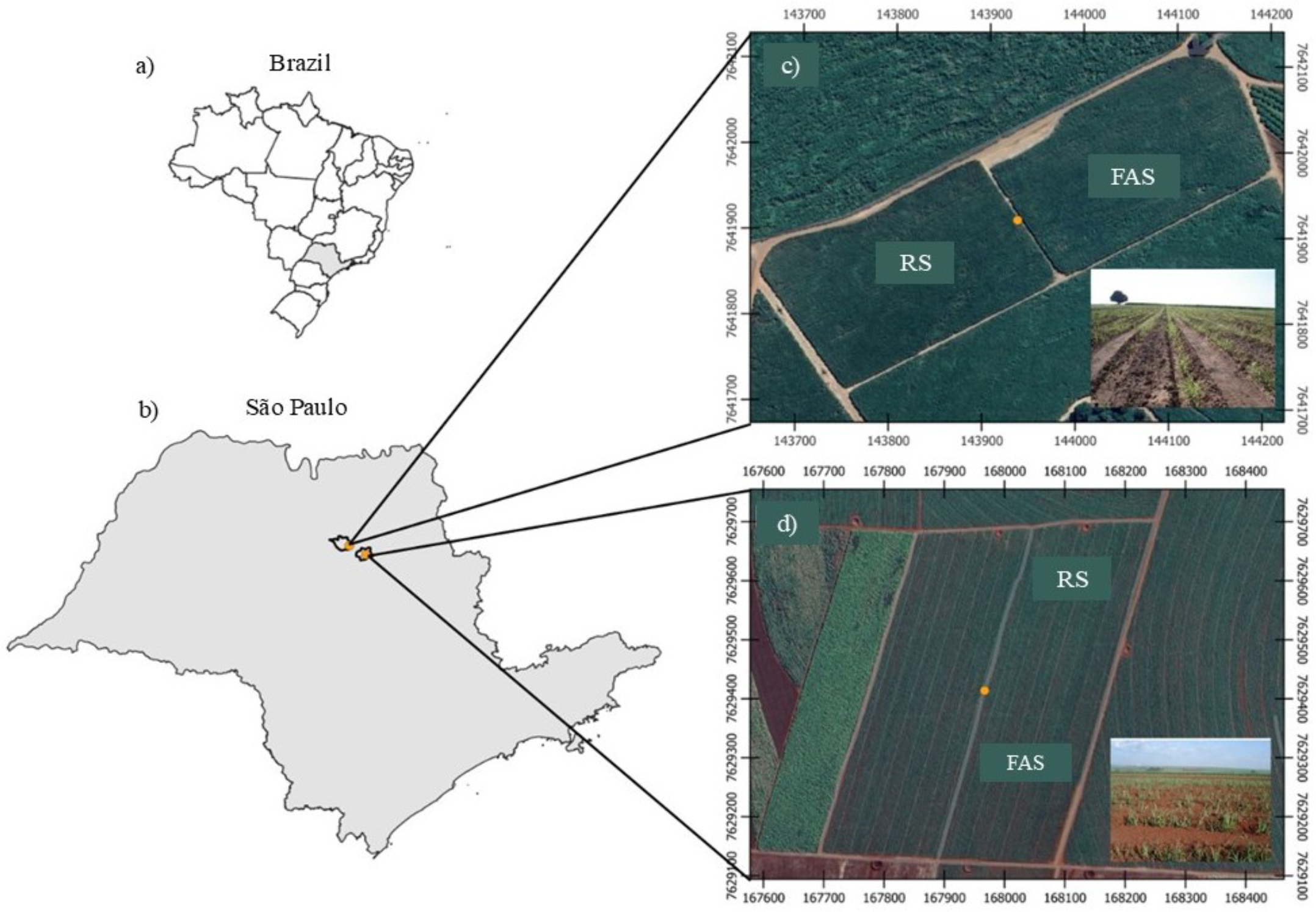
The experiment was conducted in two agricultural areas located in São Paulo state (SP), Brazil. The soil in the first area, situated near 21º24'25''S and 48º12'12''W, at an altitude of 618 meters, is classified as red Oxisol (RO), and in the second, located near 21º15'23''S and 48º25'52''W, at an altitude of 735 meters, as red-yellow Ultisol (RYU) (Figure 1).

Geographic location (Figures a and b) of the experimental areas under sugarcane cultivation following row (RS) and full-area scarification (FAS), in red-yellow Ultisol in the municipality of Monte Alto (Figure c), and red Oxisol in the municipality of Guariba (Figure d).
Both areas have been cultivated with sugarcane under mechanized harvesting for over 20 years. In the year the experiment was conducted, no crop rotation was performed. According to the Köppen climate classification, the region has a mesothermal climate with dry winters (Aw), and average annual rainfall of 1,400 mm, concentrated between November and February. The average temperatures in the hottest and coldest months are greater than 22 and 18 ºC, respectively.
Clay, sand, and silt contents were determined according to Teixeira et al. (2017), and sand particle size fractionation is presented in Table 1.
Mean clay, sand, and silt contents, and sand particle size fractionation in the 0.00-0.10 m and 0.10-0.20 m soil layers, submitted to row (RS) and full-area scarification (FAS).
Before the experiment was installed, the sugarcane ratoon from the previous production cycle was eliminated. In the RO area, a mechanical ratoon eliminator was used in November 2014. In the RYU area, chemical elimination was carried out in January 2015 with 4 L ha⁻1 of glyphosate. In soils with a sandier texture in the upper layers, such as the RYU in the study area, chemical ratoon elimination is preferred, since this type of soil is more susceptible to erosion than RO.
In the RO area, in December 2014, 1.5 t ha⁻1 of lime (35% CaO, 15% MgO, and a relative neutralizing power (RNP) of 81%) was applied to raise base saturation to 70% (RAIJ et al., 1997), along with 1.0 t ha⁻1 of agricultural gypsum. In the RYU area, in January 2015, 3.0 t ha⁻1 of dolomitic lime (35% CaO, 15% MgO, and RNP = 81%) was applied to raise base saturation to 70%, according to Raij et al. (1997), along with 1.0 t ha⁻1 of agricultural gypsum. Scarification was carried out on January 31, 2015 in RO and February 17, 2015, in RYU.
Treatments and experimental design
The experiment was conducted using large paired plots as recommended by Perecin et al. (2015), which allowed for soil preparation and mechanized sugarcane harvesting.
The experimental areas measured 10 ha in the RO and 9 ha in the RYU. Each area was divided into 20 plots, with 10 assigned to each treatment, approximately 0.5 ha for the RO area and 0.45 ha for the RYU. The treatments consisted of two soil scarification sites: row scarification (RS) and fullarea scarification (FAS).
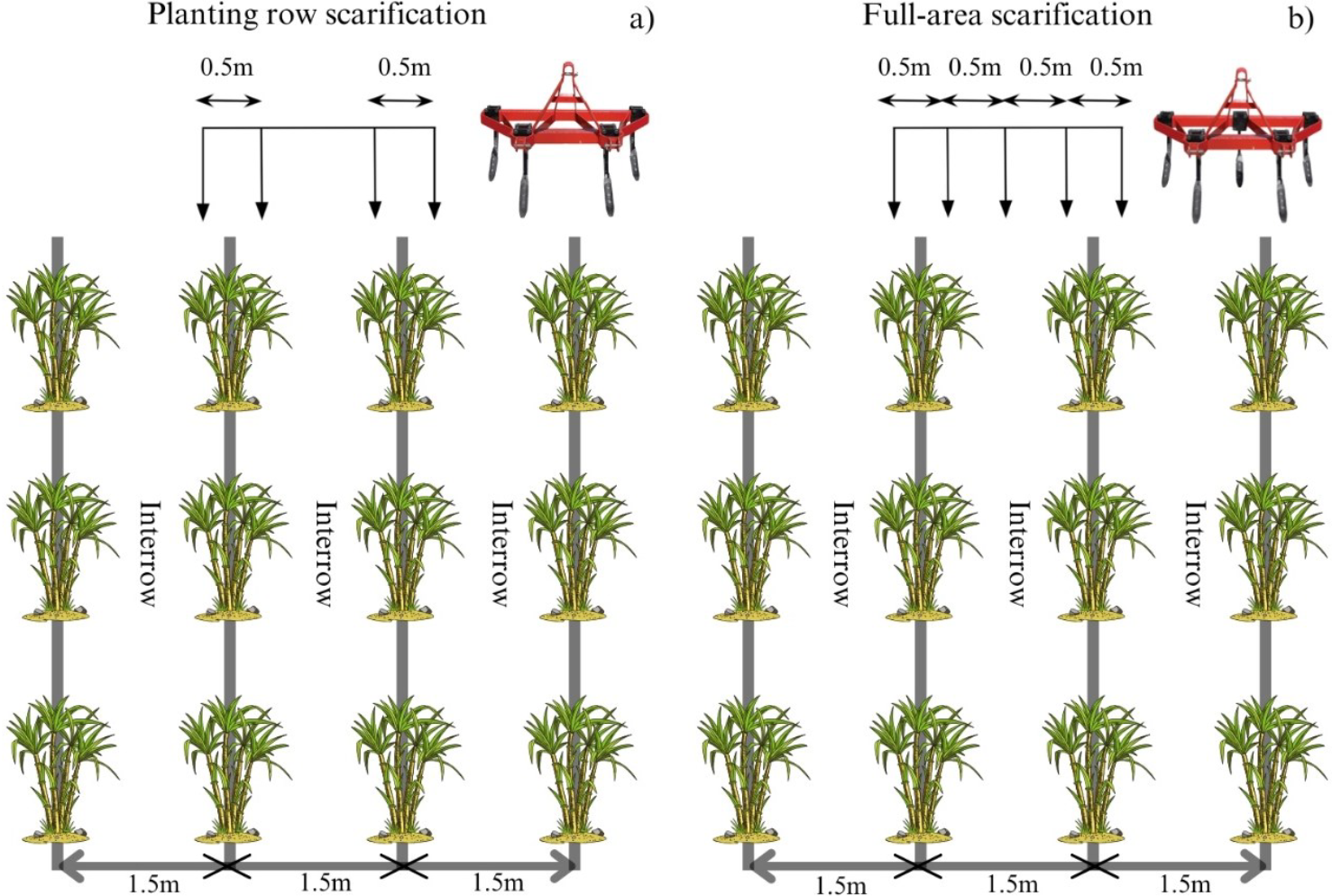
Row scarification (RS) was performed along the planting rows using a scarifier with two pairs of shanks spaced 1.5 m apart, with a working depth of 0.30 m. The distance between shanks in each pair was 0.50 m, and the scarifier was equipped with two clod-breaking rollers. For full -area scarification (FAS), a scarifier with five shanks spaced 0.50 m apart and a working depth of 0.30 m was used, also equipped with two clod-breaking rollers (Figure 2).
Schematic representation of soil preparation with scarification in the sugarcane planting row (a) and full-area scarification (b).
In the RO area, planting took place on March 7, 2015, using the CTC (Sugarcane Technology Center) 14 variety, and in the RYU area, on March 26, 2015, with the CTC 4 variety. In both areas, furrowing was conducted to a depth of 0.30 m, with 1.5 m between furrows. Fertilizer was applied at 45 kg ha⁻1 of N, 125 kg ha⁻1 of P₂O₅, and 125 kg ha⁻1 of K₂O, distributed in the furrow, according to Quaggio et al. (2022).
Soil sampling and studied variables
Soil sampling was carried out in September 2015, six months after sugarcane planting, in the 0.00-0.10 m and 0.100.20 m layers in the inter-rows (0.75 m from the plant base) and planting rows (0.20 m from the plant base) of both areas.
Undisturbed soil samples were collected using volumetric rings (diameter = 0.05 m and height = 0.05 m) with an Uhland auger. Three volumetric rings containing undisturbed soil samples were removed from each plot. In these samples, soil penetration resistance (PR) was determined according to Tormena, Silva and Libardi (1998), and soil bulk density (Ds), macroporosity (MaP), and microporosity (MiP) following the methodology described by Teixeira et al. (2017).
Sugarcane was mechanically harvested on July 1 and July 18, 2016, in the RO and RYU areas, respectively. In the ten plots per treatment, sugarcane was harvested using a “Case model 8800” harvester (358 hp, tracked type, with auto -tracker), which collected and transferred the harvested stalks into two containers equipped with load cells to measure stalk weight and calculate yield (t ha⁻1).
Average stalk production per area was determined in the plots of each treatment, which made it possible to calculate average stalk yield (t ha⁻1) in the two areas. Total recoverable sugar (TRS) was also determined. To that end, 10 stalks were collected from the plots of each treatment, then cut and stripped to determine the TRS content, expressed in kg t⁻1 of stalks, following the methodology described by Consecana (2006).
Statistical Analysis
Based on the six soil physical attributes (PR, Ds, MaP, MiP, clay, and sand) determined in the sampled layers of both soils, multivariate factor analysis was conducted to examine the intercorrelation structure between the physical attributes and the clusters formed by these attributes, influenced by scarification management.
Multivariate factor analysis was carried out using principal component extraction, with varimax normalized rotation to investigate the correlation structure between the variables (soil physical attributes), which defines a set of common latent dimensions called factors.
The rotation method aims to redistribute the variance of the first factors to the others until a simple significant factor pattern is achieved, making the result easier to interpret while preserving its statistical properties (HAIR-Jr et al., 2009). The extracted factors were selected based on Kaiser’s criterion, which suggests that only factors with eigenvalues greater than 1.00 should be retained. After this procedure, the factor loading matrix, communalities, and rotated factor scores were obtained, which represent the estimated contributions of the various factors at each original observation, in addition to being used for sample classification (LANDIM, 2011). Multivariate factor analysis was conducted using Statistica 7.0 software (StatSoft Inc., Tulsa, OK, USA).
The effects of scarification treatments (RS and FAS) and sampling location (inter-row and planting row) on the factor scores of the extracted coefficients (latent variables) from multivariate factor analysis in the sampled layers, six months after sugarcane planting, were submitted to analysis of variance. When F-values were significant, the mean factor scores of each extracted factor were compared using Tukey's test at p<0.05. The average stalk yield and TRS results were also submitted to analysis of variance and mean comparison using Tukey's test at p<0.05. Analysis of variance and Tukey’s test were carried out using SAS 9.2 statistical software.
RESULTS AND DISCUSSION
The descriptive statistics of the physical attributes in the 0.00-0.10 m and 0.10-0.20 m layers indicate that in both RO and RYU, there were no variations between mean PR, Ds, MaP, and MiP values when compared between sugarcane planting rows and inter-rows, suggesting that the sampling locations exhibited similar soil physical conditions (Table 2).
Mean ± standard deviation of the physical attributes soil penetration resistance (PR), bulk density (Ds), macroporosity (MaP), and microporosity (MiP) in the 0.00-0.10 m and 0.10-0.20 m layers, six months after planting, in the sugarcane rows and inter-rows in soils submitted to row and full-area scarification.
In the RO, two factors were extracted using multivariate factor analysis, which together explained 90% of the data variance (Table 3). This percentage means that the factors (Factor 1 and 2) generated contain a significant amount of information from the original variables.
Explained variance, communalities, and factor loadings extracted from the physical attributes of red Oxisol and red-yellow Ultisol, six months after sugarcane planting.
Factor 1 was formed by the attributes MiP, clay, and sand. The attributes PR, Ds, and MaP were responsible for forming Factor 2 (Table 3).
Factor 1 represents the clusters related to soil texture. In the RO, because of the predominance of the clay fraction over its sand counterpart, these attributes showed an inverse correlation, as can be seen from the opposite factor loadings (Table 3). In clayey soils, the clay particles organize into porous structural units, forming aggregates with pore spaces within (micropores) and between the aggregates (macropores). Given that micropores are spaces formed inside the aggregates, there is a direct correlation between micropore volume and clay content (BRADY; WEIL, 2013).
Factor 2 is related to soil structure. The attribute MaP was inversely correlated with PR and Ds. This indicates that the greater the macropore volume, the lower the Ds and, consequently, PR. These changes are related to changes in the soil mass-to-volume ratio (density) (KLEIN et al., 2008).
Soil management practices can alter the mass-tovolume ratio due to the rearrangement of soil particles after mechanical interventions such as soil scarification (DRESCHER et al., 2016). In this case, scarification increases MaP and reduces Ds and RP, respectively. By contrast, an increase in PR and Ds and a decline in MaP can occur due to the proximity of soil particles caused by natural processes, such as reconsolidation, or pressures exerted by machine traffic on the soil. In both cases, the rearrangement of soil particles reduces MaP and increases Ds and PR (OLIVEIRA et al., 2013).
In multivariate analysis of the RYU, two factors were extracted, which together explained 85 % of data variance (Table 3).
In the RYU, the physical attributes displayed a similar intercorrelation structure to that observed in the RO. However, there is a difference in the correlation structure of the factor loadings in Factor 1, since a direct correlation between sand and microporosity was observed, and both were inversely correlated with clay.
This is because the 0.00-0.10 m and 0.10-0.20 m layers consist predominantly of fine (0.25-0.125 mm) and very fine (0.125-0.05 mm) sand particles when compared to clay (Table 1). This results in the formation of micropores, whereby fine and very fine sand particles occupy the voids between medium and coarse sand particles (RIBEIRO et al., 2007).
In both soils assessed, the extracted factors (Factors 1 and 2) were not influenced (p<0.05) by the interaction between scarification and sampling site, as determined by analysis of variance (Tables 4 and 5).
Unfolding of the interaction between scarification and sampling site for the factor scores of the factors extracted in the 0.00-0.10 m and 0.10-0.20 m layers of the red Oxisol, six months after sugarcane planting.
Unfolding of the interaction between scarification and sampling site for the factor scores of the extracted factors in the 0.00-0.10 m and 0.10-0.20 m layers of the red-yellow Ultisol, six months after sugarcane planting.
Based on the information from Tables 4 and 5, it was found that seven months after soil preparation, corresponding to six months after planting, the RS and FAS treatments exhibited similar physical conditions for sugarcane root system development. This is due to soil reconsolidation, which can result from natural factors such as rainfall and wetting-drying cycles, or from the mechanical pressure exerted by machine traffic (REICHERT et al., 2017).
Souza et al. (2017) assessed the physical attributes of soils in the same experimental areas studied here immediately after soil preparation, and found changes in soil structure. In areas where soil scarification occurred (planting rows for RS and rows and inter-rows for FAS), higher MaP values and lower Ds and PR values were found when compared to the non-scarified area (inter-row area in the FAS treatment). However, as observed in the present study, the scarification effect did not last until six months after planting, with the sampling sites exhibiting similar physical conditions.
According to the literature, the effect of scarification on improving soil physical conditions after preparation is temporary (REICHERT et al., 2017; PINHEIRO; MELO; FERNADES, 2021). This is due to reconsolidation, which can occur in recently disturbed soils caused by climatic factors such as rainfall, wetting-drying cycles in the soil profile, and mechanical pressure from machine traffic during crop treatments (LOZANO et al., 2016).
In red Oxisol submitted to scarification, 12 years after no-till maize-wheat rotation, Silva et al. (2012) found that soil bulk density and compaction levels had returned to prescarification values six months after scarification. Drescher et al. (2016) observed that scarification-induced changes in soil bulk density, total porosity, and macroporosity in red Oxisol were maintained only in the first year of maize-wheat, soybean-rye, and maize/wheat-soybean cultivation, attributing this effect to soil structure reconsolidation.
Nagahama et al. (2016) found no effect on soil bulk density and soil penetration resistance in the 0.20-0.40 m layer, thirty days after scarification in dystrophic yellow Oxisol (90 g kg⁻1 clay and 878 g kg⁻1 sand), with a reduction in penetration resistance only in the 0.00-0.10 m layer. Lana et al. (2017) assessed the effect of soil preparation systems on the physical quality of a dystrophic red-yellow Oxisol (480 g kg⁻1 clay and 361 g kg⁻1 sand), and found that scarification did not alter the soil structure, showing a structural condition similar to that of areas cultivated with sugarcane and no soil preparation.
The average stalk yield and TRS in sugarcane were not affected by scarification. The F values indicated no significant difference between the treatments (RS and FAS) in either soil type (Table 6), suggesting that the physical attributes of soils submitted to RS and FAS provided similar physical conditions for sugarcane growth and development in both RS and RYU soils.
Analysis of variance for average stalk yield and TRS in sugarcane grown in soils submitted to row scarification (RS) and full-area scarification (FAS).
The average stalk yield in the plant crop was 103 t ha⁻1 in the RS with CTC 14, and 110 t ha⁻1 in the RYU with CTC 4 (Table 6), which aligns with the average regional yield. According to the Centro de Tecnologia Canavieira (CTC) (Sugarcane Technology Center), considering the soil and climate variations of each production environment, the varieties used here can potentially reach average yields of 110 t ha⁻1 for CTC 14 and 116 t ha⁻1 for CTC 4 in the first cutting (CTC, 2024).
According to Carvalho et al. (2011), in addition to stalk yield, TRS is one of the most important technological attributes for the sugar-energy sector, since it is directly related to the amount of raw material produced by the crop and available for conversion into sugar or alcohol
RTS represents the potential of the industry to recover the sugar contained in the cane, either as crystal sugar or ethanol. In this study, the average RTS values were 145 kg t⁻1 in the RO and 152 kg t⁻1 in the RYU. These results are similar to those reported by Tasso Júnior (2007), who studied medium-cycle cultivars in two municipalities in São Paulo state, and found RTS values between 137 and 166 kg t⁻1 at harvest. Alves et al. (2014) observed an average value of 161 kg t⁻1, which is within this range, as are the average RTS values of the two soils studied.
Based on the results obtained, it was found that the soils submitted to row and full-area scarification showed no significant difference in soil physical attributes at the two sampling sites (inter-row and planting row). Thus, these areas exhibited similar physical conditions that contributed to average stalk yield and the TRS content of sugarcane juice not being influenced by the treatments studied.
CONCLUSION
Row scarification can replace full-area scarification, given that the average stalk yield and TRS content in sugarcane were similar, regardless of the scarification method, with both red Oxisol and red-yellow Ultisol exhibiting similar physical conditions.
ACKNOWLEDGMENTS
We thank the Agronomy Graduate Program (Soil Science), CAPES for the funding provided, and FAPESP for financial assistance in conducting the research (grant no. 2014/14490-2).
REFERENCES
- ALVES, V. et al. Atributos tecnológicos, stand e produtividade da cana-planta correlacionados com aspectos da fertilidade do solo. Revista de Agricultura Neotropical, 1: 75-91, 2014.
- BORDONAL, R. O. et al. Sustainability of sugarcane production in Brazil. A review. Agronomy for Sustainable Development, 38: 1-23, 2018.
- BRADY, N. C.; WEIL, R. R. Elementos da natureza e propriedades dos solos 3. ed. Porto Alegre, RS: Bookman, 2013. 685 p.
- CARVALHO, L. A. et al. Produtividade e viabilidade econômica da cana-de-açúcar em diferentes sistemas de preparo do solo no centro-oeste do Brasil. Revista de Ciências Agrárias, 34: 199-211, 2011.
-
CONAB - Companhia Nacional de Abastecimento. Safra Brasileira de Cana-de-Açúcar. Produção de cana-deaçúcar na safra 2023/24 chega a 713,2 milhões de toneladas, a maior da série histórica Available at: <https://www.conab.gov.br/info-agro/safras/cana>. Access on: Sep. 2, 2024.
» https://www.conab.gov.br/info-agro/safras/cana - CONSECANA - Conselho dos Produtores de Cana-deAçúcar, Açúcar e Álcool do Estado de São Paulo. Manual de Instruções 5. ed. Piracicaba, SP: CONSECANA, 2006. 112 p.
-
CTC - Centro de Tecnologia Canavieira. Plante certezas Revista Variedades CTC Análise. Regional, MG: Triângulo. 2018. Available at: : <https://ctc.com.br/produtos/wp-content/uploads/2018/09/Revista-Minas-Tri%C3%A2ngulo-1.pdf>. Access on: Sep. 2, 2024.
» https://ctc.com.br/produtos/wp-content/uploads/2018/09/Revista-Minas-Tri%C3%A2ngulo-1.pdf - DRESCHER, M. S. et al. Duração das alterações em propriedades físico-hídricas de latossolo argiloso decorrentes da escarificação mecânica. Pesquisa Agropecuária Brasileira, 51: 159-168, 2016.
- HAIR-JR, J. F. et al. Análise multivariada de dados 6. ed. Porto Alegre, RS: Bookman, 2009. 688 p.
- KLEIN, V. A. et al. Porosidade de aeração de um Latossolo Vermelho e rendimento de trigo em plantio direto escarificado. Ciência Rural, 38: 365-371, 2008.
- LANA, R. M. Q. et al. Soil physical attributes and productivity of sugarcane under different cropping systems in the savannah goiano. Australian Journal of Crop Science, 11: 149-155, 2017.
- LANDIM, P. M. B. Análise estatística de dados geológicos multivariados 1. ed. São Paulo, SP: Oficina de textos, 2011. 208 p.
- LOZANO, L. A. et al. Soil physical quality and soybean yield as affected by chiseling and subsoiling of a no-till soil. Revista Brasileira de Ciência do Solo, 40: 1-12, 2016.
- MARTÍNI, A. F. et al. Soil physical quality response to management systems in a long-term sugarcane trial. Land Degradation and Development, 35: 1320-1334, 2024.
- MOITINHO, M. R. et al. Short-Term Soil CO2 Emission and Soil Attributes Under Contrasting Sugarcane Cultivars. Sugar Tech, 20: 658-668, 2018.
- NAGAHAMA, H. J. et al. Comunicação Efeitos da escarificação mecânica nos atributos físicos do solo e agronômicos do capim elefante. Revista Ceres, 63: 741-746, 2016.
- OLIVEIRA, P. R. et al. Qualidade estrutural de um latossolo vermelho submetido à compactação. Revista Brasileira de Ciência do Solo, 37: 604-612, 2013.
- OTTO, R. et al. High soil penetration resistance reduces sugarcane root system development. Soil and Tillage Research, 117: 201-210, 2011.
- PERECIN, D. et al. Statistical Analysis for Correlated Pairedplot Designs. American Journal of Experimental Agriculture, 9: 1-7, 2015.
- PINHEIRO, D. P.; MELO, N. C.; FERNANDES, C. Soil Quality Indicators in an Ultisol Subjected to Chiseling in a Sugarcane Crop Under Mechanized Management in Southeastern Brazil. Sugar Tech, 23: 1064-1074, 2021.
- QUAGGIO, J. A. et al. Cana-de-açúcar. In: CANTARELLA, H. et al. (Eds.). Boletim 100: recomendações de adubação e calagem para o Estado de São Paulo. Campinas, SP: IAC, 2022. v. 3, cap. 3, p. 177-186.
- RAIJ, B. et al. Recomendações de adubação e calagem para o Estado de São Paulo 2. ed. Campinas, SP: Fundação IAC, 1997. 285 p. (Boletim Técnico, 100).
- REICHERT, J. M. et al. Is chiseling or inverting tillage required to improve mechanical and hydraulic properties of sandy clay loam soil under long-term no-tillage? Geoderma, 301: 72-79, 2017.
- RIBEIRO, K. D. et al. Propriedades físicas do solo, influenciadas pela distribuição de poros, de seis classes de solos da região de Lavras-MG. Ciência e Agrotecnologia, 31: 1167-1175, 2007.
- SILVA, R. P.; FERNANDES, C. Soil uses during the sugarcane fallow period: influence on soil chemical and physical properties and on sugarcane productivity. Revista Brasileira de Ciência do Solo, 38: 575-584, 2014.
- SILVA, S. G. C. et al. Efeito temporal da escarificação sobre a compactação em Latossolo Vermelho sob sistema plantio direto. Revista Brasileira de Ciência do Solo, 36: 547-555, 2012.
- SOUZA, L. C. et al. Can partial cultivation of only the sugarcane row reduce carbon dioxide emissions in an oxisol and ultisol? Agronomy Journal, 109: 1-9, 2017.
- TASSO JÚNIOR, L. C. Caracterização agrotecnológica de cultivares de cana-de-açúcar (Saccharum spp.) na região centro-norte do Estado de São Paulo 2007. 167 f. Tese (Doutorado em Agronomia: Área de Concentração em Produção Vegetal) - Universidade Estadual Paulista, Faculdade de Ciências Agrárias e Veterinárias, Jaboticabal, 2007.
- TEIXEIRA, P. C. et al. Manual de métodos de análise de solo 3. ed. rev. e ampl. Brasília, DF: Embrapa, 2017. 574 p.
- TORMENA, C. A.; SILVA, A. P.; LIBARDI, P. L. Caracterização do intervalo hídrico ótimo de um latossolo roxo sob plantio direto. Revista Brasileira de Ciência do Solo, 22: 573-581, 1998.