Water-retaining polymer in okra cultivation under water replacement levels
ABSTRACT
The cultivation of okra [Abelmoschus esculentus (L.) Moench] has potential for expansion in Northeastern Brazil. However, irregular precipitation, associated with high evapotranspiration rates, is a limiting factor for agricultural development. In this context, the use of water-retaining polymers stands out as a promising alternative due to their capacity to retain water and ensure favorable conditions for plant growth. Thus, the present study aimed to evaluate the effects of a water-retaining polymer on the growth, production, and fruit quality of okra under different water replacement levels. The experiment was conducted in a greenhouse at CCTA/UFCG, Pombal Campus, PB, Brazil. The experimental design was a randomized block in a 5 x 4 factorial scheme, corresponding to five water replacement levels (40, 60, 80, 100, and 120% of the actual evapotranspiration - ETr) and four doses of a water-retaining polymer (0, 1.0, 2.0, and 3.0 g L-1), with three replications. A water replacement level of 80% ETr resulted in the greatest growth and production of okra cv. Carcará. Both deficit and excess water replacement caused growth inhibition and a decrease in the number of fruits. The application of the water-retaining polymer at a dose of 3.0 g L-1 had a beneficial effect on the growth, fresh mass, and mean diameter of the fruits, being indicated for okra cultivation in semiarid areas. Irrigation with 40% ETr combined with a 1.3 g L-1 of the water-retaining polymer increased the ascorbic acid content in the fruits of okra cv. Carcará.
RESUMO
A cultura do quiabeiro [Abelmoschus esculentus (L.) Moench] apresenta potencial de expansão no Nordeste brasileiro. No entanto, a irregularidade de precipitações, associada às elevadas taxas de evapotranspiração, é um fator limitante para o desenvolvimento das culturas agrícolas. Nesse contexto, a utilização de polímero hidroretentor destaca-se como uma alternativa promissora por sua capacidade de retenção de água e garantir condições favoráveis ao crescimento vegetal. Desta forma, objetivou-se com a presente pesquisa avaliar os efeitos do polímero hidroretentor no crescimento, na produção e na qualidade de frutos de quiabeiro sob níveis de reposição hídrica. O experimento foi realizado em casa-de-vegetação do CCTA/UFCG, Campus Pombal-PB, Brasil. O delineamento experimental foi de blocos casualizados, em arranjo fatorial 5 × 4, correspondente a cinco níveis de reposição hídrica (40, 60, 80, 100 e 120% da evapotranspiração real - ETr) e quatro doses de polímero hidroretentor (0; 1,0; 2,0 e 3,0 g L-1) com três repetições. A reposição hídrica de 80% da ETr resultou em maior crescimento e produção de quiabeiro cv. Carcará. O déficit ou excesso na reposição hídrica do quiabeiro ocasionou inibição no crescimento e diminuição no número de frutos. A aplicação do polímero hidroretentor na dose de 3,0 g L-1 proporcionou efeito benéfico no crescimento e na massa fresca e diâmetro médio de frutos, sendo indicada para o cultivo de quiabeiro em área semiárida. A irrigação com 40% da ETr em combinação com 1,3 g L-1 do polímero hidroretentor aumentou os teores de ácido ascórbico nos frutos de quiabeiro cv. Carcará.
Palavras-chave:
Abelmoschus esculentus (L.) Moench; Water deficit; Semiarid region
INTRODUCTION
Okra [Abelmoschus esculentus (L.) Moench], a vegetable crop belonging to the Malvaceae family, produces edible fruits rich in nutrients, particularly zinc, a mineral essential for the proper functioning of human body tissues (LIMA; SOUSA; LIMA, 2015). It is a widely produced vegetable in Brazil, with approximately 111.96 tons of okra produced in 2017. The Northeast is the second-largest producer in Brazil, with 32,337 tons (IBGE, 2017). However, the semiarid region of Northeastern Brazil is affected by the scarcity of water resources in both quantity and quality (DIAS et al., 2019), due to irregular precipitation and high evapotranspiration rates throughout most of the year (LIMA et al., 2020).
Water deficit stands out as one of the main limitations to plant growth and development, especially in arid and semiarid regions. Insufficient soil moisture can promote physiological and biochemical alterations in plants, including reduced growth rates, lower photosynthetic efficiency, decreased chlorophyll content, and interruption of nutrient transport (INGRAO et al., 2023). Furthermore, water deficiency can lead to crop yield losses, thereby reducing agricultural production and posing a substantial challenge to global food security (HE; ROSA, 2023). Given these water limitations, technologies such as the use of water-retaining polymers have been explored as an alternative to optimize water availability in the soil in areas under water-restricted conditions (FERREIRA et al., 2014; KUJUR et al., 2022).
A water-retaining polymer is a synthetic or natural soil conditioner composed of three-dimensional polymer networks. It can optimize fertilizer use and maintain moisture in the plant root zone, which favors the dilution of salts and water absorption (NEVES et al., 2021). When incorporated into the soil, the water-retaining polymer significantly improves the soil's physical-hydraulic properties, increasing soil moisture retention and decreasing water evaporation rates (YANG et al., 2014).
Kujur et al. (2022), when evaluating the effects of applying a water-retaining polymer to okra cultivation, concluded that there was a positive effect on all of the crop's growth variables. In a study assessing the efficiency of a water-retaining polymer in seedlings of seedless tangerine cultivars, Ferreira et al. (2014) observed that the effect of this soil conditioner on maintaining the water status of citrus seedlings is variable and dependent on physiological mechanisms of response to water deficit.
Although there are several reports in the literature on the use of water-retaining polymers and their effects on the physical-hydraulic properties of soils, there are still few studies that address their use in okra cultivation under water stress. The study's hypothesis is that the application of a water-retaining polymer contributes to an increase in soil moisture, reduces irrigation frequency, provides a continuous supply of water to the plants, enhances nutrient absorption, and favors the cultivation of okra in areas under water restriction.
Given the above and considering the importance of the okra crop in Brazilian agribusiness and the need for research that evaluates the potential of water-retaining polymers as a mitigator of water stress, the objective of this research was to evaluate the effects of different doses of water-retaining polymers on the growth, production, and fruit quality of okra under different water replacement levels.
MATERIAL AND METHODS
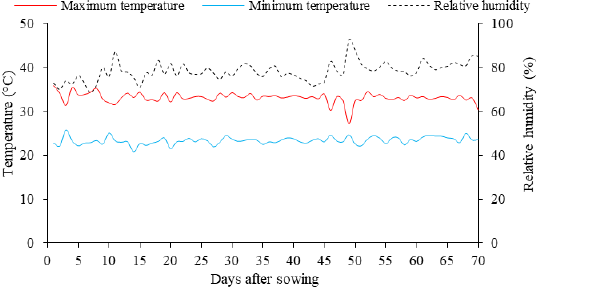
The research was conducted from February to April 2024 under greenhouse conditions at the Center of Science and Agri-Food Technology (CCTA) of the Federal University of Campina Grande (UFCG), Pombal Campus, Paraíba, Brazil, located at the geographical coordinates 6º48'16" S, 37º49'15" W, at an altitude of 144 m. The temperature and relative air humidity data collected inside the greenhouse during the research period are presented in Figure 1.
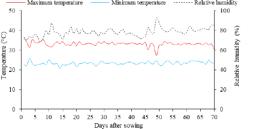
Meteorological data recorded inside the greenhouse during the experimental period from February 1 to April 10, 2024.
The treatments were arranged in a randomized block design with a 5 x 4 factorial scheme, consisting of the combination of two factors: five water replacement levels (40, 60, 80, 100 - Control, and 120% of the actual crop evapotranspiration - ETr) and four concentrations of a water-retaining polymer (0, 1.0, 2.0, and 3.0 g L-1). The experiment was conducted with three replications and one plant per plot, totaling 60 experimental units. The water replacement levels were defined based on a study by Soares et al. (2015). The 120% ETr level was established to simulate the sporadic occurrence of high-volume precipitation in the Brazilian semiarid region, which can impose stress due to excess water, in contrast to the water restriction that occurs during most of the year.
In this study, the okra cultivar 'Carcará' was used, which is characterized by its tall height, vegetative vigor, and high yield. Its fruits are ridged, have a bright purple color, and are recognized for their distinct flavor. The cultivar also stands out for its good adaptation to hot and mild climates, as well as its tolerance to powdery mildew (ISLA, 2025). This cultivar was chosen based on its agronomic characteristics, adaptation to semiarid conditions, and powdery mildew tolerance.
The plants were cultivated in 20 L pots adapted as drainage lysimeters. Each experimental unit was perforated at the base and equipped with a 4 mm transparent drain. The end of the drain inside the pot was covered with a non-woven geotextile fabric (Bidim OP 30) to prevent clogging by soil particles. The drained water was collected in plastic bottles attached to the end of the drain outside the pot, allowing for the quantification of the drained volume and the estimation of the plant's water consumption.
The lysimeters were filled with an initial layer of 0.5 kg of gravel, followed by 23.5 kg of a Neossolo Regolítico (Psamment) with a sandy loam texture, which had been previously pounded to break up clods and homogenized. A composite soil sample was collected from the 0-30 cm depth layer (A horizon). Before the experiment began, the soil sample was sent to the Laboratory of Irrigation and Salinity (LIS) at CTRN/UFCG for the determination of its chemical and physical-hydraulic parameters, following the procedures of Teixeira et al. (2017). The results are presented in Table 1.
Chemical and physical characteristics of the soil (0-0.30 m depth) used in the experiment, before the application of treatments.
Top-dressing fertilization with nitrogen, potassium, and phosphorus was performed based on the recommendations of Novais, Neves and Barros (1991). The equivalent of 100, 150, and 300 mg kg-1 of substrate of N, K2O, and P2O5, respectively, were applied in four applications via fertigation at 10-day intervals, beginning at 10 days after sowing (DAS). Ammonium sulfate, potassium chloride, and monoammonium phosphate were used as the sources for N, K2O, and P2O5, respectively. For micronutrients, Dripsol Micro® (composition: 1.2% magnesium, 0.85% boron, 3.4% iron, 4.2% zinc, 3.2% manganese, 0.5% copper, and 0.06% molybdenum) was applied as a foliar spray at a concentration of 1.0 g L-1 at 15-day intervals, totaling four applications.
Sowing was carried out by distributing five seeds per lysimeter, arranged equidistantly at a depth of 2 cm. After seedling emergence, two thinning procedures were conducted: the first when the plants had two pairs of true leaves, and the second at the three-pair stage, leaving only a single plant per container at the end. The water-retaining polymer was incorporated into the soil in its hydrated form during the filling of the lysimeters. Initially, half the lysimeter volume was filled with soil without the polymer; then, the polymer was homogeneously incorporated into the remaining soil layer. After filling, the soil was irrigated to attain field capacity (100%) to favor the polymer's hydration. The water-retaining polymer used was Forth Gel for Planting® (CEC 532.26 cmolc dm-3; WHC 1,526.69%). Sowing was performed ten days after the hydration process.
The actual crop evapotranspiration (ETr) was determined using the drainage lysimetry method (BERNARDO; SOARES, A. A.; MANTOVANI, 2019). The water consumption of the plants was measured from the control treatment (100% ETr), obtained by the difference between the volume of water applied (Va) and the volume drained in the previous irrigation (Vd). The resulting consumed volume (Vc) was then multiplied by the factors 0.40, 0.60, 0.80, and 1.20 to estimate the 40%, 60%, 80%, and 120% ETr depths, respectively. For the first 10 DAS, all treatments were irrigated to maintain soil moisture near the maximum water retention capacity. After this period, irrigations were performed manually on a daily basis, considering the pre-established water replacement depths.
At 60 DAS, when the plants were in the full fruiting stage, growth evaluations were performed. The measurements included: plant height (PH), measured with a graduated tape measure (cm); stem diameter (SD), measured at 2 cm above the soil with a digital caliper and expressed in mm; number of leaves (NL), by simple counting of leaves longer than 3 cm; and leaf area (LA), which was estimated with a graduated ruler according to Fideles Filho, Beltrão and Pereira (2010), using Equation 1.
Where:
Y - leaf area of the plant (cm2); and
x- midrib length (cm).
Harvesting was performed continuously between 49 and 70 DAS, as fruits reached 12-18 cm in length. At this time, the following production variables were measured: fresh fruit mass (FFM), total number of fruits (TNF), average fruit weight (AFW), mean fruit length (MFL), and mean fruit diameter (MFD). FFM was measured by weighing all harvested fruits from each experimental plot. TNF was obtained by summing the fruits produced per plant. AFW was established by the ratio of the fresh fruit mass to the total number of fruits per plant. MFL was measured on all collected fruits from the peduncle to the fruit's apex using a graduated ruler. MFD was measured on the transversal axis of the fruit using a digital caliper.
For chemical characterization, five fruits per plant from each treatment were collected in a single sampling. The contents of soluble solids (SS), titratable acidity (TA), and ascorbic acid (AA) were evaluated. SS were determined from the pulp of the fruits with the peel, using a digital refractometer with automatic temperature compensation, with readings performed in triplicate. The determination of TA was carried out by titration with a 0.1 N NaOH solution, in triplicate. A 3 g aliquot of the fruit extract was placed in a 125 mL beaker, to which 47 mL of distilled water was added and stirred. Subsequently, three drops of 5% phenolphthalein indicator were added, and the titration was performed with the 0.1 N NaOH solution until a pink color was achieved (IAL, 2008). Titratable acidity was expressed as % nitric acid.
Ascorbic acid contents were obtained by titration, by weighing 3.0 g of the extract sample in an Erlenmeyer flask and adding 47 mL of oxalic acid solution for dilution. Subsequently, the titration was performed with a 2,6-dichlorophenol-indophenol (DCPIP) solution until a pink color persisted, and the volume used was recorded. The results, expressed as mg 100g-1 of the sample, were obtained using Equation 2.
Where:
V - volume of DCPIP used to titrate the sample (mL);
F - correction factor for the solution normality;
and Pa - sample mass (g).
The data obtained were evaluated for normality (Shapiro-Wilk test) and homogeneity of variances (Bartlett's test). Subsequently, the data were subjected to an analysis of variance (ANOVA) by the F-test (p ≤ 0.05). When significant, polynomial regression analysis was performed for the water replacement levels and the water-retaining polymer doses, using the SISVAR - ESAL software. In cases of a significant interaction between factors, response surface curves were generated using SigmaPlot® software.
RESULTS AND DISCUSSION
There was a significant effect of the water replacement levels (WRL) on plant height (PH), stem diameter (SD), and number of leaves (NL) (Table 2). Meanwhile, the water-retaining polymer doses (WPD) significantly influenced PH and SD. The interaction between the factors (WRL x WPD) showed no significant effect on any of the evaluated growth variables for the okra plants cv. Carcará.
Summary of the analysis of variance for plant height (PH), stem diameter (SD), number of leaves (NL), and leaf area (LA) of okra plants cv. Carcará grown under different water replacement levels and water-retaining polymer concentrations.
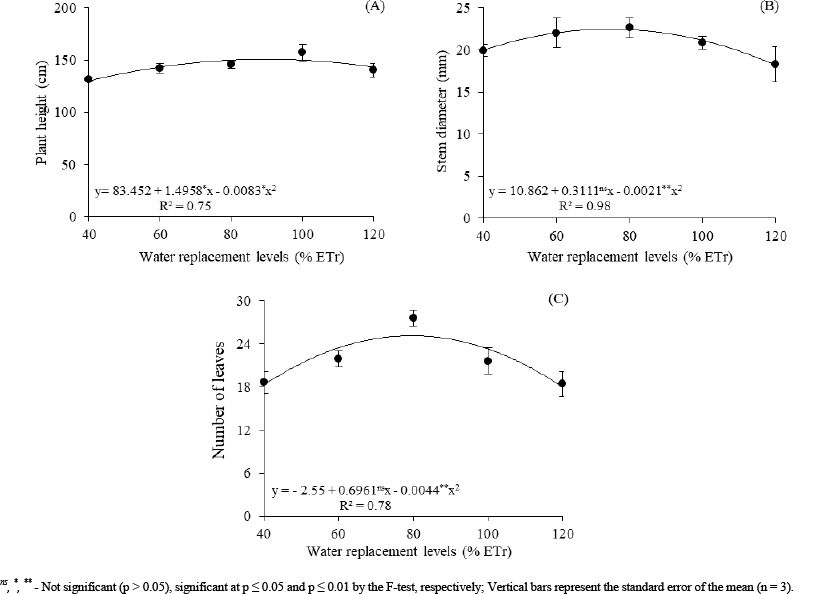
The water replacement levels influenced plant growth in a quadratic manner, with optimal values for plant height (150.84 cm), stem diameter (22.38 mm), and number of leaves (24.98) being achieved at 90%, 74%, and 79% ETr, respectively (Figures 2A, 2B, 2C). Growth was restricted under both severe deficit (40% ETr) and excess water (120% ETr). The deficit likely limited water and nutrient uptake, affecting cell turgor, while excess water can impair root respiration and ATP production (ZHOU et al., 2020).
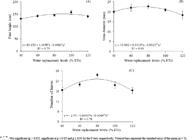
Plant height (A), stem diameter (B), and number of leaves (C) of okra plants cv. Carcará, as a function of water replacement levels, at 60 days after sowing.
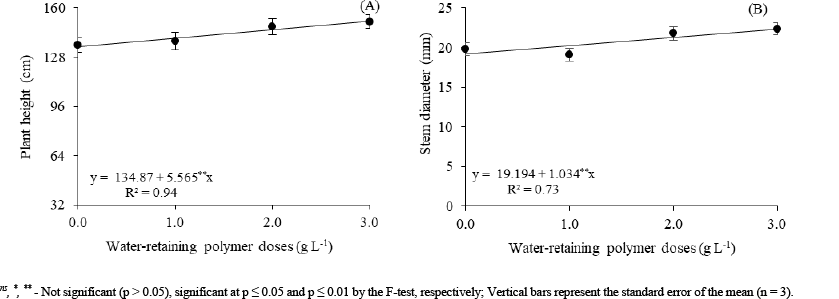
The application of the water-retaining polymer linearly increased plant height and stem diameter (Figures 3A, 3B), with the highest dose (3.0 g L-1) increasing these parameters by 12.37% and 16.16%, respectively, compared to the control. This positive effect can be attributed to the polymer's ability to maintain moisture near the root system. Due to their hydrophilic properties, hydrogels expand upon absorbing water, reducing porous drainage space, which in turn decreases water and nutrient leaching losses (FELIPPE et al., 2021; ABDELGHAFAR; ABDELFATTAH; MOSTAFA, 2024).
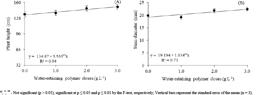
Plant height (A) and stem diameter (B) of okra plants cv. Carcará, as a function of water-retaining polymer doses, at 60 days after sowing.
There was no significant effect of the interaction between water replacement levels (WRL) and water-retaining polymer doses (WPD) for any of the measured variables of production (Table 3). As a main effect, the water replacement levels significantly influenced the total number of fruits, mean fruit diameter, and average fruit weight of the okra plants. The water-retaining polymer doses, also as a main effect, significantly affected the total fresh fruit mass and mean fruit diameter.
Summary of the analysis of variance (ANOVA) for fresh fruit mass (FFM), total number of fruits (TNF), mean fruit diameter (MFD), mean fruit length (MFL), and average fruit weight (AFW) of okra cv. Carcará, grown under different water replacement levels and water-retaining polymer doses.
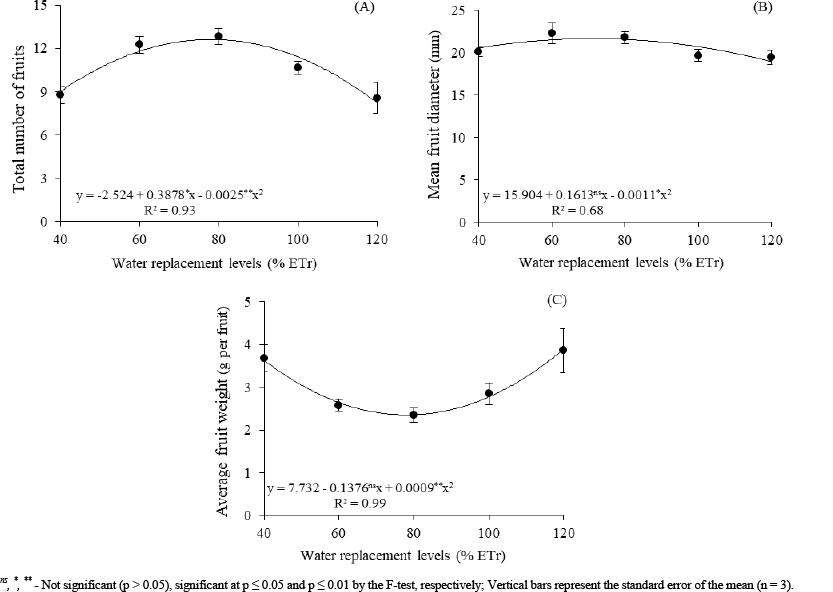
The total number of fruits (Figure 4A) and mean fruit diameter (Figure 4B) exhibited a quadratic response to the water replacement levels, with maximum values (12.51 fruits per plant and 21.81 mm) obtained at 78% and 74% ETr, respectively. Both deficit (40% ETr) and excess (120% ETr) water conditions were detrimental to these variables. This outcome is likely a consequence of the observed limitations on plant growth; the reduction in leaf number, in particular, would have decreased the photosynthetically active area, while the increased energy expenditure needed to maintain metabolic activity under stress would have diverted resources away from fruit production and development (KAPOOR et al., 2020).
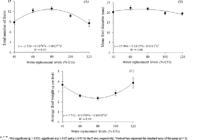
Total number of fruits (A), mean fruit diameter (B), and average fruit weight (C) of okra fruits cv. Carcará, as a function of water replacement levels.
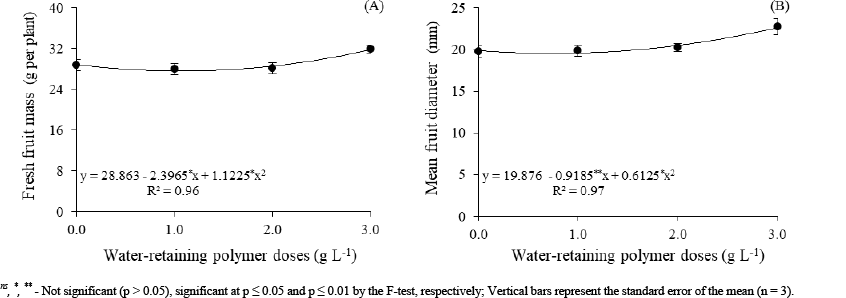
Regarding the average fruit weight (Figure 4C), it was observed that irrigation with an 80% ETr depth led to the lowest value (2.48 g per fruit), with an increase observed from this depth onward, reaching a 68.27% increase (4.18 g per fruit) as the water replacement was incremented to 120% ETr. The effects observed on AFW are related to the reduction in the quantity of fruits, which maintains a high translocation of photoassimilates to the fruits remaining on the plant (CONSTANTINESCU et al., 2016). With respect to fresh fruit mass (Figure 5A) and mean fruit diameter (Figure 5B), it is observed that the 3.0 g L-1 dose of the water-retaining polymer promoted the highest values (31.77 g per plant and 22.63 mm). Conversely, estimated water-retaining polymer doses of 1.10 and 0.20 g L-1 resulted in the lowest values for FFM and MFD of 27.58 g per plant and 19.71 mm, respectively.
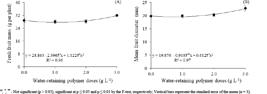
Fresh fruit mass (A) and mean fruit diameter (B) of okra fruits cv. Carcará, as a function of water-retaining polymer doses.
The highest values of FFM and AFW obtained under the 3.0 g L-1 dose of the water-retaining polymer may be related to a balance in the plant's water flow, maintaining the investment of solutes destined for fruit filling (BADR et al., 2024). Furthermore, the water-retaining polymer contributes to the absorption of nutrients from the soil solution, such as nitrogen and magnesium, which act directly in the photosynthetic metabolism of plants (SITA et al., 2005). Melo, Silva and Silva (2021), in a study conducted with watermelon under different irrigation schedules and the application of a water-retaining polymer (1 kg diluted in 400 L of water), found that the use of the polymer positively influenced fruit weight.
The interaction between the factors (WRL x WPD) significantly affected the ascorbic acid content in the okra fruits (Table 4). The water replacement levels significantly affected all measured variables. The water-retaining polymer doses had a significant effect on the soluble solids and titratable acidity of the okra fruits cv. Carcará.
Summary of the analysis of variance for soluble solids (SS), titratable acidity (TA), and ascorbic acid (AA) of okra fruits cv. Carcará, grown under different water replacement levels and water-retaining polymer concentrations.
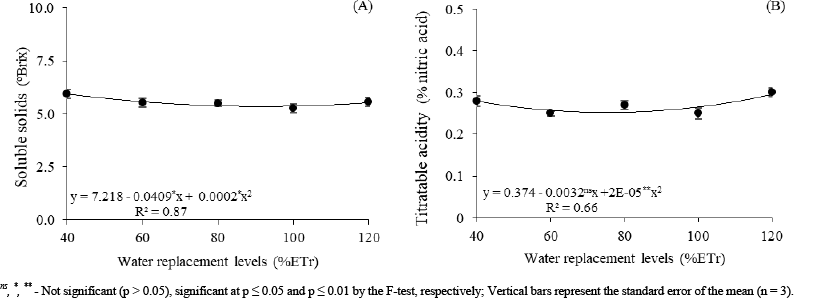
For the soluble solids content (Figure 6A), irrigation with the 100% ETr depth led to the lowest value (5.19 ºBrix). Conversely, plants irrigated with 40% ETr obtained the highest SS content (5.90 ºBrix), representing a 15.11% increase over the lowest recorded value. This behavior may be associated with the translocation of solutes to the fruit under water restriction, due to alterations imposed on the plant's physiological and metabolic activity (HOU et al., 2020), thus corroborating that a reduction in fruit size establishes a higher sap concentration relative to the mass produced. The deficit imposed by the 40% ETr depth may have contributed to the synthesis of soluble sugars and is possibly associated with complex metabolic activities, where sugars act as signaling agents and are part of the antioxidant system that controls the production of reactive oxygen species (SADDHE; MANUKA; PENNA, 2021). On the other hand, full irrigation (100% ETr) may have promoted a dilution effect of the soluble solids, resulting in a decrease in the SS content of the okra fruits.
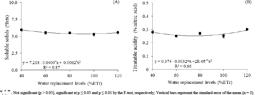
Soluble solids (A) and titratable acidity (B) of okra fruits cv. Carcará, as a function of water replacement levels.
Titratable acidity had its lowest values in plants under the 80% ETr water replacement level, with a value of 0.246% (Figure 6B). However, at the two extremes of water replacement (40% and 120% ETr), a value of 0.278% was observed, which is 13.01% higher than that established at the 80% ETr depth. This increase may be associated with the maintenance of the fruits' antioxidant protection under abiotic stress conditions (KAPOOR et al., 2020). An increment in TA is important when considering the use of okra fruits in the industry, as it reduces the need for acidifiers, contributing to the maintenance of nutritional and organoleptic quality, which is an essential attribute for postharvest determination (BRASIL et al., 2016).
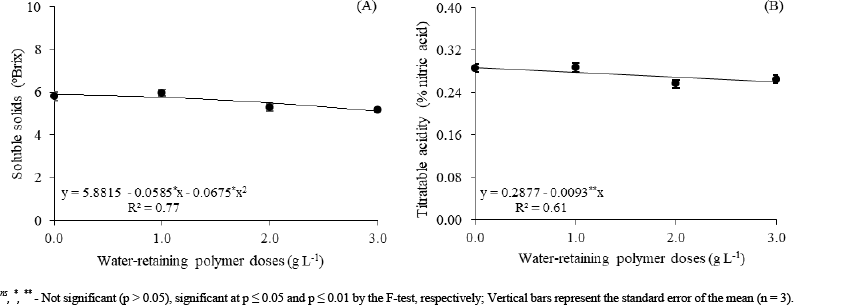
The application of the water-retaining polymer resulted in a decrease in the soluble solids and titratable acidity of the okra fruits (Figures 7A and 7B). For soluble solids, the maximum value (5.88 ºBrix) was estimated at a polymer dose of 0 g L-1 (no application). On the other hand, the lowest SS content (5.09 ºBrix) was obtained in plants that received 3.0 g L-1 (Figure 7A). The titratable acidity of the okra fruits decreased linearly (Figure 7B), with a reduction of 3.23% for each unit increase in the polymer dose. When comparing the plants cultivated under the 3.0 g L-1 dose with those that did not receive the water-retaining polymer (0 g L-1), a 9.69% decrease in TA was verified. This may be related to the gains in fresh mass of fruits and fruit diameter from the application of the water-retaining polymers, which dilutes the products formed in the fruit (LOPRESTI et al., 2014), and to the synthesis of enzymes that cause the production of acid compounds, such as malic acid (SANTOS et al., 2019).
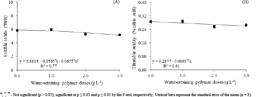
Soluble solids (A) and titratable acidity (B) of okra fruits cv. Carcará, as a function of water-retaining polymer doses.
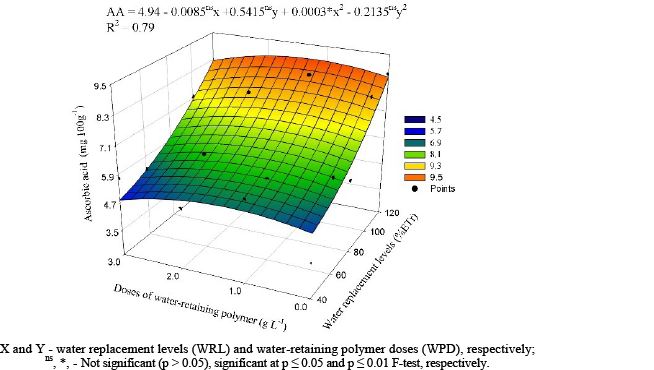
For the ascorbic acid content, the application of the polymer at a dose of 1.0 g L-1 caused an increment in the AA levels, reaching the maximum estimated value (8.56 mg 100g-1) under irrigation with 120% ETr (Figure 8). On the other hand, the application of the water-retaining polymer at a dose of 3.0 g L-1 led to the lowest AA value (4.78 mg 100g-1) in plants cultivated under 40% ETr.
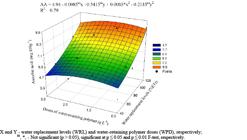
Effect of the interaction between water replacement levels and water-retaining polymer doses on the ascorbic acid (AA) content of okra fruits cv. Carcará.
Considering the functions of ascorbic acid in the plant's antioxidant defense, the reduction in the AA content of the fruits under the water deficit condition (40% ETr) may be associated with this substance being utilized to improve electron flow and maintain the photosynthetic rate in the shoots, thereby reducing its production and translocation to the fruit (ZHOU et al., 2020).
CONCLUSIONS
A water replacement level of 80% of the actual evapotranspiration results in greater growth and production of okra cv. Carcará. Both water deficit and excess inhibit the growth and decrease the number of fruits in okra cultivation. The application of a water-retaining polymer at a dose of 3.0 g L-1 promotes a beneficial effect on the growth, fresh mass, and mean diameter of the fruits, and is therefore indicated for okra cultivation in semiarid areas. Irrigation with 40% ETr combined with a 1.3 g L-1 concentration of the water-retaining polymer increases the ascorbic acid content in okra fruit.
Data Availability:
The data that support the findings of this study can be made available, upon reasonable request, from the corresponding author.
ACKNOWLEDGMENTS
To the INCT in Sustainable Agriculture in the Tropical Semi-Arid Region - INCTAgriS (CNPq/Funcap/Capes), processes 406570/2022-1 (CNPq) and INCT Process - 35960-62747.65.95/51 (Funcap).
REFERENCES
- ABDELGHAFAR, R.; ABDELFATTAH, A.; MOSTAFA, H. Effect of super absorbent hydrogel on hydro-physical properties of soil under defcit irrigation. Scientifc Reports, 14: 7655, 2024.
- BADR, E. A. et al. Enhancing canola yield and photosynthesis under water stress with hydrogel Polymers. Phyton, 93: 1623-1645, 2024.
- BERNARDO, S.; SOARES, A. A.; MANTOVANI, E. C. Manual de irrigação 8. ed. Viçosa, MG: UFV. 2013. 625 p.
- BRASIL, A. S. et al. Avaliação da qualidade físico-química de polpas de fruta congeladas comercializadas na cidade de Cuiabá MT. Revista Brasileira de Fruticultura, 38: 167-175, 2016.
- CONSTANTINESCU, D. et al. Model-assisted estimation of the genetic variability in physiological parameters related to tomato fruit growth under contrasted water conditions. Frontiers in Plant Science, 7: 1841, 2016.
- DIAS, A. S. et al. Gas exchanges, quantum yield and photosynthetic pigments of West Indian cherry under salt stress and potassium fertilization. Revista Caatinga, 32: 429-439, 2019.
- FELIPPE, D. et al. Hydrogel in the seedling growth of Eucalyptus dunnii Maiden under different irrigation management. Revista Ambiente & Água, 1: 1-11, 2021.
- FERREIRA, E. A. et al.. Eficiência do hidrogel e respostas fisiológicas de mudas de cultivares apirênicas de citros sob déficit hídrico. Pesquisa Agropecuária Tropical, 44: 158-165, 2014.
- FIDELES FILHO, J.; BELTRÃO, N. E. M.; PEREIRA, A. S. Desenvolvimento de uma régua para medidas de área foliar do algodoeiro. Revista Brasileira de Engenharia Agrícola e Ambiental, 14: 736-741, 2010.
- HE, L.; ROSA, L. Solutions to agricultural green water scarcity under climate change. PNAS Nexus, 2: e117, 2023.
- HOU, X. et al. Responses of water accumulation and solute metabolism in tomato fruit to water scarcity and implications for main fruit quality variables. Journal of Experimental Botany, 71: 1249-1264, 2020.
- IAL - Instituto Adolfo Lutz. Normas analíticas do Instituto Adolfo Lutz v. 1: Métodos químicos e físicos para análise de alimentos. 3. ed. São Paulo, SP: IMESP, 2008. 1020 p.
-
IBGE - Instituto Brasileiro de Geografia. Censo agropecuário 2017: resultados preliminares 2017. Available at: <https://www.ibge.gov.br/explica/producao-agropecuaria/quiabo/br> Access on: April. 5, 2025.
» https://www.ibge.gov.br/explica/producao-agropecuaria/quiabo/br - INGRAO, C. et al. Water scarcity in agriculture: an overview of causes, impacts and approaches for reducing the risks. Cell Press, 9: e18507, 2023.
-
ISLA. Quiabo Carcará. Available at: https://www.isla.com.br/quiabo-carcara-env-linha-super-und-579-61 Access on: Oct. 23, 2025.
» https://www.isla.com.br/quiabo-carcara-env-linha-super-und-579-61 - KAPOOR, D. et al. The impact of drought in plant metabolism: How to exploit tolerance mechanisms to increase crop production. Applied Sciences, 10: e5692, 2020.
- KUJUR, A. N. et al. Effect of hydrogel with and without vermicompost on yield and yield attributes of okra (Abelmoschus esculentus) in acid alfisol of Ranchi. The Pharma Innovation Journal, 11: 1651-1655, 2022.
- LIMA, F; SOUSA, A. P. B; LIMA, A. Propriedades nutricionais do maxixe e do quiabo. Revista Saúde em Foco, 2: 113-129, 2015.
- LIMA, G. S. et al. Gas exchange, chloroplast pigments and growth of passion fruit cultivated with saline water and potassium fertilization. Revista Caatinga, 33: 184-194, 2020.
- LOPRESTI, J. et al. Variability in size and soluble solids concentration in peaches and nectarines. Horticultural Reviews, 42: 253-312, 2014.
- MELO, R. E.; SILVA, A. E. B.; SILVA, J. R. Turnos de rega e polímero hidroretentor na qualidade de frutos de melancia em condições de semiárido. Revista Eletrônica Cientifica Inovação e Tecnologia, 12: 22-33, 2021.
- NEVES, O, S. C. et al. Retenção de água em substratos com hidrogel: influência das características do material e nível de adubação. Ciência Florestal, 31: 1751-1767, 2021.
- NOVAIS, R. D.; NEVES, J. C. L.; BARROS, N. D. Ensaio em ambiente controlado. In: OLIVEIRA, A. J. et al. (Eds.). Métodos de pesquisa em fertilidade do solo Brasília, DF: EMBRAPA, 1991. v. 1, cap. 2, p. 89-253.
- SADDHE, A. A.; MANUKA, R.; PENNA, S. Plant sugars: Homeostasis and transport under abiotic stress in plants. Physiologia Plantarum, 171: 739-755, 2021.
- SANTOS, H. C. et al. Production and quality of okra produced with mineral and organic fertilization. Revista Brasileira de Engenharia Agrícola e Ambiental, 23: 97-102, 2019.
- SITA, R. C. M. et al. Effect of polymers associated with N and K fertilizer sources on Dendrathema grandiflorum growth and K, Ca and Mg relations. Brazilian Archives of Biology and Technology, 48: 335-342, 2005.
- SOARES, L. A. A. et al. Fitomassa e produção do girassol cultivado sob diferentes níveis de reposição hídrica e adubação potássica. Revista Brasileira de Engenharia Agrícola e Ambiental, 19: 336-342, 2015.
- TEIXEIRA, P. C. et al. Manual de métodos de análise de solo 3. ed. Brasília, DF: Embrapa, 2017. 573 p.
- YANG, L. et al. Influence of super absorbent polymer on soil water retention, seed germination and plant survivals for rocky slopes eco-engineering. Ecological Engineering, 62: 27-32, 2014.
- ZHOU, W. et al. Plant waterlogging/flooding stress responses: From seed germination to maturation. Plant Physiology and Biochemistry, 148: 228-236, 2020.
Edited by
-
Editor in Chief:
Aurélio Paes Barros Júnior
-
Section Editor:
João Everthon da Silva Ribeiro