
The cultivation of okra [Abelmoschus esculentus (L.) Moench] has potential for expansion in Northeastern Brazil. However, irregular precipitation, associated with high evapotranspiration rates, is a limiting factor for agricultural development. In this context, the use of water-retaining polymers stands out as a promising alternative due to their capacity to retain water and ensure favorable conditions for plant growth. Thus, the present study aimed to evaluate the effects of a water-retaining polymer on the growth, production, and fruit quality of okra under different water replacement levels. The experiment was conducted in a greenhouse at CCTA/UFCG, Pombal Campus, PB, Brazil. The experimental design was a randomized block in a 5 x 4 factorial scheme, corresponding to five water replacement levels (40, 60, 80, 100, and 120% of the actual evapotranspiration - ETr) and four doses of a water-retaining polymer (0, 1.0, 2.0, and 3.0 g L-1), with three replications. A water replacement level of 80% ETr resulted in the greatest growth and production of okra cv. Carcará. Both deficit and excess water replacement caused growth inhibition and a decrease in the number of fruits. The application of the water-retaining polymer at a dose of 3.0 g L-1 had a beneficial effect on the growth, fresh mass, and mean diameter of the fruits, being indicated for okra cultivation in semiarid areas. Irrigation with 40% ETr combined with a 1.3 g L-1 of the water-retaining polymer increased the ascorbic acid content in the fruits of okra cv. Carcará.
Scientific Article • Rev. Caatinga 39 • 2026 • https://doi.org/10.1590/1983-21252026v3914143rc linkcopy
 Water-retaining polymer in okra cultivation under water replacement levels
Polímero hidroretentor no cultivo de quiabeiro sob níveis de reposição hídrica
Authorship
person Ericlys D. N. Trigueiro
schoolAcademic Unit of Agricultural Sciences, Center of Science and Agrifood Technology, Universidade Federal de Campina Grande, Pombal, PB, Brazil.Academic Unit of Agricultural SciencesBrazilPombal, PB, BrazilAcademic Unit of Agricultural Sciences, Center of Science and Agrifood Technology, Universidade Federal de Campina Grande, Pombal, PB, Brazil.
person Geovani S. de Lima *
schoolAcademic Unit of Agricultural Sciences, Center of Science and Agrifood Technology, Universidade Federal de Campina Grande, Pombal, PB, Brazil.Academic Unit of Agricultural SciencesBrazilPombal, PB, BrazilAcademic Unit of Agricultural Sciences, Center of Science and Agrifood Technology, Universidade Federal de Campina Grande, Pombal, PB, Brazil.
person Saulo S. da Silva
person Lauriane A. dos A. Soares
schoolAcademic Unit of Agricultural Sciences, Center of Science and Agrifood Technology, Universidade Federal de Campina Grande, Pombal, PB, Brazil.Academic Unit of Agricultural SciencesBrazilPombal, PB, BrazilAcademic Unit of Agricultural Sciences, Center of Science and Agrifood Technology, Universidade Federal de Campina Grande, Pombal, PB, Brazil.
person Reynaldo T. de Fátima
person Flávia de S. Almeida
person Vitor M. B. da Silva
schoolPost Graduate Program in Agricultural Engineering, Universidade Federal de Campina Grande, Campina Grande, PB, Brazil.Post Graduate Program in Agricultural EngineeringBrazilCampina Grande, PB, BrazilPost Graduate Program in Agricultural Engineering, Universidade Federal de Campina Grande, Campina Grande, PB, Brazil.
person Hans R. Gheyi
schoolPost Graduate Program in Agricultural Engineering, Universidade Federal de Campina Grande, Campina Grande, PB, Brazil.Post Graduate Program in Agricultural EngineeringBrazilCampina Grande, PB, BrazilPost Graduate Program in Agricultural Engineering, Universidade Federal de Campina Grande, Campina Grande, PB, Brazil.
Conflict of interest:
The authors declare no conflict of interest related to the publication of this manuscript.
Editor in Chief:
Aurélio Paes Barros Júnior
Section Editor:
João Everthon da Silva Ribeiro
SCIMAGO INSTITUTIONS RANKINGS
Academic Unit of Agricultural Sciences, Center of Science and Agrifood Technology, Universidade Federal de Campina Grande, Pombal, PB, Brazil.Academic Unit of Agricultural SciencesBrazilPombal, PB, BrazilAcademic Unit of Agricultural Sciences, Center of Science and Agrifood Technology, Universidade Federal de Campina Grande, Pombal, PB, Brazil.
Post Graduate Program in Agroindustrial Systems, Universidade Federal de Campina Grande, Pombal, PB, Brazil.Post Graduate Program in Agroindustrial SystemsBrazilPombal, PB, BrazilPost Graduate Program in Agroindustrial Systems, Universidade Federal de Campina Grande, Pombal, PB, Brazil.
Post Graduate Program in Tropical Horticulture, Universidade Federal de Campina Grande, Pombal, PB, Brazil.Post Graduate Program in Tropical HorticultureBrazilPombal, PB, BrazilPost Graduate Program in Tropical Horticulture, Universidade Federal de Campina Grande, Pombal, PB, Brazil.
Post Graduate Program in Agricultural Engineering, Universidade Federal de Campina Grande, Campina Grande, PB, Brazil.Post Graduate Program in Agricultural EngineeringBrazilCampina Grande, PB, BrazilPost Graduate Program in Agricultural Engineering, Universidade Federal de Campina Grande, Campina Grande, PB, Brazil.
Figures | Tables | Formulas
 Thumbnail
 Thumbnail
 Thumbnail
 Thumbnail
 Thumbnail
 Thumbnail
 Thumbnail
 Thumbnail
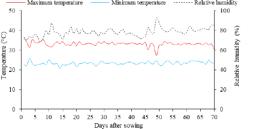
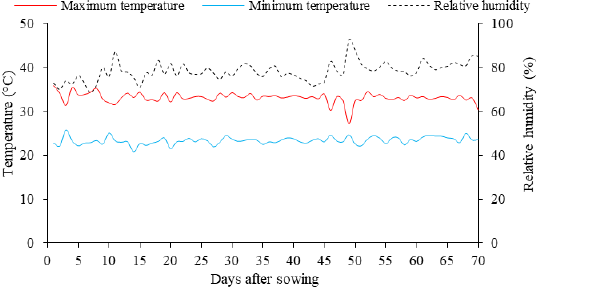
imageFigure 1 Meteorological data recorded inside the greenhouse during the experimental period from February 1 to April 10, 2024. open_in_new
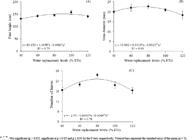
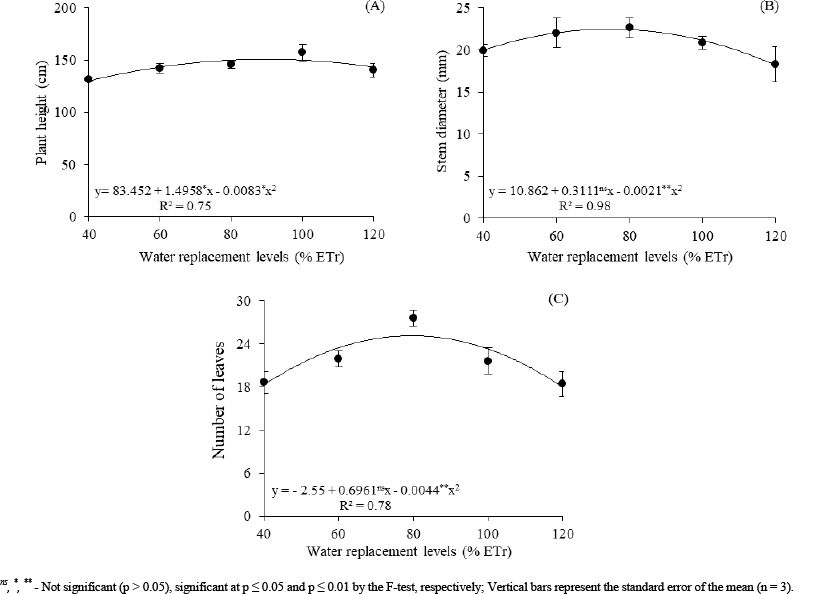
imageFigure 2 Plant height (A), stem diameter (B), and number of leaves (C) of okra plants cv. Carcará, as a function of water replacement levels, at 60 days after sowing. open_in_new
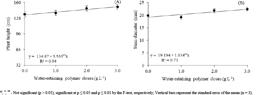
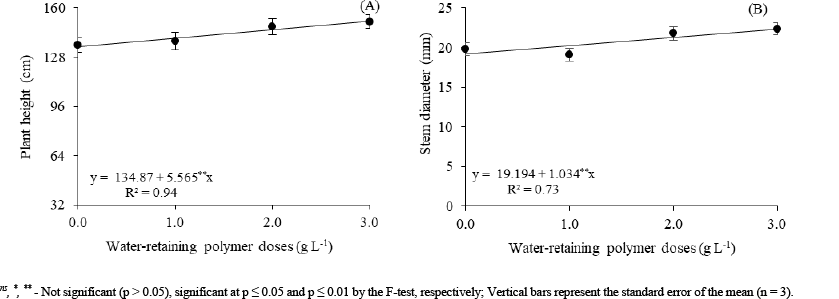
imageFigure 3 Plant height (A) and stem diameter (B) of okra plants cv. Carcará, as a function of water-retaining polymer doses, at 60 days after sowing. open_in_new
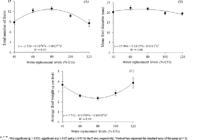
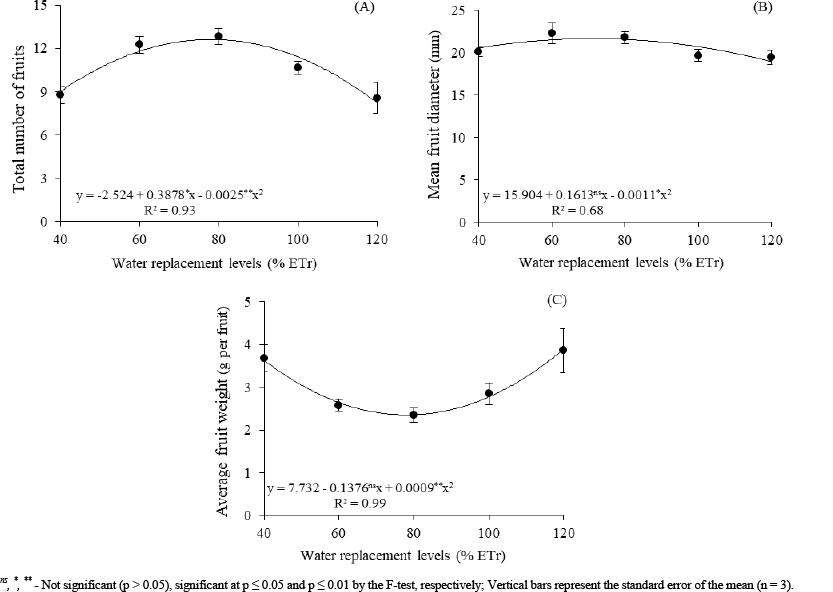
imageFigure 4 Total number of fruits (A), mean fruit diameter (B), and average fruit weight (C) of okra fruits cv. Carcará, as a function of water replacement levels. open_in_new
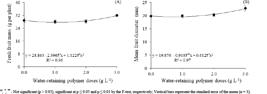
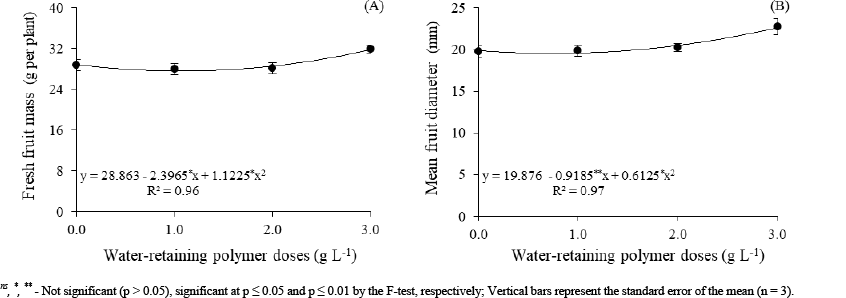
imageFigure 5 Fresh fruit mass (A) and mean fruit diameter (B) of okra fruits cv. Carcará, as a function of water-retaining polymer doses. open_in_new
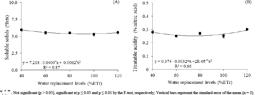
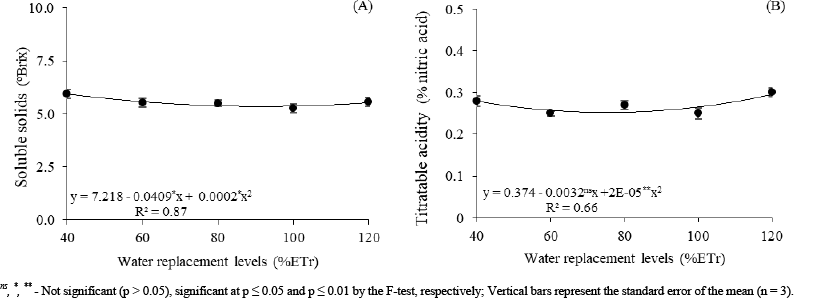
imageFigure 6 Soluble solids (A) and titratable acidity (B) of okra fruits cv. Carcará, as a function of water replacement levels. open_in_new
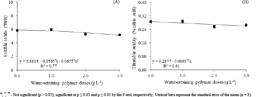
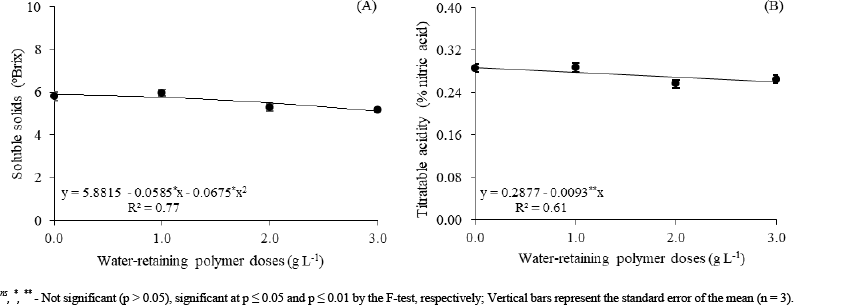
imageFigure 7 Soluble solids (A) and titratable acidity (B) of okra fruits cv. Carcará, as a function of water-retaining polymer doses. open_in_new
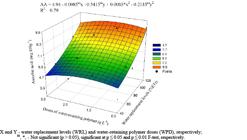
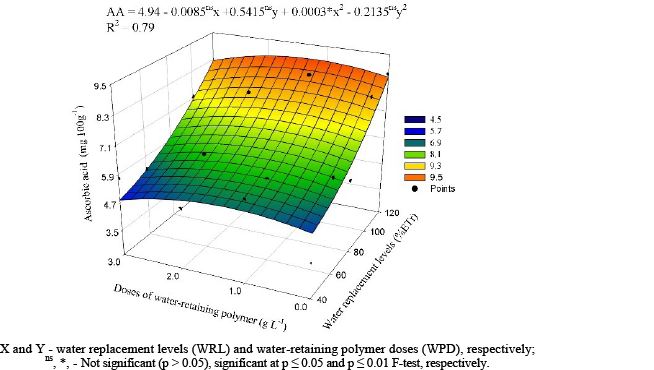
imageFigure 8 Effect of the interaction between water replacement levels and water-retaining polymer doses on the ascorbic acid (AA) content of okra fruits cv. Carcará. open_in_new
table_chartTable 1
Chemical and physical characteristics of the soil (0-0.30 m depth) used in the experiment, before the application of treatments.
| Chemical characteristics | ||||||||
| pH (H2O) (1:2.5) | OM g kg-1 | P (mg kg-1) | K+ | Na+ | Ca2+ | Mg2+ | Al3+ | H+ |
| cmolc kg-1 | ||||||||
| 9.0 | 20.34 | 180.77 | 0.50 | 0.10 | 7.17 | 5.11 | 0.00 | 0.00 |
| Chemical characteristics | Physical-hydraulic characteristics | |||||||
| ECe | CEC | SARe | ESP | Particle-size fraction (g kg-1) | Moisture (dag kg-1) | |||
| (dS m-1) | cmolc kg-1 | (mmol L-1)0.5 | % | Sand | Silt | Clay | 33.42 kPa1 | 1519.5 kPa2 |
| 0.67 | 12.88 | 0.77 | 0.78 | 775.2 | 182.3 | 42.5 | 13.77 | 5.18 |
-
pH - hydrogen potential, OM - Organic matter (determined by the Walkley-Black method); Ca2+ and Mg2+ - Extracted with 1 M KCl at pH 7.0; Na+ and K+ - Extracted using 1 M NH4OAc at pH 7.0; Al3++H+ - Extracted using 0.5 M Ca(OAc)2 at pH 7.0; ECe - Electrical conductivity of the saturation extract; CEC - Cation exchange capacity; SARe - Sodium adsorption ratio of the saturation extract; ESP - Exchangeable sodium percentage; 1 Field capacity; 2Permanent wilting point.
table_chartTable 2
Summary of the analysis of variance for plant height (PH), stem diameter (SD), number of leaves (NL), and leaf area (LA) of okra plants cv. Carcará grown under different water replacement levels and water-retaining polymer concentrations.
| Sources of variation | DF | Mean squares | |||
|---|---|---|---|---|---|
| PH(cm) | SD(mm) | NL(Unit) | LA(cm2) | ||
| Water replacement levels (WRL) | 4 | 1042.3* | 35.62* | 163.90** | 2459487ns |
| Linear | 1 | 1300.2* | 24.03ns | 0.83ns | 307ns |
| Quadratic | 1 | 1860.0* | 116.71** | 514.50** | 4877226ns |
| Water-retaining polymer doses (WPD) | 3 | 822.0* | 36.53* | 7.31ns | 634693ns |
| Linear | 1 | 2324.0** | 80.44** | 1.33ns | 1037382ns |
| Quadratic | 1 | 2.01ns | 6.16ns | 19.26ns | 1531ns |
| Interaction (WRL x WPD) | 12 | 411.5ns | 11.00ns | 27.08ns | 2694900ns |
| Block | 3 | 566.5ns | 2.73ns | 60.21ns | 7102390ns |
| Error | 38 | 278.3 | 6.52 | 26.12 | 1411701 |
| CV (%) | 11.65 | 12.31 | 23.63 | 26.54 | |
-
DF - Degrees of freedom; CV (%) - Coefficient of variation;*- Significant at 0.05 probability level; **-Significant at 0.01 probability level; ns - Not significant.
table_chartTable 3
Summary of the analysis of variance (ANOVA) for fresh fruit mass (FFM), total number of fruits (TNF), mean fruit diameter (MFD), mean fruit length (MFL), and average fruit weight (AFW) of okra cv. Carcará, grown under different water replacement levels and water-retaining polymer doses.
| Sources of variation | DF | Mean squares | ||||
|---|---|---|---|---|---|---|
| FFM(g per plant) | TNF(Unit) | MFD(mm) | MFL(mm) | AFW(g per fruit) | ||
| Water replacement levels (WRL) | 4 | 29.56ns | 46.05** | 19.85* | 12.52ns | 5.35** |
| Linear | 1 | 98.68ns | 7.00ns | 19.56ns | 21.33ns | 0.47ns |
| Quadratic | 1 | 5.50ns | 154.29** | 34.73* | 8.56ns | 20.81** |
| Water-retaining polymer doses (WPD) | 3 | 50.34* | 7.52ns | 29.42** | 3.32ns | 0.10ns |
| Linear | 1 | 70.75* | 5.60ns | 63.41** | 1.42ns | 0.02ns |
| Quadratic | 1 | 75.73* | 2.01ns | 22.55* | 7.71ns | 0.23ns |
| Interaction (WRL x WPD) | 12 | 13.78ns | 10.62ns | 12.97ns | 5.59ns | 1.80ns |
| Block | 3 | 10.43ns | 4.01ns | 1.36ns | 2.65ns | 0.05ns |
| Error | 38 | 16.63 | 4.27 | 5.42 | 3.72 | 1.09 |
| CV (%) | 13.97 | 19.67 | 34.13 | 11.29 | 11.29 | |
-
DF - Degrees of freedom; CV (%) - Coefficient of variation;*- Significant at 0.05 probability level; **- Significant at 0.01 probability level; ns - Not significant.
table_chartTable 4
Summary of the analysis of variance for soluble solids (SS), titratable acidity (TA), and ascorbic acid (AA) of okra fruits cv. Carcará, grown under different water replacement levels and water-retaining polymer concentrations.
| Sources of variation | DF | Mean squares | ||
|---|---|---|---|---|
| SS(ºBrix) | TA (% nitric acid) | AA (mg 100g-1) | ||
| Water replacement levels (WRL) | 4 | 0.73* | 0.0059** | 26.55** |
| Linear | 1 | 1.24* | 0.0018ns | 88.03** |
| Quadratic | 1 | 1.33* | 0.0158** | 2.76* |
| Water-retaining polymer doses (WPD) | 3 | 2.31** | 0.0034** | 1.16ns |
| Linear | 1 | 5.12** | 0.0064** | 0.73ns |
| Quadratic | 1 | 0.26ns | 0.0002ns | 2.74* |
| Interaction (WRL x WPD) | 12 | 0.96ns | 0.0040ns | 1.21* |
| Block | 3 | 0.03ns | 0.0001ns | 2.37* |
| Error | 38 | 0.22 | 0.0005 | 0.58 |
| CV (%) | 8.44 | 8.40 | 11.56 | |
-
DF - degrees of freedom; CV (%) - coefficient of variation; * significant at 0.05 probability level; ** significant at 0.01 probability level; nsnot significant.
(1)
(2)
How to cite
location_on
Universidade Federal Rural do Semi-Árido
Avenida Francisco Mota, número 572, Bairro Presidente Costa e Silva, Cep: 5962-5900, Telefone: 55 (84) 3317-8297 -
Mossoró -
RN -
Brazil
E-mail: caatinga@ufersa.edu.br
E-mail: caatinga@ufersa.edu.br
rss_feed
Stay informed of issues for this journal through your RSS reader
PDF version for download
Related articles
Lista de links para artigos relacionados. Os links abrem em nova aba.
Versões e tradução automática
Escolha a versão original do texto ou utilize um serviço de tradução automática.
Versão original do texto
Como citar
Escolha um formato para exportar ou selecione um estilo de citação. O conteúdo abaixo pode ser atualizado após a seleção.