Acoustic and thermal performance of sandwich panels made with pine wood and loofah sponge
ABSTRACT
Growing interest in renewable products has driven research on the development of structural composites reinforced with plant-based fibers. Among their potential applications, thermal and acoustic insulation in civil construction stands out. This study aimed to evaluate the performance of sandwich panels manufactured with Pinus oocarpa veneers and luffa sponge. Three treatments were evaluated, consisting of five-layer panels that varied in the number of luffa sponge layers in the core (0, 1, and 2). The panels were assessed for physical properties (moisture content and density), mechanical properties (modulus of elasticity and modulus of rupture), as well as acoustic and thermal insulation performance. Analysis of variance was performed, and when statistically significant differences were detected, the Scott-Knott mean comparison test (5%) was applied. The results indicated that panels manufactured with two luffa layers exhibited lower sound absorption at frequencies between 200 and 1000 Hz, meeting acoustic comfort standards at 1000 Hz. Control panels, without a luffa core layer, showed higher mechanical strength. In addition, despite differences in thermal performance, all treatments met regulatory requirements and qualified as thermal insulators. Overall, sandwich panels manufactured with Pinus oocarpa veneers and a luffa core show promise for acoustic insulation and thermal comfort applications in civil construction, representing a natural and sustainable fibrous alternative.
Keywords:
Adhesives; Renewable materials; Civil construction; Physical and mechanical properties.
RESUMO
O crescente interesse em produtos renováveis tem impulsionado a pesquisa no desenvolvimento de compósitos estruturais reforçados com fibras vegetais. Dentre suas potenciais aplicações, destaca-se o isolamento térmico e acústico na construção civil. Este estudo teve como objetivo avaliar o desempenho de painéis sanduíche fabricados com lâminas de Pinus oocarpa e bucha vegetal. Três tratamentos foram avaliados, consistindo em painéis de cinco camadas que variaram no número de camadas de bucha vegetal no núcleo (0, 1 e 2). Os painéis foram avaliados quanto às propriedades físicas (teor de umidade e densidade), propriedades mecânicas (módulo de elasticidade e módulo de ruptura), bem como desempenho de isolamento acústico e térmico. Foi realizada análise de variância e, quando diferenças estatisticamente significativas foram detectadas, aplicou-se o teste de comparação de médias de Scott-Knott (5%). Os resultados indicaram que os painéis fabricados com duas camadas de bucha vegetal apresentaram menor absorção sonora em frequências entre 200 e 1000 Hz, atendendo aos padrões de conforto acústico em 1000 Hz. Os painéis de controle, sem camada de bucha vegetal no núcleo, apresentaram maior resistência mecânica. Além disso, apesar das diferenças no desempenho térmico, todos os tratamentos atenderam aos requisitos regulamentares e foram qualificados como isolantes térmicos. No geral, os painéis sanduíche fabricados com lâminas de Pinus oocarpa e núcleo de bucha vegetal mostraram-se promissores para aplicações de isolamento acústico e conforto térmico na construção civil, representando alternativa fibrosa natural e sustentável.
Palavras-chave:
Adesivos; Produtos renováveis; Construção Civil; Propriedades físicomecânicas.
INTRODUCTION
The civil construction industry continues to expand worldwide due to population growth, housing deficits, and ongoing advances in construction technologies (CORDON; CAGNONI; FERREIRA, 2019). As a result, demand for raw materials has increased substantially, intensifying natural resource consumption and, over time, generating significant environmental impacts. In parallel, increased material use has led to higher solid waste generation, further aggravating environmental degradation.
To mitigate environmental impacts associated with civil construction, alternative production strategies based on sustainable and renewable materials have gained increasing attention. In this context, sandwich panels have emerged as a promising solution for building applications, offering advantages over conventional masonry and partition systems that rely on bricks, concrete blocks, and other non-renewable materials (REIS; SANTOS, 2022). Sandwich panels generally consist of two thin, high-strength facings bonded to a low-density core, resulting in lightweight structures with enhanced functional performance.
Panel facings may be manufactured from composite laminates, metal sheets, wood, or concrete, whereas the core commonly consists of honeycomb structures, rigid foams, or wood-based materials. Bonding between facings and core is typically achieved through adhesive bonding or thermal processes, using techniques such as vacuum bagging or hot pressing (MARTINS et al., 2023; LABANS; KALNINS; BISAGNI, 2017). The wide range of possible material combinations allows sandwich panels to be tailored to specific performance requirements, optimizing desired properties while minimizing material limitations (GAO et al., 2020).
Recent studies have explored alternative bio-based materials for sandwich panel cores, including sugarcane bagasse (POZZER et al., 2020) and recycled egg cartons (ARANTES et al., 2023), among other lignocellulosic residues. These materials have shown promising results for thermal and acoustic insulation applications, primarily due to their low density and porous structure.
Within this context, luffa sponge (Luffa cylindrica) has attracted increasing attention as a renewable and biodegradable fibrous material. Native to Asia and widely distributed in regions such as India, China, Japan, and parts of Central and South America, L. cylindrica belongs to the Cucurbitaceae family and includes several species, such as L. acutangula, L. cylindrica (L. aegyptiaca), L. echinata, L. graveolens, L. hermaphrodita, L. operculata, L. tuberosa, and L. umbellata (CHEN et al., 2014). Its fibers exhibit a microcellular structure with macropores ranging from approximately 10 to 20 µm, forming an interconnected fibrous vascular network that results in a hierarchical, multimodal porous system (YUAN et al., 2022).
Luffa sponge is primarily composed of cellulose, hemicellulose, and lignin. The presence of hydroxyl groups in its structure facilitates surface functionalization, enabling a wide range of applications, including biomedical uses (JAMSHIDI-ADEGANI et al., 2019) and fiber-reinforced composite materials (LI et al., 2019). Due to its low density, low cost, wide availability, and renewable nature, luffa sponge represents a promising alternative material for sandwich panel cores.
Despite these favorable characteristics, studies investigating the incorporation of luffa sponge into sandwich panel structures remain limited, particularly regarding its influence on acoustic and thermal insulation performance. Therefore, this study aimed to evaluate the physical, mechanical, thermal, and acoustic performance of sandwich panels manufactured with Pinus oocarpa veneers and a luffa sponge (Luffa cylindrica) core, focusing on their potential application as sustainable acoustic and thermal insulation materials in civil construction.
MATERIALS AND METHODS
Material Acquisition
Pinus oocarpa wood was obtained from an approximately 18-year-old tree harvested from experimental plantations in the municipality of Lavras, southern Minas Gerais, Brazil (21°14′45″ S, 44°59′59″ W). After harvesting, the tree was sectioned into logs approximately 80 cm long. The logs were stored in a water tank and heated to 80 °C to prevent attack by xylophagous organisms and to reduce wood mechanical resistance, thereby facilitating the rotary peeling process. Veneers measuring 30 × 30 cm were produced using a rotary lathe. After veneer production, the material was air-dried until equilibrium moisture content was reached and subsequently oven-dried at 105 °C for 48 h, resulting in an average moisture content of approximately 5%.
Luffa sponge (Luffa cylindrica), with an average density of 0.66 g cm⁻3, as reported by Alhijazi et al. (2020), was collected from commercial plantations located in the rural area of Nepomuceno, Minas Gerais, Brazil. Selection criteria included size, shape, and moisture content. After collecting, the luffa sponge was oven-dried at 80 °C for 2 h to partially remove moisture and to improve adhesive bonding and hot-pressing efficiency.
Experimental Design
A completely randomized design (CRD) was adopted. Treatments were defined according to sandwich panel composition, with the studied variable being the number of luffa sponge layers incorporated into the panel core (0, 1, and 2 layers). Two replications were produced for each treatment. All sandwich panels consisted of five layers, as detailed in Table 1.
Panel Manufacturing
Sandwich panels were manufactured following a conventional plywood configuration, in which adjacent Pinus oocarpa veneers were assembled with alternating grain orientations. Interfaces between veneers and luffa sponge layers were bonded using a urea-formaldehyde (UF) adhesive (Figure 1b), applied at a spread rate of 280 g m⁻2. The adhesive exhibited a viscosity of 950 cP, a gel time of 5 min 37 s, a solids content of 63%, and a pH of 7.09.
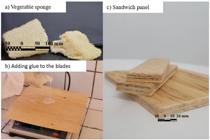
Panel assembly was performed manually using a spatula, resulting in five-layer structures. Control panels consisted exclusively of Pinus veneers, whereas the remaining treatments incorporated one or two luffa sponge layers in the core. The luffa sponge was cut into pieces approximately 10 mm in size and uniformly distributed over the veneer surface until complete coverage was achieved. After pressing, the luffa layers reached an approximate thickness of 2 mm. Pinus veneers exhibited an average thickness of 2 mm, and Pinus oocarpa wood presents an average density of approximately 0.42 g cm⁻3 (MOURA; PARCA, 1993).
After adhesive application and pre-assembly, panels were hot-pressed in a hydraulic press under a pressure of 1.0 MPa at 150 °C for 10 min. Following pressing, panels were conditioned at 20 ± 2 °C and 65 ± 5% relative humidity until constant mass was achieved. Subsequently, test specimens were prepared (Figure 1c).
Evaluation of sandwich panels
Physical and Mechanical Characterization
After conditioning, panels were subjected to physical and mechanical testing. Apparent density and oven-dry moisture content were determined in accordance with ABNT NBR 9485 (ABNT, 2011). Three test specimens were prepared for each treatment. Static bending tests were performed to determine modulus of elasticity (MOE) and modulus of rupture (MOR) in directions parallel and perpendicular to fiber orientation, following procedures described in ABNT NBR 7190 (ABNT, 2022).
Thermal Properties
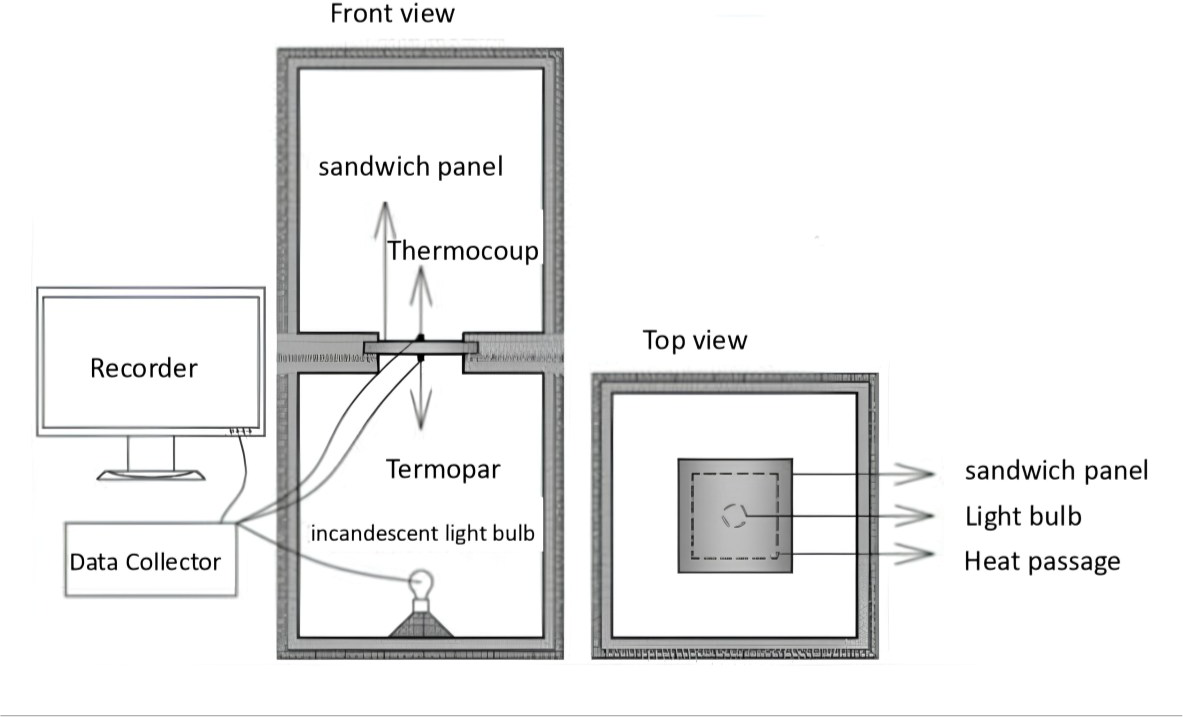
Thermal insulation performance was evaluated following the methodology proposed by (MENDES et al., 2021). A thermal actuator was positioned beneath the panels, maintaining a temperature of approximately 60 °C. Temperature measurements were obtained using thermocouple sensors installed on the base and top surfaces of the specimens (Figure 2). The heating rate was set to 1 °C min⁻1, and the test duration was 1 h. Temperature data were recorded using a data logger (model IM DC 100-01E).

Thermal insulation performance was determined based on the temperature difference between base and top thermocouples. Thermal conductivity, thermal resistance, and thermal transmittance were calculated in accordance with ABNT NBR 15220 (ABNT, 2005).
Acoustic Properties
Acoustic insulation performance was evaluated following the methodology proposed by (ARANTES et al., 2023). Two wooden box panels were vertically aligned, with the sandwich panel specimen positioned between them and supported by an acoustic foam plate, forming an acoustic barrier. The experimental setup comprised a microcomputer, two loudspeakers (50 W RMS, frequency response from 22 Hz to 30,000 Hz), and a sound level meter.
The loudspeaker was connected to the computer audio output and positioned inside one of the wooden boxes, allowing sound transmission through the sandwich panel specimen. Sound pressure levels were measured using the sound level meter, in accordance with the recommendations of ABNT NBR 12179 (ABNT, 1992).
Statistical Analysis
Data obtained from physical and mechanical tests, as well as thermal and acoustic insulation analyses, were subjected to analysis of variance (ANOVA) at a 5% significance level. Assumptions of normality, independence, and homogeneity of variances were verified prior to analysis. When statistically significant differences were detected, mean values were compared using the Scott-Knott test at a 5% probability level.
RESULTS AND DISCUSSION
Physical and Mechanical Properties
No statistically significant differences were observed among treatments for oven-dry moisture content or apparent density. Panels exhibited an average moisture content of 3.72 ± 0.30% and an apparent density of 720 ± 0.05 kg m⁻3. According to ABNT (2015), which establishes requirements for medium-density fiberboards, panel moisture content should range from 4% to 11%. It should be noted, however, that panels evaluated in this study were conditioned under controlled laboratory conditions, and moisture content is expected to increase under service conditions.
Comparable results were reported by Magalhães et al. (2025) for plywood panels produced from the same wood species, with a similar number of veneers and thickness, which exhibited apparent densities between 750 and 790 kg m⁻3 and an average moisture content of 5.37%. Apparent density of plywood and sandwich panels is influenced by several factors, including wood species, veneer moisture content, pressing temperature, and applied pressure (MAGALHÃES et al., 2025).
Studies on sandwich panels manufactured with alternative core materials report a wide range of densities. Arantes et al. (2023) reported an apparent density of 146 kg m⁻3 for sandwich panels produced with recycled egg carton cores bonded with urea formaldehyde adhesive, whereas Pozzer (2019) reported values of approximately 760 kg m⁻3 for trapezoidal sandwich panels manufactured with sugarcane bagasse cores bonded with castor oil based polyurethane adhesive. In general, materials with lower density tend to exhibit improved acoustic and thermal insulation performance due to higher porosity, making them suitable for applications such as ceiling panels and wall linings (ARANTES et al., 2023).
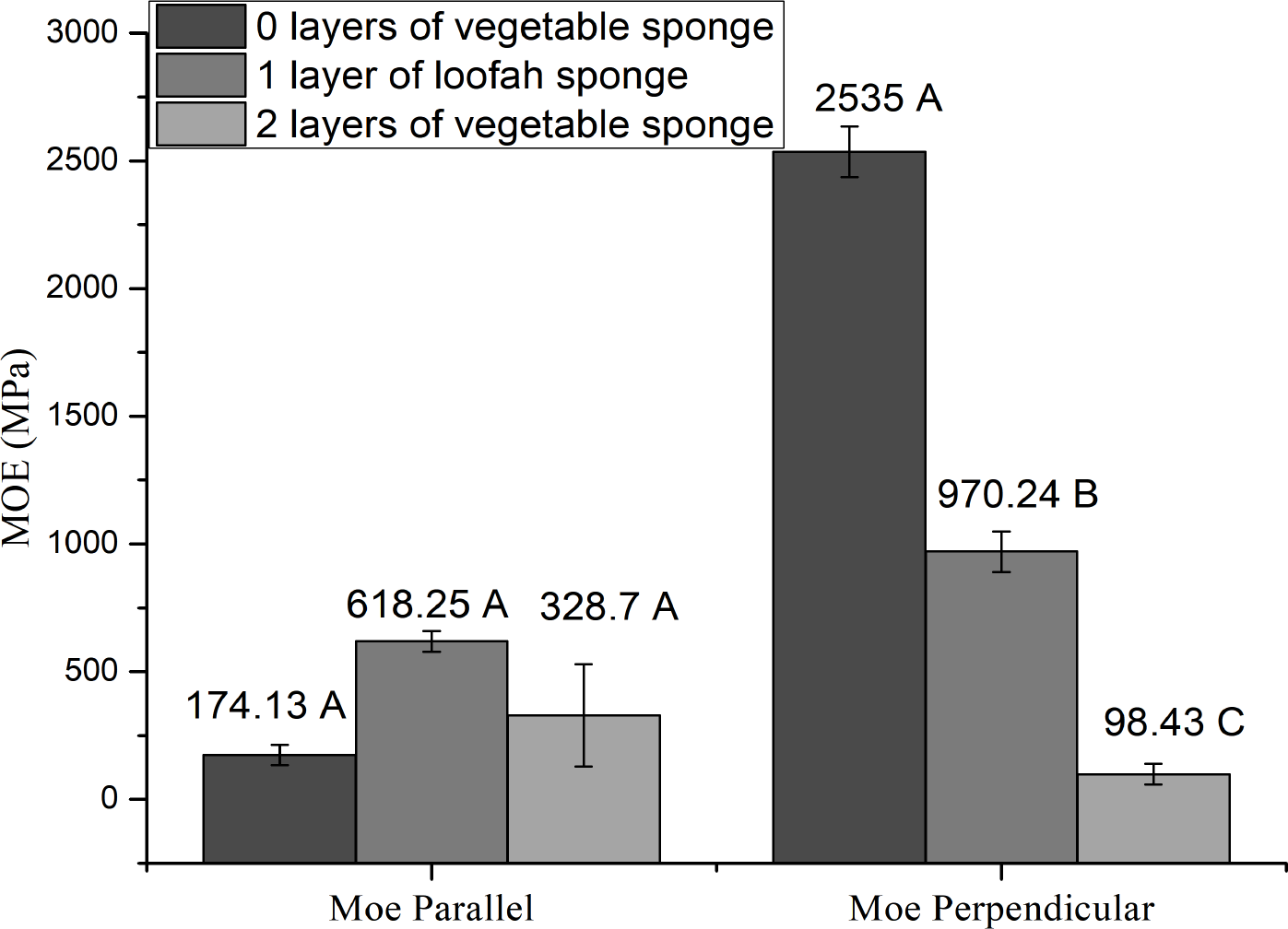
For modulus of elasticity perpendicular to fiber direction (MOE), statistically significant differences were observed among treatments (Figure 3). Control panels composed exclusively of Pinus oocarpa veneers exhibited the highest MOE value (2535 MPa). Incorporation of luffa sponge layers resulted in reduced MOE, which can be attributed to intrinsic characteristics of luffa sponge, including low density and limited mechanical strength (SHEKAR; RAMACHANDRA, 2018).
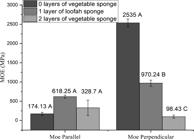
Mean values of modulus of elasticity (MOE) measured in parallel and perpendicular directions to fiber orientation.
Because studies addressing the use of luffa sponge as a sandwich panel core remain scarce, direct comparisons with the literature are limited. However, Iwakiri et al. (2012) reported MOE values of 3841 MPa for plywood panels manufactured from Pinus oocarpa veneers bonded with urea-formaldehyde adhesive, which are higher than those obtained in the present study. In contrast, no statistically significant differences were observed for modulus of elasticity parallel to fiber direction, indicating that incorporation of luffa sponge layers does not adversely affect mechanical performance under this loading condition.
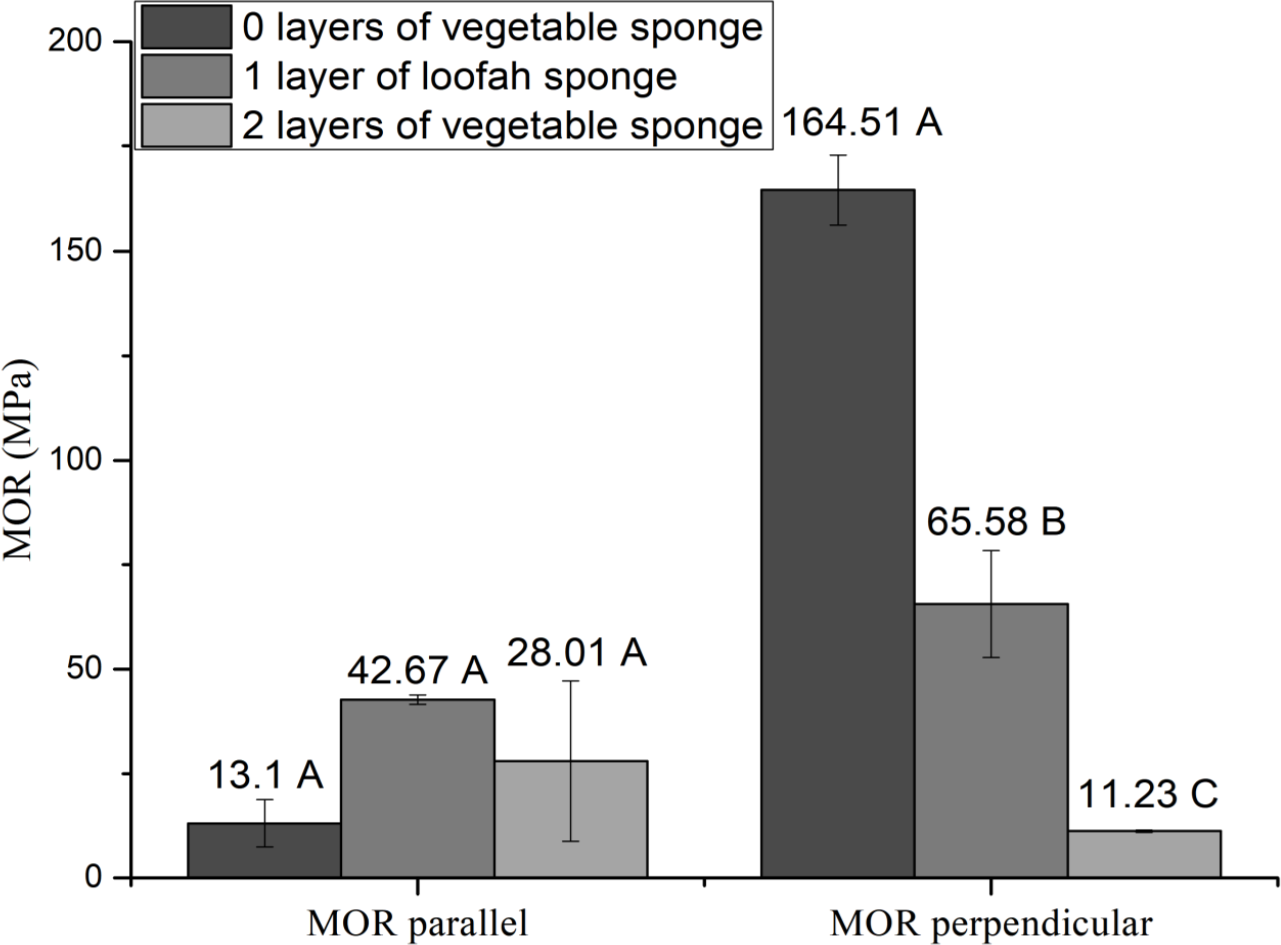
A similar trend was observed for modulus of rupture (MOR). No statistically significant differences were detected among treatments for MOR measured in the parallel direction, whereas significant differences were observed for MOR measured in the perpendicular direction (Figure 4). Control panels exhibited the highest MOR value (164.51 MPa). By comparison, Iwakiri et al. (2012) reported MOR values of 45.24 MPa for plywood panels manufactured with Pinus oocarpa, which are lower than those obtained in the present study for panels with zero and one luffa sponge layer.

Mean values of modulus of rupture (MOR) measured in parallel and perpendicular directions to fiber orientation.
The wide variability reported in the literature for MOE and MOR values of plywood and sandwich panels is associated with differences in panel architecture, wood species, regional factors, adhesive systems, pressing parameters, and inherent material heterogeneities, such as voids, bonding defects, density variations, and structural discontinuities (IWAKIRI; TRIANOSKI, 2020). In the context of civil construction, ABNT (2013) does not establish minimum requirements for MOE and MOR for vertical sealing systems, indicating that the panels evaluated in this study show potential for use as lightweight, sustainable, and technically adequate non-structural building components.
Thermal Properties
Thermal performance results are presented in Table 2. An inverse relationship was observed between thermal conductivity and thermal resistance, with higher thermal conductivity values corresponding to lower thermal resistance. Control panels exhibited the lowest thermal conductivity and the highest thermal resistance among the evaluated treatments.
Reduction in panel thickness associated with incorporation of luffa sponge layers, combined with a decrease in the number of Pinus veneers, may have facilitated heat transfer across panel thickness. In addition, the highly porous and fibrous structure of luffa sponge, when compacted within the panel core, may have created preferential heat transfer pathways at luffa wood interfaces, contributing to increased thermal conductivity.
Panels containing one and two luffa sponge layers exhibited higher thermal conductivity and lower thermal resistance than the control treatment. Thermal insulating materials should present thermal conductivity values below 0.25 W m⁻1 °C⁻1, whereas thermal resistance should exceed 0.02 m2 °C W⁻1, as established by ABNT NBR 15220 (2005). Wang et al. (2020) and Haseli et al. (2018) state that sandwich panels have a satisfactory thermal conductivity value. All panels evaluated in this study satisfied these criteria and can therefore be classified as thermal insulating materials.
The observed increase in thermal conductivity with addition of luffa sponge layers, despite similar apparent densities among treatments, may be attributed to differences in internal structure and heat transfer mechanisms. Materials with comparable densities but distinct microstructures can exhibit markedly different thermal and acoustic responses (MAGALHÃES et al., 2024).
Acoustic Properties
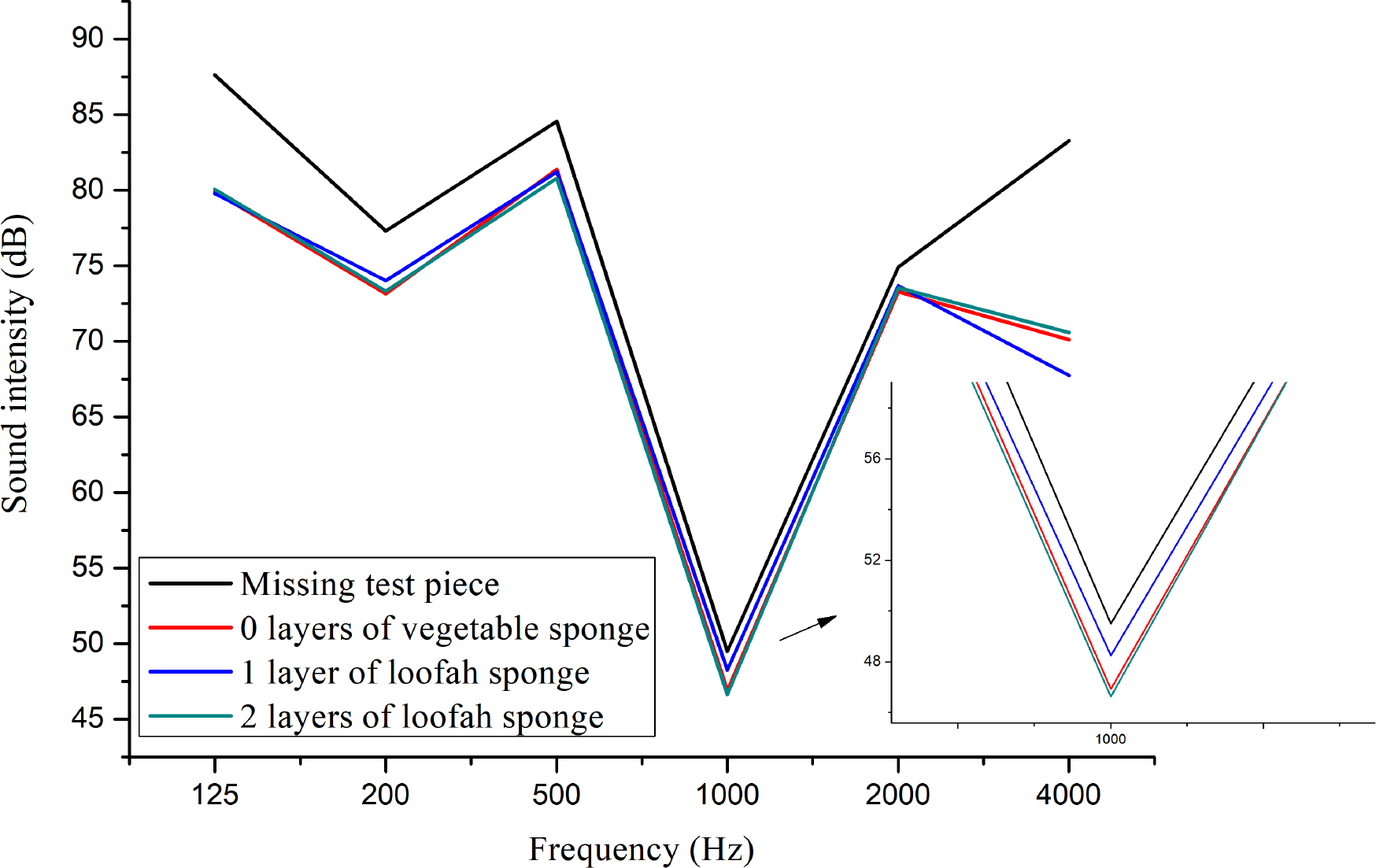
Acoustic insulation results are illustrated in Figure 5. Greater differences in sound attenuation among treatments were observed in the frequency range between 2000 and 4000 Hz. Panels containing two luffa sponge layers exhibited superior performance at 2000 Hz, with sound pressure levels of 74 dB, whereas panels with one luffa sponge layer showed the best performance at 4000 Hz, with values of 67 dB. In contrast, control panels exhibited sound pressure levels of 75 dB at 2000 Hz and 83 dB at 4000 Hz.
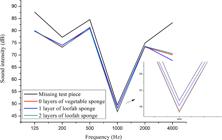
At lower frequencies (200, 500, and 1000 Hz), panels containing two luffa sponge layers showed lower sound transmission than the other treatments. According to ABNT NBR 10152 (ABNT, 2020), all evaluated panels met sound comfort requirements at 1000 Hz, within the range of 45 to 50 dB, which is suitable for enclosed spaces intended for performances and sports activities. However, at the remaining evaluated frequencies, none of the treatments fully satisfied the sound comfort limits established by the standard.
Observed acoustic behavior can be attributed to porous structure and fiber orientation of luffa sponge. When incident sound waves interact with porous fibrous materials, part of acoustic energy is dissipated through friction and viscous losses within pore structure. Nevertheless, random distribution and partial vertical orientation of luffa fibers within the panel core may limit sound absorption efficiency at certain frequency ranges, resulting in reduced acoustic performance (CHEN; REN, 2010).
CONCLUSION
This study investigated the feasibility of using luffa sponge (Luffa cylindrica) as a renewable core material in sandwich panels manufactured with Pinus oocarpa veneers for acoustic and thermal insulation applications in civil construction.
Incorporation of luffa sponge layers influenced technological performance of the sandwich panels, primarily due to changes in panel thickness and internal structure. From an acoustic perspective, panels containing two luffa sponge layers exhibited reduced sound transmission at low frequencies (200, 500, and 1000 Hz), and all evaluated configurations met sound comfort requirements at 1000 Hz in accordance with applicable standards. These results indicate that luffa sponge contributes positively to sound insulation performance within specific frequency ranges.
Regarding thermal performance, panels incorporating luffa sponge layers showed higher thermal conductivity and lower thermal resistance than control panels. Nevertheless, all evaluated treatments satisfy criteria established by ABNT NBR 15220 and can be classified as thermal insulating materials, demonstrating suitability for applications requiring thermal comfort.
Mechanical characterization indicated that control panels exhibited superior performance in terms of modulus of elasticity and modulus of rupture in the perpendicular direction, demonstrating that incorporation of luffa sponge reduces load-bearing capacity. Therefore, use of luffa sponge is not recommended for structural sandwich panels subject to significant mechanical loads. However, because current building standards do not establish minimum mechanical requirements for non-structural vertical sealing systems, the evaluated panels remain technically viable for non-load-bearing applications.
Overall, sandwich panels manufactured with Pinus oocarpa veneers and luffa sponge cores represent a promising and sustainable alternative for acoustic and thermal insulation applications in civil construction. Use of luffa sponge supports development of environmentally friendly building materials with reduced reliance on non-renewable resources, aligning with increasing demand for sustainable solutions in the construction industry.
Data Availability:
The data that support the findings of this study can be made available, upon reasonable request, from the corresponding author.
REFERENCES
- ABNT - Associação Brasileira de Normas Técnicas. NBR 7190: projeto de estruturas de madeira. Rio de Janeiro, 2022.
- ABNT - Associação Brasileira de Normas Técnicas. NBR 9485: Compensado - Determinação da massa específica aparente. Rio de Janeiro. 2011.
- ABNT - Associação Brasileira de Normas Técnicas. ABNT NBR 10152: acústica - níveis de pressão sonora em ambientes internos a edificações, ABNT, Rio de Janeiro, 2020.
- ABNT - Associação Brasileira De Normas Técnicas. ABNT NBR 12179: tratamento acústico em recintos fechados, ABNT, Rio de Janeiro, 1992.
- ABNT - Associação Brasileira de Normas Técnicas. ABNT NBR 15220: desempenho térmico de edificações, ABNT, Rio de Janeiro, 2005.
- ABNT - Associação Brasileira de Normas Técnicas. ABNT NBR 15316-2: painéis de fibras de média densidade - Parte 2: Requisitos e métodos de ensaio, ABNT, Rio de Janeiro, 2015.
- ABNT - Associação Brasileira de Normas Técnicas. ABNT NBR 15575-4: sistema de vedações verticais internas e externas, ABNT, Rio de Janeiro, 2013.
- ARANTES, L. S. et al. Avaliação de painéis sanduíche produzidos com núcleo de caixas de ovos e lâminas de paricá. Ambiente Construído, 23: 121-130, 2023.
- ALHIJAZI, M. et al. Desenvolvimentos recentes em compósitos de fibra natural de bucha vegetal. Sustentabilidade, 12: 7683, 2020.
- CHEN, D. L. I. J.; REN, J. Study on sound absorption property of ramie fiber reinforced poly (l-lactic acid) composites: Morphology and properties. Composites Part A: Applied Science and Manufacturing, 41: 1012-1018, 2010.
- CHEN, Q. et al. A multiscale study on the structural and mechanical properties of the luffa sponge from Luffa cylindrica plant. Journal of Biomechanics, 47:1332-1339, 2014.
- CORDON, H. C.; CAGNONI, F. C.; FERREIRA, F. F. Comparison of physical and mechanical properties of civil construction plaster and recycled waste gypsum from Sao Paulo, Brazil. Journal of Building Engineering, 22: 504-512, 2019.
- GAO, X. et al. Experimental and numerical investigation of thermoplastic honeycomb sandwich structures under bending loading. Thin-Walled Structures, 155: 106961, 2020.
- HASELI, M. et al. Characterization of blackboard and battenboard sandwich panels from date palm waste trunks. Measurement, 124: 329-337, 2018.
- IWAKIRI, S. et al. Avaliação do potencial de uso de espécies de pinus tropicais e eucalipto na produção de painéis compensados ureicos. Floresta, 42: 93-104, 2012.
- IWAKIRI, S.; TRIANOSKI, R. Painéis de Madeira Reconstituída 2. ed. Curitiba, PR: FUPEF, 2020. 259 p.
- JAMSHIDI-ADEGANI, F. et al. Prevention of postoperative adhesion bands by alkali-treated cellulosic luffa fibers. Journal of Natural Fibers, 18: 1-10. 2019.
- LABANS, E.; KALNINS, K.; BISAGNI, C. Comportamento à flexão de painéis sanduíche com núcleo de madeira celular, reforço de madeira compensada/espuma e compósito termoplástico. Journal of Sandwich Structures and Materials, 21: 784-805, 2017.
- LI, H. et al. Enhanced thermal conductivity by combined fillers in polymer composites. Thermochimica Acta, 676: 198-204, 2019.
- MAGALHÃES, M. R. et al. Análise de isolamento térmico de painés compensados colados com cardanol e nanoestruturas de lignina. Enciclopédia Biosfera, 21: 27-35, 2024.
- MAGALHÃES, M. R. R. et al. Quality of Plywood Bonded with Nanolignin-Enriched Cardanol-Formaldehyde Adhesive. Fibers, 13: 95, 2025.
- MARTINS, R. H. B. et al. Painel sanduíche OSB com núcleo ondulado de resíduos de madeira balsa. Maderas. Ciencia y Tecnología 25: 1-10, 2023.
- MENDES, R. F. et al. Study of new reinforcing materials for cementitious panel production. Environmental Science and Pollution Research, 28: 37217-37230, 2021.
- MOURA, V. P. G., PARCA, M. Estudo Comparativo entre Densidade Básica e Penetração do Pilodyn em Espécies/ Procedências de Pinus Centro-Americanos em três locais dos Cerrados 1. ed. Planaltina, DF: EMBRAPA - CPAC, 1993. 19 p.
- POZZER, T. et al. Trapezoidal core sandwich panel produced with sugarcane bagasse. Construction and Building Materials, 264: 120718, 2020.
- POZZER, T. F. Painel sanduíche com núcleo corrugado de partículas de bagaço de cana-de-açúcar e resina PU-mamona 2019. 72 f. Dissertação (Mestrado em Engenharia e Ciências de Materiais: Área de Concentração em Desenvolvimento, Caracterização e Aplicação de Materiais Voltados à Agroindústria) - Universidade de São Paulo, Pirassununga, 2019.
- REIS, G. P.; SANTOS, H. A. B. Comparative Study for the Application of Concrete Sandwich Panels on Standard Residential Edifications. REEC - Revista Eletrônica de Engenharia Civil, 20: 1-16, 2022.
- SHEKAR, H. S. S.; RAMACHANDRA, M. Green composites: a review. Materials Today, 5: 2518-2526, 2018.
- WANG, X. et al. Effective thermal conductivity and heat transfer characteristics for a series of lightweight lattice core sandwich panels. Applied Thermal Engineering, 173: 115205, 2020.
- YUAN J. et al. Bifunctional scaffolds for tumor therapy and bone regeneration: synergistic effect and interplay between therapeutic agents and scaffold materials. Materials Today Bio, 15: 100318, 2022.
-
Editor in Chief:
Aurélio Paes Barros Júnior