Effect of biochar soaked in wood vinegar on cowpea production and root growth
 ABSTRACT
Pyrolysis of woody biomass produces biochar, whose application aims to promote positive effects on the soil, crops and the environment, and wood vinegar (WV), which is used as growth regulator and pesticide. Cowpea (Vigna unguiculata (L.) Walp) is of great importance worldwide and, in Brazil, it is predominantly produced by family farming in the Northeast region, mainly in soils with low fertility and low productivity. In this context, this study aimed to verify the possibility that the application of biochar, pure or soaked in WV, improves the performance of cowpea crop. To this end, an experiment was conducted in two seasons in a greenhouse, in a completely randomized design, in which doses and types of biochar were tested. Grains were harvested green in four replicates of the treatments and harvested dry in the other four replicates. The determinations made were: number of pods, pod length, number of grains per pod, grain production per pot and root dry mass. The results obtained do not allow us to recommend the application of wood vinegar impregnated in biochar in cowpea. However, biochar application can be recommended at doses between 6.0 and 9.0 Mg ha-1, which can be reduced to 4.0 to 6.0 Mg ha-1 in the presence of mineral fertilization. Studies addressing the joint application of biochar and pyroligneous extract should address different doses, forms of application, raw materials, soil types, and crops.
Keywords:
Pyrolysis products; Soil amendment; Growth regulator; Vigna unguiculata (L.) Walp
RESUMO
A pirólise de biomassa lenhosa produz biochar, cuja aplicação visa promover efeitos positivos sobre o solo, as culturas e o ambiente, e o extrato pirolenhoso (EP), que é usado como como regulador de crescimento e pesticida. O feijão-caupi (Vigna unguiculata (L.) Walp) tem grande importância mundial e, no Brasil, é produzido predominantemente pela agricultura familiar da região Nordeste, principalmente em solos de baixa fertilidade e com baixa produtividade. Neste contexto, este estudo visou verificar a possibilidade de que a aplicação do biochar, puro ou embebido em EP, melhore o desempenho da cultura do feijão-caupi. Para isso, um experimento foi conduzido em duas épocas em casa de vegetação, em delineamento inteiramente casualizado, no qual foram testadas doses e tipos de biochar. Os grãos foram colhidos verdes em quatro repetições dos tratamentos e colhidos secos nas outras quatro repetições. As determinações realizadas foram: número de vagens, comprimento das vagens, número de grãos por vagem, produção de grãos por vaso e massa seca das raízes. Os resultados obtidos não permitem recomendar a aplicação em feijão-caupi do extrato pirolenhoso impregnado no biochar. No entanto, pode-se recomendar a aplicação de biochar em doses entre 6,0 e 9,0 Mg ha-1, que podem ser reduzidas para 4,0 a 6,0 Mg ha-1 na presença de adubação mineral. Estudos que abordem a aplicação conjunta de biochar e extrato pirolenhoso devem abordar diferentes doses, formas de aplicação, matérias-primas, tipos de solo e culturas.
Palavras-chave:
Produto da pirólise; Condicionador de solo; Regulador de crescimento; Vigna unguiculata (L.) Walp
INTRODUCTION
The necessary increase in global food production, demanded by population growth and food insecurity, is restricted by the climate and various types of soil degradation (FAO, 2021), particularly in semi-arid regions, whose soils are generally infertile, acidic, poor in organic matter and nutrients, with a low capacity to retain water and nutrients (IDOWU et al., 2023; RAFAEL et al., 2019). In this context, FAO (2021) recommends adopting adapted crops, capable of performing biological nitrogen fixation (BNF), and applying organic materials to the soil aiming to obtain nutrients, increase organic matter and improve structure, and promote carbon sequestration and biological activity. Among these materials are charcoal (biochar) and wood vinegar (WV), which are products of the pyrolysis of biomass (GREWAL; ABBEY; GUNUPURU, 2018).
Cowpea (Vigna unguiculata L. Walp.) is a widely adapted and stress-tolerant legume, which is consumed in the form of grains and green leaves, as its biomass is highly valued for human and animal food. It was cultivated on about 14.4 million hectares in 2020 in warm to hot regions of Africa, Asia, and the Americas, with an estimated production of more than 8.9 million metric tons of grains per year. It is a very important legume for food security and income generation in the semi-arid regions of Africa, which accounts for more than 95% of production, especially Sub-Saharan Africa, with Nigeria being the world's largest producer, followed by the Republic of Niger and Burkina Faso (ADEKIYA; AYORINDE; OGUNBODE, 2024; AKLEY et al., 2023).
Cowpea arouses interest as it adapts to the Brazilian Northeast region, which accounts for more than 90% of the cowpea area in the country. It tolerates high temperatures, water deficit and low fertility, as well as sandy soils, poor in organic matter and phosphorus (MIRANDA et al., 2020; SILVA et al., 2018). As in Africa, cowpea is cultivated by small farmers in the Northeast region, where it provides nutrition and income and is consumed as dry and green grains and green pods, which can contain up to 25% protein, as well as carbohydrates, vitamins, minerals and fiber. Cowpea improves the soil and has low production costs as it serves as green manure, performs BNF, and has short-cycle cultivars (ARAUJO, 2019). The low average cowpea yield in the Northeast region (377 kg ha-1) (CONAB, 2023) is due to irregular rainfall, high temperatures and evapotranspiration, low-fertility soils, unproductive varieties, poor-quality seeds, inefficient control of pests, diseases and weeds, and lack of nutrient replacement (BASTOS et al., 2023; MIRANDA et al., 2020).
Biochar is the pyrolyzed biomass, intentionally intended for use as a soil conditioner, so that pyrogenic carbon is applied to the soil to improve its properties and functions, influencing its fertility and crop growth, water retention and movement, and pollution control. Another important consequence is the sequestration of C and the mitigation of climate change through the reduction of anthropogenic greenhouse gas emissions. In this aspect, biochar carbon has an estimated residence time in soils of hundreds to thousands of years. The application of biochar improves soil fertility, mitigates soil degradation and environmental problems and can increase crop yields by 10% through soil liming and increased availability of water and nutrients (JEFFERY et al., 2011; NOVOTNY et al., 2015).
In turn, WV, which contains 80 to 90% water and more than 200 organic compounds, is used in the pharmaceutical and food industry, veterinary, animal production and agriculture (FEIJÓ et al., 2022), but there is little information about its effects on legume crops (CARRIL et al., 2023). WV is used in agriculture as a soil fertilizer and as a pesticide. It promotes soil health by increasing microbial activity and improving physical and chemical properties. The benefits of WV for soil quality are due to the positive effects on organic matter and because it contains humic substances that stimulate plant growth and promote root elongation. In addition, WV improves the availability of N, P and K in the soil. The organic acids in WV can solubilize soil P, making it available to plants. The acidity of WV and its effect on the leaching of soluble salts contributes to the correction of alkaline soils and remediation of saline soils (AKLEY et al., 2023; GREWAL; ABBEY; GUNUPURU, 2018; JINDO et al., 2022).
The better efficiency of the pyrolysis process, provided by the simultaneous production of biochar and WV, combined with their complementary qualities, raises the hypothesis that their joint application maximizes their benefits for the soil and crops (IDOWU et al., 2023; LUO et al., 2019). In this regard, Zhang et al. (2020) reported the greater effectiveness of mineral fertilizers, manure, biochar, compost and pesticides, when applied together with WV, but more studies on crops are needed.
In general, WV is applied diluted in water, by soil drenching, or via foliar application. Both were effective on tomato (MUNGKUNKAMCHAO et al., 2013), but cowpea yield was better with soil drenching, while its growth was better with foliar application (AKLEY et al., 2023). The novelty of our study is the application of biochar previously soaked in WV, which has been tested on rice, ornamental plants, sweet potato, and sugarcane (DU et al., 1998; KADOTA; NIIMI, 2004; SON et al., 2003), under the name Sannekka E, whose proportion is 80% biochar and 20% WV. Therefore, the objective of this study was to evaluate the effects of biochar soaked in WV on cowpea production and root growth.
MATERIAL AND METHODS
The experiment in pots was conducted in two seasons in a protected environment at the Escola Agrícola de Jundiaí, Universidade Federal do Rio Grande do Norte, Macaíba, RN, Brazil (5°53'35" S; 35°21'47" W). Macaíba's climate is a transition between Köppen's As and BSw climate types. The rainy season occurs between the months of May and July and the driest period occurs from September to December. According to data from the Natal Meteorological Station, RN (5.84°S; 35.21°W; 47 m asl), the average annual precipitation is 1,691.2 mm, the annual average minimum and maximum temperatures are 23.2 and 29.7 °C, respectively, and the annual potential evaporation is 1,871.8 mm.
The soil used in the pots is an Arenosol, collected in the 0-20 cm layer in an area of the Escola Agrícola de Jundiaí. The collected soil had its water retention capacity, chemical characteristics and particle size determined, and the following results were obtained: pH - 6.2; organic matter - 6.6 g kg-1; P - 6.5 mg dm-3; K+ - 34.2 mg dm-3; Na+ - 27.9 mg dm-3; Ca2+ - 1.3 cmolc dm-3; Mg2+ - 0.8 cmolc dm-3; potential acidity - 0.17 cmolc dm-3; cation exchange capacity (CEC) - 2.55 cmolc dm-3; exchangeable sodium percentage - 13.3%; coarse sand - 0.74 kg kg-1; fine sand - 0.16 kg kg-1; silt - 0.03 kg kg-1; clay - 0.07 kg kg-1; bulk density - 1.30 g cm-3; and water retention capacity - 0.2 m3 m-3.
The biochar was produced by carbonizing the wood of the Eucalyptus urophylla x Eucalyptus grandis hybrid in a rectangular masonry oven equipped with a tubular metal condenser, kept at room temperature. The temperature at the end of carbonization was 450 ºC; after cooling, the charcoal obtained was removed and ground to a particle size smaller than 0.25 mm. In turn, the condensed liquids were decanted and the supernatant was distilled twice at 100 °C to obtain oil- and tar-free WV. A part of the biochar was soaked in double-distilled WV in a 3:1 weight ratio, dried in an oven for 24 hours at 60 °C and then used in the experiment under the name WVbiochar. The biochar had 50 g kg-1 of moisture and the following chemical characteristics: C - 730 g kg-1; N - 3.2 g kg-1; P - 2.5 g kg-1; K - 4.6 g kg-1; Ca - 7.3 g kg-1; Mg - 2.2 g kg-1; Na - 0.8 g kg-1; Fe - 1300 mg kg-1; Mn - 32 mg kg-1; Zn - 43 mg kg-1; and Cu - 7 mg kg-1.
The experimental units were pots with a volume of 5 dm3. In each season, the pots were filled to a height of 20 cm with soil to which the doses of biochar or WVbiochar were completely mixed. The experimental design was completely randomized with eight replicates. The treatments were constituted as follows: 1. Control (soil only); 2. Soil with 3.0 Mg ha-1 of biochar; 3. Soil with 3.0 Mg ha-1 of WVbiochar; 4. Soil with 6.0 Mg ha-1 of biochar; 5. Soil with 6.0 Mg ha-1 of WVbiochar; 6. Soil with 9.0 Mg ha-1 of biochar; 7. Soil with 9.0 Mg ha-1 of WVbiochar.
Four seeds of the Pingo de Ouro cowpea variety were sown per pot, on April 3 and September 15, 2023. Mineral fertilizer was not applied in the first sowing. However, in the second sowing, in addition to the treatments, 10 kg ha-1 of N, 60 kg ha-1 of P and 50 kg ha-1 of K were applied, which were mixed in the superficial layer of the soil of all treatments. After emergence, two plants were maintained per pot. The pots were arranged in rows and columns spaced 50 cm apart in the greenhouse. Irrigation was carried out manually every time soil moisture reached 70% of field capacity. The amount of water supplied in each irrigation was determined by the difference between the average weight of eight pots chosen at random and the weight of the pots with moisture at field capacity. During the crop cycle, periodic applications of 10% WV were carried out to control whiteflies (Bemisia tabaci), leafminer flies (Liriomyza sativae) and aphids (Aphis spp.).
The harvests for each season ended on June 19th and November 20th. Of the eight pots in each treatment, four had green pods and grains harvested when the pods began to change color from green to yellow and were tender and firm. The other four pots were harvested at the end of the crop cycle, when the pods were straw-colored and the grains were dry.
The determinations carried out in each season were: average number of pods per pot (PODN); average length of pods (PODL - cm); average number of grains per pod (GRN), obtained after threshing the pods; average weight of green pods (PODW - g); production of green grains per pot (GGRP – g per pot), obtained after threshing the green pods; production of dry grains per pot (DGRP – g per pot), obtained after threshing the dry pods; root dry mass (RDM - g) per pot, obtained after harvesting, when the roots were separated by washing the soil through sieves and dried in a forced air circulation oven for 24 h at 65 °C.
Data from the variables PODN, PODL, GRN, PODW, GGRP, DGRP and RDM were subjected to procedures such as descriptive statistics, Shapiro-Wilk normality test, and analysis of variance with F test (p<0.05), which were performed separately for each season. Data of the variables were subjected to transformation, when indicated. The data of the variables that showed a significant effect of biochar doses were subjected to regression analysis, while the means for pure biochar and WVbiochar were compared using the Tukey test (p<0.05).
RESULTS AND DISCUSSION
First season
The dose of biochar applied had a significant effect (p<0.05) on the variables PODL, GRN, PODW, GGRP, and RDM. On the other hand, a significant effect of the type of biochar was observed only on PODL, GRN and GGRP (Table 1 - p<0.05). However, no significant effect of the interaction between dose and type of biochar was observed.
Average production parameters and dry mass of cowpea roots under the effect of two types of biochar in the first season.
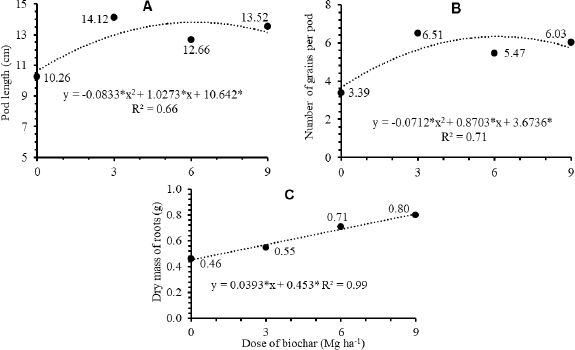
Among the variables determined in all pots, PODL (Figure 1A) and GRN (Figure 1B) showed a quadratic response as a function of the biochar dose. The estimated PODL value was maximum at a dose of 6.2 Mg ha-1 (13.81 cm), 30% higher than the control (10.64 cm). This was also the dose of maximum GRN, whose estimated value (6.33) was 72% higher than the control (3.67). In turn, the RDM variable (Figure 1C) showed a positive linear response as a function of the biochar dose and a 74% increase in the values observed for the biochar dose of 9.0 Mg ha-1 (0.80 g) compared to the control (0.46 g).
Response of variables average pod length, average number of grains per pod and dry mass of cowpea roots as a function of biochar doses in the first season. *Significant parameter.
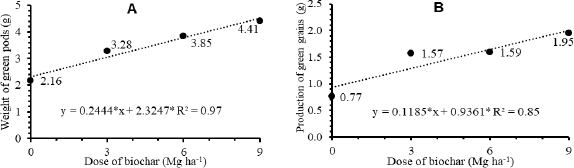
In the case of variables determined in four pots, a positive linear response was observed as a function of biochar dose for the variables PODW (Figure 2A) and GGRP (Figure 2B). The observed values of PODW referring to the dose of 9.0 Mg ha-1 (4.41 g) were 104% higher than the control (2.16 g), while GGRP referring to the dose of 9.0 Mg ha-1 (1.95 g) was 153% greater than the control (0.77 g).
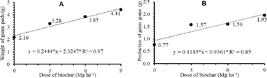
Responses of variables, average weight of green pods and production of green cowpea grains per pot as a function of biochar doses in the first season. *Significant parameter.
The averages of PODL, GRN and GGRP were significantly higher (Table 1) when using pure biochar than when using WVbiochar. PODL was 11% lower when using WVbiochar (11.85 cm) compared to using pure biochar (13.32 cm). Regarding GRN, the reduction was 21% between the use of pure biochar (5.92 cm) and WVbiochar (4.69 cm). In turn, GGRP was 28% lower when using WVbiochar (1.21 g) compared to using pure biochar (1.69 g).
Effect of biochar doses
In the first season, in which the plants did not receive mineral fertilizer, most of the cowpea variables evaluated showed a positive response as a function of biochar doses. This is in agreement with authors who tested different doses of biochar and found increases in nodulation and parameters of growth, such as biomass, and production, such as 100-seed weight, number of pods per plant and weight of pods, compared to the control (ADEKIYA; AYORINDE; OGUNBODE, 2024; MIRANDA et al., 2020; MOOSAVI et al., 2020; RAFAEL et al., 2019).
Other studies have corroborated the positive results observed in our study when comparing to the most effective doses of biochar and increases in cowpea variables. Regarding PODL, Miranda et al. (2020) also obtained a quadratic response in an Arenosol, with a maximum value at the dose of 5.3 Mg ha−1 and an increase of 13% compared to the control, but in sandy Acrisol and Ferralsol the increases were linear up to the dose of 10.5 Mg ha−1. Unlike the quadratic response of GRN in our study, Moosavi et al. (2020) and Miranda et al. (2020) obtained linear responses of 36% up to the dose of 8.0 Mg ha−1 and 26% up to the dose of 10.5 Mg ha−1, respectively. A linear increase in PODW was also obtained by Adekiya, Ayorinde and Ogunbode (2024), which was 217% up to a dose of 10.0 Mg ha-1. The linear increase in GGRP was corroborated by Moosavi et al. (2020), who observed annual increases of 26 and 38% up to a dose of 8.0 Mg ha-1, and by Miranda et al. (2020), who observed increases of 44 and 32% up to a dose of 10.5 Mg ha-1 in Acrisol and Ferralsol, and a quadratic response in Arenosol, with minimum GGRP at the dose of 3.1 Mg ha-1.
The linear increase in cowpea RDM, obtained in our study, is corroborated by observations that the application of biochar increased cowpea root growth, both in dry mass and length (ADEKIYA; AYORINDE; OGUNBODE, 2024; MOOSAVI et al., 2020; RAFAEL et al., 2019). These authors attributed the increases in RDM in their studies to the effect of biochar in reducing Al toxicity, due to improved pH, and also the reduction in soil density (ADEKIYA; AYORINDE; OGUNBODE, 2024).
In our study, production parameters and dry mass of cowpea roots were maximized by biochar doses between 3.0 and 9.0 Mg ha-1, while Mete et al. (2015) applied 20 Mg ha-1 of biochar and obtained a 63% increase in soybean yield. In this aspect, Miranda et al. (2020) reported benefits of applying biochar to cowpea crops in the Brazilian semi-arid region up to a dose of 10.5 Mg ha-1, without mineral fertilization.
Among the possible causes of the positive effects of biochar application on cowpea variables in our study are the increase in soil fertility, which according to Moosavi et al. (2020) stimulates plant growth and components of cowpea production, in addition to other benefits, such as correction of acidity, increased cation exchange capacity (CEC), the supply of essential nutrients to plants and the improvement of their retention in the soil and also the improvement of the soil structure in terms of density and water holding capacity. The increase in soil CEC is due to the large porosity and high surface area of biochar, with unprotected negative charges, which give it a great surface adsorption capacity. In addition, weathering causes oxidation of biochar and the development of carboxylic groups on its surface. Electrostatic adsorption sites form an exchange complex that increases nutrient retention in acidic soils and reduces their losses by leaching (ADEKIYA; AYORINDE; OGUNBODE, 2024; MIRANDA et al., 2020; RAFAEL et al., 2019).
The positive results obtained in this work can also be attributed to the liming effect of biochar on acidic soils, for which it is recognized as a corrective (ADEKIYA; AYORINDE; OGUNBODE, 2024). This effect is more significant in sandier soils, which have a lower buffering capacity, such as the type of soil in our study, in which the application of biochar greatly improved cowpea yield in a study by Miranda et al. (2020). According to these authors, the corrective effect is due to the alkaline nature of biochar, its significant concentrations of basic cations in its ashes and the exchange of H+ ions with the soil. In addition, biochar displaces H+, Fe2+, and Al3+ ions from soil exchange sites and releases organic acids, which can immobilize Al through chelation (ADEKIYA; AYORINDE; OGUNBODE, 2024). Therefore, the positive results obtained in our work may be due to the fact that the application of biochar to the soil reduced the exchangeable acidity and toxicity of aluminum and promoted a more favorable environment for root growth, nodulation and BNF (ADEKIYA; AYORINDE; OGUNBODE, 2024; RAFAEL et al., 2019).
Results obtained confirm that cowpea responds very well to the application of biochar, because it improves soil fertility, facilitates the biochemical cycling of N and P and favors their availability, in addition to increasing soil levels of K, Ca and Mg, in which the raw material of biochar is rich (ADEKIYA; AYORINDE; OGUNBODE, 2024; MOOSAVI et al., 2020). Biochar can promote an increase in the total N content in plants by stimulating the activity of nitrogen-fixing bacteria in the soil (ADEKIYA; AYORINDE; OGUNBODE, 2024), which is attributed to the greater availability of P, K, Ca and Mg, and also of B and Mo. Furthermore, biochar can stimulate BNF because it improves soil aeration and corrects its acidity, in addition to greatly altering the N cycle in the soil, by promoting an increase in nitrification (MIRANDA et al., 2020).
In regard to K, the application of biochar, which releases K into the soil, promotes higher absorption and increase its leaf content, which may have benefited the yield of cowpea in our study. In fact, the addition of K to soil is an important effect of the application of biochar. According to Miranda et al. (2020), the K provided by biochar can even promote an increase in the biomass production of cowpea grown without nitrogen fertilization.
The increase in cowpea yield may be also due to the greater availability of P promoted by the application of biochar (RAFAEL et al., 2019), as the high sand content of soils such as the one in our study limits the availability of P, whose adsorption to Fe and Al oxides is common in tropical and subtropical soils (MIRANDA et al., 2020). This greater availability is due to the increase in soil pH promoted by biochar, which promotes the solubilization of the P fixed in the soil, but it is also due to the contribution of the P contained in the ash fraction of biochar (ADEKIYA; AYORINDE; OGUNBODE, 2024). In addition, clay-mineral bound P is not available to plants, but becomes available when bound to organic matter, such as biochar (MIRANDA et al., 2020), which also reduces P leaching and ensures greater availability (ADEKIYA; AYORINDE; OGUNBODE, 2024).
Cowpea growth and yield in our study may also have benefited from the improved soil structure promoted by biochar application, which allows for greater root penetration, nutrient uptake, and nodulation. Biochar is porous, has low density and, through the direct effect of mixing or dilution with soil particles, reduces its density and increases its porosity, while indirectly promotes soil aggregation (MIRANDA et al., 2020).
Effect of wood vinegar impregnated in biochar
The cowpea variables showed lower values when the biochar was soaked in WV (WVbiochar), in the first season, compared to pure biochar. This is at odds with studies that obtained positive results from the application of WV in several species. According to Akley et al. (2023), the application of WV contributes to increasing the yield of legumes such as cowpea, mung bean, soybean and chickpea. These authors applied WV (0.2% v/v) to cowpea every seven days and observed improvements in soil health, root nodulation, and pod and grain yield. The application of WV by fertigation (0.3% v/v) particularly favored lentil crop in terms of total biomass, number of pods, number of seeds per pod and pod weight (CARRIL et al., 2023), while only the number of pods of common bean showed a significant effect, and no significant effect was observed in chickpea.
The negative results obtained in our study may be caused by factors like the phytotoxin content of WV, the ineffectiveness of applying WV impregnated in biochar, and the interaction between alkaline biochar and acidic WV, which can neutralize them, or cause biochar sorption of important compounds from WV (ZHANG et al., 2020). In several studies, damage from the application of WV has been reported, mainly at excessive concentrations, on the initial development, growth and yield of plants, with phytotoxicity and physiological disorders being observed in common beans (SILVA et al., 2021) and phytotoxicity and cytotoxicity in lettuce (MORALES et al., 2022). Damage of these types in
French marigold and scarlet sage has been attributed to a hormonal sensitivity to WV (KADOTA; NIIMI, 2004) and, in tomato, to the presence of phenolic compounds and the low pH of WV (LUO et al., 2019). Added to this are the biocidal properties of WV, which affected soil microbial activity and indirectly the production and quality of tomato fruits, as it delayed the conversion of N-NH4 into N-NO3 (IDOWU et al., 2023).
Another aspect that may have harmed plant growth in our study is that, due to the acidity of WV, its application at high doses can cause soil acidification (GREWAL; ABBEY; GUNUPURU, 2018). In this regard, Adekiya, Ayorinde and Ogunbode (2024) established a positive correlation between soil pH and cowpea grain yield, which may explain the negative effect of WV. In a study by Togoro, Silva and Cazetta (2014), the application of WV at concentrations of 4 and 8% (v/v) promoted an increase in potential acidity and a decrease in pH, base saturation and CEC of the soil. The authors observed that increased soil acidity, due to the application of WV, caused displacement of exchangeable bases from exchange sites and favored the leaching of cations from the surface layer with a decrease in the concentrations of K, Ca and Mg in this layer.
Second season
The dose of biochar applied had significant effects (p<0.05) on the variables PODL, PODW, determined in all pots, and on GGRP and DGRP. In this season, there was no significant effect of the type of biochar used on the variables studied (Table 2), nor a significant effect of the interaction between dose and type of biochar.
Average production parameters and dry mass of cowpea roots under the effect of two types of biochar in the second season.
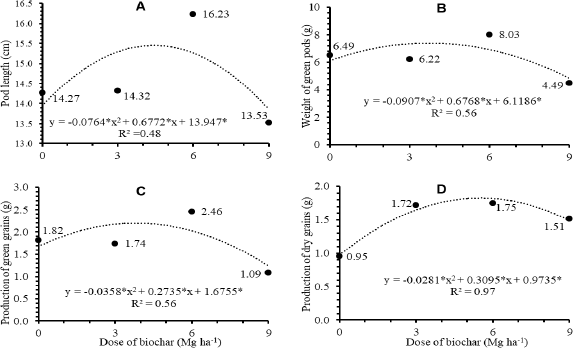
A quadratic response was observed as a function of the biochar dose on the variables PODL (Figure 3A), PODW (Figure 3B), GGRP (Figure 3C) and DGRP (Figure 3D). The maximum estimated value of PODL (15.45 cm) was obtained with a dose of 4.4 Mg ha-1, and was 11% higher than the control (13.95 cm); the maximum estimated value of PODW (7.38 g) was obtained with a dose of 3.7 Mg ha-1 and was 21% higher than the control (6.12 g); the maximum GGRP value (2.20 g) was estimated for the dose of 3.8 Mg ha-1 and was 31% higher than the control (1.66 g); in turn, the DGRP variable showed a maximum estimated value of 1.83 g, which was obtained with a dose of 5.5 Mg ha-1, and was 88% higher than the control (0.97 g).
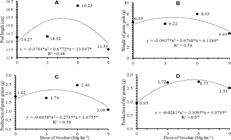
Responses of the variables average pod length, average green pod weight, green grain production per pot and dry grain production per pot of cowpea as a function of biochar doses in the second season. *Significant parameter.
Effect of biochar doses
All pots received mineral fertilization with NPK in the second season, which can explain why the variables showed higher values compared to the first season. Furthermore, the variables significantly influenced by biochar doses in the presence of mineral fertilizer (PODL, PODW, GGRP and DGRP) showed a quadratic response and smaller increases, compared to the control, than in the first season. In this regard, Moosavi et al. (2020) and Rafael et al. (2019) reported that the application of biochar with mineral fertilizer with NPK promoted greater growth and yield of cowpea in acidic sandy soils, compared to the individual application of these materials, when the control did not receive mineral fertilizer. This is due to the additional supply of nutrients by biochar and occurs because its high CEC improves the retention and availability in the soil solution of N, P and K contained in mineral fertilizer, which are more absorbed by plants, increasing nutrient use efficiency. On the other hand, there is a possibility that a synergistic effect of biochar and mineral fertilizer causes an increase in biomass production, root nodulation and soybean grain yield, as reported by Mete et al. (2015).
Although the doses of biochar used in this study are lower, compared to those applied in other studies, the predominantly quadratic effects on the variables in the second season indicate negative effects of higher doses of biochar. According to Jeffery et al. (2011), among the negative effects of high doses of biochar are the promotion of a priming effect on soil organic carbon, and toxicity to soil biota. In turn, Miranda et al. (2020) point out the possibility that high doses of biochar negatively affect soil structure by clogging its pores, increasing density and decreasing water retention capacity, thus harming the growth of cowpea roots and BNF. These authors state that biochar, at excessive doses, promotes the retention of N, which is also immobilized due to the increase in the C/N ratio of the soil. Thus, high doses of biochar may cause decreases in yield, in BNF and in the production of biomass of cowpea due to the low availability of N.
Effect of wood vinegar impregnated in biochar
In the second season, WVbiochar did not promote significant differences in cowpea variables, compared to pure biochar. It is possible that the positive effects of mineral fertilizer overcame the negative effects of WV, observed in the first season. In a study by Jindo et al. (2022), the application of the recommended dose of mineral fertilizer provided greater fresh mass of Brassica rapa var. perviridis, compared to the individual application of WV (0.5 and 0.125% v/v). In turn, Ofoe et al. (2024) found that mineral fertilizer enhanced the effects of WV application (2% v/v) on the fresh mass of the aerial part, number and weight of fruits, sugar content and other tomato parameters.
General considerations
In addition to the incorporation of a significant amount of recalcitrant carbon to the soil, as proven by the analysis of the biochar, with recognized environmental effects, the results obtained indicate that for the field cowpea crop it is possible to suggest the application of biochar incorporated into the soil, at doses between 6.0 and 9.0 Mg ha-1. However, in the case of mineral fertilization, these doses can be reduced to 4.0 to 6.0 Mg ha-1. In this aspect, future studies may test methods of applying biochar to the soil, either broadcast or in furrows, manually or mechanized.
The production of biochar by farmers in the northeast region of Brazil can be carried out in masonry furnaces of simple construction, in which small adaptations must be made to obtain WV (ALBUQUERQUE; MELO; PIMENTA, 2024). Woody raw materials can be obtained from tree pruning and clearing of shrub vegetation in urban areas (NOVOTNY et al., 2015), pruning of fruit trees such as cashew (MIRANDA et al., 2020) and mango, and the eradication of exotic species considered invasive, such as Azadirachta indica, Prosopis juliflora, and Leucaena leucocephala, in addition to the management of native vegetation, such as Mimosa tenuiflora (FEIJÓ et al., 2022), as long as native vegetation is not cleared for this purpose.
The characteristics of the soil used certainly influenced the positive results of the application of biochar, as verified in several articles. In this regard, different effects in intensity and even contrasting effects were found when studies involving different soil types were carried out (MIRANDA et al., 2020; STREUBEL et al., 2011). Therefore, studies addressing the joint application of biochar and WV should also be carried out in different types of soil and including mineral fertilization as a factor to be studied.
Although the results do not allow us to recommend the use of WV, future studies should be carried out in the field and may test different doses, in order to avoid problems of phytotoxicity and cytotoxicity (SILVA et al., 2021; MORALES et al., 2022) or soil acidification (GREWAL; ABBEY; GUNUPURU, 2018), in addition to more convenient forms of application than soaking, such as foliar application or via irrigation (MUNGKUNKAMCHAO et al., 2013; AKLEY et al., 2023). In any context, it is important that studies are carried out in the long term and that the effects on chemical, physical and biological characteristics of the soil are also evaluated.
CONCLUSION
The results obtained do not allow us to recommend the application of wood vinegar impregnated in biochar, at the dose used, in cowpea. On the other hand, biochar application at doses between 6.0 and 9.0 Mg ha-1 can be recommended for cowpea, but these doses can be reduced to 4.0 to 6.0 Mg ha-1 in the presence of mineral fertilization. Studies addressing the joint application of biochar and wood vinegar should continue and should address different doses, forms of application, raw materials, soil types, and crops.
Data Availability:
The data that support the findings of this study can be made available, upon reasonable request, from the corresponding author.
REFERENCES
- ADEKIYA, A. O.; AYORINDE, B. B.; OGUNBODE, T. Combined lime and biochar application enhances cowpea growth and yield in tropical Alfisol. Scientific Reports, 14: 1389, 2024.
- AKLEY, E. K. et al. Wood vinegar promotes soil health and the productivity of cowpea. Agronomy, 13: 2497, 2023.
- ALBUQUERQUE, F. B.; MELO, R. R.; PIMENTA, A. S. Mini-rectangular kiln to produce charcoal and wood vinegar. Floram, 31: e20240022, 2024.
- ARAUJO, K. C. Avaliação de linhagens melhoradas de feijão-caupi (Vigna unguiculata L. Walp.) na região noroeste fluminense para estudo de valor de cultivo e uso 2019. 114 f. Tese (Doutorado em Produção Vegetal: Área de Concentração em Produção Vegetal) - Universidade Estadual do Norte Fluminense Darcy Ribeiro, Campos dos Goytacazes, 2019.
- BASTOS, E. A. et al. Calibração do modelo CROPGRO-cowpea para simulação do crescimento e rendimento de grãos de feijão-caupi com e sem deficit hídrico Teresina, PI: Embrapa Meio-Norte, 2023. 24 p. (Embrapa Meio-Norte. Boletim de Pesquisa e Desenvolvimento, 149).
- CARRIL, P. et al. Effects of wood distillate (pyroligneous acid) on the yield parameters and mineral composition of three leguminous crops. Environments, 10: 126, 2023.
-
CONAB - Companhia Brasileira de Abastecimento. Previsão de safra por produto, outubro de 2023. Feijão caupi total 2023. Disponível em: <https://www.conab.gov.br/info -agro/ safras/graos>. Acesso em: 11 Mar. 2024.
» https://www.conab.gov.br/info-agro/safras/graos - DU, H. G. et al. Effect of the mixture of charcoal with pyroligneous acid on shoot and root growth of sweet potato. Japanese Journal of Crop Science, 67: 149–152, 1998.
- FAO - Food and Agriculture Organization. The state of the world’s land and water resources for food and agriculture – Systems at breaking point Main report. Rome: FAO, 2021. 62 p.
- FEIJÓ, F. M. C. et al. Efficiency of pyroligneous extract from jurema preta (Mimosa tenuiflora [Willd.] Poiret) as an antiseptic in cats (Felis catus) subjected to ovariosalpingohysterectomy. Animals, 12: 2325, 2022.
- GREWAL, A.; ABBEY, L.; GUNUPURU, L. R. Production, prospects and potential application of pyroligneous acid in agriculture. Journal of Analytical and Applied Pyrolysis, 135: 152-159, 2018.
- IDOWU, O. et al. Effect of the interaction between wood vinegar and biochar feedstock on tomato plants. Journal of Soil Science and Plant Nutrition, 23: 1599–1610, 2023.
- JINDO, K. et al. Sustainable plant growth promotion and chemical composition of pyroligneous acid when applied with biochar as a soil amendment. Molecules, 27: 3397, 2022.
- JEFFERY, S. et al. A quantitative review of the effects of biochar application to soils on crop productivity using meta-analysis. Agriculture, Ecosystems & Environment, 144: 175-187, 2011.
- KADOTA, M.; NIIMI, Y. Effects of charcoal with pyroligneous acid and barnyard manure on bedding plants. Scientia Horticulturae, 101: 327-332, 2004.
- LUO, X. et al. Effect of co-application of wood vinegar and biochar on seed germination and seedling growth. Journal of Soils and Sediments, 19: 3934–3944, 2019.
- METE, F. Z et al. Synergistic effects of biochar and NPK fertilizer on soybean yield in an alkaline soil. Pedosphere, 25: 713-179, 2015.
- MIRANDA, N. O. et al. Effect of biochar application on production parameters of two cowpea cultivars planted in succession in five soils from the Brazilian semiarid region. Arabian Journal of Geosciences, 13: 506, 2020.
- MORALES, M. M. et al. Wood vinegar: chemical characteristics, phytotoxic effects, and impacts on greenhouse gas emissions. Nativa, 10: 400-409, 2022.
- MOOSAVI, S. A. et al. Integrated application of biochar and bio-fertilizer improves yield and yield components of cowpea under water-deficient stress. Italian Journal of Agronomy, 15: 94-101, 2020.
- MUNGKUNKAMCHAO, T. et al. Wood vinegar and fermented bioextracts: Natural products to enhance growth and yield of tomato (Solanum lycopersicum L.). Scientia Horticulturae, 154: 66–72, 2013.
- NOVOTNY, E. H. et al. Biochar: pyrogenic carbon for agricultural use - a critical review. Revista Brasileira de Ciência do Solo, 39: 321-344, 2015.
- OFOE, R. et al. Foliar application of pyroligneous acid acts synergistically with fertilizer to improve the productivity and phytochemical properties of greenhouse-grown tomato. Scientific Reports, 14: 1934, 2024.
- RAFAEL, R. B. A. et al. Benefits of biochar and NPK fertilizers for soil quality and growth of cowpea (Vigna unguiculata L. Walp.) in an acid arenosol. Pedosphere, 29: 311–333, 2019.
- SILVA, D. W. et al. Efeito do extrato pirolenhoso no desenvolvimento inicial de plantas de milho e feijão. Revista Eletrônica Científica da UERGS, 7: 93-102, 2021.
- SILVA, M. B. O. et al. Desempenho agronômico de genótipos de feijão- caupi. Revista de Ciências Agrárias, 41: 1059-1066, 2018.
- SON, T. K. et al. Effect of a mixture of charcoal and pyroligneous acid applied to the soil at different fertilizer levels on the growth and yield of rice. Japanese Journal of Crop Science, 72: 345-349, 2003.
- STREUBEL, J. D. et al. Influence of contrasting biochar types on five soils at increasing rates of application. Soil Science Society of America Journal, 75: 1402-1413, 2011.
- TOGORO, A. H.; SILVA J. A. S.; CAZETTA J. O. Chemical changes in an oxisol treated with pyroligneous acid. Ciência e Agrotecnologia, 38:113-121, 2014.
- ZHANG, Y. et al. Comparative study of individual and co-application of biochar and wood vinegar on blueberry fruit yield and nutritional quality. Chemosphere, 246: 125699, 2020.
Edited by
-
Editor in Chief:
Aurélio Paes Barros Júnior