Selection of cowpea parental lines based on molecular markers and grain yield
ABSTRACT
Cowpea (Vigna unguiculata (L.) Walp.) is a crop of socioeconomic importance in Brazil, as it serves as a food source and generates employment and income. Cowpea is grown in large areas in the main grain-producing regions of Brazil and has been a good option for the second crop season due to its high tolerance to water deficit. The objective of this study was to select parental lines based on genetic divergence assessed using inter-simple sequence repeat (ISSR) molecular markers and grain yield for cowpea breeding. Genomic DNA was extracted from 14 lines and six cultivars, and amplifications were performed using ten ISSR molecular markers. Genetic diversity was estimated using Nei's gene diversity index and Shannon's information index. Pairwise genetic comparisons were based on Jaccard's similarity coefficient, and genotypes were grouped using Tocher's clustering method and unweighted pair group method with arithmetic mean (UPGMA). A total of 105 fragments were amplified, of which 99.05% were polymorphic. Nei's genetic diversity index was 0.2651, and Shannon's information index was 0.4178. Genetic dissimilarity values among genotypes ranged from 0.24 to 0.85. The smallest genetic distance was observed between genotypes MNC11-1022E-9 and MNC11-1031E-11, and the largest between genotypes MNC11-1015E-35 and Pingo de Ouro 1-5-14. The UPGMA clustering method formed five distinct groups, whereas Tocher's clustering method formed six groups. Genetic diversity exists among the evaluated genotypes, indicating potential for selecting contrasting parental lines for use in crosses aiming at breeding various commercial classes and subclasses of cowpea.
Keywords:
Vigna unguiculata; Pulse crops; ISSR molecular markers; Genetic divergence.
RESUMO
O feijão-caupi (Vigna unguiculata (L.) Walp.) é uma cultura de grande importância socioeconômica no Brasil e tem se destacado como uma boa opção para a segunda safra devido à sua elevada tolerância ao déficit hídrico. O objetivo deste estudo foi selecionar genitores com base na divergência genética avaliada por meio de marcadores moleculares inter-simple sequence repeat (ISSR) e na produtividade de grãos, visando ao melhoramento do feijão-caupi. O DNA foi extraído de 14 linhagens e seis cultivares, e as amplificações realizadas utilizando dez marcadores moleculares ISSR. A diversidade genética foi estimada pelos índices de Nei e Shannon. As comparações genéticas pareadas foram baseadas no coeficiente de similaridade de Jaccard, e os genótipos agrupados pelos métodos de agrupamento de Tocher e UPGMA (unweighted pair group method with arithmetic mean). Foram amplificados 105 fragmentos, dos quais 99,05% foram polimórficos. O índice de diversidade de Nei foi de 0,2651, e o índice de Shannon foi de 0,4178. Os valores de dissimilaridade genética entre os genótipos variaram de 0,24 a 0,85. A menor distância genética foi observada entre os genótipos MNC11-1022E-9 e MNC11-1031E-11, enquanto a maior foi observada entre os genótipos MNC11-1015E-35 e Pingo de Ouro 1-5-14. O método de agrupamento UPGMA resultou na formação de cinco grupos distintos, enquanto o método de Tocher formou seis grupos. Existe diversidade genética entre os genótipos avaliados, indicando potencial para a seleção de genitores contrastantes a serem utilizados em cruzamentos visando ao melhoramento de diferentes classes e subclasses comerciais de feijãocaupi.
Palavras-chave:
Vigna unguiculata; Leguminosas de grão; Marcadores moleculares ISSR; Divergência genética.
INTRODUCTION
Cowpea (Vigna unguiculata (L.) Walp.) is characterized by its high nutritional value and is one of the most important components of the food and production systems in the North and Northeast Regions of Brazil (OLIVEIRA et al., 2021). Its cultivation has expanded to the Cerrado biome in the Central-West Region (FREIRE FILHO, 2011) due to the limited supply of cowpea in the market. In Mato Grosso, a leading agricultural state in Brazil, cowpea occupies large areas during the second crop season, in contrast to the traditional family farming systems prevalent in the Northeast Region. Moreover, it is primarily grown in areas that would otherwise remain fallow after the optimal sowing window for maize, thereby providing producers with an additional source of income without competing for land with maize (MENEZES JÚNIOR et al., 2019).
Although cowpea shows good adaptation in Mato Grosso, genotype × environment interaction effects are frequently reported in the literature (SOUZA et al., 2018; ALVES et al., 2020). Consequently, challenges remain in improving adaptability, stability, and grain yield to satisfy domestic consumption and export requirements for cowpea (FREIRE FILHO, 2011; ALVES et al., 2020). One of the major challenges is to increase the number of available cultivars with high grain yield across the various commercial grain subclasses grown in Brazil. The most widely adopted cultivars in Mato Grosso belong to the white commercial class, specifically 'BRS Guariba' and 'BRS Tumucumaque' (smooth white subclass) and 'BRS Novaera' (rough white subclass) (ROCHA; SILVA; MENEZES JÚNIOR, 2017). Therefore, the availability of cultivars for these grain types remains limited. For the brown and white (black-eyed pea subclass) grains, virtually no commercial cultivars are currently cultivated in Mato Grosso.
In this context, the success of a breeding program aimed at developing new cultivars depends on the presence of genetic variability, and studies of genetic diversity can support the selection of parental lines (BORÉM; MIRANDA, 2009). The selection of parental lines for breeding relies on genetic divergence and germplasm characterization. Characterization may include phenotypic evaluations as well as the use of molecular markers, which enable early and rapid characterization of genotypes (NIVEDHA et al., 2024).
A wide variety of molecular markers is available to assess genetic diversity in plants, including inter-simple sequence repeat (ISSR) markers, which is an efficient tool for characterizing accessions and cultivars. These markers are abundant throughout eukaryotic genomes, require no prior sequence knowledge of the target species (FELIX et al., 2020), exhibit a high level of polymorphism, high reproducibility, and low cost (COSTA et al., 2015).
In this context, the objective of this study was to select parental lines based on genetic divergence assessed using ISSR molecular markers and grain yield for cowpea breeding.
MATERIAL AND METHODS
Twenty cowpea genotypes, comprising 13 elite lines and seven commercial cultivars, were evaluated. These genotypes were obtained from the Cowpea Breeding Program of the Brazilian Agricultural Research Corporation (Embrapa Mid-North) (Table 1).
Genomic DNA was extracted from the leaves of 15-day-old plants of the 20 cowpea genotypes according to the protocol of Doyle and Doyle (1987) with modifications (NORBERTO et al., 2025). DNA concentration was estimated using a NanoDrop 2000 spectrophotometer (Thermo Scientific), and quality was assessed by electrophoresis on a 1% agarose gel stained with GelRed (Biotium, Hayward, CA, USA) and visualized under UV light using a Loccus L-Pix EX imaging system.
PCR amplifications were performed using ten inter-simple sequence repeat (ISSR) markers developed by the University of British Columbia (UBC). These markers were previously selected from 16 primers tested based on high band intensity and reproducibility. Each reaction contained 10-50 ng genomic DNA, 1× PCR buffer (10 mM Tris-HCl, 50 mM KCl, 1.5 mM MgCl₂), 0.3 µM primer, 0.25 mM of each dNTP, 0.05 U of Taq DNA polymerase, and Milli-Q water to a final volume of 15 µL.
Amplifications were performed in a T100 thermal cycler (Bio-Rad) using the following cycling conditions: initial denaturation at 94 °C for 4 min, followed by 35 cycles of 30 s at 94 °C (denaturation), 35 s at the primer-specific annealing temperature, and 2 min at 72 °C (extension); followed by a final extension at 72 °C for 2 min. Amplification products were separated by electrophoresis on 1.5% agarose gels stained with GelRed in 0.5× TAE buffer at a constant voltage of 60 V for 3 h. A 100-bp DNA ladder (Invitrogen) was used as a molecular size standard. Gels were visualized under UV light using a Loccus L-Pix EX transilluminator and photographed.
A binary data matrix was constructed based on the presence (1) or absence (0) of amplified fragments. Each band was assumed to represent a phenotype at a biallelic locus because ISSR markers are dominant. Descriptive analysis of these data included the total number of amplified bands, the number of polymorphic bands, percentage of polymorphism, and polymorphic information content (ANDERSON et al., 1993). The minimum number of amplified fragments required to reliably estimate genetic diversity among the evaluated genotypes was determined by correlation analysis between the original and simulated genetic dissimilarity matrices and by assessing the fit between these matrices using the stress coefficient (MANLY, 1997).
Genetic diversity was estimated using Nei's gene diversity index and Shannon's information index (NEI, 1973; LEWONTIN, 1972) in POPGENE v. 1.32 (YEH et al., 1999). Pairwise genetic distances among genotypes were calculated using Jaccard's similarity coefficient, and clustering was performed by the unweighted pair group method with arithmetic mean (UPGMA). The dendrogram cutoff level was determined according to the method of Mojena (1977). The same data matrix was also used to group the genotypes by Tocher's clustering method. All analyses were conducted using the GENES software (CRUZ, 2016).
Grain yield evaluations were conducted during the second crop season (sowing in March and harvest in May) in 2019 in Sorriso and in 2020 in Sinop, Mato Grosso, Brazil. A 0-20-20 N-P-K fertilizer formulation was applied prior to seed distribution, at a rate of 150 kg ha⁻1 in Sinop and 300 kg ha⁻1 in Sorriso. The fertilizer was applied manually using pre-calibrated measuring cups, followed by thorough mixing with the soil to prevent direct contact with the seeds.
Experiments were arranged in a randomized complete block design with three replications. Each plot consisted of two 4 m rows spaced 0.50 m apart. Sowing dates were 13 March 2020 in Sinop and 9 March 2019 and 6 March 2020 in Sorriso. Grain yield data were subjected to analysis of variance using the GENES software (CRUZ, 2016), and means were grouped by the Scott-Knott test at the 5% probability level (SCOTT; KNOTT, 1974).
RESULTS AND DISCUSSION
The ten inter-simple sequence repeat (ISSR) primers amplified a total of 105 fragments, of which 104 were polymorphic (99.05%), indicating genetic variability among the evaluated cowpea genotypes. The number of polymorphic fragments per primer ranged from 8 (primers UBC 828 and DICA5'CR) to 15 (primer UBC 808), with a mean of 10.4 fragments per primer. All primers exhibited 100% polymorphism, except UBC 889 (Table 2). Asare et al. (2010) evaluated 141 cowpea accessions from different regions of Ghana using 20 SSR primers and reported a total of 74 fragments, with a mean of 3.8 fragments per primer.
Total number of amplified bands (NAB), number of polymorphic bands (NPB), percentage of polymorphism (%P), and polymorphic information content (PIC) for the 10 ISSR primers based on evaluation of 20 cowpea genotypes.
The ISSR primers exhibited a minimum polymorphic information content value of 0.55, with a mean of 0.78. Primers UBC 808, UBC 809, and UBC 817 showed polymorphic information content values above 0.90 (Table 2). Primers with polymorphic information content values greater than 0.5 are generally considered highly informative; thus, the marker set tested was effective for detecting polymorphism among the studied genotypes and has potential for use in future studies of this species. In the literature, ISSR markers have demonstrated high efficiency in discriminating species of the genus Vigna (AJIBADE; WEEDEN; CHITE, 2000). A minimum of 96 amplified fragments was required to ensure reliable genetic diversity analysis of the evaluated genotypes, based on correlation and stress values of 0.99 and 0.05, respectively. The number of amplified fragments (105) exceeded the minimum required (96) (Figure 1). This result supports the reliability of the analyses, as stress values ≤ 0.05 indicate an adequate data fit according to Kruskal (1964).
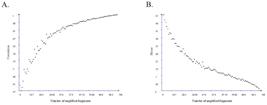
Correlation between genetic similarity estimates for increasing numbers of polymorphic ISSR primers (A) and corresponding stress values indicating the minimum number of fragments required for reliable genetic analysis of the 20 evaluated cowpea genotypes (B).
The mean Nei's gene diversity index was 0.2651 with a standard deviation of 0.1465. The mean Shannon's information index was 0.4178 with a standard deviation of 0.1880. These diversity estimates indicate genetic divergence among the evaluated genotypes. The presence of genetic diversity is advantageous for breeding programs because it enables the identification of contrasting parental lines with potential for genetic gain during selection.
Genetic dissimilarity among the genotypes ranged from 0.24 to 0.85, indicating divergence and confirming that the genotypes are not genetically identical. The smallest genetic distance occurred between lines MNC11-1022E-9 and MNC11-1031E-11, whereas the largest occurred between the lines MNC11-1015E-35 and Pingo de Ouro 1-5-14.
Dissimilarity indices are useful for identifying parental lines with greater genetic distance, thereby enabling crosses between divergent parents to generate segregating populations with variability and high mean grain yield (CRUZ; CARNEIRO, 2003).
Based on genetic distances visualized using the unweighted pair-group method with arithmetic mean (UPGMA), the 20 evaluated cowpea genotypes formed three distinct clusters, with a cutoff level at 92.15% similarity (0.7011) (Figure 2). Dias et al. (2015) evaluated genetic variability among 38 erect, early-cycle cowpea genotypes from diverse origins using nine ISSR primers and UPGMA clustering, and reported the formation of 17 clusters, indicating substantial genetic variability among the genotypes.
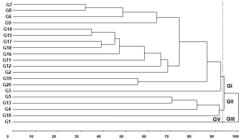
Dendrogram constructed using the unweighted pair-group method with arithmetic mean (UPGMA) based on Jaccard's similarity coefficient for 20 cowpea lines evaluated with ISSR primers.
Group I, the largest cluster, comprised eight lines and seven commercial cultivars (MNC11-1022E-9, MNC11-1031E-11, MNC11-1021E-17, Bico de Ouro 1-5-19, MNC06-909E-52, 'BRS Itaim', 'BRS Imponente', 'BRS Tumucumaque', 'BRS Novaera', 'BRS Olhonegro', MNC06-895E-2, MNC11-1015E-15, 'BRS Guariba', 'BRS Pajeú', and MNC11-1015E-35). Although this cluster included the largest number of genotypes and exhibited similarity based on ISSR markers, genetic variability within the group was evident from the formation of subgroups (Figure 2).
The most similar genotypes (MNC11-1022E-9 and MNC11-1031E-11) were assigned to Group I, forming a subgroup within this cluster. These lines share a common parent, which likely accounts for their high genetic similarity.
The seven commercial 'BRS' cultivars, despite differing in commercial grain subclass, plant architecture, and growth habit (Table 1), were assigned to the same cluster. Group II comprised four lines (MNC11-1019E-12, MNC06-907E-35, MNC11-1019E-8, and Pingo de Ouro 1-5-14). Group III consisted of a single line, MNC11-1013E-16 (Figure 2).
Tocher's clustering method formed six distinct groups (Table 3). Group I included most genotypes (14), differing from the UPGMA clustering by placing the cultivar 'BRS Guariba' and the line MNC11-1015E-35 in separate groups (Groups III and IV, respectively). The cultivar 'BRS Guariba' exhibits high grain yield, wide adaptability, and is recommended for cultivation across several Brazilian states (FREIRE FILHO et al., 2006). The combination of favorable phenotypes and genetic divergence suggests that 'BRS Guariba' is a valuable parental line for the cowpea breeding program.
Clustering of the 20 cowpea genotypes by Tocher's method based on genetic divergence assessed using ISSR primers.
In Group II from Tocher's clustering, lines MNC11-1017E-8 and MNC11-1019E-12 remained together, whereas line MNC06-907E-35 was assigned to Group I and line Pingo de Ouro 1-5-14 formed a separate group. In addition to the divergence detected with ISSR markers, line MNC11-1017E-8 exhibits high grain yield (Table 4). This line belongs to the colored commercial class, always-green subclass with brown grains; therefore, crossing it with line MNC11-1021E-17 may be useful for breeding within this subclass.
Mean grain yield (kg ha⁻1) of 20 cowpea genotypes evaluated during the second crop season in Sorriso (2019 and 2020) and Sinop (2020), Mato Grosso, Brazil.
In the 2019 evaluation in Sorriso, the genotypes formed two distinct groups according to Scott-Knott test, whereas in the 2020 evaluations (Sorriso and Sinop), they formed three groups (Table 4). The mean grain yield data across environments grouped the genotypes into five distinct classes, demonstrating genetic diversity and the potential for selecting contrasting parental lines. Lines MNC11-1021E-17 (1805 kg ha⁻1) and MNC11-1017E-8 (1652 kg ha⁻1), along with cultivar 'BRS Tumucumaque' (1595 kg ha⁻1), constituted the highest grain-yielding group.
Lines MNC11-1015E-35 and Pingo de Ouro 1-5-14, which were placed in separate groups (IV and V) by Tocher's method, also exhibited the greatest genetic dissimilarity and represented the most divergent pair based on the ISSR primer sequences used in this study. This suggests possible allelic complementarity between their loci. In addition to its divergence, line Pingo de Ouro 1-5-14 exhibited good grain yield (Table 4), making it a suitable parental line. Therefore, crossing lines MNC11-1015E-35 and Pingo de Ouro 1-5-14 may be useful for generating segregating populations aimed at developing cultivars in the colored commercial class, specifically the always-green and canapu subclasses.
On the basis of genetic divergence, UPGMA clustering (Figure 2), Tocher clustering (Table 3), and grain yield data (Table 4), potential combinations of parental lines can be identified for breeding cultivars across different commercial subclasses. The cross between line MNC11-1017E-8 and cultivar 'BRS Novaera' may be useful for generating segregating populations to develop cultivars in the always-green and rough white commercial subclasses. Similarly, the cross between line MNC11-1017E-8 and cultivar 'BRS Guariba' may be useful for developing cultivars in the always-green and smooth white commercial subclasses.
Given the limited number of available cultivars in these commercial subclasses, continued investment in research is essential to support the cowpea production chain. The principal cultivars in the white commercial class, smooth white subclass, recommended for Mato Grosso are 'BRS Guariba' and 'BRS Tumucumaque'; those in the rough white subclass are 'BRS Novaera' and 'BRS Imponente' (ROCHA; SILVA; MENEZES JÚNIOR, 2017).
The lines of the white commercial class of the black-eyed pea (fradinho) subclass were generally assigned to the same cluster by both the UPGMA and Tocher methods, indicating genetic similarity among them (Figure 2; Table 3). Together with cultivars 'BRS Itaim' and 'BRS Olhonegro', the lines of the black-eyed pea subclass exhibited lower mean grain yields than cultivars 'BRS Tumucumaque' and 'BRS Guariba' (Table 4), which are widely cultivated in Mato Grosso (MENEZES JÚNIOR et al., 2019; ROCHA; SILVA; MENEZES JÚNIOR, 2017). This finding indicates the need for investment in the selection of parental lines for development of cultivars within the black-eyed pea subclass through breeding.
Crosses involving cultivar 'BRS Olhonegro' with line MNC11-1017E-8 or cultivar 'BRS Guariba' are promising because they combine genetically divergent parental lines (Figure 2) and high grain yield (Table 4). These crosses are therefore expected to generate segregating populations suitable for breeding the black-eyed pea and always-green commercial subclasses with variability and high mean grain yield. Although the availability of cultivars belonging to the black-eyed pea subclass remains limited in Brazil, this grain type remains one of the most important and highly valued in the market (DELMONDES et al., 2017; SILVA et al., 2018). Consequently, the generation of segregating populations and breeding efforts for this commercial subclass are essential to increase cultivar availability in the market.
The cowpea genotypes evaluated in this study exhibited genetic variability, as revealed by ISSR marker analysis, which enables the selection of parental lines for promising cross combinations for generating segregating populations. Continuation of this research is therefore expected to generate segregating populations with variability and high mean grain yield, supporting the development of cowpea cultivars adapted to the edaphoclimatic conditions of Mato Grosso through breeding.
CONCLUSION
Genetic divergence exists among the cowpea genotypes evaluated in this study, as determined by analysis with inter-simple sequence repeat (ISSR) markers.
The integration of molecular marker data with grain yield information enabled the selection of parental lines and the identification of promising crosses for generating segregating populations across commercially important cowpea subclasses in Brazil.
ACKNOWLEDGMENTS
The authors thank the Brazilian National Council for Scientific and Technological Development (CNPq) for funding the research project (process 432849/2018-1, Universal Call MCTIC/2018; project SEG: 20.19.00.151.00.03); the Brazilian Agricultural Research Corporation (Embrapa Mid-North) for funding the projects SEG: 20.18.01.022.00.08.001 and SEG: 20.22.01.011.00.05.001; the Federal Institute of Mato Grosso (IFMT), Sorriso Campus; and the Mato Grosso State Company for Research, Assistance and Rural Extension (Empaer), Sinop, for their collaboration in conducting the field experiments.
Data Availability:
The data that support the findings of this study can be made available, upon reasonable request, from the corresponding author.
REFERENCES
- ALVES, S. M. et al. Adaptability, stability, and agronomic performance of cowpea lines in Mato Grosso, Brazil. Revista Brasileira de Ciências Agrárias, 15: e7896, 2020.
- AJIBADE, S. R.; WEEDEN, N. F.; CHITE, S. M. Inter simple sequence repeat analysis of genetic relationships in the genus Vigna Euphytica, 111: 47-55, 2000.
- ANDERSON, J. A. et al. Optimizing parental selection for genetic linkage maps. Genome 36: 181-186, 1993.
- ASARE, A. T. et al. Assessment of the genetic diversity in cowpea (Vigna unguiculata L. Walp.) germplasm from Ghana using simple sequence repeat markers. Plant Genetic Resources, 8: 142-150, 2010.
- BORÉM, A.; MIRANDA, G. V. Melhoramento de plantas 5. ed. Viçosa, MG: UFV, 2009. 529 p.
- COSTA, D. F. et al. Genetic diversity and selection of ISSR primers in a natural mangaba population (Hancornia speciosa Gomes) (Apocynaceae). Revista Brasileira de Fruticultura, 37: 970-976, 2015.
- CRUZ, C. D. Genes Software - extended and integrated with the R, Matlab and Selegen. Acta Scientiarum Agronomy, 38: 547-552, 2016.
- CRUZ, C. D.; CARNEIRO, P. C. S. Modelos biométricos aplicados ao melhoramento genético Viçosa, MG: UFV, 2003. 585 p.
- DELMONDES, B. L. et al. Identifying lines of the black-eyed cowpea having high productivity and quality commercial grain. Revista Ciência Agronômica, 5: 848-855, 2017.
- DIAS, F. T. C. et al. Variabilidade genética de feijão-caupi de porte ereto e ciclo precoce analisada por marcadores RAPD e ISSR. Revista Ciência Agronômica, 46: 563-572, 2015.
- DOYLE, J. J.; DOYLE, J. L. A rapid DNA isolation procedure for small quantities of fresh leaf tissue. Phytochemical Bulletin, 19: 11-15, 1987.
- FELIX, F. C. et al. Aplicações de marcadores ISSR em estudos de diversidade genética de Pityrocarpa moniliformis Revista Caatinga, 33: 1017-1024, 2020.
- FREIRE FILHO, F. R. Feijão-caupi no Brasil: produção, melhoramento genético, avanços e desafios Teresina, PI: Embrapa Meio-Norte, 2011. 84 p.
- FREIRE FILHO, F. R. et al. 'BRS Guariba': white‑grain cowpea cultivar for the mid-north region of Brazil. Crop Breeding and Applied Biotechnology, 6: 175-178, 2006.
- LEWONTIN, R. C. The apportionment of humam diversity. Evolutionary Biology, 6: 381-398, 1972.
- KRUSKAL, J. B. Multidimensional scaling by optimizing goodness of fit to a nonmetric hypothesis. Psychometrika, 29: 1-27, 1964.
- MANLY, B. F. J. Randomization, bootstrap and Monte Carlo methods in Biology 2. ed. London: Chapman and Hall, 1997. 300 p.
- MENEZES JÚNIOR, J. A. N. et al. A cultura do feijão-caupi em Mato Grosso. In: FARIAS NETO, A. L. et al. (Eds.). Embrapa Agrossilvipastoril: primeiras contribuições para o desenvolvimento de uma agropecuária sustentável Sinop, MT: Embrapa Agrossilvipastoril, 2019. v. 1, cap. 15, p. 628-634.
- MOJENA, R. Hierarchical grouping method and stopping rules: an evaluation. The Computer Journal, 20: 359-363, 1977.
- NIVEDHA, R. et al. Assessing the Genetic Diversity of Parents for Developing Hybrids Through Morphological and Molecular Markers in Rice (Oryza sativa L.). Rice, 17: 17, 2024.
- NEI, M. Analysis of gene diversity in subdivided populations. Proceedings of the National. Academy of Sciences, 70: 3321-3323, 1973.
- NORBERTO, R. L. S. et al. Adjustment of Protocol for the Extraction of Cowpea DNA. Ensaios e Ciência: Ciências Biológicas, Agrárias e da Saúde, 29: 299-311, 2025.
- OLIVEIRA, A. M. C. et al. Produção de alimentos na base do feijão-caupi (Vigna unguiculata): importância nutricional e benefícios para a saúde. Research, Society and Development, 10: e56101416054, 2021.
- ROCHA, M. M.; SILVA, K. J. D.; MENEZES JÚNIOR, J. A. N. Cultivares. In: VALE, J. C.; BERTINI, C.; BORÉM, A. (Eds.). Feijão-caupi: do plantio a colheita Viçosa, MG: UFV, 2017. v. 1, cap. 6, p. 113-142.
- SILVA, J. D. L. et al. Selection for the development of black eye cowpea lines. Revista Caatinga, 31: 72-79, 2018.
- SCOTT, A.; KNOTT, M. Cluster-analyis method for grouping means in analysis of variance. Biomtrics, 30: 507-512, 1974.
- SOUZA, M. B. E. et al. Genotype by environment interaction in cowpea lines using GGE biplot method. Revista Caatinga, 31: 64-71, 2018.
- YEH, F. C. et al. Microsoft Windowbased freeware for population genetic analysis: manual (29p) (Version 1.3) [Software]. Edmonton: University of Alberta, 1999.
Edited by
-
Editor in Chief:
Aurélio Paes Barros Júnior
-
Section Editor:
Lindomar Maria da Silveira