Cognitive performance and narrative discourse after SARS-CoV-2 infection
ABSTRACT
Purpose: to evaluate cognitive performance and narrative discourse, as well as possible associations in individuals affected by COVID-19.
Methods: a cross-sectional exploratory research involving individuals infected by COVID-19 and hospitalized in the State of Sergipe. Participants underwent anamnesis, the Mini-Mental State Examination, Neupsilin and Montreal Toulouse Language Assessment Battery Collection (MTL/Brazil). The statistical tests employed were the Shapiro-Wilk test to assess the normality of data distribution, the nonparametric Mann-Whitney test for comparing two independent samples, and Spearman's correlation to evaluate the monotonic relationship between variables. The significance level was set at P < 0.05
Results: thirty-two individuals participated in the anamnesis (75% males, 25% females). A significant correlation was found between the working memory and discourse skills (P < 0.01). Discourse analysis using the Mann-Whitney test revealed significant differences in the total number of scenes (P = 0.005; d = 0.5) and the total number of Information Units (P = 0.017; d = 0.3). These findings suggest that COVID-19 has a substantial impact on speech, affecting verbal fluency, auditory span, digit sequencing, and working memory, thereby influencing memory storage and retrieval processes.
Conclusion: the impact of the pandemic in this area covers a wide range of cognitive and discursive skills.
Keywords:
SARS-CoV-2; Cognition; Memory; Language
INTRODUCTION
From March 2020 to May 2023, the world faced a public health emergency. The COVID-19 pandemic changed the habits and routines of the global population, leading health agencies to take drastic measures to contain its spread1. Over the months, several studies have sought to better understand the behavior of SARS-CoV-2, including its family, origin, pathophysiology, treatment, and short- and long-term consequences. To date, it is known that the virus belongs to the coronavirus family, subgenus Sarbecovirus, and that it spreads through airborne droplets, facilitating its transmission and rapid progression2,3.
During the pandemic, the number of confirmed COVID-19 cases worldwide exceeded 694 million, with approximately 6.91 million deaths4. In Brazil, the number of recorded deaths was notable, totaling more than 705 thousand, with a fatality rate of 1.9%, second only to the United States and ahead of countries with larger populations, such as India4. Factors contributing to this scenario include the delay in the start of vaccination compared to other developed countries, the spread of fake news related to the infection, and the emergence of new mutations and variants of SARS-CoV-24,5.
The rapid proliferation and prevalence of SARS-CoV-2 are related to several factors, such as its structure, as the virus is composed of four proteins that play vital roles in various physiological functions of the human body. These proteins enable the virus to replicate in multiple tissues, facilitating both viral replication and cytokine communication with the host6,7. Furthermore, risk factors related to the development of the severe form of COVID-19, such as advanced age, genetic variation, comorbidities, frailty, and sociodemographic factors, also contribute to the disease's proliferation8.
After the World Health Organization declared the end of the COVID-19 public health emergency and the subsequent increase in the number of people vaccinated globally, a reduction in infection cases and mortality was observed9. With the public health emergency under control, attention turned to the consequences generated by the pandemic period, including cognitive and sensory deficits, cardiovascular diseases, chronic fatigue syndrome, and cerebrovascular diseases10,11.
Among these sequelae, cognitive impairment associated with COVID-19 has been extensively studied during the pandemic years. Impairments in memory, attention, executive functions, speech, depression, and anxiety are directly related to the severity of SARS-CoV-2 infection12. Furthermore, pre-existing comorbidities, such as diabetes and hypertension, age, and other risk factors for developing the severe form of COVID-19 have been associated with the development of long-term sequelae, known in the literature as "Long-COVID"13,14.
Regarding the long-term sequelae presented after SARS-CoV-2 infection, the impairment of communication skills stands out. This impairment has been linked to the aforementioned cognitive abilities and to neurological sequelae, such as cerebral hypoxia, aphasia, cerebrovascular and thrombotic diseases15,16. Such impairments have been associated with the cellular mediator of SARS-CoV-2, the enzyme ACE2, which is expressed in several regions of the central nervous system, such as the motor cortex, olfactory bulb, and vagus nerve. This helps explain the wide range of impaired cognitive abilities following COVID-1917,18.
Several communication skills are correlated with cognitive aspects and, consequently, may be affected by SARS-CoV-2. Among these skills is discourse, a verbal macrostructure that requires a complex ability to select and sequence semantic units, involving skills such as social cognition and working memory19. Deficits in this discursive skill can impair learning, limit participation and social interaction, and impact emotional well-being, personal development, and interpersonal relationships20.
In this context, there is still insufficient evidence on the cognitive and discursive aspects related to COVID-19. This means that these complaints are poorly understood, and the impact of the pandemic on the different functions of the human body remains unknown. Therefore, the hypothesis of this study is that people infected with SARS-CoV- 2 are more likely to present impairments in cognitive function and discourse. Thus, this study aimed at evaluating cognitive performance and narrative discourse, as well as possible associations in individuals affected by COVID-19, so as to improve the understanding of sequelae that have not yet been studied.
METHODS
Study design and ethical aspects
This observational, cross-sectional study employs a quantitative analysis of the results. It adheres to the recommendations outlined in the STROBE guidelines21 and Resolution 466/12 of the National Health Council. The study was approved by the Research Ethics Committee of the Federal University of Sergipe, Brazil (approval number 5658792; CAAE 61448422.7.0000.0217). Data collection occurred between January and November 2023 at the Adult and Elderly Communication Outpatient Clinic of the university.
Eligibility criteria
People of any gender were included in the study: residents born in Brazil, aged 18 or over, who were hospitalized for COVID-19 at the University Hospital in the municipality of Lagarto and at the Surgical Hospital in the city of Aracaju, Brazil. Individuals were excluded if, at some point during the research, they withdrew their free and informed consent, had difficulty answering the oral questionnaires, had cognitive impairment prior to hospitalization, were bedridden due to mobility problems that made their participation in the research difficult, tested positive for COVID - 19 during assessments (due to the need to adhere to isolation protocols and potential interference with test results during the acute phase of the disease), or used psychoactive drugs (including sleeping pills) without a medical prescription.
Research procedures
Testing for COVID-19
Participants underwent the iChromaTM COVID-19 Ag PCR test for COVID-19. During this stage, the team received assistance from a pharmaceutical professional who used personal protective equipment throughout the sample collection, storage, and handling processes. The product was stored at the temperature recommended by the manufacturer (below 30°C)22. Results were reported as either 'detected' (positive) or 'not detected' (negative). Individuals testing negative proceeded to the next stage.
Anamnesis
An oral interview was conducted with the research participants, and their data were recorded on a separate sheet. Information was collected on socioeconomic, identification, and discourse-language pathology complaints pre- and post-COVID-19 infection.
Mini-Mental State Examination - MMSE-2
For cognitive screening, the red abbreviated version of the MMSE-2 was utilized23. This test encompasses aspects including temporal and spatial orientation, immediate memory, attention and calculations, recall memory, language, and visual constructive ability. The analysis of the results was carried out using T scores, wherein the outcomes were converted, considering the age and years of study of each participant.
Brief Neuropsychological Assessment - Neupsilin
Cognitive function was assessed using the Brief Neuropsychological Assessment Instrument - Neupsilin, applicable to individuals aged 12 to 90 years, regardless of their neurological condition24. Neupsilin is validated and consists of 32 subtests that encompass eight distinct neuropsychological functions: Temporal-Spatial Orientation, Concentrated Attention, Visual Perception, Arithmetic Skills, Oral and Written Language, Verbal and Visual Memory, Praxis, and Executive Functions.
In this research, the assessments were conducted by a team of adequately trained discourse therapists. The test scores were converted following the calculation of the Z score, and for the quantitative analysis of the data, they were categorized into levels such as superior, medium, deficit alert, deficit, moderate-severe deficit, and severe deficit. Participants classified as medium and superior were considered normal, while the other classifications were considered altered.
Montreal Toulouse Language Assessment Battery Collection - MTL/Brazil.
Discourse was assessed using the Montreal Toulouse Language Assessment Instrument - MTL/Brazil Collection (MTL), which comprises 22 tasks covering oral and graphic emission, oral and graphic comprehension, as well as non-verbal praxis and calculation25. Exclusively, task 4 was employed during data collection, with the aim of evaluating oral discourse through the description of a 'bank robbery' scene.
The quantitative analysis was conducted based on the criteria established by the authors, considering the total number of words in the discourse, as well as the number of information units (IU). These IUs correspond to the words previously defined by MTL/Brazil, encompassing elements present in the analyzed image, such as bank, money, police, van, warn, and person. The evaluation is performed based on the total number of UIs identified in the presented discourse, ranging from 0 to 10 points. The last parameter evaluated in this task was the total number of scenes evoked during the discourse. The presence of three scenes pre-established by MTL/Brazil, related to the presented discourse, was analyzed, with scores ranging from 0 to 3. The pre-defined scenes were as follows: "Assault inside the agency," "Someone waiting for the criminals outside," and "Someone calling/notifying the police." For the quantitative analysis, the results were converted using the z-score calculation, which takes into account the age, years of study, and standard deviation of each individual analyzed. Its classification can be superior, average, deficit alert, deficit, moderate-severe deficit, and severe deficit.
BIAS
To avoid selection bias, participants who were on the list of people affected by COVID-19 and admitted to the hospitals in question were recruited. Additionally, people with severe cognitive impairment were excluded to prevent potential confounding effects on the results. All tools used were validated for the respective outcomes.
Statistical analysis
The sample selection was done for convenience, and the independent quantitative variables analyzed were age and education. Education was divided into high and low levels, where 1 to 8 years of study were considered a low level, and 9 years onwards were considered a high level. The dependent variables analyzed included the oral discourse test from the MTL/Brazil, as well as working memory tests, auditory span of words in sentences, verbal fluency, and ascending ordering of digits from the Neupsilin.
Data analysis was carried out using Jamovi software. For subsequent analyses, the effect size was considered, categorized as large (0.5), medium (0.3), and small (0.1), and the results were presented as mean, standard deviation, and median26. The choice of statistical tests used was determined based on the distribution of the sample, as verified by the Shapiro-Wilk test to ascertain whether it follows a normal distribution or not. For the subsequent analysis of the evaluated protocols, results classified as superior and average were considered normal, whereas deficit alert, deficit, moderate-severe deficit, and severe deficit were defined as altered.
RESULTS
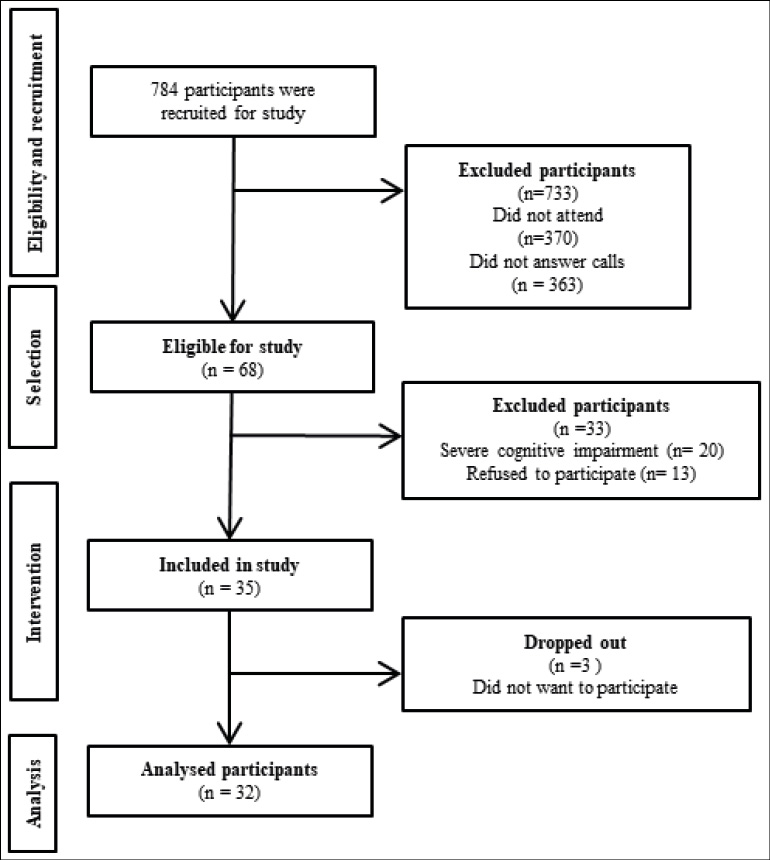
783 participants were recruited from the hospitals in question. Only 68 responded to calls to participate in the survey. After this, 20 participants were excluded due to severe cognitive impairment and 13 refused to participate. Of the remaining 35, three participants refused to continue the evaluations, thus a total of 32 people participated in this study. See details in Figure 1.
The sample consisted of a total of 32 participants, of whom 75% were males and 25% were females. The average age was 51.6 ± 13.6 years, with an average of 8.41 ± 3.77 years of study. Among the assessments conducted during the research, verbal fluency and total UI showed changes in 53.13% of cases after calculating the z-score, with these two being the ones that demonstrated the greatest changes. Table 1 provides a description of participant characteristics and applied protocols.
Table 2 describes the performance of the MTL in relation to the age range of the participants, categorized as adults and older people. The statistical calculation used was the Mann-Whitney non-parametric test. It was possible to observe statistically significant differences in the total number of scenes and total UI, with an effect size considered large (0.5) for the total number of scenes, medium for the total UI (0.3), and small for the number of words (0.1)26.
Regarding the discourse results, when comparing different levels of education, it was observed that participants with a higher educational level demonstrated superior performance in both the total number of Information Units (IU) and total scenes. However, no statistically significant difference was identified in the number of words. Table 3 outlines the relationship between discourse and the level of education.
Table 4 describes the correlation between the quantitative variables analyzed: discourse and verbal fluency tests, working memory, digit ordering, and auditory span of words in Neupsilin sentences. It was observed that verbal fluency is not correlated with working memory and discourse variables. On the other hand, working memory and discourse exhibit a strong correlation.
DISCUSSION
This study aimed to evaluate cognitive performance and narrative discourse, as well as their possible associations, in individuals affected by COVID-19. Thirty-two participants were included, most of whom were male. Among the outcomes evaluated, discourse and verbal fluency were the ones that showed significant changes. Additionally, working memory and discourse exhibited a strong correlation, while verbal fluency did not correlate with any of the analyzed variables.
A review of the literature reveals a gap in understanding the correlation between cognitive aspects such as working memory, verbal fluency, and narrative discourse in the context of COVID-19. Therefore, this study is pioneering and provides robust evidence for tracking and understanding impairments in cognitive function in people infected with SARS-CoV-2 through quantitative assessment of discourse and cognitive aspects.
Systematic reviews demonstrate a direct relationship between SARS-CoV-2 infection and cognitive alterations27,28. These changes are also associated with secondary factors related to COVID-19, such as metabolic disorders, systemic inflammation, and cerebral hypoxia, which can lead to impairments in cognitive abilities like language, memory, attention, learning, speech, and verbal fluency 29,30. Cognitive dysfunction may occur due to direct infection of neurons by the virus via angiotensin-converting enzyme 2 (ACE2), loss of gray matter, and clearance of brain metabolites (beta-amyloid peptides) post-infection29,30.
The neurological manifestations and symptoms of SARS-CoV-2 infection can vary greatly depending on the condition and severity of the disease. Among the most common are hypogeusia and anosmia (changes in taste and smell), encephalitis, and an increase in cases of stroke31. Furthermore, short- and long-term communicative sequelae have been observed in several studies. Some authors attribute these changes to factors related to the duration of hospitalization and complications encountered during this period. Specifically, long-term intubation combined with reduced family interaction due to preventive measures aimed at containing the virus has been linked to an increase in cases of impaired communication skills31-33.
Based on this premise, few studies have linked narrative discourse to cognitive function in people affected by COVID-19. In other populations with impaired cognitive function, such as those with dementia and aphasia, these impairments have been correlated with deficiencies in narrative discourse. This is because skills such as attention, working memory, executive functions, and problem-solving are crucial for effective discursive performance34,35. Another relevant study by Kertesz et al., which used the 'Picnic Scene' from the Western Aphasia Battery, demonstrated that performance in discursive tasks directly influences executive functions35. These findings reinforce the results of our study, which observed a strong correlation between working memory and narrative discourse.
Cognitive analysis is crucial as it provides insights into several components essential for daily activities, including access to stored information, processing of executive functions, working memory, short-term auditory memory, and language processing36. Studies indicate that changes in these components can lead to impairments in communication, concentration, learning, problem-solving, and decision-making37,38. Over time, these impairments can result in the decline of other skills, such as oral and written language, and affect memory subsystems39. In the present study, a higher number of participants exhibited changes in working memory and verbal fluency, suggesting that these individuals may face difficulties in daily activities, which could negatively impact their quality of life and social participation.
This study presents limitations, including a small sample size, lack of longitudinal follow-up, absence of well-being and quality-of-life assessments, and low adherence from the target population. Despite these limitations, the data obtained offer valuable insights for the fields of psychology, speech-language pathology, and psychiatry. The analysis of cognitive and discursive aspects can support not only differential diagnosis but also the formulation of therapeutic goals, assessment procedures, and treatment planning for individuals presenting with narrative discourse or cognitive impairments40. These findings also pave the way for future research, inspiring and motivating the audience to continue the exploration of this important area.
The results underscore the importance of integrating the assessment and rehabilitation of cognitive and communicative functions, particularly working memory and narrative discourse, into post-COVID-19 care protocols. These functions are essential for personal autonomy, social participation, and overall quality of life. In this context, the study highlights the crucial role of interdisciplinary strategies involving speech-language pathologists, psychologists, and other healthcare professionals. This collaborative approach is vital for the early identification of deficits and the implementation of targeted interventions, making the audience feel included and part of a larger community working towards a common goal.
CONCLUSION
It is concluded that participants infected by SARS-CoV-2, who required hospitalization in the smallest state in the northeast of Brazil, presented changes in discourse and cognitive aspects related to verbal fluency, auditory range, digit ordering and working memory. Furthermore, it was observed that changes in discursive skills were positively correlated with cognitive aspects, such as working memory and verbal fluency.
ACKNOWLEDGMENTS
Gratitude is expressed for the opportunity to have this article published as well as special thanks for the trust placed in this work and for recognition of the academic efforts. Furthermore, special thanks to colleagues and professors who helped conducting this research, as well as the Coordination for the Improvement of Higher Education Personnel Foundation (CAPES) for the support and financing of this study.
REFERENCES
-
1 Giusti L, Mammarella S, Salza A, Del Vecchio S, Ussorio D, Casacchia M et al. Predictors of academic performance during the COVID-19 outbreak: Impact of distance education on mental health, social cognition and memory abilities in an Italian university student sample. BMC Psychol. 2021;9(1):1-17. https://doi.org/10.1186/s40359-021-00649-9 PMID: 34526153.
» https://doi.org/10.1186/s40359-021-00649-9 -
2 Yüce M, Filiztekin E, Özkaya KG. COVID-19 diagnosis - A review of current methods. Biosens Bioelectron. 2021;172(1):112752. https://doi.org/10.1016/j.bios.2020.112752 PMID: 33126180.
» https://doi.org/10.1016/j.bios.2020.112752 -
3 Martora F, Fabbrocini G, Nappa P, Megna M. COVID-19 and cutaneous manifestations: A review of the published literature. J Cosmet Dermatol. 2023;22(1):4-10. https://doi.org/10.1111/jocd.15477 PMID: 36342945.
» https://doi.org/10.1111/jocd.15477 -
4 World Health Organization - WHO [webpage on the internet]. Coronavirus (COVID-19) Dashboard 2024 Jan 18 [accessed on 2024 jan 18]. Available at: https://covid19.who.int/
» https://covid19.who.int/ -
5 Orellana JDY, Marrero L, Horta BL. Letalidade hospitalar por COVID-19 em quatro capitais brasileiras e sua possível relação temporal com a variante Gama, 2020-2021. Epidemiol Serv Saude. 2021;30(1):e2021709. https://doi.org/10.1590/s1679-49742021000400024
» https://doi.org/10.1590/s1679-49742021000400024 -
6 Zhang W, Du RH, Sun R, Yang R, Zhang XE. Recent advances of functional nucleic acid-based sensors for point-of-care detection of SARS-CoV-2. Microchim Acta. 2022;189(3):128. https://doi.org/10.1007/s00604-022-05242-4 PMID: 35717434.
» https://doi.org/10.1007/s00604-022-05242-4 -
7 Chen Y, Yang W, Chen F, Cui L. COVID-19 and cognitive impairment: Neuroinvasive and blood-brain barrier dysfunction. J Neuroinflammation. 2022;19(1):222. https://doi.org/10.1186/s12974-022-02557-7 PMID: 36071466.
» https://doi.org/10.1186/s12974-022-02557-7 -
8 Golzari-Sorkheh M, Weaver DF, Reed MA. COVID-19 as a risk factor for Alzheimer's disease. J Alzheimers Dis. 2023;91(1):1-23. https://doi.org/10.3233/JAD-220800 PMID: 36314211.
» https://doi.org/10.3233/JAD-220800 -
9 Yadav T, Kumar S, Mishra G, Saxena SK. Tracking the COVID-19 vaccines: The global landscape. Hum Vaccin Immunother. 2023;19(1):2191577. https://doi.org/10.1080/21645515.2023.2191577 PMID: 36995773.
» https://doi.org/10.1080/21645515.2023.2191577 -
10 Davis HE, McCorkell L, Vogel LM, Topol EL. Long COVID: Major findings, mechanisms and recommendations. Nat Rev Microbiol. 2023;21(3):133-46. https://doi.org/10.1038/s41579-022-00846-2 PMID: 36639608.
» https://doi.org/10.1038/s41579-022-00846-2 -
11 Grundmann A, Wu CH, Hardwick M, Baillie JK, Openshaw PJ, Semple MG et al. Fewer COVID-19 neurological complications with dexamethasone and remdesivir. Ann Neurol. 2023;93(1):88-102. https://doi.org/10.1002/ana.26629 PMID: 36261315.
» https://doi.org/10.1002/ana.26629 -
12 Curley GA, Klepe A, Francistiová L, Gulya K, Dinnyés A. Cellular and molecular effects of SARS-CoV-2 linking lung infection to the brain. Front Immunol. 2021;12(1):3248. https://doi.org/10.3389/fimmu.2021.730088 PMID: 34484241.
» https://doi.org/10.3389/fimmu.2021.730088 -
13 Savikangas T, Törmäkangas T, Tirkkonen A, Alen M, Fielding RA, Kivipelto M et al. The effects of a physical and cognitive training intervention vs. physical training alone on older adults' physical activity: A randomized controlled trial with extended follow-up during COVID-19. PLoS One. 2021;16(10):e0258559. https://doi.org/10.1371/journal.pone.0258559 PMID: 34644357.
» https://doi.org/10.1371/journal.pone.0258559 -
14 Quinn KL, Lam GY, Walsh JF, Bhéreur A, Brown AD, Chow CW et al. Cardiovascular considerations in the management of people with suspected long Covid. Can J Cardiol. 2023;39(6):741-53. https://doi.org/10.1016/j.cjca.2023.03.007 PMID: 37030518.
» https://doi.org/10.1016/j.cjca.2023.03.007 -
15 Muccioli L, Pensato U, Cani I, Guerra L, Provini F, Bordin G et al. COVID-19-related encephalopathy presenting with aphasia resolving following tocilizumab treatment. J Neuroimmunol. 2020;349:577400. https://doi.org/10.1016/j.jneuroim.2020.577400 PMID: 33032013.
» https://doi.org/10.1016/j.jneuroim.2020.577400 -
16 Kong APH. COVID-19 and aphasia. Curr Neurol Neurosci Rep. 2021;21:1-8. https://doi.org/10.1007/s11910-021-01133-7 PMID: 34674039.
» https://doi.org/10.1007/s11910-021-01133-7 -
17 Bryce-Moncloa A, Bryce-Alberti M, Portmann-Baracco A, Urquiaga-Calderón J, Larrauri-Vigna C, Alegría-Valdivia E. COVID-19 from a cardiovascular perspective. Arch Cardiol Mex. 2021;91:86-94. https://doi.org/10.24875/ACM.20000229 PMID: 33871468.
» https://doi.org/10.24875/ACM.20000229 -
18 Büttner-Kunert J, Blöchinger S, Falkowska Z, Rieger T, Oslmeier C. Interaction of discourse processing impairments, communicative participation, and verbal executive functions in people with chronic traumatic brain injury. Front Psychol. 2022;13:892216. https://doi.org/10.3389/fpsyg.2022.892216 PMID: 36275227.
» https://doi.org/10.3389/fpsyg.2022.892216 -
19 Coelho CA. Management of discourse deficits following traumatic brain injury: Progress, caveats, and needs. Semin Speech Lang. 2007;28(2):122-35. https://doi.org/10.1055/s-2007-970570 PMID: 17427051.
» https://doi.org/10.1055/s-2007-970570 -
20 García JC, Díez E, Wojcik DZ, Santamaría M. Communication support needs in adults with intellectual disabilities and its relation to quality of life. Int J Environ Res Public Health. 2020;17(20):7370. https://doi.org/10.3390/ijerph17207370 PMID: 33050216.
» https://doi.org/10.3390/ijerph17207370 -
21 Cuschieri S. The STROBE guidelines. Saudi J Anaesth. 2019;13(Suppl 1):S31. https://doi.org/10.4103/sja.SJA_543_18 PMID: 30930717.
» https://doi.org/10.4103/sja.SJA_543_18 -
22 Kweon OJ, Kim HR, Lee MK, Lim YK. Real-world accuracy of a SARS-CoV-2 rapid diagnostic tests in the Republic of Korea. J Korean Med Sci. 2022;37(43):e320. https://doi.org/10.3346/jkms.2022.37.e320 PMID: 35476704.
» https://doi.org/10.3346/jkms.2022.37.e320 -
23 Spedo CT, Pereira DA, Foss MP, Barreira AA. Adaptação brasileira do Mini-Mental State Examination: guia portátil e tabela de normas. São Paulo: Hogrefe; 2018. https://doi.org/10.1080/13854046.2015.1093173
» https://doi.org/10.1080/13854046.2015.1093173 - 24 Pawlowski J, Remor E, de Salles JF, Parente MADMP, Fonseca RP, Bandeira DR. Evidência de validade de construto do NEUPSILIN utilizando análise fatorial confirmatória. Actualidades en Psicol. 2014;28(117):37-52.
-
25 Marquete VF, Chaves TA, Barreto SDS. The effectiveness of speech therapy at the discourse level: Case study of language-cognitive disorder in dementia. CoDAS. 2021;33(2):e20200023. https://doi.org/10.1590/2317-1782/20202020023 PMID: 34008775.
» https://doi.org/10.1590/2317-1782/20202020023 - 26 Cohen J. Statistical power analysis for the behavioral sciences. 2nd ed. Routledge; 2013.
-
27 Ceban F, Ling S, Lui LM, Lee Y, Gill H, Teopiz KM et al. Fatigue and cognitive impairment in post-COVID-19 Syndrome: A systematic review and meta-analysis. Brain Behav Immun. 2022;101:93-135. https://doi.org/10.1016/j.bbi.2021.12.020 PMID: 34973396.
» https://doi.org/10.1016/j.bbi.2021.12.020 -
28 Crivelli L, Palmer K, Calandri I, Guekht A, Beghi E, Carroll W et al. Changes in cognitive functioning after COVID-19: A systematic review and meta-analysis. Alzheimer's & Dementia. 2022;18(5):1047-66. https://doi.org/10.1002/alz.12644 PMID: 35297561.
» https://doi.org/10.1002/alz.12644 -
29 Au Yeung SL, Wong THT, He B, Luo S, Kwok KO. Does ACE2 mediate the detrimental effect of exposures related to COVID-19 risk: A Mendelian randomization investigation. J Med Virol. 2023;95(1):e28205. https://doi.org/10.1093/ije/dyac076 PMID: 36217700.
» https://doi.org/10.1093/ije/dyac076 -
30 Ng JH, Sun A, Je HS, Tan EK. Unravelling pathophysiology of neurological and psychiatric complications of COVID-19 using brain organoids. Neuroscientist. 2023;29(1):30-40. https://doi.org/10.1177/10738584211015136 PMID: 34036855.
» https://doi.org/10.1177/10738584211015136 -
31 Oudit GY, Wang K, Viveiros A, Kellner MJ, Penninger JM. Angiotensin-converting enzyme 2-At the heart of the COVID-19 pandemic. Cell. 2023;186(5):906-22. https://doi.org/10.1016/j.cell.2023.06.027 PMID: 36787743.
» https://doi.org/10.1016/j.cell.2023.06.027 -
32 Langton-Frost N, Brodsky MB. Speech-language pathology approaches to neurorehabilitation in acute care during COVID-19: Capitalizing on neuroplasticity. PM&R. 2022;14(2):217-26. https://doi.org/10.1002/pmrj.12691 PMID: 34595841.
» https://doi.org/10.1002/pmrj.12691 -
33 Ramage AE. Potential for cognitive communication impairment in COVID-19 survivors: A call to action for speech-language pathologists. Am J Speech Lang Pathol. 2020;29(4):1821-32. https://doi.org/10.1044/2020_AJSLP-20-00147 PMID: 32946270.
» https://doi.org/10.1044/2020_AJSLP-20-00147 -
34 Kim BS, Lee MS. Discourse performance and related cognitive function in mild cognitive impairment and dementia: A preliminary study. Appl Neuropsychol Adult. 2023;30(2):194-203. https://doi.org/10.1080/23279095.2021.1922408 PMID: 34392759.
» https://doi.org/10.1080/23279095.2021.1922408 -
35 Henderson A, Kim H, Kintz S, Frisco N, Wright HH. Working memory in aphasia: Considering discourse processing and treatment implications. Semin Speech Lang. 2017;38(1):40-51. https://doi.org/10.1055/s-0036-1597257 PMID: 28201836.
» https://doi.org/10.1055/s-0036-1597257 -
36 Leaman MC, Edmonds LA. Analyzing language in the picnic scene picture and in conversation: The type of discourse sample we choose influences findings in people with aphasia. Am J Speech Lang Pathol. 2023;32(4):1413-30. https://doi.org/10.1044/2023_AJSLP-22-00279 PMID: 37256694.
» https://doi.org/10.1044/2023_AJSLP-22-00279 -
37 Lippi G, Sanchis-Gomar F, Henry BM. COVID-19 and its long-term sequelae: What do we know in 2023. Pol Arch Intern Med. 2023;16402. https://doi.org/10.20452/pamw.16402 PMID: 36626183.
» https://doi.org/10.20452/pamw.16402 -
38 Lê K, Coelho C, Feinn R. Contribution of working memory and inferencing to narrative discourse comprehension and production in traumatic brain injury. J Speech Lang Hear Res. 2023;66(7):2346-61. https://doi.org/10.1044/2023_JSLHR-22-00632 PMID: 37257416.
» https://doi.org/10.1044/2023_JSLHR-22-00632 -
39 Kleinman D, Morgan AM, Ostrand R, Wittenberg E. Lasting effects of the COVID-19 pandemic on language processing. PLoS One. 2022;17(6):e0269242. https://doi.org/10.1371/journal.pone.0269242 PMID: 35704594.
» https://doi.org/10.1371/journal.pone.0269242 -
40 Cruice M, Botting N, Marshall J, Boyle M, Hersh D, Pritchard M et al. UK speech and language therapists' views and reported practices of discourse analysis in aphasia rehabilitation. Int J Lang Commun Disord. 2020;55(3):417-42. https://doi.org/10.1111/1460-6984.12528 PMID: 32090417.
» https://doi.org/10.1111/1460-6984.12528
-
A study conducted at the Universidade Federal de Sergipe, Lagarto, SE, Brazil.
-
Financial support
This work was supported by the Coordenação de Aperfeiçoamento de Pessoal de Nível Superior - Brasil (CAPES-PRINT #88887.838289/2023-00; CAPES #88887.863250/2023-00)
-
Data sharing statement
When requested, only legally permitted data will be share with other authors for research purposes.
When requested, only legally permitted data will be share with other authors for research purposes.