Breastfeeding difficulties after breast augmentation: A scoping review
ABSTRACT
Purpose: to identify and describe difficulties observed in breastfeeding in women who underwent breast augmentation surgery.
Methods: a scoping review, with the guiding question: "What are the possible difficulties in breastfeeding observed in women who have undergone breast augmentation, as described in the literature?". The search strategy was carried out with combinations of descriptors for searching the Lilacs, SciELO, Cochrane CENTRAL, BIREME, Pubmed, ADOLEC, BDENF, MedCarib, and gray literature databases, October 12, 2023 being the date of the last search. Complete articles, without restrictions on language and publication time, observational design, and that analyzed women with a history of breast augmentation and possible difficulties in breastfeeding, were included.
Literature Review: seven research articles were included with studies identifying the following as possible difficulties in breastfeeding in women undergoing breast augmentation surgery: the presence of breast engorgement, mastitis, pain, nipple lesions, and changes in lactation and sensitivity involved in breastfeeding.
Conclusion: it is expected that the results presented in this scoping review will stimulate the development of more robust evidence on the relationship between these findings.
Keywords:
Breastfeeding; Breast Implant; Mammoplasty; Mother-Child Relations; Lactation
RESUMO
Objetivo: identificar e descrever dificuldades observadas no aleitamento materno em mulheres submetidas à cirurgia de mamoplastia de aumento.
Métodos: trata-se de uma revisão de escopo, com a pergunta norteadora: “Quais as possíveis dificuldades na amamentação observadas em mulheres que realizaram a mamoplastia de aumento descritas na literatura?”. A estratégia de busca foi realizada com combinações de descritores para a busca nas bases Lilacs, SciELO, Cochrane CENTRAL, BIREME, Pubmed, ADOLEC, BDENF, MedCarib e literatura cinzenta, sendo 12 de outubro de 2023 a data da última busca. Foram incluídos artigos completos, sem restrição de idioma e tempo de publicação, delineamento observacional, e que analisaram mulheres com histórico de mamoplastia de aumento e possíveis dificuldades na amamentação.
Revisão da Literatura: foram incluídos sete artigos. Os estudos identificaram como possíveis dificuldades no aleitamento materno em mulheres submetidas à cirurgia de mamoplastia de aumento: a presença de ingurgitamento mamário, mastite, dor, lesões mamilares e alterações de lactação e de sensibilidade envolvidas no aleitamento materno.
Conclusão: espera-se que os resultados apresentados nesta revisão de escopo estimulem o desenvolvimento de evidências mais vigorosas sobre a relação entre estes achados.
Descritores:
Aleitamento Materno; Implante Mamário; Mamoplastia; Relações Mãe-Filho; Lactação
INTRODUCTION
The World Health Organization (WHO) recommends exclusive breastfeeding (EBF) for the first six months of life and supplementary breastfeeding for the first two years of life, which has become a global public health measure that has been adopted to this day1 , 2. Among the numerous benefits of EBF for newborns, there is a reduction in the risk of allergies3, infant mortality4, diarrhea2, and respiratory infections5. It also reduces the risk of obesity6, has a positive effect on intelligence7, and promotes adequate craniofacial development8. Furthermore, it also has benefits for the mother, such as reducing postpartum hemorrhage9, reducing the risk of hypertension9, diabetes6, and the chances of a new pregnancy10. It protects against breast11 and ovarian12 cancer and promotes an emotional bond between mother and baby13.
The prevalence of EBF in children under six months of age in Brazil increased from 2.9% to 45.7% between 1986 and 202014. However, there is a low percentage of EBF in the Brazilian population. It is believed that a substantial percentage is associated with low adherence to EBF due to situations resulting from low milk production, difficulty in adjustment, lack of knowledge and maternal insecurity, breast complications, family interference, return to work, lack of resilience, and unpreparedness of health professionals, an indication of supplementation with formula 15 - 17 and the use of pacifiers18.
In parallel, Brazil ranks second in the world ranking of countries that perform cosmetic surgical procedures. Data from 2020 from the International Society of Aesthetic Plastic Surgery (ISAPS) show approximately 10.1 million surgical procedures worldwide. Of these, 1.6 million were breast augmentation surgeries, and 57.3% were in women between 19 and 34 years old19.
Breast augmentation can cause damage to the milk ducts, glandular tissue, or breast innervation, and the implant, in turn, exerts pressure on the breast tissue20. Anatomical complications include capsular retraction with hardening of the breast, rupture of the implant, chronic pain and discomfort, and changes in the sensitivity of the nipple-areola complex21 - 23. Given the increasing number of breast augmentation surgeries and the fact that this may be associated with difficulties in EBF19 - 23, it is important that studies exist that demonstrate the possible changes resulting from this surgical procedure. Thus, there must be means to guide specific clinical practice aimed at reducing the weaning rate in women with a surgical history and allowing women to be aware of the risks and benefits before deciding to undergo surgery.
A systematic review concluded that women with breast implants were less likely to breastfeed their babies exclusively compared to women without breast implants20. Another review confirmed that women with breast implants are less likely to establish breastfeeding, especially EBF24. However, existing studies did not verify aspects related to the difficulties encountered in breastfeeding as a result of the surgical procedure.
Therefore, this review aimed at identifying and describing the difficulties in breastfeeding observed in women who underwent breast augmentation surgery, as highlighted in the literature.
METHODS
Research strategy
This scoping review was conducted based on the Preferred Reporting Items for Systematic Reviews and Meta-Analyses for Scoping Reviews guidelines25 , 26. The acronym PCC was used to construct the research question, considering “P” as women who breastfeed or have breastfed, “C” as having undergone breast augmentation surgery, and “C” as possible difficulties in breastfeeding, resulting in the guiding question for this review: What are the possible difficulties in breastfeeding observed in women who have undergone breast augmentation as described in the literature?
Data searches included articles published in the electronic databases Latin American and Caribbean Health Sciences Literature (Lilacs), Scientific Electronic Library Online (SciELO), The Cochrane Central Register of Controlled Trials (Cochrane CENTRAL), Embase, Virtual Health Library (BIREME), PubMed (accessed via MEDLINE), ADOLEC, BDENF (Nursing Database), MedCarib and articles found in the gray literature and in the references of the selected articles, as described in Table 1.
The selection of descriptors used in the construction of the search strategy was carried out by consulting the Medical Subject Headings (MeSH), Health Sciences Descriptors (DeCS), and Embase Subject headings (Emtree) related to the population and exposure.
Selection criteria
Of the references found, articles available in full, with a cross-sectional and cohort design, published in any language, without restrictions on the period of publication, and that studied women with a previous history of breast augmentation, whether or not they had difficulties in breastfeeding, were considered eligible. Articles that cited the relationship between breast augmentation surgery and breastfeeding as a secondary objective were also included. Literature reviews, case series, and articles that addressed breast reduction surgery, mastopexy surgery, mammoplasty surgical procedures, diseases or infections resulting from surgery, previous history of syndromes or cancer, hormonal changes, use of contraceptives during lactation, transplant surgeries, and articles that addressed breastfeeding and infant development were excluded.
Data analysis
The articles identified from the initial search strategies were independently assessed by two reviewers (RRP and LBS) using the Mendeley reference manager, to determine the eligibility for inclusion of the studies, discriminating the studies as "excluded", "included" and "doubtful". In situations where the reviewers did not determine whether the article was included based on the title and abstract, the article was included to be read in full. And, in cases of disagreement during the selection process, they were resolved independently by a third person (RSR).
Data extraction from the included studies was performed in a standardized manner, from records in a Microsoft Excel® spreadsheet, performed independently by two reviewers (RRP and LBS), and subsequent consensual analysis for greater accuracy in the data collected. Data analysis was performed quantitatively and qualitatively after concept training, performed by the reviewers. A data extraction form was developed, as provided in the study project, with the following information: authors and year of publication, study design, sample age, surgery time, type of incision, implant material and volume, number of pregnancies, type and duration of breastfeeding and nipple type, as shown in Chart 1.
LITERATURE REVIEW
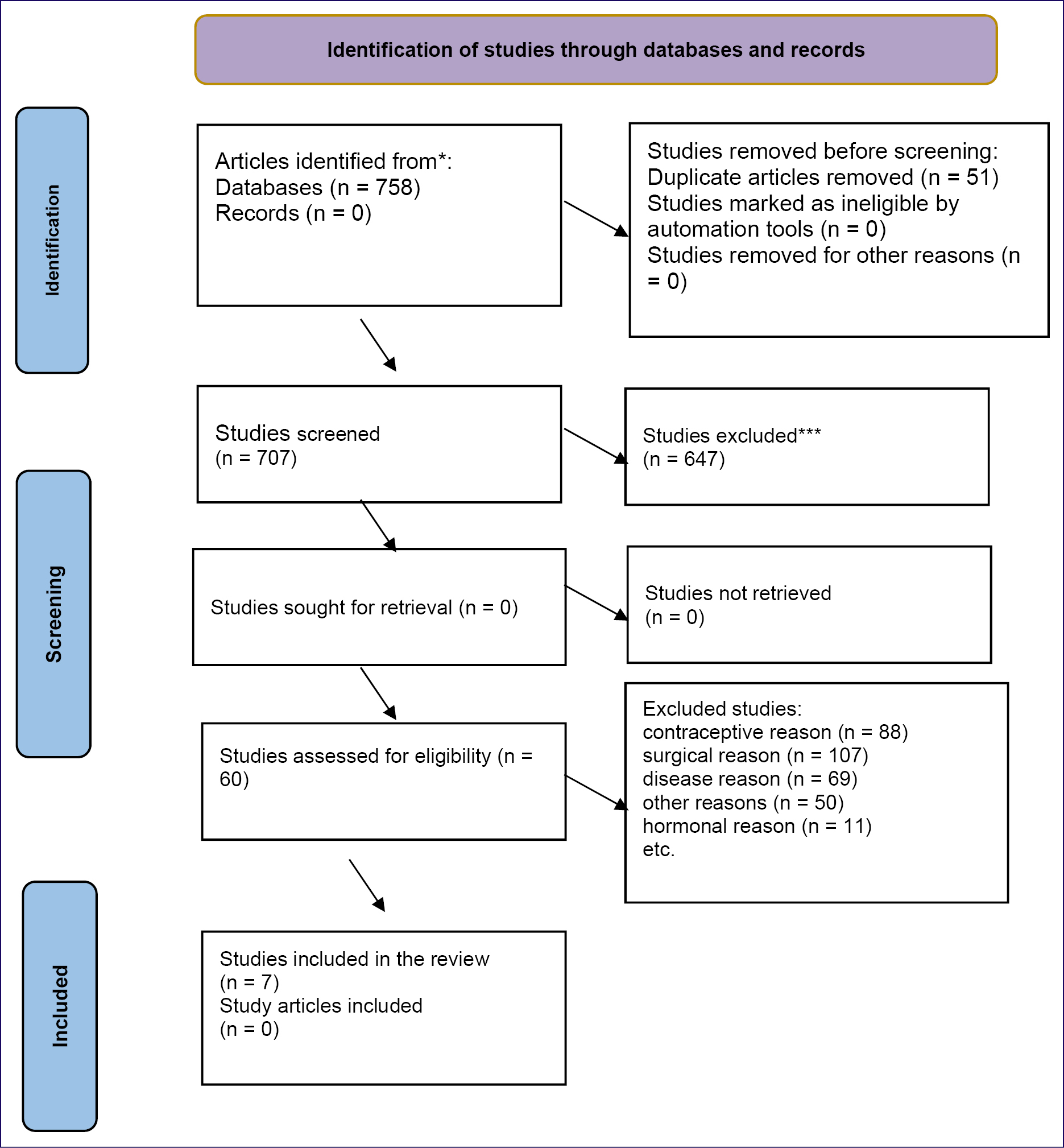
A total of 758 studies were found. After removing 51 duplicates, 707 were screened by reading the titles and abstracts. Subsequently, 60 articles were selected and read in full to verify whether the study was eligible according to the criteria established in this review. Thus, the final sample consisted of seven articles, as shown in Figure 1.
Of these studies, the year of publication ranged from 1996 to 2021, with four (57.1%) from the last five years27 - 29 , 31. The majority (n=5) were carried out in the American continent27 , 28 , 30 , 31 , 33 and the predominant language was English28 - 33. Regarding the design of the selected studies, it was found that four (57.1%) were cohort27 , 28 , 32 , 33 and three (42.85%) were cross-sectional29 - 31.
The included studies sought to analyze the associations between the surgical characteristics of breast augmentation with different implant materials and aspects related to breastfeeding. Regarding the characteristics of the study sample, the average minimum age was 23 and the maximum was 38 years, and the majority were white women, with a normal body mass index (BMI), multiparous, with higher education, and married. Only two (28.57%) of the studies provided information on childbirth and newborn data27 , 33.
Inframammary27 , 28 , 31 - 33 and periareolar27 , 28 , 31 - 33 incisions were the most frequent, followed by mastopexial31 and transaxillary31 incisions. Regarding the implantation site, a higher occurrence of submuscular implantations27 , 28 , 31 , 32 was found, followed by subglandular28 , 31 and subcutaneous27 , 28. The intervals between breastfeeding and the surgical procedure were described in periods of less than ten years, except for one study that followed for more than ten years27. Information on the implant volume was reported in two (33.33%) studies, with averages close to 300 ml27 , 32. In one study, the use of polyacrylamide hydrogel injection30 was observed, and in the others, the use of silicone28 , 31 and saline31 , 32.
Regarding the main outcome analyzed in this review, the presence of breast engorgement27, mastitis28 , 29 , 31, pain27 , 31, nipple lesions27, insufficient28 , 31 - 33 or excessive31 lactation, change in nipple sensitivity28 , 32 or skin sensitivity28 was observed (Chart 2).
According to the articles analyzed, there is a tendency for women with breast augmentation to have greater difficulties in breastfeeding when compared to women without surgery, regardless of the type of incision and implant material. The difficulties described refer to the presence of breast engorgement27, mastitis28 , 29 , 31, pain27 , 31, nipple lesions27, insufficient28 , 31 - 33 or excessive31 lactation, change in nipple sensitivity28 , 32 ), or skin sensitivity28. However, it is worth noting that these difficulties can also be identified in women without nipple implants, showing the importance of an adequate assessment and management of breastfeeding29.
In the current study, it was observed that the prevalence of EBF in the first month of life of babies from women with implants is lower when compared to the prevalence of EBF of those without implants12 , 34.
In cases of breast engorgement and mastitis, there is a possibility of an increase in breast volume beyond normal due to the location of the implant, causing discomfort to the lactating mother and incorrect latch35. Engorgement and pain may also be associated with possible obstruction and injury to the ducts during the surgical procedure since damage to this structure prevents milk from flowing from the glandular tissue to the nipple35. Nipple injuries may be caused by several factors, such as changes in sensitivity and difficulties for the baby to latch onto the nipple-areola complex35, which may or may not be directly related to breast augmentation.
Regarding insufficient lactation, the literature describes a higher occurrence among women with breast augmentation who underwent periareolar33 and inframammary28 approaches more frequently. This is justified by the fact that the incisions result in disturbance of afferent neurons and loss of cutaneous sensation in the nipple, as a consequence of postoperative sensory changes in the breast28 , 33. The change in sensitivity can compromise milk production since stimulation of the nerve endings of the mammary papilla is necessary during sucking so that somatic sensory impulses are produced and conducted to the hypothalamus. There, the hormone oxytocin is released, which is responsible for milk ejection35. Also to avoid complications in milk production, the use of polyacrylamide hydrogel (PH) injection is not recommended due to the risk of infection, tissue atrophy, and breast resection, which can make production impossible due to the lack of healthy glandular tissue30. On the other hand, excessive lactation does not necessarily mean an increase in milk production, but a possible compression of the ducts by the prosthesis, causing the ejection of a greater volume of milk that can lead to discomfort and choking in the baby36.
There was no consensus in the literature regarding the size of the prosthesis that poses a risk of interfering with lactation in women who have implants. This is because each woman has her anatomical characteristics. It was only shown that the prosthesis should not exceed the diameter of the parenchymal base of the breast, considering both aesthetic issues and changes in lactation that may be caused by compression of the mammary glands and decreased breast elasticity. The findings of this review demonstrate that the literature does not yet indicate direct impacts on the baby, only indirect ones, as described throughout the discussion.
It is known that society imposes standards that directly affect the lives of thousands of people37. Aesthetics are important and necessary to increase self-esteem, however, health should also be considered a priority. Therefore, the right to reflect on the possible consequences of undergoing breast augmentation surgery must be respected, without interference from third parties37. To this end, information must be provided clearly and completely by health professionals so that their patients are aware of the possible impact on breastfeeding when they decide to undergo breast augmentation surgery if they wish to breastfeed.
The importance of the speech-language pathologist within the multidisciplinary team that works to promote maternal and child health is highlighted. The professional's objective is to guide, clarify, and encourage the continuity of lactation from prenatal care, postpartum care, and childcare38. Emphasis is needed on breastfeeding with a view on healthy communication, specifically, craniofacial growth and development, at the skeletal, muscular, and functional levels, as well as language acquisition and development38.
Although the quality of the studies found was not analyzed27 - 33 using a pre-established and validated instrument, a full and critical reading of the studies reveals methodological and clinical heterogeneity, as well as a low level of evidence. Future probabilistic, longitudinal studies with greater methodological rigor, detailed description of the sample (mother and baby), and that control possible confounding factors are essential for understanding this phenomenon. This is an emerging theme that lacks scientific evidence, given the complexity of breastfeeding, as well as the guarantee of ethical care and the well-being of women.
The main limitation of this study is the scarcity of research addressing the relationship between breastfeeding difficulties and breast augmentation surgery, which made it impossible to conduct a systematic review and meta-analysis. The results showed that, despite its relevance, the subject is explored as a secondary outcome, in an incipient and inconsistent manner in the literature. In addition, the lack of standardization between the articles' methodology made it impossible to analyze the quality of the data. However, this scoping review is a pioneer in the area, revealing that breast augmentation is a contributing cause of breastfeeding difficulties. When present, it increases the likelihood of complications.
CONCLUSION
The studies identified the presence of breast engorgement, mastitis, pain, nipple lesions, and changes in lactation and sensitivity involved in breastfeeding as possible difficulties in breastfeeding for women undergoing breast augmentation surgery. The main variables related to the study outcome were presented as risk factors. The results presented in this scoping review are expected to stimulate the development of more robust evidence on the relationship between these findings. The aim is to raise awareness among women of childbearing age who intend to undergo breast augmentation surgery about the possible interferences in breastfeeding if they wish to become pregnant.
REFERENCES
-
1 Fundo das Nações Unidas para a Infância [Webpage on the internet]. O coletivo global de amamentação [Accessed 2021 may 30]. Availabe at: https://www.unicef.org/nutrition/index_98470.html
» https://www.unicef.org/nutrition/index_98470.html - 2 Victora C, Vaughan J, Lombardi C, Fuchs S, Gigante L, Smith P. Evidence for protection by breast-feeding against infant deaths from infectious diseases in Brazil. Lancet. 1987;2(8554):319-22.
- 3 Kramer M. Breastfeeding and allergy: The evidence. Ann Nutr Metab. 2011;59:20-6.
- 4 Hossain S, Mihrshahi S. Exclusive breastfeeding and childhood morbidity: A narrative review. Int J Environ Res Public Health. 2022;19(22):14804.
- 5 Victora C, Bahl R, Barros A, França G, Horton S, Krasevec J et al. Breastfeeding in the 21st century: Epidemiology, mechanisms, and lifelong effect. Lancet. 2016;(10017):475-90.
- 6 Horta B, Mola C, Victora C. Long-term consequences of breastfeeding on cholesterol, obesity, systolic blood pressure and type 2 diabetes: A systematic review and meta-analysis. Acta Paediatr. 2015;104:30-7.
- 7 Horta B, Mola C, Victora C. Breastfeeding and intelligence: A systematic review and meta-analysis. Acta Paediatr. 2015;104:14-9.
- 8 Peres K, Barros A, Peres M, Victora C. Effects of breastfeeding and sucking habits on malocclusion in a birth cohort study. Rev Saude Publica. 2007;41:343-50.
- 9 Park S, Choi N. Breastfeeding and maternal hypertension. Am J Hypertens. 2018;31:615-21.
- 10 Ciampo L, Ciampo I. Breastfeeding and the benefits of lactation for women's health. Rev Bras Ginecol Obstet. 2018;40:354-9.
- 11 Rodrigues F, Silveira J, Costa M, Torres G, Farial M. Amamentação na prevenção do câncer de mama: revisão de literatura. Rev Eletronica Acervo Cient. 2021;18:e5900.
- 12 Babic A, Sasamoto N, Rosner B, Tworoger S, Jordan S, Risch H. Association between breastfeeding and ovarian cancer risk. JAMA Oncol. 2020;6:e200421.
- 13 Linde K, Lehnig F, Nagl M, Kersting A. The association between breastfeeding and attachment: A systematic review. Midwifery. 2020 Feb;81:102592.
-
14 UFRJ. Estudo nacional de alimentação e nutrição infantil ENANI-2019: resultados preliminares - indicadores de aleitamento materno no Brasil: resultados preliminares. 2020. Availabel at: https://crn8.org.br/wp-content/uploads/2021/01/Relatorio-preliminar-AM_ENANI-2019-1.pdf Accessed 2023 oct 12.
» https://crn8.org.br/wp-content/uploads/2021/01/Relatorio-preliminar-AM_ENANI-2019-1.pdf - 15 Brown C, Dodds L, Legge A, Bryanton J, Semenic S. Factors influencing the reasons why mothers stop breastfeeding. Can J Public Health. 2014;105:179-85.
- 16 Oliveira C, Locca F, Carrijo M, Garcia R. Breastfeeding and complications that contribute to early weaning. Rev Gauch Enferm. 2015;36:16-23.
- 17 Rocci E, Fernandes R. Breastfeeding difficulties and influence in the early weaning. Rev Bras Enferm. 2014;67:22-7.
- 18 Sampaio R, Brito M, Siebra L, Gonçalves G, Feitosa D, Cabral K et al. Association between pacific use and breastfeeding interruption: A literature review. Braz J Health Rev. 2020;3(4):7353-72.
-
19 ISAPS [Webpage on the internet]. International survey on aesthetic/cosmetic procedures performed in 2019. Isaps. 2020. [Acessed 2023 oct 12]. Availabe at: https://www.isaps.org/discover/about-isaps/global-statistics/reports-and-press-releases/global-survey-2020-full-report-and-press-releases-english/
» https://www.isaps.org/discover/about-isaps/global-statistics/reports-and-press-releases/global-survey-2020-full-report-and-press-releases-english/ - 20 Schiff M, Algert C, Ampt A, Skywak M, Roberts C. The impact of cosmetic breast implants on breastfeeding: A systematic review and meta-analysis. Int Breastfeed J. 2014 Oct 17:9:17.
- 21 Sperli A, Freitas J, Michalany N. Complicações com próteses mamárias. Rev Bras Cir Plast. 2000;15(3):33-46.
-
22 FDA [Webpage on the internet]. Risks and complications of breast implants. Risks Complicat Breast Implant. 2020 [Acessed 2023 oct 12]. Availabe at: https://www.fda.gov/medical-devices/breast-implants/risks-and-complications-breast-implants#:~:text=Symptoms%20such%20as%20fatigue%2C%20memory,to%20better%20understand%20their%20origins
» https://www.fda.gov/medical-devices/breast-implants/risks-and-complications-breast-implants#:~:text=Symptoms%20such%20as%20fatigue%2C%20memory,to%20better%20understand%20their%20origins - 23 Michalopoulos K. The effects of breast augmentation surgery on future ability to lactate. Breast J. 2007;13:62-7.
- 24 Cheng F, Dai S, Wang C, Zeng S, Chen J, Cen Y. Do breast implants influence breastfeeding? A meta-analysis of comparative studies. J Hum Lact. 2018;34:424-32.
- 25 Tricco A, Lillie E, Zarin W, O'Brien K, Colquhoun H, Levac D et al. PRISMA extension for scoping reviews (PRISMA-ScR): Checklist and explanation. Ann Intern Med. 2018;7:467-73.
- 26 Liberati A, Altman D, Tetzlaff J, Mulrow C, Gøtzsche P, Ioannidis J et al. The PRISMA statement for reporting systematic reviews and meta-analyses of studies that evaluate health care interventions: Explanation and elaboration. J Clin Epidemiol. 2009;10:1-34.
- 27 Marcacine K, Abuchaim E, Coca K, Abrão A. Fatores associados à mamoplastia de aumento e o aleitamento materno. Rev Esc Enferm. 2018;52:e03363.
- 28 Lund H, Turkle J, Jewell M, Murphy D. Low risk of skin and nipple sensitivity and lactation issues after primary breast augmentation with form-stable silicone implants: Follow-up in 4927 subjects. Aesthet Surg J. 2016;36:672-80.
- 29 Ram S, Ram H, Rosenthal Y, Attali E, Warshaviak M, Gamzu R. The impact of breast augmentation on breast feeding in primigravida women - A cohort study. Eur J Obstet Gynecol Reprod Biol. 2022;268:116-20.
- 30 Wang Z, Luo D, Dai X, Yu P, Tao L, Li S. Polyacrylamide hydrogel injection for augmentation mammaplasty: Loss of ability for breastfeeding. Ann Plast Surg. 2012;69:123-8.
- 31 Jewell M, Edwards M, Murphy D, Schumacher A. Lactation outcomes in more than 3500 women following primary augmentation: 5-year data from the breast implant follow-up study. Aesthet Surg J. 2019;39:875-83.
- 32 Cruz N, Korchin L. Breastfeeding after augmentation mammaplasty with saline implants. Ann Plast Surg. 2010;64:530-3.
- 33 Hurst N. Lactation after augmentation mammoplasty. Obstet Amp Gynecol. 1996;87:30-4.
- 34 Ram H, Ram S, Wiser I, Tchernin N, Chodick G, Cohen Y. Associations between breast implants and postpartum lactational mastitis in breastfeeding women: retrospective study. BJOG. 2021.
- 35 De Carvalho M, Gomes C. Amamentação: bases científicas. 4a ed. Rio de janeiro: Guanabara Kooga; 2019.
-
36 Alexandre A, Silva J, Reis K, Carvalho Y, Oliveira G, Oliveira J et al. Manejo clínico da amamentação na atenção primária em marabá [Book on the internet]. Editora Pascal LTDA; 2021 [Accessed 2023 nov 25]. https://doi.org/10.29327/534093 ISBN: 978-65-86707-47-2
» https://doi.org/10.29327/534093 - 37 Schaeffer A. A responsabilidade civil do médico nas cirurgias plásticas estéticas: uma obrigação de meio [Final paper]. Porto Alegre (RS): Universidade Federal do Rio Grande do Sul; 2014.
- 38 Leite R, Muniz M, Andrade I. Conhecimento materno sobre fonoaudiologia e amamentação em alojamento conjunto. Rev Bras Em Promocao Saude. 2009;22:36-40.
-
This study was conducted at the Federal University of Health Sciences of Porto Alegre, Porto Alegre, RS, Brazil.
-
Financial support: Nothing to declare
-
Data sharing statement: All individual participant data will be made available (including data dictionaries), as well as the study protocol, statistical analysis plan and clinical trial report. They will be made available immediately upon publication and without an end date to anyone who wishes to access the data for any purpose.
Data sharing statement: All individual participant data will be made available (including data dictionaries), as well as the study protocol, statistical analysis plan and clinical trial report. They will be made available immediately upon publication and without an end date to anyone who wishes to access the data for any purpose.