 Mycorrhization and glomalin in soil in integrated crop-livestock systems under variable nitrogen doses in pasture
ABSTRACT
Integrated crop-livestock systems (ICLS) are recognized for their ecological and socioeconomic benefits, particularly for nutrient cycling efficiency and biodiversity promotion. This study assessed arbuscular mycorrhizal fungi (AMF) populations and soil glomalin concentrations, and the productivity of corn and pasture in crop-livestock (CL) and crop-livestock-tree (CLT) systems, fertilized with two nitrogen (N) doses in pasture (90 and 180 kg N ha-1, N90 and N180). Conducted in Ponta Grossa, Paraná, on soil transitioning from Cambisol Haplic Dystrophic to Dystrophic Red Latosol, samples were collected for microbiological analysis after pasture and corn cycles. The study measured easily extractable glomalin (EEG), total glomalin (TG), AMF sporulation, and root colonization, along with corn yield and pasture biomass. Results indicated that the CL system promoted higher EEG than CLT after both cycles, with N90 showing higher glomalin levels post-pasture. AMF sporulation increased with the CL N180 treatment after corn, while no differences were found in AMF root colonization across systems and N levels. Corn yield and pasture biomass were also higher in CL compared to CLT. Findings suggest that CL systems with proper N fertilization enhance AMF and soil glomalin, and agricultural productivity, supporting soil quality and sustainability.
Keywords
agroforestry; corn; sporulation; soil quality
INTRODUCTION
Integrated crop-livestock systems (ICLS) combine multiple animal and plant production activities that interact in space and time, resulting in a synergistic transfer of resources to the environment.(1) ICLS is recognized for the ecosystem services it promotes, as well as its ability to create biophysical and socioeconomic resilience, which are essential in the face of current climate and market fluctuations(2) The adoption of ICLS has been increasing considerably due to its benefits, especially in terms of soil nutrient cycling efficiency, leading to improved productivity and sustainability of the agroecosystem.(3) This adoption is mainly driven by society's demand for food with higher nutritional quality, while also resulting from a production process with a lower environmental impact, promoting biodiversity, soil and environmental health, and ensuring income for the producer.(4)
However, like any production system, crop-livestock (CL) and crop-livestock with trees (CLT) integration systems, which are variants of ICLS, also promote changes in the soil due to the management of animals, pastures, grain crops, and forestry. These changes influence the soil’s chemical, physical, and biological components, their interactions, and the transformations occurring in nutrient cycling processes.(5)
Among the biological components of the soil, arbuscular mycorrhizal fungi (AMF) play a fundamental role in plant nutrition, increasing their capacity to absorb phosphorus (P) and water, which reflects on their development and productivity.(6) Moreover, AMF, when in symbiosis, produce an extensive mycelial network externally to the roots, contributing to soil stability by helping to form aggregates that maintain its structure and reduce erosion.(7-8) The effect of AMF on soil aggregation is through the production of fungal tissues (mycelium) and glomalin, which are high-molecular-weight glycoproteins that act in the formation and stability of soil aggregates, affecting nutrient availability and soil quality.(7) Besides acting on soil aggregation, glomalin can be an important carbon reserve in the soil, contributing to climate change mitigation.(9)
Agricultural practices like crop rotation, soil cover crops, and using organic fertilizers have been linked to increased AMF populations and glomalin concentration in the soil.(10-11). In this context, ICLS can also boost AMF abundance and diversity, impacting glomalin concentration in the soil. A study by Pires et al. (2021)(12) observed an increase in AMF abundance in ICLS compared to conventional cultivation systems. However, the behavior of AMF and the presence of glomalin in the soil in ICLS fertilized with different nitrogen (N) doses in pasture is not yet fully understood, especially regarding the potential of this management to influence soil quality.
In this study, we hypothesize that crop-livestock integration, with or without a tree component, combined with adequate nitrogen fertilization in pasture, enhances mycorrhization, increases soil glomalin production, and improves corn yield and forage accumulation.
Thus, the objective of this work was to evaluate the response of the AMF population and glomalin concentration in the soil, as well as corn productivity and forage accumulation in the integrated CL and CLT systems, fertilized with different N doses in the pasture.
MATERIAL AND METHODS
Experimental area
The long-term experiment has been conducted since 2006 at the IDR-Paraná, in “Fazenda Modelo” Experimental Station, in Ponta Grossa, Paraná (25°07'22" S; 50°03'01" W; and 953 m altitude). According to the Köeppen classification, the region's climate is Cfb subtropical mesothermal humid.(13) The average temperature and rainfall data for the municipality of Ponta Grossa, during the current experimental period, are shown in Table 1.
Minimum-maximum monthly temperature (°C) and total rainfall (mm) during the experimental period (2018) compared to the historical average (HA, from 1998 to 2018)
The experimental area comprises 13.07 ha, divided into 6.09 ha planted with trees in an integrated crop-livestock with trees system (CLT), and the rest in an integrated crop-livestock system (CL). The area comprises a combination of soils classified as typical Dystrophic Haplic Cambisol and typical Dystrophic Red Latosol,(15) with a sandy texture and a slope between 4 and 9%. The chemical characterization of the soil, carried out according to the procedures described in the Manual of Chemical Analysis and Quality Control,(16) is shown in Table 2.
Chemical characterization of soil (depth 0-20 cm) in integrated crop-livestock (CL) and integrated crop-livestock with trees (CLT) systems after corn cultivation (i.e., in March 2018) and pasture in succession fertilized with 90 e 180 kg ha-1 (N90 and N180, respectively) (i.e., in October 2018)
The experimental design is a randomized block design with a 2 x 2 factorial scheme. The first factor consists of two ICLS: crop-livestock (CL) and crop-livestock with trees (CLT). The second factor involves two N doses applied as topdressing in winter pasture, 90 and 180 kg N ha-1, with three repetitions per treatment.
In the CLT system, in 2006, at the beginning of the experiment, three tree species were planted: eucalyptus (Eucalyptus dunnii Maiden), pink pepper (Schinus terebinthifolius Raddi), and silver oak (Grevillea robusta A. Cunn. ex R. Br.). The species were interspersed in the same rows running crosswise in relation to the slope, with a predominantly Southwest-Northeast orientation at 3 × 14 m spacing (238 trees ha-1). After some thinning, the tree density at the time of sampling for this study was approximately 40 trees ha-1 (i.e., 9 × 28 m; trees occupy 7.1% of the area).
In both systems, CL and CLT, soybean (Glycine max) or corn (Zea mays) were alternately cultivated in the summer, and in the winter, pasture composed of black oat (Avena strigosa Schreb) + ryegrass (Lolium multiflorum Lam.), in a no-tillage system, grazed by beef cattle, under continuous stocking.
Each experimental unit received three tester animals (permanent animals that remained throughout the experimental period), and a variable number of animals periodically adjusted (put and take method) to maintain a target surface sward height of 20 cm.(17-18) The experimental animals were Purunã beef heifers (aged between eight and ten months at the beginning of the stocking season).
The winter pasture consisted of a mix of oats and ryegrass, sown at a seed density of 45 kg ha-1 and 15 kg ha-1, respectively, on May 16, 2018, with a row spacing of 17 cm. The base fertilization used was 400 kg ha-1 of the 4-30-10 (N-P2O5-K2O) formula, with 90 kg N ha-1 or 180 kg N ha-1 applied as urea, as topdressing and applied in a single application 40 days after pasture was sown, constituting the two nitrogen fertilization doses evaluated. Corn (Balu 280 Pro) was sown on October 17, 2017, directly into the residual straw of the winter pasture. The row spacing was 0.80 m with 6.0 seeds per linear meter, resulting in an initial population of approximately 70,000 plants ha-1. Base fertilization was 400 kg ha-1 of N-P2O5-K2O in the 4-30-10 formula, and topdressing fertilization was done using a single dose of 250 kg ha-1 of urea in both systems.
In the winter of 2018, heifers weighing an average of 225 ± 3.44 kg at the beginning of the livestock phase grazed the experimental area for 105 days (from July 5 until October 18, 2018).
Sampling of soil and roots
Soil and root sampling was carried out two times: at the end of the corn cycle and at the end of the pasture phase in both ICLS. Composite samples were collected using a shovel, at a depth of 0-20 cm, at five points distributed in a zig-zag pattern across the experimental plot, totaling 60 samples. Each sample consisted of 5 sub-samples collected, one in the center of the chosen point and the rest circular around it.
The soil samples, along with the roots, were stored in plastic bags and placed in ice-filled Styrofoam boxes for transport to the Soil Microbiology Laboratory at IDR-Paraná in Londrina. In the laboratory, the soil was sieved (4 mm mesh) and kept in a cold chamber at 7 °C until analysis. The finer roots were selected using a 2 mm mesh, washed, identified, and preserved in 50% alcohol.
Corn and pasture measurements
The evaluation of corn productivity was performed 184 days after sowing. In the CLT system, three samples per plot were collected, corresponding to 5-meter segments of corn row in three different positions between the tree rows: the central position, located between two tree rows; the position adjacent to the tree rows; and an intermediate position. In the CL system, three random samples of 5-meter corn rows were collected per plot. Grain yield was calculated based on the total mass of grains harvested from all plants in each plot and/or position between the rows, adjusted to 13% moisture and extrapolated to one hectare.
Total herbage accumulation was determined by the sum of the forage accumulated during each growth period, plus the forage mass present at the beginning of the grazing phase, as described by Pontes et al. (2020).(19) Both corn and pasture yields were converted to a per‑hectare basis to compare CL and CLT.
Microbiological evaluations
In the pasture and corn, root colonization (RC) by AMF was evaluated, and in the soil, the number of AMF spores (SP) and the total glomalin (TG) and easily extractable glomalin (EEG) contents were determined.
Root colonization by AMF was assessed by clarifying them with KOH followed by staining with Trypan Blue, according to the methodology described by Koske and Gemma (1989).(20) This was determined using a stereoscopic microscope at 40x magnification, following the quadrant intersection technique.(21)
AMF spores were extracted from the soil using the wet sieving technique(22) followed by centrifugation and flotation in sucrose.(23) The spore count was performed using a stereoscopic microscope at 40x magnification.
For the extraction of TG and the EEG from the soil, the methodology proposed by Rillig et al.(24) was used. Glomalin quantification was performed using a spectrophotometer at 595 nm, with bovine serum albumin as the standard.(25)
Statistical analysis
Statistical analysis was performed using R software version 4.3.2 (R Foundation for Statistical Computing, Vienna, Austria).(26) Analysis of Variance (ANOVA) was applied to assess the equality and significance of the data, followed by residual analysis to verify the assumptions of the ANOVA. Subsequently, Tukey's test was conducted to compare the treatments regarding: a) maize and pasture productivity, b) total and easily extractable glomalin, c) spore density of arbuscular mycorrhizal fungi (AMF), and d) root colonization by AMF. Normality of the errors was checked using the Shapiro-Wilk test to confirm the distribution of the residuals and, if necessary, adjustments were made.
RESULTS AND DISCUSSION
The principle of ICLS is to integrate livestock and plant production systems in the same area, aiming to create a positive synergistic effect between production factors, which reflects on production, profitability, and environmental preservation. This study mainly evaluated the effect of the forest component of the CLT system and the fertilization of pasture with mineral N on crop mycorrhization, soil glomalin production, and the productivity of corn and pasture (Table 3).
Significant F values in the analysis of variance of microbiological attributes and yield after the crop and pasture cycle: AMF sporulation (SP), AMF root colonization (RC), easily extractable glomalin (EEG), and total glomalin (TG) in the soil, in an experiment with integrated crop-livestock (CL) and crop-livestock with trees (CLT) systems under the application of 90 and 180 kg ha-1 of N on pasture
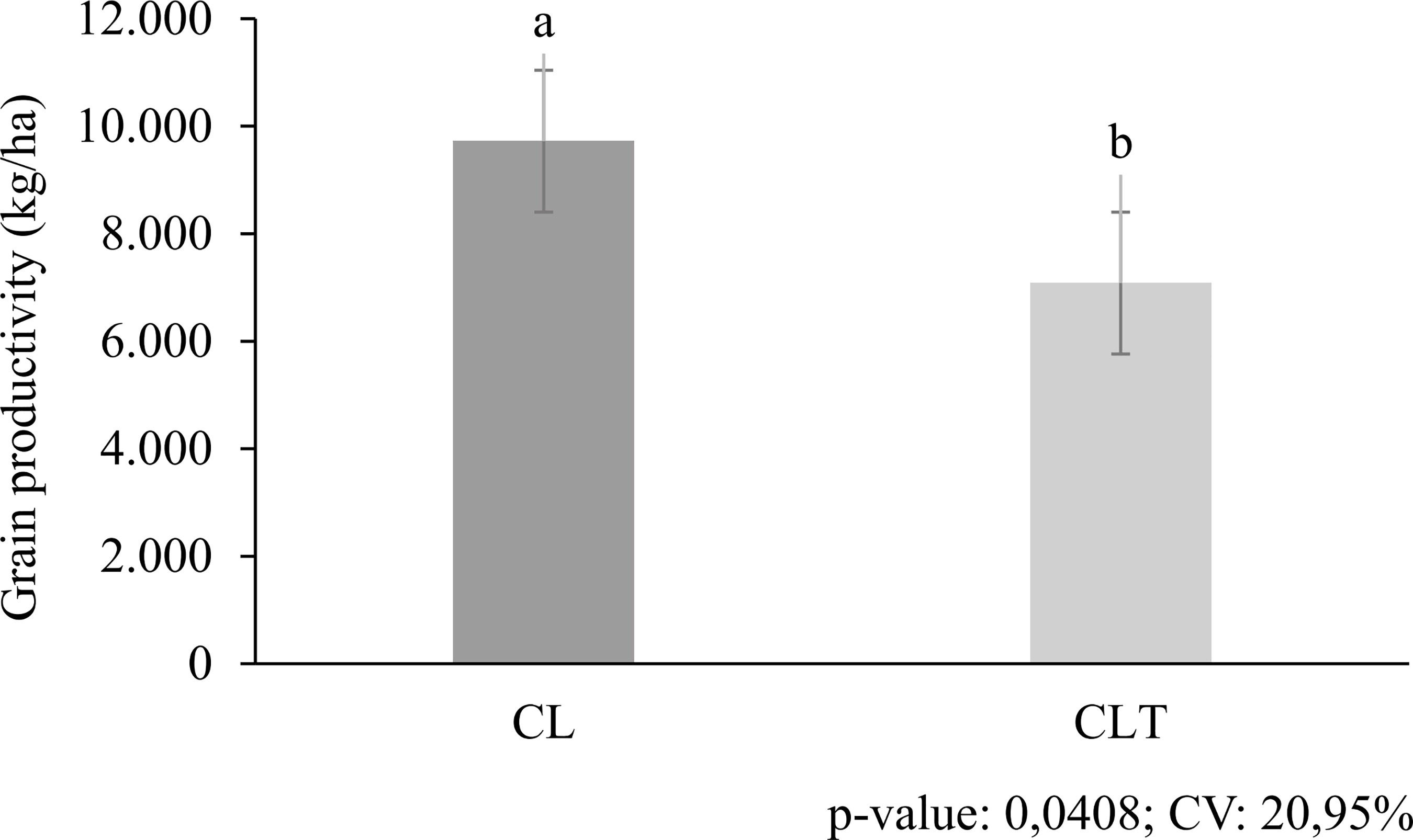
Maize productivity was significantly higher in the CL, with an average yield of 9,722 kg ha-1, approximately 37% greater than that recorded in the CLT, which reached 7,083 kg ha-1 (Figure 1). This result confirms the high sensitivity of maize to the limitation of photosynthetically active radiation in shaded environments, together with competition for water and nutrients in the soil profile. Similar reductions had already been reported in the same experimental area, but evaluated in an earlier period, when the presence of trees led to decreases of up to 52% in maize grain and silage yields.(27) Under other edaphoclimatic conditions, progressive reductions of up to 56% in maize grain yield were also observed in CLT systems as tree growth advanced.(28) Recent reviews further support this evidence, highlighting maize as one of the most affected crops by light limitation in tropical agroforestry systems.(29)
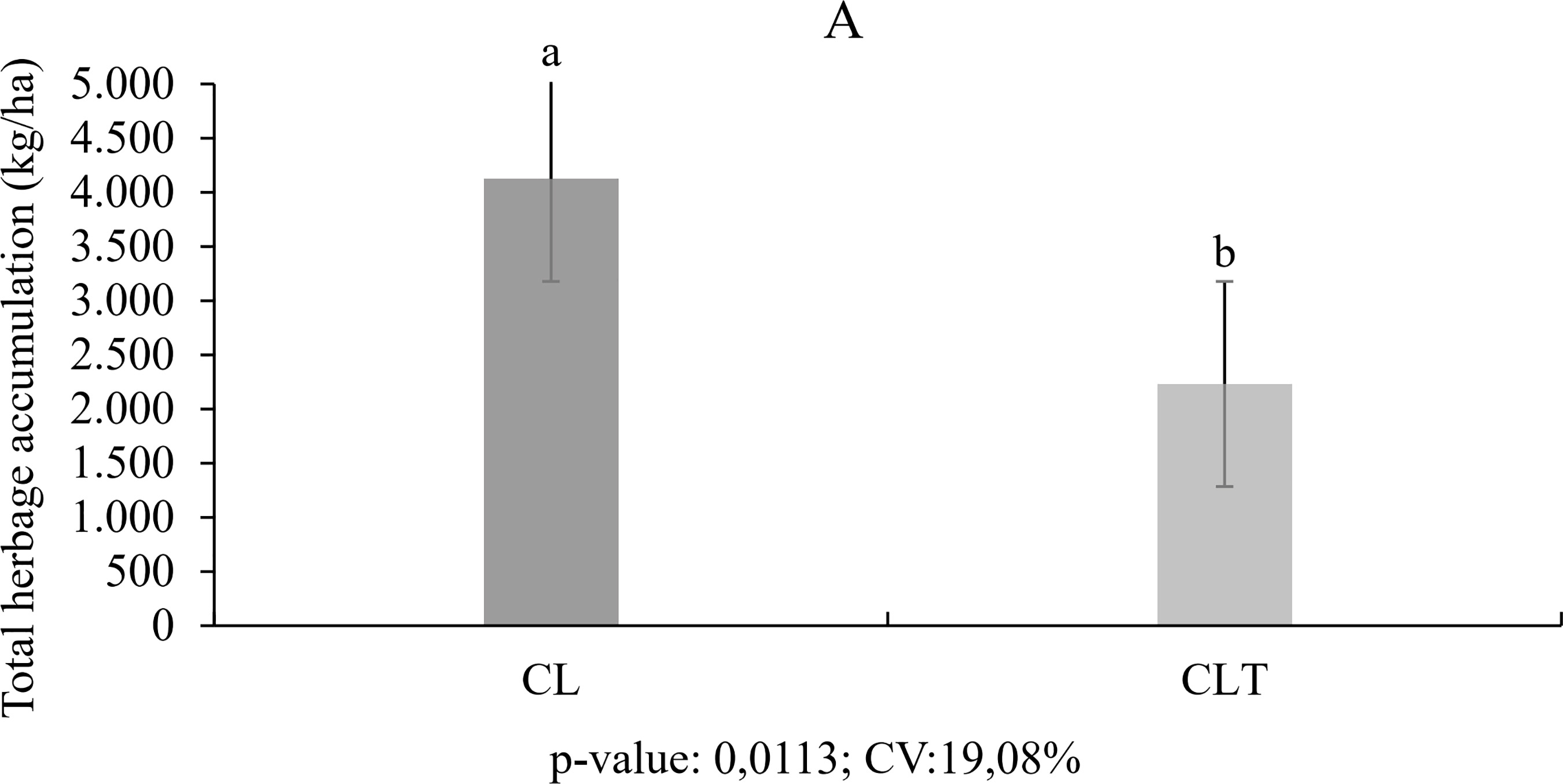
Similar patterns were observed in pasture, where the CL system also showed greater biomass accumulation compared to the CLT (Figure 1A). In the latter, a positive response was only observed with the highest nitrogen dose (180 kg ha-1), which partially mitigated the effects of tree competition (Figure 1B). Evidence obtained in the same experimental area, but evaluated in a different period, also reported reductions in pasture accumulation under moderate shading (~36%), with losses of up to 2.02 Mg ha-1.(19) These results suggest that reduced light availability in the understory, combined with interspecific competition, may contribute to productivity losses in integrated systems with trees.
Corn yield in integrated crop-livestock (CL) and crop-livestock with trees (CLT) systems. Bars represent means ± standard error. Different letters indicate significant differences between systems according to the F test (p = 0.0408). Coefficient of variation (CV) = 20.95%.
Total herbage accumulation (kg ha-1) in crop-livestock (CL) and crop-livestock-forest (CLT) systems (A), and under nitrogen doses of 90 kg ha-1 (N90) and 180 kg ha-1 (N180) (B). Bars represent means ± standard error. Different letters indicate significant differences according to the F test (A: p = 0.0113; B: p = 0.0043). Coefficient of variation (CV) = 19.08%.
The patterns observed in maize and pasture productivity may be partly explained by soil microbiological factors, since glomalin production and AMF activity directly influence soil structure, nutrient availability, and plant performance.
At the end of the corn cycle, it was observed that the different ICLS had a significant effect on the easily extractable glomalin (EEG) and total glomalin (TG) in the soil, while N doses influenced the sporulation of arbuscular mycorrhizal fungi (AMF spores). Additionally, there was a significant interaction between ICLS and N (S × N) on sporulation (SP) and TG. After the pasture cycle, the different ICLS also had a significant effect on EEG, while N doses influenced both EEG and TG (Table 3).
After both crops, corn and pasture, the EEG levels in the soil were higher in the CL compared to the CLT system (Figure 3). This suggests that the CL system may have favored more recent glomalin production in the soil. The hypothesis is that the shading caused by the trees in the CLT system may have reduced the root growth of the cultivated plants and, consequently, the EEG production. Evidence indicates that the roots of annual crops were affected by the trees, resulting in reduced root length and density.(29)
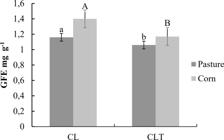
Easily extractable glomalin (EEG) in integrated crop-livestock (CL) and crop-livestock with trees (CLT) systems at the end of the corn cultivation in succession to a pasture fertilized with nitrogen doses of 90 and 180 kg ha-1, and the following pasture. Bars represent means ± standard error. Lowercase letters compare means between systems for the same crop, and uppercase letters compare means between crops within the same system. Different letters indicate significant differences according to the F test (p < 0.05).
In the CLT system, in addition to the strong correlations observed between corn productivity and glomalin fractions, studies indicate that EEG, as observed in this system (Figure 3), has a direct and immediate impact on soil functionality and crop productivity (Figures 1 and 2). This occurs because these fractions are directly associated with active microbial biomass and the formation of stable aggregates, which facilitate water and nutrient absorption by plants.(30) Thus, the higher correlation between corn productivity and EEG in the CLT system (r = 0.82) can be explained by the crucial role of this fraction in improving soil conditions, promoting a more favorable environment for plant development.
Glomalin was also favored at the lower N dose after pasture cultivation. The levels of EEG and TG were higher at the lower N dose, 90 kg ha-1 (Table 4). In other studies, EEG levels increased with N fertilization up to a peak of 70 kg ha-1 but decreased from 130 kg ha-1 onwards, indicating that high N doses can inhibit the production of EEG and TG(31) In this study, the highest N dose (180 kg ha-1) was associated with a reduction in the production of glomalin-related glycoproteins, suggesting that excessive nitrogen fertilization may limit microbial activity and glomalin synthesis. Similar responses have been observed in other studies, where high N availability reduced plant dependence on mycorrhizal symbiosis, resulting in lower hyphal development and, consequently, reduced glomalin production. These conditions may negatively affect aggregate stability and soil physical quality, reinforcing the sensitivity of glomalin dynamics to nitrogen management.(7,32,33)
Effect of nitrogen dose factor, 90 kg N ha-1 (N90) and 180 kg N ha-1 (N180), on easily extractable glomalin (EEG) and total glomalin (TG) in soil after pasture cultivation
In the unfolding of the S × N interaction, during the corn cycle, the effect of N doses on AMF sporulation (SP) was observed only in the CL system, with a higher number of AMF spores observed at the 180 kg N ha-1 dose (Table 5).
Sporulation of arbuscular mycorrhizal fungi (AMF) and total glomalin (TG) at the end of the corn cycle cultivated after pasture fertilized with nitrogen (N) doses: 90 and 180 kg ha-1 (N90 and N180, respectively), in integrated crop-livestock (CL) and crop-livestock with trees (CLT) systems
Plants exude molecular signals into the soil that stimulate fungal growth and subsequent root colonization, attracting different AMF species with functional compatibility.(34) Although higher plant diversity is often associated with increased AMF presence and activity, this relationship is strongly dependent on system conditions. In the CLT system, the greater plant diversity promoted by trees did not lead to a proportional increase in AMF sporulation or colonization. This pattern can be explained by competition for resources and soil conditions that limit mycorrhizal development, as previously observed in systems where legumes and high nitrate levels reduce AMF populations and glomalin accumulation.(35,36) This dynamic can be explained by the dominance of specific fungal isolates, which are not always compatible with all the plant species present, resulting in uneven colonization.(37) Thus, even in diverse systems, the specificity of plant-fungus interactions and the dominance of certain isolates can limit the expected effects of diversity on AMF sporulation and colonization.
In addition to the compatibility between the mycorrhizal fungus and the host plant species, several factors interfere with AMF sporulation, such as nutrient availability, cultural practices, soil and crop management, soil types, and seasonality.(38) In this study, the effect of the N dose applied to the soil on AMF sporulation was observed. A higher number of spores in the soil was observed at the higher N dose (N180) in the CL system after corn cultivation. However, this increase in the number of spores due to the increased N dose was not repeated in the CLT system after corn cultivation and in both systems after pasture cultivation.
Different behaviors in the sporulation of AMF species in response to nutrient levels have been observed in various studies. In soils with higher nutrient concentrations, especially N, there is a tendency for reduced sporulation rates.(39) However, in the present study, higher sporulation was recorded at the end of the corn cycle cultivated in the CL system, following the pasture that received the higher N dose (N180).This increase may be related to the greater root development of plants that received higher N doses.(40) Corn is a highly mycorrhizal plant, and its capacity to increase the inoculum potential in the soil is well documented.(41) Moreover, N applications stimulate root growth in corn, which can enhance molecular signals and increase infection sites for AMF.(42) Although greater plant species diversity is often associated with increased AMF presence and activity, this relationship strongly depends on system conditions. In the CLT system, the higher diversity promoted by trees did not result in a proportional increase in AMF sporulation or colonization. This pattern may be explained by resource competition and soil conditions that limit mycorrhizal development, as observed in systems with legumes and high nitrate levels, which reduce AMF populations and glomalin accumulation.(43,36) Furthermore, glomalin dynamics are closely related to soil organic matter, which is influenced by nutrient inputs and mineralization processes.(44-45) However, it is worth noting that in the CL system, two grasses were grown in succession, without the shading effect present in CLT systems. The absence of this shading may have altered the growth dynamics of the grasses and directly influenced the interaction with AMF, favoring the increased sporulation observed in this study. Shading can reduce photosynthesis and carbon allocation to the roots, which can negatively affect the formation of mycorrhizal associations, as reported by Smith & Read.(41)
Increased sporulation in the soil may represent a strategy for the fungus to persist in the system and to select more adapted AMF species.(46) However, at the end of the pasture cycle, no effect of the systems or N doses on AMF sporulation was observed. In contrast, the application of 300 kg ha-1 of N favored the establishment of AMF, resulting in higher colonization and sporulation rates compared to the treatment without N.(47) At the end of the corn cycle, in the unfolding of the interaction between S × N factors for the TG variable, differences between systems were observed only at the 90 kg N ha-1 (N90) dose, with higher TG production in the CL system (Table 5). Proper N fertilization management therefore enhanced the benefits of integrated systems. N application has been associated with increased nutrient use efficiency and crop productivity.(48)
In this study, higher EEG and TG production with the lower N dose (90 kg N ha-1) after the pasture cycle may indicate more efficient resource use, whereas the higher N dose (180 kg ha-1) resulted in greater dry mass production. This suggests that, under high N availability, plants become less dependent on microbial activity for nutrient supply, relying more directly on the applied N. Such conditions may reduce the relative importance of biological activity in nutrient cycling, favoring plant growth through direct N uptake.
No effects of the studied factors were observed on AMF root colonization after corn or pasture, with overall averages of 33.2% after corn and 36.9% in the pasture per gram of root. However, the CL system showed higher production of EEG and TG compared to CLT, which may reflect more favorable soil microbiological conditions.
These compounds contribute to improved soil structure and health, promoting conditions that support crop growth. Glomalin, in particular, improves water retention and nutrient availability, which are essential for agricultural productivity.(24) Although root colonization did not differ significantly between systems, AMF may have contributed to nutrient absorption efficiency, consistent with the greater microbial activity and the productivity patterns observed in the CL system.(41)
Analyzing the correlation between corn productivity and microbiological attributes, such as AMF spores, root colonization, EEG, and TG, it was found that in the CL system, the Pearson correlation coefficient between the number of AMF spores and productivity was r = 0.56, indicating a moderate positive correlation.
Similarly, total herbage accumulation from pasture was significantly higher in the CL system (Figure 1A). In the CLT system, the application of 180 kg ha-1 of N resulted in greater total herbage accumulation (Figure 1B). In the CL system, after the pasture cycle and with the application of 90 kg ha-1 of N, a strong positive correlation (r = 0.83) was found between total herbage accumulation and mycorrhizal colonization, while TG showed a moderate positive correlation with productivity (r = 0.65). On the other hand, in the CLT system, with the application of the same N dose (90 kg ha-1), a negative correlation (r = -0.97) was identified between total herbage accumulation and mycorrhizal colonization, while the correlation between productivity and TG was positive but moderate (r = 0.58), indicating a less direct relationship between these variables.
The data analysis suggests that the CL system provides a more favorable environment for agricultural production, with benefits in terms of corn productivity and total herbage accumulation due to the soil's microbiological attributes. The higher production of EEG and TG in the CL system may indicate a healthier and better-structured soil. On the other hand, the CLT system, although offering environmental benefits, may need specific adjustments to improve agricultural productivity. The positive impact of N doses on total herbage accumulation highlights the importance of careful fertilization management to maximize agronomic benefits. The proper application of N fertilizers is crucial to sustain high agricultural productivity, but it must be balanced to avoid negative environmental impacts.(49)
CONCLUSION
The crop-livestock (CL) system showed superior performance compared to the crop-livestock-tree (CLT) system, with higher corn yield and greater forage accumulation. These results indicate that the absence of the tree component provided more favorable conditions for crop growth and agronomic response under the experimental conditions.
Nitrogen fertilization had a direct effect on forage accumulation, especially in the CLT system, where the higher dose (180 kg N ha-1) resulted in significant increases in biomass production. This highlights the importance of adequate N management to enhance pasture performance in integrated systems.
Soil microbiological attributes, such as arbuscular mycorrhizal fungi (AMF) sporulation and glomalin concentration, were directly related to the agronomic responses observed.
High-dose N fertilization reduced the levels of total glomalin and easily extractable glomalin in the soil, indicating an inhibitory effect of N on the production of this protein. However, AMF sporulation was stimulated by the higher N dose, evidencing the interaction between mycorrhizal fungi and N application in the soil.
In summary, productivity in integrated systems was significantly influenced by both land-use arrangements (CL and CLT) and nitrogen doses. Balanced N fertilization management, with adequate doses adjusted to crop needs, can maximize the benefits of integrated systems, promote soil microbiota functionality, and sustain agronomic performance.
ACKNOWLEDGMENTS, FINANCIAL SUPPORT AND FULL DISCLOSURE
This work received funding from Agrisus (PA 3209/22, No. 104344) and Fundação Araucária (No. MUL2022201000015). The first author is grateful to Conselho Nacional de Desenvolvimento Científico e Tecnológico (CNPq) for the research fellowship (304426/2022-9). The authors declare no conflicts of interest related to this study.
-
1
This work was extracted from the dissertation presented to the Postgraduate Program in Conservation Agriculture of the Rural Development Institute of Paraná, Conservation Area in Crop Production and Protection, as part of the requirements for obtaining the Master's degree in Conservation Agriculture.
-
DECLARATION OF USE OF ARTIFICIAL INTELLIGENCE TOOLS IN SCIENTIFIC WRITINGDuring the preparation of this manuscript, the authors used OpenAI ChatGPT (version 5.2) to assist in the preparation of the graphical abstract. The authors reviewed and edited the generated content as necessary and take full responsibility for the final version of the manuscript.
DATA AVAILABILITY STATEMENT
The raw data supporting the conclusions of this article will be made available by the authors on request.
REFERENCES
- 1 Lal R. Enhancing ecosystem services with no-till. Renew Agric Food Syst. 2013;28(2):102-14.
- 2 Carvalho CF, Peterson CA, Nunes PAA, Amanda AA, Martins AP, Souza Filho W, et al. Animal production and soil characteristics from integrated crop-livestock systems: Toward sustainable intensification. J Anim Sci. 2018;96(8):3513-25.
- 3 Bansal S, Chakraborty P, Kumar S. Crop-livestock integration enhanced soil aggregate-associated carbon and nitrogen, and phospholipid fatty acid. Sci Rep. 2022;12:2781.
- 4 Peterson CA, Deiss L, Gaudin ACM. Commercial integrated crop-livestock systems achieve comparable crop yields to specialized production systems: A meta-analysis. PLoS One. 2020;15(5):e0231840.
- 5 Lemaire G, Franzluebbers A, Carvalho PCF, Dedieu B. Integrated crop-livestock systems: Strategies to achieve synergy between agricultural production and environmental quality. Agric Ecosyst Environ. 2014;190:4-8.
- 6 Diagne N, Ngom M, Djighaly PI, Fall D, Hocher V, Svistoonoff S. Roles of arbuscular mycorrhizal fungi on plant growth and performance: Importance in biotic and abiotic stress regulation. Diversity. 2020;12(10):370.
- 7 Bertagnoli BGP, Oliveira JF, Barbosa GMC, Colozzi Filho A. Poultry litter and liquid swine slurry applications stimulate glomalin, extraradicular mycelium production, and aggregation in soils. Soil Tillage Res. 2020;202:104657.
- 8 Colozzi Filho A, Bertagnoli BGP, Menoncin ASS, Oliveira JF, Campana IO, Machineski GS, et al. Terracing reduces arbuscular mycorrhizal fungi spore loss through surface runoff. Braz Arch Biol Technol. 2024;67(spe1):e24230801.
- 9 He JD, Chi GG, Zou YN, Shu B, Wu QS, Srivastava AK. Contribution of glomalin-related soil proteins to soil organic carbon in trifoliate orange. Appl Soil Ecol. 2020;154:103592.
- 10 Kuila D, Ghosh S. Aspects, problems and utilization of Arbuscular Mycorrhizal (AM) application as bio-fertilizer in sustainable agriculture. Curr Res Microb Sci. 2022;3:100107.
- 11 Agnihotri R, Bharti A, Ramesh A, et al. Glomalin related protein and C16:1w5 PLFA associated with AM fungi as potential signatures for assessing the soil C sequestration under contrasting soil management practices. Eur J Soil Biol. 2021;103:103286.
- 12 Pires GC, de Lima ME, Zanchi CS, Moretti de Freitas C, Andrade de Souza JM, Camargo A, et al. Arbuscular mycorrhizal fungi in the rhizosphere of soybean in integrated crop–livestock systems with intercropping in the pasture phase. Rhizosphere. 2021;17:100270.
- 13 Peel MC, Finlayson BL, McMahon TA. Updated world map of the Koppen-Geiger climate classification. Hydrol Earth Syst Sci. 2007;11(5):1633-44.
- 14 SIMEPAR. Relatório anual de atividades. Curitiba: Sistema Meteorológico do Paraná; 2018.
- 15 Santos HG, Jacomine PKT, Anjos LHC, Oliveira VA, Lumbreras JF, Coelho MR, et al. Sistema brasileiro de classificação de solos. 5a ed. Brasília: Embrapa; 2018.
- 16 Pavan MA, Bloch MFM, Zempulski HC, Myazawa M, Zocoler DC. Manual de análise química de solo e controle de qualidade. Londrina: IAPAR; 1992.
- 17 Mott GO, Lucas HL. The design, conduct and interpretation of grazing trials on cultivated and improved pastures. In: Proceedings of the 6th International Grassland Congress; 1952 Aug 17-22; Pennsylvania, USA. Pennsylvania: State College Press; 1952. p. 1380-5.
- 18 Kunrath TR, Cadenazzi M, Brambilla DM, Anghinoni I, Moraes A, Barro RS, et al. Management targets for continuously stocked mixed oat-annual ryegrass pasture in a no-till integrated crop-livestock system. Eur J Agron. 2014;57:71-6.
- 19 Pontes LS, Stafin G, Moletta JL, Porfírio-da-Silva V. Performance of Purunã beef heifers and pasture productivity in a long-term integrated crop-livestock system: The effect of trees and nitrogen fertilization. Agrofor Syst. 2020;94(5):1713-23.
- 20 Koske RE, Gemma JN. A modified procedure for staining roots to detect VA mycorrhizas. Mycol Res. 1989;92(4):488-505.
- 21 Giovannetti M, Mosse B. An evaluation of techniques for measuring vesicular arbuscular mycorrhizal infection in roots. New Phytol. 1980;84(3):489-500.
- 22 Gerdemann JW, Nicolson TH. Spores of mycorrhizal Endogone species extracted from soil by wet sieving and decanting. Trans Br Mycol Soc. 1963;46(2):235-44.
- 23 Jenkins WR. A rapid centrifugal-flotation technique for separating nematodes from soil. Plant Dis Rep. 1964;48:692.
- 24 Rillig MC, Wright SF, Kimball BA, Leavitt SW. Elevated carbon dioxide and irrigation effects on water stable aggregates in a sorghum field: A possible role for arbuscular mycorrhizal fungi. Glob Change Biol. 2003;7:333-7.
- 25 Bradford MM. A rapid and sensitive method for the quantitation of microgram quantities of protein utilizing the principle of protein-dye binding. Anal Biochem. 1976;72(1-2):248-54.
- 26 R Development Core Team. R: A language and environment for statistical computing [Internet]. Vienna: R Foundation for Statistical Computing; 2016 [cited 2025 Jan 10].
- 27 Pontes LS, Carpinelli S, Stafin G, Porfírio-da-Silva V, dos Santos BRC. Relationship between sward height and herbage mass for integrated crop-livestock systems with trees. Grassl Sci. 2017;63:29-35.
- 28 Moreira EDS, Gontijo MM, Lana ÂMQ, Borghi E, Santos CA, Alvarenga RC, et al. Production efficiency and agronomic attributes of corn in an integrated crop-livestock-forestry system. Pesq Agropec Bras. 2018;53(4):419-26.
- 29 Kumar BM, Kunhamu TK, Bhardwaj A, et al. Subcanopy light availability, crop yields, and managerial implications: a systematic review of the shaded cropping systems in the tropics. Agrofor Syst. 2024;98(8):2785-2810.
- 30 Schaefer DA, Gui H, Mortimer PE, Xu J. Arbuscular mycorrhiza and sustainable agriculture. Circ Agric Syst. 2021;1(1):1-7.
- 31 Cordeiro CFS, Rodrigues DR, Rocha CH, Araujo FF, Echer FR. Glomalin and microbial activity affected by cover crops and nitrogen management in sandy soil with cotton cultivation. Appl Soil Ecol. 2021;167:104026.
- 32 Wright SF, Upadhyaya A. A survey of soils for aggregate stability and glomalin, a glycoprotein produced by hyphae of arbuscular mycorrhizal fungi. Plant Soil. 1998;198:97-107.
- 33 Raphael JP, Calonego JC, Milori DMB, Rosolem CA. Soil organic matter in crop rotations under no-till. Soil Tillage Res. 2016;155:45-53.
- 34 Powell CL, Bagyaraj DJ. VA mycorrhiza. Boca Raton: CRC Press; 1984.
- 35 Balota EL, Calegari A, Nakatani AS, Coyne MS. Benefits of winter cover crops and no-tillage for microbial parameters in a Brazilian Oxisol: a long-term study. Agric Ecosyst Environ. 2014;197:31-40.
- 36 Detheridge AP, Brand G, Fychan R, Crotty FV, Sanderson R, Griffith GW, Marley CL. The legacy effect of cover crops on soil fungal populations in a cereal rotation. Agric Ecosyst Environ. 2016;228:49-61.
- 37 Bever JD. Host-specificity of AM fungal population growth rates can generate feedback on plant growth. Plant Soil. 2002;244(1):281-90.
- 38 Abbott LK, Robson AD. Factors influencing the occurrence of vesicular arbuscular mycorrhizas. Agric Ecosyst Environ. 1991;35:121-50.
- 39 Souza ED, Costa SEVG, Anghinoni I, Lima CVS, Carvalho PCF, Martins AP. Biomassa microbiana do solo em sistema de integração lavoura-pecuária em plantio direto, submetido a intensidades de pastejo. Rev Bras Ciênc Solo. 2010;34(1):79-88.
- 40 Phillips RP, Fahey TJ. Fertilization effects on fine-root biomass, rhizosphere microbes and respiratory fluxes in hardwood forest soils. New Phytol. 2007;176(3):655-64.
- 41 Smith SE, Read DJ. Mycorrhizal symbiosis. 3a ed. London: Academic Press; 2010.
- 42 Durieux RP, Kamprath EJ, Jackson WA, Moll RH. Root distribution of corn: The effect of nitrogen fertilization. Agron J. 1994;86(6):958-62.
- 43 Balota EL, Yada IF, Amaral H, Nakatani AS, Dick RP, Coyne MS. Soil enzyme activities under long-term tillage and crop rotation systems in subtropical agro-ecosystems. Braz J Microbiol. 2014;45(1):313-21.
- 44 Gao WQ, Wang P, Wu QS. Functions and application of glomalin-related soil proteins: a review. Sains Malays. 2019;48(1):111-119.
- 45 Gałązka A, Niedźwiecki J, Grządziel J, Gawryjołek K. Evaluation of changes in Glomalin-Related Soil Proteins (GRSP) content, microbial diversity and physical properties depending on the type of soil as the important biotic determinants of soil quality. Agronomy. 2020;10(9):1279.
- 46 Siqueira JO, Moreira FMS, Grisi BM, Hungria M, Araújo RS. Microrganismos e processos biológicos do solo: perspectiva ambiental. Brasília: Embrapa-SPI; 1994.
- 47 Zandoná AP, Colozzi Filho A, Pontes LS. Effects of trees and nitrogen supply on the soil microbiological attributes in integrated crop-livestock systems. Rev Ceres. 2019;66:226-34.
- 48 Fageria NK, Baligar VC, Jones CA. Growth and mineral nutrition of field crops. 3a ed. Boca Raton: CRC Press; 2010.
- 49 Smil V. Enriching the earth: Fritz Haber, Carl Bosch, and the transformation of world food production. Cambridge: MIT Press; 2004.
Edited by
-
Editors:
Thiago VargasTeogenes Senna de Oliveira