
 A decision support system for hedge transactions in electrical energy commercialization
ABSTRACT
This article proposes an optimization model that maximizes the agent’s returns subject to a risk preference function to support the hedging decision. The originality lies in the development of a commercialization decision support model that maximizes the agent’s profits, customized to a desired level of risk protection, which is a gap in the literature. As this model is tailored to the agent’s individual risk aversion rather than the market as a whole, this model assists in defining, in a personalized manner, the optimal hedging strategy given the agent’s specific risk preferences. It assists the hedging decision maker in selecting the optimal purchasing strategy based on the level of risk the firm is willing to accept. We assume that the agent has an aversion to risk and adopt a preference function, considering their willingness to pay the risk premium and the transaction cost. The case of an agent in the Brazilian electricity sector interested in defining a hedging strategy for the 2nd semester is analyzed. In their day-to-day business, agents in the electricity sector may find themselves in a short position in the market. To mitigate their exposure to this risk, they have the option of entering into fixed-price forward contracts, either partially or in full. This study contributes to the development of an original decision support tool for these agents, considering their willingness to pay the risk premium and transaction costs. In our numerical application, results suggest covering 45.3% of uncontracted amounts in the 2nd semester. However, if the decision is made quarterly, a 100% hedge is recommended for the 3rd quarter and no hedge for the 4th. Sensitivity analyses are performed to show how the level of risk aversion impacts this decision.
Keywords:
energy commercialization; hedge; preference function; risk aversion
RESUMO
Este artigo propõe um modelo de otimização que maximiza os retornos do agente, sujeito a uma função de preferência de risco, para auxiliar na decisão de hedge. A originalidade da pesquisa reside no desenvolvimento de um modelo de apoio à decisão de comercialização que maximiza os lucros do agente, customizado para um nível desejado de proteção contra riscos, o que representa uma lacuna na literatura. Como este modelo é adaptado à aversão ao risco individual do agente, e não ao mercado como um todo, ele auxilia na definição, de forma personalizada, da estratégia de hedge ótima, dadas as preferências de risco específicas do agente. O modelo auxilia o tomador de decisão de hedge na seleção da estratégia de compra ótima com base no nível de risco que a empresa está disposta a aceitar. Assume-se que o agente é avesso a risco e adota-se uma função de preferência, considerando sua disposição a pagar o prêmio de risco e o custo de transação. O caso de um agente do setor elétrico brasileiro interessado em definir uma estratégia de hedge para o segundo semestre é analisado. Em suas atividades diárias, os agentes do setor elétrico podem se encontrar em posições vendidas no mercado. Para mitigar sua exposição a esse risco, eles têm a opção de celebrar contratos a termo de preço fixo, parcial ou integralmente. Este estudo contribui para o desenvolvimento de uma ferramenta original de apoio à decisão para esses agentes, considerando sua disposição a pagar o prêmio de risco e os custos de transação. Em nossa aplicação numérica, os resultados sugerem a cobertura de 45,3% dos valores não contratados no segundo semestre. Contudo, se a decisão for tomada trimestralmente, recomenda-se uma cobertura de 100% para o terceiro trimestre e nenhuma cobertura para o quarto. Análises de sensibilidade são realizadas para demonstrar como o nível de aversão ao risco impacta essa decisão.
Palavras-chave:
comercialização de energia; hedge; função de preferência; aversão a risco
1. INTRODUCTION
In the 1990s, a broad restructuring of the electricity sector worldwide introduced competitive electricity markets (Joskow, 2006). In Brazil, this process began with the implementation of the Restructuring Project of the Brazilian Electricity Sector (Reestruturação do Setor Elétrico Brasileiro), which was coordinated by the Brazilian Ministry of Mines and Energy. As a result, a free energy market formed by generators, trading companies, and free energy consumers was established. A free contracting environment (ambiente de contratação livre), where these agents could freely negotiate bilateral contracts for the purchase and sale of energy under a set of rules and regulations, was also established (Câmara de Comercialização de Energia Elétrica [CCEE], 2024).
Due to the high volatility of electricity spot prices, agents typically seek to mitigate exposure to this price risk by negotiating forward contracts (Luz et al., 2012; Matsumoto & Yamada, 2021). On the other hand, in some countries, the restructuring of the market led to the creation of broader free markets and even energy exchanges, where a variety of energy derivatives are negotiated for hedging purposes (Pelajo et al., 2023).
Agents in the electricity sector, such as generators, traders, and consumers, may at times find themselves in a short position in the market (Gomes et al., 2010). For hydroelectric power generators, this may occur due to deficits in power generation as a result of low levels of natural energy inflow (energia natural afluente), reduction in reservoir levels during periods of drought, or even delays in the construction of a new power plant (Simões & Gomes, 2011). For a wind power generator, this can be the result of a generation shortfall due to lower-than- expected wind speeds, or for speculative reasons, in the case of a trader. Therefore, these agents are obligated to resort to future energy purchases in the spot market to fulfill their sales contract commitments, which exposes them to price risk.
These agents can hedge this risk by entering into forward contracts in which they can contract part or all of their position at a preset price (Antônio et al., 2019). If the hedge is only partial, the non-hedged balance must be settled at the spot price at maturity, which is known as the price differences settlement (preço de liquidação das diferenças [PLD]). In this case, the agent is exposed to variations in energy price. On the other hand, the agent can opt for a full hedge and eliminate all the risk, but this also eliminates any possibility of gains due to price movements in the spot market.
In this article, we develop a decision support system that maximizes the agent’s profits subject to the desired level of risk protection. We assume that the agent has a risk aversion level that can be measured by α percentiles of conditional value at risk (CVaR). Thus, the contribution of this study is the development of an original decision support tool for agents that find themselves in a short position in the electricity market, considering their willingness to pay the risk premium and the cost of this transaction.
This article is organized as follows. After this introduction, we present a review of the related literature in the field. In section 3, we develop a decision-making model on hedge transactions in electrical energy commercialization. In section 4, we present a numerical application and discuss the results. Finally, we conclude.
2. LITERATURE REVIEW
According to De Oliveira et al. (2006), in a competitive electricity market environment, risk analysis is an important tool to guide investors in the decision-making process, considering both contract uncertainties and spot market energy prices. In their study, they propose three risk measures: mean variance, maximum loss, and maximum average loss applied to the problem of energy commercialization for investment analysis purposes. The results indicate that these measures complement the techniques presented by Markowitz (1952) and the theories of value at risk VaR and CVaR, improving the quality of the decision in the energy commercialization issue.
Luz (2016) states that in the electric power market, it is necessary to determine performance and risk measures that may assist in decision making and extract functions from these measures for the calculation of risk premiums that may serve as a guide for the pricing of hedge operations. Following this logic, Benth et al. (2008) provide a framework that allows us to explain how the risk preferences of market players explain the sign and magnitude of the market risk premium across different forward contract maturities. Considering the German electricity market, the authors observe that the producer’s market power and the market risk premium show a term structure that is decreasing as the time to maturity of the forward contract increases.
Londoño and Velásquez (2023) explore risk management in electricity markets, emphasizing its importance for market participants who face physical and financial risks in the highly competitive environment. They state that effective risk management encourages active demand response and improves system performance. In addition, they affirm that companies in energy markets need hedging strategies to manage system operations, investment portfolios, and pricing decisions. After conducting a bibliometric analysis and systematic mapping of the literature on risk management in electricity markets, in which 538 documents were reviewed, they find that, given the high volatility of electricity prices compared to other commodities, tools such as futures, forwards, and bilateral contracts are essential for mitigating financial risks and have become widely used in the electricity market.
Deng and Oren (2006) argue that exposure to energy price risks can generate devastating consequences for agents in the electricity sector. The authors analyze different types of financial instruments that allow the sharing and control of these risks through appropriately structured hedge strategies and conclude that the main challenge in the electricity market is to increase its liquidity by using derivatives for economic efficiency. On the other hand, Pineda et al. (2010) analyze a specific financial instrument that is widely used as a risk mitigation tool: insurance contracts. They evaluate the convenience of signing an insurance contract against unexpected failures in electric power production units and their impact on contracting decisions through a stochastic programming model. Their findings indicate that insurance reduces financial risk and that the greater the risk aversion, the greater the value (premium) that the producer is willing to pay for a particular insurance contract.
Hanly (2017) estimates and compares optimal energy hedges using a variety of hedging models and risk measures to capture hedging performance. The author analyzes six energy products and two investor horizons (weekly and monthly). The results indicate that hedging is generally effective in reducing not only the variance of the energy hedgers’ underlying position, but also in terms of reducing both VaR and expected shortfall (ES). In addition, the results show that there are significant differences in both the hedging strategies and the hedging effectiveness of different energy assets, and that the latter increases with the hedge horizon. Better performance is found for West Texas Intermediate oil and heating oil, while the poorest performer in hedging terms is natural gas. The author concludes that these differences can be attributed in part to the higher basis risk inherent in natural gas hedges.
In a similar study, Cotter and Hanly (2015) examine the hedging performance of four different hedging strategies, focusing on strategies that are optimized based on attitudes towards risk and return, considering the investor’s utility function. Using utility-based performance metrics, they evaluate the hedging effectiveness of utility-based hedges and variance-minimizing hedges. Considering the energy market as a numerical example, their findings show significant differences between the quadratic and exponential hedge ratios and between each hedge approach. They conclude that focusing on the role of both utility and risk aversion in the hedging decision better reflects real-world investor concerns, which encompass both risk and expected return.
Other studies propose their own risk mitigation strategies. Cotter and Hanly (2010), for example, develop a generalized autoregressive conditional heteroskedasticity-in-mean model to estimate a time-varying coefficient of relative risk aversion based on the observed risk preferences of both short and long energy hedgers. Their empirical results show that, when explicit risk aversion is taken into consideration, there are large differences in the expected utility and risk-minimizing hedge strategies. They find that, in general, long hedgers are more risk-averse than short hedgers. Woo et al. (2001) also develop an innovative tool to solve the problem of a risk-averse energy trader who offers a fixed-price forward contract to provide electricity that it purchases from a potentially volatile and unpredictable fledgling spot energy market. This tool is based on a cross-hedging strategy that reduces the contract’s profit variance and determines the forward-contract price as a risk-adjusted price.
Oum and Oren (2010) propose a method of mitigating volumetric risk that regulated load-serving entities (LSEs) and traders of default service contracts face in providing their customers’ load-following service at fixed or regulated prices while purchasing electricity or facing an opportunity cost at volatile wholesale prices. They extend the work developed by Oum and Oren (2009) and present a static hedging strategy for the LSE’s retail positions using electricity standard derivatives such as forwards, calls, and puts. The authors determine the optimal hedging strategy based on expected utility maximization and, through several numerical examples, demonstrate the effect of each price-based financial energy instrument on portfolio optimization.
Zhang and Wang (2009) affirm that effective risk management fosters well-functioning electricity markets. A risk-constrained electricity procurement model based on CVaR methodology shows that hedge contracts, as price protection products, offer customers financial or physical insurance against their exposure to energy price risk in exchange for the risk premium they are willing to pay. Since the utility function is a suitable tool to consider the customer’s preferences regarding decisions under uncertainty, Niromandfam, Yazdankhah, and Kazemzadeh (2020) adopt principles of the utility function to identify the preferences and behavior of agents in the electricity sector against different risk hedging contracts. Their results suggest that the proposed risk hedging mechanism reduces the average market price of electricity and its fluctuations and allows customers to manage electricity costs properly.
From a renewable energy market perspective, Brigatto and Fanzeres (2022) propose a risk- and ambiguity-constrained portfolio model to help energy trading companies optimize trading strategies using forward contracts and call/put options for managing price and volume risks from variable renewable energy sources (VRES). The objective is to mitigate price and volume risk due to the uncertain and intermittent production of renewable energy that is inherent to electricity trading. Lotfipour and Mohtavipour (2024) also highlight the challenges posed by increasing VRES penetration, such as market instability and the merit order effect, where low-cost renewable energy reduces wholesale prices and makes fossil fuel plants uneconomical. They propose a multi-criteria decision-making model combining the analytic hierarchy process (AHP) and simple additive weighting methods to address these issues and improve the integration of renewable energy into electricity markets.
Niromandfam, Choboghloo, Yazdankhah, and Kazemzadeh (2020) discuss how to improve electricity consumers’ participation in power markets through real-time pricing (RTP) and insurance mechanisms. RTP helps consumers manage costs by adjusting consumption based on price signals but faces barriers such as complexity and price volatility. To address these challenges, the paper introduces two insurance mechanisms. The first is the financial insurance mechanism, in which consumers select a strike price and if market prices exceed this threshold, the insurer compensates for the difference. The second is the outage insurance mechanism, in which consumers specify their desired level of service reliability and pay premiums to mitigate the risks associated with service outages. By applying utility theory and modeling consumer risk aversion, the paper designs these mechanisms to provide more flexible and personalized solutions for managing both price fluctuations and outage risks. This approach enhances customer participation while reducing market uncertainty.
Hanly et al. (2018) examine the effectiveness of futures hedging as a risk management strategy for managing electricity spot price exposures in three major European electricity markets: Nordpool, APXUK, and Phelix. The study focuses on weekly and monthly hedging horizons and evaluates hedging performance using variance and VaR. Their key findings are that futures can manage risk effectively for longer hedging horizons (monthly), but this strategy is less effective for shorter weekly horizons. They conclude that while futures hedging can be a useful risk management tool for electricity markets, its effectiveness varies significantly depending on the market and the hedging horizon.
In a study closer to ours, Cotter and Hanly (2012) emphasize that a key issue in estimating energy hedges is the hedgers’ attitude towards risk based on their utility function. They test three different utility functions: quadratic, exponential, and log, where the risk aversion parameters were derived from DJSTOXX Oil & Gas Producers Index data. Their results show significant differences between the hedge strategies depending on the risk attitudes of energy hedgers as represented by different utility functions.
Like these authors, we address the issue of how an agent exposed to variations in energy prices in the electricity sector can optimally hedge her commercialization decision. Unlike Cotter and Hanly (2012), however, we extend the literature in this field by proposing a decision support tool tailored to the particular risk aversion level of the agent rather than to the market as a whole.
3. MODEL
We propose a model based on a preference function that allows modeling the risk aversion of an agent, where risk is defined as a function of the VaR, CVaR or ES measures. According to Jorion (1996), the CVaR α is the expected loss beyond the VaR α , which was proposed as the maximum risk at a confidence level of α. Despite its popularity, the VaR is criticized for not being additive and for focusing more on the center of the distribution, which may lead to excessive risk-taking.
The definitions of VaR α and CVaR α are shown respectively in Eqs. 1 and 2, considering their absolute values. It should be noted that, in many cases, their definitions are presented with their values in modulus, as it is assumed from the beginning that they are negative values since they represent losses.
where 𝛼∈ [0,1 and 𝑚∈ℝ.
We adopt the preference function proposed by Luz (2016), which allows modeling the variation of the risk aversion level of an agent considering different preference bands as defined in Eq. 3:
where 𝜆 𝑖 ≥0 is the measure of investor risk aversion and 𝑖 𝜆 𝑖 =1, 𝑖∈ 0,𝑁 .
Considering that the agents are in a short position in the electricity market, the financial position X can be expressed by Eq. 4:
where δ represents the percentage of the purchase decision of the hedge transaction, πt is the spot energy price (R$/megawatt-hour [MWh]), φt is the future price estimated by the forward energy price curve R$/MWh, χ is the energy selling price of a long-term contract opportunity cost R$/MWh, υt is the uncontracted amount (MW), and ηt is the number of hours in month t.
From the utility function developed by Luz (2016), we can define the certainty equivalent (ϕ) and the risk premium (γ), which are presented, respectively, in Eqs. 5 and 6. The certainty equivalent reflects the agent’s indifference to hedging or exposure to energy price risk. On the other hand, the risk premium is the difference between the average financial position X and the certainty equivalent, representing the premium required by the hedge transaction.
Since the utility function is linear by parts (a convex combination of expectation and tail risk), its inverse is trivial and equivalent to the expression itself.
To determine the optimal value of the hedge ratio δ* ∈ [0,1], we formulate an optimization problem in which the objective is to minimize the certainty equivalent (ϕ), subject to a price target constraint imposed by the forward energy price (φ𝑡). This constraint reflects the market condition that the risk-adjusted position must be at least as attractive as the opportunity cost embedded in the futures curve. The optimization problem is given by Eqs. 7-9:
subject to:
The optimal hedge ratio δ* is obtained by discretizing the decision space in steps of 0.001 and selecting the minimum value δ that satisfies the constraint:
This approach ensures that hedge level respects the economic viability imposed by the market while offering the best possible trade-off between mean return and downside risk, as defined through the preference function.
4. NUMERICAL APPLICATION
We apply our model to the case of an agent in the Brazilian electricity sector who will make a hedging decision for the next semester. We assume that this decision can be made in two ways: (a) a hedge decision in late June to cover the agent’s exposure for the next quarter and another hedge decision in late September to cover the agent’s exposure in the final quarter of the year; or (b) a hedge decision in late June to cover the agent’s exposure throughout the full second half of the year. The objective is to define the optimal hedge level that maximizes the agent’s profits, conditioned on a certain level of risk protection in each of these quarters (July to September; October to December; and July to December).
We first consider a fixed selling price equal to 201.00 R$/MWh and the following values presented in Table 1.
The proxy for energy prices in the spot market is assumed to be the PLD determined by CCEE. Thus, we use the monthly simulation data of the National System Operator (Operador Nacional do Sistema Elétrico) for the year 2021 for the energy market of the Southeast/Center-West of Brazil, which is the energy sales submarket with the greatest demand and liquidity in the National Integrated System (Sistema Interligado Nacional). Table 2 summarizes the data adopted in this application.
Next, we establish two target levels, one representing the intermediate risk and the other the extreme risk. We assume that the intermediate risk is the expected outcome of the worst 30% of scenarios, and the extreme risk is the worst 5%. That is, we consider that the intermediate risk is the expected value of the negative results, and the extreme risk is the expected value of the results smaller than the maximum bearable loss. In this way, we obtain the following values: N = 2, α1 = 70%, and α2 = 95%. These values can be used to tailor the risk preference function to the particular case of the agent, which, due to the relative size of her hedging needs compared to her wealth, may be different from the market average. Using typical industry data, we adopt the values of λ0 = 61.33%, λ1 = 30.34%, and λ2 = 8.33% for the agent’s risk aversion and perform sensitivity analysis over the range of these parameters for comparison purposes.
Eq. 5 is then optimized to estimate the percentage of the purchase decision of the hedge transaction in each of the blocks under analysis. The certainty equivalent, the risk premium, and the value that the agent is willing to pay for the hedge in each of the blocks are then determined through Eqs. 5 and 6. Table 3 presents the main results.
4.1 Sensitivity Analysis
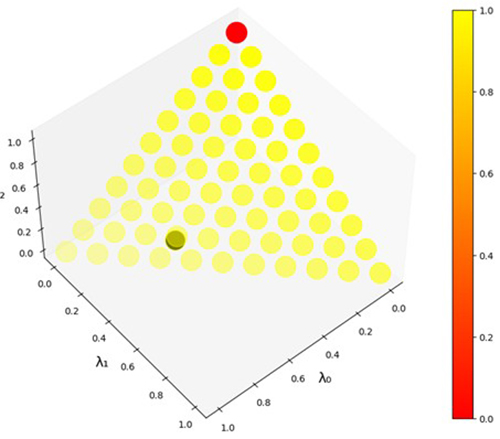
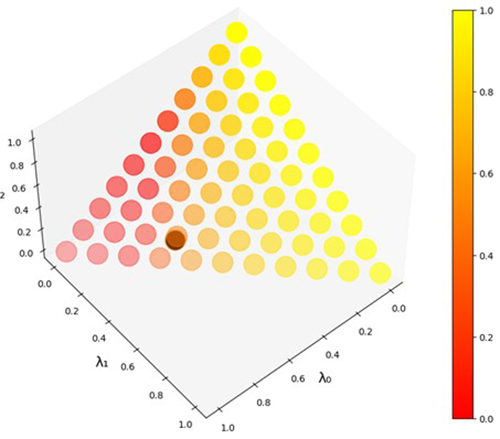
First, a sensitivity analysis was performed to verify how the optimal percentage of the purchase decision of the hedge transaction (δ) varies with changes in the measures of investor risk aversion (λ0 , λ1 , and λ2 ). Yellow circles represent full hedging (100%), while dark red circles indicate no hedging. By varying λ0 , λ1 , and λ2 from 0% to 100%, considering intervals of 10%, we show first the impact of the sensitivity analysis on the hedging decision for Block 1, which covers the months of July to September (Figure 1). For Block 1, the model suggests hedging 100% of the uncontracted amount regardless of the decision maker’s risk aversion level. This occurs because, in this case, the forward price is much more attractive than the spot energy price in the 3rd quarter. Only in the case where the agent is fully risk-seeking (λ0 = 0%, λ1 = 0%, and λ2 = 100%) is it optimal not to hedge at all, as the agent is willing to take on any risk. The highlighted dark circle indicates the optimal hedge level for the set λ adopted in the numerical example (λ0 = 61.33%, λ1 = 30.34%, and λ2 = 8.33%).
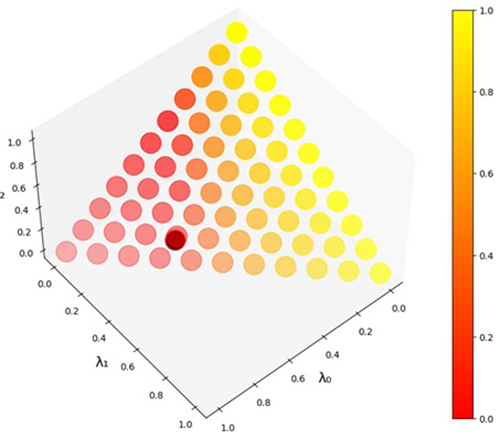
Figure 2 illustrates the sensitivity analysis on the hedging decision for Block 2, which covers the months of October to December. Unlike the previous sensitivity, the result for the 4th quarter changes depending on the decision maker’s level of risk aversion. We can observe that the greater the level of risk aversion, the less willing the decision-maker is to be exposed to the spot energy price and, consequently, the greater the need to contract a higher percentage of hedge. For the set of λ parameters adopted in the numerical application, the optimal decision is not to hedge at all, that is, a 0% of hedge, as demonstrated by the highlighted dark circle.

Finally, Figure 3 shows the impact of the sensitivity analysis on the hedging decision for Block 3, which covers the second semester of 2021 (July to December). As in the previous analysis, we can also verify evidence that the greater the decision maker’s risk aversion level, the greater the amount of hedge. However, in this case, the variation in the hedge decision is smaller as it includes the 3rd quarter, where the forward price is much more attractive than the spot energy price. For the set of λ parameters adopted in the numerical application, the optimal decision is to hedge 45.3% of the uncontracted amount for the period, as represented by the highlighted dark circle.
Another sensitivity analysis was performed to verify how the variation in the percentage of the hedge transaction purchase decision (δ) impacts the financial results of each block studied in this research, that is, the average of the financial position X (mean), the average loss incurred in the 30% worst-case scenarios of the financial position X (CVaR70% ), the average loss incurred in the 5% worst-case scenarios of the financial position X (CVaR95% ), the certainty equivalent (ϕ), the risk premium (γ), and the value that the agent is willing to pay for the hedge (ω) in blocks 1 (July to September), 2 (October to December), and 3 (July to December).
Given the forward price level of R$ 325.00, defined in Table 1 for Block 1, the decision-maker - based on the simulated spot price series and their risk aversion parameters - was not willing to take on any price risk. As a result, Table 4 shows that the optimal decision in that scenario was to fully hedge (δ = 100%) and contract the entire uncontracted amount in the forward market. This approach eliminates downside exposure that would otherwise occur under a risk-seeking strategy with no hedging (δ = 0%). In such a case, the agent would face a 5% probability of incurring an average loss of approximately R$ 45,893,000.
However, in Table 5, considering the price target of φ = R$ 310.00 for Block 2 (Table 1) and the same risk aversion parameters, it is clear that the agent is more willing to be a risk seeker in the period from October to December, since the spot market prices forecast for the period are lower, on average, than the forward prices. Therefore, the agent would be better able to withstand the possibility of losses in this case due to the eventual gains promoted by total exposure to the volatility of the energy market.
Finally, in Table 6, we show the results for the full period, considering the price target of φ = $ 325.00, as shown in Table 1. Note that the agent, with the same risk profile as in previous analyses, prefers to take a more medium-term position, as it may eventually be advantageous to be exposed to some level of risk in the spot market. Therefore, considering the full second half of the year, the agent is willing to accept a certain level of risk, with a 5% probability of an average loss of approximately R$ 71,286,000.
Note that the optimal decisions highlighted in tables 4, 5, and 6 are not simply those that minimize the certainty equivalent in isolation. Rather, they are the outcomes of an optimization process that respects a market constraint while achieving the best trade-off between expected return and tail risk. This trade-off is evaluated using the CVaR and shaped by the decision-maker’s level of risk aversion, represented by λ parameters.
5. CONCLUSION
Agents in the electricity sector may find themselves in a short position in the market for various reasons, exposing them to fluctuations in energy prices and resulting in financial losses. One of the alternatives to mitigate this risk is to hedge this position by entering into forward contracts in which the agent can contract all or part of its short position at a fixed price. On the other hand, while hedging reduces risk, it also reduces the potential to earn greater returns. Ideally, the agent will hedge only the amount necessary to bring down the risk to a level that is acceptable to her.
This article proposes a decision support model that maximizes the agent’s profits, customized to a desired level of risk protection. We assume that the agent has a level of risk aversion that is defined by α percentiles of CVaR and adopt the preference function proposed by Luz (2016). As a numerical example, we apply this model to the case of an agent in the Brazilian electricity sector who will make a hedging decision for the next two quarters. The results indicate that, considering the risk aversion level of the agent, it is optimal to hedge 29.49 MWavg or 45.3% of the uncontracted amount for the next two quarters for prices up to 325.00 R$/MWh. In the case of a two-stage hedging strategy, the model suggests a corner solution. The agent should optimally contract 100% of the uncontracted amount in the 3rd quarter (54.29 MW average) and not hedge in the 4th quarter of the year.
One of the key advantages of the proposed model is its ability to tailor hedging strategies to the specific risk preferences of market participants, recognizing that variations in risk aversion lead to distinct optimal hedging decisions. As a decision support tool, the model enables agents holding short positions in the electricity market to formulate hedging strategies that align with their individual risk tolerance.
The CVaR-based optimization framework introduced in this study offers significant advantages in managing the volatility inherent in Brazil’s electricity market, particularly through its personalized decision-making support system. By adapting to the agent’s specific risk aversion, the model addresses a critical gap in existing hedging approaches within the free contracting environment.
Numerical results confirm the model’s practical applicability, while sensitivity analyses further demonstrate its robustness across diverse risk profiles. Moreover, the time-period (block) hedging approach effectively accounts for Brazil’s pronounced seasonal price fluctuations, enhancing the model’s relevance under real-world market conditions.
Beyond these contributions, several potential enhancements can be explored in future research. One such improvement is the incorporation of more recent energy price data from 2022-2023 to better capture the impact of hydropower shortages on market dynamics. Additionally, the proposed model could be extended to refine the parametrization of the preference function using methodologies such as AHP, prospect theory within a behavioral economics framework, and other relevant approaches. These refinements would further enhance the model’s applicability by providing a more nuanced representation of market agents’ risk preferences and decision-making processes.
REFERENCES
-
Antônio, R. M., Ambrozini, M. A., Magnani, V. M., & Rathke, A. A. (2019). O uso de derivativos para hedge melhora os ratings de crédito das empresas brasileiras? Revista Contabilidade & Finanças, 31, 50-66. https://doi.org/10.1590/1808-057x201908740
» https://doi.org/10.1590/1808-057x201908740 -
Benth, F. E., Cartea, Á., & Kiesel, R. (2008). Pricing forward contracts in power markets by the certainty equivalence principle: Explaining the sign of the market risk premium. Journal of Banking & Finance, 32(10), 2006-2021. https://doi.org/10.1016/j.jbankfin.2007.12.022
» https://doi.org/10.1016/j.jbankfin.2007.12.022 -
Brigatto, A., & Fanzeres, B. (2022). A soft robust methodology to devise hedging strategies in renewable energy trading based on electricity options. Electric Power Systems Research, 207, 107852. https://doi.org/10.1016/j.epsr.2022.107852
» https://doi.org/10.1016/j.epsr.2022.107852 -
Câmara de Comercialização de Energia Elétrica. (2024). Novo Conselho de Administração. https://www.ccee.org.br/
» https://www.ccee.org.br/ -
Cotter, J., & Hanly, J. (2010). Time-varying risk aversion: an application to energy hedging. Energy Economics, 32(2), 432-441. https://doi.org/10.1016/j.eneco.2009.08.009
» https://doi.org/10.1016/j.eneco.2009.08.009 -
Cotter, J., & Hanly, J. (2012). A utility based approach to energy hedging. Energy Economics, 34(3), 817-827. https://doi.org/10.1016/j.eneco.2011.07.009
» https://doi.org/10.1016/j.eneco.2011.07.009 -
Cotter, J., & Hanly, J. (2015). Performance of utility based hedges. Energy Economics , 49, 718-726. https://doi.org/10.1016/j.eneco.2015.04.004
» https://doi.org/10.1016/j.eneco.2015.04.004 -
De Oliveira, M. F., Arfux, G. A. B., & Teive, R. C. G. (2006). Risk management in the commercialization activity in Brazil - An approach by using Markowitz, var and cvar. In Proceedings of the 2006 IEEE/PES Transmission & Distribution Conference and Exposition: Latin America (pp. 1-6). https://doi.org/10.1109/TDCLA.2006.311411
» https://doi.org/10.1109/TDCLA.2006.311411 -
Deng, S. J., & Oren, S. S. (2006). Electricity derivatives and risk management. Energy, 31(6-7), 940-953. https://doi.org/10.1016/j.energy.2005.02.015
» https://doi.org/10.1016/j.energy.2005.02.015 -
Gomes, L. L., Brandao, L. E., & Pinto, A. C. F. (2010). Electricity contracts portfolio selection based on the optimization of the omega measurement. Brazilian Review of Finance, 8(1), 45-67. https://doi.org/10.12660/rbfin.v8n1.2010.1440
» https://doi.org/10.12660/rbfin.v8n1.2010.1440 -
Hanly, J. (2017). Managing energy price risk using futures contracts: A comparative analysis. The Energy Journal, 38(3), 93-112. https://doi.org/10.5547/01956574.38.3.jhan
» https://doi.org/10.5547/01956574.38.3.jhan -
Hanly, J., Morales, L., & Cassells, D. (2018). The efficacy of financial futures as a hedging tool in electricity markets. International Journal of Finance & Economics, 23(1), 29-40. https://doi.org/10.1002/ijfe.1600
» https://doi.org/10.1002/ijfe.1600 -
Jorion, P. (1996). Risk2: Measuring the risk in value at risk. Financial Analysts Journal, 52(6), 47-56. https://doi.org/10.2469/faj.v52.n6.2039
» https://doi.org/10.2469/faj.v52.n6.2039 - Joskow, P. L. (2006). Introduction to electricity sector liberalization: lessons learned from cross-country studies. Electricity Market Reform: An International Perspective, 1, 1-32.
-
Londoño, A. A., & Velásquez, J. D. (2023). Risk management in electricity markets: Dominant Topics and research trends. Risks, 11(7), 116. https://doi.org/10.3390/risks11070116
» https://doi.org/10.3390/risks11070116 -
Lotfipour, A., & Mohtavipour, S. S. (2024). A multi-criteria decision-making model to determine the optimal share of variable renewable energy sources in a wholesale electricity market. Sustainable Energy, Grids and Networks, 39, 101408. https://doi.org/10.1016/j.segan.2024.101408
» https://doi.org/10.1016/j.segan.2024.101408 - Luz, C. P. D. M. S. (2016). Otimização comercial de um parque eólico no Brasil utilizando simulação de Monte Carlo com variáveis climáticas exógenas e uma nova função de preferência [Doctoral dissertation]. Pontifícia Universidade Católica do Rio de Janeiro.
-
Luz, C. P. D. M. S., Gomes, L. L., & Brandão, L. E. T. (2012). Analysis of the dynamics of the Brazilian forward Market of electricity. Revista Brasileira de Gestão de Negócios, 14, 314-334. https://doi.org/10.7819/rbgn.v14i44.1207
» https://doi.org/10.7819/rbgn.v14i44.1207 -
Markowitz, H. (1952). Portfolio selection. Journal of Finance, 7(1), 77-91. https://doi.org/10.2307/2975974
» https://doi.org/10.2307/2975974 -
Matsumoto, T., & Yamada, Y. (2021). Simultaneous hedging strategy for price and volume risks in electricity businesses using energy and weather derivatives. Energy Economics , 95, 105101. https://doi.org/10.1016/j.eneco.2021.105101
» https://doi.org/10.1016/j.eneco.2021.105101 -
Niromandfam, A., Choboghloo, S. P., Yazdankhah, A. S., & Kazemzadeh, R. (2020). Electricity customers’ financial and reliability risk protection utilizing insurance mechanism. Sustainable Energy, Grids and Networks, 24, 100399. https://doi.org/10.1016/j.segan.2020.100399
» https://doi.org/10.1016/j.segan.2020.100399 -
Niromandfam, A., Yazdankhah, A. S., & Kazemzadeh, R. (2020). Designing risk hedging mechanism based on the utility function to help customers manage electricity price risks. Electric Power Systems Research, 185, 106365. https://doi.org/10.1016/j.epsr.2020.106365
» https://doi.org/10.1016/j.epsr.2020.106365 -
Oum, Y., & Oren, S. (2009). VaR constrained hedging of fixed price load-following obligations in competitive electricity markets. Risk and Decision Analysis, 1(1), 43-56. https://doi.org/10.3233/RDA-2008-0005
» https://doi.org/10.3233/RDA-2008-0005 -
Oum, Y., & Oren, S. S. (2010). Optimal static hedging of volumetric risk in a competitive wholesale electricity market. Decision Analysis, 7(1), 107-122. https://doi.org/10.1287/deca.1090.0167
» https://doi.org/10.1287/deca.1090.0167 -
Pelajo, J. C., Gomes, L. L., Pinto, A. C. F., & Klotzle, M. C. (2023). Operating model and estimation of the insurance premium for an energy futures clearing house in Brazil. Revista Brasileira de Gestão de Negócios, 25(1), 132-145. https://doi.org/10.7819/rbgn.v25i1.4209
» https://doi.org/10.7819/rbgn.v25i1.4209 -
Pineda, S., Conejo, A. J., & Carrión, M. (2010). Insuring unit failures in electricity markets. Energy Economics , 32(6), 1268-1276. https://doi.org/10.1016/j.eneco.2010.02.005
» https://doi.org/10.1016/j.eneco.2010.02.005 -
Simões, M. D. D. P., & Gomes, L. L. (2011). Decisão de sazonalização de contratos de fornecimento de energia elétrica no Brasil através da otimização da medida Ômega (Ω). REAd. Revista Eletrônica de Administração (Porto Alegre), 17, 181-203. https://doi.org/10.1590/S1413-23112011000100007
» https://doi.org/10.1590/S1413-23112011000100007 -
Woo, C. K., Horowitz, I., & Hoang, K. (2001). Cross hedging and forward-contract pricing of electricity. Energy Economics , 23(1), 1-15. https://doi.org/10.1016/S0140-9883(00)00071-2
» https://doi.org/10.1016/S0140-9883(00)00071-2 -
Zhang, Q., & Wang, X. (2009). Hedge contract characterization and risk-constrained electricity procurement. IEEE Transactions on Power Systems, 24(3), 1547-1558. https://doi.org/10.1109/TPWRS.2009.2021233
» https://doi.org/10.1109/TPWRS.2009.2021233
-
This is a bilingual text. This article has also been translated into Portuguese, published under the DOI https://doi.org/10.1590/1808-057x20252172.pt
-
Study presented at the 1st IAEE Online Conference, June 2021, XLV Encontro da ANPAD (EnANPAD 2021), October 2021, and at the XXVI Seminário Nacional de Produção e Transmissão de Energia Elétrica (SNPTEE), Rio de Janeiro RJ, Brazil, May 2022.
-
DATA AVAILABILITY STATEMENT
Datasets related to this article are included in the article
-
GENERATIVE AI DISCLOSURE
The authors declare that no generative artificial intelligence was used at any stage of the production of this manuscript (including research, writing, data analysis, formula generation, or the creation of graphic elements).
-
FUNDING
The authors are grateful to the following institutions for funding this research project: - Agência Nacional de Energia Elétrica (ANEEL), research, development, and innovation project funded by Light S.A. - Coordination for the Improvement of Higher Education Personnel (Coordenação de Aperfeiçoamento de Pessoal de Nível Superior - CAPES), process numbers 88887.502048/2020-00, PROJ-CAPES PRINT 88887.310706/2018-00, and 88887.570870/2020-00. - Brazilian Council for Scientific and Technological Development (Conselho Nacional de Desenvolvimento Científico e Tecnológico - CNPq), process number 303343/2021-4. - Carlos Chagas Filho Foundation for Research Support of the State of Rio de Janeiro (Fundação de Amparo à Pesquisa do Estado do Rio de Janeiro - FAPERJ), finance code E-32/201.210/2022.
Datasets related to this article are included in the article

 Source: Prepared by the authors.
 Source: Prepared by the authors.
 Source: Prepared by the authors.