 Institutional repositories in transformation: methodological contributions to innovation and new frontiers
ABSTRACT
Introduction: Technological advancements and the intensification of information production pose new challenges for information management, requiring tools capable of organizing, preserving, and disseminating knowledge in digital environments. Institutional repositories (IRs) are strategic for systematizing large volumes of documents, promoting access, interoperability, and transparency in information. Although widely used in academia, it is necessary to understand their applicability in other organizational contexts.
Objective: To identify, in the literature, published documents on the implementation, construction, and organization of IRs, with a focus on investigating their replication in other contexts. Methodology: A literature review was conducted between May and September 2025, resulting in the selection of 31 studies organized into three analytical categories: structure, model, and typology of IRs.
Results: It was evident that IRs are dynamic ecosystems and exhibit elements of standardization in their structure, regardless of size, nature, or purpose. The models described in the literature appear outdated in light of recent technological innovations. The typologies indicate potential for application in other contexts.
Conclusion: There are indications of possible stagnation of IRs in the academic environment and gaps regarding their application in other contexts. Most studies predate the recent information explosion and the popularization of artificial intelligence, signaling opportunities for innovations and new uses. Information Science has contributed significantly to mitigating risks associated with the absence of guidelines and the lack of systematization in information management, offering theoretical foundations for proposing interoperable and structured systems in different contexts.
KEYWORDS
Institutional repositories; Information organization; Literature review.
RESUMO
Introdução: Os avanços tecnológicos e a intensificação da produção informacional impõem novos desafios à gestão da informação, demandando ferramentas capazes de organizar, preservar e disseminar o conhecimento em ambientes digitais. Repositórios Institucionais (RI) são estratégicos por sistematizar grandes volumes documentais, favorecendo o acesso, a interoperabilidade e a transparência informacional. Embora amplamente utilizados no meio acadêmico, é necessário compreender sua aplicabilidade em outros contextos organizacionais.
Objetivo: identificar, na literatura, documentos publicados sobre a implementação, construção e organização de RI, com foco na investigação de sua replicação em outros contextos. Metodologia: Realizou-se uma revisão de literatura, entre maio e setembro de 2025, que resultou na seleção de 31 estudos, organizados em três categorias analíticas: estrutura, modelo e tipologia de RI.
Resultados: Evidenciou-se que RI são ecossistemas dinâmicos e apresentam elementos de padronização na sua estrutura, independentemente do tamanho, da natureza ou da finalidade. Os modelos descritos na literatura mostram-se defasados frente às inovações tecnológicas recentes. As tipologias indicam potencial de aplicação em outros contextos.
Conclusão: Há indicação de possível estagnação dos RI no meio acadêmico e lacunas quanto à aplicação em outros contextos. A maioria dos estudos antecede a recente explosão informacional e a popularização da Inteligência Artificial, sinalizando oportunidades para inovações e novos usos. A Ciência da Informação tem contribuído significativamente para mitigar riscos associados à ausência de diretrizes e à falta de sistematização da gestão da informação, oferecendo bases teóricas para a proposição de sistemas interoperáveis e estruturados em diferentes contextos.
PALAVRAS-CHAVE
Repositórios institucionais; Organização da informação; Revisão de literatura.
1 INTRODUCTION
Technological advances have exponentially transformed the production, archiving, and sharing of information, necessitating the development and refinement of tools to optimize the management and organization of digital objects produced in this context. In light of this, Institutional Repositories (IRs) stand out as strategic tools, defined by Lynch (2003) as a set of services offered by institutions for the management and dissemination of digital materials. The adoption of IRs reflects the recognition that institutional output and the intellectual life of staff and organizational members will increasingly be recorded and shared in digital formats (Volpato; Rodrigues; Silveira, 2014).
Although the literature demonstrates established uses of IRs in academic settings, such as the preservation and dissemination of theses, dissertations, and scientific articles, their application in other contexts remains limited and presents constraints related to the retrieval and sharing of, for example, administrative documents, hindering the full visibility of institutional intellectual capital (Babini et al., 2010). However, the diversity of document types produced in different contexts has proven to be a fertile ground for expanding the use of this tool. By centralizing various records in a single digital space, IRs can strengthen document management practices and expand access to information, thereby promoting greater organizational efficiency and transparency.
Thus, the objective of this research is to identify published documents in the literature that addresses the implementation, construction, and organization of IRs, with a focus on investigating their replication in other contexts. To this end, a literature review was conducted to answer the following questions: How are IRs implemented, constructed, and organized? Which requirements and functionalities of IRs are applicable in other areas?
This study is justified by the unique nature of its contribution to the literature, which requires a more in-depth analysis of IRs, particularly regarding its implementation for replication in other contexts, since the literature primarily addresses its use in activities related to educational institutions and in academic and scientific production, suggesting a possible gap in underutilization in other contexts. By investigating its implementation in detail, it becomes possible to conceive new forms of use in contexts different from those initially designed for it such as in the Public Administration ecosystem, with all its complexity.
It should be noted that this study is part of an ongoing doctoral research project in the field of Information Science at the Federal University of Minas Gerais.
2 LITERATURE REVIEW
2.1 Institutional Repository
IRs are strategic tools in information management, initially defined by Crow (2002) as digital collections to capture and preserve academic intellectual production. Lynch (2003) expanded this view, characterizing them as organizational services committed to long-term preservation, focused on the management, curation, and dissemination of digital materials. In 2004, Genoni shed light on the various concepts surrounding digital repositories, stating that there was no consensus among researchers, up to that point, on what a digital repository was or how its structure and content should be established, suggesting that all types of published and unpublished materials should be part of a digital repository. This diversity enables the integration of diverse media into the scientific communication process, facilitating the dissemination and transfer of information in a more dynamic and accessible manner (Costa & Leite, 2006).
Since then, debates have progressed, and IRs have been named and conceptualized in distinct ways, such as: i) a repository for research and articles produced within educational institutions (Armbruster, 1989; Crow, 2002; Pennock; Lewis, 2007); ii) a set of services (Lynch, 2003); iii) a digital library (Crow, 2002; Lynch, 2003); iv) an information system (Lima; Silva; Santos, 2024); v) a database (Lima; Silva; Santos, 2024); and vi) a knowledge base (Crow, 2002; Lima; Silva; Santos, 2024), which leads to a lack of a common and settled understanding of what an institutional repository is and, above all, what it can become and where it can go.
In other contexts, such as public administration, adopting IRs requires cultural and technological changes. Bekkers (2003) as well as Nograšek and Vintar (2011) identify information technology as a decisive factor in organizational transformation, but warn that the absence of preservation policies can jeopardize the longevity of records. In this sense, poorly planned initiatives can turn IRs into “document graveyards” (Delgado López-Cózar, 2018). Conversely, when well-structured, IRs help eliminate strategic knowledge gaps, ensure transparency, optimize institutional performance, and promote the dissemination of public information (Batista; Costa, 2013). In fact, changes and adaptations - not only technological but also cultural ones - are necessary to enable the Public Administration to keep pace with rapid sociotechnological change.
3 METHODOLOGY
The methodological procedures for the literature review followed the protocol by Nascimento Silva (2023) (Chart 1), adapted to the research topic, conducted between May and September 2025. Kitchenham (2004) describes the literature review as a method for identifying, evaluating, and interpreting available and relevant research on a specific research question, theme, or phenomenon of interest, through search strategies with well-defined criteria - that is, the evolution of the topic and the ideas of different authors on the subject (Maxwell, 2013).
The objective of the review was to identify published literature on the implementation, construction, and organization of IRs, with a focus on investigating its replication in other contexts. Research sources in the field of Information Science and related areas were selected, namely: Digital Library of Theses and Dissertations (BDTD), SciELO, ScienceDirect, Scopus, Web of Science, Wiley, and Taylor & Francis. The descriptors, including terms and synonyms for constructing the search string, were defined based on the research topic, considering synonyms and related terms in Portuguese, English, and Spanish, with no date restrictions. The documents available in open-access journals are listed in Chart 2:
Regarding document types, journal articles, theses, dissertations, and book chapters were selected that included title, abstract, and keywords related to the research topic, as well as documents available in full via the Journal Portal of the Coordination for the Improvement of Higher Education Personnel (CAPES Portal). Publications in poster format, abstracts, interviews, workshops, and lectures were excluded, as well as documents that did not detail a method, methodology, or technique for developing institutional repositories and duplicate documents. Document management was performed using the Parsifal(R) and Zotero(R) software; however, all analyses were conducted critically and reflectively by the authors.
Bardin’s (2016) content analysis technique was employed in three phases: pre-analysis, material exploration, and results treatment. The phase of material exploration and content analysis consisted of a critical reading of documents on IRs implementation, seeking a holistic analysis that considered essential elements, proposed IRs models, and the main themes addressed. In this sense, content analysis was employed as a research technique for examining the selected documents, enabling the extraction of the technical procedures and instruments adopted, as well as the identification of the approaches and categories considered, as guided by Bardin (2016).
The study sought to identify the predominant themes in the final documents and the methodologies the authors employed in implementing IRs. Following the analysis and coding of the documents, three faceted categories were identified: structure, model, and typology, which aligned with the research objective and allowed for a discussion of implementation aspects focused on replicability.
A notable limitation is that all documents in the selected sample address more than one theme. Among the main challenges the following stood out: the diversity and interdisciplinarity of the documents (covering fields such as Medicine, Arts, and Information Science), the lack of terminological standardization, and the multiplicity of methodologies adopted by different fields.
4 RESULTS
4.1 Characterization of the Sample
The database search, conducted from June 6 to 13, 2025, retrieved 1,472 documents. After uploading the retrieved documents to Parsifal(R), 412 duplicate documents were automatically excluded, leaving 1,060, which proceeded to the title and abstract review phase. Based on the review of the titles and abstracts, 958 documents were excluded as unrelated to the field of Information Science or correlated fields, remaining 96.
Following a preliminary review, 46 documents were excluded because they did not describe methodologies, methods, practices, techniques, concepts, or tools for implementing IRs, and instead provided only generic and redundant information about the purpose and application of IRs, remaining 50 documents selected for the full-text reading phase, which sought to identify how institutional repositories are implemented and how they can be applied to information organization in the context of Public Administration. After the full reading, six documents were fully related to the research topic, 25 contained information and themes applicable to the research to some degree, and 19 were not applicable, totaling 31 documents selected and eligible for qualitative analysis, as shown in Figure 1.

Upon completion of the results analysis, a qualitative synthesis of the review and its categories was prepared and defined according to Bardin (2016), who considered three categories: structure, models, and typology, highlighting the faceted classification, in which a study may be assigned to more than one category (Chart 3).
The documents were published between 2003 and 2025, peaking in 2013 and 2015 (Graph 1), indicating fluctuations in annual production interspersed with periods of linear growth. These data may be related to peaks in the creation of open access policies, whose timelines may have driven publications, such as Horizon20201 , which discusses measures for adopting open access repositories as a requirement for research funded by the program, which occurred in 2013, as well as the start of discussions surrounding Plan S2 , in 2016. The annual number of publications ranges from one to four articles.

Graph 2 presents the main themes addressed in the 31 documents analyzed by the authors, from which it sought to identify predominant themes in the content analysis - that is, which themes stood out and were recurrent. These data may indicate the trends that have occupied researchers in addressing IRs implementation. All of the documents address more than two themes, reiterating that they are multifaceted and integrative, indicating that various fields have sought to implement IRs within their contexts and perspectives.

The themes were identified as follows: implementation of open access, metadata, software (DSpace, E-Print, etc.), collection management, controlled vocabulary, archiving and memory, open access in public administration, strategic planning, thematic repositories, taxonomy, and architecture (Design Science).
The study revealed that the implementation of IRs, made technically feasible by the Open Archives Initiative Protocol for Metadata Harvesting (OAI-PMH) (Lagoze; Van de Sompel, 2001), is concentrated in the academic environment and, in some cases, is used as an electronic journal for publications. In a few cases, a trend toward using it for other functionalities was identified, such as thematic, strategic, consortium (coalition), and administrative repositories.
Regarding the types of methodologies adopted by authors in implementing IRs, it sought to investigate which methodological approaches are most used (Chart 4).
It was observed that most of the documents employed more than one methodology, which were described according to the authors themselves, with the following standing out in particular: case study (15), documentary analysis (12), descriptive (9), exploratory (9), applied (6), survey-type questionnaires (5), semi-structured interviews (5), bibliographic (5), qualitative (4), literature review (4), Delphi (3), quantitative (3), ethnographic (1), cluster analysis (1), card sorting (1), and expert panel (1), demonstrating that there is no defined methodological standard and, when it comes to IRs, it is necessary to evaluate the context holistically, not merely technically.
From a metadata perspective, the literature revealed that its treatment is evolving from an approach centered on basic description and information retrieval toward a more complex perspective, aligned primarily with the principles of Open Science and semantic interoperability. However, this evolution occurs unevenly across different categories of metadata, revealing significant gaps. This literature review did not exhaustively examine all elements that comprise an institutional repository, but sought to understand how repositories are organized, what the basic requirements are for their implementation and organization, and which functionalities are applicable in distinct areas, such as the administrative one.
In the following sections, the main categories identified in the analyzed documents will be discussed: structure, model, and typology. Based on this categorization, we sought to answer the research questions, with an emphasis on replicable elements for construction and application in other contexts.
5 DISCUSSION
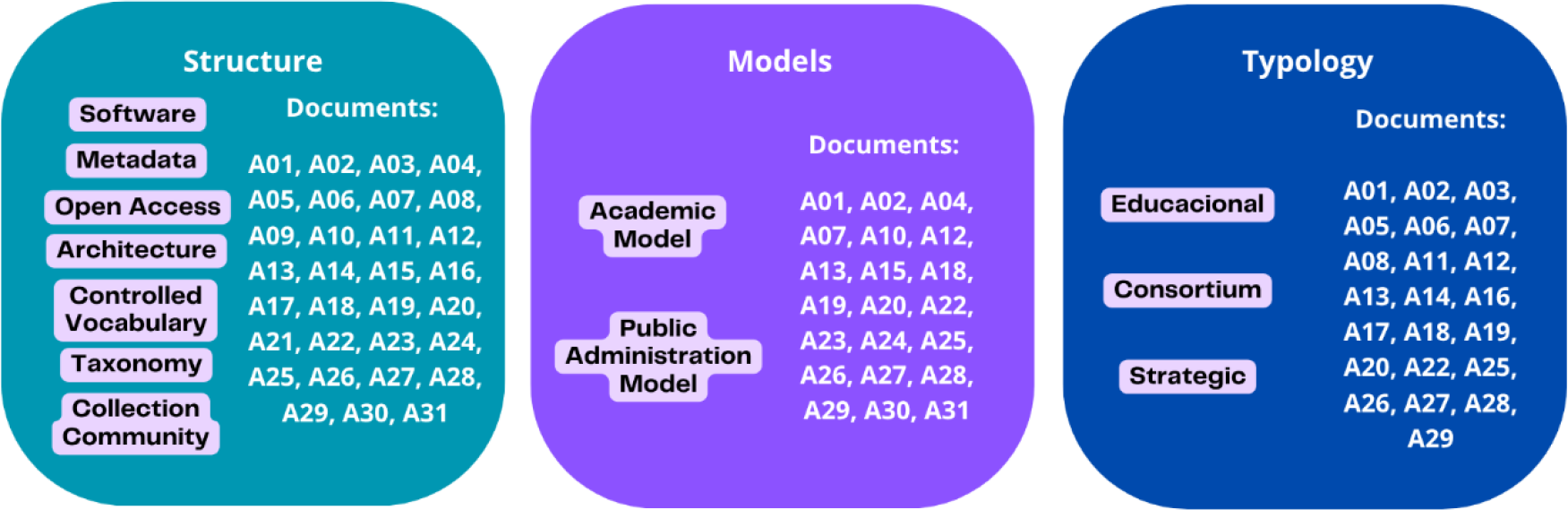
In this section, the proposed categorization is discussed in relation to the literature in the field. Figure 2 presents a summary of the distribution of studies by category and subcategory, highlighting that a faceted classification was used, allowing a study to be assigned to more than one category.

5.1 Structure
When evaluating studies on the structure of IRs, it is important to note that all of the 31 documents address this topic in some way. However, given its breadth encompassing various dimensions - authors focus on their specific research areas, touching on other important themes only in a general and superficial manner. For example, an author researching controlled vocabulary focuses the study on related topics, such as taxonomy, web semantics, and metadata, and considers other themes related to structure in a general way, without delving deeper. Thus, by analyzing the structure, it can be observed that some authors focus on the technical aspect itself - that is, the “backbone” of the IRs - while others focus on the systemic aspect, namely content organization. Most of the documents focus on the development of IRs geared toward their original purpose, which is the academic sphere - teaching, research, and outreach - whose activities are carried out primarily by professionals in Library Science, Archival Science, Computer Science, and related fields, the three central pillars to the academic communication process.
Documents A08 and A09 mention the need to establish a committee that includes the participation of information scientists, as well as experts in knowledge management and organization, particularly from the perspective of studying the socio-technical structure of IRs (Scherer; Valen, 2019; Babini et al., 2010). Thus, in this category, 30 documents were identified that address the IRs structure, including both academic documents and those developed in the context of Public Administration, the focus of this research.
Content analysis of the documents identified seven recurring themes related to the structures proposed by the authors for implementing IRs. These themes were classified as: software used, metadata standards, open access, architecture, controlled vocabulary, taxonomy, and collection communities, enabling identification of thematic clusters based on the objectives, methodologies, techniques, and applications described in the articles. This strategy allowed the documents to be grouped into converging research axes, which offers a structured view of RIs implementation.
5.1.1 Software
Installing the software is only the first step in establishing IRs, but it is a necessary one (Kennan; Wilson, 2006). Regarding the types of software used in IRs implementation, most systems currently available are open-source software developed by the community, such as DSpace, DSpace CRIS, EPrints, Islandora, Samvera, Greenstone, Omeka, Archivematica, CKAN, and Digital Commons.
Regarding software use, 11 studies address this topic (A01, A06, A08, A12, A14, A16, A20, A28, A29, A30, and A31). DSpace is cited as the most widely used, given that it is one of the pioneers, easy to install and use, open-source with superior IRs functionality, and has technical support from the Massachusetts Institute of Technology (MIT) and Hewlett-Packard, the creators of DSpace, as described in the studies by Campbell-Meier (2011); Onyancha, Al-Awah, and Cole (2012); Scherer and Valen (2019); Texier et al. (2013); Hixson and Cracknell (2007); Baudoin and Branschofsky (2003); Batista and Costa (2013); Rieger (2008), Peñalvo et al. (2010); Molina Piñero, Marrero Sera, and Puentes Puente (2015); Markey et al. (2007); Mamtora (2015); and Chapman, Reynolds, and Shreeves (2009).
Study A01 by Campbell-Meier (2011) reports that larger institutions, with advanced technology laboratories and trained technical staff, tend to customize their own systems, while smaller institutions typically use open-source service models that offer features minimizing impacts on the organizational structure, utilizing content and providers such as ProQuest or Elsevier. Document A31 by Fujita (2022) highlights the use of DSpace, though it employs auxiliary software for information processing, such as Duplicate Checker, Oxigenio, Adobe, MarcEditar, and LibreOffice.
5.1.2 Metadata
The Research Data Alliance (RDA) defines a repository as “[...] a searchable and queryable interface entity capable of storing, managing, maintaining, and curating digital data/objects that aims to provide a service for humans and machines to make the data discoverable and searchable through metadata collections” (Scherer; Valen, 2019, p. 2). The term metadata has multiple definitions. However, the most widely accepted and used conception characterizes it as descriptive information about digital resources. Its use became established with the advent of the World Wide Web, and it is considered an evolution of the bibliographic information traditionally maintained in library catalogs. The creation of metadata is fundamental to the dissemination of collections in a digital environment, as it enables the discovery, use, management, and preservation of digital resources (Peñalvo et al., 2010).
Regarding metadata standards, 14 documents address the topic (A01, A02, A06, A07, A08, A13, A14, A16, A17, A20, A23, A29, A30, and A31). Study A29 by Peñalvo et al. (2010) addresses metadata as an essential element for the description of digital resources, highlighting its role in indexing, identifying, and organizing these objects. The authors classify metadata into three main categories: (i) descriptive, used to index, describe, and identify a digital resource, such as author, title, and subject; (ii) structural, aimed at enabling the visualization and navigation of digital resources; and (iii) administrative, indispensable for managing the resource over time, including technical data related to image resolution, file size and format, as well as the hardware or software used in the production of the digital object, among others.
With regard to the choice of metadata standards used in IRs, in general, all studies revealed a predominance of the Dublin Core Metadata Initiative (DCMI) (Campbell-Meier, 2011; Dečman and Vintar, 2013; Onyancha, Al-Awah, and Cole, 2012; Caribé, 2008; Scherer and Valen, 2019; Hixson and Cracknell, 2007; Baudoin and Branschofsky, 2003; Volpato, Rodrigues, and Silveira, 2014; Batista and Costa, 2013; Peñalvo et al., 2010; Lagzian, Abrizah, and Wee, 2015; Texier et al., 2013; Formenton et al., 2018; Chapman, Reynolds, and Shreeves, 2009; and Fujita, 2022).
However, the study by Onyancha, Al-Awah, and Cole (2012) also addresses MARC21, which is primarily used in traditional libraries and union catalogs. Regarding IRs focused on Public Administration, document A23 by Formenton et al. (2018), mentions the use of METS/PREMIS (for preservation and structure), MODS/MARC21 (for detailed bibliographic description), and DCAT/CKAN (in open data portals).
Document A13 by Brito and Martins (2023) proposes a generic framework automatically generating metadata. A30, by Chapman, Reynolds, and Shreeves (2009), presents strategies for creating and aggregating heterogeneous metadata, noting that although the experiences described in the study involved DSpace, many of the problems identified also apply to other software platforms. According to these authors, the diversity of disciplines and formats present in IRs limit the use of a single metadata schema, such as Dublin Core, restricting it to more general-level data.
With regard to rights metadata, a stronger theoretical and practical foundation is observed. IDs A04 by Souza (2020) A19 by Molina Piñero, Marrero Sera, and Puentes Puente (2015), and A28 by Rieger (2008) highlight open access and licenses, with a focus on Creative Commons. In these studies, copyright and access restrictions are evaluated from the perspective of institutional policies and scientific dissemination strategies. Study A26 by Oliveira (2021) reiterates the link between repositories and Open Science policies, highlighting the need to clarify these policies. The remaining studies address the topic indirectly, linking it to the governance and management of repositories, as observed in IDs A01 by Campbell-Meier (2011), A05 by Chalhub (2012), and A10 by Lagzian, Abrizah, and Wee (2013). It can be observed that rights metadata are, among the analyzed categories, the most frequently addressed.
Regarding provenance metadata, study A30 by Chapman, Reynolds, and Shreeves (2009) highlights the importance of recording the origin of digital objects, the deposit methods used, and the modification history. Study A23 by Formenton et al. (2018) associates provenance with the authenticity, reliability, and integrity of digital documents. At the operational level, repositories such as DSpace incorporate basic mechanisms for recording authorship and submission date, even without conceptual depth; that is, the approach is more technical, as described in study A16 by Baudoin and Branschofsky (2003). In general, provenance is addressed, but only in terms of administrative aspects, without analyzing its analytical and semantic potential.
Regarding the analysis of preservation metadata, a less technical and more strategic approach can be identified. Study A02 by Dečman and Vintar (2013) discusses digital preservation in the context of cloud infrastructures, highlighting the need for robust institutional solutions for short and long-term preservation. Study A23 by Formenton et al. (2018) highlights the role of metadata standards in the sustainability of digital objects, highlighting issues of duplication, overlap, and equivalence among metadata sets in the concurrent use of these different schemas and coverers PREMIS descriptive, structural, administrative, and preservation metadata. Studies A01 by Campbell-Meier (2011) and Onyancha, Al-Awah, and Cole (2012) highlight preservation as an essential function of repositories, but neither detail preservation mechanisms, checksums, or models such as PREMIS. Thus, a significant gap is identified in the literature regarding the technical implementation of preservation metadata, which remains largely at the level of guidelines, policies, and technical dependencies.
Regarding studies on the application of semantic or relational metadata, the literature explores this topic less frequently, especially in earlier works. There is a trend toward this approach in more recent studies, such as ID A13 by Brito and Martins (2023) which indicate advances in the automatic generation of subjects and the implementation of Artificial Intelligence (AI) elements, converging toward a semantic approach. Study A31 by Fujita (2022) highlights the use of controlled vocabulary and semantic relationships between terms in the organization of information. However, it is observed that most studies do not explicitly include identifying elements such as DOI or ORCID, nor do they address relationships between projects, authors, and funding agencies or links between publications and research data - elements that are increasingly relevant in the contexts of Linked Data and Open Science.
Ideally, each community or collection should be able to adopt metadata schemas and controlled vocabularies suited to its needs, enabling integration and expanding the variety of materials while avoiding complex adaptations.
5.1.3 Open Access
Open Repositories (ORs) were designed to be open access, making information widely available for free, particularly in academic and scientific contexts. However, it is evident that there are caveats regarding IRs for Public Administration related to administrative documents, given the restricted, confidential, and sensitive nature of data protection and copyright laws and regulations - an aspect discussed in study A12, which introduces the concept of Document Managers (DM), which differ from Administrative Document Repositories (RDA) (Texier et al., 2013). For this topic, 10 documents were identified (A04, A11, A12, A13, A14, A15, A18, A20, A26, and A27).
Study A04 by Souza (2020) presents a timeline of the main open access initiatives from 1991 to 2013. Study A11 by Xia and Opperman (2010) notes that most of the repositories evaluated had few deposits, suggesting that they were unlikely to be ready for open access at that time. Studies A04 by Souza (2020) and A14 by Hixson and Cracknell (2007) address strategic planning models, theoretical frameworks, and information management tools to guide the implementation of open-access repositories, in an attempt to keep pace with changes stemming from technological advances and new ways of organizing information, which reinforces the need for new paradigms. However, study A01 by Campbell-Meier (2011) has limitations as none of the IRs analyzed by the author presented a plan for implementing open-access IRs, proposing best practices and a key project for management process.
5.1.4 Architecture
Regarding IRs architecture, three studies stand out (A17, A20, and A24). A trend toward institutional, structural, and operational architectural innovation focused on public administration agencies is observed, as described in study A17 by Volpato, Rodrigues, and Silveira (2014), as well as the proposal for a holistic (or systematic) analysis and the use of Design Science Research (DSR) for public organizations, also covered in study A20 by Batista and Costa (2013). Study A24 by Fernández-Luna, Pérez-Montoro, and Guallar (2019) proposes the use of methodologies from the discipline of Information Architecture to improve access to repository content and define standardized methodological strategies for designing the architectural structure of IRs, particularly for organizational systems, in order to ensure that digital assets can be easily retrieved and reused.
However, it can be observed that, although the models discussed by the authors are widely used in the academic context, Service-Oriented Architecture (SOA) appears to be well-suited to the purposes of Public Administration, as it considers the integration of information systems, given the fragmentation of data and the challenges in obtaining and retrieving information due to the redundancy and inconsistency of data stored in more than one system (Cunha; Souza Junior; Dornelas, 2008). Therefore, integrated and complementary systems may be more useful for Public Administration.
5.1.5 Controlled Vocabulary
For this category, five studies were identified (A06, A12, A13, A30, and A31). Controlled vocabularies play an essential role in Information Science, as Fujita (2022) argues, since they are indispensable for the retrieval and management of scientific, technological, artistic, and administrative output. However, it is necessary to assess the existence of controlled vocabulary and the mechanisms used to manage them, making the information system dynamic and user-friendly. Basically, the need to control vocabulary arises from two fundamental characteristics of natural language: 1) two or more words can be used to represent the same concept; and 2) two or more words with the same spelling represent different concepts (Ferneda, 2012). Thus, a controlled vocabulary is a list of authorized, semantically organized terms that control synonyms, distinguish homographs, and group related terms, such as thesauri (Lancaster, 2004).
Document A31 by Fujita (2022) provides a detailed analysis of the proposed systematization for vocabulary control and use in IRs and presents an action plan that discusses vocabulary control in indexing, keyword harmonization, the analysis of terminological variations at the semantic, syntactic, and pragmatic levels, and the analysis of search transaction logs by subject. To ensure vocabulary control, tools such as thesauri, lists of authorized terms, and lists of subject headings are used to standardize the terminology adopted in information representation. The A30 document by Chapman, Reynolds, and Shreeves (2009) provides communities with a means to develop their own controlled vocabularies for subjects and authority files for author and publisher names as they deposit items.
5.1.6 Taxonomy
According to Brito and Martins (2023, p. 19), “[...] a taxonomy can be defined as a controlled vocabulary term intended to describe an item. These terms can be an alphabetical list or one structured hierarchically”. Among the 31 documents selected for analysis, only two documents (A13 and A31) directly address the topic. Document A13 by Brito and Martins (2023) presents strategies to expand and to facilitate taxonomies configuration that can be applied across any field of knowledge to improve information search and retrieval. Document A31 by Fujita (2022) describes the implementation of Unesp IR from the perspective of controlled vocabularies and taxonomies use, addressing topics related to indexing policies. The remaining documents address the topic superficially.
5.1.7 Collection Communities
Collection communities established within IRs are determined by the nature of the IRs, and this topic is addressed in 10 documents (A03, A05, A07, A11, A13, A16, A20, A23, A26, and A27). The studies address the definition and management of collections, noting that collection communities in IRs require ongoing monitoring and evaluation to avoid becoming “document graveyards”. Study A03 by Stevenson and Zhang (2015) presents hypotheses for changing terms in collection categories, given the diversity of disciplines, definitions, and objectives. Study A05 by Chalhub (2012) details the institutional, thematic, governmental, and aggregator content of IRs as well as the broadening of the concept of population, that is, the types of documents to be deposited in IRs.
Regarding document depositing, study A03 by Stevenson and Zhang (2015) identifies the period during which the most deposits were made in RIs, and presents three hypotheses on how terms have changed over time within each category. Study A08 by Scherer and Valen (2019) describes a workflow for document depositing, types of material to be deposited, and presents an interesting academic ecosystem that can be adapted to the administrative context. Study A17 by Volpato, Rodrigues, and Silveira (2014) proposes the establishment of a policy that encourages or facilitates the deposit of intellectual output by members and staff of the Court of Auditors. Study A24 by Fernández-Luna, Pérez-Montoro, and Guallar (2019) proposes a methodology to improve the architecture, organization, and deposit system through user-centered techniques and card sorting, in a case study at the University of Barcelona.
According to study A07 by Caribé (2008), the current trend is toward hybrid collections, which encompass diverse genres, formats, and media, both in storage and delivery. Furthermore, study A07 provides an overview of the application of principles, practices, and methodologies for collection development and management, and suggests that the issue of an IRs content should be addressed in greater detail within the OAI framework, particularly regarding peer review and the elaboration of collection development and management policies, so that it “[...] achieves the collection’s intended objective with regard to subject scope, object type, and quality” (Caribé, 2008, p. 14).
Study A08 by Scherer and Valen (2019) examines the types of material an IR can collect, from both technical and contextual perspectives, and questions the reevaluation of the IRs primary mission - the way to fulfill an emerging role broader than merely housing an institution output - while also addressing IRs dialectical perspective. Study A11 by Xia and Opperman (2010) focuses on the composition of repository content, operational style, development history, and accessibility, presenting a study of content categories of IRs. In this study, the administrative category of documents appears last.
Documents A16, A20, A23, A26, and A27 address, to some extent, collection management in IRs. In general, they discuss the importance of defining collection management policies. Document A27 analyzes three Asian institutions - Charles Darwin University (Australia), the University of Hong Kong, and the University of Malaysia - from the perspective of open-access collections and formulates a set of guidelines for implementing IRs and defining collections. Hence, it is observed that the analyzed literature converges on the understanding that open access collection communities are active, interactive, variable in content, and responsive, and that their effectiveness depends on continuous processes of evaluation, updating, as well as the definition of clear development and management policies.
Collection management is a strategic dimension for ensuring the very existence of the IRs, both in terms of the quality and relevance of the content made available. In this sense, it is considered relevant to consult the user community in which the IR is to be implemented, using, for example, focus groups.
In summary, analyzing the IRs structure category is essential for understanding their intrinsic elements and inherent complexity. The 31 documents analyzed addressed the topic from different perspectives, albeit fragmented ones, given the diversity of themes, forming a structural mosaic in which each element contributes specific tesserae, whether technological, informational, or organizational. This multiplicity of elements shows that it is through these fragments that IRs are seen in their entirety. Thus, the structure of IRs is not limited to a mere structural and technical framework, but is a dynamic ecosystem in constant transformation that must correspond to the interface between technology, knowledge, users, society, innovation, and sustainability.
5.2 Models
5.2.1 Academic Model
The IRs academic model is historically the most discussed, given its very genesis in this context. Study A01 by Campbell-Meier (2011) establishes a standard for defining terms and meanings that can be used uniformly, regardless of the size of the IRs. This study examines the structure of six IRs, evaluates the best practices adopted, and reflects on the ambiguity of the terminology. Studies A04 and A05 by Souza (2020) and Chalhub (2012), respectively, address the characteristics of academic and research IRs. Study A09 by Babini et al. (2010) suggests an IR fed by member-centers and links them to the social context from which they originate. Study A10 by Lagazian, Abrizah, and Wee (2013, 2015) describes an empirical model for the development of successful IRs. Study A11 by Xia and Opperman (2010) describes the implementation of a consortium of 50 university repositories covering eight document categories, including a fewer number of administrative documents.
Study A25 presents the initial phase of the MIRACLE project (Making Institutional Repositories a Collaborative Learning Environment). This is a multi-phase research project involving various stages, steps, periods, phases, systems, and phenomena that develop either in isolation or simultaneously. This project investigates the development of IRs at American colleges and universities to identify models and best practices in administration, technical infrastructure, and access to repository collections, through an IR census.
5.2.2 Model for Public Administration
Study A02 by Dečman and Vintar (2013) proposes a solution for long-term digital preservation in Public Administration in the form of a centralized intermediate repository based on the concept of cloud computing. Study A06 by Onyancha, Al-Awah, and Cole (2012) presents the implementation of a digital repository at the UN Economic Commission for Africa and reports on the challenges encountered, primarily because the documents deviate from the academic standard and are more technical.
Study A08 by Scherer and Valen (2019) describes a comprehensive IR that combines data and traditional repositories into a single location and can be adapted for institutions of any size. Study A20 contributes to the field of digital repositories, particularly in the administrative sector, and serves as a model for institutions in managing and preserving documents. The study also discusses the concept of Document Managers (DM), which are tools that facilitate the creation, editing, and sharing of online documents generated by Public Administration units or organizational entities like Google Docs(R). It further presents the benefits of administrative document repositories and a table listing the categories of these repositories and their contents.
One limitation noted in document A08 relates to one of the points regarding the benefits of administrative document repositories, namely, providing access to the entire university community and the general public, given that the proposed approach may raise issues concerning confidential and sensitive data. Study A14 presents a roadmap for implementing IRs, covering essential topics to be considered for any type of IRs, including Public Administration. Study A17 describes the implementation of an IR at the Brazilian Court of Auditors.
Study A20 by Batista and Costa (2013) addresses the implementation of an IR in a Public Administration agency to eliminate an information and knowledge gap to improve organizational performance, and A38 by Oliveira (2021) addresses the implementation of a multi-collection IR.
The analyzed documents demonstrate that, in general, academic IRs models remain at the center of discussions on IRs and highlight the need for both terminological and structural standardization, given the numerous activities in the academic context. In addition, proposals have emerged that link IRs to the social and collaborative context, from a socio-technical perspective, through inter-institutional and transregional consortia, which reinforce the diversity of strategies and reveal that, although the focus remains on the academic environment, there is room to expand the scope of documentation and integrate different typologies, even if on a smaller scale.
Regarding documents addressing IR in Public Administration, studies indicate that this tool has significant potential for application, particularly in digital preservation, records management, and organizational improvement. Although its adoption is underway, the process is still developing gradually. Despite the identified advances, challenges persist regarding the diversity of document formats, the management of confidential information, and organizational transparency requirements, which highlight the need to formulate and strengthen more robust institutional policies.
5.3 Typology
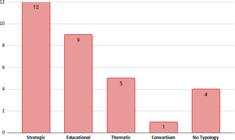
In order to understand the different natures, functions, and modes of organization of IRs, this literature review identified 27 documents (A01, A02, A03, A04, A05, A06, A08, A09, A11, A12, A13, A15, A16, A17, A18, A19, A20, A21, A22, A23, A24, A25, A26, A27, A28, A29, and A30) that classify IRs into educational, consortium, strategic, and thematic, as described in Graph 3 below.
5.3.1 Educational
Educational repositories organize learning objects for pedagogical purposes in various formats, such as lesson plans, teaching materials, handouts, and videos (Tarouco et al., 2014). Nine documents (A04, A05, A13, A16, A19, A26, A27, A29, and A30) were identified that, to some extent, address repositories for educational purposes, although there is no detailed description of the use of this resource in A01, A05, and A11.
In examining Purdue University’s IR, document A01 highlighted the relationship between institutional needs and the community’s motivational factors for adopting and strengthening the IR, emphasizing the importance of the academic community’s perception in the implementation process. In this same context, document A05 analyzed the reality of repositories at public universities in Rio de Janeiro and proposed a four-phase process model: planning, implementation, community participation, and strategy definition. This model highlights the need for adaptation to institutional particularities, especially in the Brazilian context.
In turn, study A11 found a scarcity of teaching materials in the repositories investigated, which are dominated by dissertations and final course projects, suggesting underutilization of the pedagogical potential of these digital environments. The author recommends that, in both planning processes and ongoing practices, the systematic incorporation of Open Educational Resources (OER) shall be considered as a way to expand the educational role of IRs.
5.3.2 Consortium Repositories
This type of IR presented only one significant document (A11). Consortium repositories bring together outputs from multiple institutions. Study A11 by Xia and Opperman (2010) was the only one to describe the implementation of a consortium comprising 50 university repositories in the United States, including eight document categories, among them administrative documents.
According to the authors, consortium-based IRs can represent a strategic solution by bringing together different institutions within a single digital environment, enabling greater diversity of contributors and a wider variety of content. In addition to broadening the representation of scientific and educational output, the consortium model promotes system interoperability, optimizes maintenance costs, and strengthens inter-institutional cooperation (Xia; Opperman, 2010).
When applied to the field of educational and knowledge-based repositories, the consortium could help mitigate the observed gap regarding the scarcity of teaching materials and learning objects. By allowing multiple educational institutions to share their resources, this model would expand the availability of IRs, promoting greater social and academic impact. Furthermore, the consortium approach is particularly relevant for public administration and for small and medium-sized universities, which often lack sufficient technological infrastructure to implement a robust IR on their own.
Consortium repositories can serve as a tool for democratizing access, expanding content diversity, and ensuring long-term sustainability, while also paving the way for new research trends, such as the integration of administrative, scientific, and pedagogical data within a single digital ecosystem, such as Hyper Articles en Ligne3 (Hal) in France, which functions as a national consortium repository, bringing together various universities and research centers into a single interoperable system, and the DART-Europe Consortium4 , which aggregates theses and dissertations from over 800 European universities, promoting open access and metadata standardization.
5.3.3 Strategic
For this category, 12 documents were identified (A08, A09, A15, A17, A18, A20, A21, A22, A23, A24, A25, and A28). Strategic institutional repositories go beyond collecting, organizing, preserving, disseminating, and retrieving an institution digital objects. They also serve broader objectives, functioning as tools for management, visibility, and scientific evaluation, as well as serving as electronic journals by publishing research and academic works. Furthermore, they contribute to organizational knowledge management by preserving scientific and administrative memory, integrating institutional strategic planning.
Study A08 by Scherer and Valen (2019) associates an IR with a related service aimed at diverse audiences, including researchers, authors, and administrators. Along the same lines, study A09 by Babini et al. (2010) analyzes various social groups within educational institutions involved with IR and suggests that they are not limited solely to the academic sphere. However, it does not address specific areas of public administration or even administrative management.
Study A18 by Gato and Suárez (2025) develops a methodological proposal for creating information systems integrated with knowledge management, using the ReSiste-SHC framework method and the Deming Cycle (plan, do, check, and act). Similarly, study A20 by Batista and Costa (2013) also addresses this topic. However, the institution investigated in this study did not implement a single Knowledge Management practice, but, rather, integrated the practice (repository) into a Knowledge Management framework and a systematic method for public organizations, using the KDCA Cycle (knowledge, data, content, and action), proposed by Heisig (2009).
5.3.4 Thematic
In this category, five documents stand out (A01, A02, A03, A06, and A12). Thematic repositories were created with the aim of harnessing the power of the Internet to provide an alternative, more cost-effective means of accessing literature specific to a particular field of knowledge and possess their own set of criteria and strategies (Caribé, 2008).
Study A01 analyzes six thematic repositories to assess models and patterns in the development of institutional repositories across different contexts. According to the authors, the multiplicity of cases enhances the utility of the research, especially since much of the information on development is local and unpublished. The study presents a basic framework for developing IRs based on comparative studies of the six repositories, specifying the role and stage at which each actor responsible for implementation should act.
Study A02 by Dečman and Vintar (2013) seeks to understand temporal changes in the field of institutional repositories by using information visualization techniques to discover themes, reveal relevant thematic clusters, and illustrate connections between related thematic terms. Study A03 by Stevenson and Zhang (2015) describes the development of thematic directories and seeks to identify a key model for managing the institutional repository implementation process, addressing the possibility of changes in the nature of repositories, as well as explaining patterns of change in the topic structure over time, addressing its thematic evolution.
Document A06 reports on the implementation of institutional repositories at the United Nations Economic Commission for Africa (UNECA), whose contribution is linked to the fact that it is the first repository of its kind within the United Nations Secretariat, and aims to provide exclusive knowledge and information, not available anywhere else, regarding regional programs, decisions, and resolutions that promote Africa’s socio-economic development. Document A12 contributes to studies in the field of digital repositories, particularly in the administrative domain.
In the studies evaluated, it is evident that thematic repositories are simpler from both a technical and a user perspective than other models, as they are based on a specific type of collection, which facilitates the organization of collections, the use of metadata and controlled vocabulary, indexing, and retrieval. However, when applied to Public Administration, there remains a lack of established models that account for the legal, technical, and social specificities of this context, opening the door to future research.
It was observed that four documents (A07, A10, A14, and A31) did not fit into any of the above categories, as they were empirical studies.
Finally, following the discussions, it was observed that all elements are important and must be considered in the construction of repositories. This study provides a contemporary mapping of what has been used and can be replicated in other solutions. Thus, an academic repository aims to disseminate and preserve scientific output (articles, theses, dissertations, and research data), with a focus on visibility, scientific impact, and open access.
In contrast, a repository geared toward other areas, such as the administrative sector, prioritizes support for management, transparency, and decision-making, as well as the preservation of institutional memory. It is structured primarily according to document types, such as manuals and informational materials, legislation, institutional maps, and administrative documents, respecting organizational functions, uses, and workflows, as well as data protection. However, IRs focused on this area present limitations and challenges, such as embargoes, data protection, patents, confidentiality, and sensitive data. Although the literature records few direct initiatives in this area (Camargo; Vidotti, 2009), the use of IRs in other contexts is a fertile field. Figure 3 summarizes the study.

6 CONCLUSION
This review sought to identify, in the literature, published documents on the implementation, construction, and organization of IRs, focusing on investigating their replication in other contexts. The study fully achieved its proposed objective by systematizing and analyzing the main existing approaches and highlighting relevant contributions to expanding the use of IRs beyond the university environment, even though the majority of the literature remains tied to the academic context.
The works analyzed were organized into three categories: structure, model, and typology, which provided a holistic view of the subject, particularly from the socio-technical perspective of Information Science. The analyses prompted reflections on the underutilization of IRs and even a tendency toward stagnation in academic environments, indicating that, despite their strategic potential, these systems are often not fully exploited by managers, researchers, and institutions, which, in many cases, fail to promote updates and the incorporation of new technologies. This scenario may be related to several factors, including low user adoption, technological limitations, the absence of consistent institutional policies, and a lack of integration with teaching and research practices. At the same time, underutilized opportunities in the administrative sphere are highlighted.
Regarding the gaps, the literature has proven to be fragmented, with some studies prioritizing technical aspects at times and informational content at others, which limits integrated and comprehensive approaches. It is also observed that most studies focus on the use of IRs in the academic context, with scarce research dedicated to a more in-depth investigation of its potential in the administrative sphere. Added to this is the recent decline in scientific output on the topic in general, including regarding the incorporation of new technologies. However, IRs remain strategic for the archiving, sharing, and retrieval of information.
Most of the models analyzed are based on studies that predate current innovations, which may indicate a paradigm shift that could incorporate AI. The integration of AI can facilitate document standardization, process automation, and promote greater agility in management, from cataloging to information retrieval. Features such as voice recognition can expand this potential, bringing us closer to the concept of an “intelligent” institutional repository.
Nevertheless, such advances must be guided by rigorous criteria regarding information quality, privacy, security, confidentiality, and transparency, to ensure that technological benefits remain aligned with the legal and ethical requirements of public administration. The study demonstrates pathways for consolidating IRs in new contexts, reinforcing their importance for information governance and the preservation of institutional memory. As for future work, this study - which is part of an ongoing doctoral research project - confirms the existence of a gap to be explored in the development of a repository for the administrative context, specifically public procurement.
The study revealed that scholarly output on institutional repositories in the administrative context is fragmented and scattered, remaining in its infancy in theoretical, methodological, and practical terms, which limits progress in the field. This scenario reveals not only a gap but also a weakness in the consolidation of this field of study, despite some modest progress. In light of this, it is proposed that future doctoral research systematically advances the investigation of this issue, seeking to contribute to the development and organization of repositories tailored to the specificities and demands of these fields, thereby establishing new frontiers of use.
- 1
-
2
Source: https://www.coalition-s.org/
- 3
- 4
-
Funding:
Not applicable.
-
Approval:
Not applicable.
-
Declaration of AI tool use:
The authors declare that no AI tools were used in the writing of the manuscript.
-
Image:
Retrieved from the Lattes platform.
-
Translation:
Author's translation with English revision by Raquel Rossini Martins Cardoso affiliated with ABRATES.
-
JITA:
HS. Repositories
-
SDG:
10. Reduced Inequalities
-
Article submitted to the similarity checker
Acknowledgments:
To the Coordination for the Improvement of Higher Education Personnel (CAPES) for supporting this research. To the National Council for Scientific and Technological Development (CNPq) for supporting this research, grant number 303721/2025-1.
Availability of data and materials:
Not applicable.
References
-
ARMBRUSTER, Chris; ROMARY, Laurent. Comparing repository types: challenges and barriers for subject-based repositories, research repositories, national repository systems, and institutional repositories in serving scholarly communication. Rochester: SSRN, 2010. 41 p. Disponível em: https://arxiv.org/pdf/1003.4187 Acesso em: 27 abr. 2026.
» https://arxiv.org/pdf/1003.4187 -
BABINI, Dominique; GONZÁLEZ, Jessica; LÓPEZ, Fernando; MEDICI, Flavia. Construcción social de repositorios institucionales: el caso de un repositorio de América Latina y el Caribe. Información, Cultura y Sociedad, Buenos Aires, n. 23, p. 63-90, 2010. Disponível em: https://www.redalyc.org/pdf/2630/263019487004.pdf Acesso em: 11 ago. 2025.
» https://www.redalyc.org/pdf/2630/263019487004.pdf - BARDIN, Laurence. Análise de conteúdo São Paulo: Edições 70, 2016.
-
BATISTA, Fábio Ferreira; COSTA, Veruska da Silva. Alinhando o modelo, o método de implementação e a prática de gestão do conhecimento (GC): o caso do Repositório do Conhecimento do Instituto de Pesquisa Econômica Aplicada (RCIpea). Revista do Serviço Público, Brasília, v. 64, n. 1, p. 59-76, jan./mar. 2013. Disponível em: https://revista.enap.gov.br/index.php/RSP/article/view/115 Acesso em: 18 dez. 2025.
» https://revista.enap.gov.br/index.php/RSP/article/view/115 -
BAUDOIN, Patsy; BRANSCHOFSKY, Margret. Implementing an institutional repository: the DSpace experience at MIT. Science & Technology Libraries, Binghamton, v. 24, n. 1-2, p. 31-45, 2003. DOI: https://doi.org/10.1300/J122v24n01_04
» https://doi.org/10.1300/J122v24n01_04 -
BEKKERS, Victor Jacobus Johannes Maria. E-government and the emergence of virtual organizations in the public sector. Information Polity, Amsterdam, v. 8, n. 3-4, p. 89-102, 2003. Disponível em: https://repub.eur.nl/pub/16689 Acesso em: 22 abr. 2026.
» https://repub.eur.nl/pub/16689 -
BRITO, Jean Carlos Borges; MARTINS, Dalton Lopes. Framework genérico para geração automática de assuntos e indexação em repositório digital. Perspectivas em Ciência da Informação, Belo Horizonte, v. 28, e46629, 2023. DOI: https://doi.org/10.1590/1981-5344/46629
» https://doi.org/10.1590/1981-5344/46629 -
CAMARGO, L.; VIDOTTI, S. Arquitetura da Informação para repositórios científicos digitais. In: SAYÃO, Luis Fernando (org.) et al Implementação e gestão de repositórios institucionais: políticas, memória, livre acesso e preservação. Salvador: Editora da Universidade Federal da Bahia (EDUFBA), 2009. 365p. il. ISBN: 978-85-232-0655-0. Disponível em: https://repositorio.ufba.br/bitstream/ufba/473/3/implantacao_repositorio_web.pdf Acesso em: 27 abr. 2026.
» https://repositorio.ufba.br/bitstream/ufba/473/3/implantacao_repositorio_web.pdf -
CAMPBELL-MEIER, Jennifer. A framework for institutional repository development. In: WILLIAMS, Delmus E.; NYCE, James M.; GOLDEN, Janine. (org.). Advances in Library Administration and Organization. Bingley: Emerald Group Publishing Limited, 2011. v. 30, p. 151-185. DOI: https://doi.org/10.1108/S0732-0671(2011)0000030006
» https://doi.org/10.1108/S0732-0671(2011)0000030006 -
CARIBÉ, Rita de Cássia do Vale. A aplicação do desenvolvimento e gerenciamento de coleções na construção de repositórios institucionais. Informação & Sociedade: Estudos, João Pessoa, v. 18, n. 2, 2008. Disponível em: https://periodicos.ufpb.br/index.php/ies/article/view/1010 Acesso em: 7 maio. 2025.
» https://periodicos.ufpb.br/index.php/ies/article/view/1010 -
CHALHUB, Tania. Ações para implementação de repositórios institucionais em universidade pública do Estado do Rio de Janeiro. Informação & Sociedade: Estudos, João Pessoa, v. 22, p. 115-126, 2012. Disponível em: https://periodicos.ufpb.br/index.php/ies/article/view/12147/7761 Acesso em: 2 maio. 2025.
» https://periodicos.ufpb.br/index.php/ies/article/view/12147/7761 -
CHAPMAN, John William; REYNOLDS, David; SHREEVES, Sarah. A. Repository metadata: approaches and challenges. Cataloging & Classification Quarterly, Philadelphia, v. 47, n. 3-4, p. 309-325, 2009. DOI: https://doi.org/10.1080/01639370902735020
» https://doi.org/10.1080/01639370902735020 -
COSTA, Sely; LEITE, Fernando César Lima. Repositórios institucionais como ferramentas de gestão do conhecimento científico no ambiente acadêmico. Perspectivas em Ciência da Informação, Belo Horizonte, v. 11, n. 2, p. 206-219, mai./ago. 2006. Disponível em: http://www.scielo.br/pdf/pci/v11n2/v11n2a05.pdf Acesso em: 19 set. 2025.
» http://www.scielo.br/pdf/pci/v11n2/v11n2a05.pdf -
CROW, Raym. The case for institutional repositories: a SPARC position paper Washington: SPARC, 2002. Disponível em: https://www.researchgate.net/publication/215993546 Acesso em: 2 ago. 2025.
» https://www.researchgate.net/publication/215993546 -
CUNHA, Mônica Xavier de Carvalho; SOUZA JUNIOR, Marcilio Ferreira de; DORNELAS, Jairo Simião. O uso da arquitetura SOA como estratégia de integração de sistemas de informação em uma instituição pública de ensino. In: Simpósio de Excelência em Gestão e Tecnologia (SEGeT), 2008, Resende. Disponível em: https://www.aedb.br/seget/arquivos/artigos08/498_integracao_seget_final.pdf Acesso em: 21 set. 2025.
» https://www.aedb.br/seget/arquivos/artigos08/498_integracao_seget_final.pdf -
DEČMAN, Mitja; VINTAR, Mirko. A possible solution for digital preservation of e-government: a centralised repository within a cloud computing framework. Aslib Proceedings, London, v. 65, n. 4, p. 406-424, 2013. Disponível em: https://doi.org/10.1108/AP-05-2012-0049 Acesso em: 18 ago. 2025.
» https://doi.org/10.1108/AP-05-2012-0049 -
DELGADO LÓPEZ-CÓZAR, Emilio. La hoja de ruta verde de la comunicación científica. Aula Magna 2.0, Revistas Científicas de Educación en Red, Madri, 2018. Disponível em: https://cuedespyd.hypotheses.org/5397 Acesso em: 18 ago. 2025.
» https://cuedespyd.hypotheses.org/5397 -
ESCOBAR, Liliana et al MeRINS - Methodology for the Design and Implementation of Institutional Repositories. Santiago del Estero: Universidad Nacional de Santiago del Estero (UNSE), 2012. Disponível em: https://www.aacademica.org/analia.mendez/16 Acesso em: 13 mai. 2025.
» https://www.aacademica.org/analia.mendez/16 -
FERNÁNDEZ-LUNA, Adrià; PÉREZ-MONTORO, Mario; GUALLAR, Javier. Metodología para la mejora arquitectónica de repositorios universitarios. Anales de Documentación, Murcia, v. 22, n. 2, 2019. Disponível em: https://doi.org/10.6018/analesdoc.356431 Acesso em: 15 jun. 2025.
» https://doi.org/10.6018/analesdoc.356431 - FERNEDA, Edberto. Modelos computacionais de recuperação da informação Rio de Janeiro: Ciência Moderna, 2012.
-
FORMENTON, Danilo et al. Os padrões de metadados como recursos tecnológicos para a garantia da preservação digital. Biblios Journal of Librarianship and Information Science, Pittsburgh, n. 68, p. 82-95, 2018. Disponível em: https://biblios.pitt.edu/ojs/biblios/article/view/414/311 Acesso em: 17 jun. 2025.
» https://biblios.pitt.edu/ojs/biblios/article/view/414/311 -
FUJITA, Mariângela Spotti Lopes. Systematization of the evaluation model of vocabulary control in repositories. RDBCI: Revista Digital de Biblioteconomia e Ciência da Informação, Campinas, v. 20, p. 1-21, 2022. DOI: https://doi.org/10.20396/rdbci.v20i00.8668751
» https://doi.org/10.20396/rdbci.v20i00.8668751 -
GATO, Jania Estela Cabrera; SUÁREZ, Pedro Lázaro Romero. Repositorios institucionales integrados a la gestión del conocimiento organizacional. Revista Cubana de Información en Ciencias de la Salud, La Habana, v. 36, 2025. Disponível em: https://acimed.sld.cu/index.php/acimed/article/view/2882 Acesso em: 19 jul. 2025.
» https://acimed.sld.cu/index.php/acimed/article/view/2882 -
GENONI, Paul. Content in institutional repositories: a collection management issue. Library Management, Bingley, v. 25, n. 6/7, p. 300-306, 2004. DOI: https://doi.org/10.1108/01435120410547968
» https://doi.org/10.1108/01435120410547968 -
HEISIG, P. Harmonisation of knowledge management - comparing 160 KM frameworks around the globe. Journal of Knowledge Management, v. 13, n. 4, p. 4-31, 2009. Disponível em: https://www.researchgate.net/publication/220363127_Harmonisation_of_knowledge_management_-_comparing_160_KM_frameworks_around_the_globe Acesso em: 27 abr. 2026.
» https://www.researchgate.net/publication/220363127_Harmonisation_of_knowledge_management_-_comparing_160_KM_frameworks_around_the_globe -
HIXSON, Carol; CRACKNELL, Linda. How to implement an institutional repository. The Serials Librarian, Philadelphia, v. 52, n. 1-2, p. 37-54, 2007. DOI: https://doi.org/10.1300/J123v52n01_05
» https://doi.org/10.1300/J123v52n01_05 -
KENNAN, Mary Anne; WILSON, Concepción S. Institutional repositories: review and an information systems perspective. Library Management, Bingley, v. 27, n. 4/5, p. 236-248, 2006. Disponível em: https://www.researchgate.net/publication/28808515_Institutional_repositories_Review_and_an_information_systems_perspective Acesso em: 16 set. 2025.
» https://www.researchgate.net/publication/28808515_Institutional_repositories_Review_and_an_information_systems_perspective -
KITCHENHAM, Barbara Ann. Procedures for performing systematic reviews Keele, Staffs, UK: Keele University, 2004. (Technical Report TR/SE-0401). Disponível em: https://www.inf.ufsc.br/~aldo.vw/kitchenham.pdf Acesso em: 25 ago. 2025.
» https://www.inf.ufsc.br/~aldo.vw/kitchenham.pdf -
LAGOZE, Carl; VAN DE SOMPEL, Herbert. The Open Archives Initiative: Building a Low Barrier Interoperability Framework. In: JOINT CONFERENCE ON DIGITAL LIBRARIES, 1., 2001, Roanoke. Proceedings [...]. New York: ACM, 2001. p. 54-62. DOI: https://dl.acm.org/doi/10.1145/379437.379449
» https://dl.acm.org/doi/10.1145/379437.379449 -
LAGZIAN, Fatemeh; ABRIZAH, Abdullah; WEE, Mee Chin. Critical success factors for institutional repositories implementation. The Electronic Library, Bingley, v. 33, n. 2, p. 196-209, 2013. DOI: https://doi.org/10.1108/EL-04-2013-0058
» https://doi.org/10.1108/EL-04-2013-0058 -
LAGZIAN, Fatemeh.; ABRIZAH, Abdullah; WEE, Mee Chin. Measuring the gap between perceived importance and actual performance of institutional repositories. Library & Information Science Research, Bingley, v. 37, n. 2, p. 147-155, 2015. DOI: https://doi.org/10.1016/j.lisr.2014.06.007
» https://doi.org/10.1016/j.lisr.2014.06.007 - LANCASTER, Frederick Wilfred. Indexação e resumos: teoria e prática. 2. ed. Brasília: Briquet de Lemos, 2004.
-
LIMA, Gercina Ângela de; SILVA, Rogério Mugnaini da; SANTOS, Plácida Leopoldina Ventura Amorim da Costa. Modelagem de um repositório de conhecimento. Revista Brasileira de Ciência da Informação, Marília, v. 18, e024019, 2024. Disponível em: https://revistas.marilia.unesp.br/index.php/bjis/article/view/14682 Acesso em: 20 set. 2025.
» https://revistas.marilia.unesp.br/index.php/bjis/article/view/14682 -
LYNCH, Clifford Alan. Institutional repositories: essential infrastructure for scholarship in the digital age. ARL Bimonthly Report, Washington, n. 226, p. 1-7, 2003. Disponível em: https://www.webcitation.org/getfile.php?fileid=cc1ac114fdd4c85d95010cd023c1a582be0d7029 Acesso em: 23 ago. 2025.
» https://www.webcitation.org/getfile.php?fileid=cc1ac114fdd4c85d95010cd023c1a582be0d7029 -
MAMTORA, Jayshree; YANG, Tina; SINGH, Diljit. Open access repositories in the Asia-Oceania region. IFLA Journal, London,v. 41, n. 2, p. 162-176, 2015. DOI: https://doi.org/10.1177/0340035215582219
» https://doi.org/10.1177/0340035215582219 -
MARKEY, Karen et al. Nationwide census of institutional repositories. Journal of Digital Information, Austin, v. 8, n. 2, 2007. Disponível em: https://jodi-ojs-tdl.tdl.org/jodi/article/view/194 Acesso em: 29 ago. 2025.
» https://jodi-ojs-tdl.tdl.org/jodi/article/view/194 - MAXWELL, Joseph Alex. Qualitative research design: an interactive approach 3. ed. Thousand Oaks, California: SAGE Publications, 2013.
-
MOLINA PIÑEIRO, Maricela; MARRERO SERA, Eloísa Felina; PUENTES PUENTE, Ángel de Jesús. Los repositorios de acceso abierto como alternativa para la visibilidad de la ciencia en las universidades: estudio de caso. Revista Cubana de Información en Ciencias de la Salud, La Habana, v. 26, n. 4, 2015. Disponível em: https://repositorio.unphu.edu.do/server/api/core/bitstreams/fed1be99-44fe-43af-81ed-062b74303e85/content Acesso em: 5 set. 2025.
» https://repositorio.unphu.edu.do/server/api/core/bitstreams/fed1be99-44fe-43af-81ed-062b74303e85/content -
NASCIMENTO SILVA, Patrícia. Recuperação de informação na Ciência da Informação. Transinformação, Campinas, v. 35, 2023. Disponível em: https://periodicos.puc-campinas.edu.br/transinfo/article/view/7336/6144 Acesso em: 28 set. 2025.
» https://periodicos.puc-campinas.edu.br/transinfo/article/view/7336/6144 -
NOGRAŠEK, Janja; VINTAR, Mirko. Technology as the key driver of organizational transformation in the e-government period. In: IFIP WG 8.5 INTERNATIONAL CONFERENCE ON ELECTRONIC GOVERNMENT. Proceedings on […]. Berlin: Springer, 2011. p. 453-464. Disponível em: https://dl.ifip.org/db/conf/egov/egov2011/NograsekV11.pdf Acesso em: 12 set. 2025.
» https://dl.ifip.org/db/conf/egov/egov2011/NograsekV11.pdf -
OLIVEIRA, Thierre Xavier de. O papel dos repositórios digitais na construção de políticas de Ciência Aberta. 2021. 76 f. Trabalho de Conclusão de Curso (Graduação em Administração) - Instituto de Ciências Sociais Aplicadas, Universidade Federal Rural do Rio de Janeiro, Seropédica, 2021. Disponível em: https://rima.ufrrj.br/jspui/handle/20.500.14407/14061 Acesso em: 8 set. 2025.
» https://rima.ufrrj.br/jspui/handle/20.500.14407/14061 -
ONYANCHA, Irene; AL-AWAH, Ahmed; COLE, Florie. Addressing institutional potential loss of records and knowledge in Africa. The International Information & Library Review, London, v. 44, n. 3, p. 171-179, 2012. DOI: https://doi.org/10.1080/10572317.2012.10762928
» https://doi.org/10.1080/10572317.2012.10762928 -
PEÑALVO, Francisco José García et al Qualified Dublin Core metadata best practices for GREDOS. Journal of Library Metadata, New York, v. 10, n. 1, p. 13-36, 2010. DOI: https://doi.org/10.1080/19386380903546976
» https://doi.org/10.1080/19386380903546976 -
PENNOCK, Maureen; LEWIS, Stuart. Institutional repositories: the new university challenge. ALISS Quarterly, Londres, v. 2, n. 3, p. 23-26, abr. 2007. Disponível em: http://www.ukoln.ac.uk/ukoln/staff/m.pennock/publications/docs/aliss_rsp.pdf Acesso em: 8 nov. 2025.
» http://www.ukoln.ac.uk/ukoln/staff/m.pennock/publications/docs/aliss_rsp.pdf -
RIEGER, Oya Y. Opening up institutional repositories. The Journal of Electronic Publishing, Ann Arbor, v. 11, n. 3, 2008. Disponível em: DOI: https://doi.org/10.3998/3336451.0011.301
» https://doi.org/10.3998/3336451.0011.301 -
SANTANA, Lílian Dominguez; PEREIRA, Frederico Cesar Mafra; MATTOS, Max Cirino de. Design Science Research na prática: ideação de um Repositório Institucional baseado em periódico científico. RDBCI: Revista Digital de Biblioteconomia e Ciência da Informação, Campinas, v. 21, e023011, 2023. DOI: https://doi.org/10,20396/rdbci.v21i00.8672896
» https://doi.org/10,20396/rdbci.v21i00.8672896 -
SCHERER, David; VALEN, Daniel. Balancing multiple roles of repositories. Publications, Basel, v. 7, n. 2, 30, 2019. DOI: https://doi.org/10.3390/publications7020030
» https://doi.org/10.3390/publications7020030 -
SOUZA, Robson Beatriz de. Acesso aberto às publicações científicas 2020. Tese (Doutorado em Ciência da Informação) - Universidade Federal de Sergipe, Aracaju, 2020. Disponível em: https://ri.ufs.br/jspui/handle/riufs/14076 Acesso em: 19 jun. 2025.
» https://ri.ufs.br/jspui/handle/riufs/14076 -
STEVENSON, Jennifer Ann; ZHANG, Jin. A temporal analysis of institutional repository research. Scientometrics, Budapest, v. 105, n. 3, p. 1491-1525, 2015. DOI: https://doi.org/10.1007/s11192-015-1728-x
» https://doi.org/10.1007/s11192-015-1728-x -
TAROUCO, Liane Margarida Rockenbach; EVANGELISTA, Luciana Backes; CARREÑO, Isolda; KONRATH, Mary Lúcia Pedroso; BEHAR, Patricia Alejandra. Objetos de aprendizagem: teoria e prática. Porto Alegre: Evangraf, 2014. 211 p. Disponível em: https://www.lume.ufrgs.br/handle/10183/102993 Acesso em: 15 nov. 2015.
» https://www.lume.ufrgs.br/handle/10183/102993 -
TEXIER, José et al DSpace como herramienta para un repositorio de documentos administrativos en la Universidad Nacional Experimental del Táchira. Revista Interamericana de Bibliotecología, Medellín, v. 36, p. 109-124, 2013. Disponível em: https://cip.brapci.inf.br/download/83363 Acesso em: 12 ago. 2025.
» https://cip.brapci.inf.br/download/83363 -
VOLPATO, Sílvia Maria Berté; RODRIGUES, Leonel Cezar; SILVEIRA, Amélia. Inovação no acervo e no acesso de informações. Perspectivas em Ciência da Informação, Belo Horizonte, v. 19, n. 4, p. 160-181, 2014. DOI: https://doi.org/10.1590/1981-5344/1917
» https://doi.org/10.1590/1981-5344/1917 -
XIA, Jingfeng; OPPERMAN, David Brien. Current trends in institutional repositories. Serials Review, Philadelphia, v. 36, n. 1, p. 10-18, 2010. DOI: https://doi.org/10.1080/00987913.2010.10765272
» https://doi.org/10.1080/00987913.2010.10765272
Edited by
-
Editor:
Gildenir Carolino Santos https://orcid.org/0000-0002-4375-6815

 Source: prepared by the authors (2025).Description: The figure presents a flowchart showing in pink background and black text, the number of documents retrieved from the databases throughout the identification, eligibility, and inclusion stages, with arrows and speech bubbles from left to right.
 Source: prepared by the authors (2025).Description: This is a bar graph with dark-pink vertical bars on a light-pink background, showing the years of publication for the documents from 2003 to 2025. The years with the highest output were 2013 and 2015, with four publications each.
 Source: prepared by the authors (2025).Description: This is a horizontal bar chart in blue on a white background, that shows the main themes identified in the analyzed documents. The left axis lists the themes. The right axis shows the number of documents addressing each theme.
 Source: prepared by the authors (2025).Description: Image with three segments, from left to right, showing two columns containing the summary of articles by category and their respective IDs, divided into two columns. Balloon 1 covers structure, on a green background; balloon 2 covers models, on a lilac background; and balloon 3 covers typologies, on a dark-blue background.
 Source: prepared by the authors (2025).Description: A vertical bar chart has light-pink background, dark-pink columns, and red borders, showing the types of repositories found in the analyzed documents. Each column displays the number of documents and repository type.
 Source: prepared by the authors (2025).Description: The figure presents a conceptual synthesis of the literature review on institutional repositories, organized into three columns. The left column, in green, addresses structure; the middle column, in lilac, addresses typology. At the top, just below, in blue, are the models. The right column, in dark-blue, presents future perspectives.