
 Artificial Intelligence in academic library operations and services in Brazil: evidence from a census-based survey
ABSTRACT
Introduction: This research focuses on the integration of Artificial Intelligence (AI) within the context of academic libraries.
Objectives: a) to investigate the integration of AI technologies and tools into academic library operations and services; b) to describe the uses and applications of AI technologies and tools within academic libraries; c) to identify facilitating and inhibiting factors influencing AI integration within these institutions. Methodology: The research adopts an exploratory and descriptive design with a quantitative approach. Data were collected through a questionnaire utilizing the Microsoft Forms platform. The research included librarians working in Brazilian public and private universities, totaling 207 universities. The census-based survey technique was adopted, totaling 302 respondents.
Results: Regarding AI applications and uses in academic library operations and services in Brazil, a noticeable increase in the use of QR codes, databases with AI capabilities, and the adoption of RFID for managing and securing physical collections was observed. From the perspective of librarians, an increased popularization of generative AI for management, communication, research, and standardization has been identified.
Conclusion: The integration of AI technologies and tools in Brazil is in its initial stage. Academic libraries (ALs) and their professionals should invest in continuing education, promoting awareness-raising and training initiatives to enable them to leverage the potential of AI in UL operations and services.
KEYWORDS
Artificial intelligence; Academic library; Brazil; Services; Operations; Digital transformation.
RESUMO
Introdução: Esta pesquisa tem como foco a integração da inteligência artificial no contexto das Bibliotecas universitárias.
Objetivos: a) investigar a integração das tecnologias e ferramentas de IA às operações e serviços das bibliotecas universitárias; b) descrever os usos e aplicações das tecnologias e ferramentas de IA nas BUs; c) identificar os fatores facilitadores e inibidores da integração da IA nessas bibliotecas. Metodologia: A pesquisa caracteriza-se como exploratória e descritiva, com abordagem quantitativa. O instrumento de pesquisa utilizado foi um questionário desenvolvido na plataforma Microsoft Forms. O universo da pesquisa abrange bibliotecários(as) que atuam em universidades brasileiras públicas e privadas, totalizando 207 universidades. A técnica adotada foi o levantamento censitário, realizado por meio de survey, totalizando 302 respondentes.
Resultados: No que se refere às aplicações e usos de IA nas operações e serviços de bibliotecas universitárias no Brasil, constata-se a popularização e uso de QR code, bases de dados que possuem recursos de IA e adoção da RFID para gestão e segurança do acervo físico. Na perspectiva dos(as) bibliotecários(as), constata-se popularização e uso da IA generativa para atividades de gestão, comunicação, pesquisa e normalização.
Conclusão: A integração das tecnologias e ferramentas de Inteligência Artificial (IA) no Brasil configura-se em estágio inicial, é fundamental que as Bibliotecas Universitárias (BUs) e seus profissionais invistam em formação continuada, com ações de conscientização e instrumentalização que possibilitem o aproveitamento do potencial da IA nas operações e serviços das BUs.
PALAVRAS-CHAVE:
Inteligência artificial; Bibliotecas universitárias; Brasil; Serviços e operações de bibliotecas; Transformação digital.
1 INTRODUCTION
Artificial Intelligence (AI) is among the top trends for academic libraries (ALs), as highlighted by the Research Planning and Review Committee of the Association of College and Research Libraries (2024). The impact on higher education and, consequently, on academic libraries is undeniable. In this sense, the adoption of AI in these units’ operations and services becomes an inevitable process, considering its potential to revolutionize services, improve user experience, foster innovation, increase organizational productivity and service effectiveness (Hussain, 2023; Huang, 2024; Kalbande et al., 2024a; Molaudzi; Marutha, 2024).
Library and Information Science researchers and professionals have demonstrated interest in integrating AI into academic library operations and services. The emergence of literature centered on the theme has mirrored the development of bibliometric studies (Hussain; Ahmad, 2023; Islam et al., 2025; Kulkanjanapiban; Silwattananusarn; Lambovska, 2025) and literature reviews (Danquah. et al., 2024; Shahzad; Khan; Iqbal, 2024), which point to trends and enable the construction of theoretical and practical insights.
In Latin America, and specifically in Brazil, research on the topic is still scarce. Martinez-Camacho et al. (2025) analyzed the adoption of Generative AI (GenAI) in six Latin American universities. Pacheco Gomes et al. (2019) applied a data mining model (Knowledge Discovery in Databases) to quantitatively evaluate the development of collections. Mattos(2025) investigated the application of AI in reference services in academic libraries. Lima and Aganette (2025) verified the use of GenAI for the personalization of reference service. Picalho, Oliveira, and Cativelli (2025) demonstrated the use of GenAI tools (ChatGPT-4, Gemini, and Copilot) in the construction of search strategies in databases. Araújo, Handke, and Debastiani (2024) described the experience of using AI tools (Whisper and ChatGPT) for data collection and analysis in user studies. Selbach et al. (2023, 2024) reflected on and analyzed the use of ChatGPT in cataloging processes, both in thematic and descriptive representation.
Despite advancements within the international literature, depicting the integration of AI in academic libraries in countries across Europe, Africa, Asia, and North America, no nationwide research with this focus has been identified in Brazil. Thus, an empirical gap is observed regarding the understanding of AI integration within Brazilian academic library the operations and services.
Given this empirical gap and seeking to deepen discussions and broaden theoretical and practical horizons, this research aims to answer the following questions: how are Brazilian academic libraries integrating AI technologies and tools into their operations and services? What factors facilitate or inhibit the integration of AI within these organizations? Therefore, the following objectives are proposed: a) to investigate the integration of AI technologies and tools into AL operations and services; b) to describe uses and applications of AI technologies and tools in academic libraries; c) to identify the factors that facilitate and inhibit the integration of AI within these libraries.
The research results highlight uses, applications, and ways in which AI tools and technologies are appropriated by academic libraries and their professionals. They also reveal the main inhibiting (barriers) and facilitating factors within the AI integration process. The aim is to alert managers to the need for policies, guidelines, and strategic planning focused on incorporating AI into AL operations and services. This investigation is expected to fill a research gap and foster new investigations on the theme.
From an operational and managerial perspective, with a pragmatic focus, this research may contribute to improving the management of AL operations and services integrated with AI, by bringing the Brazilian library community closer to and familiarizing them with a topic still little explored in the country, in addition to sparking reflections on the role of ALs and their professionals in the age of AI.
2 LITERATURE REVIEW
2.1 Artificial Intelligence: concepts and principles
Artificial Intelligence is a field of Computer Science that was formally established in 1956, during the landmark seminar organized by mathematicians John McCarthy at Dartmouth College in Hanover (NH), United States (Kneusel, 2024; Russell; Norvig, 2022; Taulli, 2020).
Over the 70 years since the seminar, AI has been marked by periods of greater promise and stagnation (Gabriel, 2022; Kneusel, 2024). In the 1950s and 60s, AI focused on developing algorithms for data processing and logical reasoning tasks (Suave, 2024). The 1970s and 80s were marked by the development of expert systems, while the 1990s were marked by the success of machine learning (Russell; Norvig, 2022; Kneusel, 2024). With the development of deep neural networks, advances in computing, and the emergence of Big Data, deep learning methods have gained prominence. In 2012, AlexNet won the ImageNet competition and Goodfellow, in 2014, conceived generative adversarial networks (GANs) (Russell; Norvig, 2022; Taulli, 2020).
Artificial Intelligence denotes the capacity of non-human agents to act and think rationally (Russell; Norvig, 2022). Its focus is on the development of systems or task automation, enabling machines to perform complex activities independently (Luger, 2013; Suave, 2024). By simulating human intelligence, AI is able to learn, reason, recognize patterns, understand human language, perceive the environment, and solve problems. Its operation requires knowledge representation, the use of algorithms, languages, and programming techniques (Suave, 2024; Murer, 2025).
In turn, Machine Learning is a computational technique that enables systems to learn and improve automatically from data, identifying patterns and making predictions without requiring explicit programming of logical rules; thus, they learn through experience (Kaufman, 2019; Taulli, 2020; Ludermir, 2021; Murer, 2025; Suave, 2024). The main learning methods for algorithms are supervised, unsupervised, reinforcement learning, and semi-supervised (Ludermir, 2021; Murer, 2025). Examples of machine learning applications include spam filtering, product recommendations, chatbots, and sentiment analysis on social media (Taulli, 2020).
Deep Learning (DL)is a subfield of Machine Learning that uses artificial neural networks to process data and simulate brain function. The model consists of an input layer, multiple hidden layers, and output layers. These architectures, known as deep neural networks, are capable of modeling complex patterns from large volumes of data (Shinde; Shah, 2018; Murer, 2025; Data Science Academy, 2025). According to Voulodimos et al., 2018 p. 1) DL “[...] is a rich family of methods, encompassing neural networks, hierarchical probabilistic models and a variety of unsupervised and supervised feature learning algorithms.” Deep Learning is applied in different domains, including Natural Language Processing, Semantic Analysis, Computer Vision and Information Retrieval (Shinde; Shah, 2018).
Artificial Neural Networks (ANNs) are computational algorithms that represent a mathematical model based on the structure of the biological neuron and emulate, in a simplified way, the functioning of the human brain in computers. ANNs learn and make decisions based on their learning; that is, they can be understood as a processing scheme that stores knowledge based on experience and applies this knowledge to solve problems (Spörl; Castro; Luchiari, 2011; Fleck et al., 2016). GenAI tools such as ChatGPT, Deepseek, and Copilot are based on deep neural networks.
Natural Language Processing technology allows machines to understand, learn, interpret, comprehend, process, and produce human language content, whether speech or text (Hirschberg; Manning, 2015; Supriyono et al., 2024; Meurer, 2025). To understand human language and communicate similarly, algorithms use machine learning techniques, deep learning, and statistical models to extract meaning and patterns from the textual corpus (Meurer, 2025). Within NLP, speech recognition and speech synthesis processes occur. The main NLP applications are directed towards information retrieval, chatbots, voice recognition in virtual assistants (Siri, Alexa), automatic translation, sentiment analysis, text classification, information extraction, summaries, text summarization, fake news detection, plagiarism detection, and automatic essay correction (Coneglian, 2020; Rassi; Lopes, 2023; Hirschberg; Manning, 2015; Suave , 2024; Supriyono et al., 2024).
Computer Vision allows machines or systems to simulate human vision; that is, an artificial vision capable of recognizing, understanding, and interpreting images and videos and extracting information from them. Computer vision uses cameras, visual data, and machine learning algorithms to recognize images, process video, and analyze images (Suave, 2024). In this sense, Barelli (2018, p. 3) states that "Computer Vision studies and implements systems capable of seeing through artificial processes, implemented by hardware and software." Among the applications Computer Vision brings, facial recognition, object detection and recognition, color recognition, character recognition, and object counting stand out (Barelli, 2018; Voulodimos, 2018).
According to Vrontis et al. (2021, p. 1251), “robotics involves the creation of machines that can perform human movement and mimic human behavior.” According to the authors, this field is related to artificial intelligence, machine learning, electronics, nanotechnology, and others. Advanced Robotics has direct relationships with AI, Machine Learning, and Deep Learning, as integrated with AI, robots have the ability to perceive, reason, and act autonomously; with Machine Learning, robots learn from their experiences and improve their performance; and Deep Learning is used to solve specific problems, such as image and speech recognition. Robotics can be used in robotic surgery, military robotics, service robotics, autonomous vehicles, drones, among others (Soori; Arezoo; Dastres, 2023).
Generative Artificial Intelligence (GenAI) consists of AI systems that can create content such as text, images, sound, video, and code from a large volume of data (Big Data) (Sengar et al., 2025). GenAI inputs, especially in its multimodal aspect, can combine different types of data (text, image, audio, or code), allowing for varied outputs (Banh; Strobel, 2023).
GenAI utilizes deep generative models, such as: (1) Generative Adversarial Networks (GANs); (2) Variational Autoencoders - VAEs); (3) Diffusion Models; (4) Models based on the Transformer architecture, such as Large Language Models (LLMs) (Sengar et al., 2025). Such models “acquire an understanding of the underlying patterns and structures within their training data, subsequently producing fresh data that share similar traits and characteristics” (Sengar et al., 2025, p. 23662). AI functional characteristics include (multi) modality, interaction, flexibility, and productivity (Ronge; Maier; Rathgeber, 2025). Popular AI tools include Gemini, ChatGPT, Claude, Copilot, DALL-E, among others.
Given the above, Artificial Intelligence (AI) in Academic libraries (ALs) is based on Machine Learning, Deep Learning, Natural Language Processing (NLP), Artificial Neural Networks, Robotics, Computer Vision, and Pattern Recognition technologies (Okunlaya; Syed Abdullah; Alias, 2022; Huang, 2024). The application of these technological resources in AL operations and services represents a paradigm shift in terms of information processing and retrieval, process design and management, recognition of information demands, and information dissemination.
Similarly to other organizations, ALs and their professionals can make use of AI-based tools and technologies, such as: chatbots and virtual assistants; robots; AI tools; recommendation systems/algorithms; text and data mining; predictive analytics; image recognition and processing; speech recognition; Optical Character Recognition (OCR); Radio Frequency Identification (RFID) and Quick Response Code (QR Code) (Abba, 2024; Ali; Naeem; Bhatti, 2024; Elsayed; Abusharhah, 2025; Huang, 2024; Kalbande et al., 2024a; Kalbande et al., 2024b; Lo, 2024; Leon; Flowers; Alomo, 2024).
2.2 Artificial Intelligence in Academic libraries: Empirical Studies
In recent years, empirical studies on the integration of AI into AL operations and services have been developed in different countries. Depending on the social, economic, and technological context of each country, distinct AI applications and uses are evident, as well as factors that facilitate (enhance) its integration and others that limit it. This section presents the results evidenced from the articles included in the literature review.
In Pakistan, Ali, Naeem, and Bhatti (2020) found that technologies such as Natural Language Processing (Google Translate, Voice Search, and Google Assistant), pattern recognition (fingerprint verification, RFID, QR code), and data and text mining were being used in public and private university buses in Karachi. A few years later, also in Pakistan, Asim et al. (2023) identified the following AI-based services: text-to-speech and speech-to-text technologies, Google Assistant, RFID, and QR codes and language translators. Another study by Ali, Naeem, and Bhatti (2024) identified that Pakistani ALs use RFID, pattern recognition, QR codes, chatbots, Google Translate, Google Assistant, data mining, and text. Recently, Aslam, Jabeen, and Jabeen (2025) found that few libraries make use of RFID, chatbots, and virtual assistants.
In Africa, studies have also addressed the integration of AI. Ajani et al. (2022) found that academic libraries in Nigeria had not integrated AI into their operations and services. However, they observed that librarians were aware of the possibilities and that its potential use could contribute to reducing human error. Most survey participants doubted that academic libraries would be prepared to incorporate AI. Abba (2024) identified that eight academic libraries on the African continent had adopted AI technologies, one in Nigeria and seven in South Africa. The AI technologies identified were Chatbot, ChatGPT, LibKey, robots, RFID technology, and Grammarly. These tools have been used to respond to users (reference service), in cataloging, in collection management, as a marketing strategy, and to evaluate statistics and recommendations. In Zambia, Alam et al. (2024) investigated professionals’ AI literacy. They presented a moderate level of literacy and believed that AI can improve information search and retrieval, make this information more accessible, and enable the use of chatbots and virtual assistants.
Also in Nigeria, Mabawonku and Buraimo (2025) assessed the librarians’ level of knowledge regarding AI-generated metadata tools. They found that ChatGPT-4 is the most popular among librarians, while they have a low level of knowledge on Microsoft Azure and Amazon Rekognition, DALL-E, BERT, SpaCy, AutoML, and Tesseract. Professionals expressed concern about the reliability of metadata generated by these AIs, especially regarding hallucinations. Barriers to AI adoption in metadata management include a lack of technical skills in using the tools and resistance to change, as they hesitate to trust the technologies.
Molaudzi and Ngulube (2025) interviewed 26 directors of South African public AL and identified that they lacked clear and comprehensive strategies for implementing AI in their strategic planning. Of the 301 professionals who responded to the survey questionnaire, 151 (83%) reported using automatic speech recognition technology, 105 (35%) implemented chatbots, 19 (6%) reported the existence of pattern recognition systems, and 14 (5%) indicated the use of robots. This demonstrates that South African public ALs are at different stages of AI adoption.
In Asia, some studies stand out. In China, Chan and Munier (2025) investigated AI integration through the attitudes of professionals working in universities in Guangdong, Hong Kong, and Macau. Most respondents showed an optimistic attitude towards AI tools; they believe that universities should support the use of AI tools by faculty and students; however, they are not familiar with them and demand training. Among the actions already taken, the most notable are the offering of training/workshops on the use of the tools, the development of guides and learning materials on their effective use, and the provision of paid versions of the tools.
In the Philippines, Leon, Flores, and Alomo (2024) found that librarians are familiar with virtual assistants, as academic libraries use Google Assistant, Alexa, and Siri, in addition to text generators such as ChatGPT and Bard. Huang (2024) identified that some academic libraries in Taiwan already integrate AI applications; of 472 participants in the survey, 126 indicated the implementation of AI in automatic indexing and classification, intelligent data analysis for circulation management, and intelligent data analysis for collection management. Professionals aim to implement robots, facial recognition, machine learning, and NLP in the future.
Indian ALs were investigated by Kalbande et al. (2024b). The study found that ChatGPT and Grammarly are the most popular AI tools among librarians, but the most adopted technologies in BUs were QR code, NLP (text-to-speech and speech-to-text conversion), and with the lowest adoption percentage are robots, Chabots, text mining and RFID.
In Turkey, a survey conducted with 43 AL directors showed that 12 of them use AI in the following processes/services: access to information and web search (7), circulation services (5), cataloging (2), reader services (2), acquisition processes (2), reporting (2), RFID (1) and reference services (1). The survey participants reported that AI would be most effective in “access to information systems and web search”, and for “cataloging, classification and metadata creation.” (Çakmak; Eroğlu, 2024).
Gmiterek and Kotuła (2025) investigated the use of GenAI in public academic libraries in Poland. They found that these libraries publicize events, lectures, and workshops on AI tools on their websites, predominantly offered by information service providers. Publications about books related to AI prevail on social media. It was observed that professionals have difficulty distinguishing between AI and GenAI; this lack of knowledge is the main barrier to working with GenAI.
Within the GenAI framework, Khan (2025) investigated the use by librarians in Arab countries (United Arab Emirates, Kingdom of Saudi Arabia, Oman, Bahrain, Qatar, Kuwait).
The most used tools are ChatGPT, Gemini, Copilot, Grammarly AI and QuillBot, applying them to assist users in research, summarize articles and reports, improve AL services, analyze data and make decisions, write emails and create presentations, generate content (marketing, social media), and for bibliographic research.
Elsayed and Abusharhah (2025) evaluated the use of AI by librarians from 17 Arab countries. The authors found that, among the 272 participants in the study, 170 (62.50%) professionals do not use AI tools. The main reasons for not using AI include lack of adequate infrastructure for AI implementation, lack of training, and lack of professional experience. In contrast, the 102 (37.50%) librarians who use AI tools cited the following as their main applications: cataloging and metadata generation; content synthesis; answering reference queries and questions; data mining; and automatic content translation. Furthermore, librarians who use AI report increased work efficiency.
Lo (2024) investigated AI literacy among professionals affiliated with US and Canadian ALs and found that they possess a basic understanding of AI concepts and principles; however, specific concepts such as Machine Learning and NLP are better understood than Deep Learning, Neural Networks, and Generative Adversarial Networks. The adoption of AI tools is not yet common in ALs; professionals primarily use them to generate text and assist in research. Communities of practice are highlighted as a strategy to foster AI literacy.
Martínez-Camacho et al. (2025) analyzed the adoption of GenAI in academic libraries in Latin America. The study included six universities from different countries (Argentina, Brazil, Chile, Colombia, Mexico, and Peru) and three information service providers (EBSCO, Clarivate, and Elsevier). Through interviews with library directors, a study found that only one institution has a high level of adoption of GenAI (Copilot, ChatGPT, Dall-e, Canva magic), while two others explore ChatGPT and Consensus free resources. Regarding service providers, company representatives stated: EBSCO is developing the tool Insights, which will allow questions to be asked in natural language. Clarivate mentioned the use of AI-powered search assistants integrated into the Web of Science platform. Elsevier highlighted Clinical Key AI, a chatbot-based tool for clinical use, and Scopus AI, which uses Retrieval-Augmented Generation (RAG), enabling searches based on natural language, generating summaries and concept maps.
In Croatia, Vrana (2025) investigated AI tool acceptance from the perspective of library directors. The findings indicated low use of these tools in library operations, both in user service (reference service) and in decision-making, resource management, information retrieval, and subject representation. Furthermore, the need for professional training was evident, as well as the absence of institutional policies for the effective, ethical, and transparent implementation of AI. Despite the still limited use, librarians believe that these tools have the potential to improve the quality of services and reduce workload.
Studies have shown that ALs face barriers or limiting factors, creating obstacles to AI integration. The main one, reiterated in publications, is the financial issue, specifically budgetary constraints and the high cost of implementing AI technologies (Ali; Naeem; Bhatti, 2020, 2024; Ajani, et al., 2022; Abba, 2024; Alam, et al., 2024; Aslan; Jabeen; Jabeen, 2025; Huang, 2024; Asim et al., 2023; Çakmak; Eroğlu, 2024; Huang, 2024; Lo, 2024; Kalbande et al., 2024b; Elsayed; Abusharhah, 2025; Martínez-Camacho et al. 2025). Regardless of the organization, whether public or private, financial resources are essential to acquire and maintain a technological infrastructure; without funding, projects will hardly be executed.
Another factor highlighted is the lack of experience, knowledge, and skills using AI, an aspect that reinforces the need to fill gaps in professional training and development. Professional training should have a theoretical and practical emphasis designed according to the needs and particularities of each institution (Abba, 2024; Huang, 2024; Lo, 2024; Ajani, et al., 2022; Alam et al., 2024; Kalbande et al., 2024b; Elsayed; Abusharhah, 2025, Gmiterek; Kotuła, 2025; Mabawonku; Buraimo, 2025; Martínez-Camacho et al., 2025).
The feeling of insecurity caused by AI appears in the conducted research, as a portion of librarians believe that AI can perform some of their duties, alter the functions of the profession and in the future may replace librarians, generating fear of unemployment (Ali; Naeem; Bhatti, 2020; Ajani, et al., 2022; Asim et al., 2023; Lo, 2024; Aslan; Jabeen; Jabeen, 2025; Chan; Meunier, 2025; Leon; Flowers; Alomo, 2024; Kalbande et al., 2024b; Elsayed; Abusharha, 2025, Khan, 2025; Martínez-Camacho et al. 2025, Vrana, 2025). However, this feeling is not unanimous among librarians; professionals from Taiwan and Arab countries do not believe they can be replaced by AI.
Technological resources and inadequate technical infrastructure are mentioned as barriers to AI integration. Professionals from African countries report problems such as lack of energy and non-computerized libraries; librarians from other countries highlight the need for integrated systems, investments in software and hardware, the development of projects in partnership with the technology sectors and Computer Science and Information Systems departments (Asim et al., 2023; Huang, 2024; Çakmak; Eroğlu, 2024; Elsayed; Abusharhah, 2025; Martínez-Camacho et al., 2025).
The absence of regulations and policies/guidelines generates insecurity for professionals, as they lack basic parameters to guide their practices and conduct (Asim et al., 2023; Alam et al., 2024; Lo, 2024; Gmiterek; Kotuła, 2025; Aslam; Jabeen; Jabeen, 2025; Khan, 2025; Martínez-Camacho et al. 2025, Vrana, 2025). Concerns about privacy and data security are raised by professionals (Lo, 2024; Elsayed; Abusharhah, 2025; Chan; Meunier, 2025; Leon; Flores; Alomo, 2024; Elsayed; Abusharhah, 2025; Khan, 2025), ethical issues related to academic integrity are a perceived challenge for them (Kalbande, et al., 2024b; Lo, 2024; Asim et al., 2023; Çakmak; Eroğlu, 2024; Gmiterek; Kotuła, 2025; Khan, 2025; Martínez-Camacho et al., 2025), and the fear that AI will perpetuate biases, generate hallucinations, discrimination, and prejudice is emphasized by professionals (Leon; Flowers; Alomo, 2024; Elsayed; Abusharhah, 2025; Khan, 2025; Mabawonku; Buraimo, 2025), lack of strategic planning (Molaudzi; Ngulube, 2025) resistance to change and distrust (Mabawonku; Buraimo, 2025; Martínez-Camacho et al., 2025).
Regarding the factors that promote or catalyze AI integration into AL operations and services, the following stand out: funding for AI-focused projects; time, labor, and energy savings provided by the technologies; the availability of skilled human resources; the work of willing and experienced librarians; AI user acceptance; the promotion of innovative services aligned with technological trends; the promotion of communities of practice; participation in professional networks or library associations; and participation in events, conferences, courses, and workshops. Furthermore, the following are identified as relevant factors: increased productivity and efficiency, improved information search and retrieval processes, enhanced accessibility, automation of repetitive tasks, greater accuracy of search systems, and user experience personalization, especially regarding discoveries and recommendations (Abba, 2024; Alam, 2024; Huang, 2024; Kalbande et al., 2024a; Khan, 2025; Asim et al., 2023; Elsayed; Abusharhah, 2025; Leon; Flowers; Alomo, 2024; Çakmak; Eroğlu, 2024; Aslan; Jabeen; Jabeen, 2025, Chan; Meunier, 2025; Gmiterek; Kotuła, 2025; Martínez-Camacho et al., 2025).
Given the above, professionals should understand the context of their units, diagnosing their weaknesses and potential, in order to integrate AI into AL operations and services, making processes more efficient, innovative, and responsive. Professionals should develop AI literacy within the university environment, supporting the academic community in leveraging AI tools and technologies. This is not a simple task, as it requires leadership from managers, team engagement, investment, incentives, and institutional recognition.
3 METHODOLOGY
This research is characterized as exploratory, descriptive, with a quantitative approach and multiple case studies. The used research instrument was a questionnaire composed of 11 questions: seven objective multiple-choice questions (questions 1 to 4, only one choice; 5 to 7, more than one choice); three structured on a five-point Likert scale, ranging from 1 = strongly disagree to 5 = strongly agree (questions 8 to 10); and one question (question 11) intended for optional comments from participants (Figure 1). The first set of questions characterized the participants, the second set characterized AI integration into operations and services, the third set measured the level of factors that facilitate or inhibit integration from the professionals' perspective, and the last question allowed for the optional recording of comments about the research.
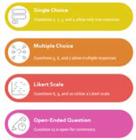
The choice of this data collection instrument converged with the studies of Huang (2024), Kalbande et al . (2024b) and Khan (2025), who also used questionnaires, showed this strategy to be suitable for reaching the highest number of participants and highlighting patterns regarding the integration of AI in ALs.
Online questionnaire was developed using the Microsoft Forms platform, and no data that could identify the respondent was collected, guaranteeing participant anonymity. Descriptive statistics (frequency and percentage) were used to describe participants’ characteristics and measure the constructs. The findings were articulated and discussed based on the empirical findings of other research that focused on AI and ALs.
The research encompasses librarians working in Brazilian public and private universities, totaling 207 universities across all states of the country (data collected from the Emec platform1). Therefore, the technique adopted was a census survey, targeting the total number of mapped universities. It is noteworthy that, in Brazil, there are no national records from the Federal Council of Librarianship (CFB) and the Brazilian Federation of Associations of Librarians, Information Scientists and Institutions (FEBAB) that provide the number of university librarians affiliated with public and private universities. Therefore, the decision was made to identify all public and private universities and consequently obtain the professionals’ contact working there through information from their websites.
The email addresses of the research participants were collected from the universities’ websites, specifically from the library pages. When searching for librarians’ individual email addresses failed, institutional email addresses, or email addresses of departments, systems, or available library networks were used.
Before its final application, the research instrument underwent a pre-test, answered by three researchers, with the aim of verifying clarity and comprehensibility of the questions. The questionnaire was sent out from November 25, 2025, and ended on December 17, 2025, remaining open for responses until January 15, 2026.
As a strategy to mitigate non-responses, in addition to sending the invitation by email, the invitation to participate in the survey was distributed to the email list of the Brazilian Commission of University Libraries (CBBU). Support was also requested from the Regional Councils of Librarianship (CRBs) to reinforce the dissemination of the invitation among registered librarians. At the end of the data collection period, 306 responses were obtained, of which four participants declined to participate, resulting in a total of 302 valid responses.
To construct the research instrument and theoretical framework, a bibliographic survey (systematized search) was conducted in the following databases: Scopus, Web of Science, on November 11, 2025, as presented in Chart 1. The search was performed using the title, abstract, and keyword fields, applying the following search filters: document type (articles), publication period between 2020 and 2025; languages: Portuguese, English, and Spanish. The search results were exported in RIS (Research Information Systems) format to EndNote and Rayaan management software, where duplicate documents were removed and eligibility criteria (inclusion and exclusion) were applied.
The eligibility criteria (Chart 2) were applied in the selection of texts retrieved from the databases and stored in Rayyan. Empirical articles were prioritized, as they present scenarios of AI uses and applications in AL, and consequently discuss barriers, challenges, and benefits related to AI integration in operations and services.
The search retrieved 816 articles; of these, 266 were removed for being duplicates, resulting in 550 analyzed based on reading the titles and abstracts, totaling 42 articles for fulltext reading. After full-text reading and application of eligibility criteria, 21 articles were included in the review (Figure 2).
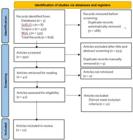
The 21 articles were read and summarized to identify the AI technologies and tools used or integrated into ALs, as well as the inhibiting and facilitating factors presented in the results.
Regarding the limitations of the research, the results cannot be generalized, considering that the revealed data represent a cross-section of characteristics and variables of those who responded to the survey, considering the context of public and private ALs and their professionals. The use of simple descriptive analysis makes more in-depth analyses impossible.
4 RESULTS
The survey included 302 librarians working in public and private universities in Brazil; it was found that the South and Southeast regions had a higher percentage of respondents, as they concentrate more universities than the other regions, as shown in Table 1.
The participants are mostly professionals working in public universities, with 262 (87%) in these institutions and 40 (13%) in private universities. It is observed that 92 (44%) of the mapped universities were characterized as private, which raises the hypothesis that private universities have a smaller number of professionals than public universities.
Regarding the highest academic degree and qualifications, the research participants are predominantly characterized as specialists and masters, with the exception of doctors and graduates who are in a smaller percentage, as shown in Table 2.
To contextualize the scope of the academic library the librarians work, the approximate number of potential users served monthly by information unit was indicated, whether a branch library, central library, network library, or library system, since this variable may imply the adoption of AI tools and technologies. As shown in Table 3, libraries that serve up to 1,000 potential users monthly predominate.
The librarians participating in the research perform activities and have responsibilities in different sectors and departments within academic libraries; some work in more than one sector, considering the size of the team and the context of the organizational unit, as described in Table 4. It is noteworthy that participants could select more than one option, since in some institutions professionals work in more than one sector. For instance, they may be in management/direction/coordination while simultaneously working in Reference, Cataloging, or Repository, etc.
Most librarians perform frontline activities, that is, "Reference, user service, research support and user training", totaling 174 (24%) individuals, as well as duties of AL direction/management/coordination of library or system/network, corresponding to 156 (22%).
Regarding AI applications and uses within AL operations and services in Brazil (organizational level), the popularization and use of QR codes, databases with AI resources, and the adoption of RFID for management and security of physical collections are evident. The integration of NLP, LLMs, and AI algorithms into library catalogs and repositories is a new phenomenon in the national scenario. Chatbots, virtual assistants, AI assistants (ChatGPT, Gemini), speech/voice recognition, and visual recognition, as well as robots, are in the discovery phase for libraries, as their application and use in operations and services is still incipient. It is observed that 81 (13%) of the professionals indicated that none of the alternatives presented in the form had been applied up to the time of the research (Table 5). The professionals selected more than one answer to indicate the tools and technologies in the AL operations and services.
Regarding AI applications and use from the perspective of librarians, while popularization and use of AI for management, communication, research, and standardization activities are evident, there is limited applicability of AI tools and technologies in the automated generation of metadata in document classification, indexing, and cataloging processes, automatic image description and automatic video captions, data/text mining, and predictive analysis. It is concerning to note that professionals are timidly appropriating AI tools to support the research process, as only 34 librarians indicated that they provide training or individualized support with this focus. Furthermore, 63 (11%) librarians did not use AI tools and technologies (Table 6). Professionals selected more than one response to indicate the tools and technologies they used.
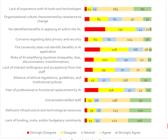
Based on the librarians’ responses, factors inhibiting the integration of AI tools and technologies into Brazilian AL operations and services were identified (Graph 1). In the participants' perception, the main inhibiting factors are: lack of experience with AI tools and technologies; untrained/unqualified staff; lack of funding, cost and/or budgetary constraints; and deficient infrastructure and technological resources. Another barrier highlighted is the absence of ethical regulations, guidelines, and institutional policies regarding AI uses and applications. Professionals disagree that AI can replace them and their functions. It is evident that both universities and academic libraries identify benefits in the application of AI.
The professionals indicated the factors facilitating (catalyzing) the integration of AI tools and technologies into AL operations and services (Graph 2). A tendency to agree with the presented factors is observed. They strongly agree on the following factors: AI provides time and resource savings; strategic investments (infrastructure, people, and technologies); a culture of innovation; support from the university (rectorate and other sectors); integrating professional networks, library associations (creating Networking and participating in courses, events, and workshops that address AI; AI Literacy (knowledge and skills). The highest percentages of disagreement, even if low, are in the following aspects: processes and operations with AI are more effective and efficient; a skilled and proactive team; AL recognition and prestige; user experience is better with AI integration.
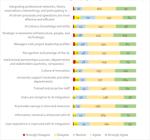
The factors facilitating integration demonstrate that librarians are attentive and aware of the digital transformation, especially the elements that contribute to AI integration.
Finally, the professionals indicated their level of knowledge regarding AI subfields and/or technologies, shown in Graph 3. It is observed that they predominantly declared themselves as laypeople in all subfields. However, AI was better evaluated in the categories of basic, intermediate, and advanced knowledge. Gaps in knowledge regarding the other subfields are notable, as shown in Graph 1. This weakness may constitute a limiting factor (barrier) for integrating AI into AL operations and services.

In the next section, the results are discussed, relating them to the selected empirical research and pointing out similarities and contrasts between the studies.
5 DISCUSSION
QR code technology is very popular and widely used in academic libraries in Brazil and other countries. Traditionally available on websites, catalogs, and social media, this type of barcode is read by the cameras of electronic devices, directing users to specific content. In academic libraries, QR codes are used to direct users to video tutorials, registration forms, space reservation forms, location of physical books, and access to e-books, etc. Ali, Naeem and Bhatti (2020, 2024), and Asim et al. (2023) highlighted its use in Pakistani academic libraries, and Kalbande et al. (2024b) in India. It is noteworthy that the QR code is an example of pattern recognition, understood as “automated recognition of patterns and regularities in data” (Ali; Naeem; Bhatti, 2020 p. 118).
Brazilian ALs provide databases with AI resources (chatbots, virtual assistants, NLP, discovery systems, recommendations). These are restricted access databases, which are subscribed to by universities or the CAPES Periodicals Portal. These databases are products offered by major scientific publishers. As pointed out by Martínez-Camacho et al. (2025), information service providers such as EBSCO, Elsevier, and Clarivate have invested in AI resources such as research assistants, chatbots, and recommendation algorithms. In this case, ALs are merely mediating actors, since they manage these resources in most universities, promoting their use and training the academic community.
Few professionals have confirmed the existence of catalogs with content discovery and recommendation systems (algorithms). In other words, most library catalogs are characterized as static and not very dynamic information sources, still focused on the logic of locating printed materials within the physical space of the library. It should be noted that, in most AL, these management systems are contracted out, so it is up to companies in the sector to innovate, integrating AI tools and technologies to improve information retrieval and usability. However, the clients of this product (libraries) need to understand the possibilities of AI integration and demand their service providers to innovate.
Similarly, few professionals confirmed the use of LLMs in institutional or digital repositories responsible for curating university publications (articles, theses, dissertations, capstone projects). In this context, Retrieval Augmented Generation (RAG) is promising in repositories, as Bevara et al. (2025) explains, it is an AI technique that combines the natural language understanding capabilities of LLMs with the structured information retrieval from verified knowledge bases, enabling contextualized, up-to-date, and well-founded responses.
RFID technology is used in AL for the management and security of physical collections, automating loans and returns, and facilitating inventory with the use of shelf readers. This technology, in varying percentages of use, was identified in the research by Ali, Naeem, and Bhatti (2020, 2024), Asim et al. (2023), Aslam, Jabeen, and Jabeen (2025), Abba (2024), and Kalbande. et al. (2024b), Çakmak and Eroğlu, (2024). Its implementation requires financial and technological investment, as well the perception as a management priority.
A limited number of ALs use robots, chatbots, virtual assistants, facial recognition, voice recognition, and OCR, demonstrating that ALs are still in the discovery phase of AI technologies and tools to optimize and improve their operations and services. It is noteworthy that 81 librarians, out of the 302 participants in the survey, stated that the AL where they work does not apply any of the alternatives described in Table 5. This indicates that these ALs are technologically stagnant, struggling to keep up with transformations and to innovate.
The low adoption of robots and chatbots was also observed in Indian AL (Kalbande et al., 2024b). Abba (2024) identified the use of robots in two AL in South Africa and one in Nigeria. The University of Pretoria's academic library has a robot called Libby that assists users, the North West University's academic library is developing a library assistant robot, and the University of Lagos's academic library uses a robot to assist users.
GenAI is the most widely used technology by Brazilian librarians, a fact that aligns with the results of other research. Khan (2025), investigating the use of GenAI by university librarians in countries such as the United Arab Emirates, the Kingdom of Saudi Arabia, Oman, Bahrain, Qatar, and Kuwait, found that the main applications of AI tools (ChatGPT, Gemini, Copilot) are related to answering user search queries and summarizing articles or reports, showing low use for cataloging and metadata management. Lo (2024) reinforces this evidence by highlighting the use of AI for text generation and research assistance among US and Canadian librarians. Martínez-Camacho et al. (2025) highlight the integration of AI (Copilot, ChatGPT, Dall-e, Canva magic) into the operations and services of a Latin American university. Other authors highlight the use and popularity of ChatGPT among librarians (Abba, 2024; Leon; Flores; Alomo, 2024; Mabawonku; Buraimo, 2025).
GenAI is primarily used to assist in building database search strategies, aiming to adapt texts to different style standards (ABNT, APA, etc.) and summarize texts. Furthermore, GenAI has been used in cataloging/indexing/classification processes or for the automated generation of metadata in MARC, RDA, and Dublin Core formats. For example, the CatalogerGPT assistant2 creates bibliographic records in MARC from text, image, and PDF file entries, facilitating and speeding up the cataloging process. Tools such as Microsoft Azure and Amazon Rekognition have also been used. DALL-E, BERT, SpaCy, AutoML, and Tesseract can be used for the automatic generation of metadata (Mabawonku; Buraimo, 2025). According to Huang (2024), librarians in Taiwan have already implemented AI in indexing and classification and in intelligent data analysis (circulation and collection). Elsayed and Abusharhah (2025) highlighted the use of AI in cataloging and metadata generation in AL in Arab countries.
However, Brazilian librarians underuse data/text mining and predictive analytics, technologies that can be useful for data analysis and decision-making, assisting in the management of library resources and services. Furthermore, AI is underutilized to promote accessibility of photos and videos, content present on social media. It is concerning to note that Brazilian librarians have not been promoting AI Literacy, given that a limited number of professionals offer training and services with this focus. It can be inferred that professionals do not perceive this service as an opportunity to redefine their role through digital transformation. In this sense, librarians from Guangdong, Hong Kong, and Macau believe that libraries should support the use of AI tools by faculty and students; they offer training/workshops on the use of these tools and have produced guides and learning materials on their effective use (Chan; Munier, 2025). In Poland, AL promote events, lectures, and workshops on AI tools, offered predominantly by information service providers (Gmiterek; Kotuła, 2025).
Of the 302 participants, 63 stated that they had not had the opportunity to use AI tools and technologies. The underutilization of AI technologies and tools may be related to a lack of knowledge and training among professionals, given that their education did not predict this type of technology and tools in AL. At present, everyone is challenged to learn continuously, either autonomously or through continuing education. Furthermore, variables such as technological proficiency, organizational culture, age range, and distrust and apprehension may reflect this underutilization.
The five main factors inhibiting AI in AL operations and services converge with the findings from other investigations, which corroborate that these barriers are faced by AL in other countries. As found in this research and portrayed in the literature, budgetary/financial limitations and the high cost of investing in and implementing AI technologies and tools are common problems in ALs, especially those located in developing countries (Ali; Naeem; Bhatti, 2020, 2024; Ajani, et al., 2022, Abba, 2024; Alam et al., 2024; Aslan; Jabeen; Jabeen, 2025; Asim et al., 2023; Çakmak; Eroğlu, 2024; Huang, 2024; Kalbande et al., 2024b; Elsayed; Abusharhah, 2025).
Martínez-Camacho et al. (2025, p. 658), when analyzing the adoption of AI in Latin American universities, found that they share challenges regarding
[…] budget allocation among institutions and the lack of concern for subscribing to institutional AI services with a service-oriented approach. This is likely because it would also entail a significant investment in staff training and the development of new digital skills, not to mention the major ethical issues that would need to be resolved.
In recent years, Brazilian federal universities have faced numerous budget cuts and limitations, hindering the development of innovative projects and investments in technology and infrastructure. Given this scenario, university administrators prioritize emergency actions, thus preventing the allocation of resources necessary for universities to modernize and keep pace with technological trends.
Considering that AI technologies and tools have emerged and become popular in the last five years, another limiting factor lies in the lack of skills and capabilities of AL teams to explore their AI resources and potential, an aspect highlighted by other studies (Ajani et al., 2022; Abba, 2024; Alam et al., 2024; Kalbande et al., 2024b; Ali; Naeem; Bhatti, 2024; Elsayed; Abusharhah, 2025; Gmiterek; Kotuła, 2025; Mabawonku; Buraimo, 2025). In this sense, professionals’ lack of experience and familiarity with AI tools and technologies is highlighted in the literature as a weak point (Asim et al., 2023; Çakmak; Eroğlu, 2024; Chan; Meunier, 2025; Elsayed; Abusharhah, 2025). As Elsayed and Abusharhah (2025, p. 9) emphasize [...] “the lack of training may hinder the effective and efficient adoption of AI in libraries […]”.
Therefore, librarians should complement their training, broadening their skills/qualifications through courses, workshops, certifications, lectures, communities of practice, and other activities that help develop the required capabilities and skills (Khan, 2025). Continuous education will be a demanded characteristic for professionals, considering the speed of technological transformations. Lo (2024, p. 14) emphasizes the urgency of “[...] ongoing, comprehensive professional development. This includes addressing both technical and ethical aspects, equipping librarians with practical AI skills, and fostering a supportive community of practice.”
When investigating the integration of AI in ALs, Indianas, Kalbande et al. (2024a, p. 140) found that librarians lack expertise in “computing, networking, cybersecurity, data analysis, and database management systems.” Mabawonku and Buraimo (2025) recommend managers to promote ongoing training for teams, focusing on ethical and technical issues, and collaborate with AI experts to implement AI-supported practices.
Deficient technical infrastructure and technological resources directly impact AI integration, as this encompasses everything from electricity supply and internet access to hardware and software availability that support professional processes and practices. (Ali; Naeem; Bhatti, 2020; Asim et al., 2023; Çakmak; Eroğlu, 2024; Huang, 2024; Elsayed; Abusharhah, 2025; Vrana, 2025).
In the Nigerian context, Mabawonku and Buraimo (2025, p. 15) recommend that AL “[…] enhance the technical infrastructure in their libraries to support the seamless adoption of AI technologies, ensuring stable power and internet connectivity, which are essential for AI operations.”
Converging with the factors presented above, Huang (2024) points to three other factors that hinder AI promotion and implementation AI in Taiwanese universities: lack of financial resources, human resources, and technological resources. Asim et al. (2023, p. 7) present similar challenges faced by Pakistani universities, “[...] the requirement of a highly networked and integrated environment, lack of budget, high cost of AI technologies, and lack of staff expertise to implement AI applications”.
It is clear that respondents to the survey are uncomfortable with the "Lack of ethical regulations, guidelines, and institutional policies regarding the uses and applications of AI." Although some institutions have been working in this direction, professionals feel helpless as these regulations in Brazilian institutions is still premature. This limiting factor is not unique to the national scenario; other studies have pointed to the need to build regulations, policies, and guidelines in the field of AI (Asim et al., 2023; Elsayed; Abusharhah, 2025; Alam et al., 2024; Gmiterek; Kotuła, 2025; Aslam; Jabeen; Jabeen, 2025).
As revealed in this research, the professionals participating in the study do not believe they will be replaced by AI, a result that converges with the perception of librarians in Taiwan and Arab countries, who are not apprehensive about job losses caused by AI (Huang 2022; Elsayed; Abusharhah, 2025). However, Indian and Pakistani librarians express concern about the advancement of AI to perform their functions more effectively, especially regarding automated activities (Ali; Naeem; Bhatti, 2020; Kalbande et al., 2024b). Khan (2025) noted concerns among Arab librarians regarding AI changes in their job functions and/or job loss in the future. Croatian librarians believe that over the next few decades some positions will be replaced by AI (Vrana, 2025).
Unlike the Brazilian scenario described in the results, North American librarians (USA, Canada) showed concern about GenAI, regarding data privacy, ethical issues, as well as the quality and accuracy of the content generated by these tools (Lo, 2024).
Regarding the factors that facilitate (catalyze) the integration of AI into operations and services, it was found that librarians agree that AI saves time and resources. This statement converges with the perception of Filipino librarians, as they "believe that AI has the potential to enhance the efficiency and effectiveness of library services" (Leon; Flores; Alomo, 2024, p. 76).
From Nigerian librarians’ perceptions, AI can reduce human error, especially in highly repetitive tasks with automation potential (Ajani et al., 2022). Elsayed and Abusharhah (2025) found that the main benefits of AI in libraries in Arab countries are: increased work efficiency and reduction of routine and repetitive operations. From the perspective of Pakistani librarians, the main benefits AI provide for academic libraries involve improved accuracy and efficiency of search systems, automation of repetitive tasks, and content discovery through recommendation systems (Asim et al., 2023). Huang (2024, p. 898) emphasizes that the
Librarians should consider how to apply AI in libraries to promote the efficiency and effectiveness of information organization, as well as the quantity and quality of information services. Machines can identify patterns in and classify images, texts, and audio much faster and more efficiently than humans can.
According to the research participants, a culture of innovation is a catalyst for AI in academic libraries. This culture lead institutions to review their practices and align them with macro-environmental trends, considering technological transformations and paradigm shifts. "Embracing AI fosters a culture of innovation within academic libraries, paving the way for the exploration and adoption of AI-powered services and technologies" (Kalbande et al., 2024b, p. 11). AI tools have fostered more innovative library services (Khan, 2025). Alignment with technological trends enables the offering of innovative services (Huang, 2024). Vrana (2025), therefore, emphasizes that AI will strongly influence innovations in academic libraries.
Integrating professional networks and library associations, networking, and participating in courses, events, and workshops fosters AI integration into operations and services. This movement of constant learning, exchange of experiences, and creation of professional networks is conducive to generating insights and an informal flow of knowledge (Aslam; Jabeen; Jabeen, 2025; Chan; Meunir, 2025; Gmiterek; Kotuła, 2025). According to Vrana (2025), librarians believe that Library Associations and Departments of Library and Information Science should promote professional development through continuing education.
University support, specifically from rectors’ offices, is a factor that catalyzes AI integration, since academic libraries are subordinate to senior management. If the university plans and intends to integrate AI into the institution, consequently, the academic libraries will follow this movement, as it is an institutional decision. Investing in people, technologies, and infrastructure is essential for institutions that wish to integrate AI, as these elements support organizational processes (Huang, 2024). Academic institutions should direct investments towards artificial intelligence technologies and training programs, adopting a proactive stance in incorporating AI into their pedagogical and administrative practices (Khan, 2025).
Regarding AI subfields, Lo (2024) also found that North American librarians (United States, Canada) are more familiar with GenAI than with understanding other AI concepts such as Machine Learning, NLP, Deep Learning, and Neural Networks. In Brazil, however, librarians demonstrated more knowledge of GenAI, self-assessing their knowledge as layperson 66 (21.85%), beginner 85 (28.15%), basic 92 (30.46%), intermediate 54 (17.88%), and advanced 5 (1.65%). In the other subfields, such as Machine Learning, Deep Learning, Neural Networks, NLP, Computer Vision, and Robotics, librarians predominantly indicated that they are laypeople, followed by beginners. Promoting AI literacy is one of the approaches to foster AI integration into ALs (Huang, 2024).
Lo (2024, p. 24), in the context of AL, lists seven competencies for professionals to develop AI literacy,
1. Understanding AI systems capabilities and limitations: Recognizing what AI can and cannot do, knowing its strengths and weaknesses. 2. Identifying and evaluating AI use cases: Discovering and assessing potential AI applications in library settings. 3. Utilizing AI tools effectively and appropriately: Applying AI technologies in library operations. 4. Critically Assessing AT quality, biases, and ethics: Evaluating AI for accuracy, fairness, and ethical considerations. 5. Engaging in informed AI discussions and collaborations: Participating knowledgeably in conversations and cooperative efforts involving AI. 6. Recognizing data privacy and security issues: Understanding and addressing concerns related to data protection and security in AI systems. 7. Anticipating AI’s impacts on library stakeholders: Preparing for how AI will affect library users and staff.
According to Lo (2025, p. 2), AI literacy denotes an individual's ability "[...] to understand, use, and think critically about AI technologies and their impact on society, ethics, and everyday life." This concept is composed of four dimensions: technical knowledge , which comprises understanding how AI operates; ethical awareness, which involves the ability to critically examine values and assumptions embedded in systems; critical thinking, necessary to evaluate sources, data, and premises that shape the models, recognizing their errors and biases; and practical skills to use AI tools and awareness of their social impact, encompassing cultural, economic, and environmental dimensions.
To assist professionals, LaFlame (2025) presents a model for university librarians to develop AI Literacy in academic communities. It consists of four workshops with theoretical explanations and practical activities, covering AI concepts and applications, its subfields, assessment of results, biases, limitations and ethical issues, prompt development, use of AI in research activities, debates, and assessment of practical cases. This model can be offered and developed independently by the academic library or in partnership with faculty and disciplines, adapting to the profile and context of the students.
In addition to focusing on AI Literacy, university building managers and their teams should consider building institutional policies/guidelines for the use of AI, aligned with the vision and pragmatism adopted by the university, as well as the guidelines of the Ministry of Education (MEC), the Coordenação de Aperfeiçoamento de Pessoal de Nível Superior (CAPES), and the National Council for Scientific and Technological Development (CNPq). This study understands that, by having a plan and policy for AI use in AL operations and services, management directs the team's efforts towards achieving the desired operational objectives, avoiding wasted energy, investments in irrelevant actions, and risks related to ethical, security, and data privacy issues. Furthermore, this initiative adds value to services, making them more responsive and personalized.
6 CONCLUSION
The integration of Artificial Intelligence (AI) technologies and tools in Brazil is in its initial stages. The most popular and widely AI tools are used by professionals, while AL are already familiar with QR codes, databases with AI capabilities, and RFID systems for managing and securing collections. However, AL and their professionals must invest in continuing education, with awareness-raising and training initiatives to enable them to leverage the potential of AI in AL operations and services. In this sense, projects focused on AI Literacy should be promoted, targeting both professionals and the academic community, as many Brazilian librarians have not yet perceived how AI tools can contribute to supporting research. Exploring its use effectively, consciously, transparently, and ethically is therefore an issue that needs to be strengthened.
Given the AI hype, librarians can actively participate in technological transformations, adopting a proactive stance in the use of AI tools and technologies in AL, or they can maintain the execution of operations and services in a traditional way. The evaluation of this stance, however, will be the responsibility of the academic community, which tends to value what best meets its informational needs.
Finally, further theoretical and empirical research is recommended to propose different methodological approaches, reduce gaps in the national literature, and contribute to AL management, AI integration into operations and services, and the identification of weaknesses in professional training that demand greater attention.
Recognitions:
Not applicable.
Availability of data and material :
Not applicable
References
-
ABBA, Tukur. Use of artificial intelligence technologies in rendering library services: an empirical evidence from university libraries in Africa. African Journal of Library, Archives and Information Science, Nigéria, v. 34, n. 1, p. 23-35, abr. 2024. Disponível em: https://ajlais.com/index.php/ajlais/article/view/11/10 Acesso em: 30 jan. 2026.
» https://ajlais.com/index.php/ajlais/article/view/11/10 -
AJANI, Yusuf Ayodeji et al. Perspectives of librarians on awareness and readiness of academic libraries to integrate artificial intelligence for library operations and services in Nigeria. Internet Reference Services Quarterly, Philadelphia, v. 27, n. 2, p. 69-90, 2022. DOI: https://doi.org/10.1080/10875301.2022.2086196
» https://doi.org/10.1080/10875301.2022.2086196 -
ALAM, Abid Fakhre et al AI literacy and Zambian librarians: a study of perceptions and applications. Open Information Science, Varsóvia, Polônia, v. 8, n. 1, e20220166, 2024. DOI: https://doi.org/10.1515/opis-2022-0166
» https://doi.org/10.1515/opis-2022-0166 -
ALI, Muhammad Yousuf; NAEEM, Salaman Bin; BHATTI, Rubina. Artificial intelligence tools and perspectives of university librarians: an overview. Business Information Review, Londres, v. 37, n. 3, p. 116-124, 2020. DOI: https://doi.org/10.1177/0266382120952016
» https://doi.org/10.1177/0266382120952016 -
ALI, Muhammad Yousuf; NAEEM, Salaman Bin; BHATTI, Rubina. Artificial intelligence (AI) applications and usage among the LIS professionals of Pakistan. Journal of Librarianship and Information Science, Reino Unido, v. 57, n. 3, p. 787-800, 2024. DOI: https://doi.org/10.1177/09610006241241306
» https://doi.org/10.1177/09610006241241306 -
ARAÚJO, Débora Kraemer de; HANDKE, Fernanda Becker; DEBASTIANI, Aline Matte. Integração de user experience e inteligência artificial na pesquisa com usuários da Biblioteca Central da PUCRS. Infor, Montevideo, v. 29, n. 2, e213, 2024. DOI: https://doi.org/10.35643/info.29.2.13
» https://doi.org/10.35643/info.29.2.13 -
ASIM, Muhammad et al. Investigating applications of artificial intelligence in university libraries of Pakistan: an empirical study. The Journal of Academic Librarianship, Holanda, v. 49, n. 6, 102803, 2023. DOI: https://doi.org/10.1016/j.acalib.2023.102803
» https://doi.org/10.1016/j.acalib.2023.102803 -
ASLAM, Sanila; JABEEN, Munazza; JABEEN, Misbah. Fostering innovation in smart library services: An in-depth exploration of empowered capabilities and dynamic strategies among university librarians in Pakistan. Information Development, Inglaterra, 2025. DOI: https://doi.org/10.1177/02666669241305379
» https://doi.org/10.1177/02666669241305379 -
ASSOCIATION OF COLLEGE AND RESEARCH LIBRARIES. Research planning and review committee. 2024 top trends in academic libraries: a review of the trends and issues. College & Research Libraries News, Chicado, v. 85, n. 6, p. 231, 2024. DOI: https://doi.org/10.5860/crln.85.6.231
» https://doi.org/10.5860/crln.85.6.231 -
BANH, Leonardo; STROBEL, Gero. Generative artificial intelligence. Electronic Markets, Alemanha, v. 33, n. 1, p. 63, 2023. DOI: https://doi.org/10.1007/s12525-023-00680-1
» https://doi.org/10.1007/s12525-023-00680-1 - BARELLI, Felipe. Introdução à visão computacional: uma abordagem prática com python e open cv. São Paulo, SP: Casa do Código, 2018.
-
BEVARA, Ravi Varma Kumar et al Prospects of Retrieval Augmented Generation (RAG) for Academic Library Search and Retrieval. Information Technology and Libraries, Chicago, v. 44, n. 2, 2025. https://doi.org/10.5860/ital.v44i2.17361
» https://doi.org/10.5860/ital.v44i2.17361 -
ÇAKMAK, Tolga; EROĞLU, Şahika. The use of artificial intelligence in university libraries in Türkiye: practices, and perspectives of library directors. Information Development, London, v. 41, n. 3, p. 642-655, 2024. DOI: https://doi.org/10.1177/02666669241264743
» https://doi.org/10.1177/02666669241264743 -
CHAN, Chistophe; MEUNIER, Benjamin. Navigating the AI Revolution: Librarian Perspectives in China’s Greater Bay Area. New Review of Academic Librarianship, Reino Unido, v. 31, n. 2, p. 224-244, 2025.DOI: https://doi.org/10.1080/13614533.2025.2466513
» https://doi.org/10.1080/13614533.2025.2466513 -
CONEGLIAN, Caio Saraiva. Recuperação da informação com abordagem semântica utilizando linguagem natural: a inteligência artificial na Ciência da Informação. 2020. Tese (Doutorado em Ciência da Informação) - Universidade Estadual Paulista Júlio de Mesquita Filho, Faculdade de Filosofia e Ciências, Marília, 2020. Disponível em: http://hdl.handle.net/11449/193051 Acesso em: 20 fev. 2026.
» http://hdl.handle.net/11449/193051 -
DANQUAH, Monica Mensah et al Artificial intelligence implementation strategies for Ghanaian academic libraries: A scoping review. The Journal of Academic Librarianship, Reino Unido, v. 50, n. 6, p. 102975, 2024. DOI: https://doi.org/10.1016/j.acalib.2024.102975
» https://doi.org/10.1016/j.acalib.2024.102975 -
DATA SCIENCE ACADEMY. O Que São Redes Neurais Artificiais Profundas ou Deep Learning? In: Deep Learning Book [s.n: s.l], 2025. Cap. 3. Disponível em: https://www.deeplearningbook.com.br/o-que-sao-redes-neurais-artificiais-profundas/ Acesso em: 15 fev. 2026.
» https://www.deeplearningbook.com.br/o-que-sao-redes-neurais-artificiais-profundas/ -
ELSAYED, Amani; ABUSHARHAH, Majed Mohammed. Artificial intelligence adoption, perceptions, and ethical literacy among Arab academic librarians: a survey. The Journal of Academic Librarianship, [S.l.], v. 51, n. 5, 2025. DOI: https://doi.org/10.1016/j.acalib.2025.103083
» https://doi.org/10.1016/j.acalib.2025.103083 -
FLECK, Leandro et al Redes neurais artificiais: princípios básicos. Revista Eletrônica Científica Inovação e Tecnologia, Medianeira, v. 1, n. 13, p. 47-57, jan./jun. 2016. Disponível em: https://periodicos.utfpr.edu.br/recit/article/view/4330 Acesso em: 4 fev. 2026.
» https://periodicos.utfpr.edu.br/recit/article/view/4330 - GABRIEL, Martha. Inteligência artificial: do zero ao metaverso. Barueri, SP: Atlas, 2022.
-
GMITEREK, Grzegorz; KOTUŁA, Sebastian. Generative artificial intelligence in the activities of academic libraries of public universities in Poland. The Journal of Academic Librarianship, [S.l.], v. 51, n. 3, 103043, 2025. Disponível em: https://www.sciencedirect.com/science/article/pii/S0099133325000394#bb0065 Acesso em: 7 fev. 2026.
» https://www.sciencedirect.com/science/article/pii/S0099133325000394#bb0065 -
HIRSCHBERG, Julia; MANNING, C Christopher. Advances in natural language processing. Science, Washington, v. 349, n. 6245, p. 261-266, 17 jul. 2015. Disponível em: https://www.science.org/doi/10.1126/science.aaa8685 Acesso em: 10 fev. 2026.
» https://www.science.org/doi/10.1126/science.aaa8685 -
HUANG, Yuan-Ho. Exploring the implementation of artificial intelligence applications among academic libraries in Taiwan. Library Hi Tech, Inglaterra, v. 42, n. 3, p. 885-905, 2024. DOI: https://doi.org/10.1108/LHT-03-2022-0159
» https://doi.org/10.1108/LHT-03-2022-0159 -
HUSSAIN, Abid. Use of artificial intelligence in the library services: prospects and challenges. Library Hi Tech News, Bingley, v. 40, n. 1, p. 1-3, jan. 2023. DOI: https://doi.org/10.1108/LHTN-11-2022-0125
» https://doi.org/10.1108/LHTN-11-2022-0125 -
HUSSAIN, Abid.; AHMAD, Shakil. Mapping the literature on artificial intelligence in academic libraries: a bibliometrics approach. Science & Technology Libraries, [S.l.], v. 43, n. 2, p. 131-146, 2023. DOI: https://doi.org/10.1080/0194262X.2023.2238198
» https://doi.org/10.1080/0194262X.2023.2238198 -
ISLAM, Md Nurul et al Application of artificial intelligence in academic libraries: a bibliometric analysis and knowledge mapping. Discover Artificial Intelligence, Suiça, v. 5, p. 59, 2025. DOI: https://doi.org/10.1007/s44163-025-00295-9
» https://doi.org/10.1007/s44163-025-00295-9 -
KALBANDE, Dattatraya et al Artificial intelligence integration in academic libraries: perspectives of LIS professionals in India. The Serials Librarian, [S.l.], v. 85, n. 5-6, p. 132143, 2024a. DOI: https://doi.org/10.1080/0361526X.2024.2433262
» https://doi.org/10.1080/0361526X.2024.2433262 -
KALBANDE, Dattatraya et al Exploring the integration of artificial intelligence in academic libraries: a study on librarians’ perspectives in India. Open Information Science, Polonia, v. 8, n. 1, p. 20240006, 2024b. DOI: https://doi.org/10.1515/opis-2024-0006
» https://doi.org/10.1515/opis-2024-0006 - KAUFMAN, Dora. A inteligência artificial irá suplantar a inteligência humana? Barueri, SP: Estação das Letras e Cores, 2019.
-
KHAN, Zafar Imam. Exploring the utilization of generative AI by librarians in higher education across the Gulf Cooperation Council (GCC) countries: trends in adoption, innovative applications, and emerging challenges. Journal of Librarianship and Information Science, [S.l.], 2025. DOI: https://doi.org/10.1177/09610006251372630
» https://doi.org/10.1177/09610006251372630 - KNEUSEL, Ronald. Como a Inteligência Artificial funciona: da magia à ciência. São Paulo: Novatec, 2024.
-
KULKANJANAPIBAN, Pachisa; SILWATTANANUSARN, Tipawan; LAMBOVSKA, Maya. Research on AI-driven innovations and services in academic libraries: a bibliometric and systematic literature review. Journal of Data and Information Science, Varsóvia, v. 10, n. 3, p. 1-51, 2025. DOI: https://doi.org/10.2478/jdis-2025-0036
» https://doi.org/10.2478/jdis-2025-0036 -
LAFLAMME, Katherine A. Scaffolding AI literacy: an instructional model for academic librarianship. The Journal of Academic Librarianship, [S.l.], v. 51, n. 3, 103041, 2025. Disponível em: https://www.sciencedirect.com/science/article/pii/S0099133325000370 Acesso em: 7 out. 2025.
» https://www.sciencedirect.com/science/article/pii/S0099133325000370 -
LEON, Lady Catherine; FLORES, Lejempf; ALOMO, Anna Rita. Artificial intelligence and Filipino academic librarians: perceptions, challenges and opportunities. Journal of the Australian Library and Information Association, Abingdon, Oxfordshire, v. 73, n. 1, p. 66-83, 2024. DOI: https://doi.org/10.1080/24750158.2024.2305993
» https://doi.org/10.1080/24750158.2024.2305993 -
LIMA, Adriléia de Moura; AGANETTE, Elisângela Cristina. A personalização do serviço de referência em bibliotecas universitárias com o uso da inteligência artificial generativa. Encontros Bibli: revista eletrônica de biblioteconomia e ciência da informação, Florianópolis, v. 30, p. 1-27, 2025. DOI: https://doi.org/10.5007/1518-2924.2025.e103494
» https://doi.org/10.5007/1518-2924.2025.e103494 -
LO, Leo Saiho. Evaluating AI literacy in academic libraries: a survey study with a focus on U.S. employees. College & Research Libraries, [S.l.], v. 85, n. 5, p. 635, 2024. DOI: https://doi.org/10.5860/crl.85.5.635
» https://doi.org/10.5860/crl.85.5.635 -
LO, Leo Saiho. AI literacy: a guide for academic libraries. College & Research Libraries News, [S.l.], v. 86, n. 3, p. 120, 2025. Disponível em: https://crln.acrl.org/index.php/crlnews/article/view/26704/34626 Acesso em: 22 jan. 2026.
» https://crln.acrl.org/index.php/crlnews/article/view/26704/34626 -
LUDERMIR, Teresa Bernarda. Inteligência artificial e aprendizado de máquina: estado atual e tendências. Estudos Avançados, São Paulo, v. 35, n. 101, p. 85-94, 2021. DOI: https://doi.org/10.1590/s0103-4014.2021.35101.007
» https://doi.org/10.1590/s0103-4014.2021.35101.007 - LUGER, George. Inteligência Artificial: estruturas e estratégias para a resolução de problemas complexos. 6. ed. São Paulo: Pearson, 2013.
-
MABAWONKU, Temitope Oluwabunmi; BURAIMO, Olaynka. Preparedness of librarians for AI-generated metadata management: a case study of university librarians in South-West, Nigeria. Journal of Library Metadata, Philadelphia, v. 25, n. 2, p. 135-152, 2025. DOI: https://doi.org/10.1080/19386389.2025.2488674
» https://doi.org/10.1080/19386389.2025.2488674 -
MARTÍNEZ-CAMACHO, Humberto et al Generative artificial intelligence and university libraries in Latin America. IFLA Journal, [S.l.], v. 51, n. 3, 2025. DOI: https://doi.org/10.1177/03400352251348246
» https://doi.org/10.1177/03400352251348246 -
MATTOS, Julia Machado Monteiro de. Inteligência artificial no serviço de referência de bibliotecas universitárias: colóquios e aplicações. 2025. Dissertação (Mestrado em Ciência da Informação) - Instituto de Arte e Comunicação Social, Universidade Federal Fluminense, Niterói, 2025. Disponível em: https://app.uff.br/riuff/handle/1/37534 Acesso em: 27 jan. 2026.
» https://app.uff.br/riuff/handle/1/37534 -
MOLAUDZI, Amogelang Isaac; MARUTHA, Ngoako. Contributory factors to attitudes towards the adoption of artificial intelligence technology in public academic libraries in South Africa. Information Development, [S.l.], v. 41, n. 3, p. 615-625 2024. Disponível em: https://journals.sagepub.com/doi/pdf/10.1177/02666669241304704 Acesso em: 27 jan. 2026.
» https://journals.sagepub.com/doi/pdf/10.1177/02666669241304704 -
MOLAUDZI, Amogelang Isaac; NGULUBE, Patrick. Use of artificial intelligence innovations in public academic libraries. IFLA Journal, [S.l.], v. 51, n. 3, 2025. DOI: https://doi.org/10.1177/03400352241301780
» https://doi.org/10.1177/03400352241301780 - MURER, Ricardo. Fundamentos da inteligência artificial: o futuro é agora. Rio de Janeiro: Alta Books, 2025.
-
OKUNLAYA, Rifqah Olufunmilayo; SYED ABDULLAH, Norris; ALIAS, Rose Alinda. Artificial intelligence (AI) library services innovative conceptual framework for the digital transformation of university education. Library Hi Tech, [S.l.], v. 40, n. 6, p. 1869-1892, 2022. DOI: https://doi.org/10.1108/LHT-07-2021-0242
» https://doi.org/10.1108/LHT-07-2021-0242 -
PACHECO GÓMEZ, Carlos Antônio et al Evaluación de colecciones en una biblioteca universitária utilizando la minería de datos. Investigación Bibliotecológica: archivonomía, bibliotecología e información, [S.l.], v. 33, n. 81, p. 201-221, 2019. Disponível em: https://rev-ib.unam.mx/index.php/ib/issue/view/4476 Acesso em: 27 jan. 2026.
» https://rev-ib.unam.mx/index.php/ib/issue/view/4476 -
PICALHO, Antônio Carlos; OLIVEIRA, Gisele Rosa de; CATIVELLI, Adriana Stefane. Inteligência artificial no levantamento bibliográfico em bases de dados científicos: comparando expressões de busca no ChatGPT, Copilot e Gemini. RDBCI: Revista Digital de Biblioteconomia e Ciência da Informação, Campinas, SP, v. 23, n. 00, p. e025013, 2025. DOI: https://doi.org/10.20396/rdbci.v23i00.8678378
» https://doi.org/10.20396/rdbci.v23i00.8678378 - RASSI, Amanda Pontes; LOPES, Priscilla de Abreu. Correção automática de redação. In: CASELI, Helena de Medeiros; NUNES, Maria das Graças Volpe (orgs.) Processamento de Linguagem Natural: Conceitos, Técnicas e Aplicações em Português. 2 ed. BPLN, 2024. Cap. 24.
-
RONGE, Raphael; MAIER, Markus; RATHGEBER, Benjamim. Towards a Definition of Generative Artificial Intelligence. Philosophy & Technology, [S.l.], v. 38, n. 31, p. 1-25, 2025. https://doi.org/10.1007/s13347-025-00863-y
» https://doi.org/10.1007/s13347-025-00863-y - RUSSELL, Stuart; NORVIG, Peter. Inteligência artificial: uma abordagem moderna. 4. ed. Rio de Janeiro: LTC, 2022.
-
SELBACH, Clarissa Jesinska et al Inteligência artificial para catalogação na Biblioteca Central da PUCRS: reflexões introdutórias sobre o ChatGPT. In: SEMINÁRIO NACIONAL DE BIBLIOTECAS UNIVERSITÁRIAS, 22, 2023, Florianópolis. Anais [...]. São Paulo: FEBAB, 2023. p. 1-9. Disponível em: https://portal.febab.org.br/snbu2023/article/view/2841 Acesso em: 22 fev. 2026.
» https://portal.febab.org.br/snbu2023/article/view/2841 -
SELBACH, Clarissa Jesinska et al Transformando as práticas de catalogação em bibliotecas universitárias: avaliação do uso do chatgpt para o processamento técnico na biblioteca centralda pucrs. Biblios, [S.l.], n. 87, 2024. Disponível em: https://brapci.inf.br/v/341627 Acesso em: 20 fev. 2026.
» https://brapci.inf.br/v/341627 -
SENGAR, Sandeep Singh et al Generative artificial intelligence: a systematic review and applications. Multimedia Tools and Applications, [S.l.], v. 84, p. 23661-23700, 2025. DOI: https://doi.org/10.1007/s11042-024-20016-1
» https://doi.org/10.1007/s11042-024-20016-1 -
SHAHZAD, Khurram; KHAN, Shakeel Ahmad; IQBAL, Abid. Effects of artificial intelligence on university libraries: an SLR of cite score and IF journals’ articles from 2018 to 2023. Global Knowledge, Memory and Communication, Bingley, 2024. DOI: https://doi.org/10.1108/GKMC-12-2023-0498
» https://doi.org/10.1108/GKMC-12-2023-0498 -
SHINDE, Pramila; SHAH, Seema. A Review of Machine Learning and Deep Learning Applications. In: INTERNATIONAL CONFERENCE ON COMPUTING COMMUNICATION CONTROL AND AUTOMATION - ICCUBEA, 4, 2018, Pune. Anais Eletrônico [...]. Canadá: IEEE, 2018. p. 1-6. DOI: 10.1109/ICCUBEA.2018.8697857.
» https://doi.org/10.1109/ICCUBEA.2018.8697857. -
SOORI, Mohsen; AREZOO, Behrooz; DASTRES, Roza. Artificial intelligence, machine learning and deep learning in advanced robotics: a review. Cognitive Robotics, Pequim, v. 3, p. 54-70, 2023. DOI: https://doi.org/10.1016/j.cogr.2023.04.001
» https://doi.org/10.1016/j.cogr.2023.04.001 -
SPÖRL, Christiane; CASTRO, Emilliano; LUCHIARI, Ailton. Aplicação de redes neurais artificiais na construção de modelos de fragilidade ambiental. Revista do Departamento de Geografia, São Paulo, Brasil, v. 21, p. 113-135, 2011. DOI: https://doi.org/10.7154/RDG.2011.0021.0006
» https://doi.org/10.7154/RDG.2011.0021.0006 - SUAVE, André Augusto. Inteligência artificial Rio de Janeiro, RJ: Freitas Bastos, 2024.
-
SUPRIYONO, Aji Prasetya Wibawa et al Advancements in natural language processing: implications, challenges, and future directions. Telematics and Informatics Reports, Amsterdã, v. 16, 100173, 2024. DOI: https://doi.org/10.1016/j.teler.2024.100173
» https://doi.org/10.1016/j.teler.2024.100173 - TAULLI, Tom. Introdução à inteligência artificial: uma abordagem não técnica. São Paulo: Novatec, 2020.
-
VOULODIMOS, Athanasios et al Deep learning for computer vision: a brief review. Computational Intelligence and Neuroscience, Londres, v. 2018, p. 1-13, 2018. DOI: https://doi.org/10.1155/2018/7068349
» https://doi.org/10.1155/2018/7068349 -
VRANA, Radovan. Perceptions and use of AI supported tools in higher education libraries in Croatia: an exploratory study. New Review of Academic Librarianship, Reino Unido, v. 31, n. 3, p. 264-289, 2025. DOI: https://doi.org/10.1080/13614533.2025.2466517
» https://doi.org/10.1080/13614533.2025.2466517 -
VRONTIS, Demetriz et al Artificial intelligence, robotics, advanced technologiesand human resource management: asystematic review. The International Journal of Human Resource Management, Routledge, v. 33, n. 6, p. 1237-1266, 2021. DOI: https://doi.org/10.1080/09585192.2020.1871398
» https://doi.org/10.1080/09585192.2020.1871398
Edited by
-
Editor:
Gildenir Carolino Santos https://orcid.org/0000-0002-4375-6815

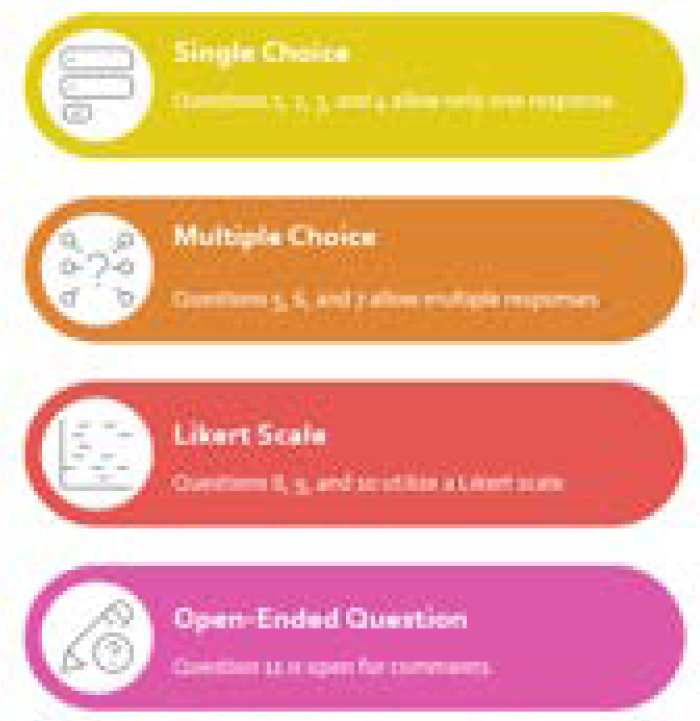 Source: Prepared by the authors (2026) using Napkin AI.Description: The image characterizes the questionnaire based on the types of questions applied.
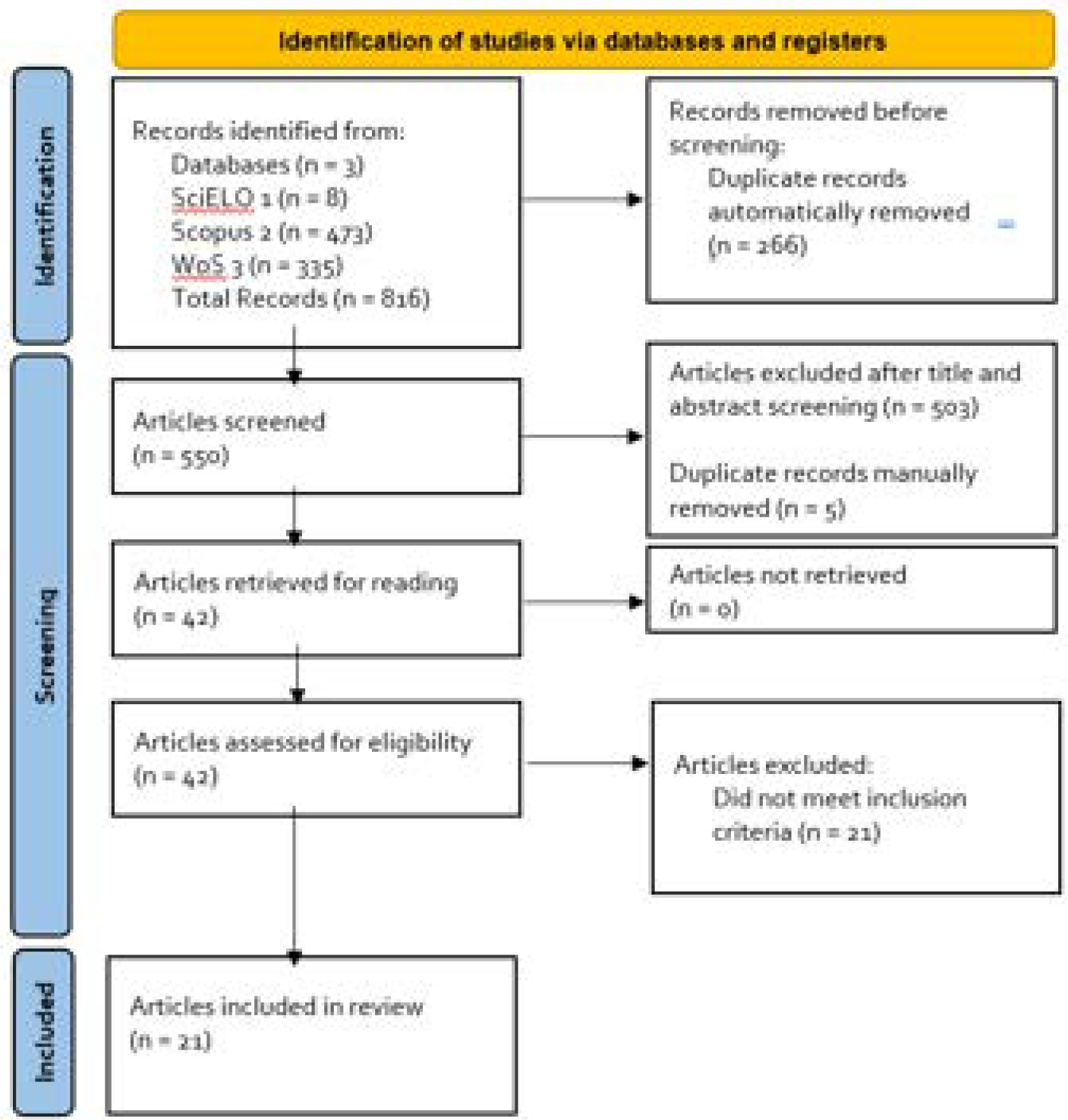 Source: Developed by the authors (2026).Description: The image presents the PRISMA 2020 flow diagram, outlining the stages of identification, screening, and inclusion of articles retrieved from SciELO, Scopus, and Web of Science; 21 articles were included in the review.
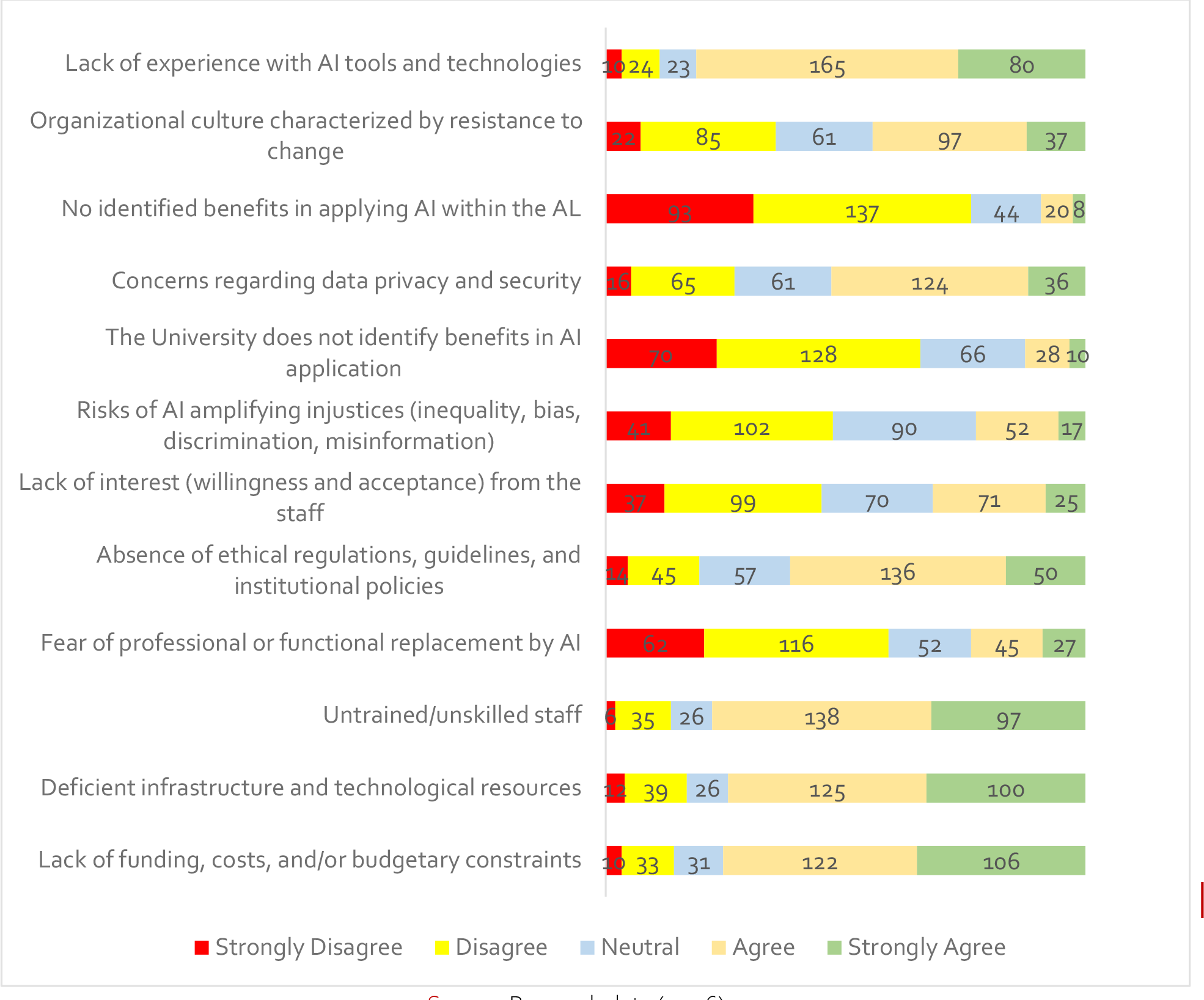 Source: Research data (2026).Description: This bar graph presents, on a scale, the factors inhibiting AI integration. The most prominent inhibiting factors are: lack of funding; limited infrastructure and technological resources; and untrained staff.
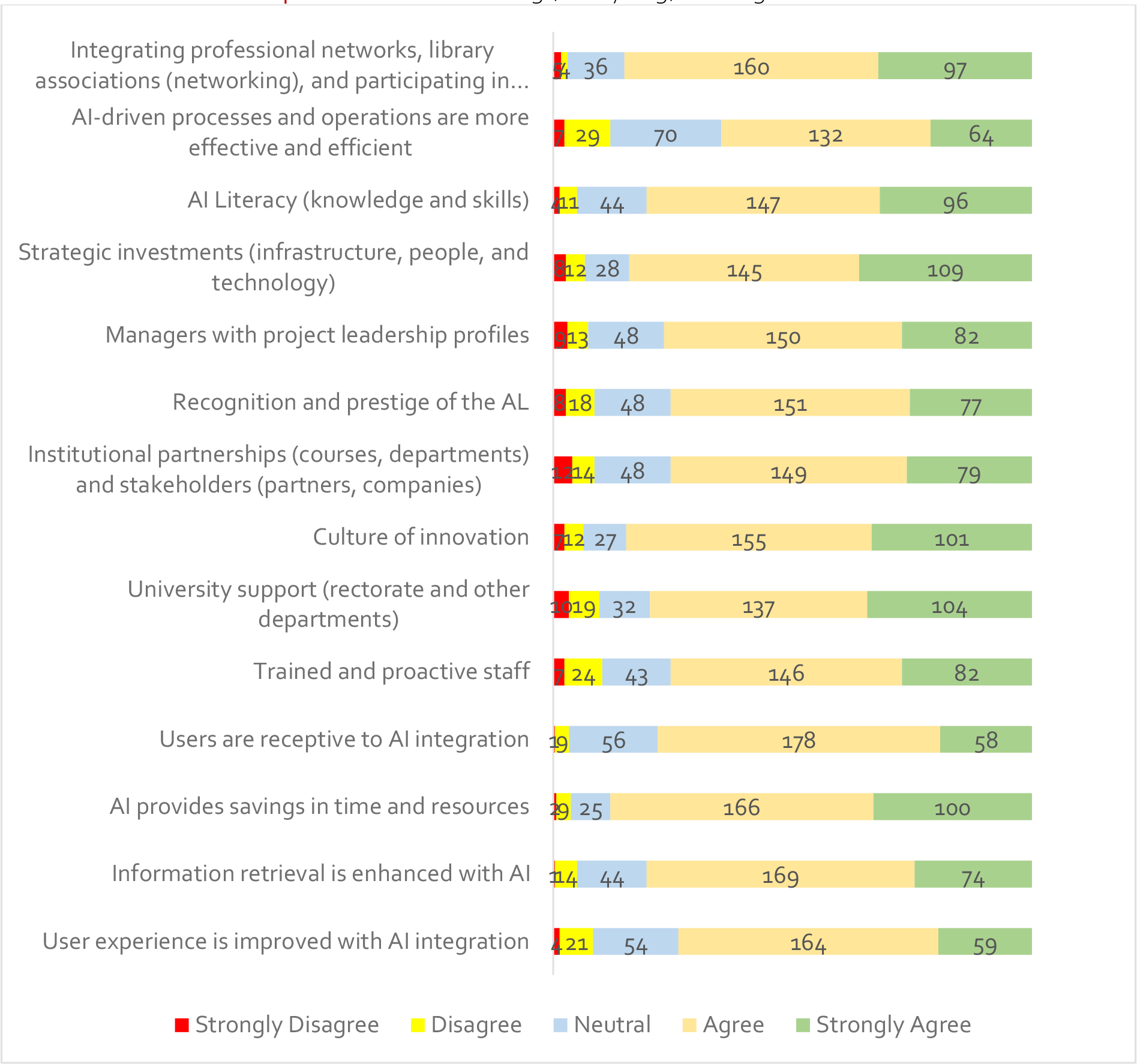 Source: Research data (2026).Description: This bar graph presents, on a scale, the factors that facilitate AI integration. The most prominent catalysts are: AI provides savings in time and resources; strategic investments (infrastructure, people, and technologies); and a culture of innovation.
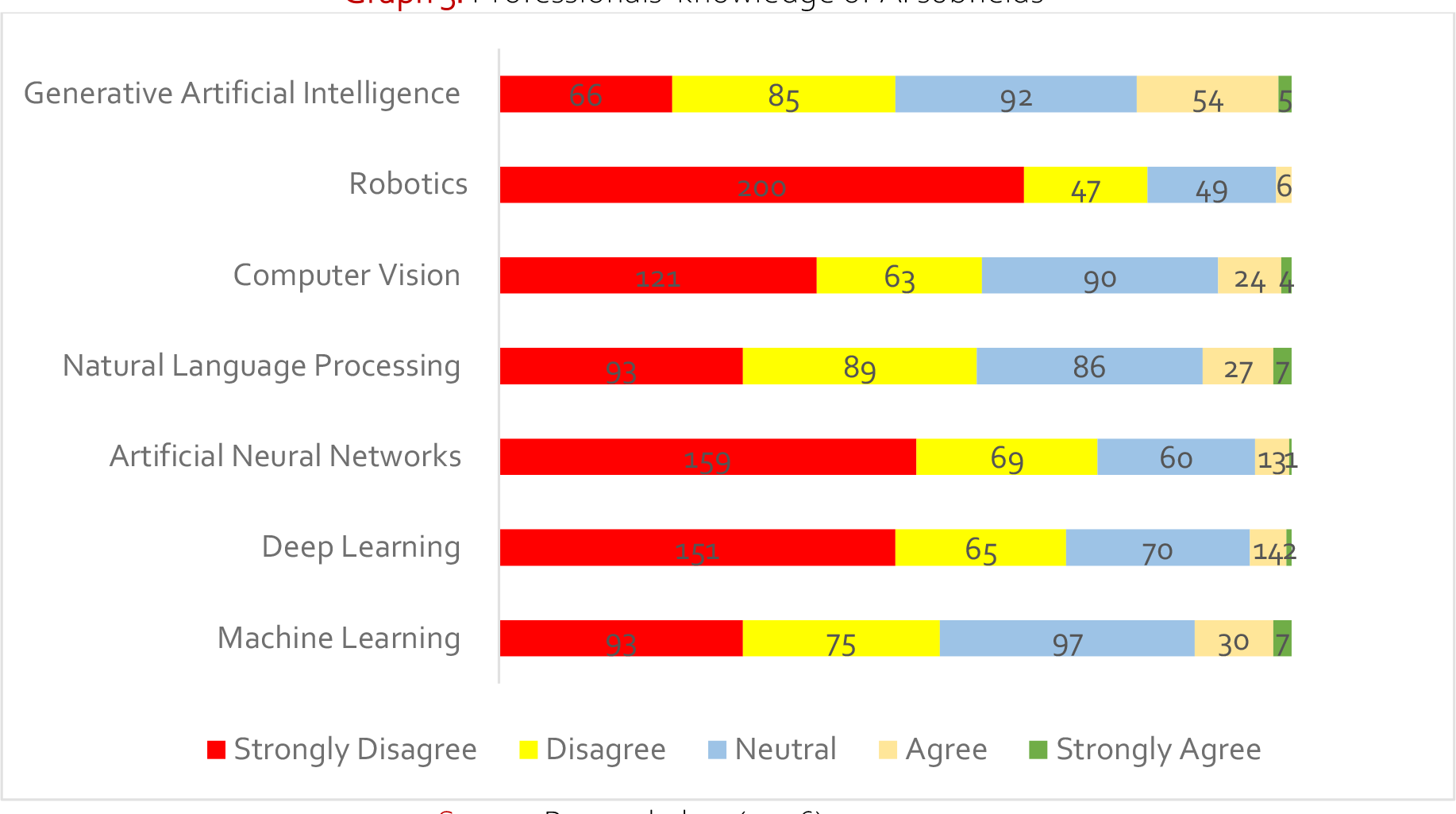 Source: Research data (2026).Description: This bar graph displays various AI subfields; GenAI received the highest ratings from professionals across the basic, intermediate, and advanced knowledge categories.