
 Presidential Decrees and Statutory Legislation in the Making and Dismantling of Brazilian Environmental Policy
ABSTRACT
The paper analyzes the use of presidential decrees and statutory legislation in Brazilian forestry policies, focusing on the Action Plan for the Prevention and Control of Deforestation in the Legal Amazon (PPCDAm). Drawing on documental sources and semi-structured interviews, the paper answers (1) why some instruments of PPCDAm became law and others were enacted by decree, and (2) how design choices impacted the policy’s resilience against dismantling. The challenges faced by PPCDAm’s architects to institutionalize its governance structure and instruments during the Workers Party governments (2003-2016) reflect the heterogeneity of interests within governing coalitions, the overrepresentation of the ruralist caucus in parliament, and the limit of the executive’s agenda power. The low institutionalization of anti-deforestation policies, resulting therefrom, enabled their dismantling via executive orders, later carried out under the government of Jair Bolsonaro (2019-2022).
KEYWORDS
Hyper-presidentialism; coalition presidentialism; democratic backsliding; environmental policy; policy dismantling
RESUMEN
El artículo analiza el uso de decretos presidenciales y legislación en las políticas forestales brasileñas, centrándose en el Plan de Acción para la Prevención y el Control de la Deforestación en la Amazonia Legal (PPCDAm). A partir de fuentes documentales y entrevistas semiestructuradas, el texto pretende responder (1) por qué algunos instrumentos del PPCDAm se convirtieron en ley y otros se promulgaron por decreto y (2) cómo las opciones de diseño influyeron en la resistencia de la política frente al desmantelamiento. Encontramos que los desafíos que enfrentaron los arquitectos del PPCDAm para institucionalizar su estructura e instrumentos de gobernanza durante los gobiernos del Partido de los Trabajadores (2003-2016) reflejan la heterogeneidad de intereses dentro de las coaliciones gobernantes, la sobrerrepresentación de la bancada ruralista en el parlamento y el límite del poder de agenda del ejecutivo. La baja institucionalización de las políticas antideforestación resultante fue una condición de posibilidad para el desmantelamento, por medio de decretos presidenciales, posteriormente realizado bajo el gobierno de Jair Bolsonaro (2019-2022).
PALABRAS CLAVE
Hiperpresidencialismo; presidencialismo de coalición; regresión democrática; política ambiental; desmantelamiento de las políticas públicas
RESUMO
O artigo analisa o uso de decretos presidenciais e legislação na política florestal brasileira, com foco no Plano de Ação para Prevenção e Controle do Desmatamento na Amazônia Legal (PPCDAm). Com base em fontes documentais e entrevistas semiestruturadas, o artigo tem como objetivo responder (1) por que alguns instrumentos do PPCDAm foram aprovados em lei e outros foram promulgados por decreto, e (2) como as escolhas de design impactaram a resiliência da política. Os desafios enfrentados pelos arquitetos do PPCDAm para institucionalizar a estrutura de governança e os instrumentos do plano durante os governos do Partido dos Trabalhadores (2003-2016) refletem a heterogeneidade de interesses dentro das coalizões de governo, a hiper-representação da bancada ruralista no parlamento e o limite do poder de agenda do Executivo sobre o Congresso. A baixa institucionalização das políticas de combate ao desmatamento resultante desses fatores constituiu uma condição de possibilidade para o desmantelamento, por meio de decretos presidenciais, realizado no governo de Jair Bolsonaro (2019-2022).
PALAVRAS-CHAVE
Hiperpresidencialismo; presidencialismo de coalizão; retrocesso democrático; política ambiental; desmantelamento de políticas públicas
Introduction1
The extensive use of presidential decrees to initiate, modify, or terminate policies is a hallmark of authoritarian rule. The plot is well known: once in power through the ballot box, would-be autocrats subvert democratic rules to concentrate authority in the executive branch, sidelining the legislative and harming judicial independence (Levitsky; Ziblatt, 2018). At first glance, the government of Jair Bolsonaro (2019-2022) in Brazil appears to be a paradigmatic example of autocratization by decree (Lührmann; Rooney, 2021) and democratic backsliding (Bermeo, 2016) through executive aggrandizement (Bauer; Becker, 2020). Shortly after assuming the presidency, Bolsonaro revoked 250 executive orders issued by earlier administrations (Silva, 2022). During his first two years, he issued more than 2,000 executive orders altering, revoking, or introducing rules in environmental policies - an average of three orders per day (Monitoramento [...], 2020).
However, it remains disputed whether the net balance of the Bolsonaro government was an empowerment of the executive or a de facto transfer of power from the presidency to Congress, thereby weakening the former and strengthening the latter in an unprecedented way. A narrow focus on the number of decrees issued by the presidential cabinet might conceal other elements that shaped executive-legislative relations and conditioned the reach and depth of policy dismantling. Particularly important was the so-called secret budget. In exchange for blocking the 158 impeachment requests filed against Bolsonaro, Congress was authorized to appropriate, without transparent monitoring rules, at least BRL 54 billion in public funds to invest in their electoral base (Weterman, 2022). This budgetary deviation not only distorted the administration’s ability to plan and implement policies but also diminished the resources available to the executive and placed it in a position of subordination to parliament. The extension and persistence of the secret budget scheme raise doubts on whether the notion of executive aggrandizement fully encompasses the specificities of democratic backsliding in Brazil under Bolsonaro.
Congress’s ability to constrain the executive and increase the price of its demands in negoti-ations with the presidency reveals yet another facet of the Brazilian political system that is key to understanding Bolsonaro’s dismantling of public policies. Scholars have consistently argued that policies whose core elements have not been institutionalized as law or constitutional guar-antees are more susceptible to dismantling (Gomide; Silva; Leopoldi, 2023, p. 26). The weaker the policy’s legal support, the laxer its lock-in mechanisms will be, and the easier to reverse, eliminate, or deform its programs and rules. Path dependence and institutional inertia tend to lose explanatory relevance when dealing with poorly institutionalized policies. In such situations, the historical and institutional reasons why specific policies have never been institutionalized in law or constitutional provision come to the fore.
This paper analyzes the use of presidential decrees and statutory legislation in the formulation, implementation, and dismantling of Brazilian forestry policies, focusing on the Action Plan for the Prevention and Control of Deforestation in the Legal Amazon (PPCDAm). Its guiding question is: How did executive-legislative relations contribute to the making and dismantling of Brazilian forestry policy? To address it, we draw on a range of documental sources (policy documents, statutes, decrees, and other official acts) and semi-structured interviews with environmental servants, political actors, prosecutors, NGO representatives, and agribusiness actors.
The paper’s contribution to the literature is twofold. At a theoretical level, it connects the discussion of democratic backsliding to a consolidated debate on the characteristics of presi-dentialism in Brazil. This enriches our vocabulary to look at the micro-interactions of execu-tive-legislative relations, helping to capture detailed insights on the patterns of decree-making in democratic policy processes while discerning those that are specific to contexts of autocratization. By adopting an analytical framework that goes beyond the executive and incorporates the legis-lative role in the policy process, this work expands the range of institutional interactions that have received scholarly attention within the literature on policy dismantling. At an empirical level, the in-depth case study sheds light on the factors that curtailed the institutionalization of Brazil’s most comprehensive forestry policy.
1. Theoretical Discussion
Recent contributions to the literature on democratic backsliding pivot on the notion of execu-tive aggrandizement to explain contemporary processes of autocratization. Vieira, Glezer, and Barbosa (2022, p. 592) have coined the term “autocratic infralegalism,” defining it as a method favoring the implementation of an authoritarian agenda through decrees, staff appointments, budgetary provisions, and other infra-legal acts that escape the control of the legislative and have the ultimate purpose of eroding constitutional rights. The main identifier of autocratic infralegalism is not the issuance of decrees that substantially modify public policies per se, but rather the manner in which such decrees do so, in ways diametrically opposed to legislative purposes and the constitutional order (Vieira; Glezer; Barbosa, 2022, p. 597).2
Bauer and Becker (2020, p. 20-23) conceptualize democratic backsliding by turning to the relationship between the central office and bureaucracy. They identify five means to secure the hypertrophy of the executive branch: (i) centralization of administrative structures by reducing vertical and horizontal autonomy; (ii) redistribution of resources; (iii) staff reshuffling and purges; (iv) suppression of internal critique; and (v) extensive use of executive decrees in detriment to legislative bodies and representative deliberation.
We have proposed elsewhere that Bolsonaro implemented the first four of the five strategies identified by Bauer and Becker to secure control over Brazilian environmental agencies (Moulin, 2024a). The last instrument (extensive use of presidential decrees) pivots on executive-legislative dynamics, demanding a separate analysis. In Brazilian law, presidential decrees fall into two categories: autonomous or regulatory. The Constitution authorizes autonomous decrees to be issued under two hypotheses: (1) to regulate the organization and functioning of the federal administration, without creating new expenditures; and (2) to create or extinguish public posi-tions, when vacant. Regulatory decrees, in turn, need to be authorized by law and are intended to complement and detail the general content of a piece of legislation. They cannot violate the law but must comply with its provisions and remain within the limits it imposes. In practice, both autonomous and regulatory decrees grant presidents room to act in policy processes, whether by changing the internal structure of implementing agencies or by designing policy procedures in minute detail.
In Brazil, the discussion on executive aggrandizement inevitably resonates with an older debate on executive-legislative relations, pursued under the rubrics of “Latin American hyper-presidentialism” and its Brazilian variant, “coalition presidentialism.” Recent scholarly efforts have identified limitations in the explanatory potential of both paradigms and have advanced alternative interpretations that address some of their blind spots. Among competing explanations of executive-legislative relations and their implications for policy processes, Marcos Nobre’s notion of pemedebismo stands out (Nobre, 2013, 2022). In the remainder of this section, we will examine the main features of these models and contrast their explanatory potential for our empirical case.
1.1. Hyper-presidentialism
In the wake of the transition of many Latin American countries from military regimes to democracies in the 1980s and 1990s, there was a proliferation of analyses by constitutionalists and political scientists on the distinctive features of Latin American presidentialism. There was a general concern with a perceived loss of influence of U.S. constitutionalism in the world, and a certain fear that the massive adoption of presidentialism by Latin American countries throughout the 19th and 20th centuries could tarnish the prestige of U.S. presidentialism as a synonym for stability and a reference to other democracies across the globe - see, for instance, Elkins (2013). Worried that the succession of coups d’état in the subcontinent could be read as evidence of the inferiority of presidentialism in comparison to parliamentarianism, scholars denounced Latin American presidential systems as authoritarian deviations from the original, archetypal U.S. presidentialism.
Carlos Nino (1989) was among the first authors to propose the concept of a Latin American “hyper-presidentialism.” He contended that a distinguishable characteristic of the region was “corporatism,” understood as the “exercise of enormous pressures upon legislative and admin-istrative agencies” by “interest groups and organizations,” with the aim of obtaining formal or informal “privileges and favors of various kinds.” Unlike the United States, “the only stable presidentialist democracy,” Latin American political systems would have “strong parties and widespread popular participation,” features he considered “largely responsible for the functional difficulties” faced by Latin American constitutions (Nino, 1989, p. 129-164). Another formulation of the deficits of presidentialism was made by Juan Linz (1990). Unlike Nino, Linz did not ascribe the model’s fragilities to the “tendency to corporatism.” He centered his argument upon the problem of “dual democratic legitimacy,” intrinsic to all presidential systems: as both the president and Congress have a claim to plebiscitarian legitimacy and enjoy a fixed term in office, “no democratic principle exists to resolve disputes between the executive and the legislature about which of the two actually represents the will of the people.” This stalemate could only be resolved with “recourse or threat of recourse to the people or nondemocratic institutions like the courts or - in the worst case - the military,” leading to a rigidification of democratic consociational strategies and uncertain and time-consuming processes of impeachment (Linz, 1990, p. 51-69). Since Linz’s formulation of the problem of dual democratic legitimacy, there have been different attempts to qualify and reinterpret the idea of hyper-presidentialism. Marsteintredet and Berntzen (2008) analyzed various forms of interruption of presidential mandates in Latin America from the 1980s to the 2000s (coups, impeachment, declarations of presidential incapacity, resignation, and resignation via the calling of early elections). They detected a pattern suggesting a mitigation of the president’s fixed-term office. Accordingly, “presidential removals, congressional elections of presidents, and calls for early elections” can be described as “para-constitutional practices” procedurally equivalent to the flexibility exhibited by parliamentary regimes. Interrupted presidencies are celebrated as a “new, strengthened horizontal and vertical accountability resulting from stronger congresses and street protests” (Marsteintredet; Berntzen, 2008, p. 83-101).
Alegre and Maisley (2022) follow a convergent reasoning. They sustain that Latin American presidential systems deviate from the archetypal U.S. presidentialism because they tend “to resolve the stalemate between the executive and the legislative by expanding even more the pres-ident’s powers, giving him or her an advantage in the day-to-day power dispute with Congress.” To avoid the danger of a “true monarch” distorting public deliberation, controlling the economy, over-expanding executive powers, colonizing the judiciary, and dismantling control agencies, Latin America should “move from hyper-presidentialism to plain presidentialism; from a system where all power rotates around a single person, to a more balanced one, where judges and legislators […] enjoy enough powers to relevantly discharge their institutional duties” (Alegre; Maisley, 2022, p. 381-393). Lastly, Gargarella’s (2013) rendition of hyper-presidentialism in his historical reconstruction of Latin American constitutionalism stands close to that of Alegre and Maisley. He has famously argued that a chain of episodic alliances between liberals and conservatives throughout the 19th and 20th centuries - formed to defeat more radical proposals of inclusion and democracy - established “the basis of a peculiar institutional system that, later on, Carlos Nino would characterize as hyper-presidentialist systems.” While adding the caveat that hyper-presidentialism does not necessarily imply disrespect for constitutional rights, Gargarella (2013, p. 150, 160-165, 217) criticizes its purported flaws, such as the concentration of power, instability, risks of capture, and a lack of oversight reflexivity.
The connection between a pathologically inflated executive and authoritarianism has long been diagnosed as a problem by the literature on Latin American politics.3 If the hyper-presiden-tialism argument is correct and decree-happy presidents are standing in the way of well-intended legislators who, if granted enough power, would “relevantly discharge their institutional duties” and produce good policies, in our empirical analysis of environmental policymaking in Brazil, we should expect to find evidence of promising legislative initiatives that were asphyxiated by ever-growing “imperial presidencies.” Next, we turn to the coalition presidentialism paradigm, which shares features with hyper-presidentialism while emphasizing the importance of multi-party coalitions in sustaining presidential mandates.
1.2. Coalition Presidentialism
Coined by Sérgio Abranches in 1988, the term “coalition presidentialism” has become ubiqui-tous in post-redemocratization Brazil to describe the use of presidential prerogatives to form parliamentary supermajorities supportive of the government’s policy agenda. Abranches’s (1988, p. 5-34) original formulation emphasized the fragmentary, unstable, and conflictual character of grand coalitions formed under such a strategy. Upon returning to the topic 30 years later, Abranches added very few qualifications to his earlier model. Despite surviving three uninter-rupted decades and admittedly enabling the emergence of important policies, Brazil’s coalition presidentialism has not proven to be inexorably unstable, nor has it fostered chronic or cyclical ungovernability. Nonetheless, it would still lack more agile mechanisms of institutional mediation to solve stalemates between the executive and the legislative and be undermined by growing party fragmentation (Abranches, 2018, p. 9-10).
Despite its journalistic appeal, this depiction of presidential coalitions as excessively frag-mented, heterogeneous, and unstable has long been challenged by empirical research. Figueiredo and Limongi’s (2001) seminal work on the relationship between the executive and legislative in policymaking has provided evidence of the preponderance of the presidency’s agenda over a Congress that is both willing to cooperate and organizes itself in a hierarchical, centralized, and disciplined manner according to party rules (Figueiredo; Limongi, 2011, p. 9-10). By negotia-ting cabinet posts and pork-barrel projects with party leaders and making use of its authority to issue decrees, propose budget law, suggest constitutional amendments, and initiate regular legislative processes, the executive can exercise “categorical agenda power” over Congress. This categorical agenda power is expressed in dominance (between 1989 and 2017, around 76.6% of all approved matters originated from the president); high success rates (nearly 80% of all presidential proposals in this period were approved); and faster speed (the average processing time of executive bills was 271 days, while that of legislature bills was 965 days) (Grin; Abrucio, 2021, p. 13).
Notwithstanding the high success rates of executive bills, Figueiredo and Limongi’s (2001) data show that when government and party leaders dissent, Congress follows party leaders. The latter are endowed by the internal regulations of congressional houses with disproportionate power to influence legislative work. The prerogatives of party leaders - in addition to intra-party powers that affect reelection, such as distributing public funds for electoral campaigns and pre-approving candidacy lists - have proven to be outstandingly effective in securing party discipline and minimizing unpredictability (Figueiredo; Limongi, 2001, p. 9-10).
The notion that presidents exercise unilateral decision-making power has also been challenged by studies examining the roles of subnational governments and civil society in policymaking. As Grin and Abrucio (2021) have argued, although the presidency is the gravitational center of the Brazilian political system, in the first 30 years of Brazil’s New Republic, federation cooperation arrangements and participatory decentralization were substantially strengthened. The authors highlight that, between 2003 and 2011, 82 policy conferences were convened, mainly by the executive branch. Councils for dialogue with social movements and society were established: in 2011, there were 35 national policy councils and 5 committees with societal representatives, in which societal representatives held an average of 55% of seats and governmental officials 45%. Public hearings were mandated by law in some cases, and participatory planning mechanisms were introduced. During the 2003-2007 multiyear plan, 27 social participation forums were held. Multiple arenas for federative horizontal and vertical cooperation and state-and municipal-level participatory forums were created (Grin; Abrucio, 2021, p. 22-25). From 1992 to 2015, Brazil’s policy-making style could be characterized by hybridism, that is, a combination of majoritarian and consociational traits.4
By adjusting to include the role of party leaders as a bridge between the president and Congress, on the one hand, and the introduction of participatory mechanisms involving subnational governments and civil society actors, on the other hand, coalition presidentialism advanced important ideas for understanding the logic of decision-making in Brazil’s New Republic. It showed that Brazil’s political system developed a functional response to address institutional stalemates and made important advances in including subnational governments and civil society actors in the policy process, to the point that one could speak of a hybrid policy-making style that mixes majoritarian and consociational features. Nonetheless, the street protests in 2013, Dilma Rousseff ’s impeachment in 2016, Jair Bolsonaro’s election in 2018, and the disruptive character of the Bolsonaro administration have prompted scholars to question the explanatory power of the coalition presidentialism paradigm. While their evidentiary force has arguably been overemphasized, the political developments of the last 10 years in Brazil call for a shift of focus toward the thorniest issues around which no consensus within governing coalitions could be found. An approach oriented toward identifying coordination, compromise, and discipline mechanisms can overlook the mechanisms of postponement and non-resolution of the most conflict-prone issues, which, if brought to the surface and forced to a decision, could lead to the collapse of the coalition. These issues provide the key to understanding the limits of coalition presidentialism and the new political configurations that have taken shape since 2013.
1.3. Pemedebismo
An alternative interpretation that seeks to address some weak spots of the coalition presi-dentialism paradigm is proposed by Marcos Nobre. Nobre’s (2013) core argument is that the logic of coalition formation that prevailed from 1988 until 2016 can be better understood as a “hierarchical system of vetoes” oriented to obstruct any concrete transformation in the patterns of distribution of power, income, and social recognition, imposing a slow and controlled pace on democratization and the fight against inequality and preventing a worsening of the relative posi-tion of ruling groups. He called this system “pemedebismo,” in memory of PMDB (today shortened to MDB), the party that led the crypto-conservative legislative cartel for the longest period.
The “most general and striking characteristic” of pemedebismo, Nobre contends, is its patrona-ge-based politics: to conquer space in the pemedebista governing block, it is imperative to be in government, whatever the government and whatever the party one belongs to. The fundamental advantage of being part of the supermajority is not the possibility to propose and pass one’s own policies, but the ability to veto potentially dangerous initiatives from other people. Many vetoes do not occur during debates, drafting, voting, or other formal stages of lawmaking. They occur in the “shadow of cabinets,” far away from the public sphere, for pemedebismo avoids open confrontation and public consultation (plebiscites and referenda) as much as possible. Actors already consolidated within the pemedebista governing block do everything in their power to prevent the entry of new members. The higher one manages to climb in the pemedebista hierarchy, the more access to public funds and posts, the greater veto power, and the greater the ability to blackmail, colonize the public debate, and occupy the media.5 Competition occurs first within the superblock and only secondarily between parties and within each party (Nobre, 2013, p. 14-15), thereby increasing the importance of supra-party caucuses, such as the Parliamentary Front of Agribusiness (Milmanda, 2023, p. 137).
The pemedebista discourse is always anodyne and “in favor of abstract generalities without practical consequences (such as ‘health, education, employment, security, and housing for all’), being very concretely against specific changes” to reduce inequality. Therefore, to approve redistributive measures, the government is obliged not only to overcome opposition but also to circumvent vetoes within its own coalition. Only decisions that pass the litmus test of getting around backstage vetoes stand a chance of being included in the agenda. Due to the influence of party leadership, presidents must negotiate congressional support through a “wholesale” logic. When presidents attempt to make “retail” deals, bypassing party leadership and making direct offers to individual members of Congress, party leaders retaliate and escalate the conflict (Nobre, 2013, p. 124).
Nobre traces the origins of the pemedebista governing block to the coalition that emerged in the 1980s to defeat the military dictatorship and guide the transition to democracy. While this alliance played a crucial role at the end of the autocratic regime, it also acted to block more active participation of social movements, unions, and popular organizations in the inauguration of the New Republic. During the administration of Fernando Henrique Cardoso (1995-2002), the balance of power within the pemedebista alliance shifted from the governors’ pole to the parliamentarians’ pole, thereby giving Congress even greater prominence within the veto system. When Lula came to power, he did not attempt a direct offensive on the system either. During his government (2003-2010), the Workers’ Party adopted the tactic of “occupying pemedebismo by the left,” infiltrating the model through its fractures to conquer and maintain the leadership of the superblock, with the objective of creating (and then erecting a “cordon sanitaire” around) compensatory social policies aimed at lowering inequality. While this instrumentalization of pemedebismo by the Workers’ Party was, to some extent, successful, its price was the normalization of pemedebismo (Nobre, 2013, p. 149).
Dilma Rousseff, who governed from 2011 until her impeachment in April 2016, confronted pemedebismo more openly than Lula. She refused to compromise on matters vital to the main-tenance of the pemedebista pact, such as the Forest Code,6 and sought to exploit loopholes in the coalition to propose more radical changes. She removed PMDB politicians investigated for corruption from high-level positions in key ministries (remarkably, the ministers of Health and Agriculture) and a dozen agencies (including directors of the state-run oil company Petrobras). By taking the honey pot out of the hands of old patronage-oriented politicians, she stirred the hornet’s nest of oligarchic power, in a bold and unprecedented movement that has been referred to by political scientists as a “republican turn” (Singer, 2018, p. 189) or an “ethical cleanup” (Limongi, 2023, p. 23).
Furthermore, Rousseff ’s proposals to intensify participatory democracy (multiplying councils and other forums for social participation), reformulate concession rules in the infrastructure and energy sectors (strengthening public-owned companies and lowering tariffs paid by consumers), and regulate financial institutions more strictly (elevating taxes over net profits and limiting bank interest rates) dismayed right-wing parties of the pemedebista governing block. The idea of creating participatory forums to include more civil society representatives in policymaking and budget planning was detracted by the press as “Bolivarian” and “soviet” and repeatedly labeled “authoritarian” by congressmen (Azevedo, 2014; Siqueira, 2014). Contrary to the idea that Rousseff ’s impeachment was a response to popular pressure materialized in street protests against the government (an exogenous factor), her ousting can be better explained as an endogenous reaction of the political system to the anti-corruption crusade she launched in the upper echelons of the state (Nobre, 2022; Singer, 2018; Limongi, 2023).
Still following Nobre’s interpretation, the political system’s response to the 2013 street protests was a complete refusal to undertake any meaningful self-reform. Frustrated in finding institutional channeling, part of the social energies mobilized in the uprisings was transformed into an anti-sys-tem, anti-establishment, and extra-institutional opposition and passed into the hands of the “new right,” forces that until then were electorally insignificant and maneuvered to present themselves as distant from the “traditional right entrenched in the political system and governed by the logic of pemedebismo” (Nobre, 2022, p. 48). If Bolsonaro’s ascension has been partially described as “a digitally organized conservative revolt” (Nobre, 2022, p. 48), it can also be interpreted as a liminal, proto-authoritarian form of pemedebismo. Bolsonaro exploited the gaps whose closure was vetoed by the pemedebista governing block, in that his anti-system approach derived much of its force from denying the political system any concession following the 2013 protests (Nobre, 2022, p. 48).
Having to project an anti-establishment image to his supporters (even though, before being elected president, he had been a congressman for 28 years), Bolsonaro could not govern but had to parasitize the state’s ordinary functioning. Unlike his predecessors, Bolsonaro’s bargain with Congress did not aim to advance a propositional agenda (even if a conservative one) but to buy protection for himself and his family against investigations and to secure permissiveness for the negative project of state destruction. The ultimate expression of this subordination was the secret budget scheme, whereby Bolsonaro transferred a huge part of the federal budget to be distributed to parliamentarians at the discretion of the presidents of the House of Representatives and the Senate in exchange for blocking impeachment requests and not interfering with the ongoing dismantling of policies and takeover of agencies (Nobre, 2022, p. 133).
If we accept the pemedebismo argument, rather than being an expression of the executive’s cate-gorical agenda power, the need to buy off cartel-like parliamentary supermajorities to approve policies is a sign of the enduring entrenchment of crypto-conservative, privileged minorities in party leaderships and Congress. Under such circumstances, coalition formation appears less a functional solution to institutional stalemates and more a “shield erected by the political system against society.” While it is clear that the system “works,” or at least worked during the first 30 years of Brazil’s New Republic, “working” meant above all the self-reproduction of a base agreement whose ultimate purpose is to slow down structural changes (Nobre, 2022, p. 48).
***
Now that we have laid down the main pieces of the hyper-presidentialism, coalition presi-dentialism, and pemedebismo arguments on the table, we can confront the explanatory potential of these interpretations with empirical data on the making and dismantling of Brazilian envi-ronmental policies, focusing on a critical watershed for the forestry sector: the rise and fall of the Action Plan for the Prevention and Control of Deforestation in the Legal Amazon (PPCDAm). The empirical data analyzed in the next section comprises mainly documental sources (statutes, decrees, judicial decisions, and other official documents) and 42 semi-structured interviews with current or former environmental civil servants (12), politically appointed officials of different state agencies (8), federal prosecutors (4), NGO representatives (2), and agribusiness actors (16). Interviews were conducted from October 2021 to May 2022. Some were conducted online, and others were conducted in person from March to April 2022 in the capital, Brasília, and in the cities of Araguaína (state of Tocantins) and Redenção (state of Pará). The last two cities are located on the consolidated frontier of the arc of deforestation in the Amazon and were selected for their proximity to the inner circle of rural producers. Some of the authors’ acquaintances have roots in these cities and served as “gatekeepers,” brokering contact with the interviewees and facilitating access to a social group notoriously refractory to researchers. Interviews were fully anonymized to ensure confidentiality. Each interview averaged 1 hour and 20 minutes. Approximately 60 hours of audio were transcribed into nearly 700 pages using the transcription software Trint. In addition to the interviews, two other cattle ranchers responded in writing. The selection of respondents followed a non-probabilistic sampling. This was mainly motivated by the difficulty of gaining access to the nucleus of policymakers responsible for the formulation of PPCDAm, given the prevailing atmosphere of fear in federal agencies during Bolsonaro’s government (Silva, 2022).
The analysis of the interviews and document sources followed a comprehensive interpretive method, which harkens back to a longstanding tradition of sociological inquiry pivoting on Max Weber’s Verstehende Soziologie and its key notion of “contextual meaning.” When constructing the scripts for the semi-structured interviews, the authors, based on the literature review, considered the contexts of action available to each type of actor interviewed, in order to elicit, through the questions, the reconstruction of decision-making processes in environmental policymaking. The interviewees’ responses were selected, coded, and analyzed to determine whether they shed light on the institutional factors that enabled or constrained PPCDAm’s effectiveness. For this purpose, codification was centered on the categories “statute,” “decree,” “Congress,” and “presidential cabinet,” along with the perceptions associated with them.
2. Data Analysis
2.1 Executive-legislative Relations in the Making of PPCDAm (2003-2012)
The Action Plan for Prevention and Control of Deforestation in the Legal Amazon (PPCDAm) was a public policy created by the Brazilian federal government during the first year of the Lula I administration, with the aim of reducing deforestation and degradation of native vegetation in the Amazon. Deforestation reached its historical peak of 29,059 km2 in 1993/1994 and a second peak of 25,396 km2 in 2002/2003, and there was growing internal and international pressure on the Brazilian government to take action against the biome’s destruction (TerraBrasilis, [s.d.]). While it stayed in force, PPCDAm indisputably achieved remarkable success. In 2012, deforesta-tion reached its lowest historical level, at 4,571 km2, an 80% reduction from 2004 (TerraBrasilis, [s.d.]). There is wide scientific convergence that PPCDAm’s implementation was the main factor driving this decrease (Miragaya, 2013; Assunção; Gandour; Rocha, 2015; Mello; Artaxo, 2017; Capobianco, 2017), which represented the largest individual contribution ever made by a single country to mitigate climate change (Fonseca et al., 2023, p. 125; Capobianco, 2021).
The policy’s coordination was entrusted to an interministerial working group established in July 2003 by a presidential decree of the “autonomous” type, that is, one that did not design procedures but rather addressed the internal organization of the federal administration, without creating new expenses. In March 2004, the working group published PPCDAm’s first document of reference, drawing on the outputs of policy conferences held by the Ministry of the Environment with state organs and civil society organizations. The plan counted on a plethora of instruments to target the direct and indirect causes of deforestation on multiple fronts. Two particularly important ones were the detailing of procedures for administrative and criminal persecution against environmental offenders, enacted by Decree No. 6,514/2008 (Brazil, 2008), and the dirty-listing of critical municipalities, enacted by Decree No. 6,321/2007 (Brazil, 2007a), which brought clearer protocols for environmental inspectors to seize goods, embargo areas, and destroy equipment used in illegal deforestation, as well as objective criteria to prioritize repressive action among a smaller fraction of the municipalities with the most deforestation.
The measures established by Decrees No. 6,514/2008 and No. 6,321/2007 were anchored in the Environmental Crimes Act (Law No. 9.605/1998 [Brazil, 1998]) and, in a strictly legal sense, did not represent any innovation to the Brazilian legal order but merely detailed a pre-existing norm. Yet, from a more comprehensive policy perspective, by creatively operationalizing the legal mandate without exceeding regulatory authority, the two decrees can be interpreted as turning points, game-changers, or watershed moments in deforestation prevention and control. They are credited with a substantial part of the 80% decrease in deforestation from 2004 to 2012, as command and control has been evaluated by independent audits and academic studies as the best-performing axis of PPCDAm (Mello; Artaxo, 2017; Miragaya, 2013; Assunção; Gandour; Rocha, 2015; Ipea; Giz; Cepal, 2011).
Therefore, a salient feature of the policy’s design was that its governance structure and most effective instruments were enacted not through statutory law but through presidential decrees, were they autonomous such as PPCDAm’s founding document (Decree No. 3/2003 [Brazil, 2003]) or regulatory such as the rules operationalizing dirty-listing of critical municipalities (Decree No. 6,321/2007) and procedures for administrative and criminal persecution (Decree No. 6,514/2008). Aside from a general authorization provided for in the Environmental Crimes Act, the legal framework governing the actions of institutions responsible for implementing PPCDAm was almost entirely composed of policy rules conceived by the executive, with little subsequent involvement by the legislative. This assertion, however, stands in need of qualification.
In at least six instances, PPCDAm’s formulators planned the drafting of legislative statutes and their submission to Congress for deliberation. Four of these initiatives were successfully enacted into law.7 Although an in-depth analysis of these statutes is beyond the scope of this paper, a relevant consideration for understanding PPCDAm’s limitations is that all four pieces of legislation mentioned above create economic opportunities rather than impose sanctions on private actors. This feature partially explains why sufficient legislative consensus for their approval was achieved in both chambers, largely composed of representatives affiliated with the ruralist caucus.8 Legislative drafts aimed at hardening enforcement or proposing substantial changes to the delicate topic of revenue distribution9 did not find their way toward legislative approval during the period corresponding to PPCDAm’s implementation.
Two interviewees who held political positions in the federal civil service during the Lula and Dilma administrations offered different yet convergent reasons why PPCDAm’s architects ultimately relied primarily on presidential decrees and made little progress in institutionalizing the working group or establishing stronger command-and-control instruments through statutes. One of them was a former Ministry of the Environment employee who was directly involved in drafting Decrees No. 6,321/2007 and 6,514/2008. His answer identified the multiplicity of interests represented in the executive, the long-standing conservativism of supermajorities in Congress, and the hierarchical veto system that operates behind cabinet doors, far from public opinion, as factors that limited PPCDAm’s reach.
According to the interviewee, the drafting of Decrees No. 6,321/2007 and 6,514/2008 took months of weekly meetings with representatives from different ministries and other authorities. During the negotiation, bolder proposals from the Ministry of the Environment were vetoed by other government members. This divergence of interests was evident in the definition of rules governing the embargo. The Ministry of the Environment’s original proposal was to extend the embargo to the entire property contaminated by illegal deforestation to minimize the risk of intra-farm leakage. The rule that came through, however, established that embargos should be restricted to the illegally deforested portion of the property and that dirty lists should prioritize recidivist properties. In practice, this meant that only recurrent deforesters would suffer the consequences of the embargo.
Everything in this package was negotiated down to the last millimeter, especially decree 6,321. It was built in three months, with two or three weekly meetings held to negotiate with the Federal Attorney General, attorneys, and representatives from various ministries. It was not flowers, harmony. It was a daily struggle because we were inventing something that didn’t exist. […] I wanted to have gone much further. What I proposed was much more daring. For example, I proposed that, in areas with illegal deforestation, the entire property be embargoed, not only the deforested area. In other words, the guy will think three times because he has an area today that is legal, that he is using, enjoying, making money, and everything is ok. If he does something wrong, I block everything. This did not pass. In fact, what passed was that only those who are recurrent offenders in deforestation would be included on the list. There was a lot of damping of everything we proposed in a very hard negotiation. But in the end, it came through (Interview with a former top-level employee of the Ministry of the Environment).
The interviewee referred to five reasons why decrees were the preferred normative venue: (1) speed (legislative procedures can take years, and the Ministry was being pressured to give a response to deforestation in real time); (2) uncertainty (even if a draft bill is proposed by the government, there is no guarantee it will not be almost completely rewritten in Congress); (3) unnecessity (there were already statutes in force establishing a broader framework for command and control, and executive orders are a legitimate instrument to regulate their operationalization without the need of other statutes); (4) Congress’s anti-environmentalism (members of Congress of the environmentalist coalition have already proposed bills to institutionalize policies to prevent and control deforestation into statutes, but these initiatives never gained traction); and (5) frag-mentation of interests within the executive (securing cooperation from parliamentarians requires a strong internal alignment within the government around the strictness of the instruments to fight deforestation; at the time, this was difficult to obtain because of the need to maintain support from the agribusiness).
This is a reality we had to face. We had to give a response in real time. I recall that we celebrated the third consecutive decrease in deforestation in August 2007, if I am not mistaken, at an event with Marina and the Minister of Agriculture. There we started to change a little, to find this new axis, which is the second phase, foreseeing the increase. There was no time to present any legislative proposal, to have a debate in the Legislative, to go through the House, the Senate. You know how a provisional measure gets in, but not how it gets out. We understood we had to take executive measures. Why? Because the law is there. That is the truth. What is the law? There is a Forest Code, there is an Environmental Crimes Law. Basically, these two laws. You cannot deforest in legal reserve areas, permanent preservation areas. What we did was to structure their application within a principle called shared responsibility. […] There is a bill from Senator Randolfe Rodrigues that structures a plan to prevent and control deforestation with instruments, mechanisms, goals. There are a series of measures that can be taken in the Legislative branch to guarantee, for example, that resources for the plan will not be made contingent on federal budget. But for this, you have to have a totally committed Executive branch and a slightly more balanced National Congress, things that are somewhat beyond our ability to govern (Interview with a former top-level employee of the Ministry of the Environment).
The second interviewee, who had the requisite knowledge to answer the question, served for years as a coordinator in the presidency’s secretariat during the Workers’ Party administrations and later became an advisor to a left-wing parliamentarian during Bolsonaro’s government. He was not directly involved in the drafting of Decrees No. 6,321/2007 and 6,514/2008, having rather followed the construction of PPCDAm from the standpoint of the presidency’s secretariat. His statement provides insight into how high-level politicians of the Workers’ Party perceived the relationship between the executive and legislative branches for policy implementation. His take on the issue was slightly different from the one presented above. He emphasized that the executive’s authority to propose a budget law is a powerful bargaining chip to induce cooperation from the legislative, given that the latter depends on pork-barreling projects to secure reelection. The strategy would have proven so effective that the left historically focused more energy on winning executive positions and underestimated the importance of electing members of Congress, thereby facilitating the rise of ruralist representation in parliament.
Why are the ruralists growing so much? There was a very big prejudice against the legislative in the left wing, by social movements. ‘It’s the executive that makes politics, the dispute is within it.’ They never gave much importance to the legislative. With the Bolsonaro government, everyone started to see the importance of the legislative. […] We always had a democratic space for discussion with the executive, even in the worst moments. […] Since the movements were organized after the 1988 constitution, we always had moments in the country when there was a more open space to do politics, discuss, and claim. The claims went straight to the executive. […] The federal government has a very big impact on federal policy. If the federal government has a position, even if it has a minority in Congress, it forces Congress to back down. Because [the Legislative] too has become dependent on the Executive to be able to meet its demands, things then become a question of exchanging favors, even if they are legitimate demands. The congressperson needs the executive on their side because otherwise, they can’t present results at the end. The concept of parliament has become very atrophied in the country. Today, even city councilmen have parliamentary budgets [money to spend on their bases]. The legislature became a builder of construction works. If you talk to any representative here, what they will say is: ‘I have this many daycare centers, I will get this.’ Then you ask them: do you follow the supervision of the executive? They will say that they don’t know what the executive is doing. Their main function was to supervise policy and budget execution, what the government is doing, what has been extinguished, but most of them don’t follow. Parliamentary budgets, they know everything about them (Interview with a former employee of the presidency’s secretariat).
In addition to the four laws approved during PPCDAm’s implementation, the plan also found legal support in two previously enacted statutes: the Environmental Crimes Act (Law No. 9,605/1998 [Brazil, 1998]) and the National System of Conservation Units (Law No. 9,985/2000 [Brazil, 2000]). Both pieces of legislation provide for punitive sanctions and were passed in the late 1990s, before the full-fledged implementation of PPCDAm. At the time, the agribusiness sector was largely unaware of the potential impacts of anti-deforestation policies on its economic activities, or at least remained skeptical about their efficacy. At that time, the ruralist caucus was neither willing nor able to offer effective congressional opposition to statutes that hardened environmental law enforcement. Yet, from the mid-2000s onward, as soon as PPCDAm was implemented and the redistributive effects of environmental and territorial protection became clearer to landowners, the ruralist caucus became increasingly hostile to bills strengthening sanctions against environmental offenders. The success of PPCDAm (especially its command-and-control axis) ignited a backlash that culminated in the approval of the New Forest Code (Law No. 12,651/2012 [Brazil, 2012].
2.2. Congress’s Reaction: The Forest Code Review and the PPCDAm (2012-2018)
The hardening of command-and-control instruments marked a dialectical inflection in the attitude of agribusiness actors toward environmental legislation. The success of PPCDAm in reducing deforestation in the Amazon and halting the expansion of the agricultural frontier over forestland intensified ruralist pressure in Congress to revise the Forest Code. As soon as this sector realized that, under PPCDAm, the sanctions established in the Environmental Crimes Act were not dead letters but had acquired a concrete, highly detrimental effect on their business, the rift between ruralists and environmentalists within Lula’s presidential coalition deepened. Led by a coalition of dissatisfied conservative forces and concluded during Rousseff ’s first term, the approval process for the Forest Code can be considered a foreshadowing of the political crisis that culminated in her impeachment in 2016.
Despite maintaining the obligation to preserve forest over not less than 80% of the property area if located in the Amazon (in contrast, this requirement lowers to 20% in other biomes), the code amnestied suppression of vegetation in small properties and allowed for the reduction of protected areas from 80% to 50% under specific conditions (Soares-Filho et al., 2014). The code also suspended sanctions against landowners, regardless of property size, who adhere to a regularization program for the recuperation of degraded areas, an instrument under the responsibility of subnational states that has been successively postponed and never gained scale. The expectation of impunity fostered by the amnesty granted by the reviewed Forest Code largely contributed to the increase in deforestation during the final years of Rousseff ’s presidency. After reaching its lowest historical level in 2012, deforestation began to rise again from 2013/2014 onward (Soares-Filho et al., 2014, p. 363).
The Forest Code was not considered a defeat for the government, as congressional representatives affiliated with or allied with the Workers’ Party voted in favor of it. The code is widely seen as a defeat for the environmental coalition and as President Rousseff’s greatest personal loss in Congress (Peres, 2016; Cunha, 2013). She used all means at her disposal to prevent the legislation from being approved, to the point of threatening to dismiss all ministers of the PMDB if their party voted in favor of the proposal. It didn’t work: the ministers mocked and defied her threat of dismissal, and PMDB congressional representatives voted massively against the president’s recommendation. Members of Rousseff’s cabinet and environmentalist senators proposed modifications to the text during Senate deliberations to reduce its ruralist bias, but most of their suggestions were later withdrawn by the House of Representatives.
The presidential prerogative to partially veto approved legislation was exercised by Rousseff as a last resource to reduce the scope of the amnesty granted by parliamentarians to their constituents and themselves (the list of congressional representatives charged with, or funded by individuals accused of, illegal deforestation, land grabbing, invasion of indigenous lands, and slave labor is not short) (Castilho, 2012). Pressured by civil society on the eve of the United Nations Conference on Sustainable Development, Rousseff vetoed 12 points and made 32 modifications to the final text, thereby restoring some of the suggestions made by the environmentalist coalition in the Senate (Peres, 2016, p. 87). Although Congress can override presidential vetoes, the ruralist caucus chose to reverse the changes introduced by Rousseff by proposing amendments to the text that altered the substance of her modifications, prompting a new round of legislative deliberation. Rousseff again vetoed nine articles of the bill to minimize the impact of flexibilization of rules (Peres, 2016, p. 88). Even with these mitigations introduced by the presidency, a part of the ruralist caucus still considered the statute quite advantageous.
This reconstruction of the lawmaking process of the New Forest Code indicates that, at least in the environmental policy field, executive-legislative relations in Brazil cannot be understood as decree-happy, proto-authoritarian presidencies undermining the sphere of action of well-intentioned and qualified parliamentarians. When we examine normative production in environmental matters during the implementation period of the PPCDAm, we observe that, to a certain extent, presidencies are willing to tighten command-and-control mechanisms, while the legislature is majority-aligned with agribusiness interests and refrac-tory to any change that could result in economic losses for the sector. Presidencies somewhat inclined to take deforestation prevention and control seriously also encountered resistance within their own governmental coalition, which, to achieve and maintain governability, had to encompass both environmentalists and ruralists. The approval process of the Forest Code provides a clear example of the multiplicity of interests composing the executive, the limits of presidential discretion to dominate the agenda, and the enduring crypto conservatism of parliament in Brazil.
2.3. Authoritarian Use of Presidential Decrees: The Dismantling of PPCDAm (2019-2022)
In the two preceding sections, we examined pieces of forestry legislation that either predated or were enacted concurrently with PPCDAm. This overview showed that the policy’s package of presidential decrees did not emerge in a legislative vacuum but was nested within a dense web of statutes. Such “nesting,” nonetheless, does not change the fact that the main innovations introduced in the scope of PPCDAm were incorporated into the Brazilian legal framework not through legislation, but through presidential decrees. This feature proved to be a decisive fragility in the transition to the government of Jair Bolsonaro.
In April 2019, only four months after taking office, Bolsonaro abolished, by presidential decree, all collegiate bodies within the federal public administration in which civil society participated (Decree No. 9,759/2019 [Brazil, 2019a]). This entailed the immediate discontinuation of the National Environmental Council (Conama) and the interministerial working group responsible for coordinating and implementing PPCDAm, as well as the complete cessation of the Amazon Fund, a crucial source of funding for the policy. Left-green parties questioned the constitutionality of the decree in the Supreme Court. In a preliminary decision, the Court suspended the decree’s effects solely in relation to collegiate bodies that were created by statute (law voted by the legislative, the case of Conama), preserving the decree’s effects in relation to collegiate bodies that were created by other sources of legislation, such as presidential decrees (the case of the interministerial working group and the Amazon Fund). The ruling ordered the federal government to undertake only one additional task, thereby enabling the collegiate bodies established by norms other than statutes to be lawfully extinguished. Instead of issuing a generic decree with an umbrella wording disconti-nuing “all collegiate bodies within public administration,” the government should issue a specific decree explicitly mentioning which collegiate bodies were to be discontinued. In response to the Court’s decision, in November 2019, Bolsonaro issued two other decrees expressly revoking the creation of PPCDAm’s working group (Decrees No. 10,142/2019 [Brazil, 2019b] and 10,223/2020 [Brazil, 2020a]).
Bolsonaro did not revoke Decrees No. 6,321/2007 and No. 6,514/2008, according to an envi-ronmental official interviewed, because it would have aroused further controversy and, without the repeal of the Environmental Crimes Act, would not have had much effect. The cessation of inspection activities was achieved through a quieter means: the dissolution of PPCDAm’s working group. With the stroke of a pen, the governance structure of PPCDAm, incrementally built over 16 years by a manifold of actors and organizations, was demolished. One could therefore conjec-ture that PPCDAm’s governance structure, which relied on an autonomous decree rather than a legislative bill, hindered the policy’s resilience during the political transition to Bolsonaro’s government. Had the policy’s coordinating group been established by law rather than by an autonomous decree, the Supreme Court decision would have prevented its extinction.
The mere existence of a formal decision-making arena would not mean, of course, that PPCDAm’s effectiveness could not be compromised by other means. Even if the plan’s gover-nance structure remained intact, policy outputs could still be hindered through interventions in implementing agencies, such as reducing vertical and horizontal autonomy, decreasing budget, nominating loyalists to top bureaucratic positions, prohibiting servants from communicating with the press, retaliating informal leaderships with disciplinary procedures, unmotivated trans-fers, and summary dismissals. Yet, the institutionalization of PPCDAm’s working group through legislation would have added an additional layer of protection to the policy.
With Bolsonaro’s election and the subsequent closure of the executive branch to the environ-mental agenda, green-left political forces had to find room in Congress to form an opposition. The parliament’s long-standing logic of acting more as “builders of construction works” than as legislators or overseers of the executive branch, to reemploy the interviewee’s expressions, made this task more complicated. However, the fact that Bolsonaro transferred one of the executive’s most persuasive bargaining chips - the distribution of budget to pork-barreling projects - to the presidents of the House of Representatives and the Senate in exchange for blocking impea-chment requests gave the opposition a gap of opportunity to obstruct the most damaging draft bills. As the internal regulations of both chambers grant their presidents enormous discretion regarding the agenda and voting calendar, the opposition was able to exert more targeted and centralized pressure on them, rather than resorting to the pulverized strategy of trying to change individual votes.
In March 2022, various social movements, artists, and NGOs organized a music festival in front of the Parliament to protest a set of draft bills endorsed by Bolsonaro’s allies in Congress, dubbed “the package of destruction.” 10 The pressure did not work for the House of Representatives (its chief, Arthur Lira, defiantly approved the package’s urgency while the festival was occurring), but had an effect in the Senate. Rodrigo Pacheco, who held the Senate’s presidential chair at the time and could be considered moderate in comparison to Bolsonaro, removed the package from the agenda, thereby indefinitely postponing its deliberation.
If organized civil society managed to lobby against the most damaging ruralist bills during Bolsonaro’s term, the ruralist caucus has also systematically blocked environmental initiatives. Two interview fragments from agribusiness actors address this conundrum. Both spontaneously cited instances in which agribusiness associations successfully lobbied against environmental bills in Congress. The first interviewee, a soy farmer, stated that the ruralist caucus prevented a constitutional amendment to designate the Cerrado, a biome contiguous to the Amazon, as national patrimony. The second interviewee, a cattle rancher, described how a senator removed a draft bill on animal welfare from the agenda because some of its propositions (banning fire branding, caging, and slaughter of pregnant or nursing females) had a “bad repercussion” among the agribusiness sector. Interestingly, the two of them used the pronoun “we” when referring to the actors responsible for obstructing the amendment, in the first case, and for redrafting the bill, in the second case - a small discursive act that shows how closely they feel represented as constituents by members of the ruralist caucus.
They tried to put it [protection of the Cerrado biome as a national patrimony] into a constitutional amendment, and we overthrew it in the House of Representatives. They wanted to put this prohibition in the Constitution. We said, ‘No, the Constitution cannot prohibit agricultural expansion’ (Interview with an agribusiness actor).
This week, a bill was introduced by Senator Álvaro Dias with a series of restrictions related to animal welfare. It is a big bill. Repercussion was bad. He removed it from the agenda. I believe it won’t come back, but these issues will come in other ways. [...] This bill from Álvaro Dias is very hard; it is unfeasible; it cannot be approved. But many things have to be improved; we have to improve. […] One issue that I think is very complicated is the slaughter of pregnant females, that you can’t slaughter pregnant or nursing females. It’s very difficult not to slaughter pregnant females, mainly for small ranchers. For big ranchers, who plan and organize themselves, it’s much easier. Not for the small ones: there’s already a bull going to impregnate her, and he needs to sell. We all need to sell to make the farm viable. This is one issue. The other is prohibition of branding. I think that has to be worked around, but it is not important. Now, banning caged animals is a big restriction. I don’t think confinement comes into that restriction, only caging. Poultry and pig farming are very dependent on this (Interview with an agribusiness actor).
The statements transcribed above provide a forceful illustration of the kind of backroom mobilization undertaken by agribusiness pressure groups, which helps explain why, during the implementation period of PPCDAm, statutes approved in Congress were more oriented toward creating economic incentives for sustainable practices than toward imposing sanctions on private actors. Lobby of agribusiness associations and opposition from the ruralist caucus managed to systematically block initiatives such as those mentioned by the interviewees: the bill to institutionalize PPCDAm into legislation and expand it to all Brazilian biomes (Draft Bill No. 6,230/2019 [Brazil, 2019c]), the constitutional amendment to include the protection of Cerrado in the Constitution (Draft Constitutional Amendment No. 504/2010 [Brazil, 2010]), and the bill to enhance rules on animal welfare (Draft Bill No. 827/2022 [Brazil, 2022]). Vetoes of these initiatives were not made in a deliberative and transparent manner. They happened in inconspicuous venues, without public debate, either by perpetually postponing the voting on the matter (the case of Draft Constitutional Amendment No. 504/2010, which has been in Congress for 13 years), by delaying the appointment of a rapporteur (the case of Draft Bill No. 6,230/2019, which has been awaiting the appointment of a rapporteur for four years), or by removing the proposal of the agenda (the case of Draft Bill No. 827/2022, withdrawn by its author).
Conclusion
The limitations encountered by PPCDAm’s architects in institutionalizing its governance structure and instruments illustrate a problem that underpins the theoretical approaches of hyper-presi-dentialism, coalition presidentialism, and pemedebismo: the use of presidential decrees to design policy in lieu of statutory legislation. Yet, arguably, both hyper-presidentialism and coalition presidentialism share an implicit normative claim regarding the scope and extent of presidential powers. Given the reliance of environmental policy on presidential decrees, these two appro-aches would amount to little more than confirmation of the executive’s agenda-setting power over Congress. Conversely, by virtue of its distinct implicit normativity, pemedebismo allows for interpreting this phenomenon as hinting at the limitations inherent in presidential agenda setting. By shedding light on the issues so disputed within the governing coalition that cannot even be brought to the legislative agenda, the latter’s explanation adds another layer of nuance and allows us to read the decrees making up the bulk of PPCDAm not as a sign of the executive’s dominance over the legislature, but rather as a sign of weakness or constraint.
Harder command-and-control measures aimed at restraining the expansion of agribusiness into Amazonian territories did not gain consensus even within the federal executive, as more restrictive proposals from the Ministry of the Environment were blocked by other members of the multiparty governing coalition in closed-door meetings. This depiction of a hierarchized system of vetoes taking place in the shadows of cabinets finds a forceful expression in the negotiations that shaped the drafting of Decree No. 6,321/2007.
Notwithstanding the multiplicity of interests within the governing coalition, during the Workers’ Party administrations, the executive was a space much more open to the agenda of deforestation prevention and control than the legislative branch. Electoral rules and the internal regulations of the House of Representatives and the Senate grant party leaders and the presidents of both congressional houses enormous discretion over the agenda, voting calendar, vote-counting methods, the allocation of public funds for electoral campaigns, and the approval of pre-candidacy lists. Such centralization of resources endows these actors with substantial power to influence legislative work, secure party discipline, minimize unpredictability, and ultimately veto changes in the patterns of distribution of power, income, and social recognition. In a context of staggering growth of the ruralist caucus and blatant underrepresentation of historically marginalized groups in parliament, the reliance of PPCDAm on presidential decrees can be better understood not as resulting from the authoritarian character of ever-expanding imperial presidencies, but as a sign of the limit of the executive’s categorical agenda power over Congress in the New Republic. The choice for decrees should not be read as a sign of inadequacy or bad policy design, but as a reflection of the limits of possibility in the face of the correlation of forces represented in the governing coalition. It reveals that more stringent command-an-d-control instruments against deforestation remained outside the consensus of the pemedebista governing block, standing at the threshold of Brazilian coalition presidentialism. Pemedebismo and the low institutionalization of anti-deforestation policies resulting therefrom can thus be read as conditions of possibility for the dismantling carried out by Bolsonaro through executive orders.
This paper sought to shed light on the use of presidential decrees and statutory legislation in the making and unmaking of Brazilian forestry policies. Its explanatory potential is restricted to factors that prevented a stronger institutionalization of PPCDAm, once Brazil’s most successful anti-deforestation plan. Research on executive-legislative relations in other policy fields may find different results. Another limitation of this work was its reliance on a limited number of respondents directly involved in the drafting of PPCDAm’s legal framework. Expanding the snowball sample of interviewees, particularly by including members of the environmentalist caucus in Congress, may add valuable information to the argument outlined here. Moreover, empirical tests of pemedebismo can be strengthened by a more detailed analysis of electoral and party law, as well as of the mechanisms by which party leaders restrict more active participation among party affiliates.
References
- ABRANCHES, Sérgio Henrique H. de. Presidencialismo de coalizão: raízes e evolução do modelo político brasileiro. São Paulo: Companhia das Letras, 2018.
- ABRANCHES, Sérgio Henrique H. de. Presidencialismo de coalizão: o dilema institucional brasi-leiro. Revista de Ciências Sociais, Rio de Janeiro, v. 31, n. 1, p. 5-34, 1988.
- ALEGRE, Marcelo; MAISLEY, Nahuel. Presidentialism and Hyper-Presidentialism in Latin America. In: MENDES, Conrado Hübner; GARGARELLA, Roberto; GUIDI, Sebastián (eds.). The Oxford Handbook of Constitutional Law in Latin America Oxford: Oxford University Press, 2022. p. 381-393.
-
ASSUNÇÃO, Juliano; GANDOUR, Clarissa; ROCHA, Rudi. Deforestation Slowdown in the Brazilian Amazon: Prices or Policies? Environment and Development Economics, Cambridge, v. 20, n. 6, p. 697-722, 2015. DOI: https://doi.org/10.1017/S1355770X15000078.
» https://doi.org/https://doi.org/10.1017/S1355770X15000078 -
AZEVEDO, Reinaldo. O decreto bolivariano de Dilma. Veja, 23 Jun. 2014. Available at: https:// veja.abril.com.br/coluna/reinaldo/o-decreto-bolivariano-de-dilma-e-a-farsa-dos-conselhos-8220-populares-8221/ Accessed on: 15 Dec. 2025.
» https:// veja.abril.com.br/coluna/reinaldo/o-decreto-bolivariano-de-dilma-e-a-farsa-dos-conselhos-8220-populares-8221/ -
BAUER, Michael; BECKER, Stefan. Democratic backsliding, populism, and public administration. Perspectives on Public Management and Governance, [s.l.], v. 3, n. 1, p. 19-31, 2020. DOI: 10.1093/ ppmgov/gvz026.
» https://doi.org/10.1093/ ppmgov/gvz026 -
BERMEO, Nancy. On Democratic Backsliding. Journal of Democracy, Washington, v. 27, n. 1, p. 5-19, 2016. DOI: https://doi.org/10.1353/jod.2016.0012.
» https://doi.org/https://doi.org/10.1353/jod.2016.0012 -
BRAZIL. Lei n. 14.701, de 20 de outubro de 2023 Regulamenta o art. 231 da Constituição Federal, para dispor sobre o reconhecimento, a demarcação, o uso e a gestão de terras indígenas; e altera as Leis n.s 11.460, de 21 de março de 2007, 4.132, de 10 de setembro de 1962, e 6.001, de 19 de dezembro de 1973. 2023. Available at: https://www.planalto.gov.br/ccivil_03/_ato2023-2026/2023/lei/ L14701.htm Accessed on: 21 Jan. 2026.
» https://www.planalto.gov.br/ccivil_03/_ato2023-2026/2023/lei/ L14701.htm -
BRAZIL. Congresso Nacional. Projeto de Lei n. 827/2022 Dispõe sobre o Estatuto dos Animais e dá outras providências. Brasília, DF: Senado Federal, 2022. Available at: https://www25.senado.leg.br/ web/atividade/materias/-/materia/152624 Accessed on: 21 Jan. 2026.
» https://www25.senado.leg.br/ web/atividade/materias/-/materia/152624 -
BRAZIL. Lei n. 14.119, de 13 de janeiro de 2021 Institui a Política Nacional de Pagamento por Serviços Ambientais; e altera as Leis n.os 8.212, de 24 de julho de 1991, 8.629, de 25 de fevereiro de 1993, e 6.015, de 31 de dezembro de 1973, para adequá-las à nova política. 2021a. Available at: https:// www.planalto.gov.br/ccivil_03/_ato2019-2022/2021/lei/l14119.htm Accessed on: 21 Jan. 2026.
» https:// www.planalto.gov.br/ccivil_03/_ato2019-2022/2021/lei/l14119.htm -
BRAZIL. Congresso Nacional. Projeto de Lei n. 510/2021 Altera a Lei n. 11.952, de 25 de junho de 2009, que dispõe sobre a regularização fundiária das ocupações incidentes em terras situadas em áreas da União; a Lei n. 8.666, de 21 de junho de 1993, que institui normas para licitações e contratos da administração pública; a Lei n. 6.015, de 31 de dezembro de 1973, que dispõe sobre os registros públicos; a Lei n. 13.240, de 30 de dezembro de 2015, que dispõe sobre a administração, a alienação, a transferência de gestão de imóveis da União e seu uso para a constituição de fundos; e a Lei n. 10.304, de 5 de novembro de 2001, que transfere ao domínio dos Estados de Roraima e do Amapá terras pertencentes à União, a fim de ampliar o alcance da regularização fundiária e dar outras providências. Brasília, DF: Senado Federal, 2021b. Available at: https://www25.senado.leg.br/web/atividade/materias/-/materia/146639 Accessed on: 19 Jan. 2026.
» https://www25.senado.leg.br/web/atividade/materias/-/materia/146639 -
BRAZIL. Congresso Nacional. Projeto de Lei n. 2.159/2021 Dispõe sobre o licenciamento ambiental; regulamenta o inciso IV do § 1º do art. 225 da Constituição Federal; altera as Leis n.s 9.605, de 12 de fevereiro de 1998, e 9.985, de 18 de julho de 2000; revoga dispositivo da Lei n. 7.661, de 16 de maio de 1988; e dá outras providências. Brasília, DF: Senado Federal, 2021c. Available at: https://www25.senado.leg.br/web/atividade/materias/-/materia/148785 Accessed on: 19 Jan. 2026.
» https://www25.senado.leg.br/web/atividade/materias/-/materia/148785 -
BRAZIL. Decreto n. 10.223, de 5 de fevereiro de 2020 Declara a revogação, para os fins do disposto no art. 16 da Lei Complementar n. 95, de 26 de fevereiro de 1998, de decretos normativos. 2020a. Available at: https://www.planalto.gov.br/ccivil_03/_ato2019-2022/2020/decreto/D10223.htm Accessed on: 19 Jan. 2026.
» https://www.planalto.gov.br/ccivil_03/_ato2019-2022/2020/decreto/D10223.htm -
BRAZIL. Congresso Nacional. Projeto de Lei n. 2.633/2020 Altera as Leis n.s 11.952, de 25 de junho de 2009, 14.133, de 1º de abril de 2021 (Lei de Licitações e Contratos Administrativos), e 6.015, de 31 de dezembro de 1973, a fim de ampliar o alcance da regularização fundiária; e dá outras providências. Brasília, DF: Senado Federal, 2020b. Available at: https://www25.senado.leg.br/web/ atividade/materias/-/materia/149358 Accessed on: 19 Jan. 2026.
» https://www25.senado.leg.br/web/ atividade/materias/-/materia/149358 -
BRAZIL. Congresso Nacional. Projeto de Lei n. 191/2020 Regulamenta o § 1o do art. 176 e o § 3o do art. 231 da Constituição para estabelecer as condições específicas para a realização da pesquisa e da lavra de recursos minerais e hidrocarbonetos e para o aproveitamento de recursos hídricos para geração de energia elétrica em terras indígenas e institui a indenização pela restrição do usufruto de terras indígenas. Brasília, DF: Câmara dos Deputados, 2020c. Available at: https:// www.camara.leg.br/proposicoesWeb/prop_mostrarintegra?codteor=1855498&filename=PL%20191/2020 Accessed on: 21 Jan. 2026.
» https:// www.camara.leg.br/proposicoesWeb/prop_mostrarintegra?codteor=1855498&filename=PL%20191/2020 -
BRAZIL. Decreto n. 9.759, de 11 de abril de 2019 Extingue e estabelece diretrizes, regras e limitações para colegiados da administração pública federal. 2019a. Available at: https://www.planalto.gov.br/ccivil_03/_ato2019-2022/2019/decreto/d9759.htm Accessed on: 19 Jan. 2026.
» https://www.planalto.gov.br/ccivil_03/_ato2019-2022/2019/decreto/d9759.htm -
BRAZIL. Decreto n. 10.142, de 28 de novembro de 2019 Institui a Comissão Executiva para Controle do Desmatamento Ilegal e Recuperação da Vegetação Nativa. 2019b. Available at: https://www.planalto.gov.br/ccivil_03/_ato2019-2022/2019/decreto/D10142.htm Accessed on: 19 Jan. 2026.
» https://www.planalto.gov.br/ccivil_03/_ato2019-2022/2019/decreto/D10142.htm -
BRAZIL. Congresso Nacional. Projeto de Lei n. 6.230/2019 Dispõe sobre os Planos de Prevenção e Controle dos Desmatamentos e ações estratégicas para a prevenção, monitoramento e controle de desmatamento em todo território nacional e altera a Lei n. 9.605, de 12 de fevereiro de 1998, que dispõe sobre as sanções penais e administrativas para crimes ambientais; a Lei n. 12.351, de 22 de dezembro de 2010, que cria o Fundo Social do Pré-Sal; a Lei n. 7.827, de 27 de setembro de 1989, que cria os Fundos Constitucionais do Norte, Nordeste e Centro-Oeste; e a Lei n. 12.187, de 29 de dezembro de 2009, que institui a Política Nacional sobre Mudança do Clima. Brasília, DF: Senado Federal, 2019c. Available at: https://www25.senado.leg.br/web/atividade/ materias/-/materia/139988 Accessed on: 21 Jan. 2026.
» https://www25.senado.leg.br/web/atividade/ materias/-/materia/139988 -
BRAZIL. Lei n. 13.123, de 20 de maio de 2015 Regulamenta o inciso II do § 1º e o § 4º do art. 225 da Constituição Federal, o Artigo 1, a alínea j do Artigo 8, a alínea c do Artigo 10, o Artigo 15 e os §§ 3º e 4º do Artigo 16 da Convenção sobre Diversidade Biológica, promulgada pelo Decreto n. 2.519, de 16 de março de 1998; dispõe sobre o acesso ao patrimônio genético, sobre a proteção e o acesso ao conhecimento tradicional associado e sobre a repartição de benefícios para conservação e uso sustentável da biodiversidade; revoga a Medida Provisória n. 2.186-16, de 23 de agosto de 2001; e dá outras providências. 2015. Available at: https://www.planalto.gov. br/ccivil_03/_ato2015-2018/2015/lei/l13123.htm Accessed on: 21 Jan. 2026.
» https://www.planalto.gov. br/ccivil_03/_ato2015-2018/2015/lei/l13123.htm -
BRAZIL. Lei n. 12.651, de 25 de maio de 2012 Dispõe sobre a proteção da vegetação nativa; altera as Leis n.s 6.938, de 31 de agosto de 1981, 9.393, de 19 de dezembro de 1996, e 11.428, de 22 de dezembro de 2006; revoga as Leis n.s 4.771, de 15 de setembro de 1965, e 7.754, de 14 de abril de 1989, e a Medida Provisória n. 2.166-67, de 24 de agosto de 2001; e dá outras providências. 2012. Available at: https://www.planalto.gov.br/ccivil_03/_ato2011-2014/2012/lei/L12651compilado.htm Accessed on: 19 Jan. 2026.
» https://www.planalto.gov.br/ccivil_03/_ato2011-2014/2012/lei/L12651compilado.htm -
BRAZIL. Congresso Nacional. Projeto de Emenda Constitucional n. 504/2010. Altera o § 4º do art. 225 da Constituição Federal, para incluir o Cerrado e a Caatinga entre os biomas considerados patrimônio nacional. Brasília, DF: Câmara dos Deputados, 2010. Available at: https://www.camara. leg.br/proposicoesWeb/fichadetramitacao?idProposicao=483817 Accessed on: 21 Jan. 2026.
» https://www.camara. leg.br/proposicoesWeb/fichadetramitacao?idProposicao=483817 -
BRAZIL. Decreto n. 6.514, de 22 de julho de 2008 Dispõe sobre as infrações e sanções administrativas ao meio ambiente, estabelece o processo administrativo federal para apuração destas infrações, e dá outras providências. 2008. Available at: https://www.planalto.gov.br/ccivil_03/_ato2007-2010/2008/ decreto/D6514compilado.htm Accessed on: 19 Jan. 2026.
» https://www.planalto.gov.br/ccivil_03/_ato2007-2010/2008/ decreto/D6514compilado.htm -
BRAZIL. Decreto n. 6.321, de 21 de dezembro de 2007 Dispõe sobre ações relativas à prevenção, monitora-mento e controle de desmatamento no Bioma Amazônia, bem como altera e acresce dispositivos ao Decreto n. 3.179, de 21 de setembro de 1999, que dispõe sobre a especificação das sanções aplicáveis às condutas e atividades lesivas ao meio ambiente, e dá outras providências. 2007a. Available at: https://www.planalto.gov.br/ccivil_03/_ato2007-2010/2007/decreto/d6321.htm Accessed on: 19 Jan. 2026.
» https://www.planalto.gov.br/ccivil_03/_ato2007-2010/2007/decreto/d6321.htm -
BRAZIL. Congresso Nacional. Projeto de Lei n. 490/2007 Altera a Lei n. 6.001, de 19 de dezembro de 1973, que dispõe sobre o Estatuto do Índio. 2007b. Available at: https://www.camara.leg.br/ proposicoesWeb/fichadetramitacao?idProposicao=345311&fichaAmigavel=nao Accessed on: 21 Jan. 2026.
» https://www.camara.leg.br/ proposicoesWeb/fichadetramitacao?idProposicao=345311&fichaAmigavel=nao -
BRAZIL. Lei n. 11.284, de 2 de março de 2006 Dispõe sobre a gestão de florestas públicas para a produção sustentável; institui, na estrutura do Ministério do Meio Ambiente, o Serviço Florestal Brasileiro - SFB; cria o Fundo Nacional de Desenvolvimento Florestal - FNDF; altera as Leis n.s 10.683, de 28 de maio de 2003, 5.868, de 12 de dezembro de 1972, 9.605, de 12 de fevereiro de 1998, 4.771, de 15 de setembro de 1965, 6.938, de 31 de agosto de 1981, e 6.015, de 31 de dezembro de 1973; e dá outras providências. 2006. Available at: https://www.planalto.gov.br/ ccivil_03/_ato2004-2006/2006/lei/L11284.htm Accessed on: 21 Jan. 2026.
» https://www.planalto.gov.br/ ccivil_03/_ato2004-2006/2006/lei/L11284.htm -
BRAZIL. Congresso Nacional. Projeto de Lei n. 3.729/2004 Dispõe sobre o licenciamento ambiental; regulamenta o inciso IV do § 1º do art. 225 da Constituição Federal; altera as Leis n.s 9.605, de 12 de fevereiro de 1998, e 9.985, de 18 de julho de 2000; revoga dispositivo da Lei n. 7.661, de 16 de maio de 1988; e dá outras providências. Brasília, DF: Câmara dos Deputados, 2004. Available at: https://www.camara.leg.br/proposicoesWeb/fichadetramitacao?idProposicao=257161 Accessed on: 19 Jan. 2026.
» https://www.camara.leg.br/proposicoesWeb/fichadetramitacao?idProposicao=257161 -
BRAZIL. Decreto de 3 de julho de 2003 Institui Grupo Permanente de Trabalho Interministerial para os fins que especifica e dá outras providências. 2003. Available at: https://www.planalto.gov.br/ ccivil_03/dnn/2003/dnn9922.htm Accessed on: 19 Jan. 2026.
» https://www.planalto.gov.br/ ccivil_03/dnn/2003/dnn9922.htm -
BRAZIL. Congresso Nacional. Projeto de Lei Complementar n. 351/2002 Cria reserva do Fundo de Participação dos Estados e do Distrito Federal - FPE, para as unidades da Federação que abri-guem, em seus territórios, unidades de conservação da natureza ou terras indígenas demarcadas. Brasília, DF: Câmara dos Deputados, 2002a. Available at: https://www.camara.leg.br/proposicoesWeb/ fichadetramitacao?idProposicao=101665 Accessed on: 19 Jan. 2026.
» https://www.camara.leg.br/proposicoesWeb/ fichadetramitacao?idProposicao=101665 -
BRAZIL. Congresso Nacional. Projeto de Lei n. 6.299/2002. Altera os arts 3º e 9º da Lei n. 7.802, de 11 de julho de 1989, que dispõe sobre a pesquisa, a experimentação, a produção, a embalagem e rotulagem, o transporte, o armazenamento, a comercialização, a propaganda comercial, a utilização, a importação, a exportação, o destino final dos resíduos e embalagens, o registro, a classificação, o controle, a inspeção e a fiscalização de agrotóxicos, seus componentes e afins, e dá outras providências. Brasília, DF: Câmara dos Deputados, 2002b. Available at: https://www. camara.leg.br/proposicoesWeb/fichadetramitacao?idProposicao=46249 Accessed on: 19 Jan. 2026.
» https://www. camara.leg.br/proposicoesWeb/fichadetramitacao?idProposicao=46249 -
BRAZIL. Lei n. 9.985, de 18 de julho de 2000 Regulamenta o art. 225, § 1º, incisos i, II, III e VII da Constituição Federal, institui o Sistema Nacional de Unidades de Conservação da Natureza e dá outras providências. 2000. Available at: https://www.planalto.gov.br/ccivil_03/leis/l9985.htm Accessed on: 19 Jan. 2026.
» https://www.planalto.gov.br/ccivil_03/leis/l9985.htm -
BRAZIL. Lei n. 9.605, de 12 de fevereiro de 1998 Dispõe sobre as sanções penais e administrativas derivadas de condutas e atividades lesivas ao meio ambiente, e dá outras providências. 1998. Available at: https://www.planalto.gov.br/ccivil_03/leis/l9605.htm Accessed on: 19 Jan. 2026.
» https://www.planalto.gov.br/ccivil_03/leis/l9605.htm - CAPOBIANCO, João Paulo Ribeiro. Amazônia, uma década de esperança: como o Brasil controlou o desmatamento entre 2004 e 2014 e está pondo tudo a perder. São Paulo: Estação Liberdade, 2021.
-
CAPOBIANCO, João Paulo Ribeiro. Governança socioambiental na Amazônia Brasileira na década de 2000 2017. Thesis (PhD) - University of São Paulo, São Paulo, 2017. Available at: https://www.teses.usp. br/teses/disponiveis/106/106132/tde-10122018-095025/pt-br.php Accessed on: 12 Dec. 2025.
» https://www.teses.usp. br/teses/disponiveis/106/106132/tde-10122018-095025/pt-br.php - CASTILHO, Alceu Luís. Partido da Terra: como os políticos conquistam o território brasileiro. São Paulo: Editora Contexto, 2012.
- CHEIBUB, Jose Antonio; ELKINS, Zachary; GINSBURG, Tom. Latin American Presidentialism in Comparative and Historical Perspective. Texas Law Review, Austin, v. 89, p. 1707-1739, 2011.
-
CUNHA, Paulo Roberto. O Código Florestal e os processos de formulação do mecanismo de Compensação de Reserva Legal (1996-2012): ambiente político e política ambiental. 2013. Master’s dissertation. University of São Paulo, São Paulo, 2013. Available at: https://www.teses.usp.br/teses/disponi-veis/90/90131/tde-06092013-000029/pt-br.php Accessed on: 12 Dec. 2025.
» https://www.teses.usp.br/teses/disponi-veis/90/90131/tde-06092013-000029/pt-br.php - ELKINS, Zachary. The Weight of History and the Rebuilding of Brazilian Democracy. Lua Nova, São Paulo, n. 88, p. 257-303, 2013.
- FIGUEIREDO, Argelina Maria Cheibub; LIMONGI, Fernando. Executivo e Legislativo na nova ordem constitucional Rio de Janeiro: Editora FGV, 2001.
- FONSECA, Igor Ferraz da et al A desconstrução organizada da política florestal no Brasil: estra-tégias de desmantelamento e de resistência. In: GOMIDE, Alexandre de Ávila; SILVA, Michelle Morais de Sá e; LEOPOLDI, Maria Antonieta (eds.). Desmonte e reconfiguração de políticas públicas (2016-2022) Brasília: IPEA, 2023. p. 125-156.
- GARGARELLA, Roberto. Latin American Constitutionalism 1810-2010: The Engine Room of the Constitution. Oxford: Oxford University Press, 2013.
- GOMIDE, Alexandre de Ávila; SILVA, Michelle Morais de Sá e; LEOPOLDI, Maria Antonieta. Políticas públicas em contexto de retrocesso democrático e populismo reacionário: desmontes e reconfigurações. In: GOMIDE, Alexandre de Ávila; SILVA, Michelle Morais de Sá e; LEOPOLDI, Maria Antonieta (eds.). Desmonte e reconfiguração de políticas públicas (2016-2022) Brasília: IPEA, 2023. p. 13-44.
-
GRIN, Eduardo José; ABRUCIO, Fernando Luiz. Hybridism as a National Policy Style. Revista Brasileira de Ciência Política, Brasília, n. 35, e234516, 2021. DOI: https://doi.org/10.1590/0103-3352.2021.35.234516.
» https://doi.org/https://doi.org/10.1590/0103-3352.2021.35.234516 -
INSTITUTO DE PESQUISA ECONÔMICA APLICADA (IPEA); GIZ; COMISSÃO ECONÔMICA PARA a AMÉRICA LATINA e o CARIBE (CEPAL). Avaliação do Plano de Ação para Prevenção e Controle do Desmatamento na Amazônia Legal (PPCDAm) 2007 - 2010 Brasília: Ipea, Giz, Cepal, 2011. Available at: https://repositorio.ipea.gov.br/handle/11058/884 Accessed on: 10 Jul. 2024.
» https://repositorio.ipea.gov.br/handle/11058/884 - LEVITSKY, Steven; ZIBLATT, Daniel. How Democracies Die New York: Penguin House, 2018.
- LIJPHART, Arend. Patterns of Democracy 2. ed. New Haven/London: Yale University Press, 2012.
- LIMONGI, Fernando. Operação Impeachment: Dilma Rousseff e o Brasil da Lava-Jato. São Paulo: Todavia, 2023.
- LINZ, Juan. The Perils of Presidentialism. Journal of Democracy, Washington, v. 1, n. 1, p. 51-69, 1990.
- LÜHRMANN, Anna; ROONEY, Bryan. Autocratization by Decree. Comparative Politics, Hanover, Pennsylvania, v. 53, n. 4, p. 617-635, 2021.
- MARSTEINTREDET, Leiv; BERNTZEN, Einar. Reducing the Perils of Presidentialism in Latin America through Presidential Interruptions. Comparative Politics, Hanover, Pennsylvania, v. 41 n. 1, p. 83-101, 2008.
-
MELLO, Natália Girão Rodrigues de; ARTAXO, Paulo. Evolução do Plano de Ação para Prevenção e Controle do Desmatamento na Amazônia Legal. Revista do Instituto de Estudos Brasileiros, São Paulo, v. 66, p. 108-129, 2017. DOI: https://doi.org/10.11606/issn.2316-901X.v0i66p108-129.
» https://doi.org/https://doi.org/10.11606/issn.2316-901X.v0i66p108-129 -
MILMANDA, Belén Fernández. Harvesting Influence: Agrarian Elites and Democracy in Brazil. Politics & Society, [s.l.], v. 41, n. 1, p. 135-161, 2023. DOI: 10.1177/00323292221094882.
» https://doi.org/10.1177/00323292221094882 -
MIRAGAYA, Júlio Flávio Gameiro. Transformações no Arco do Desmatamento: a expansão da pecuária bovina na Amazônia, pressões sobre o ambiente e o papel das políticas públicas na contenção do desmatamento de 1990 a 2010. 2013. Thesis (PhD) - Universidade de Brasília, Centro de Desenvolvimento Sustentável, Brasília, 2013. Available at: https://repositorio.unb.br/ handle/10482/15401 Accessed on: 12 Dec. 2025.
» https://repositorio.unb.br/ handle/10482/15401 -
MONITORAMENTO inédito organiza mais de 2.000 atos do governo federal na área ambiental. Política por Inteiro, 17 Dec. 2020. Available at: https://politicaporinteiro.org/2020/12/17/monitoramen-to-inedito-organiza-mais-de-2-000-atos-do-governo-federal-na-area-ambiental/ Accessed on: 10 July 2024.
» https://politicaporinteiro.org/2020/12/17/monitoramen-to-inedito-organiza-mais-de-2-000-atos-do-governo-federal-na-area-ambiental/ -
MOULIN, Carolina Stange Azevedo. Capacity-Building, Dismantling Strategies, and Resistance Tactics in Brazilian Environmental Agencies: Changes in Ibama’s Authority and Nodality Tools from 2004 to 2022. In: SÁ e SILVA, Michelle Morais de; GOMIDE, Alexandre (eds.). Public Policy in Democratic Backsliding Switzerland: Springer, 2024a. DOI: https://doi.org/10.1007/978-3-031-65707-8_10.
» https://doi.org/https://doi.org/10.1007/978-3-031-65707-8_10 -
MOULIN, Carolina Stange Azevedo. On Promised Lands: Deintrusion as Redress and the Contrivance of Land-Grabbing. Direito e Práxis, Rio de Janeiro, v. 15, n. 3, p. 1-25, 2024b. DOI: https://doi.org/10.1590/2179-8966/2023/71792.
» https://doi.org/https://doi.org/10.1590/2179-8966/2023/71792 - NINO, Carlos. Transition to Democracy, Corporatism, and Constitutional Reform. University of Miami Law Review, Coral Gables, v. 44, n. 1, p. 129-164, 1989.
- NOBRE, Marcos. Limits of Democracy: From the June 2013 Uprisings in Brazil to the Bolsonaro Government. New York: Springer, 2022.
- NOBRE, Marcos. Imobilismo em movimento São Paulo: Companhia das Letras, 2013.
-
PERES, Isabela. Conflitos nas políticas ambientais: uma análise do processo de alteração do Código Florestal Brasileiro. 2016. Master’s dissertation. University of São Paulo, São Paulo, 2016. Available at: https://www.teses.usp.br/teses/disponiveis/91/91131/tde-19042016-092527/pt-br.php Accessed on: 12 Dec. 2025.
» https://www.teses.usp.br/teses/disponiveis/91/91131/tde-19042016-092527/pt-br.php - RUBIM, Linda; ARGOLO, Fernanda. O golpe na perspectiva de gênero Salvador: Edufba, 2018.
-
SILVA, Michelle Morais de Sá e. Policy Dismantling by Capacity Manipulation in a Context of Democratic Backsliding: The Bureaucracy in Disarray in Bolsonaro’s Brazil. International Review of Public Policy, Lyon, v. 4, n. 3, p. 272-292, 2022. DOI: https://doi.org/10.4000/irpp.3001.
» https://doi.org/https://doi.org/10.4000/irpp.3001 - SINGER, André. O lulismo em crise: um quebra-cabeça do período Dilma (2011-2016). São Paulo: Companhia das Letras, 2018.
-
SIQUEIRA, Carol. Deputados derrubam decreto dos conselhos populares. Câmara dos Deputados, 28 Oct. 2014. Available at: https://www.camara.leg.br/noticias/443908-deputados-derrubam-decreto-dos-conselhos-populares Accessed on: 10 Dec. 2025.
» https://www.camara.leg.br/noticias/443908-deputados-derrubam-decreto-dos-conselhos-populares -
SOARES-FILHO, Britaldo et al Cracking Brazil’s Forest Code. Science, v. 344, n. 6182, 363-364, 2014. DOI: https://www.science.org/doi/10.1126/science.1246663
» https://www.science.org/doi/10.1126/science.1246663 -
TERRABRASILIS. [S.d.]. Available at: https://terrabrasilis.dpi.inpe.br/app/dashboard/deforestation/ biomes/legal_amazon/rates Accessed on: 19 Jan. 2026.
» https://terrabrasilis.dpi.inpe.br/app/dashboard/deforestation/ biomes/legal_amazon/rates -
VIEIRA, Oscar Vilhena; GLEZER, Rubens, BARBOSA, Ana Laura Pereira. Supremocracia e infralega-lismo autoritário: O comportamento do Supremo Tribunal Federal durante o governo Bolsonaro. Novos Estudos CEBRAP, São Paulo, v. 41, n. 3, p. 591-605, 2022. DOI: https://doi.org/10.25091/50101330 0202200030008.
» https://doi.org/https://doi.org/10.25091/50101330 0202200030008 -
WETERMAN, Daniel. Veja quanto já custou o orçamento secreto. Estadão, 7 Oct. 2022. Available at: https://www.estadao.com.br/politica/veja-quanto-ja-custou-o-orcamento-secreto/ Accessed on: 10 Jul. 2024.
» https://www.estadao.com.br/politica/veja-quanto-ja-custou-o-orcamento-secreto/
-
1.
The research was funded in part by the Deutscher Akademischer Austauschdienst (DAAD) under the program Research Grants - Bi-nationally Supervised Doctoral Degrees/Cotutelle 2021/22 (57552338) personal reference number 91644543, and in part by the Coordenação de Aperfeiçoamento de Pessoal de Nível Superior (CAPES) - Brazil - Finance Code 001. The author is grateful to Andrea Lenschow, Almut Schilling-Vacaflor, Alexandre Gomide, Michelle Morais, Gregory Michener, and Ricardo Spindola for their reading and feedback.
-
2.
We thank one anonymous reviewer for this formulation on autocratic infralegalism.
-
3.
Not all scholars who embrace the concept of hyper-presidentialism use it with a negative connotation. Cheibub, Elkins and Ginsburg (2011) compared the constitutional provisions of executive and legislative powers in the Americas and concluded that a strong executive lawmaking power is a signature feature of Latin American presidentialism. Its main difference, when compared to the U.S., would be the presidency’s ability to set the agenda through constitutional amendments and budget laws.
-
4.
The mix of majoritarian and consociational described by Grin and Abrucio (2021) resonates with the discussion about executi-ve-legislative balance in consensual democracies made by Lijphart (2012). The latter, however, focuses on parliamentary systems, openly admitting that “finding the proper values for the presidential democracies is considerably more difficult” (Lijphart, 2012, p. 119). While this article acknowledges the difficulties pointed out by Lijphart, it faces this challenge hands-on.
-
5.
The non-use of gender-neutral language here is on purpose: the pemedebista political culture is essentially patriarchal. In the 2023-2027 legislature, a record number of female candidates were elected in Brazil. Even so, the percentage is still very low: only 17.7% of the House of Representatives and 16% of the Senate are composed by women, far below the world average (25.6%). Feminine toilets were only installed in senatorial buildings in 2015. For a gender perspective on Rousseff’s impeachment see Rubim and Argolo (2018).
-
6.
Here we think Nobre’s (2013, p. 140) contention that the Forest Code was “an important issue, but not even close to vital for the maintenance of the pact with the PMDB” deserves qualification. Considering that the economic base of a large part of the pemedebista governing block depends on agribusiness, legal restrictions on the expansion of the agricultural frontier in the Amazon are not marginal but core disagreements, indeed capable of threatening the coalition.
-
7.
In 2006, illegal deforestation in public lands was made into a specific crime. In the same year, the Forest Management Act (Law No. 11,284/2006 [Brazil, 2006]) was approved. It regulated the concession of public forests, allowing companies, cooperatives, and associations of local communities to carry out sustainable forest management, extract timber and non-timber products, and offer ecotourism. In 2015, Parliament passed the Biodiversity Act (Law No. 13,123/2015 [Brazil, 2015]), which regulated the economic use of genetic heritage and associated traditional knowledge. After being stuck in Congress for 13 years, the National Policy for Payment for Environmental Services (Law No. 14,119/2021 [Brazil, 2021a]) was enacted in 2021.
-
8.
In the 2023-2027 legislature, the ruralist caucus grew 24% in the House of Representatives and 20% in the Senate in relation to the previous term, reaching 300 deputies (out of 513) and 47 senators (out of 81) (https://deolhonosruralistas.com.br/2023/04/26/ pl-compoe-1-4-da-bancada-ruralista-na-camara-que-chega-a-300-deputados/).
-
9.
Such as Draft Bill No. 351/2002 (Brazil, 2002a), which would create a permanent funding mechanism benefiting subnational governments whose territories have conservation units or demarcated indigenous areas.
-
10.
The most pressing topics among this package were Draft Bill No. 2,633/2020 and No. 510/2021 (Brazil, 2020b, 2021b), which would facilitate the appropriation of public lands by large landholders and recent occupants; Draft Bill No. 6,299/2002 (Brazil, 2002b), which would approve the use of carcinogenic agrochemicals forbidden in many countries; Draft Bills No. 3,729/2004 and No. 2,159/2021 (Brazil, 2004, 2021c), which would practically extinguish environmental licensing to undertakings of any size and scope; and the Draft Bills No. 490/2007 and 191/2020 (Brazil, 2007b, 2020c), which would impose restrictions to demarcation of indigenous lands and authorize the installation of large enterprises such as mining, hydroelectric plans, and highways inside indigenous lands. Draft Bill No. 490/2007 was enacted into Law No. 14.701/2023 (Brazil, 2023), which established the contested “temporal landmark” rule in the demarcation of indigenous lands (cf. Moulin, 2024b).
-
COMO CITAR ESTE ARTIGO
MOULIN, Carolina Stange Azevedo. Presidential Decrees and Statutory Legislation in the Making and Dismantling of Brazilian Environmental Policy. Revista Direito GV, São Paulo, v. 22, e2602, 2026. DOI: https://doi.org/10.1590/2317-6172202602
-
DECLARAÇÃO DE DISPONIBILIDADE DE DADOS
O conjunto de dados deste artigo está disponível no SciELO Dataverse da Revista Direito GV, no link: https://doi.org/10.48331/ SCIELODATA.2LQGB9
Edited by
O conjunto de dados deste artigo está disponível no SciELO Dataverse da Revista Direito GV, no link: https://doi.org/10.48331/ SCIELODATA.2LQGB9

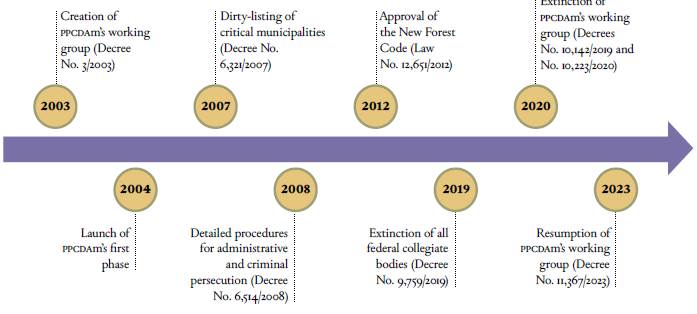 Source: Author’s own elaboration.