
 Assessing the unemployment-related literature and its driving themes: a bibliometric analysis on the Scopus and Web of Science databases
ABSTRACT
Purpose Considering both the thematic relevance and the enduring discussions in unemployment-related studies, the primary purpose of this study is to identify the driving topics and themes in research produced within this field.
Design/methodology/approach A bibliometric analysis was conducted on a sample of 913 documents retrieved from the Scopus and Web of Science databases. The data was analysed using both a merged sample approach and individual analyses by repository when necessary. The analyses were performed using R-Studio software along with its specific bibliometric packages and functions.
Findings Key topics were identified, such as unemployment rates, entrepreneurship, innovation, gender, and COVID-19 impacts. These themes are significant driving forces within the field. Conclusion is that while these topics are shaping discussions in the literature, most of the research primarily focuses on advanced and stable economies, leaving a scarcity of studies that address other contexts and realities.
Originality/value This study offers a dualdatabase bibliometric analysis spanning from 1960 to 2024, which is a longer period covered within similar studies. Also, when considering both Scopus and Web of Science outputs, thematic and networkbased mapping are integrated, uncovering enduring (e.g., Phillips’ Curve–related inflation dynamics) and emerging socioeconomic topics (gender, health impacts, entrepreneurial responses to COVID19) that have been assessed more recently. The sample of 913 openaccess journal articles ensures rigorous and reproducible, selection whereas the findings may help researchers, policymakers, and practitioners in targeting key elements to proceed with better informed and directed labour-market interventions.
Keywords
Unemployment; Literature Review; Bibliometric Analysis
RESUMO
Objetivo Considerando a relevância temática e as discussões que perduram no tempo em estudos relacionados ao desemprego, o objetivo principal deste estudo é identificar os tópicos motrizes em pesquisas sobre o tema.
Metodologia/Abordagem Uma análise bibliométrica foi conduzida em uma amostra de 913 documentos extraídos das bases de dados Scopus e Web of Science. Os dados destes repositórios foram analisados tanto em conjunto como de forma separada, a depender da análise. O tratamento de dados e análises foram feitas via software R-Studio em seus pacotes e funções bibliométricas específicas.
Resultados Tópicos como taxas de desemprego, empreendedorismo, inovação, gênero e impactos da COVID-19 foram identificados como forças motrizes na área. Conclui-se que, embora esses tópicos estejam moldando as discussões na literatura, a maioria das pesquisas têm se concentrado em economias avançadas, resultando em escassez de estudos que abordem outras realidades.
Originalidade/valor Este estudo apresenta análise em dupla base de dados abrangendo de 1960 a 2024, tempo maior que o coberto em estudos semelhantes. Ao tratar estudos de Scopus e da Web of Science, o mapeamento temático é integrado, revelando tanto tópicos socioeconômicos persistentes (como a dinâmica entre inflação e desemprego) como emergentes (gênero, impactos na saúde e respostas empreendedoras à COVID-19). A amostra de 913 artigos de periódicos de acesso aberto garante uma seleção rigorosa e reprodutível, enquanto os resultados podem auxiliar pesquisadores, políticos e o mercado acerca de elementos influentes na proposição de intervenções mais assertivas ao mercado de trabalho.
Palavras-chave
Desemprego; Revisão de Literatura; Análise Bibliométrica
1 INTRODUCTION
A comprehensive understanding of macroeconomic variables may represent a reliable source for an overview concerning the status of a given economy in a period of interest. Considering the matter of an assessment about wellbeing and economic momentum of a population, employment and unemployment rates could be one of the most discussed although its overall comprehension lacks on consolidation (Simionescu, 2020).
Focusing on the unemployment side, Phillips (1958) developed one of the seminal studies on this theme relating the absence of job opportunities and wage rates in the United Kingdom. The author found evidence that fluctuations on money wage rates vary accordingly with the highs and lows on the levels of unemployment (Phillips, 1958). This evidence, which was later acknowledged as the “Phillips Curve” concept (Phillips, 1958; Friedman, 1968), remained undeniable up until the emergence of the stagflation phenomenon (Brunner et al., 1980; Bruno & Sachs, 1985).
More recently, other surrounding unemployment have been assessed beyond the economical influence, bringing to table more societal lenses to discussions. Unemployment among young people, for example, is receiving more attention. Questions of gender, assessing the rates of men and women without a job is another topic demanding increasing attention of researchers and professionals.
According to the International Labour Organization (ILO) almost 74 million people aged 15 to 24 were looking for a job vacancy in 2014. Youth unemployment rates remained consistently elevated across all regions of the world and accentuated after the outcomes from COVID-19 pandemic outbreak (ILO, 2015; Schmillen & Umkehrer, 2017). The gender unemployment gap, which represents the difference between female and male without an active job, was regularly positive until the early 1980s and lowered after 1983, being again elevated during recessions periods, when usually more men lost their jobs (Albanesi & Sahin, 2018).
These are just some examples about how wide the unemployment-related research field is and how far from being exhausted this phenomenon remains. In fact, this is the main assumption guiding this study, the acknowledging of how complex and multifaceted the unemployment phenomenon is. Furthermore, it is reasonable to assume this as an enduring theme being recurrently discussed throughout the years and, in this sense, the intent to revisit studies already developed by other researchers who contributed to the field.
Therefore, and considering both the relevance and endurance of unemployment-related studies, the main purpose of this study is to: Identify the driving topics and themes in the unemployment-related research field. Aiming to reach this objective the related research question (What are the driving topics and themes assessed in the unemployment-related academic literature?) is to be answered when this study is finalised.
A sample of 913 documents, extracted from both Scopus and Web of Science repositories, limited by timespan (1960 to 2024) within Business, Management or Accounting areas, with open access in English, Portuguese or Spanish languages was assessed to respond to the research question. Secondary objectives addressed during this process include the identification of where are, geographically, frequently cited documents and authors discussing unemployment and what are the most recurrent sources of scientific promotion publishing unemployment-related studies.
Further considerations concerning the bibliometric analysis procedures such as the selection of databases and methodological proceedings will be presented in the following sections which also includes a literature review about unemployment, a results and discussions topic presenting the bibliometric results and a conclusion topic.
The results and analyses presented in this article may serve multiple stakeholders. For policymakers and regulators, findings offer comparative insights by benchmarking effective unemployment-reduction strategies applied and assessed in studies developed within advanced economies reality but could be adapted to the specific challenges of under-researched contexts and countries.
For academia, the results later presented may contribute by filling a gap in the literature on unemployment-related studies by consolidating years of previous studies in a condensed group of themes and terms that could be useful as a foundation for further empirical research. Finally, for businesses, investors, and labour-market practitioners, the results can better inform them on their decision-making processes by highlighting some of the emerging dynamics, such as the human-centred approach of unemployment for example, that could be efficiently explored to sustainable results.
2 THEORETICAL BACKGROUND
Unemployment has been a persistent topic of discussion for years. Macgregor (1907) was among the first to explore labour exchanges and unemployment, addressing both economic impacts and ethical issues in job relations. Johnson (1917) highlighted health status disparities between employed and unemployed individuals, predating more recent studies connecting unemployment to health (e.g., Paul & Moser, 2009; Kawohl & Nordt, 2020).
Long (1942) argued that the absence of a widely accepted definition of unemployment is a significant barrier to understanding the issue. There are many misconceptions about unemployment, influenced by various perspectives, including those of economists, statisticians, politicians, and the public. While this research aligns with Long’s argument, it does not aim to provide a definitive definition of unemployment.
To ground our later presented bibliometric findings in well-established economic theory, we draw from three pillars. First, the Phillips Curve (Phillips, 1958; Friedman, 1968) links unemployment fluctuations to wageinflation dynamics, framing why terms like “inflation” appear with consistency in the literature. Second, the Okun’s Law (Okun, 1963) formalizes the presumed inverse relationship between output growth and unemployment, explaining the prominence of “economic growth” correlated terms as it will be perceived in the results. Third, a humancapital and wellbeing perspective (Paul & Moser, 2009; Kawohl & Nordt, 2020) highlights individuallevel impacts due to unemployment, reflected in keywords like “health” and “happiness.” Embedding the bibliometric patterns unveiled within these theories enables a deeper dialogue between the statistical mappings and domainspecific knowledge.
The aim is to revisit commonly discussed evaluations of the unemployment-related research field through bibliometric analysis. The goal is to identify both persistent and emerging trends over the years. The overall understanding of work, employment, and unemployment is inevitably shaped by individual beliefs and values. Consequently, various concepts may be employed, which is a key reason for this research to assess the existing literature on unemployment.
In order to achieve a rigorous and consistent understanding in regard to the unemployment-related literature, the idea is to perform a bibliometric analysis. Wang, Reinhilde, and Stephan (2017) and Linnenluecke et al. (2020) suggest that reviewing past literature is essential for gathering knowledge and assessing the state of a research field, which relates with the focus on the unemployment-related literature.
Here applied bibliometric analysis follows some of the applicability indicated by Passas (2024), particularly the identification of emerging trends, collaboration patterns, and field constituents within an existing research field, in this study’s case the unemployment-related. Seminal contributions for the method e.g., Donthu et al. (2021) and Mukherjee et al. (2022) are taken in consideration as well.
Other specifics about the methodological steps pursued in this research are presented in the next section. Following some of the premises discussed in Kumar (2025), thematic evolution, significance of terms, applications and assessments of unemployment-related studies are unveiled by the usage of bibliometric methods to highlight influential authors, mapping collaboration networks, and emerging research trends that are further presented later in this study.
3 METHODOLOGY
This study will use the “bibliometrix” package for the bibliometric analysis, available in R-Studio (R Core Team, 2023). Developed by Aria & Cuccurullo (2017), bibliometrix enables comprehensive analyses of science mapping and bibliometrics, offering various statistical algorithms and data visualization tools (Aria & Cuccurullo, 2017).
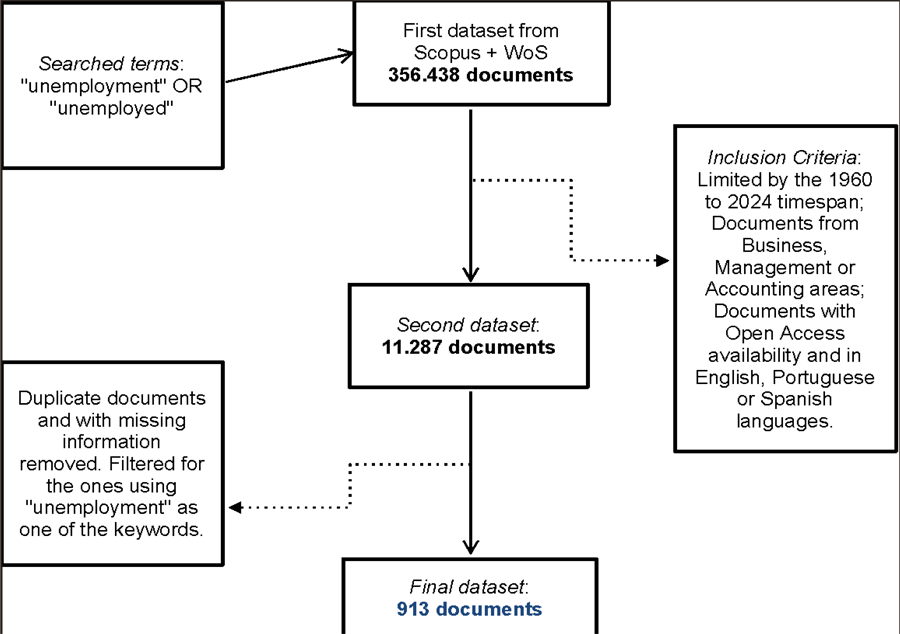
A BibliometricSystematic Literature Review (BSLR) following Donthu et al. (2021) and Zupic & Čater (2015) studies as main references was conducted. Our raw sample (N = 356.438) was retrieved on 27 Feb 2025 via identical searches in Scopus and WoS using TITLEABSKEY (“unemployment” OR “unemployed”) and limited to 1960 to 2024 timespan. The Subject areas included in the retrieving process were Business/Management/Accounting for document types = article in language = English, Portuguese, Spanish, and with an Open Access status.
A custom Rscript (using the bibliometrix R-package), available upon request, removed 470 exact duplicates and identified 2 records with missing metadata. We then filtered for “unemployment” as a keyword, yielding the final sample of 913 documents. For mapping, we applied Bradford’s Law (source dispersion), Lotka’s Law (author productivity), and Zipf’s Law (keyword frequency) to assess core journals, prolific authors, and dominant terms within the field (Chen & Leimkuhler, 1986).
The following Figure 1 summarises the research design that serves as guidance for this study and is aligned with Börner et al. (2003) and Zupic & Cater (2015) premises.
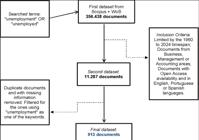
The data retrieving process, presented in Figure 1, initially yielded 356,438 documents. After applying specific inclusion criteria, this number was reduced to 11,287. Further filtering eliminated 470 duplicate entries and 2 documents lacking essential information, resulting in a final count of 10,815. While statistically feasible to analyse this number, it may still include articles that do not align with the core concepts of this study on the unemployment-related literature.
A second filtering step is conducted based on the keyword “unemployment”, focusing on documents that directly address this topic. This process, shown in Figure 1, resulted in a final sample of 913 documents from the Scopus and Web of Science databases. To achieve the study’s objective, a science mapping using bibliometric analysis is performed in a substantial number of documents on unemployment literature, providing an overview of emerging themes in the field.
4 RESULTS
This section presents the results of the bibliometric analysis based on a final sample of 913 documents retrieved from Scopus and Web of Science. For the most of the analyses the assessments will consider the combined database, the one that includes documents from both repositories, whereas at the end of this section it will be conducted a separate evaluation to enhance the understanding of overall results.
The inclusion criteria shown in Figure 1 specify that the search for documents begins with the year 1960. However, as depicted in Table 1, the database contains its earliest document dated 1985, while the most recent one is from 2025. This discrepancy may occur due journals accepting papers in 2024 for publishing them in the following year. Overall, a 40-year span of studies is covered.
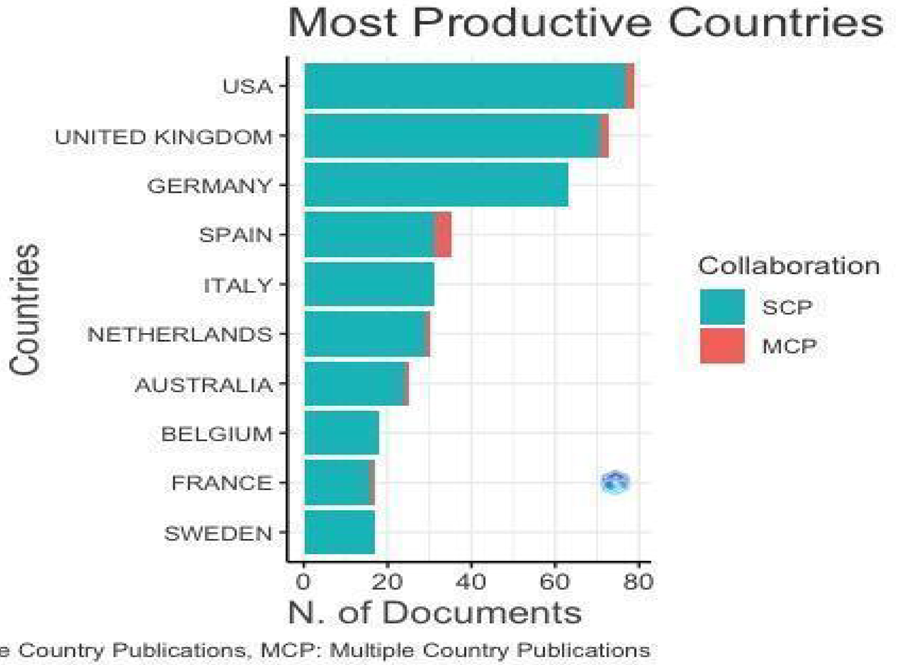
Figure 2 illustrates that much of the scientific output produced originates from European countries. The United States and Australia stand out as exceptions to this trend, which predominantly features Eurocentric literature on unemployment.
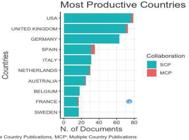
The numbers presented in Figure 2 where the USA leads the group with 78 documents, followed by the United Kingdom with 74 documents, and Germany completes the top three most productive countries with a total of 65 documents, accounts for studies authored by individuals from the same country, as well as those involving multiple countries (both single-country publications (SCP) and multi-country collaborations (MCP), as illustrated in the graphic).
Regardless of the authorship type, it is apparent that research on unemployment-related literature may benefit from shifting focus away from European perspectives. While it is important not to overlook the unemployment challenges faced by European nations, it is equally essential to investigate the impact of unemployment in less developed economies.
Table 2 presents the 10 studies that have received the highest overall citations in academic literature. This analysis is based on the selected from both databases, Scopus and Web of Science, and takes into account the total number of citations per year within the timespan covered by the merged database, which ranges from 1985 to 2025.
The paper “Does Self-Employment Reduce Unemployment?” by Thurik et al. (2008) examines the relationship between self-employment and unemployment. Rising unemployment can lead to more people becoming self-employed, while an increase in self-employment can help reduce overall unemployment. The authors have also found that the positive impact of self-employment on reducing unemployment is stronger than the effect of high unemployment driving people into self-employment (Thurik et al., 2008).
Two documents related to Total Citations per Year are highlighted in Table 2. The first, “Expanding the Impact of the Psychology of Working” by Blustein et al. (2018), explores the psychological effects of unemployment. The second, “Robots and Organization Studies” by Fleming (2018), critiques how advanced technology impacts unemployment, suggesting that organisational forces shape technology’s application and can lead to poorly paid jobs or to elevations on unemployment.
The following table presents the outputs related to local citations within the working sample of documents. This result is noteworthy because this database is predominantly composed of studies focused on unemployment. It allows us to identify which authors and studies are most influential in our area of interest: the phenomenon of unemployment.
The authors most frequently cited within the sample, as presented in Table 3, are Hjazeen, Seraj and Ozdeser. Their research has garnered the highest number of local citations within the sample. They assess the socioeconomic relationship between unemployment rates and economic growth. Focusing on Jordan, empirical results support premises from Okun’s Law (1963), demonstrating that sustainable economic growth leads to a reduction in unemployment (Hjazeen, Seraj, & Ozdeser, 2021).
In discussing Table 3 results, it’s notable that the most cited document, by Global Citations, is the paper by Koen et al. (2010), which focuses on reinsertion on the labour market for previously unemployed individuals. The authors found that reemployability relies more on a strategic approach to job searching rather than merely increasing the volume of these searches.
Despite the various perspectives that exist on unemployment studies, our analysis shows that the economic approach is the most consistent among the documents reviewed. Nonetheless, the study by Boyce et al. (2015), also featured in Table 3, emphasizes the broader psychological impacts of unemployment, suggesting it affects well-being and may even lead to personality changes in those who are unemployed for long periods.
Directing the examination for bibliographic associations, the results in Table 4 show the most frequently used keywords, which serve as an initial indicator of potential driving themes related to the field of unemployment.
The most frequently used term, as shown in Table 4, is “unemployment”, which significantly outpaces the others in frequency. This is expected, as unemployment has been the primary search term since the beginning, both in the Scopus and Web of Science databases, as illustrated in Figure 1. Additionally, the term “employment” is naturally considered, as analysing one aspect of the phenomenon necessitates examining the other side as well.
Two additional terms in Table 4 that are significant due to their links to key economic concepts about unemployment. The inflation term relates to unemployment through the Phillips Curve, which examines how wage variations signal inflationary pressures and affect unemployment levels (Phillips, 1958). Additionally, Okun’s Law (1963) highlights the connection between economic growth and unemployment, indicating that sustainable growth reduces unemployment, and vice versa.
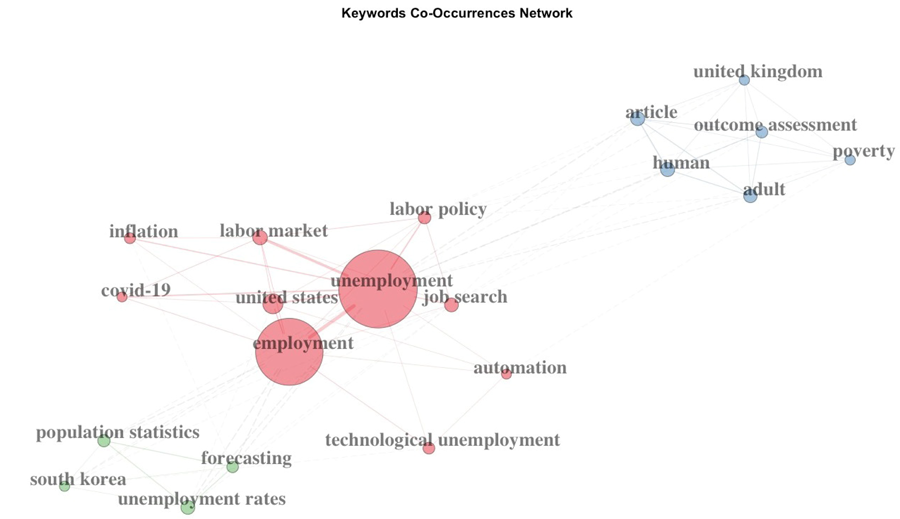
Note: To legibility and reduced label overlaps, Figure 3 applies a minimum cooccurrence threshold of n = 20, where “n” is the number of keywords clustered, and the grouping of terms is limited to three clusters by Leiden algorithm application (Traag et al., 2019).
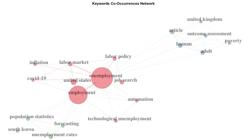
Upon further analysis and complementing the data shown in Table 4, Figure 3 illustrates the frequency of keyword co-occurrence based on the combined sample of 913 documents from both the Scopus and Web of Science databases. In Figure 3, the keywords are organized into three clusters, represented by red, blue, and green colours, each demonstrating distinct associations among the keywords.
The blue group in Figure 3 grouped terms related to individual’s level and humanistic centred themes, this may be illustrated by the presence of keywords such as “poverty” and “human”. The largest cohort of terms are in the red cluster in the middle of Figure 3, relating terms around “employment” and “unemployment” and most economic relations with these terms, the ones like “labour policy” and “inflation”, for example. Green cluster in Figure 3 includes terms such as “population statistics” and “unemployment rates”, grouping studies that are focused on measurement and empirical evaluation of unemployment theme.
To build on the insights gained from the co-occurrence analysis shown in Figure 3, a separate analysis for documents from Scopus and Web of Science is performed. This approach aims to expand upon, refine, and improve the themes and trends that were initially identified in the field of unemployment.
The rationale for conducting some analyses individually arises from the observation that recurring themes appear in both the Scopus and Web of Science databases. This recurrence serves as a strong indicator of the relevance of these themes within the broader field of research related to unemployment.
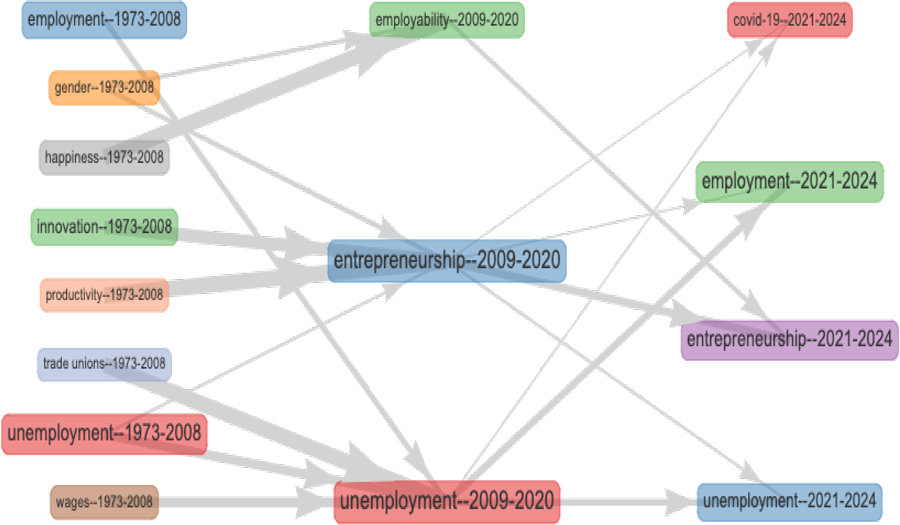
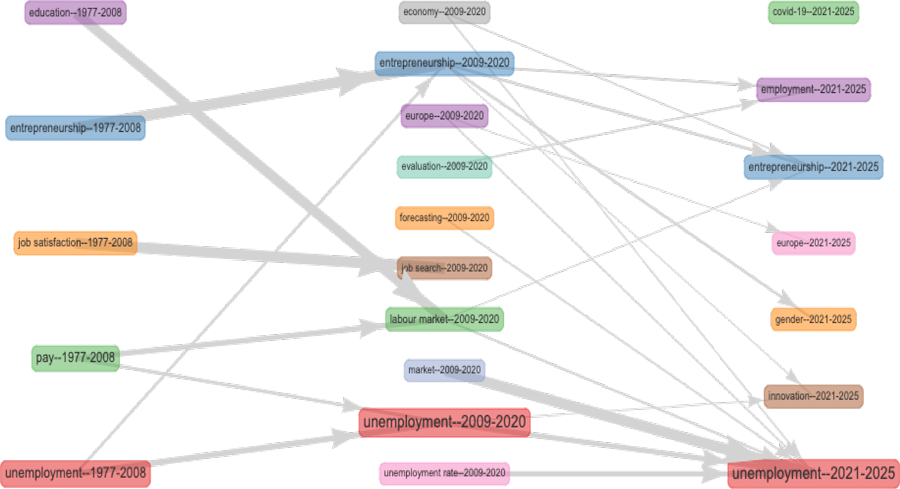
The findings will be presented in Figures 4 and 5, which are generated using “biblioshiny”, an interface from the bibliometrix R-Studio package (Aria & Cuccurullo, 2017; R Core Team, 2023), the tools utilised throughout this study. Figure 4 focuses on documents extracted from Scopus and Figure 5 on the files retrieved from Web of Science.
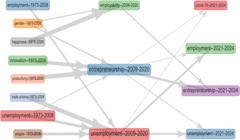
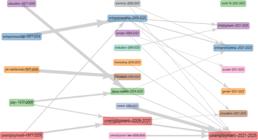
Two cutting points were inserted in the data for figures 4 and 5 to be built: 2008 and 2020 years. These points were selected to capture the effects of two major socio-economic shocks—the 2008 financial crisis, linked to the U.S. real estate market collapse (Stiglitz, 2010), and the long-lasting impacts of the COVID-19 pandemic (McKibbin & Vines, 2020). These events, naturally, have significantly influenced labour markets and issues of employment and unemployment.
Another important consideration in creating figures 4 and 5 is the option made by the Leiden algorithm for clustering terms, despite the availability of other options. Leiden generates more coherent clusters by optimizing modularity and stability, improving upon the Louvain algorithm’s weaknesses (Traag et al., 2019).
Both figures 4 and 5 consistently show the unemployment term in the three time slices for each figure, which is not surprising. Given the inclusion criteria defined and presented throughout the study, the unemployment term is expected to appear consistently. Other terms and their correlated themes are well-established in the field, while some terms appear in only one figure and not in the other.
Beginning with Figure 4, the terms “wages” and “trade unions” highlight the early academic focus on wage fluctuations and the impact of syndicalism in advocating for improved working conditions and fair wages. Wages, in particular, is a well-known indicator of inflation and illustrate how inflationary pressures influence unemployment and labour market dysfunctions. These concepts align with the previously identified studies related to the Phillips Curve (Phillips, 1958; Friedman, 1968).
As time progressed, academic interests evolved alongside the development of new methods for producing goods and services. Terms like “innovation” and “productivity” illustrate this change, while the rise of “employment” may suggest that technological advances are creating new job opportunities for tech-skilled individuals, although some may face diminishing prospects (Kiley, 1999).
A human-centred approach has gained traction since the turn of the century, as indicated by relevant studies from 1973-2008, shown in Figure 4. Concepts such as “gender” and “happiness” reflect this shift in focus toward the subjective influences of unemployment (e.g., Paul & Moser, 2009; Boyce et al., 2015; Albanesi & Sahin, 2018; Kawohl & Nordt, 2020).
In Figure 4, analysing the period from 2009 to 2020 and identify three key terms: “employability”, “entrepreneurship”, and “unemployment.” From 2021 to 2024, “entrepreneurship” and “unemployment” remain relevant, while “employability” shifts to “employment” and merges with “entrepreneurship.” A new key term, “COVID-19”, emerges as the pandemic causes a global unemployment crisis, prompting researchers to investigate its ongoing impacts (Blustein et al., 2020).
Figure 5 highlights five key terms frequently found in Web of Science (WoS) documents from 1977 to 2008: “education”, “entrepreneurship”, “job satisfaction”, “pay”, and “unemployment”. While the focus on unemployment was expected and previously evaluated, the focus moves for other terms, notable ones are pay and wages, likely linked to studies that explore wage fluctuations and related topics, such as inflation, the Phillips Curve, and unionization (Phillips, 1958; Friedman, 1968; Calvo, 1978; Pissarides, 1986).
Entrepreneurship is a prevalent theme in both the figures and repositories analyzed. In Figure 4, the term appears only in the second and third periods of the time slices, while in Figure 5, it is consistently present from 1977 to 2025. The literature indicates a clear intrinsic connection between unemployment and entrepreneurial activities, suggesting that one may alleviate or even contribute to the other (e.g., Baptista & Preto, 2007; Faria, Cuestas & Gil-Alana, 2009).
Regarding Figure 5 and the second period of terms that emerged from Web of Science documents, a focus on measurements and empirically based knowledge regarding the unemployment phenomenon is perceived. This tendency may be inferred particularly due to the appearance of terms such as “evaluation”, “forecasting” and “unemployment rate”.
The measurement of unemployment rates is a critical element for understanding this complex issue in many studies within the sample. There are two main approaches to studying unemployment: a retrospective approach, which evaluates past data to better understand current unemployment trends (e.g., Conover et al., 1986), and a prospective approach that focuses on accurate forecasting, especially during times of economic crisis (Askitas & Zimmermann, 2009).
In the final analysis of themes that emerged from Web of Science documents, it is evident that most terms are repetitions or adapted forms of those previously discussed. The emergence of COVID-19 has already been highlighted in the analysis of Figure 4 (e.g., McKibbin & Vines, 2020; Blustein et al., 2020; Ahmad et al., 2023). Additionally, two other significant terms that stand out are “gender” and “innovation,” which represent the human-centred approach and the productivity aspects of the labour force, respectively.
In concluding results presentation, it is important to acknowledge the most consistent bibliometrics laws assessments. By the Bradford’s Law (1976) it is found as the leading journal publishing unemployment-related studies within the 913 documents is the Labour Economics, having 105 documents which is approximately 11% of the sample, whereas the second placed journal (IZA Journal of Labor Policy) has 38.
Lotka’s Law (1926) indicates that the working dataset here is largely dominated by one-time contributing authors (around 91%) and very few authors writing more than one document. Estimated Lotka exponent (β ≈ 4.37) is much steeper than the “classical” value of 2, confirming that productivity within the sample is very concentrated. Nonetheless, the adjusted R-squared obtained (0.97) indicates that this study’s collection of documents analysed is suitable even though the steep β shows an extreme concentration.
Zipf’s Law assessment (Zipf, 1932; Piantadosi, 2014) in being directed to terms and keywords shows that the dataset’s vocabulary follows this law closely (slope ≈ -0.94, R2 ≈ 0.96) meaning that the word frequency distribution is highly skewed, with a handful of terms dominating discussions (i.e., unemployment and employment), while the majority of terms appears only once or twice. This indicates a conceptual concentration around key-topics, as the ones presented and discussed in this section, as well a diversity of less frequent terms to capture niche aspects of the literature.
5 DISCUSSION
This section summarises some of the key findings of the bibliometric analysis in light of established economic and social theories, highlighting how the results obtained may contribute to a deeper understanding of unemployment-related research tendencies.
The developed mapping of enduring themes, particularly unemployment rates, inflation dynamics, and labour policy, aligns with also enduring economic concepts, such as the Phillips Curve, where inflationunemployment tradeoffs appeared in our results within the cluster cooccurrence as leading terms on red and blue groups in Figure 3 (Phillips, 1958).
Furthermore, the prominence of “economic growth” and “entrepreneurship” terms within the clusters resonates the premises from Okun’s Law, suggesting that productive output expansions, whether via market innovations or policy shifts, tend to correlate with lowering of unemployment levels (Okun, 1963).
Accentuated presence of terms in line with “health” and “happiness” in later slices on both Figures 4 and 5 indicates a potential wellbeing paradigm shift, which corroborates the presence of some of the highly cited papers in the sample that assesses unemployment’s psychological effects (Paul & Moser, 2009; Boyce et al., 2015).
Taken together, these theoretical associations reinforce the relevance of classical and contemporary frameworks for interpreting trends in unemployment-related research. By connecting bibliometric patterns unveiled in this study results with foundational economic and social concepts, this paper suggests an integrated view of how academic interest in unemployment evolves over time and across contexts.
6 CONCLUSION
A thorough assessment of the literature related to unemployment was conducted, allowing us to identify both enduring and emerging themes within this field of research. The bibliometric analysis here developed serves as a foundational tool for better understanding about the various perspectives and topics used to explore such a complex phenomenon as unemployment. The belief is that this study contributes valuable insights that can advance research and foster collaboration among other authors interested in this area.
Research highlights that studies on the labour market and unemployment have evolved alongside socioeconomic scenarios, including the crises of 2008 and COVID-19. The bibliometric analysis reveals that unemployment is a complex, multifaceted issue. A successful achievement of the main objective was possible, identifying key topics and themes in unemployment-related research, addressing the research question satisfactorily.
Unemployment rates, entrepreneurship, innovation, gender, and COVID-19 have been key themes from 1985 to 2025 (as presented earlier in the Table 1). Findings suggest that most studies focus on stable, advanced economies, which may not accurately reflect the realities of lagging economies. Significant studies in the sample include Thurik et al. (2008), Blustein et al. (2018), and Hjazeen et al. (2021), focusing on entrepreneurship, health issues, and economic growth, all tied to unemployment.
This study provides an overview of unemployment-related literature in business and management, enabling the guidance of future research that intends to delve into this field while offering some key contributions in diverse fronts. For Academia, it provides a dualdatabase, a multilaw bibliometric model for unemployment studies, and insights into new theoretical integrations, such as Phillips Curve, Okun’s Law. and human-centred approaches.
Results and analyses presented here may contribute to policymakers and regulators, as they may benchmark effective results on lowering unemployment within developed economies to their own contexts, when targeting labour-market interventions in their underresearched reality.
Industry and entrepreneurs may cease the opportunity identified of entrepreneurship and innovation in mitigating unemployment shocks. Investors and market analysts may turn their attention to the emerging socioeconomic themes such as gender gaps, health outcomes, and enduring COVID-19 impacts that may implicate workforcerelated risk assessments.
By synthesizing theoretical perspectives with quantitative bibliometric evidence, this study not only deepens the understanding of unemployment as a multifaceted phenomenon but also highlights paths for interdisciplinary inquiry and practical action. Future research can build on these findings to further explore underrepresented regions, emerging labour dynamics, and the evolving socio-economic drivers that continue to shape the global employment landscape.
REFERENCES
-
Ahmad, M., Khan, Y. A., Jiang, C., Kazmi, S. J. H., & Abbas, S. Z. (2023). The impact of COVID-19 on unemployment rate: An intelligent based unemployment rate prediction in selected countries of Europe. International Journal of Finance & Economics, 28 (1), 528-543. https://doi.org/10.1002/ijfe.2434
» https://doi.org/10.1002/ijfe.2434 -
Albanesi, S. & Sahin, A. (2018). The gender unemployment gap. Review of Economic Dynamics, 30, 47-67. https://doi.org/10.1016/j.red.2017.12.005
» https://doi.org/10.1016/j.red.2017.12.005 -
Aria, M. & Cuccurullo, C. (2017). bibliometrix: An R-tool for comprehensive science mapping analysis. Journal of Informetrics, 11 (4), 959-975. https://doi.org/10.1016/j.joi.2017.08.007
» https://doi.org/10.1016/j.joi.2017.08.007 -
Askitas, N. & Zimmermann, K. F. (2009). Google econometrics and unemployment forecasting. Applied Economics Quarterly, 55 (2), 107-120. https://doi.org/10.3790/aeq.55.2.107
» https://doi.org/10.3790/aeq.55.2.107 -
Baptista, R. & Preto, M. T. (2007). The dynamics of causality between entrepreneurship and unemployment. International Journal of Technology, Policy, and Management, 7 (3), 215-224. https://doi.org/10.1504/IJTPM.2007.015107
» https://doi.org/10.1504/IJTPM.2007.015107 -
Blustein, D. L., Kenny, M. E., Di Fabio, A., & Guichard, J. (2018). Expanding the impact of the psychology of working: Engaging psychology in the struggle for decent work and human rights. Journal of Career Assessment, 27 (1), 3-28. https://doi.org/10.1177/1069072718774002
» https://doi.org/10.1177/1069072718774002 -
Blustein, D. L., Duffy, R., Ferreira, J. A., Cohen-Scali, V., Cinamon, R. G. & Allan, B. A. (2020). Unemployment in the time of COVID-19: A research agenda. Journal of Vocational Behavior, 19 https://doi.org/10.1016/j.jvb.2020.103436
» https://doi.org/10.1016/j.jvb.2020.103436 -
Börner, K., Chen, C. & Boyack, K. W. (2003). Visualizing knowledge domains. Annual Review of Information Science and Technology, 37 (1), 179-255. Available at: https://cns.iu.edu/docs/publications/2003-borner-arist.pdf
» https://cns.iu.edu/docs/publications/2003-borner-arist.pdf -
Boyce, C. J., Wood, A. M., Daly, M., & Sedikides, C. (2015). Personality change following unemployment. Journal of Applied Psychology, 100 (4), 991. https://doi.org/10.1037/a0038647
» https://doi.org/10.1037/a0038647 -
Bradford, S. C. (1976). CLASSIC PAPER: Sources of Information on Specific Subjects. Collection Management, 1 (3-4), 95-104. https://doi.org/10.1300/J105v01n03_06
» https://doi.org/10.1300/J105v01n03_06 -
Brunner, K., Cukierman, A. & Meltzer, A. (1980). Stagflation, persistent unemployment, and the permanence of economic shocks. Journal of Monetary Economics, 6 (4), 467-492. https://doi.org/10.1016/0304-3932 (80)90002-1
» https://doi.org/10.1016/0304-3932 (80)90002-1 - Bruno, M. & Sachs, J. D. (1985). Economics of worldwide stagflation Harvard University Press.
-
Calvo, G. A. (1978). Urban unemployment and wage determination in LDC's: Trade unions in the Harris-Todaro model. International Economic Review, 19 (1), 65-81. https://doi.org/10.2307/2526394
» https://doi.org/10.2307/2526394 -
Cobo, M. J., Lopez-Herrera, A. G., Herrera-Viedma, E. & Herrera, F. (2011). Science Mapping Software Tools: Review, analysis, and cooperative study among tools. Journal of the American Society for Information Science and Technology, 62 (7), 1382-1402. https://doi.org/10.1002/asi.21525
» https://doi.org/10.1002/asi.21525 -
Conover, P. J., Feldman, S., & Knight, K. (1986). Judging inflation and unemployment: The origins of retrospective evaluations. The Journal of Politics, 48 (3), 565-588. https://doi.org/10.2307/2131168
» https://doi.org/10.2307/2131168 -
Chen, Y. S., & Leimkuhler, F. F. (1986). A relationship between Lotka's law, Bradford's law, and Zipf's law. Journal of the American Society for Information Science, 37 (5), 307-314. https://doi.org/10.1002/ (SICI)1097-4571(198609)37:5%3C307::AID-ASI5%3E3.0.CO;2-8
» https://doi.org/10.1002/ (SICI)1097-4571(198609)37:5%3C307::AID-ASI5%3E3.0.CO;2-8 -
Donthu, N., Kumar, S., Mukherjee, D., Pandey, N. & Lim, W. M. (2021). How to conduct a bibliometric analysis: An overview and guidelines. Journal of Business Research, 133, 285-296. https://doi.org/10.1016/j.jbusres.2021.04.070
» https://doi.org/10.1016/j.jbusres.2021.04.070 -
Faria, J. R., Cuestas, J. C., Gil-Alana, L. A. (2009). Unemployment and entrepreneurship: A cyclical relation? Economics Letters, 105 (3), 318-320. https://doi.org/10.1016/j.econlet.2009.09.004
» https://doi.org/10.1016/j.econlet.2009.09.004 -
Fleming, P. (2018). Robots and Organization Studies: Why Robots Might Not Want to Steal Your Job. Organization Studies, 40 (1), 23-38. https://doi.org/10.1177/0170840618765568
» https://doi.org/10.1177/0170840618765568 -
Friedman, M. (1968). The role of monetary policy. American Economic Review, 58 (1), 1-17. Available at: https://www.aeaweb.org/aer/top20/58.1.1-17.pdf
» https://www.aeaweb.org/aer/top20/58.1.1-17.pdf -
Hjazeen, H., Seraj, M. & Ozdeser, H. (2021). The nexus between the economic growth and unemployment in Jordan. Future Business Journal, 7, 42. https://doi.org/10.1186/s43093-021-00088-3
» https://doi.org/10.1186/s43093-021-00088-3 - International Labour Organization (ILO) (2015). World employment and social outlook: Trends 2015. Geneva: ILO Publications.
-
Johnson, G. R. (1917). Unemployment and feeblemindedness. The Journal of Delinquency, 2 (2), 59-72. Available at: http://reparti.free.fr/johnson1917.pdf
» http://reparti.free.fr/johnson1917.pdf -
Kawohl, W. & Nordt, C. (2020). COVID-19, unemployment, and suicide. The Lancet (Psychiatry), 7 (5), 389-390. https://doi.org/10.1016/S2215-0366 (20)30141-3
» https://doi.org/10.1016/S2215-0366 (20)30141-3 -
Kiley, M. T. (1999). The supply of skilled labour and skill-biased technological progress. The Economic Journal, 109 (458), 708-724. https://doi.org/10.1111/1468-0297.00470
» https://doi.org/10.1111/1468-0297.00470 -
Koen, J., Klehe, U. C., Van Vianen, A. E.M., Zikic, J., & Nauta, A. (2010). Job-search strategies and reemployment quality: The impact of career adaptability. Journal of Vocational Behavior, 77 (1), 126-139. https://doi.org/10.1016/j.jvb.2010.02.004
» https://doi.org/10.1016/j.jvb.2010.02.004 -
Kumar, R. (2025). Bibliometric Analysis: Comprehensive Insights into Tools, Techniques, Applications, and Solutions for Research Excellence. Spectrum of Engineering and Management Sciences, 3 (1), 45-62. https://doi.org/10.31181/sems31202535k
» https://doi.org/10.31181/sems31202535k -
Linnenluecke, M. K., Marrone, M. & Singh, A. K. (2020). Conducting systematic literature reviews and bibliometric analyses. Australian Journal of Management, 45 (2), 175-194. https://doi.org/10.1177/0312896219877678
» https://doi.org/10.1177/0312896219877678 -
Long, C. D. (1942). The concept of unemployment. The Quarterly Journal of Economics, 57 (1), 1-30. Available at: http://www.jstor.org/stable/1881811
» http://www.jstor.org/stable/1881811 -
Lotka, A. J. (1926). The frequency distribution of scientific productivity. Journal of the Washington Academy of Sciences, 16 (12), 317-323. Available at: http://www.jstor.org/stable/24529203
» http://www.jstor.org/stable/24529203 -
Macgregor, D. H. (1907). Labour exchanges and unemployment. The Economic Journal, 17 (68), 585-589. Available at: https://www.jstor.org/stable/2220875
» https://www.jstor.org/stable/2220875 -
McKibbin, W. & Vines, D. (2020). Global macroeconomic cooperation in response to the COVID-19 pandemic: a roadmap for the G20 and the IMF, Oxford Review of Economic Policy, 36 (1), S297-S337. https://doi.org/10.1093/oxrep/graa032
» https://doi.org/10.1093/oxrep/graa032 -
Mukherjee, D., Lim, W. M., Kumar, S., & Donthu, N. (2022). Guidelines for advancing theory and practice through bibliometric research. Journal of Business Research, 148, 101-115. https://doi.org/10.1016/j.jbusres.2022.04.042
» https://doi.org/10.1016/j.jbusres.2022.04.042 -
Okun, A. M. (1963). Potential GNP: Its measurement and significance. Cowles Foundation for Research in Economics at Yale University. Available at: https://milescorak.com/wp-content/uploads/2016/01/okun-potential-gnp-its-measurement-and-significance-p0190.pdf
» https://milescorak.com/wp-content/uploads/2016/01/okun-potential-gnp-its-measurement-and-significance-p0190.pdf -
Paul, K. I. & Moser, K. (2009). Unemployment impairs mental health: Meta-analyses. Journal of Vocational Behavior, 74 (3), 264-282. https://doi.org/10.1016/j.jvb.2009.01.001
» https://doi.org/10.1016/j.jvb.2009.01.001 -
Passas, I. (2024). Bibliometric Analysis: The Main Steps. Encyclopedia, 4 (2), 1014-1025. https://doi.org/10.3390/encyclopedia4020065
» https://doi.org/10.3390/encyclopedia4020065 -
Phillips, A. W. (1958). The relation between unemployment and the rate of change of money wage rates in the United Kingdom, 1861-1957. Economica, 25 (100), 283-299. https://doi.org/10.2307/2550759
» https://doi.org/10.2307/2550759 -
Piantadosi, S.T. (2014). Zipf's word frequency law in natural language: A critical review and future directions. Psychonomic Bulletin Review, 21, 1112-1130. https://doi.org/10.3758/s13423-014-0585-6
» https://doi.org/10.3758/s13423-014-0585-6 -
Pissarides, C. A. (1986). Trade unions and the efficiency of the natural rate of unemployment. Journal of Labor Economics, 4 (4), 582-595. https://doi.org/10.1086/298111
» https://doi.org/10.1086/298111 -
R Core Team (2023). R: A Language and Environment for Statistical Computing R Foundation for Statistical Computing, Vienna, Austria. <https://www.R-project.org/>
» https://www.R-project.org/> -
Schmillen, A. & Umkehrer, M. (2017). The scars of youth: Effects of early-career unemployment on future unemployment experience. International Labour Review, 156 (3-4), 465-494. https://doi.org/10.1111/ilr.12079
» https://doi.org/10.1111/ilr.12079 -
Simionescu, M. (2020). Improving unemployment rate forecasts at regional level in Romania using Google Trends. Technological Forecasting and Social Change, 155, 120026. https://doi.org/10.1016/j.techfore.2020.120026
» https://doi.org/10.1016/j.techfore.2020.120026 - Stiglitz, J. E. (2010). Freefall: America, free markets, and the sinking of the world economy WW Norton & Company.
-
Thurik, A. R., Carree, M. A., Stel, A. & Audretsch, D. B. (2008). Does self-employment reduce unemployment? Journal of Business Venturing, 23 (6), 673-686. https://doi.org/10.1016/j.jbusvent.2008.01.007
» https://doi.org/10.1016/j.jbusvent.2008.01.007 -
Traag, V. A., Waltman, L. & van Eck, N. J. (2019). From Louvain to Leiden: Guaranteeing well-connected communities. Scientific Reports, 9 https://doi.org/10.1038/s41598-019-41695-z
» https://doi.org/10.1038/s41598-019-41695-z -
Wang, J., Reinhilde, V. & Stephan, P. (2017). Bias against novelty in science: A cautionary tale for users of bibliometric indicator. Research Policy, 46, 1416-1436. http://dx.doi.org/10.1016/j.respol.2017.06.006
» http://dx.doi.org/10.1016/j.respol.2017.06.006 -
Zipf, G. K. (1932). Selected studies of the principle of relative frequency in language. Harvard Univ. Press. https://doi.org/10.4159/harvard.9780674434929
» https://doi.org/10.4159/harvard.9780674434929 -
Zupic, I. & Cater, T. (2015). Bibliometric methods in management and organization. Organizational Research Methods, 18 (3), 429-472. https://doi.org/10.1177/1094428114562629
» https://doi.org/10.1177/1094428114562629
-
Plagiarism Check:
The ReA/UFSM maintains the practice of submitting all documents approved for publication to the plagiarism check, using specific tools, e.g.: Turnitin.
-
Data availability statement:
Data will be available upon request
Edited by
-
Edited by:
Jordana Marques Kneipp
Data will be available upon request

 Source: Elaborated by the author
 Source: Elaborated by the author (RStudio bibliometrix output)
 Source: Elaborated by the author (RStudio bibliometrix output)
 Source: Elaborated by the author (RStudio bibliometrix output)