
 Interorganizational performance evaluation: metrics for interorganizational cost management
ABSTRACT
Purpose Given the lack of a comprehensive model that assesses the multidimensionality of interorganizational cost management (IOCM) and its underlying aspects, this research proposes a set of metrics to evaluate relational performance in managing interorganizational cost.
Methodology a literature review was conducted based on the procedures proposed by ProKnow-C, which consisted of two groups of articles (i) performance evaluation and (ii) interorganizational cost management, from which content analysis was conducted to propose a set of metrics.
Results Based on the theoretical assumptions and empirical findings from the relevant literature, the metrics were constructed by considering the measurement objects of open book accounting, information purpose, interorganizational collaboration, management information systems, and IOCM. In addition, characteristics representing interorganizational performance evaluation systems were identified. It was found that performance evaluation in IOCM is a developing topic that encompasses several research opportunities.
Originality/Contributions In the new organizational context where organizations seek to form collaborative alliances, interorganizational performance evaluation continues to evolve to accommodate new organizational configurations. At the same time, interorganizational relationships have triggered joint efforts to promote IOCM. The study summarizes the characteristics of extended systems and the essential elements for the functioning of this management. It translates these characteristics into metrics that can be used to evaluate the performance of interorganizational relationships.
Performance evaluation; Interorganizational cost management; Metrics
RESUMO
Objetivo Diante da escassez de um modelo abrangente que avalie a multidimensionalidade da IOCM e seus aspectos subjacentes, o objetivo desta pesquisa foi propor um conjunto de métricas para avaliar o desempenho relacional durante os esforços de Gestão de Custos Interorganizacionais.
Metodologia Foi feita uma revisão de literatura, tendo por base os procedimentos sugeridos pelo ProKnow-C, composta por dois conjuntos de artigos (i) avaliação de desempenho e (ii) gestão de custos interorganizacionais, dos quais fez-se uma análise de conteúdo para propor um conjunto de métricas.
Resultados A partir dos pressupostos teóricos e achados empíricos evidenciados pela literatura pertinente, as métricas foram construídas considerando como objetos de mensuração open book accounting, finalidade da informação, cooperação interorganizacional, sistemas de informações gerenciais e IOCM. Além disso, foram identificadas características que representam os sistemas de avaliação de desempenho interorganizacionais. Identificou-se que a avaliação de desempenho na gestão de custos interorganizacionais constitui-se como uma temática em desenvolvimento que abrange diversas possibilidades de pesquisa.
Originalidade/Contribuições No contexto organizacional emergente, em que as organizações têm buscado firmar alianças colaborativas, a avaliação de desempenho interorganizacional está evoluindo para atender as novas configurações organizacionais. Ao mesmo tempo, relacionamentos interorganizacionais desencadearam esforços conjuntos para promover a gestão de custos interorganizacionais. O estudo sintetiza características de sistemas estendidos e elementos essenciais para o funcionamento da IOCM e traduz tais características em métricas capazes de avaliar o desempenho do relacionamento interorganizacional.
Avaliação de desempenho; Gestão de custos interorganizacionais; Métricas
1 INTRODUCTION
Performance evaluation systems (PES) are a set of management processes supported and implemented by tools and techniques developed and disseminated throughout the organization (Bourne et al., 2018; Franco-Santos et al., 2007). This perspective is appropriate in contexts where a common goal links the different parts that make up the organization. However, current evidence shows that emerging contexts are characterized by disruptive and transformative change. Interorganizational relationships (IORs) involve autonomous and independent organizations that carry out integrated activities based on a common goal (Bourne et al., 2018). Thus, PESs are evolving to accommodate these new organizational realities (Bourne et al., 2018; Folan & Browne, 2005).
IORs are emerging as organizations increasingly focus on their core competencies and begin to outsource more of their total product costs (Cooper & Slagmulder, 2004; Gilley & Raheed, 2000). Such relationships are developed and fostered through strategic collaboration between supply chain partners to achieve shared benefits (Chen & Paulraj, 2004), which include resource and knowledge sharing (Das & Teng, 2000), risk mitigation, access to new markets (Dekker et al., 2016) and cost reduction (Cooper & Slagmulder, 2004). The literature emphasizes that partner companies are beginning to closely monitor their suppliers’ products and manufacturing processes to reduce costs (Ansari & Bell, 1997, Dyer, 1996, Seal et al., 1999). Such joint efforts are referred to as interorganizational cost management (IOCM) (Cooper & Slagmulder, 2004). However, despite the recognized benefits of IOCM for management accounting, few studies have proposed to evaluate the performance of its implementation.
Interorganizational relationships have become a relevant research topic for supply chain management (Ricciotti, 2020). On the other hand, management accounting contributes to these partnerships by analyzing: (i) the choices between insourcing or outsourcing; (ii) the appropriate management of the relationships; and (iii) the performance evaluation applied to the partners’ responsibilities (Seal et al., 1999). In this interorganizational context, performance evaluation is used to monitor outcomes and assess the pursuit of the objectives set between partners and the contributions of interorganizational members (Dekker & Van den Abbeele 2010; Dekker et al., 2016; Schloetzer, 2012).
Against this background, the following research question arises: Which metrics can be considered in performance evaluation in the context of IOCM? This study addresses the question by examining the literature on interorganizational performance evaluation and IOCM, proposing a set of metrics to evaluate relational performance in managing interorganizational cost. A literature review was conducted using the Knowledge Development Process-Constructivist (ProKnow-C), a sequential and structured process to select a representative fragment of the literature on a given topic (Ensslin et al., 2022; Tasca et al., 2010). The characteristics of an “extended system” indicated in the literature on interorganizational performance evaluation were identified, and content analysis was conducted to select the relevant content for the development of the metrics, which allowed the selection of the relevant elements for the development of the metrics used in the performance evaluation on this topic.
Bititci et al. (2012) emphasize that the topic of IORs is a research trend in the context of performance evaluation but caution against focusing on simple case studies in organizations involved in supply chains. On the other hand, most studies on IOCM focus on analyzing its limitations and problems in implementation (DhaifAllah et al., 2020). Therefore, this study is relevant because it proposes metrics to measure relationship performance, summarizes the characteristics of interorganizational relationships, and offers key points to be prioritized when developing decision support systems (DSS) to assess performance in interorganizational contexts.
2 THEORETICAL FRAMEWORK
The literature on performance evaluation shows the applicability of the topic in a range of contexts and organizations. In the area of interorganizational cost management (IOCM), further discussion is needed to understand the contribution of performance evaluation to interorganizational relationships. This section focuses on two main areas of research: (i) interorganizational performance evaluation and (ii) IOCM.
2.1 Interorganizational Performance Evaluation
Organizational changes and the constant pressure to reduce organizational costs have increased the relevance of performance evaluation in an interorganizational context (Bar-Lev et al., 2016). Consequently, business processes have an extended character, forming alliances between organizations and connecting them in a collaborative network (Alfaro et al., 2009; Caglio and Ditillo, 2021). However, performance management is complex, and conventional evaluation methods are insufficient to meet the needs of the different perspectives comprising such relationships (Choi, 2018), which vary in design and scope (Alfaro et al., 2009).
The concept of interorganizational performance measurement system has developed inconsistently in the literature (Folan and Browne, 2005). Nevertheless, it can be described as an extended system (also referred to as a “system of systems”) involving different organizations with their own goals that work together to create a function or achieve a common goal (Bourne et al., 2018; Choi, 2018) and share information (Efatmaneshnik et al., 2016). Research on extended systems gained momentum in the late 1980s, recognizing the existence of different systems with specific characteristics (Bourne et al., 2018).
The analyzed literature points to some characteristics (Figure 1) that distinguish extended systems from individual systems and, although they may vary from one context to another, help to understand what elements should constitute an extended performance evaluation system (Bourne et al., 2018). These characteristics refer to important conditions for a robust and integrated performance evaluation system that meets all the requirements of the context in which it was developed (Alfaro et al., 2009). Bourne et al. (2018) point out that these characteristics enable systems to solve problems beyond the traditional framework.

Autonomy is defined as independence between parties, which means that organizations have their own goals and functions. However, they develop common goals and metrics regarding the relationship between partners. According to Choi (2018), it is important to align the partners’ individual goals with the collective goal whenever possible despite this freedom. Similarly, the control structure in extended systems works in a more decentralized way, as it is not possible to set common metrics that apply to the individual aspects of the partners (Bourne et al., 2018). Therefore, in this relationship context, there is a level of loose coupling where, although each partner has its own resources, a continuous exchange of performance information contributes to the duration of the relationship and the strengthening of trust (Efatmaneshnik et al., 2016; Jiang et al., 2010).
Ed-Daoui et al. (2019) mention that diversity is one of the most complex properties of extended systems. According to the authors, dealing with a heterogeneity of resources, functionalities, and capabilities is necessary due to the specificities of each partner. Furthermore, Bourne et al. (2018) point out that some relevant performance aspects are unpredictable as the information comes from different sources. Gomes et al. (2017) emphasize that selecting a suitable partner is relevant for organizations because, for example, the heterogeneity of knowledge and the continuity of partnerships influence innovation performance.
Emergence results from cumulative actions and interactions between partners and can be positive and negative (Ed-Daoui et al., 2019). According to Bourne et al. (2018), extended systems are characterized as emergent in the sense of improvements and adaptations, with actions focused on the present rather than predicting and optimizing the future. Two characteristics presented by Ed-Daoui et al. (2019) complement the mapping conducted in this research: Distribution and Extension. According to the authors, extended performance evaluation systems in the area of distribution have no geographical limitations, which means that partnerships can be formed between organizations regardless of their location. Extension, on the other hand, refers to the infrastructure of the systems, which is dynamic and evolves over time. The behavior of these identified characteristics reflects the level of collaboration, cooperation, and trust (Alfaro et al., 2009; Heigoldt and Asdecker, 2010; Mircea et al., 2016), fundamental elements of interorganizational cost management.
According to Folan and Browne (2005), there should be a win-win collaboration policy between the partners in extended systems. This aspect was confirmed by Corsten and Felde (2005) when they found that supplier collaboration positively impacts buyer performance, both in terms of innovativeness and financial results, highlighting the importance of collaboration in interorganizational relationships. In addition, da Piedade, Azevedo, and Almeida (2012) point out that a collaborative approach to performance measurement and management should be explored, which can assess whether an organization’s behavior is consistent with the expectations of the collaborative network.
In addition to collaboration, organizations have also attempted to interact to achieve common goals. According to Alfaro et al. (2009), this aspect is treated differently in the literature related to extended performance evaluation systems; however, the authors point out that organizations operating in a collaborative scenario perform activities, and the aggregation of these activities extends the process, which does not require extensive knowledge of the partner organizations. According to Efatmaneshnik et al. (2016), it is likely that the degree of collaboration between parties increases as organizations intensify their interactions.
Regarding trust, Jiang et al. (2010) mention that it is a part of exchange relationships and has been defined in different ways, including as “positive expectations of organizational members that the specific needs of the focal organization will be met by their exchange partner” (p. 710). At the organizational level, trust is based on an assessment of the expected benefits, costs, and potential risks of the partnership. The authors attribute three characteristics to relational trust: (i) economic rationality, (ii) predictive rationality, and (iii) applicability. Heigoldt and Asdecker (2010) point out that fully implementing an extended performance evaluation system requires a high level of trust between the parties.
Even though these characteristics lead to good relational performance, some issues may hinder the proper development of extended systems, such as metric cohesion (Cuthbertson and Piotrowicz, 2008), uncertainty about what to measure (Drzymalski et al., 2010), and opportunism of partners (Houston and Johnson, 2000). These barriers can be minimized through continuous monitoring that reduces information asymmetry between organizations and ensures that the process of evaluating the performance of the relationship is timely.
2.2 Interorganizational Cost Management
In the last two decades, management accounting research has shown great interest in interorganizational relationships, especially their impact on management accounting and control practices (Dekker et al., 2016). Efficient management of these relationships is important for organizations to gain a competitive advantage in a business environment characterized by rapid change (Möller et al., 2011). Therefore, the development of coordinated, synergistic, and collaborative interorganizational relationships that provide a competitive advantage can be achieved through the impact of interorganizational cost management (IOCM) (Uddin et al., 2020).
IOCM is a strategic cost management practice that extends the application of traditional internal management to cost management between members of a supply chain (Fayard et al., 2012; de Faria et al., 2013). It involves collaborative or cooperative actions between partner organizations to reduce costs and create value (Coad and Cullen, 2006). Collaborative actions also include information sharing (Cooper and Slagmulder, 2004), which is referred to in the literature as open book accounting (OBA) (Agndal and Nilsson, 2008; Agndal and Nilsson, 2009; DhaifAllah et al, 2020; Fehr and Rocha, 2018; Möller and Isbruch, 2008; Romano and Formentini, 2012).
OBA is described as a means for cost management in buyer-supplier relationships and the quality of interorganizational relationships (Agndal and Nilsson, 2009; Jack et al., 2018; Windolph and Moeller, 2012). Its main objective is to enable collaboration between buyers and suppliers to eliminate waste in joint operations and create value for interorganizational partners (Agndal and Nilsson, 2008). Cooper and Yoshikawa (1994) support this perspective by stating that information sharing enables better solutions to the problem of cost reduction because organizations can jointly design their products to achieve minimum total cost instead of a set of individual minimum costs.
Information asymmetries between partners can cause transaction costs and reduce trust in outsourcing processes as they jeopardize the relationship’s stability. Therefore, partner organizations can share and monitor strategic information to mitigate information asymmetry (Sohn, Shin, and Park, 2015). The empirical findings of DhaifAllah et al. (2019) support this view and suggest that information quality positively influences IOCM and OBA practices. Similar results were found in the study by Agndal and Nilsson (2009), who found that exchanging cost information between partners through IOCM techniques can benefit both sellers and buyers.
3 METHODOLOGICAL PROCEDURES
For this study, a literature search was conducted using ProKnow-C (Ensslin et al., 2022) as a guiding tool for the selection of two bibliographic portfolios (BPs) on interorganizational cost management (IOCM) and interorganizational performance evaluation (IPE). The data were collected in the Scopus and Web of Science databases, as these have a broad coverage of journals in the field of applied social sciences. The choice of two BPs for this research is due to the scarcity of works in the field of performance evaluation in IOCM efforts, which made it impossible to search for a unified portfolio that would meet the study objective.
The next step was to identify the appropriate keywords for each search command, which were searched in the titles, abstracts, and keywords of the articles without temporal restriction. The articles were filtered according to the procedures proposed by ProKnow-C (Ensslin et al., 2022; Welter & Ensslin, 2021). At the end of the procedures associated with ProKnow-C, the bibliographic portfolios of IOCM and IPE yielded 19 and 17 articles, respectively, as shown in Figure 2.

The bibliographic portfolios had different objectives for the data analysis. The articles related to IPE were used to create a map to illustrate the evolution of the analyzed literature (Ensslin et al., 2022) and to highlight the inherent characteristics of extended systems. These characteristics were explored in the theoretical framework of the thesis. In the case of articles examinig IOCM, the elements used in such analysis were tabulated. These elements were then used to develop metrics for IPE. The metrics were developed based on the concept of Melnyk et al. (2004) and following the principles of Stevens’ (1946) and Keeney’s (1992) measurement scale theories. In addition, we propose a research agenda to identify opportunities for future research based on the gaps identified through the survey and literature review.
4 DEVELOPMENT OF METRICS
Among organizational goals, maintaining a cost advantage has become relevant for organizations looking for ways to improve business practices beyond their organizational boundaries to reduce indirect and transaction costs (Uddin et al., 2020). Contexts in which relationships between organizations occur are referred to by Cooper and Slagmulder (2004) as hybrid relationship contexts in which buyers and suppliers seek ways to manage their costs through joint efforts. Evaluating the performance of these relationships becomes a viable option for partners to improve their competitiveness and efficiency. Therefore, developing metrics that provide an overview of relationship performance is important.
In the literature, the term ‘metrics’ is used in different ways (Drzymalski et al., 2010). For this research, we use the assumptions and definitions from the study by Melnyk et al. (2004, p. 211), who define metrics as “a verifiable measure stated in quantitative or qualitative terms and defined in relation to a reference point.” It is worth noting that the metrics highlighted in this study are qualitative in nature, but they can be further developed to include quantitative aspects as well.
To avoid possible distortions of understanding, the construction of the metrics followed the formal mathematical principles of Stevens (1946). Therefore, the scales presented include (i) all possible performances; (ii) information that allows performance to be categorized; (iii) the possible performance levels of what is being measured; and (iv) the minimum acceptable performance level and target. The scales that make up the metrics are consistent with the empirical foundations of measurement scale theory (Keeney, 1992; Stevens, 1946) in terms of objectivity, accuracy, and precision. Ordinal scales are used in this study because the intention is to rank them in order of preference based on our knowledge of IOCM.
In the hybrid relationship contexts where IOCM takes place, the exchange of information is a central element. In this context, cost and performance information is exchanged and analyzed, and adjustments are made to achieve mutual benefits for the partner organizations (Coad and Cullen, 2006; Möller and Isbruch, 2008). Various aspects of IOCM are scatteredly recognized in the literature (open book accounting, information purpose, interorganizational collaboration, management information systems, and relational closeness). This study considers the nuances relevant to these aspects. However, for this study, they are recognized in their entirety as one component of IOCM.
Various forms of interorganizational relationships have raised concerns about the relevance of traditional cost accounting, as these relationships require additional information. Therefore, cost management has evolved to accommodate various interorganizational accounting practices (DhaifAllah et al., 2019). Joint efforts to reduce costs between partners require transparent cost information in supply chains (Agndal and Nilsson, 2008; Jack et al., 2018; DhaifAllah et al., 2019). OBA is the systematic disclosure and discussion of cost information between partner organizations (Agndal and Nilsson, 2008; Möller et al, 2011; Windolph and Moeller, 2012; Ellstrom and Larsson, 2017; Fehr and Rocha, 2018).
The use of information (purpose) gained through OBA is essential for identifying cost reduction opportunities in interorganizational relationships between buyers and suppliers (Agndal and Nilsson, 2008; DhaifAllah et al, 2019; Fehr and Rocha, 2018; Möller and Isbruch, 2008; Möller et al, 2011; Romano and Formentini, 2012; Windolph and Moeller, 2012). From this perspective, establishing effective routines for information sharing is a key element for the success of these relationships (Cooper and Yoshikawa, 1994). However, to effectively reduce costs, the literature emphasizes the need to introduce IOCM through coordinated actions in buyer-supplier relationships (Agndal and Nilsson, 2009; Cooper and Slagmulder, 2004; de Faria et al., 2013; Uddin et al., 2020).
IOCM is seen as a means of increasing cost competitiveness through cooperative efforts between business partners (Sohn et al., 2015). A similar concept is advocated by Coad and Cullen (2006) when they state that IOCM involves cooperative actions between buyers and suppliers to reduce costs and add value to the partnership. Furthermore, IOCM may or may not incorporate recognized management accounting methods, but its central concern is cooperative efforts between members of an organization to change cost structures and create value. Therefore, collaborative features in IOCM include flexibility (Windolph and Moeller, 2012), information sharing (Fehr and Rocha, 2018), joint problem solving (Windolph and Moeller, 2012; Agndal and Nilsson, 2009), and power limitation (Fehr and Rocha, 2018).
Coad and Cullen (2006) suggest that some tangible assets, such as integrated information systems, can be considered critical resources for IOCM. According to Fayard et al. (2012), electronic information integration is considered a precursor to collaboration between partners, such as joint cost management. Integrated systems may include communication systems, policies, procedures, and routines for processing information and storing data and knowledge related to these systems and routines. System integration can facilitate joint efforts and coordination of activities for supply chain partners to engage in cross-organizational cost management.
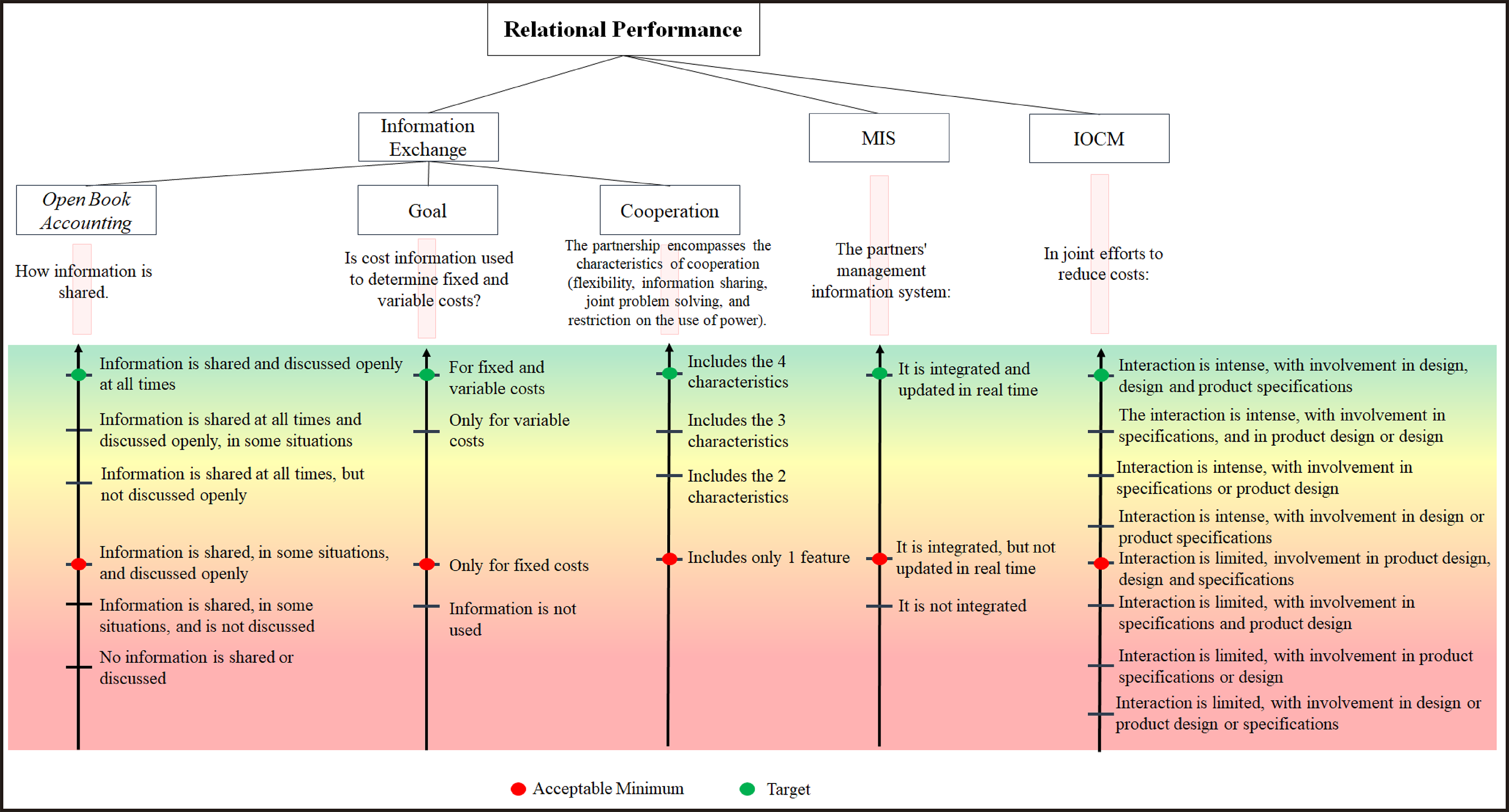
Jack et al. (2018) found in their study of performance measurement in fresh produce supply networks in the UK that the lack of fully integrated information systems between buyers, suppliers, and intermediaries makes the supply chain fragmented and incomplete, hindering fair outcomes in the supply chain. The findings of Fayard et al. (2012) show that electronic information integration can enable IOCM to provide joint benefits to supply chain partners. Based on the theoretical assumptions and empirical findings from the literature, metrics for evaluating IOCM were proposed and are shown in Figure 3.

In discussing the performance of interorganizational relationships and, consequently, the extended systems perspective, the discussion of the characteristics addressed in the theoretical framework is revisited. Although the constructed metrics do not explicitly emphasize each of the characteristics of extended systems presented, their role can be seen to be included in each measurement object. For Heigoldt and Asdecker (2011), metrics for the interorganizational context should be constructed in a way that avoids opportunistic behavior and manipulation.
Companies can decide which partners they enter into contracts with, regardless of the duration. When deciding to enter into an alliance to reduce costs and utilize resources, companies should focus their joint efforts on mutual benefit. Thus, although they are autonomous, there is a certain dependency on information for their joint goals to be achieved and for their efforts to lead to positive outcomes through the selection of appropriate metrics for the context (Bourne et al., 2018) (Drzymalski et al., 2010).
As it is a relationship in which control is decentralized, appropriate management among members is more complex because the decisions made may not be optimal for all members (Choi, 2018) and force decisions that may not be the best option for one of the partners individually but are beneficial for both parties. Thus, although organizations may be very heterogeneous, some factors cannot be ignored, such as synergy rather than the individual aspect (Bourne et al., 2018), to ensure cohesion emerges in the metrics used (Cuthbertson and Piotrowicz, 2008). In other words, when considering what is relevant for bilateral management, the heterogeneity of each organization must be respected, as each contributes in different ways to the achievement of common goals (Gomes et al., 2017), reinforcing the inherent characteristics of collaboration between partners.
Corsten and Felde (2005) mention that in extended systems, the connection between organizations should be measured, i.e. how they are involved in information exchange and how they cooperate (Alfaro et al., 2009). According to Ed-Daoui et al. (2019), the lack of connectivity can lead to interoperability issues, which refers to the ability of organizations’ systems to coexist. This increases the confidentiality of information (Folan and Browne, 2005; Bar-Lev et al., 2016) and makes it difficult to establish common goals and create connections that strengthen trust between partners (Caglio and Ditillo, 2021; Corsten and Felde, 2005).
The concern for cost reduction and continuous improvement emphasizes the emergence of the relationship reflected in the actions and interactions between the partners to achieve the established goals (Ed-Daoui et al., 2019). A lack of focused effort on these aspects can affect the performance of the relationship. Efatmaneshnik et al (2016) point out that emergent behaviors offer greater functionality than individual behaviors as they result from synergistic collaboration. Using information systems that track changes throughout the relationship is important as this facilitates information sharing. Since geography is not a barrier to interorganizational partnerships, the information system also enables integrated information sharing regardless of the location of the organizations.
Although there is evidence that collaboration between partners leads to better outcomes (da Piedade et al., 2012; Mircea et al., 2016), the literature also shows that joint efforts are not always successful (Houston and Johnson, 2000; Jiang et al., 2010). Therefore, it is important to monitor the performance of interorganizational relationships so that IOCM is more efficient and reduces the likelihood of opportunistic behavior among partners.
5 RESEARCH AGENDA
Historically, organizational performance evaluation has played an important role in organizational decision-making and actions (Folan and Browne, 2005; Choi, 2018). In the interorganizational context, Caglio and Ditillo (2021) mention that various contributions on forms, characteristics, and management accounting have been published in recent years. However, the topics of performance evaluation and interorganizational cost management represent burgeoning research fields and offer opportunities for various possible future research.
The lack of literature that has prevented the use of a unified search command to evaluate interorganizational cost management is an initial indication that much can be contributed to the literature on relational performance. Consistent with the review by Caglio and Ditillo (2021), it was found that little attention has been paid to collaboration between organizations in search of innovation and how new technologies affect interactions between partners. With the rapid development of technologies, it has become possible to form relational alliances with organizations regardless of location. However, few models in the literature can help operationalize extended systems.
The complexity associated with the use of extended systems may be a reason that hinders their operationalization due to factors such as conflicts of interest, information asymmetry, communication errors, lack of consensus on what to measure, and others. However, introducing inter-organizational cost management provides an opportunity to mitigate these issues as partner organizations join efforts to reduce costs and create value. Thus, the combination of AD and IOCM needs to be further developed.
IOCM offers mechanisms by which companies can reduce their product costs without compromising customer satisfaction. Although research on this topic has increased, it is still relatively scattered. It can be observed that IOCM is often studied in industry, with a focus on consumer discretionary goods (Caglio and Ditillo, 2021), while evidence in the service sector, for example, is scarce. Moreover, most studies focus on buyer-supplier relationships, leaving room for research on other relationships, such as horizontal and institutional partnerships.
Although several studies take a case study approach and focus on understanding what techniques were used (Cooper and Slagmulder, 2004; Agndal and Nilsson, 2009) and examine why IOCM (Uddin et al., 2020) and open book accounting (Moller et al., 2011; DhaifAllah et al., 2019; Fehr and Rocha, 2018; Windolph and Moeller, 2012) are chosen, no studies were found that analyzed the relational performance of the partner or the suggestion of metrics. Thus, it is suggested that researchers attempt to evaluate relational performance in the context of interorganizational cost management and empirically test the metrics proposed in this work.
6 CONCLUSION
The importance of interorganizational cost management (IOCM) to management interorganizational relationships is recognized in the literature and by professionals working within organizations. This aspect underscores the need to adequately understand the nature of this construct for interorganizational relationships. Given the lack of a comprehensive model that assesses the multidimensionality of IOCM and its underlying aspects, this study aimed to propose a set of metrics to evaluate relationship performance when managing interorganizational cost. We conducted a literature review using the constructivist intervention instrument ProKnow-C, which is recognized and used by researchers to select and analyze a bibliographic portfolio on a given topic.
It was noted that although this is an important topic for business competitiveness and efficiency, the literature is still scarce, and research is lacking, especially in terms of relational performance evaluation. Based on the analysis of IOCM studies, it was found that to propose a set of metrics appropriate for a more general context and applicable to different organizations, it is necessary to consider elements related to the proximity between the partners and that a bilateral approach should be applied to the relationship. The metrics deemed appropriate for this illustration include open accounting, the use of information, cooperation, management information systems (MIS), and IOCM. The metrics proposed in this research provide a consistent and replicable basis for different organizations.
Although the constituent elements of the metrics do not explicitly state the characteristics of the identified extended systems, it can be seen that they are included in the process of measuring the metrics through information sharing, inter-organizational cost management, alignment of objectives, commitment of resources, and joint actions for organizational improvement. Thus, the proposed structure meets the elements considered essential for the proper functioning of IOCM and the characteristics of extended systems.
It is important to emphasize that the topics of inter-organizational performance assessment and inter-organizational cost management (IOCM) are still evolving, highlighting the need for studies that explore how organizations can effectively operate extended systems, especially in sectors other than industry, such as services. Although the research agenda suggests relevant directions for future investigation, it is crucial that studies not only propose metrics but also test their applicability in different contexts, thus contributing to constructing a more robust and practical theoretical framework for IOCM and relational performance. From a theoretical point of view, the study proves relevant in synthesizing the characteristics of extended systems and other essential elements for the functioning of IOCM, which can serve as insights for future research. In a managerial context, the data presented may be useful for professionals working across organizational boundaries, as the discussion demonstrates the importance of assessing relational performance for the efficiency and success of interorganizational partnerships.
Although relevant contributions can be extracted from this study, it is important to mention the limitations inherent to the research. The proposed metrics were constructed according to our perceptions and knowledge of the subject. Therefore, the levels established as acceptable minimums and targets may differ from other researchers and should be adapted to the contextual reality. Likewise, since these are metrics of generic scope, the study was limited to relational proximity since the organizational specificities in relationships that occur in hybrid contexts vary considerably in each relationship.
ACKNOWLEDGMENTS
This work was supported by the State Fund to Support the Maintenance and Development of Higher Education (FUMDES) and by the Coordination for the Improvement of Higher Education Personnel (CAPES).
REFERENCES
-
Agndal, H., Nilsson, U. (2008). Supply chain decision-making supported by an open books policy. International Journal of Production Economics, 116(1), 154-167. https://doi.org/10.1016/j.ijpe.2008.08.038
» https://doi.org/10.1016/j.ijpe.2008.08.038 -
Agndal, H., Nilsson, U. (2009). Interorganizational cost management in the exchange process. Management Accounting Research, 20(2), 85-101. https://doi.org/10.1016/j.mar.2008.07.001
» https://doi.org/10.1016/j.mar.2008.07.001 -
Alfaro, J. J., Rodríguez-Rodríguez, R., Verdecho, M. J., 7 Ortiz, A. (2009). Business process interoperability and collaborative performance measurement. International Journal of Computer Integrated Manufacturing, 22 (9), 877-889. https://doi.org/10.1080/09511920902866112
» https://doi.org/10.1080/09511920902866112 -
Bar-Lev, R., Geri, N., Raban, D. R. (2016). Developing a financial statement-based effectiveness measure of interorganizational systems’ contribution. Journal of Computer Information Systems, 56(1), 62-69. https://doi.org/10.1080/08874417.2015.11645802
» https://doi.org/10.1080/08874417.2015.11645802 -
Bititci, U., Garengo, P., Dörfler, V., Nudurupati, S. (2012). Performance measurement: challenges for tomorrow. International journal of management reviews, 14(3), 305-327. https://doi.org/10.1111/j.1468-2370.2011.00318.x
» https://doi.org/10.1111/j.1468-2370.2011.00318.x -
Bourne, M., Franco-Santos, M., Micheli, P., & Pavlov, A. (2018). Performance measurement and management: a system of systems perspective. International Journal of Production Researc h, 56 (8), 2788-2799. https://doi.org/10.1080/00207543.2017.1404159
» https://doi.org/10.1080/00207543.2017.1404159 -
Caglio, A., Ditillo, A. (2021). Reviewing interorganizational management accounting and control literature: a new look. Journal of Management Accounting Research, 33(1), 149-169. https://doi.org/10.2308/jmar-18-082
» https://doi.org/10.2308/jmar-18-082 -
Choi, T. M. (2018). A system of systems approach for global supply chain management in the big data era. IEEE Engineering Management Review, 46 (1), 91-97. https://doi.org/10.1109/EMR.2018.2810069
» https://doi.org/10.1109/EMR.2018.2810069 -
Coad, A. F., Cullen, J. (2006). Inter-organizational cost management: Towards an evolutionary perspective. Management Accounting Research, 17(4), 342-369. https://doi.org/10.1016/j.mar.2006.02.003
» https://doi.org/10.1016/j.mar.2006.02.003 -
Cooper, R., Slagmulder, R. (2004). Interorganizational cost management and relational context. Accounting, organizations and society, 29(1), 1-26. https://doi.org/10.1016/S0361-3682(03)00020-5
» https://doi.org/10.1016/S0361-3682(03)00020-5 -
Cooper, R., Yoshikawa, T. (1994). Inter-organizational cost management systems: The case of the Tokyo-Yokohama-Kamakura supplier chain. International Journal of Production Economics, 37(1), 51-62. https://doi.org/10.1016/0925-5273(94)90007-8
» https://doi.org/10.1016/0925-5273(94)90007-8 -
Corsten, D., Felde, J. (2005). Exploring the performance effects of key-supplier collaboration: An empirical investigation into Swiss buyer-supplier relationships. International Journal of Physical Distribution & Logistics Management, 35(6), 445-461. http://dx.doi.org/10.1108/09600030510611666
» http://dx.doi.org/10.1108/09600030510611666 -
Cuthbertson, R., Piotrowicz, W. (2008). Supply chain best practices–identification and categorisation of measures and benefits. International Journal of productivity and performance management, 57(5), 389-404. https://doi.org/10.1108/17410400810881845
» https://doi.org/10.1108/17410400810881845 -
Da Piedade Francisco, R., Azevedo, A., & Almeida, A. (2012). Alignment prediction in collaborative networks. Journal of Manufacturing Technology Management, 23(8), 1038-1056. https://doi.org/10.1108/17410381211276862
» https://doi.org/10.1108/17410381211276862 -
Dekker, H. C. (2016). On the boundaries between intrafirm and interfirm management accounting research. Management Accounting Research, 31, 86-99. https://doi.org/10.1016/j.mar.2016.01.001
» https://doi.org/10.1016/j.mar.2016.01.001 -
Dekker, H. C., & Van Den Abbeele, A. (2010). Organizational learning and interfirm control: The effects of partner search and prior exchange experiences. Organization science, 21(6), 1233-1250. https://doi.org/10.1287/orsc.1090.0505
» https://doi.org/10.1287/orsc.1090.0505 -
Dhaifallah, B., Auzair, S. M., Maelah, R., & Ismail, M. D. (2019). Measuring Inter-organizational Cost Management and Open Book Accounting. Jurnal Pengurusan, 9 (1.5), 67-95. file:///E:/35253-110413-1-PB1.pdf
» file:///E:/35253-110413-1-PB1.pdf -
Dhaifallah, B., MD-Auzair, S., Maelah, R., & Ismail, M. D. (2020). The effect of product complexity and communication quality on IOCM and OBA in buyer-supplier relationships. Journal of Accounting & Organizational Change, 16 (1), 1-29. https://doi.org/10.1108/JAOC-04-2017-0035
» https://doi.org/10.1108/JAOC-04-2017-0035 -
Drzymalski, J., Odrey, N. G., Wilson, G. R. (2010). Aggregating performance measures of a multi-echelon supply chain using the analytical network and analytical hierarchy process. International Journal of Services, Economics and Management, 2(3-4), 286-306. https://doi.org/10.1504/IJSEM.2010.033368
» https://doi.org/10.1504/IJSEM.2010.033368 -
Ed-Daoui, I., Itmi, M., Hami, A. E., Hmina, N., Mazri, T. (2019). A study of an adaptive approach for systems-of-systems integration. International Journal of System of Systems Engineering, 9(1), 1-27. https://doi.org/10.1504/IJSSE.2019.097895
» https://doi.org/10.1504/IJSSE.2019.097895 -
Efatmaneshnik, M., Bradley, J., Ryan, M. J. (2016). Complexity and fragility in system of systems. International ournal of System of Systems Engineering, 7(4), 294-312. https://doi.org/10.1504/IJSSE.2016.080323
» https://doi.org/10.1504/IJSSE.2016.080323 -
Ellström, D., & Larsson, M. H. (2017). Dynamic and static pricing in open-book accounting. Qualitative Research in Accounting & Management, 14 (1), 21-37. http://dx.doi.org/10.1108/QRAM-09-2015-0071
» http://dx.doi.org/10.1108/QRAM-09-2015-0071 -
Ensslin, S. R., Welter, L. M., Pedersini, D. R. (2022), “Performance evaluation: a comparative study between public and private sectors”. International Journal of Productivity and Performance Management, 71(5), 1761-1785. https://doi.org/10.1108/IJPPM-04-2020-0146
» https://doi.org/10.1108/IJPPM-04-2020-0146 -
Faria, A. C. D., Soares, I. C., Rocha, W., Rossi, G. B. (2013). The Adoption of Interorganizational cost Management in a Vehicle Assembly plant in the Greater Region of ABC. Revista Brasileira De Gestão De Negócios, 15, 617-638. https://doi.org/10.7819/rbgn.v15i49.1228
» https://doi.org/10.7819/rbgn.v15i49.1228 -
Fayard, D., Lee, L. S., Leitch, R. A., & Kettinger, W. J. (2012). Effect of internal cost management, information systems integration, and absorptive capacity on inter-organizational cost management in supply chains. Accounting, Organizations and Society, 37 (3), 168-187. https://doi.org/10.1016/j.aos.2012.02.001
» https://doi.org/10.1016/j.aos.2012.02.001 -
Fehr, L. C. F. D. A., & Rocha, W. (2018). Open-book accounting and trust: influence on buyer-supplier relationship. RAUSP Management Journal, 53, 597-621. https://doi.org/10.1108/RAUSP-06-2018-0034
» https://doi.org/10.1108/RAUSP-06-2018-0034 -
Folan, P., Browne, J. (2005). A review of performance measurement: Towards performance management. Computers in industry, 56(7), 663-680. https://doi.org/10.1016/j.compind.2005.03.001
» https://doi.org/10.1016/j.compind.2005.03.001 -
Franco-Santos, M., Kennerley, M., Micheli, P., Martinez, V., Mason, S., Marr, B., Gray, D., & Neely, A. (2007), Towards a definition of a business performance measurement system. International Journal of Operations & Production Management, 27 (8), 784-801. https://doi.org/10.1108/01443570710763778
» https://doi.org/10.1108/01443570710763778 -
Gomes, R. C., Galina, S. V. R., Vicentin, F. O. D. P., Porto, G. S. (2017). Interorganizational innovation networks of Brazilian and Spanish biotechnology companies: Dynamic comparative analysis. International Journal of Engineering Business Management, 9, 1.12. https://doi.org/10.1177/1847979017739517
» https://doi.org/10.1177/1847979017739517 - Heigoldt, M., Asdecker, B. (2011). Medição de Desempenho da Cadeia de Suprimentos - Implementierung – Eine Komparative Studie. In Bogaschewsky, R., Eßig, M., Lasch, R., & Stölzle, W. (Eds.). Supply Management Research: Aktuelle Forschungsergebnisse 2011 (pp. 169-186). Gabler.
-
Houston, M. B., Johnson, S. A. (2000). Buyer–supplier contracts versus joint ventures: Determinants and consequences of transaction structure. Journal of marketing research, 37(1), 1-15. http://www.jstor.org/stable/1558537
» http://www.jstor.org/stable/1558537 -
Jack, L., Florez-Lopez, R., Ramon-Jeronimo, J. M. (2018). Accounting, performance measurement and fairness in UK fresh produce supply networks. Accounting, Organizations and Society, 64, 17-30. https://doi.org/10.1016/j.aos.2017.12.005
» https://doi.org/10.1016/j.aos.2017.12.005 -
Jiang, Z., Henneberg, S. C., Naudé, P. (2010). Exploring trust vis-à-vis reliance in business relationships: A qualitative analysis in the UK construction industry. Marketing Intelligence & Planning, 28(6), 706-722. http://dx.doi.org/10.1108/02634501011078110
» http://dx.doi.org/10.1108/02634501011078110 - Keeney, R. L. (1992). Value focused-thinking: a path to creative decision-making. Harvard Univ. Press.
-
Melnyk, S. A., Bititci, U., Platts, K., Tobias, J., Andersen, B. (2014). Is performance measurement and management fit for the future? Management accounting research, 25(2), 173-186. https://doi.org/10.1016/j.mar.2013.07.007
» https://doi.org/10.1016/j.mar.2013.07.007 -
Mircea, M., Ghilic-Micu, B., Stoica, M., Sinioros, P. (2016). Inter-organizational performance and business process management in collaborative networks. Economic Computation & Economic Cybernetics Studies & Research, 50(2), 107-122. https://ideas.repec.org/a/cys/ecocyb/v50y2016i2p107-122.html
» https://ideas.repec.org/a/cys/ecocyb/v50y2016i2p107-122.html -
Möller, K., Isbruch, F. (2008). Interorganisationales Kostenmanagement–Erfolgspotenzial oder Kooperationsrisiko? Zeitschrift für Planung & Unternehmenssteuerung, 18(4), 387-406. https://doi.org/10.1007/s00187-007-0037-9
» https://doi.org/10.1007/s00187-007-0037-9 -
Möller, K., Windolph, M., Isbruch, F. (2011). The effect of relational factors on open-book accounting and inter-organizational cost management in buyer–supplier partnerships. Journal of Purchasing and Supply Management, 17(2), 121-131. https://doi.org/10.1016/j.pursup.2011.01.002
» https://doi.org/10.1016/j.pursup.2011.01.002 -
Ricciotti, F. (2020). From value chain to value network: a systematic literature review. Management Review Quarterly, 70 (2), 191-212. https://doi.org/10.1007/s11301-019-00164-7
» https://doi.org/10.1007/s11301-019-00164-7 -
Romano, P., Formentini, M. (2012). Designing and implementing open book accounting in buyer–supplier dyads: A framework for supplier selection and motivation. International Journal of Production Economics, 137(1), 68-83. https://doi.org/10.1016/j.ijpe.2012.01.013
» https://doi.org/10.1016/j.ijpe.2012.01.013 -
Sohn, S. K., Shin, I. H., Park, S. (2015). Implementation of interorganizational cost management and its infrastructure: the case of a Korean ‘Chaebol’ firm. Asia Pacific Business Review, 21(2), 228-250. 10.1080/13602381.2014.928105
» https://doi.org/10.1080/13602381.2014.928105 -
Stevens, S. S. (1946). On the theory of scales of measurement. Science, New Series, 103 (2684), 677-680. https://www.jstor.org/stable/1671815
» https://www.jstor.org/stable/1671815 -
Tasca, J. E., Ensslin, L., Ensslin, S. R., & Alves; M. B. M. (2010). An approach for selecting a theoretical framework for the evaluation of training programs. Journal of European Industrial Training, 34 (7), 631-655. https://doi.org/10.1108/03090591011070761
» https://doi.org/10.1108/03090591011070761 -
Uddin, M. B., Fu, Y., Akhter, B. (2020). Inter-organizational cost management: effects of antecedents and methods in a hybrid relational context. Journal of Business & Industrial Marketing, 35(5), 909-923. https://doi.org/10.1108/JBIM-07-2019-0348
» https://doi.org/10.1108/JBIM-07-2019-0348 -
Welter, L. M., Ensslin, S. R. (2021). How do the unintended consequences of performance evaluation systems manifest themselves? Journal of Accounting & Organizational Change, 18(4), 509-528. https://doi.org/10.1108/JAOC-07-2020-0087
» https://doi.org/10.1108/JAOC-07-2020-0087 -
Windolph, M., Moeller, K. (2012). Open-book accounting: Reason for failure of inter-firm cooperation? Management Accounting Research, 23 (1), 47-60. https://doi.org/10.1016/j.mar.2011.07.001
» https://doi.org/10.1016/j.mar.2011.07.001
-
Copyrights
Authors of articles published by ReA/UFSM retain the copyright of their works.
-
Plagiarism Check
The ReA/UFSM maintains the practice of submitting all documents approved for publication to the plagiarism check, using specific tools, e.g.: Turnitin.
Edited by
-
Edited by
Jordana Marques Kneipp

 Source: Research data
 Source: Research data
 Source: Developed by the authors