
 Are thematic bond issuers keeping their promises? A contribution to the greenwashing analysis
ABSTRACT
We analyse the transparency of Brazilian companies issuing green, social and sustainability (GSS) bonds by conducting a content analysis of the pre- and post-issuance reports and indentures of GSS bonds issued in 2021, which was the year with the highest issuance volume. Brazil was selected as it is the largest Latin American market in terms of both market capitalisation and GSS bond issuance, and because of the role these bonds could play in financing activities that protect Brazil’s natural capital and help it to achieve its social goals. We found low disclosure rates, with 26% of issuers publishing a bond framework, 21% of transactions having an allocation report, and 27% having an impact report. We also found that penalty mechanisms of bond indentures for non-reporting are not being implemented: although 87% of transactions stipulate sanctions, most issuers still do not publish post-issuance reports. The findings suggest that the cost of compliance discourages issuer disclosure and that issuers see little value in improving transparency, while investors are not demanding further reporting, raising questions about the materiality of this information. This paper contributes to the literature on labelled bonds and greenwashing by analysing how companies engage in greenwashing behaviour through omitting material information to assess bond performance (i.e. a gap in ‘disclosure’ promises) when the cost-benefit of disclosure is unfavourable. For practitioners, the findings underscore the need to establish standardised documentation for GSS bond issuances, with data accessible via a public database.
Keywords
Green bonds; Greenwashing; Self-regulation; Reporting
RESUMO
O artigo analisa o grau de transparência das empresas brasileiras emissoras de títulos verdes, sociais e de sustentabilidade (GSS, na sigla em inglês) por meio de uma análise de conteúdo de relatórios de pré e pós-emissão e escrituras de títulos GSS emitidos em 2021, ano com o maior volume de emissões. O Brasil foi selecionado por ser o maior mercado da América Latina em termos de capitalização de mercado e emissão de títulos GSS, bem como pelo papel que esses títulos podem desempenhar no financiamento de atividades que protegem o capital natural do país e contribuem para alcançar objetivos sociais. Observa-se baixo grau de relato: 26% dos emissores publicaram bond frameworks, 21% das operações divulgaram relatórios de alocação e 27% divulgaram relatórios de impacto. Também se constatou que as penalidades previstas nas escrituras dos títulos caso não publiquem relatórios de pós-emissão não estão sendo implementadas: embora 87% das transações estipulem sanções, a maioria dos emissores não publica relatórios de pós-emissão. Os resultados da pesquisa indicam que o custo de conformidade desincentiva a divulgação por parte dos emissores, que atribuem pouco valor ao aprimoramento de sua transparência, enquanto os investidores não estão exigindo maior divulgação, o que gera dúvidas sobre a materialidade dessas informações. Este artigo contribui para a literatura acadêmica sobre títulos rotulados e greenwashing ao analisar como as empresas se engajam em greenwashing ao omitirem informações materiais para avaliar o desempenho dos títulos (isto é, uma lacuna na promessa de relato) quando o custo-benefício da divulgação é desfavorável. Para os profissionais de mercado, os resultados ressaltam a necessidade de estabelecer documentação padronizada para as emissões de títulos do GSS, disponibilizando os dados em um banco de dados de acesso público.
Palavras-chave
Títulos verdes; Greenwashing; Autorregulação; Relato
1 INTRODUCTION
Global annual financial flows toward mitigation and adaptation activities reached US$1.46 trillion in 2022, a growing, but insufficient sum compared to the US$7.4 trillion required each year through 2030 (Naran et al., 2024). In emerging markets and developing countries, the climate financing gap represents US$2-2.8 trillion per year, with spending priorities in energy, resilience, sustainable agriculture and ecosystem conservation (Songwe et al., 2022). A large financing gap is also observed for developing economies to achieve the Sustainable Development Goals (SDGs), estimated at US$4 trillion each year through 2030 (UNCTAD, 2023).
In view of these financing needs, a variety of public and private resources will be required for developing countries to reach their climate and SDG commitments (Tolliver et al., 2020). Among the financial mechanisms available, green bonds – and more recently, social and sustainability bonds – have gained prominence as potential catalysts toward a low-carbon and sustainable economy by directing debt finance to sustainable economic activities (Tuhkanen & Vulturius, 2022). As of 31 December 2024, the cumulative volume of green, social, and sustainability (GSS) bonds reached US$5.7 trillion (CBI, 2024), driven by investor demand and regulatory pressure (de Mariz, 2022; de Mariz et al., 2025; Redondo Alamillos & de Mariz, 2022).
Despite the great optimism towards GSS bonds, there is limited evidence that their use of proceeds is contributing toward a sustainable transition. One of the barriers to obtaining such evidence is the restricted degree of transparency of bond issuers (for instance, see Tuhkanen & Vulturius, 2022).
In an effort to increase the transparency of GSS bond issuances and reduce the risk of greenwashing, we have seen a variety of regulations and voluntary guidelines emerge that focus on reporting practices for bond issuers. These include the International Capital Market Association’s (ICMA) Green Bond Principles, Social Bond Principles and Sustainability Bond Guidelines, which recommend the publication of bond frameworks, annual reports and external reviews.
Given this context of an apparent low level of transparency among bond issuers, this article aims to analyse the extent of reporting of Brazilian GSS bond issuers, in order to examine the effectiveness of the aforementioned disclosure self-regulations. Our analysis provides insights into actions that could be adopted by regulators and other financial market actors to reduce information asymmetry, protect investors from the risk of greenwashing, and foster greater integrity in the market.
This research draws on a database created by the authors containing 78 labelled use-of-proceeds bonds issued by 65 Brazilian financial and non-financial companies in 2021 – the year with the highest number of issuances on record in the country. The database contains data retrieved from pre- and post-issuance reports, annual reports, and bond indentures.
Analysing 13 disclosure indicators, we found a low degree of pre- and post-issuance transparency by bond issuers. This indicates that the cost of compliance discourages issuer disclosure and that issuers see little value in improving transparency, whereas market participants – including investors, financial intermediaries and fiduciary agents – are not adequately tracking the disclosure of allocation information or demanding further reporting, which raises questions about the materiality of this information for investors.
The findings also suggest that voluntary commitments such as ICMA guidelines are insufficient to encourage improved disclosure practices by issuers, corroborating previous studies that highlight the limited effectiveness of voluntary initiatives in advancing members’ transparency and performance (Aragòn-Correa et al., 2020; Kim & Yoon, 2023; Sastry et al., 2024; Short & Toffel, 2010).
This research contributes to filling a gap in the academic literature on greenwashing behaviour in the financial sector. Whereas previous studies lack empirical research and focus on analysing the corporate mismatch between performance and disclosure (Bernini et al., 2024), this paper uses empirical data to analyse how companies engage in greenwashing not necessarily by making false claims, but by omitting information from investors that would allow an assessment of bond performance when the cost-benefit of disclosure is unfavourable. This research also contradicts previous studies that stress investor preference for divesting bonds and engaging with issuers in case of poor reporting practices (Sangiorgi & Schopohl, 2021).
This paper is structured as follows. In Section 2, we provide an overview of previous studies on green bonds, greenwashing, and the interaction between these two topics. Section 3 presents the methods employed. Section 4 presents findings on issuer transparency before and after issuance. Section 5 discusses the empirical findings, and Section 6 contains concluding remarks and suggestions for future studies.
2 LITERATURE REVIEW
2.1 Extant literature on green bonds
Green bonds are a particular type of fixed-income financial instrument distinguished from conventional bonds by requiring that the funds raised be allocated to eligible projects that have a positive contribution to the environment, such as climate change mitigation/adaptation, biodiversity conservation, or pollution prevention and control (Broadstock & Cheng, 2019; Flammer, 2021). Hence, green bonds are mostly identical in structure, risk, and return to vanilla bonds, except that they allocate capital to fund projects with a positive environmental contribution (Deschryver & de Mariz, 2020).
Since the first issuance of a green bond by the European Investment Bank in 2007, issuances have risen and amounted to US$671.7 billion in 2024, largely financing clean energy and energy efficiency projects (CBI, 2024; Deschryver & de Mariz, 2020; Sangiorgi & Schopohl, 2021).
The literature on green bonds ranges from the comparison between green and conventional bond pricing (Broadstock & Cheng, 2019; Hyun et al., 2021; MacAskill et al., 2021; Partridge & Medda, 2019; Silva et al., 2024), the relationship with commodities markets and hedging properties (Mohammed et al., 2024; Naeem et al., 2021; Nguyen et al., 2021), factors influencing the development of green bond markets (Banga, 2019; Cochu et al., 2016; Jun et al., 2016; Rajhans, 2023; Tolliver et al., 2020), the relationship with sustainable development (Flammer, 2021; Sinha et al., 2021; Tolliver et al., 2020) and the degree of disclosure of green bond issuers (González-Ruiz et al., 2023; Sangiorgi & Schopohl, 2021; Tuhkanen & Vulturius, 2022).
On green bond pricing, MacAskill et al. (2021) conducted a systematic literature review of studies published between 2007 and 2019, finding a consensus on the existence of a green premium – or ‘greenium’ – within 56% of primary and 70% of secondary market studies, particularly for those green bonds that are government issued, investment grade, and that follow defined green bond governance and reporting procedures. On the other hand, Liu (2024) found a negative green bond premium of 11 basis points by analysing a dataset of 13,199 monthly green bond observations between 2011 and 2019, consistent with previous studies on green bond pricing (Hachenberg & Schiereck, 2018; Zerbib, 2019). Comparing green bonds with conventional and carbon-intensive (black) bonds, Silva et al. (2024) find that portfolios composed of green bonds do not sacrifice returns relative to the other two categories. Moreover, during periods of heightened uncertainty around climate policy, green bonds outperform non-labelled bonds.
Studying the relationship with commodity markets, Nguyen et al. (2021) found a negative correlation between green bonds, stocks, and commodities, especially from 2013 onwards, after the financial crisis of 2007-2009. Likewise, Abuzayed & Al-Fayoumi (2023) observe that, due to low correlation, green bonds could add substantial diversification benefits for investors holding assets in clean energy, global stocks and commodities. Mohammed et al. (2024) show that green bonds have hedging properties with respect to geopolitical risks and increases in U.S. interest rates, compared to traditional fixed-income benchmarks, such as Treasury and corporate bond indices.
Another strand of the literature analyses the drivers and barriers that influence the development of green bond markets. Tolliver et al. (2020) find that macroeconomic, institutional factors and the robustness of a country’s Nationally Determined Contributions (NDC) positively influenced green bonds markets. As for challenges to scaling up such markets, Jun et al., (2016) identify issues such as the underdevelopment of the domestic institutional investor base, insufficient market liquidity and high costs in obtaining second-party opinion. Cochu et al. (2016) point to the lack of green projects pipeline and clarity about green investments’ risk profile.
On the relationship with sustainable development, green bonds are seen as part of the solution to channel financial flows towards projects aligned with sustainable development, given the significant volumes of capital required for the transition (Kedia & Joshipura, 2023). For instance, Dong et al. (2024) show that green bonds issuance in China from 2011 to 2020 had a positive effect on green innovation.
Regarding level of reporting of green bond issuers, Tuhkanen & Vulturius (2022) find several constraints in issuers’ reporting practices of European green bonds. In the Latin American and Caribbean region, González-Ruiz et al. (2023) note a poor level of reporting in the renewable energy sector, finding little or no information available in the usual channels dedicated to investor information. Analysing the impact of disclosure on investor decision to keep a green bond, Sangiorgi & Schopohl (2021) observe that 55% of 48 European asset managers surveyed would sell a green bond due to post-issuance insufficient reporting, while 30% were more likely to sell and/or to engage with the issuer. In the same survey, respondents pointed toward greenwashing as an obstacle for green bond growth, indicating investor concern that green bonds might be misused by issuers for raising funding for projects that lack sufficient green credentials or by investors that are more concerned about the green label of bonds than their green impact.
2.2 The evolution of the greenwashing literature
Various systematic review articles (Bernini et al., 2024; de Freitas Netto et al., 2020; Montgomery et al., 2024; Yang et al., 2020) analyse the extant literature on greenwashing.
Bernini et al. (2023) note that the most common definition of greenwashing emphasises the misalignment between corporate disclosure (‘talk’) and performance (‘walk’). They also observe a focus on environmental topics, with fewer studies on the social dimension of greenwashing and a gap in empirical research. In addition, they find a predominance of studies adopting quantitative methods over qualitative studies.
Analysing the 2015-2022 period, Montgomery et al. (2024) divide the greenwashing literature into three phases. In the first phase (‘Static Communication’), greenwashing is aimed at consumers, often through advertising or packaging (Szabo & Webster, 2021; Wu et al., 2021). In the second phase (‘Dynamic Management’), greenwashing becomes broader with new techniques and mechanisms (Ginder et al., 2021; Snellman, 2012) and the involvement of multiple stakeholders (e.g., employees, government) as targets or intermediaries of greenwashing (Alon-Barkat, 2020; Strauss, 2021; Testa et al., 2018; Torelli et al., 2020). The third phase (‘Narratives about the Future’) highlights upcoming issues such as ‘futurewashing’ (e.g. examining the credibility of net-zero targets) and the increasing role of the financial industry as targets of firms’ messaging, with potential to reward or punish companies through capital allocation (Chen et al., 2020).
Examining the financial sector, recent studies analyse financial institutions acting as greenwashing agents. For instance, Kim & Yoon (2023) assess whether US mutual funds exhibited superior environmental, social and governance (ESG) performance after signing to the UN Principles for Responsible Investment (PRI), finding no improvements in ESG scores or fund returns. Likewise, Abouarab et al. (2025) observed an increase in the inflows from investors in U.S. environmental funds after they announced their commitments to integrate sustainability into their investment decisions, but no reduction in their carbon footprints compared to conventional funds. Similarly, in the banking industry, Sastry et al. (2024) note that joining the Net Zero Banking Alliance (NZBA) boosted lender’s ESG rating but led to no changes in banks’ lending or loan pricing compared to banks without such climate pledge, casting doubt on the efficacy of voluntary commitments for reducing financed emissions.
Recent studies also investigate the association between green bonds and greenwashing. Exploring a sample of over 3,000 green bonds issued internationally, Baldi & Pandimiglio (2022) found that investors accept lower returns for green bonds issued by local governments and the services sector when compared to sovereign bonds and bonds issued by the manufacturing sector. According to the authors, investors find the performance of the services sector and local governments easier to monitor and therefore reward them for the lower risk of greenwashing with a lower cost of capital. Examining European green bonds, Tuhkanen & Vulturius (2022) found various limitations in issuers’ reporting practices, suggesting that there is little pressure from investors, regulators or society to reduce information asymmetry and the risk of greenwashing.
We note in the abovementioned studies that the risk of greenwashing in the financial sector can be materialised either by issuers and financial institutions not keeping their ‘disclosure’ promises (Tuhkanen & Vulturius, 2022) or not keeping their ‘performance’ promises (Abouarab et al., 2025; Kim & Yoon, 2023; Sastry et al., 2024). These two facets of greenwashing risk are reflected in the definitions of greenwashing provided by the European Supervisory Authorities (ESAs) (EBA 2023, p, p. 5) – ‘a practice whereby sustainability-related statements, declarations, actions, or communications do not clearly and fairly reflect the underlying sustainability profile of an entity, a financial product, or financial services’ – and by ICMA (2023, p, p. 6) – ‘a misrepresentation […] of the sustainable commitments and/or achievements of an issuer that is either intentional or due to gross negligence’. According to these definitions, greenwashing can arise due to omission of information, due to actual provision of information that is false, deceives or is likely to deceive market participants (i.e., a gap in ‘disclosure’ promises) or due to misconduct that result in misleading actions i.e., (a gap in ‘performance’ promises).
In this paper, we examine the fulfilment of the ‘disclosure’ promises by analysing the reporting practices of Brazilian GSS bond issuers.
Previous studies have examined greenwashing as a mismatch between communication and performance, yet few have investigated the institutional mechanisms that underpin such selective transparency in financial markets. To address this gap, this paper draws on legitimacy theory to explain how issuers’ disclosure practices may reflect attempts to secure legitimacy rather than to increase transparency.
Legitimacy theory provides a powerful lens through which to interpret organizational responses to societal expectations, particularly in the realm of sustainability and corporate responsibility. Building on Suchman’s (1995) foundational typology of pragmatic, moral, and cognitive legitimacy, organisations can be understood as operating within socially constructed systems of meaning that define what is perceived as “appropriate” or “desirable.” Within this framework, legitimacy is not a fixed attribute but a dynamic resource that organisations continuously negotiate in response to external scrutiny. Aguilera et al. (2007) further refine this understanding by framing legitimacy as a relational motive, a socially embedded drive for approval and acceptance that ensures organizational survival. In this view, corporate social responsibility (CSR) and sustainability practices are not only technical or strategic tools but also moral and relational acts aimed at preserving an organization’s social license to operate.
However, as Tee and Raschke (2023) argue, the institutionalisation of ESG norms has intensified legitimacy pressures, incentivising firms to engage in symbolic rather than substantive compliance. When actual ESG performance is low, firms often turn to communicative strategies such as selective disclosure or rhetorical amplification to maintain legitimacy in the eyes of stakeholders. Greenwashing represents a form of decoupling of talk and action, whereby the pursuit of symbolic legitimacy becomes a substitute for genuine sustainability transformation. From this perspective, greenwashing is not merely deceptive behaviour but an institutionalised response to the dual demands of accountability and conformity in an environment where legitimacy itself has become a strategic asset.
Taken together, these perspectives illustrate that legitimacy and greenwashing are intertwined phenomena operating across structural, relational, and strategic levels of analysis. Suchman (1995) conceptualises the institutional scaffolding that defines what counts as legitimate, Aguilera et al. (2007) illuminate the relational and moral motives that sustain the pursuit of legitimacy, and Tee and Raschke (2023) reveal how these motives materialise in managerial behaviour under performance pressures. Integrating these insights suggests that greenwashing emerges not only from opportunistic intent but from the institutional tension between symbolic legitimacy maintenance and substantive organisational change – a tension that defines much of the contemporary sustainability discourse.
3 METHODS
This paper analyses GSS use-of-proceed bonds, issued between 1 January and 31 December 2021 by Brazilian financial and non-financial companies. The year of 2021 was selected since it was a record year for issuances of labelled bonds globally (5,709 GSS bond issuances) and by Brazilian issuers (78 GSS bond issuances) and because the three-year lag (2021-2024) allowed for sufficient time for issuers to publish post-issuance documentation, such as allocation and impact reports. Hosting the world’s largest biological diversity and the largest Latin American market by market capitalisation and GSS bond issuance (CBI, 2025; WFE, 2025), Brazil was selected due to the role that GSS bonds could have in increasing private financial flows to activities that help protect natural capital, such as conservation of terrestrial and aquatic biodiversity and sustainable agriculture, as well as activities with social objectives, including access to affordable housing, health, education and basic infrastructure.
The size of the sample is a clear limitation to the analysis. While the selection considers a record year for issuances (2021) and a country with large environmental assets (Brazil), the sample remains limited and future studies may extend research to other countries and longer time periods.
The list of GSS bonds was retrieved from a database of Brazilian sustainable credit operations that is publicly available and hosted by Brazilian second-party opinion (SPO) provider ERM NINT. This database includes information on issuances, such as the volume issued, the date of issuance, the type of issuer (financial or non-financial corporation), and the type of use of proceeds (green, social or sustainability). It also includes the SPO provider and a link to the SPO. To only maintain use-of-proceeds bonds in the sample, we excluded all sustainability-linked bonds, loan operations and funds, from the ERM NINT list obtaining a final sample of 65 issuers and 78 GSS bonds. We complemented the data with information about the issuers’ industry sector, existence of investor relations page on the company’s website, publication of 2021 annual reports and benchmarks adopted in these reports (e.g. Global Reporting Initiative – GRI).
We justify the selection of indicators with a careful review of market best practices, by compiling the indicators that are recommended for disclosure. Specifically, we selected the 12 disclosure indicators based on the reporting recommendations of ICMA’s 2018 Green Bond Principles (GBP), the latest version of the GBP that issuers were able to consult in 2021 for disclosure guidance. In addition, we included an indicator for the existence of penalty mechanisms found in the bonds indenture for cases in which bond issuers fail to disclose allocation and impact reports. We obtained a total of 13 indicators, as shown in Table 1.
Later, we accessed the company websites of the 65 issuers to collect all relevant documents containing these indicators. We retrieved pre-issuance requirements such as sustainability, green and social bond frameworks (used as a basis for the 2021 issuance), as well as the SPOs of these frameworks and issuances. We also retrieved post-issuance reports such as allocation reports, impact reports, and external reviews of these documents. We also collected the 2021 annual reports and the indenture or issuance documentation. To supplement the data, we also retrieved SPOs from the ERM NINT database if they were not available on the issuer’s website.
Finally, in an iterative process, we collected the indicators selected in these documents to fill the database. This process involved the inclusion or exclusion of disclosure indicators until the final database was reached. Data collection was finalised on 16 May 2024.
4 RESULTS
4.1 Descriptive analysis
Within the sample analysed for 2021, we find 65 individual issuers for a total of 78 transactions, representing a volume of US$5.6 billion in labelled issuance. Most issuances are domestic, in Brazilian real, except for four large operations in US dollars, comprising 32% of the total issuance volume. Sixty-nine operations are labelled green bonds, followed by social bonds (five transactions) and sustainable bonds (four transactions).
Out of the 65 issuers, seven are financial institutions and 58 are non-financial institutions, mainly from the renewable energy (39%) and agriculture (17%) sectors by volume of issuance.
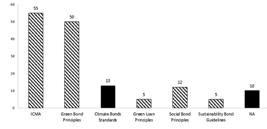
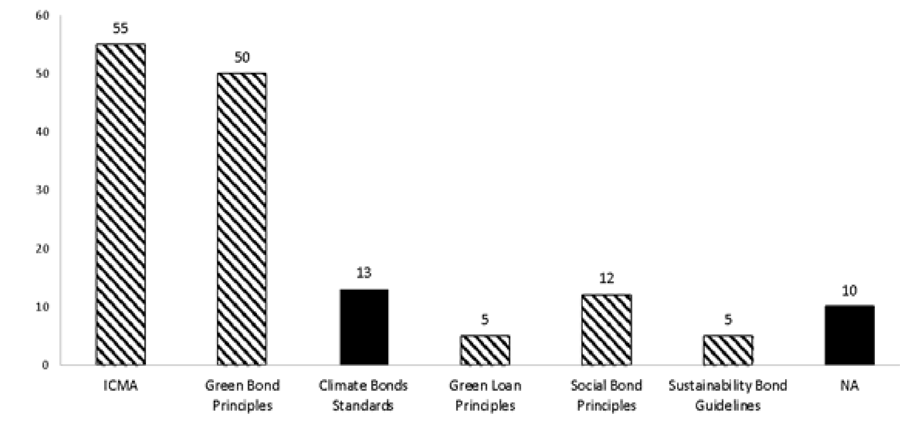
Fifty-five of the 65 issuers (equivalent to 85% of the sample) adopt as benchmark for the issuances one of the modalities of ICMA, such as the Green Bond Principles, Green Loan Principles, Social Bond Principles or Sustainability Bond Guidelines. The Green Bond Principles are by far the most common principles, followed by 50 companies (Figure 1).
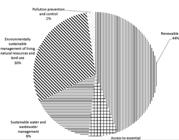
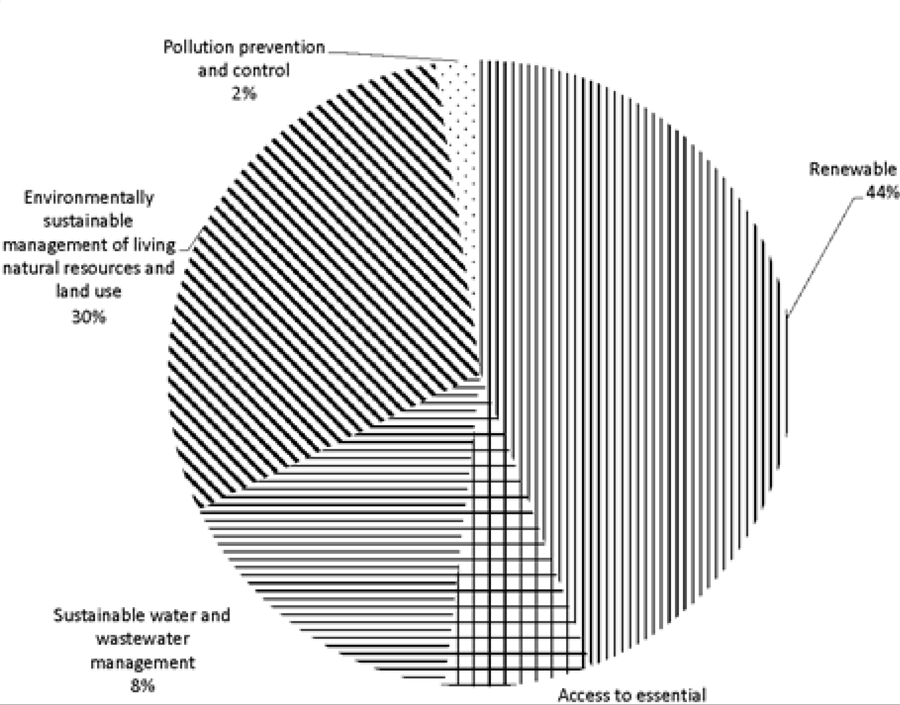
Within the sample, 16 transactions corresponding to 45% of the total net proceeds indicate sectorial categories, according to the actual allocation reports. The most popular categories include renewable energy (44% of total use of proceeds), environmentally sustainable management of living natural resources and land use (30%) and access to essential services (16%) (Figure 2).
GSS bond frameworks (DI-1): In the sample analysed, only 17 of the 65 individual issuers (equivalent to 26% of the sample) have a publicly available green, social or sustainability bond framework from 2021 or earlier, explaining the alignment of their bond programme with the four core components of use-of-proceed bonds (i.e., Use of Proceeds, Process for Project Evaluation and Selection, Management of Proceeds and Reporting). The remaining 48 issuers do not have a framework that is public and that therefore could be analysed by investors or stakeholders. This finding is consistent with the disclosure of green bond frameworks only becoming a ‘key recommendation’ in the 2021 version of the Green Bond Principles, whereas the 2018 version does not mention it as a recommendation or obligation for the issuer, even though it recommends the disclosure of a summary illustrating the alignment of the bond with the four components of the GBP to help inform market participants.
Interestingly, the average issuance for companies with a publicly available framework amounted to US$128 million, compared to US$47 million for companies without a framework, consistent with the hypothesis that larger companies and larger issuances benefit from better transparency. This also suggests that cost of compliance may be a deterrent for smaller companies. All four international issuances had a publicly available framework.
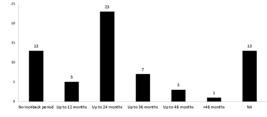
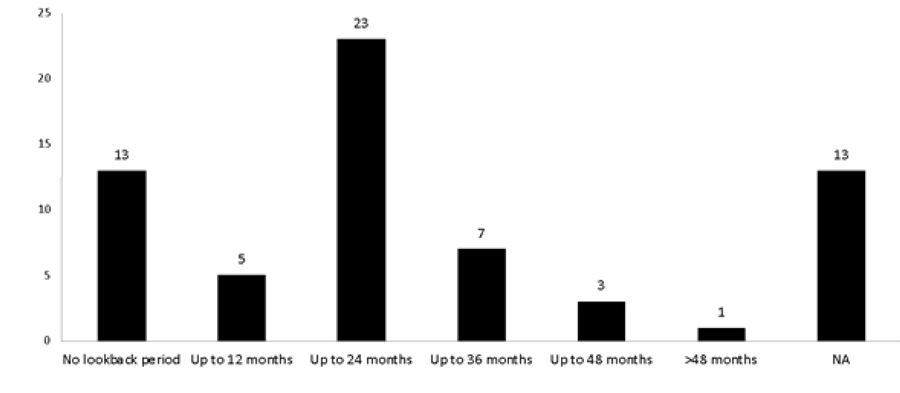
Look-back period (DI-2): In the analysed sample, 52 of the 65 issuers disclose a look-back period (Figure 3). While there is no limitation on the look-back period in the Green Bond Principles, the majority (35 issuers, cumulative) consider an explicit look-back period of up to 36 months to allocate net proceeds of an issuance, in line with market preference, of three to five years (IFC, 2020). Thirteen issuers do not allow for a look-back period.
Commitment to post-issuance reporting (DI-3 and DI-4): In the pre-issuance reports, 52 of the 65 issuers (80% of the sample) commit to publishing allocation and impact reports, respectively, despite it being a requirement of the 2018 Green Bond Principles.
Second party opinion (DI-5): In the sample of 65 issuers, 62 companies have an SPO based on the framework or on the documentation of the bond issuance. The SPO is available on the company’s website of only 31 companies, whereas, for the remaining 34 issuers, SPOs were found on the ERM NINT website.
4.2 Post-issuance transparency
Publishing an allocation report (DI-6): At the time of this analysis (May 2024), 29 months had passed since the end of 2021, offering issuers ample time to meet this requirement. We note, for example, that Bloomberg’s methodology to classify green bonds requires issuers to publish their post-issuance allocation or impact reports within one year after issuance, flagging them as ‘on watch’ in the absence of a report published within 15 months of issuance (Beteta Vejarano & Swinkels, 2023). In the sample, we find that there are allocation reports for only 16 of the 78 transactions.
Reporting allocation at bond level (DI-7): In only 18 of the 78 issuances, the use of proceeds was reported at the bond level, with six transactions reporting at the programme or corporate level and 54 not reporting use of proceeds.
Allocation to financing vs. refinancing (DI-8): Within our sample of 78 issuances, we found granular information in fund allocation for 13 transactions, corresponding to 37% of the total volume of raised proceeds. We find that 45% of net proceeds were used to refinance projects, while 55% were used to finance new projects, roughly in line with a recommendation set forth by the International Finance Corporation (IFC) that ‘a typical balance between existing and future assets might be in the region of 50/50’ IFC (2020, p. 28). The data suggests that GSS are contributing to attracting new funding for sustainable projects, but more disclosure is needed from the remaining issuances (63% in volume) for a full picture.
Publishing an impact report (DI-10): We find that there are impact reports for 21 of the 78 transactions.
Impact metrics (DI-11): Within the available impact reports, we counted 104 impact metrics, with a low level of standardisation, that can be classified under five broad categories that follow the ICMA categories. Unsurprisingly, 41% of the impact metrics fall under the renewable energy category, including metrics such as ‘Annual renewable energy generation in MWh’, ‘Percentage of renewable energy purchase (%)’, or ‘Annual GHG emissions avoided in tons of CO2 equivalent’. Twenty-three percent correspond to employment generation, followed by pollution prevention and control (20%).
External reviews (DI-9 and DI-12): Of the 16 published allocation reports, eleven were externally verified. Of the 21 impact reports published, eight were externally verified. This low level of external verification raised questions about the quality of the available data.
Penalty mechanisms (DI-13): In case of non-compliance with post-issuance commitments, such as non-allocation of 100% of the net proceeds or non-publication of allocation or impact reports, we find that there are explicit mechanisms in place in the bond indentures of 68 of the 78 transactions to accelerate the debt. The most common mechanism (66 out of 68 transactions) is a facultative early maturity (‘vencimento antecipado facultativo’), whereby the issuer must call a meeting with bondholders within a short predefined timeframe to decide whether to accelerate the debt. The other two instances have the same practical consequence, but use different mechanisms, namely defined mandatory repurchase (‘recompra compulsória deliberada’) or sale of capital set aside (‘liquidação do patrimônio separado’). The remaining ten transactions do not have an explicit provision in case of non-compliance with the obligation to disclose allocation. The data highlights that borrowers in theory face penalties for failing to meet their reporting target, but the penalties are rarely implemented.
5 DISCUSSION
This research shows that the level of disclosure of Brazilian labelled bond issuers is subpar. Regarding pre-issuance reporting, although 55 of the 65 issuers (85%) state that they follow ICMA rules, a minority of companies (17 of 65 issuers, 26%) have a publicly available framework, while the SPOs are available on the company websites of only 31 issuers (48%). On post-issuance disclosure, there are allocation reports for 16 of the 78 transactions (21%) and impact reports for 21 transactions (27%), even though 52 of the 65 issuers (80%) promised them in their pre-issuance documents. In only 18 of the 78 issuances (23%), the use of proceeds is reported at the bond level.
The limited level of disclosure by GSS bond issuers curbs the ability of policymakers and other actors to analyse whether the use of the proceeds of these bonds is effectively channelling financial flows to sustainable activities and contributing to the attainment of the Paris Agreement and SDGs. For example, from the data analysis, we find in the reports of only 13 transactions the ratio of allocation of proceeds for financing and refinancing. Corresponding to 37% of the total volume of raised proceeds, we observe in these transactions that 55% of raised funds are used to finance future projects, which suggests that labelled bonds are contributing to attract new capital to fund the SDGs. However, the picture is incomplete, since we still need information for the remaining 63%.
The research findings corroborate previous studies that found low levels of disclosure among green bond issuers, such as Tuhkanen & Vulturius (2022) in Europe, who noted that only a minority of issuers reported allocation of proceeds at the project level and detailed the share of proceeds used for financing versus refinancing, and González-Ruiz et al. (2023) in Latin America, who identified low levels of post-issuance reporting among green bond issuers in the renewable energy sector.
The limited disclosure provided by green bond issuers suggests that the market discipline pillar is not functioning well in the case of ESG-labelled issuance. The findings indicate that the cost of compliance discourages issuer disclosure and that issuers see little value in enhancing transparency, as bond holders do not seem to be adequately tracking the disclosure of allocation information and demanding its publication, begging the question of the use and materiality of allocation and impact reports in a context where investors seem to find limited value in those. In addition, it seems that fiduciary agents, whose role is to represent the interests of debt holders, are not performing their task properly. Even though most transactions (68 out of 78 transactions) have explicit penalty mechanisms in the event of non-compliance with post-issuance commitments, many companies still fail to fulfil their ‘disclosure’ promises. The findings contradict previous studies that stress investor concern with avoiding greenwashing behaviour as well as their preference for selling the bond or engaging with issuers in case of poor reporting practices (Sangiorgi & Schopohl, 2021).
Furthermore, the research findings suggest that voluntary commitments such as ICMA guidelines are insufficient to drive improved disclosure practices without effective penalty mechanisms. Adopting credible voluntary regulations such as ICMA guidelines in the pre-issuance phase likely contributes to improving the legitimacy of the issuance and to attracting potential investors, generating reputational and financial gains for the issuer. However, without credible sanctions in case of non-compliance, issuing companies may decide to partially or not comply with post-issuance disclosure guidelines and save resources instead. The research findings corroborate previous studies showing that voluntary commitments effectively improve signatories’ image and financial performance. However, these initiatives often do not improve performance itself (Kim & Yoon, 2023; Sastry et al., 2024; Short & Toffel, 2010). This is partially due to a lack of systems setting strong sanctions and penalties for noncompliance (Aragòn-Correa et al., 2020; King & Lenox, 2000). In turn, voluntary initiatives do not have incentives to exclude non-performers as they depend on a large number of participating firms, causing many voluntary systems to grow despite their potential lack of sustainability performance, facilitating corporate opportunism, symbolic participation and greenwashing behaviour (Aragòn-Correa et al., 2020).
The findings of this study can be interpreted through the lens of legitimacy theory, which helps explain why issuers of thematic bonds comply symbolically with disclosure norms rather than substantively fulfilling their transparency commitments. As Suchman (1995) notes, legitimacy is a generalised perception that organisations are acting appropriately within socially constructed systems of values and expectations. In this context, Brazilian issuers’ adherence to ICMA principles and their frequent publication of pre-issuance commitments serve as mechanisms of pragmatic legitimacy and signals to investors and regulators that the issuer operates according to accepted sustainability standards. However, the limited post-issuance transparency observed, including the absence of allocation and impact reports, suggests that such compliance is primarily symbolic, designed to project conformity and maintain reputational credibility rather than to provide material accountability. This decoupling between formal commitments and substantive disclosure indicates that legitimacy in this market is maintained through appearance, not performance.
These findings resonate with Aguilera et al.’s (2007) view of legitimacy as a relational motive and with Tee and Raschke’s (2023) argument that intensified ESG norms foster symbolic behaviour under performance pressure. The evidence from Brazilian issuers shows that voluntary guidelines like the ICMA Principles create a legitimacy-seeking dynamic: by committing to such frameworks, firms secure social and investor approval in the short term but face weak incentives for ongoing transparency once capital has been raised. In this sense, greenwashing in the thematic bond market emerges as an institutionalised response to legitimacy pressures: issuers preserve the appearance of accountability while avoiding the costs of full compliance. The interplay between relational legitimacy motives and weak enforcement mechanisms helps to explain why voluntary systems expand in participation yet fail to improve actual disclosure performance, reinforcing the institutional tension between symbolic legitimacy maintenance and substantive sustainability transformation.
6 CONCLUSION AND RECOMMENDATIONS FOR FUTURE RESEARCH
This research analyses the reporting practices of Brazilian GSS bond issuers, finding that disclosure and transparency are below par. Whereas 85% of the issuers state that they follow ICMA rules, only 26% have a publicly available framework and 48% have public SPOs. On post-issuance disclosure, only 21% of transactions have allocation reports and 27% have impact reports, even though 80% promised them in their pre-issuance documents.
The findings suggest that the cost of compliance discourages issuer disclosure and that issuers do not seem to find a benefit in increasing transparency, while investors and fiduciary agents are not demanding further reporting, begging the question of the value and materiality of this information for investors.
Moreover, voluntary commitments seem insufficient to drive improved disclosure practices without associated sanctions: while companies may decide to partially comply or not comply with disclosure guidelines and save resources instead, voluntary initiatives do not have incentives to exclude non-performers, facilitating symbolic participation and greenwashing behaviour. In sum, the findings suggest that Brazilian thematic bond issuers primarily pursue legitimacy through symbolic compliance. While they adopt recognised sustainability frameworks to signal their alignment with market norms, limited post-issuance transparency reveals that they maintain legitimacy through appearance rather than substantive accountability. This pattern reflects the broader institutional tension between maintaining symbolic legitimacy and achieving genuine sustainability performance.
This research contributes to filling a gap in the academic literature on greenwashing by using empirical data to analyse how companies engage in greenwashing through omitting information that can be used to assess bond performance when the cost-benefit of disclosure is unfavourable.
This research provides inputs to policymakers and practitioners with a view of enhancing integrity and reducing information asymmetry in the bond market.
For investors, the lack of transparency in Brazilian GSS bond issuances suggests potential greenwashing risks and challenges in assessing the actual impact of sustainable investments. This underscores the need to establish standardised documentation for GSS bond issuances, including clear allocation of use of proceeds and quantitative performance indicators both pre- and post-issuance, accompanied by periodic reporting.
For policymakers, the findings indicate the need to create a national public database with all GSS issuances’ pre- and post-issuance reports, fed periodically (no less than annually) by the bond issuers, thereby contributing to the creation of a market information infrastructure that can enhance market discipline. This would also allow for other stakeholders, such as civil society organisations and the media, to analyse and monitor the degree of issuers’ transparency and their likely contribution toward the Paris Agreement and SDG goals, creating an additional incentive mechanism for enhanced disclosure and market discipline.
As for the limitations of this study, we only analyse one fiscal year from one country. For future studies, we suggest increasing the period of analysis to obtain a more comprehensive picture; for instance, analysing the impact on issuer reporting of the Sustainability Bond Guidance, released by the Brazilian Financial and Capital Markets Association (Anbima) in 2022. We also suggest conducting semi-structured interviews with debt holders, bond issuers and fiduciary agents to examine what factors curb transparency of bond issuers and what information is actually useful for investors, providing further inputs for policymakers on actions that can be adopted to impact bond transparency.
REFERENCES
- Abouarab, R., Mishra, T., & Wolfe, S. (2025). Spotting Portfolio Greenwashing in Environmental Funds. Journal of Business Ethics, 197 (4), 811-839.
- Abuzayed, B., & Al-Fayoumi, N. (2023). Diversification and hedging strategies of green bonds in financial asset portfolios during the COVID-19 pandemic. Applied Economics, 55 (36), 4228-4238.
- Aguilera, R. V., Rupp, D. E., Williams, C. A., & Ganapathi, J. (2007). Putting the S Back in Corporate Social Responsibility: A Multilevel Theory of Social Change in Organizations. Academy of Management Review, 32(3), 836-863.
- Alon-Barkat, S. (2020). The emotive effect of government branding on citizens' trust and its boundaries: Does the personal relevance of the policy issue matter? Public Administration, 98 (3), 551-569.
- Aragòn-Correa, J. A., Marcus, A. A., & Vogel, D. (2020). The Effects of Mandatory and Voluntary Regulatory Pressures on Firms' Environmental Strategies: A Review and Recommendations for Future Research. Academy of Management Annals, 14 (1), 339-365.
- Baldi, F., & Pandimiglio, A. (2022). The role of ESG scoring and greenwashing risk in explaining the yields of green bonds: A conceptual framework and an econometric analysis. Global Finance Journal, 52, 100711.
- Banga, J. (2019). The green bond market: a potential source of climate finance for developing countries. Journal of Sustainable Finance & Investment, 9 (1), 17-32.
- Bernini, F., Giuliani, M., & La Rosa, F. (2024). Measuring greenwashing: A systematic methodological literature review. Business Ethics, the Environment & Responsibility, 33(4), 649-667
-
Beteta Vejarano, G., & Swinkels, L. (2023). Social, Sustainability, and Sustainability-Linked Bonds. SSRN Electronic Journal. https://doi.org/10.2139/ssrn.4420618
» https://doi.org/10.2139/ssrn.4420618 - Broadstock, D. C., & Cheng, L. T. W. (2019). Time-varying relation between black and green bond price benchmarks: Macroeconomic determinants for the first decade. Finance Research Letters, 29 (February), 17-22.
-
CBI. (2022). Latin America and the Caribbean Sustainable Debt State of the Market 2022. https://www.climatebonds.net/data-insights/publications/latin-america-caribbean-sustainable-debt-state-market-2022
» https://www.climatebonds.net/data-insights/publications/latin-america-caribbean-sustainable-debt-state-market-2022 -
CBI. (2024). Sustainable Debt Global State of the Market 2024. https://www.climatebonds.net/data-insights/publications/global-state-market-2024
» https://www.climatebonds.net/data-insights/publications/global-state-market-2024 - Chen, T., Dong, H., & Lin, C. (2020). Institutional shareholders and corporate social responsibility. Journal of Financial Economics, 135 (2), 483-504.
-
Cochu, A., Glenting, C., Hogg, D., Georgiev, I., Skolina, J., Eisinger, F., Jespersen, M., Agster, R., Fawkes, S., & Chowdhury, T. (2016). Study on the Potential of Green Bond Finance for Resource-Efficient Investments https://catalogue.unccd.int/802_potential-green-bond.pdf
» https://catalogue.unccd.int/802_potential-green-bond.pdf - de Freitas Netto, S. V., Sobral, M. F. F., Ribeiro, A. R. B., & Soares, G. R. da L. (2020). Concepts and forms of greenwashing: a systematic review. Environmental Sciences Europe, 32 (19).
- de Mariz, F. (2022). The Promise of Sustainable Finance: Lessons From Brazil. Georgetown Journal of International Affairs, 23 (2), 185-190.
- de Mariz, F., Aristizábal, L., & Andrade Álvarez, D. (2025). Fiduciary duty for directors and managers in the light of anti-ESG sentiment: an analysis of Delaware Law. Applied Economics, 57(30), 4309-4320.
- Deschryver, P., & de Mariz, F. (2020). What Future for the Green Bond Market? How Can Policymakers, Companies, and Investors Unlock the Potential of the Green Bond Market? Journal of Risk and Financial Management, 13 (3), 61.
- Dong, H., Zhang, L., & Zheng, H. (2024). Green bonds: Fueling green innovation or just a fad? Energy Economics, 135, 107660.
-
EBA. (2023). EBA Progress Report on Greenwashing Monitoring and Supervision. https://www.eba.europa.eu/sites/default/files/document_library/Publications/Reports/2023/1055934/EBA%20progress%20report%20on%20greewnwashing.pdf
» https://www.eba.europa.eu/sites/default/files/document_library/Publications/Reports/2023/1055934/EBA%20progress%20report%20on%20greewnwashing.pdf - Flammer, C. (2021). Corporate green bonds. Journal of Financial Economics, 142 (2), 499-516.
- Ginder, W., Kwon, W.-S., & Byun, S.-E. (2021). Effects of Internal-External Congruence-Based CSR Positioning: An Attribution Theory Approach. Journal of Business Ethics, 169 (2), 355-369.
- González-Ruiz, J. D., Mejía-Escobar, J. C., Rojo-Suárez, J., & Alonso-Conde, A.-B. (2023). Green Bonds for Renewable Energy in Latin America and the Caribbean. The Energy Journal, 44 (5), 45-66.
- Hachenberg, B., & Schiereck, D. (2018). Are green bonds priced differently from conventional bonds? Journal of Asset Management, 19 (6), 371-383.
- Hyun, S., Park, D., & Tian, S. (2021). Pricing of green labeling: A comparison of labeled and unlabeled green bonds. Finance Research Letters, 41, 101816.
-
ICMA. (2023). Market Integrity and Greenwashing Risks in Sustainable Finance. https://www.icmagroup.org/assets/documents/Sustainable-finance/Market-integrity-and-greenwashing-risks-in-sustainable-finance-October-2023.pdf
» https://www.icmagroup.org/assets/documents/Sustainable-finance/Market-integrity-and-greenwashing-risks-in-sustainable-finance-October-2023.pdf -
IFC. (2020). Green bond handbook: A step-by step guide to issuing a green bond. https://documents.worldbank.org/en/publication/documents-reports/documentdetail/099854406222232086
» https://documents.worldbank.org/en/publication/documents-reports/documentdetail/099854406222232086 -
Jun, M., Kaminker, C., Kidney, S., & Pfaff, N. (2016). Green bonds: country experiences, barriers and options. Input paper in support of the G20 finance study group. http://www.unepinquiry.org/wp-content/uploads/2016/09/6_Green_Bonds_%0ACountry_Experiences_Barriers_and_Options.pdf
» http://www.unepinquiry.org/wp-content/uploads/2016/09/6_Green_Bonds_%0ACountry_Experiences_Barriers_and_Options.pdf - Kedia, N., & Joshipura, M. (2023). Green bonds for sustainability: current pathways and new avenues. Managerial Finance, 49 (6), 948-974.
-
Kim, S., & Yoon, A. S. (2023). Analyzing Active Fund Managers' Commitment to ESG: Evidence from the United Nations Principles for Responsible Investment. https://www.researchgate.net/publication/360028919_Analyzing_Active_Fund_Managers'_Commitment_to_ESG_Evidence_from_the_United_Nations_Principles_for_Responsible_Investment
» https://www.researchgate.net/publication/360028919_Analyzing_Active_Fund_Managers'_Commitment_to_ESG_Evidence_from_the_United_Nations_Principles_for_Responsible_Investment - King, A. A., & Lenox, M. J. (2000). Industry self-regulation without sanctions: The chimical industry's Responsible Care Program. Academy of Management Journal, 43 (4), 698-716.
- Lee, M. T., & Raschke, R. L. (2023). Stakeholder legitimacy in firm greening and financial performance: What about greenwashing temptations Journal of Business Research, 155, 113393.
-
Liu, L. (2024). Exploring the relationship between green bond pricing and ESG performance: a global analysis. Environment, Development and Sustainability. https://doi.org/10.1007/s10668-024-05843-4
» https://doi.org/10.1007/s10668-024-05843-4 - MacAskill, S., Roca, E., Liu, B., Stewart, R. A., & Sahin, O. (2021). Is there a green premium in the green bond market? Systematic literature review revealing premium determinants. Journal of Cleaner Production, 280, 124491.
- Mohammed, K. S., Bouri, E., Hunjra, A. I., Tedeschi, M., & Yan, Y. (2024). The heterogeneous reaction of green and conventional bonds to exogenous shocks and the hedging implications. Journal of Environmental Management, 364, 121423.
- Montgomery, A. W., Lyon, T. P., & Barg, J. (2024). No End in Sight? A Greenwash Review and Research Agenda. Organization & Environment, 37(2), 221-256.
- Naeem, M. A., Nguyen, T. T. H., Nepal, R., Ngo, Q. T., & Taghizadeh-Hesary, F. (2021). Asymmetric relationship between green bonds and commodities: Evidence from extreme quantile approach. Finance Research Letters, 43, 101983.
-
Naran, B., Buchner, B., Price, M., Stout, S., Taylor, M., & Zabeida, D. (2024). Global Landscape of Climate Finance 2024: Insights for COP29 https://www.climatepolicyinitiative.org/wp-content/uploads/2024/10/Global-Landscape-of-Climate-Finance-2024.pdf
» https://www.climatepolicyinitiative.org/wp-content/uploads/2024/10/Global-Landscape-of-Climate-Finance-2024.pdf - Nguyen, T. T. H., Naeem, M. A., Balli, F., Balli, H. O., & Vo, X. (2021). Time-frequency comovement among green bonds, stocks, commodities, clean energy, and conventional bonds. Finance Research Letters, 40, 101739.
- Partridge, C., Medda, F. (2019). The evolution of pricing performance of green municipal bonds. Journal of Sustainable Finance & Investment, 10(1), 44–64.
- Rajhans, R. K. (2023). A Decade of Green Bond Markets in Emerging Economies. Environmental Research, Engineering and Management. Environmental Research, Engineering and Management, 79 (1), 5-6.
- Redondo Alamillos, R., & de Mariz, F. (2022). How Can European Regulation on ESG Impact Business Globally? Journal of Risk and Financial Management, 15 (7), 291.
- Sangiorgi, I., & Schopohl, L. (2021). Why do institutional investors buy green bonds: Evidence from a survey of European asset managers. International Review of Financial Analysis, 75 (101738), 101738.
-
Sastry, P., Verner, E., & Marques-Ibanez, D. (2024). Business as usual: bank climate commitments, lending, and engagement (2921; ECB Working Paper Series). https://www.ecb.europa.eu/pub/pdf/scpwps/ecb.wp2921~603e225101.en.pdf
» https://www.ecb.europa.eu/pub/pdf/scpwps/ecb.wp2921~603e225101.en.pdf - Short, J. L., & Toffel, M. W. (2010). Making Self-Regulation More Than Merely Symbolic: The Critical Role of the Legal Environment. Administrative Science Quarterly, 55 (3), 361-396.
- Silva, F., Ferreira, A., & Cortez, M. C. (2024). The performance of green bond portfolios under climate uncertainty: A comparative analysis with conventional and black bond portfolios. Research in International Business and Finance, 70, 102354.
- Sinha, A., Mishra, S., Sharif, A., & Yarovaya, L. (2021). Does green financing help to improve environmental & social responsibility? Designing SDG framework through advanced quantile modelling. Journal of Environmental Management, 292, 112751.
- Snellman, K. E. (2012). Window-dressers and Closet Conformists: Organizational decoupling revisited. Academy of Management Proceedings, 2012 (1), 14156.
-
Songwe, V., Stern, N., & Bhattacharya, A. (2022). Finance for climate action: scaling up investment for climate and development https://www.uneca.org/finance-for-climate-action-scaling-up-investment-for-climate-and-development
» https://www.uneca.org/finance-for-climate-action-scaling-up-investment-for-climate-and-development - Strauss, N. (2021). Covering sustainable finance: Role perceptions, journalistic practices and moral dilemmas. Journalism, 23, 1194-1212.
- Suchman, M. C. (1995). Managing Legitimacy: Strategic and Institutional Approaches. The Academy of Management Review, 20 (3), 571.
- Szabo, S., & Webster, J. (2021). Perceived Greenwashing: The Effects of Green Marketing on Environmental and Product Perceptions. Journal of Business Ethics, 171 (4), 719-739.
- Testa, F., Miroshnychenko, I., Barontini, R., & Frey, M. (2018). Does it pay to be a greenwasher or a brownwasher? Business Strategy and the Environment, 27 (7), 1104-1116.
- Tolliver, C., Keeley, A. R., & Managi, S. (2020). Drivers of green bond market growth: The importance of Nationally Determined Contributions to the Paris Agreement and implications for sustainability. Journal of Cleaner Production, 244, 118643.
- Torelli, R., Balluchi, F., & Lazzini, A. (2020). Greenwashing and environmental communication: Effects on stakeholders' perceptions. Business Strategy and the Environment, 29 (2), 407-421.
- Tuhkanen, H., & Vulturius, G. (2022). Are green bonds funding the transition? Investigating the link between companies' climate targets and green debt financing. Journal of Sustainable Finance & Investment, 12 (4), 1194-1216.
-
UNCTAD. (2023). World Investment Report 2023 - Investing in Sustainable Energy for All. https://unctad.org/system/files/official-document/wir2023_en.pdf
» https://unctad.org/system/files/official-document/wir2023_en.pdf - Wu, B., Jin, C., Monfort, A., & Hua, D. (2021). Generous charity to preserve green image? Exploring linkage between strategic donations and environmental misconduct. Journal of Business Research, 131, 839-850.
- Yang, Z., Nguyen, T. T. H., Nguyen, H. N., Nguyen, T. T. N., & Cao, T. T. (2020). Greenwashing behaviours: Causes, taxonomy and consequences based on a systematic literature review. Journal of Business Economics and Management, 21 (5), 1486-1507.
- Zerbib, O. D. (2019). The effect of pro-environmental preferences on bond prices: Evidence from green bonds. Journal of Banking & Finance, 98, 39–60.
-
Plagiarism Check:
The ReA/UFSM maintains the practice of submitting all documents approved for publication to the plagiarism check, using specific tools, e.g.: Turnitin.
-
Data availability statement:
Data will be available upon request
Edited by
-
Edited by:
Jordana Marques Kneipp
Data will be available upon request

 Source: SPOs of the frameworks or issuances. N = 65.
 Source: Company allocation reports. N = 16, representing 45% of the total volume of raised proceeds
 Source: Company pre-issuance reports. N = 65.