 Factors associated with post-COVID-19 health conditions at a rehabilitation center: a cross-sectional study, Paraíba, Brazil, 2024
Abstract
Objective To characterize the profile of people with post-COVID-19 conditions and factors associated with treatment outcome at a rehabilitation center in Campina Grande, Paraíba state, Brazil.
Methods This was a cross-sectional study, based on the analysis of 398 medical records of public health service users treated at a post-COVID rehabilitation center. Sociodemographic, clinical and care variables were assessed using prevalence ratios (PR) with 95% confidence intervals (95%CI) and a 5% significance level. The outcome of interest was the treatment result, categorized as hospital discharge or dropout.
Results The analysis of the 398 medical records revealed a predominance of females (62.6%) and adults in the 18-59 age group (63.3%). Treatment dropout was more frequent among females than among males (PR 1.68; 95%CI 1.11; 2.53; p-value 0.012). Hospitalized patients had lower risk of treatment dropout (PR 0.48; 95%CI 0.31; 0.74; p-value 0.001), and those who received oxygen therapy also had lower risk of treatment dropout (PR 0.50; 95%CI 0.31; 0.82; p-value 0.004). Of the 398 users analyzed, 282 (78.1%) were discharged from the rehabilitation center and 79 (21.9%) dropped out of treatment.
Conclusion Being female was associated with higher dropout rates, while hospitalization and oxygen therapy acted as protective factors for adherence. These findings emphasize the need for targeted follow-up strategies capable of reducing losses to follow-up and promoting greater effectiveness in post-COVID-19 rehabilitation within the Brazilian Unified Health System (Sistema Único de Saúde, SUS).
Keywords
Keywords: Post-Acute COVID-19 Syndrome; Health Care; Rehabilitation Services; Signs and Symptoms; Cross-Sectional Studies
Resumo
Objetivo Caracterizar o perfil das pessoas com condições pós-covid-19 e os fatores associados ao desfecho do tratamento em um centro de reabilitação em Campina Grande, Paraíba.
Métodos Estudo transversal, com base na análise de 398 prontuários de usuários atendidos em um centro de reabilitação pós-covid. Foram avaliadas variáveis sociodemográficas, clínicas e assistenciais, utilizando-se razão de prevalência (RP) com intervalo de confiança de 95% (IC95%) e nível de significância de 5%. O desfecho de interesse foi o resultado do tratamento, categorizado como alta hospitalar ou abandono.
Resultados A análise dos 398 prontuários revelou a predominância do sexo feminino (62,6%) e da faixa etária adulta de 18-59 anos (63,3%). O abandono do tratamento foi mais frequente entre mulheres do que entre homens (RP 1,68; IC95% 1,11; 2,53; p-valor 0,012). Pessoas internadas apresentaram menor risco de abandono (RP 0,48; IC95% 0,31; 0,74; p-valor 0,001), e aquelas que receberam oxigenoterapia também tiveram menor risco de abandonar o tratamento (RP 0,50; IC95% 0,31; 0,82; p-valor 0,004). Dos 398 usuários analisados, 282 (78,1%) receberam alta hospitalar e 79 (21,9%) abandonaram o tratamento.
Conclusão O sexo feminino esteve associado a maior abandono, enquanto a internação e a oxigenoterapia funcionaram como fatores de proteção para a adesão. Esses achados reforçam a necessidade de estratégias de acompanhamento direcionadas, capazes de reduzir perdas no seguimento e promover maior efetividade na reabilitação pós-covid-19 no Sistema Único de Saúde.
Palavras-chave
Síndrome de Pós-Covid-19 Aguda; Atenção à Saúde; Serviços de Reabilitação; Sinais e Sintomas; Estudos Transversais
Resumen
Objetivo Caracterizar el perfil de las personas con afecciones post-COVID-19 y los factores asociados con el resultado del tratamiento en un centro de rehabilitación en Campina Grande, estado de Paraíba, Brasil.
Métodos Estudio transversal basado en el análisis de 398 registros médicos de usuarios atendidos en un centro de rehabilitación post-COVID. Se evaluaron variables sociodemográficas, clínicas y de atención mediante la razón de prevalencia (RP) con un intervalo de confianza del 95% (IC95%) y un nivel de significancia del 5%. El resultado de interés fue el resultado del tratamiento, categorizado como alta hospitalaria o abandono.
Resultados El análisis de las 398 historias clínicas reveló un predominio del sexo femenino (62,6%) y del grupo de edad adulta de 18 a 59 años (63,3%). El abandono del tratamiento fue más frecuente en mujeres que en hombres (RP 1,68; IC95% 1,11; 2,53; valor-p 0,012). Los pacientes hospitalizados presentaron un menor riesgo de abandono del tratamiento (RP 0,48; IC95% 0,31; 0,74; valor-p 0,001), y quienes recibieron oxigenoterapia también presentaron un menor riesgo de abandono del tratamiento (RP 0,50; IC95% 0,31; 0,82; valor-p 0,004). De los 398 usuarios analizados, 282 (78,1 %) recibieron el alta hospitalaria y 79 (21,9 %) abandonaron el tratamiento.
Conclusión El sexo femenino se asoció con mayores tasas de abandono, mientras que la hospitalización y la oxigenoterapia actuaron como factores protectores para la adherencia. Estos hallazgos refuerzan la necesidad de estrategias de seguimiento específicas capaces de reducir las pérdidas de seguimiento y promover una mayor efectividad en la rehabilitación pos-COVID-19 en el Sistema Único de Salud (SUS).
Palabras clave
Síndrome Post Agudo de COVID-19; Atención de Salud; Servicios de Rehabilitación; Signos y Síntomas; Estudios Transversales
This research respected ethical principles, having obtained the following approval data:
Research ethics committee: Universidade Estadual da Paraíba
Opinion number: 6,180,794
Approval date: 13/7/2023
Certificate of submission for ethical appraisal: 69833323.3.0000.5187
Informed consent form: Dismissed.
Introduction
In January 2020, the World Health Organization recognized COVID-19 as a public health emergency, given the rapid global spread of SARS-CoV-2 (1). Infection can range from asymptomatic and mild cases to moderate, severe and critical forms requiring hospitalization (1). Consequently, the pandemic overburdened health systems and caused increased morbidity and mortality, as well as significant repercussions on the mental health of the population, associated with stress, isolation and social uncertainties (2).
Even after the acute phase of the disease, a certain amount of people remained symptomatic for weeks or months afterwards. In response, the World Health Organization adopted the term “post-COVID syndrome”, characterized by the persistence of symptoms for more than three months, without being explained by other pre-existing conditions (3). Complementarily, the Brazilian Ministry of Health employed the term “post-COVID-19 conditions”, defined as signs, symptoms and/or conditions that persist or appear after four weeks of initial infection, which may evolve in a fluctuating manner, with worsening, relapses or serious complications, even months after infection (1).
This emerging scenario has imposed new challenges on healthcare networks and required reorganization of services and care strategies. In December 2021, the Brazilian Unified Health System (Sistema Único de Saúde) incorporated specific procedures for post-COVID rehabilitation, funded by the Strategic Actions and Compensation Fund (4). However, in the absence of consistent federal responses, several states and municipalities took the lead, creating their own treatment and rehabilitation initiatives (5,6).
Primary health care has played a central role in the assessment and initial management of people with post-COVID conditions, coordinating referral and counter-referral flows with health care networks. Some municipalities have organized specialized rehabilitation services to meet this growing demand (7). In this way, it becomes essential to know the profile of people seeking these services and the factors associated with the evolution of treatment, since such knowledge can support the organization of care, optimize resources, guide evidence-based clinical practices and strengthen public policies.
The objective of this study was to characterize the profile of people with post-COVID-19 conditions between January 2021 and December 2023, and factors associated with treatment outcomes at a rehabilitation center in Campina Grande, Paraíba state, Brazil.
Methods
Design and setting
This is a cross-sectional study, developed from analysis of electronic medical records of people served by the Campina Grande Municipal SuperAR Program. At the time of the study, the service had regional coverage and received both people referred to it and also spontaneous demand. Care was provided under the Brazilian Unified Health System. The data collection period covered the months of September to December 2023.
Participants and eligibility criteria
The data for this research came from the medical records of users served by the program at the SuperAR Post-COVID Rehabilitation Center. The records included in the study were those of individuals who received assistance under the SuperAR Program with confirmed diagnosis of prior COVID-19 infection, along with accessible records relating to individuals who received treatment (respiratory physiotherapy, motor therapy, acupuncture and neurology) for post-COVID-19 symptoms between January 2021 and December 2023.
Records of psychological care were excluded because they were archived in a separate location, inaccessible to the researchers. Also excluded were the records of individuals who only attended the initial screening without subsequent return for treatment, and the records of individuals who were assessed but did not need rehabilitation. Initially, 476 records were identified, of which 78 were excluded due to incomplete data, resulting in a final sample of 398 individuals. This was a convenience sample, composed of all available and eligible records.
Variables
The following variables were collected, all of which were categorized as presented in the results tables.
-
Sociodemographic: sex (male, female), age group (in years: 18-39, 40-59, ≥60), marital status, schooling and work situation.
-
Clinical: presence of comorbidities (hypertension, diabetes, obesity, heart diseases, lung diseases), post-COVID symptoms (dyspnea, fatigue, musculoskeletal pain, cognitive changes), prior need for hospitalization (yes, no), length of inpatient stay (in days) and use of oxygen inhalation therapy (yes, no).
-
Outcomes of interest: hospital discharge, for service users who completed program follow-up and received formal discharge registered on their medical records; and dropout, for service users who interrupted follow-up before completing it, either due to non-attendance at appointments or withdrawal.
Data sources and measurement
The information was obtained directly from the program’s electronic medical records, using a standardized instrument developed from the literature and previously tested to ensure uniform data collection.
Possible biases
The possibility of selection bias was acknowledged, since the data referred only to users with follow-up in a single program, which may limit the generalizability of the findings. Furthermore, information bias may have occurred due to incomplete or inconsistent medical records. In order to minimize these risks, only medical records with complete information on the key variables were included.
Study size
A sample size calculation was not performed, since all available and eligible medical records were included (convenience sample).
Statistical analysis
The collected data were organized on a Microsoft Excel spreadsheet in (version 2018) (8), categorized according to sociodemographic, clinical, hospitalization and care characteristics and treatment outcome. Post-COVID-19 symptoms were classified as respiratory, cardiovascular, gastrointestinal, neurological, psychological, musculoskeletal and other (9).
Jamovi statistical software was used for data analysis. Descriptive analyses were performed using absolute and relative frequencies, measures of central tendency and dispersion. In order to assess associations between independent variables (sociodemographic and clinical) and the outcomes of interest (hospital discharge and dropout), prevalence ratios (PR) with respective 95% confidence intervals (95%CI) were calculated. A significance level of p-value<0.05 was adopted. Multivariate analyses were not conducted due to the small sample size and the exploratory nature of the study.
Results
The results encompassed the characterization of individuals with post-COVID-19 conditions and a description of the symptoms presented, based on the medical records of 398 individuals treated at the SuperAR Post-COVID Rehabilitation Center and eligible to participate in the study.
The average age of the service users was 48.7 years (median 48.0; standard deviation 14.1), with the 18-59 age group being the most prevalent. Higher frequencies were observed for female participants (55.8%), married participants (54.7%), and those with schooling up to high school education (42.9%). The main comorbidities were sinusitis (44.1%), hypertension (40.9%) and diabetes (23.3%) (Table 1).
Descriptive analysis of the sociodemographic characteristics (sex, marital status, education level and age group) and clinical characteristics (comorbidities, smoking and alcohol consumption) of people treated at the SuperAR Post-COVID Rehabilitation Center. Campina Grande, 2024 (n=398)
Most people with post-COVID conditions were hospitalized during the infection period (53.8%), in hospital wards (70.0%) and required oxygen inhalation therapy (41.8%). Average length of stay was 11.3 days (median 8; standard deviation 10.4). A predominant proportion of program users received respiratory physiotherapy (72.1%), followed by motor therapy (25.4%). Of the 398 medical records analyzed, 282 service users (78.1%) were discharged from the Rehabilitation Center and 79 (21.9%) dropped out of treatment (Table 2).
Descriptive analysis of the characteristics of prior hospitalization for COVID-19 and the care received during treatment of individuals treated at the SuperAR Post-COVID Rehabilitation Center. Campina Grande, 2024 (n=398)
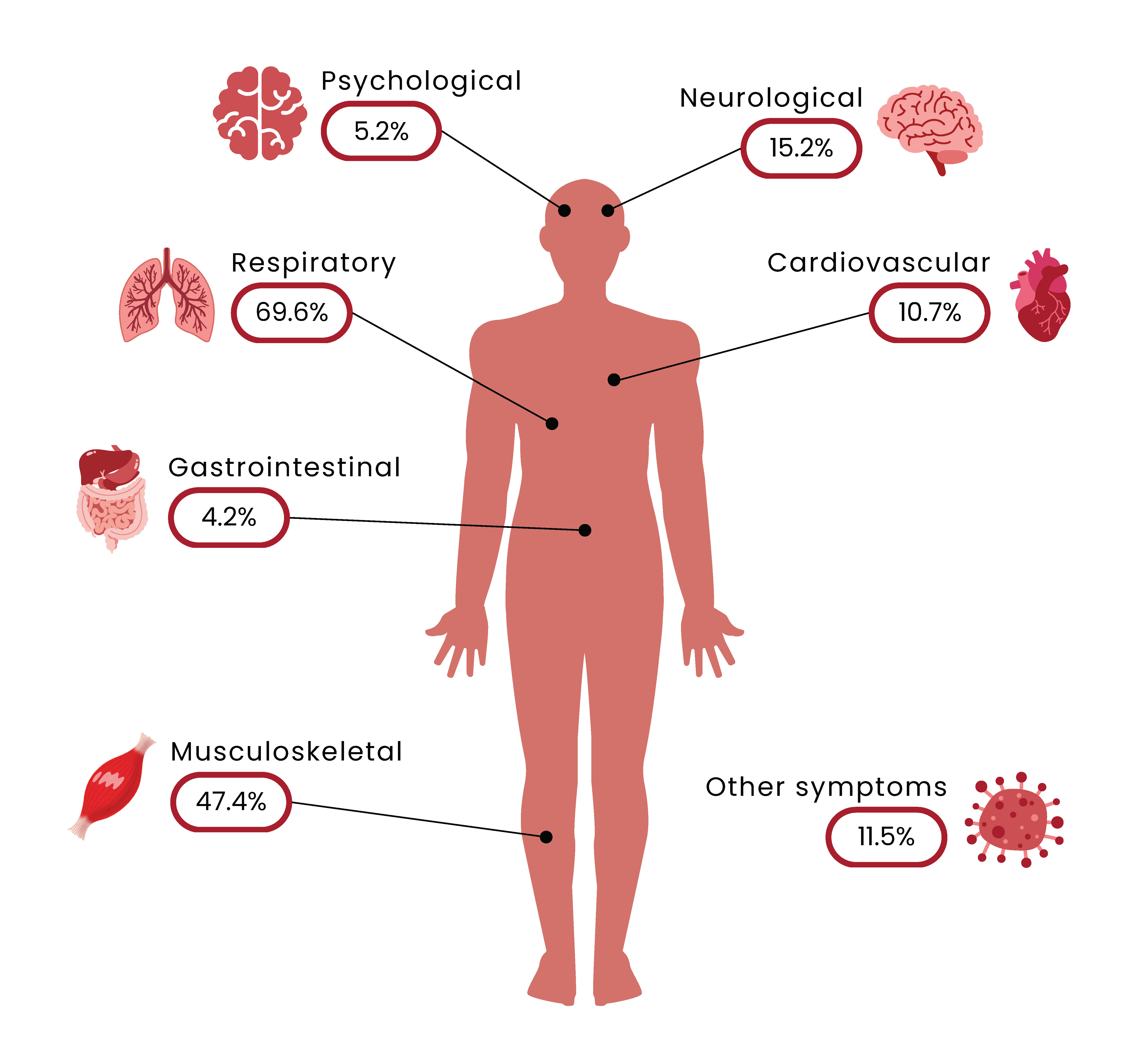
Analysis of post-COVID-19 conditions showed that people treated at the SuperAR Post-COVID Rehabilitation Center had a higher prevalence of respiratory symptoms (69.6%) (Figure 1).

Distribution of post-COVID-19 symptoms (psychological, neurological, respiratory, cardiovascular, gastrointestinal, musculoskeletal and other symptoms) by body system of people treated at the SuperAR Post-COVID Rehabilitation Center. Campina Grande, 2024 (n=398)
Regarding association between sociodemographic and clinical characteristics and treatment outcome (hospital discharge or dropout), significance was observed for sex, occurrence of hospitalization, and provision of oxygen inhalation therapy during hospitalization. Women presented a higher proportion of dropout compared to men (PR 1.68; 95%CI 1.11; 2.53; p-value 0.012). On the other hand, hospitalized individuals presented lower risk of treatment dropout (PR 0.48; 95%CI 0.31; 0.74; p-value 0.001). Those who received oxygen inhalation therapy also had lower risk of dropout (PR 0.50; 95%CI 0.31; 0.82; p-value 0.004) (Table 3).
Unadjusted prevalence ratios (PR) and 95% confidence intervals (95%CI) of association between sociodemographic characteristics and treatment outcome (dropout versus hospital discharge) of people treated at the SuperAR Post-COVID Rehabilitation Center. Campina Grande, 2024 (n=361)
When analyzing association between pre-existing comorbidities and treatment outcome, it was found that presence of bronchiectasis was associated with higher prevalence of treatment dropout (PR 2.05; 95%CI 1.34; 3.12; p-value 0.004), since all individuals with this condition discontinued follow-up (Table 4).
Unadjusted prevalence ratios (PR) and 95% confidence intervals (95%CI) of association between comorbidities and treatment outcome (dropout versus hospital discharge) of people treated at the SuperAR Post-COVID Rehabilitation Center. Campina Grande, 2024 (n=236)
Discussion
This study characterized the profile of people with post-COVID-19 conditions and factors associated with treatment outcomes. Post-COVID clinical conditions were treated at a rehabilitation center in Campina Grande, between January 2021 and December 2023. This period was considered to be one of intense demand for specialized services, marked by the need to gain a better understanding of the prolonged manifestations of the disease and to implement effective therapeutic strategies for functional recovery and improved quality of life of these individuals.
Post-COVID clinical conditions manifest themselves in approximately 10% to 20% of people who develop the disease and can have short- and long-term effects (10). We identified that most service users included in our study sample presented respiratory symptoms, followed by musculoskeletal symptoms.
Service users who experienced physiological changes such as muscle mass loss during the hospitalization period did not fully recover after six months and showed decreased strength (11). This result justifies the findings of this study. Among the symptoms presented by the individuals were arthralgia and dyspnea, which persisted for a period exceeding 12 months after COVID-19 infection. This was consistent with a setting involving 204 people in Fortaleza in 2021 (12).
The disproportionate impact of COVID-19 on women attending the SuperAR Center was identified in the sample characterization. It was observed that they represented the majority of cases followed during the period, revealing higher prevalence of persistent symptoms and greater demand for specialized rehabilitation care.
The pandemic exacerbated health-related gender inequality and particularly affected women. They not only make up the majority of health professionals, but are also frequently primary caregivers in domestic and community settings (13). Furthermore, evidence has indicated that women are more susceptible to long COVID (14-16).
In addition to women’s greater exposure to illness, they were also the ones who most frequently dropped out of treatment (PR 1.52; 95%CI 1.09; 2.11; p-value 0.012). There is no single explanation for the higher dropout rate among women, but there are sociocultural aspects that may lead women to discontinue treatment, such as high domestic demands and working outside the home.
The practical implications of providing care to women after COVID-19 infection must be addressed holistically, considering the physical repercussions of the disease, such as persistent fatigue, respiratory and cardiovascular changes, and psychological and social impacts resulting from the illness. In this context, it is possible to reduce treatment dropout by ensuring that these women receive support and that health professionals are attentive to their needs.
Regarding the severity of post-COVID-19 symptoms in adults, demographic factors such as advanced age, male sex, ethnicity and pre-existing comorbidities are considered risk factors for the development and severity of COVID-19 (17).
Regarding comorbidities identified in the study population, bronchiectasis was the only disease that had a significant association with treatment dropout (p-value 0.004). This finding may be related to the chronic course of the disease and the demands of prolonged and complex treatment, which requires a daily routine of care and, consequently, may hinder continuous adherence. A significant proportion of infected individuals, even after treatment, present prolonged symptoms, characterized by persistent lung damage and alterations in respiratory function, which may remain for months after the acute phase of the disease (18).
Post-COVID symptoms have highlighted the need for the implementation of medium- and long-term rehabilitation actions by multidisciplinary teams. Therefore, it is essential to provide comprehensive, individualized and continuous care focused on physical recovery and social and occupational reintegration, contributing to reducing long-term effects and promoting the overall well-being of service users.
There is high prevalence of persistent symptoms among people affected by Post-COVID syndrome. However, this condition remains poorly recognized in health services, which hinders timely service user access to necessary care. There is also low awareness and understanding of long COVID, both among health professionals and in society in general (19).
An integrated and multidisciplinary care approach in the management of post-COVID-19 syndrome should include detailed clinical assessment in order to ensure effective treatment of both pre-existing comorbidities and the symptoms of post-COVID-19 syndrome (20). Identification of new emerging health conditions in the post-COVID-19 context should be carefully monitored to ensure full recovery and prevent further complications.
The predominance of respiratory complications can be attributed to the mode of transmission and primary location of the virus in the respiratory tract, which can lead to more severe conditions such as acute respiratory distress syndrome and hypoxemia (21). In this context, use of oxygen inhalation therapy during hospitalization (p-value 0.004) demonstrated statistically significant association with treatment outcome. A higher proportion of individuals who did not use oxygen inhalation therapy dropped out of treatment compared to those who did. On the other hand, respiratory physiotherapy emerged as the most frequently applied therapy, followed by motor therapy.
Treatment dropout can be minimized through care coordination in primary health care, which is fundamental to ensuring effective follow-up of people with post-COVID-19 symptoms, as it promotes integration of actions at different levels of care. This coordinated approach involves various health professionals who use specific mechanisms to plan care, define flows and facilitate the exchange of information about service users. This is crucial not only for monitoring the progression of symptoms and associated complications, but also for ensuring a smooth transition from acute care to rehabilitation services, increasing the chances of long-term recovery (22,23).
A limitation of this study is that it only analyzed the SuperAR Program, not including other health services that comprise the healthcare networks in Campina Grande. Challenges arose from insufficient information held on medical records, characterized by gaps in the data collected, as several records lacked sufficient information to enable analysis. Additionally, it was not possible to verify the effective coordination of care by primary healthcare. These limitations indicate the need for more comprehensive and detailed future research.
Finally, this study contributed to identifying the characteristics of people with post-COVID-19 conditions and the rehabilitation care actions developed in a large municipality in Northeastern Brazil. Most people with these conditions presented respiratory symptoms and pre-existing comorbidities, such as bronchiectasis, and received physiotherapy and oxygen inhalation therapy. Furthermore, there was greater impact and a higher treatment dropout rate among women.
We highlight the importance of providing a comprehensive approach that considers clinical and social factors in order to improve the organization of healthcare networks in addressing these conditions. The findings reinforce the need for continuity of care and implementation of strategies aligned with the realities of health service territories, promoting improved quality of health and rehabilitation for these individuals.
-
Peer Review Administrator
Izabela Fulone (https://orcid.org/0000-0002-3211-6951)
-
Peer Reviewer
Anna Carolina Arena Siqueira (https://orcid.org/0000-0001-5643-5378)
-
Data availability
All the data supporting the results of this study has been made available on Figshare and can be accessed at: https://figshare.com/s/97a38dc6c78bc33f4fa9.
-
Use of generative artificial intelligence
Not used.
-
Funding
This research was conducted with support from the Coordination for the Improvement of Higher Education Personnel – Brazil – (Capes - Funding Code 001. Moara Alves Santa Bárbara Borges received a scholarship for a sandwich doctorate abroad from November 2022 to April 2023 (Process 88881.689934/2022-01).
References
-
1 Brasil. Ministério da Saúde. Covid-19[Internet]. Brasília: Ministério da Saúde; 2023 [cited 2024 Apr 29]. Available from: https://www.gov.br/saude/pt-br/assuntos/saude-de-a-a-z/c/covid-19
» https://www.gov.br/saude/pt-br/assuntos/saude-de-a-a-z/c/covid-19 -
2 World Health Organization. WHO COVID-19 dashboard [database]. Genebra: WHO; 2023 [cited 2024 Apr 28]. Available from: https://covid19.who.int/region/amro/country/brazil
» https://covid19.who.int/region/amro/country/brazil - 3 Kuodi P, Gorelik Y, Gausi B, Bernstine T, Edelstein M. Characterization of post-COVID syndromes by symptom cluster and time period up to 12 months post-infection: a systematic review and meta-analysis. Int J Infect Dis. 2023;134:1-7.
-
4 Brasil. Ministério da Saúde. Gabinete do Ministro. Portaria GM/MS n° 3.872, de 23 de dezembro de 2021. Inclui procedimentos na Tabela de Procedimentos, Medicamentos, Órteses, Próteses e Materiais Especiais (OPM) do Sistema Único de Saúde − SUS [Internet]. Brasília: Diário Oficial da União; 2021 [cited 2024 May 1]. Available from: https://bvsms.saude.gov.br/bvs/saudelegis/gm/2021/prt3872_29_12_2021.html
» https://bvsms.saude.gov.br/bvs/saudelegis/gm/2021/prt3872_29_12_2021.html - 5 Miranda RAR, Ostolin TLVP. Mapa de evidências sobre sequelas e reabilitação pós-covid-19: relatório completo. São Paulo: BIREME/OPAS/OMS; 2022.
- 6 Carvalho ALB, Rocha E, Sampaio RF, Ouverney ALM. Os governos estaduais no enfrentamento da covid-19: um novo protagonismo no federalismo brasileiro? Saúde Debate. 2022;46(Spe 1):62-77.
- 7 Gemelli Against COVID-19 Post-Acute Care Study Group. Post-COVID-19 global health strategies: the need for an interdisciplinary approach. Aging Clin Exp Res. 2020;32(8):1613-20.
-
8 Cardins KKB. Resultados da pesquisa sobre pessoas com condições pós-covid-19 [Banco de dados]. 2024 [cited 2025 Mar 20]. Dados não publicados. Available from: https://docs.google.com/spreadsheets/d/1L2ua-DEg96ye0XwyzOpw_4GzwX75XHo_/edit?usp=sharing&ouid=110485370156930879261&rtpof=true&sd=true.
» https://docs.google.com/spreadsheets/d/1L2ua-DEg96ye0XwyzOpw_4GzwX75XHo_/edit?usp=sharing&ouid=110485370156930879261&rtpof=true&sd=true -
9 Alberta Health Services. Post COVID-19 functional status scale and post COVID-19 symptom checklists [Internet]. Alberta: Alberta Health Services; 2020 [cited 2024 Mar 24]. Available from: https://www.albertahealthservices.ca/frm-21820.pdf
» https://www.albertahealthservices.ca/frm-21820.pdf -
10 Organização Pan-Americana da Saúde. OPAS apoia países em estudo da condição pós-covid-19 e na elaboração de diretrizes para atenção aos pacientes [Internet]. Washington D.C.: OPAS; 2022 [cited 2024 May 1]. Available from: https://www.paho.org/pt/noticias/23-6-2022-opas-apoia-paises-em-estudo-da-condicao-pos-covid-19-e-na-elaboracao-diretrizes
» https://www.paho.org/pt/noticias/23-6-2022-opas-apoia-paises-em-estudo-da-condicao-pos-covid-19-e-na-elaboracao-diretrizes - 11 Gil S, Oliveira Júnior GN, Sarti FM, Jacob Filho W, Longobardi I, Turri JAO, et al. Acute muscle mass loss predicts long-term fatigue, myalgia, and health care costs in COVID-19 survivors. J Am Med Dir Assoc. 2023;24(1):10-6.
- 12 Ida FS, Ferreira HP, Vasconcelos AKM, Furtado IAB, Fontenele CJPM, Pereira AC. Síndrome pós-covid-19: sintomas persistentes, impacto funcional, qualidade de vida, retorno laboral e custos indiretos - estudo prospectivo de casos 12 meses após a infecção. Cad Saúde Pública. 2024;40(2):e00022623.
-
13 Organização Pan-Americana da Saúde. Pandemia de covid-19 afetou mulheres desproporcionalmente nas Américas [Internet]. Washington D.C.: OPAS; 2022 [cited 2024 May 1]. Available from: https://www.paho.org/pt/noticias/8-3-2022-pandemia-covid-19-afetou-mulheres-desproporcionalmente-nas-americas
» https://www.paho.org/pt/noticias/8-3-2022-pandemia-covid-19-afetou-mulheres-desproporcionalmente-nas-americas - 14 Sylvester SV, Rusu R, Chan B, Bellows M, O’Keefe C, Nicholson S. Sex differences in sequelae from COVID-19 infection and in long COVID syndrome: a review. Curr Med Res Opin. 2022;38(8):1391-9.
- 15 Sudre CH, Murray B, Varsavsky T, Graham MS, Penfold RS, Bowyer RC, et al. Attributes and predictors of long COVID. Nat Med. 2021;27(4):626-31.
- 16 Kosugi EM, Lavinsky J, Romano FR, Fornazieri MA, Luz-Matsumoto GR, Lessa MM, et al. Incomplete and late recovery of sudden olfactory dysfunction in COVID-19. Braz J Otorhinolaryngol. 2020;86(4):490-6.
- 17 Zhang JJ, Dong X, Liu GH, Gao YD. Risk and protective factors for COVID-19 morbidity, severity, and mortality. Clin Rev Allergy Immunol. 2023;64(1):90-107.
- 18 Oscullo G, Gómez-Olivas JD, Beauperthuy T, Bekki A, Garcia-Ortega A, Matera MG, et al. Bronchiectasis and COVID-19 infection: a two-way street. Chin Med J (Engl). 2022;135(20):2398-404.
-
19 Monteiro D. Covid longa: estudo revela alta prevalência de sintomas e invisibilidade nos serviços de saúde [Internet]. Rio de Janeiro: Fiocruz; 2025 [cited 2025 Mar 25]. Available from: https://agencia.fiocruz.br/covid-longa-estudo-revela-alta-prevalencia-de-sintomas-e-invisibilidade-nos-servicos-de-saude
» https://agencia.fiocruz.br/covid-longa-estudo-revela-alta-prevalencia-de-sintomas-e-invisibilidade-nos-servicos-de-saude - 20 Castro APCR, Nascimento JS, Palladini MC, Pelloso LRCA, Barbosa MHL. Dor no paciente com síndrome pós-covid-19. Rev Cient HSI. 2021;5(2):56-62.
- 21 Carvalho FRS, Gobbi LC, Carrijo-Carvalho LD, Caetano AJF, Casotti GC, Tiussi LM, et al. Fisiopatologia da covid-19: repercussões sistêmicas. Unesc Rev. 2022;4(2):170-84.
- 22 Almeida PF, Giovanella L, Nunan BA. Coordenação dos cuidados em saúde pela atenção primária à saúde e suas implicações para a satisfação dos usuários. Saúde Debate. 2012;36(94):375-91.
- 23 Henao Martínez D, Vazquez Navarrete ML, Vargas Lorenzo I. Factores que influyen en la coordinación entre niveles asistenciales según la opinión de directivos y profesionales sanitarios. Gac Sanit. 2009;23(4):280-6.
Edited by
-
Editor-in-Chief
Jorge Otávio Maia Barreto (https://orcid.org/0000-0002-7648-0472)
-
Scientific Editor
Maria Auxiliadora Parreiras Martins (https://orcid.org/0000-0002-5211-411X)
-
Associate Editor
Mariana Del Grossi Moura (https://orcid.org/0000-0003-4268-4298)
All the data supporting the results of this study has been made available on Figshare and can be accessed at: https://figshare.com/s/97a38dc6c78bc33f4fa9.