 Understanding the identification of frequent situations in oral medicine and dental radiology among dentistry students
ABSTRACT
Objective: This study aimed to assess the level of knowledge and self-confidence of Dentistry students from the Federal University of Pará in the fields of Oral Medicine and Dental Radiology.
Methods: Questionnaires were administered to 210 students from the 4th to the 10th semester, addressing frequent clinical situations. The study evaluated participants’ ability to recognize pathologies through clinical and radiographic examinations, identified knowledge gaps, and assessed diagnostic confidence. Statistical analysis included Chi-square tests and Spearman correlation.
Results: A significant association was observed between the semester attended and the level of self-confidence, as well as a positive correlation between the number of correct answers and self-confidence. The topics with the highest accuracy rates were recurrent caries and mucocele, while the lowest performances occurred in the identification of inflammatory cysts and the recommended imaging exam for torus palatinus.
Conclusion: The results reveal specific gaps in student training and highlight the need for curricular adjustments and the use of active methodologies to strengthen diagnostic competence.
Indexing terms
Academic training; Clinical diagnosis; Education, dental, continuing; Oral medicine
RESUMO
Objetivo: Este estudo teve como objetivo avaliar o nível de conhecimento e a autoconfiança de estudantes de Odontologia da Universidade Federal do Pará nas áreas de Estomatologia e Radiologia Odontológica, com foco na segurança frente ao diagnóstico odontológico.
Métodos: Foram aplicados questionários a 210 acadêmicos do 4º ao 10º semestre, abordando situações clínicas frequentes. A pesquisa analisou a capacidade dos participantes em reconhecer patologias por meio de exames clínicos e radiográficos, além de identificar deficiências no conhecimento e avaliar a segurança diagnóstica. A análise estatística incluiu testes do Qui-quadrado e correlação de Spearman.
Resultados: Observou-se associação significativa entre o semestre cursado e o nível de autoconfiança, bem como correlação positiva entre número de acertos e autoconfiança. Os temas com maior índice de acertos foram recidiva de cárie e mucocele, enquanto os menores desempenhos ocorreram na identificação de cisto inflamatório e no exame indicado para tórus palatino.
Conclusão: Os resultados apontam lacunas específicas na formação dos estudantes e indicam a necessidade de ajustes curriculares e uso de metodologias ativas para fortalecer a competência diagnóstica.
Termos de indexação
Ensino; Diagnóstico clínico; Educação continuada em odontologia; Medicina bucal
INTRODUCTION
Oral Medicine is a dental specialty approved, registered, regulated, and recognized by the Federal Council of Dentistry (CFO) since 1992. Its scope includes the diagnosis and management of primary diseases of the oral mucosa and jaws, as well as disorders of the salivary glands, orofacial pain, and maxillofacial manifestations of systemic conditions [1].
Dental practice extends beyond the care of teeth and supporting structures, encompassing the prevention and diagnosis of diseases of the oral mucosa [2]. In this context, mastery of Oral Medicine becomes essential for clinical practice, as deviations from normality and oral lesions may directly affect the patient’s systemic health [3].
Complementarily, radiographic examinations play a fundamental role in dental practice, as they allow for detailed visualization of clinical findings obtained during anamnesis, contributing to more accurate diagnoses and more effective treatment planning. Dental Radiology is therefore indispensable for confirming clinical suspicions before, during, and after procedures [4].
Despite the relevance of radiographic interpretation, its effectiveness depends on the clinician’s technical and diagnostic skills. Variability in image analysis may directly influence diagnostic accuracy and the choice of therapeutic approach [5]. For this reason, it is essential that dentists be able to recognize and manage different types of lesions, including those with malignant potential, for which early detection is decisive for prognosis [6].
However, many students and professionals report insecurity in identifying and diagnosing oral lesions, especially due to limited practical exposure during undergraduate training. This gap highlights the need for complementary training and greater clinical experience [7].
Given this scenario, it becomes essential to assess the level of knowledge of Dentistry students regarding Oral Medicine and Dental Radiology, as well as their confidence in identifying oral pathologies. The main objective of this study is to analyze students’ ability to recognize alterations through clinical and radiographic examinations. Specifically, it aims to identify the main deficiencies in pathology-related knowledge, determine the most relevant topics, and evaluate students’ self-confidence in making dental diagnoses.
METHODS
The study was approved by the Research Ethics Committee of the Institute of Health Sciences of the Universidade Federal do Pará (UFPA, Federal University of Pará), under opinion no. 6.864.983, in accordance with the ethical principles of Resolution no. 466/2012 of the National Health Council, as well as the complementary guidelines established by the CEP/CONEP system.
This is a qualitative and exploratory study with a descriptive approach, in which the unit of analysis consisted of undergraduate students enrolled in the Dentistry program at the School of Dentistry of UFPA. The total eligible population comprised approximately 420 students from the 4th to the 10th semesters, according to the current curriculum structure. Sample size calculation was performed using the finite population formula, with a 95% confidence level and a 5% margin of error, resulting in a minimum required sample of 197 participants. However, data were collected from 210 students, ensuring statistical representativeness.
Inclusion criteria consisted of being regularly enrolled in the Dentistry program at the School of Dentistry, Federal University of Pará from the 4th semester onward. Exclusion criteria included prior completion of a specific course in Oral Medicine or Dental Radiology before the 4th semester, lack of regular enrollment, having completed only up to the 3rd semester, or refusal to sign the Informed Consent Form.
Data collection was conducted in person, in a single session and without prior notice, by two researchers. Participants completed a structured questionnaire divided into two sections. The instrument was adapted from Vasconcelos et al. [8] and reviewed by specialists to ensure content validity. The first section contained six questions related to academic profile and students’ self-perception, addressing age, gender, academic semester, study shift, diagnostic self-confidence, and self-assessed knowledge in Oral Medicine and Dental Radiology (chart 1). The second section consisted of ten multiple-choice questions addressing frequent clinical situations encountered in the School of Dentistry clinics at the Federal University of Pará, including topics such as squamous cell carcinoma, mucocele, inflammatory cyst, torus palatinus, retained root, pulp chamber obliteration, and recurrent caries (chart 2). The use of reference materials during the questionnaire was not permitted. Each question in the second section was worth 1.0 point, resulting in a total score ranging from 0 to 10. Participants’ performance was classified into four categories: insufficient (score below 4.9), regular (5.0-6.9), good (7.0-8.9), and excellent (≥9.0).
Personal questionnaire applied to students of the School of Dentistry, Federal University of Pará. Belém, PA, Brazil, 2025.
Questionnaire on Oral Medicine and Dental Radiology applied to School of Dentistry, Federal University of Pará undergraduate students. Belém, PA, Brazil, 2025.
Data were organized in Microsoft Excel 2019 spreadsheets and analyzed using Jamovi® software, version 2.3.28. Initially, descriptive analysis was performed, including the calculation of frequencies, means, medians, and standard deviations. To assess associations between categorical variables, the Chi-square test was applied, adopting a significance level of 5% (p<0.05), to examine relationships between participants’ gender and knowledge level, as well as between academic semester and self-confidence. Additionally, Spearman’s correlation was used to investigate relationships between ordinal and continuous variables, such as the number of correct answers and diagnostic self-confidence, as well as the relationship between academic semester and number of correct answers. These analyses allowed the identification of statistically significant patterns and contributed to a deeper interpretation of the data obtained.
RESULTS
The questionnaire was administered to 210 students from the 4th to the 10th semesters in both morning and afternoon shifts. Gender distribution revealed a predominance of female students (55%).
Regarding participants’ self-assessment of their knowledge in Oral Medicine and Dental Radiology, 58.1% rated their knowledge as “good,” while 78.6% reported “moderate” confidence in performing clinical diagnoses. These data are presented in table 1.
To investigate possible associations between categorical variables related to academic profile and participants’ self-confidence, statistical tests were applied using the Chi-square method. Table 2 presents the results of these analyses, highlighting the relationship between academic semester and confidence level, as well as between gender and knowledge level.
Statistical analysis using the Chi-square test revealed a significant association between academic semester and students’ confidence level (p=0.020), indicating that students in more advanced semesters tend to exhibit greater clinical self-confidence. This result suggests that academic progression is related to the development of diagnostic security. Conversely, no significant association was observed between participants’ gender and knowledge level (p=0.538), indicating that technical performance is similarly distributed among students of different genders, without relevant statistical influence.
To analyze the relationship between students’ performance and their diagnostic self-confidence, correlation tests were applied using Spearman’s coefficient. Table 3 presents the results of these analyses, showing that students with better performance tend to feel more confident in making diagnoses, and that academic progression is positively related to the number of correct answers.
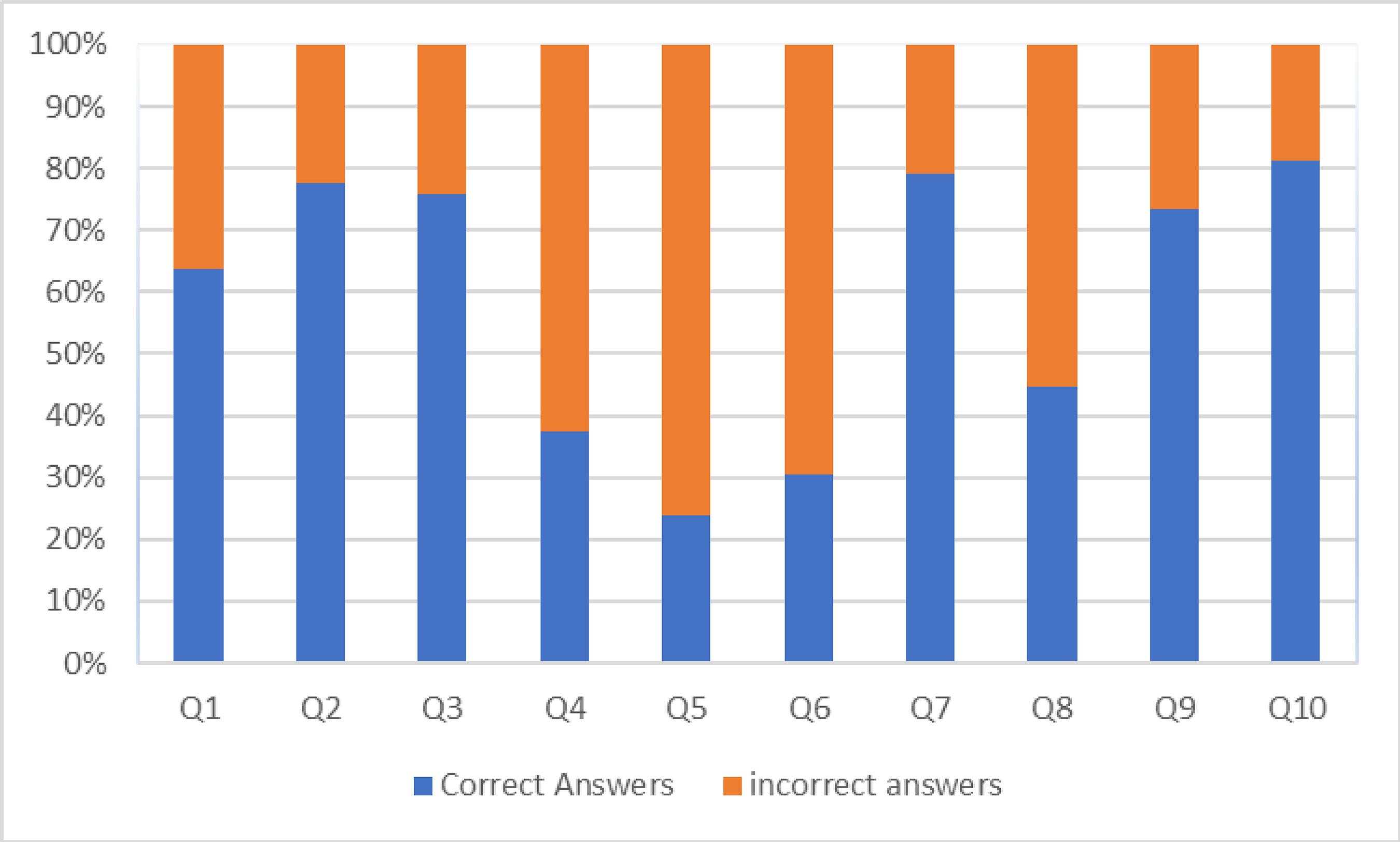
Figure 1 shows the percentage of correct and incorrect answers obtained by students for each of the ten questions in the questionnaire. This distribution makes it possible to identify the topics with greater theoretical mastery, as well as those that presented greater difficulty in clinical and radiographic recognition.
The questions with the highest accuracy rates were Q10 (81.4%), Q7 (79.0%), and Q2 (77.6%), indicating good understanding of recurrent caries, mucocele, and management of malignant lesions. The lowest-performing questions were Q5 (23.8%) and Q6 (30.5%), related to the diagnosis of inflammatory cysts and the imaging exam indicated for torus palatinus.
DISCUSSION
The results of this study reveal important aspects regarding the level of knowledge and self-confidence of Dentistry students at the School of Dentistry, Federal University of Pará in the areas of Oral Medicine and Dental Radiology. The predominance of female students (55%) is consistent with national data, which indicate a greater female presence in health-related programs. According to INEP [9], women account for 59.1% of enrollments in higher education, with 69.6% specifically in Dentistry.
Descriptive analysis showed that 58.1% of participants self evaluated their knowledge as good, while 78.6% reported moderate confidence in performing diagnoses. However, statistical tests revealed important nuances: the Chi-square test indicated a significant association between academic semester and confidence level (p=0.020), suggesting that academic progression contributes to greater clinical security. On the other hand, no significant association was found between gender and knowledge level (p=0.538), reinforcing that technical performance is distributed equitably across groups.
The Spearman correlation between the number of correct answers and the level of self-confidence was moderate and positive (ρ=0.46; p<0.001), indicating that students with better performance tend to feel more secure when making diagnoses. This finding reinforces the importance of pedagogical strategies that integrate theory and practice, promoting not only technical knowledge but also confidence in clinical decision-making.
Analysis of the questionnaire items revealed that students demonstrated good mastery of topics such as recurrent caries (81.4% correct), mucocele (79.0%), and management of malignant lesions (77.6%). These results align with previous studies highlighting students’ familiarity with common lesions and basic procedures [10].
However, questions requiring greater radiographic interpretation skills or knowledge of less frequent pathologies showed lower performance. The item on inflammatory cysts had only 23.8% correct answers, and identifying the appropriate imaging exam for evaluating torus palatinus reached 30.5%. These findings highlight specific gaps in training, particularly regarding the differentiation of pathologies with similar clinical characteristics [11].
The correlation between academic semester and the number of correct answers (ρ=0.39; p=0.003) reinforces the idea that technical knowledge becomes consolidated throughout training, while also highlighting the need for earlier pedagogical interventions. The difficulty in correctly identifying a retained root (44.8% correct) and the confusion with hypercementosis (21.9% of incorrect responses) indicate that training in radiographic interpretation still requires reinforcement.
These findings are consistent with studies emphasizing the importance of active learning methodologies, clinical simulators, and imaging technologies to enhance students’ diagnostic competence [6,7]. Implementing educational strategies focused on areas of greatest difficulty may help develop more confident and technically prepared professionals.
The statistical findings reinforce that the objectives of the study were fully achieved. The analysis of student performance, combined with self perceived confidence and academic semester, allowed precise identification of areas of greater mastery and those still presenting significant gaps. The positive correlation between number of correct answers and self confidence (ρ=0.46; ρ<0.001), as well as the association between semester and clinical security (c2=14.92; p=0.020), demonstrates that academic progression contributes to greater diagnostic competence. A moderate positive correlation was also observed between academic semester and number of correct answers (p=0.39; p=0.003), indicating that performance increases with academic progression. These results validate the study’s initial proposal and provide concrete support for pedagogical interventions aimed at improving training in Oral Medicine and Dental Radiology.
CONCLUSION
The study demonstrated that, although Dentistry students display solid theoretical knowledge in Oral Medicine and Dental Radiology, their clinical self-confidence remains moderate. The correlation between performance and self-confidence, as well as the association between academic semester and diagnostic assurance, indicates that academic progression contributes to greater clinical competence. Nevertheless, specific difficulties persist in radiographic interpretation and in recognizing less common lesions. A curricular review focused on active learning methodologies and imaging technologies is recommended, along with the expansion of future studies exploring innovative pedagogical strategies and involving different institutions and regional contexts.
-
Article aligned with the Good Health and Well-Being and Quality Education goal of the Sustainable Development Goals (SDGs).
-
How to cite this article
Oliveira ADS, Carvalho PL, Andrade WA, Medeiros JMF. Understanding the identification of frequent situations in oral medicine and dental radiology among dentistry students. RGO, Rev Gaúch Odontol. 2026;74:e20260022. http://dx.doi.org/10.1590/1981-86372026002220250089
Data Availability
The research data are available in the body of the document.
REFERENCES
-
1 Lima LEB, Carvalho TA. Diagnóstico além da tela: caracterização das publicações do Instagram sobre Estomatologia e Patologia Oral. Res Soc Dev. 2022;11(12):e573111235045. https://doi.org/10.33448/rsd-v11i12.35045
» https://doi.org/10.33448/rsd-v11i12.35045 -
2 Medeiros YDL, Silva PVR, Lopes DF, Faria LV, Guimarães LDA. Oferta da disciplina de Estomatologia nos cursos de Odontologia do sudeste brasileiro. Rev Fac Odontol UPF. 2020;25(1):26-31. https://doi.org/10.5335/rfo.v25i1.10485
» https://doi.org/10.5335/rfo.v25i1.10485 -
3 Tarakji B. Knowledge, awareness, and attitude among dental students regarding oral cancer in Saudi Arabia. Ann Afr Med. 2022;21(4):444-50. https://doi.org/10.4103/aam.aam_185_21
» https://doi.org/10.4103/aam.aam_185_21 -
4 Eaton KA. The development of digital dentistry in the UK: an overview. Prim Dent J. 2022;11(4):94-8. doi: httpd://doi.org/ 10.1177/20501684221134198
» https://doi.org/10.1177/20501684221134198 -
5 Patel S, Durack C, Abella F, Shemesh H, Roig M, Lemberg K. Cone beam computed tomography in Endodontics: a review. Int Endod J. 2015;48(1):3-15. doi: https://doi.org/10.1111/iej.12270
» https://doi.org/10.1111/iej.12270 -
6 Warnakulasuriya S. Oral potentially malignant disorders: A comprehensive review on clinical aspects and management. Oral Oncol. 2020;102:104550. https://doi.org/10.1016/j.oraloncology.2019.104550
» https://doi.org/10.1016/j.oraloncology.2019.104550 -
7 Morales CM, Piardi CC, Siqueira R, Borges LG. Avaliação do conhecimento dos acadêmicos de Odontologia sobre câncer bucal: um estudo transversal. Res Soc Dev. 2021;10(11):e1913519135. https://doi.org/10.33448/rsd-v10i11.19135
» https://doi.org/10.33448/rsd-v10i11.19135 -
8 Vasconcelos AC, Jardim JF, Damasceno CR, Delfino VIV. Avaliação do conhecimento dos acadêmicos de Odontologia sobre Patologia Oral e Estomatologia. Res Soc Dev. 2023;12(6):e2412641966. https://doi.org/10.33448/rsd-v12i6.41966
» https://doi.org/10.33448/rsd-v12i6.41966 -
9 Ministério da Educação (Brasil). Instituto Nacional de Estudos e Pesquisas Educacionais Anísio Teixeira. Censo da Educação Superior 2023. Brasília; 2023 [2025 jan. 19]. Disponível em: https://www.gov.br/inep/pt-br/assuntos/noticias/institucional/mulheres-representam-59-das-matriculas-na-educacao-superior
» https://www.gov.br/inep/pt-br/assuntos/noticias/institucional/mulheres-representam-59-das-matriculas-na-educacao-superior -
10 Soltanimehr E, Bahrampour E, Imani MM, Rahimi F, Almasi B, Moattari M. Effect of virtual versus traditional education on theoretical knowledge and reporting skills of dental students in radiographic interpretation of bony lesions of the jaw. BMC Med Educ. 2019;19:233. https://doi.org/10.1186/s12909-019-1649-0
» https://doi.org/10.1186/s12909-019-1649-0 -
11 Mota IBO, Langoni AC, Almeida GCT, Botelho E, França M, Reis T, et al. Análise do conhecimento na interpretação de imagens radiográficas de acadêmicos de um curso de Odontologia. Res Soc Dev. 2020;9(11):e88691110676. https://doi.org/10.33448/rsd-v9i11.10676
» https://doi.org/10.33448/rsd-v9i11.10676
Edited by
-
Assistant editorLuciana Butini Oliveira