 Nonlinear evaluation of reliability-based topology optimization of concrete deep beams
Abstract
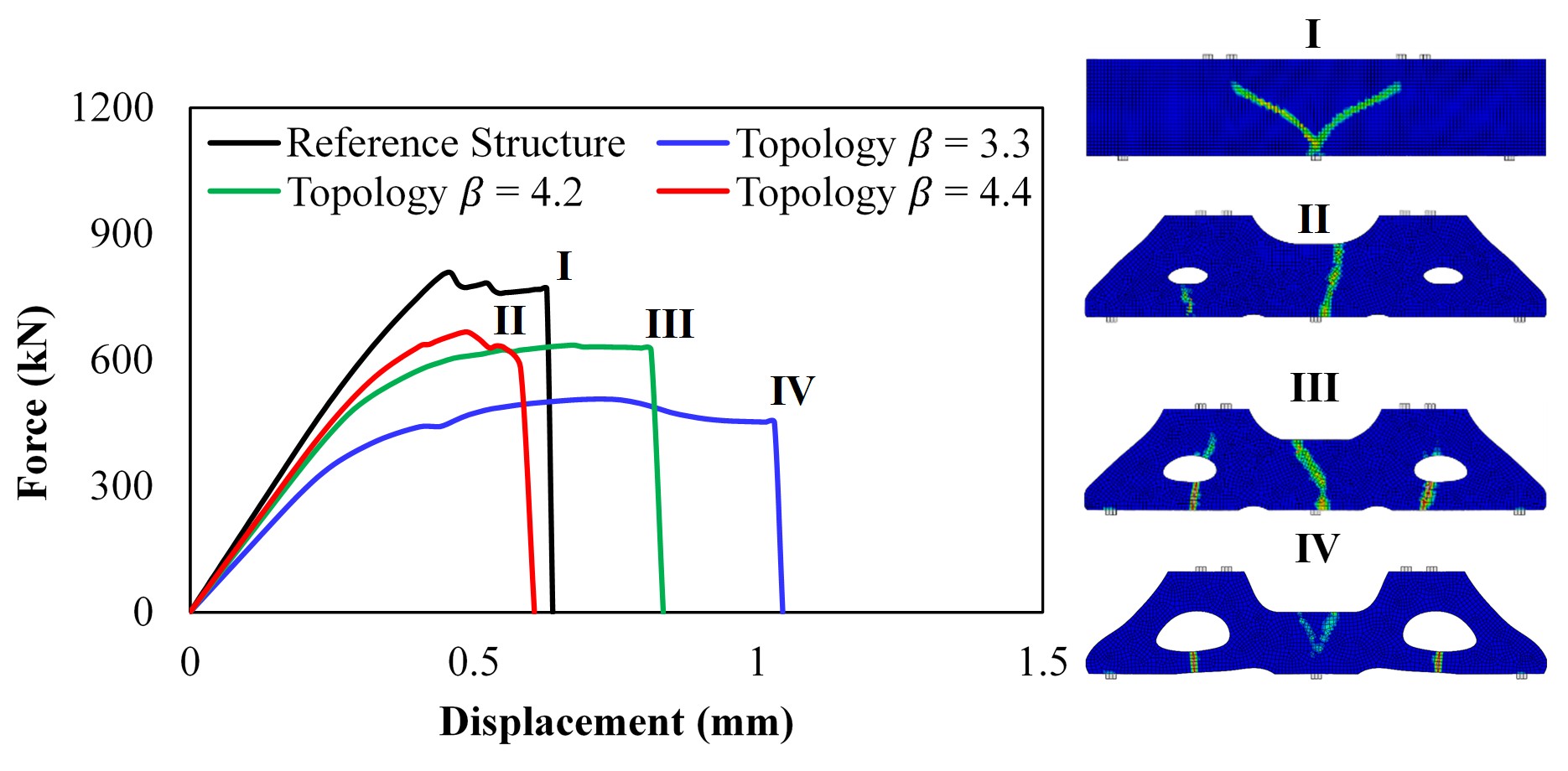
Abstract Uncertainty has long been a recognized aspect of engineering analysis and design. This inherent unpredictability is typically represented by variability and randomness. In this context, a linear elastic topology optimization (TO) approach with reliability constraints is presented. This method uses an outer loop for the optimization and an inner loop for the reliability analysis. The TO procedure based on the Bidirectional Evolutionary Structural Optimization (BESO) was developed to minimize the structure’s concrete compliance and, consequently, reduce the weight for a given reliability index constraint. Failure criterion, such as Ottosen's four-parameter surface is used to check the stress level in the computational domain. Moreover, a nonlinear finite element analysis for the resulting structure is developed in commercial software. The scope here is to conduct a comparative analysis between a reference deep beam from the literature and the optimized topologies to determine the ultimate strength capacity and assess how material reduction affects the failure mode and ultimate load. Results demonstrate resource-efficient and reliable designs with similar structural performance when compared to traditional concrete structures.
Keywords:
FORM; UHPFRC; nonlinear analysis; RBDO; Reliability Index Approach
 Thumbnail
 Thumbnail
 Thumbnail
 Thumbnail
 Thumbnail
 Thumbnail
 Thumbnail