 Evaluation of the static and dynamic moduli of elasticity of concrete with recycled aggregates and steel fibers
Abstract
Abstract This study investigates the influence of recycled concrete aggregates (RCA) on the elastic modulus of concrete, considering mixtures produced with 30%, 50%, and 100% replacement levels of natural coarse aggregates. In addition, steel fibers were incorporated at a constant dosage to improve post-cracking behavior. The main objective is to evaluate the relationship between static and dynamic moduli of elasticity and to assess the applicability of the Popovics-based formulation for estimating static modulus from dynamic measurements. Results indicate that increasing RCA content leads to a reduction in both compressive strength and static modulus of elasticity, as well as an increase in result dispersion due to material heterogeneity. The dynamic modulus showed lower sensitivity to replacement levels. The Popovics-based model systematically underestimated the static modulus, with discrepancies increasing for higher RCA contents. These findings highlight the need for calibration of empirical models when applied to recycled aggregate concretes.
Keywords:
recycled aggregate concrete; modulus of elasticity; steel fibers; non-destructive testing; sustainability
Resumo
Resumo Este estudo investiga a influência de agregados de concreto reciclado (RCA) no módulo de elasticidade do concreto, considerando misturas produzidas com níveis de substituição de 30%, 50% e 100% de agregados graúdos naturais. Além disso, fibras de aço foram incorporadas em uma dosagem constante para melhorar o comportamento pós-fissuração. O objetivo principal é avaliar a relação entre os módulos de elasticidade estático e dinâmico e verificar a aplicabilidade da formulação baseada em Popovics para estimar o módulo estático a partir de medições dinâmicas. Os resultados indicam que o aumento do teor de RCA leva a uma redução tanto na resistência à compressão quanto no módulo de elasticidade estático, além de um aumento na dispersão dos resultados. O modelo de Popovics subestimou sistematicamente o módulo estático, evidenciando a necessidade de calibração para materiais reciclados.
Palavras-chave:
concreto com agregado reciclado; módulo de elasticidade; fibras de aço; ensaios não destrutivos; sustentabilidade
1 INTRODUCTION
The growing demand for sustainable solutions has driven significant advances in construction materials research, particularly with regard to reducing natural resource consumption and mitigating the environmental impacts associated with concrete production. In this context, the use of recycled aggregates derived from construction and demolition waste has been widely investigated as a viable alternative to natural aggregates, as it enables the reduction of raw material extraction and waste generation while contributing to a lower environmental footprint of the construction sector.
Despite substantial research progress, the structural application of recycled aggregates still faces restrictions in several countries, reflecting the need for a deeper understanding of their mechanical behavior and the variability inherent to these materials. In Brazil, for example, current technical standards limit the use of recycled aggregates in structural concrete, allowing only low replacement levels of natural aggregates [1], [2], a situation that is also observed—under different regulatory approaches—in other regions worldwide [3]. Conversely, countries with more advanced practices in the reuse of construction and demolition waste show convergence regarding physical, chemical, and mechanical requirements for recycled aggregates, as well as quality control procedures.
Several studies have demonstrated that the partial replacement of natural aggregates with recycled aggregates significantly influences concrete properties, with this behavior being strongly dependent on variables such as replacement level, curing conditions, and mixing method. Xiao et al. [4] observed that although concretes with different replacement levels exhibit globally similar stress–strain curves, those with higher recycled aggregate contents tend to present greater deformations and reduced compressive strength, with losses of approximately 26% in the case of total replacement—a result later corroborated by Oliveira [5].
These changes are directly associated with the intrinsic characteristics of recycled aggregates. Studies conducted by Ferreira et al. [6], Khoury et al. [7], and Verian et al. [8] indicate that, compared to natural aggregates, recycled aggregates exhibit higher water absorption, lower mechanical strength, and greater heterogeneity, mainly due to the presence of adhered mortar on the particles. This heterogeneity is reflected in increased dispersion of experimental results, particularly for concretes with high replacement levels, as reported by Etxeberria et al. [9], who observed higher standard deviations in compressive strength values for concretes produced with 100% recycled aggregates. In addition, Khoury et al. [7] highlighted that significant density variations may occur even within the same particle size range due to differences in the amount of adhered mortar.
Another aspect widely discussed in the literature concerns the high water absorption capacity of recycled aggregates, which directly affects the water-to-cement ratio and, consequently, concrete workability. The absorption of part of the mixing water by the aggregates may compromise the mechanical performance of the material, making mitigation strategies necessary. In this regard, Etxeberria et al. [9] recommended the pre-wetting of recycled aggregates prior to concreting to ensure adequate saturation without exceeding their absorption capacity, thereby preserving the quality of the interfacial transition zone between the aggregate and the new cement paste.
With respect to the mechanical properties of hardened concrete, several factors influence both compressive strength and elastic modulus, including the replacement level of natural aggregates, particle size distribution, and the origin and characteristics of the original concrete. Recent studies indicate a progressive reduction in elastic modulus with increasing recycled aggregate content [5], [10], a trend also identified by Wang et al. [11] and Xiao et al. [4] based on analyses of experimental data reported in the literature.
In addition to material characteristics, the methodology employed for determining the elastic modulus plays a significant role in the values obtained. Etxeberria et al. [9] demonstrated that different calculation methods could lead to considerable variations in elastic modulus values for concretes containing recycled aggregates. Complementarily, Debieb and Kenai [12] reported reductions of approximately 30% in elastic modulus when recycled coarse aggregates were used, while the replacement of fine aggregates resulted in reductions of up to 40% compared to conventional concrete.
The incorporation of steel fibers has also been widely investigated as a strategy to improve the mechanical performance of cementitious materials, particularly with regard to crack control, toughness, and post-peak behavior. Carneiro et al. [13] observed that fiber reinforcement contributes to improvements in tensile strength and energy absorption capacity. However, its influence on the initial elastic response of concrete is generally limited, as the modulus of elasticity is primarily governed by the stiffness of the matrix and aggregates.
Despite the extensive body of research on recycled aggregate concrete, a gap still exists regarding the combined assessment of static and dynamic elastic moduli, particularly when empirical models are used to estimate one parameter from the other. This gap becomes even more relevant in concretes incorporating both recycled aggregates and steel fibers, for which the applicability and limitations of such models have not yet been fully established.
Among the available predictive approaches, the model proposed by Popovics [14] has been widely used to describe the stress–strain behavior of concrete and to estimate elastic properties based on empirical relationships. Although previous studies have demonstrated good agreement between model predictions and experimental results for conventional concretes [15], its applicability to concretes containing recycled aggregates, characterized by higher heterogeneity and lower stiffness, remains uncertain and requires further investigation.
In this context, the present study aims to evaluate the influence of recycled aggregate replacement levels on the static and dynamic moduli of elasticity of concrete, while comparing experimentally determined static values with those estimated from dynamic measurements using a Popovics-based formulation, in order to assess the accuracy and limitations of this model for concretes incorporating recycled aggregates.
It is important to emphasize that steel fibers were incorporated at a constant content in all mixtures and were not treated as an independent variable in this study. This approach reflects a fiber-reinforced condition representative of practical structural applications; however, it does not allow the isolated evaluation of fiber influence, which is acknowledged as a limitation of the present work.
By systematically analyzing the relationship between static and dynamic elastic moduli and evaluating the performance of the predictive model across different replacement levels and curing ages, this study seeks to contribute to a more reliable mechanical characterization of recycled aggregate concretes and to support the development of more accurate predictive approaches for sustainable construction materials.
2 EXPERIMENTAL PROGRAM
The experimental program was designed to investigate the influence of recycled concrete aggregate (RCA) content on the mechanical behavior of concrete, with emphasis on compressive strength and the static and dynamic moduli of elasticity. The experimental campaign included the physical characterization of recycled and natural aggregates, the production of concrete mixtures with different RCA replacement ratios, and the evaluation of empirical models for estimating the elastic properties of the analyzed concretes.
2.1 Recycled Concrete Aggregate Characterization
The recycled coarse aggregate used in this study was obtained from Class A construction and demolition waste, according to the classification established by CONAMA Resolution 307 [16] and ABNT NBR 15116 [17]. Based on the composition analysis presented by Marques [10], the material was classified as recycled cementitious aggregate (ARCI), predominantly composed of concrete and other cement-based constituents, with a reduced content of ceramic materials.
The characterization of the recycled aggregate included particle size distribution, density, water absorption, bulk density, and composition analysis tests, performed in accordance with the applicable Brazilian standards.
2.1.1 Composition Analysis
The composition analysis of the recycled aggregate, presented in Table 1, was carried out according to ABNT NBR 15116 [17]. Based on the results obtained by Marques [10], the material was classified as recycled cementitious aggregate (ARCI), indicating the predominance of concrete and other cement-based constituents in its composition.
2.1.2 Particle Size Distribution
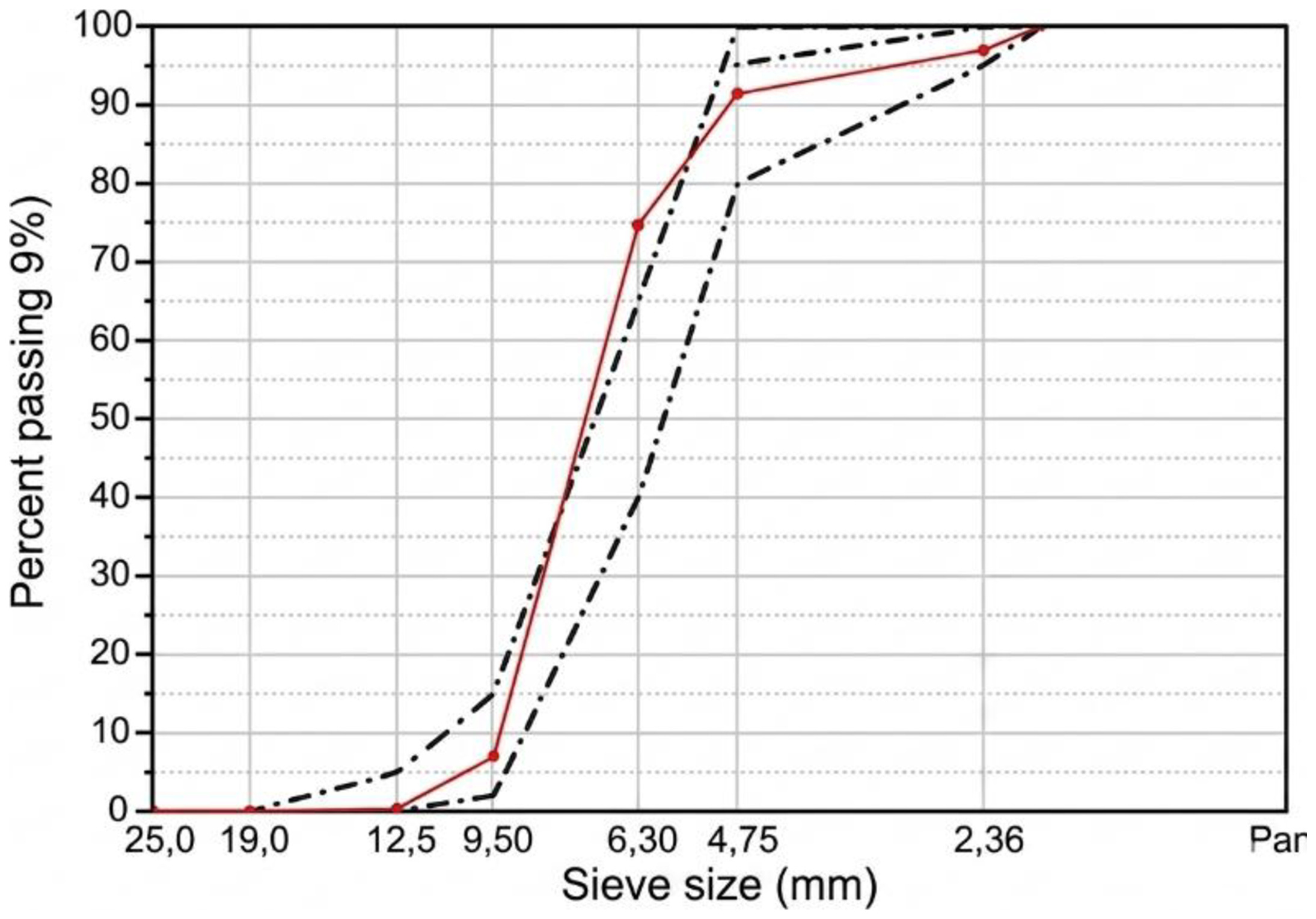
The particle size distribution analysis of the recycled aggregate was performed in accordance with ABNT NBR 17054 [18]. The results obtained are presented in Table 2, while the grading curve and its comparison with the limits established by ABNT NBR 7211 [19] are shown in Figure 1. The recycled aggregate presented a maximum characteristic size of 12.50 mm and a fineness modulus of 2.70.
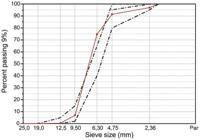
Particle size distribution curve of the recycled coarse aggregate and grading limits according to ABNT NBR 7211 [18].
The results indicate that the recycled aggregate presented a particle size distribution compatible with the limits established by ABNT NBR 7211 [19] for coarse aggregates used in concrete production.
2.1.3 Density, Water Absorption, and Bulk Density
The physical properties obtained for the recycled aggregate are summarized in Table 3. The recycled aggregate presented lower density and significantly higher water absorption compared to the natural course aggregate.
These results are consistent with the typical behavior reported for recycled concrete aggregates in the literature and are mainly associated with the presence of adhered mortar and the higher porosity of the recycled particles. Such characteristics directly influence the volumetric proportioning of the mixtures and may contribute to greater variability in the mechanical behavior of recycled aggregate concretes.
The main physical properties of the natural and recycled aggregates are summarized in Table 4, providing a consolidated overview of the parameters used in the analysis and mix proportioning.
2.2 Natural Aggregate Characterization
The characterization of the aggregates used in this study is essential for understanding the mechanical behavior of the analyzed concretes, since the physical properties of the aggregates directly influence workability, density, water absorption, and the interaction with the cementitious matrix, thereby affecting compressive strength and elastic modulus.
The physical characterization of the aggregates was carried out through particle size distribution, density, water absorption, and bulk density tests, in accordance with the applicable Brazilian standards.
2.2.1 Particle Size Distribution
The particle size distribution analysis was performed in accordance with ABNT NBR 17054 [18], using sieve analysis for both fine and coarse aggregates.
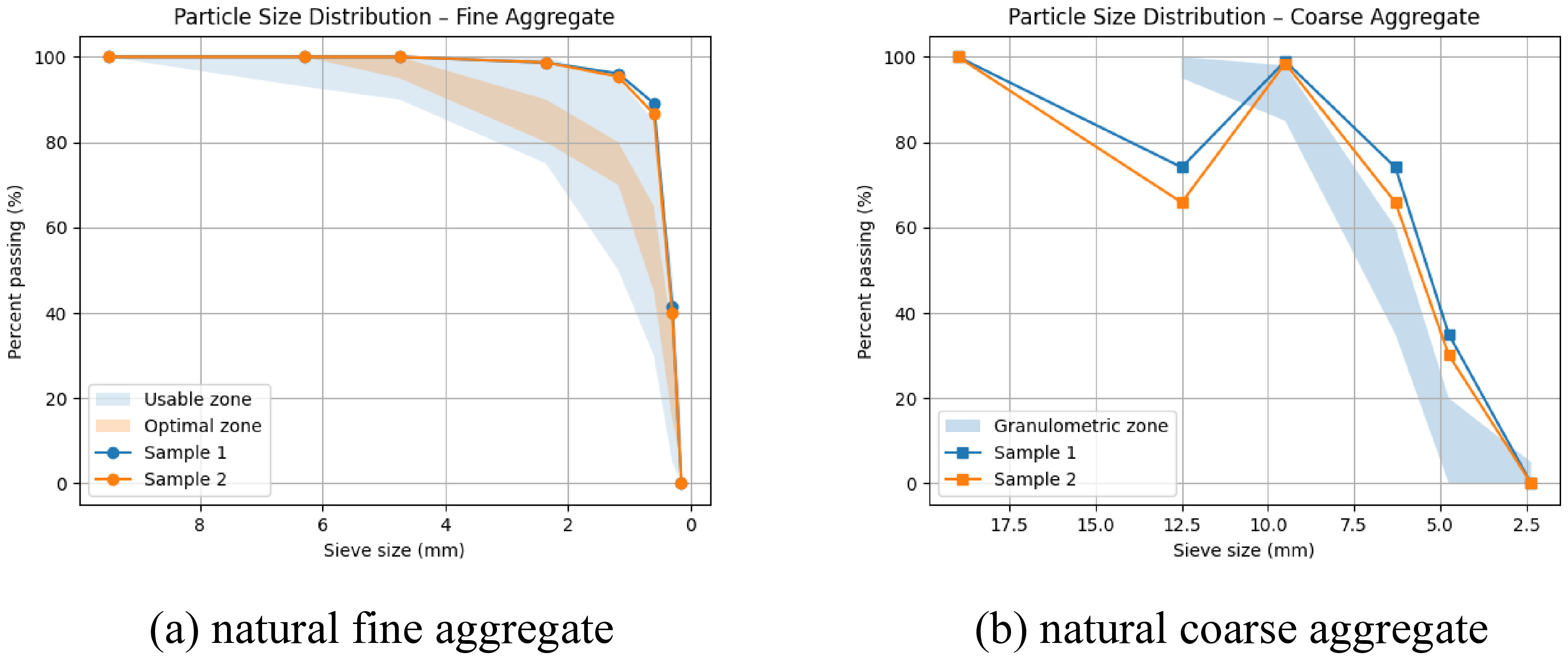
The grading curves are presented in Figure 2(a) (natural fine aggregate) and Figure 2(b) (natural coarse aggregate), expressed in terms of percentage passing. The normative limits for aggregate grading were considered based on ABNT NBR 7211 [19], which defines the acceptable ranges for particle size distribution, including the usable and optimal zones for fine aggregates and the corresponding granulometric zones for coarse aggregates.
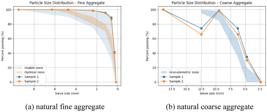
Particle size distribution curves of fine and coarse aggregates, including grading limits according to ABNT NBR 7211 [19].
The results indicate that both fine and coarse aggregates fall within the limits established by the standard. The fine aggregate presents a well-distributed grading within the usable and optimal zones, while the coarse aggregate is consistent with the 4.75–12.5 mm granulometric range, showing adequate particle size distribution for concrete production.
2.2.2 Density and Water Absorption
The density and water absorption of the aggregates were determined in accordance with ABNT NBR 16916 [20] (fine aggregate) and ABNT NBR 16917 [21] (coarse aggregate). The results obtained for the fine and coarse aggregates are presented in Tables 5 and 6, respectively.
The results indicate that the recycled aggregates present lower density and higher water absorption compared to natural aggregates, which is attributed to the presence of adhered mortar and higher porosity. These characteristics are consistent with findings reported in the literature and are known to influence the mechanical behavior and variability of recycled aggregate concretes.
2.2.3 Bulk Density
The bulk density and void index of the aggregates were determined in accordance with ABNT NBR 16972 [22]. The results obtained for the fine and coarse aggregates are presented in Tables 7 and 8, respectively.
2.3 Mix Proportioning
Concrete mixtures were produced with 0%, 30%, 50%, and 100% replacement of natural coarse aggregates by recycled concrete aggregates (RCA). The replacement was carried out on a volumetric basis to ensure consistency among mixtures, considering the difference in specific density between natural and recycled aggregates.
The mix design was based on adaptations proposed by Gerin [23] and the methodology developed by Pereira [24]. As highlighted in these studies, a direct mass replacement of natural aggregates by recycled aggregates results in an increase in aggregate volume, which may affect the workability and mechanical performance of the mixtures. To account for this effect, the mass of recycled aggregate was corrected to ensure volumetric equivalence, according to Equation (1).
Where MRCA represents the mass of recycled aggregate, MNAT is the mass of natural aggregate in the reference mixture, and γRCA and γNAT correspond to the specific densities of the recycled and natural aggregates, respectively.
The cement content was determined based on the volumetric composition of the mixture, as expressed in Equation (2).
In Equation 2, C denotes the cement content of the mixture (kg/m3); γcement, γsand , γcoarse, and γrecycled represent the specific densities (kg/m3) of cement, natural fine aggregate, natural coarse aggregate, and recycled coarse aggregate, respectively; and a/b is the water-to-cement ratio.
Steel fibers were incorporated at a constant dosage of 125.6 kg/m3, with a length of 30 mm, satisfying the requirement that the fiber length be at least twice the maximum aggregate size and complying with ABNT NBR 15530 [25]. It is important to emphasize that all mixtures contained fibers; therefore, their influence was not evaluated as an independent variable in this study.
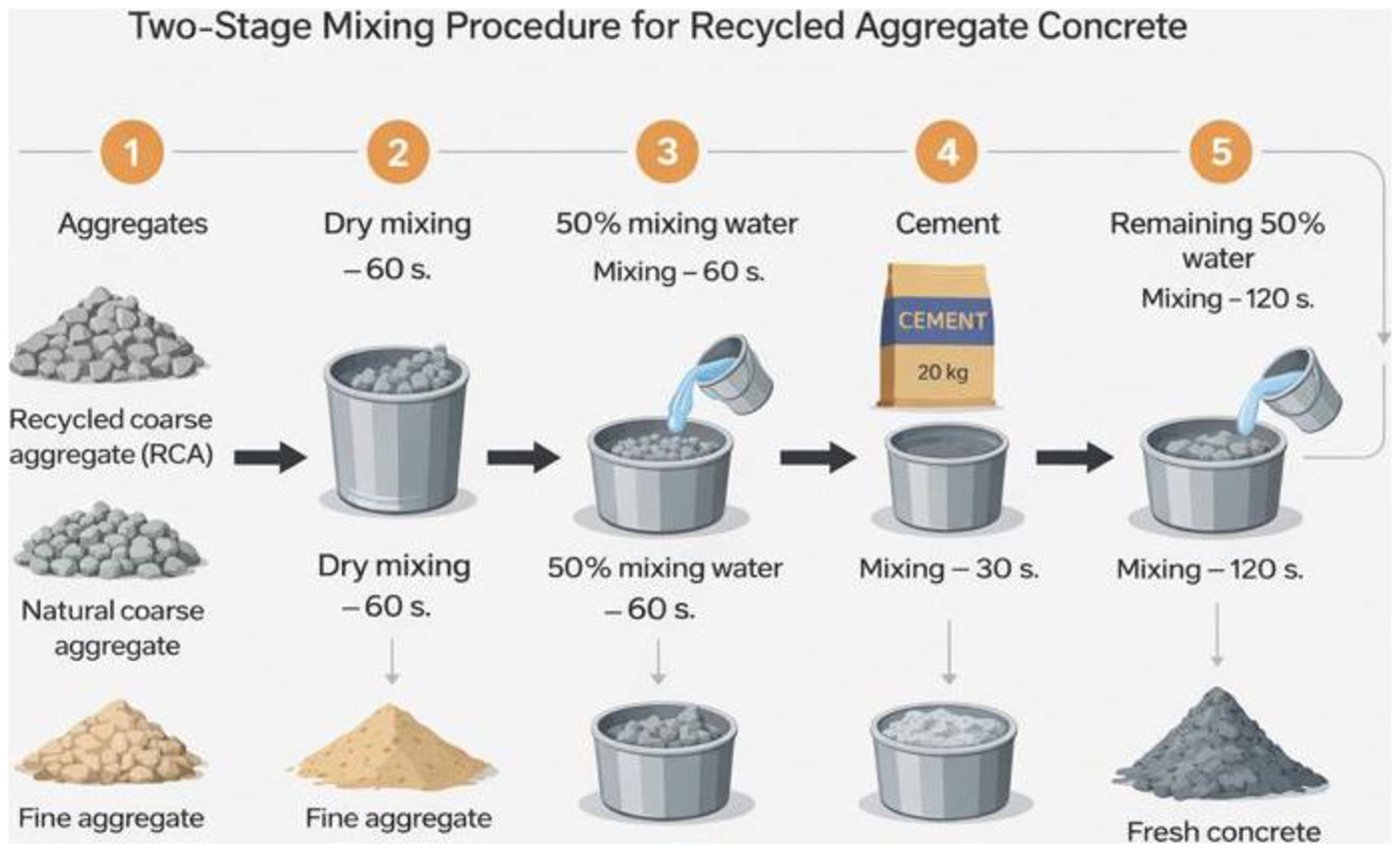
The mixing procedure adopted follows the two-stage method proposed by Tam et al. [26], as illustrated in Figure 3. This method improves the interaction between the cement paste and recycled aggregates, contributing to a more homogeneous mixture and reducing the variability of mechanical properties.
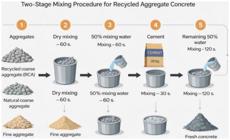
Two-stage mixing procedure adopted for recycled aggregate concrete, based on the method proposed by Tam et al. [26].
The mix proportions adopted for each mixture are presented in Table 9. Concretes with natural aggregates are identified as NAC, while those incorporating recycled aggregates are designated as RAC, followed by the corresponding replacement level (30, 50, and 100%). The adopted procedure ensures consistency among mixtures, thereby enabling a reliable comparison of their mechanical behavior.
2.4 Casting of the specimens
The concrete mixing procedure followed the two-stage method proposed by Tam et al. [26], as illustrated in Figure 3 and previously described in Section 2.3.
The recycled aggregates were used in a pre-wetted condition, ensuring adequate moisture without reaching full saturation, in order to control water absorption during mixing and maintain consistency in the effective water-to-cement ratio.
Cylindrical specimens with dimensions of 100 mm in diameter and 200 mm in height were cast for each mixture. After casting, the specimens were compacted using standard procedures and stored under controlled curing conditions until testing.
The workability of the fresh concrete was evaluated by means of the slump test, performed in accordance with ABNT NBR NM 67 [27], with the results presented in Table 10. Subsequently, cylindrical specimens were cast and tested at 7, 14, and 28 days to evaluate the development of mechanical properties over time.
2.5 Determination of the moduli of elasticity
The static modulus of elasticity was determined in accordance with ABNT NBR 8522 [28] – Part 1: Static modulus under compression, using cylindrical specimens. Method A described in the standard was adopted, considering stress levels corresponding to 0.5 MPa and 30% of the compressive strength. The maximum compressive strength values obtained for each specimen are presented in Table 11, while the corresponding static modulus of elasticity values are provided in Table 12.
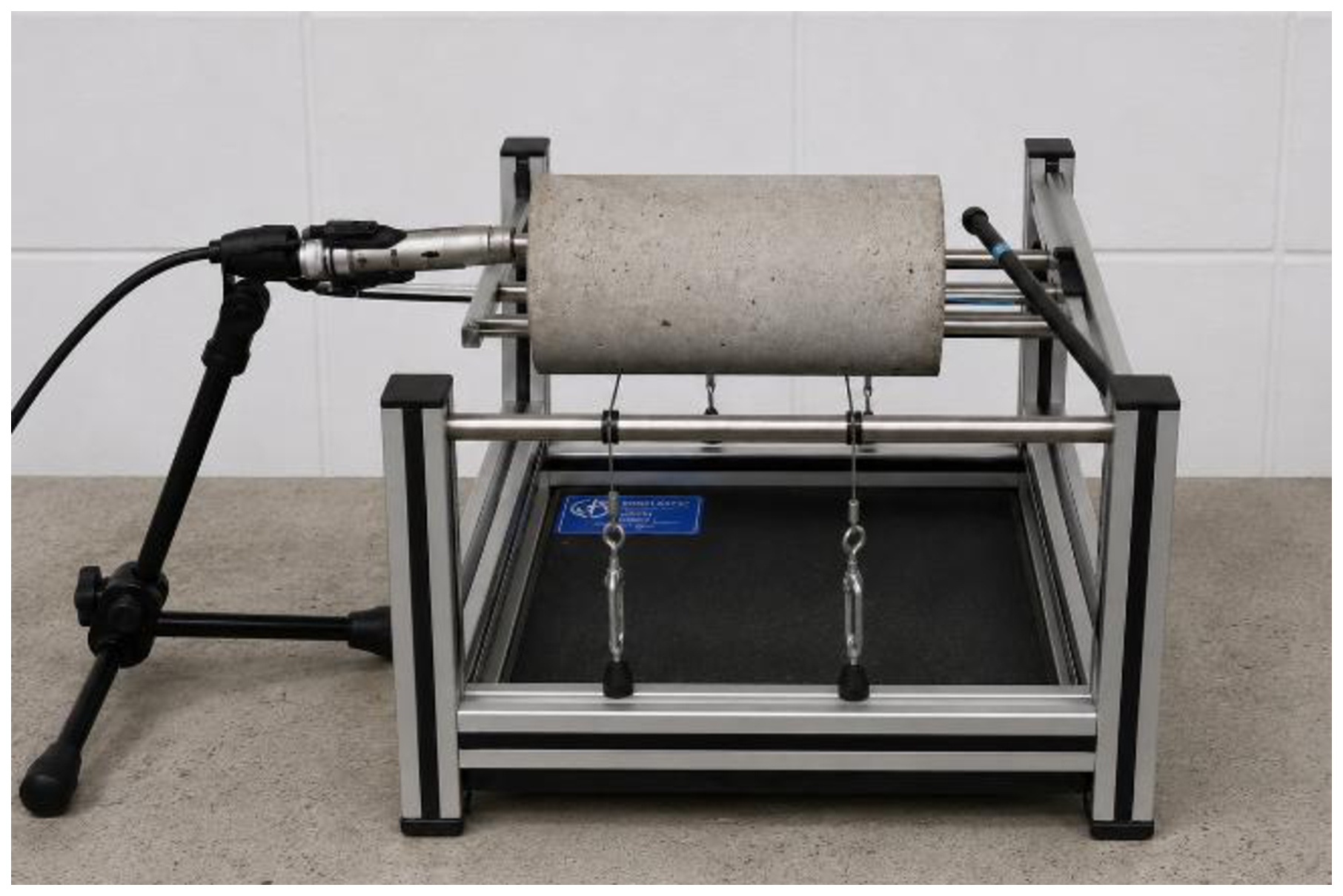
The dynamic modulus of elasticity was determined using the impulse excitation technique, following procedures commonly adopted for the dynamic characterization of concrete through acoustic response and natural vibration frequencies, as reported by Diógenes et al. [29]. The tests were performed using the Sonelastic equipment and the corresponding software developed by ATCP Engenharia Física, and the non-destructive testing setup adopted for signal acquisition and frequency identification is illustrated in Figure 4. The experimental procedure was conducted in accordance with ABNT NBR 8522 [28] – Part 2, which evaluates the dynamic modulus from the fundamental vibration frequencies of the specimens.
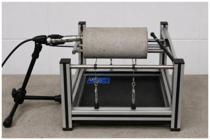
The dynamic modulus was calculated based on the fundamental longitudinal vibration frequency of the specimens, considering their geometry and mass, as prescribed by the standard. The measured specimen masses and the corresponding dynamic modulus values are presented in Tables 13 and 14, respectively.
The apparent density of the specimens was determined from the ratio between the measured mass and the specimen volume (1570.80 cm3). The resulting density values are presented in Table 15.
The estimation of the static modulus of elasticity from dynamic measurements is based on the relationship between the static modulus (Eci) and the dynamic modulus (Ecd), which has been extensively investigated in the literature. Dynamic modulus values are generally higher than those obtained from static tests due to differences in loading conditions and strain levels, as well as the composite nature of concrete, which leads to distinct mechanical responses under dynamic and quasi-static regimes [14].
In this context, the model originally proposed by Popovics [14] establishes a generalized relationship between static and dynamic elastic moduli, incorporating the influence of material density. Unlike purely empirical correlations, this formulation is derived from a broader representation of the mechanical behavior of cementitious materials and can be applied to different types of concrete.
According to Possan et al. [15], the combination of dynamic testing methods, particularly those based on natural frequencies of vibration, combined with the Popovics formulation, provides a practical and reliable alternative for estimating the static modulus of elasticity. The authors report that this approach yields average errors on the order of −6.7%, which are lower than the typical variability associated with direct static measurements, indicating that indirect estimation may achieve comparable accuracy while offering advantages such as reduced cost, faster testing, and non-destructive evaluation.
Based on this approach, the static modulus of elasticity was estimated from the dynamic modulus using the formulation proposed by Possan et al. [15], as expressed in Equation (3):
where Eci is the static modulus of elasticity (GPa), Ecd is the dynamic modulus of elasticity (GPa), and ρ is the apparent density of the concrete (g/cm3).
The estimated values of the static modulus of elasticity obtained using Equation (3) are presented in Table 16. All tests were carried out at 7, 14, and 28 days in order to monitor the evolution of the elastic properties of the concretes over time.
3 RESULTS AND DISCUSSION
3.1 Mechanical Properties
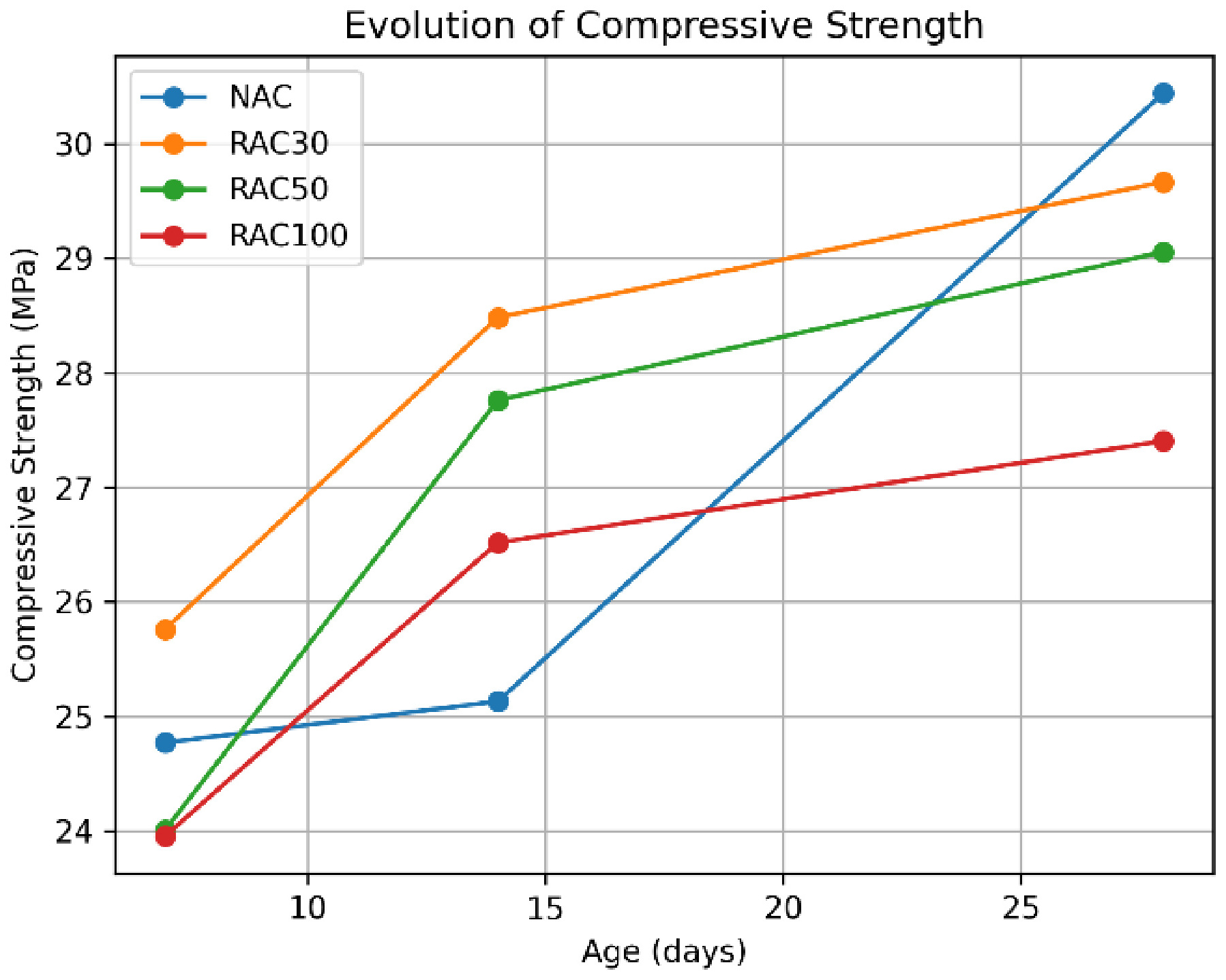
The compressive strength results obtained at 7, 14, and 28 days are presented in Table 8, and their evolution is illustrated in Figure 4. An increase in compressive strength over time was observed for all mixtures, as expected due to the progression of cement hydration.
As shown in Figure 5 and Table 11, concretes with 30% replacement of natural aggregates by recycled aggregates (RAC30) exhibited compressive strength values comparable to those of the reference concrete (NAC), and in some cases slightly higher at early ages. In contrast, mixtures with higher replacement levels (RAC50 and RAC100) showed a reduction in compressive strength. This behavior is associated with the lower stiffness and higher porosity of recycled aggregates, as well as the presence of adhered mortar, which increases the heterogeneity of the material and weakens the interfacial transition zone. Although higher strength values were reported by Marques [10] and Oliveira [5] for similar mixtures, the results obtained in this study are consistent with the general trends observed in the literature, with differences attributed to variations in cement properties and in the physical characteristics of the recycled aggregates.
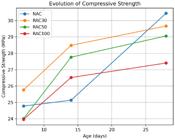
Evolution of compressive strength of the concretes at 7, 14, and 28 days for different replacement levels of recycled aggregates.
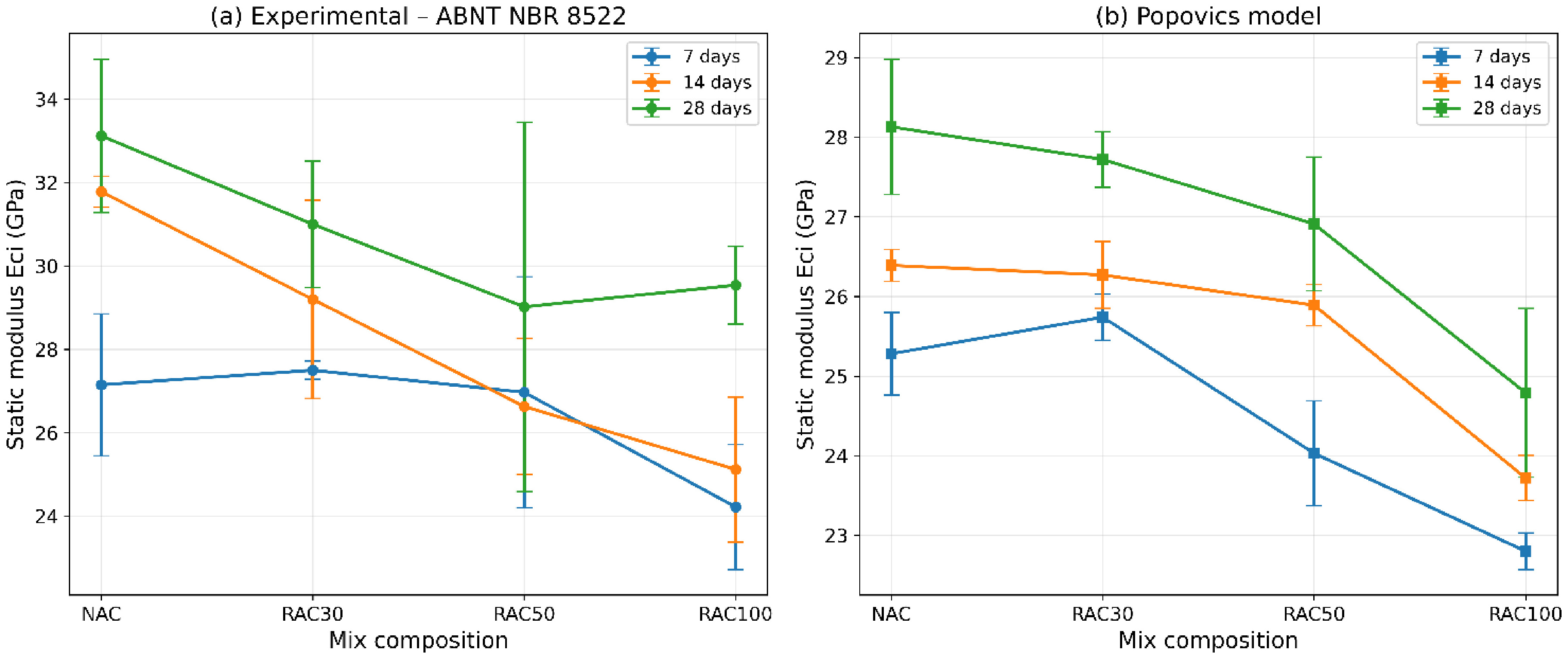
The behavior of the static modulus of elasticity (Eci) follows a trend similar to that observed for compressive strength. The interaction between curing age and mix composition is presented in Figure 6.
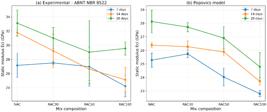
Interaction between curing age and mix composition for the static modulus of elasticity (Eci): (a) ABNT NBR 8522 [28] results and (b) Popovics model estimates.
As observed, the static modulus increases with curing age for all mixtures, reflecting the development of the cementitious matrix. However, a reduction in stiffness is evident with increasing recycled aggregate content, particularly for RAC50 and RAC100. This behavior is directly related to the lower stiffness and higher deformability of recycled aggregates, as well as the presence of adhered mortar, which affects the overall elastic response of the composite material.
In contrast, the dynamic modulus of elasticity exhibited a more stable behavior over time and showed lower sensitivity to the replacement level of recycled aggregates. This reduced sensitivity can be attributed to the nature of the non-destructive testing method, which is based on wave propagation and is less influenced by localized defects and microcracking than static loading conditions.
3.2 Comparison between Experimental Static Modulus and Estimated Values from Dynamic Modulus
The comparison between the experimental static modulus of elasticity and the values estimated from the dynamic modulus provides an assessment of the applicability of the adopted empirical formulation. The corresponding results are presented in Tables 17 and 18.
Standard deviation and coefficient of variation of the static modulus of elasticity (Popovics-based model) for different curing ages.
Standard deviation and coefficient of variation of the static modulus of elasticity determined experimentally according to ABNT NBR 8522 [28] for different curing ages.
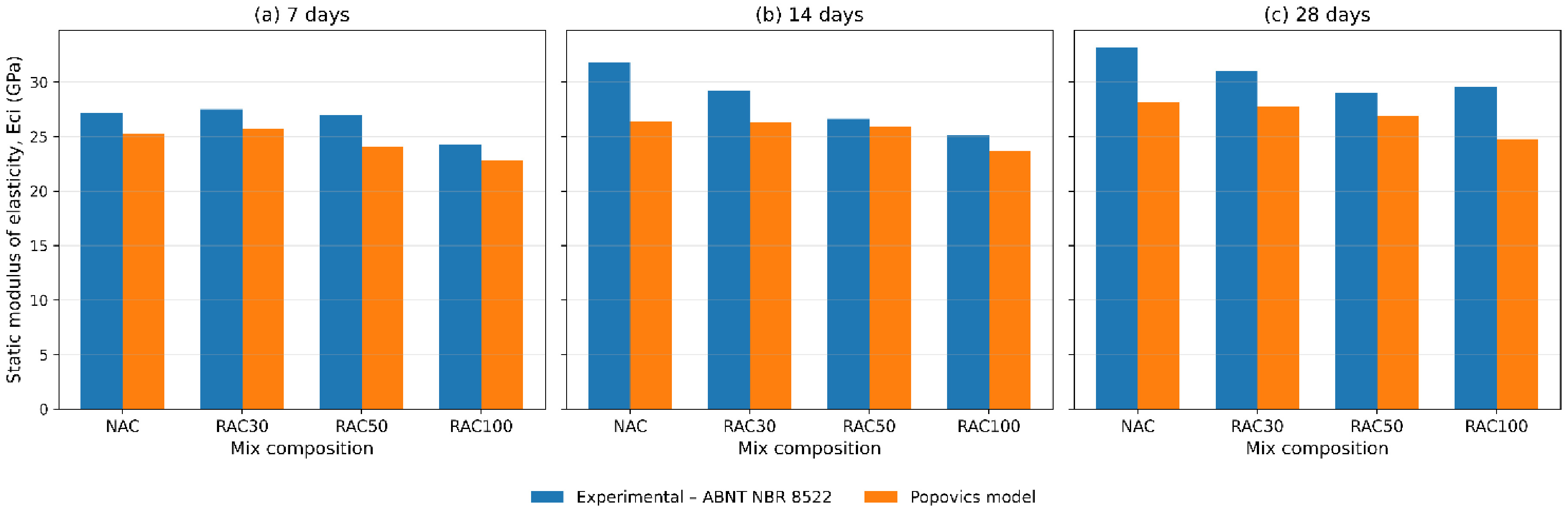
The estimated static modulus of elasticity, calculated using Equation (3), is presented in Table 13, while the experimentally determined values obtained from axial compression tests are provided in Table 9. A visual comparison between the experimental and estimated values is illustrated in Figure 7.
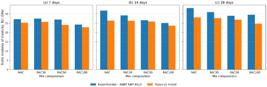
Bar chart comparison of the static modulus of elasticity (Eci) obtained experimentally according to ABNT NBR 8522 [28] and estimated by the Popovics model for different mix compositions at (a) 7 days, (b) 14 days, and (c) 28 days.
A comparison between Tables 17 and 18 indicates that the estimated values generally exhibit lower variability than the experimental results. This behavior is expected, since the estimation procedure is based on a mathematical relationship that smooths local variations observed in experimental measurements.
A summary of the comparison between experimental and estimated values, including mean error and variability indicators for each mixture, is presented in Table 19.
Comparison between experimental and estimated static modulus of elasticity for different mixtures.
As observed in Table 19, the mean error between the experimental and estimated values is negative for all mixtures, confirming the tendency of the model to underestimate the static modulus of elasticity. The magnitude of this difference varies among mixtures, with RAC30 and RAC100 presenting smaller deviations, while RAC50 exhibits higher variability.
It is important to note that the number of specimens tested for each mixture and curing age was limited to three, which restricts the application of more robust statistical analyses, such as analysis of variance (ANOVA), particularly considering the inherent heterogeneity of recycled aggregate concretes. Although the adopted sample size is consistent with common experimental practices in concrete research, especially in studies involving mechanical characterization, the results should be interpreted with caution. In this context, the analysis of variability through standard deviation and coefficient of variation was adopted as a complementary approach to assess the dispersion of the results and to support the comparison between experimental and estimated values. These indicators provide relevant insight into the consistency of the measurements, although they do not replace more comprehensive statistical analyses.
Despite these limitations, the results indicate that the empirical formulation based on the Popovics model, as adapted by Possan et al. [15], is suitable for estimating the static modulus of elasticity of concretes incorporating recycled aggregates, particularly at lower replacement levels.
Overall, the results indicate that the use of dynamic modulus measurements combined with empirical correlations represents a viable approach for estimating static elastic properties, although attention must be given to the influence of recycled aggregate content on prediction accuracy.
4 CONCLUSIONS
This study investigated the mechanical behavior of concretes incorporating recycled concrete aggregates (RCA) and steel fibers, with emphasis on compressive strength and the static and dynamic moduli of elasticity. The results showed that compressive strength increased with curing age for all mixtures, as expected due to the progression of cement hydration. Concretes with 30% replacement of natural aggregates by recycled aggregates (RAC30) exhibited performance comparable to that of the reference concrete (NAC), while higher replacement levels resulted in a reduction in strength. The presence of steel fibers contributed to the integrity of the material by assisting in stress redistribution and controlling crack propagation, which may have contributed to maintaining mechanical performance, particularly at moderate replacement levels.
A similar trend was observed for the static modulus of elasticity, which increased with age and decreased with increasing RCA content. This behavior is associated with the lower stiffness and higher porosity of recycled aggregates, as well as the presence of adhered mortar, which affects the overall deformability of the material. The action of the fibers may also have contributed to reducing the variability of the results by promoting internal cohesion and limiting the development of microcracks. In contrast, the dynamic modulus of elasticity exhibited a more stable evolution over time and showed lower sensitivity to the replacement level, highlighting the potential of non-destructive testing methods for monitoring the elastic properties of concretes incorporating recycled aggregates.
The comparison between experimentally determined and estimated values of the static modulus of elasticity indicated that the empirical formulation adopted in this study, based on the model originally proposed by Popovics [14] and adapted by Possan et al. [15], provides a reasonable approximation of the experimental results. However, a consistent tendency to underestimate the static modulus was observed, with differences depending on the replacement level. The variability analysis further indicated that the estimated values generally present lower dispersion than the experimental results, reflecting the smoothing effect of the mathematical formulation.
Overall, the results demonstrate that the use of recycled aggregates at moderate replacement levels, particularly up to 30%, is technically feasible without significant loss of mechanical performance. In this context, the incorporation of steel fibers represents an additional strategy to improve material behavior, contributing to greater mechanical stability and crack control. Furthermore, the combined use of dynamic modulus measurements and empirical correlations represents a viable approach for estimating static elastic properties. These findings contribute to the understanding of the mechanical behavior of fiber-reinforced concretes incorporating recycled aggregates and support their application in structural engineering.
ACKNOWLEDGEMENTS
The authors gratefully acknowledge the Laboratory of Materials and Civil Construction (LMCC) and Department of Structural Engineering (SET) for the technical and institutional support provided throughout this study. The authors also thank the University of São Paulo (USP) for the undergraduate research scholarship (Scientific Initiation) that supported this work.
-
Financial support:
This work was supported by Universidade de São Paulo through an undergraduate research scholarship from the Programa Unificado de Bolsas (PUB). The total funding provided to this study was R$ 8,400.00.
-
Data Availability:
The data that support the findings of this study are available from the corresponding author, [M. N. Kataoka], upon request.
-
How to cite:
M. N. Kataoka, G. O. Thomaz, and B. B. Marques, “Evaluation of the static and dynamic moduli of elasticity of concrete with recycled aggregates and steel fibers,” Rev. IBRACON Estrut. Mater., vol. 19, no. 3, e19120, 2026, https://doi.org/10.1590/S1983-41952026000100020
REFERENCES
- 1 Associação Brasileira de Normas Técnicas, Agregados reciclados de resíduos sólidos da construção civil: execução de camadas de pavimentação: procedimentos, NBR 15115, 2004.
- 2 Associação Brasileira de Normas Técnicas, Agregados reciclados para uso em argamassas e concretos de cimento Portland – Requisitos e métodos de ensaio, NBR 15116, 2021.
-
3 E. P. V. Alberte and J. B. Handro, "Estado do conhecimento acerca de especificações técnicas e normativas para agregados reciclados de RCD," Ambient. Constr., vol. 21, no. 3, pp. 305–320, 2021, https://doi.org/10.1590/s1678-86212021000300553
» https://doi.org/10.1590/s1678-86212021000300553 -
4 J. Xiao, J. Li, and Ch. Zhang, "Mechanical properties of recycled aggregate concrete under uniaxial loading," Cement Concr. Res., vol. 35, no. 6, pp. 1187–1194, Jun 2005, https://doi.org/10.1016/j.cemconres.2004.09.020
» https://doi.org/10.1016/j.cemconres.2004.09.020 -
5 F. G. B. S. Oliveira “Análise experimental e numérica do comportamento à flexão de vigas formadas por perfis de aço parcialmente revestidas com concreto de resíduos reciclados de concreto,” M.S. thesis, Escola de Engenharia de São Carlos, Universidade de São Paulo, São Carlos, Brazil, 2022. https://doi.org/10.11606/D.18.2022.tde-19102022-122217
» https://doi.org/10.11606/D.18.2022.tde-19102022-122217 -
6 L. Ferreira, J. de Brito, and M. Barra, "Influence of the pre-saturation of recycled coarse concrete aggregates on concrete properties," Mag. Concr. Res., vol. 63, no. 8, pp. 617–627, Aug 2011, https://doi.org/10.1680/macr.2011.63.8.617
» https://doi.org/10.1680/macr.2011.63.8.617 -
7 E. Khoury, W. Ambrós, B. Cazacliu, C. H. Sampaio, and S. Remond, "Heterogeneity of recycled concrete aggregates, an intrinsic variability," Constr. Build. Mater., vol. 175, pp. 705–713, Jun 2018, https://doi.org/10.1016/j.conbuildmat.2018.04.163
» https://doi.org/10.1016/j.conbuildmat.2018.04.163 -
8 K. P. Verian, W. Ashraf, and Y. Cao, "Properties of recycled concrete aggregate and their influence in new concrete production," Resour. Conserv. Recycling, vol. 133, pp. 30–49, 2018., https://doi.org/10.1016/j.resconrec.2018.02.005
» https://doi.org/10.1016/j.resconrec.2018.02.005 -
9 M. Etxeberria, E. Vásquez, A. Marí, and M. Barra, "Influence of amount of recycled coarse aggregate and production process on properties of recycled aggregate concrete," Cement Concr. Res., vol. 37, no. 5, pp. 735–742, May 2007, https://doi.org/10.1016/j.cemconres.2007.02.002
» https://doi.org/10.1016/j.cemconres.2007.02.002 -
10 B. B. Marques, “Estudo experimental e numérico de pilares mistos parcialmente revestidos com concreto de resíduos reciclados de concreto e fibras de aço,” M.S. thesis, Escola de Engenharia de São Carlos, Universidade de São Paulo, São Carlos, Brazil, 2022. https://doi.org/10.11606/D.18.2022.tde-22112022-115211
» https://doi.org/10.11606/D.18.2022.tde-22112022-115211 -
11 B. Wang, L. Yan, Q. Fu, and B. Kasal, "A comprehensive review on recycled aggregate and recycled aggregate concrete," Resour. Conserv. Recycling, vol. 171, pp. 105565, 2021., https://doi.org/10.1016/j.resconrec.2021.105565
» https://doi.org/10.1016/j.resconrec.2021.105565 -
12 F. Debieb and S. Kenai, "The use of coarse and fine crushed bricks as aggregate in concrete," Constr. Build. Mater., vol. 22, no. 5, pp. 886–893, 2008., https://doi.org/10.1016/j.conbuildmat.2006.12.013
» https://doi.org/10.1016/j.conbuildmat.2006.12.013 -
13 J. A. Carneiro, P. R. L. Lima, M. B. Leite, and R. D. Toledo Filho, "Compressive stress-strain behavior of steel fiber reinforced-recycled aggregate concrete," Cement Concr. Compos., vol. 46, pp. 65–72, 2014, https://doi.org/10.1016/j.cemconcomp.2013.11.006
» https://doi.org/10.1016/j.cemconcomp.2013.11.006 -
14 S. Popovics, "Verification of relationships between mechanical properties of concrete-like materials," Mater. Constr., vol. 8, no. 3, pp. 183–191, 1975., https://doi.org/10.1007/BF02475168
» https://doi.org/10.1007/BF02475168 -
15 E. Possan, H. Alves, P. Helene, P. Bilesky, R. Carrazedo, and R. Curti, “Módulo de elasticidade dinâmico do concreto: por que utilizar,” in Proc. 62a Congresso Brasileiro do Concreto, Florianópolis, Brazil, 2020, https://doi.org/10.4322/2175-8182.62CBC020
» https://doi.org/10.4322/2175-8182.62CBC020 -
16 Brasil. Conselho Nacional do Meio Ambiente, “Resolução no 307, de 5 de Julho de 2002. Estabelece diretrizes, critérios e procedimentos para a gestão dos resíduos da construção civil,” DOU, July 17, 2002. Available: http:// https://conama.mma.gov.br/?option=com_sisconama&task=arquivo.download&id=305
» https://conama.mma.gov.br/?option=com_sisconama&task=arquivo.download&id=305 - 17 Associação Brasileira de Normas Técnicas, Agregado reciclado para uso em argamassa e concreto de cimento Portland - Requisitos e métodos de ensaio, NBR 15116, 2021.
- 18 Associação Brasileira de Normas Técnicas, Agregados – Determinação da composição granulométrica, NBR 17054, 2022.
- 19 Associação Brasileira de Normas Técnicas, Agregados para concreto – Especificação, NBR 7211:2022, Rio de Janeiro: ABNT, 2022.
- 20 Associação Brasileira de Normas Técnicas, Agregado miúdo – Determinação da densidade e da absorção de água, NBR 16916, 2021.
- 21 Associação Brasileira de Normas Técnicas, Agregado graúdo – Determinação da densidade e da absorção de água, NBR 16917, 2021.
- 22 Associação Brasileira de Normas Técnicas, Agregados – Determinação da massa unitária e índice de vazios, NBR 16972, 2021.
- 23 M. T. Gerin, “Comportamento de pilares mistos preenchidos com concreto de resíduos de concreto submetidos à compressão axial centrada: efeito do teor de substituição e da forma de aplicação da força,” M.S. thesis, Dept. Civil Eng., Universidade Federal de São Carlos, São Carlos, Brazil, 2020.
-
24 M. F. Pereira, “Comportamento estrutural de pilares mistos parcialmente revestidos submetidos a flexo-compressão,” Ph.D. dissertation, Escola de Engenharia de São Carlos, Universidade de São Paulo, São Carlos, Brazil, 2017, https://doi.org/10.11606/T.18.2017.tde-22062017-104032
» https://doi.org/10.11606/T.18.2017.tde-22062017-104032 - 25 Associação Brasileira de Normas Técnicas, Fibras de aço para concreto – Requisitos e métodos de ensaio, NBR 15530, 2019.
-
26 V. W. Y. Tam, X. F. Gao, and C. M. Tam, "Microstructural analysis of recycled aggregate concrete produced from two-stage mixing approach," Cement Concr. Res., vol. 35, no. 6, pp. 1195–1203, Jun 2005, https://doi.org/10.1016/j.cemconres.2004.10.025
» https://doi.org/10.1016/j.cemconres.2004.10.025 - 27 Associação Brasileira de Normas Técnicas, Concreto — Determinação da consistência pelo abatimento do tronco de cone, NBR NM 67, 1998.
- 28 Associação Brasileira de Normas Técnicas, Determinação dos módulos de elasticidade do concreto empregando a Técnica de Excitação por Impulso, NBR 8522-1&2, 2021.
- 29 H. J. F. Diógenes, L. C. Cossolino, A. H. A. Pereira, M. K. El Debs and A. L. H. C. El Debs, “Determination of modulus of elasticity of concrete from the acoustic response, " IBRACON Struct. Mater. J., vol. 4, no. 5, pp. 792–813, 2011.
Edited by
-
Editors:
Bernardo Horowitz, Leandro Trautwein.
The data that support the findings of this study are available from the corresponding author, [M. N. Kataoka], upon request.