 Potential strengths and limitations of the Better at Home Program identified by professionals and managers: a scoping review of the literature
Objective: to map the strengths and limitations of the Better at Home Program identified by health professionals and managers in the scientific literature.
Method: this is a scoping review based on the JBI manual and the PRISMA-ScR guidelines. The search was conducted in the MEDLINE/PubMed, LILACS, Scopus, Embase, Web of Science, CINAHL databases, and CAPES theses and dissertations, covering publications between 2011 and 2024.
Results: 552 studies were identified, eight met the inclusion criteria and were analyzed. The program’s potential lies in promoting dehospitalization, strengthening networking, developing educational health initiatives with families, and providing flexibility in care management. On the other hand, limitations were evident in relation to insufficient continuing education for professionals, emotional exhaustion among teams, technological limitations, and difficulties in communicating with the Health Care Network.
Conclusion: the Better at Home Program is a relevant strategy in the dehospitalization process; however, it faces structural and operational challenges that compromise its sustainability. Investments in technological support and team strengthening are necessary to improve the continuity and quality of home care. Study registry: Open Science Framework: DOI 10.17605/OSF.IO/6UCDB
Descriptors:
Home Care Services; Hospital-Based Home Care Services; Home Nursing; Home Health Nursing; Homebound Persons; Home Schooling.
Highlights:
(1) Strengthening network care promotes safe dehospitalization. (2) Health education promotes autonomy among users and caregivers. (3) The use of telecare expands access and improves the quality of home care. (4) Continuing health education is essential for the program’s effectiveness. (5) Lack of structure and emotional support weaken home care teams.
Objetivo: mapear na literatura científica as potencialidades e fragilidades do Programa Melhor em Casa identificadas por profissionais de saúde e gestores.
Método: revisão de escopo embasada no manual do JBI e nas diretrizes PRISMA-ScR. A busca foi realizada nas bases PubMed/MEDLINE, LILACS, Scopus, Embase, Web of Science, CINAHL, e teses e dissertações CAPES, abrangendo publicações entre 2011 e 2024.
Resultados: dos 552 estudos identificados, oito atenderam aos critérios de inclusão e foram analisados. As potencialidades do programa referem-se à promoção da desospitalização, fortalecimento do trabalho em rede, desenvolvimento de ações educativas em saúde com as famílias e flexibilidade na gestão do cuidado. Em contrapartida, foram evidenciadas fragilidades relacionadas à insuficiência da educação permanente dos profissionais, desgaste emocional das equipes, limitações tecnológicas, e dificuldades de interlocução com a Rede de Atenção à Saúde.
Conclusão: o Programa Melhor em Casa é uma estratégia relevante no processo da desospitalização, contudo, enfrenta desafios estruturais e operacionais que comprometem sua sustentabilidade. Investimentos em suporte tecnológico e fortalecimento das equipes para melhorar a continuidade e a qualidade da atenção domiciliar são necessários. Registro Open Science Framework: DOI 10.17605/OSF.IO/6UCDB
Descritores:
Serviços de Assistência Domiciliar; Serviços Hospitalares de Assistência Domiciliar; Assistência Domiciliar; Enfermagem Domiciliar; Pacientes Domiciliares; Educação Domiciliar.
Destaques:
(1) Fortalecimento do cuidado em rede favorece a desospitalização segura. (2) A educação em saúde promove autonomia de usuários e cuidadores. (3) O uso do teleatendimento amplia o acesso e qualifica o cuidado domiciliar. (4) Educação permanente em saúde é essencial para a efetividade do programa. (5) Falta de estrutura e apoio emocional fragilizam equipes da atenção domiciliar.
Objetivo: mapear en la literatura científica las potencialidades y fragilidades del Programa Melhor em Casa identificadas por profesionales de la salud y gestores.
Método: revisión de alcance basada en el manual del JBI y en las directrices PRISMA-ScR. La búsqueda se realizó en las bases PubMed/MEDLINE, LILACS, Scopus, Embase, Web of Science, CINAHL, y en tesis y disertaciones CAPES, abarcando publicaciones entre 2011 y 2024.
Resultados: de los 552 estudios identificados, ocho cumplieron los criterios de inclusión y fueron analizados. Las potencialidades del programa se refieren a la promoción de la deshospitalización, el fortalecimiento del trabajo en red, el desarrollo de acciones educativas en salud con las familias y la flexibilidad en la gestión del cuidado. En contrapartida, se evidenciaron fragilidades relacionadas con la insuficiencia de la educación permanente de los profesionales, el desgaste emocional de los equipos, las limitaciones tecnológicas y las dificultades de interlocución con la Red de Atención a la Salud.
Conclusión: el Programa Melhor em Casa es una estrategia relevante en el proceso de deshospitalización; sin embargo, enfrenta desafíos estructurales y operativos que comprometen su sostenibilidad. Se requieren inversiones en soporte tecnológico y fortalecimiento de los equipos para mejorar la continuidad y la calidad de la atención domiciliaria. Registro Open Science Framework: DOI 10.17605/OSF.IO/6UCDB
Descriptores:
Servicios de Atención de Salud a Domicilio; Servicios de Hospitalización a Domicilio Provisto por Hospital; Atención Domiciliaria de Salud; Cuidados de Enfermería en el Hogar; Personas Imposibilitadas; Educación en Casa.
Destacados:
(1) El fortalecimiento de la atención en red favorece la deshospitalización segura. (2) La educación en salud promueve la autonomía de usuarios y cuidadores. (3) El uso de la teleatención amplía el acceso y cualifica la atención domiciliaria. (4) La educación permanente en salud es esencial para la efectividad del programa. (5) La falta de estructura y de apoyo emocional fragiliza a los equipos de atención domiciliaria.
Introduction
Home care (HC) is a type of care provided in the user’s home, which can be carried out within the scope of Primary Health Care (PHC) or, in cases that require more complex care, through the Better at Home Program (PMeC). In recent years, HC has gained increasing relevance in the Unified Health System (SUS), especially because it provides continuous, humanized care focused on the needs of users. Integrated into the Health Care Network (HCN), this type of care stands out for offering assistance in the home environment, prioritizing the safety and well-being of users1.
HC promotes treatment, rehabilitation, palliative care, and prevention measures, and is recommended for users who are temporarily or permanently confined to bed or home due to clinical conditions or situations of vulnerability2. This type of care recognizes the social and cultural context of the user and their family members, contributing to reducing the risk of infections, repeat hospitalizations, and inappropriate use of hospital services. In addition, it promotes the efficient management of hospital beds and available health resources, serving as a qualified “exit door” from the urgent and emergency care network, with the potential to reduce overcrowding in these services3.
The PMeC focuses on the dehospitalization of users who require clinical monitoring and support from a multidisciplinary team, promoting not only care, but also educational activities for users, family members, guardians, and caregivers to ensure continuity of care at home. The PMeC operates through Home Care Services (HCS), which complement primary health care and emergency services and can also be a substitute for hospitalization2.
In view of the aging population and the growing demand for more comprehensive and humanized healthcare, HC services have been expanding worldwide4. In Brazil, HCSs began to be structured more intensively in 1990 and were strategically and definitively incorporated into the SUS in 2011 with the creation of the PMeC5.
Factors such as accelerated demographic and epidemiological transition, rising healthcare costs, the process of deinstitutionalization, and the search for more humanized models of care highlight the importance of expanding the PMeC nationwide3-5. To improve its management, it is important to understand the perceptions of professionals and managers about the program in terms of its challenges and potential.
The multidisciplinary teams working in the PMeC experience different barriers and challenges in the practice of providing care to users and are therefore a valuable source for identifying elements that can support improvements in the program’s management. However, despite the relevance of their experiences, no reviews have been identified in the scientific literature that bring together these perceptions of the daily routine of the PMeC since its creation. In this context, this review aimed to map the strengths and limitations of the Better at Home Program identified by health professionals and managers in the scientific literature.
Method
Type of study
This is an evidence-based literature review of the scoping review type, guided by the recommendations of the JBI Reviewer’s Manual, which provides guidance on mapping key concepts, clarifying areas of research, and identifying gaps in knowledge6. Five stages proposed by the JBI were followed in conducting the study: 1) Formulation of the research question; 2) Identification of relevant studies; 3) Selection of studies; 4) Data extraction; and 5) Synthesis and presentation of results. The research protocol was registered on the Open Science Framework platform under DOI 10.17605/OSF.IO/6UCDB7. The Preferred Reporting Items for Systematic Reviews and Meta-Analyses for Scoping Reviews (PRISMA-ScR) extension was used to report transparently on the conduct of the scoping review results8. The study was conducted in the city of Porto Alegre, in the state of Rio Grande do Sul, Brazil, from February 2024 to March 2025.
Selection criteria
The inclusion criteria were: studies published in full, available electronically, without language restrictions, that answered the proposed research question. The time frame was set from 2011 to 2024, due to the approval of the PMeC Ordinance by the Ministry of Health (MS) in 20119, thus covering thirteen years of program implementation in Brazil. Editorials, letters to the editor, websites, news, and summaries of scientific events were excluded.
Data collection
The PCC mnemonic structure was adopted for the review search strategy, considering: Population (P) - health professionals and managers; Concept (C) - strengths and limitations of the PMeC; and Context (C) - Brazil. The question formulated was: “What are the strengths and limitations observed by health professionals and managers regarding the Better at Home Program in Brazil?”
The search strategy included terms present in the PCC structure, using descriptors identified in health thesauri such as Medical Subject Headings (MeSH) and Health Sciences Descriptors (DeCS). As this is a program exclusive to the Brazilian context, the research was supported by a librarian in the construction of the search strategy, who suggested using the program’s own name in Portuguese, “Programa Melhor em Casa”, and in English, “Better at Home Program”, in order to have greater coverage of the bibliography on the subject and expand the search strategy (Figure 1).
The search for scientific evidence was conducted in the following data sources: Latin American and Caribbean Health Sciences Literature (LILACS); Public Medical Literature Analysis and Retrieval System Online (MEDLINE/PubMed); Scopus; Excerpta Medica data BASE (EMBASE); Web of Science (WoS); and Cumulative Index to Nursing and Allied Health Literature (CINAHL). Gray literature was searched in the Brazilian Digital Library of Theses and Dissertations of CAPES.
Selection of studies
All records retrieved from the databases were identified, grouped, and uploaded to the Rayyan® (Intelligent Systematic Review) application, where duplicates were removed and initial screening of titles and abstracts was performed10. The gray literature was analyzed in Excel® spreadsheets, also through initial reading of the title and abstract. After removing duplicates in Rayyan®, the initial stage of data analysis was performed, with reviewers conducting independent and blind reading of titles and abstracts of all documents on the Rayyan® platform and in the Excel® spreadsheet. The reviewers assigned acceptance or rejection concepts according to the review’s research question. The blinding of the Rayyan® platform was opened in a meeting between the reviewers to verify the discrepancies. In this sense, the studies that remained with discrepancies were evaluated by a third reviewer, who performed the evaluation on the Rayyan® platform. Regarding the grey literature, a face-to-face meeting was held with the two reviewers to evaluate the results and discuss the discrepancies, so that the intervention of a third reviewer was not necessary.
The selected studies were read in full and analyzed descriptively in accordance with the research question and the relevance of the study objective. Regarding the grey literature, one specific dissertation was not found in its entirety. Attempts to contact the author and advisor by email were unsuccessful, and the other dissertation was the result of an article selected in the study, so it was decided to use the published article.
Data processing
Based on the selected documents, the extracted data were organized in an Excel® spreadsheet containing information on: author, title, type of study, year of publication, language, sample, publication journal, country of origin, year of publication, study objectives, main results, and conclusions. The data were analyzed descriptively, and the findings were subsequently categorized into strengths and limitations of the PMeC through a thematic analysis.
Ethical aspects
As this was a scoping review, there was no need to submit the study to the Research Ethics Committee. It is stated that there was no conflict of interest on the part of the researchers involved and that the copyright of the documents cited was respected in accordance with Law No. 12,853 of 201311.
Results
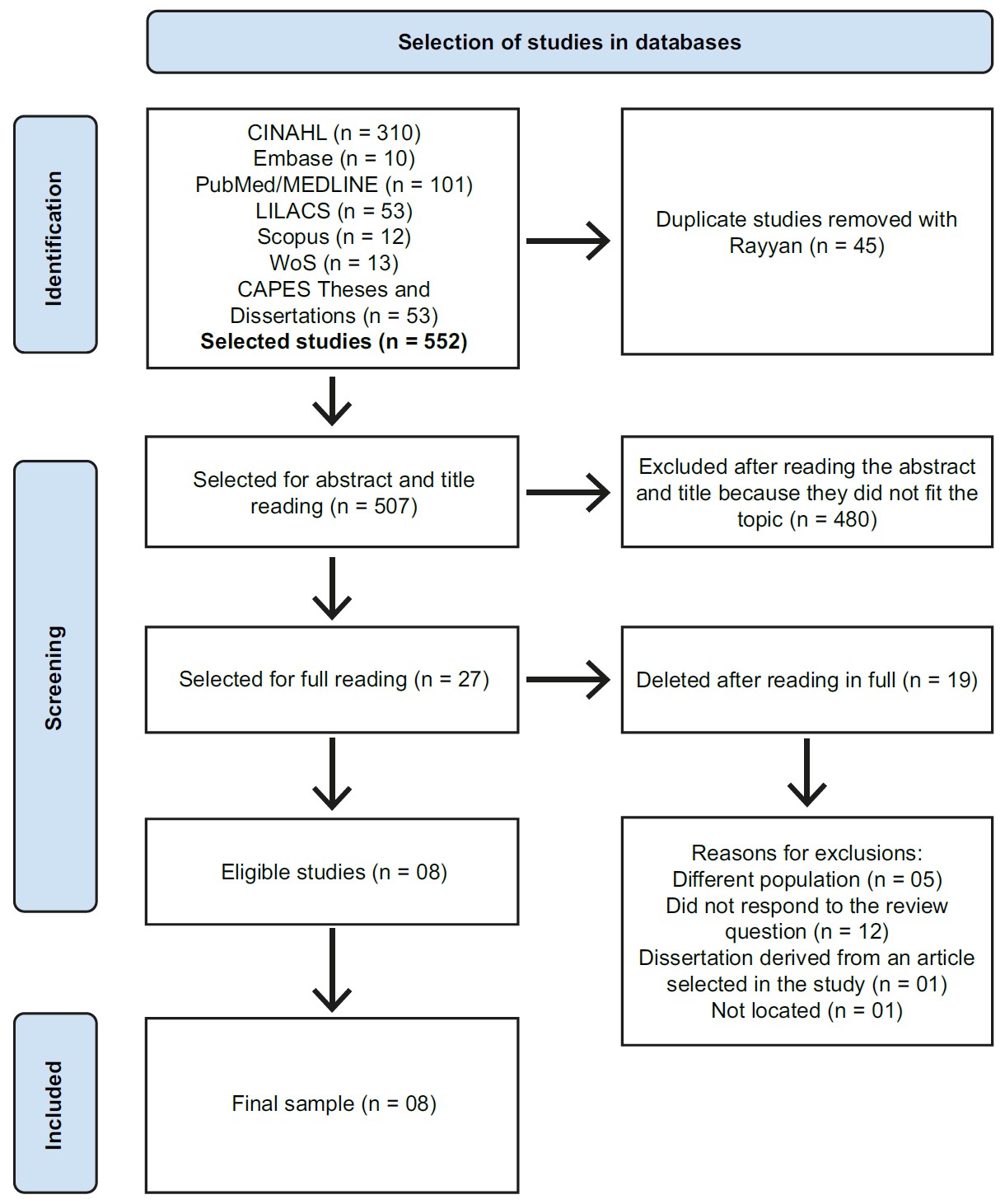
In the database search, 552 publications were identified. After removing 45 duplicates, 507 studies remained. Next, the titles and abstracts were read, and the inclusion and exclusion criteria were applied by two independent reviewers, resulting in the selection of 27 studies. Subsequently, the selected documents were read in full, considering the established inclusion and exclusion criteria, culminating in a final sample consisting of eight publications (Figure 2).
PRISMA-ScR12 flowchart used for study identification and selection. Porto Alegre, RS, Brazil, 2025
The main language of the publications was Portuguese (n=5; 62.5%), followed by English (n=3; 37.5%). Regarding the methodological design used by the authors, qualitative studies prevailed (n=6; = 75%), followed by quantitative studies (n=1; 12.5%) and mixed methods (n=1; 12.5%).
A total of 90 participants were identified in the studies. Regarding the year of publication, the articles were published between 2016 and 2022, with the highest number in 2022 (n=3; 37.5%), followed by 2018 (n=2; 25%), 2020 (n=1; 12.5%), 2019 (n=1; 12.5%), and 2016 (n=1; 12.5%). Figure 3 presents the characterization of the studies included in the review, with information on authorship, title, type of study, year of publication, and number of participants.
Figure 4 summarizes the objectives of the studies and the main results of each study, allowing us to visualize the perceptions of professionals regarding the PMeC.
To facilitate understanding and organization of the results, as well as to answer the review’s research question, the findings were subdivided into two thematic categories: Strengths and Limitations of the PMeC, as shown in Figure 5.
Discussion
The findings of this scoping review highlighted two thematic categories that characterize the program’s performance in the Brazilian context: the strengths and limitations of the PMeC. Critical analysis allows us to understand the progress achieved and the persistent challenges in consolidating HC as a strategy integrated into the HCN.
Strengths for the Better at Home Program
The development of networking, as a structuring axis of the PMeC, stood out as the main potential highlighted in the studies analyzed. Coordinated action between the different points of the HCN is fundamental, considering that the program mainly assists users who have recently been hospitalized. This configuration requires coordination with the intra-hospital network to ensure a safe transition of care, the establishment of intra-family ties between the PMeC team and the family at home, and, subsequently, the integration of the user into PHC, thus creating a continuum of care in the HCN. In this context, the consolidation of networking is necessary and intrinsically related to the structure of the service, contributing to better clinical outcomes. A narrative review highlighted that the quality of home care is influenced both by the ability of professionals to address needs and by the establishment of direct communication with the family21. This reinforces coordination with the different levels of the HCN, which favors the formulation of strategies for integrated actions that meet, in a multidisciplinary manner, the needs and expectations of users and families in the face of uncertainties associated with home care.
Another point highlighted in the studies refers to dehospitalization and the reduction of hospitalizations considered avoidable, corroborating the central objectives of the program, which aim at the safe transition of stable users to their homes. The user’s return to the home environment is a continuation of the care initiated in the hospital context and, when carried out in a planned manner and with access to the necessary resources, allows for the maintenance of coordination with the different levels of the network in an integrated, decisive, and person-centered manner. Planning for a safe discharge involves assessing the user’s clinical and social needs, as well as their family structure and the availability of HCN services, which are fundamental elements for preventing readmissions22. Still in this context, the reduction of unnecessary hospitalizations is favored by the early recognition of changes in the user’s clinical condition and by the adequate management of complications, which is the result of the educational process promoted by the teams with the families, contributing to a decrease in the user’s return to the hospital environment.
Health education aimed at families was represented in the studies as one of the differential strategies of the PMeC. The program goes beyond the focus on dehospitalization by investing in educational actions with caregivers and family members in the home environment, where intense exchanges of knowledge occur. In this intimate and unique context, marked by the reorganization of the family routine in the presence of a sick family member, it is essential that the team demonstrates empathy and commitment to progressively promote the construction of knowledge among family members for the exercise of safe and comprehensive care. Health education should, therefore, be conceived as a tool for promoting the autonomy and protagonism of all those involved, encouraging co-responsibility in the care process23.
The adoption of telecare and ITP was also highlighted as a strategy that personalizes care, placing the user at the center of their rehabilitation process and promoting greater agility and effectiveness in care actions. Telecare is a support system that allows users to remain at home, while the platform’s visual resources enable the development of interpersonal relationships with healthcare professionals over time. This modality is a viable alternative for monitoring symptoms, guiding actions, and encouraging adherence to home care, exploring both care and educational possibilities24. With regard to care planning, the ITP serves as a guide for the actions of the multidisciplinary team, being shared among team members with a view to implementing interventions tailored to the unique needs of each user25-26.
Limitations of the Better at Home Program
The most recurrent limitations identified in the studies were continuing education and dialogue with the HCN, highlighting two central aspects that require qualified attention in the national context. Another aspect frequently pointed out in the studies refers to the structure of services, followed by user accountability for care and the emotional exhaustion of professionals involved in HC.
Continuing education, recognized as an in-service teaching-learning strategy with problematizing, interdisciplinary, and interprofessional principles in a real context, focuses on the daily needs of professional practice to improve the quality of care provided to users, especially in the PMeC, given the complexity of home care. This educational process has brought about gradual changes in health practices, with the aim of improving care, reorganizing the work process, and enhancing the quality of public management through innovative pedagogical actions aligned with the current care model27. Such actions should include innovative methodologies, including virtual learning and technological resources, that promote the development of skills among healthcare workers4.
Fragmentation in communication with the HCN or difficulties in accessing users in the PMeC in situations of intercurrence constitute significant obstacles that lead to emotional exhaustion in multidisciplinary teams, as well as to the resolution of user needs. These barriers compromise the comprehensiveness of care and can lead to discontinuity of care, recurrence of health problems, and avoidable readmissions, often related to the fragility of coordination between the services that make up the network. Effective integration between HCN services, based on a shared vision, adoption of clinical guidelines, and horizontal organization, is imperative for improving the quality of care and reducing redundancies28.
The structuring of services, in turn, ranges from limitations in inadequate physical facilities to insufficient vehicles, often shared with other services or municipal units, compromising the performance of home visits. The adequate provision of material resources, although essential, is not sufficient to ensure the effectiveness of care in the home context. For HC to be carried out efficiently and safely, strategic planning is necessary that incorporates continuing education and ensures the adequate allocation of material resources and qualified personnel management28.
Another emerging aspect in the studies refers to the need to incorporate new technologies, such as the PEP. The absence of this resource limits the sharing of information between HCN services, hindering the continuity and comprehensiveness of care. The implementation of the PEP, in addition to providing greater practicality and agility in information management, is essential for the expansion of HC29. PEP contributes to the safety and effectiveness of care, allowing access to user history and supporting clinical decision-making26.
The accountability of users and families for care is a challenge in some studies. This aspect requires an approach from the moment the user is admitted to the program, through clear agreements with the family regarding care processes and discharge, ensuring that users and caregivers are equipped for care, in order to awaken interest, co-responsibility, and the sharing of knowledge and expertise30. It is necessary to promote family autonomy in the process of co-responsibility and encourage the protagonism of those involved, and consolidate HC as a reference for care whenever necessary31. HC is a new and innovative alternative to care provision outside traditional institutions such as hospitals, allowing the family and caregiver to take on a central role in managing care at home, contributing to the development of strategies that are more appropriate to the realities of the territory32.
Another aspect of vulnerability identified in two studies was the emotional exhaustion of professionals, especially when caring for users with chronic diseases. Working in the home exposes professionals to adverse realities, including poor housing conditions and scarcity of resources, conditions that increase psychological distress and emotional overload. Such conditions require managers to pay attention to the mental health of their teams through health education initiatives, listening spaces, and psychosocial support33. Continued exposure to psychosocial risks can result in significant physical, mental, and social impacts, often overlooked due to prejudices that associate psychological distress with individual fragility, to the detriment of understanding the working conditions involved in everyday life at HC34.
Among the limitations of the study, we highlight the scarce availability of scientific publications on the subject, which highlights the need for further research to gain a more comprehensive understanding of the program’s potential and identify improvements that can be applied to the PMeC. Considering the cultural and geographical diversity of the country, many actions can be adapted, recreated, and expanded. Continuing education is also a significant limitation, indicating the relevance of developing intervention studies aimed at training professionals in the PMeC.
This study makes significant contributions to nursing by offering a critical and comprehensive analysis of the PMeC, highlighting its potential and limitations in the context of HC integrated with the HCN. The role of nursing in the context of the multidisciplinary team in the PMeC is essential in coordinating networked care, educating families about health, and promoting safe, user-centered continuity of care. On the other hand, the study supports the improvement of professional practices and contributes to the strengthening of HC as an innovative and decisive strategy in terms of continuing education, the use of technologies such as telecare and electronic medical records, and the valorization of mental health care in the face of the emotional exhaustion of teams. This reinforces the strategic role of nursing in coordinating care, improving the quality of home care, and building more sustainable, efficient, and humanized care models.
Conclusion
The mapping of scientific publications on the strengths and limitations of the PMeC, as identified by healthcare professionals and managers, proved to be limited in quantity when compared to other areas of healthcare knowledge. The strengths of the PMeC identified included networking, dehospitalization, reduction of avoidable readmissions, health education for families, telecare, use of the ITP, flexibility and autonomy in management, as well as humanization and improvement in the quality of life of users. With regard to the limitations observed, aspects that require qualified measures to improve the program and home health care stand out: continuing education, dialogue with the HCN, the structure of services, the shared responsibility of users and family members for care, the emotional exhaustion of professionals, the insufficiency of technological resources, the absence of the PEP, and the fragmentation of the team.
Thus, the study highlights the relevance of the PMeC in the Brazilian healthcare system by demonstrating its potential to improve home care. To this end, strategic interventions and structural investments are needed to strengthen the program and ensure its long-term effectiveness and sustainability. It is also recommended that further studies be conducted to explore the topics addressed in greater depth, contributing to the advancement of knowledge and the improvement of practices in the field of home care offered by the PMeC.
Acknowledgments
We would like to thank Aline Matte Debastiani, librarian who collaborated in the search strategy and data collection stage.
Data Availability Statement:
All data generated or analysed during this study are included in this published article.
References
-
1 Ministério da Saúde (BR), Secretaria de Atenção à Saúde, Departamento de Atenção Básica. Caderno de atenção domiciliar [Internet]. Brasília-DF: Ministério da Saúde; 2012 [cited 2024 Jul 15]. 102 p. Available from: Available from: http://189.28.128.100/dab/docs/publicacoes/geral/cad_vol1.pdf
» http://189.28.128.100/dab/docs/publicacoes/geral/cad_vol1.pdf -
2 Ministério da Saúde (BR), Gabinete do Ministro. Portaria GM/MS nº 3.005, de 2 de janeiro de 2024. Altera as Portarias de Consolidação nos 5 e 6, de 28 de setembro de 2017, para atualizar as regras do Serviço de Atenção Domiciliar (SAD) e do Programa Melhor em Casa (PMeC). Diário Oficial da União [Internet]. 2024 Jan 2 [cited 2024 Jul 17]:4(seção 1):56. Available from: Available from: https://www.in.gov.br/en/web/dou/-/portaria-gm/ms-n-3.005-de-2-de-janeiro-de-2024-535816012
» https://www.in.gov.br/en/web/dou/-/portaria-gm/ms-n-3.005-de-2-de-janeiro-de-2024-535816012 -
3 Savassi LCM, Dias MB, Boing AF, Verdi M, Lemos AF. Educational strategies for human resources in home health care: 8 years’ experience from Brazil. Rev Panam Salud Publica. 2020;44:e103. https://doi.org/10.26633/RPSP.2020.103
» https://doi.org/10.26633/RPSP.2020.103 -
4 Ministério da Saúde (BR), Departamento de Atenção Hospitalar, Domiciliar e de Urgência. Potencializar a utilização do Programa Melhor em Casa: relatório de análise de impacto regulatório [Internet]. Brasília-DF: Ministério da Saúde ; 2023 [cited 2024 Jul 17]. 40 p. Available from: Available from: https://bvsms.saude.gov.br/bvs/saudelegis/doc_tec/mar_24/Relatorio%20AIR%20_%20PRT%20GM%203005.2024.pdf
» https://bvsms.saude.gov.br/bvs/saudelegis/doc_tec/mar_24/Relatorio%20AIR%20_%20PRT%20GM%203005.2024.pdf -
5 Colussi CF, Hellmann F, Verdi M, Serapioni M, Savassi LCM, Ferreira DD, et al. Evaluability study of the Multicenter Program for Professional Qualification in Distance Home Care (PMQPAD). Cad Saude Publica. 2021;37(10):e00081920. https://doi.org/10.1590/0102-311X00081920
» https://doi.org/10.1590/0102-311X00081920 -
6 Aromataris E, Lockwood C, Porritt K, Pilla B, Jordan Z, editors. JBI manual for evidence synthesis [Internet]. Adelaide: JBI; 2024 [cited 2024 Jul 10]. Available from: https://doi.org/10.46658/JBIMES-24-01
» https://doi.org/10.46658/JBIMES-24-01 -
7 Viana CN, Paz AA, Weston FCL, Silva LAS. Strengths and weaknesses of the Better at Home Program: scoping review [Internet]. Open Science Framework. 2024 Apr 5 [cited 2024 Oct 3]. Available from: https://doi.org/10.17605/OSF.IO/6UCDB
» https://doi.org/10.17605/OSF.IO/6UCDB -
8 Tricco AC, Lillie E, Zarin W, O’Brien KK, Colquhoun H, Levac D, et al. PRISMA extension for scoping reviews (PRISMA-ScR): checklist and explanation. Ann Intern Med. 2018;169(7):467-73. https://doi.org/10.7326/M18-0850
» https://doi.org/10.7326/M18-0850 -
9 Ministério da Saúde (BR). Portaria nº 2.527, de 27 de outubro de 2011. Redefine a Atenção Domiciliar no âmbito do Sistema Único de Saúde (SUS). Diário Oficial da União [Internet]. 2011 Oct 28 [cited 2024 Oct 3];208(seção 1):44. Available from: Available from: https://bvsms.saude.gov.br/bvs/saudelegis/gm/2011/prt2527_27_10_2011_comp.html
» https://bvsms.saude.gov.br/bvs/saudelegis/gm/2011/prt2527_27_10_2011_comp.html -
10 Ouzzani M, Hammady H, Fedorowicz Z, Elmagarmid A. Rayyan-a web and mobile app for systematic reviews. Syst Rev. 2016;5(1):210. https://doi.org/10.1186/s13643-016-0384-4
» https://doi.org/10.1186/s13643-016-0384-4 -
11 Presidência da República (BR), Casa Civil, Subchefia para Assuntos Jurídicos. Lei nº 12.853, de 14 de agosto de 2013. Altera os arts. 5º, 68, 97, 98, 99 e 100, acrescenta arts. 98-A, 98-B, 98-C, 99-A, 99-B, 100-A, 100-B e 109-A e revoga o art. 94 da Lei nº 9.610, de 19 de fevereiro de 1998, para dispor sobre a gestão coletiva de direitos autorais, e dá outras providências. Diário Oficial da União [Internet]. 2013 Aug 15 [cited 2025 Jun 13];seção 1:1. Available from: Available from: https://www.planalto.gov.br/ccivil_03/_ato2011-2014/2013/lei/l12853.htm
» https://www.planalto.gov.br/ccivil_03/_ato2011-2014/2013/lei/l12853.htm -
12 Page MJ, McKenzie JE, Bossuyt PM, Boutron I, Hoffmann TC, Mulrow CD, et al. The PRISMA 2020 statement: an updated guideline for reporting systematic reviews. BMJ. 2021;372:n71. https://doi.org/10.1136/bmj.n71
» https://doi.org/10.1136/bmj.n71 -
13 Verdi DS, Pires RRC. Between standardization and flexibility: the implementation of federal program “Better at home” considering local diversity. Rev Serv Publico. 2022;73(1):168-93. https://doi.org/10.21874/rsp.v73.i1.4124
» https://doi.org/10.21874/rsp.v73.i1.4124 -
14 Nascimento ABO, Balica HLL, Mayorga FDO, Silva MAM, Albuquerque IMAN, Almeida MB. Limits and potentials of pediatric home care in a Ceará State municipality. Medicina (Ribeirao Preto). 2022;55(2):e-181963. https://doi.org/10.11606/issn.2176-7262.rmrp.2022.181963
» https://doi.org/10.11606/issn.2176-7262.rmrp.2022.181963 -
15 Cavalcante MEPL, Santos MM, Toso BRGO, Vaz EMC, Lima PMVM, Collet N. It is better at home: characterization of home care services. Esc Anna Nery. 2022;26:e20220001. https://doi.org/10.1590/2177-9465-EAN-2022-0001pt
» https://doi.org/10.1590/2177-9465-EAN-2022-0001pt -
16 Castro EAB, Leone DRR, Santos CM, Gonçalves FCC Neta, Gonçalves JRL, Contim D, et al. Home care organization with the Better at Home Program. Rev Gaucha Enferm. 2018;39:e2016-0002. https://doi.org/10.1590/1983-1447.2018.2016-0002
» https://doi.org/10.1590/1983-1447.2018.2016-0002 -
17 Lima ACB. Análise da implantação do Serviço de Atendimento Domiciliar na óptica dos profissionais da Atenção Primária à Saúde [thesis]. Criciúma: Universidade do Extremo Sul Catarinense; 2020 [cited 2024 Sep 29]. Available from: Available from: http://repositorio.unesc.net/handle/1/8115
» http://repositorio.unesc.net/handle/1/8115 -
18 Maldonado TCP. “Melhor em Casa!?” A resiliência do profissional frente à prática do atendimento domiciliar [thesis]. São Paulo: Pontifícia Universidade Católica de São Paulo; 2019 [cited 2024 Sep 29]. Available from: Available from: http://tede2.pucsp.br/bitstream/handle/22702/2/Thais%20de%20Cassia%20Peixoto%20Maldonado.pdf
» http://tede2.pucsp.br/bitstream/handle/22702/2/Thais%20de%20Cassia%20Peixoto%20Maldonado.pdf -
19 AV Oliveira Neto . Análise do Programa Melhor em Casa: um olhar sobre a atenção domiciliar no âmbito do Sistema Único de Saúde (SUS) [thesis]. Brasília: Universidade de Brasília; 2016 [cited 2024 Sep 30]. Available from: Available from: https://repositorio.unb.br/handle/10482/20974
» https://repositorio.unb.br/handle/10482/20974 -
20 Canuto KF. Melhor em Casa: um estudo de caso sobre a interdisciplinaridade no programa no município de Palmeira dos Índios/AL [thesis]. Maceió: Centro Universitário Tiradentes; 2018 [cited 2024 Sep 30]. Available from: Available from: https://cdn.prod.website-files.com/655df2405bb5d917601b0774/6673193949bdcf20604de4a0_7-%20Kamilla%20Fran%C3%A7a.pdf
» https://cdn.prod.website-files.com/655df2405bb5d917601b0774/6673193949bdcf20604de4a0_7-%20Kamilla%20Fran%C3%A7a.pdf -
21 Teixeira C, Rosa RG. Home care after intensive care unit-discharge: global differences. Crit Care Sci. 2025;37:e20250269. https://doi.org/10.62675/2965-2774.20250269
» https://doi.org/10.62675/2965-2774.20250269 -
22 Gheno J, Weis AH. Care transition in hospital discharge for adult patients: integrative literature review. Texto Contexto Enferm. 2021;30:e20210030. https://doi.org/10.1590/1980-265X-TCE-2021-0030
» https://doi.org/10.1590/1980-265X-TCE-2021-0030 -
23 Fittipaldi ALM, O’Dwyer G, Henriques P. Health education in primary care: approaches and strategies envisaged in public health policies. Interface (Botucatu). 2021;25:e200806. https://doi.org/10.1590/interface.200806
» https://doi.org/10.1590/interface.200806 -
24 Steindal SA, Nes AAG, Godskesen TE, Holmen H, Winger A, Österlind J, et al. Advantages and challenges of using telehealth for home-based palliative care: systematic mixed studies review. J Med Internet Res. 2023;25:e43684. https://doi.org/10.2196/43684
» https://doi.org/10.2196/43684 -
25 Baptista JA, Camatta MW, Filippon PG, Schneider JF. Singular therapeutic project in mental health: an integrative review. Rev Bras Enferm. 2020;73(2):e20180508. https://doi.org/10.1590/0034-7167-2018-0508
» https://doi.org/10.1590/0034-7167-2018-0508 -
26 Silva JL, Teston EF, Marcon S, Vieira VCL, Ferreira PC, Andrade GKS, et al. Potentials and limits in home care shared between teams: a qualitative study. Rev Min Enferm. 2022;26:e-1485. https://doi.org/10.35699/2316-9389.2022.39204
» https://doi.org/10.35699/2316-9389.2022.39204 -
27 Ferraz EM, Mendonça FF, Carvalho BG, Nunes EFPA, Santini SML. Permanent education in health: a strategy for strengthening the training and performance of municipal management teams in the Unified Health System. Physis. 2025;35(3):e350304. https://doi.org/10.1590/S0103-73312025350304pt
» https://doi.org/10.1590/S0103-73312025350304pt -
28 Nakata LC, Feltrin AFS, Chaves LDP, Ferreira JBB. Concept of health care network and its key characteristics: a scoping review. Esc Anna Nery. 2020;24(2):e20190154. https://doi.org/10.1590/2177-9465-EAN-2019-0154
» https://doi.org/10.1590/2177-9465-EAN-2019-0154 -
29 Bezerra AM, El Akra KMA, Oliveira RMB, Marques FRB, Neves ET, Toso BRGO, et al. Children and adolescents with special healthcare needs: care in home care services. Esc Anna Nery. 2023;27:e20220160. https://doi.org/10.1590/2177-9465-EAN-2022-0160pt
» https://doi.org/10.1590/2177-9465-EAN-2022-0160pt -
30 Silva KL, Braga PP, Silva AE, Lopes LFL, Souza TM. Discourses on technologies in home care: contributions between innovating, inventing, and investing. Rev Gaucha Enferm. 2022;43:e20200491. https://doi.org/10.1590/1983-1447.2022.20200491.pt
» https://doi.org/10.1590/1983-1447.2022.20200491.pt -
31 Silva AE, Duarte ED, Fernandes SJD. Palliative care production for health professionals in the context of home care. Rev Bras Enferm. 2022;75(1):e20210030. https://doi.org/10.1590/0034-7167-2021-0030
» https://doi.org/10.1590/0034-7167-2021-0030 -
32 Ubessi LD, Meneses MN, Silva LDA, Coimbra VCC, Kantorski LP, Rocha CMF. Permanent health education: experiencing ways to see, live, feel and build the Unified Health System. Saberes Plurais Educ Saude. 2021;5(2):71-80. https://doi.org/10.54909/sp.v5i2.118777
» https://doi.org/10.54909/sp.v5i2.118777 -
33 Belga SMMF, Jorge AO, Silva KL. Continuity of care from the hospital: interdisciplinarity and devices for integrality in health care networks. Saude Debate. 2022;46(133):551-70. https://doi.org/10.1590/0103-1104202213321
» https://doi.org/10.1590/0103-1104202213321 -
34 Santos KM, Tracera GMP, Nascimento FPB, Moreira JPL, Ruas CAS, Fonseca EC, et al. Work-related disorders and psychosocial risks in nursing professionals. Acta Paul Enferm. 2022;35:eAPE03447. https://doi.org/10.37689/acta-ape/2022AO03447
» https://doi.org/10.37689/acta-ape/2022AO03447
-
How to cite this article:
Viana CN, Silva LAS, Weston FCL, Paz AA. Potential strengths and limitations of the Better at Home Program identified by professionals and managers: a scoping review of the literature. Rev. Latino-Am. Enfermagem. 2026;34:e4879 [cited year month day ]. Available from: URL .https://doi.org/10.1590/1518-8345.8251.4879
Edited by
-
Associate Editor:
Maria Lúcia Zanetti