Substantial contributions to the conception or design of the work · or the acquisition, analysis, or interpretation of data for the work · drafting the work or reviewing it critically for important intellectual content · final approval of the version to be published and agreement to be accountable for all aspects of the work in ensuring that questions related to the accuracy or integrity of any part of the work are appropriately investigated and resolved · Data curation · Obtaining financing · Project supervision and management
school Universidade Federal de Santa Maria, Enfermagem, Santa Maria, RS, Brazil.Universidade Federal de Santa MariaBrazilSanta Maria, RS, Brazil Universidade Federal de Santa Maria, Enfermagem, Santa Maria, RS, Brazil.school Scholarship holder at the Coordenação de Aperfeiçoamento de Pessoal de Nível Superior (CAPES), Brazil.Coordenação de Aperfeiçoamento de Pessoal de Nível Superior (CAPES)BrazilBrazil Scholarship holder at the Coordenação de Aperfeiçoamento de Pessoal de Nível Superior (CAPES), Brazil.
person Eduardo da Silva Gomes
Substantial contributions to the conception or design of the work · or the acquisition, analysis, or interpretation of data for the work · drafting the work or reviewing it critically for important intellectual content · final approval of the version to be published and agreement to be accountable for all aspects of the work in ensuring that questions related to the accuracy or integrity of any part of the work are appropriately investigated and resolved · Data curation · Obtaining financing
school Universidade Federal de Santa Maria, Enfermagem, Santa Maria, RS, Brazil.Universidade Federal de Santa MariaBrazilSanta Maria, RS, Brazil Universidade Federal de Santa Maria, Enfermagem, Santa Maria, RS, Brazil.school Scholarship holder at the Conselho Nacional de Desenvolvimento Científico e Tecnológico (CNPq), Brazil.Conselho Nacional de Desenvolvimento Científico e Tecnológico (CNPq)BrazilBrazil Scholarship holder at the Conselho Nacional de Desenvolvimento Científico e Tecnológico (CNPq), Brazil.
person Juliano Teixeira Moraes
Substantial contributions to the conception or design of the work · or the acquisition, analysis, or interpretation of data for the work · drafting the work or reviewing it critically for important intellectual content · final approval of the version to be published and agreement to be accountable for all aspects of the work in ensuring that questions related to the accuracy or integrity of any part of the work are appropriately investigated and resolved
school Universidade Federal de São João del-Rei, Enfermagem, Minas Gerais, MG, Brazil.Universidade Federal de São João del-ReiBrazilMinas Gerais, MG, Brazil Universidade Federal de São João del-Rei, Enfermagem, Minas Gerais, MG, Brazil.
person Leonardo Rozinelli
Substantial contributions to the conception or design of the work · or the acquisition, analysis, or interpretation of data for the work · drafting the work or reviewing it critically for important intellectual content · final approval of the version to be published and agreement to be accountable for all aspects of the work in ensuring that questions related to the accuracy or integrity of any part of the work are appropriately investigated and resolved
school Universidade Federal de Santa Maria, Medicina, Santa Maria, RS, Brazil.Universidade Federal de Santa MariaBrazilSanta Maria, RS, Brazil Universidade Federal de Santa Maria, Medicina, Santa Maria, RS, Brazil.
person Maria Ribeiro Lacerda
Substantial contributions to the conception or design of the work · or the acquisition, analysis, or interpretation of data for the work · drafting the work or reviewing it critically for important intellectual content · final approval of the version to be published and agreement to be accountable for all aspects of the work in ensuring that questions related to the accuracy or integrity of any part of the work are appropriately investigated and resolved · Data curation · Project supervision and management
school Scholarship holder at the Conselho Nacional de Desenvolvimento Científico e Tecnológico (CNPq), Brazil.Conselho Nacional de Desenvolvimento Científico e Tecnológico (CNPq)BrazilBrazil Scholarship holder at the Conselho Nacional de Desenvolvimento Científico e Tecnológico (CNPq), Brazil.school Universidade Federal do Paraná, Enfermagem, Curitiba, PR, Brazil.Universidade Federal do ParanáBrazilCuritiba, PR, Brazil Universidade Federal do Paraná, Enfermagem, Curitiba, PR, Brazil.
person Nara Marilene Oliveira Girardon-Perlini
Substantial contributions to the conception or design of the work · or the acquisition, analysis, or interpretation of data for the work · drafting the work or reviewing it critically for important intellectual content · final approval of the version to be published and agreement to be accountable for all aspects of the work in ensuring that questions related to the accuracy or integrity of any part of the work are appropriately investigated and resolved · Data curation · Obtaining financing · Project supervision and management
school Universidade Federal de Santa Maria, Enfermagem, Santa Maria, RS, Brazil.Universidade Federal de Santa MariaBrazilSanta Maria, RS, Brazil Universidade Federal de Santa Maria, Enfermagem, Santa Maria, RS, Brazil.
Conflict of interest:
the authors have declared that there is no conflict of interest.
Associate Editor:
Maria Lúcia Zanetti

 Specific situation theory of the transition experience lived by people with intestinal ostomies and their families
 Thumbnail
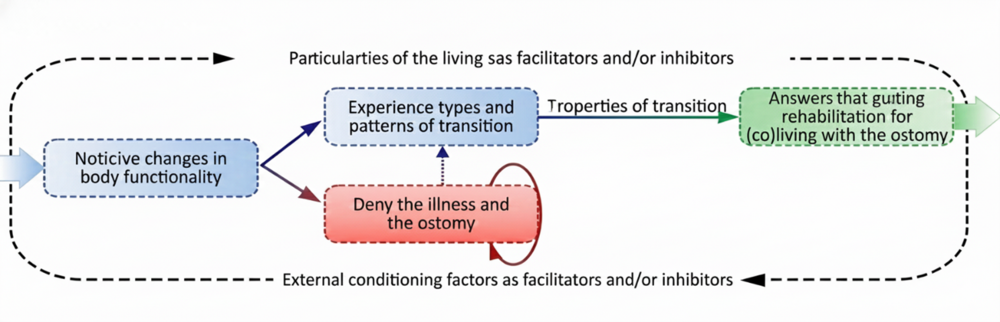 *SST = Specific Situation Theory