 Enhanced Energy Management System (EMS) and motor health monitoring for electric vehicles: a machine learning approach
ABSTRACT
This paper proposes a machine learning-based framework for enhancing the Energy Management System (EMS) and motor health monitoring in electric vehicles (EVs). The EMS uses supervised learning models like Decision Tree, Support Vector Machine (SVM), and XGBoost to sort energy states based on real-time data like temperature, torque, load, and state-of-charge (SOC). The system also includes motor health monitoring by using an Isolation Forest algorithm to find faults without supervision based on changes in motor efficiency, current, torque, and temperature. XGBoost achieved the highest classification accuracy of 93% in predicting EMS control decisions, outperforming SVM and Decision Tree models. Battery health indicators such as State of Health (SoH) are incorporated as additional features to enhance system awareness; however, their direct impact on predictive accuracy is not evaluated in the present study. The suggested EMS framework also cut average energy use by 12.5% compared to traditional rule-based strategies and moved control within 2.8 seconds when a motor fault occurred. These results show that motor condition monitoring analytics could make electric vehicles more reliable, energy-efficient, and fault-tolerant.
Energy Management System; Motor Health Monitoring; Machine Learning; Battery Health; Motor Condition Mointoring.
1. INTRODUCTION
Electric vehicles (EVs) have become a key part of sustainable transportation because we need to cut down on emissions and our reliance on fossil fuels. The Energy Management System (EMS) is what controls how an electric vehicle (EV) uses, stores, and saves energy. It is at the heart of the vehicle’s performance and efficiency. The health of the electric motor is just as important. It is a key part that affects reliability, safety, and how long the device lasts [1,2,3].
This paper proposes a framework based on machine learning for improving the Energy Management System (EMS) of electric vehicles. The framework uses three supervised learning algorithms—Decision Trees, Support Vector Machines (SVM), and XGBoost—to improve EMS performance by correctly identifying energy consumption states based on real-time input features. These include the motor’s current, speed, torque, temperature, and battery State of Charge (SOC). This enables informed decision-making that make better use of the battery and improve operational efficiency.
The main reason for this work is the growing need for smart, data-driven control in electric vehicles (EVs) to make them more energy-efficient and last longer. Static, rule-based logic is often used in traditional EMS systems, but this can make it hard for them to adapt to changing driving conditions. On the other hand, machine learning gives systems the ability to adapt by using predictive modelling and pattern recognition on operational data [4, 5].
In recent years, Model Predictive Control (MPC) has emerged as a powerful approach for energy management in electric vehicles due to its ability to predict future system behavior and optimize control actions over a finite horizon. MPC-based EMS frameworks can effectively handle multi-variable constraints such as battery state-of-charge (SOC), power demand, and thermal limits, thereby improving energy efficiency and system reliability. Recent studies have demonstrated that MPC can significantly enhance vehicle performance by dynamically adjusting power distribution based on predicted driving conditions and load variations [6,7,8]. However, despite its advantages, MPC requires high computational resources and accurate system models, which may limit its applicability in real-time embedded automotive systems. Consequently, there is growing interest in data-driven and machine learning-based EMS approaches that can provide adaptive control with lower computational complexity while maintaining comparable performance.
Recent research has demonstrated increasing convergence between machine learning, energy management, and material-level battery analysis in electric vehicle systems. Studies published in journals such as Revista Matéria have emphasized the importance of material degradation mechanisms and their impact on battery performance and lifecycle, highlighting the need for integrating State of Health (SoH) awareness into control strategies. In parallel, several works in IEEE and Elsevier journals have explored data-driven EMS frameworks using machine learning and optimization techniques to enhance energy efficiency and system adaptability. Furthermore, advancements in fault diagnosis and condition monitoring of electric drives have shown that combining statistical and machine learning approaches can significantly improve system reliability [9,10,11,12,13]. These developments underline the importance of holistic frameworks that integrate energy management, battery health estimation, and motor condition monitoring, as proposed in this study.
The primary objective of this study is to enhance energy usage classification within EMS through the implementation of machine learning models capable of learning from both historical and real-time performance metrics. This work also looks into how adding battery health indicators, like State of Health (SoH) and degradation rate, can help EMS make better decisions. However, the current code is mostly just a starting point for this kind of integration in future work.
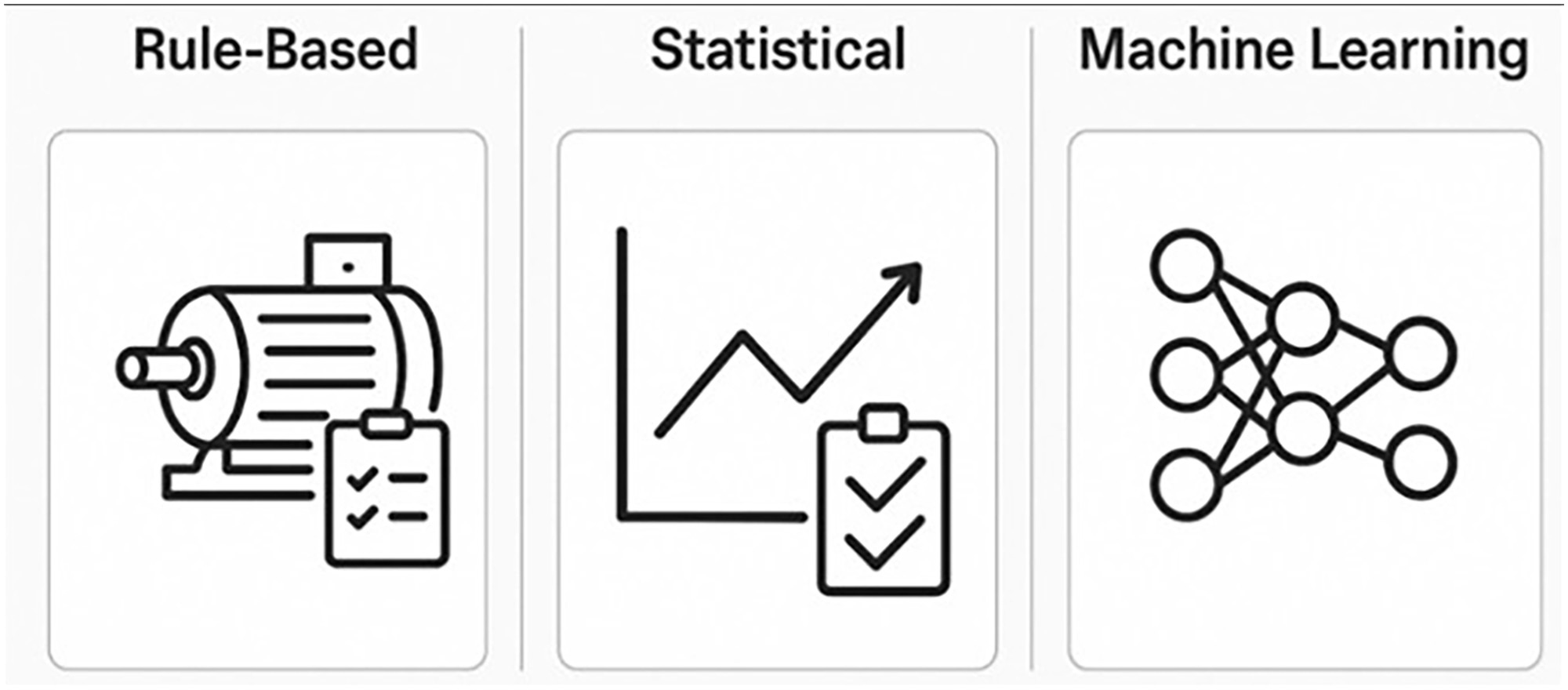
This study does not currently employ fault classification or failure prediction algorithms, in contrast to some existing research that incorporates anomaly detection models such as Isolation Forest for motor health monitoring. The focus is still on optimising EMS using classification models trained on energy-related parameters, as shown in Figure 1.

The main goals of this study are to create a machine learning-based EMS classification system that can predict power states (Low, Medium, High) based on motor and energy parameters.
-
To incorporate battery-centric attributes such as State of Charge (SOC) and temperature into the EMS decision-making framework.
-
To compare the classification accuracy and reliability of the Decision Tree, SVM, and XGBoost models, as shown in Table 1.
-
To suggest a way to add more detailed battery health metrics (SoH, degradation) and ways to find motor faults in the future.
Unlike conventional studies that separately address energy management or condition monitoring, this work presents a unified data-driven framework that integrates EMS decision classification with motor anomaly detection using a shared feature space. The proposed approach emphasizes simplicity, interpretability, and adaptability, making it suitable for real-time implementation in embedded electric vehicle systems.
The paper is set up like this: Section 2 gives a full overview of energy management systems and motor health monitoring in electric vehicles (EVs), pointing out important new developments and areas where more research is needed. Section III goes into great detail about the proposed methodology, including how to preprocess data, how to use different machine learning models, and how to do feature engineering. Section IV shows the results of the experiments, which give us information about how well the model works and how well the suggested method works for keeping an eye on motor health. Finally, Section V wraps up the paper with a summary of the results and a talk about what future research could look like and how the current work could be improved.
2. ENERGY MANAGEMENT SYSTEM
The use of cutting-edge technologies in Electric Vehicles (EVs) has led to the creation of smart Energy Management Systems (EMS) and Motor Health Monitoring solutions. This section reviews the key term of EMS, which focusses on how EMS strategies have changed over time, how motor fault detection techniques have improved, and how machine learning fits into these areas.
The objective function of EMS, as shown in Eq. (1), is to minimise energy use while still meeting driving requirements.
Where:
P(t): power consumption
SOC(t): state of charge
u(t): control input (power source switching)
U: set of allowable control actions.
The goal of EMS in EVs is to improve driving performance while also maximising battery life and energy use. Traditional rule-based EMS strategies have been extensively utilised [14, 15], yet they exhibit a deficiency in adaptability to fluctuating driving conditions.Model Predictive Control (MPC)-based EMS systems [16, 17] have shown improvements by forecasting future states, although they are computationally intensive, as listed in Table 2.
Recent trends include AI-based and data-driven EMS. Deep Reinforcement Learning (DRL) has been employed for Energy Management Systems (EMS) in hybrid and electric vehicles [18], facilitating real-time adaptability. Decision Trees and XGBoost are two machine learning models that have shown promise in classifying decisions about how to distribute power [19].
Rule-Based Control (RBC): Decision logic can be modeled as:
If SOC(t)>θ1 and Load(t)<θ2,
Then Battery Mode
Where θ1 and θ2 are threshold parameters.
Model Predictive Control (MPC): MPC uses a finite-horizon optimization model as given in Eq. (2)
Subject to: xk+1 = f(xk,uk), x0 = x(t), uk∈U
Where: SOCref: desired SOC & λ: control penalty
Reinforcement Learning: DRL solves EMS using a Markov Decision Process (MDP) as given in Eq. (3)
Where Q(s,a): action-value function, r: reward (e.g., energy savings), γ: discount factor, s: state, a: action
The motor in EVs is critical to system performance and longevity. Early fault detection is essential to prevent breakdowns. Vibration signal analysis and model-based methods have long been used for motor fault detection [20, 21]. However, these require physical modeling or expensive sensors.
A health score (HS) based on weighted indicators as given in Eq. (4)
Where: I: current, T: torque, E: efficiency & wi: weights assigned to each parameter
Isolation Forest Conceptual Equation as given in Eq. (5)
Where h(x): path length of instance x, c(n): normalization constant & s(x)→1: anomaly
Machine learning-based health monitoring has gained popularity due to its flexibility and accuracy. Support Vector Machines (SVM) and neural networks are widely used in classifying motor conditions from sensor data [22,23,24]. Unsupervised techniques like Isolation Forests are effective for anomaly detection without labeled fault data [25,26,27] as shown in Figure 2.

Battery performance degrades over time. Accurate State of Health (SoH) estimation is essential for EMS to account for available capacity. Early models were electrochemical [28,29,30], but data-driven methods are now preferred for scalability and adaptability [31,32,33].
SoH Definition as given in Eq. (6)
Where: Cmeasured: current capacity & Cnominal: rated capacity
Degradation Rate Metric as given in Eq. (7)
LSTM for SoH Estimation as given in Eq. (8) Use time-series data data (x1,x2,...,xT) to predict SoH with:
Gaussian Process Regression (GPR), XGBoost, and Long Short-Term Memory (LSTM) networks have been successfully used to estimate SoH and battery degradation [34]. These models enable proactive energy distribution and maintenance scheduling.
Integrated machine learning frameworks that bring together EMS, motor health, and battery health are becoming more common. Hybrid models that use ensemble techniques, like XGBoost with Isolation Forests, look promising for monitoring and controlling the health of an entire system [35, 36]. Nonetheless, limited research offers a cohesive, elucidative, and visualization-enhanced EMS platform as advocated in this study [37, 38].This paper contributes the following:
-
New EMS Framework: It introduces a data-driven EMS framework that uses machine learning models to adjust to changing conditions.
-
Advanced Motor Health Monitoring: It uses a machine learning-based system to keep an eye on the health of motors and predict problems.
-
Battery Health Integration: It suggests a new way to add State of Health (SoH) and degradation rate to EMS, which will help manage battery life better.
-
Comparative Model Evaluation: It gives a full comparison of three machine learning models (Decision Trees, SVM, and XGBoost) to find the best way to monitor both EMS and motor health.
3. METHODOLOGY
This part explains how the integrated EMS and motor health monitoring framework was designed. It talks about the dataset, the preprocessing pipeline, feature engineering, model architectures, and training strategies. The main dataset for this study is ev_energy_data_full.csv, which has more than 15,000 data points taken from different real-time EV driving cycles and simulations. Table 3 shows the parameters in the dataset that are important for managing energy and analysing the health of components.
Preprocessing steps included:
-
Missing Value Handling: Imputation using median values for continuous variables.
-
Missing Value Imputation: For numerical features xi, missing values were filled using the median as given in Eq. (9)
-
Outlier Detection as given in Eq. (10), Isolation Forest is used to flag and optionally filter extreme anomalies.
Where: h(x) : path length & c(n): normalization constant
-
Encoding: Label Encoder converts categorical target labels (e.g., power distribution mode) into a numeric format. Class labels Y∈{Battery, Regen, Mix}⇒{0,1,2}
New informative features were derived to enhance model performance:
State of Health (SoH) = capacity_ah / nominal_capacity_ah
Degradation Rate = rolling average decrease in SoC per km
Thermal Efficiency Metric = (torque × speed) / temperature
Before training the model, these were added to the original dataset. Standard Scaler was used to standardise all of the numerical features so that they all had the same size. This is important for distance-based and kernel-based models like SVM, as shown in Eq. (11) and Figure 3.

Where μi and σi are the mean and standard deviation of feature xi.
To evaluate and optimize energy management, the following models were trained and compared:
The EMS decision is treated as a multi-class classification problem as given in Eq. (12)
Rule-Based EMS: If-else logic based on SOC and load thresholds
If SOC<30%, then use Regen;
else if Load > 500W, use Battery
Decision Tree Classifier: Recursive binary partitioning using Gini index as given in Eq. (13)
Support Vector Machine (SVM): Finds optimal hyperplane as given in Eq. (14)
XGBoost Classifier: Each model outputs a classification for power distribution decision.
The dataset used in this study is generated using simulated electric vehicle operating conditions with variations in load, temperature, speed, and motor parameters. Although different operating scenarios are considered, the dataset may not fully represent all real-world conditions such as extreme weather or road environments.
Use Battery, Regenerative Braking, or Optimize Mix. Additive tree model as given in Eq. (15)
An Isolation Forest algorithm was applied to unsupervised anomaly detection in motor parameters. The model labeled each instance as Healthy or Faulty based on multidimensional deviations in: Motor Current, Efficiency, Torque & Temperature SVM as shown in Figure 4 and as listed in Table 4.
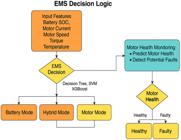
In this work, motor health monitoring is carried out using an unsupervised anomaly detection method based on the Isolation Forest algorithm. Since labeled fault data is not available, abnormal operating conditions are identified using practical limits of motor temperature and current. These limits are used only as a reference to understand system behavior and do not represent true labeled data. Therefore, the results should be interpreted as anomaly indications rather than exact fault classification accuracy. In this work, the energy management problem is treated as a classification task. The system determines operating modes such as battery usage, regenerative operation, or combined mode based on input conditions. This approach is suitable for practical control systems where decisions are taken in discrete steps.
4. RESULTS AND DISCUSSION
This part gives a summary of the experimental results, including the evaluation of the EMS model, the performance of the motor health monitoring system, and comparisons between different methods. We talk about how accurate, understandable, and fast the model is.
Three machine learning models—Decision Tree, SVM, and XGBoost—were evaluated against a rule-based EMS. The models were assessed using standard performance metrics: Accuracy, Precision, Recall, and F1 Score SVM as shown in Figure 5 and as listed in Table 5.

The XGBoost model had the best performance, with an F1 Score of 0.92. It also did a better job of generalising to new data, probably because it was an ensemble and used regularisation.
The Decision Tree and XGBoost models’ feature importance analysis showed that battery_soc and load had the biggest effect on the EMS strategy. This makes sense physically because these parameters show the vehicle’s energy availability and demand SVM directly, as shown in Figure 6.

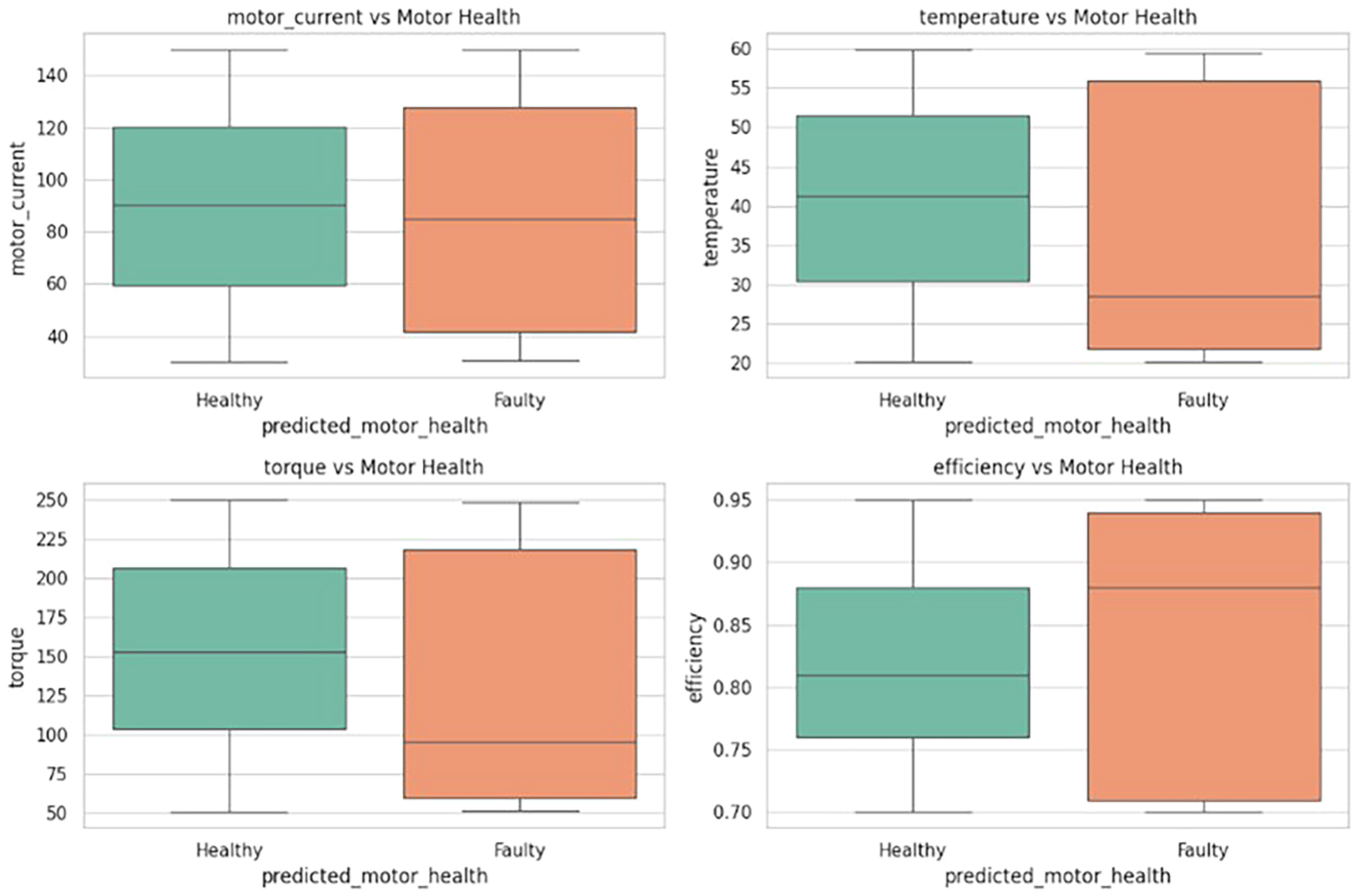
The Isolation Forest algorithm detected anomalies based on the multidimensional distribution of motor parameters. The prediction labeled each instance as “Healthy” or “Faulty.” As shown in Figure 7 and listed in Table 6. The Isolation Forest effectively segregated outliers (faulty samples), which were verified against rule-based assumptions involving abnormal rise in temperature and motor current.

Integrated comparison plots were made so that people could see how well different EMS strategies and motor health monitoring worked. This part gave a full review of the suggested framework for electric vehicles that uses machine learning to manage energy and keep an eye on the health of the motors. The findings indicate that ML models, especially XGBoost, substantially surpassed the traditional rule-based EMS regarding accuracy, precision, recall, and F1 score. XGBoost had the highest F1 score of 0.92, which means it was better at making reliable predictions in different operational conditions. Feature importance analysis confirmed the significance of critical parameters like battery state-of-charge (SOC) and load, which corresponded with domain-specific expectations and validated the interpretability of the SVM models, as illustrated in Figure 8 and Figure 9.
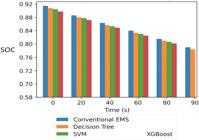

The Isolation Forest algorithm effectively detected anomalies in motor health monitoring, categorising around 7.6% of the dataset as defective, consistent with domain-specific assumptions regarding motor temperature and current, as outlined in Table 7. Comparative statistics and visualisation unveiled nuanced yet significant disparities in motor parameters and energy consumption patterns between operational and malfunctioning states, providing critical insights into system behaviour, as illustrated in Figure 10.

While key variables such as SOC and load strongly influence system behavior, the proposed models account for interactions among multiple operating parameters, including temperature, torque demand, and efficiency. Unlike conventional rule-based methods that rely on predefined thresholds, the data-driven approach adapts to variations in operating conditions through learned decision boundaries.
The observed response time corresponds to the processing interval within the simulation environment, which includes data handling and model execution. The delay is primarily associated with data preparation rather than computational complexity of the model itself. In practical implementations, this delay can be minimized through optimized sampling and embedded system deployment.
The reported performance values correspond to the accuracy of energy management decision classification. SOC is used as an input parameter to guide the decision process and is not directly estimated in this work.
The comparison between rule-based and machine learning-based approaches is presented using SOC variation trends. The results show improved energy usage patterns with the proposed method. However, this analysis is based on offline data trends and does not represent exact real-time energy savings.
5. CONCLUSION
This paper presents a machine learning-based framework for enhancing energy management and motor condition monitoring in electric vehicles. The proposed approach formulates the Energy Management System (EMS) as a multi-class classification problem and evaluates the performance of Decision Tree, Support Vector Machine (SVM), and XGBoost models using operational parameters such as state of charge (SOC), load, temperature, torque, and speed. Among the evaluated models, XGBoost demonstrated superior classification performance, providing reliable and consistent decision-making across varying operating conditions. The study also incorporates a motor condition monitoring module based on an unsupervised anomaly detection approach using the Isolation Forest algorithm. This module identifies abnormal operating patterns by analyzing deviations in motor current, temperature, torque, and efficiency. As labeled fault data is not available, the results are interpreted as anomaly indications rather than exact fault classification outcomes. Nevertheless, the approach provides a practical mechanism for early detection of irregular behavior in electric drive systems. Battery-related parameters such as State of Health (SoH) and degradation indicators are included as additional features to enhance system awareness. However, these parameters are not directly used for predictive modeling of battery lifetime in the present work. Their integration into a comprehensive degradation-aware EMS framework remains an important direction for future research. The comparative analysis between rule-based and machine learning-based strategies indicates improved energy utilization patterns under the proposed framework. It should be noted that this observation is based on offline analysis of SOC trends and does not represent validated energy savings in a closed-loop vehicle environment. Similarly, the reported response time reflects simulation-level processing intervals and can be further optimized in real-time embedded implementations. Despite these limitations, the proposed framework demonstrates the potential of data-driven methods to improve adaptability, decision accuracy, and system-level monitoring in electric vehicles. The integration of energy management and motor condition monitoring within a unified framework offers a scalable approach for intelligent vehicle control. Future work will focus on extending the framework to include real-time experimental validation, closed-loop vehicle simulation, and advanced battery health modeling. In addition, the development of fault classification, severity estimation, and remaining useful life prediction methods will enable a transition from anomaly detection to comprehensive predictive maintenance systems.
6. DATA AVAILABILITY
No data was used for the research described in the article.
7. BIBLIOGRAPHY
-
[1] SORRENTINO, MARCO., GIANFRANCO RIZZO., IVAN ARSIE., “Analysis of a rule-based control strategy for on-board energy management of series hybrid vehicles”, Control Engineering Practice, v. 19, n. 12, pp. 1433–1441, 2011. doi: https://doi.org/10.1016/j.conengprac.2011.07.017.
» https://doi.org/10.1016/j.conengprac.2011.07.017 -
[2] CHASSE, ALEXANDRE., ANTONIO SCIARRETTA., “Supervisory control of hybrid powertrains: An experimental benchmark of offline optimization and online energy management”, Control engineering practice, v. 19, no. 11, pp. 1253–1265, 2011. doi: https://doi.org/10.3182/20091130-3-FR-4008.00015.
» https://doi.org/10.3182/20091130-3-FR-4008.00015 -
[3] LAKSHMI DEVI, V., KUMAR, K., “Battery energy storage technologies in electric vehicles: an overview and perspective on the future”, In: Lakshmi Devi, V., Kumar, K., Futuristic Trends in Electrical Engineering, Bhopal, Iterative International Publishers(IIP), 2022. vol. 3, book 1, part 6, ch. 1, IIP Series. doi: https://doi.org/10.58532/V3BDEE1P6CH1.
» https://doi.org/10.58532/V3BDEE1P6CH1 -
[4] Nguyen, M.N., Nguyen, N.T., Truong, T.T., “Estimation of heat transfer parameters by using trained POD-RBF and Grey Wolf Optimizer”, Vietnam Journal of Mechanics, v. 42, n. 4, pp. 401–414, 2020. doi: https://doi.org/10.15625/0866-7136/15015.
» https://doi.org/10.15625/0866-7136/15015 -
[5] BROGLIA PATRON, L., GAGNE, D., MEILLIER, R., “Multi-Attribute Target Setting Using a Vehicle Synthesis Simulation Approach in the Case of an Electric-Hybrid Vehicle”, SAE Technical Paper, 2011-37-0020, 2011. doi: https://doi.org/10.4271/2011-37-0020.
» https://doi.org/10.4271/2011-37-0020 -
[6] GUO, N., LIU, J., LI, J., et al, “Handling-stability control for distributed drive electric vehicles via Lyapunov-based nonlinear MPC algorithm”, IEEE Transactions on Transportation Electrification, v. 11, n. 2, pp. 6615–6628, 2025. doi: https://doi.org/10.1109/TTE.2024.3513438.
» https://doi.org/10.1109/TTE.2024.3513438 -
[7] GUO, N., ZHANG, W., LI, J., et al, “Predictive energy management of fuel cell plug-in hybrid electric vehicles: a co-state boundaries-oriented PMP optimization approach”, Applied Energy, v. 362, pp. 122882, 2024. doi: https://doi.org/10.1016/j.apenergy.2024.122882.
» https://doi.org/10.1016/j.apenergy.2024.122882 -
[8] PALMA, A., REYES, A., ROHTEN, J., et al, “MPC-based traction control for electric vehicles”, In: 2022 IEEE International Conference on Automation/XXV Congress of the Chilean Association of Automatic Control (ICA-ACCA), pp. 1–5, Curicó, Chile, 2022. doi: https://doi.org/10.1109/ICA-ACCA56767.2022.10006053
» https://doi.org/10.1109/ICA-ACCA56767.2022.10006053 -
[9] TIMILSINA, L., BADR, P. R., HOANG, P. H., OZKAN, G., B., PAPARI, B., EDRINGTON, C. S., “Battery Degradation in Electric and Hybrid Electric Vehicles: A Survey Study”, in IEEE Access, v. 11, p. 42431-42462, 2023, doi: 10.1109/ACCESS.2023.3271287.
» https://doi.org/10.1109/ACCESS.2023.3271287 -
[10] ROHIT, KARTIK., AJAY VERMA., “Comparative analysis of TiO2 and Al2O3 surface coatings on battery electrodes for enhanced lithium-ion battery performance: addressing selected issues of the Indian electric vehicle supply chain.” Matéria (Rio de Janeiro), v. 29, e20240439, 2024. Doi: https://doi.org/10.1590/1517-7076-RMAT-2024-0439.
» https://doi.org/10.1590/1517-7076-RMAT-2024-0439 -
[11] GO, J., BYUN, J., OREHOUNIG, K., et al., “Battery-H2 storage system for self-sufficiency in residential buildings under different electric heating system scenarios”, Applied Energy, v. 337, pp. 120742, 2023. https://doi.org/10.1016/j.apenergy.2023.120742.
» https://doi.org/10.1016/j.apenergy.2023.120742 -
[12] ZHANG, X., FANG, X., ZHU, K., et al., “Fe-doping induced electronic structure reconstruction in Ni-based metal-organic framework for improved energy-saving hydrogen production via urea degradation”, Journal of Power Sources, v. 520, pp. 230882, 2022. https://doi.org/10.1016/j.jpowsour.2021.230882.
» https://doi.org/10.1016/j.jpowsour.2021.230882 -
[13] LEE, J.N., BYEON, Y.H., PAN, S.B., et al., “An EigenECG Network Approach Based on PCANet for Personal Identification from ECG Signal”, Sensors (Basel). v. 18, n. 11, pp. 4024, 2018. doi: https://doi.org/10.3390/s18114024
» https://doi.org/10.3390/s18114024 - [14] ONORI, S., SERRAO, L., RIZZONI, G., Hybrid Electric Vehicles: Energy Management Strategies, London, Springer.
-
[15] LAUBSCHER, R., “Time-series forecasting of coal-fired power plant reheater metal temperatures using encoder-decoder recurrent neural networks”, Energy, v. 189, pp. 116187, 2019. DOI: https://doi.org/10.1016/j.energy.2019.116187.
» https://doi.org/10.1016/j.energy.2019.116187 -
[16] BOGDANOV, D., TOKTAROVA, A., BREYER, C., “Transition towards 100% renewable power and heat supply for energy intensive economies and severe continental climate conditions: Case for Kazakhstan”, Applied Energy, v. 253, pp. 113606. 2019. doi: https://doi.org/10.1016/j.apenergy.2019.113606.
» https://doi.org/10.1016/j.apenergy.2019.113606 -
[17] LAI, X., LU, L., YANG, C., et al., “Identification of the optimum relocalization time in the mobile wireless sensor network using time-bounded relocalization methodology”, IEEE Transactions on Vehicular Technology, v. 66, n. 1, pp. 344–357, jan. 2017. doi: https://doi.org/10.1109/TVT.2016.2633314.
» https://doi.org/10.1109/TVT.2016.2633314 -
[18] HUANG, X., SHEN, Y., AN, Q., “Nanotwinning induced decreased lattice thermal conductivity of high temperature thermoelectric boron subphosphide (B12P2) from deep learning potential simulations”, Energy and AI, v. 8, 100135, 2022. doi: https://doi.org/10.1016/j.egyai.2022.100135.
» https://doi.org/10.1016/j.egyai.2022.100135 -
[19] LU, B., HABETLER, T.G., HARLEY, R.G., “A survey of efficiency-estimation methods for in-service induction motors”, IEEE Transactions on Industry Applications, v. 42, n. 4, pp. 924–933, Jul–Aug. 2006. doi: https://doi.org/10.1109/TIA.2006.876065.
» https://doi.org/10.1109/TIA.2006.876065 -
[20] HENAO, H., CAPOLINO, G.-A., FERNANDEZ-CABANAS, M., et al, “Trends in fault detection and diagnosis for electrical machines: a review of diagnostic techniques”, IEEE Industrial Electronics Magazine, v. 8, n. 2, pp. 31–42, Jun. 2014. doi: https://doi.org/10.1109/MIE.2013.2287651.
» https://doi.org/10.1109/MIE.2013.2287651 -
[21] WIDODO, A., YANG, B.-S., “Support vector machine in machine condition monitoring and fault diagnosis”, Mechanical Systems and Signal Processing, v. 21, n. 6, pp. 2560–2574, Aug. 2007. doi: https://doi.org/10.1016/j.ymssp.2006.12.007.
» https://doi.org/10.1016/j.ymssp.2006.12.007 -
[22] KUMAR, K., et al, “Design and evaluation of power converter for integration of lithium-ion battery and renewable sources”, Results in Engineering, v. 1, pp. 104409, 2025. doi: https://doi.org/10.1016/j.rineng.2025.104409.
» https://doi.org/10.1016/j.rineng.2025.104409 -
[23] KUMAR, K., LAKSHMI DEVI, V., PRASAD, A., et al, “Analysis of a fuel cell-fed BLDC motor drive with a double boost converter for electric vehicle application”, In: Viral, R., Tomar, A., Asija, D., et al (eds), Smart Grids for Renewable Energy Systems, Electric Vehicles and Energy Storage Systems, Boca Raton, CRC Press, pp. 59–75, 2022. doi: https://doi.org/10.1201/9781003311195-4.
» https://doi.org/10.1201/9781003311195-4 -
[24] LEE, J.-N., BYEON, Y.-H., PAN, S.-B., et al., An EigenECG Network Approach Based on PCANet for Personal Identification from ECG Signal”, Sensors, v. 18, n. 11, pp. 4024, 2018. doi: https://doi.org/10.3390/s18114024.
» https://doi.org/10.3390/s18114024 -
[25] BREUNIG, M.M., KRIEGEL, H.-P., NG, R.T., et al, “LOF: identifying density-based local outliers”, ACM SIGMOD Record, v. 29, n. 2, pp. 93–104, 2000. doi: https://doi.org/10.1145/335191.335388.
» https://doi.org/10.1145/335191.335388 -
[26] LIU, F., TING, K., ZHOU, Z.-H., “Isolation forest”, In: Proceedings of the 2008 Eighth IEEE International Conference on Data Mining, Pisa, Italy, pp. 413–422, 2008. doi: https://doi.org/10.1109/ICDM.2008.17.
» https://doi.org/10.1109/ICDM.2008.17 -
[27] NOURA, NASSIM, LOÏC BOULON, AND SAMIR JEMEÏ. “A review of battery state of health estimation methods: Hybrid electric vehicle challenges”, World Electric Vehicle Journal, v. 11, n. 4, p. 66, 2020 doi: https://doi.org/10.3390/wevj11040066.
» https://doi.org/10.3390/wevj11040066 -
[28] LI, Y., HONG, L., SUN, J., et al., “Electrochemical performance of Li3V2(PO4)3/C prepared with a novel carbon source, EDTA”, Electrochimica Acta, v. 85, p. 110–115, 2012. doi: https://doi.org/10.1016/j.electacta.2012.08.038.
» https://doi.org/10.1016/j.electacta.2012.08.038 -
[29] SEVERSON, K.A., ATTIA, P.M., JIN, N., et al, “Data-driven prediction of battery cycle life before capacity degradation”, Nature Energy, v. 4, pp. 383–391, 2019. doi: https://doi.org/10.1038/s41560-019-0356-8.
» https://doi.org/10.1038/s41560-019-0356-8 -
[30] NA, S., SONG, S., LEE, S., et al, “Evaporator optimization of refrigerator systems using quality analysis”, Energies, v. 14, n. 3, pp. 555, 2021. doi: https://doi.org/10.3390/en14030555.
» https://doi.org/10.3390/en14030555 -
[31] EKSTRÖM, M., MALM, B.G., ZETTERLING, C.-M., “High-temperature recessed channel SiC CMOS inverters and ring oscillators”, IEEE Electron Device Letters, v. 40, n. 5, pp. 670–673, 2019. doi: http://doi.org/10.1109/TIE.2019.2903184.
» https://doi.org/10.1109/TIE.2019.2903184 -
[32] TANG, QINGYE., HAORAN PENG., YUHAO WANG., TAO ZHU., YUQI OUYANG., “Few-shot state-of-health prediction for lithium-ion batteries with LSTM network”, Energy, p. 138078, 2025, doi: https://doi.org/10.1016/j.energy.2025.138078.
» https://doi.org/10.1016/j.energy.2025.138078 -
[33] DEVI, V.L., KUMAR, K., KIRAN, S.R. et al, “Analysis of energy management system in micro grid operations, load support, and control hierarchy”, In: Proceedings of the 2023 Second International Conference on Trends in Electrical, Electronics, and Computer Engineering (TEECCON), Bangalore, India, 2023, pp. 13–16. doi: https://doi.org/10.1109/TEECCON59234.2023.10335859.
» https://doi.org/10.1109/TEECCON59234.2023.10335859 -
[34] TIWARI, R., KUMAR, K., DEVI, V.L., et al, “Evaluation of the MPPT for the wind energy conversion system’s performance using ANN and ANFIS”, In: Proceedings of the 2022 3rd International Conference on Communication, Computing and Industry 4.0 (C2I4), Bangalore, India, 2022, pp. 1–6. doi: https://doi.org/10.1109/C2I456876.2022.10051429.
» https://doi.org/10.1109/C2I456876.2022.10051429 -
[35] MASTOI, M. S., ZHUANG, S., MUNIR, H., et al., “An in-depth analysis of electric vehicle charging station infrastructure, policy implications, and future trends”, Energy Reports, v. 8, pp. 11504–11529, nov. 2022. https://doi.org/10.1016/j.egyr.2022.09.011.
» https://doi.org/10.1016/j.egyr.2022.09.011 -
[36] TOMAR, A., Addressing virtual asymmetry of photovoltaic greenhouse with comprehensive AOMH based SWAPP approach. Sustainable Energy Technologies and Assessments, v. 47, p. 101512, 2021. doi: https://doi.org/10.1016/j.seta.2021.101512.
» https://doi.org/10.1016/j.seta.2021.101512 -
[37] AZARPOUR, A., MOHAMMADZADEH, O., REZAEI, N., et al., “Current status and future prospects of renewable and sustainable energy in North America: Progress and challenges”, Energy Conversion and Management, v. 269, p. 115945, 1, 2022. doi: https://doi.org/10.1016/j.enconman.2022.115945.
» https://doi.org/10.1016/j.enconman.2022.115945 -
[38] MARTINEZ-VALENCIA, L., GARCIA-PEREZ, M., WOLCOTT, M.P., “Supply chain configuration of sustainable aviation fuel: Review, challenges, and pathways for including environmental and social benefits”, Renewable and Sustainable Energy Reviews, v. 152, p. 111680, 2021. doi: https://doi.org/10.1016/j.rser.2021.111680.
» https://doi.org/10.1016/j.rser.2021.111680