 Formation and migration energies of vacancies at the Cu/Ta interface
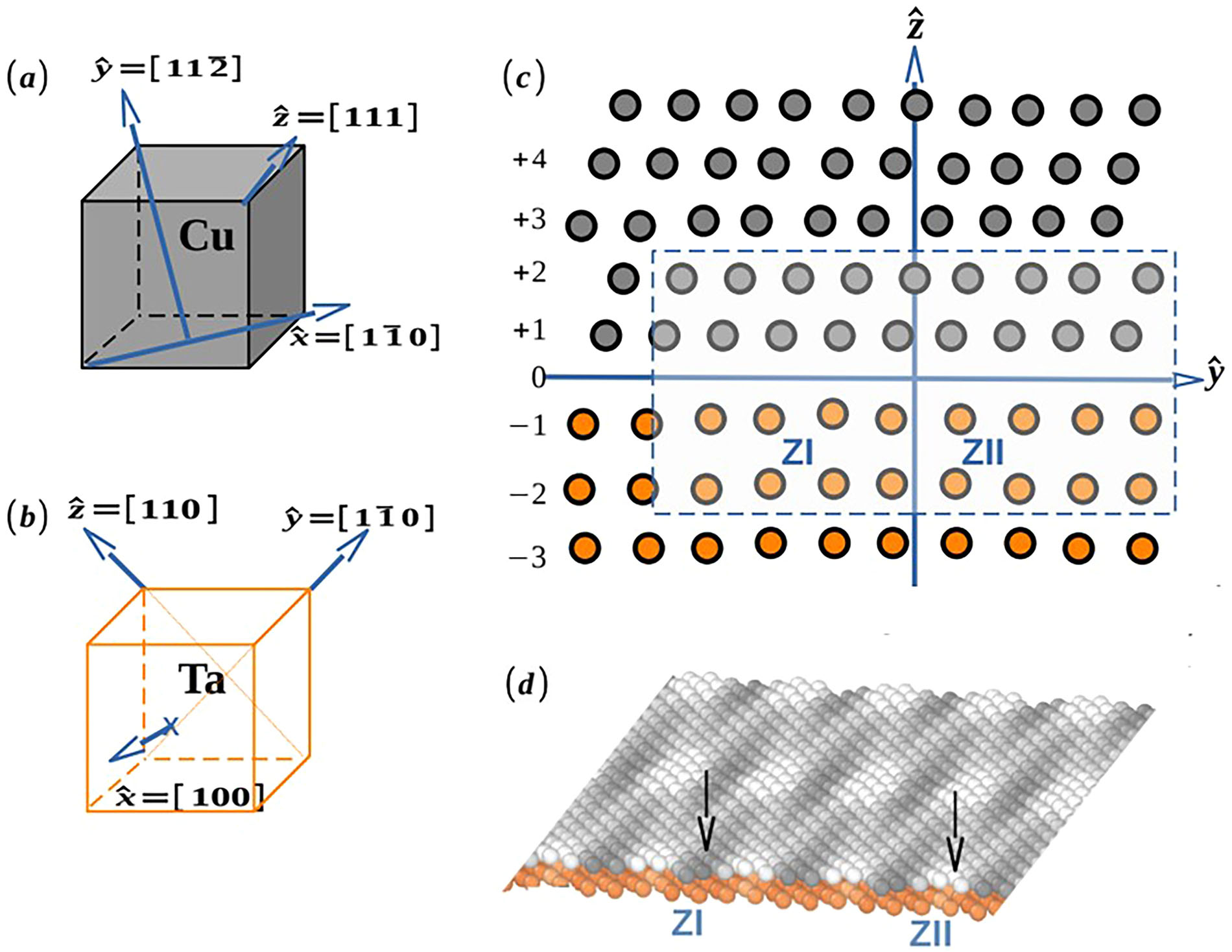
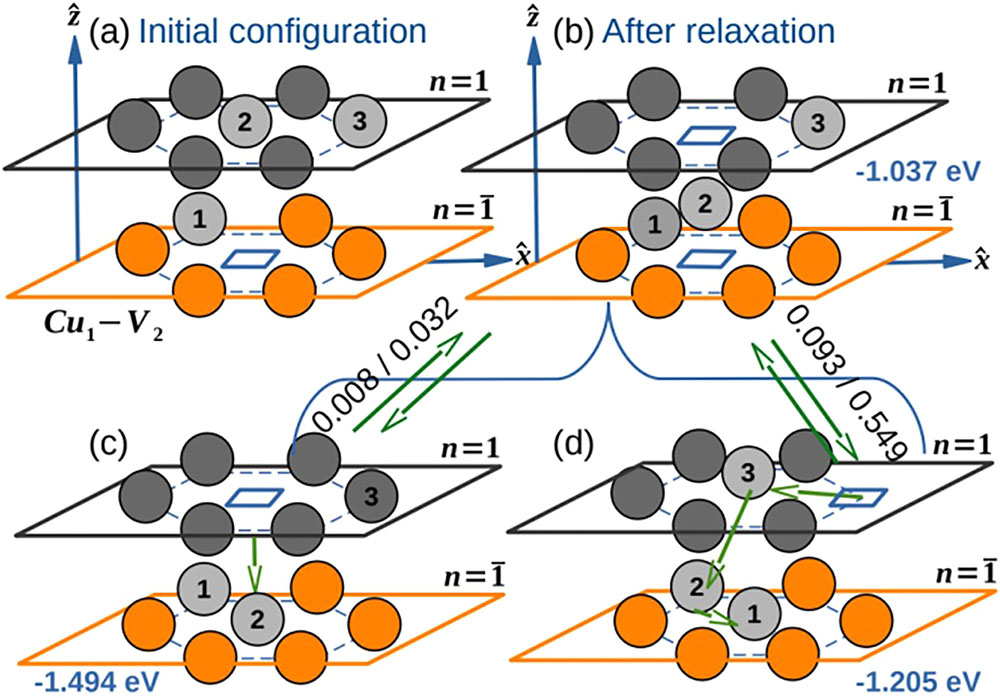
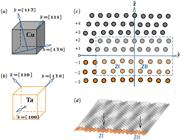
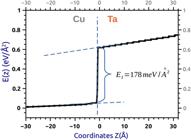
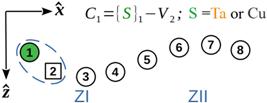
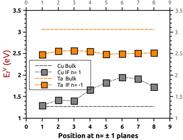
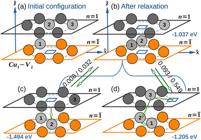
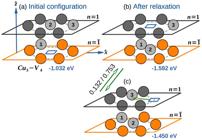
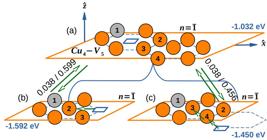
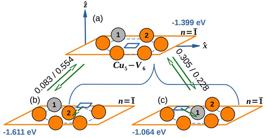
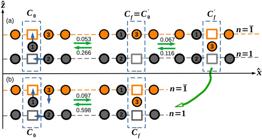
In this work, we investigate the equilibrium atomic structure of the Cu/Ta interface in the Ta–Cu system, focusing on the Nishiyama–Wasserman orientation relationship, by means of atomistic simulations employing angular-dependent potentials (ADP). Two distinct lattice-mismatch regions, denoted as ZI and ZII, are identified at the interface. The static properties of vacancies and solute–vacancy complexes are systematically analyzed within the first interfacial planes. We find that the vacancy formation energy strongly depends on the local interfacial environment, exhibiting significant variations between ZI and ZII. For solute–vacancy complexes, both binding energies and exchange migration barriers are calculated, revealing noticeable deviations from their corresponding bulk values. Furthermore, the vacancy–solute interaction is found to depend sensitively on the distance from the interface core. In particular, vacancies located on the Ta side act as efficient traps for Cu atoms, promoting an enhanced Cu solubility in the interfacial region. These results provide insight into defect energetics and solute behavior at Cu/Ta interfaces.
Keywords:
Ta-Cu; interfaces; solute-vacancy complex; migration; atomistic simulations
 Thumbnail
 Thumbnail
 Thumbnail
 Thumbnail
 Thumbnail
 Thumbnail
 Thumbnail
 Thumbnail
 Thumbnail
 Thumbnail
 Thumbnail
 Thumbnail
 Thumbnail