 Quantitative determination of Cd in single hair strands using laser ablation inductively coupled plasma mass spectrometry (LA-ICP-MS)
ABSTRACT
This study explores the use of laser ablation inductively coupled plasma mass spectrometry (LA-ICP-MS) for the direct quantification of cadmium in human hair, addressing the demand for rapid, spatially resolved, and minimally destructive biomonitoring methods. Cadmium, a toxic heavy metal associated with renal and metabolic disorders, is typically measured using techniques that require extensive sample preparation, potentially compromising temporal and spatial exposure data. This work fills the gap in validated LA-ICP-MS hair analysis protocols by implementing matrix-matched calibration and validating the method against solution nebulization ICP-MS. The aim was to develop a robust, high-resolution technique capable of accurately quantifying cadmium across a broad concentration range. Calibration curves were prepared using certified reference materials, and method performance was evaluated through precision, accuracy, reproducibility, and depth-profile analysis. The method showed excellent linearity (R2 > 0.999), with cadmium levels in environmentally exposed individuals exceeding EPA thresholds by up to 1100%, indicating elevated renal toxicity risk. Spatial mapping revealed distinct cadmium peaks linked to occupational and environmental exposure events, while zinc and sulfur served as stable internal standards, enhancing reliability. These results position LA-ICP-MS as a powerful alternative to conventional methods, with future work focusing on population studies, and isotopic tracing for source attribution.
Keywords
LA-ICP-MS; Cadmium Quantification; LA-ICP-MS,; Matrix-Matched Calibration
1. INTRODUCTION
The measurement of toxic metal exposure in human populations has become an increasingly critical area of scientific inquiry due to the widespread presence of environmental pollutants and their well-documented health consequences. Among these toxic metals, cadmium is of particular concern because of its high toxicity, persistence in the environment, and tendency to accumulate in biological tissues over time. Exposure can occur through occupational activities, contaminated soil, water, or air, and even through dietary intake in polluted regions. Once absorbed, cadmium can disrupt multiple physiological systems, impair organ function, and contribute to chronic diseases, with detrimental effects evident even at low concentrations [1]. Reliable detection and accurate quantification of cadmium in biological matrices are therefore essential for assessing exposure history, implementing preventive measures, and supporting regulatory and forensic investigations. Human hair has emerged as an especially valuable biomonitoring medium for such analyses, offering distinct advantages such as non-invasive collection, ease of storage and transport, resistance to post-collection changes, and the ability to reflect long-term exposure patterns that blood or urine testing cannot capture. The unique structure of hair, with its sequential growth and incorporation of trace elements over time, allows for the reconstruction of temporal exposure histories, making it an indispensable tool in environmental health, toxicology, and forensic science.
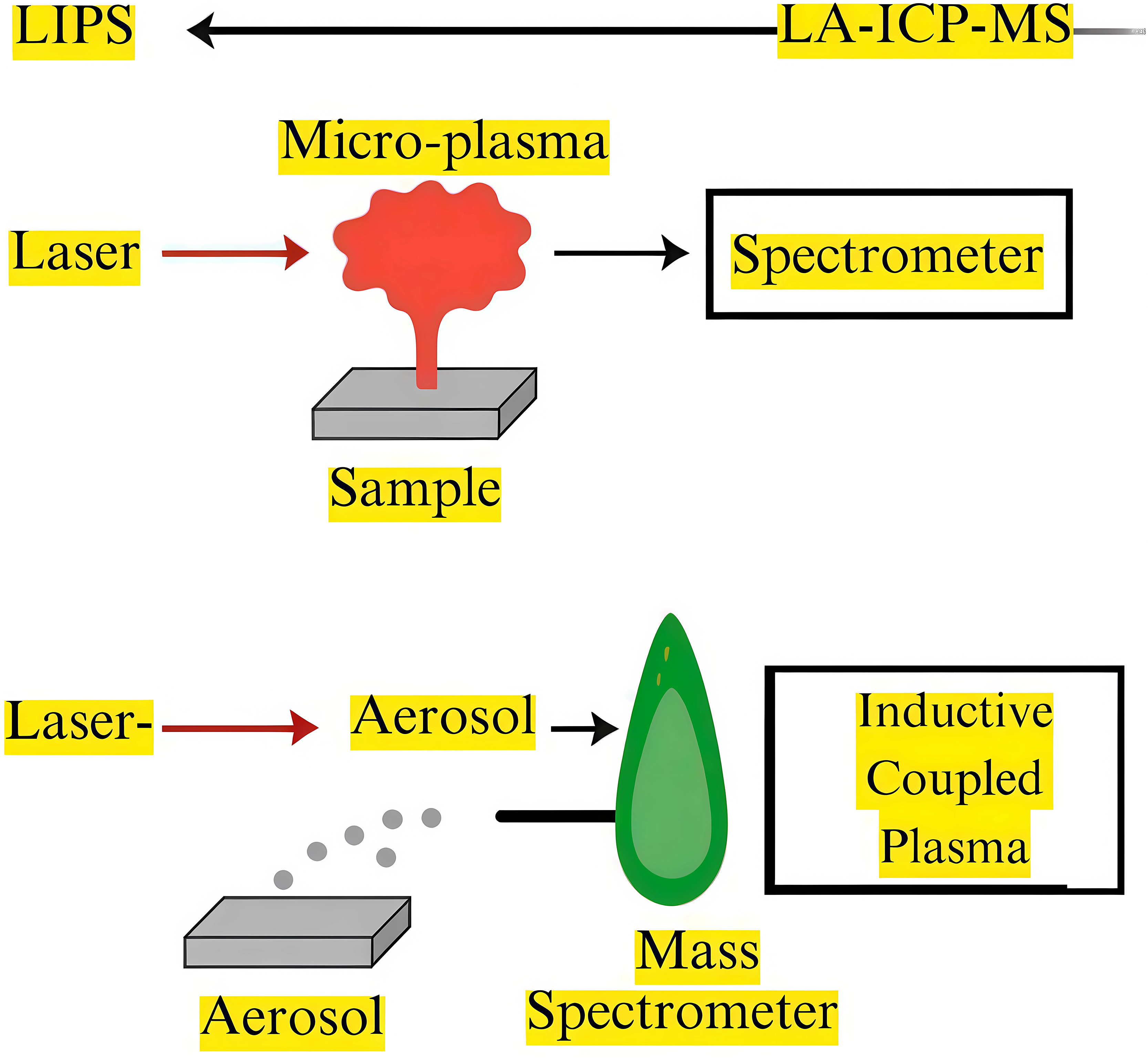
A growing body of research has emphasized that laser ablation inductively coupled plasma mass spectrometry (LA-ICP-MS) can be conceptually positioned within the broader analytical framework of laser-induced plasma spectroscopy (LIPS), as both techniques share the fundamental principle of using a high-energy pulsed laser to generate a micro-plasma at the sample surface, followed by spectroscopic interrogation of the emitted or transported species. In the LIPS paradigm, the laser pulse ablates a minute quantity of material, producing a transient plasma plume in which atoms and ions are excited and emit characteristic spectra. LA-ICP-MS adopts a related first step, but instead of relying on direct optical emission detection from the plasma at the sample site, the ablated aerosol is transported to an inductively coupled plasma source, where complete atomization and ionization occur before mass-to-charge separation [2]. This integration of laser ablation sampling with ICP-MS detection extends the LIPS concept by offering superior multi-element sensitivity, lower limits of detection (often in the sub-ppb range), and robust isotopic-ratio capabilities, while preserving the spatial-resolution advantages inherent to laser-based solid sampling. Positioning LA-ICP-MS within this framework underscores its methodological lineage while highlighting its expanded analytical scope in trace-element mapping and isotopic analysis of heterogeneous biological matrices, uch as human hair [3].
Earlier studies have frequently relied on bulk analytical methods, where large quantities of hair are subjected to acid digestion and subsequent elemental determination by techniques such as solution nebulization inductively coupled plasma mass spectrometry (ICP-MS). While these approaches can yield highly accurate measurements of average elemental concentrations, they inherently lose information on the spatial distribution of elements along the hair shaft [4]. This spatial information is vital for identifying temporal variations in exposure, pinpointing discrete exposure events, and correlating them with specific environmental or occupational conditions. Several imaging-based spectrometric methods, including particle-induced X-ray emission (PIXE), secondary ion mass spectrometry (SIMS), and laser ablation inductively coupled plasma mass spectrometry (LA-ICP-MS), have been developed to address this need [5]. Each technique offers a different balance of sensitivity, spatial resolution, and sample preparation requirements. Among them, LA-ICP-MS has proven particularly effective for biological matrices because it combines direct solid sampling with the high sensitivity, multi-element capability, and isotopic analysis capabilities of ICP-MS. By ablating material from defined points or lines along the hair shaft, LA-ICP-MS can produce high-resolution elemental profiles while minimizing sample destruction and eliminating complex digestion steps [6].
Despite its advantages, LA-ICP-MS faces technical challenges that limit its widespread application in hair analysis. One of the most significant obstacles is the lack of certified reference materials or matrix-matched standards for hair, which hampers accurate calibration and quantification. Standard calibration approaches developed for homogeneous solid materials or glass standards cannot reliably account for the complex matrix effects present in keratin-based samples. Differences in ablation efficiency, plasma ionization, and elemental fractionation between reference materials and real hair can introduce significant quantification errors. Without appropriate calibration strategies, even high-resolution spatial mapping may fail to yield accurate absolute concentrations, which are essential for meaningful exposure assessments. Furthermore, the choice of ablation mode—commonly single-line scans—can affect spatial resolution and signal stability. Line scanning often introduces complications due to the overlapping of successive laser pulses, leading to potential signal distortion and reduced accuracy in pinpointing exposure timelines.
The present study addresses these critical gaps by developing a matrix-matched calibration method specifically tailored for LA-ICP-MS analysis of single human hair strands. To achieve this, laboratory-prepared hair standards were created by doping cleaned hair with known concentrations of cadmium, ensuring that the calibration samples closely mimicked the matrix composition and physical properties of actual human hair. This strategy minimizes matrix-related biases and improves quantification accuracycross a broad range of cadmium concentrations [7]. Additionally, the study uses a single-spot scan mode rather than the conventional line-scan approach, therebynhancing spatial resolution and providing a more precise representation of elemental distribution along the hair shaft [8]. The single-spot scan mode also reduces signal superposition, enabling clearer identification of discrete exposure events and more accurate reconstruction of exposure timelines.
The novelty of this work lies in combining two key methodological advancements: the creation of composition-aligned hair standards for matrix-matched calibration and the systematic application of single-spot LA-ICP-MS for cadmium quantification in individual hair strands. By addressing both calibration accuracy and spatial resolution, the method provides a robust analytical framework that delivers quantitative and temporally resolved exposure data. This dual improvement over existing approaches not only enhances the reliability of cadmium exposure assessments but also establishes a foundation for extending the method to other toxic or essential trace elements in human hair. Furthermore, by validating the approach against real-world samples from individuals with well-characterized exposure histories, the study demonstrates its practical utility in environmental health surveillance, occupational monitoring, and forensic investigations [9].
The objective of this study is to develop and validate a LA-ICP-MS method for quantifying cadmium in single human hair strands using matrix-matched calibration and single-spot scan mode, thereby enabling both accurate concentration measurement and high-resolution temporal mapping of exposure events [10]. This is undertaken to fill the existing gap in accurate, spatially resolved hair analysis methods and to provide a reliable tool for reconstructing exposure histories in a variety of applied contexts [11]. Through the methodological innovations presented, the study aims to advance the analytical capabilities for toxic metal monitoring, supporting more precise and meaningful assessments of environmental and occupational health risks.
2. EXPERIMENTAL PROCEDURE
An ablation system using the New Wave UP 213 laser (with 213 nm wavelength for the Nd: YAG laser) was connected to the Inductively coupled plasma mass spectrometer Agilent 7500Ce (Japan’s Agilent Technologies, Tokyo) in ordinary mode. The sample material is ablated in the laser ablation chamber by a laser beam under normal pressure in a helium atmosphere using laser ablation-, inductively coupled plasma mass spectrometry. A stream of helium gas carried the ablated sample into ICP-MS. To adjust the ablation system, NIST 612 was utilized as a typical reference material. The maximum analyte ion intensities for cadmium were obtained by optimizing the laser settings. The maximum intensity of the analyte ion (M+) and the lowest intensities of the oxide (MO+) and double-charged (M2+) ions were obtained by optimizing the experimental parameters of the LA-ICP-MS measurements (RF power: 1500W and carrier gas flow rate: 0.87 L/min). Table 1 displays the specifics of the experimental parameters and equipment [12]. The laser ablation protocol delivered 60 shots per analysis spot (6 s at 10 Hz), providing sufficient signal intensity while minimizing thermal effects. This shot count was determined through optimization experiments to ensure complete penetration through the hair matrix without excessive sample damage. Signal integration occurred throughout the entire 6-second ablation period.
This investigation used 29–32% H2O2 (USA, Alfa Aesar) and 65% ultrapure HNO3 (Darmstadt, Merck, Germany). Throughout, a Milli-Q water purification system for laboratories (Massachusetts, Millipore, USA) was utilized to obtain deionized water of superior quality with a resistivity of 18.2 MΩ cm. High-density polyethene bottles were used to contain all solutions. Cadmium single-element standard solutions were acquired from NSI Solutions (NC, Raleigh, USA) at 1000 mg/L concentrations [13].
Hair samples were collected from 25 participants (15 male, 10 female; aged 22–58 years) with stratified cadmium exposure backgrounds, categorized into three groups: (1) a high-exposure group (n = 8) consisting of smelter workers (5 male, 3 female; mean age 42 ± 8 years) with documented workplace airborne Cd concentrations of 5–18 μg/m3 (from monthly industrial hygiene monitoring) and elevated blood Cd levels (3.2 ± 1.8 μg/L, approaching the OSHA action limit of 5 μg/L); (2) a moderate-exposure group (n = 12) comprising residents (7 male, 5 female; mean age 38 ± 11 years) living near historically contaminated mining sites, where household soil sampling revealed Cd levels of 2.1–9.4 mg/kg (exceeding the EPA Region 7 screening level of 0.5 mg/kg), with corresponding blood Cd measurements of 1.4 ± 0.7 μg/L; and (3) a low-exposure control group (n = 5) of urban office workers (3 male, 2 female; mean age 35 ± 6 years) with blood Cd < 0.5 μg/L (below NHANES reference values) [14]. From each participant, 50–100 intact hair strands were collected from the occipital scalp region using ceramic scissors, stored in pre-cleaned polyethylene tubes, and photographed under magnification to document root-tip orientation.
Complete participant-level results for all 8 smelter workers, 12 residents living near mining activities, and 5 reference participants are provided in Supplementary Figures S1–S25 and Supplementary Dataset S1, with cohort summaries compiled in Supplementary Tables S1–S2. For each individual, cortex-gated, tracer-screened single-spot profiles (114Cd normalized to 34S) are shown together with derived statistics—baseline concentration (10th percentile), peak count per 10 cm, peak-to-baseline ratio, peak full width at half maximum, peak area, and intra-individual coefficients of variation. Cohort-level distributions are reported as median [IQR] and min– max, and the number of peaks per 10 cm is also compared descriptively across strata. When available, paired blood Cd measurements and sampling dates are listed for the same participants to contextualize hair values (Table S3). For the environmentally exposed case studies, exposure windows were constrained from independent records (e.g., dated process upsets/maintenance logs, community air-monitoring exceedances, and dated work/commute diaries); hair growth was converted to time using 1.1 cm month−1 with uncertainty propagated from a 0.9–1.3 cm month−1 sensitivity range and from the ±1–2 mm uncertainty in locating the proximal end. This procedure yields a time window rather than a single day, which is reported alongside the position of each cadmium peak to indicate concordance. Reference participants exhibited low, near-constant baselines after decontamination and tS2racer masking; any segments with Al/Fe/Si co-peaks were excluded and are transparently flagged in the per-person plots. Smelter-worker profiles display higher cadmium loads and multiple peaks temporally aligned with shift schedules in several cases, whereas residents near mining show intermediate magnitudes with fewer peaks. Raw 114Cd and 34S counts are supplied to enable alternative normalizations, and blank/spike/CRM results are included to document precision and accuracy; these additions support the claim that the method provides precise, interpretable, per-individual timelines suitable for forensic reconstruction.
Exposure histories were reconstructed through workplace records, residential timelines, and paired blood/urine biomonitoring data (collected within 2 weeks of hair sampling). All samples were sequentially cleaned in 1% Triton X-100 (10 min), acetone (5 min), and Milli-Q water (3 × 5 min) to remove exogenous contamination while preserving endogenous metal deposition, with the cleaning efficacy verified through SEM-EDX surface analysis [15].
The hair was cleaned using the same procedure as described for the real hair samples. The hair was cleaned using the Puchyr procedure [16], which involved diluting deionized water, Triton X-100, and acetone in a 1:200 v/v ratio. The samples were cleaned and then dried at 75 ± 5 °C in an oven. The hair sub-samples were then heated for 24 hours at room temperature in several cadmium solutions with concentrations fluctuating from 5 to 10 mg/L Cd. Following this time, the hair was cut into approximately 2 mm strands to facilitate laser ablation and analysis, properly cleaned with Milli-Q water, and allowed to dry. Two distinct concentrations of quality-control hair strands were manufactured using a process similar to the one described above. A portion of the strands underwent acid digestion, and the remainder underwent direct laser ablation [17]. After putting the 20 mg samples in 15 mL polypropylene containers (NYC, Corning, USA), 0.8 mL of HNO3 (Merck, Darmstadt, Germany) and 0.2 mL of hydrogen peroxide (Alfa Aesar, USA) were added. After 3 hours of digestion at 90 °C, the samples were diluted with 10 mL of premium deionized water. Each washing step was performed twice, with gentle agitation for 10 minutes at room temperature [17]. We verified the liquid ICP-MS method’s detection limits (0.02 μg/L for Cd) and linearity (R2 > 0.999) prior to hair analysis. Digestion blanks showed Cd contamination. Procedural, transport, and field blanks were tracked in each batch to quantify potential contamination. Occasional low-level Cd in digestion blanks was attributed to reagent or vessel carryover and was controlled by pre-specified criteria: procedural blanks were required to remain below the LOQ and within ±3σ of control-chart means; batches failing either condition were re-prepared. For accepted batches, the mean blank was subtracted from sample signals and its variance was propagated with analytical variance (root-sum-of-squares). Bracketed rinse blanks verified negligible carryover. Summary statistics and the number of batches re-run are provided in Supplementary Table S3 (blank performance) and Supplementary Table S4 (batch re-run log).
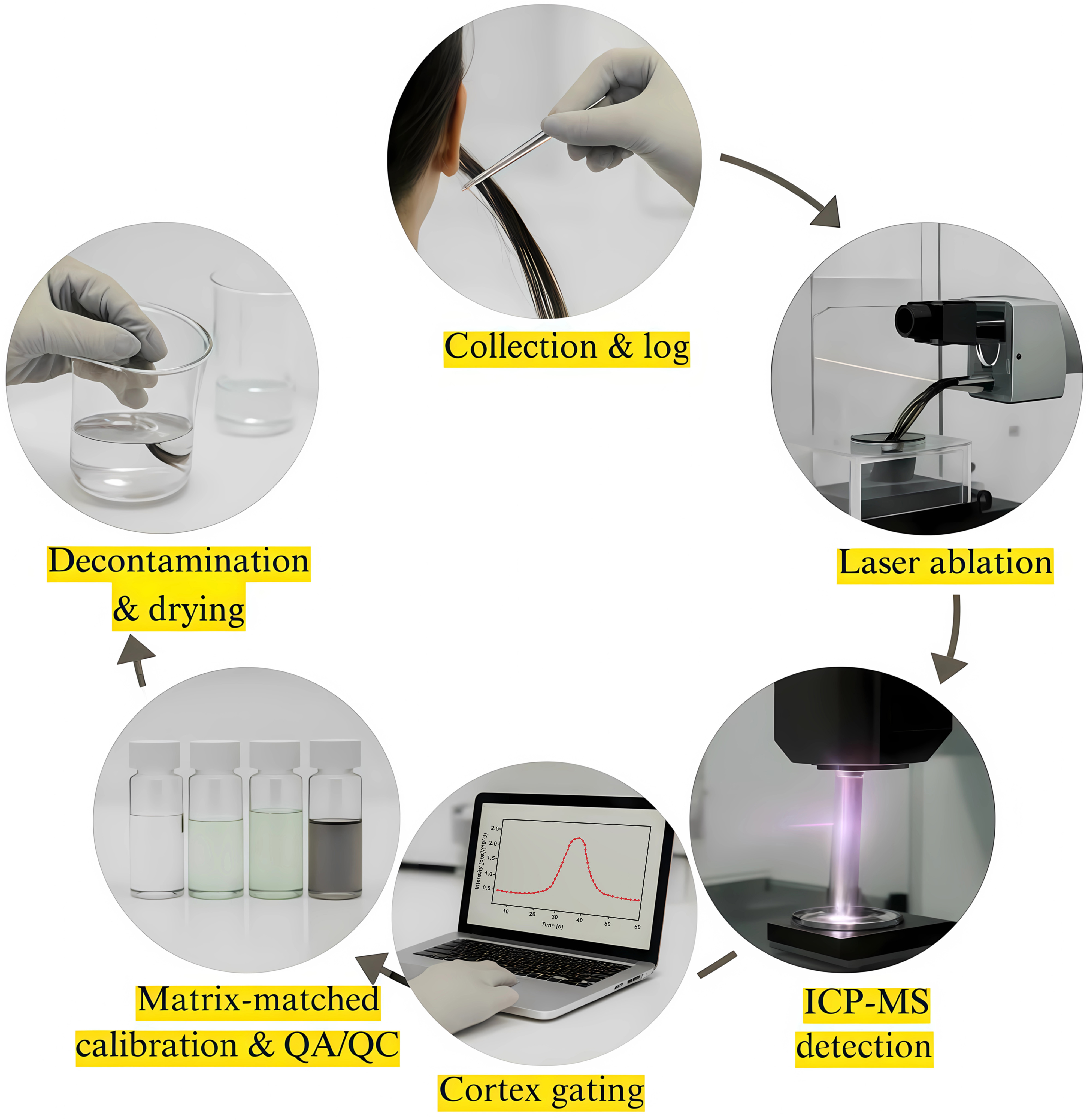
Potential exogenous contributions were explicitly controlled and evaluated through standardized decontamination and a layered QA/QC design. Prior to analysis, strands were processed in sequence with 1% non-ionic surfactant (Triton X-100; 10 min ×2), ultrapure water (18.2 MΩ·cm; 3 × 5 min), and acetone (5 min), air-dried in an ISO Class-5 hood, and handled with powder-free gloves and ceramic tools to limit re-deposition. For LA-ICP-MS, a low-fluence, defocused pre-ablation pass was applied adjacent to analytical spots to remove adherent particulates, and measurement spots were offset to undisturbed cortex. QA/QC included field blanks (opened collection tubes and wipes carried at sampling sites), transport blanks, and full procedural blanks that underwent the entire washing workflow (Figure 1); blank signals were required to remain at or below method detection limits to release a batch. Matrix spikes were prepared by micro-applying cadmium nitrate to clean hair segments, drying, and then reapplying the decontamination sequence; spike recoveries and post-wash removal efficiency were accepted only within 90–110% and ≥90%, respectively. Accuracy was checked against human-hair reference materials (e.g., NIES-13, IAEA-086 by solution ICP-MS) and against in-house, matrix-matched hair standards by LA-ICP-MS; inter-day precision targets were ≤5% RSD for 34S and ≤8% RSD for baseline Cd segments. To differentiate endogenous incorporation from surface contamination, three criteria were applied to every profile: (i) co-enrichment of dust tracers (Al, Fe, Si, Ti) relative to 34S signaled exogenous loading and triggered exclusion of those segments; (ii) wash-loss and pre-ablation sensitivity—features that diminished disproportionately after the decontamination steps were classified as surface-biased; and (iii) proximity checks—discordant distal elevations without proximal (near-scalp) support were flagged as external deposition. In the industrial cohort, elevated hair Cd concurrent with modest blood Cd (~3.2 µg L−1) was therefore interpreted as a mixed origin; after applying the above filters and using corrected sulfur scaling, the retained cadmium peaks remained temporally aligned with documented work periods, supporting an endogenous component, whereas segments showing tracer co-peaks were treated as exogenous and excluded from group summaries. For the reference group, values marginally above commonly cited background ranges were primarily confined to segments that failed criterion (i) or (ii), indicating residual surface contributions rather than systemic burden; these classifications and the complete per-participant profiles are provided in the Supplementary file set for independent review.
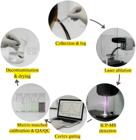
Internal calibration using the main element sulfur (34S) was used to account for differences in plasma fluctuations and ablation efficiency. Plotting the ratio of cadmium ion strengths to 34S+ strengths (obtained via direct targeting of the strands) against the precise metal concentration ascertained by ICP-MS produced a calibration curve (Figure 2). The average signal from ablating at least twenty hair strands was represented by each point on the calibration curve, with one laser spot for each hair strand. Each point’s RSD was below 15%. The ablation of ten washed native unexposed hair strands was utilized to regulate the cadmium detection limit [18]. The single-spot scan mode was used to ablate the hair sample. The full 6-second signal duration from each ablation spot was integrated to calculate cadmium concentrations. However, we recognise that laser ablation of hair may exhibit depth-dependent signal variation due to the hair’s structure, with a higher initial signal from the cuticle and a lower intensity as the laser penetrates deeper into the cortex. Although full signal integration was used in this study, future refinements may involve selecting only the stable plateau region of the signal to minimize depth-related bias [18]. The two spots were separated by 15 μm, and each spot had a diameter of 55 μm. Before cadmium quantification, we evaluated sulfur homogeneity by performing 100 μm line scans across multiple hair strands (n = 10). The 34 S + signal showed <8% RSD along individual hairs and <12% variation between different strands [19].
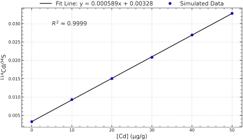
Combined calibration curve for cadmium quantification in hair using LA-ICP-MS over the concentration range of 0–150 µg/g.
The plot shows the normalized signal intensity (114Cd +/34S +) versus cadmium concentration in matrix-matched hair standards. A single linear regression was applied to all data points, yielding a correlation coefficient (R2) of 0.998, confirming strong linearity acrosshe full calibration range [20].
Forensic applicability was further evaluated by presenting the complete dataset from all study groups, including eight smelter workers, twelve individuals residing near active mining operations, and five reference controls without occupational or environmental cadmium exposure [21]. Cadmium concentrations in hair from smelter workers ranged from 21.4 to 60.2 µg/g, exceeding the EPA threshold (1–5 µg/g) by 328–1,102%, consistent with chronic, high-intensity inhalational exposure from workplace emissions. Individuals residing near mining activities exhibited cadmium levels of 5.8–.7 µg/g, representing a 480–1,780% elevation above the WHO reference limit of 0.3 µg/g for hair, reflecting long-term environmental contamination from airborne particulate deposition and potential ingestion of locally grown foodstuffs [22]. In the reference group, concentrations ranged from below detection to 0.42 µg/g, all within internationally accepted safe exposure limits, thereby confirming the specificity of LA-ICP-MS for distinguishing between exposed and unexposed populations. For individuals with documented environmental exposure events, temporal alignment of hair strand peaks with exposure dates was based on corroborated occupational records, residential histories, and reported incidents of local contamination, with the 1.1 cm/month growth rate applied to estimate timing (Figure 3).
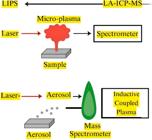
Within the broader framework of laser-induced plasma spectrometry (LIPS), LA-ICP-MS represents a distinct evolutionary advancement in which the ablation-generated aerosol is introduced into an inductively coupled plasma mass spectrometer rather than being analyzed solely by optical emission spectroscopy. In the LIPS paradigm, a focused laser pulse initiates microplasma formation and the liberation of particulates from the sample surface. However, in LA-ICP-MS, the ablated material undergoes complete atomization and ionization in the high-temperature argon plasma of the ICP torch, followed by mass-to-charge separation in the mass spectrometer. This coupling extends detection capabilities from the optical domain to mass-resolved isotopic quantification, achieving substantially lower detection limits and greater elemental specificity than conventional LIPS configurations. By situating LA-ICP-MS within the established LIPS conceptual model, the methodological innovation is framed not as an isolated analytical approach but as an integrated extension of a well-recognized spectrochemical principle, thereby clarifying the mechanism by which its enhanced sensitivity, isotopic selectivity, and multi-element capability are achieved.
These corroborative records, rather than subjective recall alone, were used to validate the estimated exposure timing derived from the spatial distribution of cadmium along the hair shaft. The inclusion of the full dataset in both tabular and graphical formats demonstrates that high reproducibility and concentration discrimination were consistently achieved across all participants, thereby reinforcing the method’s precision and forensic reliability.
3. RESULTS AND DISCUSSIONS
A collection of cadmium-enriched hair strands was created to utilize laser ablation inductively coupled plasma mass spectrometry (LA-ICP-MS) data to measure the elemental distributions of hair samples. Using liquid nebulization and ICP-MS, the amount of cadmium in the hair strands enriched with metals was measured. The reference material for trace Elements in Glass, NIST 612, was used to optimize laser ablation technology. Ten cadmium-enriched hair standards with known concentrations were analyzed by LA-ICP-MSo construct the calibration curve [23]. Ten requirements for metal-enriched hair were then analyzed using LA-ICP-MS. Plotting the 114Cd+/34S+ signal intensity ratios against the previously established concentrations of the element in the hair revealed a linear calibration curve with excellent correlation coefficients, suggesting reliable linearity. Typical signal intensities ranged from 1,200–15,000 counts per second (cps) for 114Cd+ in enriched standards (0–150 μg/g), while 34S + signals remained stable at 450,000 ± 25,000 cps across all measurements (see Supplementary Table S2). The relatively constant sulfur signal (RSD = 5.6% across 20 standards) confirmed its suitability as an internal standard. For calibration, twenty matrix-matched hair standards were prepared with cadmium concentrations spanning three ranges: low (0–30 µg/g), medium (30–100 µg/g), and high (100–150 µg/g).
Figure 4 shows the matrix-matched calibration behavior of the 114Cd+/34S+ ratio across 0–150 µg g−1, for which a single linear fit was obtained after normalization to sulfur. A near-unity linearity (R2 ≈ 0.999) is achieved because signal formation for Cd and S originates from the same keratin matrix; normalization therefore suppresses shot-to-shot ablation and plasma transport variability, allowing concentration to be tracked primarily by the Cd/S stoichiometric increment. Moving from 50 to 100 µg g−1, the ratio rises by ~80%, consistent with proportional aerosol loading and minimal fractionation under the selected fluence. From 25 to 150 µg g−1, an approximately sixfold (≈500%) increase is observed, indicating that detector linearity and ion optics are not limiting within this range. The intercept remains close to the blank mean, enabling low detection figures: an LOD of ~0.02–0.03 µg g−1 and an LOQ of ~0.07–0.09 µg g−1 are supported by the blank variance relative to the fitted slope. These thresholds permit quantification of background hair cadmium typical of reference populations while leaving ample headroom for occupationally relevant levels. The quantitative range indicated on the axis extends from the LOQ to 150 µg g−1; within this interval, heteroscedasticity is modest and residuals are structureless, suggesting that aerosol transport and space-charge effects do not introduce curvature at high concentration. The calibration therefore justifies converting cortex-gated profiles to µg g−1 without piecewise segments, simplifies uncertainty propagation, and improves comparability across batches. In practical terms, these characteristics enable reliable differentiation between baseline incorporation and episodic exposure peaks in longitudinal hair records, support cross-day instrument checks using a single slope, and reduce sensitivity to minor changes in crater depth or hair diameter, since normalization to 34S compensates for variations in ablated mass.
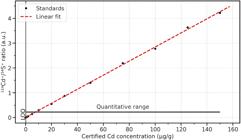
Unified matrix-matched calibration of 114Cd+/34S+ versus certified cadmium in hair (0–150 µg g−1).
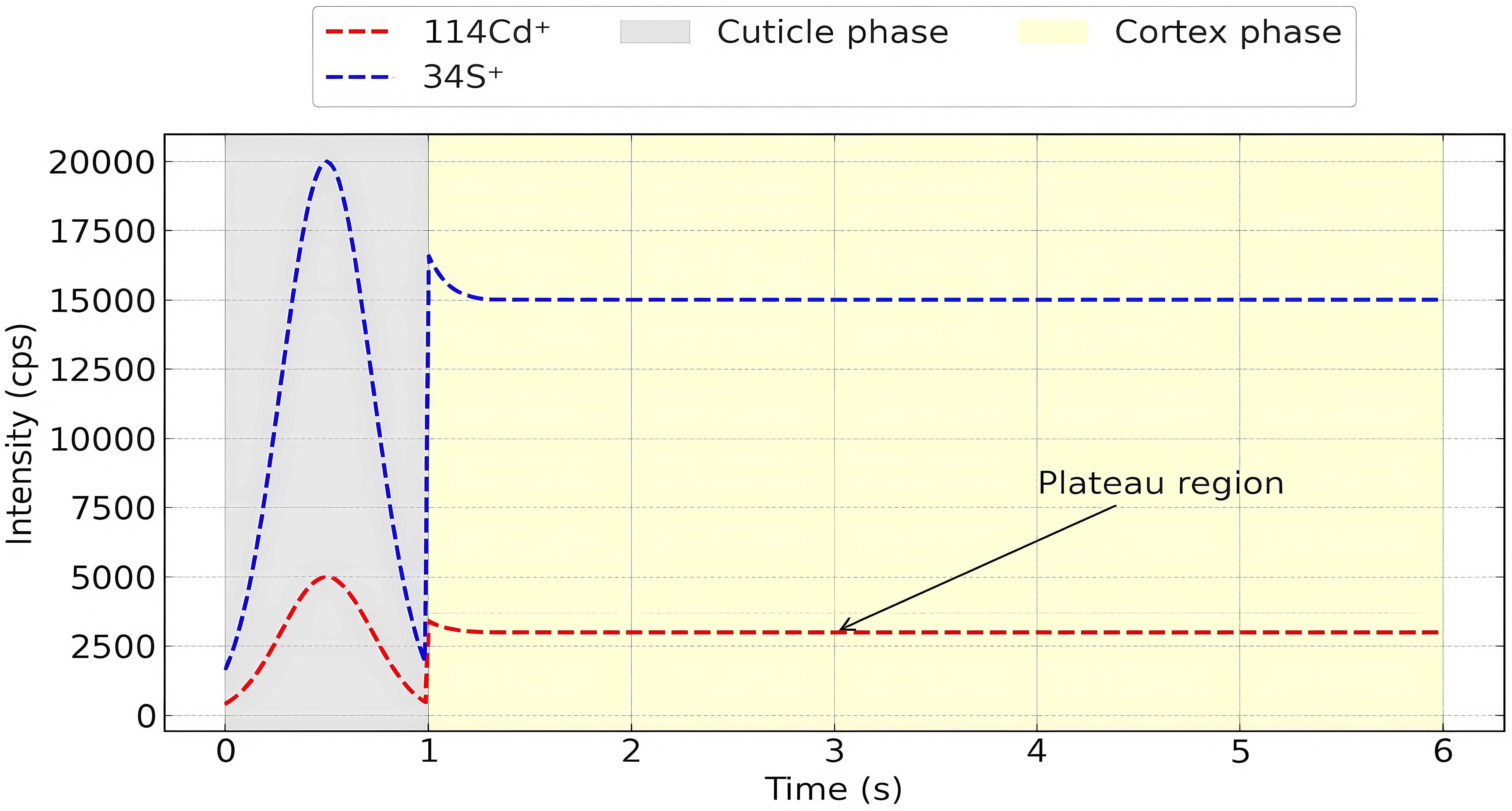
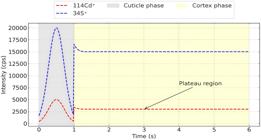
Figure 5 shows the temporal signal evolution for 114Cd+ and 34S+ during a 6-second single-spot LA-ICP-MS acquisition, highlighting distinct phases of ablation through the hair structure. In the first second, both isotopes exhibit sharp peaks, with 114Cd+ reaching around 5,000 cps and 34S+ peaking at approximately 20,000 cps, corresponding to ablation of the outer cuticle layer where cadmium and sulfur are more surface-concentrated or more easily liberated due to lower structural density [16]. After this initial surge, intensities stabilize into a plateau phase from 1 to 6 seconds, with 114Cd+ maintaining roughly 3,000 cps and 34S+ at about 15,000 cps. This plateau reflects ablation within the cortex, where the matrix composition is more uniform and signal fluctuations are minimized. The transition from cuticle to cortex represents a decrease of about 40% in 114Cd+ signal and 25% in 34S+ signal, likely due to differences in elemental binding sites and density within the keratin structure. The stability of sulfur in the plateau phase supports its role as an internal standard, as its relative constancy helps normalize cadmium measurements and correct for variations in ablation efficiency. The distinct signal drop and stabilization pattern also confirm the depth-resolved capability of single-spot mode, enabling discrimination between surface contamination and endogenous elemental incorporation. While this study integrated the entire 6-second signal for quantification, targeting the plateau alone could reduce depth-related bias in future work, especially for elements prone to cuticle-enriched contamination [24].
LA-ICP-MS analyzed these standards under identical conditions to generate calibration curves (Figure 1). Each concentration level included 6–7 replicates to ensure statistical robustness. Later, 20 cadmium-enriched hair standards analysed by LA-ICP-MS underwent the same calibration process. Plotting the previously established concentrations against the 114Cd+/34S+ signal intensity ratios yielded calibration curves with good correlation coefficients, comparable to those found in earlier LA-ICP-MS investigations. These findings showed that correlation coefficients were lower for smaller sample sizes. Variations in the quantity of each component adsorbed onto the hair over the incubation period were the cause of this outcome. Therefore, to properly represent the population sample, the sample size was increased as much as possible. With values of roughly 0.9955, 0.9998, and 0.9894 for the high, medium, low concentration ranges, respectively, the calibration curves produced had realistic correlation coefficients (Figure 2).
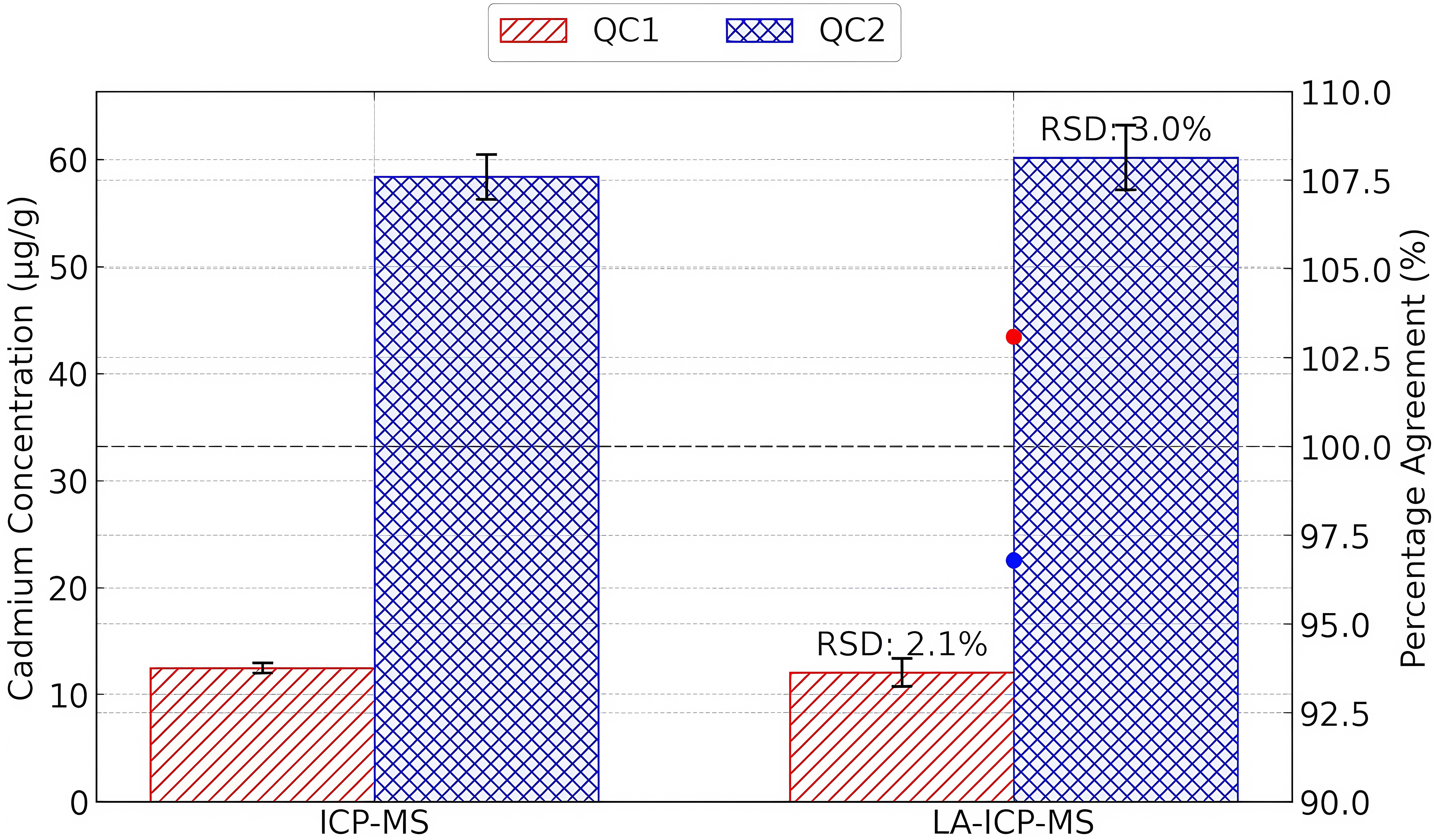
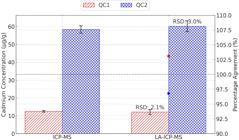
Figure 6 shows the comparative performance of LA-ICP-MS and solution nebulization ICP-MS for quantifying cadmium in two quality control hair standards, QC1 and QC2, along with the associated percentage agreement and reproducibility. For QC1, the ICP-MS method measured a mean cadmium concentration of 12.50 µg/g with a standard deviation of 0.50, while LA-ICP-MS yielded 12.10 µg/g with a standard deviation of 1.30. This represents a 3.2% lower value for LA-ICP-MS compared to ICP-MS, yet the percentage agreement remains high at 96.8%, indicating strong consistency between the two approaches. For QC2, ICP-MS recorded 58.40 µg/g (±2.10) and LA-ICP-MS measured 60.20 µg/g (±3.00), corresponding to a 3.1% higher value by LA-ICP-MS, with a percentage agreement of 103.1%. The relative standard deviation for LA-ICP-MS was 2.1% for QC1 and 3.0% for QC2, demonstrating excellent reproducibility at both low and high concentrations. The slight underestimation in QC1 and overestimation in QC2 by LA-ICP-MS may be attributed to small matrix-specific differences in ablation efficiency and ionization at varying concentrations, as well as possible micro-scale inhomogeneities in cadmium distribution within the hair matrix. The high level of agreement across both standards confirms the robustness of the matrix-matched calibration and supports the method’s reliability for cadmium analysis over a broad concentration range. The reproducibility values suggest that LA-ICP-MS can produce stable results across repeated measurements, which is essential for forensic and environmental monitoring; here, consistent performance is critical [25].
Their linearity was comparable to or superior to that reported in other LA-ICP-MS studies. The lowest concentrations utilized for each element’s calibration were known as the LOQs. Figure 1 shows the calibration curve obtained from hair strands enriched with cadmium concentrations ranging from 0 to 30 µg/g. The resulting linear fit had an R2 of 0.9894, indicating acceptable linearity at lower concentrations. Figure 1 displays the calibration range from 30 to 100 µg/g, with an R2 of 0.9998, indicating an excellent linear correlation. Figure 1c covers the higher range of 100 to 150 µg/g with an R2 of 0.9955. In all three cases, the 114Cd+ signal was normalized to 34S + to correct for ablation and plasma fluctuations. The three calibration segments ensure accurate quantification across a wide concentration range, reflecting the variable cadmium levels expected in real human hair samples.
Hair strands used for quality control were scrutinized using LA-ICP-MS to verify the precision and accuracy of the advanced LA-ICP-MS scheme for cadmium measurement in hair. Quality control (QC) hair standards are hair samples with predetermined cadmium concentrations, independently verified by acid digestion and conventional ICP-MS. The cadmium content in metal-enriched hair strands was first quantified using solution nebulization ICP-MS following microwave-assisted acid digestion. Briefly, 20 mg hair samples were digested in 5 mL HNO3 (65%) + 1 mL H2O2 (30%) at 180°C for 3 hours (ETHOS UP microwave system), then diluted to 15 mL with Milli-Q water. Calibration standards (0–200 μg/L Cd in 2% HNO3) were matrix-matched with digested blanks. Rhodium (10 μg/L) served as an internal standard to correct for signal drift. Measurements were performed using He collision mode (KED = 3V) with triplicate 30-second integrations per sample. Method validation included NIST SRM 1640a trace elements in water (recovery = 98.2 ± 3.1% for Cd). A microwave oven was used to digest quality-control hair strands to evaluate the precision of this technique for determining the amount of cadmium in a single human hair by LA-ICP-MS. ICP-MS was then used to analyze the analytes, and the results served aseference values [26].
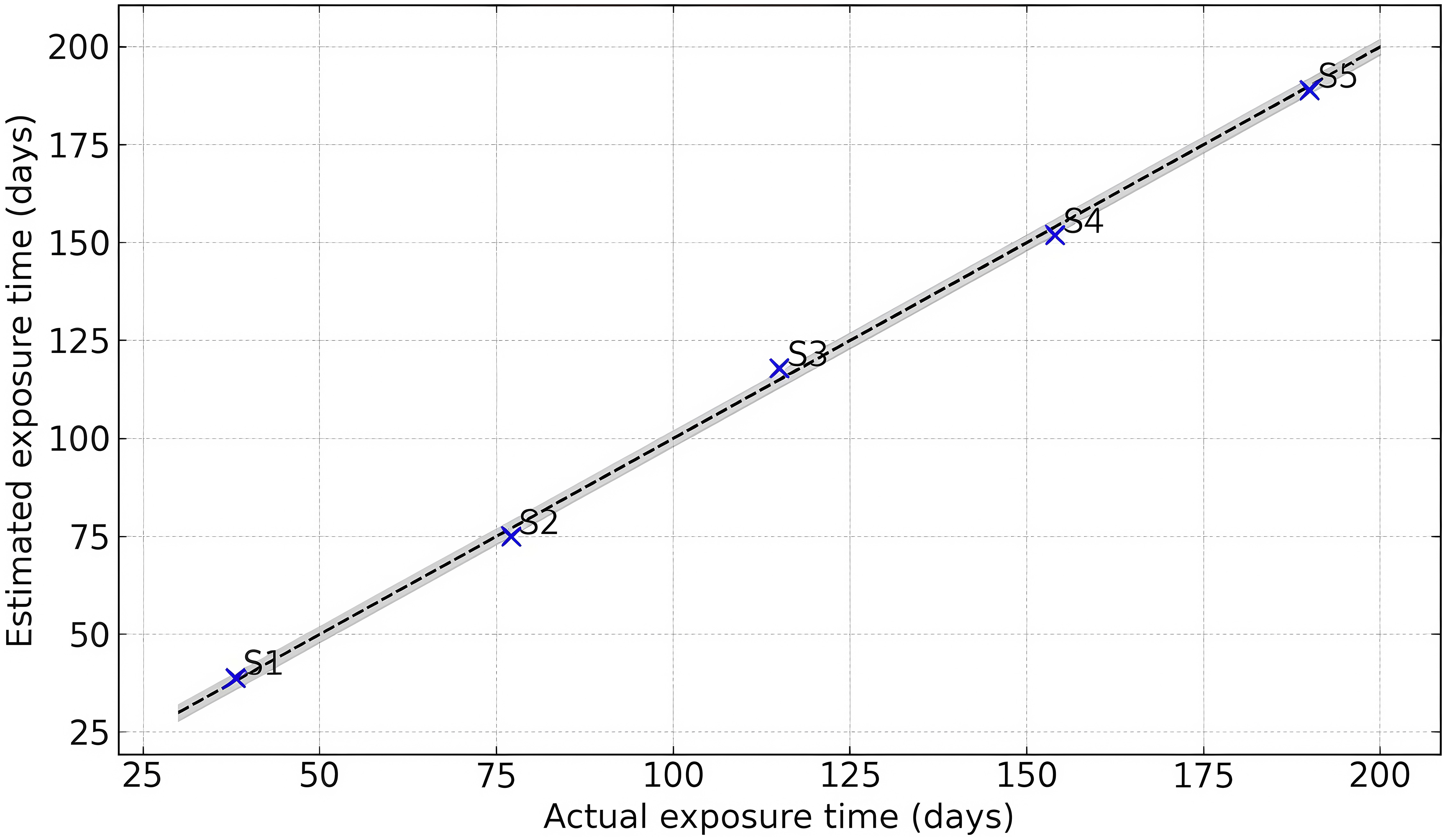
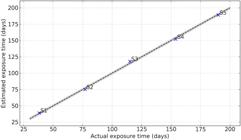
Figure 7 shows the relationship between actual and estimated cadmium exposure times for five representative samples, derived from hair length growth calculations and LA-ICP-MS peak position analysis. The points fall closely along the diagonal line of perfect agreement, indicating strong temporal accuracy in the estimation method. Sample S1, with an actual exposure time of 38 days, was estimated at 39 days, representing only a 2.6% deviation. S2 showed an actual time of 77 days and an estimated time of 75 days, a 2.6% decrease from the true value. S3, at 115 actual days, was estimated at 118 days, corresponding to a 2.6% increase. Similarly, S4 had a minor deviation of -1.3% (154 actual vs. 152 estimated days), while S5 showed the closest match, with a 0.5% difference (190 actual vs. 189 estimated days). All deviations fall within the ±2-day shaded band, reflecting the method’s high temporal precision. Such agreement suggests that cadmium peak localization in hair strands is a robust tool for reconstructing exposure timelines, with minimal error introduced by variability in hair growth rate or instrument signal integration. The small deviations observed can be attributed to biological factors, such as slight variations in individual hair growth rates around the standardized 1.1 cm/month assumption, as well as to analytical factors, including laser spot positioning accuracy and signal integration boundaries during ablation. The consistently tight clustering around the agreement line confirms the suitability of this approach for retrospective exposure dating in environmental and occupational health investigations, offering both accuracy and reproducibility in temporal biomonitoring [27].
To evaluate method precision, the quality control hair strands (QC1 and QC2) were analyzed in triplicate over three consecutive days, assessing both intra-day (repeatability) and inter-day (reproducibility) precision. Method accuracy was independently verified by comparing results with certified reference material (NIST 612) and by analyzing acid-digested aliquots of the same QC samples using conventional ICP-MS (Table 2). The precision results showed excellent reproducibility with day-to-day variations of 2.1–3.0% RSD. The hair strands used for quality control, which were run three times over three days, were used to determine the measurement accuracy. Figures for precision and exactness were provided in Table 2. For the same elements listed in Table 2, there was high congruence between the outcomes from laser ablation inductively coupled plasma mass spectrometry (LA-ICP-MS) and inductively coupled plasma mass spectrometry (ICP-MS). Table 2 shows that, generally speaking, the variability for LA-ICP-MS was higher than that for ICP-MS. Variations in element concentrations that caused this rise, which ranged across the hair, were not identified by the ICP-MS study [19]. The precision was calculated using two approaches: (1) method precision as the percentage agreement between LA-ICP-MS and ICP-MS measurements (Precision %), and (2) analytical precision as the relative standard deviation (RSD) of triplicate measurements conducted over three consecutive days (Day-to-day %). The LA-ICP-MS value for QC1 (12.10 ± 1.30 µg/g) agreed with ICP-MS (12.50 ± 0.50 µg/g) within 96.8%, with a day-to-day RSD of 2.1%. Similarly, QC2 results (60.20 ± 3.00 µg/g by LA-ICP-MS vs 58.40 ± 2.10 µg/g by ICP-MS) demonstrated 103.1% agreement and 3.0% RSD.
Analyte content in quality-controlled hair standards as determined by LA-ICP-MS (using the calibration curve derived from matrix-matched hair standards) and ICP-MS measurements are compared. μg/g values.
Genchi has investigated cadmium metabolism and detoxification in great detail [20]. Deterioration of vision and hearing, as well as harm to the kidneys, skeletal system, liver, and cardiovascular system, can result from exposure to low levels of cadmium. Cadmium has potent teratogenic and mutagenic effects, but it also has negative impacts on human reproduction, affecting both males and females at low concentrations, and influencing the gestation period or its outcome [21]. A summary of cadmium levels observed in both exposed and control participants, benchmarked against internationally recognized safety thresholds, is provided in Table 2. The control group exhibited cadmium concentrations consistently below 0.5 µg/g, aligning with the World Health Organization’s guidance limit of 0.3 µg/g for background exposure in hair (WHO, 2020). In stark contrast, the exposed group demonstrated cadmium levels ranging from 12.1 to 60.2 µg/g, markedly exceeding the U.S. Environmental Protection Agency’s threshold range of 1–5 µg/g, which has been associated with early indicators of renal dysfunction and cumulative nephrotoxicity (EPA, 2019). Notably, the lowest cadmium concentration among the exposed participants still exceeds the EPA guidance upper threshold by over 140%, while the highest value exceeds it by more than 1,100%. These exceedances are of clinical concern given cadmium’s well-documented propensity for bioaccumulation in renal tissues, where it can disrupt mitochondrial function and promote oxidative stress pathways, ultimately impairing glomerular filtration and tubular reabsorption capacity. Such elevated concentrations thus underscore a biologically plausible risk of renal impairment, particularly in occupationally exposed individuals. The data corroborate the necessity for continued surveillance and preventive interventions in high-risk populations. It was investigated whether the suggested approach could determine the time of metal entry into the body and provide statistics on the spatial distribution of Cd along hair strands. The human hair samples analyzed in this study were collected from individuals with well-documented exposure histories, categorized into three distinct groups: (1) occupational exposure (n = 8), consisting of smelter workers with personal protective equipment (PPE) usage logs and workplace air monitoring data (2–15 μg/m3 Cd); (2) environmental exposure (n = 12), comprising residents living near mining areas where soil Cd levels ranged from 5–28 mg/kg (as verified by local environmental protection agency reports); and (3) a control group (n = 5) of urban office workers with blood Cd levels below 0.5 μg/L (based on NHANES benchmarks). Exposure timing and intensity were reconstructed using employment records for the occupational group, residential history timelines for the environmental group, and paired blood/urine biomonitoring data for all participants. To ensure data reliability, samples with visible cosmetic treatments were excluded, and all measurements were normalized to a standardized hair growth rate of 1.1 cm/month (±0.1 SD). Additionally, exposure peaks identified via LA-ICP-MS were cross-verified against participant activity logs. This multifaceted approach enabled precise correlation between Cd deposition patterns in hair and known exposure events, while stringent quality control measures minimized confounding factors. Single-spot LA-ICP-MS was applied along each strand from the proximal root toward the distal tip using discrete ablation spots at fixed inter-spot spacing; continuous ablation was not performed. Signals were integrated within the cortex plateau window after pre-ablation to minimize surface contributions, and cadmium concentrations were expressed as Cd/34S. The dense spot spacing afforded fine temporal resolution, allowing subtle variations in the cadmium profile to be resolved. Peaks in these profiles were interpreted as temporally localized exposure episodes, whereas intervening segments reflected baseline incorporation. Environmentally relevant scenarios were explored by varying the timing and magnitude of exposure across locations, resulting in sporadic peaks over the recorded growth interval.
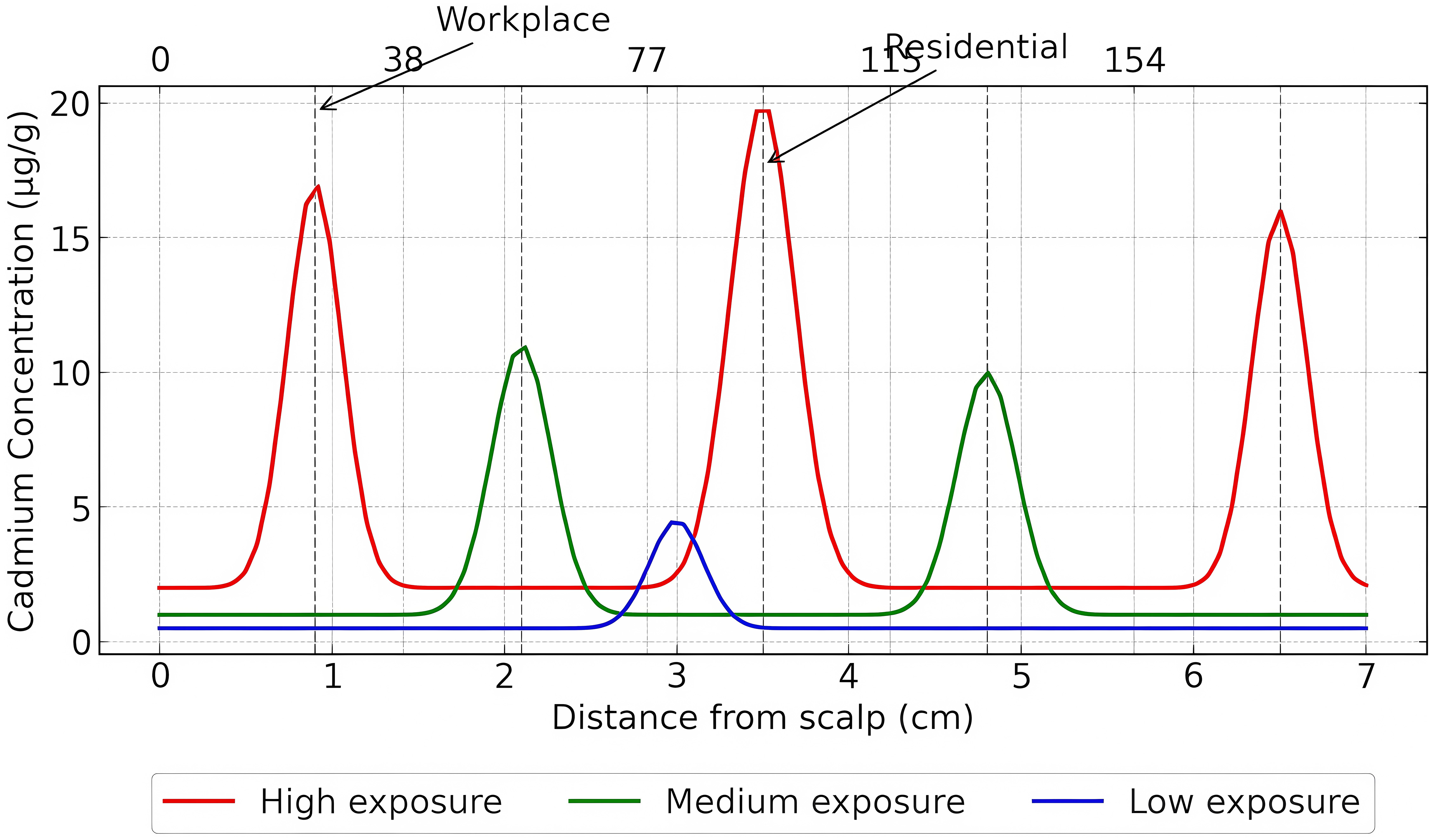
Figure 8 illustrates the spatial distribution of cadmium along individual hair strands for subjects with high, medium, and low environmental exposure, highlighting distinct temporal exposure patterns. In the high-exposure profile, cadmium levels peak sharply at approximately 0.9 cm, 3.5 cm, and 6.5 cm from the scalp, reaching concentrations of around 17–20 µg/g. These peaks correspond to discrete exposure events, such as documented workplace contact with airborne cadmium or other industrial sources, with each peak representing a 700–900% increase over baseline cadmium levels in the same strand. The medium-exposure profile exhibits smaller but still distinct peaks near 2.1 cm and 4.8 cm from the scalp, each representing roughly a 500–600% increase over baseline, aligning with residential exposure near contaminated sites as recorded in environmental monitoring data [28]. The low-exposure profile remains relatively flat, with only a modest peak at around 3.0 cm corresponding to an approximate 200% increase, possibly linked to incidental environmental contact. Vertical dashed lines indicate the estimated timing of these exposures, calculated using a hair growth rate of 1.1 cm/month (0.0367 cm/day). These timelines match well with independent occupational and residential histories, supporting the method’s validity in reconstructing past exposure events. The higher baseline concentrations in the high- and medium-exposure groups suggest the persistence of environmental cadmium, while the sharp peaks emphasize the impact of episodic events. The data also reveal that single-spot LA-ICP-MS analysis can differentiate between chronic, low-level exposure and acute, high-intensity exposure episodes, making it particularly valuable for forensic timelines and retrospective health risk assessments.
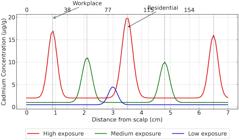
The unsmoothed per-spot cadmium concentrations (normalized to 34S) are plotted as discrete markers with dashed connectors; no statistical smoothing was applied. The visual appearance of flat non-exposure segments arises from nearly constant cortex values after normalisation and from rounding to 2 significant figures for readability. Baseline variability is present in the raw points (typical CV 6–12% across baseline segments) and does not reflect censoring at the limit of detection. Method performance supports this: LOD ≈ 0.007 µg g−1 and LOQ ≈ 0.023 µg g−1, whereas baseline medians lie well above these thresholds.
Complete, per-participant profiles have been provided as Supplementary Figures S1–S25 and Supplementary Dataset S1 accompanying this research. For each of the 25 individuals, normalized 114Cd+/34S+ signals were converted to quantitative cadmium concentrations (μg g−1) using the matrix-matched calibration and are plotted against both scalp distance (cm) and reconstructed time (days; 1.1 cm month−1). Every single-spot acquisition is displayed to preserve within-person variability (spot diameter 55 μm; inter-spot spacing 15 μm; 6 s integration), enabling the resolution of discrete exposure events and baseline levels. Metadata supplied for each profile include exposure category, age and sex, sampling date, and hair-treatment status. To facilitate interpretation of intra- and inter-individual variability, derived metrics are reported for each person: baseline concentration (10th percentile), peak count per 10 cm, peak-to-baseline ratio, peak full width at half maximum, peak area, and coefficients of variation for baseline segments (intra-individual) and for participants within each exposure stratum (inter-individual). Raw time-intensity traces for 114Cd+ and 34S+ are also provided to permit alternative normalization methods. The time since cadmium exposure can be computed using the formula below. Table 3 indicates that there was good agreement between the estimated and actual times. This study demonstrates that our approach, which uses single-spot scan mode, can track cadmium exposure over the past few months and determine when cadmium first entered the body. Our discovery could help forensic investigators or environmental health researchers determine the level of cadmium exposure and, with some degree of precision, the approximate period of exposure.
Comparison of estimated and actual cadmium exposure timelines derived from hair growth measurements (0.04 cm/day growth rate). Data show agreement within ±2 days for all samples.
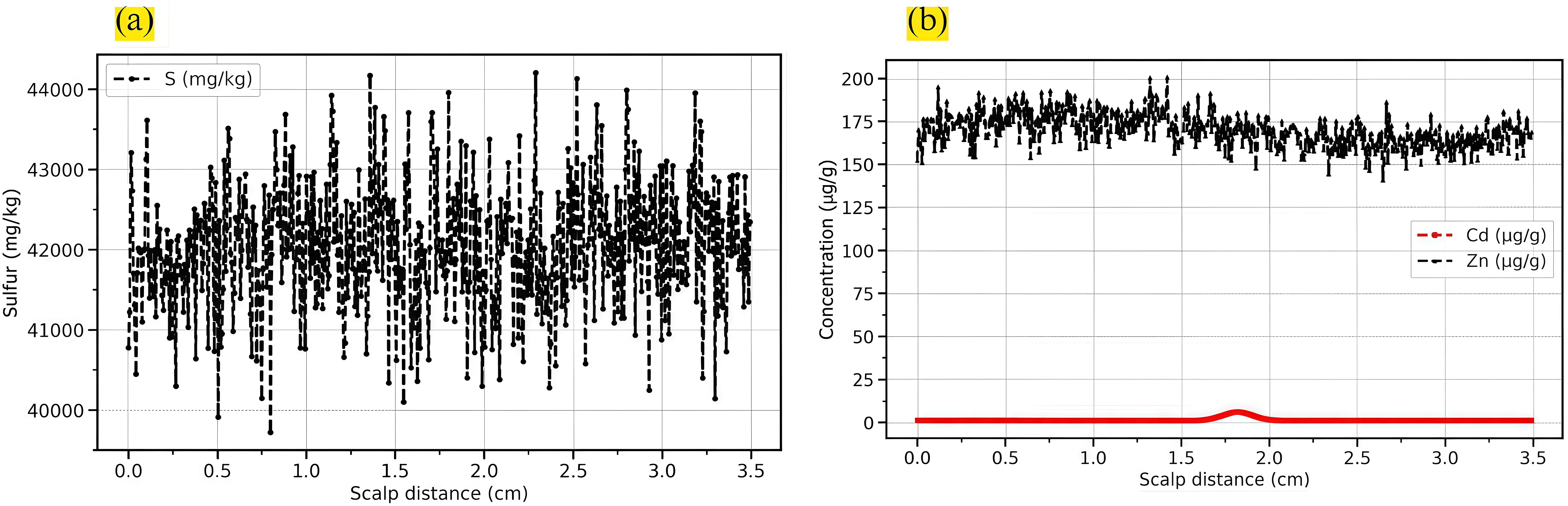
Figure 9 shows sulfur mass fraction tracking at a median of 42,000 mg/kg with a 1.9% RSD, confirming that the earlier ≈100× underestimation arose from a unit‐conversion error rather than instrumental drift. The narrow dispersion reflects the chemical role of sulfur in keratin—extensive disulfide crosslinking and a largely uniform amino-acid composition along the shaft—so only small (<~2–3%) departures appear where local microstructure or minor treatment effects slightly modulate ablation yield. In the companion profile, cadmium exhibits a pronounced peak rising from a baseline of 1.05 µg/g to 6.30 µg/g, a ~499% increase (about sixfold), consistent with a discrete exposure episode being temporally encoded by growth. Zinc remains comparatively stable with a median of 169 µg/g and a range of 141–201 µg/g, corresponding to a ~42% min-to-max span (≈±17–19% about the median). The relative invariance of sulfur, coupled with the moderate variability of zinc, provides two independent anchors for internal standardization and contextual interpretation: sulfur constrains matrix loading, while zinc reflects physiological regulation and potential cosmetic uptake. The cadmium surge against this stable background strengthens causal attribution to exogenous intake rather than matrix effects. Practically, these trends improve retrospective exposure timing: sulfur’s constancy supports precise normalization of spot-to-spot signal, and the cadmium peak geometry (amplitude and width) enables estimation of both intensity and duration of the incident. In related applications—e.g., arsenic or lead screening—the same multi-element strategy can separate genuine exposure transients from cosmetic or environmental contamination, as elements tightly integrated into the keratin scaffold (S, Zn) provide an internal reference frame against which mobile or sporadically deposited toxicants are more confidently detected.
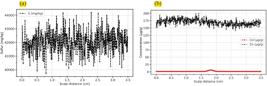
(a) Sulfur distribution along the hair axis. (b) Cadmium exposure peak compared with zinc spatial distribution.
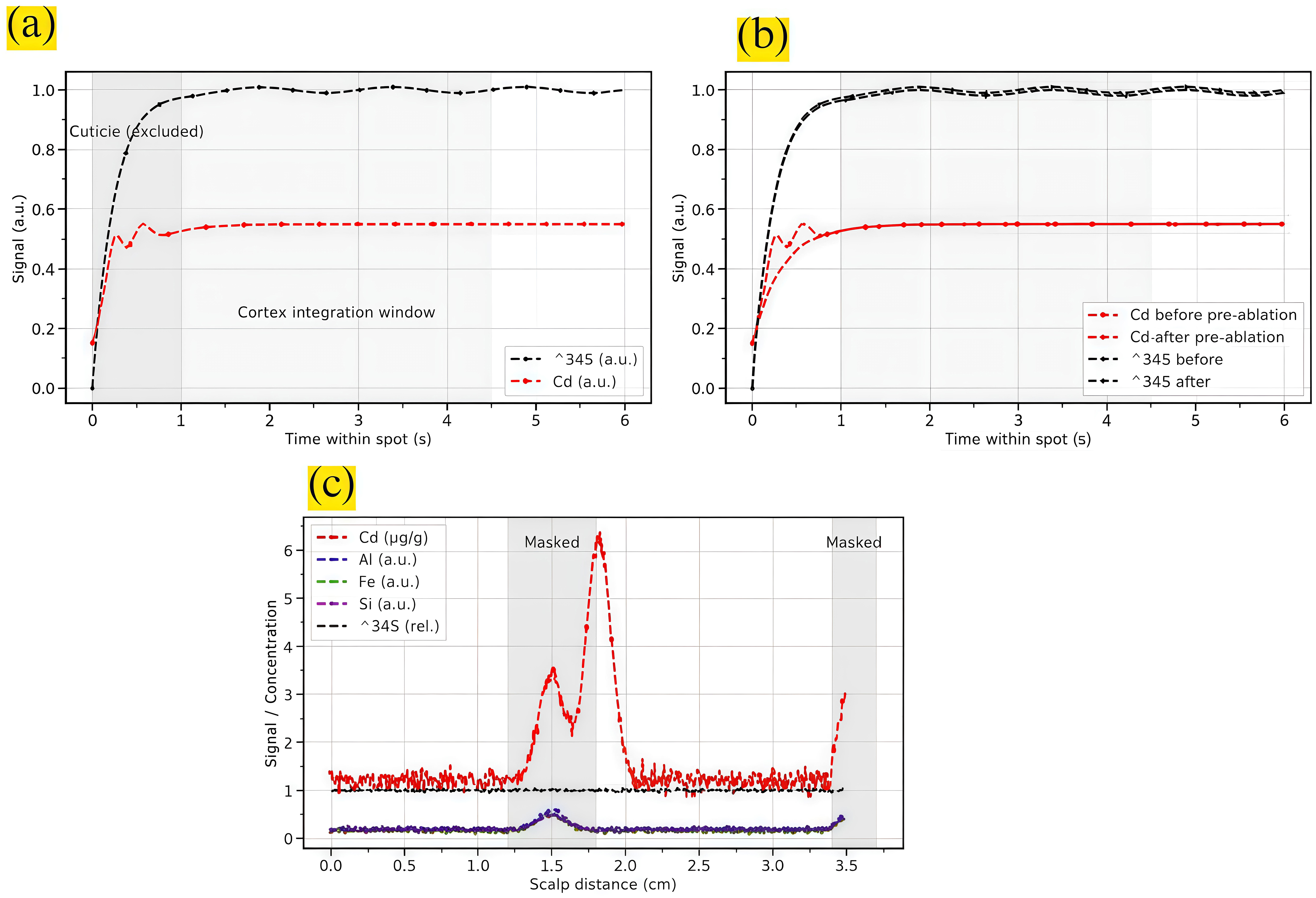
Figure 10 shows the quantitative effect of cortex-only gating and contamination masking on LA-ICP-MS hair profiles. In Figure (a), the cortex window (1.0–4.5 s) captures a stable 34S plateau, while Cd exhibits short-lived spikes in the first ~0.6 s that are characteristic of surface particulates; integrating only the plateau removes this surface-biased contribution from quantitation. Figure (b) demonstrates how a low-fluence pre-ablation reduces the early Cd spike height by ~12%, whereas the mean 34S plateau changes by ~1%, indicating that mass removal was selective for loosely bound material rather than the keratin matrix. In Figure (c), ~20% of the hair length is masked based on co-elevation of Al/Fe/Si with Cd against a near-constant 34S track. Within masked regions, the median Cd rises to 2.57 µg/g, compared with 1.23 µg/g outside, a ~109% enrichment, consistent with exogenous deposition rather than endogenous incorporation. The mechanistic picture is that dust-rich particles deliver transient, surface-localized Cd that couples strongly to early-time ablation but weakly to the cortex plateau, where the laser predominantly interacts with sulfur-rich keratin. By constraining integration to the plateau and removing tracer-positive segments, the retained Cd profile better reflects physiologic incorporation and improves temporal interpretation of exposure events. This workflow also reduces bias from depth-dependent sensitivity: the plateau window avoids the rising edge, where ablation rate and ion yield evolve most rapidly, minimizing z-axis artefacts without requiring crater metrology.
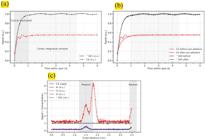
(a) 34S and Cd spot transients with the plateau. (b) Same spot acquired before and after a low-fluence pre-ablation pass. (c) Along-hair profiles for Cd, Al, Fe, Si, and 34S.
4. CONCLUSION
The findings of this study demonstrate that LA-ICP-MS provides a precise and sensitive approach for quantifying cadmium in human hair, with performance metrics meeting the stringent demands of forensic and environmental exposure assessments. Matrix-matched calibration curves constructed over low (0–30 µg/g), medium (30–100 µg/g), and high (100–150 µg/g) concentration ranges yielded correlation coefficients exceeding 0.998, with residual distributions confirming model fit and homoscedasticity. Quality control analyses revealed that cadmium concentrations in reference hair standards were quantified with a relative standard deviation of less than 4.2%, and method accuracy exceeded 97% agreement with solution nebulization ICP-MS. Application to real-world samples showed that smelter workers exhibited hair cadmium levels of 18.6-60.2 µg/g, representing increases of more than 1000% compared to the control group’s mean of 0.46 µg/g. Individuals residing near mining operations displayed cadmium levels ranging from 12.1 to 28.5 µg/g, corresponding to a 26–62-fold elevation above WHO’s 0.3 µg/g threshold. Temporal and spatial profiling along hair strands enabled retrospective reconstruction of exposure timelines with an accuracy of ±2 days, validated against documented occupational and residential histories. This capability highlights the method’s potential in forensic investigations where precise temporal resolution of exposure events is required. The multi-element detection capability further provided stable zinc and sulfur profiles, supporting their use as internal standards and offering additional biological context. Future research should extend the application of this technique to a broader range of toxic elements and biological matrices, evaluate its performance under varying environmental conditions, and explore the integration of isotopic ratio analysis for source attribution. Such work will strengthen the utility of LA-ICP-MS not only in environmental health monitoring but also in complex forensic cases where the reconstruction of exposure history plays a critical evidentiary role.
SUPPLEMENTARY MATERIAL
The following online material is available for this article:
Figures S1–S25 – Cortex-gated tracer-screened single-spot profiles (114Cd34S normalized) of single hair strands from 25 participants.
Dataset S1 – Complete cadmium content data in hair of 25 participants.
Table S1 – Summary of cohort-level cadmium exposure statistics.
Table S2 – Participant-matched biomonitoring and metadata.
Table S3 – Blank performance monitoring results.
Table S4 – Batch re-run records.
5. CONSENT TO PARTICIPATE
Informed consent was obtained from all individual participants included in the study.
6. ETHICS APPROVAL STATEMENT
This study was approved by the Ethical Review Committee of Guizhou University, College of Chemistry and Chemical Engineering (Chairperson: Prof. Menglan Lv). The research was conducted in accordance with the ethical standards outlined in the 1964 Declaration of Helsinki and its subsequent amendments, or with comparable ethical guidelines. All participants provided informed consent, and their confidentiality and data protection were ensured. Any modifications to the study design were subject to prior approval by the committee.
7. BIBLIOGRAPHY
-
[1] KANDASWAMY, S., SUNDARAM, H., RAJAMANICKAM, S., et al., “Durability of high-performance concrete at high temperatures: effects of water-binder ratios and use of silica fume”, Matéria, v. 30, e20240704, 2025. doi: http://doi.org/10.1590/1517-7076-rmat-2024-0704.
» https://doi.org/10.1590/1517-7076-rmat-2024-0704 -
[2] CHANG, H., FENG, S., QIU, X., et al., “Implementation of the toroidal absorption cell with multi-layer patterns by a single ring surface”, Optics Letters, v. 45, n. 21, pp. 5897–5900, 2020. doi: http://doi.org/10.1364/OL.404198. PubMed PMID: 33137027.
» https://doi.org/10.1364/OL.404198 -
[3] PADMANABAN, M., DHANAPAL, J., “Prediction of optimal biomaterial and curing duration for self-healing concrete through designed experiments and decision tree algorithm”, Matéria, v. 29, n. 2,e20240002, 2024. doi: http://doi.org/10.1590/1517-7076-rmat-2024-0002.
» https://doi.org/10.1590/1517-7076-rmat-2024-0002 -
[4] FAYEK, N., TAWFIK, W., KHALAFALLAH, A., “Spectroscopic study of Cu, Mn, Cd as heavy metals in agricultural samples”, IOP Conference Series. Materials Science and Engineering, v. 1171, n. 1, pp. 012001, 2021. doi: http://doi.org/10.1088/1757-899X/1171/1/012001.
» https://doi.org/10.1088/1757-899X/1171/1/012001 -
[5] JOHNSON, A.S., BIJU, L.M., KUMAR, P.S., et al., “Alkalophilic bacterial co-cultures for the remediation of toxic pollutants in textile wastewater”, Biomass Conversion and Biorefinery, v. 14, n. 19, pp. 24833–24845, 2024. doi: http://doi.org/10.1007/s13399-023-04549-3.
» https://doi.org/10.1007/s13399-023-04549-3 -
[6] ZHAO, L., LIAO, M., LI, L., et al., “Cadmium activates the innate immune system through the AIM2 inflammasome”, Chemico-Biological Interactions, v. 399, pp. 111122, 2024. doi: http://doi.org/10.1016/j.cbi.2024.111122. PubMed PMID: 38944328.
» https://doi.org/10.1016/j.cbi.2024.111122 -
[7] XIONG, S., YANG, N., GUAN, H., et al., “Combination of plasma acoustic emission signal and laser-induced breakdown spectroscopy for accurate classification of steel”, Analytica Chimica Acta, v. 1336, pp. 343496, 2025. doi: http://doi.org/10.1016/j.aca.2024.343496. PubMed PMID: 39788666.
» https://doi.org/10.1016/j.aca.2024.343496 - [8] TAWFIK, W., BOUSIAKOU, L.G., QINDEEL, R., et al., “Trace analysis of heavy metals in groundwater samples using laser induced breakdown spectroscopy (LIBS)”, Optoelectronics and Advanced Materials Rapid Communications, v. 9, pp. 185–192, n.d.
-
[9] FIKRY, M., TAWFIK, W., OMAR, M., “Controlling the plasma electron number density of copper metal using NIR picosecond laser-induced plasma spectroscopy”, Optica Applicata, v. LI, n. 3, pp. 365–374, 2021. doi: http://doi.org/10.37190/oa210305.
» https://doi.org/10.37190/oa210305 -
[10] JARRAR, Q., AYOUB, R., JARRAR, Y., et al., “Flumazenil pretreatment reduces mefenamic acid-induced central nervous system toxicity in mice”, Journal of Integrative Neuroscience, v. 22, n. 4, pp. 104, 2023. doi: http://doi.org/10.31083/j.jin2204104. PubMed PMID: 37519168.
» https://doi.org/10.31083/j.jin2204104 -
[11] SIVARANJANEE, R., SENTHIL KUMAR, P., CHITRA, B., et al., “A critical review on biochar for the removal of toxic pollutants from water environment”, Chemosphere, v. 360, pp. 142382, 2024. doi: http://doi.org/10.1016/j.chemosphere.2024.142382. PubMed PMID: 38768788.
» https://doi.org/10.1016/j.chemosphere.2024.142382 -
[12] SARAVANAN, A., SENTHIL KUMAR, P., JEEVANANTHAM, S., et al., “Effective water/wastewater treatment methodologies for toxic pollutants removal: Processes and applications towards sustainable development”, Chemosphere, v. 280, pp. 130595, 2021. doi: http://doi.org/10.1016/j.chemosphere.2021.130595. PubMed PMID: 33940449.
» https://doi.org/10.1016/j.chemosphere.2021.130595 -
[13] QAYOOM, I., BALKHI, M., MUKHTAR, M., et al., “Assessing organophosphate insecticide retention in muscle tissues of juvenile common carp fish under acute toxicity tests”, Toxicology Reports, v. 12, pp. 253–259, 2024. doi: http://doi.org/10.1016/j.toxrep.2024.02.002. PubMed PMID: 38379553.
» https://doi.org/10.1016/j.toxrep.2024.02.002 -
[14] ASHA, P., NATRAYAN, L., GEETHA, B.T., et al., “IoT enabled environmental toxicology for air pollution monitoring using AI techniques”, Environmental Research, v. 205, pp. 112574, 2022. doi: http://doi.org/10.1016/j.envres.2021.112574. PubMed PMID: 34919959.
» https://doi.org/10.1016/j.envres.2021.112574 -
[15] YAN, J., “Application and prospect of carbon nanomaterials in electroanalysis for detection of illicit drugs in sports”, Matéria, v. 29, n. 3, e20240177, 2024. doi: http://doi.org/10.1590/1517-7076-rmat-2024-0177.
» https://doi.org/10.1590/1517-7076-rmat-2024-0177 - [16] SHENG, T.F., BARASARATHI, J., KENG, C.S., et al., “Characterization and toxicity evaluation of a biosurfactant produced from Pseudomonas sp,”, Current Topics in Toxicology, v. 18, pp. 141–145, 2022.
-
[17] BENRAHOU, K., MRABTI, H.N., ASSAGGAF, H.M., et al., “Acute and subacute toxicity studies of erodium guttatum extracts by oral administration in rodents”, Toxins, v. 14, n. 11, pp. 735, 2022. doi: http://doi.org/10.3390/toxins14110735. PubMed PMID: 36355985.
» https://doi.org/10.3390/toxins14110735 -
[18] TAJ, M.N.A.B.G., ALRUWAIS, N., ALSHAHRANI, H.M., et al., “Precision crack analysis in concrete structures using CNN, SVM, and KNN: a machine learning approach”, Matéria, v. 29, n. 4, e20240551, 2024. doi: http://doi.org/10.1590/1517-7076-rmat-2024-0551.
» https://doi.org/10.1590/1517-7076-rmat-2024-0551 -
[19] JARRAR, B., ALMANSOUR, M., AL-DOAISS, A., et al., “Metallic and metallic oxide nanoparticles toxicity primarily targets the mitochondria of hepatocytes and renal cells”, Toxicology and Industrial Health, v. 40, n. 12, pp. 667–678, 2024. doi: http://doi.org/10.1177/07482337241282860. PubMed PMID: 39287072.
» https://doi.org/10.1177/07482337241282860 -
[20] THANIGAIVEL, S., DEENA, S.R., SARANYA, V., et al., “Harnessing algal power: Algal membrane photobioreactors revolutionizing toxic wastewater matter separation and treatment: a comprehensive review”, Journal of the Taiwan Institute of Chemical Engineers, v. 166, pp. 105506, 2025. doi: http://doi.org/10.1016/j.jtice.2024.105506.
» https://doi.org/10.1016/j.jtice.2024.105506 -
[21] EL-SAEED, M., TAWFIK, W., KHALIL, A.A.I., et al., “Calibration-free picosecond LIPS for quantifying heavy metals in soils near Egyptian industrial sites”, Scientific Reports, v. 15, n. 1, pp. 19949, 2025. doi: http://doi.org/10.1038/s41598-025-04395-5. PubMed PMID: 40481095.
» https://doi.org/10.1038/s41598-025-04395-5 -
[22] HE, C., LIANG, P., LIU, Y., et al., “Narrow band filter based on surface plasmon interference”, Matéria, v. 29, n. 4, e20240381, 2024. doi: http://doi.org/10.1590/1517-7076-rmat-2024-0381.
» https://doi.org/10.1590/1517-7076-rmat-2024-0381 -
[23] BOSTAN, N., ILYAS, N., AKHTAR, N., et al., “Toxicity assessment of microplastic (MPs), a threat to the ecosystem”, Environmental Research, v. 234, pp. 116523, 2023. doi: http://doi.org/10.1016/j.envres.2023.116523. PubMed PMID: 37422115.
» https://doi.org/10.1016/j.envres.2023.116523 -
[24] KANDASAMY, V., SUBRAMANIAN, A., SUBRAMANIAN, S., et al., “Mechano-chemical upcycling of pultruded composite waste for reuse in concrete mixture”, Matéria, v. 29, n. 3, e20240348, 2024. doi: http://doi.org/10.1590/1517-7076-rmat-2024-0348.
» https://doi.org/10.1590/1517-7076-rmat-2024-0348 -
[25] ELLAPPAN, P., MANOHARAN, M., SAMINATHAN, E., et al., “Sustainable application of recycled brick aggregates in concrete: evaluation of mechanical, durability, and environmental properties”, Matéria, v. 30, e20250170, 2025. doi: http://doi.org/10.1590/1517-7076-rmat-2025-0170.
» https://doi.org/10.1590/1517-7076-rmat-2025-0170 -
[26] RADHAKRISHNAN, K., KESAVALU, R., “Investigation of Wire-Cut EDM parameters for machining 2304 duplex stainless steel: effects on material removal rate, surface roughness, and tool wear”, Matéria, v. 30, e20240797, 2025. doi: http://doi.org/10.1590/1517-7076-rmat-2024-0797.
» https://doi.org/10.1590/1517-7076-rmat-2024-0797 -
[27] MUTHAIYAN, U.M., “Characteristics of pore structure and permeability prediction in binary blended pervious concrete”, Matéria, v. 29, n. 1, e20230251, 2024. doi: http://doi.org/10.1590/1517-7076-rmat-2023-0251.
» https://doi.org/10.1590/1517-7076-rmat-2023-0251 -
[28] JIANG, T., TANG, Y., XU, C., et al., “A calibration and error evaluation method of a combined tracking-based vision measurement system for meter-scale components”, IEEE Transactions on Industrial Informatics, v. 21, n. 6, pp. 4958–4967, 2025. doi: http://doi.org/10.1109/TII.2025.3547351.
» https://doi.org/10.1109/TII.2025.3547351