 Investigating the influence of polypropylene and steel fibers on the mechanical properties of UHPFRC
ABSTRACT
Ultra high performance fiber reinforced concrete (UHPFRC) stands at forefront of modern construction materials, offering superior strength and durability. The removal of coarse aggregate aims to enhance the compactness and performance of the material, while alternative reinforcement mechanisms of Polypropylene fiber (PF) and hooked Steel fibers (SF) compensate for the absence of traditional fibers. Six mix designs M1 comprises 1% PF and 0.25% SF, M2 features 1% PF and 0.5% SF, and M3 incorporates 1% PF and 0.75% SF, M4 comprises of 1% PF and 1% SF, M5 of 1% PF and 1.25% SF and M6 with 1% PF and 1.5% SF. The mechanical behaviour of these mixes compressive, tensile, and flexural strength were assessed through extensive testing. The findings offer crucial insights into the mechanical performance of UHPFRC formulations that exclude coarse aggregates and traditional fibers, aiding in the optimization of mix designs and broadening the material’s application potential. This research advances sustainable construction practices which encourages the usage of materials with enhanced mechanical properties across various structural applications. Understanding the nuances of UHPFRC mixes without coarse aggregate and traditional fibers is paramount for driving innovation in the construction industry and meeting the demands of modern infrastructure projects.
Keywords:
Polypropylene fiber (PF); Steel fiber (SF); UHPFRC; mechanical properties
1. INTRODUCTION
UHPFRC stands as a landmark development in the science of construction materials. Renowned for its exceptional strength, durability, and versatility, UHPFRC stands as a promising solution to the challenges facing modern infrastructure. By incorporating a high volume of fibers and fine-grained materials into its composition, UHPFRC exhibits remarkable mechanical properties that surpass those of conventional concrete [1]. In recent years, the growing demand for resilient and sustainable construction materials has propelled UHPFRC into the forefront of scientific inquiry. Its potential to redefine structural design and construction practices has captured the attention of researchers, engineers, and industry professionals worldwide. However, to fully realize its benefits and ensure its widespread adoption, a comprehensive understanding of UHPFRC’s mechanical behavior is essential [2]. This investigation embarks on a journey to explore the mechanical properties of UHPFRC, seeking to unravel its intricacies through a combination of rigorous experimentation, theoretical analysis, and advanced modeling techniques. By scrutinizing its mechanical properties and durability under various environmental conditions, we aim to elucidate the factors that govern its performance and identify opportunities for further enhancement [3]. Accurately knowing UHPFRC’s mechanical behavior allows engineers to optimize designs and push the limits of construction. Firstly, understanding its remarkable compressive strength, often surpassing 150 MPa, is essential for assessing its ability to withstand heavy structural loads [4].
This property serves as a fundamental indicator of UHPFRC’s overall structural robustness and its capacity to support various construction elements. Secondly, evaluating its tensile strength, which can exceed 10% of its split tensile strength, is critical for gauging its resistance to cracking and fracture, especially under tensile loading conditions where concrete typically exhibits weaknesses [5]. Thirdly, analyzing its flexural behavior provides valuable insights into its ability to endure bending loads, making it suitable for a diverse array of structural components such as beams and slabs. Lastly, investigating its durability under different environmental conditions, including exposure to chloride ions, sulfate attack, and freeze-thaw cycles, is crucial for ensuring its long-term performance and service life in real-world applications [6]. Through meticulous research, this study aims to contribute to the evolving understanding of UHPFRC, offering insights that can inform the design, construction, and maintenance of infrastructure projects. By unraveling its mechanical complexities, our goal is to unleash the full potential of UHPFRC, driving innovation and sustainability in the construction industry [7]. This study investigated how changing the ingredients in UHPFRC affects its fresh properties and split tensile strength. The researchers replaced some micro silica with blast furnace slag, used quartz powder instead of natural sand in some mixes, and even tried two different types of sand [8]. They also looked at how adding extra fillers and using different methods of curing impacted the concrete’s strength after 7 and 28 days [9]. Because UHPFRC requires a lot of raw materials, the study used special methods to find the best combinations of ingredients to make the concrete. Additionally, they assessed impact of these materials on environment, excluding the effects of transportation and the concrete mixing process itself [10]. Given the unique benefits and drawbacks of geopolymer concrete, especially UHPFRC, more research is needed. This research aimed to enhance our knowledge in UHPFRC by examining its properties thoroughly, including how strong it is, how durable it is, and how it affects the environment [11]. By considering these factors, the study hopes to contribute to making concrete construction materials stronger and more eco-friendly. Through careful testing and analysis, the researchers aimed to find new knowledge that can lead to innovation and make UHPFRC more widely used in construction around the world [12].
This research emphasis on combination of both polypropylene and steel fiber for producing UHPFRC inspite of using traditional fiber alternative. Steel fibers enhance the tensile strength, ductility, and impact resistance, crucial for high-performance structural applications and also control crack propagation, improving the durability and lifespan of the concrete. Polypropylene fibers improve crack resistance and control shrinkage, especially during the curing phase. They enhance the material’s flexibility and toughness, reducing micro-cracks and preventing early-age cracking.
2. MATERIALS AND METHODS
2.1. Materials
The material used natural river sand with a density of 1460 kg /m3 and a Fineness Modulus of 2.51 was used. The sand having a specific gravity of 2.6. The water with a pH of 7 is used for mixing. It was free of organic matter, and its solid content fell within the permissible limits specified by IS 456-2000 and IS 3025:1964. In this study, OPC 53 grade cement was utilized. For this grade, tests were conducted in accordance with IS 456-2000 and in compliance with IS 4031 (Part 1): 1996, as shown in Table 1.
Ultra High Performance Fiber Reinforced Concrete (UHPFRC) was produced using components sourced from alumino-silicate materials, featuring steel fiber with a density measuring 400 kg/m3. The chemical properties of steel fiber are detailed in Table 2. The characteristics of polypropylene fiber and hooked steel fibers were summarized in Table 3.
The mix design specifies the amount of polypropylene (PP) and hooked steel fibers (SF) added to UHPFRC. For instance, in the first mix ratio (1%, 0.25%), 1% of the total mixture comprises polypropylene fiber, while 1% consists of hooked steel fibers. Similarly, the other mix ratios represent different proportions of PF and SF (1%, 0.5%), (1%, 0.75%) (1%, 1%) (1%, 1.25%) & (1%, 1.5%) [13]. These mix ratios were investigated to assess their impact on the mechanical behavior of UHPFRC, which was formulated without coarse aggregate and traditional fibers. For optimal dispersion and to minimize fiber balling, the fibers were incorporated gradually into the homogenous concrete mix. Mixing continued until the fibers were uniformly distributed throughout the mixture. Subsequently, the blended mix was poured into molds and covered with lids to minimize loss of moisture. The specimens are removed from the molds and kept at ambient temperature (24–30°C) for testing.
2.2. Methods
To investigate the mechanical properties of Ultra High Performance Fiber Reinforced Concrete, various sample geometries are prepared, each designed to test different mechanical properties. For compressive strength testing, cube specimens with dimensions of 100 × 100 × 100 mm are used [14]. Additionally, cylinder specimens having diameter of 150 mm and height of 300 mm are made to test for split tensile strength, while prism specimens measuring 100 × 100 × 500 mm are utilized to assess flexure or bending strength [15, 16].
The testing process follows a systematic and controlled approach to ensure reliable and consistent results. Initially, the freshly prepared UHPFRC mix is carefully poured into the designated moulds for each specimen type. This process requires attention to detail to avoid any air pockets, which could compromise the integrity and accuracy of the tests. After pouring, the specimens are typically allowed to cure within their moulds for an initial period of 24 hours [17]. During this time, they are kept under controlled conditions to facilitate optimal curing and strength development. Once this initial curing period is complete, the specimens are gently removed from their moulds, with care taken to avoid any surface damage that could affect testing outcomes. Each specimen is then labelled with a unique identifier, enabling precise tracking throughout the testing process. This labelling is crucial, as it ensures that data can be accurately recorded and associated with each specific sample. After labelling, the specimens may undergo further curing under specified conditions, depending on the standard testing protocols or project requirements. Finally, the specimens are subjected to testing using calibrated testing machines, which apply controlled forces to measure their respective strengths. The data collected from these tests provide valuable insights into the structural properties and durability of UHPFRC, which are essential for various high-performance applications.
3. RESULTS AND DISCUSSION
3.1. Compressive strength
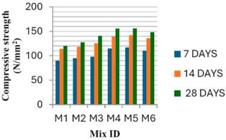
The Table 4 provides a detailed look at the effect of varying Steel fiber (SF) content on the compressive strength of concrete mixes over 7, 14, and 28 days, with a consistent Polypropylene Fiber (PF) content of 1% across all mixes. The compressive strength increases with curing time in all mixes, highlighting the impact of SF as a supplementary cementitious material [18]. Starting with M1, which has the lowest SF content of 0.25%, the 7-day compressive strength is 90 MPa. M2, with 0.5% SF, improves to 95 MPa, and M3, with 0.75% SF, reaches 98 MPa, illustrating a positive correlation between SF content and early strength gain. By the time we reach M4, with 1% SF, the compressive strength significantly rises to 115 MPa at 7 days. This trend continues in M5, where the 7day strength is the highest among the mixes at 117 MPa, suggesting that SF additions up to this level promote early strength development.
At 14 days, the strength gains become more prominent. M1 records a compressive strength of 114 MPa, while M2 and M3 show increases to 118.4 MPa and 125.5 MPa, respectively. The peak mid-term strength is observed in M5, which achieves 142 MPa, slightly higher than M4’s 140 MPa. M6, however, with 1.5% SF, experiences a drop to 136 MPa. This may imply that higher SF contents begin to yield diminishing returns or potentially hinder the strength gain rate as the mix ages [19].
By 28 days, all mixes have reached their maximum recorded strengths, with M1 reaching 120 MPa, M2 reaching 127.6 MPa, and M3 further improving to 140.5 MPa. The most substantial strengths are recorded in M4 and M5, which achieve compressive strengths of 155.5 MPa and 156 MPa respectively. Notably, M6, with 1.5% SF, shows a decline to 148.4 MPa at this stage, which is lower than both M4 and M5, indicating that excessive SF content might lead to a reduction in ultimate strength. Figure 1 suggests that while SF additions improve the strength properties of concrete up to an optimal point, excessive SF may reduce workability or lead to an over-densified matrix that could impact the hydration process and bonding properties within the concrete. Overall, the results point towards an optimal SF range of 1% to 1.25% for maximizing compressive strength. Beyond this range, as seen in M6, additional SF may no longer contribute positively and can, in fact, begin to adversely affect the concrete’s mechanical performance.
3.2. Splitting tensile strength
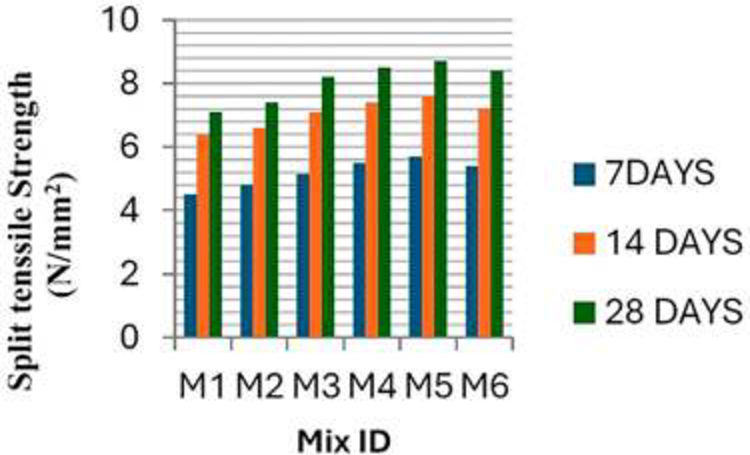
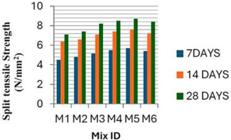
The Table 5 outlines the split tensile strength of concrete mixes (M1 to M6) with varying Steel fiber (SF) content over a curing period of 7, 14, and 28 days, while maintaining a constant Polypropylene Fiber (PF) content of 1%. The data provides insight into how incremental increases in SF content influence early, mid-term, and ultimate split tensile strength [20, 21]. Starting with M1, which contains the lowest SF content at 0.25%, the concrete reaches 7day strength of 4.5 MPa, increasing to 6.4 MPa at 14 days and achieving a final strength of 7.1 MPa at 28 days. M2, with 0.5% SF, shows a marginal increase in split tensile strength, as 7 days shows 4.8 MPa, 14 days shows 6.6 MPa and 28 days shows 7.4 MPa. The pattern indicates that slight increases in SF content can enhance early strength gain, likely due to SF’s role in improving the concrete matrix’s microstructure by filling voids and contributing to the pozzolanic reaction.
The trend continues with M3, which contains 0.75% SF and achieves 7-day strength of 5.15 MPa, rising to 7.1 MPa by 14 days and culminating in 8.2 MPa strength at 28 days. This upward trend becomes more pronounced with M4 (1% SF), which attains strengths of 5.5 MPa, 7.4 MPa, and 8.5 MPa over the 7, 14, and 28 day periods, respectively. These findings suggest that an SF content of around 1% is optimal for a balanced improvement across all stages of strength development. M5, with 1.25% SF, reaches the highest split tensile strength s recorded in the table, achieving 5.7 MPa in 7 days, 7.6 MPa in 14 days, and peaking at 8.7 MPa at 28 days. This indicates that the addition of SF up to 1.25% optimally enhances strength, possibly due to improved particle packing, reduced porosity, and a denser interfacial transition zone, which boosts the concrete’s overall structural integrity.
However, the data for M6, with an SF content of 1.5%, reveals a slight reduction in split tensile strength. M6 shows strengths of 5.4 MPa, 7.2 MPa, and 8.4 MPa at the 7, 14, and 28 day marks, respectively, indicating that excessive SF may lead to a decline in performance. The reduction in strength at higher SF levels might be due to issues such as reduced workability and potential segregation within the concrete mix, which can hinder the bonding and hydration processes necessary for optimal strength gain. Figure 2 suggests an optimal SF range of 1% to 1.25% for enhancing split tensile strength, with diminishing returns observed when SF content exceeds this range. This optimal level likely provides the best balance between matrix densification, hydration efficiency, and workability, making it an effective proportion for high-strength concrete mixes.
3.3. Flexural strength test
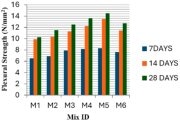
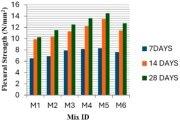
The Table 6 illustrates the Flexural strength of concrete mixes (M1 to M6) with a consistent Polypropylene Fiber (PF) content of 1% and varying Steel fiber (SF) percentages, measured over 7, 14, and 28 days. The data highlights how incremental increases in SF content affect the early, mid-term, and ultimate Flexural strength s of concrete [22]. In Mix M1, with the lowest SF content of 0.25%, the concrete achieves a 7-day Flexural strength of 6.5 MPa, increasing to 9.9 MPa by 14 days and reaching a final strength of 10.25 MPa at 28 days. As SF content increases to 0.5% in M2, the early strength at 7 days rises slightly to 6.9 MPa, while the 14-day and 28-day strengths increase to 10.35 MPa and 11.5 MPa, respectively. This trend indicates that even modest increases in SF contribute to improved Flexural strength, likely due to enhanced pozzolanic reactions and improved microstructure as SF helps fill voids and create a denser concrete matrix.
The next mix, M3, contains 0.75% SF and shows a noticeable boost in Flexural strength, reaching 7.9 MPa in 7 days, 11.3 MPa in 14 days, and 12.5 MPa in 28 days. As the SF content reaches 1% in M4, the Flexural strength gains continue to improve, with the mix achieving 8.16 MPa in 7 days, 12.24 MPa in 14 days, and 13.6 MPa in 28 days. This consistent improvement with increasing SF content suggests that the optimal range for SF content may be around 1% to 1.25% for achieving balanced strength gains across different curing times. Mix M5, containing 1.25% SF, records the highest Flexural strength s across all curing times with 7 day, 14 day, and 28 day strengths of 8.3 MPa, 13.5 MPa, and 14.5 MPa, respectively. These results imply that increasing SF content up to this level enhances the Flexural strength due to a denser interfacial transition zone and better particle packing, improves the structural integrity of the concrete matrix by reducing porosity.
In contrast, Mix M6 with 1.5% SF shows a slight decline in Flexural strength, recording 7.62 MPa in 7 days, 11.43 MPa in 14 days, and 12.7 MPa in 28 days. This decrease suggests that excessive SF content may negatively impact workability, potentially leading to segregation or an overly dense matrix that hinders optimal hydration and bonding. Figure 3 highlights an optimal SF range of 1% to 1.25%, as further increases beyond this range (as in M6) may result in reduced strength. This optimal range likely represents a balance between matrix densification, effective hydration, and improved particle packing, making it a suitable target for high-strength concrete applications.
3.4. Water absorption test
The concrete cubes are casted same as for above test and cured for a period of 28 days. After, the specimens are taken out and allowed to sundry for about one day. Then, the initial weight (W1) is noted. Again, the specimen are immersed in water for about 24–48 hrs [23]. Then the cubes taken and surface is wiped and the weight (W2) is noted. The percentage of water absorption is calculated using following table.
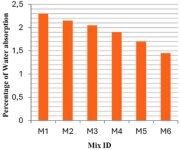
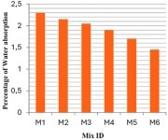
The Table 7 shows the percentage of water absorption in concrete mixes (M1 to M6) with a consistent Polypropylene Fiber (PF) content of 1% and varying percentages of Steel fiber (SF). This data is valuable for understanding how SF content affects the porosity and durability of concrete, as lower water absorption typically indicates a denser, more durable matrix with reduced permeability [20]. Starting with M1, which has the lowest SF content at 0.25%, the water absorption is 2.3%. This relatively higher absorption rate suggests that the concrete has a more porous structure, as the minimal SF content likely provides limited improvement in filling voids or enhancing the microstructure [24]. In M2, the SF content is increased to 0.5%, leading to a slight decrease in water absorption to 2.15%. This drop indicates that even a modest addition of SF helps to refine the pore structure, making the concrete less permeable and more resistant to moisture ingress. The trend continues with M3, which has an SF content of 0.75% and a water absorption rate of 2.05% [25]. This reduction in water absorption reflects further improvements in concrete density, as additional SF promotes the pozzolanic reaction, resulting in finer calcium silicate hydrates that enhance the overall matrix. In M4, with 1% SF, the water absorption rate decreases further to 1.9%. This reduction highlights the SF’s role in filling micro-pores, which not only decreases water absorption but also improves the concrete’s resistance to chemical attacks and freeze-thaw cycles. M5, with an SF content of 1.25%, records a water absorption rate of 1.7%, indicating a significant enhancement in density and impermeability [26]. This reduced water absorption is likely due to the SF particles filling voids between cement grains and increasing the packing density, resulting in a denser matrix that limits moisture penetration. The data suggests that the range of 1% to 1.25% SF content is particularly effective for achieving low water absorption, improving durability, and reducing the potential for water-induced damage over time.
In M6, where the SF content is raised to 1.5%, the water absorption is further reduced to 1.45%, the lowest among the mixes. This decreasing trend in Figure 4 suggests that higher SF content continues to refine the concrete matrix, minimizing pore space and enhancing durability. However, while lower water absorption generally signifies better performance, extremely high SF levels can sometimes lead to workability challenges and potential issues with hydration efficiency [27]. The data demonstrates that increasing SF content progressively reduces water absorption, with optimal effects observed between 1% and 1.5% SF. This range offers a strong balance between reducing porosity and maintaining workability, ultimately producing a concrete mix with enhanced durability and resistance to environmental factors.
4. CONCLUSION
This paper presents the properties of UHPFRC with different fibers namely Steel fibers and polypropylene fibers with three different mix proportions M1, M2, M3, M4, M5 and M6 with 1% of polypropylene remains same varying steel fiber as 0.25%, 0.5%, 0.75%, 1%, 1.25% and 1.5% for this study. Based on the results obtained, the following conclusions were arrived,
-
1)
Increasing the dosage of steel fibers in ultra-high-performance fiber-reinforced concrete (UHPFRC) mixtures resulted in a corresponding decrease in the workability of the fresh mixture.
-
2)
Enhancement in mechanical properties in compression, split tension and flexural strength were recorded for each mix.
-
3)
Mix M5 containing 1.25% Steel Fiber (SF) in UHPFRC provides the optimal balance for mechanical properties, delivering significant performance gains over lower and higher SF levels. Excess SF content may disrupt particle packing, leading to reduced efficiency in strength enhancement.
-
4)
As the volume fraction of fibers increases in ultra-high-performance fiber-reinforced concrete (UHPFRC), there is a significant improvement in its mechanical characteristics.
-
5)
As the Steel fiber content increases from 0.25% to 1.5%, there is a notable decrease in water absorption, indicating reduced porosity and enhanced durability. Mix M6, with the highest Steel fiber content, exhibits the lowest water absorption, emphasizing the effectiveness of Steel fiber in creating a denser, more impermeable concrete matrix.
5. BIBLIOGRAPHY
-
[1] WU, F., XU, L., CHI, Y., et al, “Compressive and flexural properties of ultra-high performance fiber-reinforced cementitious composite: The effect of coarse aggregate”, Composite Structures, v. 236, pp. 111810, 2020. doi: http://doi.org/10.1016/j.compstruct.2019.111810.
» https://doi.org/10.1016/j.compstruct.2019.111810 -
[2] AMRAN, M., MURALI, G., MAKUL, N., et al, “Sustainable development of eco-friendly ultra-high performance concrete (UHPC): Cost, carbon emission, and structural ductility”, Construction & Building Materials, v. 398, pp. 132477, 2023. doi: http://doi.org/10.1016/j.conbuildmat.2023.132477.
» https://doi.org/10.1016/j.conbuildmat.2023.132477 - [3] GANGWAR, S., MISHRA, S., SHARMA, H.K., “An experimental study on mechanical properties of Ultra-High-Performance Fiber-Reinforced Concrete (UHPFRC)”, In: “Sustainable Construction and Building Materials” Select Proceedings of ICSCBM 2018, pp. 873–886, Singapore, 2019.
-
[4] YU, R., SONG, Q., WANG, X., et al, “Sustainable development of Ultra-High Performance Fibre Reinforced Concrete (UHPFRC): Towards to an optimized concrete matrix and efficient fibre application”, Journal of Cleaner Production, v. 162, pp. 220–233, 2017. doi: http://doi.org/10.1016/j.jclepro.2017.06.017.
» https://doi.org/10.1016/j.jclepro.2017.06.017 -
[5] PARTHIBAN, P., KAR, S., MONDAL, A.K., et al, “Stress-strain behaviour of (hpfrc) high-performance fibre reinforced concrete: an experimental study”, Materials Today: Proceedings, v. 80, pp. 3119–3123, 2023. doi: http://doi.org/10.1016/j.matpr.2021.07.175.
» https://doi.org/10.1016/j.matpr.2021.07.175 -
[6] POURBABA, M., SADAGHIAN, H., MIRMIRAN, A., “Flexural response of UHPFRC beams reinforced with steel rebars”, Advances in Civil Engineering Materials, v. 8, n. 3, pp. 411–430, 2019. doi: http://doi.org/10.1520/ACEM20190129.
» https://doi.org/10.1520/ACEM20190129 -
[7] BERTOLA, N., KÜPFER, C., KÄLIN, E., et al, “Assessment of the environmental impacts of bridge designs involving UHPFRC”, Sustainability, v. 13, n. 22, pp. 12399, 2021. doi: http://doi.org/10.3390/su132212399.
» https://doi.org/10.3390/su132212399 -
[8] PRAKASH, S., KUMAR, S., BISWAS, R., et al, “Influence of silica fume and ground granulated blast furnace slag on the engineering properties of ultra-high-performance concrete”, Innovative Infrastructure Solutions, v. 7, n. 1, pp. 117, 2022. doi: http://doi.org/10.1007/s41062-021-00714-7.
» https://doi.org/10.1007/s41062-021-00714-7 -
[9] PARK, S., WU, S., LIU, Z., et al, “The role of supplementary cementitious materials (SCMs) in ultra high performance concrete (UHPC): a review”, Materials, v. 14, n. 6, pp. 1472, 2021. doi: http://doi.org/10.3390/ma14061472. PubMed PMID: 33802943.
» https://doi.org/10.3390/ma14061472 -
[10] XU, S., YUAN, P., LIU, J., et al, “Development and preliminary mix design of ultra-high-performance concrete based on geopolymer”, Construction & Building Materials, v. 308, pp. 125110, 2021. doi: http://doi.org/10.1016/j.conbuildmat.2021.125110.
» https://doi.org/10.1016/j.conbuildmat.2021.125110 -
[11] ABDELLATIEF, M., ELRAHMAN, M.A., ABADEL, A.A., et al, “Ultra-high performance concrete versus ultra-high performance geopolymer concrete: mechanical performance, microstructure, and ecological assessment”, Journal of Building Engineering, v. 79, pp. 107835, 2023. doi: http://doi.org/10.1016/j.jobe.2023.107835.
» https://doi.org/10.1016/j.jobe.2023.107835 -
[12] YANG, J., CHEN, B., SU, J., et al, “Effects of fibers on the mechanical properties of UHPC: a review”, Journal of Traffic and Transportation Engineering, v. 9, n. 3, pp. 363–387, 2022. doi: http://doi.org/10.1016/j.jtte.2022.05.001.
» https://doi.org/10.1016/j.jtte.2022.05.001 -
[13] AHMAD, S., RASUL, M., ADEKUNLE, A., et al, “Mechanical properties of steel fiber-reinforced UHPC mixtures exposed to elevated temperature: effects of exposure duration and fiber content”, Composites. Part B, Engineering, v. 168, pp. 291–301, 2019. doi: http://doi.org/10.1016/j.compositesb.2018.12.083.
» https://doi.org/10.1016/j.compositesb.2018.12.083 -
[14] WEN, C., ZHANG, P., WANG, J., et al, “Influence of fibers on the mechanical properties and durability of ultra-high-performance concrete: a review”, Journal of Building Engineering, v. 52, pp. 104370, 2022. doi: http://doi.org/10.1016/j.jobe.2022.104370.
» https://doi.org/10.1016/j.jobe.2022.104370 -
[15] HUNG, C.C., CHEN, Y.-T., YEN, C.-H., “Workability, fiber distribution, and mechanical properties of UHPC with hooked end steel macro-fibers”, Construction & Building Materials, v. 260, pp. 119944, 2020. doi: http://doi.org/10.1016/j.conbuildmat.2020.119944.
» https://doi.org/10.1016/j.conbuildmat.2020.119944 -
[16] WU, Z., SHI, C., KHAYAT, K.H., et al, “Effect of SCM and nano-particles on static and dynamic mechanical properties of UHPC”, Construction & Building Materials, v. 182, pp. 118–125, 2018. doi: http://doi.org/10.1016/j.conbuildmat.2018.06.126.
» https://doi.org/10.1016/j.conbuildmat.2018.06.126 -
[17] CHEN, Z., WANG, X., DING, L., et al, “Mechanical properties of a novel UHPC reinforced with macro basalt fibers”, Construction & Building Materials, v. 377, pp. 131107, 2023. doi: http://doi.org/10.1016/j.conbuildmat.2023.131107.
» https://doi.org/10.1016/j.conbuildmat.2023.131107 -
[18] AISHEH, Y.I.A., ATRUSHI, D.S., AKEED, M.H., et al, “Influence of polypropylene and steel fibers on the mechanical properties of ultra-high-performance fiber-reinforced geopolymer concrete”, Case Studies in Construction Materials, v. 17, e01234, 2022. doi: http://doi.org/10.1016/j.cscm.2022.e01234.
» https://doi.org/10.1016/j.cscm.2022.e01234 -
[19] QAIDI, S.M.A., ATRUSHI, D.S., MOHAMMED, A.S., et al, “Ultra-high-performance geopolymer concrete: a review”, Case Studies in Construction Materials, v. 346, pp. 128495, 2022. doi: http://doi.org/10.1016/j.conbuildmat.2022.128495.
» https://doi.org/10.1016/j.conbuildmat.2022.128495 -
[20] AKEED, M.H., QAIDI, S., AHMED, H.U., et al, “Ultra-high-performance fiber-reinforced concrete. Part V: mixture design, preparation, mixing, casting, and curing”, Case Studies in Construction Materials, v. 17, e01363, 2022. doi: http://doi.org/10.1016/j.cscm.2022.e01363.
» https://doi.org/10.1016/j.cscm.2022.e01363 -
[21] TAYEH, B.A., AKEED, M.H., QAIDI, S., et al, “Influence of microsilica and polypropylene fibers on the fresh and mechanical properties of ultra-high performance geopolymer concrete (UHP-GPC)”, Case Studies in Construction Materials, v. 17, e01367, 2022. doi: http://doi.org/10.1016/j.cscm.2022.e01367.
» https://doi.org/10.1016/j.cscm.2022.e01367 -
[22] AISHEH, Y., ATRUSHI, D.S., AKEED, M.H., et al, “Influence of polypropylene and steel fibers on the mechanical properties of ultra-high-performance fiber-reinforced geopolymer concrete”, Case Studies in Construction Materials, v. 17, e01234, 2022. doi: http://doi.org/10.1016/j.cscm.2022.e01234.
» https://doi.org/10.1016/j.cscm.2022.e01234 -
[23] QAIDI, S.M.A., SULAIMAN ATRUSHI, D., MOHAMMED, A.S., et al, “Ultra-high-performance geopolymer concrete: a review”, Construction & Building Materials, v. 346, pp. 128495, 2022. doi: http://doi.org/10.1016/j.conbuildmat.2022.128495.
» https://doi.org/10.1016/j.conbuildmat.2022.128495 -
[24] ABDAL, S., MANSOUR, W., AGWA, I., et al, “Application of ultra-high-performance concrete in bridge engineering: current status, limitations, challenges, and future prospects”, Buildings, v. 13, n. 1, pp. 185, 2023. doi: http://doi.org/10.3390/buildings13010185.
» https://doi.org/10.3390/buildings13010185 -
[25] IYAPPAN, R., MURUGAN, M., “Shear strengthening of reinforced concrete beams using fibre reinforced polymer composites”, Matéria, v. 29, n. 1, e20230247, 2024. doi: http://doi.org/10.1590/1517-7076-rmat-2024-0013.
» https://doi.org/10.1590/1517-7076-rmat-2024-0013 - [26] YUVARAJ, K., SAKTHIVEL, M., DHIVAKAR KARTHICK, M., et al, “Mechanical performance of mono and hybrid synthetic fibers engineered cementitious composites with silica fume”, Journal of Ceramic Processing Research, v. 25, n. 2, pp. 254–260, 2024.
-
[27] PERIYASAMY, M., KANAGARAJ, R., “Fiber reinforced self compacting concrete workability properties prediction and optimization of mix using machine learning modeling”, Matéria, v. 29, n. 1, e20230309, 2024. doi: http://doi.org/10.1590/1517-7076-rmat-2023-0309.
» https://doi.org/10.1590/1517-7076-rmat-2023-0309