 Response surface methodology-based optimization of multi-walled carbon nanotube-graphene oxide enhanced stearic acid phase change materials
ABSTRACT
The development of stable and thermally effective phase change materials (PCMs) is important for upgrading the energy conservation technologies. The minimal thermal conductivity of organic PCMs, like stearic acid, limits their thermal efficiency. This study utilized a novel nano-encapsulated phase change material (NEPCM) containing stearic acid integrated with nanofillers-multi-walled carbon nanotubes (MWCNTs) and graphene oxide (GO)- which was encapsulated by polymethyl methacrylate using the mini-emulsion polymerization method. The pivotal aim of the study is to optimize the thermal conductivity of MWCNT-GO hybrid nanomaterials integrated with stearic acid PCM by using Response Surface Methodology (RSM)-Central Composite Design. The optimized values were assessed by experimental designing, quadratic regression model construction, parameter interactions analyzing using ANOVA, and developing response surface plots utilizing the Minitab software. The developed quadratic model resolved the optimum parameters, which were found to be 368.18 nm, 86.82°C, and 3.85 wt% for shell thickness, synthesis temperature, and MWCNT-GO, respectively. By employing the optimal parameters, the thermal conductivity of NEPCM was enhanced 2.9 times than stearic acid. The obtained results indicated that the NEPCM can significantly improve the thermal efficiency of PCMs and demonstrates RSM as an approach for designing highly efficient NEPCMs, which is specific for green building applications.
Graphene oxide; Optimization; Multi-walled carbon nanotube; Stearic acid; Phase change materials
1. INTRODUCTION
Considering the world’s rapidly increasing demand for energy and the negative environmental impacts of burning fossil fuels, it is critical that green energy alternatives be deployed. A substantial amount of the worldwide consumption of energy and carbon emissions is linked to buildings solely. Green building practices aim to minimize their adverse environmental impacts, improve energy savings, and restrict usage of energy via the incorporation of renewable energy inclusion, innovative energy management technologies, and passive design strategies [1]. Renewable energy from the sun is an important renewable resource for green structures; however, because of its uncertain availability, a constant and reliable energy supply demands robust thermal energy storage (TES) systems. Thus, improving the effectiveness of TES systems is vital for achieving the targets of green buildings while solving sustainability concerns and the global demand for energy [2].
TES have been broadly categorized into 3 types: sensible heat storage that utilizes a substance’s temperature to preserve energy without altering its phase, usually utilizing water, molten salts, or sand; latent heat storage that utilizes phase change materials (PCMs) like paraffin wax, stearic acid, or salt hydrates to retain energy by means of phase change at a relatively uniform temperature, providing a greater density of energy but being constrained by less thermal conductivity; and thermochemical storage that utilizes reversible chemical processes in materials including metal oxides or salts to provide extremely high energy density and increased storing life span [3].
The growing demand for eco-friendly and energy-efficient buildings has accelerated research into increased thermal energy storage (TES) methodologies and materials. Phase change materials (PCMs) employed by latent heat internal energy storage systems have evolved as a feasible alternative for energy conservation and passive regulation of temperature in green buildings [4, 5]. Amidst phase transitions, PCMs absorb and liberate a considerable amount of thermal energy. This renders them exceptionally effective in balancing indoor temperatures and reducing HVAC loads. However, widely used organic PCMs, like stearic acid, show inherently low thermal conductivity, thereby constraining their energy storage and retrieval rates and reducing the complete system effectiveness [6].
To address their limitation, we have examined the integration of nanomaterials with increased thermal conductivity, such as graphene oxide (GO) and multi-walled carbon nanotubes (MWCNTs), to PCMs. These organic nanostructures display exceptional mechanical and thermal capabilities. When widely circulated, they can build conducting networks in the interior of the PCM matrix [7, 8]. The inclusion of nanomaterials often leads to complications like agglomeration, decreased latent heat, and sedimentation because of minimized compatibility and unequal distribution [9]. Nanoencapsulation is proven to be a successful approach for overcoming these problems. This process necessitates encompassing the nanofillers and the PCM inside a polymeric shell to fabricate nanoencapsulated phase change materials (NEPCMs). This method improves dispersion stability, increases the thermal stability and mechanical strength of the PCM system, and reduces leakage at the time of melting [10]. Emulsion polymerization imparts precise control on shell thickness and capsule dimensions, contributing to the fabrication of homogenous and stable NEPCMs for buildings incorporated with TES approaches [11].
TES studies have addressed PCMs and NEPCMs extensively. In a study, lauric acid was combined with nanoparticles such as aluminum oxide, copper oxide, and magnesium oxide, which enhanced heat transfer, maintained proper melting temperatures, and cooled the photovoltaic module [12]. Hybrid graphene-silver nanocomposites dispersed in paraffin [13] showed increased thermal conductivity and energy storage capacity, also providing UV shielding and reducing bandgap energy, which suggests strong potential for efficient building thermal management. Also, the selection of nanoparticle types, sizes, and dispersion stability is crucial for long-term performance and safety applications [14]. The above studies overall highlight the advantages of the use of nano-enhanced PCMs and innovative structural designs for advanced thermal management. The importance of PCMs in TES systems is highlighted in a study conducted by [15], where the challenges in large-scale deployment are well analyzed. Another study [16] observed an improvement in thermal conductivity using hybrid nanofillers, but it lacked experimental verification of these hybrid nanofillers. A study [17] that examines the thermal conductivity and stability of graphene does not explore the hybrid usage of MWCNT and GO. Similarly, [18] and [19] showed the improved thermal conductivity in inorganic PCMs but lacked research on organic PCMs and hybrid nanofillers. Finally, most of the studies [20] concentrate on studying the hybrid system integration with PCMs, but a statistical optimization study is not performed. These reviews of literature showed that although thermal conductivity enhancement studies have been conducted, there exists a research gap in the systematic optimization study of organic PCMs with MWCNT-GO nanohybrids, and hence this study is aimed at addressing this research gap.
Despite progress in NEPCM manufacturing, optimizing the processing and formulation parameters to increase thermal conductivity is required and remains unexplored, particularly with applications in sustainable building. In this case, response surface methodology (RSM) functions as a solid statistical method for enhancing intricate, multivariate systems with minimized experimental attempts and modeling [21]. RSM can evaluate the interrelated influences of crucial factors such as encapsulation thickness (ET), synthesis temperature, and nanofiller concentration on the thermal efficiency of NEPCMs. This research attempts to develop a stearic acid-based NEPCM integrated with GO and MWCNT to enhance the thermal conductivity for eco-friendly building approaches. Employing an RSM and Central Composite Design (CCD), the consequences of synthesis elements on thermal conductivity are examined, resulting in identifying the best approach.
The novelty of the study lies in optimizing hybrid nanoencapsulated stearic acid PCMs for enhancing the thermal conductivity in a systematic manner using the RSM-CCD approach. In contrast to the conventional trial and error method, this RSM-CCD method ensures a systematic evaluation of the effects and interactions of the concentrations of MWCNT and GO on thermal conductivity. The RSM-CCD enables predictive modeling of characteristic features, reduces the count of experimental runs, and guarantees realistic optimal formulations of the factors with the highest accuracy.
2. MATERIALS AND METHODS
2.1. Materials
For the organic PCM, stearic acid (analytical grade, melting point around 69°C) was selected due to its increased chemical stability, no toxicity, and latent heat. MWCNTs and GO (length 5–15 µm, diameter 10–20 nm, purity > 95%) were used as hybrid nanofillers to enhance the thermal conductivity of the matrix of PCM. Polymethyl methacrylate (PMMA) was used as the encapsulating agent because of its higher thermal stability and film formation properties. Benzoyl peroxide (BPO) and sodium dodecyl sulfate (SDS), acting as an initiator and surfactant, were purchased from Sigma Chemicals and used without further purification.
2.2. Preparation of NEPCM
Using the modified mini-emulsion polymerization method, the NEPCMs were produced. The preparation of the organic phase was done by melting stearic acid (75 wt%) at ~75°C and eventually blending it with defined amounts of GO and MWCNTs in a 1:3 ratio by employing a high-shear homogenizer (Silverson L4R) for 30 min at 10,000 rpm (±1% uncertainty) to attain an even distribution. A minimal amount of PMMA (25 wt%) was integrated into this mixture to initiate shell development. The surfactant SDS was dissolved in deionized water and continuously agitated to prepare the aqueous phase. The organic phase was progressively integrated into the aqueous phase while continuously stirring at 600 rpm, subsequently subjecting it to ultrasonication (Bandelin Sonoplus HD 4050 ultrasonic homogenizer; power and time uncertainty of ±5W and ±1s respectively) at 40 kHz for 20 min to obtain a stabilized emulsion. BPO was incorporated as an initiator, and the emulsion was kept up for 3-4 hours at 70°C under a nitrogen environment to end polymerization. The obtained NEPCM particles were clarified, washed with ethyl alcohol, and dried at 40°C in a vacuum oven (Memmert VO-series; temperature uncertainty of ±0.5°C).
2.3. Experimental design using RSM
A CCD-RSM was developed to statistically assess the effect of contributing factors on thermal conductivity [21]. The independent variables studied were
A: Concentration of MWCNT-GO (wt% of PCM): 0.5%–3.0%
B: ET (nm): 100 nm–300 nm
C: Synthesis temperature (°C): 60°C–80°C
The response variable was the thermal conductivity (W∙m-1∙K-1) of the developed NEPCM.
Using the Minitab software, a total of 20 experimental runs were conducted, which included the center, factorial, and axial points. A subsequent polynomial model was used on the data, and analysis of variance (ANOVA) was carried out to study the statistical significance of the model. Table 1 provides the overall study plan developed for NEPCM, along with the coded and uncoded values of the independent variables.
2.4. Verification and optimization
The graphical and numerical optimizing methods estimate the optimum values of 3 independent factors (A: concentration of MWCNT-GO, B: ET, and C: synthesis temperature) to find out the most appropriate thermal conductivity. The model-predicted values and experimental data were subjected to comparison to study the appropriateness and validity of the regression analysis results. For both graphical and numerical enhancements, Minitab software was used.
2.5. Determination of thermal conductivity
Thermal conductivity was determined by employing the Transient Plane Source method (TPS) using a thermal analyzer with Hot Disk. Correctly position the slender nickel spiral sensor between the two similar NEPCM pellets. The initial parameters were set to a measurement period of 10 to 80 s and an input power of 20 to 100 mW. The sensor detects the rise in temperature, and the device records how the temperature increases over time. Through the transient response method, the software calculates the thermal conductivity (k).
3. RESULTS
3.1. Optimization of ET, temperature, and concentration of MWCNT-GO: RSM analysis
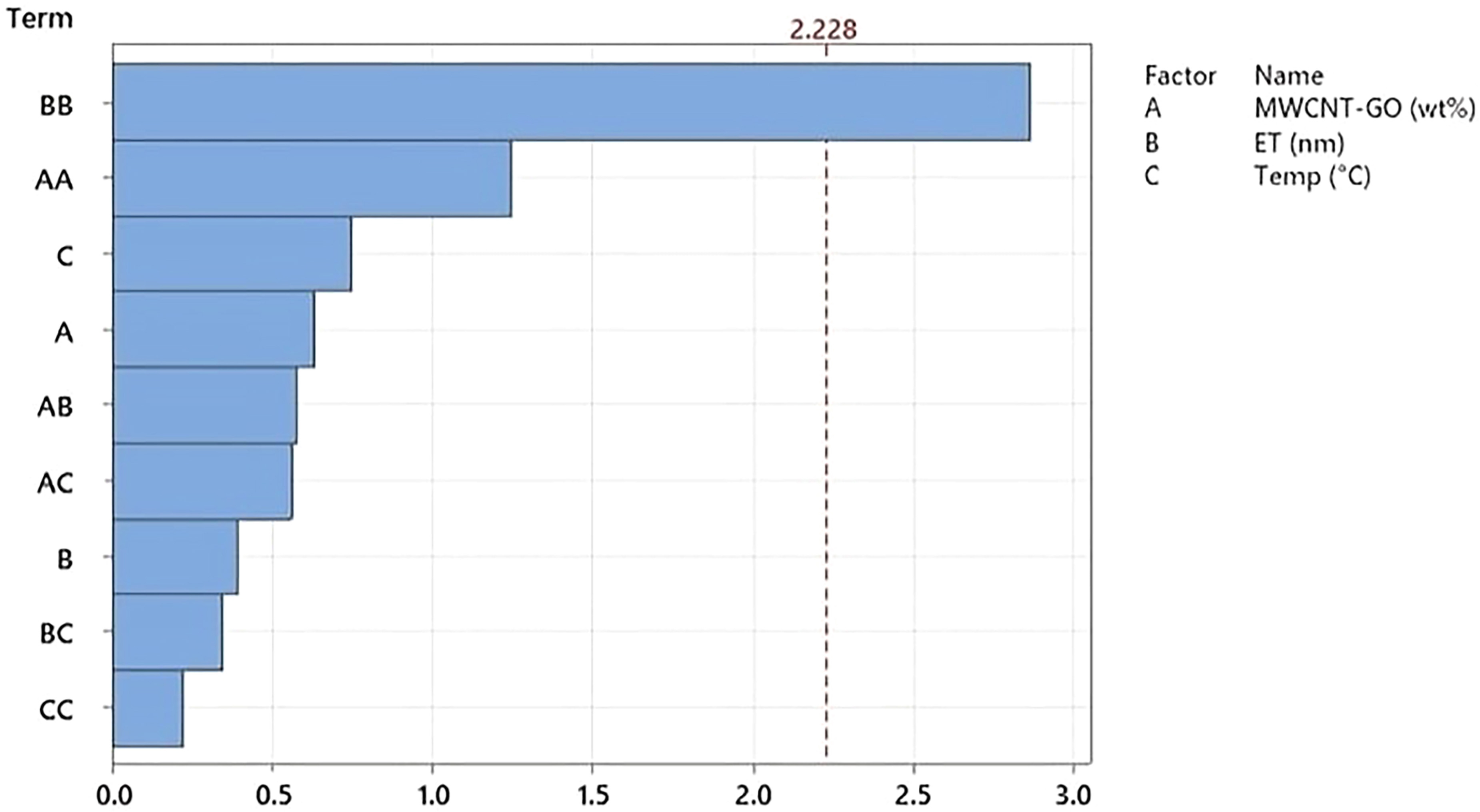
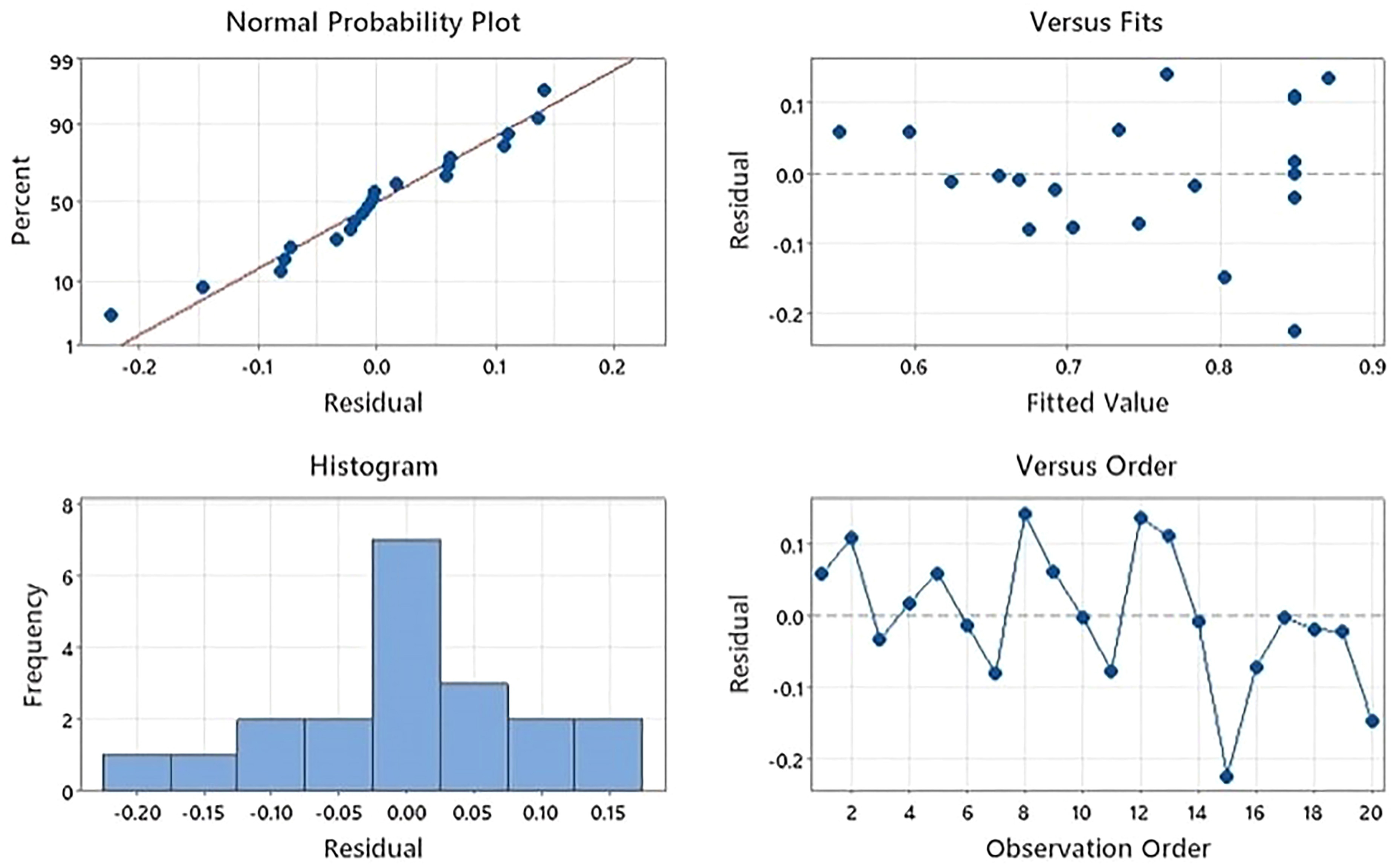
This research used RSM to estimate the quadratic, linear, and interaction outcome of predictor variables such as synthesis temperature, concentration of MWCNT-GO, and ET on thermal conductivity (dependent variable). For evaluating the models’ acceptability, different metrics were studied, encompassing the R2 coefficient, the adjusted R2, the F-value, and the lack of fit F-value. The outcome of experimental data taken from the independent and response variables is displayed in Table 2. The quadratic models depicted significance (P < 0.05) for thermal conductivity. The lack of fit values for the quadratic models was non-significant (P > 0.05) for thermal conductivity. The Pareto chart of standardized effects for thermal conductivity (W∙m-1∙K-1) was presented in Figure 1, showing major components and their interactions in NEPCM optimization utilizing MWCNT-GO, temperature, and ET. Figure 2 shows the residual plots for thermal conductivity (W∙m-1∙K-1) in the RSM model of NEPCM optimization using MWCNT-GO nanofillers. The residual plots contain a normal probability plot illustrating a residual vs. fitted values plot, indicating that there is no visible non-linearity, a near-normal residual distribution, a plot of observations versus residuals that captures randomized error, and a histogram showing a symmetric distribution.
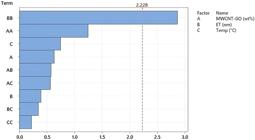
Pareto chart of consistent effects for thermal conductivity (W∙m-1∙K-1) showing significant factors and interactions in NEPCM optimization using MWCNT–GO, shell thickness, and polymerization temperature.
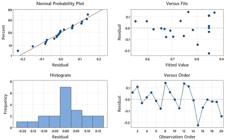
Residual plots for thermal conductivity (W∙m-1∙K-1) in the RSM model of NEPCM optimization using MWCNT–GO hybrid fillers.
The adjusted R2 and R2 determine the model’s fit quality to the empirical data and the applicability of models. Increased R2 values (R2 > 0.80) specify a significant fraction of the variation assessed based on the models and display a better relation between the observed and computed outcomes in the test area [22]. The insignificant contrast connecting R2 and adjusted R2 values specified that the majority of parameters were pertinent, and the chosen polynomial model displayed acceptable accuracy [23]. The regression equation below illustrates the influence of MWCNT-GO concentration, synthesis temperature, and ET on thermal conductivity:
3.2. Interaction effects of concentration of MWCNT-GO, synthesis temperature, and ET on thermal conductivity
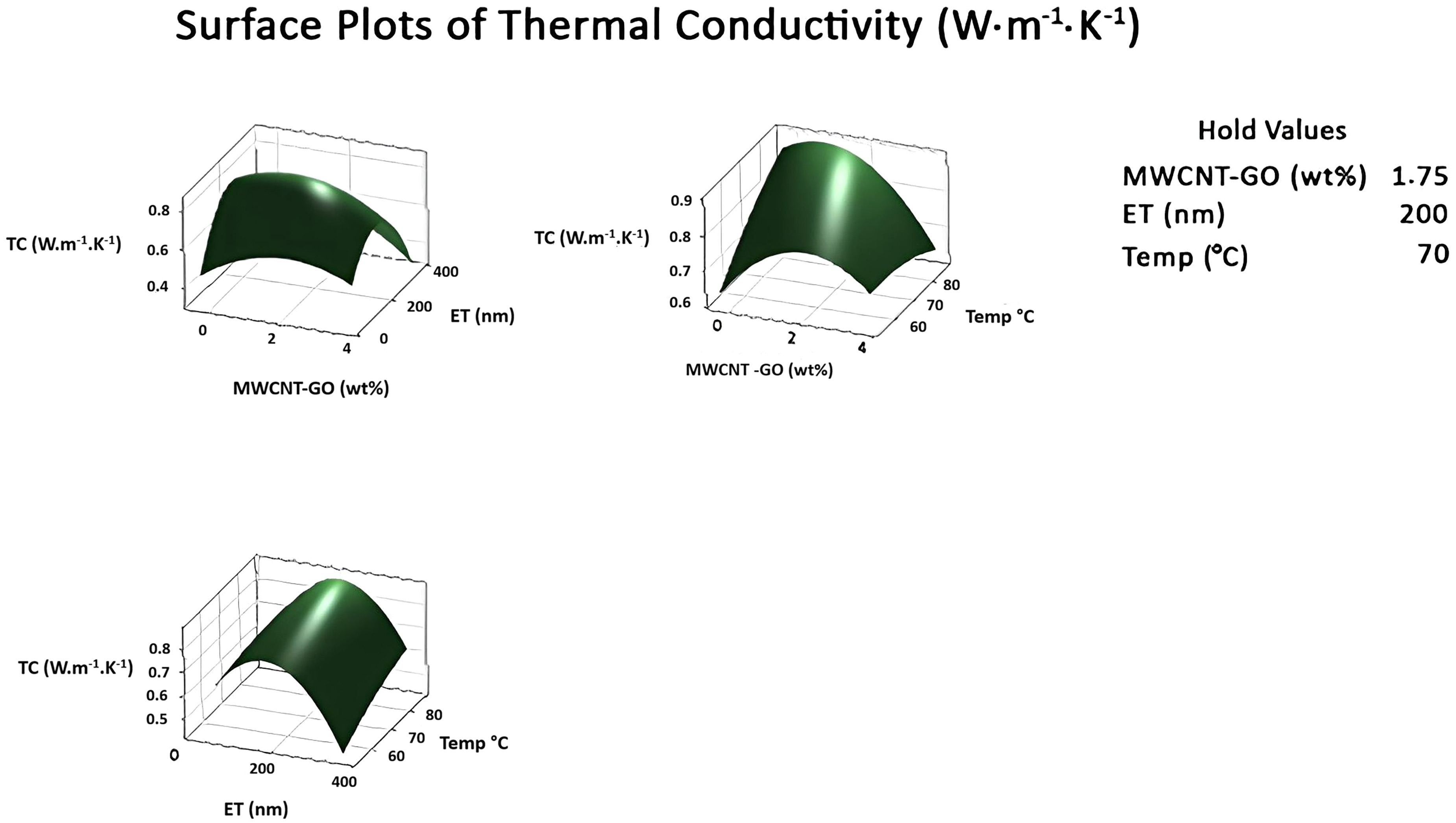
The 3D response surfaces (Figure 3) were used to demonstrate the synergistic effects of the independent factors (concentration of MWCNT-GO, synthesis temperature, and ET) on thermal conductivity. Interaction plots illustrated that increased concentration of MWCNT-GO enhanced thermal conductivity. An increase in ET increased heat retention yet decreased the rate of thermal response. Enhanced heating rates did not significantly affect the thermal conductivity. MWCNT showed extraordinarily high inherent thermal conductivity, getting around 3000 W∙m-1∙K-1 [24]. GO, yet not as effective as pure graphene, shows significant thermal conductivity (~ 500 W∙m-1∙K-1) [25]. When combined with the PCM matrix, they serve as thermal bridges, optimizing heat transfer mechanisms. At higher concentrations, the MWCNT-GO hybrids infiltrate the PCM matrix. This causes the development of a three-dimensional integrated network, enhancing heat transfer all over the NEPCM. When adequate loading is reached, the percolation threshold is crucial for greatly improving the thermal conductivity [26]. The successful dissemination of MWCNT-GO, especially when encapsulated, reduces thermal barriers between the nanofillers and PCM. Due to its oxygen-comprising groups, GO increases compatibility and maximizes the MWCNTs’ dispersion and their adherence to the encapsulating matrix. The combination of MWCNT and GO causes synergistic effects, where MWCNT offers a 1-D high-aspect-ratio pathway. GO sheets provide a 2-D planar heat transfer. Together they fill gaps and enhance phonon conduction, decreasing thermal resistance [27].
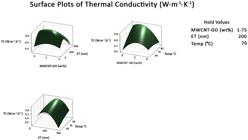
Profile of response surface as interaction effects of MWCNT-GO concentration, encapsulation thickness, and synthesis temperature on thermal conductivity.
3.3. Statistical modeling and optimization using RSM
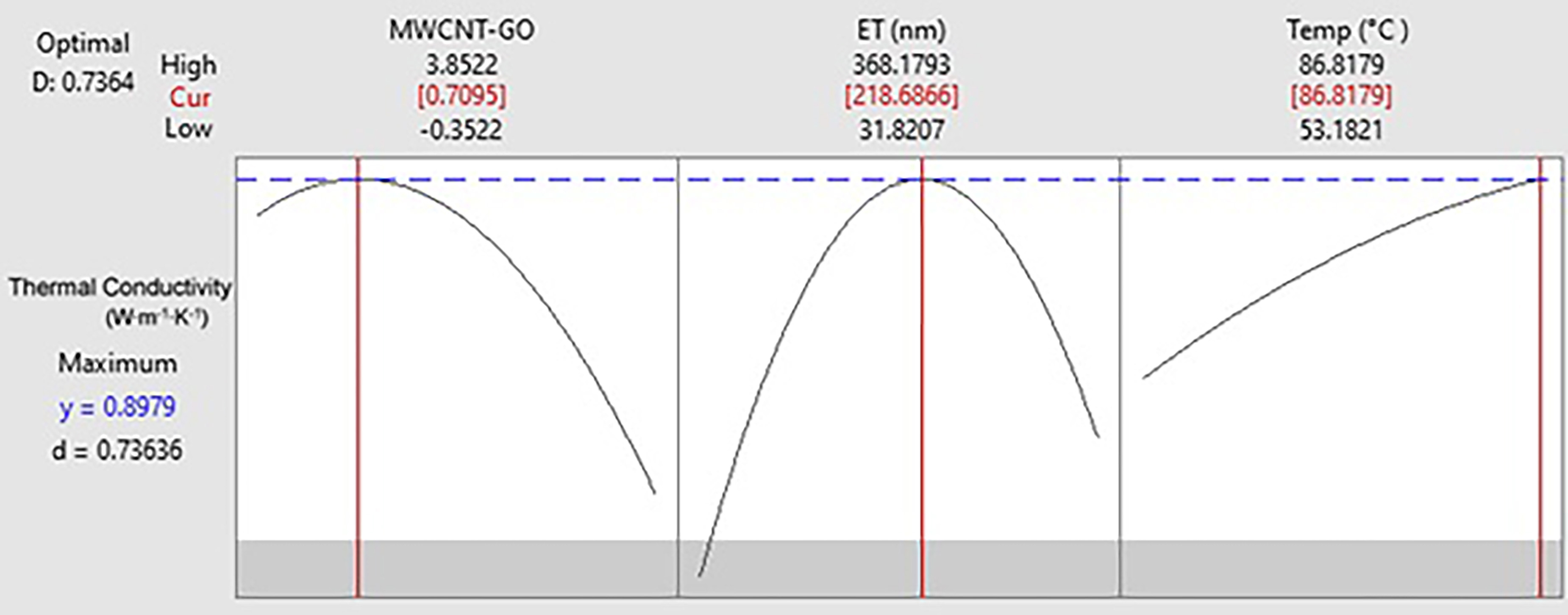
Using CCD-RSM, a subsequent polynomial model was developed to examine the effects of 3 independent variables: ET, synthesis temperature, and MWCNT-GO concentration on thermal conductivity. In Figure 4, the optimization plot for increasing the thermal conductivity (W∙m-1∙K-1) of NEPCM based on stearic acid-GO-MWCNT using RSM is shown. It demonstrates the optimal concentrations of ET (368.18 nm), synthesis temperature (86.82°C) and MWCNT-GO (3.85 wt%) leading to a maximum desirability index and thermal conductivity of 0.7364 and 0.8979 W∙m-1∙K-1, respectively.
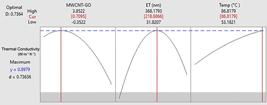
Optimization plot for maximizing thermal conductivity (W∙m-1∙K-1) of stearic acid–MWCNT–GO-based NEPCM using response surface methodology.
The increased thermal conductivity in PCMs led to higher charging and discharging rates, which are crucial for thermal management in eco-friendly building components such as insulation panels, wall-integrated storage layers, and plasterboards. The enhanced NEPCMs indicate the potential for reducing HVAC loads, enhancing stabilizing indoor temperature changes, and boosting the efficiency of passive solar gain, hence contributing to the standards of sustainable building performance [28, 29].
3.4. Enhancement of thermal conductivity
The thermal conductivity of the optimized nanoencapsulated stearic acid PCMs was experimentally assessed to validate the simulated outcomes obtained using the RSM. The accuracy and reliability of the developed RSM model are evidenced by the strong correlation between the predicted and experimental outcomes. The model’s capacity to precisely predict thermal conductivity across different MWCNT-GO hybrid concentrations and processing conditions was validated by the maximum variation. The predicted thermal conductivity was 0.89 W∙m-1∙K-1, and it was experimentally proven with a difference of lower than 3%. The thermal conductivity of the NEPCM is greatly influenced by the hybrid nanofiller content. Increasing the MWCNT-GO concentration from 0.5% to 3.85% (wt%) caused a notable improvement in thermal conductivity, attaining the highest point of 0.89 W∙m-1∙K-1, which is about 2.9 times greater than pure stearic acid (0.31 W∙m-1∙K-1). This improvement is because of the formation of a thermally conductive system inside the PCM matrix, facilitated through the high aspect ratio and intrinsic conductivity of MWCNTs, in conjunction with the interfacial interaction offered by GO [30, 31]. The formation of a thermally conductive system inside the PCM matrix, where GO and MWCNT nanohybrid constructs constant heat transfer pathways, is responsible for maximum thermal conductivity. Additionally, the nanoencapsulation matrix ensures the nanofillers’ uniform dispersion and durability. The nanofillers’ interaction effect reduces the phonon scattering and enhances energy transmission. The obtained enhancement in the performance of heat transfer can be well understood by this process, where the novel optimized NEPCM is qualified for efficient thermal energy storage applications.
4. DISCUSSION
The thermal conductivity enhancement in PCMs is important for increasing the effectiveness of thermal energy storage systems. In this research, stearic acid was integrated with hybrid nanofillers comprising MWCNTs and GO and optimized using RSM. The results revealed that the MWCNT-GO hybrid nanostructures improve the thermal efficiency of the stearic acid. The utilization of MWCNT-GO hybrids caused a significant enhancement of thermal conductivity because of their interaction effects. MWCNTs, using their linear tubular structure, provide exceptional thermal pathways, while GO, having a 2D structure and increased surface area, provides efficient dispersion stability and phonon transport [32, 33]. The combination of both nanomaterials generates a consistent heat exchange network that minimizes the thermal boundary resistance within the nanocomposite matrix [34]. This hybridization prevents a common problem in single-filler systems, i.e., agglomeration, and aids improved dispersion owing to GO’s oxygenic functional groups that increase compatibility among the encapsulating shell [35].
The implementation of RSM ensured the optimization and modeling of the crucial parameters, such as the MWCNT:GO ratio, shell content, and concentration of the nanofiller, which directly influenced the nanocomposite’s thermal conductivity. Additionally, the regression model indicated a highly accurate prediction (R2 = 0.80) and a significant p-value (p < 0.05), which verifies the reliability of the optimization model. Further, the process of optimization enhances the thermal conductivity up to 2.9 times in comparison to pure stearic acid, consistent with the findings from related studies of hybrid nanofiller [36, 37]. In comparison to PCMs with individual fillers (MWCNT or GO), an improved performance is shown by hybrid nanofillers, like lowering the risk of increasing viscosity, latent heat loss, or lower filler loadings, which are a common disadvantage in highly loaded systems [38]. Furthermore, this work provides an ideal route for enhancement of thermal conductivity while maintaining capacity for energy storage, advancing the expanding field of hybrid enhanced PCMs.
The optimized NEPCM exhibited great possibility for usage in passive cooling systems, solar thermal collectors, green building applications, and electronic thermal management. The amalgamation of enhanced thermal reliability, increased thermal conductivity, and maintained latent heat makes it appropriate for thermal energy management on both industrial and domestic scales.
5. CONCLUSION
This research focused on the development and enhancement of novel NEPCM using stearic acid integrated with GO and MWCNTs to improve the thermal conductivity for its application in green building energy systems. Through a mini-emulsion polymerization method, the NEPCMs were made, easing stable dispersion and homogenous encapsulation of the nanofillers inside a polymeric shell. RSM using CCD was used for examining the impact of formulation factors-synthesis temperature and concentration of MWCNT-GO and ET- on the NEPCM’s thermal conductivity. The statistical model is significant (p < 0.05), specifying the accuracy of the predictive model. Upon optimization, the formulation of NEPCM reached a 2.9 times thermal conductivity enhancement in contrast to pure stearic acid, at the same time conserving heat stability and feasible phase change attributes. These results conclude that a hybrid NEPCM based on carbon nanomaterial is an advanced TES system for sustainable buildings. By increasing the energy efficiency and thermal conductivity of building materials, these improvised NEPCMs ease temperature stabilization, decrease HVAC loads, and reduce carbon footprints. Further research will focus on characterizing of the optimized NEPCM for validating the chemical integrity and thermal stability, incorporating the developed NEPCMs within building materials like drywall, plaster, and concrete and examining their long-lasting performance in existing building habitats.
Additionally, the aim of the research was to maximize the thermal conductivity of stearic acid PCMs by employing the hybrid nanofillers MWCNT-GO. However, the crucial parameter —latent heat retention —was not measured for analyzing the energy storage performance. To assess the latent heat, detect cycle stability, and establish equilibrium between enhanced thermal conductivity and adequate energy storage capability for large-scale applications, a Differential Scanning Calorimetry study should be carried out.
Furthermore, this research work is restricted to lab-scale fabrication and characterization. The long-term stability and chemical integrity of the NEPCM during real working conditions have not been evaluated. Subsequently, the research will be concentrated on scaling up the NEPCM production process, evaluating its efficiency in model storage structures, and analyzing the cost-effective methods for large-scale deployment. The industrial value is maximized by additional studies on nanocomposite fillers and biologically based NEPCMs.
In summary, the results of the research highlight the productive contribution of MWCNT-GO nanofillers in enhancing the thermal conductivity of stearic acid through the RSM-CCD optimization process, thereby, promising a high-efficiency future-oriented PCM for energy storage.
6. BIBLIOGRAPHY
- [1] KAYGUSUZ, K., TOKLU, E., “Green buildings for decarbonization and air conditioning”, Journal of Engineering Research and Applied Science, v. 12, n. 2, pp. 2337–2347, Dec. 2023.
- [2] VALENTINI, F., FREDI, G., DORIGATO, A., “Thermal Energy Storage (TES) for Sustainable Buildings: Addressing the Current Energetic Situation in the EU with TES-Enhanced Buildings”, In: Nazari-Heris, M. (eds), Natural energy, lighting, and ventilation in sustainable buildings, Cham, Springer Nature Switzerland, pp. 191–224, 2023.
-
[3] CARAMITU, A.R., LUNGU, M.V., “An overview of Thermal Energy Storage (TES) materials and systems for storage applications”, Electrotehnica, Electronica, Automatica, v. 72, n. 4, pp. 28–42, Dec. 2024. doi: https://doi.org/10.46904/eea.24.72.4.1108003.
» https://doi.org/10.46904/eea.24.72.4.1108003 -
[4] JIAO, K., LU, L., ZHAO, L., et al., “Towards passive building thermal regulation: a state-of-the-art review on recent progress of PCM-Integrated building envelopes”, Sustainability, v. 16, n. 15, pp. 6482, Jul. 2024. doi: https://doi.org/10.3390/su16156482.
» https://doi.org/10.3390/su16156482 - [5] EZE, V.H.U., TAMBALL, J.S., ROBERT, O., et al., “Advanced modelling approaches for latent heat thermal energy storage systems”, Journal of Applied Sciences, v. 11, n. 1, pp. 49–56, 2024.
-
[6] TAN, Q., LIU, H., SHI, Y., et al., “Lauric acid/stearic acid/nano-particles composite phase change materials for energy storage in buildings”, Journal of Energy Storage, v. 76, pp. 109664, Jan. 2024. doi: https://doi.org/10.1016/j.est.2023.109664.
» https://doi.org/10.1016/j.est.2023.109664 -
[7] KUMAR, R., SAMYKANO, M., PANDEY, A.K., et al., “A comparative study on thermophysical properties of functionalized and non-functionalized Multi-Walled Carbon Nano Tubes (MWCNTs) enhanced salt hydrate phase change material”, Solar Energy Materials and Solar Cells, v. 240, pp. 111697, Jun. 2022. doi: https://doi.org/10.1016/j.solmat.2022.111697.
» https://doi.org/10.1016/j.solmat.2022.111697 -
[8] SINGH, P., SHARMA, R.K., KHALID, M., et al., “Evaluation of carbon based-supporting materials for developing form-stable organic phase change materials for thermal energy storage: a review”, Solar Energy Materials and Solar Cells, v. 246, pp. 111896, Oct. 2022. doi: https://doi.org/10.1016/j.solmat.2022.111896.
» https://doi.org/10.1016/j.solmat.2022.111896 -
[9] BARRENECHE, C., MONDRAGON, R., VENTURA-ESPINOSA, D., et al., “Influence of nanoparticle morphology and its dispersion ability regarding thermal properties of water used as phase change material”, Applied Thermal Engineering, v. 128, pp. 121–126, Jan. 2018. doi: https://doi.org/10.1016/j.applthermaleng.2017.09.014.
» https://doi.org/10.1016/j.applthermaleng.2017.09.014 -
[10] ABDULLAH, M., OBAYEDULLAH, M., MUSFIKA, S.A., “Recent advances in phase change energy storage materials: developments and applications”, International Journal of Energy Research, v. 2025, n. 1, pp. 6668430, Jan. 2025. doi: https://doi.org/10.1155/er/6668430.
» https://doi.org/10.1155/er/6668430 -
[11] AHANGARAN, F., NAVARCHIAN, A.H., PICCHIONI, F., “Material encapsulation in poly (methyl methacrylate) shell: A review”, Journal of Applied Polymer Science, v. 136, n. 41, pp. 48039, Nov. 2019. doi: https://doi.org/10.1002/app.48039.
» https://doi.org/10.1002/app.48039 -
[12] PHUKAOKAEW, W., SUKSRI, A., WONGWUTTANASATIAN, T., “The modification of thermal conductivity of phase change material using nano metal-oxide particles”, Materials Science Forum, v. 1113, pp. 69–74, Feb. 2024. doi: https://doi.org/10.4028/p-W84KYz.
» https://doi.org/10.4028/p-W84KYz -
[13] PAUL, J., SAMYKANO, M., PANDEY, A.K., et al., “Nano engineered paraffin-based phase change material for building thermal management”, Buildings, v. 13, n. 4, pp. 900, Apr. 2023. doi: https://doi.org/10.3390/buildings13040900.
» https://doi.org/10.3390/buildings13040900 -
[14] VUSTELAMURI, P., HAJARE, R.S., “Thermophysical and chemical properties of nano-additives in phase change materials for enhanced heat transfer”, In: Bodukuri, A.K., Prasad, S.V.G.V.A., Gupta, R.K. (eds), Solar thermal technologies and nano-enhanced phase change materials for high-efficiency electric and solar mobility, Coimbatore, India, Rademics Research Institute, pp. 63–87, Jun. 2025. doi: https://doi.org/10.71443/9789349552654-03.
» https://doi.org/10.71443/9789349552654-03 -
[15] KUMAR, R.R., SAMYKANO, M., PANDEY, A.K., et al., “Phase change materials and nano-enhanced phase change materials for thermal energy storage in photovoltaic thermal systems: A futuristic approach and its technical challenges”, Renewable & Sustainable Energy Reviews, v. 133, pp. 110341, Nov. 2020. doi: https://doi.org/10.1016/j.rser.2020.110341.
» https://doi.org/10.1016/j.rser.2020.110341 - [16] KALIDASAN, B., PANDEY, A.K., RAJAMONY, R.K., et al., “Numerical investigation on thermal conductivity of metal nanoparticle dispersed composite phase change materials”, Malaysian Journal of Chemistry, v. 26, n. 3, pp. 72–81, Jun. 2024.
-
[17] KUMAR, R., SAMYKANO, M., NGUI, W.K., et al., “Investigation of thermal performance and chemical stability of graphene enhanced phase change material for thermal energy storage”, Physics and Chemistry of the Earth Parts A/B/C, v. 128, pp. 103250, Dec. 2022. doi: https://doi.org/10.1016/j.pce.2022.103250.
» https://doi.org/10.1016/j.pce.2022.103250 -
[18] RAJAMONY, R.K., SAMYKANO, M., PANDEY, A.K., et al., “Investigation on thermophysical properties of multi-walled carbon nanotubes enhanced salt hydrate phase change material”, International Journal of Automotive & Mechanical Engineering, v. 20, n. 3, pp. 10595, Sep. 2023. doi: https://doi.org/10.15282/ijame.20.3.2023.03.0817.
» https://doi.org/10.15282/ijame.20.3.2023.03.0817 -
[19] RAJAMONY, R.K., PAW, J.K.S., PASUPULETI, J., et al., “Experimental investigation on the performance of binary carbon-based nano-enhanced inorganic phase change materials for thermal energy storage applications”, Journal of Energy Storage, v. 86, pp. 111373, May. 2024. doi: https://doi.org/10.1016/j.est.2024.111373.
» https://doi.org/10.1016/j.est.2024.111373 -
[20] KOONDHAR, M.A., LAGHARI, I.A., ASFAW, B.M., et al., “Experimental and simulation-based comparative analysis of different parameters of PV module”, Scientific African, v. 16, pp. e01197, Jul. 2022. doi: https://doi.org/10.1016/j.sciaf.2022.e01197.
» https://doi.org/10.1016/j.sciaf.2022.e01197 - [21] REJI, M., KUMAR, R., “Response surface methodology (RSM): an overview to analyse multivariate data”, Indian Journal of Microbiology Research, v. 9, n. 4, pp. 241–248, Jan. 2022.
-
[22] BAGHERI, V., GHANBARZADEH, B., AYASEH, A., et al., “The optimization of physico-mechanical properties of bio nanocomposite films based on gluten/carboxymethyl cellulose/cellulose nanofiber using response surface methodology”, Polymer Testing, v. 78, pp. 105989, Sep. 2019. doi: https://doi.org/10.1016/j.polymertesting.2019.105989.
» https://doi.org/10.1016/j.polymertesting.2019.105989 -
[23] RODRIGO, R., TORO, C.A., CUELLAR, J., “Influence of the geometric factors of the experimental device used in suspension polymerization on the properties of poly (styrene‐co‐divinylbenzene) microparticles”, Journal of Applied Polymer Science, v. 124, n. 2, pp. 1431–1446, Apr. 2012. doi: https://doi.org/10.1002/app.35129.
» https://doi.org/10.1002/app.35129 -
[24] NADA, S.A., ALSHAER, W.G., “Experimental investigation of thermal conductivity enhancement of carbon foam saturated with PCM and PCM/MWCNTs composite for energy storage systems”, Heat and Mass Transfer, v. 55, n. 9, pp. 2667–2677, Sep. 2019. doi: https://doi.org/10.1007/s00231-019-02610-4.
» https://doi.org/10.1007/s00231-019-02610-4 -
[25] SHARMA, A., AFTAB, W., LI, Y., et al., “Enhanced heat transfer behaviour of a water-based graphene oxide PCM composite for cold energy storage systems”, Journal of Energy Storage, v. 124, pp. 116880, Jul. 2025. doi: https://doi.org/10.1016/j.est.2025.116880.
» https://doi.org/10.1016/j.est.2025.116880 -
[26] SHAHID, U., AHZI, S., ABDALA, A., “Effect of carbon-based hybrid Nano-fillers on the thermal conductivity of PCM composites”, IOP Conference Series. Materials Science and Engineering, v. 380, pp. 012008, Jun. 2018. doi: https://doi.org/10.1088/1757-899X/380/1/012008.
» https://doi.org/10.1088/1757-899X/380/1/012008 -
[27] LIU, Z.P., YANG, R., “Synergistically-enhanced thermal conductivity of shape-stabilized phase change materials by expanded graphite and carbon nanotube”, Applied Sciences, v. 7, n. 6, pp. 574–585, Jun. 2018. doi: https://doi.org/10.3390/app7060574.
» https://doi.org/10.3390/app7060574 -
[28] TYAGI, V.V., KAUSHIK, S.C., TYAGI, S.K., et al., “Development of phase change materials based microencapsulated technology for buildings: a review”, Renewable & Sustainable Energy Reviews, v. 15, n. 2, pp. 1373–1391, Feb. 2011. doi: https://doi.org/10.1016/j.rser.2010.10.006.
» https://doi.org/10.1016/j.rser.2010.10.006 -
[29] KUZNIK, F., DAVID, D., JOHANNES, K., et al., “A review on phase change materials integrated in building walls”, Renewable & Sustainable Energy Reviews, v. 15, n. 1, pp. 379–391, Jan. 2011. doi: https://doi.org/10.1016/j.rser.2010.08.019.
» https://doi.org/10.1016/j.rser.2010.08.019 -
[30] QURESHI, Z.A., ALI, H.M., KHUSHNOOD, S., “Recent advances on thermal conductivity enhancement of phase change materials for energy storage system: a review”, International Journal of Heat and Mass Transfer, v. 127, pp. 838–856, Dec. 2018. doi: https://doi.org/10.1016/j.ijheatmasstransfer.2018.08.049.
» https://doi.org/10.1016/j.ijheatmasstransfer.2018.08.049 -
[31] SABAGH, S., BAHRAMIAN, A.R., MADADI, M.H., “Improvement in phase-change hybrid nanocomposites material based on polyethylene glycol/epoxy/graphene for thermal protection systems”, Iranian Polymer Journal, v. 29, n. 2, pp. 161–169, Feb. 2020. doi: https://doi.org/10.1007/s13726-020-00783-y.
» https://doi.org/10.1007/s13726-020-00783-y -
[32] SHARMA, A., TYAGI, V.V., CHEN, C.R., et al., “Review on thermal energy storage with phase change materials and applications”, Renewable & Sustainable Energy Reviews, v. 12, n. 2, pp. 318–345, Feb. 2009. doi: https://doi.org/10.1016/j.rser.2007.10.005.
» https://doi.org/10.1016/j.rser.2007.10.005 -
[33] AL-AHMED, A., SARI, A., MAZUMDER, M.A., et al., “Thermal energy storage and thermal conductivity properties of fatty acid/fatty acid-grafted-CNTs and fatty acid/CNTs as novel composite phase change materials”, Scientific Reports, v. 10, n. 1, pp. 15388, Sep. 2020. doi: https://doi.org/10.1038/s41598-020-71891-1. PubMed PMID: 32958838.
» https://doi.org/10.1038/s41598-020-71891-1 -
[34] LIU, Z., CHEN, Z., YU, F., “Enhanced thermal conductivity of microencapsulated phase change materials based on graphene oxide and carbon nanotube hybrid filler”, Solar Energy Materials and Solar Cells, v. 192, pp. 72–80, Apr. 2019. doi: https://doi.org/10.1016/j.solmat.2018.12.014.
» https://doi.org/10.1016/j.solmat.2018.12.014 -
[35] ZEINEDINI, A., SHOKRIEH, M.M., “Agglomeration phenomenon in graphene/polymer nanocomposites: Reasons, roles, and remedies”, Applied Physics Reviews, v. 11, n. 4, pp. 041301, Dec. 2024. doi: https://doi.org/10.1063/5.0223785.
» https://doi.org/10.1063/5.0223785 -
[36] ZENDEHBOUDI, A., ASLFATTAHI, N., RAHMAN, S., et al., “Optimization of thermal conductivity of NanoPCM-based graphene by response surface methodology”, Journal of Advanced Research in Fluid Mechanics and Thermal Sciences, v. 75, n. 3, pp. 108–125, Sep. 2020. doi: https://doi.org/10.37934/arfmts.75.3.108125.
» https://doi.org/10.37934/arfmts.75.3.108125 -
[37] CHANANIPOOR, A., AZIZI, Z., RAEI, B., et al., “Optimization of the thermal performance of nano-encapsulated phase change material slurry in double pipe heat exchanger: design of experiments using response surface methodology (RSM)”, Journal of Building Engineering, v. 34, pp. 101929, Feb. 2021. doi: https://doi.org/10.1016/j.jobe.2020.101929.
» https://doi.org/10.1016/j.jobe.2020.101929 -
[38] ABDELRAZIK, A.S., SAIDUR, R., AL-SULAIMAN, F.A., et al., “Multiwalled CNT and graphene nanoplatelets based nano-enhanced PCMs: evaluation for the thermal performance and its implications on the performance of hybrid PV/thermal systems”, Materials Today. Communications, v. 31, pp. 103618, Jun. 2022. doi: https://doi.org/10.1016/j.mtcomm.2022.103618.
» https://doi.org/10.1016/j.mtcomm.2022.103618