 Fatigue life prediction of asphalt mixtures in the Brazilian indirect tension tests from the linear amplitude sweep binder data
ABSTRACT
This study compared the fatigue performance of one unmodified and two Brazilian commercial modified binders – SBS copolymer (AC+SBS) and recycled tire rubber (AC+rubber) – with their corresponding dense-graded asphalt mixtures. Linear Amplitude Sweep (LAS) tests at 19°C were conducted in the binders, while Indirect Tension (IDT) tests at 25°C were performed in the mixtures. The fatigue lives of binders (Nf) and mixtures (N) were determined in the LAS and IDT tests, and power correlations were fitted to the data. The AC+rubber showed the highest fatigue lives in both asphalt and mixture scales, and at least good correlations (R2 > 0.83) between N and Nf were found. With respect to the parameter A35 from LAS, it showed reasonable to excellent correlations (R2 values from around 0.70 to 0.96) with the fatigue lives of mixtures. Overall, these findings give support to the use of LAS as an indicator of the fatigue resistance in the laboratory. In addition, the promising outcomes of IDT contribute to its use in the Brazilian mechanistic-empirical pavement design method (MEDINA). Further investigations with field test sections and other modification types of the binder may give new insights and allow comparisons between field and laboratory data.
Keywords:
SBS copolymer; Crumb rubber; Linear amplitude sweep; Fatigue life; Indirect tension test
1. INTRODUCTION
Fatigue cracking has been affecting Brazilian flexible pavements for many years. Nevertheless, the pavement design method standardized by the Brazilian Federal Government [1] is deterministic and very simple. Such a method typically requires only one numerical value per input parameter, and fatigue cracking is not considered as a failure distress mechanism. More specifically, the pavement layers are designed such that the subgrade does not fail by shear stresses [2]. As a consequence, a report published by the National Confederation of Transport [3] showed that sometimes the pavement fails only seven months after construction, even though its expected service life ranges from 8 to 12 years. This may be explained not only by inadequate design methods, but also overloaded vehicle axes and lack of proper maintenance and rehabilitation throughout the service life.
Recently, a new mechanistic-empirical Brazilian pavement design method has been proposed under the acronym MEDINA [4]. Fatigue cracking and rutting are included in MEDINA, since they are the two most common distress mechanisms in Brazilian flexible pavements. Specifically in terms of fatigue, it is evaluated by a maximum percentage of the surface area of the pavement that can show fatigue cracks. This percentage is equal to 30%, regardless of the functional classification of the roadway [5]. Despite the application of MEDINA in earlier publications from Brazilian researchers, there are concerns regarding the use of recycled materials and absence of field calibration of its fatigue models [6, 7].
Mixture fatigue performance in MEDINA is analyzed from the Indirect Tension Test (IDT), a very common mixture fatigue test in Brazil [5]. Based on the outcomes of this test, it is possible to estimate fatigue life of a particular mixture according to parameters of the Wöhler’s prediction model. Examples of this application include VALE et al. [8] and CARVALHO et al. [9]. Even though concerns about IDT are reported in the literature [10], advantages include the possibility of testing field cores and the applicability of its results in the design of mixtures and pavements, at least in the initial stages [11].
When dealing with fatigue cracking in the asphalt binder scale, one may see that several parameters and laboratory tests have been proposed within the last 20–30 years. They include the Time Sweep (TS) test, the Superpave parameter given by multiplication of complex modulus G* by the sine of phase angle δ (G*sinδ) and the Linear Amplitude Sweep test – LAS [12,13,14]. Differently from a true fatigue test such as TS, the continuous and linear growth in the applied strains makes LAS a damage tolerance test [15]. Several recent publications highlighted promising correlations between the outcomes of LAS and those from mixture fatigue tests [16,17,18,19,20]. However, these correlations appear to be strongly dependent on the mixture test because other authors did not reach similar conclusions about the LAS data [21]. Moreover, the prediction of the cracked surface area in the field pavement may not be properly estimated from the outcomes of LAS [22]. In fact, estimating fatigue in the mixture scale from binder data is a tough issue and there is still no clear understanding about it. Hence, future investigations are required to further clarify this point, especially because no consensus about the most accurate method for identifying fatigue life in the binder and the mixture exists, even in the current days [14].
In this manner, the present study evaluated the role of LAS test in the prediction of fatigue performance of dense-graded mixtures in the laboratory. The choice for LAS is mainly justified by its promising findings, whereas IDT was selected due to its great applicability in Brazil and possibility of estimation of fatigue life under different applied stresses [23, 24]. The minor objectives are the following:
-
To seek for correlations between some parameters of LAS with IDT test results;
-
To compare fatigue lives of binders and mixtures in both LAS and IDT tests; and
-
To select the materials with higher resistances in the asphalt binder and mixture scales.
2. EXPERIMENTAL DESIGN AND ANALYSIS OF DATA
2.1. Sample preparation and classification
One unmodified asphalt binder/cement (AC) classified as 50/70 in the Brazilian specification and supplied by the REPAR Refinery (Araucaria, Parana, Brazil) was defined as the reference material. This material is graded as PG 58-xx on Superpave [25]. The two commercial formulations were prepared with the styrene-butadiene-styrene copolymer – SBS (AC+SBS) and recycled tire rubber (AC+rubber), which are the mostly used additives in Brazil. The AC+SBS is classified as 60/85-E according to a Brazilian specification for polymer-modified binders and based on elastic recovery at 25°C [26]. The AC+rubber is classified as AB 8, as prescribed by another Brazilian specification for rubber-modified materials and based on the rotational viscosity measured at 175°C and the speed of 20 rpm [27]. Table 1 shows the outputs of some initial characterization tests performed in these formulations and the reference material.
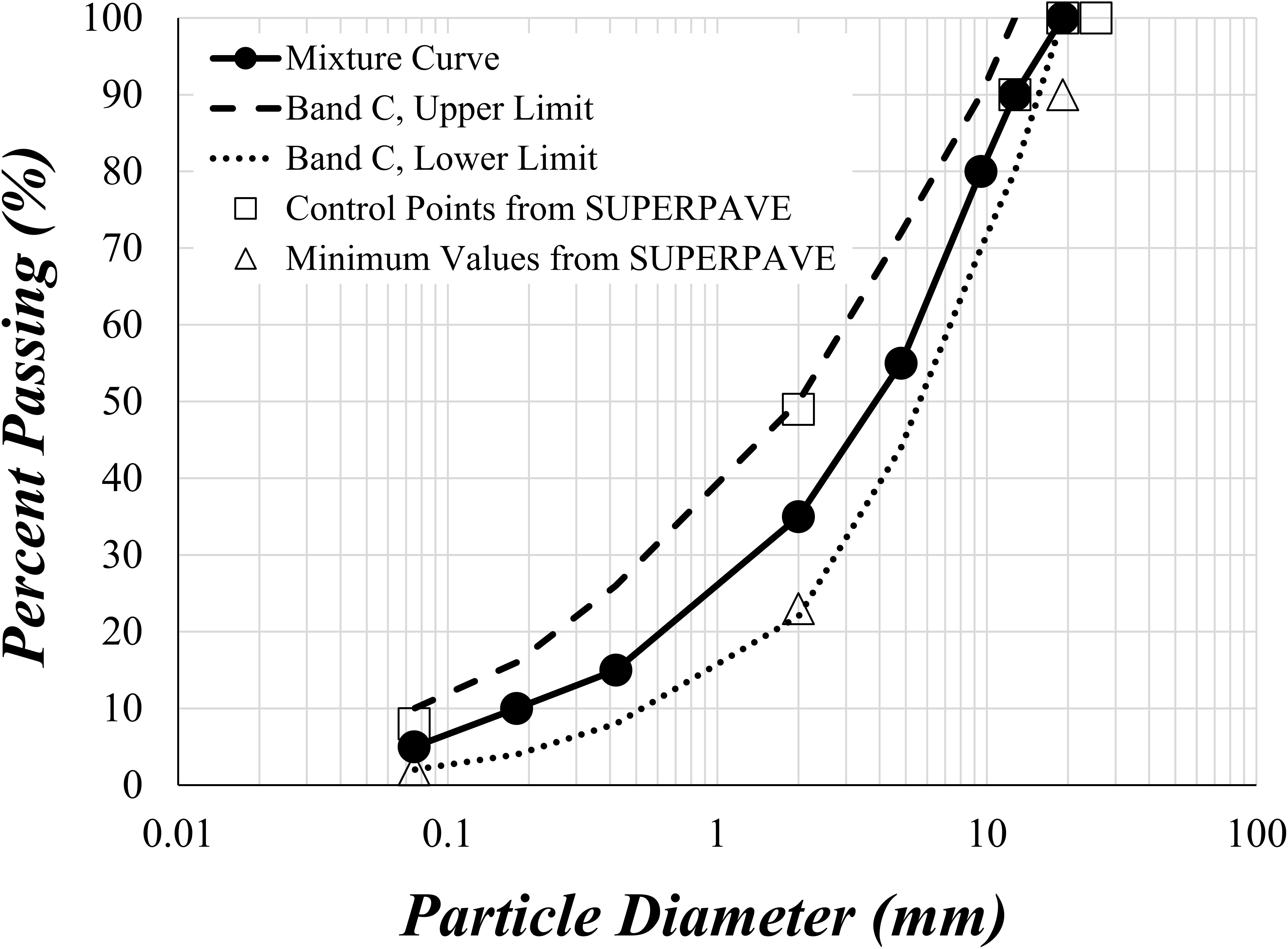
The dosages of the mixtures were made in the Armando Martins Pereira Pavement Laboratory (LAMP). Basaltic aggregate was provided by a quarry located in the Santa Catarina State (municipality of Maravilha), and its Los Angeles abrasion is equal to 16% [30]. The granulometric curve in Figure 1 complies with the requirements for dense-graded curves in the band “C” of the national standards [31]. The application of this curve has been a common practice, and it has also been used for paving applications throughout the country [23, 32, 33].
The designed binder contents ranged from 4 to 6% in all mixtures, which appears to be relatively common elsewhere [16, 34,35,36]. The desired air voids content was equal to 4%, and the samples were subjected to 100 gyrations in a Superpave Gyratory Compactor from Servopac®. Before compaction in the laboratory, all mixtures underwent a short-term preconditioning period of two hours in an oven at the compaction temperature to simulate aging. Other processing variables included a rotation angle of 1.25°, a rotation speed of 30 rpm, and a vertical stress of 600 kPa, as per the 178/2018-PRO standard [37]. Table 2 shows more technical details about these mixture samples.
2.2. Laboratory tests for mixtures
The Splitting Tensile Strength (STS) tests were performed in a device supplied by Solotest. The samples had height of 50 mm and diameter of 100 mm. Four replicates were prepared per binder type. As stated by 136/2018-ME [38], each sample was stored at 25°C in a chamber and for a minimum time of 4 h before testing. Then, a vertical compression load was applied in the middle of the sample and with a rate of increase equal to 0.8 ± 0.1 mm/s until failure. The failure load (F) was registered manually, and the vertical stress (σR) was calculated according to Equation 1, where F is given in Newton, σR is given in MPa and both diameter (D) and height of the mixture sample (H) are in mm.
The IDT tests were conducted in compliance with the 183/2018-ME national standard [39]. Replicates were molded per binder type, and they were previously maintained in a chamber at 25°C for at least seven days. Fixed percentages of σR – 20, 30, 35 and 40% – were considered in the experiments, as referenced on the protocol followed by COLPO et al. [40]. The loading frequency was equal to 1 Hz, and each pulse had 0.1 s of loading time and 0.9 s of unloading time. All tests were interrupted after one million (106) cycles or failure of the mixture sample, whichever came first. Linear Variable Differential Transducers (LVDTs) were used to determine the vertical displacements during the first 60 cycles. The data were fitted to a power-type equation as detailed in Equation 2:
where N is the fatigue life of the material (cycles), k1 and n1 are regression parameters, σt is the tensile stress in the middle of the sample (MPa), and N is given as number of cycles. The calculation of σt followed Equation 3 below:
where P is the applied load (in Newton), d is the diameter of the sample (mm), and t refers to its thickness (also in mm).
2.3. Laboratory tests for binders
Binder tests were performed in a SmartPave 102 dynamic shear rheometer supplied by Anton Paar. Oscillatory shear tests were carried out in two aging conditions – unaged and short-term aged [28] – and in compliance with the protocols from AASHTO [29]. As shown earlier in Table 1, the true grade of the AC+rubber is slightly higher than the one found in the AC+SBS (about 4°C higher), but their high PG grades are similar. The base material shows a true grade that almost reaches 64.0°C, but it is not sufficient to yield PG 64-xx in the unaged condition.
The LAS tests followed the steps outlined in AASHTO T 391 [41]. Short-term aged samples were placed between the 8 mm parallel plates of the dynamic shear rheometer, and the gap height was equal to 2 mm. Test temperature remained constant and equal to 19°C, similarly to what was made by other Brazilian researchers [34, 42, 43]. Initially, a frequency sweep test was conducted to determine the rheological parameters of the binder in the undamaged condition (parameter α). Then, 10 s cycles of constant strain increments were applied in the asphalt binder sample, and such increments ranged from 0.1% to 30%. In this last phase of the test, two fatigue model parameters (B and A35) were calculated and fatigue life of the material (Nf) was estimated. The relationship between Nf, A35, and B is given in Equation 4 [41]:
where γmax is the highest expected strain in the binder and for a predefined pavement structure, in percentage. The parameters B and α are correlated with each other by means of Equation 5:
Other parameters derived from the LAS test such as the curve-fit coefficients C1 and C2, the damage characteristic curve, the model constant k and the initial value of G* at 1% (ID) were determined in accordance with the standards [41]. Further details about the equations and corresponding explanations can be found elsewhere [44].
It should be noticed that, even though fatigue is traditionally evaluated in long-term aged samples [12,13,14,15, 20, 22], a group of authors has highlighted that the adverse effects of aging depend on some testing variables such as frequency and strain level. In general, these authors claimed that long-term aging may deteriorate fatigue resistance of the binder at high applied strains, mainly higher than 10% [14, 45,46,47]. Nevertheless, the AASHTO standard for LAS [41] gives the possibility of testing binders under short-term or long-term aging. To make the binder aging level compatible with the mixture aging level, short-term aging of the bituminous materials was chosen in the present research study.
2.4. Comparisons between binder and mixture results
Comparisons between the fatigue lives of the mixture and the binder – N and Nf, respectively – were drawn in the study. Power correlations were chosen here, in accordance with the investigation from BESSA et al. [16]. Earlier publications considered the four-point bending fatigue test and reported R2 values from 0.56 to 0.98 [20, 22, 40, 47, 48]. Differently from these publications, an attempt was made in the present investigation to seek for possible correlations between N (from IDT) and Nf (from LAS). A quite similar approach was followed for the parameter A35, in that a group of authors indicated the tendency of correlation between this parameter and fatigue life of the asphalt mixture [20, 49, 50].
It is anticipated that the application of loads equal to 20% of σR in the IDT tests typically did not lead the samples to failure after 106 cycles. Therefore, such a percentage was not chosen in the determination of possible correlations between mixture and binder data. The pairs of data sets listed below were defined by following an increasing order of magnitude of loads:
-
Strain level of 2.5% in LAS and 30% of σR in IDT;
-
Strain level of 5.0% in LAS and 35% of σR in IDT; and
-
Strain level of 15.0% in LAS and 40% of σR in IDT.
3. FINDINGS AND DISCUSSIONS
3.1. Linear amplitude sweep tests
The main outputs of LAS are given in Table 3. It follows that the Nf values at 2.5% range from about 37,000 cycles for the 50/70 unmodified binder until around 848,000 cycles for AC+rubber. When this strain is 5.0%, the fatigue lives oscillate from 987 cycles for the base material up to 19,000 cycles for AC+rubber. In terms of the highest strain value (15%), none of the studied binders can deal with more than 50 cycles. Moreover, AC+rubber holds the highest A35 value and AC+SBS holds the lowest B value. In other words, AC+rubber has the greatest ability to maintain its integrity with increasing cycles, whereas AC+SBS depicts the lowest decreases in fatigue life at higher strains [20].
Higher fatigue lives for modified binders when compared with the original material – and regardless of the applied strain – are somehow expected, as the literature reports similar trends for SBS-modified and rubber-modified materials [51, 52]. However, the mechanisms by which each modifier enhances fatigue resistance of binder are different. While SBS modification creates a three dimensional structure by cross-linking, the rubber particles perform as a skeleton in the binder phase after degradation by aging, thus preventing further fatigue cracking [51]. In general, AC+rubber depicts a higher fatigue resistance than AC+SBS and for all the applied strains. These most promising findings for rubber-modified binders were also published earlier by other researchers in the literature, refer to the investigation from YUE et al. [53] as a characteristic example.
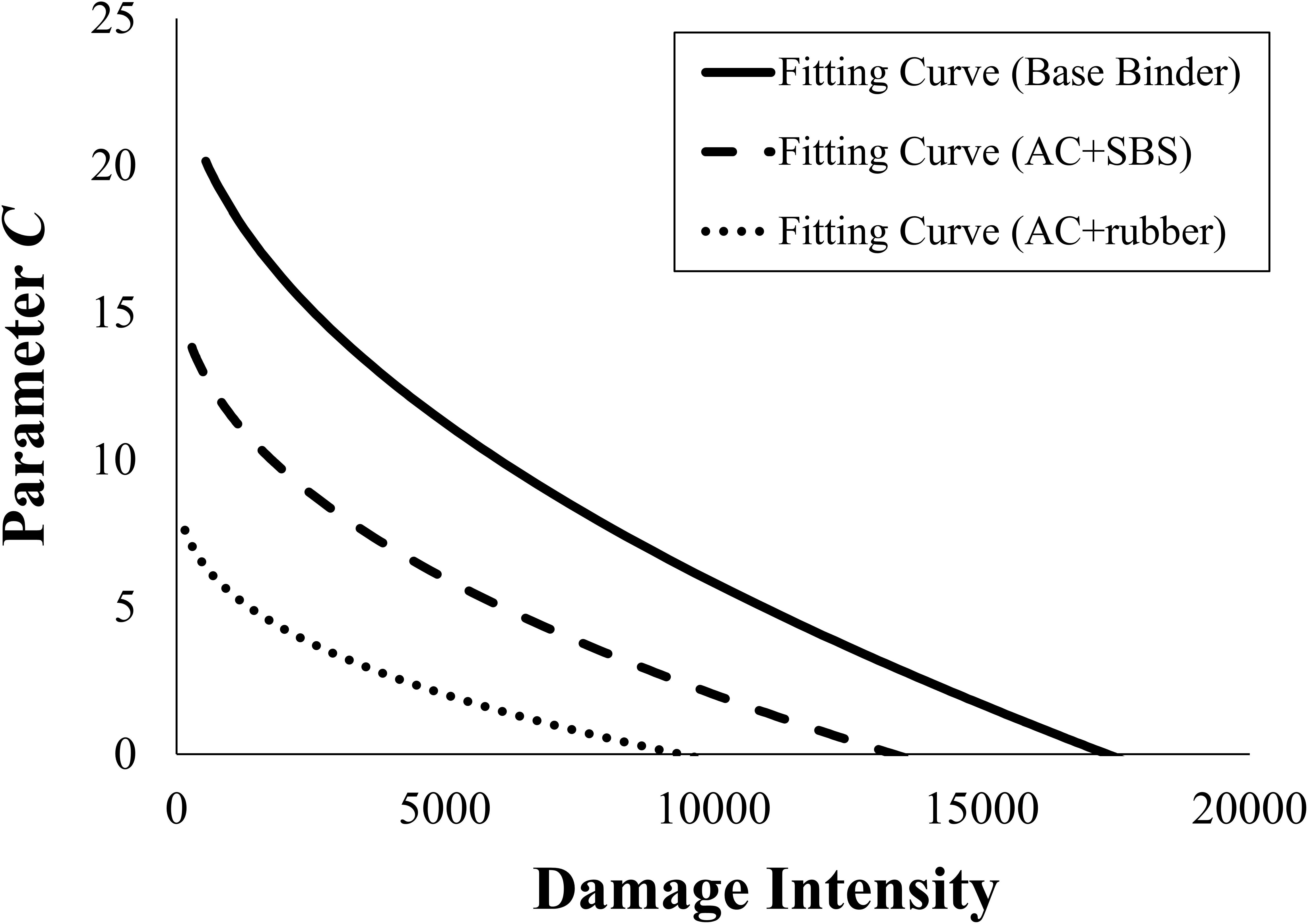
Figure 2 shows the fatigue curves of each binder, whereas their damage characteristic curves can be seen in Figure 3. The slope of the power regression trendline of AC+SBS is lower than the ones of AC+rubber and the original binder, and this is in accordance with the A35 and B values in Table 3. Moreover, the rate of decrease in C with increasing damage intensity is the lowest one for AC+rubber amongst all the studied materials, see Figure 3. This may be associated with the fact that the coefficient C2 is lower for AC+rubber than for AC+SBS and the base binder (Table 3). In terms of resistance, lower curve-fit coefficients C1 and C2 may indicate that a particular binder is less susceptible to failure by fatigue than another one with higher values, provided that the damage strength is similar for both materials [53].


3.2. Indirect tension and splitting tensile strength tests
Table 4 contains a summary of the main parameters of the two mixture tests, namely, STS and IDT. Even though the σR values are all higher than the minimum accepted value of around 0.7 MPa established by standards [27, 31, 54], they do not show an expected pattern of behavior. The reason for this observation is that the highest result (1.36 MPa) can be found in the 50/70 base binder, whereas the lowest one (1.06 MPa) belongs to the AC+rubber. This ranking of binders indicates an opposite tendency in comparison to the rankings based on the LAS test parameters – refer to Table 3. These same differences were reported by ISHAQ and GIUSTOZZI [18], amongst others in the literature.
Mixture data collected in the splitting tensile strength (STS) and indirect traction tests (IDT).
In terms of the fatigue lives of mixtures, the N values provided by IDT indicate that AC+rubber is the most resistant material to failure by fatigue cracking, followed by AC+SBS and the neat binder. According to these findings, mixtures prepared with the AC+rubber can withstand higher numbers of cycles in the field pavement before failure, regardless of the applied stress. From a numerical approach, the fatigue lives increase from 142 to 624% after modification with SBS. When the original material is modified with crumb rubber, these percentages of increase in N range from 655% to more than 1,080%. None of the formulations (AC+SBS and AC+rubber) failed after 106 cycles and when the applied stress was equal to 20% of σR.
With respect to the ability of IDT in predicting field pavement performance, CUSTÓDIO [55] highlighted that the fatigue lives obtained in this test and the simulations from MEDINA could be reasonably correlated with the cracked surface areas in pavement sections. Additionally, the laboratory experiments performed by MARTINS [43] and POSSEBON [34] suggest at least good correlations between the results of LAS and the ones of the mixtures in the IDT tests, especially because the Viscoelastic Continuum Damage (VECD) theory may be successfully applied in both cases. On the other hand, COLPO et al. [40] indicated that the estimations of fatigue life from IDT – and using shift factors to convert from laboratory data to field data – are not as good as the ones derived from four-point bending fatigue tests. Hence, there seems to be no consensus about the feasibility of IDT in estimating the fatigue performance of the field pavement.
3.3. Relationships between fatigue data of binders and mixtures
The correlations between mixture and binder data – and in terms of their corresponding fatigue lives (Nf and N) – may be seen in Figure 4. This appears to be a rational approach in the literature, since many authors [16, 18,19,20, 48] adopted it in their investigations. As the strain in the LAS test increases, better correlations (or higher R2 values) between the two sets of data are obtained. This may be due to the fact that strain values as lower as 2.5% are not able to cause a similar damage pattern in the binder sample, when compared with the corresponding pattern in the mixture sample [18]. Irrespective of these findings, the R2 values are from good to excellent and suggest that LAS may explain the fatigue performance of mixtures according to IDT.

Power correlations between the fatigue lives of the binder and the mixture for different strain values in the linear amplitude sweep (LAS) tests and percentages of the failure stress in the indirect tension (IDT) tests.
Figure 5 shows the correlations between the parameter A35 from LAS and the fatigue lives of mixtures. The R2 values were good for some binder types, i.e., no greater than 0.70. A literature review from ISHAQ and GIUSTOZZI [18] reported R2 values from 0.68 to 0.96 when A35 is considered as a binder parameter. Therefore, it seems that the correlations reached in this study are in agreement with other findings from the literature. Moreover, SABOURI et al. [20] pointed out that the unrealistic strain value of 100% associated with the concept of A35 may justify the determination of poorer correlations between this parameter and mixture data in some cases.

Power correlations between the parameter A35 from the linear amplitude sweep (LAS) tests in the binder and the fatigue lives of the mixtures (N) from the indirect tension (IDT) tests.
Overall, the outcomes of LAS can reasonably estimate mixture fatigue performance in the IDT. Other than being in alignment with previous investigations that indicated similar tendencies [34, 43, 55], the LAS tests are relatively simple and do not demand a lot of time to be carried out in the dynamic shear rheometer when compared with TS. Additionally, the failure criterion adopted in TS is empirical and the applied stress should be carefully selected [52]. Even with these differences in the protocols and failure criteria, there may exist strong correlations with mixture data sets and for both binder tests, refer to the article from MANNAN et al. [19] as an example.
Despite the absence of TS data in this investigation, the findings and correlations shown in the study give further support to the recommendation of LAS as an indicator of fatigue performance of the mixture in the laboratory scale. This becomes even more noticeable when one observes the presence of similar rankings of mixtures and binders in terms of their fatigue resistances according to LAS and IDT data, refer to Table 5. With exception of σR from the STS test, all the other parameters reported exactly the same ranking (AC+rubber > AC+SBS > Base Binder). ENRÍQUEZ-LÉON et al. [56] adopted the same methodology, and they noticed that the binder parameters derived from LAS are rather sensitive to the ones of the mixture in the IDT. On the other hand, research regarding the capability of LAS in predicting field cracking of the pavement appears to be scarce and some recent publications point to R2 ≈ 0.60 – i. e., only reasonable correlations [22]. Consequently, further analyses are required to evaluate the feasibility of the use of LAS as a performance-related test.
Direct comparisons among the rankings of binders and mixtures in terms of their fatigue resistances.
Even though LAS is based on fundamental and robust principles about fatigue cracking and may provide strong correlations with mixture results, there is still a gap concerning the representation of actual fatigue performance in field pavements [57]. Moreover, BABADOPULOS et al. [58] reported concerns about fundamentals of IDT in the evaluation of fatigue performance of asphalt mixtures, e. g., separation of fatigue damage from creep flow damage and the presence of non-homogeneous stress and strain states in the mixture samples. Quite similar observations about the influence of permanent deformation (i.e., creep flow damage) on fatigue damage of mixtures under indirect tensile testing were highlighted by WANG et al. [59]. Nevertheless, IDT has been widely used in research papers within the last 25 years, despite its known limitations [60]. One should also note that the implementation of MEDINA in Brazil is still in progress, and hence differences between the estimated and field-observed performance may be found. This is the case of a BR-420 Brazilian highway located in the Bahia state, in which rutting performance estimated from MEDINA did not precisely match field rutting [61]. With respect to mixture fatigue analysis, BESSA [62] reported that the fatigue lives estimated from IDT showed excellent fitting to the data from laboratory-based samples, but not to the data from extracted samples of field pavements. Some possible explanations for these findings may include field compaction conditions, variability in the sample characteristics and induced microcracking caused by the extraction process.
Overall, it can be said that there are critical gaps concerning the use of IDT to estimate field fatigue performance of asphalt mixtures. On the other hand, the literature typically shows positive recommendations for the IDT data in the estimation of fatigue resistance of mixtures, including practical recommendations such as quality control, data repeatability, balanced mix design and minimum financial investment [8, 9, 16, 23, 24, 34, 43, 62,63,64]. Additionally, IDT may yield similar results of the fatigue lives in MEDINA when compared with other fatigue tests, which is the case of the semi-circular bending test – SCB [65, 66]. Since MEDINA is still under implementation in Brazil [67], its transfer functions and estimated performance models may be further calibrated and/or adapted to account for these and other gaps in the near future. Alternatively, machine-learning techniques may be used in the mixture fatigue analyses to overcome the extensive amount of time required in the IDT tests, lack of national laboratory infrastructure and insufficient number of professionals to critically evaluate the data [68].
4. SUMMARY AND CONCLUSIONS
Based on the findings reported in this study, one may reach the following summary of results:
-
Binder modification with SBS copolymer and crumb rubber leads to increases in the fatigue resistance of the original material, and the formulation with crumb rubber (AC+rubber) shows the highest resistances in both mixture and binder scales – IDT and LAS tests, respectively;
-
Differently from IDT data, the ranking of mixtures obtained in the STS tests are reversed when compared with the one derived from LAS, although the materials complied with minimum required vertical stresses for use in Brazilian pavements;
-
Fatigue lives of the studied binders and derived from the LAS test data show at least good power correlations with the corresponding ones of the mixtures and derived from IDT; other than being in accordance with earlier publications, this observation suggests that LAS may be used as an indicator of fatigue resistance of mixtures in the laboratory; and
-
The parameter A35 from LAS depicts reasonable correlations with fatigue lives of mixtures in some cases, and this may be attributed to the unrealistic strain value associated with its concept.
In a general context, this study provides valuable contribution to a better understanding about the capability of LAS in predicting fatigue resistance of the mixture. It should be noticed that several publications took into account the four-point bending beam test in the determination of possible correlations between binder and mixture data, not IDT. Hence, the use of a different fatigue testing protocol – which has a widespread use in Brazil, including the new mechanistic-empirical pavement design method known as MEDINA – and the promising correlations shown in the investigation may help highway agencies and civil engineers in better selecting a particular binder for a predefined paving application. More specifically, these correlations indicate that IDT may be applied in the estimation of the fatigue performance of asphalt mixtures, even though some concerns about the actual field performance of these mixtures still demand further investigations.
Future studies involving test sections and other binder modification types could provide new insights into fatigue performance estimated from IDT and LAS tests and the one observed in the field. Different mixture gradations could also be included in other investigations about the feasibility of LAS in estimating fatigue resistance of mixtures in the IDT tests.
5. ACKNOWLEDGMENTS
This work was supported by the UNIEDU/FUMDES Program (Santa Catarina State, Brazil) under Grant number 16429/2021.
6. BIBLIOGRAPHY
- [1] DEPARTAMENTO NACIONAL DE INFRA-ESTRUTURA DE TRANSPORTES, Manual de pavimentação, IPR Publ. 719, Rio de Janeiro, Instituto de Pesquisas Rodoviárias, 2006.
- [2] BALBO, J.T., Pavimentação asfáltica: materiais, projeto e restauração, São Paulo, Oficina de Textos, 2007.
-
[3] CONFEDERAÇÃO NACIONAL DO TRANSPORTE, Transporte rodoviário: por que os pavimentos das rodovias do Brasil não duram?https://cnt.org.br/agencia-cnt/cnt-divulga-estudo-por-que-pavimento-rodovias-brasil-nao-duram-resultados, accessed in August, 2025.
» https://cnt.org.br/agencia-cnt/cnt-divulga-estudo-por-que-pavimento-rodovias-brasil-nao-duram-resultados -
[4] SOUZA, P.M., OLIVEIRA, F.L.S., LIMA, M.V.P., et al., “Considerations on the analysis of permanent deformation in the new Brazilian asphalt pavement design method”, Transportes, v. 30, n. 2, pp. 2715, Aug. 2022. doi: https://doi.org/10.14295/transportes.v30i2.2715.
» https://doi.org/10.14295/transportes.v30i2.2715 - [5] FRANCO, F.A.C.P., MOTTA, L.M.G., Manual de utilização do programa MeDiNa: apresentação dos programas, Projeto 682/2014, Rio de Janeiro, Instituto de Pesquisas Rodoviárias, 2020.
-
[6] FARDIN, H.E., SANTOS, A.G., “Predicted responses of fatigue cracking and rutting on roller compacted concrete base composite pavements”, Construction & Building Materials, v. 272, pp. 121847, Feb. 2021. doi: https://doi.org/10.1016/j.conbuildmat.2020.121847.
» https://doi.org/10.1016/j.conbuildmat.2020.121847 -
[7] FEDRIGO, W., NÚÑEZ, W.P., VISSER, A.T., “A review of full-depth reclamation of pavements with Portland cement: Brazil and abroad”, Construction & Building Materials, v. 262, pp. 120540, Nov. 2020. doi: https://doi.org/10.1016/j.conbuildmat.2020.120540.
» https://doi.org/10.1016/j.conbuildmat.2020.120540 -
[8] VALE, A.C., CASAGRANDE, M.D.T., SOARES, J.B., “Behavior of natural fiber in stone matrix asphalt mixtures using two design methods”, Journal of Materials in Civil Engineering, v. 26, n. 3, pp. 457–465, Mar. 2014. doi: https://doi.org/10.1061/(ASCE)MT.1943-5533.0000815.
» https://doi.org/10.1061/(ASCE)MT.1943-5533.0000815 -
[9] CARVALHO, J.R., BARROS, A.G., LUCENA, A.E.F.L., et al., “Mechanical performance of asphalt mixture composed of asphalt binder modified with sunflower oil”, Transportes, v. 30, n. 3, pp. 2703, Sep. 2022. doi: https://doi.org/10.14295/transportes.v30i3.2703.
» https://doi.org/10.14295/transportes.v30i3.2703 -
[10] BENNERT, T., HAAS, E., WASS, E., “Indirect Tensile Test (IDT) to determine asphalt mixture performance indicators during quality control testing in New Jersey”, Transportation Research Record: Journal of the Transportation Research Board, v. 2672, n. 28, pp. 394–403, Aug. 2018. doi: https://doi.org/10.1177/0361198118793276.
» https://doi.org/10.1177/0361198118793276 - [11] TANGELLA, S.C.S.R., CRAUS, J., DEACON, J.A., et al., Summary report on fatigue response of asphalt mixtures, Report Number TM-UCB-A-003A-89-3, Berkeley, University of California, 1990.
- [12] BAHIA, H.U., HANSON, D.I., ZENG, M., et al., Characterization of modified asphalt binders in Superpave mix design, Report Number 459, Washington, D.C., National Academy Press, 2001.
-
[13] HAJJ, R., BHASIN, A., “The search for a measure of fatigue cracking in asphalt binders: a review of different approaches”, The International Journal of Pavement Engineering, v. 19, n. 3, pp. 205–219, 2018. doi: https://doi.org/10.1080/10298436.2017.1279490.
» https://doi.org/10.1080/10298436.2017.1279490 -
[14] YANG, K., CUI, H., MA, X., et al., “Understanding and characterizing the fatigue cracking resistance of asphalt binder at intermediate temperature: a literature review”, Construction & Building Materials, v. 407, pp. 133432, Dec. 2023. doi: https://doi.org/10.1016/j.conbuildmat.2023.133432.
» https://doi.org/10.1016/j.conbuildmat.2023.133432 -
[15] HINTZ, C., BAHIA, H., “Simplification of linear amplitude sweep test and specification parameter”, Transportation Research Record: Journal of the Transportation Research Board, v. 2370, n. 1, pp. 10–16, Jan. 2013. doi: https://doi.org/10.3141/2370-02.
» https://doi.org/10.3141/2370-02 -
[16] BESSA, I.S., VASCONCELOS, K.L., CASTELO BRANCO, V.T.F., et al., “Fatigue resistance of asphalt binders and the correlation with asphalt mixture behaviour”, Road Materials and Pavement Design, v. 20, n. sup2, pp. S695–S709, 2019. doi: https://doi.org/10.1080/14680629.2019.1633741.
» https://doi.org/10.1080/14680629.2019.1633741 -
[17] CHEN, H., ZHANG, Y., BAHIA, H.U., “The role of binders in mixture cracking resistance measured by Ideal-CT test”, International Journal of Fatigue, v. 142, pp. 105947, Jan. 2021. doi: https://doi.org/10.1016/j.ijfatigue.2020.105947.
» https://doi.org/10.1016/j.ijfatigue.2020.105947 -
[18] ISHAQ, M.A., GIUSTOZZI, F., “Correlation between rheological fatigue tests on bitumen and various cracking tests on asphalt mixtures”, Materials, v. 14, n. 24, pp. 7839, Dec. 2021. doi: https://doi.org/10.3390/ma14247839. PubMed PMID: 34947432.
» https://doi.org/10.3390/ma14247839 -
[19] MANNAN, U.A., ISLAM, M.R., TAREFDER, R.A., “Effects of recycled asphalt pavements on the fatigue life of asphalt under different strain levels and loading frequencies”, International Journal of Fatigue, v. 78, pp. 72–80, Sep. 2015. doi: https://doi.org/10.1016/j.ijfatigue.2015.04.004.
» https://doi.org/10.1016/j.ijfatigue.2015.04.004 -
[20] SABOURI, M., MIRZAIYAN, D., MONIRI, A., “Effectiveness of Linear Amplitude Sweep (LAS) asphalt binder test in predicting asphalt mixtures fatigue performance”, Construction & Building Materials, v. 171, pp. 281–290, May. 2018. doi: https://doi.org/10.1016/j.conbuildmat.2018.03.146.
» https://doi.org/10.1016/j.conbuildmat.2018.03.146 -
[21] ZHOU, F., MOGAWER, W., LI, H., et al., “Evaluation of fatigue tests for characterizing asphalt binders”, Journal of Materials in Civil Engineering, v. 25, n. 5, pp. 610–617, May. 2013. doi: https://doi.org/10.1061/(ASCE)MT.1943-5533.0000625.
» https://doi.org/10.1061/(ASCE)MT.1943-5533.0000625 - [22] CHRISTENSEN, D.W., TRAN, N., Relationships between the fatigue properties of asphalt binders and the fatigue performance of asphalt mixtures, Report Number 982, Washington, D.C., National Academies of Sciences, Engineering, and Medicine, 2022.
-
[23] SILVA, C.C.V.P., MELO NETO, O.M., RODRIGUES, J.K.G., et al., “Evaluation of the rheological effect of asphalt binder modification using linum usitatissimum oil”, Matéria, v. 27, n. 3, e20220138, 2022. doi: https://doi.org/10.1590/1517-7076-rmat-2022-0138.
» https://doi.org/10.1590/1517-7076-rmat-2022-0138 -
[24] SOUZA, D.T., SILVA, B.H.A., GUIMARÃES, A.C.R., et al., “Propriedades mecânicas de concretos asfálticos dosados com rejeitos do beneficiamento magnético a seco do minério de ferro”, Transportes, v. 28, n. 1, pp. 175–187, Apr. 2020. doi: https://doi.org/10.14295/transportes.v28i1.1964.
» https://doi.org/10.14295/transportes.v28i1.1964 - [25] AMERICAN ASSOCIATION OF STATE HIGHWAY AND TRANSPORTATION OFFICIALS, AASHTO M 320-21 Standard Specification for Performance-Graded Asphalt Binder, Washington, D.C., AASHTO, 2021.
- [26] DEPARTAMENTO NACIONAL DE INFRAESTRUTURA DE TRANSPORTES, DNIT 129/2011-EM Cimento Asfáltico de Petróleo Modificado por Polímero Elastomérico – Especificação de Material, Rio de Janeiro, DNIT, 2011.
- [27] DEPARTAMENTO NACIONAL DE INFRAESTRUTURA DE TRANSPORTES, DNIT 111/2009-EM Pavimentação Flexível – Cimento Asfáltico Modificado por Borracha de Pneus Inservíveis pelo Processo via Úmida, do Tipo “Terminal Blending” – Especificação de Material, Rio de Janeiro, DNIT, 2009.
- [28] AMERICAN SOCIETY FOR TESTING AND MATERIALS, ASTM D2872-12 Standard Test Method for Effect of Heat and Air on a Moving Film of Asphalt (Rolling Thin-Film Oven Test), West Conshohocken, ASTM,2012.
- [29] AMERICAN ASSOCIATION OF STATE HIGHWAY AND TRANSPORTATION OFFICIALS, AASHTO T 315-19: Standard Method of Test for Determining the Rheological Properties of Asphalt Binder Using a Dynamic Shear Rheometer (DSR), Washington, DC, AASHTO, 2019.
- [30] DEPARTAMENTO NACIONAL DE ESTRADAS DE RODAGEM, DNER-ME 035/98Agregados – Determinação da Abrasão “Los Angeles”, Rio de Janeiro, DNER, 1998.
- [31] DEPARTAMENTO NACIONAL DE INFRAESTRUTURA DE TRANSPORTES, DNIT 031/2024-ES: Pavimentação – Concreto Asfáltico – Especificação de Serviço, Rio de Janeiro, DNIT, 2024.
-
[32] MOTTER, J.S., MIRANDA, L.F.R., BERNUCCI, L.L.B., “Performance of hot mix asphalt concrete produced with coarse recycled concrete aggregate”, Journal of Materials in Civil Engineering, v. 27, n. 11, pp. 04015030, Nov. 2015. doi: https://doi.org/10.1061/(ASCE)MT.1943-5533.0001284.
» https://doi.org/10.1061/(ASCE)MT.1943-5533.0001284 -
[33] CARVALHO, F.S.S., LUCENA, A.E.F.L., MELO NETO, O.M., et al., “Characterization of asphalt mixtures with addition of drill-well gravel”, Journal of Materials in Civil Engineering, v. 35, n. 7, pp. 04023180, Jul. 2023. doi: https://doi.org/10.1061/JMCEE7.MTENG-14944.
» https://doi.org/10.1061/JMCEE7.MTENG-14944 - [34] POSSEBON, E.P., “Advanced characterization of Brazilian bitumens and mixtures”, Tese de D.Sc., Universidade Federal de Santa Maria, Santa Maria, 2021.
-
[35] RIBAS, C.Y., THIVES, L.P., “Evaluation of effect of compaction method on the macrostructure of asphalt mixtures through digital image processing under Brazilian conditions”, Construction & Building Materials, v. 228, pp. 116821, Dec. 2019. doi: https://doi.org/10.1016/j.conbuildmat.2019.116821.
» https://doi.org/10.1016/j.conbuildmat.2019.116821 -
[36] SREEDHAR, S., COLERI, E., “The effect of long-term aging on fatigue cracking resistance of asphalt mixtures”, The International Journal of Pavement Engineering, v. 23, n. 2, pp. 308–320, 2022. doi: https://doi.org/10.1080/10298436.2020.1745206.
» https://doi.org/10.1080/10298436.2020.1745206 - [37] DEPARTAMENTO NACIONAL DE INFRAESTRUTURA DE TRANSPORTES, DNIT 178/2018-PRO: Pavimentação Asfáltica – Preparação de Corpos de Prova para Ensaios Mecânicos Usando o Compactador Giratório Superpave ou o Marshall – Procedimento, Rio de Janeiro DNIT, 2018.
- [38] DEPARTAMENTO NACIONAL DE INFRAESTRUTURA DE TRANSPORTES, DNIT 136/2018-ME: Pavimentação Asfáltica – Misturas Asfálticas – Determinação da Resistência à Tração por Compressão Diametral – Método de Ensaio, Rio de Janeiro, DNIT, 2018.
- [39] DEPARTAMENTO NACIONAL DE INFRAESTRUTURA DE TRANSPORTES, DNIT 183/2018-ME: Pavimentação Asfáltica – Ensaio de Fadiga por Compressão Diametral à Tensão Controlada – Método de Ensaio, Rio de Janeiro, DNIT, 2018.
-
[40] COLPO, G.B., BRITO, L.A.T., DOËRING, D., et al., “Fatigue behavior study of a dense graded HMA using the four point bending beam test aided by an in-situ instrumentation at BR-116/RS, Brazil”, Transportes, v. 28, n. 2, pp. 14–28, May. 2020. doi: https://doi.org/10.14295/transportes.v28i2.1907.
» https://doi.org/10.14295/transportes.v28i2.1907 - [41] AMERICAN ASSOCIATION OF STATE HIGHWAY AND TRANSPORTATION OFFICIALS, AASHTO T 391-20: Standard Method of Test for Estimating Fatigue Resistance of Asphalt Binders Using the Linear Amplitude Sweep, Washington, D.C., AASHTO, 2020.
-
[42] MAIA, I.G., MOTTA, L.M.G., LEITE, L.F.M., et al., “Rheological behavior of asphalt binders modified with fourth generation rubber asphalts (pellets)”, Transportes, v. 31, n. 2, e2692, Jun. 2023. doi: https://doi.org/10.58922/transportes.v31i2.2692.
» https://doi.org/10.58922/transportes.v31i2.2692 - [43] MARTINS, A.T., “Contribuição para a validação do ensaio de resistência ao dano por fadiga para ligantes asfálticos”, Tese de M.Sc., Universidade Federal do Rio de Janeiro, Rio de Janeiro, 2014.
-
[44] LIU, J., WANG, Y.D., LIU, J., “Implementation of the linear amplitude sweep test to evaluate fatigue resistance of highly polymerized asphalt binders”, Journal of Materials in Civil Engineering, v. 34, n. 5, pp. 04022070, May. 2022. doi: https://doi.org/10.1061/(ASCE)MT.1943-5533.0004212.
» https://doi.org/10.1061/(ASCE)MT.1943-5533.0004212 - [45] HINTZ, C., VELASQUEZ, R., LI, Z., et al., “Effect of oxidative aging on binder fatigue performance”, Electronic Journal of the Association of Asphalt Paving Technologists, v. 80, pp. 527–548, 2011.
-
[46] ZHANG, H., SHEN, K., XU, G., et al., “Fatigue resistance of aged asphalt binders: an investigation of different analytical methods in linear amplitude sweep test”, Construction & Building Materials, v. 241, pp. 118099, Apr. 2020. doi: https://doi.org/10.1016/j.conbuildmat.2020.118099.
» https://doi.org/10.1016/j.conbuildmat.2020.118099 -
[47] ZIARI, H., AMINI, A., GOLI, A., “The effect of different aging conditions and strain levels on relationship between fatigue life of asphalt binders and mixtures”, Construction & Building Materials, v. 244, pp. 118345, May. 2020. doi: https://doi.org/10.1016/j.conbuildmat.2020.118345.
» https://doi.org/10.1016/j.conbuildmat.2020.118345 -
[48] SHAFABAKHSH, G., RAJABI, M., SAHAF, A., “The fatigue behavior of SBS/nanosilica composite modified asphalt binder and mixture”, Construction & Building Materials, v. 229, pp. 116796, Dec. 2019. doi: https://doi.org/10.1016/j.conbuildmat.2019.116796.
» https://doi.org/10.1016/j.conbuildmat.2019.116796 -
[49] AMERI, M., NOWBAKHT, S., MOLAYEM, M., et al., “A study on fatigue modeling of hot mix asphalt mixtures based on the viscoelastic continuum damage properties of asphalt binder”, Construction & Building Materials, v. 106, pp. 243–252, Mar. 2016. doi: https://doi.org/10.1016/j.conbuildmat.2015.12.066.
» https://doi.org/10.1016/j.conbuildmat.2015.12.066 -
[50] HASANINIA, M., HADDADI, F., “Studying engineering characteristics of asphalt binder and mixture modified by nanosilica and estimating their correlations”, Advances in Materials Science and Engineering, v. 2018, n. 1, pp. 4560101, Feb. 2018. doi: https://doi.org/10.1155/2018/4560101.
» https://doi.org/10.1155/2018/4560101 -
[51] WANG, S., HUANG, W., LIN, P., “Low-temperature and fatigue characteristics of degraded crumb rubber-modified bitumen before and after aging”, Journal of Materials in Civil Engineering, v. 34, n. 3, pp. 04021493, Mar. 2022. doi: https://doi.org/10.1061/(ASCE)MT.1943-5533.0004131.
» https://doi.org/10.1061/(ASCE)MT.1943-5533.0004131 -
[52] YAN, C., YUAN, L., YU, X., et al., “Characterizing the fatigue resistance of multiple modified asphalts using time sweep test, LAS test and elastic recovery test”, Construction & Building Materials, v. 322, pp. 125806, Mar. 2022. doi: https://doi.org/10.1016/j.conbuildmat.2021.125806.
» https://doi.org/10.1016/j.conbuildmat.2021.125806 -
[53] YUE, M., YUE, J., WANG, R., et al., “Evaluating the fatigue characteristics and healing potential of asphalt binder modified with Sasobit® and polymers using linear amplitude sweep test”, Construction & Building Materials, v. 289, pp. 123054, Jun. 2021. doi: https://doi.org/10.1016/j.conbuildmat.2021.123054.
» https://doi.org/10.1016/j.conbuildmat.2021.123054 - [54] DEPARTAMENTO NACIONAL DE ESTRADAS DE RODAGEM, DNER-ES 385/99: Pavimentação – Concreto Asfáltico com Asfalto Polímero, Rio de Janeiro, DNER, 1999.
- [55] CUSTÓDIO, D.A.S., “Caracterização à fadiga de misturas asfálticas por compressão diametral e comparação com os resultados do ensaio de tração-compressão”, Dissertação de M.Sc., Universidade Federal de Santa Maria, Santa Maria, 2022.
- [56] ENRÍQUEZ-LÉON, A.J., ROCHA, M.L., OSMARI, P.H., et al., “Avaliação da fadiga em misturas asfálticas: uma abordagem baseada em índices reológicos”, In: Anais do 25º Encontro Nacional de Conservação Rodoviária e 48ª Reunião Anual de Pavimentação, pp. 600–611, Foz do Iguaçu, Sep. 2023.
-
[57] ALSHEYAB, M.A., KHASAWNEH, M.A., ABUALIA, A., et al., “A critical review of fatigue cracking in asphalt concrete pavement: a challenge to pavement durability”, Innovative Infrastructure Solutions, v. 9, n. 10, pp. 386, Sep. 2024. doi: https://doi.org/10.1007/s41062-024-01704-1.
» https://doi.org/10.1007/s41062-024-01704-1 -
[58] BABADOPULOS, L.F.A.L., SOARES, J.B., CASTELO BRANCO, V.T.F., “Interpreting fatigue tests in hot mix asphalt (HMA) using concepts from viscoelasticity and damage mechanics”, Transportes, v. 23, n. 2, pp. 85–94, Aug. 2015. doi: https://doi.org/10.14295/transportes.v23i2.898.
» https://doi.org/10.14295/transportes.v23i2.898 -
[59] WANG, Y., WEI, J., CHI, F., et al., “Evaluation of fatigue behavior in asphalt mixtures using bidirectional splitting and indirect tensile testing”, Matéria, v. 30, e20250035, 2025. doi: https://doi.org/10.1590/1517-7076-rmat-2025-0035.
» https://doi.org/10.1590/1517-7076-rmat-2025-0035 -
[60] LIZ, J.V., BARRA, B.S., MIKOWSKI, A., et al., “Fatigue testing in asphalt mixes: emerging trends and findings from an integrated literature review”, Applied Sciences, v. 15, n. 18, pp. 10220, Sep. 2025. doi: https://doi.org/10.3390/app151810220.
» https://doi.org/10.3390/app151810220 -
[61] SANTANA, V.R., ALMEIDA, M.S.S., MATEUS, M.S.C.S., et al., “Accuracy of the Brazilian mechanistic-empirical method in the analysis of asphalt pavements from two experimental sections”, Contribuciones a las Ciencias Sociales, v. 18, n. 2, e15741, Feb. 2025. doi: https://doi.org/10.55905/revconv.18n.2-342.
» https://doi.org/10.55905/revconv.18n.2-342 - [62] BESSA, I.S., “Laboratory and field study of fatigue cracking prediction in asphalt pavements”, Tese de D.Sc., Universidade de São Paulo, São Paulo, 2017. doi: https://doi.org/10.11606/T.3.2018.tde-15012018-160715.
-
[63] GUIMARÃES, A.C.R., ARÊDES, M.L.A., CASTRO, C.D., et al., “Evaluation of the mechanical behavior of asphaltic mixtures utilizing waste of the processing of iron ore”, Mining, v. 4, n. 4, pp. 889–903, Oct. 2024. doi: https://doi.org/10.3390/mining4040049.
» https://doi.org/10.3390/mining4040049 - [64] BENNERT, T., HAAS, E., WASS, E., et al., “Indirect tensile testing for balanced mixture design and quality control performance testing”, Electronic Journal of the Association of Asphalt Paving Technologists, v. 89, pp. 363–389, Jan. 2021.
-
[65] MELO, K.P., TEIXEIRA, J.E.S.F., REZENDE, L.R., “Dynamic semicircular bending testing for asphalt mixture fatigue evaluation”, Transportes, v. 33, e3101, Apr. 2025. doi: https://doi.org/10.58922/transportes.v33.e3101.
» https://doi.org/10.58922/transportes.v33.e3101 -
[66] TEIXEIRA, J.E.S.F., AMAECING JUNIOR, C.M., REZENDE, L.R., et al., “Evaluation of asphalt concrete’s fatigue behavior using cyclic semi-circular bending test”, Construction & Building Materials, v. 400, pp. 132772, Oct. 2023. doi: https://doi.org/10.1016/j.conbuildmat.2023.132772.
» https://doi.org/10.1016/j.conbuildmat.2023.132772 -
[67] LIZ, J.V., BARRA, B.S., MIKOWSKI, A., et al., “National pavement design method (MeDiNa) applied to rehabilitation and restoration: a literature review”, Caderno Pedagógico, v. 21, n. 5, e4191, May. 2024. doi: https://doi.org/10.54033/cadpedv21n5-209.
» https://doi.org/10.54033/cadpedv21n5-209 -
[68] SILVA, S.N., FURTADO, L.S., SOARES, J.B., et al., “Predição da conformidade à fadiga de pavimentos asfálticos por aprendizado de máquina”, In: Anais do 27º Encontro Nacional de Conservação Rodoviária e 50ª Reunião Anual de Pavimentação, pp. 284–295, Belo Horizonte, Oct. 2025. doi: https://doi.org/10.21526/50rapv.26.
» https://doi.org/10.21526/50rapv.26