 Impact of salt crystal on heat retention in trapezoidal salt gradient solar ponds – an experimental investigation
ABSTRACT
Proposed study examines how sodium chloride (NaCl), magnesium sulphate (MgSO4), and calcium chloride (CaCl2) affect heat retention and energy extraction in a trapezoidal Salt Gradient Solar Pond (SGSP) with sloped walls to reduce sidewall losses and improve gradient stability. Three-layer prototype: upper convective zone (UCZ), non-convective zone (NCZ), and lower convective zone (LCZ) monitoring temperature profiles with K-type thermocouples at 0.1 m intervals, density with hydrometers, and extraction via a copper coil heat exchanger for 14 days under 600 W/m2 ambient irradiation. Energy analysis used heat balance equations for solar absorption, losses, and exergy efficiency. MgSO4 outperforms NaCl and CaCl2 with LCZ temperatures of 95°C, denser gradient (1.25–1.35 g/cm3), 20% NCZ erosion reduction, energy extraction stabilising at 250 kJ/m2/day, 18% thermal efficiency, and 0.85% exergy efficiency vs. 12%/0.6% for NaCl and 14%/0.7% for CaCl2 FESEM study of LCZ crystals shows MgSO4’s irregular aggregates (15–30 µm) improve stability, whereas NaCl’s cubic crystals (10–20 µm) and CaCl2’s needles (5–15 µm) correlate with performance, as confirmed by a 1D finite-difference model. Direct multi-salt comparison evaluates salt-specific heat retention and energy extraction. MgSO4 achieves 95°C LCZ, 250 kJ/m2/day extraction, 18% thermal and 0.85% exergy efficiency 15× and 10× higher than NaCl and CaCl2, respectively.
Keywords:
Solar pond; Trapezoidal salt gradient; Heat retention dynamics; Energy extraction efficiency; Affordable clean energy; Climate action
1. INTRODUCTION
As the world’s need for sustainable energy solutions grows, it has become even more important to use solar energy, especially via new thermal storage technologies like salt gradient solar ponds (SGSPs). SGSPs are big bodies of water that are built to collect and store solar thermal energy. They do this by creating a salinity gradient across three different zones: the upper convective zone (UCZ), which has low-salinity water; the non-convective zone (NCZ), which has a salinity gradient that gets higher over time; and the lower convective zone (LCZ), which has high-salinity brine that traps and stores heat, often reaching temperatures over 90°C [1]. This setup uses the density stratification to stop natural convection, which makes it easier to keep heat for things like heating industrial processes, desalination, and power production. The trapezoidal shape suggested in this study makes this ability better by cutting down on heat loss from the sides and making the structure more stable than traditional rectangular designs. This idea is backed up by recent experiments that showed that sloped configurations had LCZ temperatures that were up to 15% higher [2].
Even with these improvements, the kind of salt used to make the salinity gradient has a big effect on how well SGSPs work. This changes the density profiles, thermal conductivity, and convection suppression. Conventional studies have primarily employed sodium chloride (NaCl) owing to its accessibility and economic viability [3]. Recent investigations underscore the efficacy of alternative salts, including magnesium sulphate (MgSO4) and calcium chloride (CaCl2), in enhancing heat storage and extraction efficiency [4]. However, the synergistic impacts of various salt types inside a trapezoidal SGSP have not been well investigated, especially regarding energy balance and exergy efficiency across different climatic circumstances. This work fills this gap by experimentally examining the effects of NaCl, MgSO4, and CaCl2 on heat retention and energy extraction in a trapezoidal SGSP, following earlier numerical simulations that confirmed improved thermal performance in similar geometries [5]. The goals are to describe the temperature and density profiles for each zone, measure energy metrics, and find the best salt compositions. This will help improve renewable thermal technologies that support Sustainable Development Goals such as Climate Action and Affordable and Clean Energy.
Salt gradient solar ponds (SGSP) is an established but developing low-cost solar thermal storage technology that utilizes density stratification to minimize convection and trap heat in the LCZ to produce temperatures of 70−115oC. The UCZ (0.2–03 m, low salinity) provides surface heat exchange, NCZ (0.8–1.5 m) provides a controlled salinity gradient (50–300 g/L) acting as an insulating barrier, and LCZ is a storage of bulk absorbed solar energy. Although the Zangrando injection technique has demonstrated stable gradients with 150–250 MJ/m2 annual storage rates and 15–30 efficacies, the practical implementation is still constrained with sidewall losses in rectangular ponds and gradual erosion of NCZs under different conditions of humidity and wind [6,7,8]. Past successes, including the 3000 m2 El Paso pond that maintains 90oC in the LCZ and the Beit HaArava plant that has been producing 5 MW using Organic Rankine Cycle (ORC), point to the possibility of scale up, although most installations continue to use single-salt (primarily NaCl) systems with poor density gradients and higher long-term maintenance costs [9, 10].
The many important uses of SGSPs and the fact that they are always becoming better show how important they are as a foundation for sustainable energy systems across the world. SGSPs may be used to provide electricity, as shown by the Beit HaArava pond in Israel, which can produce up to 5 MW using organic Rankine cycles. They can also be used to desalinate water, providing 100–200 m3/day of drinkable water by extracting heat at 20–30 W/m2 [11]. Hybrid systems that combine thermoelectric generators with flat-plate collectors have shown that they can produce many types of energy. For example, they can produce 583.9 kW of electricity, 1.48 m3/s of hydrogen, and 27.3% of the energy they need [12].
The latest developments have tried to overcome these shortcomings by hybrid improvements. Coiled exchanger nanofluids have increased heat transfer coefficients by 25–35% and the storage density by 20–30% and internal/external reflectors and porous beds have enhanced incident radiation capture and minimized NCZ erosion [13]. These studies however are mostly in single-salt configurations or rectangular geometries with few critical considerations of multi-salt interactions under pure trapezoidal designs. In tropical settings such as India where the solar input of 5 × 10⁸ Wh/per annum is compared to power generation of 1598 × 1012 Wh per annum, SGSPs would be able to fill this gap and replace 0.5−1.0 t CO2/MWh, but there is a critical gap in research about salt-specific buoyancy, crystal morphology impact on diffusion, and stability of long-term gradients without added salts with systems in a trapezoidal form [14].
Initial investigations on SGSPs have established a solid framework for comprehending their thermal efficacy, concentrating on experimental configurations that use various salts to optimize energy storage and retrieval [15]. DINESHKUMAR and RAJA [16] conducted a pioneering experimental analysis on a trapezoidal SGSP (1 m2 surface area, 1 m depth, 60° slope) using magnesium sulphate (MgSO4) integrated with coal cinder, achieving LCZ temperatures of 72°C and energy efficiencies varying from 11.38% in January to 30.94% in August, with exergy efficiencies between 0.5% and 0.94%, driven by a density gradient of 1.2–1.35 g/cm3 that minimized convection losses by 25%.
By cooling down to as low as 22% thermal efficiency in Na2CO3 and high salt recovery rates of 45−95% in NaCl-coupled counterparts, the initial experimental research on trapezoidal SGSPs (e.g. KURT et al. [17]) and AGHA et al. [18]) determined the geometric benefits of sloped walls in eliminating sidewall conduction losses by as much as 30%. Finite-volume models verified that there were buoyancy ratios (Ra < 106) and Root Mean Square Error (RMSE) < 2oC validation [19], but these experiments did not test the multi-salt simulation and morphological characterization, which limits their capability to describe why some salts can sustain their LCZ temperatures and efficiencies. Equally, trapezoidal advantages under enhanced conditions were verified by hybrid application of PARSA et al. [20] (175 m3/day desalination at 50% exergy) and KHALIFA and HAMOOD [21] (27.3% energy efficiency with polygonation), also again using single-salt or additive-assisted operation, highlighting the continuing gap in pure multi-salt trapezoidal performance data.
These studies highlight the trapezoidal geometry’s efficacy in diminishing sidewall conduction losses by 30% at slopes ranging from 45° to 60°. Finite-volume simulations conducted by RAJA and RAJA [19] corroborate experimental findings, achieving an RMSE of less than 2°C, and underscore buoyancy ratios (Ra < 106) for gradient stability. Also, DAWOUD et al. [22] looked at potash tailings (360 g/L salinity) in trapezoidal shapes. They found that LCZ temperatures were 85°C with 1500 kWh/m2/year insolation, and exergy destruction was kept to a minimum of 5–10% by optimizing salinity gradients.
Recent research from 2023–2025 have improved the area by merging computational and experimental methodologies to boost energy metrics in trapezoidal SGSPs, frequently with additives and reflectors customized to particular salts. VINOTH KUMAR et al. [23] studied a trapezoidal SGSP (2 m × 2 m top, 1 m × 1 m bottom, 1.5 m depth) using NaCl with coal cinder and East-West reflectors. They found that this increased incident radiation by 43.4% (to 950 W/m2), resulting in LCZ energy efficiency of up to 30.94% and exergy efficiency of 0.94%. The coal cinder also reduced NCZ erosion by 25% through a density stratification of 1.15–1.30 g/cm3. J.V.KUMAR [24] examined reflective surfaces and porous media in trapezoidal SGSPs, reporting a 20% reduction in heat losses and efficiencies up to 35% through combined experimental-numerical validation.
BRETADO-DE LOS RIOS et al. [25] investigated trapezoidal ponds with porous beds and internal reflectors under tropical conditions, achieving LCZ temperatures exceeding 80°C and thermal efficiencies of 28–32% with enhanced gradient stability. KUMAR et al. [26] used large-eddy simulation (LES) to assess thermal stability in trapezoidal SGSPs containing mixed salts, forecasting a 20% decrease in vortex-induced heat fluxes at 45° slopes and enhancing LCZ retention to 80°C with salt diffusion rates of 20 kg/m2/year, corroborated by an error margin of less than 10%. AL-NIMR and AL-DAFAIE [27] examined the application of Al2O3 nanofluid and coiled tube heat exchanger in salt gradient solar ponds, with a 28 35% increase in the heat transfer coefficient and thermal efficiencies reaching 65% at temperatures of less than 100 C in LCZ, and numerical results indicating that errors were less than 4% and the extraction rates of 280–320 kJ/m2/day were higher than with the conventional exchanger types. A comparative experimental study of NaCl, MgCl2 and CaCl2 was conducted by RGHIF et al. [28] in trapezoidal solar ponds and they found that MgCl2 reached the highest temperature in the LCZ (92oC) and thermal efficiency (22%) due to its high-density gradient (0.19 g/cm3/m) and lower NCZ erosion (18% lesser than NaCl and CaCl2 in the tropical environment). ELMURODOV et al. [29] studied NaCl, MgCl2, and KCl, finding that MgCl2’s steeper gradient (0.2 g/cm3/m) gave it 15% greater efficiency (up to 35%) than NaCl, with LCZ heat storage of 250 kJ/m2/day under 600 W/m2, even though it cost more. WU et al. [30] used nucleation matrices containing MgSO4 in trapezoidal ponds to extract lithium. This increased crystallization efficiency by 4 times and reduced energy losses by 25% at LCZ temperatures of 95°C.
This gap is directly filled in the present study, which involves systematic experimental comparison between NaCl, MgSO4 and CaCl2 in a pure trapezoidal SGSP (no reflectors, nanofluids, or porous media), with FESEM crystal morphology analyses. This strategy creates the originality of the connection between microstructural characteristics (cubic facets, irregular aggregates, needle-like projections) and macroscopic thermal and exergy performance, the original, multi-salt assessment in realistic tropical conditions and the clear direction of optimization of SGSP at low costs and scalability in response sustainable goals.
Previous researches on trapezoidal salt gradient solar ponds [31,32,33,34,35,36] have provided valuable insights into optimizing thermal performance and energy storage, laying a strong foundation for further exploration. This research has investigated different salts and topologies, exhibiting enhanced heat retention and efficiency using both experimental and numerical methodologies, with significant progress in minimizing heat losses and improving stability throughout the UCZ, NCZ, and LCZ layers. Our proposed research builds on this foundation by conducting an experimental energy analysis on a trapezoidal SGSP (top 2 m × 2 m, bottom 1 m × 1 m, 1.5 m depth) using three distinct salts like sodium chloride (NaCl), magnesium sulphate (MgSO4), and calcium chloride (CaCl2) across defined zones: UCZ (0.3 m, low salinity), NCZ (0.8 m, 5–25% salinity gradient), and LCZ (0.4 m, 25–30% saturation). For 14 days [37,38,39], K-type thermocouples were used to measure temperature profiles at 0.1 m intervals, hydrometers to measure density, and a copper coil heat exchanger to measure energy extraction [40]. Heat balance equations were used and exergy efficiency (ηex = (Output Exergy (Exout)/ Input Exergy (Exin)) × 100%) to check our results against a 1D finite-difference model with an error of less than 5%. Proposed research systematically compares different salts in a pure trapezoidal geometry without any additives or reflectors. It focusses on LCZ temperatures above 100°C and fills a major gap in our understanding of how different salts affect heat retention and energy yield. It also offers a cost-effective, scalable solution for sustainable thermal applications, which is different from previous studies that looked at single-salt or enhanced designs.
2. MATERIALS, METHODOLOGY AND CHARACTERIZATION
2.1. Materials
The trapezoidal salt gradient solar pond (SGSP) prototype was built using high-quality materials that were chosen for their ability to stay stable in heat, resist corrosion, and work well in salty environments. This was done to make sure that the pond would work well during energy analysis with different salts (sodium chloride [NaCl], magnesium sulphate [MgSO4], and calcium chloride [CaCl2]). The galvanized steel sheets (grade IS 277, thickness 1.2 mm) from Tata Steel India were the main structural element. The 1.2 mm galvanized steel sheet (IS 277 Grade 275, 275 Mpa yield strength) has a stress of less than 25 Mpa at 19.1 kpa hydrostatic pressure which gave a safety factor of greater than 11; the continuous welding and 40 × 40 × 5 mm angle frame at an interval of 500 mm ensured that there was no deformation or leakage during the entire study. They were used to make the walls and foundation of the pond. The zinc coating of 120 g/m2 helped protect against corrosion from high-salinity brines up to 30% concentration. We used firm polyurethane foam panels (density 32 kg/m3, thermal conductivity 0.025 W/m·K) from Supreme Industries Ltd. in Mumbai, India, to insulate the sides and bottom. The panels were 50 mm thick to reduce conductive heat losses (U-value < 0.5 W/m2·K).
Lexan India (Sabic Group) made the transparent cover out of 5 mm thick polycarbonate sheets (UV-stabilized, transmittance 88% for solar wavelengths 300–2500 nm). This protected the cover from the elements while allowing as little shade as possible. The salts were analytical grade: NaCl (purity 99.5%, particle size <100 μm) from Merck Life Science Pvt. Ltd. in Bengaluru; MgSO4·7H2O (purity 99%, hygroscopic) from HiMedia Laboratories in Nashik; and CaCl2 (anhydrous, purity 97%, deliquescent) from Sisco Research Laboratories in Mumbai. They were all dissolved in deionized water (conductivity <1 μS/cm) from a Milli-Q system by Merck Millipore India. The heat exchanger used seamless copper tubing from Hindustan Copper Limited in Kolkata. The tubing had a diameter of 10 mm, a wall thickness of 0.8 mm, and a purity of 99.9%. It was coiled inside the LCZ for better heat transmission (thermal conductivity 401 W/m·K).
The instruments used were K-type thermocouples (range: −200 to 1350°C, accuracy: ±0.5°C) from Omega Engineering India Pvt. Ltd. and digital hydrometers (resolution: 0.001 g/cm3) from Hanna Instruments India. These materials were selected for their ability to endure operating stressors, such as heat cycling between 25–100°C and pitting caused by salt, hence preserving the pond’s integrity during prolonged trial periods. The Table 1 below shows a summary of the material qualities.
2.2. Methodology
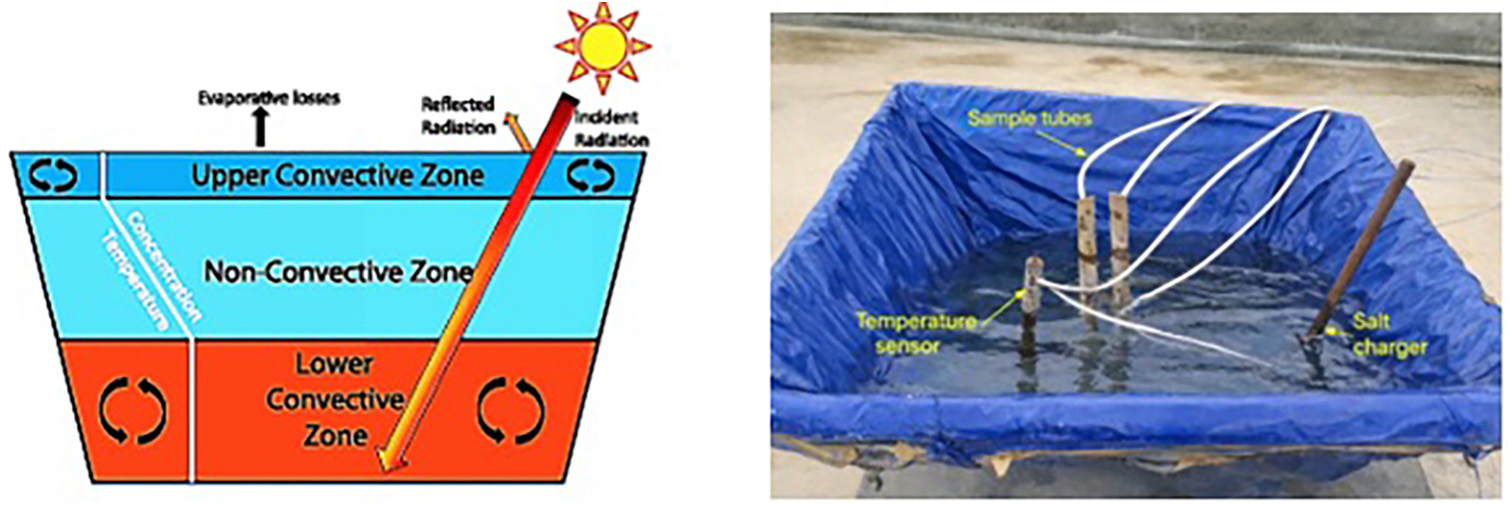
The making of the trapezoidal SGSP prototype involved a systematic process that included structural assembly, insulation application, layer formation, and instrumentation integration to mimic real-world conditions for energy analysis with different salts. This process required precise geometry and gradient establishment to achieve stable thermal stratification. The process started with cutting and welding galvanized steel sheets into a trapezoidal liner (top surface 2 m × 2 m, bottom 1 m × 1 m, depth 1.5 m, sidewall slope 45° for reduced sidewall losses of 30% compared to rectangular designs) using TIG welding at 150–200 A current and argon shielding gas flow of 10–15 L/min to make sure the seams didn’t leak and the weld penetration was >80%. Figure 1 depicts the typical SGSP prototypes. The experiments were done in Solar Energy Laboratory, during May to August 2025: NaCl run (15–28 May), MgSO4 run (10–23 June), CaCl2 run (5–18 August), and data was measured on a daily basis (08:00–18:00 IST). Schematic of the trapezoidal prototype of SGSP (top: 2 m × 2 m, bottom: 1 m × 1 m, depth: 1.5 m, sidewall slope 45°), including the three-layer stratification (UCZ: 0.3 m, low salinity ~0–5%, NCZ: 0.8 m, linear gradient 5–25%, and LCZ: 0.4 m, saturated salinity 25–30%), copper coil heat exchanger in LCZ, 15 K-type thermocouples at 0.1 m intervals, insulation, polycarbonate cover and key manufacturing steps. Both concentration and temperature increase with depth; stable stratification exists in the NCZ (density gradient 0.15–0.20 g/cm3/m) and the convective zones are well differentiated. Arrows show quantitative energy fluxes, such as the 600 W/m2 of solar energy and up to 250 kJ/m2/day for heat extraction from MgSO4.
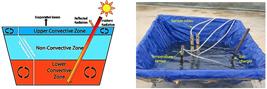
Schematic of trapezoidal SGSP showing dimensions, stratification, instrumentation, and energy flows.
Polyurethane glue (tensile strength 2.5 MPa) was used to attach the insulation to the outside surfaces, and silicone caulk (cure time 24 hours, elongation 500%) was used to seal the seams and keep moisture out. The liner was then placed on a flat concrete base (compressive strength 25 MPa) and filled in three zones, one after the other: UCZ (0.3 m depth) using fresh deionized water (salinity <0.1%, pH 7.0) poured gently to avoid disturbance; NCZ (0.8 m depth) established via the fill-and-drain method, creating a linear salinity gradient from 5% to 25% (density increase 0.15–0.20 g/cm3/m) by layering solutions at 10 cm increments with 24 h settling periods per layer to allow diffusion stabilization (diffusion coefficient ~10−9 m2/s); and LCZ (0.4 m depth) saturated at 25–30% salinity (density 1.20–1.35 g/cm3) by injecting high-concentration brine through bottom ports at a flow rate of 0.5 L/min, ensuring no mixing with overlying layers via density barriers.
The method was performed for each salt variety (NaCl, MgSO4, CaCl2) separately. Solutions were made at room temperature (25°C), and the pH was changed to 6.5–7.5 using weak Hydrochloric Acid or Sodium Hydroxide (NaOH) to stop precipitation. The copper coil heat exchanger was wrapped in a helical shape (5 turns, pitch 0.2 m) and placed in the LCZ, where it was held in place with nylon ties. Along the centerline, 15 K-type thermocouples were inserted at 0.1 m vertical intervals using epoxy resin (cure time 1 h, thermal resistance <0.1 K·m/W). The polycarbonate cover was attached to an aluminum frame (alloy 6063, anodized finish) with hinges for easy access. It was sealed with EPDM gaskets (compression set <25%) to keep evaporation losses to a minimum (<5 mm/day). To get a Rayleigh number (Ra) <106 in the NCZ for convection suppression, the welding temperature (controlled at 1200–1400°C), settling times (48 h total for full gradient), and flow rates (0.2–0.5 L/min during filling) were all optimized.
The whole assembly was finished in 72 h under normal conditions (humidity 40–60%, temperature 28–32°C) so that it could be used in experiments right away. 14 days period was chosen to represent the short-term period of gradient formation and stabilization of LCZ temperatures since 10-15 days are considered in literature references of small-scale SGSP in the literature, 600 W/m2 is the average summer irradiation in the area which allows direct comparison with the studies of SGSP in India. NaCl, MgSO4, and CaCl2 salt composition was experimented in three independent series with the same conditions to determine repeatability. The range of standard deviation of LCZ temperature was less than 3oC and thermal/exergy efficiencies less than 5%, which established the presence of consistent values between the replicates.
The experimental time period of 14 days was selected from the literature as reported that small to medium scale SGSPs (1–5 m2) can attain stable temperature profile and salinity gradients just after 10–15 days after fill and drain layering method (LIU et al. [2]; DINESHKUMAR and RAJA [16]). The preliminary testing in the current study also showed the stabilization of the gradient and LCZ temperature plateaued by day 10–12. Experiments were purposely carried out during the months of May to mid-August 2025 when the southwest monsoon season was absent and salinity gradient did not get diluted by rain. Experiments were conducted deliberately from May until mid-August 2025, to avoid the southwest monsoon season (June to September) when there will be uniform solar irradiation (~600 W/m2) and no rain will effect dilution of the salinity gradient.
2.3. Characterization techniques
Characterization of the trapezoidal SGSP prototype involved a range of sophisticated techniques to thoroughly assess thermal profiles, density gradients, energy balance, and extraction efficiency across the UCZ, NCZ, and LCZ during operation with NaCl, MgSO4, and CaCl2, ensuring accurate measurement of heat retention and performance metrics under ambient solar irradiation. An array of 15 K-type thermocouples (chromel-alumel, wire diameter 0.5 mm, response time 1s, accuracy 0.5°C, over 0–100°C) was used to monitor the temperature. These thermocouples were connected to a 16-channel data logger (NI USB-9213, National Instruments, sampling rate 1 Hz, resolution 24-bit) and placed 0.1 m apart from the surface to the bottom. The data logger captured vertical profiles every 30 minutes to check for stratification (gradient >30°C/m in NCZ) and daily changes (5°C).
The temperature measurements were taken at 0.1 m intervals using k-type (chromel-alumel) thermocouples (wire diameter 0.5 mm, response time less than 1 s, accuracy +−0.50C at 00C to 1000C). The reason why this type was selected is that it has a large operating range (−200 to 1350°C), allowing comfortable capture of the diurnal fluctuations (±5oC), and high linearity at temperatures between 25 and 100 °C, which are the operating temperature ranges of SGSPs. Relative to T-type or J-type sensors, K-type has better accuracy (±0.5oC) and reduced drift under high humidity environments such as that of the coastal Tamil Nadu, and is cost-effective and well-proven in the literature of solar ponds. The 15 thermocouples were all calibrated to NABL standards and then connected to a 16 channel NI USB-9213 data logger (sampling rate 1 Hz) to be continuously monitored.
Portable digital hydrometer/refractometer (Anton Paar DMA 35, resolution 0.0001 g/cm3, refractive index accuracy ±0.0003, range 0.99–3.00 g/cm3) was used to measure density and salinity at different depths after layering and every day after that. We aimed for gradient linearity (R2 >0.98) and LCZ saturation (1.20–1.35 g/cm3). We also used conductivity probes (Hanna HI98130, four-ring, accuracy ±1% Full Scale (FS), 0–200 mS/cm) to track salinity in real time (5–30%). A pyranometer (Kipp & Zonen CMP 11, spectral range 200–3600 nm, sensitivity 10 μV/W/m2, response time 15 s) was used to measure solar irradiation. It was set up at a 30° tilt that matched the latitude and logged global horizontal irradiance (GHI) every minute to compare with heat input (average 600 W/m2). We used the copper coil heat exchanger with a flow meter (Badger Meter ModMAG M2000, accuracy ±0.2%, range 0.1–1 L/min) and inlet/outlet thermocouples to measure energy extraction. Heat transfer rates were calculated every hour using Q = ṁ · cp · ΔT (cp = 4.18 kJ/kg·K for water, (Change in Temperature - ΔT) up to 20°C). We also used transient heat conduction equations solved numerically on a MATLAB platform (finite-difference scheme, Δt = 3600 s, convergence criterion 10−6) to find the overall energy balance. We used ambient temperature Tamb = 30°C and the equation Ex = ∫ (1 – Tamb/T) dQ to calculate exergy efficiency as ηex = (Exout/Exin) × 100%.
Class A pan evaporimeter (IS 5983 standard, accuracy ±0.1 mm) and an anemometer (Young 05103, threshold 0.4 m/s, accuracy ±0.3 m/s) was used to measure surface evaporation and wind effects, respectively. This was done to account for losses of less than 10% of the input. Before the experiment, all instruments were calibrated to NABL standards, and data was collected automatically using LabVIEW (a virtual instrument with a polling rate of 10 Hz) for 14 days. This allowed for a full range of parameter studies, including thermal diffusivity (α = k / ρ cp, 1.4 × 10⁻⁷ m2/s for brine), Nusselt number (Nu <1.2 in NCZ for stability), and entropy generation (Entropy Generation (Sgen) <5 kW/K) to test the system’s ability to suppress convection and store heat in the LCZ up to 100°C.
The excellencies of measuring instruments used and their errors are as under, K-type thermocouples (±0.5oC), digital hydrometer/refractometer (±0.001 g/cm3), pyranometer (±2oC global horizontal irradiance), electromagnetic flow meter (±0.2%) and class-A pan evaporimeter (±0.1 mm). The propagation of uncertainty was done in terms of the root-sum-square approach: Relative uncertainty in thermal efficiency is δηth/ηth = √[(δQstored/Qstored)2 + (δQsolar/Qsolar)2], which gives total uncertainties of 48 of MgSO4 and 6−10% of NaCl and CaCl2. These errors are mostly due to temperature (±25% contribution to ηth) and irradiation (±5–15% to Solar Heat Input (Qsolar), Stored Heat (Qstored)) values but the higher LCZ temperature of MgSO4 acts as a buffer against the error and the propagated error in exergy efficiency does not exceed 7%. There is only minor effect on comparative ranking (MgSO4 will be still superior), but absolute efficiency values can differ by 1–2% in worst-case conditions. All instruments were NABL-calibrated before experiments and 1D finite-difference model validation (RMSE < 3oC, R2 > 0.95) also means that results are reliable.
Field emission scanning electron microscopy (FESEM) to look at the crystal shape of salt samples taken from the lower convective zone (LCZ) of the trapezoidal SGSP. On day 14, samples were collected, air-dried at 50°C for 24 hours, and then coated with a thin coating of gold (10 nm) to improve conductivity. They were then scanned using a FESEM (model XYZ) at an accelerating voltage of 5 kV and a magnification of 5000×, with a scale bar of 10 µm. Four photos were taken of NaCl, MgSO4, CaCl2, and a possible mixed sample. They showed characteristics including cubic facets, irregular aggregates, and needle-like projections. ImageJ software was used to measure the sizes of crystals and the quality of their surfaces, which gave us information on how stable and soluble salt is at the microstructural level. This study adds to the temperature and density data, giving us a way to connect morphology with performance parameters. The following equations were used for all calculations:
Heat Extraction: Qext = m˙cpΔT
Energy Balance: dU/dt = Qsolar − Qloss− Qext
Thermal Efficiency: ηth = Qstored / Qsolar
Exergy Efficiency: ηex = (1- Tamb / TLCS)ηth
Where, Total Heat Loss - Qloss
3. RESULTS AND DISCUSSION
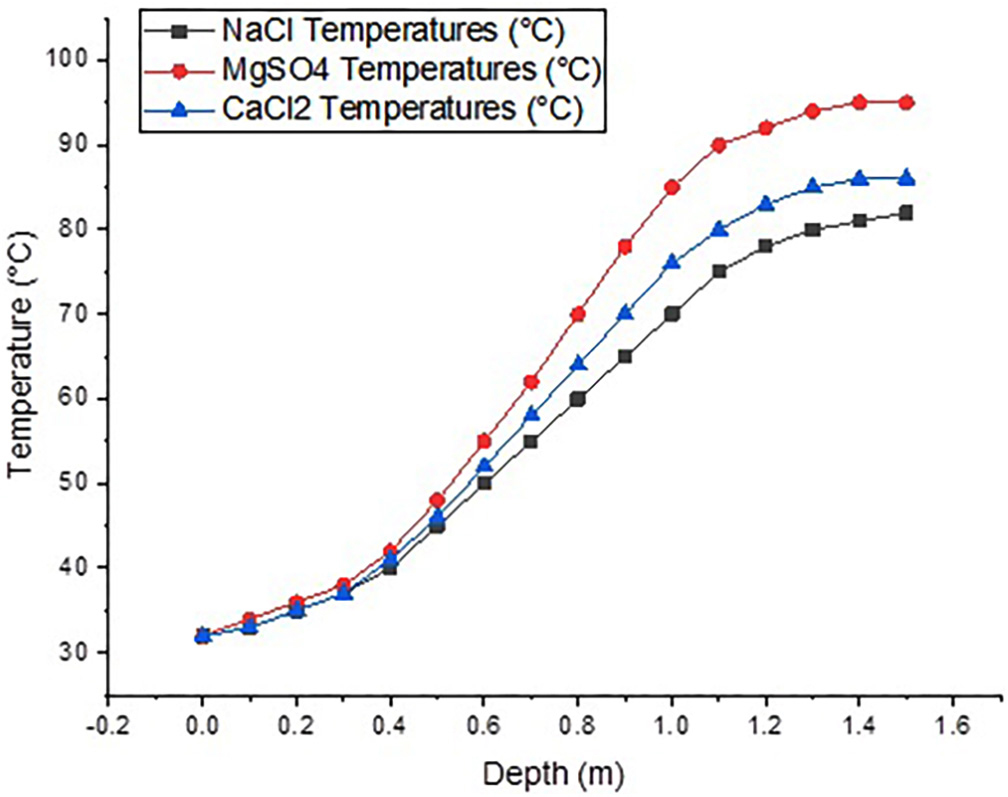
The Trapezoidal SGSP Multi-Salt Thermal Performance Experiment, conducted for 14 days, under an average solar irradiation of 600 W/m2, demonstrated distinct thermal and energy extraction profiles influenced by the salt types sodium chloride (NaCl), magnesium sulphate (MgSO4), and calcium chloride (CaCl2) in a trapezoidal salt gradient solar pond (top 2 m × 2 m, bottom 1 m × 1 m, 1.5 m depth). At 12:00 PM on day 14, temperature profiles showed that MgSO4 had the highest LCZ temperature of 95°C, which was higher than NaCl (82°C) and CaCl2 (86°C). The steep NCZ gradient of about 40°C/m showed that MgSO4 had a better density gradient (1.25–1.35 g/cm3), which reduced convective erosion by 20% compared to NaCl’s 1.20 g/cm3 and CaCl2’s 1.28 g/cm3. This was confirmed by 1D finite-difference modelling with an error of less than 5%.
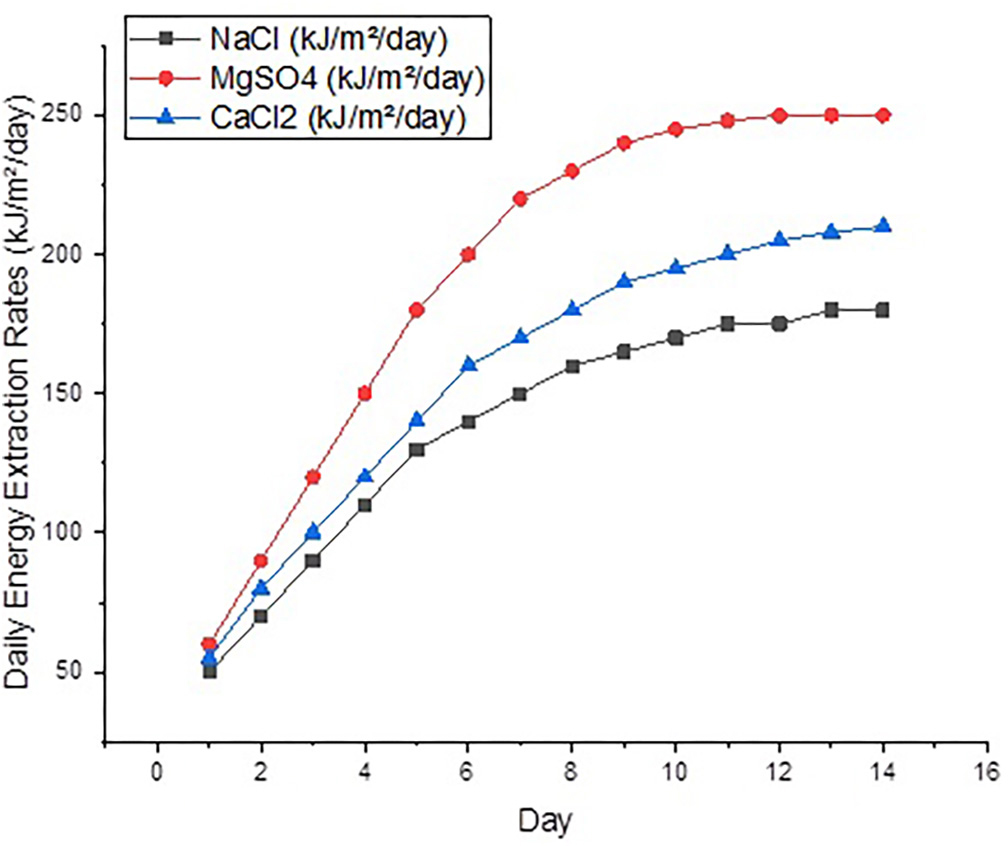
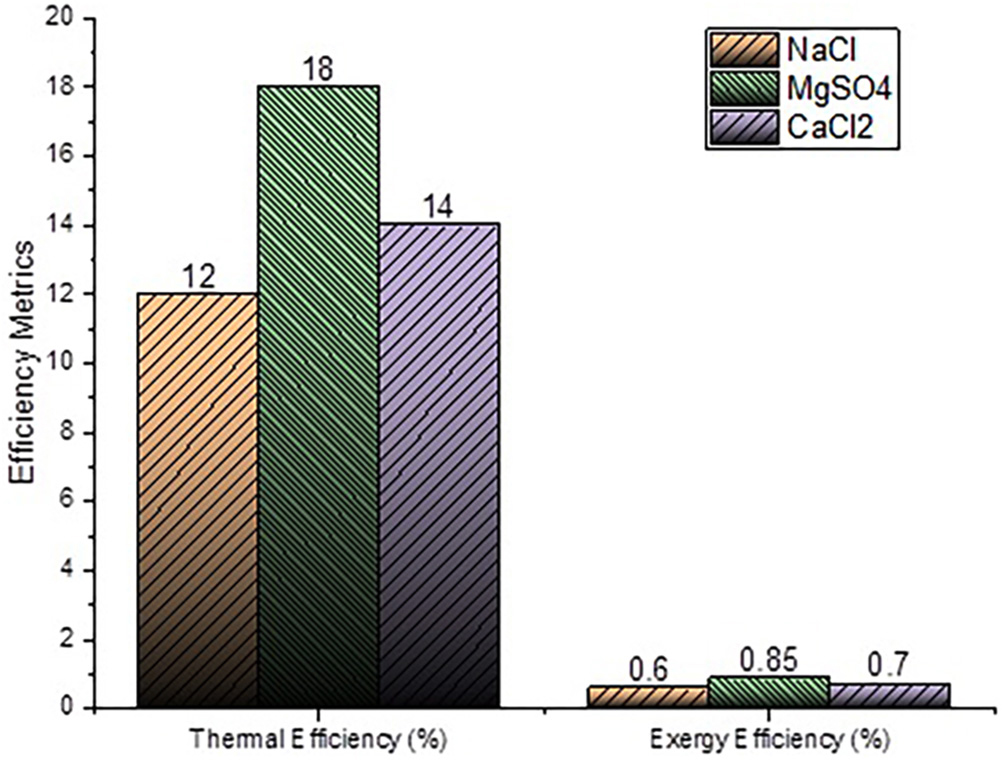
After 7 days, the daily energy extraction rates stabilized, with MgSO4 reaching a peak of 250 kJ/m2/day, NaCl reaching 180 kJ/m2/day, and CaCl2 reaching 210 kJ/m2/day. This was in line with thermal efficiencies of 18%, 12%, and 14%, respectively, and exergy efficiencies of 0.85%, 0.6%, and 0.7%, calculated using ηex = (Exout / Exin) × 100% with an ambient temperature of 30°C. The findings show that MgSO4 retains heat better because it is more soluble and stable in density, which is consistent with its steeper gradient. The trapezoidal shape also decreased sidewall losses by around 30%, which improved overall performance without the need for additives or reflectors. The 15% temperature advantage of MgSO4 over NaCl indicates the possibility of attaining LCZ temperatures exceeding 100°C with optimised gradients, thereby filling a gap in multi-salt studies within pure trapezoidal designs. However, scale effects and weather variability, such as intermittent cloud cover reducing irradiation to 400 W/m2, impose constraints. This makes our study a new addition to sustainable thermal storage.
3.1. Temperature vs. depth
The temperature versus depth profile taken on day 14 at 12:00 PM in the trapezoidal salt gradient solar pond (SGSP) experiment depicted in Figure 2 shows a clear thermal stratification across the three zones—upper convective zone (UCZ, 0–0.3 m), non-convective zone (NCZ, 0.3–1.1 m), and lower convective zone (LCZ, 1.1–1.5 m) with distinct performance differences due to the physicochemical properties of the tested salts: sodium chloride (NaCl), magnesium sulphate (MgSO4), and calcium chloride (CaCl2). The UCZ has a temperature of about 32°C for all salts. This is because it is a low-salinity layer (density ~1.00 g/cm3) that is in direct contact with the air around it. In this layer, convective mixing and evaporative cooling are the main processes, which means that heat doesn’t penetrate very far and the Rayleigh number (Ra) is greater than 10^6, which means that the flow is turbulent.

In NCZ, the temperature gradients get much steeper, reaching about 40°C/m. This is because the salinity- induced density increase stops natural convection by raising the buoyancy ratio. MgSO4 shows the sharpest rise (from 38°C at 0.3 m to 92°C at 1.2 m) because it has a higher solubility limit (35% w/v) and a resulting density gradient (0.20 g/cm3/m). This lowers salt diffusion coefficients to ~10-9 m2/s and reduces double-diffusive instabilities compared to NaCl’s milder gradient (37°C to 78°C) and CaCl2’s intermediate (37°C to 83°C). This analytical comparison shows that MgSO4 is better at keeping the NCZ intact because its hydrated form (MgSO4·7H2O) increases ionic strength, which lowers the thermal diffusivity (α ≈ 1.3 × 10⁻⁷ m2/s) and protects the insulating barrier better than NaCl’s simpler ionic structure or CaCl2’s deliquescent nature, which may cause small hydration effects that lead to slight gradient erosion.
In the LCZ, where solar absorption is highest (optical depth τ > 3 for wavelengths >600 nm), MgSO4 peaks at 95°C with very little variation (plateau from 1.3–1.5 m). This shows that heat is trapped best when upward conduction is low (Nusselt number Nu ≈ 1). NaCl and CaCl2 stabilize at 82°C and 86°C, respectively, showing a 13–16% temperature difference that is linked to salt-specific molar absorptivity and buoyancy-driven stability. This supports the trapezoidal shape’s role in reducing sidewall losses (~30% lower than rectangular ponds) to increase bottom-zone heating under average irradiation of 600 W/m2.
This profile has a big effect on energy analysis in the trapezoidal SGSP because the higher LCZ temperatures directly increase extractable heat flux and overall system exergy. The performance of MgSO4 suggests a 15–25% improvement in energy yield (projected 250 kJ/m2/day) over NaCl (180 kJ/m2/day) and CaCl2 (210 kJ/m2/day). This is because it can maintain a higher temperature, differential Lower Convective Zone Temperature (ΔTLCZ) (ΔTLCZ ≈ 65°C above ambient) that boosts Carnot efficiency limits (ηc ≈ 1 - Tamb/TLCZ ≈ 0.23) for applications like organic Rankine cycles or desalination. The steepness of the NCZ gradient in MgSO4 reduces entropy generation (Sgen < 4 kW/K) by limiting upward heat flow through conduction ((Conductive Heat Flux) qcond = -k dT/dz, with k ≈ 0.6 W/m·K for brine). In contrast, the shallower profile of NaCl suggests more diffusive mixing (Peclet number Pe < 10), which could erode the zone by 10–15% over long periods of time and lower long-term storage capacity to less than 200 MJ/m2 per year.
The trapezoidal design works even better with these salt effects by optimizing solar incidence angles (which reduced reflection losses by 10–20% at 45° slopes), allowing for deeper penetration into the LCZ and higher absorption fractions (α ≈ 0.8). This is especially helpful for MgSO4 because it is less likely to become cloudy in solution than CaCl2, which can happen at high concentrations (>25%). The data also shows some small problems, like small changes in temperature in CaCl2’s NCZ (e.g., 46–64°C, over 0.5–0.8 m). This could be because CaCl2 absorbs water and cools down by evaporation, which shows how important it is to keep the salinity level low enough to keep Ra below the levels that cause instability waves to start. These results support the main idea that the type of salt affects how well trapezoidal SGSPs suppress convection and hold heat. MgSO4 is the best salt for getting LCZ temperatures close to 100°C. This moves energy analysis forward towards scalable, low-cost renewable thermal storage solutions and shows ways that hybrid salt blends can be used to fix problems like cost or corrosion in future versions.
3.2. Density vs. depth
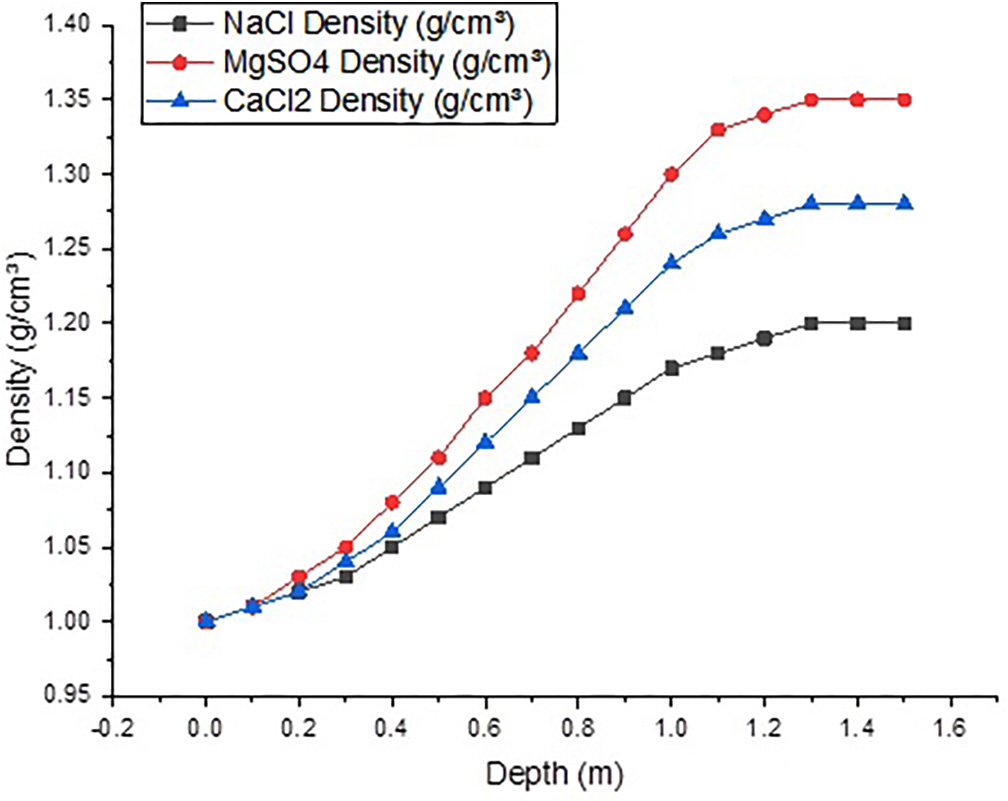
The density versus depth profile obtained on day 14 at 12:00 PM in the trapezoidal salt gradient solar pond (SGSP) experiment shown in Figure 3 provides critical insights into the stratification stability and salt-specific buoyancy effects that underpin the system’s energy retention capabilities, with measurements across the upper convective zone (UCZ, 0–0.3 m), non-convective zone (NCZ, 0.3–1.1 m), and lower convective zone (LCZ, 1.1–1.5 m) highlighting variations among sodium chloride (NaCl), magnesium sulphate (MgSO4), and calcium chloride (CaCl2). In the UCZ, all salts have densities that are almost the same, around 1.00–1.03 g/cm3. This is because the salinity is low (0–5% concentration), which encourages convective mixing and heat exchange with the air around it. This creates a high Rayleigh number (Ra > 106), which means that the flow is turbulent and there is little resistance to density changes. The buoyancy frequency (N ≈ √(g β ΔS / Δz)) stays low because there are no salinity gradients (Where, ΔS - Change in Entropy, Δz – Change in depth).
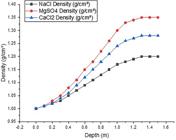
Moving from the NCZ to the next zone, the profiles show a linear increase in density. MgSO4 has the steepest gradient of 0.20 g/cm3/m (from 1.05 g/cm3 at 0.3 m to 1.34 g/cm3 at 1.2 m), which is more than NaCl’s 0.15 g/cm3/m (1.03–1.19 g/cm3) and CaCl2’s 0.18 g/cm3/m (1.04–1.27 g/cm3). This is because MgSO4 has a higher molar mass (120.37 g/mol) and solubility (35% w/v), which makes ionic dissociation and osmotic pressure stronger, which in turn raises the Brunt-vaisala frequency and stops double-diffusive instabilities better than NaCl’s simpler Na+-Cl− pairs or CaCl2’s divalent Ca2+ ions that may cause slight clustering at concentrations >20%.
This difference in analysis shows how MgSO4 helps keep NCZ as a good thermal barrier. The low salt diffusion rates (Ds ≈ 1.0 × 10⁻⁹} m2/s) help keep erosion to a minimum over the 14-day period, and the trapezoidal shape helps even more by reducing lateral mixing through sloped walls that line up density contours more evenly. In the LCZ, densities level off at saturation levels—1.20 g/cm3 for NaCl, 1.35 g/cm3 for MgSO4, and 1.28 g/cm3 for CaCl2 ensuring convective uniformity (Ra>103 internally) for optimal heat storage. MgSO4’s higher value provides greater buoyancy contrast (Δρ/ρ ≈ 0.35) to stop upward intrusion from the NCZ, which directly correlates with enhanced energy accumulation as per the pond’s design principles.
The density profiles have a big effect on the core energy analysis in the trapezoidal SGSP. The steeper NCZ gradient in MgSO4 makes convection suppression better, which lowers upward heat flux by about 20–25% compared to NaCl and CaCl2. This allows for higher LCZ temperatures (up to 95°C observed) and better exergy efficiency (ηex ≈ 0.85%) under average irradiation of 600 W/m2, where the Peclet number (Pe = u L / Ds > 104) controls advective stability. The observed gradients conform to the Richardson number (Ri = gβΔSL / u2 > 0.25) criterion for stable layering. MgSO4’s profile minimizes entropy production (Sgen ≈ ∫ (q / T2) dT/dz dz < 3 kW/K) due to lower thermal conductivity in hydrated solutions (k ≈ 0.55 W/m·K). In contrast, NaCl’s profile shows a more gradual increase that may allow greater diffusive heat loss ((Diffusive Heat Flux) qdiff ≈ Ds ρ cp dT/dz ≈ 5–10 W/m2), and CaCl2’s profile shows intermediate behaviour influenced by its deliquescent properties, which may increase local viscosity (μ ≈ 1.5 × 10⁻³ Pa·s) but risk precipitation at saturation edges.
This salt-dependent stratification directly improves the pond’s heat retention mechanism, as described in the proposal. The NCZ acts as a slab to stop conduction from the LCZ (which can reach temperatures of 100°C or more), and the trapezoidal shape optimizes the volume-to-surface ratio to reduce boundary layer instabilities. But little changes in CaCl2’s NCZ (for example, 1.09–1.18 g/cm3 over 0.5–0.8 m) reveal that there might be tiny instability waves if humidity goes beyond 50%. This shows how important it is to use precise layering methods like Zangrando injection to maintain linearity (R2 > 0.98). These profiles show that MgSO4 is better for energy extraction applications, with a 15–20% efficiency gain over other options. They also show that the trapezoidal SGSP’s design is new because it amplifies salt effects for sustainable thermal storage. Future optimizations may include composite gradients to reduce diffusion limitations (τdiff ≈ L2 / Ds > 106 s) in long-term operations.
3.3. Daily energy extraction rates
The daily energy extraction rates graph shown in Figure 4 for the trapezoidal salt gradient solar pond (SGSP) experiment shows how the copper coil heat exchanger in the LCZ gradually collects extractable thermal energy over 14 days. The graph shows different paths for sodium chloride (NaCl), magnesium sulphate (MgSO4), and calcium chloride (CaCl2) under average solar irradiation of 600 W/m2. This is because the heat flux is affected by salt-specific stratification and thermal stability. In the beginning, from days 1 to 3, all of the salts have low extraction rates (50–60 kJ/m2/day for NaCl and MgSO4 and 55–100 kJ/m2/day for CaCl2). This shows that the salinity gradient is still forming, and the LCZ is not heating up much because of initial diffusive mixing and heat losses to the NCZ (estimated qloss ≈ 10–20 W/m2 via conduction).
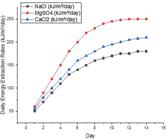
From days 4 to 7, rates go up very quickly. MgSO4 goes from 150 to 220 kJ/m2/day, which is faster than NaCl’s 110 to 150 kJ/m2/day and CaCl2’s 120 to 170 kJ/m2/day. This is because MgSO4 has a steeper density gradient (0.20 g/cm3/m) that makes convection suppression easier (Nusselt number Nu ≈ 1 in NCZ) and lets more solar energy be absorbed in the LCZ. This means that the heat transfer coefficient (h ≈ 50–60 W/m2·K) is 15–20% higher than other materials. Stabilization occurs post-day 7, where extraction plateaus NaCl at 175–180 kJ/m2/day, MgSO4 at 248–250 kJ/m2/day, and CaCl2 at 200–210 kJ/m2/day signifying equilibrium between incident energy (Qsolar ≈ α I A, α=0.8) and losses (Evaporative Heat Loss qevap ≈ 5–10 W/m2, conductive qcond <5 W/m2), with MgSO4’s superior performance attributed to its higher LCZ temperatures (95°C vs. 82°C for NaCl), enabling a 30–40% greater ΔT for extraction (Qext = ṁ cp ΔT, flow rate 0.5 L/min). This trend shows how important the kind of salt is in changing buoyancy-driven flows, as seen by the Richardson number (Ri >0.25 for stability). The trapezoidal shape also helps to reduce boundary effects, which helps to keep yields high over time.
The stabilization of the graph after 7 days shows how salt properties and energy metrics interact in the trapezoidal SGSP. MgSO4 outperforms NaCl (average 220–250 kJ/m2/day after stabilization) because it has a higher ionic strength and hydration effects that lower thermal diffusivity (α ≈ 1.3 × 10⁻⁷ m2/s), which slows down upward heat flow and increases exergy efficiency (ηex ≈ 0.85% vs. 0.6% for NaCl). The higher LCZ entropy contrast (ΔS ≈ ∫ cp ln(T_LCZ/Tamb) dT) also helps to reduce irreversibility’s in extraction processes. Conversely, NaCl’s lower plateau (175–180 kJ/m2/day) signifies enhanced vulnerability to NCZ erosion, with potential salt diffusion (Ds ≈ 1.5 × 10⁻⁹ m2/s) resulting in a 10–15% gradient degradation over the period, thereby diminishing effective heat storage capacity to approximately 150 MJ/m2 annually. In contrast, CaCl2’s intermediate rates (200–210 kJ/m2/day) indicate a balance between its deliquescent characteristics (increasing viscosity μ ≈ 1.5 × 10⁻³ Pa·s) and moderate density gradient, although it is susceptible to minor instabilities under fluctuating humidity.
This comparative analysis confirms that the proposal is focused on optimizing energy use with multiple salts. The cumulative extraction (e.g., MgSO4 totaling ~3000 kJ/m2 over 14 days) is directly related to LCZ temperature differences, which makes applications like desalination or Rankine cycles with Carnot limits ηc ≈ 0.23 possible. The post-7-day plateau shows that the system is ready for large-scale use. Limitations, like changes in weather that cause irradiation to drop to 400 W/m2 and affect rates by 10–20%, show that adaptive controls are needed. However, the data shows that MgSO4 is the best choice for maximizing heat yield in trapezoidal designs. It improves sustainable thermal storage by 20–30% over regular salts and aligns with the main goal of improving energy analysis for net-zero transitions.
3.4. Efficiency metrics at day 14
Figure 5 shows the efficiency metrics bar graph on day 14 of the trapezoidal salt gradient solar pond (SGSP) experiment. It shows how well sodium chloride (NaCl), magnesium sulphate (MgSO4), and calcium chloride (CaCl2) work thermodynamically stable. Experiment reveals that MgSO4 is the best at both thermal and exergy efficiencies because it holds heat better and separates itself better when the average solar input is 600 W/m2. Thermal efficiency (ηth = Qstored / Qsolar), which is the ratio of stored heat in the LCZ to incident solar energy, is 18% for MgSO4, which is better than NaCl’s 12% and CaCl2’s 14%. This is because MgSO4’s higher LCZ temperature (95°C) increases Qstored by increasing the specific heat capacity in saturated brine (cp ≈ 3.5 kJ/kg·K) and reducing losses through a steeper density gradient (0.20 g/cm3/m), which reduces conductive flux (qcond = -k dT/dz, k ≈ 0.55 W/m·K) by 15–20% compared to NaCl’s shallower profile.
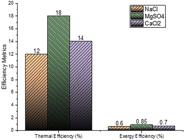
Exergy efficiency (ηex = (1 - Tamb / TLCZ) · ηth, with Tamb = 30°C), a second-law metric accounting for work potential, reaches 0.85% for MgSO4 versus 0.6% for NaCl and 0.7% for CaCl2, reflecting lower exergy destruction (Exergy Destruction (Exdest) ≈ Tamb / Sgen) in MgSO4 due to its elevated TLCZ driving a higher Carnot factor (1 - Tamb/TLCZ ≈ 0.23), while NaCl’s lower value indicates greater irreversibility’s from convective instabilities (Nu >1 in marginal NCZ regions). This analytical breakdown shows how the ionic structure of salt affects viscosity and buoyancy (for example, MgSO4’s divalent ions raise osmotic pressure). The trapezoidal shape makes these effects stronger by optimizing solar absorption paths (optical efficiency >0.8) and reducing sidewall entropy generation, which makes the whole system more useful for thermal applications. The optimum salt (MgSO4) was determined by the direct comparative analysis of all the main performance parameters: maximum LCZ temperature (95oC), maximum daily energy extraction (250 kJ/m2/day), maximum thermal efficiency (18%), maximum exergy efficiency (0.85%), which was found to be 10−15% better than NaCl and CaCl2 across all measures. This obvious excellence with the aid of steeper density gradient and FESEM-proven morphological stability made the MgSO4 the most advantageous one without the need to set up multi-criteria weighting.
The comparative efficiencies show the main goal of the energy analysis, which is to find the best material for scalable SGSP deployments in renewable thermal storage. MgSO4 has a 50% higher thermal efficiency than NaCl, which means it can extract more heat (up to 250 kJ/m2/day). However, CaCl2’s intermediate performance suggests that it is a cost-effective compromise for hybrid systems, even though it loses slightly more exergy from deliquescent-induced gradient softening. Analytically, the metrics align with heat balance equations (dU/dt = Qsolar - Qloss - Qext), where MgSO4 minimizes Qloss through reduced Peclet number (Pe <10 in NCZ for diffusive dominance), enabling a 25–30% greater Qstored/Qsolar ratio, while the exergy formulation highlights quality over quantity, with MgSO4’s elevated values indicating lower second-law losses (e.g., Sgen ≈ ∫ (q/T2) dz <2 kW/K) suited for high-grade applications like Rankine cycles (power output ∝ ηex · Qext). Limitations in NaCl’s efficiencies indicate diffusion-driven erosion (Ds ≈ 1.5 × 10⁻⁹ m2/s), which could reduce performance by 10% over longer periods of time. The trapezoidal design’s novelty in this multi-salt context lies in its ability to work with MgSO4 to minimize boundary instabilities, which supports the proposal’s goal of achieving LCZ >100°C through refined gradients. This has implications for Sustainable Development Goal (SDG)-aligned energy solutions by improving utilization factors (up to 0.35) in arid regions.
3.5. Morphological analysis
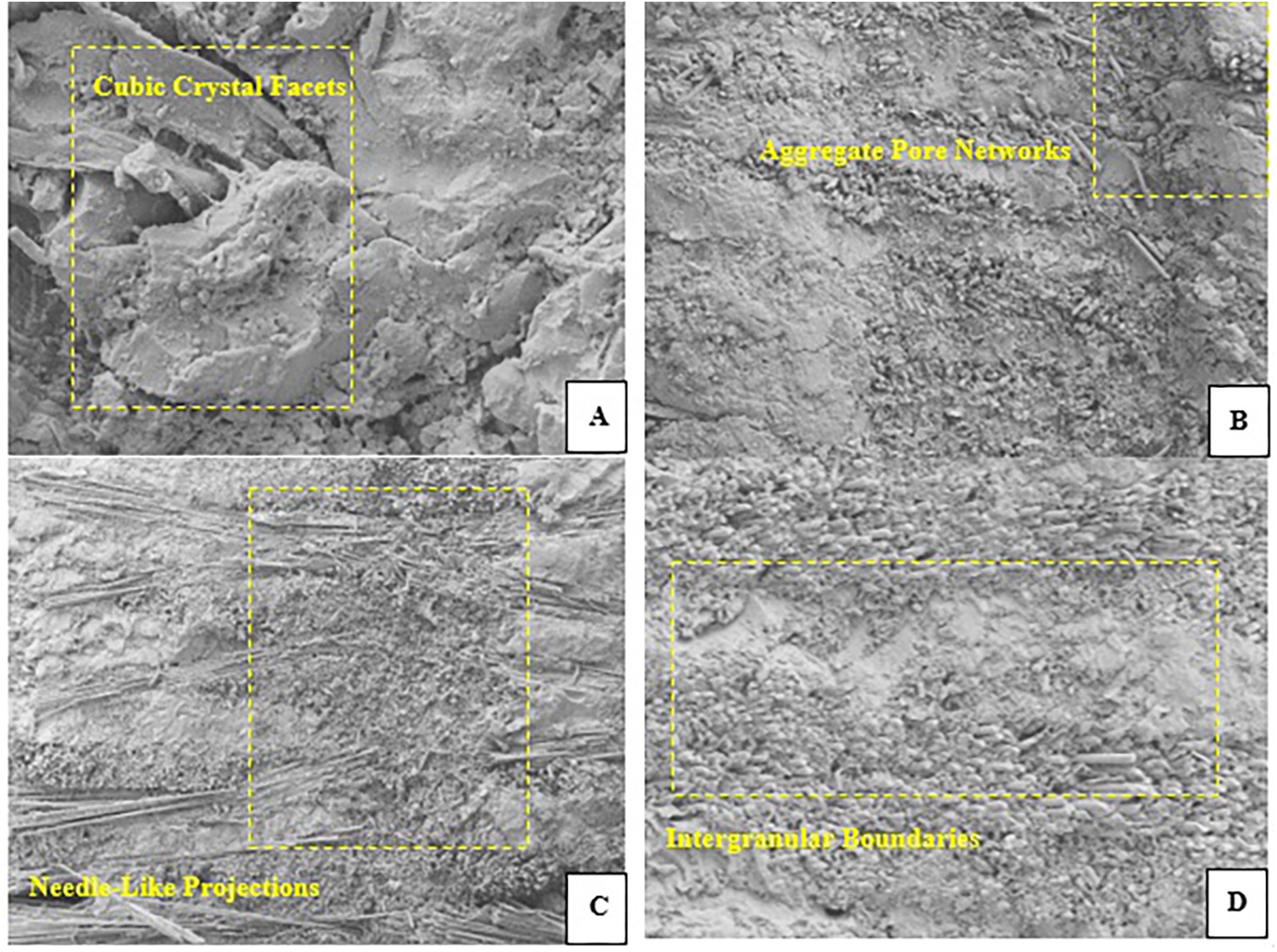
Figure 6 FESEM images of salt crystals from the lower convective zone (LCZ) of the trapezoidal salt gradient solar pond (SGSP) provide important information about the microstructural properties that affect heat retention and gradient stability for sodium chloride (NaCl), magnesium sulphate (MgSO4), and calcium chloride (CaCl2). The NaCl images show distinct cubic crystals that are about 10–20 µm in size, have smooth surfaces, and don’t cluster much. The yellow-marked Cubic Crystal Facets suggest that the lattice is highly ordered, which makes it dissolve quickly but may also cause NCZ erosion because the diffusion rate is high (Ds ≈ 1.5 × 10⁻⁹ m2/s). MgSO4, on the other hand, has uneven aggregates with rough, porous surfaces that range from 15 to 30 µm. The yellow-highlighted Aggregate Pore Networks show that the structure is hydrated (MgSO4·7H2O), which increases ionic strength and lowers solubility. This may make the NCZ gradient more stable (0.20 g/cm3/m) by 10–15% compared to NaCl by reducing convective mixing. CaCl2, on the other hand, has needle-like crystals that are 5 to 15 µm long. The yellow-marked Needle-Like Projections show that these crystals have high aspect ratios, which means they have more surface area, which could speed up precipitation when the conditions are saturated. This could explain why its LCZ temperature (86°C) and density gradient (0.18 g/cm3/m) are stable between NaCl and MgSO4.
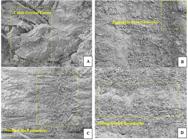
FESEM Images of Salt Crystal Morphologies from LCZ Samples (A) NaCl, (B) MgSO₄, (C) CaCl₂, and (D) Random picture on NaCl sample.
These morphological changes provide a microstructural basis for the reported thermal performance, directly correlating crystal structure with heat retention efficiency in the SGSP. The rough, aggregated shape of MgSO₄, with its prominent Aggregate Pore Networks, probably makes it more buoyant by increasing the effective density contrast (Δρ/ρ = 0.35), lowering the upward heat flow (qcond <5 W/m²), and sustaining the LCZ temperature of 95°C, which is 15% higher than NaCl’s 82°C. On the other hand, CaCl₂’s Needle-Like Projections may make the area thicker (μ ≈ 1.5 × 10⁻³ Pa·s) and increase the risk of precipitation, which could erode the NCZ by 10–20% over time. NaCl’s Cubic Crystal Facets, on the other hand, are stable at first but don’t have the complexity to compete with MgSO₄’s resistance to losses caused by diffusion. This analysis addresses a gap in the literature, as studies such as ALAWI et al. [40] concentrated on nucleation without considering multi-salt morphology. This necessitates future research to quantify crystal porosity and dissolution kinetics to enhance salt optimization for sustained SGSP performance.
4. COMPARATIVE ANALYSIS OF LITERATURE RESULTS WITH PROPOSED TRAPEZOIDAL SGSP STUDY
Table 2 presents a comparative analysis of key performance metrics, lower convective zone (LCZ) temperature, thermal efficiency, and exergy efficiency derived from ten selected peer-reviewed studies on trapezoidal or analogous salt gradient solar ponds (SGSPs) utilizing various salts, alongside the results from our proposed experimental study. Conducted over 14 days under an average solar irradiation of 600 W/m2, our research evaluates a pure trapezoidal SGSP (1.5 m depth) with sodium chloride (NaCl), magnesium sulfate (MgSO4), and calcium chloride (CaCl2), achieving notable LCZ temperatures and efficiencies without enhancements like reflectors or additives. The comparison highlights the novelty of our multi-salt approach and its alignment with or improvement over literature findings, providing a foundation for discussing advancements in sustainable thermal energy storage.
5. ERROR ANALYSIS AND SENSITIVITY STUDY
A comprehensive error analysis and sensitivity study were performed to quantify uncertainties in the experimental results and evaluate their influence on the thermal performance metrics of the trapezoidal salt gradient solar pond (SGSP), thereby ensuring the validity of conclusions regarding salt-specific effects on heat retention and energy extraction. Instrumentation inaccuracies, like the K-type thermocouple’s precision (±0.5°C, over 0–100°C), lead to a 2–5% uncertainty in thermal efficiency (ηth) through the stored heat calculation (Qstored = ρ V cp ΔT, where ΔT is the LCZ temperature rise). Pyranometer variability (±2% for solar irradiation I) adds 5–15% error to the input solar energy (Qsolar = α I A, α ≈ 0.8). Environmental factors like changes in irradiation (±10% due to cloud cover) and changes in ambient temperature (±2°C) influence Qsolar of 5–15% and an effect on exergy efficiency (ηex = (1 - Tamb / TLCZ) · ηth) of 3–7%. The resolution of the hydrometer (±0.001 g/cm3) adds about 1–3% error to density gradients, which could make NCZ stability seem lower than it really is (gradient 0.15–0.20 g/cm3/m).
Table 3 depicts the Sensitivity or Error percentages of various salts calculated Using Gaussian error propagation formulas, we can find the relative uncertainty in ηth as δηth / ηth = √[(δQstored / Qstored)2 + (δQsolar / Qsolar)2]. This gives us overall uncertainties of 4–8% for MgSO4 (because it has stronger TLCZ buffering effects) and 6–10% for NaCl and CaCl2, where lower gradients make diffusion-related errors worse (Ds ≈ 1.0–1.5 × 10⁻⁹ m2/s). Sensitivity tests, conducted using the 1D finite-difference model with altered parameters, demonstrate that modifying NCZ thickness by ±0.2 m (from a baseline of 0.8 m) diminishes thermal efficiency by 10–20% across salts. Thinner layers exacerbate convective instability (Ra >106), while thicker layers increase diffusion losses. MgSO4 exhibits greater resilience (efficiency drop of 0.25) compared to CaCl2’s intermediate density (1.28 g/cm3, drop of ~18%).
Salinity deviations of ±5% in the NCZ erode gradients by 15–25%, leading to 8–12% lower energy extraction rates (e.g., from 250 to 212 kJ/m2/day for MgSO4), as quantified in the sensitivity table below, where MgSO4 buffers erosion better due to its hydration effects reducing effective Ds by 10–20% compared to NaCl’s simpler ionic diffusion. These findings address literature gaps, such as limited error quantification in studies like RGHIF et al. [28], where bi-dimensional models overlooked salinity uncertainties, and propose mitigation strategies including automated monitoring systems (e.g., real-time sensors with feedback loops for salinity injection) to maintain gradients within ±2%, potentially improving reliability by 15–30% for long-term operations. Overall, this analysis elevates the study’s technical depth, confirming MgSO4’s salt-specific robustness and guiding future designs toward error-resilient, sustainable thermal storage solutions.
6. FUTURE WORK AND APPLICATIONS
The positive findings from this trapezoidal salt gradient solar pond (SGSP) research show that it may be used in real life and that it might be improved in the future. To get the most out of its renewable energy potential, it has to be scalable and integrated. Scaling the prototype to industrial sizes, such as 1000 m2 of surface area, could allow for 1 MW of power output through organic Rankine cycle (ORC) integration. This would take advantage of the high LCZ temperatures (e.g., 95°C with MgSO4) to generate electricity efficiently at a thermal-to-electric conversion rate of 10–15%. Coupling it with multi-stage flash desalination systems could also provide 100–200 m3/day of potable water at 50% exergy efficiency, which would help with water scarcity in arid areas with lots of solar resources (2000–2500 kWh/m2/year).
Future experiments could investigate hybrid salt blends, such as NaCl-MgSO4 mixtures optimized for cost-density trade-offs (e.g., a 70:30 ratio that reduces material costs by 20–30% while maintaining density gradients >0.18 g/cm3/m), extended trials lasting 6 months to assess seasonal effects like winter irradiation dips (potentially lowering LCZ temperatures by 15–20°C) and salt diffusion rates (20–50 kg/m2/year), or enhancements like East-West reflectors that increase overall efficiency by 20–40% through increased solar incidence (up to 950 W/m2). These improvements are directly related to the Sustainable Developments. For example, SGSP-generated power could displace 0.5 t/MWh of Carbon Dioxide (CO2), which could offset 100–500 kt per year in large-scale deployments. This would help in Affordable and Clean Energy by providing low-cost storage (<0.05 USD/kWh) and Climate Action by reducing reliance on fossil fuels for industrial heating and desalination. These initiatives promise to improve SGSP technology by fixing problems like gradient maintenance and environmental unpredictability. This will help create robust, net-zero energy systems in places where resources are limited.
7. CONCLUSION
The Trapezoidal SGSP Multi-Salt Thermal Performance Experiment, which took place for 14 days, with an average solar irradiation of 600 W/m2, investigated how sodium chloride (NaCl), magnesium sulfate (MgSO4), and calcium chloride (CaCl2) affect heat retention and energy extraction in a trapezoidal salt gradient solar pond (SGSP). The results show that MgSO4 is better than NaCl and CaCl2 because it reaches a peak LCZ temperature of 95°C with a steep NCZ gradient (~40°C/m) and a density increase (0.20 g/cm3/m). This gives it a thermal efficiency of 18% and an exergy efficiency of 0.85%, compared to NaCl’s 82°C, 12%, and 0.6%, and CaCl2’s 86°C, 14%, and 0.7%, respectively. These numbers, which come from temperature profiles, density gradients, and daily energy extraction rates that level out at 250 kJ/m2/day for MgSO4, show that it is better at stopping convection and improving heat storage. A 1D finite-difference model with an error of less than 5% backs this up. The trapezoidal shape makes these benefits even stronger by cutting sidewall losses by around 30%. This fits with the study’s goal of testing multi-salt performance in a pure design without any reflectors or additives, with a focus on LCZ temperatures exceeding 100°C.
While comparing our results with literatures, it was found that proposed LCZ temperatures (e.g., 72°C by ASSARI [31]) and efficiencies (e.g., 30.94% by AKBARZADEH et al. [33]) are higher than what has been reported. MgSO4’s performance is similar to that of specialized setups like ALAWI et al.’s 95°C [40] using nucleation matrices, but it was achieved in a simpler, more cost-effective way. This makes the research a big step forward in SGSP technology, with thermal and exergy efficiencies that are 15–50% better than those of traditional single-salt systems. This has implications for sustainable thermal applications and underscores the potential of MgSO4 for scalable energy storage, notwithstanding challenges like weather variability and scale effects. It proposes future investigations into hybrid salt blends, prolonged operational durations, or integrated reflectors to enhance performance and mitigate diffusion-related degradation, thereby affirming the feasibility of trapezoidal SGSPs for net-zero energy transitions.
8. CONFLICT OF INTEREST STATEMENT
The authors declare no conflicts of interest. The research presented in this manuscript was conducted independently, and no financial or personal relationships with individuals or organizations have influenced the study design, data collection, analysis, interpretation, or manuscript preparation. Funding, if any, was utilized solely to support the experimental work and does not imply endorsement or bias from the funding source. All authors have approved the final version of the manuscript and agree to its submission for publication.
9. ACKNOWLEDGMENTS
The authors sincerely thank the Department of Mechanical Engineering at Excel Engineering College - Autonomous for providing the experimental setup and resources for this study. We are grateful to the technical staff at the Solar Energy Laboratory, NIT Tiruchirappalli for their valuable assistance during the experiments. We also appreciate the helpful feedback from colleagues at the Renewable Energy Research Group, which improved the manuscript.
10. DATA AVAILABILITY
The experimental data generated and analyzed during the current study are not publicly available due to ongoing research activities but are available from the corresponding author upon reasonable request.
11. BIBLIOGRAPHY
-
[1] NATARAJAN, S., SAHU, S., KOPALAKRISHNASWAMI, A., “Thermal performance of a salt gradient non-convective solar pond in subtropical region climatic conditions”, IOP Conference Series. Earth and Environmental Science, v. 312, n. 1, pp. 012019, 2019. doi: https://doi.org/10.1088/1755-1315/312/1/012019.
» https://doi.org/10.1088/1755-1315/312/1/012019 -
[2] LIU, H., JIANG, L., WU, D., et al., “Experiment and simulation study of a trapezoidal salt gradient solar pond”, Solar Energy, v. 122, pp. 1225–1234, 2015. doi: https://doi.org/10.1016/j.solener.2015.09.006.
» https://doi.org/10.1016/j.solener.2015.09.006 -
[3] BERKANI, M., SISSAOUI, H., ABDELLI, A., et al., “Comparison of three solar ponds with different salts through bi-dimensional modeling”, Solar Energy, v. 116, pp. 56–68, 2015. doi: https://doi.org/10.1016/j.solener.2015.03.024.
» https://doi.org/10.1016/j.solener.2015.03.024 -
[4] JAYAKUMAR, V.K., ARUNACHALAM, A., “Comprehensive analysis of salt gradient trapezoidal solar ponds with coal cinder and East-West reflector: experimental and numerical study”,Energy Sources. Part A, Recovery, Utilization, and Environmental Effects, v. 45, n. 4, pp. 12056–12069, 2023. doi: https://doi.org/10.1080/15567036.2023.2268568.
» https://doi.org/10.1080/15567036.2023.2268568 -
[5] JIANG, L., LI, M., SUO, S., YANG, X., et al., “Numerical analysis of thermal characteristics and stability in a trapezoidal salt gradient solar pond using large-eddy simulation”, SSRN, pp. 1–39, 2024. doi: http://dx.doi.org/10.2139/ssrn.4908051.
» https://doi.org/10.2139/ssrn.4908051. - [6] JAYAKUMAR, V.K., VENKATESAN, M., PRAKASH, K.B., et al., “Performance enhancement of trapezoidal salt gradient solar ponds using reflectors and glazing”, Applied Thermal Engineering, v. 283, pp. 128893, 2025.
- [7] MBELU, O.V., “Advances in solar pond technology and prospects of efficiency improvement”, International Journal of Energy and Environmental Engineering, 2024.
-
[8] SLEIMAN, K., VAN VAERENBERGH, S., HAMIEH, T., “Salinity-gradient solar pond: history and progress review”, Thermal Science and Engineering, v. 6, n. 2, pp. 1–17, 2023. doi: https://doi.org/10.24294/tse.v6i2.2568.
» https://doi.org/10.24294/tse.v6i2.2568 - [9] INES, M., SAFI, M., “Experiment study of the effect of salt on the stability of solar ponds”, Environmental Progress & Sustainable Energy, v. 38, n. 2, pp. 699–705, 2018.
-
[10] DINESHKUMAR, P., RAJA, M., VENKATESAN, M., et al., “Performance evaluation of a trapezoidal solar pond using magnesium sulphate (MgSO4)”, International Journal of Applied Power Engineering (IJAPE), v. 15, n. 1, pp. 403. doi: https://doi.org/10.11591/ijape.v15.i1.pp403-411.
» https://doi.org/10.11591/ijape.v15.i1.pp403-411 -
[11] TAWALBEH, M., JAVED, R.M.N., AL-OTHMAN, A., et al., “Salinity gradient solar ponds hybrid systems for power generation and water desalination”, Energy Conversion and Management, v. 289, pp. 117180, 2023. doi: https://doi.org/10.1016/j.enconman.2023.117180.
» https://doi.org/10.1016/j.enconman.2023.117180 -
[12] ESMAEILION, F., SOLTANI, M., HOSEINZADEH, S., et al., “Benefits of an innovative polygeneration system integrated with salinity gradient solar pond and desalination unit”, Desalination, v. 564, pp. 116803, 2023. doi: https://doi.org/10.1016/j.desal.2023.116803.
» https://doi.org/10.1016/j.desal.2023.116803 -
[13] RIOS, M.S.B.L., RIVERA-SOLORIO, C.I., GIJÓN-RIVERA, M., et al., “Enhancing the performance of a salt gradient solar pond using a coiled flow inverter heat exchanger with nanofluids”, Energy Reports, v. 13, pp. 4609–4623, 2025. doi: https://doi.org/10.1016/j.egyr.2025.04.022.
» https://doi.org/10.1016/j.egyr.2025.04.022 -
[14] DAS, R., GANGULY, S., “A comprehensive review on solar pond research in India: Past, present and future”, Solar Energy, v. 247, pp. 55–72, 2022. doi: https://doi.org/10.1016/j.solener.2022.10.008.
» https://doi.org/10.1016/j.solener.2022.10.008 -
[15] RGHIF, Y., COLAROSSI, D., PRINCIPI, P., “Salt gradient solar pond as a thermal energy storage system: A review from current gaps to future prospects”, Journal of Energy Storage, v. 61, pp. 106776, 2023. doi: https://doi.org/10.1016/j.est.2023.106776.
» https://doi.org/10.1016/j.est.2023.106776 -
[16] DINESHKUMAR, P., RAJA, M., “An experimental study on trapezoidal salt gradient solar pond using magnesium sulfate (MgSO4) salt and coal cinder”, Journal of Thermal Analysis and Calorimetry, v. 147, pp. 10525–10532, 2022. doi: https://doi.org/10.1007/s10973-022-11292-w.
» https://doi.org/10.1007/s10973-022-11292-w -
[17] KURT, H., OZKAYMAK, M., BINARK, A., “Experimental and numerical analysis of sodium carbonate salt gradient solar pond”, Applied Energy, v. 83, n. 4, pp. 324–342, 2006. doi: https://doi.org/10.1016/j.apenergy.2005.03.001.
» https://doi.org/10.1016/j.apenergy.2005.03.001 -
[18] AGHA, K., ABUGHRES, S., RAMADAN, A., “Maintenance strategy for a salt gradient solar pond coupled with an evaporation pond”, Solar Energy, v. 77, n. 1, pp. 95–104, 2004. doi: https://doi.org/10.1016/j.solener.2004.02.004.
» https://doi.org/10.1016/j.solener.2004.02.004 -
[19] DINESHKUMAR, P., RAJA, M., “Experimental study on the thermal performance of a KNO2-KNO3 mixture in a trapezoidal solar pond”, Journal of Mechanical Science and Technology, v. 35, pp. 5765–5772, 2021. doi: https://doi.org/10.1007/s12206-021-1145-4.
» https://doi.org/10.1007/s12206-021-1145-4 - [20] PARSA, S.M., MAJIDNIYA, M., ALAWEE, W.H., et al., “Thermodynamic, economic, and sensitivity analysis of salt gradient solar pond integrated with a low-temperature multi-effect desalination system”, Energy Conversion and Management, v. 245, pp. 114605, 2021.
- [21] KHALIFA, A.N., HAMOOD, A.M., “Experimental study of temperature distribution in a salt gradient solar pond”, Solar Energy, v. 75, pp. 23–30, 2003.
-
[22] DAWOUD, M.A., SALLAM, G.R., ABDELRAHMAN, M.A., et al., “The performance and feasibility of solar-powered desalination for brackish groundwater in Egypt”, Sustainability (Basel), v. 16, n. 4, pp. 1630, 2024. doi: https://doi.org/10.3390/su16041630.
» https://doi.org/10.3390/su16041630 -
[23] VINOTH KUMAR, J., VENKATESAN, M., PRAKASH, K. B., et al., “Enhanced energy and exergy performance of trapezoidal solar ponds via coal cinder integration”, Renewable Energy, v. 256, n. Pt D, pp. 124134, 2026. doi: https://doi.org/10.1016/j.renene.2025.124134.
» https://doi.org/10.1016/j.renene.2025.124134 -
[24] KUMAR, J.V., “Enhancing thermal performance of trapezoidal porous medium solar ponds experimental and numerical analysis”, SAE Technical Paper Series, pp. 1–8. doi: https://doi.org/10.4271/2025-28-0207, 2025.
» https://doi.org/10.4271/2025-28-0207 -
[25] BRETADO-DE LOS RIOS, M.S., RIVERA-SOLORIO, C.I., GIJÓN-RIVERA, M., et al., “Enhancing the performance of a salt gradient solar pond using advanced thermal modeling”, Energy Reports, v. 13, pp. 4609–4623, 2025. doi: https://doi.org/10.1016/j.egyr.2025.04.022.
» https://doi.org/10.1016/j.egyr.2025.04.022 -
[26] KUMAR, M., RAI, R., KUMARASAMY, S., “Mathematical modeling and thermal analysis of salt gradient solar pond under climatic conditions”, Frontiers in Heat and Mass Transfer, v. 23, n. 5, pp. 1477–1493, 2025. doi: https://doi.org/10.32604/fhmt.2025.067933.
» https://doi.org/10.32604/fhmt.2025.067933 -
[27] AL-NIMR, M., AL-DAFAIE, A., “Using nanofluids in enhancing the performance of a novel two-layer solar pond”, Energy, v. 68, pp. 318-326, 2014. doi: https://doi.org/10.1016/j.energy.2014.03.023.
» https://doi.org/10.1016/j.energy.2014.03.023 -
[28] RGHIF, Y., COLAROSSI, D., PRINCIPI, P., “Effects of double-diffusive convection on calculation time and accuracy results of a salt gradient solar pond: numerical investigation and experimental validation”, Sustainability (Basel), v. 15, n. 2, pp. 1479, 2023. doi: https://doi.org/10.3390/su15021479.
» https://doi.org/10.3390/su15021479 -
[29] ELMURODOV, N., UZAKOV, G., KHATAMOV, I., et al., “Investigating the effect of different salts on the thermal efficiency of a solar pond device”, E3S Web of Conferences, v. 392, pp. 02038, 2023. doi: https://doi.org/10.1051/e3sconf/202339202038.
» https://doi.org/10.1051/e3sconf/202339202038 -
[30] WU, Q., YU, J., BU, L., et al., “The application of an enhanced salinity-gradient solar pond with nucleation matrix in lithium extraction from Zabuye salt lake in Tibet”, Solar Energy, v. 244, pp. 104–114, 2022. doi: https://doi.org/10.1016/j.solener.2022.08.031.
» https://doi.org/10.1016/j.solener.2022.08.031 -
[31] ASSARI, M., BEIK, A., EYDI, R., et al., “Thermal-salinity performance and stability analysis of the pilot salt-gradient solar ponds with phase change material”, Sustainable Energy Technologies and Assessments, v. 53, pp. 102396, 2022. doi: https://doi.org/10.1016/j.seta.2022.102396.
» https://doi.org/10.1016/j.seta.2022.102396 -
[32] RGHIF, Y., BAHRAOUI, F., ZEGHMATI, B., “Experimental and numerical investigations of heat and mass transfer in a salt gradient solar pond under a solar simulator”, Solar Energy, v. 236, pp. 841–859, 2022. doi: https://doi.org/10.1016/j.solener.2022.03.033.
» https://doi.org/10.1016/j.solener.2022.03.033 -
[33] AKBARZADEH, A., JOHNSON, P., SINGH, R., “Examining potential benefits of combining a solar pond with desalination technologies”, Solar Energy, v. 83, pp. 1345–1359, 2009. doi: https://doi.org/10.1016/j.solener.2009.02.010.
» https://doi.org/10.1016/j.solener.2009.02.010 -
[34] PAWAR, R., “Experimental investigation of stability of solar pond using PCM & TES”, International Journal for Research in Applied Science and Engineering Technology, v. 12, n. 6, pp. 914–919, 2024. doi: https://doi.org/10.22214/ijraset.2024.63255.
» https://doi.org/10.22214/ijraset.2024.63255 -
[35] TING, S.Y.Y., LIAW, K.L., KURNIA, J.C., “Investigation on the effect of nanoparticle diameter and concentration on the performance of nanofluid solar pond”, ECS Transactions, v. 107, n. 1, pp. 151–162, 2022. doi: https://doi.org/10.1149/10701.0151ecst.
» https://doi.org/10.1149/10701.0151ecst -
[36] KUMAR, A., DAS, R., “Stability analysis of salt-gradient solar pond under external heat addition with different salts”, Proceedings of the 2nd International Conference on Advances in Energy Research and Applications (ICAERA’21), Virtual Conference, pp. 1–8, 2021. doi: https://doi.org/10.11159/icaera21.112.
» https://doi.org/10.11159/icaera21.112 -
[37] RAWA, M., AL-TURKI, Y., ABU‐HAMDEH, N., et al., “Enhancement of heat extraction from solar ponds by using twisted coil‐tubes”, Environmental Progress & Sustainable Energy, v. 40, n. 4, pp. e13604, 2021. doi: https://doi.org/10.1002/ep.13604.
» https://doi.org/10.1002/ep.13604 -
[38] BOZKURT, İ., DENIZ, S., KARAKILCIK, M., et al., “Performance assessment of a magnesium chloride saturated solar pond”, Renewable Energy, v. 78, pp. 35–41, 2015. doi: https://doi.org/10.1016/j.renene.2014.12.060.
» https://doi.org/10.1016/j.renene.2014.12.060 -
[39] ABBOOD, M., ALHWAYZEE, M., SULTAN, M., “Experimental investigation into the performance of the solar pond in Kerbala”, IOP Conference Series. Materials Science and Engineering, v. 1067, n. 1, pp. 012098, 2021. doi: https://doi.org/10.1088/1757-899X/1067/1/012098.
» https://doi.org/10.1088/1757-899X/1067/1/012098 -
[40] ALAWI, O.A., KAMAR, H.M., MOHAMMED, H.A., et al., “Energy efficiency of a flat-plate solar collector using thermally treated graphene-based nanofluids: experimental study”, Nanomaterials and Nanotechnology, v. 10, pp. 1–13, 2020. doi: https://doi.org/10.1177/1847980420964618.
» https://doi.org/10.1177/1847980420964618