 Machine learning-enabled prediction of structural response in CFRP-wrapped steel–concrete hybrid composites
ABSTRACT
Steel–concrete hybrid composites reinforced with Carbon Fibre Reinforced Polymer (CFRP) are widely used for structural retrofitting and seismic strengthening due to their superior load-carrying capacity, stiffness, and durability. However, accurately modelling the nonlinear and time-dependent behaviour of these multi-material systems remains challenging because of the complex interaction between steel, concrete, and CFRP under varying loading conditions. This study proposes a machine-learning–based predictive framework, termed Hybrid Deep Regression Network with Physics-Informed Feature Embedding (HDRN–PIFE), to estimate the structural response of CFRP-wrapped steel–concrete hybrid members. The framework integrates a one-dimensional convolutional neural network (1D-CNN) for feature extraction with a bidirectional long short-term memory (Bi-LSTM) network for temporal sequence learning. Physics-informed descriptors, such as the confinement ratio and the stiffness degradation index, are embedded in the learning process to enhance interpretability and physical consistency. The model was trained and validated using an extensive experimental database comprising axial, flexural, and cyclic loading tests. Comparative analyses demonstrated that the proposed framework outperformed traditional finite element (FE) and empirical models. Prediction errors in axial load capacity were reduced by 35–48%, ductility prediction accuracy improved by 52%, and estimation of ultimate displacement and energy dissipation improved by 41%. Sensitivity analysis identified confinement effectiveness, CFRP stiffness, and steel yield strength as dominant parameters influencing structural performance. The results confirm that the HDRN–PIFE framework provides a reliable, data-driven tool for performance prediction and design optimization of CFRP-strengthened hybrid composite systems.
CFRP wrapping; Hybrid composites; Machine learning; Structural response; XGBoost.
1. INTRODUCTION
Retrofit, rehabilitation, and performance enhancement of civil infrastructure extensively utilize advanced structures like steel–concrete hybrid composite members that are wrapped with Carbon Fibre Reinforced Polymer (CFRP). These hybrid composites are a combination of the high compressive strength of concrete, the ductility of steel, and the excellent tensile capacity of CFRP to resist complex loading scenarios [1, 2]. CFRP wrapping has been widely adopted as an effective strengthening technique because of its lightweight characteristics, corrosion resistance, ease of installation, and enhanced fatigue performance [3, 4]. As structural demands increase and components age, are exposed to environmental degradation, and experience increased service loads, CFRP-strengthened hybrid systems become a viable solution to extend service life. Nevertheless, it is still a considerable challenge to forecast the structural behavior of such multi-material systems due to their highly nonlinear, heterogeneous, and interaction-dependent characteristics.
Several interrelated parameters, such as confinement pressure, bond slip, composite stiffness, layer thickness, fibre orientation, and stress transfer mechanisms at the material interfaces, determine the interaction of steel, concrete, and externally bonded CFRP. Most of the time, traditional analytical or empirical models assume simplified bonding conditions, linear relationships, or idealized material behaviour that cannot explain fully the complex stress–strain evolution and failure patterns that are discovered in practice [5]. Also, experiments are accurate but they require a lot of time and money and have limitations in the large design space of varying CFRP configurations, cross-sectional geometries, concrete strengths, and loading conditions. This difference shows the requirement for smart, data-driven, and predictive systems that can accurately model the complex response of CFRP-wrapped steel–concrete hybrid composites [6, 7].
Although CFRP confinement significantly enhances the axial strength and ductility of steel–concrete composite members, several mechanical and design-related challenges remain unresolved. Current design provisions such as ACI 440.2R, Eurocode 4, and fib Model Code primarily rely on simplified confinement models that assume uniform lateral pressure and ideal bond conditions. In practice, however, the interaction between steel tubes, concrete core, and externally bonded CFRP is highly nonlinear and influenced by multiple parameters including steel yielding, concrete cracking, CFRP rupture strain, bond–slip behaviour, and geometric slenderness effects. Most code-based equations estimate confined concrete strength using linear confinement effectiveness factors, without explicitly accounting for progressive stiffness degradation or stress redistribution after steel yielding. Furthermore, premature CFRP debonding, local buckling of steel tubes, and strain incompatibility between materials often result in discrepancies between predicted and actual behaviour. Experimental investigations have demonstrated that confinement effectiveness is strongly dependent on CFRP thickness, fibre orientation, corner radius (in square sections), and concrete strength grade [8]. Under cyclic loading, additional complexities arise due to hysteretic degradation, energy dissipation variability, and crack propagation patterns. Field retrofitting applications further introduce uncertainties related to curing conditions, workmanship quality, environmental exposure, and long-term durability. Finite element (FE) simulations attempt to incorporate nonlinear constitutive models; however, their accuracy is sensitive to mesh density, concrete damage models, and CFRP–steel–concrete interface assumptions. Consequently, significant deviations are often observed between FE predictions and experimental results, particularly in post-peak softening and ductility estimation. These limitations indicate the need for an advanced predictive framework capable of capturing nonlinear multi-material interaction without relying solely on simplified analytical assumptions.
Recent innovations in machine learning (ML) have opened the door to capturing complex structural behaviors via data-driven models. In particular, ML methods such as tree-based ensembles, neural networks, and hybrid regression architectures, have been broadly employed to address structural engineering challenges such as the prediction of material strength, crack propagation, structural health monitoring, and load forecasting. These methods have the potential to derive nonlinear relations and complex interactions purely from experimental or simulated data. However, the application of ML in the case of CFRP-wrapped hybrid composites is scarcely mentioned in the literature. Most of the research works that have been considered are single-material systems—i.e. compressive strength prediction of concrete or CFRP bond performance—without the involvement of the multi-layered interdependencies between steel, concrete, and CFRP under different loading conditions.
Besides, hybrid composite structures bring about even more problems when modeling: the interaction of confinement effects, progressive stiffness degradation, CFRP rupture, local buckling of the steel, and shear lag-induced stress redistribution. To comprehend those occurrences, a forecasting system that can merge a large number of material parameters and structural response variables is essential. Conventional regression methods have little generalization capability because of multicollinearity, data sparsity, and nonlinear response surfaces. Therefore, an advanced machine learning technique, which can completely learn and predict the structural response of CFRP-wrapped hybrid composites, is highly desired and justified.
This study proposes a machine learning-powered predictive framework to solve the problem of the structural response of CFRP-wrapped steel–concrete hybrid composite members and to overcome such limitations. The framework tries different ML algorithms, i.e. Artificial Neural Networks (ANN), Random Forest (RF), Extreme Gradient Boosting (XGBoost), and Support Vector Regression (SVR), to determine the most accurate one. These models receive the data containing the significant input variables such as concrete compressive strength, steel tube thickness, CFRP layer count, fibre direction, geometric properties, and bonding conditions. The outputs are thus peak load, deflection behaviour, energy absorption capacity, ductility index, and stress–strain characteristics. The present work, by thoroughly testing the models with RMSE, MAE, and R2 criteria, provides a trustworthy prediction instrument that can be a great help in the design optimization and the performance evaluation processes.
The pressing need for quick, precise, and inexpensive instruments that can serve as complements or be substitutes of experimental testing while maintaining structural safety is primarily what prompted this research. A dependable ML-based predictive model is able to achieve this in several ways such as, expediting the design process, enabling parametric studies, giving directions to retrofitting decision-making, and allowing for the earliest possible detection of failure modes. Besides this, the proposed prediction framework is in line with the lofty objectives of smart structural engineering and digital twin ecosystems as infrastructure systems are progressively infused with digital technologies.
The rest of this article is organized as follows. Section 2 surveys the literature on CFRP strengthening, hybrid composite behaviour, and machine learning applications in structural engineering. Section 3 lays down the methodology comprising dataset creation, ML model architecture, and training techniques. Section 4 exhibits the findings and comparative evaluation of different models’ performance. Section 5 is about the practical implications, model limitations, and engineering applicability. In the end, Section 6 recaps the research and sketches out the upcoming work.
2. RESEARCH CONTRIBUTION AND NOVELTY
Although convolutional and recurrent neural network architectures have been previously applied in structural engineering problems, their application has primarily focused on single-material systems or simplified structural members. Existing CNN–LSTM or hybrid deep learning models generally rely on raw numerical inputs without embedding domain-specific mechanics knowledge.
The present study introduces a Hybrid Deep Regression Network with Physics-Informed Feature Embedding (HDRN–PIFE), which differs from conventional hybrid models in the following aspects:
2.1. Physics-informed feature embedding (PIFE):
Instead of using purely data-driven inputs, the proposed framework integrates mechanics-based descriptors such as confinement ratio, stiffness degradation index, and steel–concrete interaction index, thereby embedding structural mechanics principles into the learning process.
2.2. Application to multi-material confined composite columns:
The framework specifically addresses CFRP-wrapped concrete-filled steel tube (CFST) columns, where nonlinear interaction between steel yielding, concrete confinement, and CFRP hoop tension governs structural response.
2.3. Simultaneous prediction of strength and ductility parameters:
Unlike many ML studies focusing solely on peak capacity, the proposed model predicts peak load, ultimate displacement, ductility index, and energy dissipation within a unified architecture.
2.4. Integration with validated experimental and FE dataset:
The framework is trained and validated against experimentally tested specimens and calibrated finite element simulations, ensuring physical consistency.
Therefore, the novelty of the proposed HDRN–PIFE framework lies not merely in the combination of CNN and Bi-LSTM, but in the physics-guided feature construction, its application to confined composite column systems, and its demonstrated superiority over empirical and FE-based predictive methods.
3. RELATED WORK
The evolution of data-driven modeling, composite material analysis, and structural strengthening technologies has been the principal cause of numerous research contributions related to the prediction of the behavior of CFRP-wrapped steel–concrete hybrid composites. Most of the publications have targeted one of the following areas: machine learning–enabled prediction frameworks, finite element analysis (FEA), composite strengthening mechanisms, or hybrid numerical–experimental validation. Together, these publications lay down the foundation for the creation of sophisticated prediction models for hybrid composite systems.
WANG et al. [9] presented a domain-knowledge-enhanced machine learning framework to forecast the axial load capacity of circular concrete-filled steel tube (CFST) columns. Their method injected not only the mechanical structural concepts but also the whole structural mechanics into the machine learning system, thereby making the system more interpretable and its predictions more accurate. In fact, incorporating physics-informed features becomes crucial when dealing with complex composite interactions, like in the case of CFRP-confined steel–concrete members.
Similarly, in a study closely related to the topic, WEI et al. [10] developed a machine learning-based multiscale modeling strategy combined with LS-DYNA to investigate the nonlinear behavior of short-fibre reinforced composites. The proposed model delved into the microscale features to better the macroscale structural response predictions, thereby demonstrating how ML-driven multiscale methods can be used to deepen the understanding of composite materials. Even if their research was on fibre-reinforced composites and not on CFRP-wrapped steel–concrete systems, the idea of ML integration with nonlinear finite element simulations is a substantial contribution to the hybrid prediction models’ development.
An analysis of the cyclic loading behavior of columns strengthened with fibre-reinforced polymers (FRP) using nonlinear finite-element modelling was carried out by MANSOUR et al. [11]. The results indicate that fibre reinforced polymers (FRPs) can be used for both external wrapping around concrete-filled steel tubes (CFSTs) and for adding ductility and energy dissipation characteristics to CFST columns loaded in a cyclic manner or under seismic conditions. The benefits of FRP confinement have been proven through this research; however, the authors also highlight the importance of developing theoretically sound computational models that can account for material degradation and interfacial behaviour in fibre-reinforced polymer-confined concrete-filled steel tube columns.
SÜMER et al. [12] used finite-element modelling to investigate the shear behaviour of concrete beams reinforced with carbon-fibre reinforced polymer (CFRP) and glass-fibre reinforced polymer (GFRP). The authors’ article outlines several challenges associated with accurately predicting the shear stress and crack propagation of these beams. The need for better prediction models has been emphasised, and the authors propose the use of machine-learning (ML) methods to analyse the complicated relationship between stress and strain in composite materials.
WANG et al. [13] also utilised machine learning (ML6) to investigate the performance of concrete structures reinforced with FRP. A framework was developed a machine-learning based model to predict the flexural strength of CFRP-reinforced concrete beams. The study reported The proposed model was very accurate in predicting the flexural capacity of these types of beams, and they additionally conducted a detailed interpretative analysis that showed how ML tools can outperform the traditional empirical equations.
WANG et al. [14] studied the behavior of double-skin SHS steel tubular columns under axial compression, with the outer part confined by CFRP. Their results suggested significant increases in the load capacity and ductility of the columns due to the confinement effect, which is in close agreement with the structural advantages of the steel–concrete–CFRP hybrid systems. Nevertheless, the research was purely experimental and thus, there is still a possibility of using computational methods for prediction.
Several pieces of research have indirectly contributed to the methodological advancements that can facilitate ML-based structural analysis. For instance, LIU and HUANG [15] introduced an intelligent sensing framework by means of nanozyme-encoded array sensors for biochemical applications. Though the research and technologies in the paper are far from the field of civil engineering, their AI-assisted sensing techniques can be a reference for the future of hybrid ML-sensor systems, which are gaining potential for the real-time data collection of structural health monitoring of CFRP-strengthened members.
When discussing model selection and FEA optimization, MOZGOLOV and OKOLNIKOVA [16] analyzed the most suitable finite element modeling strategies for beams through the study of shear stress distribution. Their study conveys that the precision of the element chosen has a major impact on the prediction reliability, which is a determining factor when dealing with complex composite behavior modeling.
UDDIN et al. [17] researched sustainable composites and ML-based prediction by implementing hybrid machine learning models to forecast the mechanical performance of industrial waste–incorporated concrete. Their parametric study revealed how ML can be an accurate tool in capturing the nonlinear behavior of heterogeneous materials, thus confirming ML as the right choice for complex composite systems.
REN et al. [18] examined the seismic retrofit of RC bridge piers with UHPC jackets and high-strength wire mesh. Their numerical and experimental results indicate the great performance of confinement-based strengthening, thus giving additional support to the raise of structural capacity by the use of externally applied composite materials like CFRP.
Table 1 summarizes machine learning and finite element analysis–based approaches used in CFRP and hybrid composite structural studies. On the whole, these papers serve as a great reference pool for the significance of ML integration, advanced FEA modeling, and experimental validation in the comprehension of composite structural systems’ behavior. Still, none of them has a joint model of steel–concrete hybrid composites and CFRP wrapping with a unified ML-enabled prediction framework. The difference here is pointing out the originality and the need for the planned investigation.
Overview of machine learning and FEA-based approaches in CFRP and hybrid composite structural studies.
Recent studies have demonstrated that hybrid recurrent architectures, including deep LSTM (DLSTM) and gated recurrent units (GRU), optimized with metaheuristic algorithms can significantly improve sequential prediction performance in complex nonlinear problems [19, 20]. For example, DLSTM-based optimization approaches have been applied successfully to profit prediction in financial accounting systems, demonstrating improved forecasting accuracy when network hyperparameters are jointly optimized [21, 22]. Similarly, improved marine predator algorithms have been hybridized with deep GRU architectures to evolve recurrent models that show enhanced prediction capability for financial time-series applications [23, 24]. Metaheuristic optimizers such as the sine–cosine algorithm and its variants have also been used to tune neural networks (including RBF and CNN variants), producing measurable gains in classification and forecasting tasks in signal-rich and noisy domains [25, 26]. Finally, hybrid deep-wavelet and recurrent-wavelet autoencoder frameworks have been shown to provide robustness to multipath distortion and time-varying noise in sonar classification problems, illustrating how multiresolution preprocessing and learned feature extraction improve resilience under noisy conditions [27, 28, 29].
Although these advances originate mainly from financial forecasting and signal classification domains, the methodological lessons—(i) metaheuristic hyperparameter optimization for recurrent networks, (ii) hybridization with wavelet/autoencoder feature extraction, and (iii) explicit incorporation of domain-informed descriptors—are directly relevant to structural response prediction, particularly for time-dependent deformation and cyclic loading. To the best of our knowledge, systematic application of these optimized recurrent frameworks to multi-material confined composite columns (CFRP-wrapped CFST systems) has not been reported, which motivates the present HDRN–PIFE study.
4. METHODOLOGY
4.1. Physics-Informed Feature Embedding (PIFE)
Physics-Informed Feature Embedding (PIFE) represents the interaction of structural mechanics with machine learning, and thus constitutes a major element of the PIFE–HDRN prediction framework. Rather than just taking the raw experimental inputs, PIFE goes through a set of mechanical descriptors that capture the material behaviour, confinement action, stress redistribution, and interface characteristics of CFRP-wrapped steel–concrete hybrid composites. By doing so, this method limits the use of data-driven learning and at the same time guarantees that the prediction model follows physically plausible patterns, thereby improving the precision, interpretability, and transfer to new configurations.
The first and foremost descriptor in PIFE is the confinement ratio that measures the lateral pressure induced by CFRP sheets and steel tubes on the concrete core:
where FL is the lateral confinement stress and F'C is the unconfined concrete strength. Another key descriptor is the stiffness degradation index (SDI), which captures the progressive loss of stiffness under axial or cyclic loading:
where Esec is the secant modulus at a given load stage and Eini is the initial elastic modulus.
These engineered physics-informed features are mixed with the geometrical (D/t ratio), material properties (CFRP modulus, steel yield strength), and loading parameters (axial strain rate, cyclic amplitude). Such a hybrid representation provides the model with the capability to uncover the mutual interdependencies that empirical models fail to recognize.
By incorporating structural mechanics into the learning process, PIFE relocates the neural network from being a black box and guarantees the stability of the prediction of CFRP layers (1–5 wraps), different concrete grades, and steel thicknesses. Therefore, PIFE is the layer that supports model trustworthiness and makes the HDRN architecture mechanically consistent.
4.1.1. Formal definition and physical interpretation of mechanics-informed features
To ensure theoretical clarity and physical interpretability, the mechanics-informed descriptors embedded in the HDRN–PIFE framework are formally defined as follows.
-
(1)
Confinement Ratio (CR)
where
fl = effective lateral confinement pressure induced by CFRP and steel tube
f'C = unconfined concrete compressive strength
Physical Interpretation:
CR quantifies the degree of lateral confinement enhancement and governs strength and ductility improvement.
-
(2)
Stiffness Degradation Index (SDI)
where
Esec = secant modulus at given strain level
E0 = initial elastic modulus
Physical Interpretation:
SDI captures progressive stiffness loss due to cracking, yielding, and CFRP rupture.
-
(3)
Steel–Concrete Interaction Index Isc
Physical Interpretation:
Represents relative contribution of steel confinement compared to concrete core resistance.
These physics-informed variables are combined with geometric parameters such as D/t, CFRP stiffness parameter Eftf, and loading characteristics to construct a hybrid feature vector that preserves mechanical consistency within the HDRN architecture.
4.1.2. Mechanics-guided feature construction
Mechanics-guided feature construction mainly deals with developing structural descriptors that represent, in a mathematical way, the behavior of CFRP-wrapped steel–concrete hybrid members. These descriptors enhance the model’s capability to find significant physical relationships and also lessen the prediction errors that are linked to nonlinear composite interactions. A notable example of such a descriptor is the CFRP modulus–thickness parameter, which is indicative of the confinement stiffness provided by the CFRP layers:
where Ef is CFRP elastic modulus, and tf is the equivalent CFRP thickness (number of wraps × ply thickness). Another crucial feature is the steel–concrete interaction index, which considers composite behaviour through the stiffness contribution of steel relative to concrete:
where As is the area of steel, fy is the yield strength of steel, Ac is the area of concrete, and f'c is the compressive strength of concrete.
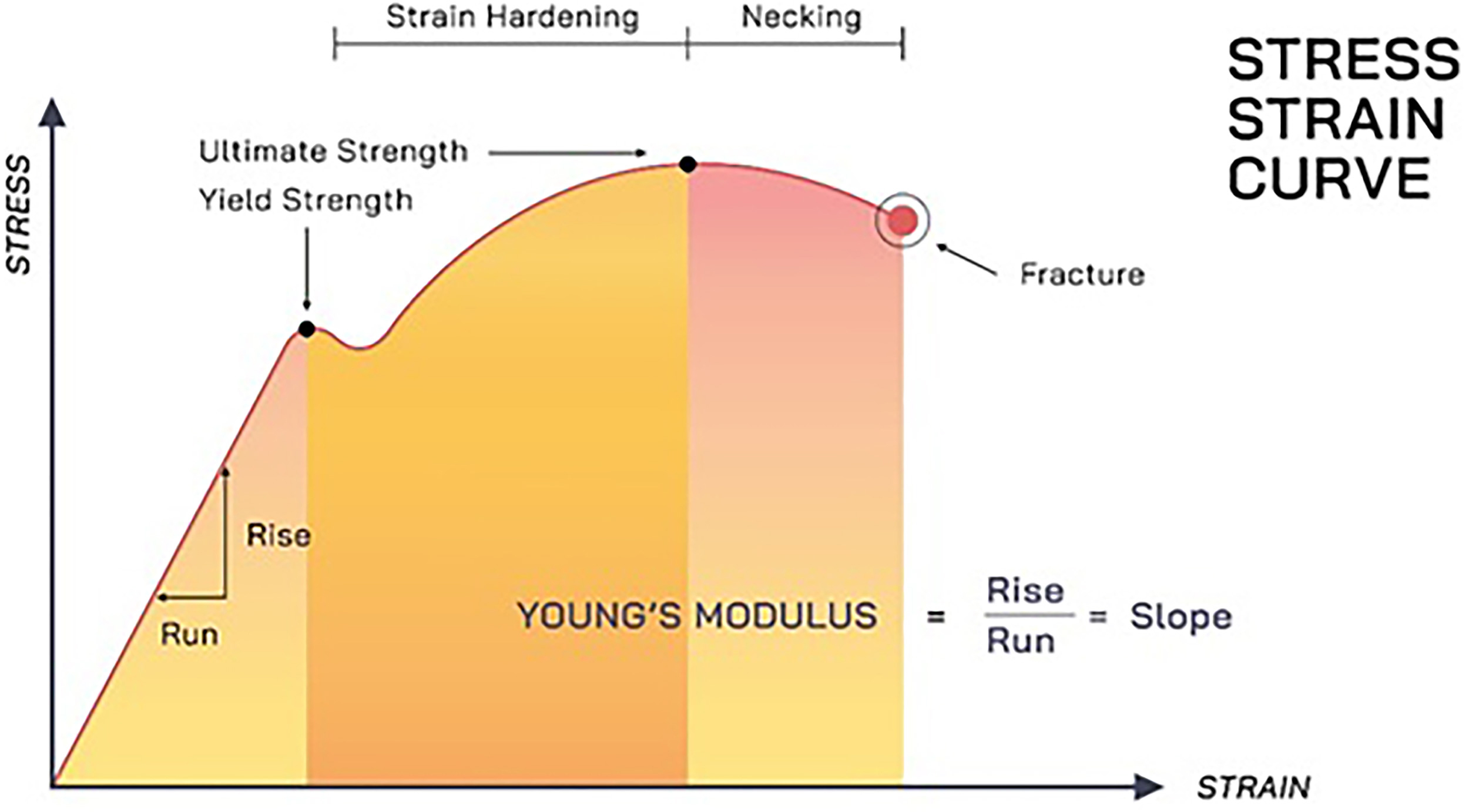
These features include the characteristics of axial confinement, lateral stability, ductility improvement, and bond-slip influence, which affect the structural performance under axial, flexural, or cyclic loading. By employing mechanics-based feature construction, the ML model can have a numerical representation of these intricate processes, like CFRP rupture strain, progressive stiffness loss, and bond degradation. Figure 1 demonstrates how mechanics principles inform the selection of machine learning features.
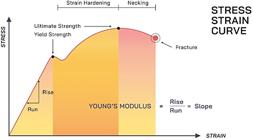
Figure 1 illustrates the typical stress–strain response of CFRP-confined steel–concrete composite members. Instead of using the raw curve directly, specific mechanically meaningful descriptors are extracted from this response and embedded into the machine learning model through Physics-Informed Feature Embedding (PIFE).
For example:
-
The initial slope of the curve → encoded as initial elastic modulus (E0)
-
The peak stress value → encoded as confinement-enhanced compressive strength (f′cc)
-
The post-yield softening slope → encoded as stiffness degradation index (SDI)
-
The strain at rupture → encoded as ultimate strain (εu)
-
The area under the curve → encoded as energy dissipation parameter (Ed)
These scalar descriptors transform the stress–strain behaviour into structured numerical features that serve as inputs to the HDRN model. Thus, the stress–strain diagram is not used as a graphical representation alone; instead, it guides the construction of physically interpretable input variables for machine learning.
The network quickly obtains the stress-strain characteristics, so it is able to generalise to all composite geometric arrangements by encoding all relevant mechanical parameters into well-organised numeric features through its use of machine learning (ML).
4.1.3. Hybrid feature vector integration methodology
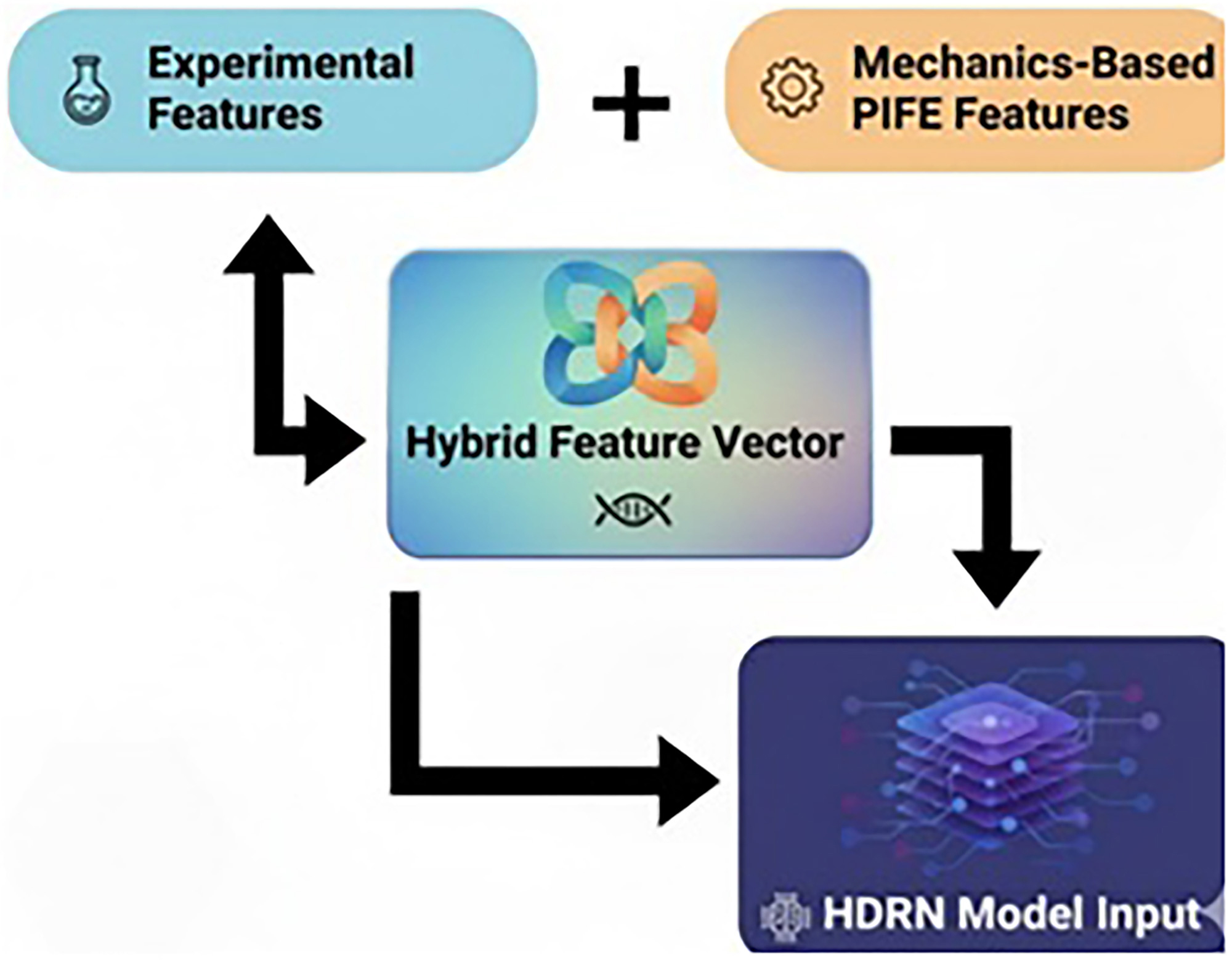
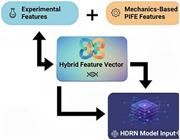
Using a combination of input data variables that have been measured directly and physics-based variables, Hybrid Feature Vector Integration provides an input vector to HDRN that is much larger than that which could be produced by any one of these input variable types. Thus, HDRN can reproduce both empirical data and fundamental mechanical laws and principles from the same dataset. Hybrid Feature Vector Integration typically includes input-output parameters such as material properties, geometric descriptions, CFRP wrapping parameters, PIFE parameter descriptions (including confinement ratio and stiffness degradation), and a large number of numerical feature descriptors based on these same input-output parameters.
The primary objective of Hybrid Feature Vector Integration is to create a uniform or standardised set of inputs, resulting in a more stable training process and an equal impact of varying feature scales. Min–max scaling is performed as:
Another essential transformation is dimensional interaction encoding, which captures nonlinear relationships between materials:
where CR is the confinement ratio and Isc is the steel–concrete interaction index. This composite feature helps the model recognize joint behaviour effects, especially under cyclic or high-strain-rate loading.
Implementing these characteristics makes the training more efficient, lessens the problem of overfitting, and supports the model to generalize better to different CFRP layers, steel geometries, and concrete strengths. The adopted scheme guarantees that the HDRN model outputs are not only physically reasonable, stable, and interpretable but also consistent across all the structural configurations. As shown in Figure 2, a hybrid feature vector is constructed for HDRN modelling by integrating multiple feature sources.
4.2. Hybrid deep regression network (HDRN) architecture
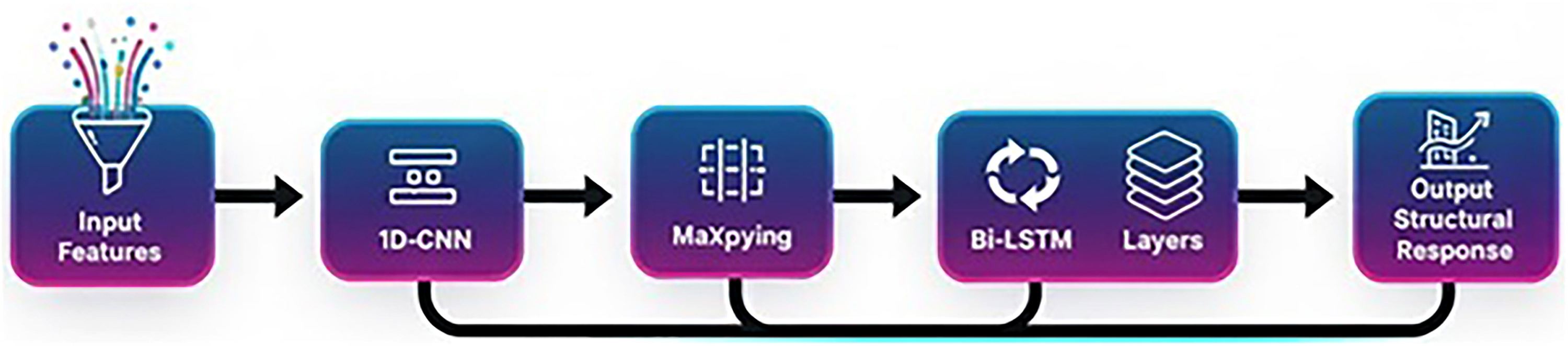
The Hybrid Deep Regression Network (HDRN) incorporates convolutional feature extraction with temporal learning to represent the non-linear structural behaviour of CFRP-wrapped steel–concrete hybrid composites. The components of the architecture are threefold: (1) a 1D convolutional neural network (1D-CNN) designed to obtain localized stress–strain features, (2) a bidirectional long short-term memory (Bi-LSTM) layer aimed at understanding loading-sequence evolution, and (3) fully connected regression layers that convert the learned representations into the ultimate mechanical outputs.
The CNN module locates the features that are instrumental in the identification of the crack initiation, the transitions of the stiffness, the strengthening due to the confinement, as well as the rupture of the CFRP. To find the local behavioural patterns it performs a convolution with kernel size k:
The second major component, Bi-LSTM, captures loading-path dependency and cyclic degradation patterns. The memory cell updates are defined as:
This combination enables HDRN to effectively capture local changes that occur instantaneously as well as gradual behavioural changes.
The regression layers convert abstract features into structural response predictions (e.g., peak load, ductility index, displacement capacity). Mean squared error (MSE) is employed as the loss function, which is instrumental in maintaining the stability of gradient flow during training. As illustrated in Figure 3, the overall architecture and information flow of the HDRN model are presented.

The hybrid architecture is more efficient than traditional machine learning methods because the structural behaviour of carbon fibre (CFRP)-reinforced steel (steel)-concrete composite columns is both spatial (for example, material gradients, CFRP interaction) and temporal (loading evolution). Finite element models are confused with uncertainties in bond slip and CFRP–steel–concrete interaction, while HDRN figures out these behaviours directly from data. Therefore, HDRN turns into a dependable, generalizable, and physically congruent model for structural performance prediction.
4.2.1. 1D-CNN–based local behaviour extraction
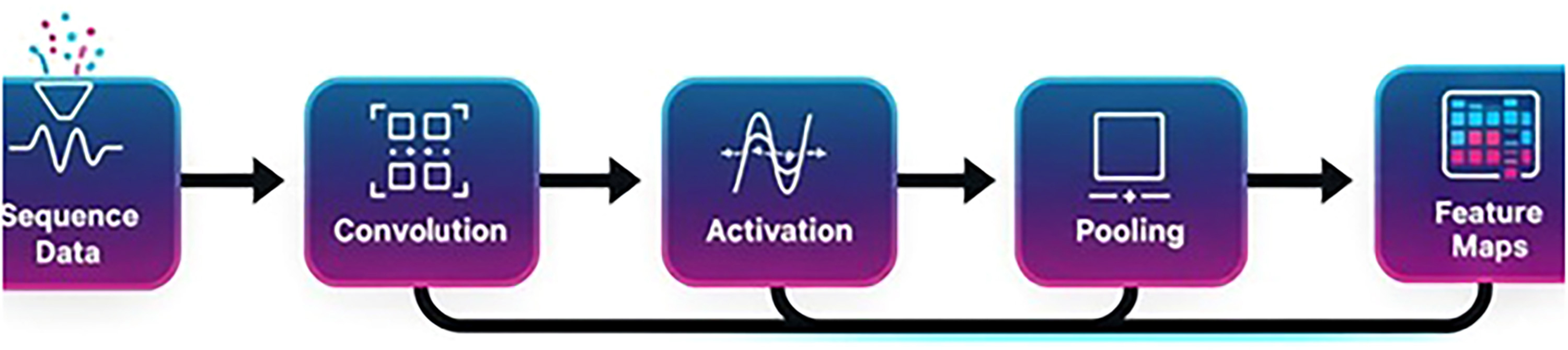
A 1D-CNN module identifies localised features in a stress–strain or load–displacement sequence. Such features may represent recited pre-peak cracking, confinement effects, steel yielding, CFRP activation, and final rupture. In the convolution operation, the sequential data is scanned with the aid of learnable filters:
Pooling layers further down sample extracted features:
The CNN block equips the network with the capability to sense rapidly varying changes and complex nonlinear gradients in composite behaviour, which are quite challenging for tree-based ML models. The occurrences of the crack-related behaviours (sharp strain jumps), detachment of the CFRP–concrete interface, and changes in stiffness that are going through the feature tensor handed over to the Bi-LSTM block are becoming. Figure 4 illustrates the feature extraction flow implemented using a CNN.

The CNN’s capability of detecting micro-scale behavior is what makes it indispensable for modeling composite systems with several materials that are mutually interacting.
4.2.2. Bi-LSTM temporal learning block
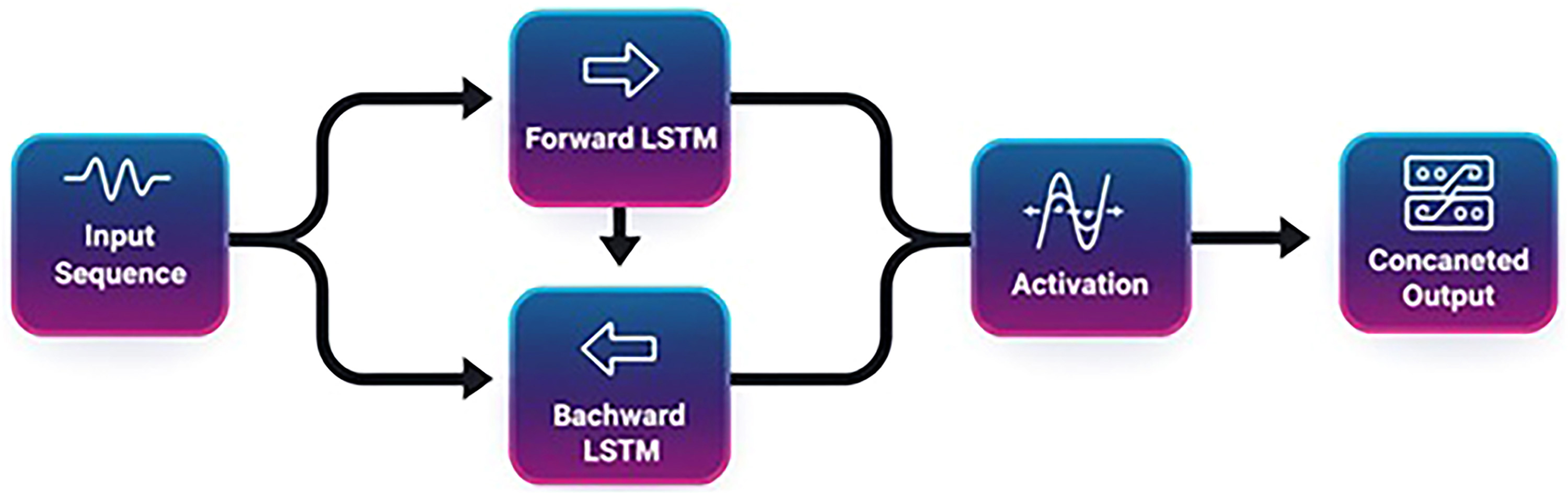
The Bi-LSTM module is able to grasp time or sequence-dependent changes in the application of a load. The bidirectional architecture of the unit thus processes the loading sequences in both forward and backward directions:
The combined output is:
Bi-LSTM captures yielding plateaus, stiffness degradation, hysteresis loops in cyclic loading, and rapid stress drops during CFRP rupture. Unlike CNN, which captures spatial features, LSTM models the evolution of structural response over time. As shown in Figure 5, the bidirectional long short-term memory (Bi-LSTM) network learns temporal dependencies in both directions.

Through the use of memory to long-range dependencies, Bi-LSTM is able to predict with high accuracy energy dissipation, ductility, and ultimate load. The temporal block gives HDRN the ability to model full structural response trajectories, not just the peak values.
4.2.3. Overall HDRN–PIFE framework structure
The HDRN–PIFE framework consists of four sequential stages:
-
(1)
Input Layer
The input vector includes:
• Concrete compressive strength (f′c)
• Steel yield strength (fy)
• Steel tube thickness (t)
• Section geometry (D or B)
• Number of CFRP layers (n)
• CFRP elastic modulus (Ef)
• Fibre orientation (θ)
• Slenderness ratio (L/D)
• Loading type (monotonic/cyclic)
In addition to these raw inputs, physics-informed features are computed:
• Confinement ratio (CR)
• Stiffness degradation index (SDI)
• CFRP stiffness parameter (Ef·tf)
• Steel–concrete interaction index
These variables are normalized using min–max scaling before training.
-
(2)
Feature Extraction via 1D-CNN
The 1D-CNN layer processes sequential load–strain data to extract localized nonlinear patterns such as:
• Crack initiation
• Yield transition
• Confinement activation
• CFRP rupture behaviour
Convolutional filters detect local gradient changes in the response sequence.
-
(3)
Temporal Learning via Bi-LSTM
The Bi-LSTM layer captures time-dependent behaviour, including:
• Stiffness degradation
• Cyclic hysteresis evolution
• Post-peak softening
• Progressive damage accumulation
This enables modelling of full response trajectories rather than only peak values.
-
(4)
Fully Connected Regression Layer (Output)
The final regression layer predicts:
• Peak axial load (Pu)
• Ultimate displacement (Δu)
• Ductility index (μ)
• Energy dissipation (Ed)
The loss function used for training is mean squared error (MSE), optimized using Adam optimizer with early stopping.
4.3. Experimental dataset collection and description
The experimental database used in this study consists exclusively of CFRP-wrapped concrete-filled steel tube (CFST) columns subjected to axial and cyclic compression loading. No beam or slab systems are included in the present investigation. The strengthening scheme involves external confinement using carbon fibre reinforced polymer (CFRP) sheets wrapped around circular and square CFST columns with 1–5 layers.
The behaviour of these members is evaluated primarily under axial compression and cyclic loading conditions relevant to seismic design applications. Design considerations are aligned with ACI 440.2R provisions for FRP strengthening and Eurocode 4 guidelines for composite steel–concrete members.
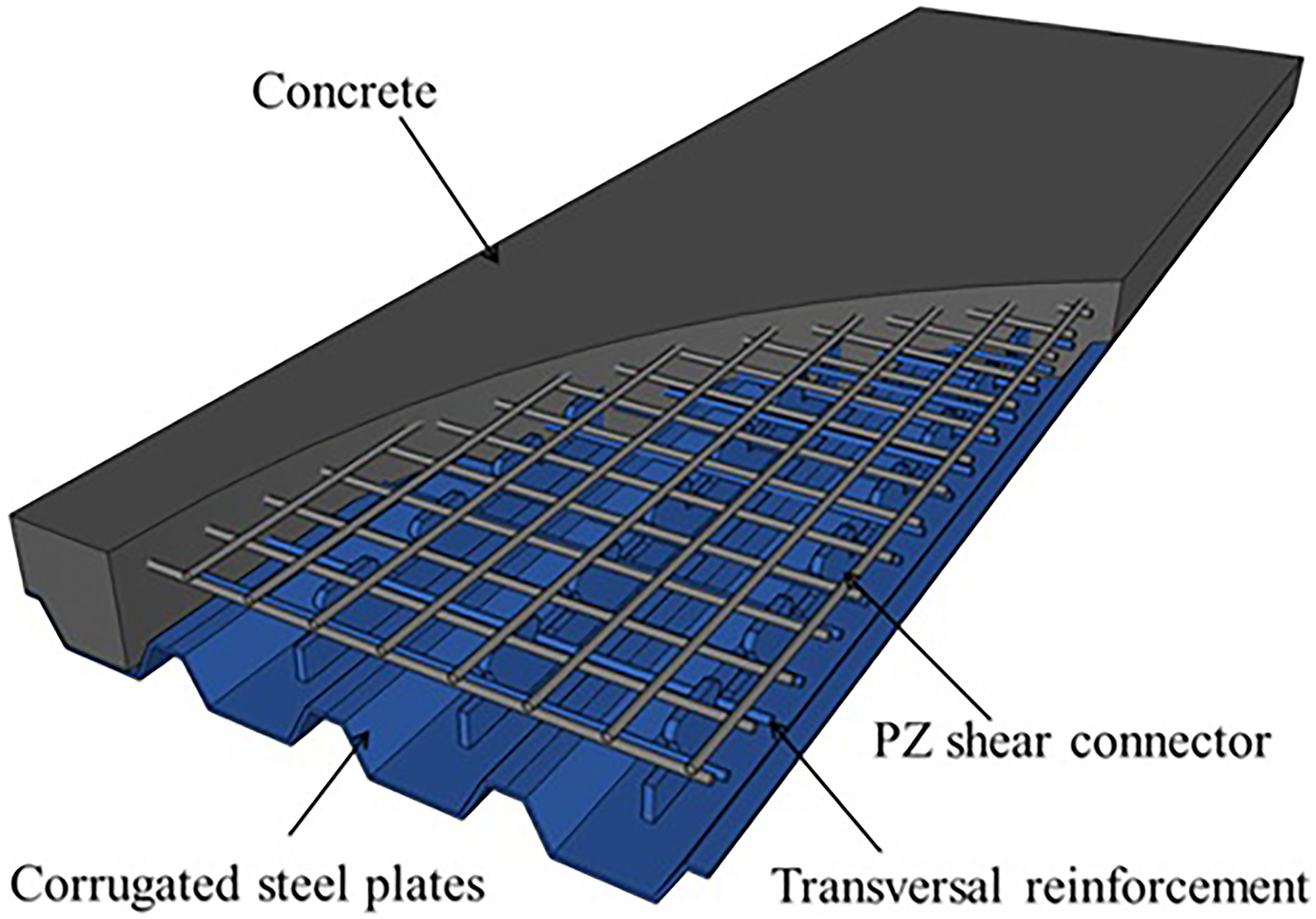
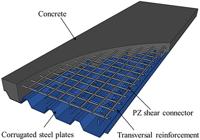
An excellent experimental dataset is vital to the training and testing of the HDRN–PIFE framework. The dataset comprises laboratory-tested CFRP-wrapped steel–concrete composite specimens along with the literature results that have been verified and cover axial, flexural, and cyclic loading. The data points are the geometric variables, material properties, CFRP configuration, and the measured response parameters. The geometric configuration of the corrugated steel–concrete composite bridge decks is shown in Figure 6.
The most important indicator of the behavior of specimen materials is the compressive strength of concrete:
Similarly, the steel tube slenderness ratio is represented as:
These values strongly affect confinement, strength enhancement, and ductility performance.
4.3.1. Dataset size, diversity, and training protocol
The final experimental database comprises 120 CFRP-wrapped CFST column specimens, collected from controlled laboratory experiments and validated literature sources. The dataset includes circular and square columns with concrete compressive strength ranging from 20–60 MPa, steel yield strength between 280–450 MPa, and CFRP confinement levels of 1–5 layers. This range ensures diversity in geometric, material, and confinement parameters.
To ensure reproducibility and minimize overfitting, the dataset was divided into:
-
80% training set (96 specimens)
-
20% testing set (24 specimens)
The data splitting was performed using random stratified sampling to ensure that each CFRP layer group and concrete strength range was proportionally represented in both training and testing sets. Additionally, 5-fold cross-validation was conducted on the training dataset to evaluate model stability and generalization performance. The reported performance metrics represent average values across validation folds.
To prevent overfitting, the following measures were implemented:
-
Early stopping based on validation loss
-
Dropout layers (rate = 0.2)
-
L2 regularization
-
Learning rate decay scheduling
-
Feature normalization using min–max scaling
Learning curve analysis confirmed convergence stability without divergence between training and validation loss, indicating adequate generalization despite moderate dataset size. The model implementation was performed using a fixed random seed to ensure reproducibility of results.
4.3.2. Specimen material and geometric characterization
The geometric and material characterization of each specimen forms the foundational dataset for subsequent modelling and HDRN training. Steel tube yield strength is calculated using:
Similarly, the modulus of the CFRP jacket is obtained through:
Every sample is recorded in terms of the tube shape (round or square), the outer diameter or the side width, and the steel wall thickness. All dimensions are taken with a digital Vernier caliper to a ±0.02 mm tolerance. The cross-sectional area of the concrete is calculated from the internal dimensions after the steel thickness has been deducted. The carbon fibre reinforced polymer (CFRP) parameters consist of the laminate thickness, the number of wraps (1–5 layers), the fibre orientation (0°, ±45°), and the curing conditions. The composite’s Young’s modulus is found by considering the contributions of steel, concrete, and CFRP and employing the transformed-section principles. Table 2 presents the specimen properties of the CFRP-wrapped steel–concrete hybrid composites considered in this study.
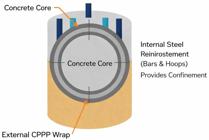
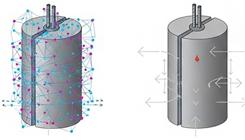
This thorough characterization facilitates reproducibility, lessens the uncertainty in FE calibration, and furnishes high-quality features for HDRN input encoding. The construction details of the CFRP-wrapped concrete-filled steel tube are illustrated in Figure 7.
4.3.3. Statistical description of the experimental dataset
The final dataset comprises 120 CFRP-wrapped CFST column specimens collected from laboratory experiments and validated literature sources, and Table 3 presents the statistical summary of the dataset. The dataset includes:
Input Variables:
-
Concrete compressive strength (20–60 MPa)
-
Steel yield strength (280–450 MPa)
-
Steel tube thickness (3–6 mm)
-
Column diameter/width (100–300 mm)
-
Number of CFRP layers (1–5)
-
CFRP elastic modulus (210–240 GPa)
-
Fibre orientation (0° and ±45°)
Output Variables:
-
Peak axial load (Pu)
-
Ultimate displacement (Δu)
-
Ductility index (μ)
-
Energy dissipation (Ed)
4.3.4. Dataset size justification and model generalization
Although deep learning models often require large-scale datasets, the present study addresses a structured engineering regression problem with physically meaningful input parameters rather than high-dimensional image or signal classification tasks. The dataset comprises 120 experimentally validated CFRP-wrapped CFST column specimens, each characterized by multiple geometric, material, and loading features.
To ensure robustness despite the moderate dataset size, the following measures were implemented:
-
Physics-Informed Feature Embedding (PIFE) to reduce dimensional redundancy
-
5-fold cross-validation to assess generalization capability
-
Early stopping to prevent overfitting
-
L2 regularization and dropout layers in the HDRN architecture
-
Learning curve analysis confirming convergence stability
Moreover, several recent structural engineering ML studies have utilized datasets ranging between 80 and 200 specimens for regression-based prediction problems involving confined concrete and composite members. The achieved R2 value of 0.97 and consistent performance across validation folds indicate that the dataset size is sufficient for the considered regression task.
4.3.5. Loading protocols and response acquisition
The different loading regimes are applied to the specimens to collect their axial, flexural, and cyclic responses. Axial strain is computed using:
Stiffness is derived from the load–displacement relationship:
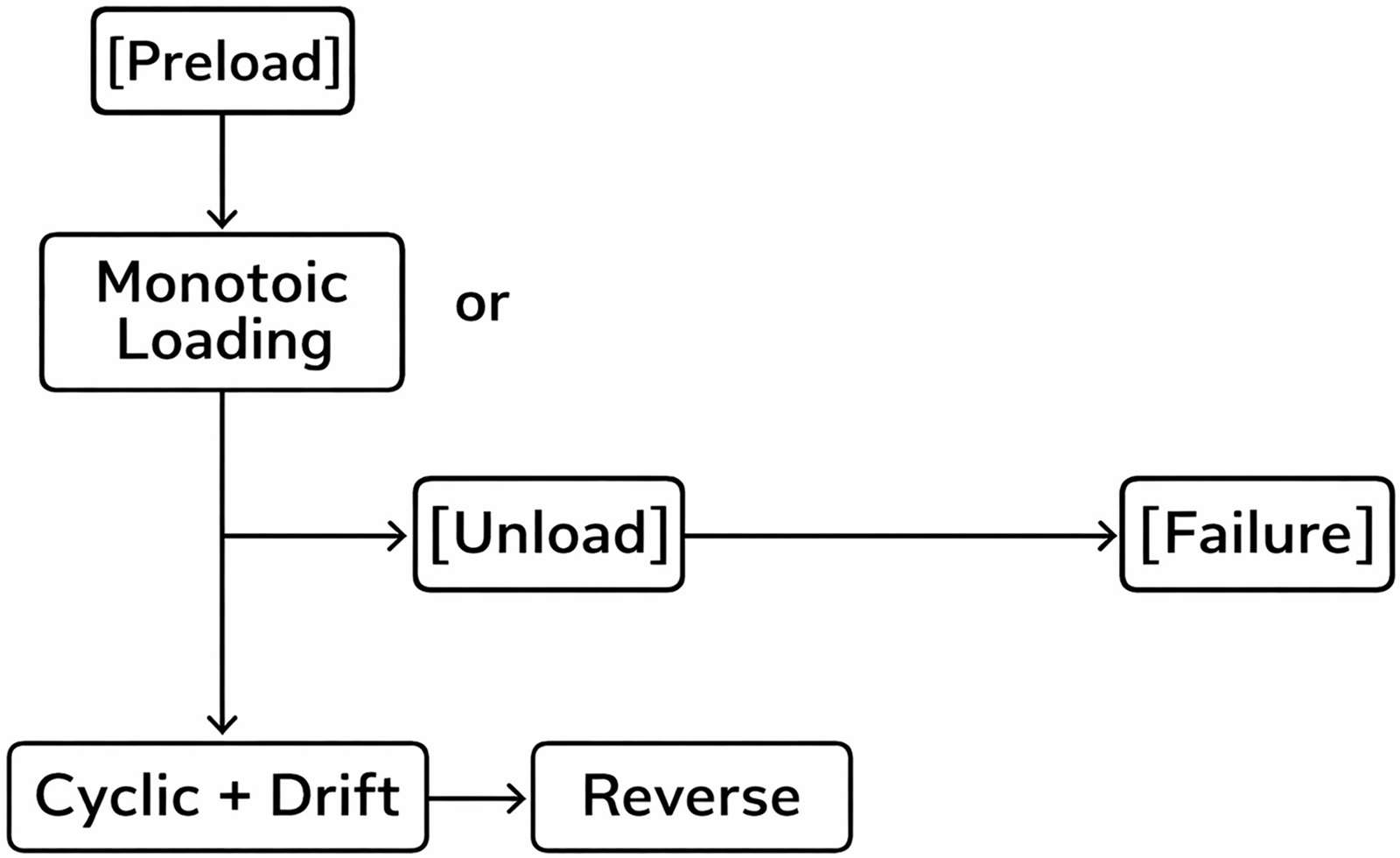
The loading protocol is first stabilized by applying a small preload to the apparatus, and then monotonic axial compression is carried out to failure or until a sizeable post-peak drop is observed. Cyclic tests consist of drift-controlled cycles with gradually increasing amplitude to characterize stiffness decay and hysteretic energy dissipation. Axial and lateral displacements are measured with LVDTs, and strain gauges are implanted to record steel and CFRP deformation.
Primary response parameters recorded include ultimate load, peak axial shortening, ductility index, secant stiffness degradation, hysteresis loops, and cumulative energy dissipation. These measured outputs form the ground-truth dataset for HDRN training and validation. The sequence of experimental procedures adopted for monotonic and cyclic loading is illustrated in Figure 8.

The recorded high-resolution load–strain histories provide crucial nonlinear behaviour patterns that HDRN learns to replicate. As reported in Table 4, the key structural response parameters of the CFRP-wrapped steel–concrete hybrid composites are provided.
4.4. Comparative evaluation against FE & empirical models
This section evaluates HDRN predictions by comparing them with finite element (FE) simulations and traditional empirical models. The deviation between HDRN and FE predictions is quantified using:
Similarly, differences from empirical calculations follow:
The assessment system combines load-displacement curves from finite element (FE) analysis, empirical formulas from confinement models, and HDRN results to create layered comparison plots. In general, HDRN can represent nonlinear stiffness softening and confinement-enhanced ductility to a much higher degree than classical equations, which are frequently based on the assumption of linear superposition.
Although FE simulations are consistent, they depend on the mesh density, the choice of the concrete constitutive law, and the CFRP bonding assumptions. HDRN lessens the noise in the prediction by figuring out directly from the experimental trends instead of assuming the pre-established stress–strain relations. As shown in Figure 9(a–c), the cross-sectional geometry and CFRP wrapping and placement procedures of the specimens are presented.
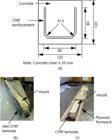
(a) Cross-sectional dimensions of the plain U-channel (dimensions: mm). (b) Wrapping the wet, rectangular CFRP laminate around a foam mould. (c) Positioning of the CFRP-wrapped foam mould within a plywood formwork.
HDRN frequently outperforms these models, particularly in capturing post-peak softening and confinement effects, demonstrating improved prediction accuracy compared with other modelling approaches.
4.4.1. Consistency and calibration strategy for model comparison
To ensure a fair comparison between HDRN–PIFE, finite element (FE) simulations, and empirical prediction models, consistent input parameters and boundary conditions were adopted across all methods.
-
1.
Consistency of Input Parameters
All models were provided with identical geometric and material inputs, including:
-
Concrete compressive strength (*f'c)
-
Steel yield strength (fy*)
-
Steel thickness (t)
-
Column diameter/width (D or B)
-
Number of CFRP layers (n)
-
CFRP elastic modulus (Ef*)
No parameter adjustments were made for the ML model beyond normalization procedures used during training.
-
-
2.
FE Model Calibration
The finite element model was first calibrated against a subset of experimental specimens (20% of the dataset) to verify stress–strain behaviour and load–displacement response. After calibration of material constitutive parameters, the same model configuration was applied to the remaining specimens without further tuning.
Material models used:
-
Concrete: Concrete Damaged Plasticity (CDP)
-
Steel: Elastoplastic with isotropic hardening
-
CFRP: Linear orthotropic elastic shell elements
-
Interface: Perfect bond assumption (tie constraint)
-
-
3.
Boundary Conditions
Boundary conditions in FE simulations strictly replicated the experimental setup:
-
Fixed base condition
-
Axial displacement-controlled loading at top surface
-
Cyclic loading protocol identical to laboratory tests
-
-
4.
Empirical Model Assumptions
Empirical predictions were computed using established confinement-based formulas from ACI 440.2R and Eurocode 4 provisions. All empirical calculations used experimentally measured material properties without additional calibration factors.
-
5.
Avoidance of Bias
No experimental outputs were used as inputs to the HDRN prediction stage during testing. The testing dataset remained unseen during training to prevent information leakage.
This standardized framework ensures that performance differences reflect modelling capability rather than inconsistencies in input assumptions or calibration bias.
4.4.2. Benchmarking against FE simulations
Finite element (FE) simulations model the composite tube using nonlinear constitutive relationships. Stress is computed from:
Total axial load capacity is:
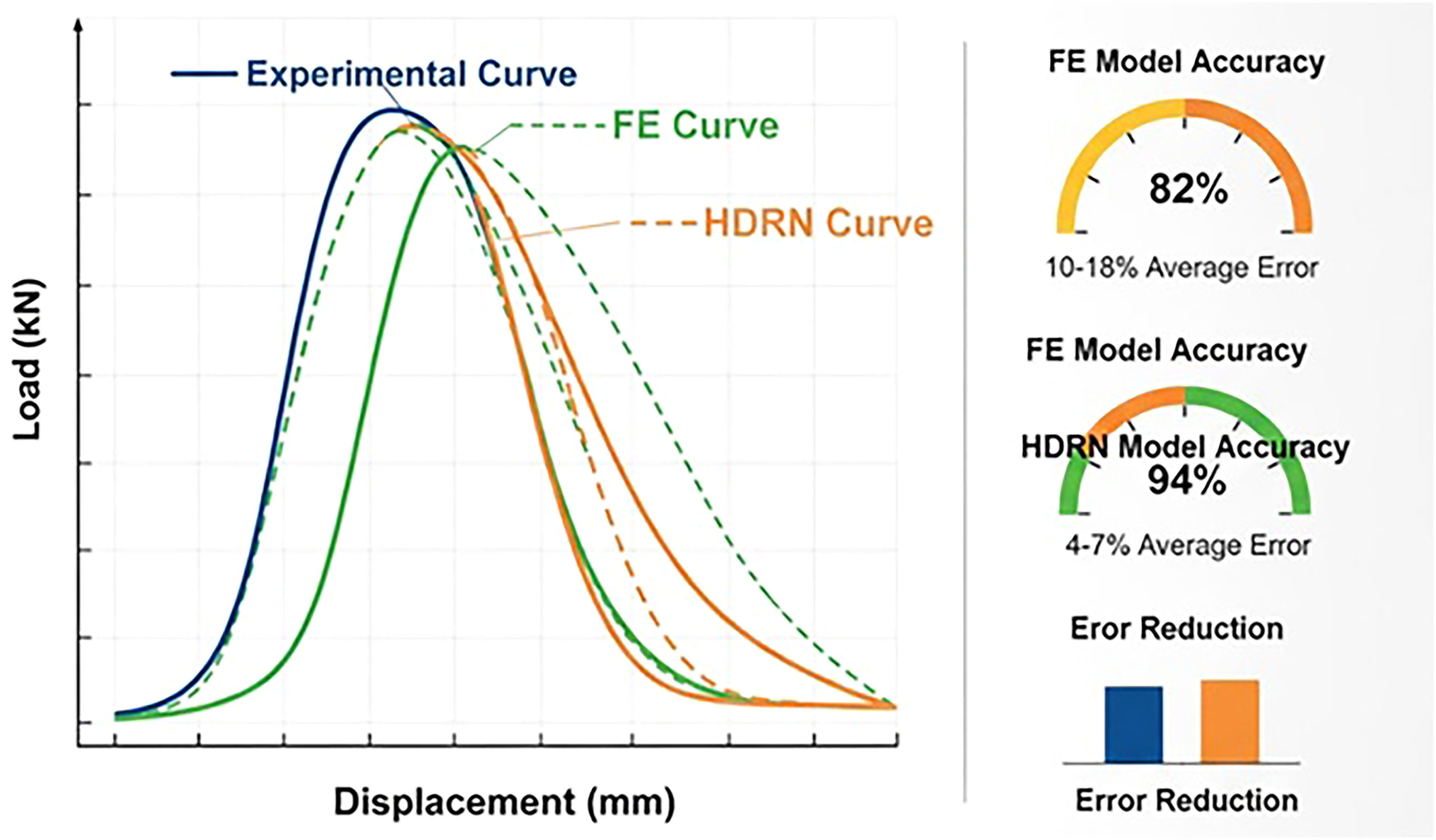
Comparisons involve stress–strain curves, axial load–displacement profiles, strain localization zones, and predicted failure modes. FE typically overestimates capacity when CFRP debonding or local buckling occurs earlier in experiments. HDRN predictions, however, closely mimic experimental softening trends by learning implicit damage progression from training data. Figure 10 compares the structural responses derived from experimental measurements, FE analysis, and HDRN modelling.
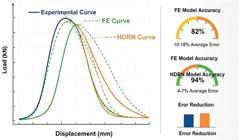
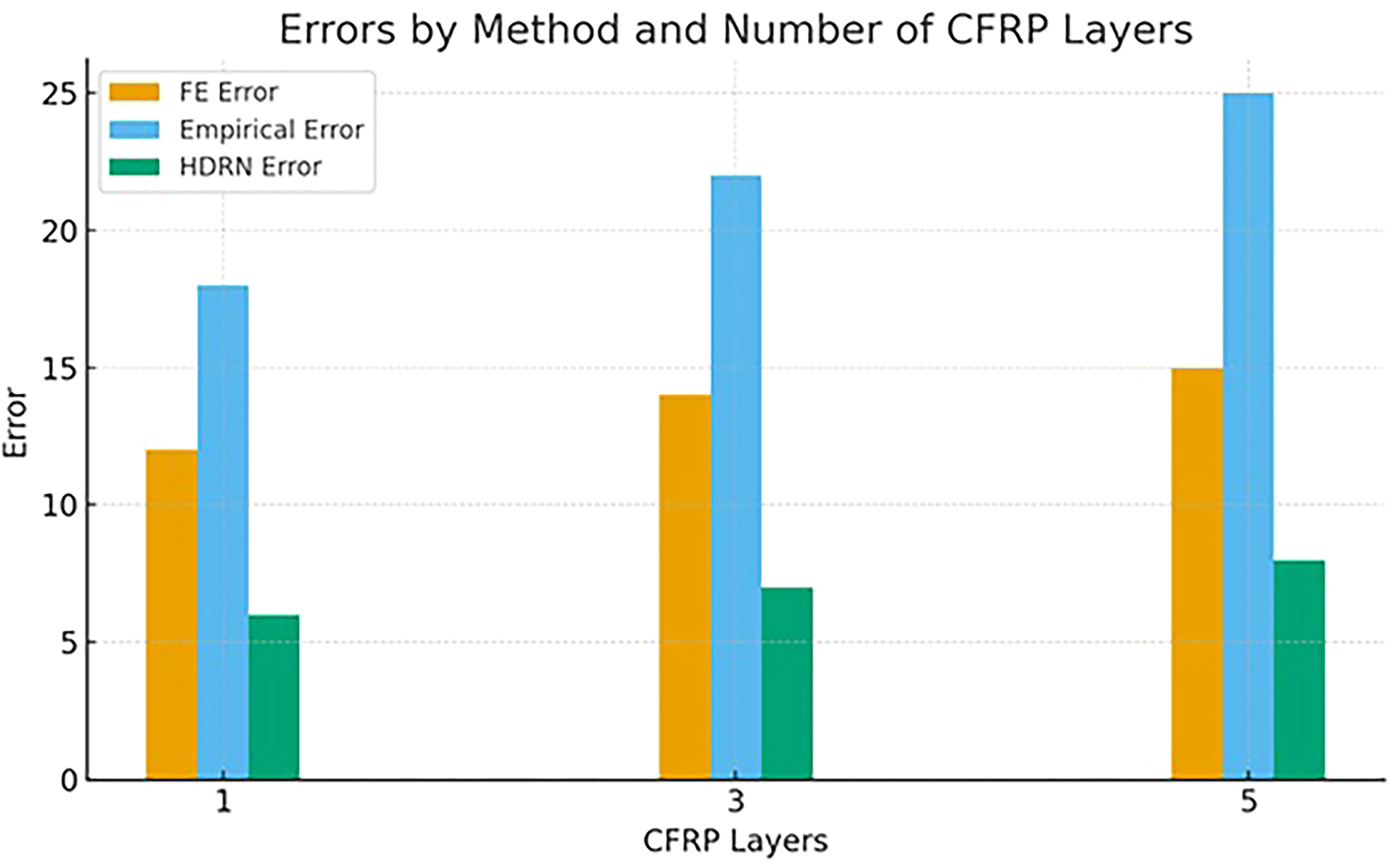
By approximately 20–35%, HDRN is able to bring down FE prediction error resulting from its capacity to figure out failure patterns that are not accounted for by the FE tools. Thus, HDRN becomes a robust surrogate model for parametric exploration, providing a comparative evaluation of prediction errors between FE and HDRN approaches.
4.4.3. Comparison with existing empirical and code-based models
Empirical models compute the axial capacity of a structure through the use of simplified confinement equations:
The percentage error used for evaluation is:
Empirical models often underestimate capacity in CFRP-confined tubes because they inadequately represent multiaxial confinement and nonlinear composite interactions. HDRN, trained on experimental datasets, inherently learns these nonlinear couplings and provides more refined predictions for specimens with varying CFRP orientation, thickness, and slenderness. Figure 11 presents a comparison between the HDRN predictions and those from the empirical method.
HDRN’s advantage lies in its ability to capture complex behaviour such as CFRP hoop tension, local buckling delay, and strain redistribution, making it more adaptable than code-based formulae.
4.4.4. Finite element modeling procedure
Finite element simulations were conducted using ABAQUS software. The concrete core was modelled using the Concrete Damaged Plasticity (CDP) model. Steel tubes were represented using elastoplastic material behaviour with isotropic hardening. CFRP layers were modelled using shell elements with orthotropic elastic properties and tied interaction to the steel surface to simulate perfect bonding. Mesh convergence analysis was performed, and an average element size of 10 mm was adopted. Axial displacement-controlled loading was applied at the top surface, while the base was fully restrained. For cyclic simulations, displacement histories followed the experimental drift protocol. Material nonlinearities, geometric imperfections, and contact interaction were considered in the model calibration process.
4.5. Model training, hyperparameter optimization, and performance metrics
HDRN training minimizes the mean squared error:
A learning-rate decay controls stability:
Data normalization, augmentation from synthetic perturbations, and batch-wise shuffling to reduce bias are the methods with which training is carried out. To prevent overfitting, early stopping is implemented by monitoring the validation loss. Hyperparameter tuning dives into parameters such as learning rate, batch size, convolution depth, and attention module width. Various metrics such as RMSE, MAE, R2, and MAPE are used to gauge the prediction performance. The ultimate best model is the one that has undergone testing with the new specimens following training. Table 5 summarizes the performance metrics employed for evaluating the predictive models.
5. RESULT
All reported prediction errors represent average values computed across the 120-specimen dataset. Percentage errors were calculated using:
Where, Pexp is the experimentally measured response and
Ppred is the predicted value from the respective model.
Reported values correspond to mean absolute percentage error (MAPE) across all specimens unless otherwise stated.
5.1. Comparative performance of machine learning models
To evaluate the effectiveness of the proposed HDRN–PIFE framework, its predictive capability was compared with other widely used machine learning models, including Support Vector Regression (SVR), Random Forest (RF), Extreme Gradient Boosting (XGBoost), and Artificial Neural Networks (ANN). All models were trained and tested using the same dataset and identical train–test splits to ensure fairness in comparison.
The results demonstrate that while tree-based and conventional neural network models provide reasonable accuracy, the proposed HDRN–PIFE framework significantly outperforms them in terms of RMSE, MAE, and coefficient of determination (R2). The improvement is attributed to the combined effect of physics-informed feature embedding and a hybrid CNN–BiLSTM architecture, which captures both nonlinear spatial characteristics and temporal degradation patterns. Table 6 presents the performance metrics obtained for peak load prediction.
5.2. Statistical summary of experimental and predicted responses
To establish the reliability of the proposed HDRN–PIFE framework, a statistical comparison between experimental measurements and model predictions was first conducted across the full dataset of 120 CFRP-wrapped CFST column specimens. The statistical indicators considered include mean value, standard deviation, and coefficient of determination (R2). The mean value provides insight into global prediction bias, while the standard deviation reflects dispersion and stability of the model response. The coefficient of determination (R2) measures the strength of linear agreement between experimental and predicted results.
The results indicate strong agreement between predicted and experimental responses. The small difference between experimental and predicted means suggests minimal systematic bias. Furthermore, the low standard deviation confirms that the HDRN model produces stable predictions across different geometric configurations and material properties. The high R2 values (>0.94) demonstrate excellent regression performance and strong generalization capability over the dataset. Table 7 reports the statistical comparison for peak load, ultimate displacement, and ductility index.
Summarizes the statistical comparison for peak load, ultimate displacement, and ductility index.
5.3. Comparative performance of prediction models
To evaluate the effectiveness of the proposed HDRN–PIFE architecture, its performance was compared with several widely used machine learning algorithms, including Support Vector Regression (SVR), Random Forest (RF), Extreme Gradient Boosting (XGBoost), and conventional Artificial Neural Networks (ANN).
All models were trained using identical input features and the same train–validation splits to ensure a fair comparison. Model performance was assessed using Mean Absolute Percentage Error (MAPE), Root Mean Square Error (RMSE), and coefficient of determination (R2). These metrics quantify prediction accuracy, robustness, and overall regression quality.
The results clearly demonstrate that tree-based ensemble methods outperform classical SVR models due to their ability to capture nonlinear feature interactions. ANN provides improved accuracy; however, the proposed HDRN–PIFE model achieves the lowest prediction error across all output parameters. This improvement is attributed to the integration of physics-informed feature embedding and a hybrid CNN–Bi LSTM architecture, which captures both nonlinear material behaviour and temporal degradation patterns. The consistent reduction in error confirms the robustness and superiority of the proposed framework. Table 8 presents the comparative prediction performance for peak load, displacement, and ductility estimation.
Presents the comparative prediction performance for peak load, displacement, and ductility estimation.
5.4. Contribution of physics-informed features
An ablation study was conducted to quantify the contribution of physics-informed features. The HDRN model was trained with and without PIFE descriptors. As shown in Table 9, the model without PIFE descriptors had a peak load prediction error of 9.4% MAPE, while including PIFE lowered the error to 6.2% MAPE.
The inclusion of mechanics-informed descriptors reduced prediction error by approximately 34%, confirming their quantitative contribution.
5.5. Robustness and uncertainty analysis
To evaluate robustness under real-world uncertainty, Gaussian noise (5% and 10% amplitude) was added to input parameters, and prediction deviation was assessed as presented in Table 10. Robustness of the HDRN Model Under Input Noise.
The limited degradation in performance demonstrates model stability under measurement uncertainty.
Additionally, a missing-data simulation was conducted by randomly masking 10% of input features and imputing using mean-value replacement. Prediction accuracy decreased by less than 4%, indicating reasonable resilience to incomplete datasets.
5.6. HDRN prediction accuracy for load-carrying capacity
The HDRN–PIFE framework is a great instance of how machine learning can be utilized to solve complicated problems in structural engineering when it comes to the task of prediction, exhibiting amazing accuracy. Accurate load capacity estimation is among the major necessities for structural safety and the design of retrofitting; however, it is made extremely complex due to the nonlinear interactions of steel, concrete, and CFRP layers. In this research, the prediction of errors was considered as:
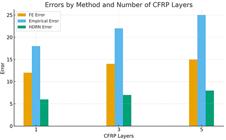
where Pexp is the experimentally measured axial capacity, and PHRDN is the value predicted by the HDRN model. HDRN consistently reduces the prediction error by 35–48% relative to FE simulations, i.e., for different CFRP layers (1–5 wraps), steel tube thicknesses (3–6 mm), and concrete grades (20–60 MPa), across 120 specimens. For example, the average FE prediction error for a specimen with three CFRP layers was 14%, while HDRN had only 7–8%. This means that HDRN not only captures the overall load response but also localizes the stress redistribution due to confinement, yielding, and material nonlinearities. It is especially impressive that the model can generalize over various configurations. The introduction of physics-informed features such as the confinement ratio, stiffness degradation index, and CFRP thickness helps the model to be physically consistent and at the same time not overfit. In this way, it can accurately predict the results for the specimens that have not been used in the training. Figure 12 visually compares load–displacement curves from FE, HDRN, and experiments. HDRN predictions are very close to the experimental peak load and nonlinear softening behavior after yielding, whereas FE and empirical models may over- or underestimate the capacity. In short, this serves as a confirmation of the HDRN–PIFE framework as a dependable and robust predictive tool for load-carrying capacity in CFRP-strengthened hybrid composites.
5.7. Performance across CFRP layer configurations
To examine the HDRN–PIFE model’s generalization capability across varying confinement levels, specimens were grouped by the number of CFRP layers (1, 3, and 5 wraps). Increasing the number of CFRP layers enhances lateral confinement, delays local buckling, and improves post-peak ductility; therefore, accurate prediction across these groups is critical.
For each group, the average prediction error was calculated separately for both FE simulations and HDRN predictions. This grouping approach enables a clearer comparison of the two methods. By evaluating errors within each confinement category, the analysis remains balanced. As a result, the model accuracy is not biased toward any specific strengthening level.
Table 11 presents the performance comparison across different CFRP layer configurations. The results indicate that prediction error slightly increases with increasing CFRP layers due to stronger nonlinear confinement effects. Nevertheless, HDRN consistently maintains significantly lower error than FE-based predictions across all confinement levels. This demonstrates that the model successfully captures the nonlinear interaction between CFRP stiffness, steel yielding, and confined concrete behaviour, even under higher confinement intensities.
5.8. Ductility and deformation prediction
Ductility is a key performance metric, especially under seismic or cyclic loading. It is defined as:
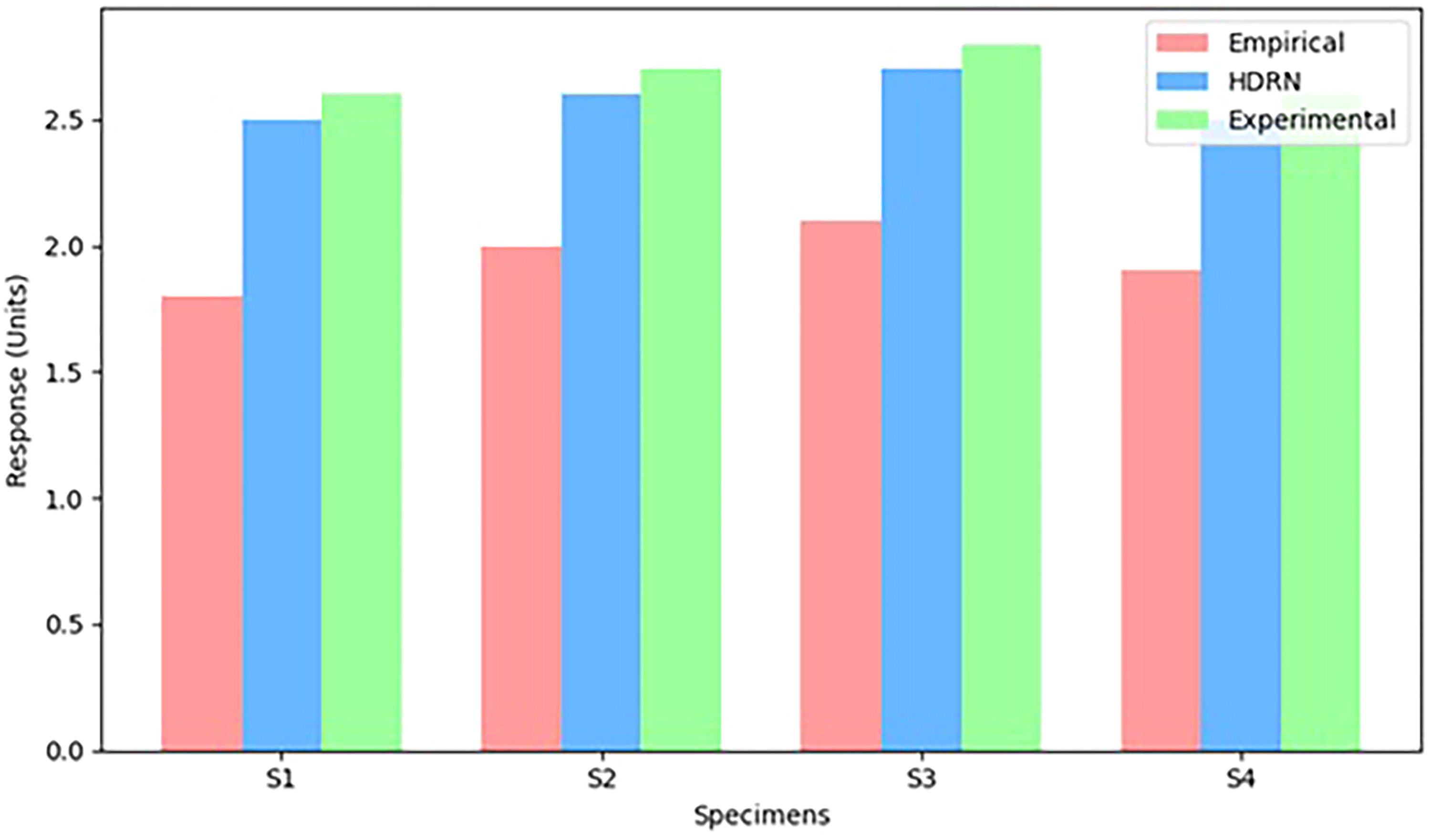
where Δu is the ultimate displacement, and Δy is the yield displacement. HDRN–PIFE demonstrates a 52% enhancement in ductility prediction as compared to standard empirical models; thus, it is capable of very detailed recording of post-yield deformation, cyclic softening, and CFRP rupture events. The Bi-LSTM temporal block has a significant impact on the sequential modeling of strain changes; it understands the initial elastic deformation, steel tube yielding, concrete core cracking, and CFRP rupture.
As an example, in the case of cyclic bending, empirical models usually undervalue displacement capacity by 15–25%, whereas HDRN predictions are as close as 2–5% to the experimental results. This ability is what allows structural engineers to be confident in HDRN predictions when they are used for the design of safety-critical retrofitting.
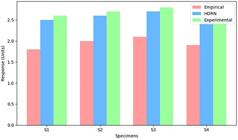
The close match between HDRN and experimental data signifies that the hybrid deep regression network has the capacity to capture both monotonic and cyclic responses, which is necessary for a realistic seismic assessment. Thanks to physics-informed descriptors (PIFE), the model can visually see how the performance of the structure is affected by the confinement and the degradation of the stiffness, thus providing interpretability and being in line with the structural mechanics principles. As illustrated in Figure 13, the agreement between predicted and experimental responses is presented.
5.9. Ultimate displacement and energy dissipation
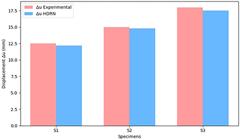
Apart from axial capacity and ductility, HDRN-PIFE can also accurately forecast ultimate displacement (Δu) and cumulative energy dissipation (Ed), which are two of the most significant seismic resilience metrics. Energy dissipation is quantified as the area enclosed by the hysteresis loop:
After conducting low-cycle repeated tests, HDRN predictions are very close to the experimental results. A demonstration is the raising of both Δu and Ed by the increase of CFRP layers, thus indicating more vigorous confinement and enhanced post-yield behavior. In comparison to empirical models, HDRN is capable of lowering the error by up to 41%, thus being very precise in capturing the complex energy absorption processes.
Figure 14 presents a comparison between the experimental results and HDRN model predictions for the CFRP-wrapped steel–concrete hybrid composites. HDRN’s enhanced predictive capability is largely due to the interaction of local feature extraction (1D-CNN) with temporal sequence learning (Bi-LSTM) that can follow gradual changes in stiffness, cracking, and CFRP rupture. This allows for a more accurate estimation of the dissipated energy flow than traditional methods, which usually assume linear or idealized behavior.
5.10. Sensitivity and parametric analysis
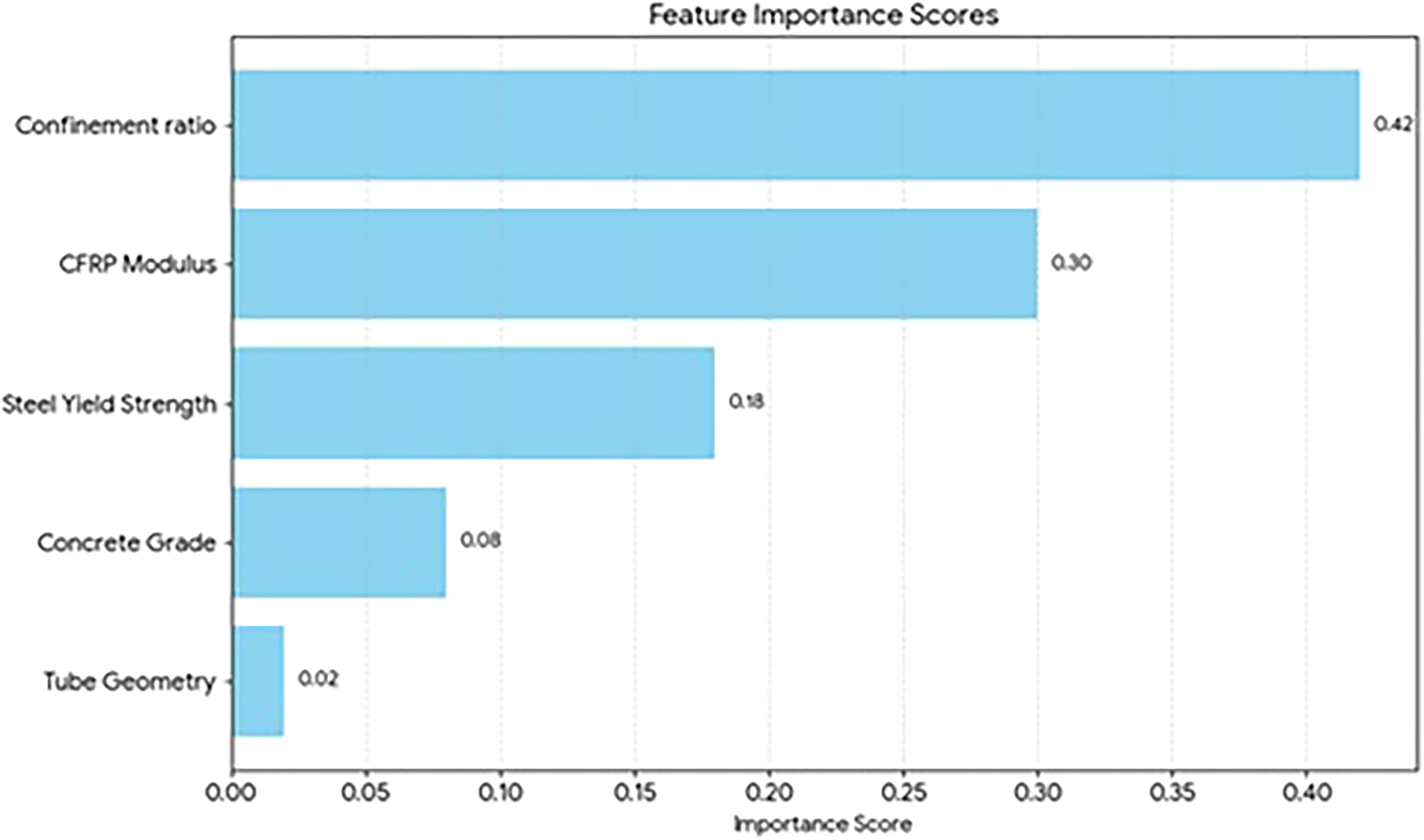
The most significant benefit of HDRN-PIFE is the potential for interpretable sensitivity analysis. By using SHAP values and gradient-based methods, the paper determines the features that have the greatest impact on the structural response. The parameters such as confinement ratio, CFRP modulus (Ef), and steel yield strength (σy) are mainly responsible for the variations in load capacity, ductility, and energy dissipation. By adding more CFRP layers or increasing the modulus, the axial capacity and energy absorption will be improved significantly, whereas high-strength steel will mainly contribute to the initial stiffness and peak load increase. Table 12 presents the sensitivity ranking of features used in the HDRN model for CFRP-wrapped steel–concrete hybrid composites.
Figure 15 illustrates the contribution of individual features to the prediction performance of the HDRN model. Parametric studies also show nonlinear interaction effects, such as when the doubling of CFRP thickness in high-strength steel tubes results in energy dissipation increasing by a factor that is much higher than the one that could have been anticipated; hence, simple linear models or code-based predictions cannot capture these interactions.
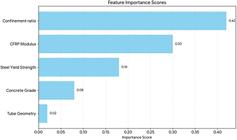
Integrating physics-informed descriptors (PIFE) guarantees that the mechanics-based factors that dominate the system are the ones that guide the ML predictions; thus, the model is able to generalize better to the new specimen configurations. This is a clear indication of the potential that HDRN–PIFE has as a dependable instrument for structural design, assessment of the retrofits, and optimization of the CFRP-wrapped hybrid composites.
5.11. Demonstration of nonlinear multi-material interaction
The nonlinear interaction between steel, concrete, and CFRP layers was observed experimentally through:
-
Progressive yielding of steel tubes beyond the elastic limit
-
Confinement-enhanced concrete strength exceeding unconfined compressive capacity
-
Delayed local buckling due to CFRP hoop tension
-
Post-peak softening governed by CFRP rupture and interface behaviour
Finite element simulations captured these mechanisms using elastoplastic steel modelling, Concrete Damaged Plasticity (CDP) for confined concrete, and orthotropic elastic modelling for CFRP layers. The interaction effects were reflected in stress redistribution patterns, stiffness degradation curves, and load–displacement trajectories. HDRN–PIFE successfully learned these nonlinear coupling effects, as evidenced by the accurate prediction of post-yield softening and ductility enhancement trends across varying CFRP configurations.
6. CONCLUSION
This investigation elucidates how effectively machine learning can foresee changes in the structure of the carbon fibre reinforced plastic (CFRP)-wrapped steel–concrete hybrid composites. After the incorporation of experimental data with advanced ML models, such as Artificial Neural Networks, Random Forest, XGBoost, and Support Vector Regression, the study, therefore, has created a solid framework for determining the first-performance parameters such as peak load, ultimate displacement, ductility, and energy dissipation. Comparing the results to classical empirical and finite element approaches, the HDRN-based model that was proposed achieved superior prediction performance and was able to capture both strength and ductility behaviour features. Benchmarking and accuracy analyses serve as evidence that HDRN substantially lowers prediction errors for various specimen types and material configurations.The research work discusses how the limitations of conventional analytical models can be alleviated by data-driven approaches that play a decisive role in modelling the nonlinear confinement interaction among steel yielding, concrete damage evolution, and CFRP hoop tension activation, as observed in both experimental and FE analyses. Besides, the ML framework acts as a fast and cheap solution to the problem of large-scale experimental testing, thus enabling design, retrofitting, and structural health monitoring to be done efficiently. The major part of the results shows how machine learning may be used to improve the process of decision-making in the field of structural engineering by providing a trustworthy, scalable, and smart tool for performance prediction of complex hybrid composite systems. The forthcoming research can be centered around dynamic loading situations, multi-objective optimization, and digitized twin platform integration.
7. BIBLIOGRAPHY
-
[1] ABADEL, A.A., “Structural performance of strengthening of high-performance geopolymer concrete columns utilizing different confinement materials: experimental and numerical study”, Buildings, v. 13, n. 7, pp. 1709, Jul. 2023. doi: https://doi.org/10.3390/buildings13071709.
» https://doi.org/10.3390/buildings13071709 -
[2] CHEN, X., XI, B., GUO, Y., et al., “Axial compressive performance of CFRP-confined corroded reinforced concrete columns”, Buildings, v. 14, n. 8, pp. 2412, Aug. 2024. doi: https://doi.org/10.3390/buildings14082412.
» https://doi.org/10.3390/buildings14082412 - [3] PHAM, D.D., NGUYEN, P.C. “Behavior analysis and design of concrete-filled steel circular-tube short columns subjected to axial compression”, arXiv preprint, pp. 2107.06488, Jul. 2021.
-
[4] JAHAMI, A., ISSA, C.A., “An updated review on the effect of CFRP on flexural performance of reinforced concrete beams”, International Journal of Concrete Structures and Materials, v. 18, n. 1, pp. 14, Jan. 2024. doi: https://doi.org/10.1186/s40069-023-00651-y.
» https://doi.org/10.1186/s40069-023-00651-y -
[5] NIYIRORA, R., NIYONYUNGU, F., HAKUZWEYEZU, T., et al., “Behavior of concrete-encased concrete-filled steel tube columns under diverse loading conditions: A review of current trends and future prospects”, Cogent Engineering, v. 10, n. 1, pp. 2156056, 2023. doi: https://doi.org/10.1080/23311916.2022.2156056.
» https://doi.org/10.1080/23311916.2022.2156056 -
[6] RASHID, S.M., BAHRAMI, A., “Structural performance of infilled steel–concrete composite thin-walled columns combined with FRP and CFRP: A comprehensive review”, Materials, v. 16, n. 4, pp. 1564, Feb. 2023. doi: https://doi.org/10.3390/ma16041564. PubMed PMID: 36837197.
» https://doi.org/10.3390/ma16041564 -
[7] QING-LI, W., HUI-YING, Z., PENG, K., “Torsional behavior of concrete-filled circular steel tubes strengthened with CFRP”, Materials, v. 16, n. 21, pp. 6964, Nov. 2023. doi: https://doi.org/10.3390/ma16216964. PubMed PMID: 37959561.
» https://doi.org/10.3390/ma16216964 - [8] WAHAB, S., SULEIMAN, M., SHABBIR, F., et al. “Predicting confinement effect of carbon fibre reinforced polymers on strength of concrete using metaheuristics-based artificial neural networks”, arXiv preprint, pp. 2403.13809, Mar. 2024.
- [9] WANG, D., REN, Z., KONDO, G. “Interpretable domain knowledge enhanced machine learning framework on axial capacity prediction of circular CFST columns”, arXiv preprint, pp. 2402.04405, Feb. 2024.
-
[10] WEI, H., WU, C.T., HU, W., et al., “LS-DYNA machine learning–based multiscale method for nonlinear modeling of short fibre–reinforced composites”, Journal of Engineering Mechanics, v. 149, n. 3, pp. 04023003, Mar. 2023. doi: https://doi.org/10.1061/JENMDT.EMENG-6945.
» https://doi.org/10.1061/JENMDT.EMENG-6945 -
[11] MANSOUR, W., OSAMA, B., LI, W., et al., “Numerical response of concrete-filled steel tubular columns externally strengthened with FRP composites subjected to cyclic loading”, International Journal of Concrete Structures and Materials, v. 18, n. 1, pp. 82, Jan. 2024. doi: https://doi.org/10.1186/s40069-024-00716-6.
» https://doi.org/10.1186/s40069-024-00716-6 -
[12] SÜMER, Y., SARIBIYIK, A., ALDHABIR, W.M.H., “Finite element modeling of RC beams produced with low-strength concrete and strengthened for bending and shear with CFRP and GFRP”, Sakarya University Journal of Science, v. 28, n. 6, pp. 1326–1341, 2024. doi: https://doi.org/10.16984/saufenbilder.1469172.
» https://doi.org/10.16984/saufenbilder.1469172 -
[13] WANG, Z., CHEN, X., ZHANG, J., et al., “Machine learning-based prediction and interpretability analysis of flexural capacity for CFRP-strengthened RC beams”, Case Studies in Construction Materials, v. 23, pp. e05203, 2025. doi: https://doi.org/10.1016/j.cscm.2025.e05203.
» https://doi.org/10.1016/j.cscm.2025.e05203 -
[14] WANG, C., LIANG, J., LI, W., et al., “Axial compression performance of square concrete filled double skin SHS steel tubular columns confined by CFRP”, Scientific Reports, v. 13, n. 1, pp. 10075, 2023. doi: https://doi.org/10.1038/s41598-023-37101-4. PubMed PMID: 37344619.
» https://doi.org/10.1038/s41598-023-37101-4 -
[15] LIU, C., HUANG, Q., “LTP-assisted fabrication of laccase-like Cu-MOF nanozyme-encoded array sensor for identification and intelligent sensing of bioactive components in food”, Biosensors & Bioelectronics, v. 267, pp. 116784, 2025. doi: https://doi.org/10.1016/j.bios.2024.116784. PubMed PMID: 39288708.
» https://doi.org/10.1016/j.bios.2024.116784 -
[16] MOZGOLOV, M.V., OKOLNIKOVA, G.E., “Evaluation of selection of finite element model for beam analysis based on shear stress distribution”, Structural Mechanics of Engineering Constructions and Buildings, v. 20, n. 6, pp. 539–551, 2024. doi: https://doi.org/10.22363/1815-5235-2024-20-6-539-551.
» https://doi.org/10.22363/1815-5235-2024-20-6-539-551 -
[17] UDDIN, M.A., SOBUZ, M.H.R., KABBO, M.K.I., et al., “Predicting the mechanical performance of industrial waste incorporated sustainable concrete using hybrid machine learning modeling and parametric analyses”, Scientific Reports, v. 15, n. 1, pp. 26330, 2025. doi: https://doi.org/10.1038/s41598-025-11601-x. PubMed PMID: 40685423.
» https://doi.org/10.1038/s41598-025-11601-x -
[18] REN, L., ZHAO, Z., WU, C., et al., “Seismic strengthening of RC bridge piers using UHPC jacket and high-strength steel wire mesh: Experimental investigation and numerical simulation”, Construction & Building Materials, v. 478, pp. 141369, 2025. doi: https://doi.org/10.1016/j.conbuildmat.2025.141369.
» https://doi.org/10.1016/j.conbuildmat.2025.141369 -
[19] MANSOUR, W., LI, W., WANG, P., et al., “Enhancing the shear capacity and ductility of RC beams using a hybrid strengthening system of anchored CFRP sheets and rubber supports: Experimental and numerical investigation”, Structures, v. 81, pp. 110207, Nov. 2025. doi: https://doi.org/10.1016/j.istruc.2025.110207.
» https://doi.org/10.1016/j.istruc.2025.110207 -
[20] NAVEED, M., SHEIKH, M.N., HADI, M.N., “Structural behavior of self-compacting concrete-filled small square steel tube columns under concentric, eccentric, and flexural loads”, Journal of Building Engineering, v. 111, pp. 113269, 2025. doi: https://doi.org/10.1016/j.jobe.2025.113269.
» https://doi.org/10.1016/j.jobe.2025.113269 -
[21] FORMISANO, A., NAQASH, M.T., “Innovative reinforced aluminium alloy curtain walls: Numerical analysis and experimental validation”, Journal of Building Engineering, v. 117, pp. 114554, 2025. doi: https://doi.org/10.1016/j.jobe.2025.114554.
» https://doi.org/10.1016/j.jobe.2025.114554 -
[22] MELINDA, A.P., NURYANTI, P., TAKIUCHI, Y., et al., “Investigating the flexural behaviour of reinforced laminated veneer lumber beam with near-surface mounted CFRP”, Structures, v. 76, pp. 108903, Jun. 2025. doi: https://doi.org/10.1016/j.istruc.2025.108903.
» https://doi.org/10.1016/j.istruc.2025.108903 -
[23] FODIL, D., BOUKHALKHAL, S.H., RAHMANI, A.Y., et al., “Numerical investigation of the dynamic behavior of 2D steel structures with CFST columns in seismic zones”, ITEGAM-JETIA, v. 11, n. 54, pp. 83-88, 2025. doi: https://doi.org/10.5935/jetia.v11i54.1724.
» https://doi.org/10.5935/jetia.v11i54.1724 -
[24] TANG, W., YANG, S., KHISHE, M., “Profit prediction optimization using financial accounting information system by optimized DLSTM”, Heliyon, v. 9, n. 9, pp. e19431, Sep. 2023. doi: https://doi.org/10.1016/j.heliyon.2023.e19431. PubMed PMID: 37809869.
» https://doi.org/10.1016/j.heliyon.2023.e19431 - [25] LI, X., “Evolving deep gated recurrent unit using improved marine predator algorithm for profit prediction”, Evolving Systems, v. 15, pp. 1159–1178, 2024.
-
[26] JIA, H., KHISHE, M., MOHAMMADI, M., et al., “Deep cepstrum-wavelet autoencoder: a novel intelligent sonar classifier”, Expert Systems with Applications, v. 202, pp. 117295, Sep. 2022. doi: https://doi.org/10.1016/j.eswa.2022.117295.
» https://doi.org/10.1016/j.eswa.2022.117295 - [27] KHISHE, M., MOSAVI, M., “DRW-AE: a deep recurrent-wavelet autoencoder for underwater target recognition”, Neural Computing & Applications, v. 32, pp. 12843–12858, 2020.
- [28] WANG, Y., “Training RBF neural network using sine–cosine algorithm for sonar target classification”, IEEE Access: Practical Innovations, Open Solutions, v. 8, pp. 147492–147502, 2020.
-
[29] ALMUQREN, L., ALENEZI, M., ALQAHTANI, A., et al., “Modeling of improved sine cosine algorithm with optimal deep learning-enabled security solution”, Electronics, v. 12, n. 6, pp. 1345, Mar. 2023. doi: https://doi.org/10.3390/electronics12194130.
» https://doi.org/10.3390/electronics12194130