 Bulbothrix species (Parmeliaceae, lichenized Ascomycota) with new records from the Cerrado in the state of Maranhão, Brazil
Resumo
O gênero Bulbothrix compreende cerca de 60 espécies de fungos liquenizados em todo o mundo, com notável diversidade na América do Sul, particularmente no Brasil, que abriga 28 espécies. Suas espécies são caracterizadas por seus talos pequenos e laciniados, cílios com base bulbosa, atranorina cortical e química medular diversa. Apesar de alguns estudos taxonômicos no Brasil, apenas seis espécies foram registradas no Maranhão. Dado que aproximadamente 60% do Maranhão é coberto pelo rico e diverso domínio do Cerrado, há uma necessidade urgente de mais pesquisas liquenológicas nessas áreas. Este estudo visou preencher parte da lacuna de conhecimento sobre o gênero no Estado através de expedições a várias áreas de Cerrado no sul do Maranhão. Foram coletadas e identificadas seis espécies corticícolas de Bulbothrix: B. continua, B. fungicola, B. isidiza, B. sipmanii, B. subcoronata e B. viridescens. Notavelmente, três espécies (B. isidiza, B. subcoronata e B. viridescens) representam novos registros para o Maranhão. Este trabalho não apenas fornece uma chave de identificação e descrições para estas espécies, mas também aumenta nossa compreensão da diversidade de Bulbothrix no Maranhão, expandindo as ocorrências conhecidas e enfatizando a importância de mais explorações taxonômicas nesta região de grande biodiversidade.
Palavras-chave:
corticícola; fungos liquenizados; novas ocorrências; taxonomia
Abstract
The genus Bulbothrix comprises over 60 species of lichenized fungi worldwide, with notable diversity in South America, particularly in Brazil, which is home to 28 species. Its species are characterized by their small, laciniate thallus, bulbous-based cilia, cortical atranorin, and diverse medullary chemistry. Despite some taxonomic studies in Brazil, only six species have been recorded from Maranhão. Given that approximately 60% of Maranhão is covered by the rich and diverse Cerrado domain, there is an urgent need for more lichenological research in these areas. This study aims to address part of the knowledge gap regarding the genus in the state through expeditions to various Cerrado areas in Southern Maranhão. We collected and identified six corticolous species of Bulbothrix: B. continua, B. fungicola, B. isidiza, B. sipmanii, B. subcoronata, and B. viridescens. Notably, three species (B. isidiza, B. subcoronata, and B. viridescens) represent new records for Maranhão. This work not only provides an identification key and descriptions of these species but also enhances our understanding of Bulbothrix diversity in Maranhão, expanding the known occurrences, and emphasizing the importance of further taxonomic explorations in this biodiverse region.
Key words:
corticolous; lichenized fungi; new occurrence; taxonomy
Introduction
Bulbothrix Hale is a genus of lichenized fungi belonging to the family Parmeliaceae, with more than 60 species distributed worldwide (Benatti 2012a; Lucking et al. 2017). Its centers of diversity are in South America, where approximately half of the species (35 spp.) of the genus are reported, including 28 species recorded in Brazil (Benatti 2010).
Bulbothrix species are characterized by small, laciniate, and usually adnate thallus; the presence of ciliar bulbs on the margins of the laciniae and/or lobes, atranorin in the upper cortex; ellipsoid or bicornous ascospores, and bacilliform to bifusiform conidia (Hale 1976; Elix 1993). The medullary chemistry of these species can be quite variable and complex. While some species may lack medullary substances, others can contain fatty acids and/or gyrophoric, lecanoric, lobaric, norstictic, protocetraric, and salazinic acids, among other compounds (Benatti 2012a, b, 2013a, 2014).
Although limited in number, several important taxonomic studies on the genus Bulbothrix have been conducted in Brazil over the last two decades, revealing new taxa and revisiting some species. Notable contributions include Jungbluth et al. (2008), Spielmann & Marcelli (2008), Benatti (2010, 2012a, b, c, d, 2013 a, b, c, 2014), Benatti & Marcelli (2010), and Benatti et al. (2015).
In the state of Maranhão, however, only six species of Bulbothrix these are: B. continua (Lynge) Hale, B. fungicola (Lynge) Hale, B. sipmanii Aptroot & Aubel, B. subdissecta (Nyl.) Hale, B. regnelliana Jungbluth, Marcelli & Elix (Cunha 2012), and B. pseudocoronata (Gyeln.) Benatti (Aptroot et al. 2017) have been reported so far. This may be attributed to the limited published research on the lichen flora of the state.
Anoteworthy point is that approximately 60% of Maranhão state vegetation is covered by the Cerrado domain (Spinelli-Araujo et al. 2016). This region is known for its heterogeneous plant formations, which include diverse physiognomies such as cerradões, cerrado sensu stricto, and campos rupestres (Arruda 2001). Preliminary studies suggest that these areas harbor significant environmental diversity that has yet to be explored from a lichenological perspective (Cunha et al. 2015; Santos et al. 2021).
Material and Methods
Various specimens of lichenized fungi from Parmeliaceae were collected, including some belonging to the genus Bulbothrix. The specimens were collected in expeditions conducted in Cerrado areas within the municipalities of Carolina (07°20’S, 47°27’W), and Ribamar Fiquene (05°55’S, 47°23’W), located in the Southern mesoregion of Maranhão. The collections were made randomly, with active searches for specimens on the branches and trunks of trees and shrubs and on rocks (Cáceres et al. 2008). The specimens were removed from their substrates following the techniques described by Hale (1979) and Benatti & Marcelli (2007).
Species identification was based on the morphological, chemical, and anatomical study of the lichen thallus. A Zeiss Stemi 305 stereomicroscope and a Zeiss Primo Star 3 optical microscope were used to characterize the specimens. To analyze thallus structures, we followed the protocol established by the Grupo de Estudos Liquenológicos (GEL) of the Instituto de Botânica of São Paulo, Brazil, as detailed in Canêz & Marcelli (2006), with some adaptations.
For the chemical characterization of the specimens, spot staining tests were performed on the thallus and medulla of the lichens, along with ultraviolet (UV) light irradiation and thin-layer chromatography (TLC) using two solvent systems: solvent A (toluene, dioxane, and acetic acid in a ratio of 180:45:5), and solvent C (toluene, and acetic acid in a ratio of 170:30). These analyses were conducted according to the methodologies of Huneck & Yoshimura (1996), Bungartz (2002), Orange et al. (2010), and Elix (2014).
Results and Discussion
Six species belonging to the genus Bulbothrix Hale were identified, and are described and discussed below. All the species sampled here exhibit a corticolous habit. They are found on the twigs, trunks, or branches of trees and/or shrubs in various areas of Cerrado vegetation, especially in cerrado sensu stricto, where most of the material was collected. Three of the recorded species lack vegetative propagules (soredia, isidia, or pustules), and possess only indirect reproductive structures (apothecia or pycnidia), while the other three species are all isidiate.
Key to Bulbothrix species reported from the Cerrado of Maranhão
1. Thallus with direct reproductive structure (isidia)........................2
2. Medulla with salazinic acid (K+ yellow → red, C-)..........3. Bulbothrix isidiza
2’. Medulla with gyrophoric acid (K-, C+ pink).........................3
3. Macules present................................................................4
3’. Macules absent......................................4. Bulbothrix sipmanii
4. Isidia concolorous with black apex (ciliate) 2. Bulbothrix fungicola
4’. Isidia concolorous with brown apex (non-ciliate)............................................Bulbothrix subdissecta
1’. Thallus with indirect reproductive structure (apothecia and/or pycnidia)........................................................................................5
5. Lacinulae present....................................................................6
6. Lacinulae adventitious marginal, scarce, simple to rarely furcated...........................................1. Bulbothrix continua
6’. Lacinulae marginal or laminal, abundant, subcanaliculated or semi-cylindrical.......................................................................................................................................................................................................................Bulbothrix pseudocoronata
5’. Lacinulae absent......................................................................7
7. Medullary norstictic acid (K+ yellow → orange)...........5. Bulbothrix subcoronata
7’. Absence of medullary substances (K-, C-, KC-)...........6. Bulbothrix viridescens
Species registered
1. Bulbothrix continua (Lynge) Hale, Phytologia 28: 480. 1974. Fig. 1a
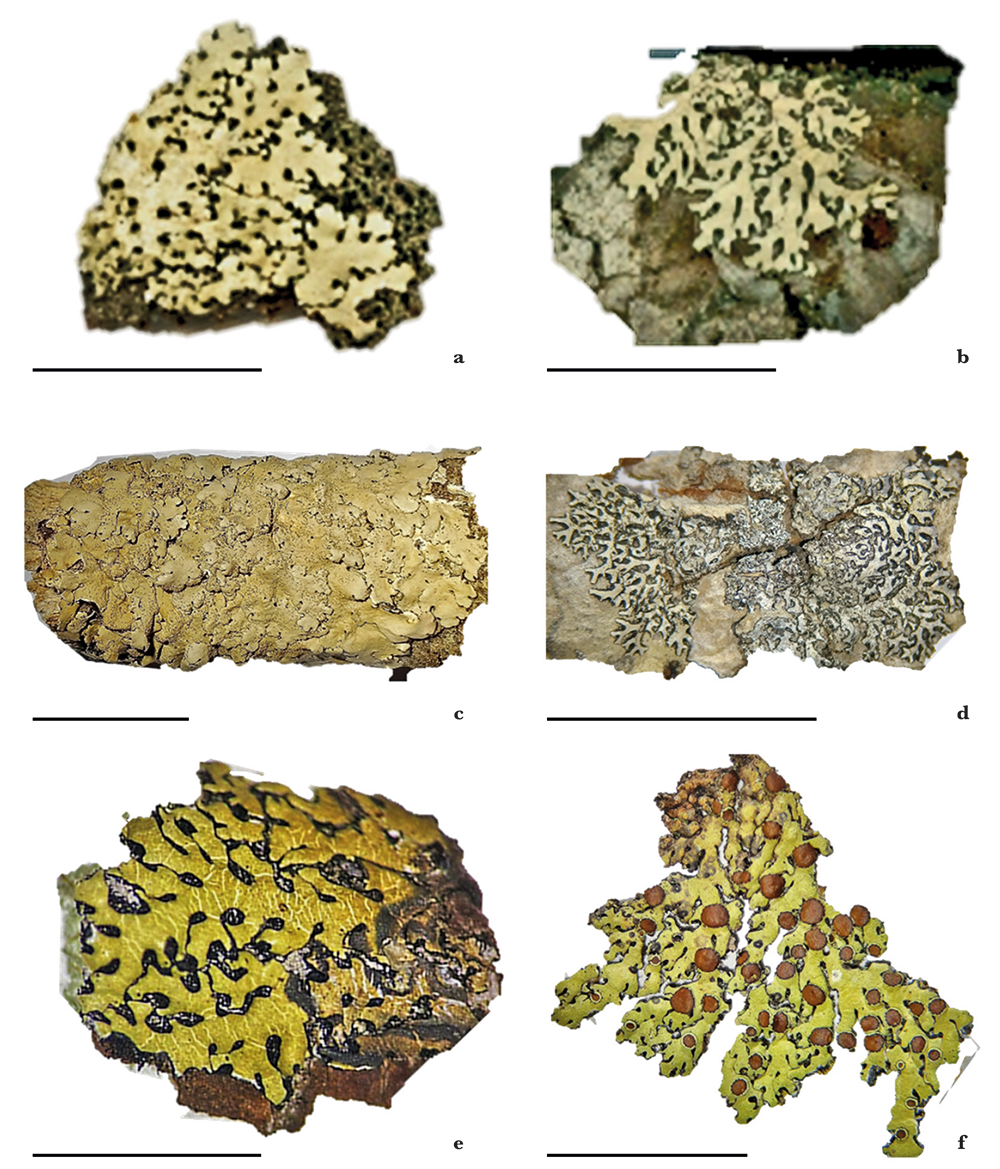
a. Thallus of Bulbothrix continua. b. Thallus of B. fungicola. c. Thallus of B. isidiza. d. Thallus of B. sipmanii. e. Thallus of B. subcoronata. f. Thallus of B. viridescens. (a. IPR Cunha & MAL Dias 122; b. IPR Cunha & MAL Dias 985; c. GM Nascimento & Cunha-Dias 55; d. GM Nascimento & IPR Cunha-Dias 60; e. GM Nascimento & AVT Pinheiro 133; f. GM Nascimento & IPR Cunha-Dias 83). Scale bar = 1 cm.
Thallus corticolous, grayish green, laciniate, 1 cm in diameter, subcoriaceous. Laciniae 0,7-1,3 mm wide, sublinear, irregular dichotomous branching, slightly imbricate to rarely crowded in the center, adnate and adpressed, with flat, subtruncate apices, and flat, smooth, and sinuous to crenate margins, occasionally sublaciniate, axils ovate. Lacinulae adventitious marginal, 0,25-0,5 mm wide, scarce, and restricted to old parts, short, flat, simple to rarely furcated, with truncate apices. Soredia, pustules, isidia, and macules absent. Cilia with bulbous bases, 0,05-0,4 mm, black, apices simple or sometimes absent, usually curved downwards. Medulla white. Lower surface brown to light brown in the center and margins, glossy to opaque, smooth to subrugose, sparsely papillate, moderately rhizinate. Rhizines black to light brown, 0,06-0,7 mm, partly white or with whitish apexes near the margin, simple or sometimes irregularly branched, usually with bulbous bases, often becoming more abundant near the margins, evenly distributed. Apothecia absent. Pycnidia very scarce, laminal, black ostiole. Conidia not seen. Chemistry: Cortex K+ yellow, UV-; medulla K+ yellow → red, C-, KC-. TLC: atranorin, and salazinic acid.
Specimens examined: Carolina, Reserva Particular do Patrimônio Natural-RPPN “Mansinha”, (07°07’56”S, 47°26’03”W), 18.XII.2020, GM Nascimento & IPR Cunha-Dias 102, 104.
This species is chemically and morphologically similar to B. hypocraea (Vain.) Hale, which also occurs in Brazil. However, they differ by the presence of strongly maculated upper surface in B. hypocraea (Benatti 2012a), whereas such macules are absent in B. continua.
Bulbothrix linteolocarpa Marcelli also closely resembles B. continua. This species differs by having narrower laciniae (up to 0,5 mm wide × up to 2,5 mm long) and a significantly darker lower surface (Benatti 2012a). Additionally, B. linteolocarpa contains cortical chloroatranorin and medullary secalonic A acid. Both species share only salazinic acid.
This species has previously been reported only in the states of Maranhão (Cunha 2012), Mato Grosso (Lynge 1914), Pernambuco (Buril 2015), and São Paulo (Benatti 2012a).
2. Bulbothrix fungicola (Lynge) Hale, Phytologia 28(5): 480. 1974. Fig. 1b
Thallus corticolous, gray, strongly adnate, 1,5 cm in diameter, laciniate, membranaceous. Laciniae 0,6-1 mm wide, dichotomously branched, with smooth, flat margins, and truncated apices. Lacinulae adventitious, 0,1-0,3 mm, marginal, short, and flat. Soredia and pustules absent. Macules punctate to effigurate. Cilia with a bulbous base, 0,05-0,1 mm, black, simple or furcated, abundantly distributed on the sides of the margins. Isidia laminal, 0,05-0,15 mm, grouped, simple, straight and short, concolorous at the base, and black at the apex (ciliate). Medulla white. Lower surface black and brown in the margins, opaque, densely rhizinate. Rhizines furcate, 0,05-0,25 mm, black, recurved to intertwined, evenly distributed. Apothecia, pycnidia, and conidia not found. Chemistry: Cortex K+ yellow, UV-; medulla K-, C+ pink, KC+ pink. TLC: atranorin, and gyrophoric acid.
Specimens examined: Carolina, Reserva Particular do Patrimônio Natural-RPPN “Mansinha”, (07°07’56”S, 47°26’03”W), 18.XII.2020, GM Nascimento & IPR Cunha-Dias 65, 78.
This species is morphologically and chemically very similar to B. sipmanii, since both have very narrow laciniae with truncate apices. However, B. fungicola has slightly larger laciniae than B. sipmanii, which has the smallest laciniae in the genus (0,1-0,3 mm wide) (Benatti 2010). The species also differ in the presence of punctate, and effigurate macules, which are found in B. fungicola, while in B. sipmanii is immaculate. These characteristics allow for differentiation between the two species (Benatti 2014).
The species appears to have a wide distribution throughout Brazil, having already been reported in several states across all Brazilian regions, including Amazonas (Aptroot 2023), Distrito Federal (Mistry 1998; Silva et al. 2023), Goiás (Marcelli 1993), Maranhão (Cunha 2012), Mato Grosso (Lynge 1914; Marcelli 1993), Mato Grosso do Sul (Fleig & Riquelme 1991; Marcelli 1993), Pará (Brako et al. 1985), Rio Grande do Sul (Spielmann 2006), and São Paulo (Marcelli 1993; Benatti 2014).
3. Bulbothrix isidiza (Nyl.) Hale, Phytologia 28(5): 480. 1974. Fig. 1c
Thallus corticolous, gray greenish (brownish to yellowish in herbarium), strongly adnate/revolute, up to 4 cm in diameter, sublaciniate, membranaceous. Laciniae on average 3 mm wide, continuous to overlapping, imbricate to clumped in the center, apex flattened, irregularly branched, crenulate margin. Lacinulae, soredia, and pustules absent. Macules are weak, punctate to effigurate. Cilia with a bulbous base, 0,05-0,3 mm, black, simple, distributed on the crests/axils of the laciniae, pointed apexes. Medulla white. Isidia laminal, 0,04-0,25 mm, abundant, cylindrical, straight, and short or sometimes inclined, concolorous to the upper cortex. Lower surface brown and glossy, rhizinate, with lighter margins and glossy. Rhizines black, 0,05-0,5 mm, simple and short, evenly distributed, sparse at the margins. Apothecia and pycnidia not found. Chemistry: Cortex K+ yellow, UV-; medulla K+ yellow → red, C-, KC+ yellow → red. TLC: atranorin, and salazinic, and consalazinic acids.
Specimens examined: Carolina, Reserva Particular do Patrimônio Natural-RPPN “Mansinha”, (07°07’56”S, 47°26’03”W), 16.XII.2020, GM Nascimento & Cunha-Dias 55, 57. Ribamar Fiquene, às margens da Rodovia BR-010 (05°58’S, 47°23’W), 21.II.2022, GM Nascimento & AVT Pinheiro 124.
This species is very similar, morphologically and chemically, to B. tabacina (Mont. & Bosch) Hale, which is also distributed in Brazil. Both species contain salazinic acid in their medullary chemistry. However, B. isidiza also has consalazinic acid as an accessory substance, which is not present in B. tabacina (Divakar & Upreti 2005). Moreover, morphologically, they differ only in the coloration of the lower surface, with B. isidiza exhibiting a glossy brown color and B. tabacina appearing black and glossy (Benatti 2013a).
Hale (1976) considered that Bulbothrix isidiza had a pantropical distribution, but a recent study based on molecular phylogeny suggests that the species has a predominantly African phylogenetic lineage. However, these analyses sampled only one Brazilian specimen that was assigned to one of the five clades formed (Kirika et al. 2017). Furthermore, the species can be considered cryptic, having unclear morphological boundaries, and probably requiring additional taxonomic and phylogenetic studies to resolve identification challenge.
The species is being reported for the first time from Maranhão. It has previously been reported from Bahia (Aptroot & Cáceres 2018), Distrito Federal (Mistry 1998; Silva et al. 2023), Mato Grosso do Sul (Fleig & Riquelme 1991), Pará (Brako et al. 1985), Paraná (Eliasaro et al. 2009), Rio de Janeiro (Hale 1976), Rio Grande do Sul (Spielmann 2006), and São Paulo (Hale 1976; Pereira & Marcelli 1989; Marcelli 1993).
4. Bulbothrix sipmaniiAptroot & Aubel, Mycotaxon 71: 139. 1999. Fig. 1d
Thallus corticolous, strongly adnate, gray (greenish brown in herbarium), up to 2 cm in diameter, laciniate, submembranaceous. Laciniae 0,15-0,3 mm wide, linear, isotomic-dichotomous to partially irregular dichotomous branching, contiguous to sometimes slightly imbricate, very adnate, and rather adpressed, with flat, truncate to acute apices. Lacinulae adventitious marginal, 0,1-0,25 mm, scarce in old parts, short, flat, simple to rarely furcate, with acute apexes. Soredia, pustules, and macules absent. Cilia with bulbous bases, 0,04-0,15 mm, black, apexes initially simple or furcate, soon becoming very dichotomous. Isidia arranged in small clusters, 0,04-0,08 mm, laminal, cylindrical, smooth, short, straight, simple, erect, firm, concolorous with black apices. Medulla white. Lower surface of varying color, dark brown to brown or partially black, slightly glossy to opaque, smooth, densely rhizinate. Rhizines black to brown, 0,05-0,15 mm, initially furcate, soon becoming very dichotomous, very intertwined, partly with basal bulbs, abundant, evenly distributed. Apothecia and pycnidia absents. Cortex K+ yellow, UV-; medulla K-, C+ pink, KC+ pink. TLC: atranorin, and gyrophoric acid.
Specimens examined: Carolina, Reserva Particular do Patrimônio Natural-RPPN “Mansinha”, (07°07’56”S, 47°26’03”W), 18.XII.2020, GM Nascimento & IPR Cunha-Dias 60, 64, 66; 17.XII.2021, GM Nascimento & TS Dutra 92. Ribamar Fiquene, às margens da Rodovia BR-010 (05°58’S, 47°23’W), 21.II.2022, GM Nascimento & AVT Pinheiro 128, 129.
In Brazil, the species has only been reported from Maranhão (Cunha 2012; Aptroot et al. 2017). In South America, it occurs in Guyana, which corresponds to the type locality of the species (Aptroot & Aubel 1999; Benatti 2014).
5. Bulbothrix subcoronata (Müll. Arg.) Hale, Phytologia 28(5): 481. 1974. Fig. 1e
Thallus corticolous, greenish, adnate, sublaciniate, 2 cm in diameter, coriaceous. Laciniae on average 1-1,5 mm wide, sublinear, anisotomous to irregular dichotomous branching, flat to sinuous margins, flat, truncate to subtruncate apexes. Lacinulae, soredia, isidia, pustule, and maculae absent. Cilia black, 0,07-0,3 mm, straight, bulbous, pointed, and short. Medulla white. Lower surface black, with dark brown margins, glossy. Rhizines black, 0,1-0,3 mm, forked, straight. Apothecia when young, laminal, crowned, sessile, concave, 1,2 mm wide, disc brown, open, and imperforate. Ascospores not found. Pycnidia, and conidia not seen. Cortex K+ yellow, UV-; medulla K+ yellow → orange, C-, KC-. TLC: atranorin, and norstictic acid.
Specimens examined: Ribamar Fiquene, às margens da Rodovia BR-010 (05°58’S, 47°23’W), 21.II.2022, GM Nascimento & AVT Pinheiro 130, 133.
This species is similar to B. regnelliana and B. viatica Spielmann & Marcelli due to shared morphological traits, suche as: the absence of vegetative propagules, the similar shape of the laciniaes and ascospores, and the presence of norstictic acid as the major medullary substance.
For many years, all were identified as B. subcoronata until Jungbluth et al. (2008) and Spielmann & Marcelli (2008) identified specific characteristics that warranted their classification as separate species. Key distinguishing features include the width of the laciniae, the larger size of the ascospores in B. regnelliana (8-12 × 4-7 µm) and B. viatica (12-16 × 7-10 µm) [with B. subcoronata having the smallest ascospores in the genus (5-7,5 × 4-5,5 µm)]. Furthermore the coloration of the lower surface also differs: in B. subcoronata, it is black with brown marginal zone, shiny; in B. regnelliana, it is brown to light brown, opaque and with no distinction between the central and marginal zones; and in B. viatica, it is brown to variegated with a very distinct marginal zone (Benatti 2012d).
This is the first record of Bulbothrix subcoronata from Maranhão. It has previously been reported from Goiás (Hale 1976; Silva et al. 2023), Mato Grosso (Hale 1976), Minas Gerais (Ribeiro 1998), Rio de Janeiro (Hale 1976), Pará (Brako et al. 1985), Paraná (Eliasaro 2001), Rio Grande do Sul (Fleig 1985; Käffer et al. 2015), and São Paulo (Marcelli 1993; Benatti 2012d).
6. Bulbothrix viridescens (Lynge) Hale, Phytologia 28(5): 481. 1974. Fig. 1f
Thallus corticolous, green-yellowish, adnate, 2 cm in diameter, laciniate, membranaceous. Laciniae are on average 1 mm wide, sublinear, irregularly branched, truncated apex, and irregular margin. Lacinulae, soredia, isidia, pustules, and macules absent. Cilia with a bulbous base, 0,05-0,15 mm, black, simple, and short, sparsely distributed on the margins of the laciniae, and young apothecia. Medulla white. Lower surface black and glossy, densely rhizinate. Rhizines simple to furcate, 0,08-0,3 mm, straight to recurved, black, evenly distributed. Apothecia laminal, 0,5-1,5 mm, subconcave and ciliated (younger) to flat, and coronate (older), disc brown, imperforate, adnate to subsessile. Ascospores spherical (smaller) to subglobose (larger), measuring up to 4×2,5 μm. Pycnidia infrequent, laminal, black. Conidia were not observed. Cortex K+ yellow, UV-; medulla K-, C-, KC-. TLC: atranorin in the cortex, and absence of medullary substances.
Specimens examined: Carolina, Reserva Particular do Patrimônio Natural-RPPN “Mansinha”, (07°07’56”S, 47°26’03”W), 16.XII.2020, GM Nascimento & IPR Cunha-Dias 80, 83; 15.XII.2021, GM Nascimento & TS Dutra 97, 99, 100.
This species is very similar to B. semilunata (Lynge) Hale, but they can be differentiated mainly by the shape of the ascospores. In B. semilunata, the ascospores are bicornate and shaped like a “half-moon” (Benatti 2013b), whereas in B. viridescens, they vary in shape from spherical to subglobose.
This constitutes the first report of Bulbothrix viridescens in Maranhão. Previously, it has only been reported from Mato Grosso (Lynge 1914; Marcelli 1993), Mato Grosso do Sul (Fleig & Riquelme 1991; Marcelli 1993), and Pará (Brako et al. 1985).
Acknowledgements
The authors thank UEMASUL (Universidade Estadual da Região Tocantina do Maranhão) productivity fellowship (object of the edital n° 014/2022-CPG/PROPGI/UEMASUL), for financial support granted to the second author, IPRCD.
References
- Aptroot A & Aubel RJMT (1999) Bulbothrix sipmanii, a new lichen species from Guyana. Mycotaxon 71: 139-140.
- Aptroot A & Cáceres MES (2018) New species and new records of lichens from inselbergs and surrounding Atlantic rain forest in the Chapada Diamantina (Bahia, Brazil). Herzogia 31: 359-373.
- Aptroot A (2023) Lichens from the Roosevelt River Area in the Brazilian Amazon. Microbiology Research 14: 755786.
- Aptroot A, Feuerstein SC, Cunha-Dias IPR, Nunes ARL, Honorato ME & Cáceres MES (2017) New lichen species and lichen reports from Amazon forest remnants and Cerrado vegetation in the Tocantina Region, northern Brazil. The Bryologist 120: 320-328.
- Arruda MB (2001) Ecossistemas brasileiros. IBAMA, Brasília. 49p.
- Benatti MN (2010) Revisão taxonômica do gênero Bulbothrix Hale (Parmeliaceae, Ascomycotina, liquenizados). 2010. Tese de Doutorado. Instituto de Botânica, São Paulo. 423p.
- Benatti MN (2012a) A review of the genus Bulbothrix Hale: the species with medullary salazinic acid lacking vegetative propagules. MycoKeys 5: 1-30.
- Benatti MN (2012b) New species of Bulbothrix Hale containing gyrophoric acid from Brazil. Mycology 3: 127-131.
- Benatti MN (2012c) Three resurrected species of the genus Bulbothrix Hale (Parmeliaceae, Lichenized Fungi). Mycosphere 3: 46-55.
- Benatti MN (2012d) A review of the genus Bulbothrix Hale: the species with medullary norstictic or protocetraric acids. MycoKeys 2: 1-28.
- Benatti MN (2013a) A review of the genus Bulbothrix Hale: the species with medullary fatty acids or without medullary substances. Mycosphere 4: 303-331.
- Benatti MN (2013b) A review of the genus Bulbothrix Hale: the isidiate, sorediate, and pustulate species with medullary salazinic acid. Mycosphere 4: 1-30.
- Benatti MN (2013c) A review of the genus Bulbothrix Hale: species with gyrophoric, lecanoric or lobaric acids lacking vegetative propagules. Opuscula Philolichenum 12: 151-173.
- Benatti MN (2014) A review of the genus Bulbothrix Hale: the isidiate, lacinulate, sorediate and pustulate species with medullary gyrophoric, lecanoric and lobaric acids, together with a world key for the genus. Opuscula Philolichenum 13: 122-154.
- Benatti MN, Kaffer MI, Martins SMA & Lemos AB (2015) Bulbothrix bulbillosa, a presumed Galapagos endemic, is common in Rio Grande do Sul state, Brazil (Parmeliaceae, Lichenized Ascomycota). Cryptogamie. Mycologie 36: 109-114.
- Benatti MN & Marcelli MP (2007) Gêneros de fungos liquenizados dos manguezais do sul-sudeste do Brasil, com enfoque no manguezal do Rio Itanhaém, estado de São Paulo. Acta Botanica Brasilica 21: 863-878.
- Benatti MN & Marcelli MP (2010) Four Parmeliaceae species excluded from Bulbothrix Mycotaxon 111: 387-401.
- Brako L, Dibben MJ & Amaral I (1985) Preliminary Notes on the macrolichens of Serra do Cachimbo, Northcentral Brazil. Acta Amazonica 15: 123-135.
- Bungartz F (2002) Recipes and other techniques. In: Nash III TH, Ryan BD, Gries C & Bungartz F (eds.) Lichen flora of the Greater Sonoran Desert Region. Vol. 1. Lichens Unlimited. Arizona State University, Tempe. Pp. 49-52.
- Buril MLL (2015) Levantamento de liquens foliosos (Parmeliaceae) do Semiárido de Pernambuco - NE, Brasil. 2015. Tese de Doutorado. Universidade Federal de Pernambuco, Recife. 314p.
- Cáceres MES, Lücking R & Rambold G (2008) Efficiency of sampling methods for accurate estimation of species richness of corticolous microlichens in the Atlantic rainforest of northeastern Brazil. Biodiversity and Conservation 17: 1285-1301.
- Canêz LS & Marcelli MP (2006) Gêneros de Parmeliaceae (Ascomycetes Liquenizados) na localidade de Fazenda da Estrela, Vacaria, Rio Grande do Sul, Brasil. Caderno de Pesquisa (Série Biológica) 18: 38-81.
- Cunha IPR (2012) A família Parmeliaceae (Fungos liquenizados) região tocantina: diversidade e potencial econômico/medicinal. 2012. Tese de Doutorado. Universidade Federal de Pernambuco, Recife. 259p.
- Cunha IPR, Marcelli MP & Pereira EC (2015) Espécies de Canoparmelia s.l. (Parmeliaceae, ascomicetes liquenizados) da região Tocantina, MA e TO, Brasil. Hoenea 42: 265-272.
- Divakar PK & Upreti DK (2005) Parmelioid Lichens in India - a revisionary study. Bishen Singh Mahendra Pal Singh, Dehra Dun. 488p.
- Eliasaro S (2001) Estudio taxonómico y florístico sobre las Parmeliaceae sensu stricto (Ascomycota Liquenizados) del Segundo Planalto del estado de Paraná, Brasil. 2001. Tesis de Doctor. Universidad de Buenos Aires, Facultad de Ciencias Exactas y Naturales, Buenos Aires. 267p.
- Eliasaro S, Veiga PW, Donha CG & Nogueira L (2009) Inventário de macroliquens epífitos sobre árvores utilizadas em arborização urbana em Curitiba, Paraná, Brasil: subsídio para biomonitoramento urbano. Biotemas 22: 1-8.
- Elix JA (1993) New species in the lichen family Parmeliaceae (Ascomycotina) from Australia. Mycotaxon 47: 101-129.
- Elix JA (2014) A catalogue of standardized chromatographic data and biosynthetic relationships for lichen substances. 3rd ed. Published by the author, Canberra. 322p.
- Fleig M & Riquelme I (1991) Liquens de Piraputanga, Mato Grosso do Sul, Brasil. Acta Botanica Brasilica 5: 3-12.
- Fleig M (1985) Estudo preliminar da Família Parmeliaceae (liquens) no Rio Grande do Sul, Brasil. Comunicações do Museu de Ciências da Pontifícia Universidade Católica do Rio Grande do Sul (PUCRS), Série Botânica 35: 79-91.
- Hale ME (1976) A monograph of the lichen genus Bulbothrix Hale (Parmeliaceae). Smithsonian Contributions to Botany 32: 1-29.
- Hale ME (1979) How to know the Lichens. 2nd ed. The Pictured-Key Nature Series. McGraw-Hill Science/Engineering/Math, Dubuque. 246p.
- Huneck S & Yoshimura I (1996) Identification of lichen substances. Springer, Berlin. 493p.
- Jungbluth P, Marcelli MP & Elix JA (2008) Five new species of Bulbothrix (Parmeliaceae) from Cerrado vegetation in São Paulo state, Brazil. Mycotaxon 104: 51-63.
- Käffer MI, Martins SMA, Dantas RV & Maciel FC (2015) Composição da comunidade liquênica em floresta ribeirinha na APA do Ibirapuitã, RS, Brasil. Hoehnea 42: 273-288.
- Kirika PM, Divakar PK, Buaruang K, Leavitt SD, Crespo A, Gatheri GW, Mugambi G, Benatti MN & Lumbsch HT (2017) Molecular phylogenetic studies unmask overlooked diversity in the tropical lichenized fungal genus Bulbothrix s.l. (Parmeliaceae, Ascomycota). Botanical Journal of the Linnean Society 184: 387-399.
- Lücking R, Hodkinson BP & Leavitt SD (2017) The 2016 classification of lichenized fungi in the Ascomycota and Basidiomycota - approaching one thousand genera. The Bryologist 119: 361-416.
- Lynge B (1914) Die Flechten der ersten Regnellschen Expedition. Die Gattungen Pseudoparmelia gen. nov. und Parmelia Ach. Arkiv för Botanik 13: 1-172.
- Marcelli MP (1993) Pequenas Parmelia s.l. ciliadas dos cerrados brasileiros. Acta Botanica Brasilica 7: 25-70.
- Mistry J (1998) Corticolous lichens as potential bioindicators of fre history: a study in the cerrado of the Distrito Federal, central Brazil. Journal of Biogeography 25: 409-441.
- Orange A, James PW & White FJ (2010) Microchemical methods for the identification of lichens. 2nd ed. British Lichen Society, London. 101p.
- Pereira WR & Marcelli MP (1989) Liquens da Reserva Biológica do Alto da Serra de Paranapiacaba. Acta Botanica Brasilica 3: 89-94.
- Ribeiro CH (1998) A família Parmeliaceae (Ascomycota liquenizados) em regiões montanhosas dos estados de Minas Gerais, Rio de Janeiro e São Paulo. 1998. Dissertação de Mestrado. Instituto de Biociências da Universidade de São Paulo, São Paulo. 194p.
- Santos JS, Cunha-Dias IPR, Silva ILA & Nascimento GM (2021) Ocorrência de espécies corticícolas de Parmotrema A.Massal. (Parmeliaceae; Ascomycota liquenizados) em vegetação de Cerrado no estado do Maranhão, Brasil. Revista de Ciências Ambientais 15: 1-15.
- Silva JR, Aptroot A & Cáceres MES (2023) Lichens from dry central Brazil: a checklist of lichenized fungi from Distrito Federal and Goiás. Cryptogamie Mycologie 44: 117-133.
- Spielmann AA & Marcelli MP (2008) Bulbothrix viatica Spielmann & Marcelli, a new species of Parmeliaceae from Brazil. Mycotaxon 103: 201-205.
- Spielmann AA (2006) Checklist of lichens and lichenicolous fungi of Rio Grande do Sul (Brazil). Caderno de Pesquisa (Série Biologica) 18: 7-125.
- Spinelli-Araujo L, Bayma-Silva G, Torresan FE, Victoria D, Vicente LE, Bolfe EL & Manzatto C (2016) Conservação da biodiversidade do estado do Maranhão: cenário atual em dados geoespaciais. Embrapa Meio Ambiente, Jaguariúna. 28p.
Data availability statement
In accordance with Open Science communication practices, the authors inform that there is no data sharing of this manuscript.