 Flora of Ceará state, Brazil: Dilleniaceae
Abstract
A floristic-taxonomic study is presented and the geographic distribution of the family Dilleniaceae for the state of Ceará, northeastern Brazil, is updated here, as part of the project “Flora of Ceará: From Knowledge to Conservation”. The research was consolidated through integrated morphological analyses of samples collected in the field from 2012 to 2024, as well as specimens deposited in herbaria, along with consultations of specialized literature. In Ceará, Dilleniaceae is represented by five species distributed in four genera: Curatella (1), Davilla (1), Doliocarpus (1) and Tetracera (2), of which Davilla cearensis Huber and Tetracera breyniana Schltdl. are endemic to Brazil. The species were recorded predominantly in the Coastal Vegetation Complex and Coastal Savanna and Forested Savanna. Curatella americana is the most widely distributed taxon, recorded in 14 municipalities, occurring predominantly in the Coastal Vegetation Complex, Cristalino Caatinga, Sedimentary Seasonallly Dry Forest, Sedimentary Moist Forest and Coastal Savanna and Forested Savanna. The species were recorded in eight Conservation Units: Environmental Protection Area (EPA) of Dunas de Lagoinha, EPA Pacoti River, EPA Lagamar do Cauípe, Pecém Ecological Station, Araripe-Apodi National Forest, Ceará Botanical State Park, Serra das Almas Private Natural Heritage Reserve and Ubajara National Park. We present an identification key, morphological descriptions, taxonomic comments, distribution, ecological, economic and phenological information, plus ilustrations and distribution maps of the species in the state of Ceará.
Key words:
Dilleniales; floristic; northeastern of Brasil; Tetracera
Resumo
Apresenta-se o estudo florístico-taxonômico e a atualização da distribuição geográfica das espécies de Dilleniaceae no estado do Ceará, nordeste do Brasil, como parte do projeto “Flora do Ceará: conhecer para conservar”. A pesquisa consolidou-se através de análises morfológicas integradas de amostras coletadas em campo durante o período de 2012 a 2024, além de espécimes depositadas nos herbários nacionais e internacionais e consultas à literatura especializada. No Ceará, Dilleniaceae é representada por cinco espécies, distribuídas em quatro gêneros: Curatella (1), Davilla (1), Doliocarpus (1) e Tetracera (2), das quais Davilla cearensis Huber e Tetracera breyniana Schltdl. são endêmicas do Brasil. As espécies foram registradas predominantemente no Complexo Vegetacional Costeiro e Cerrado e Cerradão Costeiros. Curatella americana é o táxon mais amplamente distribuído, registrado em 14 municípios, ocorrendo predominantemente no Complexo Vegetacional Costeiro, Caatinga do Cristalino, Mata Seca do Sedimentar, Mata Úmida do Sedimentar e Cerrado e Cerradão Costeiros. As espécies foram registradas em oito Unidades de Conservação: Área de Proteção Ambiental (APA) Dunas de Lagoinha, APA do Rio Pacoti, APA Lagamar do Cauípe, Estação Ecológica do Pecém, Floresta Nacional do Araripe-Apodi, Parque Estadual Botânico do Ceará, Reserva Particular do Patrimônio Natural Serra das Almas e Parque Nacional de Ubajara. Apresentamos chave de identificação, descrições morfológicas, comentários taxonômicos e informações sobre distribuição, ecologia, economia e fenologia; além de ilustrações e de mapa da distribuição das espécies ocorrentes no estado do Ceará.
Palavras-chave:
Dilleniales; florística; nordeste do Brasil; Tetracera
Introduction
Dilleniaceae comprises 11 genera and 615 species (POWO 2025) with pantropical (Horn 2009) and, occasionally, subtropical (Kubitzki 2004) distributions, reaching the temperate region of Australia (Horn 2009). The last compilation of the family in the Neotropical region was made by Fraga & Stehmann (2010), witch 102 species were recognized (Fraga & Stehmann 2010). After this work, several other species were described in Brazil (Fraga et al. 2017; Fraga & Stehmann 2018; Monzoli et al. 2022, 2025)
In Brazil, Dilleniaceae is represented by 88 species (50 endemic) organized into seven genera with records in all phytogeographic domains, except in the Pampas (Flora e Funga do Brasil 2025, continuously updated). The vast majority of the species are concentrated in the Amazon, Atlantic Forest and in Cerrado (Flora e Funga do Brasil 2025, continuously updated).
Dilleniaceae is monophyletic and it is classified into four subfamilies: Delimoideae, representing the genus Tetracera as the only pantropical genus of the family; Doliocarpoideae, which includes the Neotropical genera Davilla, Curatella, Pinzona, Doliocarpus, and Neodillenia; Hibbertioideae, containing Hibbertia and its subgenera; and Dillenioideae, grouping Schumacheria, Acrotrema, Dillenia, and Didesmandra, the latter in a provisional placement (Horn 2009). Its representatives are trees, shrubs, lianas or herbs, with simple, alternate, rough or leathery leaves, with often craspedodromous venation; inflorescences in cyme or raceme, usually paniculate, or in glomeruli or reduced to a single flower; monoclinous, dichlamydeous, actinomorphic flowers, imbricate prefloration; dialysepalous calyx, with sepals of unequal sizes and persistent in fruiting; dialypetalous corolla, white or yellow; polystemonous androecium, rimose, basifixed anthers; dialycarpellary gynoecium, 1-6 carpels, superior ovary, uni- to pluri-ovulate locules, with erect or pendulous placentation; fruits of the follicle, berry, capsule or kernel type (Bruniera & Groppo 2010; Pereira 2014; Souza & Lorenzi 2019).
Dilleniaceae species have different uses and applications, mainly medicinal, due to their secondary metabolites (flavonoids and terpenoids, among others) with anti-inflammatory, antihypertensive, analgesic, antibacterial, antiulcerogenic, antihemorrhagic, antiparasitic, antiviral, healing, antioxidant, and antitumor properties (Lima et al. 2014). Other peculiar aspects include the use of some species as emergency water sources, due to the presence of drinkable water in the stem (Ribeiro et al. 1999; Souza & Lorenzi 2019) and some representatives, such as Davilla rugosa Poir and Doliocarpus spraguei Cheesm, which are used in handmade and fishing items, such as corrals and transport baskets (Oliveira et al. 2006). Dillenia indica L., popularly known as “elephant apple or April flower”, is an exotic species with large, showy flowers and fruits used in urban ornamentation (Souza & Lorenzi 2019).
In the Flora brasiliensis, seven genera and 53 species were recognized in Dilleniaceae, of which 20 were new to science (Eichler 1863). In Brazil, recent studies have resulted in the publication of new species of Davilla and Doliocarpus (Fraga & Aymard 2007; Fraga 2008; Fraga & Stehmann 2010, 2018; Fraga et al. 2017; Monzoli et al. 2022, 2025), in addition to covering phylogenetic analyses of the family (Fraga 2012) and taxonomic updates (Fraga & Stehmann 2010).
Several floristic studies on this family were carried out in Brazil. In the North, in the Adolpho Ducke Forest Reserve in Manaus, Amazonas (Ribeiro et al. 1999) and in the cangas of the Serra dos Carajás, Pará (Zappi 2018); in the Midwestern region, there is a survey of Dilleniaceae in the states of Goiás and Tocantins (Pereira & Gomes-Klein 2007); in the Southeastern region, there is a floristic survey in the Serra do Cipó, Minas Gerais (Bruniera & Groppo 2010) and in Rio de Janeiro (Castilhori et al. 2010; Araújo 2024).
In the Northeastern region, only a list of Dilleniaceae species occurring in the state of Alagoas has been recorded (Lemos et al. 2010). In the state of Ceará, representatives of the family have been mentioned in some floristic surveys (Loiola et al. 2020; Silveira et al. 2020a, b). The evident incipiency of floristic studies dealing with representatives of Dilleniaceae in the state of Ceará highlights a gap in knowledge about the real diversity and distribution of its species, which may interfere with planning for biodiversity conservation.
This study, associated with the project “Flora of Ceará: from Knowledge to Conservation”, aimed to carry out a floristic-taxonomic survey and update the geographical distribution of the representatives of Dilleniaceae in the state.
Material and methods
The study was carried out in the state of Ceará, located in the Northeast region of Brazil, between 02° and 08° South latitude and 37° and 42° West longitude, with an approximate area of 148,825 km² and 184 municipalities (IBGE 2017). In the state, the prevailing climate is Hot Tropical Semi-arid, with an average annual rainfall that does not exceed 1,000 mm and temperature varying between 24º and 26ºC (Nimer 1972; Lima et al. 2000) Neosols and Argisols covers 36% and 25% of the state’s area, respectively (Governo do Ceará 2023). Moro et al. (2015) recognize two major geological domains for the state of Ceará: one of sedimentary origin, divided into five relief units (Coastal Plain, Fluvial Plain, Chapada do Araripe, Chapada do Apodi, and Serra da Ibiapaba); and another of crystalline origin, divided into two relief units (Depressão Sertaneja and Residual Massif).
To carry out the study, 47 samples were analyzed from collections deposited in herbaria ALCB, CEN, EAC, HCDAL, HUEFS, HUVA, NY, RB and TEPB, acronyms according to Thiers (continuously updated) and HST, not indexed; in addition to the observation of samples obtained from fields between 2012 and 2024, deposited in EAC, whose herborization and management processes followed Mori et al. (1989). Only native species were considered.
Species identification was performed using specialized literature (Bruniera & Groppo 2010; Zappi 2018; Muniz 2025) and confirmed through analysis of type collections available in the online database (JSTOR 2025). The authors of the species are in accordance with The International Plant Names Index (IPNI 2025).
Morphological terminology followed Harris & Harris (2001), while leaf character descriptions were based on Ash et al. (1999). For each genus and its respective taxa, a pattern of description were adopted based on specimens from Ceará. Data on growth form, phenology, common names, and habitats were obtained from the labels of the analyzed specimens and/or observed during field expeditions.
The geographic distribution map of the species was created with QGIS (2016), version 2.18 “Las Palmas”, based on coordinates from the specimen labels or obtained during field collections. When missing, municipal coordinates were georeferenced using Geoloc (CRIA 2025).
The vegetation types follow Moro et al. (2015): Carnaubal, Coastal Savanna and Forested Savanna, Coastal Vegetation Complex, Cristalino Caatinga, Cristalino Moist Forest, Cristalino Seasonally Dry Forest, Inland Savanna and Forested Savanna, Mangrove, Sedimentary Caatinga, Sedimentary Moist Forest and Sedimentary Seasonally Dry Forest.
Results and Discussion
In the state of Ceará, Dilleniaceae is represented by four genera and five species: Curatella americana L., Davilla cearensis Huber, Doliocarpus dentatus (Aubl.) Stand., Tetracera breyniana Schltdl., and T. willdenowiana Steud. The species Davilla cearensis and T. breyniana are endemic to Brazil (Flora e Funga do Brasil 2025, continuously updated).
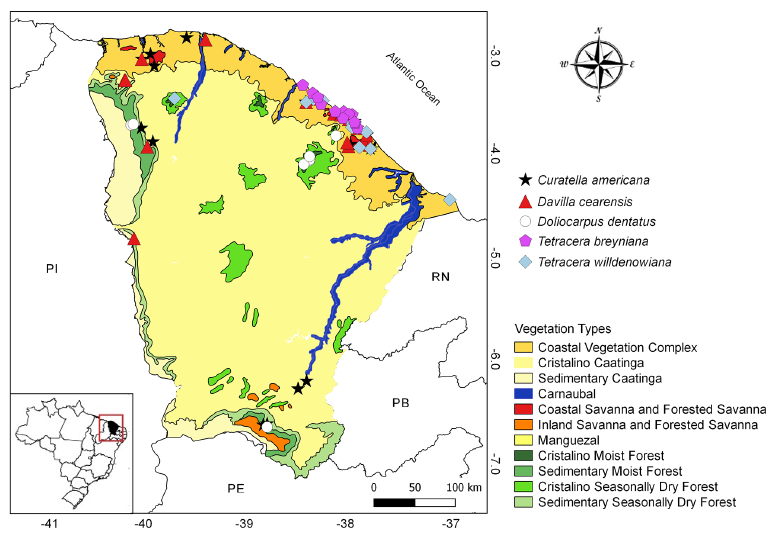
The species were found in 25 municipalities, with the Coastal Vegetation Complex being the vegetation type with the greatest species richness (4 spp.). Curatella americana was the most widely distributed species, with records in 14 municipalities, occurring predominantly in the Coastal Vegetation Complex, Cristalino Caatinga and Sedimentary Seasonally Dry Forest.
The species were recorded in eight Conservation Units: Environmental Protection Area (EPA) of Dunas de Lagoinha (T. breyniana), EPA of Rio Pacoti (C. americana, Davilla cearensis, T. breyniana, T. willdenowiana), EPA Lagamar do Cauípe (T. breyniana), Pecém Ecological Station (C. ameriana, T. breyniana), Araripe-Apodi National Forest (C. americana, Doliocarpus dentatus), Ceará Botanical State Park (C. americana, Davilla cearensis), Serra das Almas Private Natural Heritage Reserve (Davilla cearensis) and Ubajara National Park (Doliocarpus dentatus).
Taxonomic treatment
Dilleniaceae Salisb.
Trees, shrubs or lianas. Branches with stellate or simple to glabrescent trichomes. Leaves simple, alternate, chartaceous or coriaceous; veins craspedodromous or brochidodromous. Inflorescences in fascicles, panicles or thyrses cauliflorous/ramiflorous, terminal or axillary. Flowers yellow or white; androecium polystemone; gynoecium 1-5-carpellate, carpels free or united at the base, ovary superior. Fruits berry, capsule, follicle or nucule, often with sepals and/or reproductive organs persistent.
Identification key for Dilleniaceae species occurring in Ceará state
-
1. Branches and leaves with stellate trichomes.
2. Tree or shrub; winged petiole; leaf blade with undulate margin; gynoecium with 2 carpels united at the base …………………………………………………………………………… 1. Curatella americana
2’. Liana; canaliculate petiole; leaf blade with flat margin; gynoecium with 3-4 carpels free …… …………………………………………………………………………… 4.2. Tetracera willdenowiana
-
1’. Branches and leaves with simple trichomes.
3. Inflorescence in cauliflorous/ramiflorous fascicles; gynoecium unicarpellary; seeds with glutinous aril ………………………………………………………………………………………. 3. Doliocarpus dentatus
- 3’. Inflorescence in terminal or axillary panicles or thyrses; gynoecium 2 or 5-carpellary; seeds with laciniate or papyraceous aril.
4. Inflorescence in panicle; gynoecium 2-carpellar; 2 inner sepals, orbicular, crustaceous, accrescent, covering the fruit completely; indehiscent follicle; seeds with papyraceous aril………………. 2. Davilla cearensis
4’. Inflorescence in thyrse; gynoecium 5-carpellar; 3 inner sepals, flat, not crustaceous, not accrescent; dehiscent follicle; seeds with laciniate aril …………………………………… 4.1. Tetracera breyniana
1. Curatella americana L., Syst. Nat., ed. 10. 2: 1079. 1759. Figs. 1; 2a-c; 3a-c
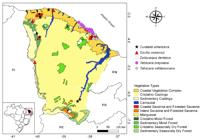
Geographic distribution of the Dilleniaceae species occurring in the state of Ceará, northeastern Brazil.
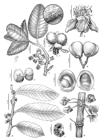
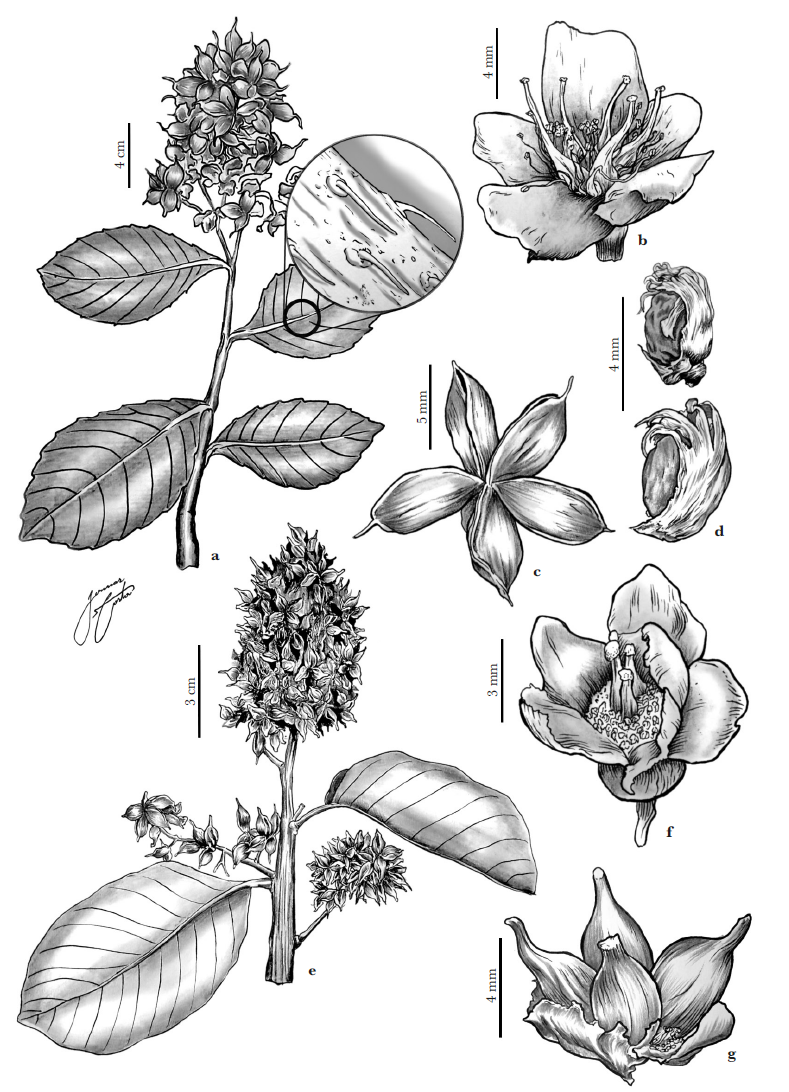
a-c. Curatella americana - a. branch with inflorescence and leaves showing detail of stellate trichomes; b. flower; c. nucule. d-f. Davilla cearensis - d. fruit covered completely by sepals; e. exposed fruit (accrescent sepals open); f. seed with paperyceous aril. g-i. Doliocarpus dentatus - g. branch; h. cauliflorous/ramiflorous infructescences; i. seed with glutinous aril. (a-c. A.P. Negreiros & E.F. Marques 88; d-f. M.I.B. Loiola 3002; g. L.W. Lima-Verde 1808; h,i. M.L. Guedes et al. 25283).
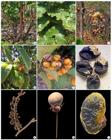
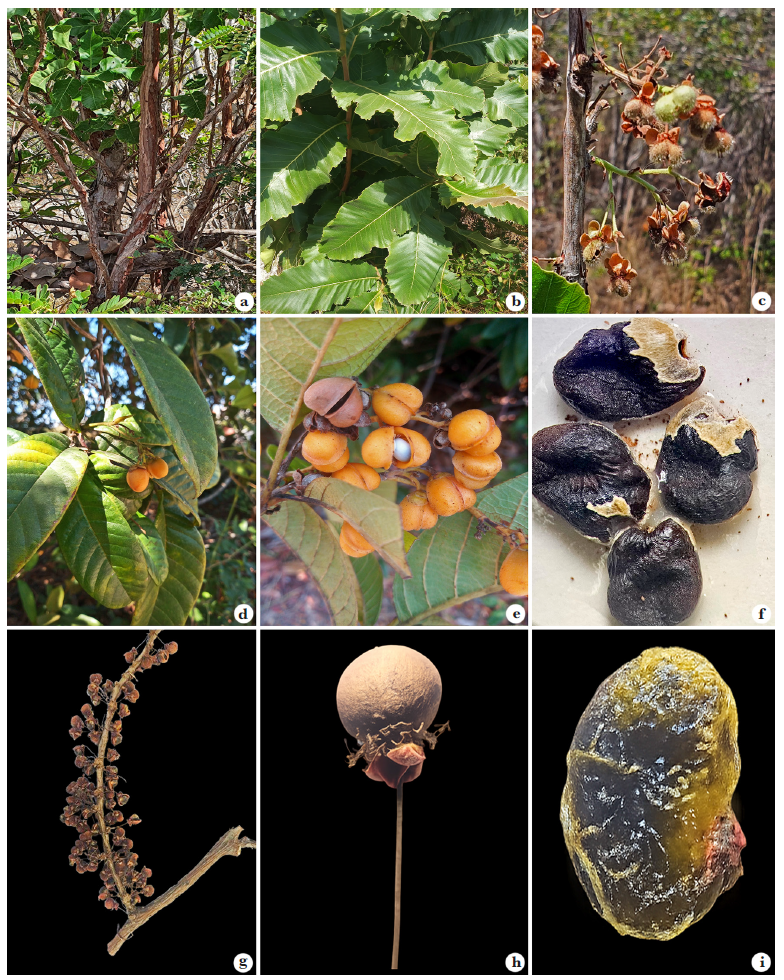
a-c. Curatella americana - a. habit; b. leafes; c. branch with inflorescence. d-f. Davilla cearensis - d. habit; e. fruits; f. seeds. g-i. Doliocarpus dentatus - g. branch with fruits; h. fruit; i. seed. (Photos: a-e. M.I.B. Loiola; g-i. L.G.A. Melo.).
Tree or shrub, 3-5 m tall; young branches tomentose, mature branches with stellate trichomes, squamose rhytidome, grayish. Leaves simple, alternate; petiole 0.2-1.5 cm long, winged, tomentose to glabrescent; leaf blade 6-21 × 3-8.5 cm, elliptical to obovate, apex obtuse to rounded, base rounded to cuneate, margin undulate, asperous, floccose, with stellate trichomes on both sides; secondary veins 14-20 pairs, evident on the abaxial surface, craspedodromous. Inflorescence in ramiflorous, panicle, up to 7 cm long, axillary, tomentose; peduncle 0.3-1 cm long, pubescent, with stellate trichomes; bracteoles 5-5.5 mm long, elliptical, concave, pubescent on both sides; pedicel 0.5-1.8 cm long, pubescent, with stellate trichomes; sepals 4-7 mm long, 4, elliptical, obovate, concave, not crustaceous, not accrescent pilose on both sides, with simple trichomes, persistent during fruiting; petals deciduous (not seen). Androecium polystemonous, persistent during fruiting, filaments 5-7 mm long, glabrous, swollen distal portion; anthers ca. 0.8 mm long, oblong, glabrous. Gynoecium with 2 carpels united at the base, ovary ca. 2 mm long, densely pubescent, with simple trichomes, style 2.5-3 mm long, glabrous, stigma capitate. Nucule 3-5 mm long, ellipsoid, densely pubescent, with simple trichomes. Seeds 3-4 mm long, 1-2 per carpel, ellipsoid to obovoid, striated aril.
Selected examined material: Aquiraz, trilha da Lagoa Encantada, substrato arenoso, 03°48’18”S, 38°16’54”W, 22.VII.2017, fl. and fr., A.P. Negreiros & E.F. Marques 88 (EAC). Barbalha, Floresta Nacional do Araripe, 18.IX.2022, fl., M.S. Alcântara (HCDAL 15865). Cascavel, estrada para Caponga, 26.X.1992, fr., F.S. Araújo (EAC 38022). Caucaia, Parque Estadual Botânico do Ceará, 03º42’13”S, 38º38’10” W, 21.IX.2018, fl. and fr., E.M.P. Lucena et al. 276 (EAC). Crato, Chapada do Araripe, 18.IX.1992, fl. and fr., L.P. Félix (EAC 19015). Cruz, Congl. 04, sub. 1, árv. 10, 02º52’48”S, 40º19’12”W, 29.X.2013, fr., W. Batista 36 (EAC). Eusébio, APA do Rio Pacoti, 03º38’10”S, 38º22’77”W, 20.X.2018, fl., S.T. Rabelo & L.X. Sampaio 20 (EAC). Fortaleza, terreno vizinho ao EAC, 9.VIII.1955, fl., A. Fernandes (EAC 1465). Granja, Fazenda Recanto, 10.X.1989, fl. and fr., E Nunes & F.S. Cavalcanti (EAC 16218). Horizonte, estrada Coluna-Cascavel, km 5, 10.X.2018, fl. and fr., J.E. Alves (EAC 43877). Ibiapina, Açude do Jacaré, 4.VI.2012, fl., M.I.B. Loiola & R.L. Soares Neto 1774 (EAC). Lavras da Mangabeira, estrada para Quitaius, 16.X.1985, fl. and fr., A. Fernandes et al. (EAC 13756). Martinópole, estrada para Bom Princípio, ca. 2 km da sede municipal, 03º11’54”S, 40º41’03”W, 21.VII.2017, fl., E.B. Souza et al. 4718 (HUVA). Pacujá, Serrinha, Bom Gosto, Planalto da Ibiapaba, 04º03’10”S, 40º42’10”W, 23.I.2009, fl., E.B. Souza et al. 1675 (HUVA). São Gonçalo do Amarante, Estação Ecológica do Pecém, 15.VIII.2011, fr., R.G Ferreira (EAC 49907).
Curatella americana is easily distinguished from the other species occurring in Ceará by its arboreal or shrubby habit, with squamose rhytidome, young branches tomentose, mature branches with stellate trichomes, leaf blade with undulate margin, asperous, floccose, with stellate trichomes on both surfaces, inflorescence in ramiflorous panicle, and gynoecium with 2 carpels united at the base.
This species is found mainly in the Neotropical Savannas, from southern Mexico to Bolivia (Rizzini 1997; Lorenzi 1998; Kubitzki 2004). It occurs in practically all of Brazilian territory (except in the Southern region), mainly in the Cerrado (Kissmann & Groth 1995; Ratter et al. 2003, Flora e Funga do Brasil 2025, continuously updated). This species is typical of acidic, nutrient-poor sandy soils (Furley & Ratter 1988). In Ceará, the species is widely distributed, with records in 15 municipalities and 4 conservation units: Rio Pacoti EPA, Pecém Ecological Station, Araripe-Apodi National Forest, and Ceará State Botanical Park. It occurs predominantly in the Coastal Vegetation Complex, Cristalino Caatinga, Sedimentary Seasonallly Dry Forest, Sedimentary Moist Forest and Coastal Savanna and Forested Savanna (Fig. 1).
Collected with flowers from July to October and with fruits in January and from July to October.
The leaves and bark of Curatella americana are used in folk medicine to prepare teas and infusions and have analgesic, anti-inflammatory, and anti-ulcerogenic properties (Hiruma-Lima et al. 2009; Toledo et al. 2011). Furthermore, its leaves are used by rural populations as a natural sponge for cleaning household utensils such as aluminum cups and pans (Bruniera & Groppo 2010).
The vernacular name is cajueiro-branco, cajueiro-bravo, sambaíba ou lixeira (due to the high density of stellate trichomes and the accumulation of silica in the leaf blade, Dalmolin et al. 2015).
2. Davilla cearensis Huber, Bull. Herb. Boissier ser. 2, 1: 312. 1901 . Figs. 1; 2d-f; 3d-f
Liana; young branches sericeous to glabrescent, simple trichomes. Leaves simple, alternate; petiole 1-2.5 mm long, canaliculate; leaf blade 5.5-3 × 17-8.5 cm, elliptical to oblong, apex obtuse to rounded, base cuneate, margin flat, charthaceous to subcoriaceous, adaxial and abaxial surface sparse-villous to glabrescent, simple trichomes; secondary veins 12-15 pairs, evident on the abaxial surface, brochidodromous, sericeous. Inflorescence in panicle up to 10 cm long, terminal or axilar; peduncle 1-3 cm long; pedicel 2-5 mm long; sepals 5, externally sericeous, 3 outer, 4-5 mm long, unequal in size, orbicular, coriaceous, 2 inner, 1-1.1 cm long, equal in size, orbicular, crustaceous, accrescent, covering the fruit completely, green when flowering and yellowish-brown when mature; petals 5, 6-7 mm long, spatulate. Androecium polystemonous, persistent during fruiting, filaments 1-2 mm long, glabrous, dorsiventrally compressed; anthers ca. 0.3 mm long, oblong, glabrous. Gynoecium with 2 carpels free; ovary ca. 1.5 mm long, style ca. 2 mm long, sinuous, glabrous, stigma capitate, discoid. Indehiscent follicle, ca. 6 mm long, subglobose, glabrous, membranous. Seeds up to 5 mm long, 2 per carpel, ellipsoid, glabrous, blackish, papyraceous aril.
Selected examined material: Acarau, área prevista para ampliação da Subestação de Energia Elétrica Acaraú II, 10.XII.2018, fr., B.M.T. Walter et al. 6897 (CEN). Aquiraz, Trilha da Encantada, 04º17’08”S, 38º59’40”W, 3.XI.2016, fr., A.P. Negreiros 39 (EAC). Caucaia, Parque Estadual Botânico do Ceará, 03º42’43”S, 38º38’31”W, 29.VI.2018, fr., V.S. Sampaio et al. 420 (EAC). Crateús, RPPN Serra das Almas, 18.VII.2001, fr., M.S. Sobrinho & M.M.A. Bruno (EAC 32948). Eusébio, Centro de Estudos Ambientais Costeiros - CEAC/UFC, 03º49’56”S, 38º25’21”W, 15.IX.2023, fr., M.I.B. Loiola 3002 (EAC). Fortaleza, Mata do Pici, 12.X.1999, fr., L.Q. Matias 205 (EAC). Graça, Cachoceira do Belizário, 04º06’34”S, 49º45’49”W, 29.IX.2017, fr., E.B. Souza et. al 4793 (EAC). Granja, distrito Santa Terezinha, localidade de São Miguel, 03º21’30”S, 41º00’38”W, 3.VI.2016, fl., E.B. Souza et al. 4129 (EAC, HUVA). Horizonte, Tijuco da Preaoca, 6.VIII.2000, fr., A.S.F Castro 881 (EAC). São Gonçalo do Amarante, Pecém, 8.IX.2008, fr., R.G. Ferreria 44 (EAC).
Additional material: BRAZIL. PIAUÍ: Boqueirão, próx. à casa da Angélica, 26.VI.1999, fl., A.R.S. França (TEPB 10545).
Davilla cearensis has as its exclusive characteristic a chartaceous to subcoriaceous leaf blade, gynoecium with 2 carpels free, two larger internal sepals (1-1.1 cm long) which are yellowish, crustaceous, accrescent, covering the fruit completely, and seeds with papiraceous aril.
Davilla cearensis is endemic to Brazil, restricted to the Northern (Pará and Tocantins) and Northeastern (Ceará, Maranhão and Piauí) regions, and distributed in the Amazon, Cerrado and Atlantic Forest phytogeographic domains (Flora e Funga do Brasil 2025, continuously updated). In Ceará, the species was recorded in 10 municipalities concentrated in the Coastal Vegetation Complex, Sedimentary Seasonally Dry Forest, Sedimentary Moist Forest and Coastal Savanna and Forested Savanna (Fig. 1). Davilla cearensis was registered in 3 conservation units: Serra das Almas Private Natural Heritage Reserve, Rio Pacoti EPA and Ceará State Botanical Park.
Collected with flowers in June and with fruits in June, August, September and November.
There is no registered use for this species.
The vernacular name of this species is cipó de fogo.
3. Doliocarpus dentatus (Aubl.) Standl., J. Wash. Acad. Sci. 15: 286. 1925. Figs. 1; 2g-i; 3g-i
Liana, slightly ribbed branches, tomentose to glabrescent, simple trichomes, grayish. Leaves simple, alternate; petiole 1-2 cm long, canaliculate, sericeous to glabrescent; leaf blade 4-16 × 3.5-13 cm long, elliptical, apex acuminate, base acute or obtuse, margin serrated-dentate, chartaceous to subcoriaceous, sericeous to glabrescent on both surfaces, simple trichomes; secondary veins 8-15 pairs, craspedodromous, central and lateral veins evident. Inflorescence in cauliflorous/ramiflorous fascicles, ca. 4 cm long, 10-30 flowers; peduncle absent; bracteole ca. 1 mm long, oval, sericeous; pedicel 0.7-1.8 mm long, pubescent to glabrescent; sepals 4-5, with 3.5-4 mm long, elliptical, obovate, concave, not crustaceous, not accrescent, glabrous on the adaxial surface, tomentose on the abaxial surface, persistent during fruiting; petals not seen. Androecium polystemonous, persistent during fruiting, filaments 5-6 mm long, glabrous, swollen in distal portion; anthers 0.8-1 mm long, oblong, glabrous. Gynoecium unicarpellary, glabrous; ovary ca. 2 mm long, style ca. 2 mm long, glabrous, stigma peltate, usually persistent during fruiting. Berry 6-7 mm long, globose. Seed 1, ca. 6 mm long, reniform, glabrous, blackish, shiny, glutinous aril.
Selected examined material: Crato, trilha do Belmonte, no sentido casa Sede Ibama, Sítio Luanda, Floresta Nacional do Araripe, 7.V.2015, fr., J.E.G. Santos & D.L. Silva (HCDAL 12106). Guaramiranga, Sítio Sinimbu, 04°17’49”S, 38°55’59”W, 10.IX.2003, fl., V. Gomes & M.M.A. Bruno 776 (EAC). Ibiapaba, Sítio de Sta. Maria, Serra Grande, 03º52’S, 40º57’W, 10.XI.2016, fr., M.L. Guedes; F, Guaré & E.R., Silveira 25283 (ALCB; EAC). Mulungu, Sítio do Heliomar, 5.XI.1996, fr., E. Silveira (EAC 24465). Pacatuba, Serra da Aratanha, 12.XI.1983, fr., A. Fernandes (EAC 12241). Pacoti, Sítio Sta. Madalena, 9.X.1980, fr., E. Nunes & P. Martins (EAC 08952). Ubajara, Parque Nacional de Ubajara, 25.VII.1999, fl., F.S Cavalcanti & E. N. Silveira 563 (EAC).
Doliocarpus dentatus is a well-defined species and is easily differentiated from others occurring in Ceará by presenting cauliflorous/ramiflorous fascicles, ca. 4 cm long and with 10-30 flowers, gynoecium unicarpellary; berry globose and, seeds with glutinous aril.
This species is widely distributed in Mesoamerican tropical forests, ranging to southern Mexico, northern Peru, northern Bolivia (Aponte et al. 2008), and in Brazil, in near all the country, except Amapá, Rio de Janeiro, Santa Catarina, and Rio Grande do Sul (Flora e Funga do Brasil 2025, continuously updated), where it occurs in all geographic regions, typically in gallery forests, seasonally dry forests, and various variations of the Cerrado (Sano et al. 2008). In Ceará, Doliocarpus dentatus was recorded in 7 municipalities and 2 conservation units (Araripe-Apodi National Forest and Ubajara National Park), occurring in Cristalino Moist Forest and Sedimentary Moist Forest.
Collected with flowers in August and September and with fruits in Juny, September and November.
The leaves and roots of Doliocarpus dentatus are popularly used in the preparation of infusions for the treatment of cystitis (Rodrigues & Carvalho 2001), treating the pain and urinary retention resulting from the inflammatory process (Rodrigues 2007).
The vernacular name of this species are cipó-de-cururú, cipó-caninana, uva-da-serra.
4. Tetracera L.: 533.1753.
Lianas. Branches grayish, rhytidome squamose or striate. Petiole canaliculate. Leaves simple, alternate, coriaceous, brochidodromous, secundary veins not evident. Inflorescence in thyrse, terminal, asperous peduncle, with simple or stellate trichomes; bracteoles elliptical, sericeous, with stellate trichomes; sepals 5, unequal, 2 outer, 3 inner, persistent during fruiting. Androecium polystemonous. Gynoecium with 3-5 free carpels. Follicle dehiscent, glabrous. Seeds 1-2 per carpel, glabrous, blackish, laciniate aril.
4.1. Tetracera breyniana Schltdl., L. 8(2): 174.1833. Figs. 1; 4a-d; 5a-e
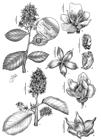
a-d. Tetracera breyniana - a. branches and leaves showing detail of simple adpressed trichomes with a multicellular base; b. flower; c. dehiscent follicle; d. seeds with laciniate aril. e-g. Tetracera willdenowiana - e. branch; f. flower; g. follicle. (a,c,d. A.S.F. Castro 97; b. A.S.F. Castro 1543; e-g. M.F. Moro & E. Tameirão Neto 369).
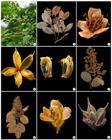
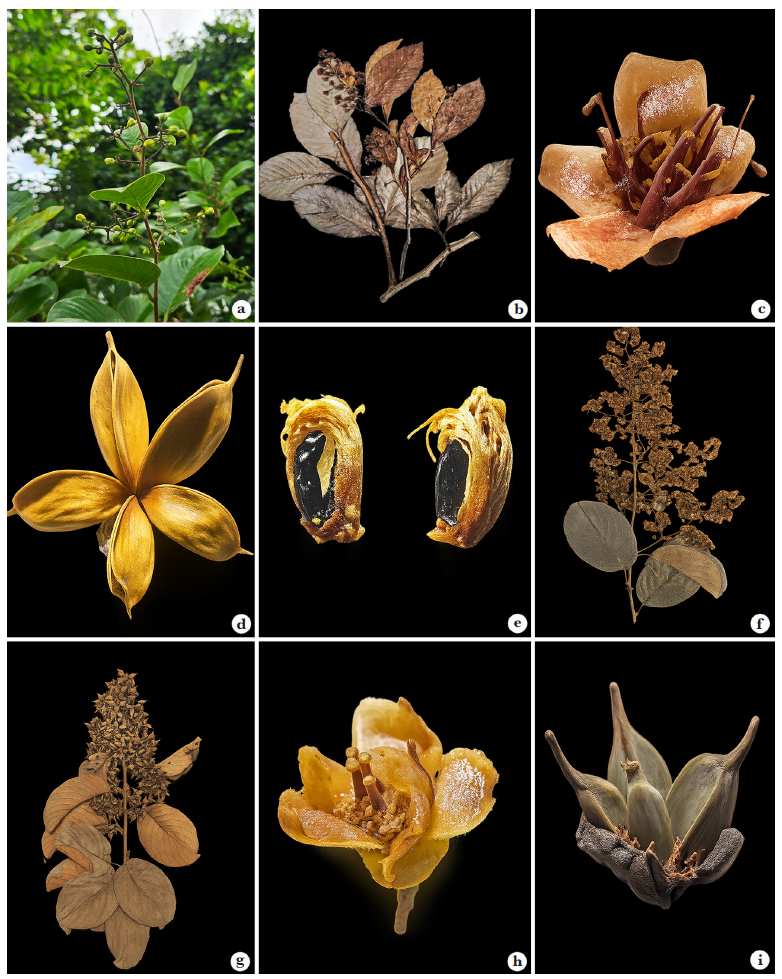
a-e. Tetracera breyniana - a. habit; b. branch with inflorescence; c. flower; d. fruit; e. seeds. f-i. Tetracera willdenowiana - f. branch with inflorescence; g. branch with fruits; h. flower; i. fruit. (Photos: a-i. L.G.A. Melo.).
Liana; branches with simple trichomes, rhytidome squamose. Leaves simple, alternate; petiole 1-1.5 cm long, discretely canaliculate, not winged; leaf blade 4.5-14 × 2.5-6.5 cm, elliptical, obovate or rounded, apex obtuse, acute, rounded, base rounded or obtuse, margin discretely crenate to serrate, discolor, coriaceous, pilose to glabrescente on both surfaces, simple adpressed trichomes with multicellular base; secondary veins 9-15 pairs. Thyrsi up to 11 cm long, terminal, peduncle 3-5 cm long, asperous, with simple trichomes; bracteoles 2-3 mm long, elliptical, sericeous; pedicel 2-6 mm long; sepals 5, unequal, ovate, oblong, elliptical, not crustaceous, not accrescent, 2 outer, 4-5 mm long, sericeous on both surfaces, reflexed, persistent during fruiting, 3 inner, 6-7.5 mm long, abaxial surface glabrous, adaxial surface densely sericeous, flat; petals deciduous (not seen). Androecium polystemonous, filaments 3-4 cm long, glabrous, swollen in distal portion, anthers ca. 0.4 mm long, oblong. Gynoecium 5-carpellary; ovary ca. 2 mm long, pubescent, style 3-3.5 mm long, glabrous, stigma capitate. Follicle ca. 2 cm long, ovoid, apiculate, glabrous. Seeds ca. 4 mm long, 2 per carpel, globose, glabrous, blackish, partially enclosed by the laciniate aril.
Selected examined material: Aquiraz, Encantada próx. à Lagoa, 14.XI.2004, fl., A.S.F Castro 1543 (EAC). Caucaia, APA Lagamar do Cauípe, 03°36’17.33”S, 38°46’54.11”W, 1.XI.2014, fr., F.R.S Tabosa 07 (EAC); Icaraí, 8 km N of Caucaia, 24.I.1972, fr., D.V. Johnson 16 (NY). Eusébio, APA do Rio Pacoti, 03º51’05”S, 38º25’11”W, 30.XII.2022, fl., S.T. Rabelo 330 (EAC). Fortaleza, Dunas da Praia do Futuro, 11.III.2002, fl., A.S.F Castro (EAC 31358). Paraipaba, estrada para Lagoinha, 27.I.1996, fr., A.S.F Castro 97 (EAC). São Gonçalo do Amarante, Estação Ecológica do Pecém, 03°34’00”S, 38°49’00”W, X.1999, fr., H. Magalhães 63 (EAC).
Tetracera breyniana shares with T. willdenowiana liana habit, coriaceous leaves, non-califlorous/ramiflorous thyrse inflorescence, and ovoid and dehiscent follicle. However, Tetracera breyniana can be easily recognized by its leaf blade covered with simple trichomes with a multicellular base (vs. stellate trichomes), gynoecium with 5 free carpels (vs. 3-4), pubescent ovary (vs. with sparse stellate trichomes), and 2 seeds per carpel (vs. 1).
Tetracera breyniana is endemic to Brazil, occurring in the Northeastern and Southeastern regions along the coastal strip in the Atlantic Forest domain, in gallery forests, restingas, and in the Carrasco (Muniz 2025). In Ceará, the species was recorded in 6 municipalities and 3 conservation units: Lagamar do Cauípe EPA, Rio Pacoti EPA, and Pecém Ecological Station, and it was recorded in the Coastal Vegetation Complex and Coastal Savanna and Forested Savanna.
Collected with flowers in March, November, and December and in fruits in January, October, and November.
There is no registered use for this species.
The vernacular name this species is cipó-de-fogo.
5. Tetracera willdenowiana Steud., Nomencl. Bot. [ Steudel], ed.2. 2:670. 1841 . Figs. 1; 4e-g; 5f-i
Liana; branches with stellate trichomes; rhytidome striate. Leaves, simple, alternate; petiole 1.5-2.5 cm long, canaliculate, not winged; leaf blade 4.3-12.5 × 2.5-6.8 cm, elliptical, ovate or rounded, apex obtuse, rounded, cuspidate, base rounded or obtuse, margin flat, discolor, coriaceous, stellate trichomes to glabrescent on both surfaces; secondary veins 9-15 pairs, brochidodromous. Thyrsi up to 11 cm long, terminal; peduncle 3-4 cm long, asperous, with stellate trichomes; bracteoles ca. 2 mm long, elliptical, sericeous; pedicel 1-3 mm long, with stellate trichomes; sepals 5, unequal, ovate to oblong, apex rounded, base truncate, not crustaceous, not accrescent, 2 outer ca. 5 mm long, reflexed, outer sericeous, persistent during fruiting, 3 inner ca. 6 mm long; petals 3-4, obovate-oblong, with stellate trichomes. Androecium polystemoneous, filaments 2-2.5 cm long, glabrous, anthers ca. 0.4 mm long, oblong. Gynoecium 3-4-carpellary; ovary ca. 2 mm long, with sparse stellate trichomes, style ca. 3 mm long, glabrous, stigma capitate. Follicle 5-7 mm long, ovoid, glabrous. Seed 1 per carpel, ca. 3 mm long, globose, glabrous, blackish, lacinated aril.
Selected examined material: Aquiraz, Loteamento Novo Aquiraz, 8.XII.1988, fl. and fr, A. Figueiredo (EAC 16376). Aracati, Icapuí, 14.V.1983, fr., A. Fernandes & F.J.A Matos (EAC 12006). Cascavel, estrada p/ Caponga, 26.X.1992, fl., F.S Araújo (EAC 38014). Caucaia, Lagoa do Cauípe, 1.II.1998, fl., E.B. Souza (EAC 26380). Eusébio, APA do Rio Pacoti, 03º51’05”S, 38º25’11”W, 30.XII.2022, fl., S.T. Rabelo 330 (EAC). Fortaleza, Cidade dos Funcionários, 7.VI.1993, fr., I.M.B Sá (EAC 20790). Horizonte, Barra, 04º06’59”S 38º21’58”W, 3.IV.2004, fr., A.V. Vieira (EAC 33769). Meruoca, Serra da Meruoca, São João, 15.VI.1988, fl., A. Fernandes (EAC 15491). São Gonçalo do Amarante, Pecém, 6.IV.2008, fr., M.F Moro & E. Tameirão Neto 369 (EAC).
Tetracera willdenowiana is distinguished from T. breyniana by having leaves with stellate trichomes (vs. simple trichomes with a multicellular base), a gynoecium with 3-4 free carpels (vs. 5), an ovary with sparse stellate trichomes (vs. pubescent), and one seed per carpel (vs. 2).
This species is found throughout northern South America and in parts of Central America, including Belize, Bolivia, Colombia, Costa Rica, Ecuador, French Guiana, Guatemala, Guyana, Panama, Peru, Suriname, and Venezuela (POWO 2024). In Brazil, T. willdenowiana has been recorded in all regions, both in wetter (Amazon Rainforest) and drier (Caatinga, Cerrado) environments. In Ceará, the species was recorded in 9 municipalities and in 1 conservation unit (Rio Pacoti EPA), predominantly in Coastal Vegetation Complex, Cristalino Moist Forest and Coastal Savanna and Forested Savanna.
Collected with flowers in June, October and Decemver and with fruits in April and December.
There is no registered use for this species.
The vernacular name this species is cipó-de-fogo.
Acknowledgements
We are grateful for the funding grant awarded by CNPq to the first author. DS is grateful to FUNCAP, for the schorlaship (Edital FUNCAP/CNPq nº 03/2022 - Programa de Apoio à Fixação de Jovens Doutores no Brasil - Process FC3-00198-00091.01.00/22). LMS is grateful to CAPES (Coordenação de Aperfeiçoamento de Pessoal de Nível Superior), for the schorlaship (Financial Code 001). MIBL to CNPq, for the research productivity scholarship granted (Process 306723/2023-9) and FUNCAP (Edital FUNCAP nº 01/2022 - Mulheres na Ciência - Process MLC-0191-00147.01.00/22).
References
- Aponte JC, Vaisberg AJ, Rojas R, Caviedes L, Lewis WH, Lamas G, Sarasara C, Gilman RH & Hammond GB (2008) Isolation of cytotoxic metabolites from targeted Peruvian Amazonian medicinal plants. Journal of Natural Products 71: 102-105.
- Araújo MDF & Fraga CN (2024) Flora of Rio de Janeiro: Dilleniaceae. Rodriguésia 75: e00082023.
- Ash A, Elis B, Hickey LJ, Johnson K, Wilf P & Wing S (1999) Manual of leaf architecture - morphological description and categorization of dicotyledonous and net-veined monocotyledonous angiosperms. Leaf Architecture Working Group c/o Scott Wing Department of Paleobiology Smithsonian Institution, Washington, DC. 65p.
- Bridgewater S, Ratter JA & Ribeiro JF (2004) Biogeographic patterns, diversity and dominance in the cerrado biome of Brazil. Biodiversity and Conservation 13: 2295-2318.
- Bruniera CP & Groppo M (2010) Flora da Serra do Cipó, Minas Gerais: Dilleniaceae. Boletim de Botânica 28: 59-67.
- Castilhori MF, Pereira-Fontella J & Araújo DSD (2010) Flórula do Parque Nacional da Restinga de Jurubatiba, Rio de Janeiro, Brasil: Dilleniaceae. Arquivos do Museu Nacional 68: 227-229.
-
CRIA - Centro de Referência em Informação Ambiental (2025) Geoloc. Available at <http://splink.cria.org.br/geoloc?criaLANG=pt>. Access on 1 February 2025.
» http://splink.cria.org.br/geoloc?criaLANG=pt - Dalmolin AC, Thomas SEO, Almeida BC & Ortíz CER (2015) Alterações morfofisiológicas de plantas jovens de Curatella americana L. submetidas ao sombreamento. Revista Brasileira de Biociências 13: 41-48.
- Eichler AW (1863) Dilleniaceae. In: Martius CFP & Urban I (eds.) Flora brasiliensis Fleicher, Liepizig. Vol. 13, pars 1, pp. 65-120, t. 15-27.
-
Flora e Funga do Brasil 2025 (continuously updated) Dilleniaceae in Flora e Funga do Brasil 2025 (continuously updated). Jardim Botânico do Rio de Janeiro. Available at <https://floradobrasil.jbrj.gov.br/FB103>. Access on 29 April 2025.
» https://floradobrasil.jbrj.gov.br/FB103 - Figueiredo MA (1997) A cobertura vegetal do Ceará (Unidades Fitoecológicas): Atlas do Ceará. Governo do Estado do Ceará, IPLANCE, Fortaleza. 65p.
- Fraga CN & Aymard CGA (2007) Tetracera forzzae (Dilleniaceae), uma nova espécie para a Zona da Mata de Minas Gerais, Brasil. Novon 17: 433-436.
- Fraga CN (2008) Three new species of Davilla (Dilleniaceae) from Bahia, Brazil. Brittonia 60: 355-361.
- Fraga CN & Stehmann J (2010) Novidades taxonômicas para Dilleniaceae brasileiras. Rodriguésia 61: S01-S06.
- Fraga CN (2012) Filogenia e revisão taxonômica de Davilla Vand. (Dilleniaceae). Tese de Doutorado. Universidade Federal de Minas Gerais, Belo Horizonte. 425p.
- Fraga CN, Aymard G & Stehmann JR (2017) Davilla hirsuticarpa (Dilleniaceae), a new species from the Atlantic Forest of Brazil. Plant Ecology and Evolution 150: 367-373.
- Fraga CN & Stehmann JR (2018) Wrongly identified material of Davilla macrocarpa (Dilleniaceae) representes two new species from Brazil. Plant Ecology and Evolution 151: 423-433.
- Furley PA & Ratter JA (1988) Soil resources and plant communities of central Brazilian cerrado and their development. Journal of Biogeography 15: 97-108.
-
Governo do Ceará (2023) Ceará em números 2022. Instituto de Pesquisa e Estratégia Econômica do Ceará, Fortaleza. Available at <https://www.ipece.ce.gov.br/ceara-em-numeros/>. Access on 30 October 2025.
» https://www.ipece.ce.gov.br/ceara-em-numeros - Harris JG & Harris MV (2001) Plant identification terminology: an illustrated glossary. 2nd ed. Spring Lake Publishing, Payson. 216p.
- Hiruma-Lima CA, Rodrigues CM, Kushima H, Moraes TM, Lolis SF, Feitosa SB, Magri LP, Soares FR, Cola MM, Andrade FD, Vilegas W & Souza Brito AR (2009) The anti-ulcerogenic effects of Curatella americana L. Journal of Ethnopharmacology 121: 425-432.
- Horn JW (2009) Phylogenetics of Dilleniaceae using sequence data from four plastid loci (rbcL, infA, rps4, rpl16 Intron). International Journal of Plant Sciences 170: 794-813.
- Huber JE (1901) Bulletin de l’Herbier Boissier. Vol. 1. Ed. Imprimerie Romet, Geneva. 1367p.
- IBGE - Instituto Brasileiro de Geografia e Estatística (2012) Manual técnico da vegetação brasileira. 2a ed. Available at <ftp://geoftp.ibge.gov.br/ documentos/recursos_ naturais/manuais_tecnicos/ manual_tecnico_vegetacao_brasileira.pdf>. Access on 26 June 2025.
-
IPNI - The International Plant Names Index (2025) Dilleniaceae. Available at <http://www.ipni.org>. Access on 18 May 2025.
» http://www.ipni.org -
JSTOR - Global Plants (2025) Dilleniaceae. Available at <https://plants.jstor.org/>. Access on 10 April 2025.
» https://plants.jstor.org - Kissmann KG & Groth D (1995) Plantas infestantes e nocivas. Vol. 3. BASF, São Paulo. Pp. 653-655.
- Kubitzki K (2004) Dilleniaceae. In: Smith N, Mori SA, Henderson A, Stevenson DW & Heald SV (eds.) Flowering plants of the Neotropics. The New York Botanical Garden, New York. Pp. 128-130.
- Lemos RPL, Mota MCS, Chagas ECO & Silva FC (2010) Checklist da flora de Alagoas: Angiospermas. Instituto do Meio Ambiente de Alagoas, Maceió. 141p.
- Lima CC, Lemos RPL & Conserva LM (2014) Dilleniaceae family: an overview of its ethnomedicinal uses, biological and phytochemical profile. Journal of Pharmacognosy and Phytochemistry 3: 108-204.
- Lima LC, Morais JO & Souza MJN (2000) Compartimentação territorial e gestão regional do Ceará. FUNECE, Fortaleza. 268p.
- Linnaeus C (1753) Species Plantarum. Vol. 1. Ed. Impensis Laurentii Salvii, Estocolmo. 560p.
- Linnaeus C (1759) Systema Naturae. Vol. 2. Ed. Reformata, Estocolmo. 1384p.
-
Loiola MIB, Ribeiro RTM, Sampaio VS & Souza EB (2020) Diversidade de angiospermas do Ceará. Edições HUVA, Sobral. Available at <https://ww2.uva.ce.gov.br/apps/common/documentos_uva/ebook_4f67b7b91bb5b9c8d95c217a.pdf>. Access on 6 February 2025.
» https://ww2.uva.ce.gov.br/apps/common/documentos_uva/ebook_4f67b7b91bb5b9c8d95c217a.pdf - Lorenzi H (1998) Árvores brasileiras - Manual de identificação e cultivo de plantas arbóreas nativas do Brasil. 2a ed. Vol.1. Plantarum, Nova Odessa. 352p.
- Monzoli JVL, Araújo MDF, Fraga CN & Silveira DS (2022) Two new species of Doliocarpus (Dilleniaceae) from Eastern Brazil, with an emended key for species of Brazilian Atlantic Forest. Systematic Botany 47: 952-961.
- Monzoli JVL, Aymard G, Araújo MDF, Fraga CN & Sampaio D (2025) Doliocarpus stehmannii (Doliocarpoideae, Dilleniaceae): a new species of water vine from Brazil. Phytotaxa 705: 193-202.
- Mori SA, Silva LAM, Lisboa G & Coradin L (1989) Manual de Manejo do Herbário Fanerogâmico. Centro de Pesquisas do Cacau, Itabuna. 97p.
-
Moro MF, Macedo MB, Moura-Fé MM, Castro ASF & Costa RC (2015) Vegetação, unidades fitoecológicas e diversidade paisagística do estado do Ceará. Rodriguésia 66: 717-743. DOI: 10.1590/2175- 7860201566305
» https://doi.org/10.1590/2175- 7860201566305 -
Muniz FH (2025) Tetracera in Flora do Brasil 2020 (continuously updated). Jardim Botânico do Rio de Janeiro. Available at <https://floradobrasil2020.jbrj.gov.br/FB7366>. Access on 15 July 2025.
» https://floradobrasil2020.jbrj.gov.br/FB7366 - Nimer E (1972) Climatologia da Região Nordeste do Brasil: subsídios à geografia regional do Brasil. Revista Brasileira de Geografia 34: 5-51.
- Oliveira J, Potiguara RCV & Lobato LCB (2006) Fibras vegetais utilizadas na pesca artesanal na microrregião do Salgado, Pará. Boletim do Museu Paraense Emílio Goeldi, Ciências Humanas 1: 133-127.
- Pereira IM & Gomes-Klein VL (2007) Taxonomia e ecologia da família Dilleniaceae nos estados de Goiás e Tocantins. Revista Brasileira de Biociências 5: 975-977.
- Pereira IM (2014) Ecologia, conservação e aspectos taxonômicos do gênero neotropical Davilla Vand. (Dilleniaceae). Tese de Doutorado. Universidade Federal de São Paulo, Ribeirão Preto. 125p.
-
QGIS - Geographic Information System (2016) versão 2.18 “Las Palmas”. [software livre]. OpenSource Geospatial Foundation. Available at <https://qgis.org>. Access on 7 May 2025.
» https://qgis.org - Ratter JA, Atter JA, Bridgewater S & Ribeiro JF (2003) Analysis of the floristic composition of the Brazilian cerrado vegetation III: comparison of the woody vegetation of 376 areas. Edinburgh Journal of Botany 60: 57-109.
- Ribeiro JELS, Hopkins MJG, Vicentini A, Sethers CA, Costa MAS, Brito JM, Souza MAD, Martins LHP, Lohmann LG, Assunção PACL, Pereira EC, Silva CF, Mesquita MR & Procópio LC (1999) Flora da Reserva Ducke: guia de identificação das plantas vasculares de uma floresta de terra-firme na Amazonia Central. Instituto Nacional de Pesquisas da Amazônia, Manaus. 800p.
- Rizzini CT (1997) Tratado de Fitogeografia do Brasil: aspectos ecológicos, sociológicos e florísticos. Âmbito Cultural Edições, Rio de Janeiro. 374p.
- Rodrigues VEG & Carvalho AD (2001) Levantamento etnobotânico de plantas medicinais no domínio do cerrado na região do alto Rio Grande - Minas Gerais. Ciência e Agrotecnologia 25: 102-123.
- Rodrigues VEG (2007) Etnobotânica e florística de plantas medicinais nativas de remanescentes de floresta estacional semidecidual na região do Alto Rio Grande, MG. Dissertação de Mestrado. Universidade Federal de Lavras, Lavras. 136p.
-
POWO - Plants of the World Online (2024) Royal Botanic Gardens, Kew. Available at <https://powo.science.kew.org/>. Access on 25 June 2025.
» https://powo.science.kew.org - Salisbury RA (1805) The Paradisus Londinensis. Vol. 2. Ed. William Hooker, London. 303p.
- Sano SM, Almeida SP & Ribeiro JF (2008) Cerrado: ecologia e flora. Embrapa Cerrados. Vol. 2. Ed. Embrapa Informação Tecnológica, Brasília. 1279p.
- Schlechtendal DFL (1833) Ein Journal für die Botanik in ihrem ganzen Umfange. Vol. 8. F. Dümmler, Berlim. 206p.
- Silveira AP, Menezes BS, Loiola MIB, Lima-Verde LW, Zanina DN, Carvalho ECD, Souza BC, Costa RC, Mantovani W, Menezes MOT, Flores LMA, Nogueira FCB, Matias LQ, Barbosa LS, Gomes FM, Cordeiro LS, Sampaio VS, Batista MEP, Soares Neto RL, Silva MAP, Campos NB, Oliveira AA & Araújo FS (2020a) Flora and annual distribution of flowers and fruits in the Ubajara National Park, Ceará, Brazil. Floresta e Ambiente 27: e20190058.
- Silveira AP, Loiola MIB, Gomes VS, Lima-Verde LW, Oliveira TS, Silva EF, Otutumi AT, Ribeiro K, Xavier FAS, Bruno MMA, Souza SSG & Araújo FS (2020b) Flora of Baturité, Ceará: a wet island in the Brazilian semiarid. Floresta e Ambiente 27: e20180320.
- Souza VC & Lorenzi H (2019) Botânica Sistemática: guia ilustrado para identificação das famílias de fanerógamas nativas e exóticas do Brasil, baseado em APG IV. 4. Ed. Plantarum, Nova Odessa. 768p.
- Standley PC (1925) Journal of the Washington Academy of Sciences. Vol. 15. Ed. Washington Academy of Sciences, Baltimore. 493p.
- Steudel EG (1841) Nomenclator Botanicus. Vol. 2. Ed. JG Cottae, Stuttgart. 810p.
-
Thiers B (continuously updated) Index Herbariorum: a global directory of public herbaria and associated staff. New York Botanical Garden’s Virtual Herbarium. Available at <http://sweetgum.nybg.org/science/ih/>. Access on 1 July 2025.
» http://sweetgum.nybg.org/science/ih - Toledo CE, Britta EA, Ceole LF, Silva ER, De Mello JC, Dias Filho BP, Nakamura CV & Ueda-Nakamura T (2011) Antimicrobial and cytotoxic activities of medicinal plants of the brazilian cerrado, using brazilian cachaça as extractor liquid. Journal of Ethnopharmacology 133: 420-425.
- Zappi DC (2018) Flora of the canga of the Serra dos Carajás, Pará, Brazil: Dilleniaceae. Rodriguésia 69: 1099-1103.
-
Data availability statement
In accordance with Open Science communication practices, the authors inform that there is no data sharing of this manuscript.
-
Cite as:
Melo LGA, Santos D, Sousa LM & Loiola MIB (2026) Flora of Ceará state, Brazil: Dilleniaceae. Rodriguésia 77: e00812025. DOI: 10.1590/2175-7860202677017
In accordance with Open Science communication practices, the authors inform that there is no data sharing of this manuscript.