 A web tool for predicting log assortments in secondary Atlantic forests using regional taper models
ABSTRACT:
Intense exploitation of the Atlantic forest in southern Brazil has caused the depletion of stocks of valuable timber. Legal restrictions and socioeconomic changes have subsequently promoted the expansion of secondary forests in the region. In addition to their ecological importance, secondary forests are endowed with promising productive potential, with fast-growing species and good quality timber. Given this context, this study introduces a web application developed in R language (‘shiny’ package) to predict log assortments – i.e. the number and volume of logs by dimensional classes (encompassing different log lengths and minimum diameters) that may be extracted from a stem – for species growing in three forest types of the Atlantic forest. The application uses new taper models calibrated with large datasets acquired by the FlorestaSC program, an initiative linked to the National Forest Inventory of Brazil, and aims to contribute to the development of sustainable management of secondary forests in the region.
Keywords:
National Forest Inventory; Atlantic forest; forest management; forest resources; taper model
The intense exploitation of timber resources in the southern Brazilian Atlantic forest led to the depletion of stocks of valuable timber, such as ‘canela-preta’ (Ocotea catharinensis Mez), ‘imbuia’ (Ocotea porosa (Nees) Barroso), ‘grápia’ (Apuleia leiocarpa (Vogel) J.F.Macbr.), among others. Legislative instruments limiting exploitation of the Atlantic forest – combined with socioeconomic phenomena, such as rural exodus, agricultural land abandonment, and expansion of commercial forests of exotic species – have favored the expansion of secondary forests in the region over recent decades (Baptista and Rudel, 2006; Fantini et al., 2017; Vibrans et al., 2020). It should be noted that this phenomenon occurred not only in the southern Brazilian portion of the Atlantic forest but also in other regions of the biome across the country (Rosa et al., 2021).
In addition to their important role in providing environmental services and conserving biodiversity, secondary forests are endowed with a relevant productive potential – they can provide good quality timber under sustainable forest management schemes (Fantini and Siminski, 2016; Fantini et al., 2019; Oliveira et al., 2019). Tree species such as ‘jacatirão’ (Miconia cinnamomifolia (DC.) Naudin), ‘licurana’ (Hieronyma alchorneoides Allemão), and ‘bracatinga’ (Mimosa scabrella Benth.) stand out on account of their fast growth and good quality timber, which is suitable for multiple uses (Schuch et al., 2008; Mello et al., 2012; Zambiazi et al., 2021).
The analysis of economic viability and the planning of forest management operations depend on information obtained through forest inventory and biometrics (Pretzsch et al., 2017). In this context, assortment tables are important tools for predicting log volume by dimensional classes encompassing different log lengths and minimum diameters. These tables are typically constructed using taper models that describe the longitudinal profile of the stem and predict stem diameter at a given height (Kozak, 1988, 2004; McTague and Weiskittel, 2021). These models, combined with mathematical integration techniques, enable the prediction of the number and volume of extractable logs from a stem based on technical and/or market criteria, underpinning operational planning and timber commercialization (Costa et al., 2016; Oliveira et al., 2020).
With the aim of supporting the management of secondary forests in southern Brazil, this study presents a novel web application designed to predict log assortments for timber species in three forest types, namely, evergreen rainforest (ERF), Araucaria forest (AF), and semi-deciduous forest (SF) (Oliveira-Filho et al., 2015). For this exercise, field data collected by the FlorestaSC program (http://www.floresta.sc.gov.br), linked to the National Forest Inventory of Brazil (Freitas et al., 2010), were used.
Between 2007 and 2011, the FlorestaSC field crews measured the diameter at breast height (D, cm) and total height (Ht, m) of 1,727 stems across 305 systematically distributed sampling units (SUs) in the three aforementioned forest types in the southern Brazilian state of Santa Catarina (located between latitudes 25°57’36" S and 29°21’48" S, and longitudes 48°22’55" W and 53°60’00" W), using measuring tapes and hypsometers. Additionally, the diameter (d, cm) of each stem was measured at heights (h, m) of 0.3, 1.0, 1.3, 2.0, 3.0 m, and then consecutively at every meter until the beginning of the crown, using a measuring tape and climbing techniques (Vibrans et al., 2010, 2015). The merchantable height (Hm, m) was defined as the h at the upper d measurement. A total of 182 additional stems were measured using the same procedure described above at a secondary ERF stand in the municipality of Guaramirim, in the state of Santa Catarina, except that measurements were taken on felled trees and two additional measurements for d were taken at h of 0.1 and 0.7 m. It is worth noting that no data from Araucaria angustifolia (Bertol.) Kuntze individuals were collected. Descriptive statistics for the model calibration datasets are presented in Table 1.
After calibrating and evaluating several nonlinear taper models with different mathematical structures, including the variable exponent models by Kozak (1988, 2004) and Sharma and Parton (2009), the variable form model by Valentine and Gregoire (2001) was selected on account of its flexibility and biological consistency (Westfall and Scott, 2010; McTague and Weiskittel, 2021). This model achieved prediction accuracy closely comparable to the others according to the metrics in Eq. (8) and (9). However, in contrast to the other models, it yielded parameter estimates that were significantly different from zero (t-test, significance level of 0.05) across all forest types, indicating consistency with respect to parameter identifiability. The model assumes that the lower, middle, and upper portions of the stem exhibit approximately neiloid, parabolic, and conic shapes, respectively. It continuously represents these geometric forms via numerical switches (Eq. 2 and 3), which activate or deactivate specific terms along the stem. The statistical model has the following form,
where i (i = 1, 2, …, nspp), j (j = 1, 2, …, nstems) and k (k = 1, 2, …, K) index species, stems, and measurements along the same stem, respectively; aijk is the stem cross-sectional area (m2) at hijk, calculated based on dijk; Aij is the stem cross-sectional area (m2) at 1.3 m above the ground, calculated based on Dij; α1, α2, θ1, θ2, λ1 and λ2 are parameters to be estimated; is a random effect to be predicted for the ith species; and εijk is a random residual.
The model described above was calibrated independently for each forest type, incorporating the ‘species’ factor as a random effect. Although the calibration datasets have a clustered structure – with multiple stems measured on the same SU – the ‘SU’ factor was not included as a random effect. This exclusion aimed to simplify the models, making them more broadly applicable without requiring the prediction of random effects for an area not included in the calibration datasets. It should be noted, however, that by not accommodating the clustered structure of the dataset bias may be introduced into the estimator of the variance-covariance matrix for the model parameter estimates; therefore, the corresponding standard errors should be interpreted with caution.
To accommodate the autocorrelation among cross-sectional areas measured along the same stem, the CAR(1) (continuous autoregressive) residual correlation structure was adopted. It assumes that the correlation between two model residuals decreases exponentially as the distance between them increases (Gregoire et al., 1995),
where ρ is a parameter to be estimated; k and k′ index two distinct heights along the same stem; and |hijk − hijk′| is the absolute distance between those heights.
Residual heteroscedasticity was accommodated via a combination of two variance functions, with forms similar to those proposed by Valentine and Gregoire (2001), such that
where εij = (εij1, εij2, …, εijK)′; Σij is the residual variance-covariance block diagonal matrix, with heteroscedastic residual variances as diagonal elements and covariances as off-diagonal elements; is the heteroscedastic residual variance; and j, δ and γ are parameters to be estimated.
The models were calibrated using the Lindstrom and Bates algorithm, with the restricted maximum likelihood method, as implemented in the ‘nlme‘ function of the ‘nlme’ R package (version 3.1-164). Model prediction accuracy was evaluated using the metrics mean absolute percentage error (MAPE) and mean systematic percentage error (MSPE),
where yijk and are an observation and a prediction for the response variable (either d or total merchantable volume, Vm, m3), respectively; was obtained from ; was calculated using the Smalian formula (Avery and Burkhart, 2015); and was calculated as a special case of the predictor,
where is the height at the stem base; ; and is the predicted diameter at hij.
Parameter estimates for each taper model are presented in Table 2. All fixed effects parameter estimates were significantly different from zero according to the t-test at the significance level of 0.05. MAPEs ranged from 4.1 to 5.3 % for d, and from 5.9 to 7.1 % for Vm. In turn, MSPEs varied slightly around 0 %, indicating an absence of strong systematic prediction errors (Table 3). It is worth noting that although attempts were made to calibrate models with random effects associated with parameters other than α1, these models failed to converge.
Species-level random effects associated with parameter α1 showed different levels of divergence from the average tapering profile across the three forest types (see the standard deviations of in Table 2). In general, most species presented minor differences from the average profile. Among the key timber species, Tapirira guianensis Aubl. in the ERF and Prunus myrtifolia (L.) Urb. in the AF exhibited tapering patterns that were notably less pronounced than the average (i.e., more cylindrical stems). In contrast, Cedrela fissilis Vell. and Ocotea puberula (Rich.) Nees in the ERF exhibited tapering patterns that were more pronounced than the average (i.e., less cylindrical stems).
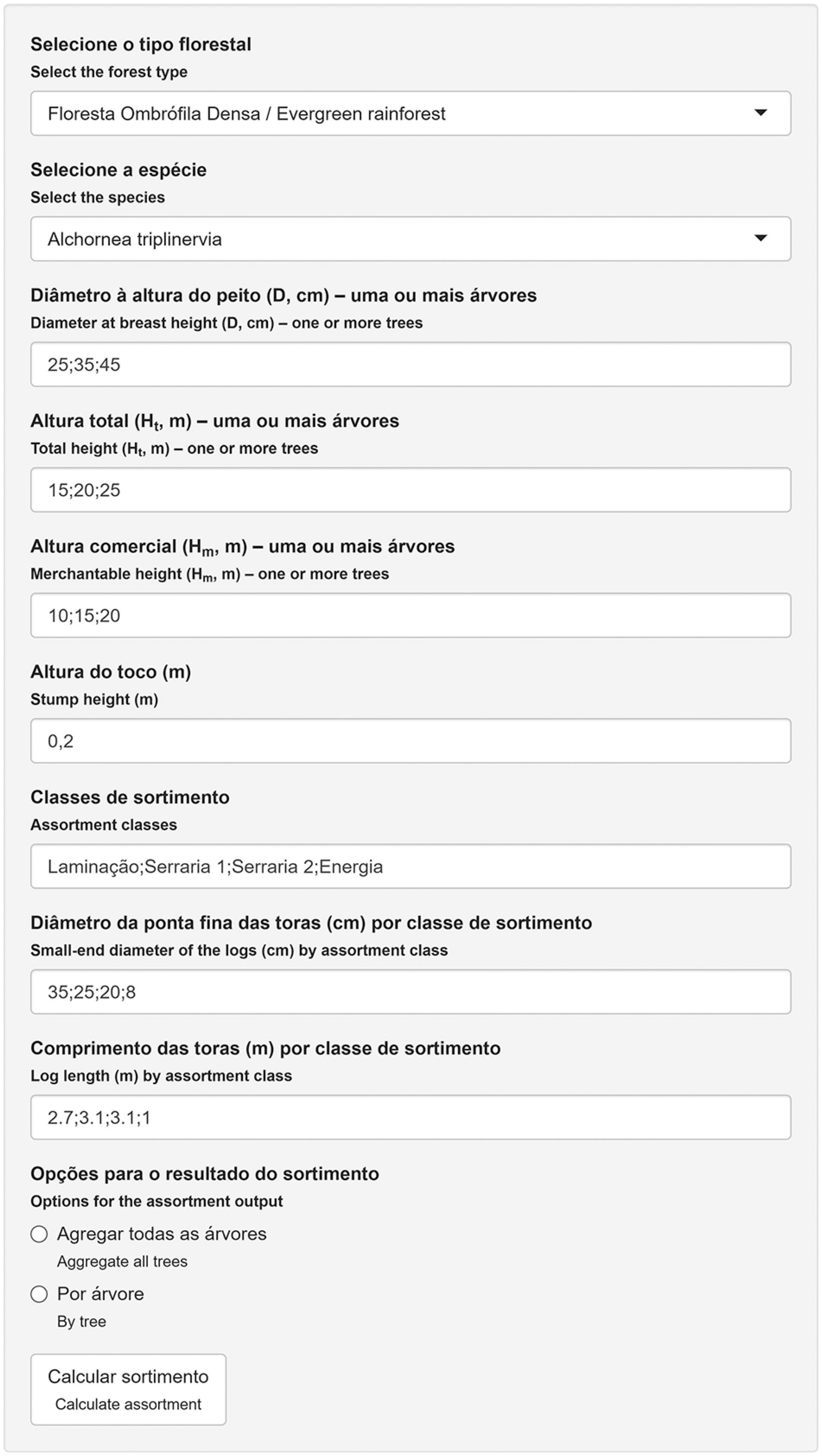
The assortment prediction application was developed using the ‘shiny’ R package (version 1.9.1) and is available at https://florestasc.shinyapps.io/sortimento. It employs an algorithm that applies the calibrated taper models to classify logs into assortment classes, and uses numerical integration of these models (Eq. 10) to predict the outside-bark wood volume per class based on user-provided information. The application features a simple and intuitive layout (Figure 1); it has ten fields where the user should select an option or enter alphanumeric information, as explained below:

Select the forest type: Select the forest type to be considered, i.e. ERF, AF, or SF.
Select the species: Select the species of interest. When a given species is selected, the taper model is evaluated with the random effects predicted for it; in turn, when the option ‘Other species’ is selected, the model is evaluated with the expected value of the random effects, i.e. zero – in other words, only the estimated fixed effects are considered. Evaluating the random effects at zero did not result in predictions with systematic errors, as revealed by their strong alignment with predictions obtained via Monte Carlo integration over simulated distributions of the random effects. The species with timber potential included in the dropdown lists were selected based on the literature and the criterion of having at least 15 stems measured in the field. It should be emphasized that the taper models calibrated in this study were applied to all species, with the exception of A. angustifolia, for which the taper model of Kozak (1988), as calibrated by Costa et al. (2016), was used.
Diameter at breast height (D, cm) – one or more trees: Enter the D of one or more trees (separated by semicolon), in cm. The application requires a period as the decimal separator for all numerical variables.
Total height (Ht, m) – one or more trees: Enter the Ht of one or more trees (separated by semicolon), in m.
Merchantable height (Hm, m) – one or more trees: Enter the Hm of one or more trees (separated by semicolon), in m.
Stump height (m): Define the stump height to be left by the tree harvesting operator, in m.
Assortment classes: Define the names of the assortment classes to be considered (separated by semicolon). The classes ‘Residual’ (portion of timber not classified in any of the other classes entered by the user) and ‘Total’ (sum of all classes) are automatically added during the calculations and shown in the final result.
Small-end diameter of the logs (cm) by assortment class: Define the minimum small-end diameter of the logs admitted in each assortment class (separated by semicolon), in cm.
Log length (m) by assortment class: Define the log length for each assortment class (separated by semicolon), in m.
Options for the assortment output: When the option ‘Aggregate all trees’ is selected, the assortments for individual trees are summed and the result is a single table containing the number of logs and outside-bark volume per assortment class, along with other auxiliary information. In contrast, when ‘By tree’ is selected, the assortment for each tree is displayed individually, in the order that the dendrometric data were entered.
The management of native species/forests outside the Brazilian Amazon faces several obstacles, such as legal restrictions, excessive bureaucracy, and a lack of management initiatives (Britto et al., 2017; Fantini et al., 2019; Huss et al., 2020). However, developing tools like the application presented here may be a relevant step towards supporting and promoting the sustainable management of secondary Atlantic forests. Log assortment predictions for different forest types and multiple timber species, obtained through a simple platform, may help improve the effectiveness and efficiency of economic and operational planning for sustainable forest management projects. Furthermore, this study reiterates the management of timber resources – based on solid scientific knowledge – as a feasible strategy for regional socioeconomic development and the conservation of the rich native forests in southern Brazil (Fantini and Siminski, 2016; Zambiazi et al., 2021; Cysneiros et al., 2023).
Data availability statement
The data underlying this article may be shared on reasonable request to the corresponding author.
Acknowledgments
The authors are grateful to the landowners who allowed fieldwork on their properties, to the FlorestaSC field crews/climbers for collecting data from thousands of trees, and to Dr. Jackson Roberto Eleotério for discussions on the topic of this study. The FlorestaSC program is funded by the Secretaria de Estado do Meio Ambiente e da Economia Verde (SEMAE-SC, 2022TR001389) and Fundação de Amparo à Pesquisa e Inovação de Santa Catarina (FAPESC, 2023TR001432). This study was partially funded by the Coordenação de Aperfeiçoamento de Pessoal de Nível Superior (CAPES) – Financial Code 001. The first author is supported by SEMAE-SC (2022TR001389) and Universidade do Estado de Santa Catarina (Programa de Bolsas de Monitoria de Pós-Graduação). The second author is supported by the Conselho Nacional de Desenvolvimento Científico e Tecnológico (CNPq, 305199/2022-6).
References
- Avery TE, Burkhart HE. 2015. Forest Measurements. 5ed. Waveland Press, Long Grove, IL, USA.
-
Baptista SR, Rudel TK. 2006. A re-emerging Atlantic forest? Urbanization, industrialization and the forest transition in Santa Catarina, southern Brazil. Environmental Conservation 33: 195-202. https://doi.org/10.1017/S0376892906003134
» https://doi.org/10.1017/S0376892906003134 -
Britto PC, Jaeger D, Hoffmann S, Robert RCG, Fantini AC, Vibrans AC. 2017. Productivity assessment of timber harvesting techniques for supporting sustainable forest management of secondary Atlantic Forest in southern Brazil. Annals of Forest Research 60: 203-215. https://doi.org/10.15287/afr.2017.898
» https://doi.org/10.15287/afr.2017.898 -
Costa EA, Finger CAG, Schneider PR, Hess AF. 2016. Taper function and timber assortments for Araucaria angustifolia Ciência florestal 26: 523-533 (in Portuguese, with abstract in English). https://doi.org/10.5902/1980509822753
» https://doi.org/10.5902/1980509822753 -
Cysneiros VC, Pelissari AL, Péllico Netto S, Machado SA, Figueiredo Filho A. 2023. Population structure of Araucaria angustifolia under distinct forest protection status: implications for management and conservation. Journal of Forestry Research 34: 1437-1446. https://doi.org/10.1007/s11676-023-01603-8
» https://doi.org/10.1007/s11676-023-01603-8 -
Fantini AC, Siminski A. 2016. Management of secondary forests of the Brazilian Atlantic Forest for timber production: possible and desirable. Revista Brasileira de Pós-Graduação 13: 673-698 (in Portuguese, with abstract in English). https://doi.org/10.21713/2358-2332.2016.v13.1013
» https://doi.org/10.21713/2358-2332.2016.v13.1013 -
Fantini AC, Bauer E, Valois CM, Siddique I. 2017. The demise of swidden-fallow agriculture in an Atlantic Rainforest region: implications for farmers’ livelihood and conservation. Land Use Policy 69: 417-426. https://doi.org/10.1016/j.landusepol.2017.09.039
» https://doi.org/10.1016/j.landusepol.2017.09.039 -
Fantini AC, Schuch C, Siminski A, Siddique I. 2019. Small-scale management of secondary forests in the Brazilian Atlantic Forest. Floresta e Ambiente 26: e20170690. https://doi.org/10.1590/2179-8087.069017
» https://doi.org/10.1590/2179-8087.069017 -
Freitas JV, Oliveira YM, Rosot MAD, Gomide G, Mattos PP. 2010. National Forest Inventories: Brazil. p. 89-95. In: Tomppo E, Gschwantner T, Lawrence M, McRoberts RE. eds. National Forest Inventories: pathways for common reporting. Springer, Dordrecht, Netherlands. https://doi.org/10.1007/978-90-481-3233-1
» https://doi.org/10.1007/978-90-481-3233-1 -
Gregoire TG, Schabenberger O, Barrett JP. 1995. Linear modelling of irregularly spaced, unbalanced, longitudinal data from permanent-plot measurements. Canadian Journal of Forest Research 25: 137-156. https://doi.org/10.1139/x95-017
» https://doi.org/10.1139/x95-017 -
Huss J, Dobner Jr M, Paixão CA, ten Caten A, Siminski A. 2020. Regeneration of Araucaria angustifolia in pine plantations in the south of Brazil: a silvicultural approach. Scientia Forestalis 48: e3265. https://doi.org/10.18671/scifor.v48n127.16
» https://doi.org/10.18671/scifor.v48n127.16 -
Kozak A. 1988. A variable-exponent taper equation. Canadian Journal of Forest Research 18: 1363-1368. https://doi.org/10.1139/x88-213
» https://doi.org/10.1139/x88-213 -
Kozak A. 2004. My last words on taper equations. The Forestry Chronicle 80: 507-515. https://doi.org/10.5558/tfc80507-4
» https://doi.org/10.5558/tfc80507-4 -
McTague JP, Weiskittel A. 2021. Evolution, history, and use of stem taper equations: a review of their development, application, and implementation. Canadian Journal of Forest Research 51: 210-235. https://doi.org/10.1139/cjfr-2020-0326
» https://doi.org/10.1139/cjfr-2020-0326 -
Mello AA, Nutto L, Weber KS, Sanquetta CE, Matos JLM, Becker G. 2012. Individual biomass and carbon equations for Mimosa scabrella Benth. (bracatinga) in southern Brazil. Silva Fennica 46: 333-343. https://doi.org/10.14214/sf.44
» https://doi.org/10.14214/sf.44 -
Oliveira LZ, Gasper AL, Lingner DV, Sevegnani L, Vibrans AC. 2019. Secondary subtropical Atlantic forests shelter a surprising number of rare tree species: outcomes of an assessment using spatially unbiased data. Biodiversity and Conservation 28: 751-768. https://doi.org/10.1007/s10531-018-01690-8
» https://doi.org/10.1007/s10531-018-01690-8 -
Oliveira GS, Soares PRC, Sampietro JA, Silva MTS, Nicoletti MF, Silva JP. 2020. Evaluation of assortments considering different stump and pre-bucking disc heights in mechanized harvesting operations of a Pinus taeda L. forest. Floresta 50: 1133-1142. https://doi.org/10.5380/rf.v50i1.61775
» https://doi.org/10.5380/rf.v50i1.61775 -
Oliveira-Filho AT, Budke JC, Jarenkow JA, Eisenlohr PV, Neves DRM. 2015. Delving into the variations in tree species composition and richness across South American subtropical Atlantic and Pampean forests. Journal of Plant Ecology 8: 242-260. https://doi.org/10.1093/jpe/rtt058
» https://doi.org/10.1093/jpe/rtt058 -
Pretzsch H, Forrester DI, Bauhus J. 2017. Mixed-Species Forests. Ecology and Management. Springer, Berlin, Germany. https://doi.org/10.1007/978-3-662-54553-9
» https://doi.org/10.1007/978-3-662-54553-9 -
Rosa MR, Brancalion PHS, Crouzeilles R, Tambosi LR, Piffer PR, Lenti FEB, et al. 2021. Hidden destruction of older forests threatens Brazil's Atlantic Forest and challenges restoration programs. Science Advances 7: eabc4547. https://doi.org/10.1126/sciadv.abc4547
» https://doi.org/10.1126/sciadv.abc4547 -
Schuch C, Siminski A, Fantini AC. 2008. Uses and lumber potential of jacatirão-açú (Miconia cinnamomifolia (De Candolle) Naudin) in the Atlantic coast region of Santa Catarina State, Brazil. Floresta 38: 735-741 (in Portuguese, with abstract in English). https://doi.org/10.5380/rf.v38i4.13169
» https://doi.org/10.5380/rf.v38i4.13169 -
Sharma M, Parton J. 2009. Modeling stand density effects on taper for jack pine and black spruce plantations using dimensional analysis. Forest Science 55: 268-282. https://doi.org/10.1093/forestscience/55.3.268
» https://doi.org/10.1093/forestscience/55.3.268 -
Valentine HT, Gregoire TG. 2001. A switching model of bole taper. Canadian Journal of Forest Research 31: 1400-1409. https://doi.org/10.1139/x01-061
» https://doi.org/10.1139/x01-061 - Vibrans AC, Sevegnani L, Lingner DV, Gasper AL, Sabbagh S. 2010. The Floristic and Forest Inventory of Santa Catarina State (IFFSC): methodological and operational aspects. Pesquisa Florestal Brasileira 30: 291-302 (in Portuguese, with abstract in English).
-
Vibrans AC, Moser P, Oliveira LZ, Maçaneiro JP. 2015. Generic and specific stem volume models for three subtropical forest types in southern Brazil. Annals of Forest Science 72: 865-874. https://doi.org/10.1007/s13595-015-0481-x
» https://doi.org/10.1007/s13595-015-0481-x -
Vibrans AC, Gasper AL, Moser P, Oliveira LZ, Lingner DV, Sevegnani L. 2020. Insights from a large-scale systematic inventory in the southern Brazilian Atlantic Forest. Scientia Agricola 77: e20180036. https://doi.org/10.1590/1678-992X-2018-0036
» https://doi.org/10.1590/1678-992X-2018-0036 -
Westfall JA, Scott CT. 2010. Taper models for commercial tree species in the northeastern United States. Forest Science 56: 515-528. https://doi.org/10.1093/forestscience/56.6.515
» https://doi.org/10.1093/forestscience/56.6.515 -
Zambiazi DC, Fantini AC, Piotto D, Siminski A, Vibrans AC, Oller DC, et al. 2021. Timber stock recovery in a chronosequence of secondary forests in southern Brazil: adding value to restored landscapes. Forest Ecology and Management 495: 119352. https://doi.org/10.1016/j.foreco.2021.119352
» https://doi.org/10.1016/j.foreco.2021.119352
Edited by
-
Edited by:
Sebastião Martins Filho https://orcid.org/0000-0002-8317-4318