 ‘They come in to devour nature and to destroy what we preserve!’ - Ecocide, capitalism, and quilombola resistance in Cocalinho, Maranhão
ABSTRACT
The article analyzes ecocide in Cocalinho, a quilombola community in Maranhão, in Brazil’s Cerrado. In the first part, a theoretical section refines the traditional criminal-law conception and defines ecocide as an economic, political, social, and cultural process of radical, violent appropriation of nature that converts it into a commodity consumable up to the limit of profit, despite the destruction of human and non-human life. Operationally, this definition supports a four-stage analytical model. The second section outlines methods. Residents’ perceptions-central to the model-were collected in July 2023 through ethnographic fieldwork with participant observation and semi-structured and open interviews. To systematize and analyze perceptions, two instruments were created: the Ecocide Radar (quantitative) and the Panel of Voices (qualitative). The final part, an applied section, discusses results from Cocalinho, indicating a stage of ‘intense competition’, in which quilombolas perceive the ecocidal attacks as strong, yet consider themselves protected enough to confront them. The article concludes that this stage is extremely dangerous and demands public action to safeguard nature, ensure sustainable development, promote well-living (bem-viver), and uphold democracy.
KEYWORDS
Ecocide; Capitalism; Nature; Quilombola communities; Policy public.
RESUMO
O objetivo do artigo é analisar o ecocídio em Cocalinho, comunidade quilombola do Maranhão, Cerrado brasileiro. Na primeira parte, teórica, apresentam-se reflexões sobre ecocídio que, aperfeiçoando tradicional concepção jurídico-criminal, definem-no como processo econômico-político-social-cultural de apropriação radical e violenta da natureza, transformando-a em mercadoria consumível até o limite máximo da geração de lucros, a despeito da destruição de vidas humanas e não humanas. Essa definição operacional embasa a elaboração de modelo de análise do ecocídio em quatro etapas. Na segunda parte, apresentam-se as considerações metodológicas. Consideradas centrais no modelo de análise, as percepções dos moradores foram levantadas em julho de 2023, via método etnográfico com aplicação de observação participante e entrevistas (semiestruturada e aberta). Para sistematizá-las e analisá-las, foram desenvol-vidos dois dispositivos, Radar do Ecocídio (quantitativo) e Painel de Falas (qualitativo). Na última parte, prática, discutem-se os resultados da aplicação do modelo analítico e seus dispositivos em Cocalinho, indicando um estágio de ‘competição intensa’, no qual os quilombolas percebem os ataques ecocidas como fortes, mas consideram-se protegidos para os enfrentarem. Conclui-se que esse estágio é extremamente perigoso para os quilombolas, exigindo a ação do poder público para garantir a preservação da natureza, o desenvolvimento sustentável, o bem-viver e a democracia.
PALAVRAS-CHAVE
Ecocídio; Capitalismo; Natureza; Quilombola; Políticas públicas.
Introduction
Originating in the legal sphere, the term ecocide has been understood as a crime caused by the intentional destruction of a territory’s biome. This article proposes an analysis that, without conflicting with this approach, aims to broaden it, working with ecocide as an economic-political-social-cultural process with different and even contradictory moments that can be both rapid in execution or last for years.
In this sense, starting from the discussion on economic aspects and adopting an intersectional perspective1, we seek to show that the destruction promoted by ecocide is related to racism, attacking indigenous people, quilombola communities, and survivors of populations historically subjected to colonization. Understanding this relationship also aims to contribute to Brazil’s efforts to create Sustainable Development Goal 18 (SDG 18), on ethnic-racial equality2.
As the debate progresses, emphasis is placed on the relationship between ecocide and violence against women, who are generally the most affected, revealing both its heteropatriarchal character and the erasure of knowledge and wisdom, characterizing it as epistemicide3.
Under this approach, ecocide merges and promotes, in its development, the joint destruction of non-human and human lives. Its effects are revealed, therefore, in nature, in social interactions, and in bodies, increasing morbidity and mortality, deforesting and destroying territories, knowledge, memories, and ways of life, which prevents well-being and democracy.
To navigate these dimensions, it is considered that ecocide is driven by intricate arrangements of formal and informal, legal and illegal economic and political activities, through which certain actors appropriate nature, transforming it into a commodity of very low value. By buying it (or illegally seizing it), they contractually obtain the privilege of using it as they see fit, including destroying it.
Thus, ecocide is, dialectically, both a cause and a consequence of economic activities whose state regulation is subjected to the power of the market, becoming weak and/or nonexistent. It therefore expresses a development model based on the unlimited exploitation of nature, the commodification of ecosystems, and the subordination of socio-environmental relations to the logic of capital.
Like climate change, ecocide negatively impacts public/collective health, intensifying physical and mental problems, as well as spreading diseases transmitted by vectors, food, and water4. This reveals a complex scenario of relationships that are still poorly studied, in which the main global challenge interacts with local problems and vulnerabilities.
In the following pages, we intend to reflect on the relationships mentioned above, incorporating them into the process of developing an analytical model that, strictly speaking, addresses ecocide as a public/collective health issue and, broadly speaking, contributes to its tackling by public authorities.
This analytical model, in order to have internal coherence and viability, cannot follow only a theoretical path, but must be subjected to the scrutiny of reality in order to understand its explanatory potential and its gaps.
The Cocalinho quilombola community lives in the municipality of Parnarama, state of Maranhão, Northern region, Cerrado biome, where ecocide is directly related to the advance of agribusiness on the territories of traditional communities, with effects that accumulate over the years5.
Analyzing ecocide in this community from the model formulated here constitutes the objective of this article, to which is added the intention of giving voice to the population of Cocalinho, highlighting their problems and sufferings, their joys and knowledge.
Ecocide: Reflections towards an analytical category
The term ecocide, coined in the 1970s, has regained prominence in the 21st century, especially in the field of law and social movements. Both in its origin and currently, it emphasizes legal aspects that seek to classify certain acts as crimes against nature and its inhabitants. The definition of ecocide, as developed by the International Criminal Court since 2021, makes this emphasis explicit:
Any unlawful or arbitrary act perpetrated with the awareness that there is a high probability that it will cause serious, widespread, or lasting damage to the environment6.
Despite its importance, this legal definition is limited, because, as Westing7 points out, “intent may not only be impossible to establish without admission, but, I believe, is essentially irrelevant!”.
Kowalska8, seeking to broaden these limits, considers that the anthropocentric basis of environmental law takes nature as the backdrop for human rights. In contrast, she defends an ecocentric perspective - nature has intrinsic value and human beings are part of the ecosystem, not its owner - postulating ‘ecological security’ as a new paradigm of law, responsible for guaranteeing environmental integrity and its sustainability for future generations.
Crook and Short9 recall the work of the Polish jurist Raphael Lemkin, who, in 1944, under the impacts of Nazism and the Holocaust, was the first to use the term genocide, an international reference for the creation and legal use of the term ecocide. For him, genocide is a two-phase process, “the destruction of the national standard of the oppressed group and the imposition of the national standard of the oppressor”9. To this end, genociders need to develop ‘methods’ that can give organization and momentum to the destruction and imposition of their ‘national standard’. Lemkin lists such ‘methods’:
[...] physical massacre and mutilation, deprivation of means of subsistence (starvation, exposure, deportation), slavery; exposure to death; biological separation of families, sterilization, destruction of fetuses; cultural desecration and destruction of cultural symbols (books, art objects, plunder, religious relics, etc.), destruction of cultural leadership, destruction of cultural centers (cities, churches, monasteries, schools, libraries), prohibition of cultural activities or codes of conduct, forced conversion, demoralization9.
Terrifying, the ‘methods of genocide’ consist of external attacks whose analysis allows us to propose that, in the territories where they are practiced, a competition is established, against the will of the inhabitants, between: a new pattern of relations (economic, political, social, cultural, legal...) that attempts to violently abolish the traditional pattern; and the resistance and confrontation to this imposition.
This competition is unequal in favor of the occupiers, which stimulates and combines activities that increasingly blur the boundaries between legal, illegal, and informal. Since neither destruction nor imposition is immediately consolidated because of resistance and confrontation, the competition stimulates new methods of genocide, multiplying the power of external attacks.
Lemkin attributes fundamental importance to the social relations established by the attacked peoples. Approaching them from perspectives linked to law and psychology, he calls them ‘cultural’, which is why his report to the United Nations Convention on Genocide in 1946 highlighted ‘cultural genocide’ as an essential method of genocide. However, due to insufficient support, he had to withdraw it from the Convention’s Final Report.
[...] the removal of this method seems to have contributed to a concern... in legal and academic circles, regarding the perpetrator’s intent... and to the popular (mis)understanding of the crime of genocide as simply mass murder with racial motivation7.
Decades later, the wars produced by European and North American neocolonialism in Asia adopted the use of chemical weapons as a method, especially Agent Orange (napalm). Capable of destroying nature, local combatants, and the civilian population simultaneously, chemical warfare was harshly criticized at the Conference on War and National Responsibility at the United Nations (UN) in 1970.
At that Conference, Arthur Galston first used the term ecocide, associating it with genocide: “An attempt to destroy a natural environment [must be] qualified as... an atrocity! It requires a similar concept [to that of genocide]: ecocide!”10.
By directly linking ecocide and genocide, Galston’s proposal revived in the new debate the need for the classification of a crime and, consequently, the identification of the perpetrator. Falk11 criticized it:
Ecocide generally occurs as a consequence of human economic activity and not as a result of a predetermined and intentional direct attack on the environment.
Crook and Short9 start from this critique to point out that, in ecocide, the main objective is the transformation of nature into a commodity. They consider it a “method of genocide” which, by commodifying nature, also becomes a “function of capital”9. They thus introduce dialectical and historical materialism into the debate, valuing the processual dimension.
As a consequence, it can be argued that, in each territory where it is perpetrated, ecocide goes through different stages related to the historical process experienced by the affected societies in a non-linear way. These stages produce superstructural manifestations that express and, at the same time, modify the structural relations that sustain societies. To a certain extent, the superstructural ones correspond to the cultural dimension valued by Lemkin.
Madarasz12 deepens the dialogue with Marx, understanding ecocide as a direct result of the logic of self-valorization of capital and criticizing the notion of the Anthropocene for obscuring the unequal power relations and the historical responsibility of central countries for the ongoing environmental catastrophe. Instead of a ‘generic humanity causing climate collapses’, he proposes recognizing the geopolitical and historical effects of extractivism, slavery, racialization, and the violent appropriation of nature as constituent elements of ecocide.
For him, capitalism promotes a rupture between humanity and nature, which constitutes the core of ecocide. Mediated by ‘abstract labor’ - a specific form of exploitation of human labor by capital - the destruction of nature is not a side effect of economic growth, but the mode of operation of capital. Therefore, global ecological transformations are inseparable from social relations of production, which requires, for their overcoming, the transformation of the forms of appropriation, use and control of natural resources. Ecocide, therefore, must be confronted not only by laws and sanctions, but also by the reorganization of forms of life and production, based on the sovereignty of peoples and ecological justice.
In researching ecocide in Latin American countries that underwent mercantilist colonization processes, extermination of indigenous peoples and enslavement of Africans to serve as labor, Quiñones13 produced a set of reflections whose main merits are to discuss ecocide in contemporary times and in societies that have experienced colonization processes similar to that of Brazil; and to focus on populations and, within them, the segments that are generally most affected by ecocide.
His critique of the ‘fragmented analysis of reality’ demands that those who study ecocide not focus solely on one dimension of the process, a stance that produces a theoretical-methodological reductionism whose intention is to make invisible and divert attention from the real problems. To this end, he cultivates a term that articulates the dimensions he considers essential: ‘Ecogenoethnocide’.
Moreira14 reinforces this critique by considering that state, legal, and scientific institutions that remain silent or even legitimize ecocidal processes become part of a ‘necropolitics’ that makes it impossible to recognize victims as subjects of rights and discourse.
Quiñones argues that, in countries that have undergone European mercantile colonization, there is a ‘racist genocide’ that aims to eliminate diversity and plurality as a constitutive characteristic of humankind13.
In South America, the diversity affected is always that which relates to the original/indigenous peoples and to the Black populations kidnapped from Africa and enslaved in the then-new continent. Ecocide does not develop among the populations that are directly descended from the European colonizer, especially its wealthier strata. It focuses on the descendants of those who were subjected to colonization, who have fewer economic and political resources to face the competition for ownership of nature, which highlights its unequal character.
Similarly to what Lemkin thought about genocide, ecocide establishes an unequal competition, this time around nature, more specifically in its consumption as a commodity. Waged between market actors (the ‘capitalists’), who attack nature to consume it and profit from it, and those who fight to preserve it as a place where they live (the ‘residents’), this competition is here called Capitalist Competition for Nature (CCN), whose analysis reveals the class struggle as structuring of ecocide and its racist dimension, since the competition does not occur between white capitalists, but between them and indigenous people, black people and all the population diversity that exists among the exploited classes.
Tognini15 addresses ecocide as a sociopolitical process sustained by devices of silencing, disinformation, and denial, interpreting them as an ‘active production of opacity’ that is expressed in the absence of reliable data, the invisibility of the cumulative effects of destruction, the denial of the relationship between pollution and illness, and the neutralization of local narratives about the impacts of ecocide.
Tognini criticizes international environmental governance regimes that, under the discourse of universal protection, legitimize neocolonial practices of territorial and epistemic control over peoples of the Global South, impose agendas, disregard local knowledge, and reinforce the geopolitical division between environmentally destructive production and consumption. In this logic, ecocide becomes a geopolitical device that organizes global space according to criteria of exploitation and racialized management of destruction.
The paths and debates explored in this article allow its authors to conclude this topic with the proposition of a synthetic and operational definition for the category of ecocide:
A radical and violent economic, social, political, historical, and cultural process of appropriating nature with the aim of transforming it into a commodity whose value lies in its ability to be consumed to the maximum extent possible for generating profits, producing extremely negative impacts on territories and the destruction of non-human and human lives that coexist within them.
A proposed model for analyzing ecocide
Based on this definition of ecocide, the proposed analysis model consists of four interconnected stages: Stage 1 - Identification of the public problem; Stage 2 - Characterization of the CNN; Stage 3 - Definition of the stage in which the CNN finds itself; and Stage 4 - Production of recommendations for overcoming government failures.
Stage 1 adopts as the starting point of the model the need to understand ecocide as a “public problem”16, one that, involving private entities, cannot be solved by them and/or by the market, producing negative impacts in the public sphere and demanding action from the State to produce solutions.
With regard to ecocide, the public problem has as its backdrop the reification of nature as a commodity, that is, its use as private property, whose exchange value is that of being consumed in whatever way pleases the owner, regardless of the environmental, climatic and life-destroying impacts. Plant production, mineral extraction, extensive animal farming, waste disposal and mega-projects are, among others, economic activities that promote this reification. As long as it is generating profit, nature will be exploited in every possible way.
This is precisely what generates the need for state action. The absence and/or weakness of public action represent government failures17. Motivated by lack of resources, incompetence or complicity with appropriation, these failures act as catalysts for the development of ecocide.
As a typical process of capitalist political economy, ecocide has a super-intensive and expansionist character. Being super-intensive means that it vigorously consumes and destroys the exploited territory, reducing the very historical time of possible consumption. This consumerist frenzy generates waste, debris, and negative impacts that spread to territories contiguous to the original. A typical example of this is pesticides carried by the wind to neighboring properties.
Super-intensiveness amplifies the constant need for expansion in search of new nature-commodities. If these are properties of people who also have the financial, legal, and political resources to compete on equal terms with those who want to buy them, their appropriation reduces or prevents profits, which would be an inefficient allocation of capital, a market failure18.
The territories contiguous to the original property then become the main targets of appropriation, because, having already been affected by the impacts of super-intensive consumption of nature, they tend to have their exchange value reduced. If they are linked to populations that have little or no financial, legal, and political resources to compete for their property, their value will be even lower.
Thus, planning expansion is essential for an efficient allocation of resources. Sometimes, the appropriation of a territory is carried out with the aim of acquiring contiguous territories more cheaply. In these situations, the super-intensive and expansionist nature of the consumption of the original property also becomes a method of reducing the exchange value of contiguous territories.
The territory that market actors (the ‘capitalists’) intend to buy for the lowest possible price is, for those who live there (the ‘residents’), not a commodity, but their own home, a place without which life would hardly make sense, which indicates that they will resist the purchase and confront attempts at unrestrained consumption of nature.
A CCN is then established, which directs the analysis model to Stage 2.
The CCN tends not to be resolved quickly through a single attack. In many cases, it persists, either because of the resistance of the ‘residents’, or because the ‘capitalists’ have the resources to wait for the most appropriate economic and political moment. In this time-space, such competition engenders different social relations through which the ‘residents’ interact in different ways with the ‘capitalists’, especially with their employees.
These interactions are what generate and define the stages of the CCN, driving the analysis model to Stage 3.
In the territory, interactions are built from and around legal, informal, and illegal actions. For example, ‘capitalists’ may offer legal or informal income-generating opportunities to residents, aiming for proximity due to a need for labor or an attempt to co-opt and weaken resistance. At the same time, they may promote illegal actions in a region of the territory, deforesting it and/or preventing residents’ access.
In the different stages that the CCN can assume, feelings and practices related to calm moments of rapprochement are mixed with tense moments of distancing, dispute, and conflict. Therefore, the analysis of the CCN in a given community, at a given historical moment, allows us to understand the weight of each type of action in the competition, identifying the stage in which it is found.
This reinforces the procedural aspect of ecocide, transforming the stage of competition into a proxy for ecocide. In other words: understanding ecocide in a given space-time is made possible by identifying the stage of the CCN.
Regardless of the duration of the CCN, without public action, it will hardly fail to be won by the ‘capitalists’. For this action to be as effective as possible, it demands an adequate understanding of the stage of the CCN. Without this, the public authorities will not have the necessary evidence to formulate and implement policies to combat ecocide that are appropriate to that particular territory.
This reflection places the model in Stage 4. In this stage, all analyses converge on the action of public authorities, seeking to overcome the government failures that opened the possibility of ecocide taking hold, the full guarantee of the rights of the ‘residents’, and the possible punishments for the ‘capitalists’.
It is clear that the model can be applied by different actors. Originating from academia, the analyses tend to produce policy recommendations to be presented to the public authorities, including the Judiciary. Coming from organized civil society, the recommendations take on the incisive tone typical of social movements and can also be used to influence the electoral process. If the model is applied by the public authorities themselves, the analyses tend to consolidate into actions, as these are the actors who have the prerogative to develop policies and the obligation to guarantee rights.
Having proposed the analytical model, it is necessary to apply it to reality in order to identify to what extent it is capable of producing analyses that, in some way, contribute to overcoming ecocide. Beginning this part of the text, the following topic is dedicated to discussing methodological aspects related to the process of applying the model in the quilombola community of Cocalinho.
Material and methods
This article is the product of the research project ‘Ecocide and Globalization of the Brazilian Cerrado: resistance and struggles of indigenous and traditional peoples and communities for the rights to health and life’ - Certificate of Presentation for Ethical Appraisal (CAAE) No. 68525423.0.0000.5241 and Opinion No. 6.069.015 -, a collaboration between the Vice-Presidency for Environment, Care and Health Promotion of the Oswaldo Cruz Foundation (VPAAPS/FIOCRUZ) and the Center for Social Studies of the University of Coimbra (CES-Coimbra/Portugal).
It is structured in two interconnected parts: the first, composed of the topics preceding this one, presented a critical reflection on the concept of ecocide, proposing an analytical model constructed in the theoretical debate with authors who study the topic in its emergence, development and contemporaneity; The second part, developed in the sections following this one, applies the elaborated model to the reality experienced by the population of Cocalinho, and is based on information gathered through fieldwork.
The theoretical debate was constructed through the articulation of primary and secondary sources. Throughout the first semester of 2023, the aforementioned research held a cycle of 7 international seminars that included the participation of 30 experts from academia, public management, social movements, and populations experiencing ecocide. Dedicated to discussing theoretical and methodological contributions to research on ecocide, the seminars promoted interdisciplinary reflections and exchanges that, above all, valued the knowledge of those who, living in the affected territories, resist and fight against ecocide. These individuals, from different peoples, ethnicities, and communities, participated in all the seminars, taking the lead in two of them.
In total, there were approximately 20 hours of debate, in which a dense set of texts, productions, and experiences were discussed, in a dynamic that guided the selection of the authors discussed in this article.
To apply this theoretical and methodological discussion to reality, the first step was to select the territory that would be the universe of the research. The quilombola community of Cocalinho lives in the municipality of Parnarama, in the state of Maranhão, although it is closer to Teresina, the capital of the state of Piauí, both in the Northeast region, in the Cerrado biome. The criteria adopted for its selection were: participation in the cases analyzed by the Permanent Peoples’ Tribunal (TPP) in 2021, involving ecocide in the Brazilian Cerrado; the community’s articulation with FIOCRUZ and the ‘Campanha do Cerrado’ (a Brazilian civil society organization); and the community’s interest in participating in the research.
The research in Cocalinho was carried out through fieldwork developed between July 1 and 12, 2023, by a team of six researchers. In it, the ethnographic method19 was applied, incorporating elements of participatory action research20 and focusing on the perceptions, knowledge and experiences of the research subjects, gathered through participant observation and interview techniques (open and semi-structured).
Participant observation was carried out in 13 regions identified by the community as sensitive to the impacts of ecocide.
Open interviews were conducted with 16 people, selected jointly by the research team and local leaders, representing ‘women’, ‘mothers’, ‘young men’ and ‘leaders’. The scripts contained 12 open-ended questions and a registration section. The testimonies were audio-recorded and subsequently transcribed.
Semi-structured interviews were applied to 86 residents over 18 years of age, using an instrument with 42 questions (31 closed and 11 mixed). As most respondents were illiterate or semi-literate, the answers were noted by the researchers on the instrument and subsequently typed into spreadsheets in Excel® software.
Table 1 illustrates the themes addressed by these three techniques.
Research ‘Ecocide in the Brazilian Cerrado’. Themes addressed through the application of the techniques of ‘participant observation’; ‘open interview’; and ‘semi-structured interviews’
To analyze the information gathered according to the model outlined in the analysis, two analytical tools were developed that also allow for the integration of quantitative and qualitative approaches: the Ecocide Radar and the Panel of Voices.
The Ecocide Radar is a quantitative analytical tool developed to identify, based on the perceptions of research subjects, the public problem that produces ecocide (Step 1 of the analysis model), characterize the CCN in a given community (Step 2), and measure the stage of this CCN and, therefore, the stage of ecocide (Step 3).
The Radar expresses the concept that the stage of CCN in a community represents, at the historical moment studied, the competition between external actors who attack a territory to consume it in order to obtain the maximum possible profit (the ‘capitalists’) and internal actors who defend the territory - and, therefore, their lives and non-human lives - from these attacks (the ‘residents’).
To analyze this competition, the premise adopted was that the (intention to) defend the territory by the ‘residents’ can be measured through their perceptions of the intensity of external attacks placed in perspective, compared with their perceptions of protection conferred by the state/public policies, the community, and individual living and health conditions.
For this purpose, 38 questions were selected from the semi-structured interview instrument, whose themes were worked on as variables because they enabled the outlining of three dimensions: (D1) ‘Perception of external attacks’; (D2) ‘Perception of protection’, with two sub-dimensions, ‘Protection by the SUS’ (assuming the role of proxy for the state/public policies) and ‘Protection by social relations’; and (D3) ‘Perception of life and health’, with two sub-dimensions, ‘Perception of living conditions’ and ‘Perception of health conditions’.
As the type of questions selected varies according to the objectives of the research, their answers were standardized, classifying them as: ‘Positive (P)’, when they indicate access to and care by the Unified Health System (SUS), favorable living and health conditions, welcoming social relations and scenarios of a better future; ‘Negative (N)’, when they indicate problems in the SUS, in living and health conditions, in social relations and scenarios of a worse future; ‘Intermediate (I)’, when they express perceptions that are neither ‘Positive’ nor ‘Negative’; and ‘Unclassified (SC)’, grouping responses such as ‘I don’t know’, ‘I don’t remember’ and ‘I didn’t look it up’.
The responses ‘Positive’, ‘Intermediate’ and ‘Negative’ were scored on a scale ranging from 0 (N), 0.5 (I) to 1.0 (P), while the responses ‘Unclassified’ were not scored.
Table 2 illustrates this entire process.
Research ‘Ecocide in the Brazilian Cerrado...’: dimensions, sub-dimensions, variables, instrument questions, responses and classification used in the development of the ‘Ecocide Radar’
The points assigned to each response were added up within each dimension. D1, with 8 variables, has a score ranging from 0 to 8. In turn, D2, with 15 variables, has a score from 0 to 15. Similarly, this happens with D3, which also has 15 variables and a score from 0 to 15.
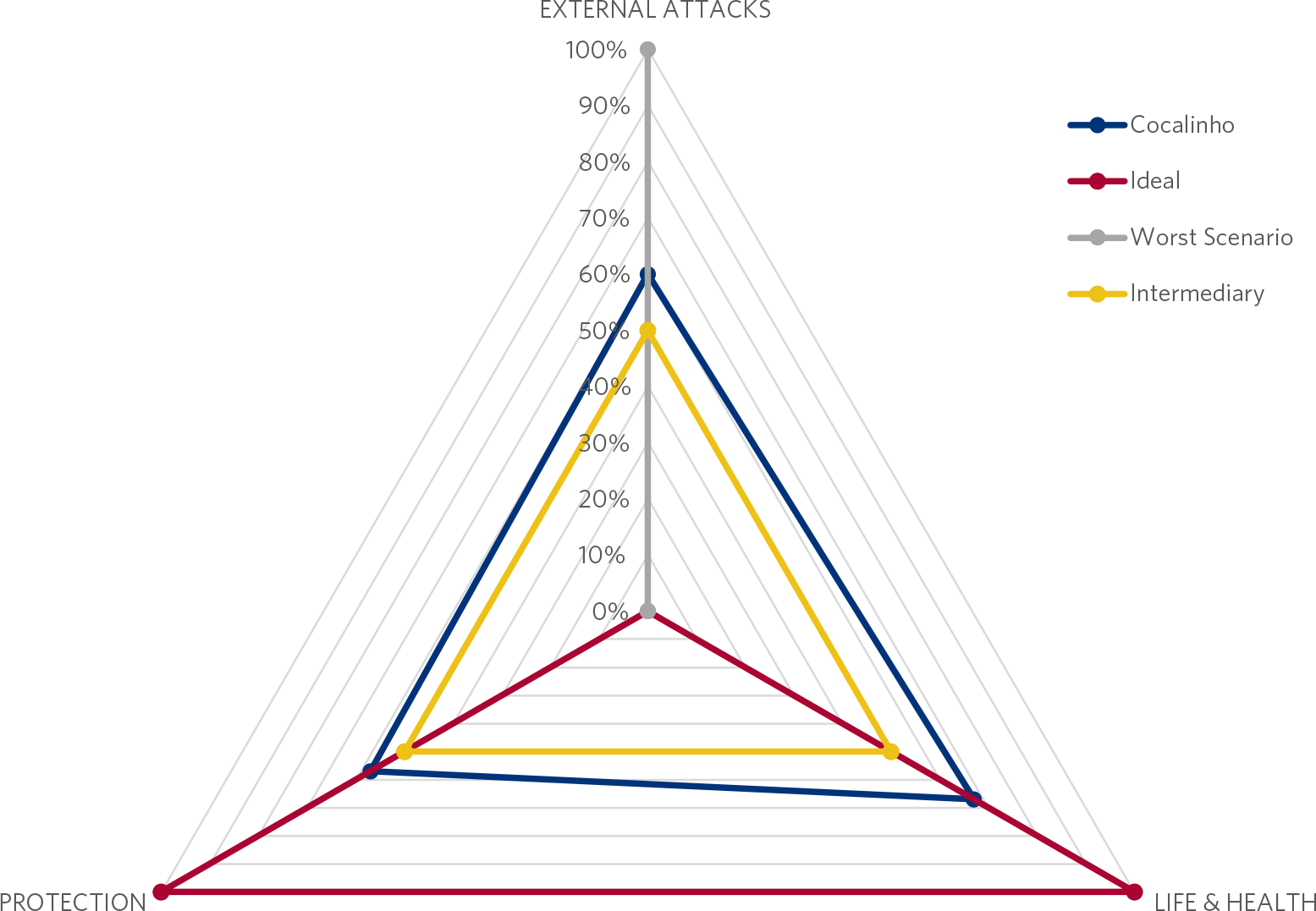
Next, the points for each dimension were summed. Since these dimensions do not have the same number of variables, it was decided to work with the percentage that the summation result represents in relation to the maximum score for each dimension. These percentages model the Ecocide Radar in the form of an equilateral triangle, in which each vertex corresponds to one of the dimensions.
It is important to highlight that, when developed in this way, the Ecocide Radar can be worked on both individually and collectively, simply by considering the average of each individual’s results as the collective result. In this article, we worked exclusively with the collective type.
The Ecocide Radar works with baseline scenarios: ‘Ideal Scenario’: D2 and D3 reach 100%, while D1 is 0%; ‘Intermediate Scenario’: all three dimensions reach 50% each; and ‘Worst Scenario’: D1 reaches 100%, while D2 and D3 remain at 0%.
Comparing these baseline scenarios with the scenario obtained by applying Radar to a specific community allows for an understanding of the stage of ecocide in that community.
The Collective Ecocide Radar allows us to understand to what extent, in a given community, at a given historical moment, the residents’ perception of the ‘external attacks’ produced by ‘capitalists’ surpasses, equals, or is inferior to their perception of their degree of ‘protection’ and their ‘living and health conditions’, making it possible to understand the stage of the CCN in that community, as illustrated in table 3.
Research ‘Ecocide in the Brazilian Cerrado’: stages of Capitalist Competition for Nature (CCN) defined by the comparative analysis of the dimensions that make up the ‘Ecocide Radar’
The Panel of Voices, in turn, is an analytical tool with a qualitative approach, designed to further explore, through information gathered in open interviews, the results of the Ecocide Radar, complementing and consolidating Stages 2 and 3 of the analysis model.
In the development of the Panel, the testimonies of the ‘residents’ are initially systematized into thematic axes that express the negative impacts of ecocide on nature, climate, labor relations, social relations, quilombola identity, and the lives of women, as well as the licit, illicit, and criminal relations engendered by ‘capitalists’.
In a second step, these systematized testimonies are associated with the three dimensions of the Ecocide Radar, deepening them with the force of their senses and meanings. In the third step, they are related to the four stages of the analysis model, which allows these - and the elements that compose them - to cease being constructs and gain existence through the perceptions of the ‘residents’.
By highlighting the demands of the ‘residents’ for actions and policies, the Panel of Voices enters Stage 4 of the analysis model, concluding its application by considering such demands as evidence capable of producing recommendations for the formulation and implementation of policies that overcome the government failures that encourage ecocide in that community.
Concluding this methodological discussion, it is worth noting that the selection, classification, standardization, and scoring processes presented here were developed according to social values agreed upon by the research team. Other teams and colleagues may present their own values which, a priori, are as valid as those worked on here, regardless of whether they present similar or different results.
Ecocide in the quilombola community of Cocalinho
This topic aims to apply the analytical model proposed here. Figure 1 illustrates the results of the Ecocide Radar for Cocalinho, showing that the ‘Protection’ dimension reached 57%; ‘Life and health’, 67%; and ‘External attacks’, 60%.

Research ‘Ecocide in the Brazilian Cerrado’. ‘Ecocide Radar’ applied to the Quilombola Community of Cocalinho/MA: results, comparison with ‘ideal’, ‘worst’ and ‘intermediate’ scenarios, and analysis of the stage of Capitalist Competition for Nat
Since the dimensions ‘Protection’ and ‘Life and Health’ are between the ‘Intermediate’ and ‘Ideal’ scenarios, while the dimension ‘Protection’ is between ‘Ideal’ and ‘Worst’, the CCN stage is one of ‘Intense Competition’.
This means that the interviewed ‘residents’ perceive themselves as threatened, but able to resist external attacks, resulting in a dangerous and unstable situation in which legal, illegal, and informal actions by ‘capitalists’ tend to multiply.
Table 4 presents the Panel of Voices developed in a way that gives voice to the ‘residents’ and their demands; injects life and feelings into the scenario outlined by the Ecocide Radar; and mobilizes empirical evidence for the analysis model.
‘Ecocide Research in the Brazilian Cerrado...’: Ecocide in the Cocalinho Quilombola Community: relations between the stages of the analysis model, the dimensions of the Ecocide Radar and the axes of the Panel of Voices
The statements - beautiful, brave, proud, concerned, and denunciatory - show that: i) destruction is not yet dominant in the community; ii) certain regions of the territory have already been severely affected; iii) there is a possibility of containing the advance of ecocide and recovering from losses; iv) there is still nature to be consumed, which means that, without public regulation, ecocide can intensify; v) labor relations are being disrupted; vi) internal tensions are emerging among residents; and vii) the racist, heteropatriarchal, and epistemicidal dimensions of ecocide are strongly present.
They also reveal that the coexistence of the ‘residents’ with the ‘capitalists’ - especially their employees - is conflictive. In some situations, the ‘capitalists’ offer economic opportunities, generating internal feelings of ambivalence that promote discord among the ‘residents’.
At the same time, illegal actions, such as deforestation and misuse of land, begin to become evident. The ‘capitalists’ begin to try to control regions traditionally used by the ‘residents’, preventing their access.
The perception that conditions for protection and dignified living still exist underpins the community’s coping strategies. Residents recognize the value of their culture, history, and organization, and understand that the offers made by agents of capital aim to weaken resistance. In this logic, traditional ways of life and work take on the character of an active defense of nature, while social organization strengthens the quilombola identity and enhances collective actions of resistance.
This combination suggests that the community is in a critical situation, since destruction, although not yet predominant, is underway, impacting territories, cultural practices, and social relations. It is real and tends to be progressive, but there are still possibilities for resistance and reversal.
For this, the State and public policies are needed. The first and most important recommendation emanating from this analysis is the issuance, by the National Institute for Colonization and Agrarian Reform, of the Technical Report of Identification and Delimitation, an essential document for the Cocalinho Quilombo to obtain the land title and, with that, expand its capacity to confront the CCN.
Going further, it is essential that public authorities recognize the centrality of local knowledge, guaranteeing the active participation of the community in the decision-making processes of intersectoral policies that articulate health, territory, culture, and the environment.
That is why one of the statements was chosen as the title of the article: “They come in to devour nature and destroy what we preserve!”.
Final considerations
It is necessary to point out the limitations of the proposed ecocide analysis model. The main one is that it was constructed during the research process. Although its general conception and the participatory premise of being centered on the voices of the ‘residents’ were present from the beginning, its refinement and operationalization were influenced by the researchers’ relationships with nature, the territory, and the ‘residents’.
From a technical standpoint, the Ecocide Radar and the Panel of Voices, due to their novelty, can and should be improved in future applications. Obviously, these are not the only devices capable of applying the proposed model, and there are certainly ample possibilities for developing different and more capable devices.
The authors encourage new research dedicated to the realities of other populations facing ecocide, refining categories and analytical models, as well as supporting social struggles and resistance.
Without research analyzing ecocide in different territories and historical moments, there is a lack of evidence to analyze whether the stages of the CCN follow a chronology or whether there are stages that only occur in certain communities. For this reason, there has been no progress in discussions and comparisons between the stages.
If several communities are studied, a comparative analysis of the CCN will be possible, producing a more refined understanding of its stages and ecocide in general. The biggest problem is that, without new research, the lack of information makes ecocide invisible - and this is happening.
To promote the feedback of reflections and results to the community, the research team held the workshop ‘Sensitive Methodologies and Popular Health Surveillance in the Cerrado Territories’ in March 2025. In it, Raimunda Nonata, a leader from Cocalinho, reported the increase in death threats against those who opposed the advance of ecocide, as well as the effects of climate change, pointing out that “It didn’t rain enough to sustain the crops this year... our food wasn’t enough”.
This may indicate that the process of capitalist appropriation of nature is moving to another stage, producing a situation that may shift to the ‘Worst-case scenario’ presented by the Radar. As pointed out before: the state is needed!
This is also why the concept of ecocide formulated in this article considers the need to identify crime, intent, and perpetrators as elements resulting from economic, political, social, and cultural processes. In doing so, it gains the ability, supported by the application of the proposed analytical model, to unveil and explain the abusive consumption of nature, class exploitation, racism, misogyny, and cultural destruction involved in ecocide.
It is considered that the adoption of this concept strongly supports the development of public policies. It is also understood that it is capable of strengthening legal action, which would benefit from having arguments and evidence that would allow it to incorporate, in its actions against ecocide, legislation and regulations to combat racism and related prejudices, violence against women, and economic exploitation. It is thus possible to build more robust public policies and judicial decisions with a greater probability of success.
In the current historical moment, in times of COP30 and intense discussions about the climate crisis and sustainable development, there are two concrete opportunities to which this article is considered to be able to contribute: the proposal by the Ministry of Justice21 to classify ecocide as a crime and the development, by the Ministry of Racial Equality, of SDG 18 - Ethnic-racial equality -, a commitment voluntarily undertaken by Brazil and announced globally by President Lula22.
The interest and initiative of Minister Ricardo Lewandowski deserve highlighting. To support this argument, it is analyzed here that the proposed penalty, while indispensable, is not capable of reversing the radical capitalist appropriation of nature without being associated with policies that address the economic and symbolic relations of production that structure ecocide. Without this, the government failures that originated the public problem will remain, generating constant opportunities for the emergence of new forms of exploitation of nature and citizens.
Public policies tend to be more efficient and effective as they articulate and promote consensual agendas. The UN’s 2030 Agenda is a powerful policy guide, and the proposal of SDG 18 is a gain that the Brazilian government offers to national and global society23.
While its statement expresses concern about eliminating racism and ethnic-racial discrimination against indigenous peoples, Afro-descendants, and population groups affected by multiple forms of discrimination, this SDG does not yet address ecocide, which, as we have read here, produces and is produced by racism and ethnic-racial inequalities.
As it is crucial not to miss the window of opportunity that is still open, this article concludes by proposing that SDG 18 adopt the following goal: to prevent the advancement of ecocide by resolving existing cases and developing economic, political, social, and legal instances and instruments that prevent the emergence of new cases.
-
Financial support:
Non-existent
Data availability:
The research data is contained in the manuscript itself
References
- 1 Collins PH, Bilge S. Interseccionalidade. São Paulo: Boitempo; 2021.
-
2 Agência Gov. Governo federal apresenta ODS 18 sobre igualdade étnico-racial em evento na ONU. Agência Gov [Internet]. 2024 jul 16 [acesso em 2025 jun 27]. Disponível em: https://agenciagov.ebc.com.br/noticias/202407/governo-federal-apresenta-ods-18-sobre-igualdade-etnico-racial-em-evento-na-onu
» https://agenciagov.ebc.com.br/noticias/202407/governo-federal-apresenta-ods-18-sobre-igualdade-etnico-racial-em-evento-na-onu - 3 Santos BSS. O fim do império cognitivo. Belo Horizonte: Autêntica; 2019.
-
4 Xavier DR, Cunha LRA, Saldanha R, et al. Climate change and health vulnerabilities: the case of 2024 floods in Rio Grande do Sul, Brazil. Trends Health Sci. 2025;67(1):e20250008. DOI: https://doi.org/10.47626/ths-2025-0008
» https://doi.org/10.47626/ths-2025-0008 -
5 Lopes HR, Gurgel AM, Melo LC, et al. Vivendo em territórios contaminados: um dossiê sobre agrotóxicos nas águas de Cerrado [Internet]. Palmas: APATO; 2023 [acesso em 2025 jun 27]. Disponível em: https://campanhacerrado.org.br/images/biblioteca/dossie-agrotoxicos-aguas-cerrado.pdf
» https://campanhacerrado.org.br/images/biblioteca/dossie-agrotoxicos-aguas-cerrado.pdf -
6 Stop Ecocide Foundation. Independent expert panel legal definition of ecocide [Internet]. [local desconhecido]: Stop Ecocide International; 2021 [acesso em 2026 maio 1]. Disponível em: https://www.stopecocide.earth/legal-definition
» https://www.stopecocide.earth/legal-definition - 7 Westing A. Environmental war crimes: the need for a clear legal definition. London: Sage; 1980.
-
8 Kowalska S. Ecocídio: uma ameaça ao tecido biológico e à segurança ecológica. Ver Dir. 2023;20:e202416. DOI: https://doi.org/10.18623/rvd.v20.2416-ptbr
» https://doi.org/10.18623/rvd.v20.2416-ptbr -
9 Crook M, Short D. Marx, Lemkin and the genocide-ecocide nexus. Int J Hum Rights. 2014;18(3):298-319. DOI: https://doi.org/10.1080/13642987.2014.914703
» https://doi.org/10.1080/13642987.2014.914703 -
10 Amy MH. Environment Roundtable Reviews. H-Net [Internet]. 2012 [acesso em 2025 jun 27];2(1). Disponível em: https://www.h-net.org/~environ/roundtables/env-roundtable-2-1.pdf
» https://www.h-net.org/~environ/roundtables/env-roundtable-2-1.pdf -
11 Falk RA. Environmental warfare and ecocide - Facts, appraisal and proposals. Bull Peace Propos. 1973;4(1):80-96. DOI: https://doi.org/10.1177/096701067300400105
» https://doi.org/10.1177/096701067300400105 - 12 Madarasz N. Autorizar o ecocídio: Marx sem o trabalho abstrato. Rev Soc Bras Econ Pol. 2023;(55):125-50.
- 13 Quiñones SA. Ecogenoetnocídio y migradesterración: racismo ambiental y colonialismo climático en América Latina. Sucre: Universidad Andina Simón Bolívar; 2019.
- 14 Moreira RA. Despatriados pela organização petroquímica: o ecocídio como necropolítica. Rev Mackenzie Edu Arte Hist Ciênc. 2023;2(1):98-114.
- 15 Tognini H. Ecocídio, opacidade e vitimização ecológica. Rev Latinoamericana Crítica Jurídica. 2022;4(1):77-92.
-
16 Cefai D. Públicos, problemas públicos, arenas públicas…: O que nos ensina o pragmatismo (Parte 1). Novos estudos CEBRAP [Internet]. 2017 [acesso em 2026 maio 1];36(1):187-213. Disponível em: https://novosestudos.com.br/wp-content/uploads/2017/09/09_cefai_107_p186a213_site.pdf
» https://novosestudos.com.br/wp-content/uploads/2017/09/09_cefai_107_p186a213_site.pdf -
17 Costa NR. Austeridade, predominância privada e falha de governo na saúde. Ciênc saúde coletiva. 2017;22(4):1065-74. DOI: https://doi.org/10.1590/1413-81232017224.28192016
» https://doi.org/10.1590/1413-81232017224.28192016 - 18 Sales FRA. Justificativa para a Política Ambiental: falhas de mercado, bens públicos, externalidades, incertezas e meio ambiente. Informe Econômico (UFPI). 2010;11(23):47-51.
-
19 Peirano M. Etnografia, ou a Teoria Vivida. Ponto Urbe. 2008;2:1-12. DOI: https://doi.org/10.4000/pontourbe.1890
» https://doi.org/10.4000/pontourbe.1890 - 20 Brandão CR. A Pesquisa Participante e a Participação da pesquisa: um olhar entre tempos e espaços a partir da América Latina. In: Brandão CR, Streck DR, organizadores. Pesquisa participante: a partilha do saber. Aparecida-SP: Ideias e Letras. 2006. p. 21-54.
-
21 Amato F. Lewandowski propõe criar crime de ecocídio para punir crimes ambientais com até 40 anos de prisão. G1 [Internet]. 2025 jun 23 [acesso em 2025 jun 29]; Política. Disponível em: https://g1.globo.com/politica/noticia/2025/06/23/ministerio-da-justica-elabora-projeto-para-punir-o-crime-de-ecocidio-com-pena-de-ate-20-anos-de-prisao.ghtml?utm_source=meio&utm_medium=email
» https://g1.globo.com/politica/noticia/2025/06/23/ministerio-da-justica-elabora-projeto-para-punir-o-crime-de-ecocidio-com-pena-de-ate-20-anos-de-prisao.ghtml?utm_source=meio&utm_medium=email -
22 Presidência da República (BR) [Internet]. [Brasília, DF]: Gov.br; 2025. Discurso do presidente Luiz Inácio Lula da Silva na abertura da 78ª Assembleia da ONU; 2023 set 19 [acesso em 2025 jun 29]. Disponível em: https://www.gov.br/planalto/pt-br/acompanhe-o-planalto/discursos-e-pronunciamentos/2023/discurso-do-presidente-luiz-inacio-lula-da-silva-na-abertura-da-78a-assembleia-da-onu
» https://www.gov.br/planalto/pt-br/acompanhe-o-planalto/discursos-e-pronunciamentos/2023/discurso-do-presidente-luiz-inacio-lula-da-silva-na-abertura-da-78a-assembleia-da-onu -
23 Galvão TG, Silva TD, Ramiro R, et al. Ethnic-racial approach to the SDG: promoting a Global South perspective to the 2030 Agenda and sustainable development. ESG. 2025;25:100272. DOI: https://doi.org/10.1016/j.esg.2025.100272
» https://doi.org/10.1016/j.esg.2025.100272
Edited by
-
Editor in charge:
Lenaura de Vasconcelos Costa Lobato, Universidade Federal Fluminense (UFF), Niterói (Rio de Janeiro/RJ), Brasil. Lattes: http://lattes.cnpq.br/0424725782547579, Orcid: https://orcid.org/0000-0002-2646-9523, e-mail: lenauralobato@uol.com.br