
 Socio-environmental and health impacts caused by flooding and heat waves in Brazil: A scoping review
ABSTRACT
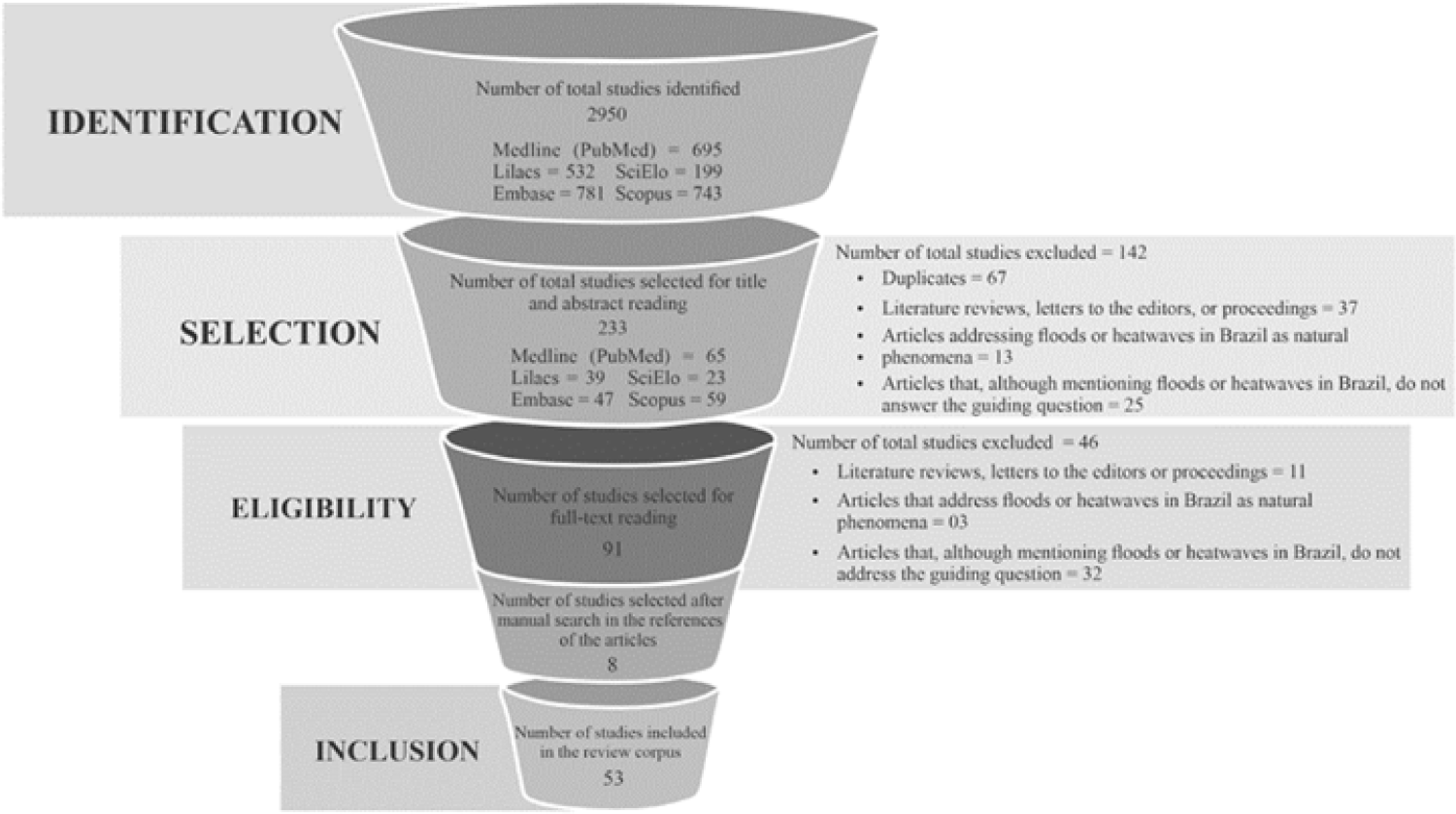
The aim of this article is to systematise the scientific evidence on the socio-environmental and health impacts caused by floods and heatwaves in Brazil. This is a scoping review conducted using the Medline, SciELO, Lilacs, Embase, and Scopus databases. The search was independently carried out in pairs, covering the period from 1992 to 2023. A total of 2,950 articles were identified, resulting in a final corpus of 53 studies, which were analysed thematically. The findings include 37 studies on floods and 16 on heatwaves, with reports from all regions of Brazil. The results indicate negative effects on territorial organisation, living conditions, and the process of illness and death, whether due to infectious diseases, chronic conditions, or other health issues, as well as economic losses, structural damage, and disruptions in service provision. Environmental damage such as wildfires, landslides, river siltation, and vegetation loss are also highlighted. The impacts vary according to social class, gender, and age group, with a more clearly defined pattern of exposure found in studies on floods than on heatwaves. It is concluded that floods and heatwaves have exacerbated inequalities in Brazil through negative impacts on the economy, society, agriculture, the environment, and health.
KEYWORDS
Health inequities; Climate change; Health systems; Floods; Extreme heat.
RESUMO
Objetivou-se sistematizar as evidências científicas sobre os impactos socioambientais e na saúde provocados por enchentes e ondas de calor no Brasil. Trata-se de uma revisão de escopo realizada nas bases Medline, SciELO, Lilacs, Embase e Scopus. A busca foi conduzida por pares de forma independente, com recorte histórico de 1992 a 2023. Foram identificados 2.950 artigos, que resultaram em um corpus final de 53 estudos analisados tematicamente. Os resultados apresentam 37 estudos abordando enchentes e 16 sobre ondas de calor, com relatos para todas as regiões do Brasil. Apontam-se efeitos negativos na organização dos territórios, nas condições de vida e no processo de adoecimento e morte, seja para doenças infectocontagiosas, crônicas ou outros agravos; prejuízos na economia, estrutura e oferta de serviços; além de danos ao ambiente, como queimadas, deslizamentos de terra, assoreamento de rios e perda da vegetação. Os impactos variam segundo classe social, gênero, faixa etária e um padrão de exposição mais caracterizado pelos estudos para as enchentes do que para as ondas de calor. Conclui-se que as enchentes e as ondas de calor têm agravado as iniquidades no Brasil a partir de impactos negativos na economia, na sociedade, na agricultura, no ambiente e na saúde.
PALAVRAS-CHAVE
Desigualdades de saúde; Mudança climática; Sistemas de saúde; Inundações; Calor extremo.
Introduction
The world has undergone profound social, economic, political and environmental transformations since the first industrial revolution in the 18th century, especially those associated with the production and use of non-renewable energies. Over time, a model of global development characterized by the exploitation of the environment, dependent on energy matrices centered on the use of fossil fuels, with high emissions of atmospheric gases, carbon dioxide, methane and nitrous oxide, which are major contributors to global warming, has been increasingly established1.
The results of this development model have converged towards imbalances on a planetary scale, with effects culminating in climate change, a relationship widely recognized by the world’s leading multilateral organizations2. Lowand middle-income countries are more susceptible to the negative impacts of climate change, which can reduce their Gross Domestic Product (GDP) by up to 8%, generating estimated global losses of up to US$50 trillion3,4.
Extreme weather events, such as prolonged droughts, intense rainfall, and heat waves, have generated increasing global concern due to their environmental consequences and impacts on human communities5. The extent of their effects affects all ecosystems, producing a decrease in biodiversity, food and drinking water shortages, economic and life losses, as well as an increase in the incidence of numerous health problems, such as malnutrition, infectious diseases, chronic diseases, mental disorders, and environmental conflicts5-7. In this context, environmental injustices tend to be intensified, reproducing inequalities based on race and ethnicity, gender, and class, which disproportionately affect traditional communities, such as indigenous, quilombola, sertaneja, and fishing communities8,9.
In recent years, Brazil has faced climatic events with catastrophic consequences for its population, such as the floods experienced by the states of Rio Grande do Sul10, Pernambuco11 and Rio de Janeiro12, or the heat waves in Minas Gerais, Brasília and Mato Grosso13. These events have put pressure on the Unified Health System (SUS) and scientific production in the country, given the need to generate evidence to support the formulation of policies, programs and actions for the control and mitigation of the impacts of these extreme events.
In the literature, there is a lack of research that synthesizes the multiple impacts of floods and heat waves on the social, sanitary, and environmental dimensions that have occurred in Brazil. This constitutes a significant gap for health policy, planning, and management. This hinders the organization of services and work processes due to a lack of comprehensive understanding of these phenomena, their effects, and their particularities in the country, reducing the capacity for emergency response and subsequent recovery14. Thus, the objective of this review is to systematize the scientific evidence on the socio-environmental and health impacts caused by floods and heat waves in Brazil.
Material and methods
Study type
This is a scoping review conducted according to the principles and guidelines of the Joanna Briggs Institute (JBI)15, in addition to the guidelines adapted from the checklist of the Preferred Reporting Items for Systematic Reviews and Meta-Analyses - Extension for Scoping Reviews (PRISMA-ScR)16. This type of review is strategic in scientific production as it allows for the mapping of concepts, theories and the synthesis of evidence from a given area of knowledge15. The protocol for this review is registered in the Open Science Framework (OSF) scientific repository17.
Research question
The research question was formulated based on the PCC (Population, Concept, and Context) strategy, where P represents the Brazilian population and ecosystems, C represents socio-environmental and health impacts, and C represents floods and heat waves. The research question was synthesized as follows: what are the socio-environmental and health impacts caused by floods and heat waves in Brazil, considering the population and ecosystems?
Eligibility criteria
Studies included needed to: i) address floods or heat waves in Brazil; ii) be written in Portuguese, English, or Spanish; and iii) be published between 1992 and 2023.
The historical cutoff from 1992 is justified by the holding, in Brazil, of the United Nations Conference on Environment and Development (Rio-92), recognized as an important milestone in global governance related to environmental issues. It was from this conference that policymakers, managers, social movements, and researchers became more intensely engaged around these issues from the perspective of sustainable development and climate justice18.
The exclusion of studies was based on the following criteria: i) duplication; ii) grey literature; iii) documents issued by public administration bodies; iv) theses, dissertations, and undergraduate publications; v) literature reviews, letters to the editor, and conference proceedings; vi) articles that address floods or heat waves in Brazil as common phenomena in the territories where they occur, and not associated with disasters; and vii) articles that, although mentioning floods or heat waves in Brazil, do not answer the guiding question.
Information sources and search strategy
The studies were selected from the following databases and virtual libraries: Medical Literature Analysis and Retrieval System Online (Medline); Latin American and Caribbean Literature in Health Sciences (Lilacs); Scientific Electronic Library Online (SciELO); Excerpta Medica Database (Embase) and Scopus. The search strategy was created from the combination of controlled descriptors on the topic (heat waves, floods, Brazil), using Boolean operators OR and AND, as detailed in table 1.
A broad search strategy was chosen to capture as many studies related to the research topic as possible, considering the need to map the studies comprehensively, but refining the results based on eligibility criteria.
Study selection process
The searches were conducted from September 20 to 30, 2024, by two independent, double-blind researchers (R.C. and A.M.), according to the established eligibility criteria. Any disagreements were resolved by a third researcher (M.O.), a specialist in the subject matter.
In the first phase, studies were identified in databases using the search keyword. In the second phase, eligibility was assessed by reading titles and abstracts. Studies that remained eligible were forwarded to the third stage, in which the full texts were read, and their references were also checked for the inclusion of new studies not captured by the initial strategy. In this phase, studies that met the inclusion criteria were considered for the composition of the final corpus of the review (figure 1).

Data extraction process from selected studies
The data from the selected studies were collected using a standard Excel® form by the same reviewers from the previous phase, independently (R.C. and A.M.), with subsequent validation of the information by the third researcher (M.O.). The variables collected were: author and year of the study; type of event studied (floods or heat waves); type of study; study location; social, environmental, or health impacts resulting from the event; exposure; vulnerability; description of actions or practices that promote the building of social and health resilience; suggestions for future research; and limitations of the study.
Data summary
The data extracted from the corpus were organized and analyzed according to thematic categorizations, using descriptive quantification of the collected information and qualitative synthesis of the studies19. For the economic values indicated as losses from the events, we adjusted the values to February 2025 prices using the Broad Consumer Price Index (IPCA).
Results
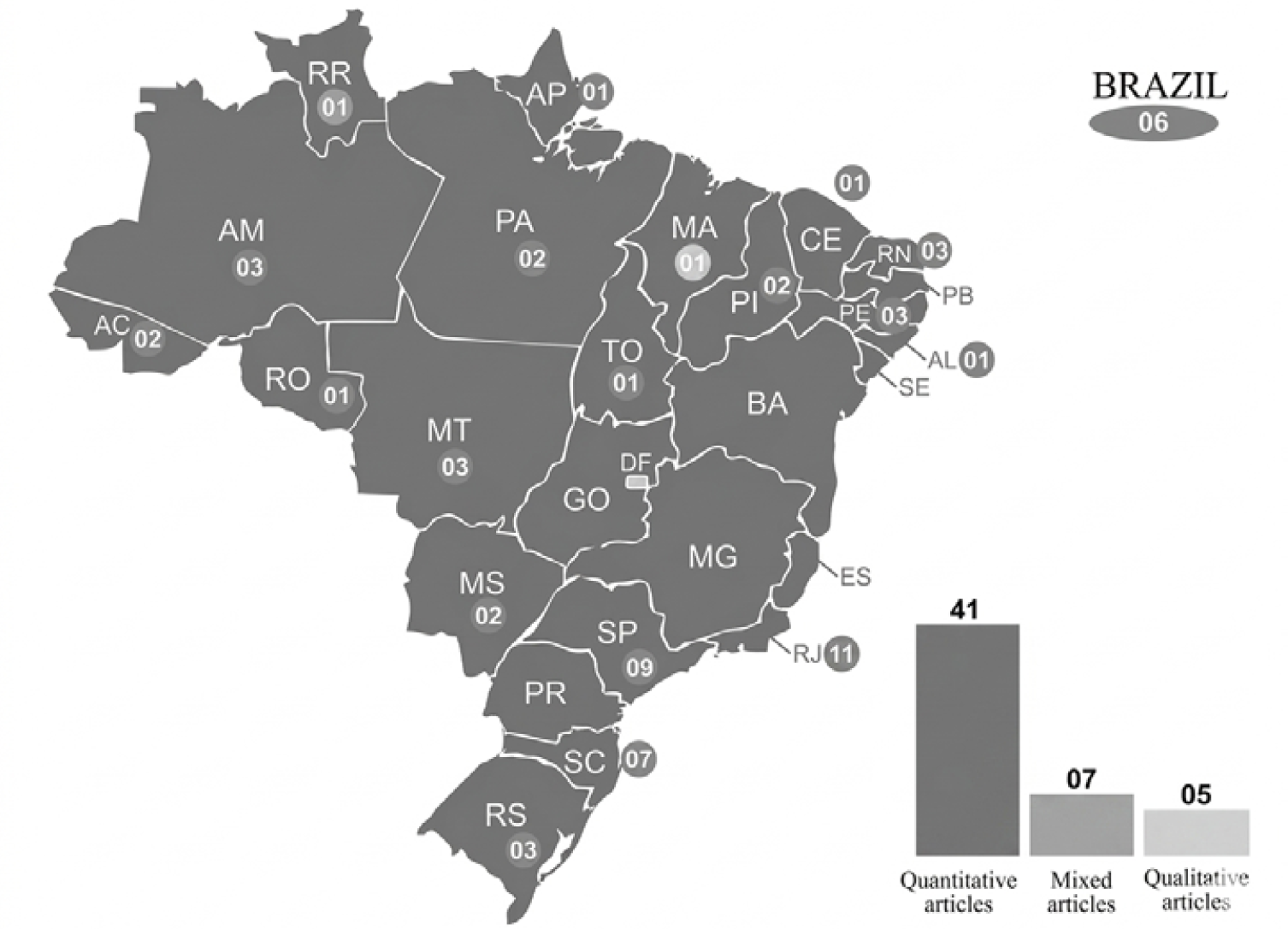
53 studies were analyzed that address the socio-environmental and health impacts caused by floods (37) and heat waves (16) in all regions of Brazil, most of which were based on quantitative methods (41) (figure 2).
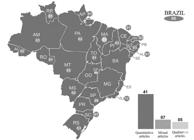
Distribution of studies addressing the socio-environmental and health impacts of floods and heat waves in Brazil, by federative unit*
Floods in Brazil: impacts, exposures, vulnerability, and resilience of the health system
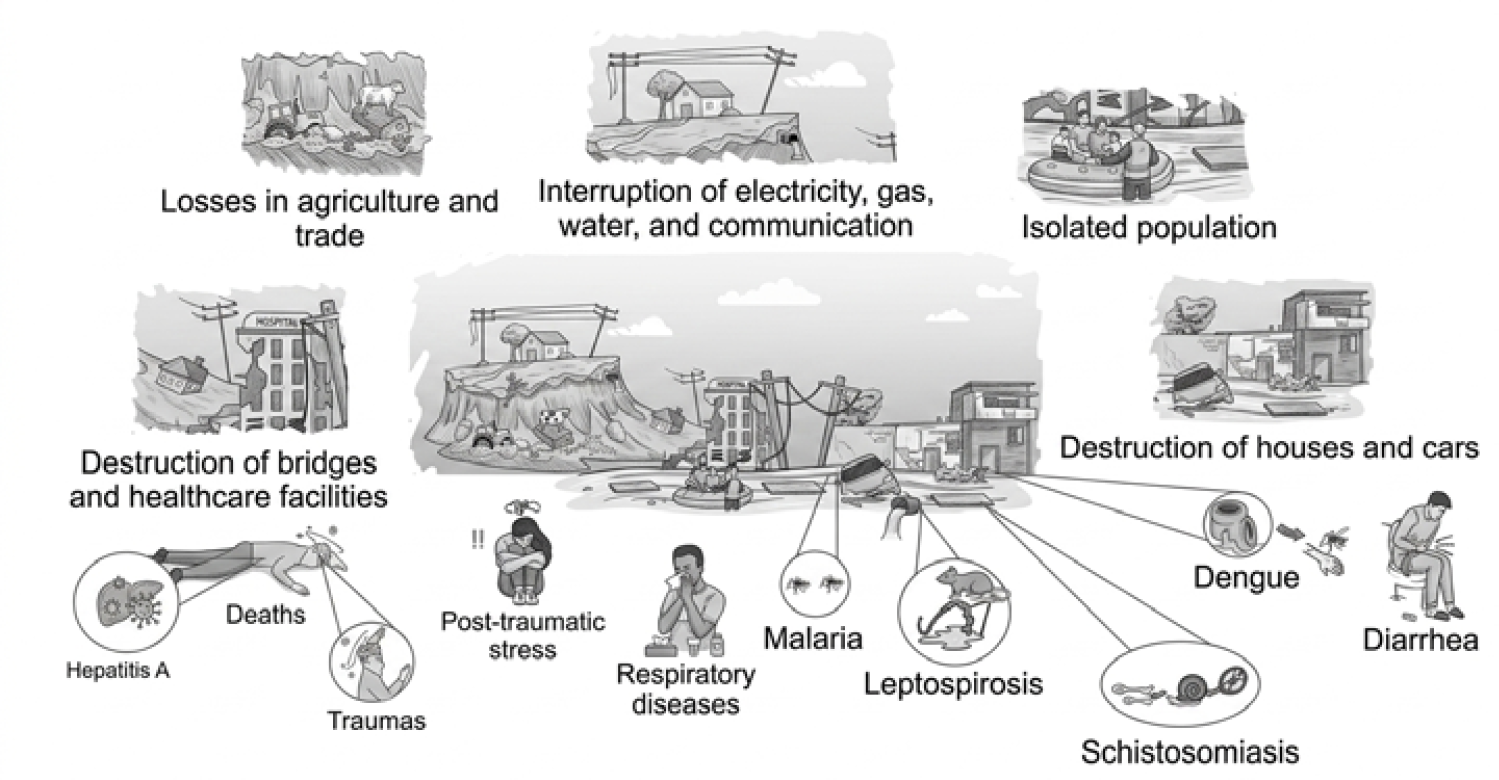
The literature addresses a range of social impacts related to floods that have direct consequences for the organization of life in the affected territories (figure 3). Studies mention the destructive capacity of this event on housing20-33; commercial buildings29,34-37; health units21,35; hospitals20; schools33,35; cars25,32; bridges20,36,38; roads and highways20,22,27,31-33,36,37; in addition to causing interruptions in public transport services39 and in the supply of electricity, gas, water and communication20,27,30,32,38-40, all of which also cause massive displacements of the affected populations21 (figure 3).
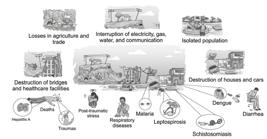
The floods reported in the studies affected a population ranging from 32,000 people in Santa Catarina in 200827; 800,000 in Rio de Janeiro in 201140; to 119,000 in Pernambuco in 202241. Economic losses in the country were estimated at R$ 97 million (R$ 248 million, adjusted for inflation) in São Paulo in 200834; R$ 253 million (R$ 550 million, adjusted for inflation) in 2011 in Rio de Janeiro38; and R$780 million (R$1.3 billion, adjusted for inflation) in Acre in 201537. When estimated nationally, losses exceeded R$331 billion (R$605 billion, adjusted for inflation) between 2010 and 201435. Financial damage to the health system related to the treatment of diseases influenced by floods was estimated at R$700,000 (R$1.5 million, adjusted for inflation) for the treatment of dengue cases30; and R$160,000 (R$350,000, adjusted for inflation) for leptospirosis cases39, both events occurring in 2011. Impacts on the microeconomy were also estimated, such as a 16% decrease in the value of properties exposed to floods42, as well as at the macro level, with a decrease in the GDP of states, such as Santa Catarina in 200833, which lost 7.8% of its income27 (figure 3).
The environmental impacts were concentrated in the effects of landslides20,22,38-40,43; with destruction of native vegetation21, agricultural areas29,37,42; death of native trees not adapted to flooding periods29; capacity to generate a huge amount of solid waste22,37; alteration of river courses caused by silting and erosion21,22; and dam breaks41 (figure 3).
In terms of health, the impacts identified included an increase in the incidence of cases of diarrhea24,32,44; leptospirosis21,24,39,45-52; skin diseases24; schistosomiasis53; dengue30,32; hepatitis A54; malaria55; traumatic injuries, such as multiple fractures, crushing, amputation, soft tissue perforation, dust inhalation38; mental disorders or suffering21,37,56; and respiratory diseases32,37 (figure 3).
Deaths due to floods were also mentioned20,24,27,28,38,40,41,43, with 135 deaths reported in Santa Catarina in 200827; 1,300 in Rio de Janeiro in 201140; 100 in Recife in 202220; and 4,389 across Brazil between 2013 and 201624 (figure 3).
Studies indicate important temporal aspects to be considered in identifying the impacts of floods. For example, there may not be an instantaneous relationship between floods and health outcomes, and time is needed for the incidence of certain conditions to increase. Evidence indicates a period of up to 3 months for cases of hepatitis A54; 1 year for the increase in demand for mental health care after the event56; 1 to 4 months for malaria55; 3 months for the initial search for physiotherapy rehabilitation due to traumatic injuries38; and up to 12 months for deaths resulting from complications of injuries suffered or diseases developed during the event24 (figure 3).
The impacts identified here are concentrated in rural areas, peripheral areas, hills and riverbanks21-23,31,32,41,51,52; regions of lower altitudes47; with little sanitation and drainage infrastructure such as sewers, sewers, ditches, canals, with the deposition and accumulation of garbage26,32,46,48,51; places with wooden dwellings32,48; and where mobility takes place within the flooded areas53.
The populations most impacted were people with low economic status20,25,26,28,32,46,51,53; with lower educational levels26; elderly people32,48, children32 and women30. These characteristics were relevant to susceptibility to social and health impacts that need to be better understood for policy formulation and organization of health services and actions, both in the preparation and response stages to these events.
The social and health actions or practices for mitigating the impacts in the territories affected by the floods described included: establishment of land use planning, regulation of civil construction, financing for the construction of dikes, dams, widening and deepening of canals23; adoption of a multidisciplinary health team, with occupational therapist and physiotherapist in Primary Health Care (PHC)38; financial transfers for homeless residents to rent new housing25,37; donation of mattresses, sheets, clothing and food immediately26,28,31; reuse of debris from rubble for the ecological reconstruction of houses22; construction of temporary shelters31,37; increased police surveillance37; use of hydraulic pumps for draining accumulated water31; policies for building safe housing in areas far from risk zones21.
Other lessons for building an effective, timely, and qualified response to the context of floods were highlighted. Among them, the need for training rescue and health teams; the instantaneous implementation of responses to the impacts of climate events; the centralization of victims’ bodies in a single space for rapid identification and release40; the maintenance and expansion of impact monitoring systems, focusing on densely populated risk areas; the encouragement of research on floods and their impacts; communication strategies between the population and local governments41; the promotion of community education on disasters; robust and sustainable financing for the development of climate services; and the production of intersectoral contingency plans20.
In general, the studies point to a polysemous definition of the term floods, as any hydrological event that causes overflow or runoff of watercourses, both with destructive power, thus converging the phenomena of floods, flash floods, and inundations. These differ from the official classification methods of the federal government - which provide specifications for each type of event and are used by the country’s Civil Defense57 - resembling more the concepts of dictionaries such as Houaiss58, in which the terms are considered synonyms.
The limitations described are related to the methods used. Regarding quantitative studies, the typical challenges of ecological studies stand out:45,52; the use of secondary data, which presents problems of reliability, quality, and the absence of completion of some fields23,30,32,35,38,45,47,52,56; and the possibility of destruction of physical clinical records during the disaster38. In qualitative studies, there is the possibility of memory bias38; violence and territorial insecurity that prevent the carrying out of interviews32; disregard for socioeconomic aspects in the investigation52; barriers to access to health services56; scarcity of other studies on the subject, which may influence in reduced discussion33. It is emphasized that the studies point to the difficulties in establishing a linear relationship between climate and health outcomes because their variables are complex and still poorly understood in their entirety30,55.
Heat waves in Brazil: impacts, exposures, vulnerability, and resilience of the health system
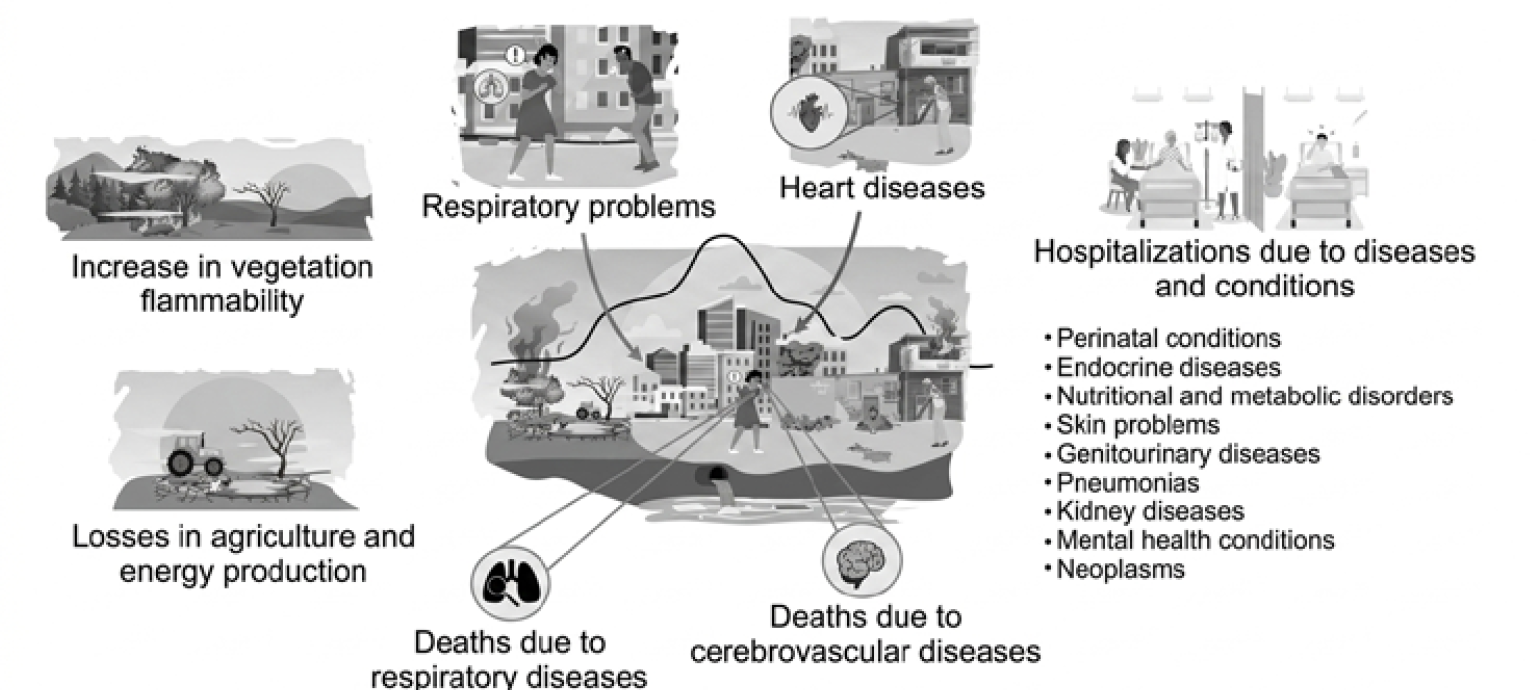
The social impacts of heat waves identified in the literature include economic losses in the agricultural or energy production sectors59; increased risk of death for intensively farmed animals, such as chickens60; and low yields in soybean crops61. Among the environmental impacts are high evaporation rates, soil desiccation, vegetation dryness, and increased territorial flammability, thus promoting forest fires59,61,62 (figure 4).
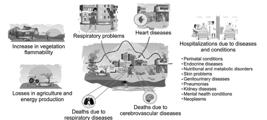
In health, studies report that during heat waves in Brazil, there was a higher risk of hospitalizations for various conditions, including: perinatal, endocrine, nutritional and metabolic diseases, skin problems and genitourinary diseases63; ischemic heart disease, asthma, pneumonia, kidney disease, mental health conditions and neoplasms64,65. Effects on mortality were also reported, specifically for cardiovascular, respiratory diseases66-74 and diabetes62. These studies were conducted in the municipalities of Rio de Janeiro67,68,70,71 and São Paulo69,72; as well as cities in the Legal Amazon, distributed across the states of Acre, Amapá, Amazonas, Mato Grosso, Pará, Rondônia, Roraima, Tocantins and Maranhão66 (figure 4).
The populations most vulnerable to heat waves identified in the analyzed studies were children aged 0 to 9 years63, women63,66,67,69,70;71,73, elderly people over 60 years63,66,67,69,70-72,74; people with worse economic conditions64,71; and lower educational levels64,73,74.
The definition of a heat wave varied among the included studies, indicating little consensus on its description, although all considered criteria based on intensity and duration, typically starting from two or more days59,60,63,64,66,69-72. Some studies highlight that the intensity of the events may be more relevant than their duration66,70, while others suggest that the combination of longer duration and intensity is associated with higher risks of negative health outcomes63.
The temporality of health outcomes associated with heat waves involves a latency period necessary for the manifestation of the effects of exposure71,72, which can occur between 2 and 11 days after the heat wave event71.
Physiologically, elderly people and children may be the most susceptible due to biological limitations of these age groups, resulting from metabolic excesses caused by intense dehydration, vasodilation, increased heart rate, increased blood viscosity, reduced blood pressure, and decreased cerebral circulation72.
Suggestions for future research and limitations highlighted by studies on heat waves in Brazil
Suggestions for future studies on heat waves point to expanding analyses in elderly populations71, with lower economic conditions71; research that can investigate whether better socioeconomic conditions promote greater adaptability to heat64, in other regions of the country that are not concentrated in the South or Southeast71,74; investigation of the interaction with other variables, such as humidity, wind speed, air pollution, forest fires59,67,70, that is, studies that can better characterize the role of individual and contextual characteristics; in addition to clinical and experimental studies that can establish the biological mechanisms involved in thermophysiological stress68.
The limitations observed are similar to those pointed out in the context of floods and include the characteristics of ecological studies59,72 and the use of secondary data, which may have incompleteness, inconsistencies, or underreporting65,67,68,72; the non-inclusion of a set of environmental variables beyond heat waves63,64,67,70,72, such as altitude, air quality, land cover, proximity to water, solar radiation, wind speed, green spaces, use of air conditioning equipment64,70; temperature measurements in only one or two meteorological stations67,72; possible losses of notifications of hospitalized cases or deaths due to deficiencies in the information system70; absence of data at the individual level64; scarce literature on heat waves in the various regions of the country65, or of biological plausibility for their effects63, reducing the possibility of establishing more robust comparative and explanatory discussions.
The data reported here can be consulted in its entirety at OSF17.
Discussion
According to our survey, this scoping review is the first study to identify the social, environmental, and health impacts of heat waves and floods in Brazil, describing analyses of the effects, vulnerable populations, and response strategies to these climatic events in the country. The Southeast region was the most studied, although states throughout the national territory reported some damage suffered.
The impacts described in Brazil are similar to those discussed in the international literature, whether for floods in Somalia75, the United Kingdom and Germany76; or for heat waves in China77 and Italy78, where all converge on the need for nation-states to prepare for the intensification of these events in the coming decades as a result of worsening climate change and extreme events, especially in low-income tropical countries79.
The results of this article indicate that there are important markers of vulnerability to the effects of heat waves and floods in Brazil, according to age, gender, and class characteristics, which need to be considered in the formulation of public policies in light of the social determinants of health and intersectionalities80. There is a consensus that building climate resilience will need to consider the individual characteristics of subjects, in addition to the territorial singularities in which they are embedded, since social, environmental, and health reproduction is experienced unequally81.
The extremes of age may have the lowest capacity to withstand health outcomes, due to physical or social limitations or poor maturation of the physiological system82, having 14 times more chances of dying in a disaster83. Previous studies also highlight that access to health in the context of climate disasters occurs unequally, for example: the direct costs for paying for hospital services during extreme events are higher for older people and women, with an average expenditure of US$ 1,600 and US$ 500, respectively, a higher value compared to other population groups84,85. These values reflect the greater complexity in care or the prolonged length of hospital stay associated with these groups85.
The synthesis of the influence of floods and heat waves in Brazil demonstrates that social, environmental and health damages result in an increased demand for social assistance and health care; lost work days or reduced productivity; and aspects related to well-being and quality of life86. These variables lead to human, financial, and structural losses, with the potential to exacerbate inequalities between nations.
It is noteworthy that exposure to the climatic events studied here is associated with disordered land occupation, precarious infrastructure, and a process of urban consolidation and low territorial afforestation that has already been widely discussed82,87, with the worst indicators in peripheral locations87 with a historical absence of public housing and sanitation policies82. In the last 12 years (2010-2022), there has been a 103% increase in the number of people living in favelas in Brazil. Approximately 16 million people, or 8.1% of the country’s population, live in territories with the worst living and housing conditions88, subject to heat waves and floods, which is similar to the results observed in countries in Africa89 and Europe90. It is worth noting that social vulnerabilities contribute both to exposure and to the ability to adapt to climate events91, as they define the autonomy or lack thereof to buy an air conditioner, to live in a tree-lined neighborhood, to have running water in the home, or simply not to live in a risk area.
Although Brazil has a health system with a consolidated PHC, access barriers are still faced by specific populations, such as rural, homeless and traditional populations92. This scenario aggravates the impacts resulting from heat waves and floods by increasing the risks and damages, considering the reduced reach of the health care network and other intersectoral approaches81.
Although floods and seasons with higher temperatures may be seen in some territories as cyclical natural events, the increase in intensity and the reduction in the intervals of occurrence point to an anthropogenic influence93. For example, extreme events following major disasters recorded in Brazil, such as the floods in Pernambuco in 2023 and those in Rio Grande do Sul in 2024, are closely linked to abnormal patterns of climatic phenomena such as La Niña and El Niño, whose change in behavior is strongly attributed to anthropogenic action94. Other examples are the increase in fires and deforestation in the Legal Amazon or in areas of the Central-West region, whose consequences are widely known for their ability to influence atmospheric dynamics, increasing thermal retention, contributing to cold fronts not crossing the country95. At the same time that deforestation increases surface water runoff, amplifying the flow that reaches waterways, it exacerbates erosion due to the loss of topsoil cover, decreasing its stability, silting up rivers and increasing the risks of floods and landslides28,96.
Countries in the Global South, such as Egypt, Gambia, Nigeria, and Namibia, have important experiences in adapting their health systems to the environmental crisis scenario, and can serve as examples for other nation-states, although Brazil has implemented similar and specific actions. In those countries, the actions involve: a weather forecasting system with early warnings; education, training, and awareness strategies for the population and health workers; epidemiological surveillance and control; healthy socio-environmental policies; expansion of housing, sanitation, and health services; in addition to encouraging the development of research on climate change and its dissemination for government planning97.
Certainly, the responses involved in the context of climate change must be intersectoral, ensuring that the SUS absorbs, adapts, and transforms itself in an equitable, efficient, and timely manner, thus developing its resilience attributes98, which are strategic in the 13th Sustainable Development Goal (SDG). The holding of the 30th Conference of the Parties (COP30) in Brazil in 2025 represents a window of opportunity for the construction of a climate geopolitical agenda that should consider the improvement of living conditions and the environment as a structuring element for political choices, as per the needs identified by this study and in dialogue with other research79,86,92.
The effects of floods and heat waves cannot be discussed without considering the neoliberal reforms of the State and the precariousness of health systems that culminate in reduced health funding, market dependence, and increased social inequalities99. The rhetoric of fiscal adjustment, produced by an ultraliberal and conservative model, cannot be used as a device for the loss of social rights, worsening living conditions, environmental deregulation, and climate injustices80.
We hope that this article will stimulate and provide support to policymakers, managers, social control bodies, researchers, and health professionals in the development of strategies that strengthen, according to Freitas and colleagues83,
[...] the capacity of the health sector to propose and act, in partnership with other sectors, both in disaster prevention and in post-disaster preparedness, response, rehabilitation, recovery and reconstruction actions83(3628).
Final considerations
This review presents a synthesis of the main evidence on the negative impacts of heat waves and floods in Brazil, demonstrating their influence on social, environmental, and health aspects. The data point to the urgency of building climate resilience within the national health and social protection systems, in order to better respond to the challenges that emerge from an extreme event and are exacerbated in a context of profound social inequalities.
Although the studies address a set of suggestions for new research on the topic, we draw attention to the absence of mention of those related to aspects of maternal and child health, arboviruses, violence, as well as those focusing on specific populations, such as homeless people, indigenous people, and quilombola communities, who will present distinct markers and experiences of illness and death in the wake of climate change.
As a limitation of our study, we mention that this review adopts a broad search strategy, although justifiable by the need for a wider scope in the selection of articles. Furthermore, the inclusion of exclusively empirical studies may also have been a limiting factor. However, this initial survey is considered a starting point for further research on the topic.
-
Financial support:
The research received funding from the Coordination for the Improvement of Higher Education Personnel (CAPES), through a doctoral scholarship (funding code 001) granted to the first author of the article. It also received funding from the Fiocruz Innovation Program for Sustainable and Healthy Territories in Health Care - Call for Proposals No. 6/2024
Data availability:
The research data is contained in the manuscript itself
References
-
1 Rossati A. Global Warming and Its Health Impact. Int J Occup Environ Med. 2017;8(1):7-20. DOI: https://doi.org/10.15171/ijoem.2017.963
» https://doi.org/10.15171/ijoem.2017.963 - 2 Campello LGB, Lima RD. O regime internacional de mudanças climáticas: uma análise da cooperação internacional solidária no acordo de Paris. Rev Argum. 2018;19(3):659-689.
-
3 Levy BS, Patz JA. Climate Change, Human Rights, and Social Justice. Ann Glob Health. 2015;81(3):310-22. DOI: https://doi.org/10.1016/j.aogh.2015.08.008
» https://doi.org/10.1016/j.aogh.2015.08.008 -
4 Callahan CW, Mankin JS. Globally unequal effect of extreme heat on economic growth. Sci Adv. 2022;8(43):eadd3726. DOI: https://doi.org/10.1126/sciadv.add3726
» https://doi.org/10.1126/sciadv.add3726 - 5 Intergovernmental Panel on Climate Chance. Climate Change 2022: Impacts, adaptation and vulnerability. Contribution of Working Group II to the Sixth Assessment Report of the Intergovernmental Panel on Climate Change. Cambridge: Cambridge University Press; 2022.
-
6 Rocque RJ, Beaudoin C, Ndjaboue R, et al. Health effects of climate change: an overview of systematic reviews. BMJ Open. 2021;11(6):e046333. DOI: https://doi.org/10.1136/bmjopen-2020-046333
» https://doi.org/10.1136/bmjopen-2020-046333 -
7 Charlson F, Ali S, Benmarhnia T, et al. Climate Change and Mental Health: A Scoping Review. Int J Environ Res Public Health. 2021;18(9):4486. DOI: https://doi.org/10.3390/ijerph18094486
» https://doi.org/10.3390/ijerph18094486 -
8 Shultz JM, Sands DE, Kossin JP, et al. Double Environmental Injustice - Climate Change, Hurricane Dorian, and the Bahamas. N Engl J Med. 2020;382(1):1-3. DOI: https://doi.org/10.1056/NEJMp1912965
» https://doi.org/10.1056/NEJMp1912965 -
9 Dennis MK, Bell FM. Indigenous Women, Water Protectors, and Reciprocal Responsibilities. Soc Work. 2020;65(4):378-86. DOI: https://doi.org/10.1093/sw/swaa033
» https://doi.org/10.1093/sw/swaa033 -
10 G1. Enchentes no Rio Grande do Sul. G1 [Internet]. 2024 maio 19 [acesso em 2025 abr 21]; Notícia. Disponível em: https://g1.globo.com/rs/rio-grande-do-sul/noticia/2024/05/29/um-mes-de-enchentes-no-rs-veja-cronologia-do-desastre.ghtml
» https://g1.globo.com/rs/rio-grande-do-sul/noticia/2024/05/29/um-mes-de-enchentes-no-rs-veja-cronologia-do-desastre.ghtml -
11 Guarda A. Memória das vítimas das chuvas de 2022 será lembrada em ato no Recife. Jornal do Comércio [Internet]. 2023 maio 23 [acesso em 2025 abr 21]. Disponível em: https://jc.ne10.uol.com.br/pernambuco/2023/05/15471644-memoria-das-vitimas-das-chuvas-de-2022-sera-lembrada-em-ato-no-recife.html
» https://jc.ne10.uol.com.br/pernambuco/2023/05/15471644-memoria-das-vitimas-das-chuvas-de-2022-sera-lembrada-em-ato-no-recife.html -
12 Puente B. Tragédia em Petrópolis completa um mês e mais de 600 seguem desabrigados. CNN Brasil [Internet]; Nacional. 2022 mar 15 [acesso em 2025 abr 21]. Disponível em:https://www.cnnbrasil.com.br/nacional/petropolis-tragedia-completa-um-mes-e-mais-de-600-seguem-desabrigados/
» https://www.cnnbrasil.com.br/nacional/petropolis-tragedia-completa-um-mes-e-mais-de-600-seguem-desabrigados/ -
13 Azevedo AL. Os extremos que fizeram de 2023 o ano com o pior clima do Brasil. O Globo [Internet]; Especial. 2023 dez 31 [acesso em 2025 abr 21]. Disponível em: https://oglobo.globo.com/brasil/especial/os-extremos-que-fizeram-de-2023-o-ano-com-o-pior-clima-do-brasil.ghtml
» https://oglobo.globo.com/brasil/especial/os-extremos-que-fizeram-de-2023-o-ano-com-o-pior-clima-do-brasil.ghtml -
14 Freitas AWQ, Witt RR, Veiga ABG. The health burden of natural and technology disasters in Brazil from 2013 to 2021. Cad Saúde Pública, 2023;39(4):e00154922. DOI: https://doi.org/10.1590/0102-311XEN154922
» https://doi.org/10.1590/0102-311XEN154922 -
15 Peters MDJ, Godfrey C, McInerney P, et al. Scoping Reviews. In: Aromataris E, Lockwood C, Porritt K, et al., editores. JBI Manual for Evidence Synthesis. [local desconhecido]: JBI; 2020. DOI: https://doi.org/10.46658/JBIMES-24-09
» https://doi.org/10.46658/JBIMES-24-09 -
16 Tricco AC, Lillie E, Zarin W, et al. PRISMA Extension for Scoping Reviews (PRISMA-ScR): Checklist and Explanation. Ann Intern Med. 2018;169(7):467-73. DOI: https://doi.org/10.7326/M18-0850
» https://doi.org/10.7326/M18-0850 -
17 Santos RC, Santos MOS, Silveira IH, et al. Socio-environmental and health impacts caused by floods and heatwaves in Brazil: a scoping review. OSF. 2025 mar 7. DOI: https://doi.org/10.17605/osf.io/h5wfg
» https://doi.org/10.17605/osf.io/h5wfg - 18 Martins CHB, Carvalho PGM, Barcellos FC, et al. Da Rio-92 à Rio+20: avanços e retrocessos da Agenda 21 no Brasil. Indic Econ FEE. 2015;42(3):97-108.
- 19 Minayo MCS. O desafio do conhecimento: pesquisa qualitativa em saúde. 8a ed. São Paulo: Hucitec; 2004.
-
20 Marengo JA, Alcantara E, Cunha AP, et al. Flash floods and landslides in the city of Recife, Northeast Brazil after heavy rain on May 25-28, 2022: Causes, impacts, and disaster preparedness. Weather Clim Extrem. 2023;39:100545. DOI: https://doi.org/10.1016/j.wace.2022.100545
» https://doi.org/10.1016/j.wace.2022.100545 -
21 Freire NCF, Bonfim CV, Natenzon CE. Vulnerabilidade socioambiental, inundações e repercussões na Saúde em regiões periféricas: o caso de Alagoas, Brasil. Ciênc saúde coletiva. 2014;19(9):3755-62. DOI: https://doi.org/10.1590/1413-81232014199.07572014
» https://doi.org/10.1590/1413-81232014199.07572014 -
22 Scatolini F, Bandeira RAM. Desastres como oportunidade de implementação de políticas de gerenciamento de resíduos de construção e demolição no Brasil: chuvas de Nova Friburgo (RJ), 2011. Eng Sanit Ambient. 2020;25(5):739-52. DOI: https://doi.org/10.1590/S1413-415220202018053
» https://doi.org/10.1590/S1413-415220202018053 -
23 Araújo RS, Ohara M, Miyamoto M, et al. Flood impact on income inequality in the Itapocu River basin, Brazil. J Flood Risk Management. 2022;15:e12805. DOI: https://doi.org/10.1111/jfr3.12805
» https://doi.org/10.1111/jfr3.12805 -
24 Souza FAO, Oliveira MM. Panorama dos danos humanos provocados por secas e cheias no Brasil e uma proposta de regionalização de investimentos na gestão de riscos. Desenvolv Meio Ambiente. 2019;51:282-310. DOI: https://doi.org/10.5380/dma.v51i0.59793
» https://doi.org/10.5380/dma.v51i0.59793 -
25 Frutuoso GKC, Grigio AM, Barros TCAN. Mapeamento das áreas de risco de inundação urbana na cidade de Assú - Rio Grande do Norte, Brasil. Rev Bras Geogr Fís. 2022;15(06):2994-3012. DOI: https://doi.org/10.26848/rbgf.v15.6.p2994-3012
» https://doi.org/10.26848/rbgf.v15.6.p2994-3012 -
26 Cavalcante JSI, Aloufa MAI. Percepção de riscos ambientais: uma análise sobre riscos de inundações em Natal-RN, Brasil. Invest Geogr. 2014;84:54-68. DOI: https://doi.org/10.14350/rig.33709
» https://doi.org/10.14350/rig.33709 -
27 Lima RCA, Barbosa AVB. Natural disasters, economic growth and spatial spillovers: Evidence from a flash flood in Brazil. Pap Reg Sci. 2019;98:905-24. DOI: https://doi.org/10.1111/pirs.12380
» https://doi.org/10.1111/pirs.12380 -
28 Gomes ERB, Cavalcante ACS. Desastres naturais: perdas e reações psicológicas de vítimas de enchente em Teresina-PI. Psicol Soc. 2012;24(3):720-8. DOI: https://doi.org/10.1590/S0102-71822012000300025
» https://doi.org/10.1590/S0102-71822012000300025 -
29 Herraiz AD, Graça PMLA, Fearnside PM. Amazonian flood impacts on managed Brazilnut stands along Brazil’s Madeira River: A sustainable forest management system threatened by climate change. For Ecol Manag. 2017;406:46-52. DOI: https://doi.org/10.1016/j.foreco.2017.09.053
» https://doi.org/10.1016/j.foreco.2017.09.053 -
30 Pereira CAR, Barata MML, Hoelz MPC, et al. Avaliação econômica dos casos de Dengue atribuídos ao desastre de 2011 em Nova Friburgo (RJ), Brasil. Ciênc saúde coletiva. 2014;19(9):3693-704. DOI: https://doi.org/10.1590/1413-81232014199.01682014
» https://doi.org/10.1590/1413-81232014199.01682014 - 31 Gomes EJS, Sales CB, Louzeiro AS. Eventos climáticos extremos associados a inundações urbanas: o caso do município de Touros/RN Brasil. Rev Equador (UFPI). 2020;9(2):235-50.
-
32 Chaves SVV, Tavares AC, Andrade CSP. Vulnerabilidade às inundações em Teresina, Piauí e ações mitigadoras do poder público. Soc Territ. 2017;29(2):175-97. DOI: https://doi.org/10.21680/2177-8396.2017v29n2ID12533
» https://doi.org/10.21680/2177-8396.2017v29n2ID12533 - 33 Ribeiro FG, Estein G, Carraaro A, et al. O impacto econômico dos desastres naturais::o caso das chuvas de 2008 em Santa Catarina. Plan Polít Públicas. 2014;43:299-322.
-
34 Haddad EA, Teixeira E. Economic impacts of natural disasters in megacities: The case of floods in São Paulo, Brazil. Habitat Int. 2015;15(parte2):106-13. DOI: https://doi.org/10.1016/j.habitatint.2014.06.023
» https://doi.org/10.1016/j.habitatint.2014.06.023 -
35 Minervino AC, Duarte EC. Danos materiais causados à Saúde Pública e à sociedade decorrentes de inundações e enxurradas no Brasil, 2010-2014: dados originados dos sistemas de informação global e nacional. Ciênc saúde coletiva. 2016;21(3):685-94. DOI: https://doi.org/10.1590/1413-81232015213.19922015
» https://doi.org/10.1590/1413-81232015213.19922015 -
36 Borba ML, Warner JF, Porto MFA. Urban stormwater flood management in the Cordeiro watershed, São Paulo, Brazil: does the interaction between socio-political and technical aspects create an opportunity to attain community resilience? J Flood Risk Management. 2015;9:234-42. DOI: https://doi.org/10.1111/jfr3.12172
» https://doi.org/10.1111/jfr3.12172 -
37 Dolman DI, Brown IF, Anderson LO, et al. Re-thinking socio-economic impact assessments of disasters: The 2015 flood in Rio Branco, Brazilian Amazon. Int J Disaster Risk Reduct. 2018;31:212-9. DOI: https://doi.org/10.1016/j.ijdrr.2018.04.024
» https://doi.org/10.1016/j.ijdrr.2018.04.024 -
38 Carvalho ML, Freitas CM, Miranda ES. Physical rehabilitation in the context of a landslide that occurred in Brazil. BMC Public Health. 2019;19(1):1615. DOI: https://doi.org/10.1186/s12889-019-7964-x
» https://doi.org/10.1186/s12889-019-7964-x -
39 Pereira C, Barata M, Trigo A. Social cost of leptospirosis cases attributed to the 2011 disaster striking Nova Friburgo, Brazil. Int J Environ Res Public Health. 2014;11(4):4140-57. DOI: https://doi.org/10.3390/ijerph110404140
» https://doi.org/10.3390/ijerph110404140 -
40 Pereira BM, Morales W, Cardoso RG, et al. Lessons learned from a landslide catastrophe in Rio de Janeiro, Brazil. Am J Disaster Med. 2023;8(4):253-8. DOI: https://doi.org/10.5055/ajdm.2013.0131
» https://doi.org/10.5055/ajdm.2013.0131 -
41 Marengo JA, Seluchi ME, Cunha AP, et al. Heavy rainfall associated with floods in southeastern Brazil in November-December 2021. Natural Hazards. 2023;116:3617-44. DOI: https://doi.org/10.1007/s11069-023-05827-z
» https://doi.org/10.1007/s11069-023-05827-z -
42 Palagi S, Patzlaff J, Stumpf M, et al. Análisis del impacto de las inundaciones en el valor de las propiedades inmobiliarias en la ciudad de Lajeado, Brasil - Estudio de caso de viviendas unifamiliares. Rev Ing Constr. 2014;29:87-97. DOI: http://dx.doi.org/10.4067/S0718-50732014000100006
» http://dx.doi.org/10.4067/S0718-50732014000100006 -
43 Ferreira STG, Kuser HH, Garrido RG, et al. Floods and mudslides in the State of Rio de Janeiro and a plane crash in the Brazilian Amazon rainforest: A study of two different experiences in disaster victim identification (DVI). Forensic Sci Int Genet Suppl Ser. 2011;3:e516-e517. DOI: https://doi.org/10.1016/j.fsigss.2011.10.005
» https://doi.org/10.1016/j.fsigss.2011.10.005 -
44 Cesa M, Fongaro G, Barardi CRM. Waterborne diseases classification and relationship with social-environmental factors in Florianópolis city - Southern Brazil. J Water Health. 2016;14(2):340-8. DOI: https://doi.org/10.2166/wh.2015.266
» https://doi.org/10.2166/wh.2015.266 -
45 Guimarães RM, Cruz OG, Parreira VG, et al. Análise temporal da relação entre leptospirose e ocorrência de inundações por chuvas no município do Rio de Janeiro, Brasil, 2007-2012. Ciênc saúde coletiva. 2014;19(9):3683-92. DOI: https://doi.org/10.1590/1413-81232014199.06432014
» https://doi.org/10.1590/1413-81232014199.06432014 -
46 Gracie R, Xavier DR, Medronho R. Inundações e leptospirose nos municípios brasileiros no período de 2003 a 2013: utilização de técnicas de mineração de dados. Cad Saúde Pública. 2021;37(5):e00100119. DOI: https://doi.org/10.1590/0102-311X00100119
» https://doi.org/10.1590/0102-311X00100119 -
47 Silva AEP, Conceição GMS, Chiaravalloti NF. Spatial analysis and factors associated with leptospirosis in Santa Catarina, Brazil, 2001-2015. Rev Soc Bras Med Trop. 2020;53:e20200466. DOI: https://doi.org/10.1590/0037-8682-0466-2020
» https://doi.org/10.1590/0037-8682-0466-2020 -
48 Gonçalves NV, Araujo EN, Sousa-Júnior AS, et al. Distribuição espaço-temporal da leptospirose e fatores de risco em Belém, Pará, Brasil. Ciênc saúde coletiva. 2016;21(12):3947-55. DOI: https://doi.org/10.1590/1413-812320152112.07022016
» https://doi.org/10.1590/1413-812320152112.07022016 -
49 Silva AEP, Latorre MRDO, Chiaravalloti NF, et al. Tendência temporal da leptospirose e sua associação com variáveis climáticas e ambientais em Santa Catarina, Brasil. Ciênc saúde coletiva. 2022;27(3):849-60. DOI: https://doi.org/10.1590/1413-81232022273.45982020
» https://doi.org/10.1590/1413-81232022273.45982020 -
50 Miyazato KE, Fonseca A, Caputto LZ, et al. Incidence of Leptospirosis infection in the East Zone of Sao Paulo City, Brazil. Int Arch Med. 2013;6(1):23. DOI: https://doi.org/10.1186/1755-7682-6-23
» https://doi.org/10.1186/1755-7682-6-23 - 51 Magalhães GB, Zanella ME, Sales MCL. A ocorrência de chuvas e a incidência de leptospirose em Fortaleza-CE. Hygeia. 2009;5(9):77-87.
-
52 Péres WE, Russo A, Nunes B. The Association between Hydro-Meteorological Events and Leptospirosis Hospitalizations in Santa Catarina, Brazil. Water. 2019;11(5):1052. DOI: https://doi.org/10.3390/w11051052
» https://doi.org/10.3390/w11051052 -
53 Barbosa CS, Domingues ALC, Abath F, et al. Epidemia de esquistossomose aguda na praia de Porto de Galinhas, Pernambuco, Brasil. Cad Saúde Pública. 2001;17(3):725-8. DOI: https://doi.org/10.1590/S0102-311X2001000300028
» https://doi.org/10.1590/S0102-311X2001000300028 -
54 Silveira PO, Guasselli LA, Oliveira GG, et al. Relação entre casos de hepatite A e áreas de inundação, município de Encantado, Rio Grande do Sul, Brasil. Ciênc saúde coletiva. 2021;26(2):721-8. DOI: https://doi.org/10.1590/1413-81232020261.30592018
» https://doi.org/10.1590/1413-81232020261.30592018 -
55 Wolfarth-Couto B, Filizola N, Durieux L. Padrão sazonal dos casos de malária e a relação com a variabilidade hidrológica no Estado do Amazonas, Brasil. Rev Bras Epidemiol. 2020;23:e200018. DOI: https://doi.org/10.1590/1980-549720200018
» https://doi.org/10.1590/1980-549720200018 -
56 Dell’Aringa M, Ranzani O, Bierens J, et al. Rio’s Mountainous Region (“Região Serrana”) 2011 Landslides: Impact on Public Mental Health System. PLoS Curr. 2018;10:1-10. DOI: https://doi.org/10.1371/currents.dis.156b98022b9421098142a4b31879d866
» https://doi.org/10.1371/currents.dis.156b98022b9421098142a4b31879d866 -
57 Ministério da Integração e do Desenvolvimento Regional (BR) [Internet]. [Brasília, DF]: Gov.br; [data desconhecida]. Entenda a diferença entre os tipos de desastres naturais e tecnológicos registrados no Brasil; 2022 jul 11 [acesso em 2025 abr 21]. Disponível em: https://www.gov.br/mdr/pt-br/ultimas-noticias/entenda-a-diferenca-entre-os-tipos-de-desastres-naturais-e-tecnologicos-registrados-no-brasil
» https://www.gov.br/mdr/pt-br/ultimas-noticias/entenda-a-diferenca-entre-os-tipos-de-desastres-naturais-e-tecnologicos-registrados-no-brasil - 58 Houaiss A. Dicionário Houaiss da Língua Portuguesa. 1ª ed. Rio de Janeiro: Objetiva, 2001.
-
59 Silva PS, Geirinhas JL, Lapere R, et al. Heatwaves and fire in Pantanal: Historical and future perspectives from CORDEX-CORE. J Environ Manag. 2022;323:116193. DOI: https://doi.org/10.1016/j.jenvman.2022.116193
» https://doi.org/10.1016/j.jenvman.2022.116193 -
60 Riquena RS, Pereira DF, Vale MM, et al. Mortality prediction of laying hens due to heat waves. Rev Ciênc Agron. 2019;50(1):18-26. DOI: https://doi.org/10.5935/1806-6690.20190003
» https://doi.org/10.5935/1806-6690.20190003 -
61 Gusso A, Ducati JR, Veronez MR, et al. Monitoring Heat Waves and Their Impacts on Summer Crop Development in Southern Brazil. Agric Sci. 2014;5(4):353-64. DOI: https://doi.org/10.4236/as.2014.54037
» https://doi.org/10.4236/as.2014.54037 -
62 Libonati R, Geirinhas JL, Silva PS, et al. Assessing the role of compound drought and heatwave events on unprecedented 2020 wildfires in the Pantanal. Environ Res Lett. 2022;17:015005. DOI: https://doi.org/10.1088/1748-9326/ac462e
» https://doi.org/10.1088/1748-9326/ac462e -
63 Zhao Q, Li S, Coelho MSZS, et al. The association between heatwaves and risk of hospitalization in Brazil: A nationwide time series study between 2000 and 2015. PLoS Med. 2019;16(2):e1002753. DOI: https://doi.org/10.1371/journal.pmed.1002753
» https://doi.org/10.1371/journal.pmed.1002753 -
64 Xu R, Zhao Q, Coelho MSZS, et al. Socioeconomic level and associations between heat exposure and all-cause and cause-specific hospitalization in 1,814 Brazilian cities: A nationwide case-crossover study. PLoS Med. 2020;17(10):e1003369. DOI: https://doi.org/10.1371/journal.pmed.1003369
» https://doi.org/10.1371/journal.pmed.1003369 -
65 Bernal N, Schwarz L, Benmarhnia T, et al. Impact of heat waves on cardiovascular and respiratory morbidity and mortality in municipalities of Northeast Brazil. Sustentabilidade Debate. 2022;3(2):96-122. DOI: https://doi.org/10.18472/SustDeb.v13n2.2022.4222
» https://doi.org/10.18472/SustDeb.v13n2.2022.4222 -
66 Silveira IH, Hartwig SV, Moura MN, et al. Heat waves and mortality in the Brazilian Amazon: Effect modification by heat wave characteristics, population subgroup, and cause of death. Int J Hyg Environ Health. 2023;248:114109. DOI: https://doi.org/10.1016/j.ijheh.2022.114109
» https://doi.org/10.1016/j.ijheh.2022.114109 -
67 Geirinhas JL, Russo A, Libonati R, et al. Heat-related mortality at the beginning of the twenty-first century in Rio de Janeiro, Brazil. Int J Biometeorol. 2020;64(8):1319-32. DOI: https://doi.org/10.1007/s00484-020-01908-x
» https://doi.org/10.1007/s00484-020-01908-x -
68 Sharovsky R, César LAM, Ramires JAF. Temperature, air pollution, and mortality from myocardial infarction in São Paulo, Brazil. Braz J Med Biol Res. 2004;37(11):1651-7. DOI: https://doi.org/10.1590/S0100-879X2004001100009
» https://doi.org/10.1590/S0100-879X2004001100009 -
69 Diniz FR, Gonçalves FLT, Sheridan S. Heat Wave and Elderly Mortality: Historical Analysis and Future Projection for Metropolitan Region of São Paulo, Brazil. Atmosphere. 2020;11:933. DOI: https://doi.org/10.3390/atmos11090933
» https://doi.org/10.3390/atmos11090933 -
70 Silveira IH, Cortes TR, Bell ML, et al. Effects of heat waves on cardiovascular and respiratory mortality in Rio de Janeiro, Brazil. PLoS One. 2023;18(3):e0283899. DOI: https://doi.org/10.1371/journal.pone.0283899
» https://doi.org/10.1371/journal.pone.0283899 -
71 Geirinhas JL, Trigo RM, Libonati R, et al. Characterizing the atmospheric conditions during the 2010 heatwave in Rio de Janeiro marked by excessive mortality rates. Sci Total Environ. 2019;650(1):796-808. DOI: https://doi.org/10.1016/j.scitotenv.2018.09.060
» https://doi.org/10.1016/j.scitotenv.2018.09.060 -
72 Moraes SL, Almendra R, Barrozo LV. Space-time clusters of cardiovascular mortality and the role of heatwaves and cold spells in the city of São Paulo, Brazil. Spat Spatio-temporal Epidemiol. 2023;47:100620. DOI: https://doi.org/10.1016/j.sste.2023.100620
» https://doi.org/10.1016/j.sste.2023.100620 -
73 Son JY, Gouveia N, Bravo MA, et al. The impact of temperature on mortality in a subtropical city: effects of cold, heat, and heat waves in São Paulo, Brazil. Int J Biometeorol. 2016;60(1):113-21. DOI: https://doi.org/10.1007/s00484-015-1009-7
» https://doi.org/10.1007/s00484-015-1009-7 -
74 Bell ML, O’Neill MS, Ranjit N, et al. Vulnerability to heat-related mortality in Latin America: a case-crossover study in Sao Paulo, Brazil, Santiago, Chile and Mexico City, Mexico. Int J Epidemiol. 2008;37(4):796-804. DOI: https://doi.org/10.1093/ije/dyn094
» https://doi.org/10.1093/ije/dyn094 -
75 Abdullahi AM, Nor FI, Abdullahi AM. Climate-induced humanitarian crisis, assessing the impact of recent floods and disease outbreaks in Somalia: short communication. Ann Med Surg (Lond). 2024;86(7):3806-7. DOI: https://doi.org/10.1097/MS9.0000000000002139
» https://doi.org/10.1097/MS9.0000000000002139 -
76 Platt S, Mahdavian F, Carpenter O, et al. Were the floods in the UK 2007 and Germany 2013 game-changers? Philos Trans A Math Phys Eng Sci. 2020;378(2168):20190372. DOI: https://doi.org/10.1098/rsta.2019.0372
» https://doi.org/10.1098/rsta.2019.0372 -
77 Xi D, Liu L, Zhang M, et al. Risk factors associated with heatwave mortality in Chinese adults over 65 years. Nat Med. 2024;30(5):1489-98. DOI: https://doi.org/10.1038/s41591-024-02880-4
» https://doi.org/10.1038/s41591-024-02880-4 -
78 Alfano V, Serini F, Scaletti A. Addressing heatwave impacts on hospital admissions in an Italian region. Sci Rep. 2024;14(1):27994. DOI: https://doi.org/10.1038/s41598-024-79652-0
» https://doi.org/10.1038/s41598-024-79652-0 -
79 Harrington LJ, Frame DJ, Hawkins E, et al. Seasonal cycles enhance disparities between lowand high-income countries in exposure to monthly temperature emergence with future warming. Environ Res Lett. 2017;12:114039. DOI: https://doi.org/10.1088/1748-9326/aa95ae
» https://doi.org/10.1088/1748-9326/aa95ae -
80 Santos RC, Gurgel AM, Lopes AS, et al. Mudanças climáticas à luz do pensamento afro-indígena: um diálogo para a COP30 no Brasil. Oikos (Viçosa. Online). 2025;31(1):1-25. DOI: https://doi.org/10.31423/oikos.v37i1.21579
» https://doi.org/10.31423/oikos.v37i1.21579 -
81 Jerrett M, Connolly R, Garcia-Gonzales DA, et al. Climate change and public health in California: A structured review of exposures, vulnerable populations, and adaptation measures. Proc Natl Acad Sci USA. 2024;121(32):e2310081121. DOI: https://doi.org/10.1073/pnas.2310081121
» https://doi.org/10.1073/pnas.2310081121 -
82 Saito SM, Dias MCA, Alvalá RCS, et al. Urban population exposed to risks of landslides, floods and flash floods in Brazil. Soc Nat. 2019;31:e46320. DOI: https://doi.org/10.14393/SN-v31-2019-46320
» https://doi.org/10.14393/SN-v31-2019-46320 -
83 Freitas CM, Miranda ES, Osorio-de-Castro CGS. A redução dos riscos de desastres naturais como desafio para a saúde coletiva. Ciênc saúde coletiva. 2014;19(9):3628. DOI: https://doi.org/10.1590/1413-81232014198.08262014
» https://doi.org/10.1590/1413-81232014198.08262014 -
84 Schmeltz MT, Petkova EP, Gamble JL. Economic Burden of Hospitalizations for Heat-Related Illnesses in the United States, 2001-2010. Int J Environ Res Public Health. 2016;13(9):894. DOI: https://doi.org/10.3390/ijerph13090894
» https://doi.org/10.3390/ijerph13090894 -
85 Wondmagegn BY, Xiang J, Williams S, et al. What do we know about the healthcare costs of extreme heat exposure? A comprehensive literature review. Sci Total Environ. 2019;657:608-18. DOI: https://doi.org/10.1016/j.scitotenv.2018.11.479
» https://doi.org/10.1016/j.scitotenv.2018.11.479 - 86 Ebi KL, Hess JJ, Watkiss P. Health Risks and Costs of Climate Variability and Change. In: Mock CN, Nugent R, Kobusingye O, editores. Injury Prevention and Environmental Health. 3rd ed. Washington, DC: The International Bank for Reconstruction and Development; The World Bank; 2017 Oct 27. Chapter 8.
-
87 Redes da Maré [Internet]. Rio de Janeiro: Redes da Maré; ©2025. Eixo direitos urbanos e socioambientais: respira maré; 2025 [acesso em 2025 abr 21]. Disponível em: https://www.redesdamare.org.br/br/info/86/respira-mare
» https://www.redesdamare.org.br/br/info/86/respira-mare -
88 Bello L. Censo 2022: Brasil tinha 16,4 milhões de pessoas morando em Favelas e Comunidades Urbanas. Agência IBGE notícias [Internet]. 2024 nov 8 [atualizado em 2025 ago 12; acesso em 2025 abr 18]. Disponível em: https://agenciadenoticias.ibge.gov.br/agencia-noticias/2012-agencia-de-noticias/noticias/41797-censo-2022-brasil-tinha-16-4-milhoes-de-pessoas-morando-em-favelas-e-comunidades-urbanas
» https://agenciadenoticias.ibge.gov.br/agencia-noticias/2012-agencia-de-noticias/noticias/41797-censo-2022-brasil-tinha-16-4-milhoes-de-pessoas-morando-em-favelas-e-comunidades-urbanas -
89 Abdullahi AM, Nor FI, Abdullahi AM. Climate-induced humanitarian crisis, assessing the impact of recent floods and disease outbreaks in Somalia: short communication. Ann Med Surg (Lond). 2024;86(7):3806-7. DOI: https://doi.org/10.1097/MS9.0000000000002139
» https://doi.org/10.1097/MS9.0000000000002139 -
90 Platt S, Mahdavian F, Carpenter O, et al. Were the floods in the UK 2007 and Germany 2013 game-changers? Philos Trans A Math Phys Eng Sci. 2020;378(2168):20190372. DOI: https://doi.org/10.1098/rsta.2019.0372
» https://doi.org/10.1098/rsta.2019.0372 -
91 Rathi SK, Chakraborty S, Mishra SK, et al. A Heat Vulnerability Index: Spatial patterns of exposure, sensitivity and adaptive capacity for urbanites of four cities of India. Int J Environ Res Public Health. 2021;19(1):283. DOI: https://doi.org/10.3390/ijerph19010283
» https://doi.org/10.3390/ijerph19010283 - 92 Viveros-Uehara T. Health care in a changing climate: A review of climate change laws and national adaptation plans in Latin America. Health Hum Rights. 2021;23(2):139-51.
-
93 Clarke B, Otto F, Stuart-Smith R, et al. Extreme weather impacts of climate change: an attribution perspective. Environ Res Clim. 2022;1(1):012001. DOI: https://doi.org/10.1088/2752-5295/ac6e7d
» https://doi.org/10.1088/2752-5295/ac6e7d -
94 Cai W, Ng B, Geng T, et al. Anthropogenic impacts on twentieth-century ENSO variability changes. Nat Rev Earth Environ, 2023;(4):407-18. DOI: https://doi.org/10.1038/s43017-023-00427-8
» https://doi.org/10.1038/s43017-023-00427-8 - 95 Portella DAPC, Blanco LS, Mello-Filho MET, et al. A importância da Amazônia na dinâmica climática do centro-sul brasileiro: influência nas dinâmicas ambientais e socioeconômicas. Ens Geogr. 2022;9(19):66-86.
-
96 Lyra BU, Rigo D. Impacto do desmatamento no regime de descarga na Bacia do Rio Doce. Rev Ambient Água. 2019;14(4):e2370. DOI: https://doi.org/10.4136/ambi-agua.2370
» https://doi.org/10.4136/ambi-agua.2370 -
97 Nhamo G, Muchuru S. Climate adaptation in the public health sector in Africa: Evidence from United Nations Framework Convention on Climate Change National Communications. Jamba. 2019;11(1):644. DOI: https://doi.org/10.4102/jamba.v11i1.644
» https://doi.org/10.4102/jamba.v11i1.644 -
98 Paschoalotto MAC, Lazzari EA, Castro MC, et al. A resiliência de sistemas de saúde: apontamentos para uma agenda de pesquisa para o SUS. Saúde Debate. 2022;46(Esp 8):156-70. DOI: https://doi.org/10.1590/0103-11042022E812
» https://doi.org/10.1590/0103-11042022E812 -
99 Barcellos C, Monteiro AMV, Corvalán C, et al. Mudanças climáticas e ambientais e as doenças infecciosas: cenários e incertezas para o Brasil. Epidemiol Serv Saúde. 2009;8(3):285-304. DOI: http://dx.doi.org/10.5123/S1679-49742009000300011
» http://dx.doi.org/10.5123/S1679-49742009000300011
Edited by
-
Editor in charge: Guilherme Franco Netto, Fundação Oswaldo Cruz (Fiocruz), Rio de Janeiro (Rio de Janeiro/RJ), Brasil. Lattes: http://lattes.cnpq.br/5162760718464160, Orcid: https://orcid.org/0000-0002-8861-8897, e-mail: guilherme.netto@fiocruz.br

 Source: Author’s own elaboration, adapted from PRISMA-ScR
 Source: Author’s own elaboration.* An article may address more than one state in its analysis.
 Source: Author’s own elaboration.
 Source: Author’s own elaboration.