
 A comprehensive model of civic identity formation and pedagogical conditions for its implementation
Abstract
This study aimed to examine the implementation of the “Kyrgyz Zharany” model in higher education institutions of the Kyrgyz Republic, considering the pedagogical conditions, methods, and outcomes of civic identity formation. Methodologically, the research was grounded in a combination of conceptual analysis of civic education theories, documentary analysis of four state acts, comparative-pedagogical analysis of educational practices, and indicative assessment of expected outcomes. The study reconstructed the integral logic of the model’s functioning, which is based on eight interrelated components and reflects the transition from normative-value orientations to specific educational outcomes. The analysis demonstrated that conceptual provisions are implemented through the renewal of pedagogical and social-humanitarian disciplines, where themes of legal culture, interethnic dialogue, state symbolism, and the history of statehood have become mandatory components of academic preparation. In the course of examining educational practices, the dissemination of innovative didactic formats was identified, including discussion-based lectures, problematisation of content, simulation exercises, and role-modelling of civic processes, all of which contributed to the development of critical thinking, the ability to argue one’s position, and participation in public dialogue. The comparison of different approaches allowed specifying pedagogical conditions for effectiveness, which include the integration of theory and practice, alignment of curricular and extracurricular activities, support for intercultural dialogue, and the development of volunteer and project-based formats. Systematisation of the obtained results allowed identifying assessment indicators – levels of legal literacy, participation in civic initiatives, tolerance, and social responsibility – which form the basis for monitoring progress and improving educational and upbringing strategies. The practical significance of the research lies in providing universities and policy developers with an evidence-based framework for implementation, assessment indicators, and a set of didactic solutions suitable for scaling within multicultural educational systems.
Keywords:
legal literacy; social responsibility; democratic process; critical thinking; educational process; “Kyrgyz Zharany”
Resumo
O objetivo deste estudo foi examinar a implementação do modelo “Kyrgyz Zharany” em instituições de ensino superior da República Quirguiz, levando em consideração as condições pedagógicas, os métodos e os resultados da formação da identidade cívica. Metodologicamente, a pesquisa se baseou em uma combinação de análise conceitual de teorias da educação cívica, análise documental de quatro atos estatais, análise comparativo-pedagógica de práticas educacionais e avaliação indicativa dos resultados esperados. O estudo reconstruiu a lógica integral do funcionamento do modelo, que se baseia em oito componentes inter-relacionados e reflete a transição de orientações normativas-valorativas para resultados educacionais específicos. A análise demonstrou que as disposições conceituais são implementadas por meio da renovação das disciplinas pedagógicas e socio-humanitárias, em que temas como cultura jurídica, diálogo interétnico, simbolismo estatal e história da formação do Estado se tornaram componentes obrigatórios da formação acadêmica. No decorrer da análise das práticas educacionais, identificou-se a disseminação de formatos didáticos inovadores, incluindo palestras baseadas em discussões, problematização do conteúdo, exercícios de simulação e modelagem de processos cívicos, os quais contribuíram para o desenvolvimento do pensamento crítico, da capacidade de argumentar e da participação no diálogo público. A comparação de diferentes abordagens permitiu especificar as condições pedagógicas para a eficácia, que incluem a integração da teoria e da prática, o alinhamento das atividades curriculares e extracurriculares, o apoio ao diálogo intercultural e o desenvolvimento de formatos baseados em voluntariado e projetos. A sistematização dos resultados obtidos permitiu a identificação de indicadores de avaliação – níveis de alfabetização jurídica, participação em iniciativas cívicas, tolerância e responsabilidade social – que servem como base para o monitoramento do progresso e o aprimoramento das estratégias educacionais e de formação. A importância prática da pesquisa reside em fornecer às universidades e aos formuladores de políticas uma estrutura baseada em evidências para a implementação, indicadores de avaliação e um conjunto de soluções didáticas adequadas para serem ampliadas em sistemas educacionais multiculturais.
Palavras-chave:
alfabetização jurídica; responsabilidade social; processo democrático; pensamento crítico; processo educacional; “Kyrgyz Zharany”
1. Introduction
The problem of civic identity formation in the educational process has gained attention due to the dynamics of globalization, increasing interethnic diversity, and the necessity of ensuring stability in multi-ethnic societies. Universities have been increasingly viewed as environments not only for the transmission of knowledge but also for the formation of active, responsible citizens capable of navigating political, cultural, and social challenges. In this context, the relevance of the research lies in identifying mechanisms that ensure the effective combination of educational strategies with upbringing practices that enable students to integrate intellectual development with the formation of civic competences. Furthermore, the digital environment has emerged as a crucial factor in shaping civic identity. In turn, civic identity refers to the understanding of oneself as a member of a political community, shaped by shared values, legal norms, and social responsibilities. It involves the internalization of civic duties, the ability to critically engage in democratic processes, and a sense of belonging to a broader society. As a channel for civic socialization, a space for identity negotiation, and an infrastructural condition shaping participation, the digital environment has played an increasingly central role in youth civic practices (Karabalaeva et al., 2021, Sadirbekova et al., 2024). Neglecting its impact risks under-theorizing a key mechanism in civic identity formation and expression.
Pashby et al. (2020) made a significant contribution to the development of theoretical approaches to civic education by conducting a meta-analysis of existing typologies of global citizenship. Their study demonstrated that classifications of civic education models encompass a wide spectrum of approaches – from liberal ones, oriented towards developing legal awareness and basic civic competences, to critical ones, focused on issues of social justice, overcoming inequalities, and transformative practices. The authors emphasised that distinctions between these typologies were determined both by educational aims and specific cultural, political, and institutional contexts in which programmes were formed. Another dimension of the problem was revealed by Torres and Bosio (2020), who focused on the potential of civic education as a means of fostering young people’s critical consciousness. The authors concluded that the effectiveness of educational programmes largely depended on the capacity of institutions to cultivate not only knowledge of state institutions and norms but also young people’s ability to become active agents of social change. Particular emphasis was placed on nurturing readiness for participation in global processes and awareness of the significance of the common good extending beyond national borders.
Meanwhile, Rapanta et al. (2021) reported considerably significant findings, showing that dialogue and reasoned discussion serve as key means of developing cultural literacy and civic skills. Their conclusions underlined that practices of public discussion create conditions for mutual respect, critical comprehension of differing viewpoints, and the ability to act within socially diverse environments. The authors noted that the inclusion of dialogical learning forms within civic education programmes contributes to students’ development as active participants in democratic processes, capable not only of expressing their own opinions but also of defending them with reasoned arguments in multicultural settings. Moreover, Tazhibaeva (2023) focused in the local context by analyzing the specific features of Kyrgyz citizens’ civic identity in the context of globalisation. The author described that its formation was influenced both by national factors – linked to cultural heritage and historical traditions – and transnational influences reflected in human rights values and international democratic norms. In addition, Kamchybekova (2020) also contributed by emphasing that civic identity and patriotism constitute the foundation of state stability. Her findings demonstrated that the cultivation of patriotism had an institutional character and was regarded as a necessary condition for strengthening social cohesion and the legitimacy of state institutions. This approach revealed that patriotism functions not only as an emotional resource but also as a structural element within the system of national security (Rozhkova et al., 2026).
Zulpueva and Ergeshova (2025) investigated the significance of the scholarly ideas of the prominent ethnographer A. Asankanov in shaping the “Kyrgyz Zharany” concept. The authors concluded that his approach to understanding culture and identity underpinned key normative and legal documents. These findings highlighted that civic identity in Kyrgyzstan was not an abstract construct but was rooted in the foundations of national scholarship. Meanwhile, Nusubalieva et al. (2023) confirmed that youth civic identity is a key factor in sociocultural transformations. The authors demonstrated that the youth environment serves as the main space in which new values and coexistence practices are formed; universities in Kyrgyzstan indeed function as environments where multidimensional identity develops through academic courses, volunteering, and digital practices. Notably, there is a lack of analysis concerning the specific pedagogical methods used to foster civic identity, such as the integration of digital technologies, innovative teaching practices, and real-life civic engagement projects. This research gap limits the understanding of how such a model functions in practice, especially in terms of integrating educational strategies with socio-political outcomes. Asyltaeva et al. (2024) made a significant contribution through a comparative analysis of civic identity formation practices in different countries. The authors found that universities implemented such models more effectively when combining academic preparation with civic engagement projects. The work of Jailobaeva and Baialieva (2020) focused on the influence of study-abroad programmes on youth civic engagement in Kyrgyzstan. The authors concluded that such programmes enhanced openness to dialogue, fostered tolerance, and promoted social integration.
The scientific novelty of this study lies in its comprehensive analysis of the “Kyrgyz Zharany” model for civic identity formation, specifically within the context of higher education in Kyrgyzstan. This research uniquely integrates pedagogical strategies with both national and international frameworks, examining how legal, cultural, and democratic principles can be effectively transmitted through education. Unlike previous studies, which focus primarily on theoretical frameworks or isolated pedagogical practices, this study provides empirical insights into the practical implementation of the model, highlighting specific educational methods such as simulation exercises and intercultural dialogue. The study also stands out by using indicators for measuring civic identity, which can be used for future assessments in multicultural educational systems. By focusing on both the theoretical and practical aspects of civic identity formation, this study fills a gap in the existing literature and offers actionable insights for educators and policymakers aiming to integrate civic education into broader educational reforms.
This study addresses these gaps by examining the practical implementation of the “Kyrgyz Zharany” model across higher education institutions in Kyrgyzstan, focusing on pedagogical conditions, methods, and outcomes. It contrasts the existing models in global civic education with the unique approach employed in Kyrgyzstan, which combines legal literacy, interethnic dialogue, and national cultural values, offering new insights into civic education’s effectiveness in post-Soviet, multi-ethnic societies.
This research aimed to identify the specific features of students’ civic identity formation within Kyrgyz higher education by analyzing the pedagogical conditions, methods, and outcomes of the educational process. For such a purpose, the following objectives were formulated: to characterise the key concepts and approaches to civic identity formation; to elucidate the normative and conceptual foundations of the “Kyrgyz Zharany” model; to analyse the practical forms of the model’s implementation in higher education institutions; and to determine the pedagogical conditions and effectiveness of integrating the model into the teaching and upbringing process.
2. Materials and methods
This study investigated the use of the “Kyrgyz Zharany” model in Kyrgyzstan’s higher education institutions through a combination of conceptual analysis, documentary analysis, comparative-pedagogical analysis, and indicative assessment. The theoretical framework for comprehending the development of civic identity in education was provided by important educational theories, including Dewey’s (1930) notion of education as a democratic space, Nye’s (2021) concept of “soft power”, and Tajfel and Turner’s (1979) social identity theory. The concept of “soft power,” as defined by Nye, refers to the ability of a state to shape outcomes through the attractiveness of its culture, values, and policies rather than coercion or military force. In the context of Kyrgyzstan, “soft power” plays a crucial role in the formation of civic identity, as universities serve as key spaces for disseminating not only national values but also the country’s legal, cultural, and ethical frameworks. The “Kyrgyz Zharany” model, which aims to integrate civic education with national and global citizenship, draws on this concept by using educational institutions to influence students’ sense of belonging and responsibility toward both the nation and the international community. Through academic and extracurricular activities, universities in Kyrgyzstan promote dialogue, legal literacy, and interethnic tolerance, thereby strengthening the country’s “soft power” both internally and externally. By aligning educational practices with global human rights values and promoting engagement in civic life, the model fosters a positive perception of Kyrgyzstan’s commitment to democracy and social integration, further solidifying its role in global and regional cooperation.
Documentary analysis was based on the Concept for the Development of Civic Identity “Kyrgyz Zharany” (2020), the National Development Strategy of the Kyrgyz Republic (2018–2040), the Concept for Spiritual-Moral Development and Physical Education (2021), and the Doctrine “National Spirit – Global Heights” (Kyrgyz Republic, 2024). These policy documents were essential for reconstructing the logic of state policy on civic identity formation and identifying its alignment with both national and international educational standards.
Comparative-pedagogical analysis involved examining the practices of three universities: Issykkul State University, Kyrgyz National University, and Kusein Karasaev Bishkek State University, focusing on how they integrate civic values into their curricula and extracurricular activities. The analysis also assessed the use of innovative teaching methods, such as role-playing, simulations, and student-led projects, in fostering civic engagement and legal literacy.
Indicative assessment was employed to evaluate the outcomes of the implemented educational strategies. Indicators such as legal literacy, participation in civic initiatives, and interethnic tolerance were used to measure the effectiveness of the “Kyrgyz Zharany” model in enhancing students’ civic identity.
Additionally, practices involving innovative teaching methods were examined, as reflected in publications by Alykulov (2022), Bolponova (2023), Koshbakova and Zhusubaliev (2021), as well as Arynbaev (2025). The fourth stage involved the exploration of pedagogical practices through comparative-pedagogical analysis. Traditional and innovative forms of teaching were juxtaposed, including discussion-based lectures, provocative lectures, and simulations of parliamentary debates. This approach enabled the evaluation of how innovative methodologies contribute to the development of critical thinking and civic engagement. The final stage entailed assessing the outcomes of educational practices through indicative analysis. Indicators were identified that reflect students’ levels of legal literacy, their participation in civic initiatives, and their capacity for interethnic tolerance and social responsibility.
The selection of these methods was determined by the multi-level nature of the research problem. Conceptual analysis ensured the integration of classical theories; documentary analysis allowed us to reconstruct the logic of state policy; content analysis of educational programmes helped specify the practical mechanisms for implementing the model; comparative-pedagogical analysis provided insight into concrete cases; and indicative analysis systematised the results and identified indicators of effectiveness.
3. Results
3.1 Concepts of civic identity formation
The formation of civic identity is inseparable from participation in social practices that exert direct influence on students, particularly through volunteering initiatives, community development projects, debates, and simulations of parliamentary procedures. Increasingly, the digital environment is central to these practices, providing new avenues for engagement, particularly through virtual platforms, digital media projects, and online discussions. These online spaces enable students to interact across cultural and national boundaries, thereby extending the reach and impact of their civic participation. Educational systems across various countries actively integrate digital tools and platforms as part of their strategies to promote civic participation, legal literacy, and social responsibility. In the Kyrgyz context, universities have started incorporating digital technologies as a tool for fostering civic identity by enabling online civic discussions, creating digital educational resources, and engaging in international virtual projects. The goal of education must be to develop students’ ability to think critically, to demonstrate intergroup empathy, and to recognise the value of human rights and democratic procedures (Mazhiyev et al., 2024; Shabalala, 2025). This concerns not only the acquisition of theoretical knowledge but also the creation of practical situations in which young people gain experience of democratic participation, learn to conduct reasoned dialogue, make responsible decisions, and act within conditions of social diversity. The formation of civic identity is inseparable from participation in social practices that exert direct influence on students – particularly through volunteering initiatives, community development projects, debates, and simulations of parliamentary procedures (Arynov et al., 2025, Giroux; Bosio, 2021, Yesmaganbet; Kairbekov, 2025). Such approaches indicate that identity cannot be regarded as a stable or permanently defined characteristic; rather, it is a process continuously reconstructed through an individual’s interaction with the educational and social environments. It is shaped through shared experience, the interpretation of cultural and political contexts, and the individual’s capacity for reflection and self-reconsideration of their role within the community.
Dewey (1930) viewed education not merely as a tool for transmitting knowledge from teacher to student, but as a distinctive social space in which the socialisation of the individual, the internalisation of values, and the development of civic competences take place. Central to his approach was the understanding of education as life itself, rather than mere preparation for it. Within this conception, the school or university appears as a “small democratic community”, where the student is not a passive recipient of knowledge but an active participant in collective life, capable of influencing the educational process and cooperating with others. J. Dewey emphasised that only through active interaction with the social environment does the learner acquire experiences that nurture them as citizens. It is precisely the experience gained in collective activity that provides the foundation for developing critical thinking, the ability to make balanced decisions, and the readiness to engage in democratic practices. Therefore, the pedagogical environment should create opportunities for discussing social issues, conducting debates, and seeking collective solutions – that is, for situations in which the learner experiences themselves as an active member of civil society. J. Dewey’s views also reveal a close relationship between education and democratic processes. He stressed that democracy cannot exist without citizens’ participation, and that the school is precisely the place where the readiness for such participation is formed. Consequently, the educational process acquires the significance of a laboratory of civic experience, where learning, interaction, and practical engagement converge. Subsequent interpretations of J. Dewey’s ideas highlight the continuing relevance of his conception in the contemporary context: learning through activity is seen as a way of linking intellectual development to the emergence of social and civic agency. For example, a study of Norwegian prospective teachers revealed that student teachers perceive civic education as more effective when it is integrated into practice – when they participate in simulations of democratic practices, lectures, and discussions that connect theory with experience (Haukanes, 2024). This aligns with J. Dewey’s central tenets, as he underscored the importance of environments in which learners interact with one another and with the wider social community, and where educators create situations that enable students to perceive themselves as active citizens.
The concept of “soft power”, introduced by Joseph Nye, occupies a significant place in contemporary scholarly discourse, as it elucidates how states and other social actors can influence society not through coercion or economic pressure, but rather through the attractiveness of their values, culture, and political models. J. Nye emphasised that genuine societal resilience is achieved when citizens voluntarily share key norms and ideals rather than being compelled to do so (Nye, 2004). Therefore, “soft power” is viewed as a resource that fosters trust, loyalty, and willingness to cooperate, rather than as a mechanism of control. In the educational dimension, this concept implies that universities and schools act as transmitters of cultural models, linguistic practices, and social values that extend far beyond national systems. Through academic mobility, exchange programmes, international projects, and language training, higher education institutions create conditions conducive to forming a positive international image of the country, while simultaneously serving as spaces for cultivating civic identity within the state itself (Nye, 2021). Here, a dual effect can be observed: an external one, by enhancing cultural authority on the international level, and an internal one, by disseminating universal human values that become an element of students’ self-awareness.
The theory of social identity, formulated by Tajfel and Turner (1979), remains one of the leading frameworks for understanding how individuals define their place in society through group membership. It is grounded on the idea that people construct their self-concept not only at the individual level but also through collective affiliation, which provides a sense of stability, security, and significance. The central mechanisms of this process are social categorisation, social identification, and social comparison. Social categorisation enables individuals to organise the complexity of the social environment by dividing both themselves and others into groups according to particular characteristics (Efremov, 2026). Social identification assigns personal meaning to these categories when an individual begins to perceive themselves as part of a specific group. Social comparison, in turn, provides the basis for intergroup differentiation, as individuals maintain a positive self-image by highlighting the advantages of their own group relative to others (Doroshko; Tsyrfa, 2021, Sedliar et al., 2023). The relevance of this theory can be traced across various domains, particularly in education. The learning environment serves as a key arena where processes of categorisation, identification, and comparison manifest most distinctly. Students develop their identities within the context of academic groups, national communities, or intercultural educational exchanges. When such groups foster cooperation, solidarity, and tolerance, social identification contributes to the development of civic responsibility and integration into the wider society. Conversely, in the absence of positive mechanisms of inclusion, identity can become a source of isolation or intergroup conflict.
H. Tajfel and J.C. Turner stressed that the pursuit of a positive identity is a universal human need; therefore, the education system should play a crucial role in creating a safe space for fulfilling this need (Harwood, 2020). The university, in this regard, can provide an environment in which diverse social groups interact not based on competition but through cooperation. This is achieved through group projects, interdisciplinary seminars, and discussions that allow students to maintain their individuality while engaging in collective activity. In the digital age, the theory of social identity acquires a new dimension. Virtual platforms have become spaces where young people determine their affiliations and find affirmation of their identities. This implies that the formation of social belonging extends beyond physical classrooms and attains a global scale. A dual effect emerges here as well: on the one hand, virtual groups strengthen in-group solidarity; on the other, they may accentuate differences and deepen alienation (Whelan, 2025). Hence, the task of education is to teach students how to navigate these processes, critically assess information, and cultivate an open and responsible civic stance.
3.2 The experience of Kyrgyzstan: Conceptual foundations of the “Kyrgyz Zharany” model
The formation of civic identity in Kyrgyzstan is regarded as a strategic direction of state policy aimed at ensuring stability, national unity, and the development of democratic institutions. At the centre of this process lies the “Kyrgyz Zharany” model, which operates not as a separate educational project but as an integrated system encompassing legislative documents, conceptual approaches, educational programmes, and social practices. Its development and implementation are linked to the necessity of consolidating a multi-ethnic society, fostering law-abiding citizens, and aligning national policy with international standards. The normative and legal foundation of the model comprises several key documents, each performing a distinct function within the system of civic identity formation. The main document is the Concept for the Development of Civic Identity “Kyrgyz Zharany” for 2021-2026, approved by Presidential Decree No. 39 (Kyrgyz Republic, 2020). It emphasises that civic identity serves as a unifying category for all ethnic groups within the country, which must be built upon shared values and the principles of the rule of law. The document outlines tasks for fostering youth tolerance, legal literacy, and responsibility for the nation’s future. The cConcept envisions the implementation of educational programmes, extracurricular initiatives, and cultural projects that promote the integration of students and schoolchildren into a common social space.
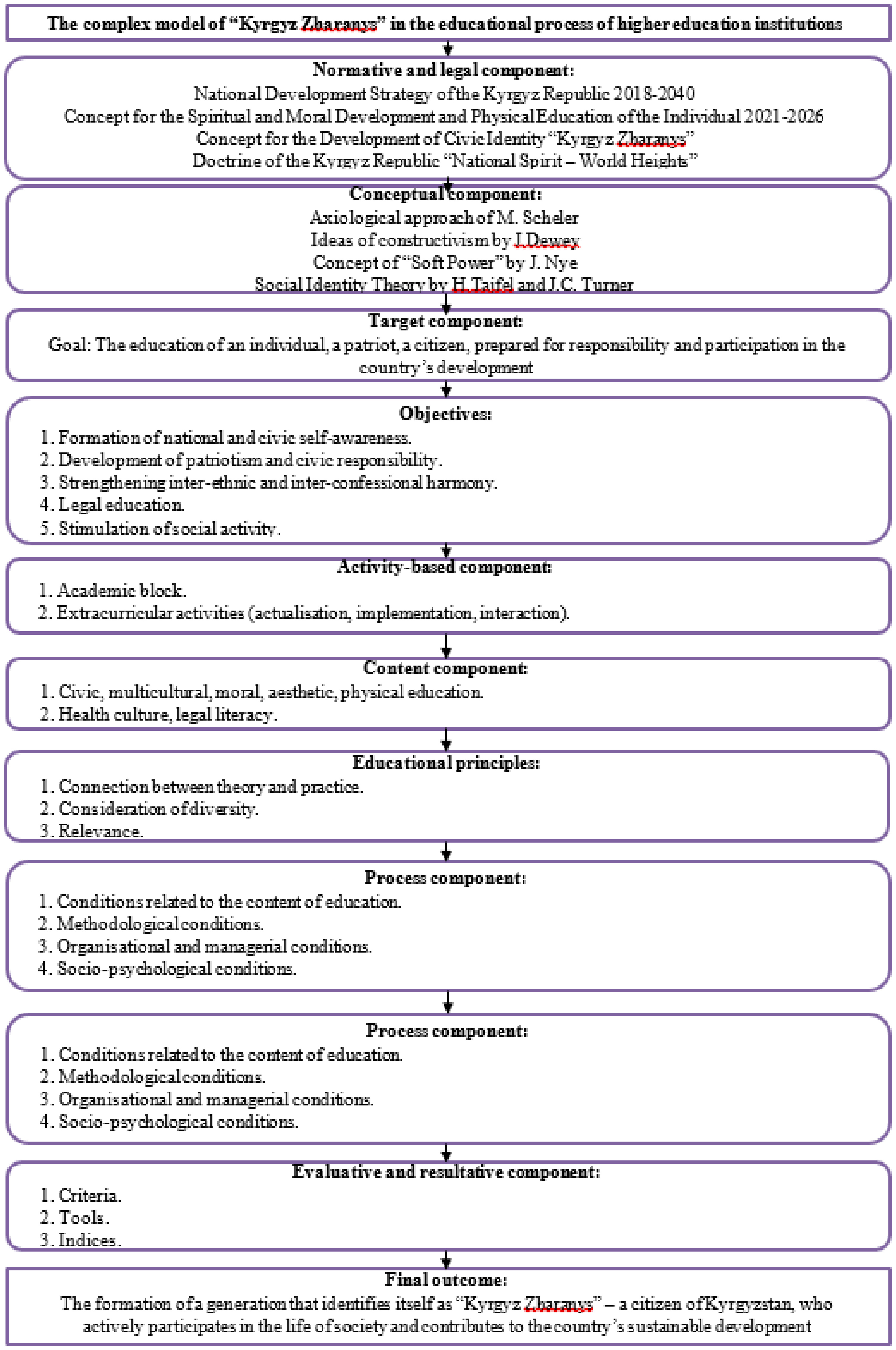
The long-term guidelines are defined in the National Development Strategy of the Kyrgyz Republic for 2018-2040 (Kyrgyz Republic, 2018). Its priorities include the formation of an active citizen who participates in political and economic scopes of life, adheres to legal norms, and demonstrates social responsibility. The strategy underscores that national unity can be preserved only through consolidation based on a shared identity that unites diverse ethnic, cultural, and religious groups. An important complement to these documents is the Concept for Spiritual and Moral Development and Physical Education of the Individual for 2021-2026 (Kyrgyz Republic, 2021), which highlights the connection between civic identity and moral-ethical foundations. In this context, educational institutions perform not only the function of knowledge transmission but also the task of nurturing moral norms, the values of humanism, and respect for cultural diversity among young people. The concept emphasises that spiritual development must go hand in hand with legal literacy and readiness to participate in public life. The ideological framework of the model is provided by the Doctrine “National Spirit – Global Heights”, approved in December 2024 (Kyrgyz Republic, 2024). This document articulates the principles of national dignity, patriotism, and high moral standards, which are to be consolidated through the systems of education, culture, and civic engagement. The doctrine underscores the importance of national integrity as a prerequisite for state development and directs educational policy towards harmonising national values with international norms in the fields of human rights and democracy. Taken together, these documents constitute the normative-legal framework within which the “Kyrgyz Zharany” model is implemented. Its key feature lies in its multi-component structure. The model comprises eight core blocks: normative-legal, conceptual, target-oriented, activity-based, content-based, procedural, evaluative, and resultant (Figure 1).

The functioning of the “Kyrgyz Zharany” model is feasible only when resting upon a stable legal foundation. State documents and strategic frameworks here serve not as mere formalities but as mechanisms that bridge political initiatives with the practical implementation within educational institutions. Through these instruments, interaction among various institutions is ensured, as well as the distribution of responsibility among those implementing educational and upbringing programmes. In this sense, the normative framework ensures consistency by aligning individual initiatives towards a unified direction and prevents fragmentation. Equally important is the system of ideas and principles that determines the general orientation of upbringing (Zhanabergenova; Kairbekov, 2024). This refers to a set of values – equality, tolerance, legal consciousness, and civic responsibility – which form the conceptual core of the model. It is precisely these values that allow diverse programmes and activities to remain interconnected, as they are oriented towards shared priorities. Thus, the ideological level is not limited to rhetoric but performs an integrative function: it ensures the internal coherence of the entire system.
Once the value foundation was established, there arose the need for strategic guidelines. The main emphasis here was placed on the formation of an identity uniting diverse ethnic and cultural groups, the cultivation of patriotism and legal culture, and the encouragement of youth participation in civic life. Such orientations are not abstract slogans but programme objectives detailed within the plans of universities and civic organisations. This creates a link between the national strategy and the concrete practice of educational and formative activities. These goals are achieved through a wide range of activities. The teaching of academic disciplines, the functioning of student clubs, and the organisation of volunteer initiatives and cultural events create an environment in which students gain practical experience of active civic behaviour (Mazhiyev et al., 2024). Participation in such activities fosters not only knowledge acquisition but also the development of teamwork, responsibility, and social interaction skills. It is precisely within this domain that the practical assimilation of civic values occurs – something that cannot be achieved solely within the classroom. Another key component is the thematic content of the educational and upbringing process. It encompasses the study of the history of Kyrgyzstan, the state language, national symbols, as well as an introduction to the fundamentals of law and issues of interethnic dialogue. Such content creates conditions in which knowledge becomes closely linked to values. As a result, students not only acquire information but also develop attitudes towards the state, society, and cultural diversity.
To ensure that all these elements do not exist in isolation, a clear organisational structure of the process is required. The sequence of implementation includes the integration of curricular and extracurricular practices, as well as interaction among students, lecturers, administrators, and civic organisations. That way, the educational and formative process acquires a multi-level character in which all participants play an active role. This allows ensuring flexibility and multidimensionality in education, rendering the model more effective. For the “Kyrgyz Zharany” model, the evaluation system is based on a set of indicators reflecting the level of legal literacy, student engagement in civic initiatives, as well as indices of tolerance and social responsibility. This approach transforms monitoring from a punitive instrument into a developmental mechanism, as the evaluation results are used to refine and improve the programmes. The intended outcome of these efforts is a generation of citizens who not only possess knowledge of their rights and responsibilities but also feel a sense of belonging to the state, recognise the value of the rule of law, and are ready to act for the public good. This implies the integration of personal convictions with social behaviour, contributing to the strengthening of democratic principles and legal culture. Such an outcome reflects the integrity of the model and its capacity to influence the real lives of young people.
The integration of the model into the international context represents another essential characteristic. Official documents emphasise the need for aligning national values with the principles of human rights, democracy, and interethnic tolerance. This entails the participation of universities in academic mobility programmes, collaboration with foreign educational institutions, and the engagement of students in international projects and volunteer initiatives. Hence, “Kyrgyz Zharany” does not isolate national identity but rather situates it within a broader framework of interaction with other cultures and value systems. Thus, the “Kyrgyz Zharany” model constitutes a multidimensional system combining legal foundations, conceptual approaches, educational strategies, and social practices. It aims to create the required conditions for nurturing citizens who are aware of their belonging to the nation, willing to contribute to its development, and simultaneously guided by universal human values. Its strength lies in its comprehensiveness – from legislative frameworks to practical measures, from national traditions to international integration. Through such an approach, Kyrgyzstan constructs a system capable of ensuring the sustainability of civic identity amid multiculturalism and social transformation.
3.3 Implementation of the “Kyrgyz Zharany” model in higher education institutions of Kyrgyzstan
The universities selected for this analysis were chosen based on their prominent roles in implementing the “Kyrgyz Zharany” model and their varied academic profiles. The following institutions were selected due to their significant contributions to higher education in Kyrgyzstan and their inclusion of civic identity formation in their curricula: Issykkul State University, named after Kasym Tynystanov, Kyrgyz National University, named after Jusup Balasagyn, and Kusein Karasaev Bishkek State University . Furthermore, these universities were chosen for their diverse approaches to integrating legal culture, civic engagement, and interethnic tolerance within academic programmes. Their participation in both national and international educational projects, as well as their innovative pedagogical practices, made them suitable subjects for comparative analysis. This selection ensures a comprehensive understanding of how the “Kyrgyz Zharany” model is implemented across different educational contexts within the Kyrgyz Republic.
The development of educational practices aimed at forming a multidimensional civic identity within Kyrgyzstan’s higher education system requires integrating the conceptual principles of the “Kyrgyz Zharany” model across all levels of the educational process. This concerns not merely the formal inclusion of relevant courses in curricula but a profound transformation of pedagogical strategies that enable the integration of academic disciplines with activity-based and value-oriented practices. One of the key directions involves the renewal of educational programmes in pedagogy, socio-humanitarian disciplines, and subjects related to upbringing work. At the Issykkul State University, named after Kasym Tynystanov, curricula include courses addressing not only the professional training of future educators but also issues of legal culture, tolerance, patriotism, and interethnic interaction. Updated programmes are designed to foster critical thinking and civic engagement through discussions, analysis of social case studies, and work with primary sources in the fields of law and statehood history (Arynov et al., 2023, Bolponova, 2023). Such courses must not be treated as supplementary or elective but integrated into the mandatory component of student training.
The practical implementation of the model’s objectives requires the introduction of innovative teaching methods. The traditional lecture-based format, oriented towards passive knowledge reception, has been gradually replaced by interactive forms. At the Kyrgyz National University, named after Jusup Balasagyn, lecture-discussions are effectively employed, where students not only listen but also participate in collective discussions of issues related to legal and civic topics (Alykulov, 2022). Provocative lectures are equally effective, in which the lecturer deliberately introduces a disputable or erroneous statement to stimulate students’ critical analysis and reasoned response. Such practices foster the development of dialogical skills, the ability to question, and to defend one’s position based on evidence. Another important approach involves the modelling of situations requiring civic decision-making. These may include simulations of parliamentary debates, role-playing exercises, analysing interethnic conflicts, or public hearings on pressing social issues. Such classes allow students not only to comprehend the theoretical foundations of the legal system or ethical norms but also to experience personal responsibility for the decisions they make. Thus, innovative teaching methods become tools for shaping a reflective and critically minded personality. A key role in the practical realisation of the model is played by student research and volunteer projects. In both metropolitan and regional universities, the establishment of youth initiatives is encouraged – efforts aimed at analysing social processes, studying local traditions and cultures, and participating in legal and educational activities. For instance, student groups conduct sociological surveys on public legal awareness, organise educational campaigns in schools, and participate in volunteer programmes supporting socially vulnerable groups. Participation in such projects fosters not only professional skills but also social responsibility, which is a crucial component of civic identity.
In this context, extracurricular activity is equally significant complementing formal education. Clubs focused on discussing the values of “Kyrgyz Zharany” operate actively; cultural festivals, essay competitions on patriotism and civic responsibility, and student media projects – in the form of newspapers, podcasts, or video blogs (Koshbakova; Zhusubaliev, 2021) – are regularly organised. Such initiatives not only contribute to the assimilation of knowledge but also create a space for creative self-expression and the development of communication competences. Extracurricular engagement enables students to test themselves in roles such as organisers, journalists, moderators, or group leaders, thus fostering collaboration and responsibility.
Educational work in higher education institutions is oriented towards the integration of national values with universal human rights (Olga et al., 2023). This implies that students learn to respect state symbols, history, and cultural traditions while simultaneously internalising the principles of democracy, equality, and the rule of law. Such an approach facilitates the formation of a multidimensional civic identity that is not confined to ethnic or local boundaries but integrates the individual into a broader context of social and international relations. It is worth emphasising that the successful implementation of this model depends on the coherence of actions among all participants in the educational process. Lecturers must possess not only professional expertise but also pedagogical methods for working with students through discussions, project-based learning, and volunteering. University administrations, in turn, should ensure the organisational conditions required for student clubs, cultural activities, and research projects to function. At the same time, students themselves should perceive participation in these initiatives not as an obligation, but as an opportunity for personal development. It is precisely the interaction across all levels that generates a synergistic effect, ensuring the model’s overall effectiveness. Particular attention should be paid to the role of digital technologies in the educational process (Arynbaev, 2025). The use of online platforms for discussing social issues, creating student-led media, and conducting virtual conferences expands opportunities for student engagement. This enables the inclusion of a wider audience, including those who, for various reasons, cannot actively participate in traditional forms of activity. Thus, the digital environment becomes an additional resource in the implementation of the model, fostering the development of critical thinking and communication skills. A significant example is provided by the practice of Kusein Karasaev Bishkek State University, where teaching serves not only as a means of transmitting technical knowledge but also as an instrument for cultivating civic identity. Through assignments involving the analysis of socially relevant data, the creation of digital educational resources, and participation in interdisciplinary projects, students acquire the skills of responsible use of information technologies within the context of civic values.
The practical implementation of the “Kyrgyz Zharany” concept in higher education institutions takes various forms depending on the universities’ profiles and their educational strategies. A comparison on the specific features of the model’s realisation is required to examine concrete examples from three leading institutions that combine formal learning, innovative methodologies, and educational practices (Table 1).
A comparison of the practical implementation of the “Kyrgyz Zharanys” model in higher education institutions of Kyrgyzstan
The comparison presented in Table 1 highlights the distinct approaches each institution takes in integrating the “Kyrgyz Zharany” model. Issykkul State University focuses on incorporating legal culture and managerial competences within the core academic curriculum, emphasizing the importance of critical thinking and civic engagement. Kyrgyz National University, on the other hand, places significant emphasis on developing dialogue skills and interethnic understanding through interactive and participatory teaching methods. Finally, Bishkek State University utilizes digital literacy alongside traditional academic subjects, aiming to equip students with the necessary skills for responsible civic engagement in the digital age. This diversity in approaches shows how the “Kyrgyz Zharany” model can be adapted across different university profiles, ultimately achieving the common goal of fostering a well-rounded civic identity among students.
The pedagogical conditions under which the implementation of the model achieves the highest degree of effectiveness are grounded in several key principles. Firstly, the linkage between theoretical courses and practical application ensures deeper knowledge acquisition. When confined solely to lecture-based material, academic disciplines fail to generate a sense of relevance. In contrast, combining lectures with practical tasks, social projects, and research activities makes learning activity-oriented. Secondly, the integration of curricular and extracurricular work creates a holistic educational environment in which students perceive the university not merely as a place of knowledge acquisition but as a space for civic formation. Thirdly, an emphasis on tolerance and intercultural dialogue is crucial in a multi-ethnic country. This is realised through joint activities involving students of different ethnic groups, providing opportunities for discussion of interethnic harmony and social integration. Finally, the formation of social responsibility is achieved through student engagement in volunteering and civic initiatives, allowing them to perceive the tangible impact of their actions on society. In summary, it can be stated that the practical realisation of the model in Kyrgyzstan’s higher education institutions is based on the integration of academic curricula, the application of innovative teaching methods, the organisation of extracurricular activities, and the creation of pedagogical conditions conducive to the development of multidimensional identity.
4. Discussion
The consideration of education as a resource of influence through the attractiveness of values became central in the comparison with the concept of the “soft power” of educational institutions (Gauttam et al., 2024). Empirical findings confirmed the internal dimension: the integration of state policy documents, curricula, and extracurricular practices strengthened loyalty to constitutional norms and willingness to cooperate with institutions (Pangalila et al., 2020). The role of the digital environment in this process is crucial, as online platforms have expanded the reach of civic engagement, allowing students to participate in global discussions and projects. This digital dimension not only provides a space for reinforcing civic identity but also facilitates deeper engagement with international human rights and democratic values, fostering a more integrated approach to global citizenship education (Haduong et al., 2024).
Based on the results obtained, the key relationship identified lies between the curricular integration of civic and legal themes, activity-based formats (discussions, debates, and role-playing workshops), and extracurricular initiatives (clubs, volunteering, and media projects), which collectively enhanced students’ legal awareness, participation, and tolerance (Evans et al., 2020; Oglu, 2021). The alignment of educational programmes with a competence-based interpretation of citizenship correlated with findings on the use of the Sustainable Development Goals (SDGs) framework as an instrument of civic education. Leite (2022) conceptualised the incorporation of SDGs as a means of structuring knowledge, values, and actions, emphasising the need for definitional clarity and cautioning against declarative approaches. The results indicated that institutional integration of modules on human rights, tolerance, and local community engagement produced tangible improvements in behavioural indicators when these modules were linked with real community-based projects. This finding corresponded to the focus on operationalising objectives, yet differed by placing greater emphasis on the local rather than the global framework. A shared feature across studies was the recognition that without coherence among content, methods, and assessment, the effects became diluted. The key distinction, however, concerned the scale: our data demonstrated the primacy of the micro level (university-community), whereas S. Leite concentrated on transnational coordination.
Our findings align with several key studies that emphasize the importance of integrating civic education into academic curricula and extracurricular activities. For instance, Leite (2022) conceptualized the use of the SDGs as a framework for structuring civic education, a finding reflected in our study’s integration of human rights and local community engagement modules. Similarly, the study corroborates Donbavand and Hoskins (2021), who showed that active, reflective methods lead to stronger political participation. Similarly, our research found that integrating discussion-based learning, role-playing, and other activity-based formats significantly improved students’ civic engagement and legal literacy.
However, several points of our findings diverge from existing literature. While many studies (e.g., Leite, 2022) focus on global frameworks for civic education, our results emphasize the primacy of local, community-based projects in Kyrgyzstan, particularly within the context of a multicultural and multi-ethnic society. The study further diverges from existing studies by highlighting the dual impact of digital technologies on civic education, which is a relatively under-explored aspect in current literature on civic identity formation. The use of digital platforms for student-led media and virtual civic discussions has emerged as an essential tool in fostering democratic participation (Waliszewski et al., 2025), which has not been thoroughly emphasized in previous research.
The primary contribution of this study lies in its explicit integration of digital environments as a central factor in civic identity formation. While digital technologies have been acknowledged in passing in some studies, this research identifies them as a critical mechanism through which civic identity is negotiated and expressed, particularly in the context of Kyrgyzstan’s evolving educational landscape (Carmona et al., 2024). The study also contributes by presenting a nuanced understanding of the interplay between legal literacy, civic participation, and interethnic dialogue in the context of higher education institutions (Hu; Cheung, 2024). Furthermore, the study introduces a comprehensive evaluation system that encompasses both qualitative and quantitative indicators, such as students’ participation in civic initiatives and levels of tolerance, which were used to track the outcomes of the “Kyrgyz Zharany” model.
However, the model’s implementation does not come without potential risks, some of which require careful consideration. The “Kyrgyz Zharany” model faces several risks, including over-institutionalisation, where formal compliance may replace genuine engagement with civic values, reducing activities like volunteering to mere formalities. Another concern is declarative implementation, where the model’s goals are presented ideally but lack real follow-through, potentially making civic practices superficial. Additionally, there are tensions between national and global civic frameworks, as an overemphasis on national identity could create conflicts with global citizenship and human rights, limiting students’ broader engagement (Ilieva; Ivanov, 2025; Mirsayitov, 2023; Rashimbetov et al., 2025). Finally, unequal access to civic-learning opportunities across regions and universities may result in disparities, with urban students having more access to civic initiatives than those in rural or underfunded areas, thus hindering the model’s inclusivity and effectiveness.
Last but not least, the combination of a course on legal culture with extracurricular activities ensured not only educational but also behavioural outcomes: sustainable volunteering, student self-governance, and the initiation of public dialogues on campuses. In research, such an effect is usually attributed to active pedagogical practices and structured reflection, which was corroborated by the collected data and further indicated that institutional regulations (multilingualism policies, moderation procedures, and assessment rubrics) constituted an independent factor enhancing the reproducibility of effects across different groups. Alignment with state policy documents and the availability of methodological packages for instructors reinforced the sustainability of implementation. In comparable studies, pedagogical technologies or macro-level frameworks were discussed more frequently, whereas these results emphasised the managerial and organisational dimension as a condition for practical realisation. In summary, it can be stated that comprehensive integration (curriculum + active methods + extracurricular channels + institutional assessment) was associated with an increase in legal literacy, participation, and intercultural interaction. The significance of the findings lies in demonstrating that, in multilingual and multicultural environments, it is precisely the combination of educational and organisational levers that creates the prerequisites for sustainable behavioural change.
In conclusion, this study not only corroborates prior research on civic education but also presents distinct findings that offer new insights into the pedagogical and digital dimensions of civic identity formation. By foregrounding the digital environment and providing a comprehensive, locally grounded analysis of the “Kyrgyz Zharany” model, this study contributes to the broader discourse on civic education and identity formation in post-Soviet higher education systems.
5. Conclusions
This study confirms that the formation of civic identity in higher education in Kyrgyzstan is a multifaceted and systemic process that integrates legal, conceptual, pedagogical, and socio-practical components. The research highlights the effectiveness of the “Kyrgyz Zharany” model, which integrates academic curricula with activity-based practices to foster civic engagement, critical thinking, and social responsibility. Key factors influencing the success of this model include the alignment of curricular and extracurricular activities, the use of innovative teaching methods, and the incorporation of national values alongside human rights principles.
The study’s practical implications are twofold: first, it provides universities with a framework for integrating civic identity formation into educational strategies; second, it offers policymakers actionable insights for developing assessment indicators and scaling these initiatives in multicultural contexts. A significant contribution of this research lies in its identification of specific pedagogical conditions for success, such as the combination of theory and practice, the emphasis on intercultural dialogue, and the development of volunteer and project-based formats.
At the same time, the study revealed certain limitations. These primarily concerned the heterogeneity of model implementation across different universities, which was determined by differences in resources, teacher training, and the level of institutional support. These factors affected the pace of implementation and could lead to uneven achievement of results. The limitations also included the difficulty of quantitatively measuring indicators of civic identity, since this process is multidimensional and dynamic in nature. Prospects for further research are seen in expanding the empirical base through inter-university comparisons, incorporating quantitative indicators of students’ social activity, and studying the influence of digital environments on the transformation of civic identity. In the future, research should address a more in-depth analysis of how different university profiles and cultural contexts affect the successful implementation of the “Kyrgyz Zharany” model.
-
Financial support:
None.
-
Ethics Committee Approval:
Nothing to declare.
-
Data Availability:
Research data is only available upon request.
-
Use of artificial intelligence-assisted technology:
Grammar and sentence structure.
References
- ALYKULOV, Urmat Z. Patriotic education of student youth in modern conditions. Bulletin of Kyrgyz National University Named After Jusup Balasagyn, v. 23, p. 23-32, 2022.
- ARYNBAEV, Eraly. The role of informatics subject in forming students’ “Kyrgyz citizen” civic identity. Bulletin of Osh State Pedagogical University Named After A. Myrsabekov, v. 2, n. 25, p. 154-159, 2025.
- ARYNOV, Kaldybay et al Urban planning foundations for the formation of training and production centres for folk art crafts. Architectural Studies, v. 11, n. 1, p. 22-34, 2025.
-
ARYNOV, Kaldybay K. et al Architectural and historical value – The heritage of the people. In: ZHUSSUPBEKOV, Askar; SARSEMBAYEVA, Assel; KALIAKIN, Victor N. (eds.). Smart geotechnics for smart societies Boca Raton: CRC Press, 2023. p. 2456-2462. DOI: https://doi.org/10.1201/9781003299127-381.
» https://doi.org/DOI: https://doi.org/10.1201/9781003299127-381 -
ASYLTAEVA, Elnura B.; TOLEN, Zhengisbek M.; ZHUMAN, Nazym M. A comparative analysis of the formation of civic identity practice in foreign countries. Bulletin of KazNU International Relations and International Law Series, v. 105, n. 1, p. 79-86, 2024. DOI: https://doi.org/10.26577/IRILJ.2024.v105.i1.08.
» https://doi.org/DOI: https://doi.org/10.26577/IRILJ.2024.v105.i1.08 - BOLPONOVA, Asyl B. Implementation of the “Concept of Kyrgyz Citizen” in higher education institutions of the Kyrgyz Republic: Experience of AGUPKR named after Zh. Abdrakhmanov. Bulletin of the Academy of Public Administration Under the President of the Kyrgyz Republic Named After Jusup Abdrakhmanov, v. 33, p. 39-44, 2023.
-
CARMONA, Margarida; SHARMA, Mayank; SINGH, Nandini Chatterjee. Global citizenship identity mediates the relationship of knowledge, cognitive, and socio-emotional skills with engagement towards global issues. Scientific Reports, v. 14, n. 1, p. 22209, 2024. DOI: https://doi.org/10.1038/s41598-024-72658-8. PMid:39333216.
» https://doi.org/DOI: https://doi.org/10.1038/s41598-024-72658-8 - DEWEY, John. Democracy and education New York: The Macmillan Company, 1930.
-
DONBAVAND, Steven; HOSKINS, Bryony. Citizenship education for political engagement: A systematic review of controlled trials. Social Sciences, v. 10, n. 5, p. 151, 2021. DOI: https://doi.org/10.3390/socsci10050151.
» https://doi.org/DOI: https://doi.org/10.3390/socsci10050151 -
DOROSHKO, Mykola; TSYRFA, Iuliia. Russian strategic culture: Why the past matters. Przeglad Strategiczny, n. 14, p. 147-163, 2021. DOI: https://doi.org/10.14746/ps.2021.1.9.
» https://doi.org/DOI: https://doi.org/10.14746/ps.2021.1.9 -
EFREMOV, Andrei. Integration of AI and neuroscience: new methods in studying the causes of mental disorders. International Journal of Psychiatry in Medicine, v. 61, n. 4, p. 498-514, 2026. DOI: https://doi.org/10.1177/00912174261428872. PMid:41761902.
» https://doi.org/DOI: https://doi.org/10.1177/00912174261428872 -
EVANS, Mark et al Pedagogy and youth civic engagement: Shifting understandings, emergent considerations and persisting challenges. Citizenship Teaching and Learning, v. 15, n. 2, p. 155-186, 2020. DOI: https://doi.org/10.1386/ctl_00027_1.
» https://doi.org/DOI: https://doi.org/10.1386/ctl_00027_1 -
GAUTTAM, Priya et al Education as a soft power resource: A systematic review. Heliyon, v. 10, n. 1, p. e23736, 2024. DOI: https://doi.org/10.1016/j.heliyon.2023.e23736. PMid:38268586.
» https://doi.org/DOI: https://doi.org/10.1016/j.heliyon.2023.e23736 -
GIROUX, Henry A.; BOSIO, Emiliano. Critical pedagogy and global citizenship education. In: BOSIO, Emiliano (ed.). Conversations on global citizenship education New York: Routledge, 2021. p. 3-12. DOI: https://doi.org/10.4324/9780429346897-1.
» https://doi.org/DOI: https://doi.org/10.4324/9780429346897-1 -
HADUONG, Paulina et al Who am I and what do I care about? Supporting civic identity development in civic education. Education, Citizenship and Social Justice, v. 19, n. 2, p. 185-201, 2024. DOI: https://doi.org/10.1177/17461979231151616.
» https://doi.org/DOI: https://doi.org/10.1177/17461979231151616 -
HARWOOD, Jake. Social identity theory. In: BULCK, Jan van den (ed.). The international encyclopedia of media psychology Hoboken: Willey, 2020. p. 1-7. DOI: https://doi.org/10.1002/9781119011071.iemp0153.
» https://doi.org/DOI: https://doi.org/10.1002/9781119011071.iemp0153 -
HAUKANES, Sigrid. Norwegian pre-service teachers’ understanding of reflective rehearsals and democratic citizenship education: Opportunities and challenges. Discover Education, v. 3, n. 1, p. 173, 2024. DOI: https://doi.org/10.1007/s44217-024-00280-x.
» https://doi.org/DOI: https://doi.org/10.1007/s44217-024-00280-x -
HU, Jieyi; CHEUNG, Chau Kiu Jacky. Social identity and social integration: A meta-analysis exploring the relationship between social identity and social integration. Frontiers in Psychology, v. 15, p. 1361163, 2024. DOI: https://doi.org/10.3389/fpsyg.2024.1361163. PMid:38638525.
» https://doi.org/DOI: https://doi.org/10.3389/fpsyg.2024.1361163 - ILIEVA, Raya Koleva; IVANOV, Atanas Simeonov. Controversial issues in the action for annulment of the resolutions of the general meeting of the commercial companies in the Republic of Bulgaria. Balcan Social Science Review, v. 25, n. 25, p. 27-43, 2025.
-
JAILOBAEVA, Kanykey; BAIALIEVA, Myrzagul. Sponsored study abroad and civic engagement in Kyrgyzstan. Journal of Civil Society, v. 16, n. 3, p. 234-242, 2020. DOI: https://doi.org/10.1080/17448689.2020.1794169.
» https://doi.org/DOI: https://doi.org/10.1080/17448689.2020.1794169 - KAMCHYBEKOVA, S. M. Civil identity and patriotism – the basis of state stability. Bulletin of Kyrgyzstan Universities, n. 6, p. 158-163, 2020.
-
KARABALAEVA, Gulmira T. et al Training of doctors of philosophy in the Kyrgyz Republic in the context of modern trends. Journal of Higher Education Theory and Practice, v. 21, n. 14, p. 57-66, 2021. DOI: https://doi.org/10.33423/jhetp.v21i14.4809.
» https://doi.org/DOI: https://doi.org/10.33423/jhetp.v21i14.4809 - KOSHBAKOVA, Batmakhan Muktarovna; ZHUSUBALIEV, Abdikayym Rysbaevich. Sociocultural features of patriotism and formation of civic identity in Kyrgyzstan. Bulletin of Kyrgyzstan Universities, n. 6, p. 101-105, 2021.
- KYRGYZ REPUBLIC. On The national development strategy of the Kyrgyz Republic for 2018–2040 Bishkek: Kyrgyz Republic, 2018.
- KYRGYZ REPUBLIC. On the concept of development of civic identity “Kyrgyz Citizen” in the Kyrgyz Republic for 2021–2026 Bishkek: Kyrgyz Republic, 2020.
- KYRGYZ REPUBLIC. On the approval of the concept of spiritual and moral development and physical education of personality Bishkek: Kyrgyz Republic, 2021.
- KYRGYZ REPUBLIC. Doctrine of the Kyrgyz Republic: national spirit – global heights. Bishkek: Kyrgyz Republic, 2024.
-
LEITE, Stephanie. Using the SDGs for global citizenship education: Definitions, challenges, and opportunities. Globalisation, Societies and Education, v. 20, n. 3, p. 401-413, 2022. DOI: https://doi.org/10.1080/14767724.2021.1882957.
» https://doi.org/DOI: https://doi.org/10.1080/14767724.2021.1882957 -
MAZHIYEV, Gilimbek; RASHIMBETOV, Rakhymzhan; KAIRBEKOV, Nurlan. Religious orientations on attitude toward a secular state: Case of Evangelical Lutheran Churches in north regions of Kazakhstan. Pharos Journal of Theology, v. 105, n. 3, p. 1-10, 2024. DOI: https://doi.org/10.46222/pharosjot.105.311.
» https://doi.org/DOI: https://doi.org/10.46222/pharosjot.105.311 - MIRSAYITOV, Ikbalzhan Erkinovich. Religious identity and “Kyrgyz citizen” in search of dialogue. Proceedings of the National Academy of Sciences of the Kyrgyz Republic, n. 4, p. 179-190, 2023.
-
NUSUBALIEVA, Eliza et al Civic identity of youth as an important element of modern sociocultural transformation of society. Social & Legal Studies, v. 4, n. 6, p. 145-154, 2023. DOI: https://doi.org/10.32518/sals4.2023.145.
» https://doi.org/DOI: https://doi.org/10.32518/sals4.2023.145 -
NYE, Joseph S. Soft power: The evolution of a concept. Journal of Political Power, v. 14, n. 1, p. 196-208, 2021. DOI: https://doi.org/10.1080/2158379X.2021.1879572.
» https://doi.org/DOI: https://doi.org/10.1080/2158379X.2021.1879572 - NYE, Joseph S. Soft power: the means to success in world politics. New York: PublicAffairs, 2004.
- OGLU, Abduganiev Ozod Tursunboy. Pedagogical conditions and mechanisms of development of social active civil competence in students. Turkish Journal of Computer and Mathematics Education, v. 12, n. 7, p. 433-442, 2021.
-
OLGA, Semenyuk et al Ecological architecture in the steppe zone of Northern Kazakhstan. Environmental Science and Engineering, v. 1, p. 297-307, 2023. DOI: https://doi.org/10.1007/978-3-031-30233-6_27.
» https://doi.org/DOI: https://doi.org/10.1007/978-3-031-30233-6_27 -
PANGALILA, Theodorus; TUERAH, Javier; UMAR, Mardan. Character formation through civic education learning process. International Journal of Psychosocial Rehabilitation, v. 24, n. 2, p. 2335-2345, 2020. DOI: https://doi.org/10.37200/IJPR/V24I2/PR200529.
» https://doi.org/DOI: https://doi.org/10.37200/IJPR/V24I2/PR200529 -
PASHBY, Karen et al A meta-review of typologies of global citizenship education. Comparative Education, v. 56, n. 2, p. 144-164, 2020. DOI: https://doi.org/10.1080/03050068.2020.1723352.
» https://doi.org/DOI: https://doi.org/10.1080/03050068.2020.1723352 -
RAPANTA, Chrysi; VRIKKI, Maria; EVAGOROU, Maria. Preparing culturally literate citizens through dialogue and argumentation: Rethinking citizenship education. Curriculum Journal, v. 32, n. 3, p. 475-494, 2021. DOI: https://doi.org/10.1002/curj.95.
» https://doi.org/DOI: https://doi.org/10.1002/curj.95 -
RASHIMBETOV, Rakhymzhan et al Correlation between secular state and religious orientation: Internal and external motives of madrasa students. Pharos Journal of Theology, v. 106, n. 5, p. 1-19, 2025. DOI: https://doi.org/10.46222/pharosjot.106.58.
» https://doi.org/DOI: https://doi.org/10.46222/pharosjot.106.58 - ROZHKOVA, Mariia et al International legal regulation of anti-Russian sanctions and its impact on the formation of Ukraine’s foreign policy identity. European Political Science, v. 27, n. 1, p. 219-239, 2026.
- SADIRBEKOVA, Dinara et al Study of professional development barriers in the formation of soft skills at different stages of HEI teachers’ career through digital resources. Ricerche di Pedagogia e Didattica, v. 19, n. 2, p. 65-80, 2024.
- SEDLIAR, Yulii et al Political and legal assessment of the Budapest Memorandum: From Ukraine’s renunciation of nuclear weapons to the annexation of the Crimean Peninsula. Social & Legal Studies, v. 6, n. 3, p. 162-169, 2023.
-
SHABALALA, Nonkanyiso Pamella. Global citizenship education as a strategy for social justice and identity: Achieving balance for meaningful social impact. Globalisation, Societies and Education, p. 1-13, 2025. DOI: https://doi.org/10.1080/14767724.2025.2537371.
» https://doi.org/DOI: https://doi.org/10.1080/14767724.2025.2537371 - TAJFEL, Henri; TURNER, John C. An integrative theory of intergroup conflict. In: AUSTIN, William G.; WORCHEL, Stephen (eds.). The social psychology of intergroup relations Monterey: Brooks/Cole, 1979. p. 33-47.
- TAZHIBAEVA, Ainagul. Civil identity of Kyrgyzstanis in conditions of globalization: Current state and directions. Journal of Osh State University History, v. 1, n. 2, p. 51-56, 2023.
-
TORRES, Carlos Alberto; BOSIO, Emiliano. Global citizenship education at the crossroads: Globalization, global commons, common good, and critical consciousness. Prospects, v. 48, n. 3, p. 99-113, 2020. DOI: https://doi.org/10.1007/s11125-019-09458-w.
» https://doi.org/DOI: https://doi.org/10.1007/s11125-019-09458-w - WALISZEWSKI, Krzysztof et al Key drivers shaping adoption of BNPL (Buy Now, Pay Later) payments by consumers. Equilibrium: Quarterly Journal of Economics and Economic Policy, v. 20, n. 4, p. 1535-1574, 2025.
-
WHELAN, Brian. Toward networked social identity theory: Reconceptualizing social identity in the digital age. AMS Review, v. 15, n. 3-4, p. 502-518, 2025. DOI: https://doi.org/10.1007/s13162-025-00321-0.
» https://doi.org/DOI: https://doi.org/10.1007/s13162-025-00321-0 -
YESMAGANBET, Nurbek; KAIRBEKOV, Nurlan. Examination of the activities of religious educators of the Soviet period in the context of the development of European religious thought. Pharos Journal of Theology, v. 106, n. 3, p. 1-15, 2025. DOI: https://doi.org/10.46222/pharosjot.106.3030.
» https://doi.org/DOI: https://doi.org/10.46222/pharosjot.106.3030 - ZHANABERGENOVA, Dinara; KAIRBEKOV, Nurlan. Absattar Haji Derbisali and the importance of his works for the development of Islamic studies in Kazakhstan. Journal of Al-Tamaddun, v. 19, n. 1, p. 235-246, 2024.
- ZULPUEVA, Raby Zhanybaevna; ERGESHOVA, Burulkan Mamatkasymovna. The significance of scientific works of the famous Kyrgyz ethnographer, Professor A. Asankanov in forming the concept of Kyrgyz citizen. Proceedings of the National Academy of Sciences of the Kyrgyz Republic, v. 1, n. 1, p. 76-80, 2025.
Edited by
-
Editors:
Venera Sabirova (OshSU, Kyrgyzstan) e Iuliia Tsyrfa (KNU, Ukraine).
Research data is only available upon request.

 Source: compiled by the authors.