
 Differences in citations between assessment and mapping bibliometrics articles on management
Abstract
This study examines the relationship between the type of bibliometric paper in the field of management (mapping vs. assessment) and its subsequent citation impact, while controlling for collaboration, documen type, and paper length. Using a negative binomial regression model, our findings highlight significant associations among these variables. Notably, assessment papers receive fewer citations than mapping papers, and co-authored papers receive more citations than their single-authored counterparts. Additionally, articles attract fewer citations than reviews, while longer papers tend to receive more citations. To mitigate selection bias, propensity score matching was conducted, confirming the robustness of the relationship between paper type and citation impact in a balanced dataset. The scholarly implications include more informed publication strategies and research design choices. While certain limitations exist, these results open avenues for future research, spanning longitudinal analyses, qualitative explorations, and multidisciplinary investigations, thus advancing the comprehension of factors influencing citation impact in scholarly literature.
Keywords
Bibliometrics; Citation impact; Collaboration patterns; Management research; Scholarly publishing
Resumo
Este estudo examina a relação entre o tipo de artigo bibliométrico na área de Administração (mapeamento vs. avaliação) e seu impacto subsequente em citações, controlando as variáveis colaboração, tipo de documento e extensão do artigo. Utilizando um modelo de regressão binomial negativa, os resultados destacam associações significativas entre essas variáveis. Notavelmente, artigos do tipo “avaliação” apresentam menos citações do que os do tipo “mapeamento”, e artigos com coautoria recebem mais citações do que aqueles de autoria individual. Além disso, artigos do tipo “artigo” atraem menos citações do que os do tipo “revisão”, enquanto artigos mais longos demonstram uma propensão a receber mais citações. Para mitigar o viés de seleção, foi realizada a correspondência por escore de propensão (propensity score matching), confirmando a robustez da relação entre o “tipo” de artigo e o impacto em citações em um conjunto de dados balanceado. As implicações acadêmicas abrangem estratégias de publicação mais informadas e escolhas mais adequadas de desenho de pesquisa. Embora existam limitações, esses resultados abrem caminhos para pesquisas futuras, abrangendo análises longitudinais, explorações qualitativas e investigações multidisciplinares, avançando assim, a compreensão dos fatores que influenciam o impacto das citações na literatura acadêmica.
Palavras-chave
Bibliometria; Impacto de citações; Padrões de colaboração; Pesquisa em administração; Publicação acadêmica
Introduction
In academic research, assessing the impact of scholarly production is a fundamental endeavor that shapes not only how knowledge is disseminated but also how it is valued and legitimized within scientific communities. Among the methodological tools developed for this purpose, bibliometric analysis has become a pivotal, offering both quantitative rigor and conceptual insight into the structure and dynamics of science (De Bellis, 2009). Through citation-based indicators and network-analytic techniques, bibliometrics enables the examination of visibility, influence, and connectivity among publications, authors, and institutions.
In recent decades, the field of business and management has witnessed a remarkable proliferation of bibliometric studies (Zupic; Čater, 2015), reflecting the expansion of academic output and the growing interest in understanding its internal dynamics. Within this context, two complementary but epistemologically distinct approaches have emerged: research assessment, which evaluates productivity and impact through quantitative indicators, and science mapping, which seeks to uncover the intellectual and conceptual structures underlying a discipline (De Bellis, 2009). Although often intertwined, these approaches differ in their underlying assumptions regarding knowledge organization and the nature of scholarly influence.
A wide range of studies in management research has employed these methodological traditions, ranging from performance-based analyses (e.g., publication and citation metrics) to mapping techniques such as co-citation, co-authorship, and co-word analyses. For instance, Agostini and Nosella (2019) and García-Lillo et al. (2017) applied co-word analysis to reveal the conceptual structure of interorganizational research in SMEs. Mishra et al. (2017) and Ardito et al. (2019) combined performance metrics and co-citation analysis to trace the evolution of Big Data research, identifying key authors and thematic clusters. Likewise, Belussi, Orsi and Savarese (2019) employed bibliographic coupling to delineate the intellectual boundaries of the business model literature, while Ben-Daya, Hassini and Bahroun (2019) used citation analysis to chart the development of Internet of Things research within supply chain management. Delafenestre (2019) adopted a hybrid approach integrating performance and thematic analyses, and Martin-De Castro, Diez-Vial and Delgado-Verde (2019) utilized longitudinal co-citation techniques to examine the trajectory of intellectual capital research. Similarly, Zhu et al. (2019) applied citation network analysis to explore leadership studies.
Collectively, these examples underscore the dual function of bibliometric research: evaluating scholarly productivity and impact and mapping the conceptual architecture of academic fields. Yet, despite this methodological richness, few studies have examined whether these two orientations, assessment and mapping, differ systematically in their own citation impact. In other words, while bibliometric methods are widely used to measure the influence of other scholars, the relative influence of different bibliometric approaches remains underexplored. This gap constitutes the central focus of the present study.
The proliferation of bibliometric analyses in management research has illuminated emerging trends, influential works, collaborative structures, and thematic clusters across subfields. However, the comparative citation performance of assessment-oriented and mapping-oriented bibliometric studies has not been systematically examined. Given that citation counts are commonly used as a proxy for scholarly influence, understanding whether these methodological orientations attract different levels of recognition is crucial.
This study addresses this gap by investigating whether bibliometric articles in management journals that focus on research productivity assessment differ in citation impact from those emphasizing science mapping. By analyzing a comprehensive corpus of bibliometric articles categorized according to their methodological focus, we aim to determine whether the academic community attributes differential value, as measured through citation behavior, to these distinct orientations.
Our central hypothesis posits that articles classified as mapping and those as research assessment exhibit significant differences in citation performance, reflecting the distinct dimensions of scholarly impact associated with each bibliometric paradigm. Testing this hypothesis contributes not only to methodological reflection within bibliometrics but also to the broader sociology of academic recognition and influence in management research.
To examine this, we conducted an empirical analysis of bibliometric articles published in business and management journals, classifying them according to their analytical scope and modeling their citation performance using a Negative Binomial Regression Model, which accommodates the overdispersion characteristic in citation data.
The following sections present the theoretical and empirical background of bibliometric research in management, outline methodological framework, and discuss the results and implications of the statistical analysis. By examining the citation dynamics of bibliometric research itself, this study provides a meta-analytical perspective on how evaluative tools shape patterns of scholarly communication and legitimacy within the field.
While bibliometric methods are often treated as neutral instruments for measuring scholarly output, their application is inherently theory-laden, grounded in assumptions about knowledge structures, academic influence, and visibility. As De Bellis (2009) emphasizes, bibliometrics is not merely a technical methodology but also an epistemological stance on how science is organized and evaluated. Recent debates have further highlighted that evaluation-oriented bibliometrics (e.g., citation counts, productivity metrics) and mapping-oriented bibliometrics (e.g., co-word or co-citation analyses) capture different dimensions of scientific knowledge systems (Hicks et al., 2015; Leydesdorff; Rotolo; De Nooy, 2013). By juxtaposing these two orientations in terms of their citation outcomes, this study offers a nuanced contribution to understanding the epistemic foundations and practical implications of bibliometric analysis in management research.
Methodological Procedures
Retrieval of Scientific Information
This study focuses on bibliometric articles within the thematic domains of business and management. A search strategy similar to that of Zupic and Cater (2015) advanced search strategy was used to curate a comprehensive dataset from Web of Science (WoS): TS = (bibliometric* OR co-citation OR bibliographic coupling OR co-author OR co-word) AND WC = (business OR management) AND DT = (article OR review) AND PY = 1975 – 2020. Citation indexes Science Citation Index Expanded, Social Sciences Citation Index, Arts & Humanities Citation Index, and Emerging Source Citation Index.
A deliberate decision was made to include only articles and reviews, as these document types undergo rigorous peer evaluation (Adams, 2014). Furthermore, these document types constitute the primary channel for the generation and dissemination of new scientific knowledge, thereby reducing the risk of including extraneous information of limited relevance in the dataset.
Citation data were collected from the Science Citation Index Expanded, Social Sciences Citation Index, Arts & Humanities Citation Index, and Emerging Source Citation Index indices. To ensure comparability across publication years and to minimize temporal citation bias, we adopted a fixed three-year citation window, defined as (t ₀ + 2), where t ₀ represents the year of publication. This approach provides a standardized period of citation accumulation across all documents, regardless of their publication date, thereby controlling for variations in article age and mitigating distortions caused by the accelerating pace of scientific production. The temporal scope of the dataset spans from 1975, coinciding with the establishment of the Social Sciences Citation Index, to 2020, which represents the most recent year for which a full three-year citation window could be applied.
Data Cleaning and Standardization
The initial query yielded a total of 1,185 records. To classify these articles into mapping or assessment categories, a panel of seven domain experts was convened. The classification process was evaluated using the Kappa test Landis and Kotch (1977) to assess inter-expert agreement. Classifications achieving an agreement level above 0.60 were retained, ensuring robust categorization. Specifically, classifications within the ranges of substantial agreement (0.61–0.80) and almost perfect agreement (0.81–1.00) were retained, ensuring a high level of classification reliability.
The classification yielded 499 bibliometric articles in the fields of business and management, spanning the period from 1985 to 2020 (326 mapping articles, and 173 research assessment articles).
The experiment
Variables
Dependent Variable
Citation count. To measure citation counts, a fixed three-year time window was used. For instance, an article published in 2020 would have its impact measured by the citations it received in 2020, 2021, and 2022. This approach ensures that all articles have a comparable time frame to receive citations, thereby mitigating fluctuations caused by the article age. Citation data were collected from the Science Citation Index Expanded, Social Sciences Citation Index, Emerging Source Citation Index, and Arts & Humanities Citation Index. To obtain the citation count for each individual article, the data were manually retrieved using the query UT = (WoS ID), citation report.
Independent Variable
Type of study: For quantitative analysis and hypothesis testing, articles that map specific areas within the management discipline, or research lines were coded as 0. Articles that assess the productivity, impact, or performance of areas or themes were coded as 1. This classification enables a distinction between studies focusing on mapping and those centered on assessment within the discipline of management.
Control variables
Document type: The document type was defined according to WoS classification in the DT field. Reviews were coded as 0, and articles as 1. The inclusion of document type as a control variable is based on previous findings suggesting that, in business and management – review articles tend to attract more citations (Ketcham; Crawford, 2007).
Length: Length was measured as the number of pages; obtained from the PG field in the WoS database. Previous studies suggest a positive correlation between article length, and the number of citations received (Falagas et al., 2013; Fox; Paine; Sauterey 2016; Hasan; Breunig, 2021; Xie et al., 2019).
Collaboration: Collaboration refers to the number of authors contributing to the paper. Single authored papers were coded as 0, whereas papers with two or more authors were coded as 1. Previous bibliometric studies suggest a positive correlation between collaboration and citation impact in business and management (Frenken; Holzl; De Vor, 2005; Paphawasit; Wudhikarn, 2022).
Statistical Procedures
To evaluate the hypothesis, we employed a negative binomial Regression analysis. This choice was motivated by the categorical nature of the independent variable (mapping or assessment and our focus on the dependent variable, which represents citation counts for these bibliometric articles.
The decision to use the negative binomial regression is also based on the following considerations. Assumption: Relaxation of the equidispersion assumption in poisson regression. . The negative binomial accounts for overdispersion, where the variance exceeds the mean. This analytical approach is well-suited to explore the relationship because the Poisson regression model is not accurate when the assumption that the mean equals the variance is not satisfied (z = 1.594, p-value = 0.055).
Interpretation: The coefficients represent the log-linear effect of the predictors on the expected count, similar to Poisson regression.
Variance: The model can accommodate both equidispersion (Poisson distribution) and overdispersion (negative binomial distribution).
The model for the Negative Binomial Regression is as follows:
Where:
T3 is the dependent variable representing the citation impact.
μ is the mean of the distribution, which is related to the predictor variables.
θ is the dispersion parameter of the negative binomial distribution, accounting for overdispersion.
Mathematically, the mean μ can be modeled as a function of the predictor variables:
This formula becomes.
In this formula:
β0, β1, β2, β3, and β4 are the coefficients to be estimated. Type, Coll, DT, Len are the predictor variables, as described earlier. The dispersion parameter θ reflects the extra variability beyond what would be expected from a Poisson distribution. A value of θ=0 corresponds to a Poisson distribution, while larger values account for overdispersion.
In summary, the negative binomial regression model extends the Poisson Regression model by incorporating a dispersion parameter, which captures the extra variability present in the data. The goal is to better model situations in which the variance is larger than the mean, which is often the case in count data such as citation counts.
Propensity Score Matching
To strengthen causal inference and control for potential confounding effects, we applied a propensity score matching procedure. The matching aimed to compare articles categorized under distinct bibliometric orientations (e.g., mapping and research assessment) while balancing relevant covariates that may influence citation outcomes.
The propensity scores were estimated using a logistic regression model, in which the treatment variable was article type. The covariates included in the model were as follows:
Len: document length (measured in number of pages), Coll: collaboration status (single -authored vs. co-authored), and DT: document type (e.g., article or review).
We employed a nearest-neighbor matching algorithm with one-to-one pairing and no replacement, ensuring comparability between treated and control units. A caliper of 0.1 was applied to restrict the maximum allowable difference in propensity scores, thereby reducing the risk of poor matches.
All computations were performed using Python, specifically leveraging the pymatch library for matching and scikit-learn for model estimation. After matching, we assessed covariate balance to confirm that the treated and control groups were sufficiently similar, improving the reliability of the estimated treatment effects on citation impact.
This approach enhances the transparency and reproducibility of the analysis while addressing potential selection bias arising from observable factors.
Results and Discussion
Table 1 presents the distribution and citation impact (T3) of the two types of bibliometric studies analyzed. Mapping papers represent 65% of the sample and account for 75% of total T3 citations, with a mean T3 of 14.85 – significantly higher than the 9.22 observed for assessment papers. This result suggests that science mapping approaches may receive greater recognition within the academic community, possibly due to their broader applicability and integration across thematic areas. These papers often identify emerging trends or intellectual structures, making them highly citable reference points.
Distribution of papers and citation impact (T3) by study type, document type, and collaboration status.
Review articles (Table 1), while comprising only 19% of the dataset, account for 36% of total citations, with a substantially higher mean T3 (23.85) than research articles (10.26). This confirms a well-documented pattern in the bibliometric literature: review articles, by summarizing and synthesizing knowledge, tend to attract more citations and serve as authoritative sources. Despite this, original research articles dominate the corpus (81%), reflecting the primary format of academic output in the field.
These findings align with the large-scale analysis conducted by Ronda-Pupo (2017), who examined 36,241 papers published in 52 top-tier management journals and found that citation-based performance follows a superlinear scaling pattern with respect to document type. Although review papers exhibit a cumulative advantage relative to their proportion of publications, they do not surpass research articles in citation growth rates. Specifically, the scaling exponent between citations and the number of published documents was 1.67±0.05 for articles and 1.29±0.05 for reviews, indicating that citations to articles increased approximately 3.18-fold when the number of published articles doubled, whereas citations to reviews increased approximately 2.45-fold under the same condition. These results suggest that, within management research, original articles sustain a higher cumulative citation growth and thus contribute more substantially to the overall citation output of the discipline.
Together, our findings and those of Ronda-Pupo nuance the conventional assumption that review articles inherently outperform research articles in citation impact. Instead, the citation advantage appears contingent on disciplinary conventions and knowledge – production dynamics rather than on document type per se – emphasizing that the structure of scholarly influence in management research is shaped as much by epistemic and collaborative factors as by the format of publication.
Results in Table 1 show that co-authored papers represent the vast majority (86%) of the sample and are associated with significantly higher citation impact (mean T3 = 13.78 vs. 7.31 for single-authored papers). This reinforces the role of collaboration as a facilitator of visibility and academic reach, likely due to increased network effects, interdisciplinary input, and broader dissemination through multiple authors’ networks. These findings align with previous studies indicating that co-authored works generally have greater scholarly impact.
This result is consistent with large-scale empirical evidence showing a positive and statistically significant relationship between the number of authors and citation counts. Using more than 600,000 papers from Computer Science Bibliography, Association for Computing Machinery and MAG (Microsoft Academic Graph databases, Talaat and Gamel (2022) found that the correlation between author count and citation count is positive (r=0.0539) and that the number of authors is the most influential variable in predicting citation performance compared to other factors such as the number of countries, journal quartile, or publication year. Their multiple regression and probabilistic neural-network models confirm that collaborative authorship acts as the strongest predictor of citation visibility, reflecting the amplification of cognitive and social reach through co-authorship networks.
Similarly, in a field-normalized analysis of international co-publications, Pohl (2024) demonstrated that collaborative outputs consistently yield higher citation impact, even after controlling for the number of co-authors. His regression models across nine countries showed that both the number of co-authors and the international nature of the collaboration contribute significantly (p<0.001) and positively to citation performance, with international co-publications exhibiting higher Field-Weighted Citation Impact than national ones in all cases. Pohl further noted that fractional counting methods confirm this advantage, suggesting that collaboration itself – not merely the inflation from multiple co-authors – enhances scientific visibility.
Taken together, these studies strengthen the interpretation of our results: co-authored papers not only dominate scholarly production but also achieve disproportionately higher citation impact. The effect appears to stem from the combined cognitive, social, and dissemination benefits of collaboration – an observation consistent across computational, bibliometric, and scientometric approaches.
Mapping papers (Table 2) also tend to be longer (mean length = 20.72 pages) than assessment papers (17.86 pages), which may reflect methodological and conceptual differences. Mapping studies often require broader coverage of the literature, as well as more elaborate data visualization and network analysis, resulting in more extensive documents. The longer format may contribute to their higher citation impact, as more comprehensive studies may serve as foundational references.
Distribution of papers based on their type (Mapping and Assessment) and their respective lengths.
This interpretation aligns with the empirical findings of Hasan and Breunig (2021), who analyzed over 36,000 economics papers and demonstrated a positive, statistically significant relationship between article length and citation counts, even after controlling for factors such as journal impact, the number of authors, and publication year. Their results show that each 10% increase in article length corresponds to an average 6–7% increase in citations, indicating that longer papers tend to be more influential, likely because they provide greater methodological detail, richer discussion, and more comprehensive coverage of the literature.
Applying this reasoning to our dataset, the greater average length of mapping papers may enhance their visibility and utility within the scholarly community, functioning as integrative reference points that accumulate citations over time. In this sense, length operates not merely as a stylistic attribute but as a structural factor that amplifies a paper’s potential for scholarly impact in management bibliometric research.
Negative Binomial Regression and Causal Analysis
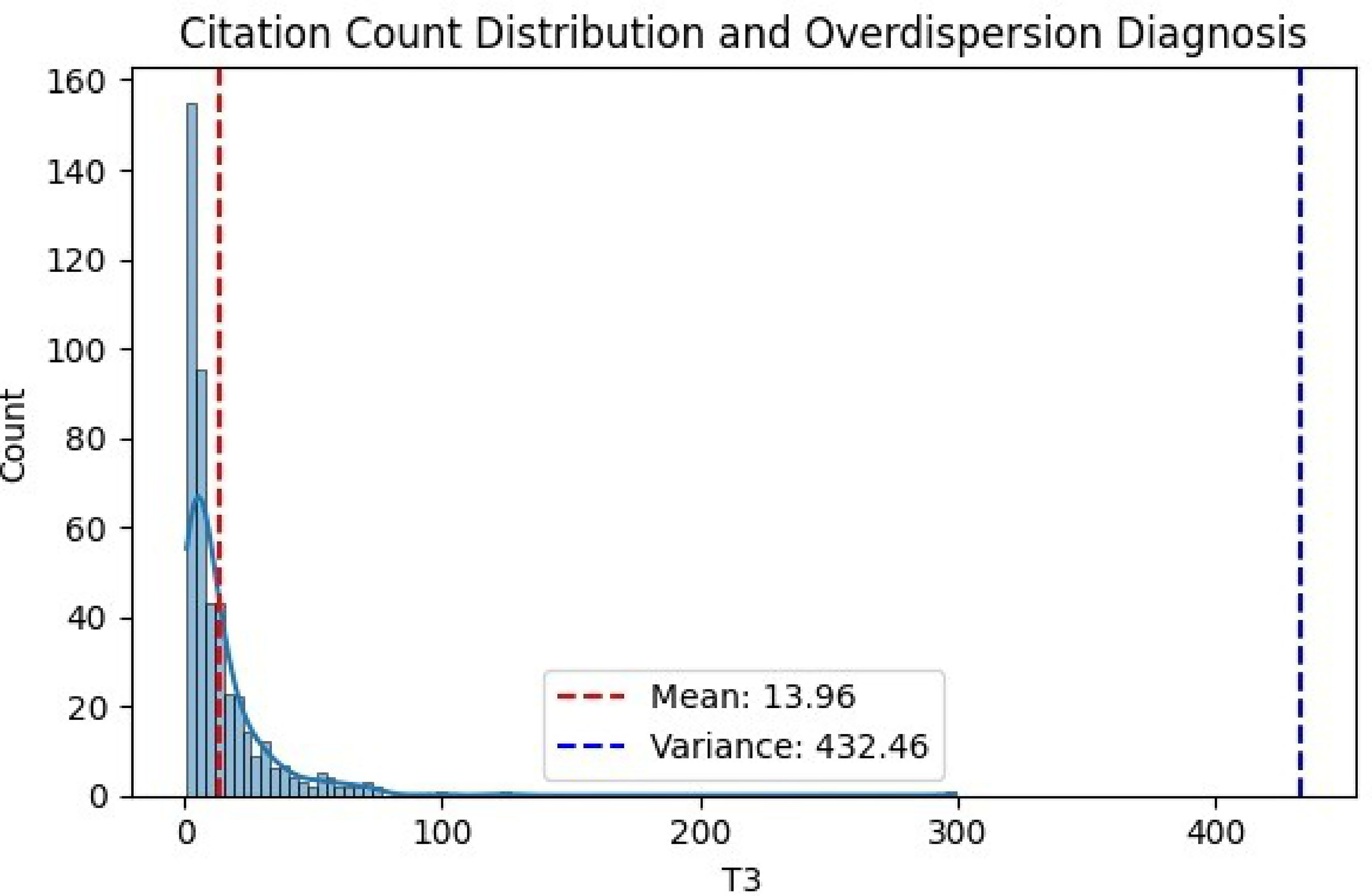
As part of the model diagnostics, overdispersion was assessed both visually and formally. Figure 1 illustrates the distribution of citation counts (T3), showing a substantial gap between the mean and the variance. Furthermore, the dispersion parameter α was estimated at 1.00, indicating a clear departure from the equidispersion assumption of the Poisson model. This value confirms that the negative binomial model is statistically appropriate for modeling the citation data.
Citation distribution (T3) and overdispersion diagnosis. The histogram illustrates the distribution of citations counts (T3), with vertical dashed lines representing the mean (red) and the variance (blue). The observed overdispersion, confirmed by the estimated dispersion parameter (α = 1.00), supports the use of a Negative Binomial regression model.
To model citation counts (T3), we employed a negative binomial regression model, which is suitable for overdispersed count data. A formal test of overdispersion confirmed that the dispersion parameter (α) differs significantly from zero (p<0.01), justifying the choice of this model over a standard Poisson regression. This finding confirms the presence of variability beyond what would be expected under the Poisson assumption.
The regression results for the full dataset are presented in Table 3. All covariates included in the model – type, DT (document type), Len (length), and Coll (collaboration) – were statistically significant at the 0.001 level. The coefficients are presented on the log scale (log(μ)). To facilitate interpretation, we exponentiated these coefficients to derive incidence rate ratios (IRRs), which indicate the multiplicative change in expected citations counts for a one-unit change in the predictor, holding all else constant.
For instance, the coefficient for Coll (β=0.498) corresponds to an IRR of 1.645, suggesting that co-authored papers receive 64.5% more citations than single-authored ones, on average. Conversely, type has a negative coefficient (-0.217), implying that, controlling for other factors, papers classified as assessment tend to receive fewer citations than mapping papers. Similarly, DT (β= -0.720; IRR ≈ 0.487) indicates that review articles are associated with significantly lower citation counts compared to articles, a finding that contrasts with as descriptive results and may reflect confounding effects – addressed next via matching.
Propensity Score Matching and Covariate Balance
To improve causal inference and address potential confounding, we applied propensity score matching using logistic regression to estimate treatment probabilities. Matching was performed using nearest-neighbor (1:1, no replacement) with a caliper of 0.1, balancing the covariates Len, Coll, and DT. The balance diagnostics are presented in Table 4, showing substantial improvement across covariates after matching. Standardized mean differences and distribution metrics (CDF and variance ratio) indicate reduced bias between treated and control groups.
Post-Matching Regression and Interpretation
Using the matched dataset, we re-estimated the model using a negative binomial regression to assess the causal effects more robustly. The results are presented in Table 5 and they generally reinforce the initial findings. All covariates remained significant, and the directionality of the effects was consistent.
Notably, the coefficient for type reversed sign (from -0.217 to +0.211) after matching, suggesting that, when covariates are balanced, assessment papers may actually receive more citations than previously estimated. This highlights the importance of controlling for observable confounding.
The IRRs from the matched model also provide meaningful interpretations: for example, the coefficient for Coll (β = 0.176) yields an IRR ≈ 1.193, indicating a 19.3% increase in expected citations counts due to collaboration, even after accounting for selection bias.
Conclusion
In this study, we investigated the relationship between the type of bibliometric paper in management (mapping vs. assessment) and citation impact (T3) while controlling for factors such as collaboration, document type, and paper length.
The findings from the negative binomial regression model revealed significant associations between the variables of interest. Papers classified as assessment were found to receive fewer citations than mapping papers, holding other factors constant. Co-authored papers exhibited higher citation impacts than single-authored ones. Furthermore, articles tended to have lower citation counts compared to review type papers. Additionally, longer papers showed a positive association with higher citation counts.
Using propensity score matching to address selection bias, we confirmed that the relationship between paper type and citation impact remains robust even after balancing the covariates. This suggests that the observed impact of paper type on citation counts is not merely a result of selection bias, but rather reflects a genuine underlying relationship.
Practical implications
The results of this study have several practical implications for stakeholders in academia and research evaluation. The findings can impact scholars, policymakers, funding agencies, and research evaluation teams.
Scholars
Publication strategy: Scholars can use the insights from this study to make informed decisions about the type of paper they choose to publish. If they aim to achieve higher citation impact, they may consider focusing more on mapping papers, while being mindful of collaboration and paper length.
Research design: Researchers can take into account the factors identified in this study when designing their research projects, particularly with respect to collaboration and paper length, which appear to influence citation impact.
Policymakers and Funding Agencies
Research funding allocation: Policymakers and funding agencies can consider the different impacts of ‘Mapping’ and ‘Assessment’ papers when allocating research funding. They may prioritize funding for research that contributes more to mapping as it appears to lead to higher citation impact.
Policy Formulation: The findings can inform the development of policies that encourage collaborative research, as co-authored papers were associated with higher citation impact.
Research Evaluation Teams
Scholarly Impact Assessment: Research evaluation teams can take into account the findings when assessing the scholarly impact of researchers and research outputs. They can consider paper type, collaboration, document type, and paper length as important factors when evaluating the impact of research contributions.
Peer Review and Selection: When evaluating research proposals, teams can be aware of the differences in citation impact between ‘Mapping’ and ‘Assessment’ papers and consider how different paper characteristics may affect the overall impact of a proposed research project.
In summary, the findings of this study offer insights for various stakeholders in the academic ecosystem. By understanding how paper type, collaboration, document type, and paper length interact with citation impacts, scholars can make informed choices, policymakers can allocate funding effectively, research evaluation teams can assess scholarly impact more accurately, and editors can shape their editorial policies to align with citation impact goals.
Limitations of the study
Causality and Unobserved Variables: While our analysis provides valuable insights, the observational nature of the study limits our ability to establish causal relationships. Unobserved variables may still influence the results.
Generalizability: Our study focuses on a specific field (management) and may not fully represent other domains or disciplines.
Propensity score matching: Despite our efforts to control for selection bias, propensity score matching relies on the observed covariates and cannot account for unobserved factors.
Future Lines of Research
Longitudinal Analysis: Conducting longitudinal studies could shed light on how the relationships observed in this cross-sectional study evolve over time.
Qualitative Analysis: Qualitative research can complement quantitative findings by exploring the underlying mechanisms and contextual factors that influence citation impacts.
Citation Dynamics: Investigate how citation impacts change over time, including factors like the age of the paper and its trajectory in terms of citations.
Network Analysis: Consider the influence of co-authorship networks on citation impacts, investigating collaboration patterns and their effects.
Content Analysis: Analyze the content of ‘Mapping’ and ‘Assessment’ papers to identify any inherent differences that could contribute to their differing citation impacts.
Multidisciplinary Studies: Extend the research to encompass multiple disciplines to ascertain whether the observed patterns hold across various fields.
The study highlights the intricate interplay between paper characteristics, collaboration, and citation impacts within the realm of bibliometrics. Despite certain limitations, our findings contribute to the understanding of the factors influencing citation impacts and provide a foundation for future research endeavors aimed at refining our insights into scholarly impact assessment.
-
How to cite this article:
Ronda-Pupo, G. A. Differences in citations between assessment and mapping bibliometrics articles on management. Transinformação, v. 38, e16059, 2026. https://doi.org/10.1590/2318-0889202638e16059.
Data Availability
The research data are available on request from the corresponding author.
References
-
Adams, J. Bibliometrics: The citation game. Nature, v. 510, n. 7506, p. 470-471, 2014. Doi: https://doi.org/10.1038/510470a.
» https://doi.org/10.1038/510470a -
Agostini, L.; Nosella, A. Inter-organizational relationships involving SMEs: a bibliographic investigation into the state of the art. Long Range Planning, v. 52, n. 1, p. 1-31, 2019. Doi: https://doi.org/10.1016/j.lrp.2017.12.003.
» https://doi.org/10.1016/j.lrp.2017.12.003 -
Ardito, L. et al. A bibliometric analysis of research on Big Data analytics for business and management. Management Decision, v. 57, n. 8, p. 1993-2009, 2019. Doi: https://doi.org/10.1108/md-07-2018-0754.
» https://doi.org/10.1108/md-07-2018-0754 -
Belussi, F.; Orsi, L.; Savarese, M. Mapping Business Model Research: a document bibliometric analysis. Scandinavian Journal of Management, v. 35, n. 3, p. 19, 2019. Doi: https://doi.org/10.1016/j.scaman.2019.101048.
» https://doi.org/10.1016/j.scaman.2019.101048 -
Ben-Daya, M.; Hassini, E.; Bahroun, Z. Internet of things and supply chain management: a literature review. International Journal of Production Research, v. 57, n. 15-16, p. 4719-4742, 2019. Doi: https://doi.org/10.1080/00207543.2017.1402140.
» https://doi.org/10.1080/00207543.2017.1402140 -
De Bellis, N. Bibliometrics and Citation Analysis: from the Science Citation Index to Cibermetrics. Toronto: The Scarecrow Press, Inc, 2009. Available from: https://www.google.cl/books/edition/Bibliometrics_and_Citation_Analysis/ma4YjaKyM9cC?hl=es-419&gbpv=1&dq=Bibliometrics+and+Citation+Analysis:+From+the+Science+Citation+Index+to+Cybermetrics&printsec=frontcover. Cited: April 13, 2025.
» https://www.google.cl/books/edition/Bibliometrics_and_Citation_Analysis/ma4YjaKyM9cC?hl=es-419&gbpv=1&dq=Bibliometrics+and+Citation+Analysis:+From+the+Science+Citation+Index+to+Cybermetrics&printsec=frontcover -
Delafenestre, R. New business models in supply chains: a bibliometric study. International Journal of Retail & Distribution Management, v. 47, n. 12, p. 1283-1299, 2019. Doi: https://doi.org/10.1108/ijrdm-12-2018-0281.
» https://doi.org/10.1108/ijrdm-12-2018-0281 -
Falagas, M. E. et al. The Impact of Article Length on the Number of Future Citations: A Bibliometric Analysis of General Medicine Journals. Plos One, v. 8, n. 2, p. 8, 2013. Doi: https://doi.org/10.1371/journal.pone.0049476.
» https://doi.org/10.1371/journal.pone.0049476 -
Fox, C. W.; Paine, C. E. T.; Sauterey, B. Citations increase with manuscript length, author number, and references cited in ecology journals. Ecology and Evolution, v. 6, n. 21, p. 7717-7726, 2016. Doi: https://doi.org/10.1002/ece3.2505.
» https://doi.org/10.1002/ece3.2505 -
Frenken, K.; Holzl, W.; De Vor, F. The citation impact of research collaborations: the case of European biotechnology and applied microbiology (1988-2002). Journal of Engineering and Technology Management, v. 22, n. 1-2, p. 9-30, 2005. Doi: https://doi.org/10.1016/j.jengtecman.2004.11.002.
» https://doi.org/10.1016/j.jengtecman.2004.11.002 -
Garcia-Lillo, F. et al. Mapping the Intellectual Structure of Research on ‘Born Global’ Firms and INVs: a citation/co-citation analysis. Management International Review, v. 57, n. 4, p. 631-652, 2017. Doi: https://doi.org/10.1007/s11575-016-0308-5.
» https://doi.org/10.1007/s11575-016-0308-5 -
Hasan, S.; Breunig, R. Article length and citation outcomes. Scientometrics, v. 126, n. 9, p. 7583-7608, 2021. Doi: https://doi.org/10.1007/s11192-021-04083-x.
» https://doi.org/10.1007/s11192-021-04083-x -
Hicks, D. et al. Bibliometrics: The Leiden Manifesto for research metrics. Nature, v. 520, p. 429-431, 2015. Doi: https://doi.org/10.1038/520429a.
» https://doi.org/10.1038/520429a -
Ketcham, C. M.; Crawford, J. M. The impact of review articles. Lab Invest, v. 87, n. 12, p. 1174-85, 2007. Doi: https://doi.org/10.1038/labinvest.3700688.
» https://doi.org/10.1038/labinvest.3700688 -
Landis, J. R.; Koch, G. G. The Measurement of Observer Agreement for Categorical Data. Biometrics, v. 33, n. 1, p. 159-174, 1977. Doi: https://doi.org/10.2307/2529310.
» https://doi.org/10.2307/2529310 -
Leydesdorff, L.; Rotolo, D.; De Nooy, W. Innovation as a nonlinear process, the scientometric perspective, and the specification of an “innovation opportunities explorer’. Technology Analysis & Strategic Management, v. 25, n. 6, p. 641-653, 2013. Doi: https://doi.org/10.1080/09537325.2013.801948.
» https://doi.org/10.1080/09537325.2013.801948 -
Martin-De Castro, G.; Diez-Vial, I.; Delgado-Verde, E. M. Intellectual capital and the firm: evolution and research trends. Journal of Intellectual Capital, v. 20, n. 4, p. 555-580, 2019. Doi: https://doi.org/10.1108/jic-12-2018-0221.
» https://doi.org/10.1108/jic-12-2018-0221 -
Mishra, D. et al. A bibliographic study on big data: concepts, trends and challenges. Business Process Management Journal, v. 23, n. 3, p. 555-573, 2017. Doi: https://doi.org/10.1108/bpmj-10-2015-0149.
» https://doi.org/10.1108/bpmj-10-2015-0149 -
Paphawasit, B.; Wudhikarn, R. Investigating Patterns of Research Collaboration and Citations in Science and Technology: a case of Chiang Mai University. Administrative Sciences, v. 12, n. 2, 2022. Doi: https://doi.org/10.3390/admsci12020071.
» https://doi.org/10.3390/admsci12020071 -
Pohl, H. Using citation-based indicators to compare bilateral research collaborations. Scientometrics, v. 129, p. 4751-4770, 2024. Doi: https://doi.org/10.1007/s11192-024-05087-z.
» https://doi.org/10.1007/s11192-024-05087-z -
Ronda-Pupo, G. A. The effect of document types and sizes on the scaling relationship between citations and co-authorship patterns in management journals. Scientometrics, v. 110, n. 3, p. 1191-1207, 2017. Doi: https://doi.org/10.1007/s11192-016-2231-8.
» https://doi.org/10.1007/s11192-016-2231-8 -
Talaat, F. M.; Gamel, S. A. Predicting the impact of no. of authors on no. of citations of research publications based on neural networks. Journal of Ambient Intelligence and Humanized Computing, v. 14, n. 7, p. 8499-8508, 2022. Doi: https://doi.org/10.1007/s12652-022-03882-1.
» https://doi.org/10.1007/s12652-022-03882-1 -
Xie, J. et al. The correlation between paper length and citations: a meta-analysis. Scientometrics, v. 118, n. 3, p. 763-786, 2019. Doi: https://doi.org/10.1007/s11192-019-03015-0.
» https://doi.org/10.1007/s11192-019-03015-0 -
Zhu, J. L. et al. Visualizing the landscape and evolution of leadership research. Leadership Quarterly, v. 30, n. 2, p. 215-232, 2019. Doi: https://doi.org/10.1016/j.leaqua.2018.06.003.
» https://doi.org/10.1016/j.leaqua.2018.06.003 -
Zupic, I.; Cater, T. Bibliometric Methods in Management and Organization. Organizational Research Methods, v. 18, n. 3, p. 429-472, 2015. Doi: https://doi.org/10.1177/1094428114562629.
» https://doi.org/10.1177/1094428114562629
-
Editor
Luisa Angélica Paraguai Donati

 Source: Prepared by the author (2025).