“Universal and mythical”: peripheries of a Rio de Janeiro film circuit
Abstract:
The present article discusses some of the meanings attributed to the periphery as portrayed in a film circuit in the Baixada Fluminense, Rio de Janeiro. Based on ethnography carried out between 2018 and 2024, the work presented below investigates audiovisual collectives organized by the Baixada Filma movement, whose activities and productions are often described as “periphery cinema”. Taking as our starting point the problematization of this concept, we reflect upon the ambivalences and disputes surrounding the term periphery in order to highlight its polysemic uses as a category of representation and its impact on the construction of subjectivities and relationships with the city.
Keywords:
Periphery; Cinema; Baixada Fluminense; Audiovisual; City
Resumo:
Este artigo discute sentidos atribuídos à periferia a partir de um circuito de cinema da Baixada Fluminense, no Rio de Janeiro. Com base em uma etnografia realizada entre 2018 e 2024, o trabalho investiga coletivos audiovisuais articulados pelo movimento Baixada Filma, cujas atividades e produções são frequentemente descritas como “cinema de periferia”. Tomando como ponto de partida a problematização dessa nomeação, busca-se refletir sobre as ambivalências e disputas em torno do termo periferia a fim de evidenciar a polissemia do seu uso como categoria de representação e seu impacto na construção de subjetividades e relações com a cidade.
Palavras-chave:
periferia; cinema; Baixada Fluminense; audiovisual; cidade
INTRODUCTION
“More than the internet, the periphery is the great novelty of the 21st century.” So writes Heloisa Teixeira1 in her presentation of Tramas Urbanas (Urban Weavings), a project that gave rise to a collection of books by authors described as “organic intellectuals” from the favelas and peripheries of Brazil’s big cities.2 The phrase is intriguing. For decades - long before the beginning of the 21st century - the word “periphery” has been used by researchers, journalists, and the Brazilian population in general to label certain regions of the metropolis. So, what is new here? To answer this question, we need to reflect upon the meanings historically associated with “periphery” and their transformations.
Teixeira points to something that goes beyond literal meaning or mere geographical description: she is indicating a symbolic change. The periphery she describes has come to be a “political position” (Aderaldo 2017: 83) taken up by certain “peripheral subjects” (D’Andrea 2020: 31). This process began in the 1990s, when there was an expansion of periphery to take in a shared sense of belonging. This change was spearheaded by cultural movements such as hip hop, which gave the term a new and unprecedented visibility (D’Andrea 2020).
Etymologically speaking, periphery refers to something that surrounds a center, that is set on the edges. It is a recent social phenomenon in historical terms - an expression of an accelerated and segregating urbanization that has occurred in Brazil from the 1940s onwards (D’Andrea 2020). In its urbanist sense, the periphery term derives from the economic debates that took place in the 1950s and 1960s concerning the relationship between the countries of the capitalist periphery and those of capitalism’s central economies (D’Andrea 2020: 20).
In the 1970s, the concept of periphery became consolidated in academic debates and common sense as a synonym for a territory whose main characteristics were poverty, precariousness, and distance from the center. “The notion of the ‘dormitory town’ emerged as a synthesis of these deficiencies and the enormous distances one needed to travel, daily, between one’s residence and place of work” (Lago 2007: 9).
Later, the idea that the periphery was a place of “non-work,” a “dormitory” employed in the replenishment of productive forces, began to be confronted by data revealing a “socioeconomic decentralization towards peripheral municipalities” (Lago 2007: 9). These were demonstrated to have an increasing ability to absorb local labor.
Another important agent in the popularization of the use of periphery was the Catholic Church, which established a Pastoral for the Peripheries in the 1970s. At the time, interaction between academics, the Church, and social movements seems to have boosted the use of the term by residents of the peripheries, but not by the general population (D’Andrea 2020).
In the 1980s, periphery was restricted to academic and media discourses, not yet having the positive charge it would acquire in later decades (D’Andrea 2020: 21). This positivity began to appear in the 1990s, culminating in the construction of a “peripheral consciousness”. This, in turn, brings us closer to the periphery described by Heloisa Teixeira. It is in this context that
The affirmation of the periphery brought together under the same umbrella a segment of the population that, despite internal differences, was unified against common antagonists and by a need for territorial pacification. Its antagonists were expressed by classifications such as elites, bourgeoisie, police, [play]boys, rich girls, or wealthy neighborhoods. […] This process was reflected in the creation of a peripheral consciousness (expressed by the understanding that one occupied a certain urban position) and by local belonging, among other characteristics. However, the search for the periphery’s attributes had not yet demarcated any rigid geographical boundaries. [Peripheral consciousness] was based on criteria of observing the city and on shared practices and codes. Qualitative definitions of the periphery were then in play. […] The periphery contained and negated violence and poverty. It contained these things because, as a denunciation, it affirmed itself conceptually in these two phenomena. It negated them because it wanted to overcome these characteristics. Thus began a social process of expanding the meaning of periphery through attempts to transform its reality, giving continuance to struggles that were already underway. The critical version of periphery was thus born with the germ of its own mutation. (D’Andrea 2020: 23-24)
From the 2000s onwards, this “novel” meaning of periphery gained substance and scope. While peripheries around the world began to connect via the internet, a combination of social and political factors led to a new “national construction” in Brazil, from which a general climate of “hope” unfolded (Pinheiro-Machado and Scalco 2018: 4). This is when urban peripheries and favelas became “fashionable,” as Adriana Facina (2013) states, gaining greater prominence as they became linked to markets, consumption, culture, and political engagement (Aderaldo 2017).
Guilhermo Aderaldo (2017) lists some of the factors that contributed to what he calls a “semantic repositioning of the periphery” in the first decade of the 2000s. This included the growth in the purchasing power of Brazil’s poorer populations due to the relative economic stabilization of the country during that period, which facilitated the acquisition of consumer products and electronic goods. Expanded access to higher education for the poor through the social policies implemented during this decade also played a significant role in the refashioning of the periphery.
Aderaldo draws attention to the increased importance of cultural policies during this period, which began to be formulated based on the principle of “cultural citizenship” (Chauí 2006). An important effect of this new perspective was that residents of the peripheries began to be understood not only as a target audience, but also as producers of culture. They started to be encouraged as agents and mediators in carrying out cultural projects in their neighborhoods.3
Given so many transformations, the periphery has also become a subject of dispute. For some, it remains a valid concept in expressing inequalities in the distribution of wealth in urban space (D’Andrea 2020). Others, however, question its limitations in naming places and setting boundaries (Birman 2013). Academia has begun to abandon the term and to relativize its explanatory power as an analytical category.
But as anthropologist José Guilherme Magnani said, it was precisely “when the term periphery no longer had any sociological value that it began to be used politically by the natives.”4 It is therefore necessary to listen to what these “natives” have to say, going beyond fixed definitions in order to explore the polysemic meanings of periphery in its everyday usage. One language has been playing a preponderant role in this process: audiovisual media.
Peripheries have increasingly attracted the interest of national cinematography, journalistic and entertainment programs, soap operas, television series and, more recently, social media content producers primarily focused on audiovisual production for platforms such as YouTube, Instagram and TikTok. The cultural industry has been a decisive producer of representations of peripheries, often portrayed as “other spaces,” which can be both violent and threatening, as well as exotic, burlesque or kitsch” (Leroux 2017:18).
However, the hegemonic media were not the only agents of representation involved in this process. In a context of decreasing costs and popularization of communication technologies - especially audiovisual devices - residents of the peripheries with modest resources and equipment began to produce their own images. These new agents of “peripheral production” were self-taught or trained through courses offered by various educational institutions, NGOs, and cultural collectives themselves.5
This brings us to a new figure that has emerged in the last twenty years: the peripheral filmmaker or audiovisual producer. While it once seemed impossible for someone from a poor background to make films due to the high costs of audiovisual equipment, today poor urban residents can make and edit films on their cell phones or with small cameras and computers. These are largely individuals interested in recording and reflecting on their neighborhoods and surroundings, but also on the city as a whole. Their productions circulate through alternative exhibitions, where lifestyles, representations and social bonds are constructed. Despite their wide and varied circulation, these productions are frequently described as localized and are covered by the umbrella expression “periphery cinema.”
Below, we will reflect on the ambivalences and meanings of this designation in order to think about the understandings of periphery that unfold based upon it. To this end, we will look at a film circuit in the Baixada Fluminense region of Rio de Janeiro. Adopting a critical and relational perspective, I use the term periphery in the present article for two different but complementary purposes. On the one hand, I see it as a category of representation to be analyzed in its “native” senses. On the other, I use it to refer to places constructed and recognized as peripheral in the urban context. In both cases, periphery is, above all, my central question and concern.
FROM PERIPHERY AS PROBLEM TO PERIPHERY AS SOLUTION
In the first decade of the 2000s, audiovisual media “expanded to the peripheries” driven by the decreasing cost of digital equipment (Carvalho 2022: 112). According to Carvalho, in this context, Rio de Janeiro became the stage for Brazil’s principal independent film and audiovisual exhibition scene (2022). Dozens of alternative exhibition spaces, such as film clubs, film festivals and other events focused on producing hybrid events.
The substantial growth in the volume of production, especially of short films, and the new generation’s desire for expression has motivated the creation of dedicated exhibition spaces. The intensity and uniqueness of the Rio de Janeiro scene also stem from its cultural effervescence, which brings together people from different backgrounds in events scattered throughout the territory. This is all together unlike the classical cinephilic tradition. It mixes languages and formats, not only in the films and videos that are shown, and which commonly flirt with the visual arts and video art, but also in the way the events are organized. The exhibition of works takes place alongside parties, shows, performances, occupations, interventions and various attractions in varied and often non-traditional spaces such as basements, markets, warehouses, open-air alleys and bars. (Carvalho 2022: 107)
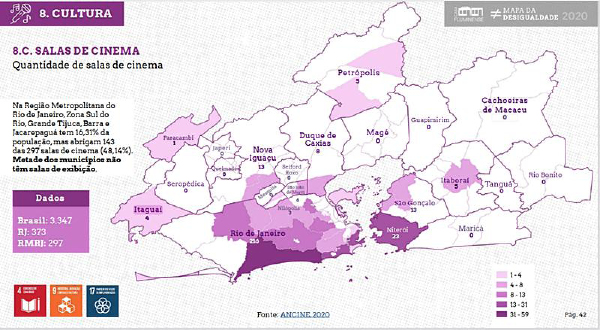
The distribution of movie theaters in the Greater Rio de Janeiro Metropolitan Region has not kept pace with this wave of popularization, as Casa Fluminense’s Inequality Map (2020) reveals. While some municipalities in the Greater Rio have no movie theaters at all, 216 theaters are concentrated within the neighborhoods of the city itself. (Figure 1)
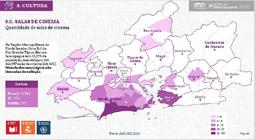
Looking closely at this map, we can see that the 13 municipalities of the Baixada Fluminense region are among the most affected by the unequal distribution of movie theaters. These are Japeri, Queimados, Mesquita, Belford Roxo, Nova Iguaçu, Duque de Caxias, Nilópolis, São João de Meriti, Magé, Itaguaí, Seropédica, Paracambi and Guapimirim. According to the Audiovisual Statistical Yearbook (Ancine 2023), Belford Roxo is the largest city in Brazil without a movie theater.
This reality contrasts with the region’s very active audiovisual production and distribution scene, echoing the cultural activities of previous generations (Freire 2016: 28). The historic TV Maxambomba and TV Olho stations have been encouraging residents to produce videos about their stories and airing these in public squares in the Baixada Fluminense region since the 1980s.
This history has made the Baixada Fluminense fertile ground for the emergence of several new audiovisual collectives at the dawn of the 21st century. This took place amidst a context of cultural effervescence, as revealed by the Mapping of Creative Groups in the Baixada Fluminense (Brasil Próximo 2015), which identified more than 300 collectives in the region as born or expanded in the first decade of the 2000s. These encompass many diverse artistic approaches.6
The Baixada Fluminense is fundamental in reflecting upon Rio de Janeiro’s periphery. Of the 22 municipalities in the greater metropolitan region, 13 are located in the Baixada. Frequently described as peripheral, these municipalities total approximately 3.5 million inhabitants (IBGE 2024), of whom 69% identify as Black or mixed-race. It is a territory of enormous heterogeneity, marked by complex dynamics of inequality.7
For decades, the Baixada Fluminense region has been denigrated in public debates (Freire 2016). For this reason, it is not only a geographic entity, but also a “mega moral region,” in the words of Jussara Freire (2016: 121). As Freire points out, the Baixada is saddled with a regional designation that - at least in Rio de Janeiro - evokes strong emotions of fear, shock, pity, and compassion.
Although these perceptions remain quite vivid and present today, other ways of looking at the Baixada Fluminense have gained in strength over the last two decades. Often taken as synonymous of “periphery” and seen as a “problem”, the Baixada has also come to be understood as a “solution” (Menezes 2021). Today, it is often cast as a space of creative potential, new repertoires, and as an accumulation of certain ways of experiencing and representing the city. Audiovisual media has played an important role in this process and an expression of this can be found in the Baixada Filma movement.
Founded in 2018, Baixada Filma emerged with the aim of organizing mobilizations to demand public culture and audiovisual production policies. The movement brought together “more than 150 filmmakers and 45 collectives/production companies from the region,” as reported on its Instagram in July 2023 (Baixada Filma 2023). This network functions as a facilitator of contacts and an information exchange network for its members, publicizing professional opportunities, public announcements, debates and funding opportunities.
Driven by dissatisfaction with what commercial networks generally offer, the groups that make up Baixada Filma propose free ways of exhibiting and appreciating cinema through events that blend different languages and artistic interventions (theater, poetry, and music among others). The group thus circulates works that would be restricted to small specific screenings and festivals without this type of mediation (Butruce 2003).
Film clubs play an important role in this process. While traditional cinemas theoretically offer a solitary and silent immersion experience, film clubs aim to make cinema a reason for interaction. This is encouraged by the venues where screenings are held: bars, cultural centers, public squares, or screening rooms transformed into spaces for discussion. This dynamic involves not only the screening of films, but also conversations about what has been watched. It therefore encourages direct contact with other people. For this reason, different artistic expressions are welcome in these spaces.
Screenings focus on Brazilian films in general, and specifically on short films by members or partners of the Baixada Filma movement. Most of these productions address issues such as racism, gender, and territoriality, inviting us to reflect on the positions of individuals in society and the complexity of their “identities”. The films eschew essentialist perspectives, seeking to understand how identities are socially constructed and constantly (re)negotiated (Woodward 2014).
During my doctoral research, I conducted an ethnography of the film clubs and collectives that make up Baixada Filma to understand how the category of “periphery” appeared in their productions and discourses. As a resident of Baixada, I noticed that the concept of periphery wove together certain identifications among people who saw themselves as part of a whole, even though they originated in many different municipalities. These people also tended to see themselves as belonging to the periphery. They referred with pride to their place of origin, often claiming that “the Baixada is my country!” This proclamation suggests the existence of a space with its own rules and symbols, shared among “equals” not as stable and natural elements, but as an “imagined community” (Anderson 2008).
My research focused on cases from four municipalities in the Baixada Fluminense: Nova Iguaçu, Duque de Caxias, Belford Roxo, and São João de Meriti. The groups I studied were Mate com Angu (founded in 2002, in Caxias), Buraco do Getúlio (founded in 2006, in Nova Iguaçu), Donana (founded in 2009, in Belford Roxo), Xuxu ComXis (founded in 2012, in Nova Iguaçu), Cinema de Guerrilha (founded in 2014, in São João de Meriti), Baixada Cine (founded in 2016, in Belford Roxo), and Sessão Damana (founded in 2019, in Belford Roxo). What all these collectives have in common is the fact that they operate in three areas of audiovisual production: exhibition, training and production. This means that they exist as film clubs, but also as spaces for film training and production. In addition to showing films, they conduct courses and workshops, encouraging the creation of new original productions by residents of Baixada and other peripheral areas.
These groups are not static, nor do they exist in isolation. They constitute a circuit: a “non-contiguous spatial configuration produced by the trajectories of social actors in the exercise of some of their practices over a given period of time” (Magnani 2014: 9).8 What makes a circuit live is movement through space during the exercise of certain activities that connect groups and individuals through common interests. There is a shared public agenda in which members are not limited to their municipalities and collectives of origin. Members move between various spaces, frequenting other film clubs and watching each other’s films. It was this circuit that I followed during my ethnographic research.
A circuit is not something that is given: it is constructed. And it is not built solely by the social actors who are part of it. Observers also circumscribe any given circuit by naming it as an object of analysis. To undertake such a task, one must analytically connect spatially discontinuous and distant points in the urban fabric while understanding these as constitutive of a whole. My fieldwork was therefore not limited to the Baixada Fluminense. I also followed events in regions that, in Rio de Janeiro, symbolically contrast with the idea of periphery, specifically the city’s center and the south zone - the latter region being heavily associated with cosmopolitanism, modernity and sophistication (O’Donnell 2013). Stepping outside of the Baixada was necessary in order for me to reflect upon the city from a relational perspective, considering that the members of the circuit I was studying also exhibited their films and circulated through events in these richer, more central regions.
My research was conducted between 2018 and 2024, using participant observation, film and documentary analysis, and interviews. This work involved participation in film club sessions and film festivals, as well as the monitoring of shoots, the meetings of the groups being studied and audiovisual workshops. Some of these activities were adapted to an online context during the pandemic and were thus digitally observed for a time. Let’s look at the meanings of periphery that emerged from this set of observations.
CINEMA FROM THE PERIPHERY
“The fact that a butcher is also a poet and musician, or that a young person from the periphery is a samba composer, doesn’t cause much surprise - that they decide to make films… that is a more recent phenomenon.” It is with this observation that Liliane Leroux (2017: 4) reflects on the historical difficulties and current possibilities for the entry of the less privileged social classes into the artistic field through audiovisual language. She reminds us that:
Brazilian cinema, especially, has always been marked by strong elitism. Access to the means of film production required a considerable amount of money. Initially, it was necessary to study in a handful of expensive training courses, mostly abroad. Film production, in turn, depended on a large and costly structure and a well-established network of acquaintances, friends, or “godfathers” who provided access to funding. There are very few accounts of directors who reached the public without mobilizing vast resources of their own or who originated in a wealthy social circle (of which, in most cases, they were already a member of through birth). Popular access on a visible scale to the skills and aspirations related to filmmaking is now emerging at the turn of the 21st century with the incorporation of cheaper and simpler audiovisual technologies into the daily lives of an increasing number of people, including those with low incomes. The extent of this access is evident not only in the sheer number of videos of all kinds proliferating on social media, incorporating images as a common form of communication, but also in the growing production and circulation of films made with cinematic intent outside of specialized and institutional frameworks. By facilitating access to films - from great classics to home videos - and enabling the discussion of them on broad networks, the new technological landscape has inaugurated a self-taught movement of cinematographic vision and technique from which emerges a new generation of audiovisual producers from less privileged social classes and places far from major cultural centers. (Leroux 2017: 4)
The issues described by Leroux point to the construction of a new social actor: a “new generation of audiovisual producers from less privileged social classes and places far from the major cultural centers”. These actors are commonly grouped under the umbrella of so-called “periphery cinema,” an expression that provokes controversy, as described by sociologist Livia de Tommasi:
What caught my attention was the statement by a young filmmaker, Diego Bion, trained in NGO courses, who vehemently stated during a debate: “I don’t make films to be shown at festivals in the periphery. I make films, not films of the periphery.” Evidently, identity affirmation can become a label that limits the possibilities for experimentation, both in aesthetic terms and in terms of content. (De Tommasi 2013: 27)
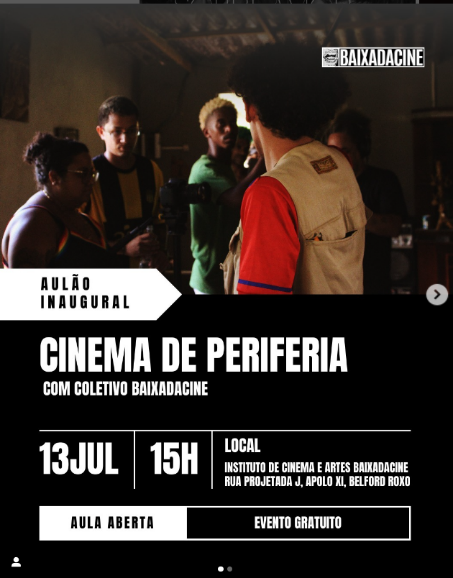
The young filmmaker described by De Tommasi is one of the founders of Buraco do Getúlio, a film club in Nova Iguaçu that is part of Baixada Filma. This questioning of the term periphery cinema “as a label that limits the possibilities of experimentation” is shared by several collectives and individuals who are part of the movement. But there are also those who frequently use the expression to define their work. This is the case of Baixada Cine. Several of its productions and courses are labeled as “periphery cinema”, as shown in Figure 2:
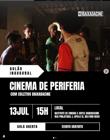
Poster advertising the inaugural “Cinema de Periferia” master’s class. Source: Baixada Cine (2024).
Obviously then, the term “periphery cinema” triggers ambivalent feelings. On the one hand, it is criticized for being a restrictive label, placing productions from the center as universal and those from the periphery as secondary. On the other hand, it has been increasingly incorporated into the vocabulary of various audiovisual collectives.
Discomfort and identification with the expression “periphery cinema” as a category of representation are not mutually exclusive positions. Both can be expressed by the same individual, depending on the situation and the relationships at play. Let’s look, for example, at how Heraldo HB, a member of the Mate com Angu film club, perceives the expression “periphery cinema”:
Around 2005, we started to have a clearer understanding that a somewhat strait-jacketed notion of “periphery cinema” was being created within a given framework. Fundamentally, this is the aesthetics of the `favela movie`, related to the success of NGOs like Nós do Morro, CUFA, and Observatório de Favelas. There was the issue of the success of certain audiovisual productions and there was a certain pressure to conform. The point is that the periphery is much broader than that. Favela movies, then, were a cruel thing, because the Baixada Fluminense (a low-income area in Rio de Janeiro [that is not necessarily a favela]) was also excluded from this field. And then there was pressure from people coming in and saying, “Hey, you mobilize a lot of people, but you don’t politicize them.” (...) That’s one way. There are many ways. (excerpt from an interview given to the author)
HB explains how the “Baixada problem,” often taken as a synonym for the periphery in general, is different from the “favela problem,” implying distinct visibilities regarding the two themes (Freire 2016). We see that a “straight-jacketed” notion of periphery cinema had been subordinated to what is expected from favela movies and to the success of productions of this type carried out by NGOs such as Nós do Morro, CUFA and Observatório de Favelas.
This restricted notion of periphery cinema was furthermore linked to a demand for politicization, as HB says at the end of his quote. In practice, this means the expectation (based on the logic of the instrumentalization of culture) that collectives in the peripheries should be spaces for “transformation,” “militancy,” or “social projects”. Such a conceptualization can even be extended to the logic of “combating crime”. After all, as observed by Livia De Tommasi (2013: 23), “the possibilities of funding expand for those who embrace the discourse of the ‘social’ and the idea that it is possible to ‘escape marginality’ through culture by promoting ‘social inclusion.’”
This perspective, often implicit in funding guidelines, tends to restrict thematic and stylistic possibilities, limiting so-called periphery cinema to something more functional. Considering this, De Tommasi (2013: 27) asks “Should periphery cinema necessarily be socially engaged and neorealist? Should it only show the periphery and its ‘values,’ while middle-class filmmakers can make experimental films?” The response to this type of expectation is usually laden with irony. Film clubs are advertised as places to “drink beer,” to have fun and let loose, without any pretensions towards converting their audiences. HB’s text published on the Lurdinha.com website touches upon this, referencing the “noble” motives that led to the creation of Mate com Angu:
When we created the Mate Com Angu film club back in 2002, the main theme we always talked about had to do with helping the city of Caxias and the Baixada Fluminense region to reflect on their self-representations. To think about images, to provoke images, to nudge people towards producing images. (In addition, of course, to other quite noble objectives such as watching films and drinking beer together). (HB 2015)
We see that, as HB said in his interview, “the periphery is much broader.” It is necessary, then, to delve into the periphery and think of it as something more than an adjective attached to a particular type of cinema.
The periphery has given a name to a set of subjectivities that involve profound existential understandings of individuals about themselves and their territories, giving rise to a “discovery” of oneself and one’s surroundings, as we shall see below. Even though there are disagreements about and critiques of certain designations, the term periphery and its derivations or synonyms (peripheral, perifa, Baixada) remains attached to the movement. This means that it is entirely possible to oppose the use of the expression “periphery cinema” and, at the same time, to describe oneself as peripheral in various situations, including in order to differentiate oneself from other artists and audiovisual producers “from the center.”
This stance, when taken by members of audiovisual collectives in the Baixada Fluminense region, reflects something broader, as we saw in our introduction. “Periphery” is a word that contemporary cultural movements refuse to relinquish. Its employment contests its own meanings, imbuing the term with other symbolic charges beyond those that led to its uses in promoting stigmatization.
An example of this type of reinterpretation can be found in the film Rádio Perifa (2018), by Baixada Cine. This 7-minute short is set in a radio station with stickers and collages on the wall bearing sayings such as “freedom,” “struggle,” and “audiovisual.” In the background, pop music plays, interspersed with the sounds of changing radio stations. At the center of the scene, a Black woman tells the story of a young man, described as someone born in “peripheral cradles” to a family that reproduces a certain pattern: an absent father (“the invisible man”) and a very hardworking mother who never had a formal job. Throughout the description, certain words are highlighted (streaming, omnipresent) to show that “the periphery also has a dictionary” and “is not synonymous with stupidity,” as stated by the protagonist.
At the end of the film, slides are shown accompanied by rap music, with different definitions of “periphery” ranging from the geological, geographical and even botanical, to the idea of “a place far from the urban center that houses a low-income population” and finally to the concept of a group of “countries that are underdeveloped in relation to the major powers considered to be the center of a global socioeconomic system” (Rádio Perifa 2018). These varied definitions emphasize the polysemic nature of periphery. They share something in common, however: a marginal dimension; the idea that a part of the whole is somehow outside what is considered central. This “outside” is the periphery.
To reflect upon the different meanings of periphery, it is necessary to take a relational look at the discourses and contexts in which the term is used. In this exercise, the periphery overflows beyond its imagined contours, provoking us to think of the city as a whole, with its fissures and interconnections. Like any other idea of place, the periphery is not self-contained: it always exists in relation to something else. As summarized by Sandro, a member of Baixada Cine, “what makes the periphery seem like hell is the expectation that the center will seem like paradise” (Garcia 2021:12). As he said in one of the sessions we attended together: “The center does not exist without the periphery.” We could say that the opposite is also true.
In Rio de Janeiro, the city center and the south zone act as contrasting poles and therefore help constitute the meanings of periphery. A text by Sandro demonstrates this. He begins by describing perceptions about the center of Rio and then goes on to talk about his relationship with Belford Roxo, a municipality in the Baixada Fluminense where he was born:
When I first discovered the city center, I had things in mind that I didn’t dare say aloud. Like, “Wow, the buildings are so big here!” or even, “Wow, there are so many artists here!” People singing in the streets, performances, theaters, cinemas, museums, libraries. That was another thing that took me a while to grasp. In the city center, being an artist is a reality. A possibility. A desire. And here’s a parenthesis: desire is very much linked to possibility. How can a young person want to be an astronaut if their city doesn’t have a sky with a moon? Space motivates you, awakens that feeling. It’s real. There’s a cinema there where you can show a film you make. Maybe someone you know has already shown one. So yes, maybe if Belford Roxo had that perspective, I would have considered the possibility. The plot twist is that I went to the cinema in Belford Roxo as a child. My older brother took me a few times. He stopped taking me before I turned 10. After I turned 18, I realized the movie theater had closed. Why didn’t I miss it? Simple. I had started going to movie theaters downtown. Far away. Very far away. (Garcia 2021: 10)
This excerpt is part of a publication entitled “Cinema de Pedreiro: uma linha tênue entre amar a sétima arte e viver na maior cidade em número de habitantes do Brasil sem sala de cinema, onde o litrão custa 7 reais” (“Bricklayer Cinema: A thin line between loving the seventh art and living in the largest city in Brazil by population without a movie theater, where a liter of beer costs 7 reais”.) This is a 5-page long text written by Sandro for the first edition of an audiovisual education magazine entitled Trajeto Errático (“Erratic Trajectory”), produced by the Cidadania por Imagem collective.9 Sandro shares things he learned from his experiences. He describes his relationship with the city during childhood and adolescence. The city center was enchanting, a place of multiple possibilities. Belford Roxo, on the other hand, was the place without a movie theater, forcing people to go far away for their entertainment. The way Sandro viewed these spaces changed when he “discovered” his place of origin:
The thing I took a while to understand was where I came from. Today, I completely understand my brothers and feel they were way ahead of me when they drank at home with their friends. Their bathrooms were clean, an [a Bohemian neighborhood in the center of Rio]. The warm beer, the reek of urine on the sidewalks and the exorbitant prices of everything confused my perception. That’s the only plausible explanation I have for it. But jokes aside, after discovering Belford Roxo, I didn’t want to know about any other place. Or rather, I discovered that I didn’t need to go anywhere. Belford Roxo offered me a unique perspective. Whether it’s the demand for audiovisual work, the geographical particularity that allows for very specific perspectives in our productions, the sense of belonging, the possibility of making a film with a neighbor, the liter of Brahma beer sold at 3 for R$20, the heartwarming bus stops, or even more banal reasons…, these are treasons that carry much more weight for me than believing that “it’s better downtown,” as I used to think. I feel there’s societal pressure that makes us seek out large urban centers, and then, for very banal reasons, like a beautiful view, we end up believing that it’s worth paying R$15 for a small bottle of beer in Lapa, compared to paying R$7 for a liter in Belford Roxo. Or paying R$2000 for a technical course with the goal of making a film, but not trying to do it independently at all, as if both possibilities were somehow implausible. It’s either one extreme or the other. Either you have a diploma or you’re nobody. It doesn’t matter what you want, what matters is... how society views what is right. I find it particularly sad, especially because, for my part, I just want to make films and have an affordable beer. Belford Roxo gave me that. (Garcia 2021: 12)
Sandro underwent a metamorphosis (Velho 1994) by building new relationships with Belford Roxo mediated by the audiovisual and artistic circuits through which he inserted himself and which grew into a web of relationships and sociabilities that broadened his field of possibilities (Velho 1994). This process cultivated in Sandro a feeling of belonging. Desiring and frequenting the center is now seen as a “social pressure,” the result of “banal” motivations such as the search for beautiful landscapes, as well as being synonymous with uncomfortable sensations, such as warm beer and “the reek of urine.”
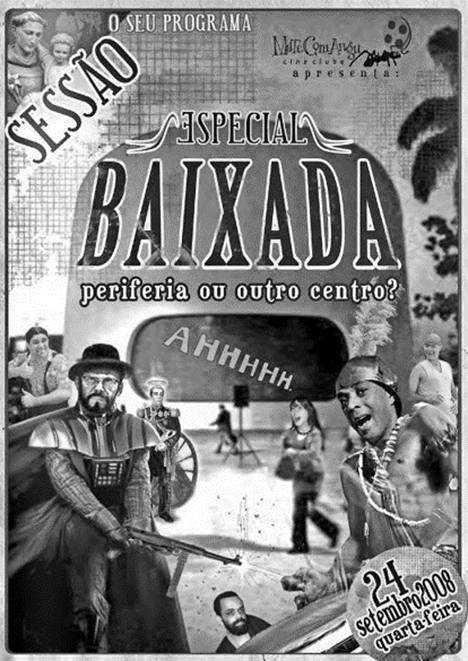
Seeking the center is also understood here as outdated. After all, Sandro’s brothers, who drank at home with their friends, “in their clean bathrooms,” “were far ahead” of him, who paid dearly to drink in Lapa (in downtown Rio). In other words, “this idea of leaving here to go there in search of culture is over,” “the greatest occupation we can conduct is to de-occupy,” “the de-occupation of the center is the greatest occupation we have,” Sandro told me in a film club session. There is a reversal of signs here: what was negative becomes positive and vice versa. This shifts from an idealized center to an idealized periphery, based on a “territorial identity, claimed and positivized” (De Tommasi 2013: 19). This process of positivizing the periphery is inseparable from a “relativization of the idea of the center” (Aderaldo 2017: 248). This is what prompts us to think about Mate com Angu in a poster advertising one of its sessions (figure 3).

The poster for Mate com Angu, taken together with Sandro’s account, stimulates reflection on the construction of other centralities. This is what we see in the provocation “periphery or another center?” The question allows us to think of the Baixada as a center in itself: a place of reference for filmmakers and the audience of film clubs and something beyond the center of Rio. This relativization of the center is also constitutive of Sandro’s perspective. Upon discovering Belford Roxo, he discovered that he didn’t need to go anywhere beyond his own neighborhood, because it was there he found a “unique perspective” that allowed him to “make films and have a beer at an affordable price”.
Beer emerges not only at this concluding moment, but as a guiding thread throughout the entire narrative, beginning with the piece’s title and the drunkenness that confused Sandro’s perceptions in Lapa (where beer is more expensive) all the way to the cheap liter of beer near home. Beer symbolizes the choice for fun and creative production in one territory and not another. It is also a representative metaphor for a refusal to instrumentalize art and culture as elements for social management (Yúdice 2002), a logic which the “periphery cinema” collectives generally must deal with and even confront, as we have discussed above.
Sandro conceives of his relationship with the periphery as a “geographical particularity that allows for very personal visions in our productions”. This idea can lead to formulations such as “only those from Baixada (or the periphery) can make a film like this,” which I heard several times while in the field. Being from the periphery opens up possibilities for differentiated perceptions that are unattainable for those who are not from there. They also become a way to compete for places in the market and in public policies, as De Tommasi explains:
It is through the activation of identity that this dispute operates. Inclusion (in and by the art market) occurs through the expression of otherness, both territorial and political. That is, peripheral artists make their peripheral location a marketable added value. This in turn, was politically available to add value to peripheral productions, both from the point of view of the search (always present in the art market) for innovation and from the point of view of the discovery-affirmation, entirely political, of the periphery’s “good” side. (De Tommasi 2013: 28)
Even though Belford Roxo is Sandro’s main focus, he needs to travel to promote his work. With his partners from Baixada Cine, he has participated in several festivals, exhibitions, and cultural activities, both in and outside of Rio de Janeiro. He is a prominent figure in the Baixada Fluminense audiovisual circuit, participating in screenings not only in Belford Roxo but also in other municipalities. I have run into him several times at Mate com Angu screenings, for example.
In July 2024, Sandro was with other members of Baixada Cine at the “Vem pra casa” (“Come Home”) event at Casa França Brasil, in downtown Rio de Janeiro. The event was advertised as free, with popcorn included. In an Instagram post, it was announced that the collective “occupied the house with 4 screenings” (Baixada Cine 2024). “This is how the city center usually appears in the discourses I analyzed: a place to “occupy,” “invade,” to go to and return from. The Baixada, on the other hand, is what remains and reinvents itself; what takes root. It is where “discoveries” happen, even for those who have lived in the Baixada their entire lives.
The idea of discovering oneself in order to be something one supposedly already was (a resident of a place, someone from a certain origin) is intriguing. It reveals that the mere position of individuals in certain geographical locations is not enough to create a sense of belonging to a particular territory. This process is constructed by and depends on subjective elaborations that are stimulated by contact with cultural collectives.
Being from the Baixada Fluminense is often described as a landmark of self-discovery or an “encounter” with oneself and one’s peers. The following testimony from a member of Buraco do Getúlio collective provides an example of how the relationship with the film club produces an “identity” capable of changing one’s relationship with the city:
[Elaine Rodrigues]: I started to have a relationship with the territory, understanding this territory as something that was part of my identity, towards the end of college, in 2012, 2013. And I think that was fundamental for my formation. Obviously as a citizen, but it also had a very large influence on my professional life. It coincided with the period of the protests [2013] and everything else. I started to participate in the Buraco do Getúlio film club and this ended up really changing my relationship with my identity as a woman from the periphery. It changed my relationship with the city, with the understanding of what it meant to be from Baixada Fluminense; in short, the pains and the joys of being part of this place (...). My thesis ended up being about these cultural initiatives in Baixada Fluminense. (“Praça (...)” 2022)
One’s process of self-discovery as a peripheral person, a resident of one’s territory, and an associate of one’s peers is narrated as something personal, generally involving a “click”, a turning point, specific to each individual’s biography. It’s common for accounts to take on the tone of epiphanies, of events that profoundly transform the subject and their way of perceiving the world. This process is also collective, reflected in the gaze of the other, generating catharsis and the desire to bring more people along on one’s journey to discover it together. It is the periphery that weaves together these earthly and imaginary incursions.
In Sandro’s text that we read earlier, we saw that he mentions discovering Rio, but only at the beginning of his narrative, when the city center was a place of multiple possibilities. This self-discovery seems to relate less to the materiality of places and more to a subjective process of self-investigation from which he has constructed an internal map of references.
Sandro’s perspective on the Baixada Fluminense (and by extension, the periphery) is shared by many people, but not by everyone in the Baixada Filma movement. At a film club session, for example, I’ve heard that “living down there [in central Rio] is better.” Complaints about the limited variety of cultural facilities, leisure areas and parties in the Baixada compared to downtown Rio, where many cultural filmmakers frequently go and eventually live or consider living, are also not uncommon. In any case, Sandro’s situation is representative of the attitudes and life stories that constitute the audiovisual scene of the Baixada, especially among the younger generation.
Among older generations, a certain ambivalence is more common in how they deal with the city and its boundaries. For example, in his book about the Mate com Angu film club, HB (2013) cites several cultural spaces in the city center that were and continue to be references for him, such as the Banco do Brasil Cultural Center, the Museum of Modern Art, and the Odeon cinema. The identification he built with the Baixada Fluminense did not mean, for him, a rejection of the city center, as was the case with Sandro. This does not mean, however, an absence of conflict. HB frequently criticizes the “south zone” lifestyle or “posture” and its “logic”. In the interview he gave me, the south zone is described as follows:
Dude, let me say something that sounds like a stereotype: you go to a film production in the south zone, and people control the number of sandwiches. Our logic is the opposite; for our crew, everything starts with food. In Cascudos (a short film by a member of Mate com Angu), we distributed a ton of sandwiches, even to the hangers-on, friends of whoever was making the film. The logic is different. (Excerpt from an interview given to the author)
We see how the comparison with the southern zone reinforces a quality that is understood as intrinsic to a peripheral context. The production of a “south zone film” is marked by avarice. In Caxias, however, where Cascudos was filmed, there is abundance and sharing. “The logic is different,” collective and inclusive. There is, therefore, a differentiation between “them” from the center and the south zone and “us” from the Baixada and the periphery.
This distinction has been a source of conflict among the members of Mate com Angu. The triggering situation was a bus that transported part of the audience from the center to the film club. Transport was provided by the Caxias Cultural Secretariat, which, for more than a year, brought people from central Rio de Janeiro to film screenings in the Baixada Fluminense region, free of charge. At the end of the films, the audience was taken back to the center, usually in the early morning hours after the post-screening parties. In his book, HB recounts that this bus was the subject of much criticism:
The controversy always arose: why do we go to events in Rio, with all the hassle of getting there, and you provide a convenient bus for the middle class to have fun in Caxias? Why don’t you also provide a bus from Nova Iguaçu and Belford Roxo? We heard that a million times... (...). The thing is, most of us work in Rio, and on session days, Wednesday nights, we often struggle to get to Caxias. Then, there was a celebratory session where several directors were in Rio and confirmed their attendance, along with a band and their instruments and a DJ and their equipment. We scrambled to find a van, and someone raised the issue: why don’t we just get a bus and take our people too? Yes, it made perfect sense. That’s how the bus was born (...). But the bus controversy continued, and finally we decided to discontinue it. Enough of this easy life! Nowadays, each session is a different production and it’s very common for people to charter a van or even meet up at Central Station to go together. (...) This public transportation issue is one of the biggest problems for those who live in the periphery and in Baixada Fluminense it’s cruel, really frustrating. Besides the terrible service, the monopolies, the kickbacks that buy politicians, and other ills, the [transportation] system simply can’t cope. At night, you can’t rely on public transport. In the last decade, van, minibus, and motorcycle taxis services have grown a lot in this service vacuum. After all, transport is also communication and a possibility for inner growth, exchange and broadening horizons. (...) Lately… It’s beautiful to see, in the early hours of the morning after a session in Caxias do Sul, people stopping minibuses and negotiating with the drivers to share rides to Rio, having a great time. However, many people are very bothered by this trans-city profile of Mate. The fact, for example, that many people from the city of Rio go to the event. There are even harsh criticisms [of this]. But we still think it’s cool to have an event that people from other cities feel like going to Caxias to enjoy. More bridges, fewer walls. Flows, friend, flows. (HB 2013: 181-182)
The conflict described by HB reveals hierarchies and distinctions caused by unequal possibilities of movement within the city. In the case of Mate com Angu, we can see how these inequalities affect perceptions about the film club’s audience. As we progress through HB’s description, we notice that the questioning of “the middle-class having fun in Caxias” goes beyond disapproval of an “easily available” bus service. Even with the end of the bus, the criticisms did not cease. Discomfort remained due to “people from Rio de Janeiro going to the event” and the “trans-city” profile of Mate.
In response, HB rejects what he calls “silly parochialism” and proposes more “flows, bridges, fewer walls.” This is an issue that is also disputed by other collectives. The title of a Cinema de Guerrilha program is self-explanatory regarding the collective’s stance on the subject: “Come to the Baixada.”
And what happens when the path is reversed and the issue is the presence of artists from the Baixada Fluminense region at events in the city center and south zone? Certainly, there are different perspectives on this, but Isabella, from the Xuxu ComXis film club, seems to condense the understanding that circulation is necessary for the dissemination of one’s own work:
There was also the issue of us doing things at the school (Nova Iguaçu Film School) and exhibiting them at the Odeon, for example, you know? There was a cultural exchange between the Baixada Fluminense region and the city of Rio, right? Like, there was a festival at the end of 2019, the Escuta Festival, at the Jardim Botânico, at the Instituto Moreira Sales, to kind of show what we’ve done throughout this time of cultural production in the Baixada Fluminense, you know? […] The film club is when we really find our people. But we can’t stay in our bubble. So, it’s the role of the arts to spread feelings. I see that the arts have this power. That’s why I want to go down this path. (Excerpt from an interview given to the author)
Isabela highlights the “cultural exchange between the Baixada Fluminense region and the city of Rio.” Her tone carries the weight of a mission, the “role of the arts in spreading feeling,” the awareness that one cannot remain in a “bubble.” The film club, on the other hand, is like being at home. It’s “when we really meet our people.” The periphery here is a place one intentionally goes to for the realization and enjoyment of activities, moving beyond a space for mere replenishment of the workforce. This idea opposes a notion of the periphery characterized exclusively by deprivations, identified as a cluster of dormitory towns.
A synthesis of this type of problematization can be found in a poster produced by the Baixada website, which states: “We believe in Baixada as a destination, not just as a dormitory town.” The poster was widely disseminated by members of the Baixada audiovisual scene (see figure 4).

Another example can be found in a publication by Baixada Cine (see figure 5), entitled “Dormitory city: Those who live there are the ones who sleep the least”. Whether through work, leisure, or culture, elaborations of this type synthesize the assertion that a vibrant life takes place in the periphery, challenging representations that associate it with a dormant territory constituted by absences. Therefore, it makes so much sense for many “peripheral subjects,” as described by D’Andrea (2020), to incorporate the term periphery as defining not only a certain type of cinema, but a way of being and existing in the city, something in constant discovery and construction. (Figure 5)

A PERIPHERAL FEELING IN ONE’S CHEST
Although the periphery is an “embodied experience” (Aderaldo 2017: 83), it transcends geographical boundaries, going beyond the mere description of physical territories. It can therefore express subjectivities underlying certain stances. Periphery can thus be an imaginary, a perspective, a feeling and even something universal and mythical. These are the kinds of definitions I encountered in the field, as the texts below by members of the Mate com Angu film club describe:
[In the Baixada] there is an atavism and at the same time a dialogue with contemporaneity that goes beyond bloodless theories. It is the peripheral imaginary provoking minds, setting tradition and modernity to samba together, intermixed. Like the crazy, creative and swinging mix present in the work of rapper João Xavi, an international sensation from São João de Meriti. It´s as if there were a specific kind of roguishness born from the experience of rawness and a certain nonsense in facing life in cities from various points of view, not just that of the South Zone of Rio de Janeiro. A certain mediating humanity, perhaps. (Mate com Angu 2008)
[Mate com Angu is] an audiovisual provocation from a peripheral and nonconformist perspective. (HB 2013: 14, emphasis added)
(...) [Mate com Angu emerged from] a desire to shed light on sensitive issues such as sexuality, drugs, micropolitics, and prejudice. It is a perspective of translating into images the peripheral feeling that beats in one’s chest: the capture of a universal and mythical Baixada. (HB 2013: 81-82)
The Baixada is unique, but also universal. From here one can think about the world in all its complexity and leave one’s mark. It is the center of another wheel, of many possible centers, of a periphery that can also laugh at the world. (HB 2013: 228)
These excerpts bring together syntheses for reflection, as they point to clues for understanding the current meanings of periphery. They show us that, as Aderaldo observes in São Paulo (2017: 249), the term periphery has been used to name not only places, but also relationships. This is what allows HB to describe the peripheral imaginary as one that provokes “minds, setting tradition and modernity to samba together, intermixed”, something that is the result of a “specific roguishness, born from the experience with the rawness and a certain nonsense of facing life in cities.”
According to HB, the peripheral feeling is thus forged by experiences and their interpretations: roguishness, raw, nonsense. But it’s not enough to have lived these experiences: one must elaborate on their meanings. One must discover oneself as peripheral, as we have seen above. Collectives and film clubs are spaces that stimulate these elaborations, which are not limited to the Baixada Fluminense or the periphery. What is at stake is the construction of another perspective, another way of looking at cities and oneself. We can see this in the testimony of Luana Pinheiro, one of the founders of the Buraco do Getúlio film club, as she narrates how she became an audiovisual producer:
I learned by doing. I understood my place in the world. I understood myself as a person, as a woman, as someone from the Baixada, as a person from the periphery, I also understood things from my past. And then things start moving inside us. “Man, where did I come from? Who am I?” (Pinheiro 2020)
Luana’s reflections show that understanding oneself as a “peripheral person” is part of a quest to understand one’s “place in the world.” “Making art, in this sense, involves an ontological reflection on what life is” (Campos 2022: 297). The urban environment is therefore not taken as a given: it is the object of constant investigation and (re)creation.
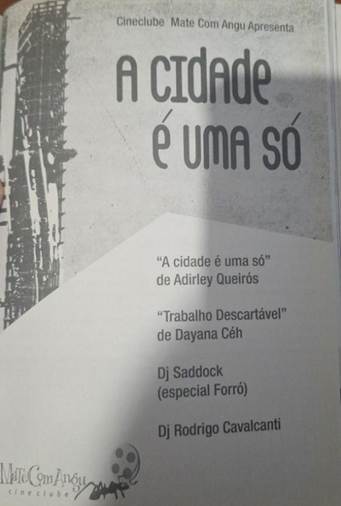
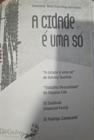
Audiovisual filmmakers from the Baixada have also claimed an integrative perspective that finds its place in the idea of the metropolis, recognizing the periphery as part of a region, of a city that is “one whole” (Figure 6), not as something that can be outside, on the margin. HB, for example, speaks of a “metropolitan city,” an expression also used by Henrique Silveira (2023) in his reflections on “Rio as a whole.”
This integrative perspective is fundamental to understanding the political uses of periphery. This is revealed in an interview with members of the Baixada Cine collective for the É pau, é pedra podcast, in an episode titled “Cinema de pedreiro - das periferias para as telas” (2020). When talking about the collective’s history and its area of activity, one of the interviewees stated: “Although we currently operate in the Baixada Fluminense and that is our focus, we have a very strong connection with the peripheries of the world. The periphery is the future of our world.”
Another example is a comment on Alessandro Buzo’s novel, Suburbano Convicto, which, according to HB (2013: 16), “even though it is set in São Paulo, is nonetheless an excellent portrayal of what it was like to grow up and live in Caxias” during the military dictatorship and of what the “Baixadas da vida” (the lowlands of life) are like. Related to this perspective is another account by HB regarding his participation in the Brésil en Mouvements Festival in France in 2010. HB attended at the invitation of the Autres Brésils institution. He held film workshops with young people from Aubervilliès, described by him as a “neighborhood on the periphery of Paris”. Recalling the experience, HB remarked:
Everywhere we went, it wasn’t just a warm welcome we received after being identified as Brazilians; it was more than that. There was a genuine interest in learning about Brazil, in wanting to know everything good that we were doing on the world stage, what this novelty was all about. Here, we knew that this novelty was nothing more than the beginning of the recognition of the periphery as a protagonist: a small beginning of the people conquering spaces of power. A small opening, still, but one that has already illuminated the world with joy, inventiveness, and inclusion of differences (...). I saw that the periphery of Paris is a melting pot in the best Baixada Fluminense style, only with turbans of the most varied types. (HB 2020)
Peripheries of the world, of Paris and São Paulo, the lowlands of life. How can we explain that such broad, distant, and diverse contexts can be described as part of the same group, named as peripheral, “in the best Baixada Fluminense style”? We are faced with verbalizations of a feeling of belonging to something broader, of that novelty that began to emerge in the early 2000s, according to HB: the “recognition of the periphery as a protagonist,” not only locally but also internationally, with the possibility of establishing connections with similar experiences across the world. But what would allow these connections? The closing narration of the film Rádio Perifa can help us understand:
I want to send a shout-out to all the peripheries of Brazil and the world. To all those who think this is a difficult time and those who have been in a difficult time since the moment they were born. I know. The world isn’t an amusement park, and even if it were, there would be walls around that park and the entrance fee would be too expensive for us. But one thing is certain: no wall will silence our voice. A shout-out to you who are on this side of the wall, to you who were born into this reality. Heaven will have open doors when you leave, because you already know hell. A shout-out, a shout-out to you who smile in this chaos. Smile more, much more! You will smile so loudly that even those on the other side, even those inside the park, will realize that the world is not just an amusement park. Radio Perifa signs off here. Peace. (Rádio Perifa, 2021)
In the words of Rádio Perifa, we see that those on the periphery are those who have been in a difficult reality since birth, who know “chaos” and “hell.” These difficulties materialize territorially, symbolized by walls that make an amusement park inaccessible, limiting its use to those who can pay its expensive entrance fee. The voice that refuses to be silenced and loud laughter are ways to confront the divisions between those who are “there” and those who are “here.” The peripheries of the world are those on “this” side, who share experiences of exclusion similar to those experienced by the people of the Baixada Fluminense. This is the universal and, above all, mythical periphery, made up of stories, representations and imaginaries.
FINAL CONSIDERATIONS
In this article, I sought to reflect on the periphery as a polysemic category. To this end, I took “periphery cinema” as my starting point: an expression criticized and rejected at some times, claimed and appropriated at others. To capture this variation in meanings, it was essential to adopt the perspective of situational analysis (Van Velsen 1987), seeking to understand the uses of periphery in each specific context of interaction.
Periphery cinema, however, is only one of the many possible uses of periphery and its derivations. Therefore, I focused on problematizing the notion of periphery itself, rejecting it as something given and self-evident, going against normative precepts that seek to catalog audiovisual practices and works under the umbrella label of so-called “periphery cinema” (Aderaldo 2017: 26).
From an ethnographic perspective, my interest has been to reflect on the relationships at play in order to consider how the agents I study are “making the city” (Agier 2015) and - in doing so - propose other ways of approaching urban life. Therefore, I did not limit myself to film analysis, but considered films as products around which bonds, disputes, and conflicts are constructed.
The set of discourses I analyzed revealed two poles from which the meanings of periphery are negotiated. Both have a common matrix: the differentiation between peripheral and non-peripheral people in order to affirm the value and legitimacy of the former. One discourse tends to be more restrictive and the other more comprehensive. While one proposes the depopulation of the center, the other suggests flows, bridges, and exchanges. If, on the one hand, there is discomfort with the presence of “middle-class” people in spaces where peripheral people are the protagonists, there is also a bus provided to facilitate the attendance of the middle class at sessions in the periphery, as well as a program that calls out “Come to Baixada!”
It can be argued that the Baixada Fluminense is a microcosm from which it is possible to visualize broader processes that express conflicts often referred to as “identity disputes”. On one hand, there is the prevailing idea that other representations need to be widely disseminated, and that “cultural exchanges” happen following such dissemination. On the other hand, there is a certain resistance to interaction with certain “non-peripheral” audiences and places. These are not necessarily mutually exclusive positions. They can coexist among members of the same group and generally do not appear in isolation. The uses of periphery are usually accompanied by one or more forms of identification, such as “black and peripheral,” “woman from the periphery,” “peripheral queer person.” Place of origin matters, but it is not absolute.
It is not my intention to compare the two perspectives or to suggest any value judgment about them. What is important is to consider how these two poles have been part of the construction of links with the idea of periphery and reflect broader forms of relationship with the category that extend well beyond the Baixada Fluminense. Constitutive of relationships and languages, this periphery is closer to “a political position than to a pure and simple social and identity origin” (Aderaldo 2017: 83). It is this perspective that allows “a very strong connection with the peripheries of the world,” in the words of a member of Baixada Cine.
The notion of periphery is thus adopted as a resource capable of creating symbolic connections with “a variety of mobilizations and cultural events that are currently taking place, including at the transnational level” (Aderaldo 2017:34). Although described as “universal,” this way of understanding the periphery is mediated by localized materialities and references. The Baixada Fluminense is one of these. Described as a way of being and existing in the world that can be discovered, as seen in words analyzed above, the imaginaries surrounding the region are internalized like a lens, a stance, a set of experiences and imaginaries inscribed in bodies and memories.
Discovering oneself as peripheral is, in this sense, a subjective process of self-investigation and investigation of one’s surroundings, from which an inner map is constructed in which certain geographies become an internal landscape. The search to understand one’s “place in the world” is a driving force behind this process.
Not being able to love one’s place of origin or residence is violent: a “reduction of being” (Schinkel 2010). The subject loses an essential point of reference for themselves and their own history. This is why we encounter so many declarations of love for the Baixada Fluminense and the periphery. What the cultural and audiovisual collectives of these territories do is fundamentally restore the possibility of elaborating one’s bonds with one’s own origin.
The audiovisual circuit of the Baixada invites us to consider the periphery as a starting point for observing and experiencing the city, engaging in the exercise of recognizing local dimensions of existence to look further afield. By taking the Baixada as a source for elaborating one’s own subjectivity, it becomes a point of reference for a relationship with the world, a place for the invention of new centers, an allegory, something like a compass. And if Mate com Angu is the backlands, as stated in one of the collective’s films,10 we could rephrase Guimarães Rosa’s classic statement to conclude that the Baixada is within us. The periphery as well.
REFERENCES
- ADERALDO, Guilhermo. 2017. Reinventando a cidade: uma etnografia das lutas simbólicas entre coletivos culturais vídeo-ativistas nas “periferias” de São Paulo São Paulo: Annablume.
- AGIER, Michel. 2015. “Do direito à cidade ao fazer-cidade: o antropólogo, a margem e o centro”. Mana, 21(3): 483-498.
- ANCINE. 2023. Anuário Estatístico do Audiovisual Brasileiro 2023 Rio de Janeiro: Ancine.
- ANDERSON, Benedict. 2008. Comunidades imaginadas: reflexões sobre a origem e a difusão do nacionalismo São Paulo: Companhia das Letras.
-
BAIXADA CINE. 2020. “#abaixadapensa”. Jun 10. Instagram: baixadacine. https://www.instagram.com/p/CBQRUd7pX6v/
» https://www.instagram.com/p/CBQRUd7pX6v/ -
BAIXADA CINE. 2024. “No sábado, 06/07, aconteceu o primeiro cineclube do Projeto #VemPraCasa (...)”. Instagram, July 9. https://www.instagram.com/p/C9NexVLJVF7/?img_index=1
» https://www.instagram.com/p/C9NexVLJVF7/?img_index=1 -
BAIXADA FILMA. 2023. “Nós do Baixada Filma tivemos destaque no jornal Extra!”. Instagram, July 16. https://www.instagram.com/p/CuxTOnUJW2_/?img_index=1
» https://www.instagram.com/p/CuxTOnUJW2_/?img_index=1 - BIRMAN, Patricia. 2013. “Apresentação”. Neiva Vieira da Cunha and Gabriel de Santis Feltran (orgs.), Sobre periferias: novos conflitos no Brasil contemporâneo Rio de Janeiro: Lamparina: Faperj. pp. 7-8.
- BRASIL PRÓXIMO. 2015. Mapeamento dos grupos criativos da Baixada Fluminense: relatório final Rio de Janeiro: Brasil Próximo.
-
BUTRUCE, Débora. 2003. “Cineclubismo no Brasil: esboço de uma história”. Acervo, 16(1): 117-124. https://revista.an.gov.br/index.php/revistaacervo/article/view/140/140 Accessed on July 27th, 2024.
» https://revista.an.gov.br/index.php/revistaacervo/article/view/140/140 - CAMPOS, Marcos Vinicius Lopes. 2022. Sobre o corre da arte: uma etnografia dos futuros vividos e do ganhar a vida na cidade do Rio de Janeiro Doctoral dissertation, Instituto de Estudos Sociais e Políticos, Universidade do Estado do Rio de Janeiro - Rio de Janeiro.
- CARVALHO, Thiago Nogueira. 2022. Cinema é celebração: a cena de exibição de cinema e audiovisual independentes do Rio de Janeiro na virada dos anos 2000 Master’s dissertation, Escola de Comunicação, Universidade Federal do Rio de Janeiro - Rio de Janeiro.
- CASA FLUMINENSE. 2023. Mapa da desigualdade: região metropolitana do Rio de Janeiro: 2023. Rio de Janeiro: Casa Fluminense.
- CASA FLUMINENSE. 2020. Mapa da Desigualdade: região metropolitana do Rio de Janeiro: 2020. Rio de Janeiro: Casa Fluminense .
- CHAUÍ, Marilena. 2006. Cidadania cultural: o direito à cultura São Paulo: Fundação Perseu Abramo.
- D’ANDREA, Tiaraju. 2020. “Contribuições para a definição dos conceitos periferia e sujeitas e sujeitos periféricos”. Novos Estudos CEBRAP, 39(1): 19-36.
- DE TOMMASI, Livia. 2013. “Culturas de periferia: entre o mercado, os dispositivos de gestão e o agir político”. Política & Sociedade, 12(23): 11-34.
- FACINA, Adriana. 2013. “Consumo favela”. In: Aline Dantas, Marisa S. Mello, and Pâmella Passos (orgs.), Política cultural com as periferias: práticas e indagações de uma problemática contemporânea Assis: Gráfica Storbem.
- FREIRE, Jussara. 2016. Problemas públicos e mobilizações coletivas em Nova Iguaçu Rio de Janeiro: Garamond.
- GARCIA, Sandro. 2021. “Cinema de Pedreiro: uma linha tênue entre amar a sétima arte e viver na maior cidade em número de habitantes do Brasil sem sala de cinema, onde o litrão custa 7 reais”. Trajeto Errático, (1): 8-13.
- HB, Heraldo. 2013. O cerol fininho da Baixada: histórias do cineclube Mate com Angu Rio de Janeiro: Aeroplano.
-
HB, Heraldo. 2015. “Um pouco sobre auto-imagem cultural nessa sexta-feira”. Lurdinha.org, May 31. https://lurdinha.org/site/um-pouco-sobre-auto-imagem-nessa-sexta-feira-em-caxias/
» https://lurdinha.org/site/um-pouco-sobre-auto-imagem-nessa-sexta-feira-em-caxias/ -
HB, Heraldo. 2020. “Relato de Heraldo HB sobre um momento onde o Brasil tinha tudo para dá certo”. Cineclube Mate com Angu, Duque de Caxias, 15 jun. Facebook: MateComAngu. https://www.facebook.com/MateComAngu/posts/pfbid0BGCpZjYXDxZFMLD1XDQVp9hxA8FD4rS2GdTPm5xvVrF8hKUpifPc3HavBE7PJgKdl?rdid=23IWPRfHwtIa6o0V
» https://www.facebook.com/MateComAngu/posts/pfbid0BGCpZjYXDxZFMLD1XDQVp9hxA8FD4rS2GdTPm5xvVrF8hKUpifPc3HavBE7PJgKdl?rdid=23IWPRfHwtIa6o0V - IBGE. 2024. Censo demográfico 2022. Composição domiciliar e óbitos informados: resultados do universo Rio de Janeiro: IBGE.
- LAGO, Luciana Corrêa do. 2007. “A ‘periferia’ metropolitana como lugar do trabalho: da cidade-dormitório à cidade plena”. Cadernos IPPUR, 21(2): 9-28.
- LEROUX, Liliane. 2017. “Táticas do Cinema de Guerrilha da Baixada para transitar entre o popular e o artístico”. Polêm!ca, 17(1): 1-23.
- MAGNANI, José Guilherme Cantor. 2014. “O Circuito: proposta de delimitação da categoria”. Ponto Urbe, (15): 1-13.
- MATE COM ANGU. 2012. Mate com Angu: 10 anos Duque de Caxias, RJ
-
MATE COM ANGU. 2008. “Texto da sessão Baixada”. In: Mate com Angu Cineclube. Duque de Caxias, 24 dez. Disponível em: https://matecomangu.org/site/texto-da-sessao-baixada/
» https://matecomangu.org/site/texto-da-sessao-baixada/ - MELO, Renata da Silva. 2024. Cinema, cidade e cerveja: uma etnografia dos circuitos audiovisuais da Baixada Fluminense Doctoral thesis, Instituto de Filosofia e Ciências Sociais, Universidade Federal do Rio de Janeiro - Rio de Janeiro.
- MENEZES, Palloma. 2021. “Da ‘Baixada como problema’ à ‘Baixada como solução’: resenha do livro Problemas públicos e mobilizações coletivas em Nova Iguaçu, de Jussara Freire”. Dilemas: Revista de Estudos de Conflito e Controle Social, 14(2): 587-597.
- O’DONNELL, Julia. 2013. A invenção de Copacabana: culturas urbanas e estilos de vida no Rio de Janeiro (1890-1940) Rio de Janeiro: Zahar.
-
PINHEIRO, Luana. 2020. “Produção é afeto”. Lua vai dizer, June 29. https://open.spotify.com/episode/41FgSVeYM1eKwBF0g5MyL1
» https://open.spotify.com/episode/41FgSVeYM1eKwBF0g5MyL1 - PINHEIRO-MACHADO, Rosana, and SCALCO, Lucia Mury. 2018. “Da esperança ao ódio: juventude, política e pobreza do lulismo ao bolsonarismo”. Cadernos IHU Ideias, 16(278): 3-15.
-
Praça dos Direitos Humanos: um ponto de encontro entre arte e memória 2022. Directed by Mazé Mixo. Nova Iguaçu: Estamira Produtora. https://www.youtube.com/watch?v=k0lusFtmzy0&t=4s
» https://www.youtube.com/watch?v=k0lusFtmzy0&t=4s -
Rádio Perifa 2018. Directed by Sandro Garcia. Belford Roxo: Baixada Cine. https://www.youtube.com/watch?v=Fx2W5pVUPLU
» https://www.youtube.com/watch?v=Fx2W5pVUPLU - SCHINKEL, Willem. 2010. Aspects of Violence: a Critical Theory Basingtoke: Palgrave Macmillan.
- SILVEIRA, Henrique. 2023. Rio por inteiro: reflexões sobre a cidade metropolitana Rio de Janeiro: Periferias.
-
SITE DA BAIXADA. 2023. Baixada Fluminense, 21 fev. Instagram: sitedabaixada. https://www.instagram.com/p/Co8OWKUA7tN/
» https://www.instagram.com/p/Co8OWKUA7tN/ - VAN VELSEN, J. 1987. “A análise situacional e o método de estudo de caso detalhado.” In Bela Feldman-Bianco (org.), A antropologia das sociedades contemporâneas: métodos São Paulo: Global. pp. 345-374.
- VELHO, Gilberto. 1994. Projeto e metamorfose: antropologia das sociedades complexas Rio de Janeiro: Zahar .
- WOODWARD, Kathryn. 2014. “Identidade e diferença: uma introdução teórica e conceitual”. In: Tomaz Tadeu da Silva (org.), Identidade e diferença: a perspectiva dos estudos culturais 14th ed. Petrópolis: Vozes. pp. 7-72.
- YÚDICE, George. 2002. El recurso de la cultura: usos de la cultura en la era global Barcelona: Gedisa.
-
1
At the time the publication was released, Heloisa Teixeira signed her work as Heloisa Buarque de Hollanda.
-
2
This description and the books published by the project can be accessed at: https://www.heloisabuarquedehollanda.com/lorem-iupsum-lirem.
-
3
Aderaldo (2017: 21) explains that the public policy model based on the principle of cultural citizenship “is particularly aimed at young populations, inhabitants of areas with precarious cultural facilities, as well as ethnic minorities. It is characterized by a break with the hegemonic conception of financing the cultural sector, based on a restricted notion of the concept of culture”.
-
4
Phrase uttered at the “Aesthetics of the Periphery” seminar in 2011 and subsequently reproduced in an article by Tiaraju D’Andrea (2020).
-
5
Aderaldo (2017: 21) defines cultural collectives as small, generally informal associations, “formed by bringing together people with certain affinities who organize themselves to carry out simultaneously aesthetic and political interventions in various urban spaces”.
-
6
This mapping effort considered the following areas: dance, music, theater, circus arts, audiovisual arts (film clubs, cinema, video), literature, carnival, traditional popular expressions, and “others.” The audiovisual category included 21 mapped groups.
-
7
This means that there are many internal differences between the municipalities that make up the Baixada Fluminense region. Duque de Caxias, for example, has the 4th largest GDP in the state and the 20th largest in the country. Meanwhile, in Japeri, 9 out of 10 residents live on less than a monthly minimum wage (Casa Fluminense 2023). In general, the Baixada region has a low supply of public cultural and leisure facilities. In 2015, there were only 34 libraries, 3 museums, 11 theaters, and 8 cultural centers in the region’s 13 municipalities (Brasil Próximo 2015).
-
8
The author adds that “it is the routes that trigger this movement, producing configurations within the circuit: they can be broader or more restricted, more enduring or ephemeral - a party, an invasion, the presentation of the Tucandeira or ‘typical’ dances in a school, a skateboarding exhibition, a rap battle…. In this way, routes establish circuits and set certain segments in motion, producing new configurations” (Magnani 2014: 9).
-
9
In its preface, Trajeto errático is presented as a magazine that “is born from the desire to create a space for expression that can be used by any and all audiovisual educators.”
-
10
The phrase is said in the film Fragments of a Loving Cinema (2020), by Mate com Angu.
-
Data Availability Statement
The datasets generated by the survey research conducted during and/or analyzed during the current study are available in the doctoral tesis that gave rise to the article, which can be accessed in the Federal University of Rio de Janeiro repository: https://minerva.ufrj.br/F/5C3EHRYRNU3H6UYVSGRJISMIU4DYKGUXXMT9LGLU5LXFFDF2KA-46065?func=find-b&find_code=WRD&request=Cinema%2C+cidade+e+cerveja&local_base=UFR01
-
Funding Statement
This research was funded by CAPES, which subsidized the author with a scholarship during her doctorate, resulting in the thesis “Cinema, city, and beer: an ethnography of the audiovisual circuits of the Baixada Fluminense” (Melo 2024).
Edited by
-
Dossier Editors
Adriana FacinaPrograma de Pós-graduação em Antropologia Social, Museu Nacional, Universidade Federal do Rio de Janeirohttp://adriana.facina2@gmail.com | https://orcid.org/0000-0001-9381-5134Silvia CapanemaUniversité Sorbonne Paris Nord, pesquisadora de Pléaide/Campus Condorcet, pesquisadora bolsista CNRS CREDA-IHEAL (2024-2025)silvia.capanema@gmail.com | https://orcid.org/0000-0002-1607-2055
The datasets generated by the survey research conducted during and/or analyzed during the current study are available in the doctoral tesis that gave rise to the article, which can be accessed in the Federal University of Rio de Janeiro repository: https://minerva.ufrj.br/F/5C3EHRYRNU3H6UYVSGRJISMIU4DYKGUXXMT9LGLU5LXFFDF2KA-46065?func=find-b&find_code=WRD&request=Cinema%2C+cidade+e+cerveja&local_base=UFR01