
 Letters of extractive capitalism and corporate uses of writing
Abstract:
The present article looks at public letter writing as one of the strategies employed by certain agents of extractive capitalism to reinforce discourses of sustainability and distance themselves from the authoritarian anti-environmentalism of the Brazilian federal government during the Bolsonaro regime (2019-2022). The research behind this article was conducted through a review of the literature surrounding debates evoking the analytical categories of environmentalization, agribusiness/ neo-extractivism, and reputational capital, as well as the social uses of writing. Secondary sources were also consulted, such as the websites of selected companies and economic groups, news clippings, and media outlets. A central source of employed in our analysis, given the specificity of our work, were the letters indirectly addressed through public media to the government of President Jair Bolsonaro. We conclude that these letters seek to legitimize the way in which business agents attempt to organize the world, producing a truth proven by their words. This, in turn, functions as an alarm system, indicating the need to uncover the political, socio-cultural, and territorial implications contained in these letters.
Keywords:
Neo-extractivism; Agribusiness; Environmentalization; Written Expression; Reputational Capital
Resumo:
O presente artigo tem por fim, discutir cartas públicas como uma das estratégias de agentes do capitalismo extrativo em adotar o discurso da sustentabilidade como forma de se distanciar do antiambientalismo autoritário do governo brasileiro 2019-2022. A pesquisa foi realizada através da revisão bibliográfica de debates evocando as categorias de análise ambientalização, agronegócio/neoextrativismo e capital reputacional, assim como sobre os usos sociais da escrita; foram consultadas fontes secundárias como sítios eletrônicos das empresas e grupos econômicos selecionados, clipping de notícias, e meios de comunicação. Uma fonte central de análise, que justifica a especificidade do trabalho, foram as cartas dirigidas indiretamente, por meios públicos de comunicação, ao governo Jair Bolsonaro. Conclui-se que buscam legitimar a forma como os agentes empresariais pretendem organizar o mundo, produzindo uma verdade comprovada por suas palavras, que operam, por sua vez, como um sistema de alerta para a necessidade de desencobrir suas implicações políticas, socioculturais e territoriais.
Palavras-chave:
neoextrativismo; agronegócio; ambientalização; expressão escrita; capital reputacional
INTRODUCTION
In June 2020, a letter signed by 29 financial institutions (managing US$3.7 trillion in assets at the time) warned the government of Brazilian President Jair Bolsonaro that deforestation needed to be curbed in Brazil, at the risk of losing investments in the country. The list of signatories eventually grew to include 32 investors with a total of around US$4.5 trillion in assets (“Investor Statement on Deforestation (...)” 2020). On July 8th of that year, leaders of 38 large Brazilian and foreign companies and four sectoral groups from agribusiness, the financial market, and industry sent a manifesto to the president of the National Council of the Legal Amazon, then Brazilian Vice-President Hamilton Mourão. The letter expressed concern about deforestation. It requested actions and recommended that Brazil transition to a low-carbon economy. Intellectuals, politicians, and various companies increasingly began to express discontent with the government’s environmental policy through widely accessible media outlets. They also began to affirm the sustainable nature of their own practices, seeking to distance themselves from Bolsonaro’s anti-environmentalism. Among these groups were the Investor Initiative for Sustainable Forests, Agropalma, Alcoa, Amaggi, Ambev, Bayer, Bradesco, Brasilagro, Cargill, Cosan, DSM, the Brazilian Business Council for Sustainable Development (CEBDS), and the Brazilian Agribusiness Association (ABAG). (The complete list can be found in Table 1, below.)
Since the early 2000s, so-called market environmentalism has expanded and intensified among large-scale extractive industries. Using mechanisms such as the financialization of nature1, policies and projects based on the notion of decarbonization that respond to international environmental agreements - mainly the climate agreement - have created and expanded mechanisms for carbon credits, forest compensation, and/or green bonds (Bringel and Svampa 2023). The composers of the letters we will analyze below refer to these technological and institutional adjustments as a solution to deforestation and other socio-environmental problems. In the present article, we seek to understand the strategies these corporations (largely linked to large-scale extractive activities, particularly agribusiness) employed in renewing their legitimacy by adopting sustainability discourse, in its various facets, to distance themselves from the explicit anti-environmentalism of the Bolsonaro government. Here, we analyze the corporate uses of writing, looking at the letters through which corporations claimed a public place among the government’s critics at the time. Do these writings merely reorganize previously existing discourses and practices within new analytical frameworks (in this case environmental) or do they effectively construct realities? We seek to understand the meaning of this use of the public epistolary form by business sectors that benefited from policies favorable to large-scale extractive enterprise, but which nevertheless simultaneously sought to portray themselves as critics of government policy. The policies referred to resulted from what we might call “the art of corporate governance” and involved public funding from such bodies as the BNDES and tax exemptions, as well as the relaxation of environmental licensing, the liberalization of the use of pesticides, and bills such as PL 2633/20 (encouraging private appropriation of public lands) and PL6.050/2023 (which proposes the regulation of economic exploitation on indigenous lands, allowing things like extraction of minerals, oil, and natural gas (Furtado 2020).
Historically, different governmental agencies have been involved in pushing the neo-extractive2 development model in Brazil, increasing the privatization and financialization of land and territory, deepening structural inequalities, and intensifying conflicts in the countryside. The establishment of macroeconomic policies based on deregulation, neoliberalization, and financialization, strengthened by an ideological narrative that promotes extraction/exportation as a means of generating economic growth and jobs, has resulted in increased deforestation, fires, intensified rural violence, and the pollution of land, air, and rivers (Girardi 2024; Influencemap 2024). According to the Pastoral Land Commission (CPT, 2023), there were 1935 occurrences of land invasions in Brazil between 2013 and 2022. Of this total, 1185 were registered during the four years of Bolsonaro’s term: some 61.25%. In 2021, Brazil was the world’s second-largest producer of beef and iron ore and the world’s largest producer of soybeans. Agribusiness accounted for 27,4% of the country’s GDP and mining for a further 5% (Furtado 2022). In 2023, at the beginning of Luiz Inácio Lula da Silva’s third presidential term, soybeans, corn and cellulose exports drove Brazil’s trade balance to record levels, with the country accumulating a surplus of US$ 62.4 billion up to August of that year. This represented a 43% increase compared to 2022. Projections indicated that the surplus would reach US$ 90 billion by the end of 2023 - the highest value in history - reinforcing Brazil’s global role as a commodity exporter (Costa and Neto 2023).
Pressure has grown to weaken or eliminate environmental, labor, and indigenous and traditional peoples’ rights in order to sustain the developmental logic of the subordination of Brazil’s economic, financial, and ecological policies to the decision-making centers of global capitalism. The election of Jair Bolsonaro to the Presidency of the Republic in October 2018 transformed this agenda into a government priority. Laws and regulations were reformulated. New measures, such as the militarization and demobilization of environmental enforcement, were adopted to guarantee the advancement of agribusiness and mining. Illegal deforestation and other environmental crimes were not only tolerated but encouraged. Force was increasingly used to solve land and deforestation data was openly manipulated3. The liberal-authoritarian political forces that took over the government in 2022 did not bother to conceal the processes by which they enacted “policies of subsidizing large banks, large industrial companies, and large agricultural operations, [while promoting] an authoritarian dismantling of social policy” (Heller 1933 apud Chamayou 2020: 230). Brazil’s image abroad deteriorated. It was in this context that banks, investment funds, and extractive companies, as well as certain intellectuals and politicians, drafted several public letters, disseminated through the media, in order to improve their reputational capital4 in the face of Bolsonaro’s anti-environmentalism.
How can we assess the meaning of these attempts by segments of the business sector - agribusiness, finance, mining companies, banks and industries - to publicly distance themselves from the anti-environmentalism of the Bolsonaro government? Pompeia (2021) identifies five environmental agendas within agribusiness: denialist claims; conservative positions; volatile demands; “decarbonization”; and socio-environmental positions. Part of this agenda supposedly revealed signs of the existence of an agro-sustainable faction within Brazilian ruralism. That being said, have environmental regulations ceased to be an obstacle to investment for both the so-called “decarbonizing” and “socio-environmental” sectors within ruralism and large-scale extractivism in general? Is this a “new moment” of capitalism, the era of the so-called the New Green Deal, in which environmental legitimacy matters?
Let us consider this.
UBS, the largest bank in Switzerland, presents itself as a group that is building a sustainable future, promoting investments that are said to be environmentally friendly. However, it approved a joint venture with BB Investimentos, a subsidiary of the Banco do Brasil, creating the UBS BB Investment Bank, an institution responsible for raising funds for one of the largest soybean producers in Brazil, the Sheffer Group. The Group has been denounced for deforestation in the state of Mato Grosso, and several of the smaller agribusiness clients of the Bank have also been accused of deforestation (Wenzel and Christe 2021). Among the companies affiliated with the Brazilian Agribusiness Association (ABAG), such as UBS BB Investment Bank, are the meat processor JBS and the grain trader Cargill. Both companies have been accused by various sources of deforestation in the Amazon and of promoting what has been called “cattle laundering”: raising cattle on indigenous lands and transferring them to farms outside of government oversight (Greenpeace 2019, 2022, 2025; Dalabrida and Campos 2022; Dalabrida 2024; Alessi 2024).
The extractive industry has been increasing investments in what they call the decarbonization processes. These include tree plantations, so-called renewable energies, carbon capture and storage technologies, and/or participation in the carbon market. These measures are justified as offsetting emissions while continuing the extraction of “natural resources” (Furtado 2021). The mining company Vale, for example, has committed to investing at least US$2 billion to reducing emissions by 33%. Vale is planning to reduce the company’s carbon emissions by 2030 as part of its commitment to becoming carbon neutral by 2050 and pursuing long term net biodiversity loss. These actions are part of Vale’s legitimizing strategy. The company asserts that it not only offsets the negative impacts of its extraction, exploration, and transportation activities, but also generates net positive impacts (Strautman, Chammas, and Pena 2025). At the same time, Vale has been undergoing an accelerated process of denationalization, privatization, and financialization. A survey of the company’s 100 largest investors in 2023 reveals that a significant portion of its shares are held by large foreign funds such as Capital Group, BlackRock, Vanguard, GQG Partners, Allianz, and the Japanese pension fund GPIF, alongside Brazilian pension funds and financial institutions such as Previ, Caixa, and Itaú. This highlights the company’s growing dependence on global financial markets and the central importance of maximizing shareholder value for its investors, regardless of socio-environmental impacts and reparation commitments (“Top 100 (…)” 2023).
Given the ambiguity of such strategies, situated between the desire for environmental legitimacy and the promotion of predatory land practices, how should we understand the public letters sent by extractive capitalist companies and investment funds to the Bolsonaro government? We know that one of the instruments of struggle frequently used by social movements affected by capitalist extractivism has been the dissemination of letters staking positions, making denunciations and containing demands by the affected social groups. Different organizations, networks, and movements can organize themselves around a common language and a collective identity using this method (Losekann 2016). The messages are aimed at the public sphere and, frequently, at government authorities. The question here is this: in the case under discussion, representatives of powerful agribusiness and extractive capitalist interests drafted letters: to whom were these “sent” and what messages did they contain? How and why did different entities - companies, banks, and funds - link together to construct a common language? What were they demanding? To whom were they sending their message? What is the point when agents of major economic interests appropriate an instrument of social protest such as the public letter at a time when a liberalizing authoritarianism was particularly affecting dispossessed social groups? These questions are part of analyses that understand concepts not only as a way of describing the world, but also of organizing and producing realities. They are abstractions that carry ontological and epistemological affirmations. They describe the world, but also simultaneously construct it. They are not innocent. They reflect the interests of powerful groups and, in doing so, legitimize these interests to reconfigure the world according to said groups’ logics.
The present article discusses these public letters as one of the strategies employed by agents of the Brazilian development model - centering on the expansion of agribusiness, mining, and financial capital5 - in adopting sustainability discourse of as a way of distancing themselves from the authoritarian anti-environmentalism of the 2019-2022 Bolsonaro government. Our research was conducted via a literature review of debates evoking the analytical categories of environmentalization, agribusiness/neo-extractivism, and reputational capital, as well as the social uses of writing. We also consulted secondary sources such as websites of selected companies and economic groups, news clippings6, documents, and reports in the media. Given this work’s focus, a central point of our analysis is the letters indirectly addressed through public media to the Bolsonaro government.
The article begins with us addressing the role of writing and its appropriation by dominant agents in the construction and identification of damages, responsibilities, and a collective identity. Next, we present complaints leveled against some of the signatory companies that problematize the relationship between the constructed identity of sustainable agribusiness and said companies’ actions in the field. We seek here not only to demonstrate the contradiction between what was said and what was done, but also to reflect on the strategy of public letters as a way to guarantee the continuity of modern capitalism through the construction of an environmental nexus that appears sustainable. This strategy legitimizes continuous exploitation of nature, the concealment of the socio-environmental risks and consolidation of corporate interests. We end the article with concluding remarks presenting our findings.
THE ROLE OF THE WRITTEN WORD IN DEFINING COLLECTIVE DAMAGES, RESPONSIBILITIES AND IDENTITIES
Organizations, networks, and social movements connected through a collective identity of victimization by large-scale extractive capitalist projects (Losekann 2016) have developed strategies of resistance, confrontation, and political advocacy. One of these strategies is the drafting of letters making their positions, denunciations, and demands public. These letters have a set target: the general public, government agencies, and/or companies. They mobilize different actors around demands and slogans. Through this instrument of struggle, these collectives seek to break the mass media’s narrative hegemony, which generally pays little attention to the groups’ agendas, often disqualifying and delegitimizing them and presenting them as obstacles to progress and development. Therefore, public letters are a means of shaping and amplifying the discourse of groups mobilized around a given cause (Acselrad 2019a).
Werneck analyzes letters by incarcerated individuals and groups silenced during the 1964-1985 dictatorship in Brazil as instruments of denunciation. They argue that such letters sought to “reconstitute dignity by leaping over walls of silence”. Through letters, “imprisoned men and women developed strategies for freedom… They dared to be and to speak. They dared to write. They sent the letters. They accepted being the bridge to listening.” (Werneck 2018: 9-10)
Another more recent example is the report prepared by the Association of Threatened Peoples, the Tapajós Arapiuns Indigenous Council (CITA), and the Pariri Indigenous Association (2021: 5). This report was based on “indigenous voices” from the Tapajós Basin in the Brazilian Amazon; indigenous people affected and threatened by infrastructure projects (some of which are, ironically, the responsibility of companies that signed the letters we analyze here). This document emphasizes its objective of “functioning as a warning system for companies that may be involved in [said] projects regarding the associated environmental and social risks.”
In the field of “ethnography of documents,” Padovani (2020) analyzes letters written and exchanged between incarcerated wives and husbands. Said letters gave the couples a sense of “documenting” and producing truths, material evidence of something they wanted to prove the existence of their relationship. The letters, therefore, were material proof of words. The author draws on the documentary ethnography work of Ferreira and Lowenkron (2020:84) concerning federal and civil police investigations into international trafficking and the disappearance of people in Rio de Janeiro, noting the importance of “following the papers.” Padovani (2020: 99) notes the legal expression “what is not in the records is not in the world,” used to illustrate how an undocumented police investigation does not exist, translating it into the expression “what is not in letters is in the world, but what is in letters can highlight what is in the world.” The questions that arise in both cases, and which serve us in our analysis of the letters analyzed below are: “Under what terms and in what contexts can letters or records be written about the world? And who can do this?”
In the field closest to the “environmental question,” Acselrad (2019a, 2019b) analyzes the archives of the movement of those affected by the Tucuruí dam in the Amazon region of Pará. They highlight the role of printed material in the process of disseminating knowledge produced in the conflict. In this case, writing appeared as a political act, a popular script that disputed the prevailing narrative surrounding the meanings of the conflict itself. Artieres and Rodak (2008), in turn, analyzed the use of posters as a printed instrument for contesting public visibility, using the expression “graphic resistance” to describe the way in which collectives seek to generate new ways of making conflicts engaging and intelligible to readers.
In all the cases mentioned so far, instruments of contesting public visibility were used by agents lacking economic or political power. However, Stoler (2009) addresses the issue of archives and documents as part of a critique of colonial history, highlighting how archives are not merely neutral repositories of facts or records, but rather sites of knowledge, affect, and power production, traversed by tensions, silences, selections, and omissions. In this sense, we draw upon the work of Ferreira and Lowenkron (2020), who propose a critical reflection on the use of documents as objects of study in anthropology, bringing together research that explores documents’ complexities and methodological challenges in different contexts. These authors highlight the centrality of documents as political and social artifacts that not only record but also produce social realities, acting in the governance of bodies, territories, and relationships, while revealing practices of power, control, and resistance. In this sense, documents are neither neutral, objective, nor transparent; They have their own agency, being tools that produce meanings and social organization, but also constitute social and power relations. It is therefore important to approach them as ethnographic artifacts through a critical and situated reading (Cunha 2004).
Let’s examine the specifics of the use of public letters signed by large-scale extractive business entities during the 2019-2022 liberal-authoritarian government in Brazil.
Felstiner, Abel, and Sarat (1980) distinguish three stages in the publicizing of harm: (a) the moment when harm is identified and constructed as such; (b) the attribution of responsibility for that harm to an actor; and (c) the public dissemination of both the identification of the harm and the responsible party. Based on this framework, the following two sections examine the construction of harm and analyze the imputation of responsibility based on letters from business entities published in media outlets such as the Folha de S. Paulo, Valor Econômico, O Globo, Correio Braziliense, UOL, BBC, El País, Outras Palavras, Ecodebate, and Mídia Ninja, between June 2020 and June 2021.
IDENTIFICATION OF HARM
We can clearly see the use of phrases to describe the construction of harm in the letters above. The signatories refer to financial, social, or reputational risks or to problems regarding access to markets: “the loss of biodiversity and carbon emissions represent a systemic risk to our portfolios”; “the financial impact of deforestation as well as violations of the rights of indigenous peoples, which imply potential consequences for the reputational, operational and regulatory risks of our clients and investee companies”; “increasing difficulties in accessing international markets”; “It is likely that Brazilian sovereign bonds will be considered high-risk if deforestation continues”; “concern about the impact on business of the current negative perception of Brazil’s image abroad in relation to socio-environmental issues in the Amazon”; “potential harm to Brazil, not only from a reputational point of view, but effectively for the development of businesses and projects fundamental to the country”; “The images of our forests burning or falling, circulating around the world, represent significant damage to our external reputation. And this considerably worsens our opportunities in the field of trade and international relations.”
Reputational risk, frequently employed in the letters, reflects the centrality that a company’s reputation has in constructing the market value of its products and services. In management terminology, the greater the reputational capital and the lower the reputational risk, the greater and more sustained the growth and profits of a given company. In other words, a better reputation means higher market value and lower capital expenditures. According to Eccles, Newquist, and Schatz (2007: 1), “in an economy where 70% to 80% of market value comes from intangible assets that are difficult to assess, such as brand value, intellectual capital, and goodwill, organizations are especially vulnerable to anything that harms their reputation.” The authors highlight three factors that determine reputational damage: when a company’s reputation is better than its performance; changes in external beliefs and expectations, which can aggravate or (less probably) reduce this gap; and the quality of internal reputational risk management. In other words, reputational risk management begins with the recognition that reputation is a matter of perception, which involves the beliefs and expectations of stakeholders and the profile of the company’s management, particularly that of their CEO.
In the case analyzed here, expectations surrounding the adoption of environmental policies by companies are understood to be a determining factor in the formation of reputational capital and access to markets. Take, for example, the letter addressed to Arthur Lira (PP-AL), the president of the Chamber of Deputies, signed by 170 business leaders: “It’s 2021, and the financial market and the modern world desire sustainable development, whether through impactful investing, ESG investments, or by respecting compliance policies.” Along the same lines, research conducted by the Brazilian Business Council for Sustainable Development (CEBDS) in 2012 highlighted that the main reason why companies incorporate environmental services into their businesses was the business opportunity (the design of their business case). This was followed by dependence, image improvement, and risk reduction. Worries about climate change itself were the last reason cited. Among the companies that participated in the research,7 at least 7 signed letters publicly addressed to then-President Bolsonaro: Alcoa, Eletrobras, Vale, Braskem, Michelin, Suzano, and Natura (see the figure below).
Main Reasons for Companies to Voluntarily Incorporate Ecosystem Services into their Operations (2012). Source: CEBDS (2012).
The representatives of the extractive sector signing these letters were threatened by the policies of the Bolsonaro government, considered by researchers and the press as explicitly anti-environmental (Furtado 2021; Acselrad 2022b; Santos, Paixão and Barros 2024). This threat was magnified by the corporate discursive strategy of attempting to establish so-called stakeholder capitalism , defined as the success of companies as intrinsically related to their contribution to the development of the whole society. Shareholder capitalism seeks qualified corporate “governance” in three areas: environmental, social and governance - abbreviated to ESG (Lemos 2022). The dissemination of responsible business conduct, as argued by Govier and Alves (2020, online), would thus leverage “deserved reputational capital in order to sell more, avoid fines and interruptions from government authorities, and also to obtain more licenses to operate in the long term”.
In other words, extractive capitalism seeks to “green” itself to maintain the status quo and attract new investments, responding to pressure from consumers and investors in the face of the growing centrality of the environmental and climate agenda. In other words, it engages with the environmental question and as an instrument of legitimation. Since Rio+20 (2012) and, especially, after the Paris Agreement of the United Nations Framework Convention on Climate Change (2015), extractive capitalist enterprises have been appropriating concepts such as “sustainable agriculture” or “climate-smart mining,” as well as mechanisms such as carbon credits and payment for environmental services, while simultaneously legitimizing authorized deforestation. Large companies-such as Cargill, Amaggi, and JBS-are part of this emerging “green market,” capturing national and international resources linked to emissions reduction and low-carbon agriculture, highlighting the strategic importance of the narrative and political disputes surrounding environmental issues (Bassi 2022; Paim and Furtado 2024).
CONSTRUCTION OF (IR)RESPONSIBILITIES
Regarding the determination of “liability for damages,” the letters examined here reveal the signatories clearly distancing themselves from responsibility for the socio-environmental damage caused by neo-extractive projects. On the one hand, they point to pseudo-responsible agents such as “bills” and “provisional measures,” or generically evoke facts like “deforestation,” as if these were all events that were somehow independent of the actions of the signatory companies and funds, both in terms of their territorial practices and lobbying. It is worth remembering that the role of agribusiness and the rural caucus in the weakening of Brazil’s Forest Code in 2012 led to amnesty being granted to deforesters for their actions prior to 2008 (among other things). Other letters directly link environmental damage to the Bolsonaro government. They attempt to treat projects and policies favorable to the expansion of extractive practices as if they were the exclusive responsibility of the administration that began in 2019, without acknowledging that no political action was taken by the signatories to inhibit said policy changes. According to one of the letters: “recent statements by the Minister of the Environment, Ricardo Salles, [uses] the crisis caused by the pandemic to promote environmental deregulation and bills aimed at legalizing the occupation of public lands and forests, opening indigenous territories to mining, and weakening the environmental licensing system.”
The letters also reveal efforts to implicitly respond to criticisms leveled at large extractive projects. The practices of large corporations are thus presented as virtuous, transforming the seemingly critical nature of the texts into a vast repertoire of self-praise: “We are responsible for generating millions of jobs, for a strong share in the trade balance, and for a significant base for public tax collection”; “The modern Brazilian agribusiness has a history of success, recognized worldwide, as a result of the innovation and sustainability that have made us a global agro-environmental power. We are a force for progress, advancement, and indispensable stability, not for avoidable crises”; “We want to continue investing in Brazil and help show that economic development and environmental protection do not need to be mutually exclusive”; “We want to reaffirm our public commitment to the sustainable development agenda”; “We must converge on an agenda that allows us to resume economic activities, address social problems, and simultaneously build a more resilient economy in dealing with climate risks and their implications for Brazil.”
However, there are records indicating that many of the companies that signed these letters have been denounced for involvement in deforestation and conflicts in the Brazilian countryside (CPT 2023). We do not have space to analyze each of the signatories in this regard, but we can mention the studies carried out on the agribusiness sector, heavily represented in the letters we are looking at here.
The analysis carried out by Delgado (2012) on the evolution of Brazilian agriculture highlights the transition from conventional agriculture to an agribusiness-integrated economy. This transformation was not the result of technological innovations or improvements in productivity: it was due to a strategic articulation between financial capital, the State, and the agro-industrial sector. This resulted in the capture of land productivity, consolidating a conservative modernization model that privileges large business groups to the detriment of family farming. In this sense, agribusiness in Brazil is a political and economic construct that reflects hegemonic interests that, over time, have deepened socio-environmental inequalities. The increase in agribusiness production depends on the extensive and intensive use of land, privatization or land grabbing, and the overexploitation of natural resources (with increased deforestation, intensive use of pesticides, and violation of environmental laws) and labor (through, for example, the employment of what is, essentially, slave labor). This development model has led to the expropriation of territories, environmental degradation, increased concentration of land ownership and power, the capture of land productivity, and more precarious working conditions.
Studies on plantations and the plantationcene have revealed how these industrialized monoculture systems not only transform ecosystems and social relations but also exemplify forms of ecological and economic domination that connect deforestation and other environmental crimes with violence and labor exploitation and global environmental crises (Ferdinand 2022; Haraway 2016; Palmeiras 2009; Tsing 2015). Given that plantations have shaped the organization of contemporary agribusiness, with traditional exploitative practices having adapted to social and political transformations, the subordination of workers and the “domestication” of nature have remained the keystones of this economic form. We tend to conceive of these arrangements as the only possible way to practice agriculture, something that the letters analyzed here tend to reinforce.
The linkages between the State and large corporations in the construction of this agribusiness accumulation, this neo-extractive plantation system, has resulted in policies that favor the exploitation of indigenous, quilombola (Afro-Brazilian), and family farming territories. These policies, often supported by legislative reforms, aim to deregulate by making environmental and labor standards more flexible, allowing companies to operate with greater freedom, frequently at the expense of the rights of affected communities. The rhetoric of sustainable development and corporate social responsibility has been used to mask and legitimize practices that deepen inequality and accelerate environmental degradation (De Almeida et al. 2010; Acselrad 2022b).
Regarding the agribusiness sector, we can cite some specific cases. One of the signatories of the letters listed above, the Amaggi Group, is the largest exporter of soybeans in Brazil and also one of the main contributors to deforestation in the Cerrado. Blairo Maggi as a major shareholder in this group. His family owns a veritable economic empire in the agricultural commodities sector. Blairo, former governor of Mato Grosso and Minister of Agriculture in the Temer government, is the 2006 winner of the Golden Chainsaw Award, a trophy awarded by Greenpeace to those who most encourage environmental destruction. Blairo publicly demonstrated support for Bolsonaro during the 2018 presidential campaign (“Blairo Maggi (…)”, 2018). He was responsible for the so-called “Poison Bill” (6299/2002), a bill that proposes new rules for the evaluation, approval, and oversight of the production and marketing of pesticides, fixing the deadline for obtaining pesticide registration in Brazil, in addition to allowing for temporary registration. The bill passed the Chamber of Deputies and is awaiting consideration by the Federal Senate (Brazil 2023a). Blairo has also been held responsible for the fires that broke out in the Pantanal region of Mato Grosso in 2020, which originated on ranches belonging to cattle ranchers who sell livestock to the Amaggi group and the Bom Futuro group, both owned by Eraí Maggi.
The Amaggi Group has also been one of the companies cited in relation to the encroachment of private capital upon the territories of traditional peoples and, in particular, the violation of the rights of the Tapajós people. The Tapajós Bulletin (2019) addresses the construction of large hydroelectric and mining projects in Pará, citing the importance of the Tapajós and Lower Amazon regions for the outflow of grain production from the Central-West region of Brazil. “To accomplish this, companies like Amaggi, Bunge, and Cargill have managed to build large ports on the banks of the Tapajós River, causing various impacts, such as the displacement of dozens of families and an increase in accidents on the BR 163 highway due to the increased transport of cargo by trucks on the road” (Monteiro, Brito, Schramm, and Martins 2019: 4). Cargill is also a signatory to a letter to Bolsonaro.
The Tapajós case is central to our discussion because it reveals the strong links between the companies involved in these ecological and political crimes and the governments of Presidents Bolsonaro and Temer. Companies that signed the letters had projects in the Tapajós region that benefited from the policies adopted by these regimes. The Ferrogrão project, for example, a railway that aims to connect the Port of Mirituba in Pará to the municipality of Sinop in Mato Grosso, involves four multinational trading companies (ADM, Bunge, Cargill and Dreyfus, the ABCD group) and the Brazilian company Amaggi. Proposed during the government of Dilma Rousseff, it was taken up by Michel Temer and became Bolsonaro’s main infrastructure project, representing a strong concession to the demands of the agribusiness sector: “The mission has begun to be fulfilled by the government in 2021, with the opening of the auction for the concession,” declared Bolsonaro (Barrocal 2021: online). This is a project agribusiness considers to be strategic, because it allows for a reduction in transportation costs, principally for corn and soybeans. The railroad is over 900 kilometers long, with an estimated investment of R$12 billion and a concession period of 69 years. Ferrogrão can still potentially obtain the “green seal” by following the parameters of the Climate Bond Initiative (CBI), an international organization that certifies sustainable initiatives (Subtil 2021).
In advancing the Ferrogrão project in connection with agribusiness giants, the Bolsonaro government was denounced for disobeying a preliminary injunction from the Federal Supreme Court (STF). The government had ignored the mandatory prior, open and informed consultation period stipulated by ILO Convention 169 and had also attempted to illegally recruit indigenous support for the project, which is questionable in terms of its economic viability. In December 2016, Temer issued Provisional Measure 758 to remove 862 hectares from the Jamanxim National Park in Pará, an area that houses a stretch of the BR-163 highway, to create a legal right of way for Ferrogrão. On March 15th, 2021, Alexandre de Moraes, a Justice of the STF, approved a preliminary injunction in a lawsuit filed by the PSOL Party in September 2020, arguing that, according to the Constitution, only a public law can alter protected areas, not a Provisional Measure. As a result of this Direct Action of Unconstitutionality (6553), the project ground to a halt (Barrocal 2021).
However, in a post on his Instagram profile on August 21st, 2021, the then Minister of Infrastructure, Tarcísio de Freitas, stated that “the question is not if Ferrogrão will happen: it is when Ferrogrão will happen” (Barros 2021). On September 19th, 2023, because of actions by the Federal Supreme Court (STF), but also due to pressure from civil society organizations, Minister Alexandre de Moraes ordered the suspension of the project for another six months (Brazil 2023b).
Cargill’s operations are also well known in the Tapajós region. They include the construction of a port complex with capacity to ship 5 million tons of grain per year, principally to China and Europe. Cargill has been accused of contributing to the growth of soybean production in Brazil, affecting indigenous, riverside, and quilombola communities. The allegations include fraud in licensing reports; non-compliance with commitments made to environmental agencies; lack of environmental impact studies; and conflict with indigenous, quilombola, and riverside communities - including implementing projects without prior consultation, contrary to ILO standards. Soybean residue is transformed into large clouds of toxic during loading and unloading of the grain shipments. This affects riverside communities that depend on the Tapajós River for their livelihood, as well as families living near the port area (Schramm et al. 2021). Cargill has also been accused of buying soybeans from a farm in São José do Xingu (MT) that deforested around 800 hectares of forest between 2015 and 2023 (Dalabrida and Campos 2022).
Agropalma, another signatory of the letters analyzed here, is the largest palm oil producer in Latin America. For many years now, the company has been denounced for buying palm oil from farmers who kept workers in conditions analogous to slavery. It has also been accused of buying large tracts of land from small farmers at low prices in Pará and violating the autonomy and food sovereignty of these individuals, generating land concentration and what civil society organizations call “the green latifundia”. But Cargill is also currently involved in a forest carbon credit project (Reducing Emissions from Deforestation and Forest Degradation (REDD+)) in partnership with Biofílica, a company specializing in these types of projects. Biofílica has been denounced for generating conflicts with quilombola communities, including armed surveillance and control of quilombola territories (Bessi 2023; Paim and Furtado 2024).
By analyzing these corporate letters, we aim to demonstrate the contradiction between the writings and actions of companies in Brazil, looking at no only what they “say,” but what they do in the social and political world. From this perspective, a question arises: are we merely reorganizing existing discourses and practices into new analytical frameworks, or are we participating in the very construction of realities, considering that documents and discursive practices constitute technologies of government (Foucault 2008)? This question gains weight when we consider Stoler’s (2009) critique of colonial archives as spaces producing epistemological anxieties and the management of life, and also Ferreira and Lowenkron’s proposal (2020) of an ethnography of documents capable of revealing how papers, stamps, and bureaucracies organize regimes of truth. In this light, corporate charters cannot merely be read as formal records of positions: they must also be understood as acts of governance that seek to frame environmental policies, fabricate legitimacy, and displace conflicts. In practice, these same corporations violate rights in the territories where they operate even as they protest in public letters regarding those violations.
By presenting themselves as victims of the harmful effects of government policies, corporations distance themselves from any responsibility for environmentally damaging practices and policies, quickly shifting from criticism directed at third parties to self-praise. The companies that signed the letters produce performative statements that aim to project the emergence of a new actor on the global stage: a sustainable neo-extractivism that feeds the world while it simultaneously saves the planet from climate change (“Agropecuária brasileira ajuda a salvar o planeta (...)” 2021).
FINAL CONSIDERATIONS
Based on an analysis of five public letters written by agents of national and international extractive and financial capitalism between June 2020 and June 2021 protesting Bolsonaro’s anti-environmentalism, we have sought to discuss the corporate uses of this instrument, through which representatives of powerful political and economic sectors have claimed the role of critics of government policies. We observed that the letters were constructed in such a way as to name damages, assign responsibility, and seek support for “solutions” in the form of new institutional frameworks understood as environmentally friendly. Through the open letter format, alongside their efforts to increase their presence at international climate conferences, some of these agents (often themselves denounced as responsible for deforestation and human rights violations) have sought to distance themselves from responsibility for government measures of environmental deregulation and from complacency in the face of the violation of the rights of indigenous and traditional peoples. In the name of their reputational capital, these entities seek to outline the features of a utopian hybrid business model: sustainable, decarbonizing agriculture and mining and financial capital, concerned not only with financial return, but also with feeding the people and saving the planet. Through such letters, political acts are configured resulting from the corporate appropriation of an instrument traditionally used by non-dominant agents. What the corporate agents want to show in this case is not exactly the denunciation of a situation, followed by demands for change (common actions referred to in protest letters written by social groups and movements). Rather, they want to show their lack of responsibility for the disastrous results of policies that were ultimately designed for their benefit. They wish to create an impression of non-commitment to the authoritarian political order that was then entrenching itself in Brazil. The large agribusiness and mining corporations abdicated the use of their considerable capacity to influence government in order to resort to a “loud” public denunciation of government policies that benefited the corporations.
The practices of these agents do not seem to confirm their belief in sustainability as a means of stabilizing the ecological conditions for the reproduction of capitalism. For the “decarbonizing” sectors, environmental regulations continued and continue to be seen as an obstacle to their investments. However, the Bolsonaro government’s anti-environmentalism was too explicit for a world dominated by narratives of a low- or carbon-neutral economy, a situation that could affect the reputational capital of these companies. As we saw in the case of Amaggi, one of the companies responsible for the advancement of soy in Brazil that was also connected to several cases of deforestation and conflicts and was a beneficiary of the deregulation processes, no concrete action was taken by the companies who signed the public letters. None of these seem to have employed their capacity for political and economic influence to try to alter Bolsonaro’s anti-environmental policies. The letters thus emerge as a means of guaranteeing business and market opportunities, as well as reducing companies’ reputational risks. After all, neo-extractive logic requires that new land and territories be incorporated into the financial, economic, and ecological dynamics of global capitalism. In other words, the signatories of the letters had already achieved their goals at the moment their public letters were distributed and disseminated. New frontiers of accumulation had already been opened through the construction of a forest and carbon market.
It is no coincidence that the “Letter from the Brazilian Business Sector on the Ecological Transition Plan - ‘Green Package’ highlights that “global assets classified as ESG are on track to exceed US$53 trillion by 2025, more than a third of the US$140.5 trillion in total assets under management”. Thus, “measures foreseen in the Green Package” aim to contribute to directing a greater flow of international investments backed by ESG to Brazil, as well as fostering this market nationally, given that Brazil is “one of the countries with the greatest potential for selling carbon credits” (CEBDS 2023: 5-6). Its signatories also remind us that “Brazil will host the G20 meeting in Rio de Janeiro in 2024. In 2025, it will host the UN Climate Conference, COP30, in Belém”. The objective of these meetings, in this new logic of green capitalism, is to show “that it is possible to reconcile agricultural production with environmental protection”. Rio+Agro thus aimed to “consolidate Brazil as the world’s leading agro-environmental power” (Miltersteiner 2023).
It is clear that, contrary to this narrative, what we have seen is the continued prioritization of the neo-extractive model, the logic of extraction-export driven by external demands, and the colonial and neocolonial appropriation of the territories of traditional, indigenous, and peasant peoples. This process pushes other possible policies and values out the collective imagination. This has also been the main role of the letters. On the one hand, they seek to create a world where financial capital and neo-extractivism are mediators of possible and desirable ways of life. On the other hand, they produce ignorance and silencing, erasing the voices and experiences of subalternized subjects (Stoler 2009). Corporate letters thus intentionally express dominant interests, seeking to legitimize the way in which business agents intend to organize the world, producing a truth proven by their words. This, in turn, functions as a warning system for the need to uncover the implications of companies’ political, sociocultural and territorial activities by applying a critical perspective of the multiple ways of giving meaning to the environment, territories and ways of life.
In this sense, it is interesting to mention that in the context of Luiz Inácio Lula da Silva’s new government, more specifically in August 2024, letters began to appear in which business leaders requested efforts to protect nature and economic policies which would be driven by the private sector and adapted to the new climate reality (G1 2024). They warned of recent catastrophes, such as the floods in Rio Grande do Sul, as well as the fires which were then breaking out across Brazil. Among the signatories of these letters, we find Roberto Klabin and Horacio Piva of the Klabin Group and Walter Schalka and José Alberto Abreu of Suzano, two companies in the paper and pulp sector; Rubens Ometto of COSAN, involved in agribusiness, fossil fuels, natural gas and logistics; Pedro Passos of Natura; and Pedro Parente of Brazilian Foods - BRF SA, owner of brands such as Sadia and Perdigão; Marcos Molina, from Marfrig and BRF; Guilherme Quintella from EDLP, involved in the Ferrogrão project mentioned above; and Eduardo Bartolomeo from Vale.
Undoubtedly, there are two distinct moments here and two distinct problems. The first occurs during Bolsonaro’s liberal-authoritarian government, with companies attempting to distance themselves from the tragedy of the collapse of democracy. The signatories claimed not to be involved in the coup, implying they had no power over the political sphere. In today’s context, faced with the effects of deregulation, the dismantling of environmental policies, and the expansionist practices of agribusiness and mining, these same actors seek to demonstrate indignation at the phenomena that supposedly harm their businesses, suggesting they did not contribute in any way to their emergence. But what the two processes have in common is the fact that the main corporations of extractive capitalism seek, through these letters, to distance themselves from the problems for which they are responsible and/or from which they benefit, positioning themselves as part of the solution, not the problem. Public letters, therefore, function as an instrument to protect the reputational capital of extractive capitalism, thus guaranteeing the advancement of the accumulation frontier.
REFERENCES
-
ASSOCIAÇÃO BRASILEIRA DO AGRONEGÓCIO (ABAG). 2021. “Agronegócio faz Manigesto pela Democracia”. Abag.com.br, September 8. https://abag.com.br/agronegocio-faz-manifesto-pela-democracia/
» https://abag.com.br/agronegocio-faz-manifesto-pela-democracia/ -
AGRICULTURAL INDUSTRIES CONFEDERATION (AIC) et. al. 2021. “An open letter on the protection of the Amazon”. Retail Soy Group, May 5. https://www.retailsoygroup.org/wp-content/uploads/2021/05/Letter-from-Business-on-Amazon_2021.pdf?utm_source=akna&utm_medium=email&utm_campaign=15072121-ClimaInfo-Newsletter 6.2021.
» https://www.retailsoygroup.org/wp-content/uploads/2021/05/Letter-from-Business-on-Amazon_2021.pdf?utm_source=akna&utm_medium=email&utm_campaign=15072121-ClimaInfo-Newsletter -
AMAGGI. 2023. “Amaggi Regenera”. Amaggi.com.br, June 10. https://www.amaggi.com.br/amaggi_regenera/
» https://www.amaggi.com.br/amaggi_regenera/ - ARTIÈRES, Philippe, and RODAK, Pawet. 2008. “Écriture et soulèvement: Résistances graphiques pendant l’état de guerre en Pologne”. Genèses, 70: 120-139.
-
ASSOCIAÇÃO PARA OS POVOS AMEAÇADOS, CONSELHO INDÍGENA TAPAJÓS ARAPIUNS (CITA), and ASSOCIAÇÃO INDÍGENA PARIRI. 2021. Perspectivas Indígenas sobre Projetos de Infraestrutura Planejados APA: Bern. https://www.gfbv.ch/wp-content/uploads/vozes-do-tapajos_relatorio_portugues.pdf
» https://www.gfbv.ch/wp-content/uploads/vozes-do-tapajos_relatorio_portugues.pdf - ACSELRAD, Henri. 2019a. “Em Brumadinho, Mais uma vez lama, destruição, morte, desamparo e desolação”. Folha de São Paulo, February 3.
- ACSELRAD, Henri. 2019b. “O papel da escrita na construção de causas públicas: uma análise do acervo de documentos produzidos por grupos de atingidos pela Usina Hidrelétrica de Tucuruí Pará”. Revista Brasileira de História, 81(39): 93-116.
- ACSELRAD, Henri. 2022a. Neoextrativsmo - tripla dependência? Notes sent by e-mail.
- ACSELRAD, Henri (org.). 2022b. Neoextrativismo e autoritarismo: afinidades e convergências Rio de Janeiro: Garamond.
-
“Agropecuária brasileira ajuda a salvar o planeta, reconhece a Convenção-Quadro das Nações Unidas sobre Mudança do Clima”. 2021. Forbes, May 6. https://forbes.com.br/forbesagro/2021/05/agropecuaria-brasileira-ajuda-a-salvar-o-planeta-reconhece-a-convencao-quadro-das-nacoes-unidas-sobre-mudanca-do-clima/
» https://forbes.com.br/forbesagro/2021/05/agropecuaria-brasileira-ajuda-a-salvar-o-planeta-reconhece-a-convencao-quadro-das-nacoes-unidas-sobre-mudanca-do-clima/ -
ALESSI, Gil et al. 2024. “Cadeia de Responsabilidades: Desmatamento e violações de direitos humanos e ambientais aparecem em denúncias na cadeia produtiva da Cargill”. Reporter Brasil, n.d. https://reporterbrasil.org.br/biblioteca/boletim-monitor-21-cadeia-de-responsabilidades/
» https://reporterbrasil.org.br/biblioteca/boletim-monitor-21-cadeia-de-responsabilidades/ -
BARROCAL, André. 2021. “Governo ignora STF e tratado internacional em nome da Ferrogrão”. Carta Capital, April 9. https://www.cartacapital.com.br/politica/governo-ignora-stf-e-tratado-internacional-em-nome-da-ferrograo/
» https://www.cartacapital.com.br/politica/governo-ignora-stf-e-tratado-internacional-em-nome-da-ferrograo/ -
BARROS, Rafaella. 2021. “Conflito entre Bolsonaro e STF compromete a Ferrogrão”. Poder360, August 20. https://www.poder360.com.br/governo/conflito-entre-bolsonaro-e-stf-compromete-a-ferrograo/
» https://www.poder360.com.br/governo/conflito-entre-bolsonaro-e-stf-compromete-a-ferrograo/ - BASSI, Bruno Stankevicius. 2022. O agro não é verde: como o agronegócio se articula para parecer sustentável Rio de Janeiro: De Olho nos Ruralistas; Fase.
-
BESSI, Renata. 2023. “Palma e Conservação: aliadas na expulsão de comunidades da Amazônia”. AVISAP Mídia, May 22. https://avispa.org/palma-e-conserva%C3%A7%C3%A3o-aliadas-na-expuls%C3%A3o-de-comunidades-na-amaz%C3%B4nia-brasileira/
» https://avispa.org/palma-e-conserva%C3%A7%C3%A3o-aliadas-na-expuls%C3%A3o-de-comunidades-na-amaz%C3%B4nia-brasileira/ -
“Blairo Maggi, ministro da Agricultura, assume voto em Bolsonaro”. 2018. IstoÉ, January 16. https://istoe.com.br/blairo-maggi-ministro-da-agricultura-assume-voto-em-bolsonaro
» https://istoe.com.br/blairo-maggi-ministro-da-agricultura-assume-voto-em-bolsonaro - BOISTEL, Philippe. 2014. “Reputation: un concept à définir”. Communication et organisation, (46): 211-224.
-
BRAZIL. Câmara Legislativa. 2023a. PL 6299/2002 Brasília: Câmara Legislativa. https://www.camara.leg.br/proposicoesWeb/fichadetramitacao?idProposicao=46249
» https://www.camara.leg.br/proposicoesWeb/fichadetramitacao?idProposicao=46249 -
BRAZIL. 2023b. STF suspende tramitação de ação sobre a Ferrogrão por seis meses Brasília: STF. https://portal.stf.jus.br/noticias/verNoticiaDetalhe.asp?idConteudo=514389&ori=1
» https://portal.stf.jus.br/noticias/verNoticiaDetalhe.asp?idConteudo=514389&ori=1 -
BRINGEL, Breno, and SVAMPA, Maristella. 2023. Do consenso das commodities ao consenso da descarbonização. Editora Elefante, September 4. https://elefanteeditora.com.br/do-consenso-das-commodities-ao-consenso-da-descarbonizacao/
» https://elefanteeditora.com.br/do-consenso-das-commodities-ao-consenso-da-descarbonizacao/ -
CAETANO, Rodrigo. 2020. “38 empresas pedem a Mourão o fim do desmatamento”. Exame, July 7. https://econews.com.br/38-empresas-pedem-a-mourao-o-fim-do-desmatamento/?pdf=8343
» https://econews.com.br/38-empresas-pedem-a-mourao-o-fim-do-desmatamento/?pdf=8343 -
CEBDS. 2012. Biodiversidade e serviços ecossistêmicos: a experiência das empresas brasileiras Rio de Janeiro: CEBDS. https://cebds.org/wp-content/uploads/2023/06/CEBDS_BiodiversidadeEServicos_PT_2012.pdf
» https://cebds.org/wp-content/uploads/2023/06/CEBDS_BiodiversidadeEServicos_PT_2012.pdf -
CEBDS. 2021. Posicionamento: Empresários pelo clima. Rio de Janeiro, CEBDS. https://cebds.org/wp-content/uploads/2023/06/CARTA_Empresarios-Clima_PT-3.pdf
» https://cebds.org/wp-content/uploads/2023/06/CARTA_Empresarios-Clima_PT-3.pdf -
CEBDS. 2023. Carta ao Setor Empresarial Brasileiro sobre o Plano de Transição Ecológica - Pacto Verde Rio de Janeiro: CEBDS . https://cebds.org/wp-content/uploads/2023/06/CARTA_PlanoTransicaoEco_revisada.pdf
» https://cebds.org/wp-content/uploads/2023/06/CARTA_PlanoTransicaoEco_revisada.pdf - CHAMAYOU, Grégoire. 2020. A sociedade ingovernável: uma geologia do liberalismo autoritário São Paulo: Ubu Editora.
-
COMISSÃO PASTORAL DA TERRA. 2023. Conflitos no Campo Brasil 2022 Goiânia: CPT. https://www.cptnacional.org.br/downlods?task=download.send&id=14302&catid=41&m=0
» https://www.cptnacional.org.br/downlods?task=download.send&id=14302&catid=41&m=0 -
COSTA, Vitor da, and NETO, João Sorema. 2023. “Superávit Recorde: saldo da balança comercial pode superar US$ 90 bi, puxado por bens primários”. O Globo, September 18. https://oglobo.globo.com/economia/noticia/2023/09/18/brasil-tera-superavit-recorde-com-salto-nas-exportacoes-do-agronegocio.ghtml
» https://oglobo.globo.com/economia/noticia/2023/09/18/brasil-tera-superavit-recorde-com-salto-nas-exportacoes-do-agronegocio.ghtml -
CUNHA, Olivia Maria Gomes da. 2004. “Tempo Imperfeito: uma etnografia de arquivo”. Mana, 10(2): 287-322. : https://www.scielo.br/j/mana/a/XYzjLRvbTLVNnfsZVMJTYgf/?format=pdf⟨=pt
» https://www.scielo.br/j/mana/a/XYzjLRvbTLVNnfsZVMJTYgf/?format=pdf⟨=pt - DE ALMEIDA, Alfredo Wagner Berno et al. 2010. Capitalismo globalizado e recursos territoriais Rio de Janeiro: Lamparina.
-
DALABRIDA, Poliana. 2024. “Terra arrasada: fogo no Pantanal deixa animais resgatados sem ter para onde ir”. Reporter Brasil, August 10. https://reporterbrasil.org.br/2024/10/fogo-pantanal-deixa-animais-resgatados-sem-ter-para-onde-ir/
» https://reporterbrasil.org.br/2024/10/fogo-pantanal-deixa-animais-resgatados-sem-ter-para-onde-ir/ -
DALABRIDA, Poliana, and CAMPOS, André. 2022. “Cargill compra soja de fazenda que desmatou na Amazônia e descumpre pacto do setor”. Reporter Brasil, January 14. https://reporterbrasil.org.br/2022/01/cargill-compra-soja-de-fazenda-que-desmatou-na-amazonia-e-descumpre-pacto-do-setor/
» https://reporterbrasil.org.br/2022/01/cargill-compra-soja-de-fazenda-que-desmatou-na-amazonia-e-descumpre-pacto-do-setor/ - DELGADO, Guilherme Costa. 2012. Do “capital financeiro na agricultura” à economia do agronegócio: mudanças cíclicas em meio século (1965-2012) Porto Alegre: Editora da UFRGS.
- ECCLES, R. G., NEWQUIST, S. C., and SCHATZ, R. 2007. “Reputation and its risks”. Harvard Business Review, 85(2): 104.
-
“Empresários e Economistas Assinam Pacto pela Natureza”. 2024. G1, August 28. https://g1.globo.com/economia/noticia/2024/08/28/empresarios-e-economistas-assinam-pacto-pela-natureza.ghtml
» https://g1.globo.com/economia/noticia/2024/08/28/empresarios-e-economistas-assinam-pacto-pela-natureza.ghtml - FELSTINER, William L. F., ABEL, Richard L., and SARAT, Austin. 1980. “The Emergence and Transformation of Disputes: Naming, Blaming, Claiming”. Law & Society Review, 3-4(15): 631-654.
- FERDINAND, Malcom. 2022. Uma ecologia decolonial: pensar a partir do mundo caribenho São Paulo: Ubu Editora .
- FERREIRA, Letícia, and LOWENKRON, Laura (org.). 2020. Etnografia de documentos: pesquisas antropológicas entre papéis, carimbos e burocracias Rio de Janeiro: E-Papers.
- FOUCAULT, Michel. 2008. Segurança, território, população Curso dado no Collège de France. Trad. Eduardo Brandão. São Paulo: Martins Fontes.
- FURTADO, Fabrina. 2015. Em nome do clima: instituições e práticas da ambientalização das finanças no Brasil Doctoral Dissertation, IPPUR, UFRJ - Rio de Janeiro.
- FURTADO, Fabrina. 2020. “Antiambientalismo bolsonarista e financeirização da natureza em tempos de pandemia”. In: Elisangela Paim (org), Resistências e Re-existências: mulheres, território e meio ambiente em tempos de pandemia São Paulo: Editora Funilaria. pp. 39-68.
- FURTADO, Fabrina. 2021. Clima S.A: soluções baseadas na natureza e emissões líquidas zero Rio de Janeiro: FASE.
- FURTADO, Fabrina. 2022. “As ‘crises’ e as estratégias de legitimação do neoextrativismo no Brasil”. In: Henri Acselrad, Neoextrativismo e autoritarismo: afinidades e convergências. pp. 71-111.
- GIRARDI, Giovanna. 2024. “‘Agrossuicídio’: desmatamento na Amazônia já afeta plantio duplo de soja e milho”. A Pública, February 9.
- GOVIER, Mathew, and ALVES, Flávio. 2020. “Os impactos de longo prazo da COVID-19 na indústria de mineração no Brasil”. Brasil Mineral, September 9.
-
GREENPEACE. 2019. Greenpeace report reveals fast food suppliers importing deforestation and violence from Brazil Amsterdam: Greenpeace International. https://www.greenpeace.org/international/press-release/27560/greenpeace-report-brazil-agronegocio-estrondo-fast-food-deforestation-violence/
» https://www.greenpeace.org/international/press-release/27560/greenpeace-report-brazil-agronegocio-estrondo-fast-food-deforestation-violence/ -
GREENPEACE. 2022. Investigação exclusiva liderada pelo Greenpeace Brasil apresenta compra de gado em área de desmatamento na Amazônia São Paulo: Greenpeace Brasil. https://www.greenpeace.org/brasil/imprensa/investigacao-exclusiva-liderada-pelo-greenpeace-brasil-apresenta-compra-de-gado-em-area-de-desmatamento-na-amazonia/
» https://www.greenpeace.org/brasil/imprensa/investigacao-exclusiva-liderada-pelo-greenpeace-brasil-apresenta-compra-de-gado-em-area-de-desmatamento-na-amazonia/ -
GREENPEACE. 2025. JBS: cozinhando o planeta São Paulo: Greenpeace Brasil . https://www.greenpeace.org/brasil/publicacoes/jbs-cozinhando-o-planeta/
» https://www.greenpeace.org/brasil/publicacoes/jbs-cozinhando-o-planeta/ - HARAWAY, Donna J . 2016. Staying with the trouble: making kin in the Chtchulucene Durham, NC: Duke University Press.
-
INFLUENCEMAP. 2024. “The Carbon Major Database: Launch Report”. Influencemap.org, April 2024. https://influencemap.org/briefing/The-Carbon-Majors-Database-26913
» https://influencemap.org/briefing/The-Carbon-Majors-Database-26913 - “Investor Statement on Deforestation and Forest Fires in the Amazon”. 2020. Investors, June 23.
-
KAFRUNI, Simone. “Política ambiental: investidores internacionais enviam carta a embaixadas do Brasil”. 2020. Correio Brasiliense, June 23. https://blogs.correiobraziliense.com.br/4elementos/2020/06/23/politica-ambiental-investidores-internacionais-enviam-carta-a-embaixadas-do-brasil/
» https://blogs.correiobraziliense.com.br/4elementos/2020/06/23/politica-ambiental-investidores-internacionais-enviam-carta-a-embaixadas-do-brasil/ - KILL, Jutta. 2014. Economic valuation of nature Bruxelles: Rosa Luxemburg Stiftung.
-
LEMOS, Francine. 27/01/2022. “Capitalismo de stakeholders e o Movimento B”. Exame, January 27. https://exame.com/colunistas/francine-lemos/capitalismo-de-stakeholders-e-o-movimento-b/
» https://exame.com/colunistas/francine-lemos/capitalismo-de-stakeholders-e-o-movimento-b/ - LOHMANN, L. 2012. Financialization, commodification and carbon: The contradictions of neoliberal climate policy. Social Register, Vol. 48. September 24.
- LOSEKANN, Cristiana. 2016 “A política dos afetados pelo extrativismo na América Latina”. Revista Brasileira de Ciência Política, 20: 121-164.
-
MILTERSTEINER, Yuri. 2023. “Rio + Agro vai Debater a União do Agronegócio com a Preservação Ambiental”. Agência Brasil, September 21. https://agenciabrasil.ebc.com.br/radioagencia-nacional/meio-ambiente/audio/2023-09/rioagro-vai-debater-uniao-do-agronegocio-com-preservacao-ambiental
» https://agenciabrasil.ebc.com.br/radioagencia-nacional/meio-ambiente/audio/2023-09/rioagro-vai-debater-uniao-do-agronegocio-com-preservacao-ambiental - MONTEIRO, Aianny, BRITO, Ciro, SCHRAMM, Franciele Petry, and MARTINS, Pedro (orgs.). 2019. Tapajós: informes de uma terra em resistência 2nd ed. Curitiba: Terra de Direitos.
-
NUNES, Mônica. 2021. “Personalidades, empresários e executivos do mercado financeiro enviam carta à Arthur Lira contra retrocessos ambientais”. Conexa Planeta, June 24. https://conexaoplaneta.com.br/blog/personalidades-empresarios-e-executivos-do-mercado-financeiro-enviam-carta-a-arthur-lira-contra-retrocessos-ambientais/
» https://conexaoplaneta.com.br/blog/personalidades-empresarios-e-executivos-do-mercado-financeiro-enviam-carta-a-arthur-lira-contra-retrocessos-ambientais/ - PADOVANI, Natália Corazza. 2020. “Cartas reduzidas a termo: processos de Estado e trâmites do comando na gestão das relações em uma penitenciária feminina da cidade de São Paulo”. In: Letícia Ferreira and Laura Lowenkron (orgs.), Etnografia de documentos: pesquisas antropológicas entre papéis, carimbos e burocracias Rio de Janeiro: Papéis Selvagens. p. 77-106
-
PAIM, Elisangela, and FURTADO, Fabrina. 2024. Em nome do clima: transição energética e financeirização da natureza. Mapeamento crítico São Paulo: Fundação Rosa Luxemburgo. https://rosalux.org.br/wp-content/uploads/2024/03/Em-nome-do-clima-mapeamento-critico.pdf
» https://rosalux.org.br/wp-content/uploads/2024/03/Em-nome-do-clima-mapeamento-critico.pdf - PALMEIRAS, Moacir. 2009. “Plantation no Brasil”. Transcrição de apresentação realizada no Seminário “ Repensando a Plantation: paisagens simbólicas, sociais e materiais ”, com o título “Plantation: transformações de um modelo” Rio de Janeiro: Museu Nacional/UFRJ.
- POMPEIA, Caio. 2021. Formação política do agronegócio São Paulo: Elefante Editora.
- SANTOS, André Luiz Silva, PAIXÃO, Gildemar, and BARROS, Juliana Neves. 2024. Capitalismo Extrativista e Estado de Intimidação Rio de Janeiro: Coletivo de Pesquisa Desigualdade Ambiental, Economia e Política.
-
SCHRAMM, Franciele Petry, ANDRADRE, Marcelo Moraes de, MARTINS, Pedro Sérgio Vieira, and PÈREZ, Sol Elizabeth González. 2021. "Sem licença para destruir: Cargill e violações de direitos humanos no Tapajós". SemLicençaparaaCargill.org.br, June 2021. https://semlicencaparacargill.org.br/assets/estudo-completo-cargill-santarem.pdf
» https://semlicencaparacargill.org.br/assets/estudo-completo-cargill-santarem.pdf -
SHINOHARA, Gabriel. “Em carta ex ministra e ex prisentes do BC cobram desmatamento zero na Amazônia e no Cerrado”. O Globo, July 14. https://oglobo.globo.com/economia/em-carta-ex-ministros-ex-presidentes-do-bc-cobram-desmatame-zero-na-amazonia-no-cerrado-24531601
» https://oglobo.globo.com/economia/em-carta-ex-ministros-ex-presidentes-do-bc-cobram-desmatame-zero-na-amazonia-no-cerrado-24531601 - STRAUTMAN, Gabriel, CHAMMAS, Danielo, and PENA, Thabata. 2025. “Transição energética no Brasil: minerais críticos, conflitos e a construção corporativa da COP 30”. In: CENSAT Agua Viva, OCMAL, OLCA (orgs.), Conflictos y debate minero-energético en tiempos de transición en América Latina y el Caribe Bogotá: Censat Agua Viva. pp. 31-43.
- STOLER, Ann Laura. 2009. Along the archival grain: epistemic anxieties and colonial common sense Princeton, NJ: Princeton University Press.
-
SUBTIL, Mayara. 2021. “Ferrogrão: entenda sobre o projeto de ferrovia que promete impulsionar o escoamento de grãos pelo Norte, mas enfrenta impasse legal”. G1, November 7. https://g1.globo.com/natureza/amazonia/noticia/2021/07/11/ferrograo-entenda-sobre-o-projeto-de-ferrovia-que-promete-impulsionar-o-escoamento-de-graos-pelo-norte-mas-enfrenta-impasse-legal.ghtml
» https://g1.globo.com/natureza/amazonia/noticia/2021/07/11/ferrograo-entenda-sobre-o-projeto-de-ferrovia-que-promete-impulsionar-o-escoamento-de-graos-pelo-norte-mas-enfrenta-impasse-legal.ghtml - “Top 100 2023 Investors in Vale”. 2023. Bloomberg Terminal
- TSING, Anna Lowenhaupt. 2015. “Margens Indomáveis: cogumelos como espécies companheiras”. Ilha, 1(17): 177-201.
-
WENZEL, Fernanda, and CHRISTE, Olivier. 2021. Maior banco suíço volta ao Brasil e coloca em risco compromisso ambiental Uol, May 16. https://www.uol.com.br/ecoa/ultimas-noticias/2021/05/16/maior-banco-suico-volta-ao-brasil-e-coloca-em-risco-compromisso-ambiental.htm?cmpid=copiaecola
» https://www.uol.com.br/ecoa/ultimas-noticias/2021/05/16/maior-banco-suico-volta-ao-brasil-e-coloca-em-risco-compromisso-ambiental.htm?cmpid=copiaecola -
WERNECK, Prefácio. 2018. In: Thula Pires and Felipe Freitas (org.), Vozes do Cárcere: ecos da resistência política Rio de Janeiro: Kitabu. pp. 09-10. https://www.jur.puc-rio.br/wp-content/uploads/2019/02/Vozes_do_carece.pdf
» https://www.jur.puc-rio.br/wp-content/uploads/2019/02/Vozes_do_carece.pdf
-
1
In a simplified way, the financialization of nature can be defined as the transformation of natural processes into commodities inserted into the financial market or, more broadly, as the use of financial language to define aspects of nature. Here, we are concerned with the increasing influence of financial actors, institutions, and thought on society’s perception and approach to nature, as well as the incorporation of so-called environmental justifications into the procedures of financial capital. This process is also analyzed as the environmentalization of financial capital (Furtado 2015; Kill 2014; Lohmann 2012). These concepts seek to place environmental issues within the historical context of the development of capitalism, shifting the focus of the problem from “nature” to the State, corporations, and financial agents. We are interested in understanding the how, why, and effects of this environmentalization of capital.
-
2
We understand neo-extractivism as an accumulation regime and development paradigm based on the subordinate international insertion of national economies on the periphery of global capitalism. This strategy is based on productive specialization in goods that are intensive in natural resources, the ecological subjugation of peripheral societies to global capitalism, and the appropriation of extraordinary rents by large extractive and financial corporations (Acselrad, 2023a).
-
3
A process has been established that incorporates climate and environmental denial, the radical liberalization of extractive agribusiness practices, prejudice, and violent actions against indigenous peoples, quilombola communities, and populations living in poverty. The Bolsonaro government refused to host the Conference of the Parties to the United Nations Framework Convention on Climate Change (UNFCCC), attempted to block climate agreements, and legitimized criminal actions by large landowners, such as the fires in the Amazon and Pantanal wetlands and violence against rural populations. It contested information, scientific evidence, and testimonies contrary to its claims; it exonerated spokespeople for this manipulated data, as in the case of INPE’s deforestation monitoring system; and it even tried to alter the target for reducing deforestation and illegal fires in the country, as foreseen in the government’s Multi-Year Plan (PPA) until 2023.
-
4
Management theorists define “reputation” as an intangible business asset resulting from society’s perception of firms’ commitment to respecting laws and regulations, and more generally, the reliability of corporate practices. In reputation, companies see a means of securing their sales volumes and long-term profits, avoiding losses in the event of incidents that compromise their image. So-called reputational capital thus designates the capacity of large corporations (and capitalism itself) to present themselves as committed to environmental protection and the fight against poverty (Boistel 2014).
-
5
Including other sectors such as oil and gas exploration, hydroelectric power, and other energy projects.
-
6
The clipping collection analyzed here was organized by the Study Group on Social Change, Agribusiness and Public Policies (GEMAP) of the CPDA and included the collaboration of undergraduate research student, Guilherme Vasconcelos.
-
7
The following companies participated in the research: GE, Alcoa, ELETROBRAS, Vale, SHV Gas Brasil, CETREL SA, Petrobras, EBX Holding, Chemtech, Monsanto do Brasil Ltda, Braskem, Plantações Michelin da Bahia Ltda., Suzano Papel e Celulose, Natura Cosméticos, ETH Bioenergia, Votorantim Industrial, Det Norske Veritas, Anglo American, CEMIG, COPEL, Furnas, and Fibria.
-
Data Availability Statement:
All data that supports the findings of this study is used in its entirety in the article.
Edited by
-
Editors
Laura Moutinho (https://orcid.org/0000-0001-6479-2711)Gisele Fonseca Chagas (https://orcid.org/0000-0003-3798-8721)Vinicius Kauê Ferreira (https://orcid.org/0000-0001-9925-3304)Vinícius Venancio (https://orcid.org/0000-0003-3245-1204)
All data that supports the findings of this study is used in its entirety in the article.

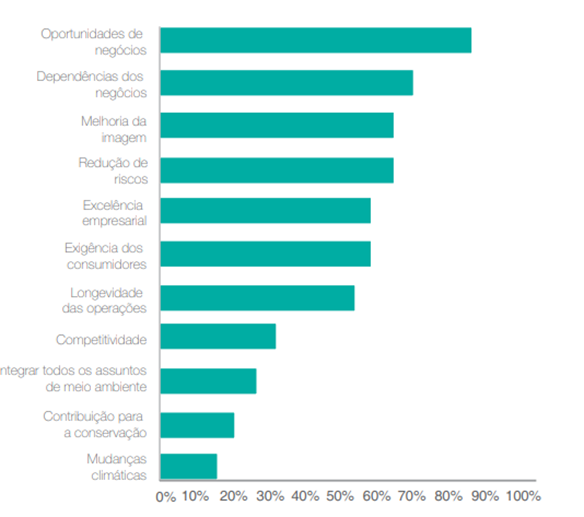 Caption. In order from top to bottom: Business Opportunities; Business Dependency; Imagem Improvement; Risk Reduction; Business Excellence; Consumer Demands; Operational Longevity; Competitiveness; Integration of all environmental issues; Contribution to conservation; Climate change.