| LETTER |
Investor letter - June 22nd, 2020 |
| CONTENT |
We are deeply concerned about Provisional Measure 910 (recently amended to PL 2633/2020), which was submitted for a vote in the Brazilian Congress and which would legalize the occupation of public lands, mainly concentrated in the Amazon. If the measure is approved, it will encourage the illegal occupation of public lands and widespread deforestation, which would jeopardize the survival of the Amazon and the fulfillment of the goals of the Paris Agreement, also harming the rights of indigenous and traditional communities.
Recent statements by Environment Minister Ricardo Salles, using the crisis caused by the pandemic to promote environmental deregulation and bills aimed at legalizing the occupation of public lands and forests, opening indigenous territories to mining, and weakening the environmental licensing system, are just some of the threats we have observed regarding environmental policies and human rights in Brazil.
We are concerned about the financial impact of deforestation as well as violations of the rights of indigenous peoples, which imply potential consequences for the reputational, operational, and regulatory risks of our clients and investee companies.
It is probable that Brazilian sovereign bonds are likely to be considered high-risk if deforestation continues.
We are concerned that companies exposed to potential deforestation in their operations and supply chains in Brazil may face increasing difficulty accessing international markets.
We want to continue investing in Brazil and help show that economic development and environmental protection do not have to be mutually exclusive. Therefore, we urge the Brazilian government to demonstrate a clear commitment to eliminating deforestation and protecting the rights of indigenous peoples.
|
| SIGNATORIES |
1. Storebrand Asset Management; 2. KLP; 3. Gjensidige ; 4. Sparebank 1 Forsikring; 5. MP Pension; 6. Nordea Asset Management; 7. AP Pension; 8. SEB Investment Management; 9. AP2 Second Swedish National Pension Fund; 10. AP4 Fourth Swedish National Pension Fund; 11. Handelsbanken Asset Management; 12. Robeco; 13. ACTIAM; 14. NN Investment Partners; 15. A.S.R.; 16. Church Commissioners for England; 17. LGPS Central; 18. Legal and General Investment Management; 19. Brunel Pension Partnership; 20. Boarder to Coast Pension Partnership; 21. BlueBay Asset Management; 22. Surrey Pension Fund; 23. Northern LGPS; 24. Comgest; 25. Indep’AM; 26. Domini Impact Investment; 27. Pax World Funds; 28. Sumitomo Mitsui Trust Asset Management; 29. Fram Capital;
Most of the signatories are members of the Investor Initiative for Sustainable Forests (Investors’ Initiative for Sustainable Forests)
Source: Kafruni (2020).
|
|
| LETTER |
Letter to Vice-President Mourão - July 7th, 2020 |
| CONTENT |
To reaffirm their public commitment to the sustainable development agenda.
Concern is growing about the impact on business of the current negative perception of Brazil’s image abroad regarding socio-environmental issues in the Amazon. This negative perception has enormous potential to harm Brazil, not only from a reputational standpoint, but also effectively hindering the development of the country’s fundamental businesses and projects.
Proposals:
- Unwavering and comprehensive struggle against illegal deforestation in the Amazon and other Brazilian biomes;
- Social and economic inclusion of local communities to guarantee the preservation of forests;
- Minimization of the environmental impact of natural resource use, seeking efficiency and productivity in resulting economic activities;
- Valuation and preservation of biodiversity as an integral part of business strategies;
- Adoption of carbon credit trading mechanisms;
- Directing financing and investments towards a circular and low-carbon economy, and;
- Incentive packages for economic recovery from the effects of the COVID-19 pandemic, conditioned towards a circular and low-carbon economy.
We need to make the right choices now and start redirecting investments to address and recover the Brazilian economy within a circular, low-carbon, and inclusive economic model, where there is no conflict between production and preservation.
|
| SIGNATORIES |
Agropalma, Alcoa, Amaggi, Ambev, Bayer, Bradesco, Brasilagro , Cargil, Cosan, DSM, Ecolab , Eletrobras, ERM, Grupo Vamos, Iguá, Itaú, Jacto, JSL, Klabin, Marfrig, Maua Capital, Michelin, Microsoft, Movida, Natura, Rabobank, Santander, Schneider Electric, Shell, Siemens, Sitawi , Stefanini, Suzano, Ticket Log, Tozzini Freire Advogados, Vale, Vedacit, WeWork.
Conselho Empresarial Brasileiro de Desenvolvimento Sustentável (CEBDS)
Associação Brasileira do Agronegócio (ABAG)
Associação Brasileira das Indústrias de Óleos Vegetais (ABOVE)
Indústria Brasileira de Árvores
Source: Caetano (2020).
|
|
| LETTER |
Letter to the President of the Chamber of Deputies, Arthur Lira (PP-AL). - June 2021
“Environmental setbacks: a terrible deal for Brazil and for sustainable development”
|
| CONTENT |
It’s 2021, and the financial market and the modern world desire sustainable development, whether through impactful investing, ESG investments, or by respecting compliance policies.
We know that every country carries an image, which also functions as a kind of brand. The images of our forests burning or falling, which circulate around the planet, represent significant damage to our external reputation. This considerably worsens our opportunities in the field of trade and international relations.
Concern [exists] regarding the progress of PLs 984/2019 (which interferes with the National System of Conservation Units, creating the category of roadside park), 2633/2020 (defined as the “Land Grabbing Bill”) and 490/2017 (demarcation of indigenous lands).
These projects inherently represent a step backward in this regard. Aside from creating enormous legal uncertainty, as they contradict final and unappealable court decisions and Article 225 of the Federal Constitution, they could cause irreversible damage to Brazilian companies and their international image.
|
| SIGNATORIES |
170 businesspeople and intellectuals
Examples: José Olympio Pereira, president of Credit Bank. Switzerland in Brazil; Luis Stuhlberger, manager of the Green Fund; Luiz Fernando Furlan, former Minister of Development, Industry and Foreign Trade; and Guilherme Leal, from Natura.
The letter was drafted by the National Network for Protected Areas and the Observatory for Justice and Conservation of Paraná.
Source: Nunes (2021).
|
|
| LETTER |
Letter from former Finance Ministers and former Central Bank Presidents - June 14th, 2020
“A necessary convergence: towards a low-carbon economy”
|
| CONTENT |
We must converge on an agenda that allows us to resume economic activities, address social problems, and simultaneously build a more resilient economy to deal with climate risks and their implications for Brazil.
Achieve a low-carbon economy.
Zero deforestation in the Amazon and Cerrado biomes.
Increase climate resilience.
To promote research and development of new technologies.
|
| SIGNATORIES |
17 former Finance Ministers and former Central Bank Presidents:
Alexandre Antônio Tombini; Armínio Fraga; Eduardo Guardia ; Fernando Henrique Cardoso; Gustavo Krause; Gustavo Loyola; Henrique Meirelles; Ilan Goldfajn; Joaquim Levy; Luiz Carlos Bresser-Pereira; Maílson da Nóbrega; Marcílio Moreira; Nelson Henrique Barbosa Filho; Pedro Malan; Persio Arida; Rubens Ricupero; Zélia Cardoso de Mello
Coordinated by the Instituto Clima e Sociedade (iCS) and the Instituto O Mundo Que Queremos.
Source: Shinohara (2020).
|
|
| LETTER |
Open Letter - Protecting the Amazon - May 5th, 2021 |
| CONTENT |
Our door remains open to working with Brazilian partners in supporting the development of land management and agriculture. As partners, we are willing to enable this in a way that supports economic development while respecting the rights of Indigenous Peoples and communities. These critical objectives must be achieved without jeopardizing the progress Brazil has made so far in protecting the vital ecosystems that are essential to the health of the world in which we all participate. However, if these or other measures that undermine these existing protections become law, we will have no choice but to reconsider our support for and use of Brazilian agricultural commodities in the food chain.
|
| SIGNATORIES |
Agricultural Industries Confederation (AIC) Ahold Delhaize; Albert Heijn; ALDI Einkauf SE & Co. oHG; ALDI SOUTH Group; AP7 (Sjunde AP- fonden); Aquascot Ltd.; Asda Stores Ltd.; BIAZA; The Big Prawn Company; British Retail; Consortium Centraal Bureau Levensmiddelenhandel (CBL); CIV Superunie BA; Congregation of Sisters of St. Agnes; Co-op Switzerland; The Co-operative Group; Cranswick plc; DNB Asset Management AS; Donau Soja; EdenTree Investment Management; Greggs plc; Hilton Food Group I; Celand Foods; Jumbo Supermarket; BV KLP Kapitalforvaltning; AS Legal & General Investment Management Lidl Stiftung; Marks & Spencer; METRO AG; Migros Moy Park; Nando’s National Pig Association; Nevedi - Dutch Feed Industry Association; New England Seafood International (NESI) Nordea Asset Management; Ocado Retail; Öhman Fonder Pilgrim’s UK; ProTerra Foundation; Red Tractor Assurance; Retail Soy Group; J Sainsbury Plc; Skandia; Swedbank Robur Fonder AB; Tesco PLC; Waitrose & Partners; Winterbotham Darby; Wm Morrison Supermarkets; Woolworths Group plc
Source: Agricultural Industries Confederation (AIC) et al. (2021).
|
|
| LETTER |
Letter in defense of democracy in Brazil - July 2021 |
| CONTENT |
Concern about the current challenges to political and institutional harmony and, consequently, to economic and social stability in our country.
We are responsible for generating millions of jobs , for a strong contribution to the trade balance , and as a significant source of public tax revenue.
The 1988 Constitution defined the Democratic Rule of Law within which we chose to live and build the Brazil we dream of.
More than three decades of freedom and pluralism, with alternation of power through legitimate and frequent elections.
For Brazil’s economic and social development to be effective and sustainable , it requires peace and tranquility, indispensable conditions for continuing to advance on the civilizing path of a fraternal and supportive nation that recognizes the majority without ignoring minorities, that welcomes and fosters diversity, that thrives in the respectful confrontation between opposing ideas, without any kind of violence between people or groups. Above all, a society that no longer tolerates the misery and inequality that so shame us.
Brazil is much bigger and better than the image we have projected to the world. This is costing us dearly and will take time to reverse.
Modern Brazilian agribusiness has a history of success recognized worldwide, as a result of innovation and sustainability that have made us a global agro-environmental power . We are a force for progress, advancement, and indispensable stability, not for avoidable crises.
|
| SIGNATORIES |
Brazilian Agribusiness Association (Abag); Brazilian Association of Palm Oil Producers (Abrapalma); Brazilian Association of Vegetable Oil Industries (Abiove); Brazilian Association of Plant Nutrition Technology Industries (Abisolo); CropLife Brazil; Brazilian Tree Industry (Ibá); National Union of the Plant Protection Products Industry (Sindiveg).
Source: Abag (2021)
|
|
| LETTER |
Business Leaders for the Climate |
| CONTENT |
The world urgently needs to move towards a low-carbon economy , and the business sector recognizes its responsibility in this transformation. Brazil has extraordinary comparative advantages in the race to achieve a net-neutral carbon emissions economy by leveraging our natural resources.
Business leaders advocate for strategic planning for sustainable growth and combating climate change. The document notes that the productive sector is working to recover the country from the effects of Covid-19, promoting a green recovery based on the so-called circular economy, low carbon emissions, and inclusion.
Support for the proposal of a regulated carbon market in Brazil.
We have climate ambitions, and our companies are increasingly relying on science-based carbon neutrality targets, using rigorous corporate governance, social, and environmental (ESG) parameters.
|
| SIGNATORIES |
BRF, Bradesco, Alcoa, Cargill, Braskem
Brazilian Agribusiness Association (Abag), Brazilian Aluminum Association (Abal), Brazilian Association of Infrastructure and Basic Industries (Abdib), Brazilian Association and National Union of Machinery and Equipment Industries (Abimaq/ Sindimaq)
Initiative: Brazilian Business Council for Sustainable Development (CEBDS).
Of the 107 companies, 46 are publicly traded and have a combined net revenue of R$ 951 billion. The letter is signed by representatives of companies in the agribusiness, food, aviation, electricity, pharmaceutical, finance, infrastructure, logistics, paper and pulp, petrochemical, healthcare, technology, telecommunications, and retail sectors.
Source: CEBDS (2021).
|

 As cartas do capitalismo extrativo e os usos empresariais da escrita
 Thumbnail
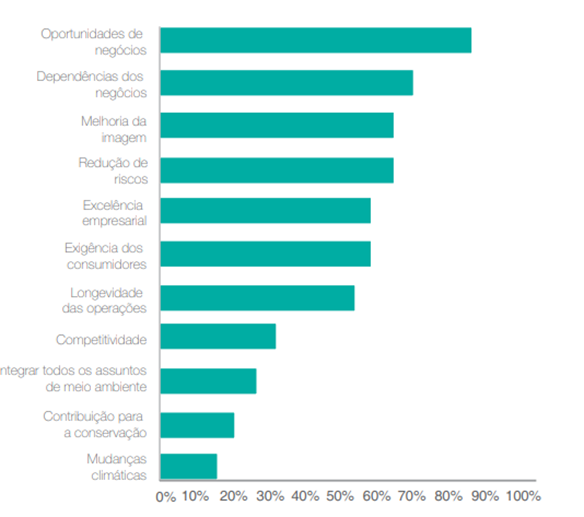 Caption. In order from top to bottom: Business Opportunities; Business Dependency; Imagem Improvement; Risk Reduction; Business Excellence; Consumer Demands; Operational Longevity; Competitiveness; Integration of all environmental issues; Contribution to conservation; Climate change.