From a short flight to eternity: Ephemeroptera (Insecta) in the Taxonomic Catalog of the Brazilian Fauna-an overview
ABSTRACT
Data from the Taxonomic Catalog of the Brazilian Fauna (CTFB), complemented by the website EphemBrazil, provide a comprehensive overview of the diversity and historical development of Ephemeroptera taxonomy in Brazil. Historical analyses reveal three distinct phases: (1) the 19th and early 20th centuries, dominated by European and later North American authors; (2) the second half of the 20th century, marked by increasing contributions from South American researchers; and (3) the 21st century, characterized by the consolidation of Brazilian specialists and a surge in species descriptions. Currently, 472 valid species names, distributed across 10 families and 81 genera, are recorded in the country. Leptophlebiidae and Baetidae are the most species-rich families, with 153 and 151 species respectively, followed by Leptohyphidae (59 spp.) and Polymitarcyidae (56 spp.). Endemism is high, with 280 species (59%) restricted to Brazil. Spatial patterns show a strong geographic bias, with Amazonia and the Atlantic Forest harboring the greatest richness (224 and 245 species, respectively), while the Caatinga, Pantanal, and Pampa remain poorly studied. At the state level, Amazonas (114 spp.), Espírito Santo (112 spp.), and Roraima (96 spp.) show higher recorded richness, reflecting greater sampling effort, whereas several Northeastern states have fewer than five recorded species. This geographic bias reflects the distribution of researchers, availability of resources, and asymmetries in sampling effort. Despite substantial progress, important gaps persist regarding immature stages, molecular data, and undersampled areas. Sustained training of specialists, integrative approaches, and expanded surveys are essential to refine taxonomy and strengthen the role of mayflies as bioindicators in freshwater conservation and monitoring across Brazil.
KEYWORDS:
Aquatic insect; biodiversity; Brazilian Zoology Group; database; Mayflies; Neotropics
INTRODUCTION
Ephemeroptera, commonly known as mayflies, repre sent a small order of an ancient lineage of insects dating back to the late Carboniferous or early Permian periods (~290 million years ago) (Barber-James et al. 2008). Uniquely among living insects, they undergo an additional molt after reaching the winged stage, progressing from aquatic nymphs to a pre-reproductive subimago and ultimately to the reproductive imago stage (Sartori and Gattolliat 2024). This dual-winged condition, exclusive to Ephemeroptera, is regarded as a plesiomorphic trait that may reduce predation risk and facilitate the transition from aquatic to aerial environments (Edmunds and McCafferty 1988, Da-Silva and Salles 2024). Nymphs, which represent the dominant stage of their life cycle, are strictly aquatic and inhabit a wide variety of freshwater habitats, from fast-flowing streams to lentic systems, although many are restricted to specific habitats (Beutel et al. 2013, Sartori and Gattolliat 2024, Da-Silva and Salles 2024). Mayfly nymphs fulfill various ecological roles-acting as collectors, scrapers, filter-feeders, shredders, or predators-and contribute substantially to nutrient dynamics and energy flow in freshwater ecosystems (Merritt and Cummins 1996, Domínguez et al. 2006, Jacobus et al. 2019). Adults, though short-lived and non-feeding, play a vital part in trophic webs, serving as prey for a broad range of terrestrial and aquatic predators during mass emergencies (Edmunds et al. 1976, Grant 2001). In addition to their ecological relevance, their high sensitivity to environmental disturbances and widespread occurrence make them valuable bioindicators in freshwater biomonitoring programs (Albutra et al. 2017, Tubić et al. 2024).
Ephemeroptera currently comprises over 4,500 described species distributed in over 500 genera and 42 families (Jacobus et al. 2021, Sartori and Gattolliat 2024, Barber-James, Salles and Sartori - Ephemeroptera Checklist, in prep.). These insects are found across all continents except Antarctica and a few remote oceanic islands (Da-Silva and Salles 2024). In South America, two major biogeographic zones are recognized: the Andean-Patagonian, hosting relictual lineages with Australasian affinities, such as the families Ameletopsidae, Coloburiscidae, Nesameletidae, and Oniscigastridae; and the Neotropical, characterized by widespread tropical families (Domínguez et al. 2006). The tropical regions exhibit the highest species richness, accompanied by significant endemicity across taxonomic levels (Domínguez et al. 2006). Despite this richness and their importance as bioindicators in freshwater biomonitoring programs, true diversity in tropical zones is likely underestimated, with many taxa remaining undescribed. Currently, South America comprises 14 families, 117 genera, and 765 described species (Salles et al. 2025b). Brazil alone harbors 472 species, representing more than 60% of all South American Ephemeroptera, distributed in 10 families and 81 genera (Salles et al. 2025a). However, the actual species richness remains poorly understood. Da-Silva and Salles (2024) estimated that the true diversity in Brazil may be up to three times higher than currently documented, whereas Cardoso et al. (2015) suggested that as many as 10,864 species remain to be described in the country.
The first comprehensive compilation of mayflies including the Brazilian fauna was published by Hubbard (1982), with a focus on South America and the goal of consolidating previously scattered records. Over two decades later, Salles et al. (2004a) presented the first checklist dedicated exclusively to Brazilian Ephemeroptera, updating Hubbard’s compilation and integrating all available knowledge to that date. Their work detailed species distributions by state and included corresponding bibliographic references. This dataset served as the basis for the website “Ephemeroptera do Brasil,” the first online platform devoted to Brazilian mayflies. In 2020, the website was reformulated as “Ephemeroptera da América do Sul” (Salles et al. 2025b, https://ephemeroptera.com.br), broadening its geographic scope and incorporating resources such as identification keys, morphological glossaries, and an image bank.
Currently, the full list of Brazilian species is also accessible via the Catálogo Taxonômico da Fauna do Brasil (CTFB: http://fauna.jbrj.gov.br), a continuously updated platform (Salles et al. 2025a). The CTFB is integrated into the Brazilian Biodiversity Information System (SiBBr), supported by the Ministry of Science, Technology and Innovation (MCTI), the United Nations Environmental Programme (UNEP), and the Global Environment Fund (GEF), serving as the Brazilian hub for the Global Biodiversity Information Facility (GBIF) (Boeger et al. 2024). For Ephemeroptera, the CTFB initially relied on the dataset from “Ephemeroptera da América do Sul”. Although developed independently, the EphemBrazil database (Salles et al. 2023; https://edelponte.shinyapps.io/ephembrazil/) is also a valuable tool, compiling georeferenced occurrence data for valid Brazilian nominal species, links each record to its original publication, and providing dynamic distribution maps. While distinct in scope, EphemBrazil complements the CTFB by offering detailed spatial and bibliographic information. Another online initiative is SALVE, a platform by ICMBio focused on national Red List assessments and conservation (ICMBio 2025).
As part of a broader initiative between Zoologia and the CTFB to present syntheses on the species richness of the Brazilian fauna, this article focuses on the order Ephemeroptera. Using data extracted from the CTFB and EphemBrazil, the objectives of this study are: (1) to provide a historical overview of Ephemeroptera taxonomy in Brazil; (2) to compile and quantify all currently valid extant nominal species and occurrence records across geographic regions and biomes; (3) to assess the proportion of endemic species per family; (4) to evaluate the current state of taxonomic knowledge on Brazilian mayflies; and (5) to highlight knowledge gaps and priority areas or taxa for future research.
MATERIAL AND METHODS
All data analyzed in this study were compiled from the Ephemeroptera section of the Catálogo Taxonômico da Fauna do Brasil (CTFB; http://fauna.jbrj.gov.br/fauna/faunadobrasil/122; Salles et al. 2025a) and EphemBrazil databases (Salles et al. 2023; https://edelponte.shinyapps.io/ephembrazil/), and from published literature on Brazilian mayflies (e.g., species descriptions, taxonomic revisions, and checklists). Records were included only when a species name was associated. Unpublished academic works, such as master’s dissertations or doctoral theses, were not considered because they do not meet the criteria of publication under the International Code of Zoological Nomenclature (ICZN, Art. 8). An MS Excel spreadsheet containing all Ephemeroptera data was extracted from the CTFB website on August 21, 2025, and served as the primary data for the analyses.
While the CTFB was used to quantify taxonomic information (number of species, genera, families, and endemic species), the EphemBrazil database was incorporated to complement the analyses of occurrence records. EphemBrazil provided both historical (e.g., record dates and authorship) and georeferenced data, which were fundamental for visualizing the temporal evolution of Ephemeroptera publication records in Brazil, as well as for constructing treemaps of Ephemeroptera families regarding the number of records (% of total records and absolute counts). The four-time intervals presented in the first section of the results reflect distinct historical phases in the study of Brazilian Ephemeroptera, characterized by changes in the profile of authors describing species. Each interval corresponds to shifts in research leadership, including periods dominated by foreign researchers, phases of increased international collaboration, and later stages marked by the consolidation of national researchers and the emergence of new generations working on the Brazilian fauna.
For each Ephemeroptera species reported from Brazil, comprehensive information was compiled, including taxonomic classification, author and year of description, name qualification, synonymy, type data, life form and substrate, relevant literature, and geographic distribution. Distribution data included occurrence by Brazilian states, endemic status, and presence across the major continental biomes, as defined by the Instituto Brasileiro de Geografia e Estatistica (IBGE 2004).
Spatial analyses and grid maps used georeferenced record counts aggregated into 1° × 1° grid cells across Brazil. State-level administrative boundaries follow official shapefiles from the IBGE, available through the “geobr” R package (Pereira and Gonçalves 2024). Maps display the number of records using a logarithmic color scale for better visualization of lower values; darker shades indicate higher record density. Species richness and number of records were also summarized by Brazilian state and by biome. For treemap visualizations, the size of each cell represents the percentage of total species or records per family, with absolute numbers presented in parentheses.
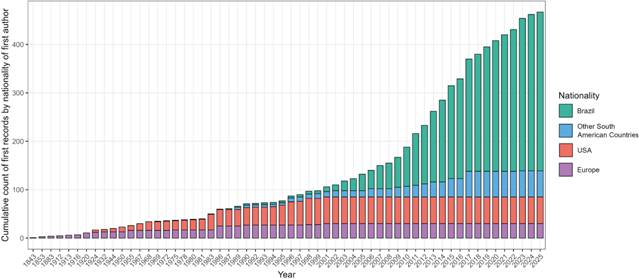
We compiled data on the first records of species for Brazil and the nationality of the first author of the description or record (in cases where species were originally described from other countries). Cumulative counts were calculated from 1843 to August 2025 and grouped into six-time intervals: before 1900, before 1950, before 1980, before 1990, before 2000, and up to 2010, considering the following regions: Brazil, other South American countries, USA, and Europe. The first two intervals (before 1900 and before 1950) were defined to encompass the earliest phase of Ephemeroptera studies, during which contributions were sparse and discontinuous. From 1980 onwards, intervals were defined on a decadal basis to better capture the acceleration and accumulation of taxonomic publications over time, allowing finer resolution of publication trends and regional contributions, as illustrated in Fig. 4.
We used the R programming language (R Core Team 2022) for data wrangling and visualization. Data manipulation was performed using the “dplyr” package (Wickham et al. 2023), while plotting was done using the “ggplot2” (Wickham 2016) and “treemapify” (Wilkins 2023) packages. Maps and geographical analyses were conducted using the “sf” package (Pebesma 2018, Pebesma and Bivand 2023). Final images were prepared and exported using Adobe Illustrator 2025.
The following institutions and universities mentioned throughout the text are listed here in full for reference: Instituto Federal Farroupilha (IFFar), Universidade Federal da Bahia (UFBA), Universidade Federal do Espírito Santo (UFES), Universidade Federal de Mato Grosso (UFMT), Universidade Federal do Pará (UFPA), Universidade Federal do Rio de Janeiro (UFRJ), Universidade Federal de Rondônia (UNIR), Universidade Federal de Roraima (UFRR), Universidade Federal do Estado do Rio de Janeiro (UNIRIO), Universidade Federal do Tocantins (UFT), Universidade Federal de Viçosa (UFV), Florida Agricultural and Mechanical University (FAMU, USA), Instituto Nacional de Pesquisas da Amazônia (INPA), Universidade Estadual Paulista (UNESP), Universidade Estadual do Maranhão (UEMA), Universidade do Estado de Mato Grosso (UNEMAT), Universidade Estadual do Piauí (UESPI), Universidade Estadual de Santa Cruz (UESC), Universidade de São Paulo (USP, Ribeirão Preto), and Universidade Federal de São Carlos (UFSCar).
RESULTS AND DISCUSSION
History of the discovery of Ephemeroptera species in Brazil
The beginnings of Brazilian Ephemeropterology (1838-1900) (Figs 1-4A)
Ephemeropterology in Brazil begins almost in the middle of the 19th century with the description of two poorly known species by Percheron in Guérin-Meneville and Percheron (1838) and Burmeister (1839). These species, originally Ephemera albicans Percheron, 1838 and Palingenia dorsalis Burmeister, 1839, respectively, were ultimately transferred to the genus Campsurus Eaton, 1868 by Eaton (1883) and now, according to Molineri et al. (2015b), are treated as nomina dubia. Soon after that, three species from Brazil were described by the Swiss zoologist François-Jules Pictet de la Rive: Cloe fasciata Pictet, 1843, Potamanthus inanis Pictet, 1843, and Oligoneuria anomala Pictet, 1843. These species, currently recognized as Callibaetis fasciatus (Pictet, 1843) (Fig. 1A-B), Leptohyphodes inanis (Pictet, 1843) (Figs 1E, 2D), and Oligoneuria (Oligoneuria) anomala (Pictet, 1843) (Eaton 1888, Ulmer 1920, Salles et al. 2014), are still valid names and were described based on a few mayfly specimens collected by Johann Natterer and Heinrich Wilhelm Schott during the Austrian expedition Österreichische Brasilien-Expedition to Brazil in São Paulo and Rio de Janeiro (Sartori and Bauernfeind 2020) (Figs 3, 4A).
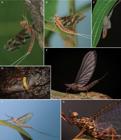
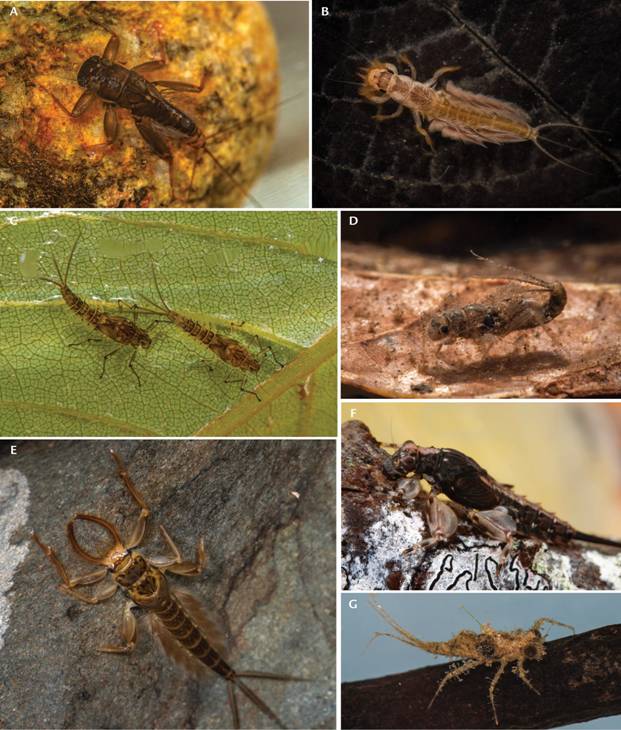
Living adults of Brazilian mayflies: (A) male imago of Callibaetis fasciatus (Baetidae); (B) female imago of Callibaetis fasciatus (Baetidae); (C) final molt of a female of Campylocia anceps (Euthyplociidae); (D) female imago of Campsurus sp. laying eggs on a stone (Polymitarcyidae); (E) female imago of Leptohyphodes inanis (Leptohyphidae); (F) male subimago of Hexagenia albivitta (Ephemeridae); (G) Details of a male imago of a new species of Massartella (Leptophlebiidae). All photographs by Frederico Salles.

Living nymphs of Brazilian mayflies: (A) Thraulodes sp. (Leptophlebiidae); (B) Campsurus truncatus (Polymitarcyidae); (C) Camelobaetidius hamadae (Baetidae); (D) Leptohyphodes inanis (Leptohyphidae); (E) Campylocia sp. (Euthyplociidae); (F) Melanemerella brasiliana (Melanemerellidae); (G) Coryphorus aquilus (Coryphoridae). All photographs by Frederico Salles.
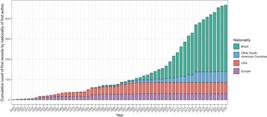
Cumulative count of first records of species for Brazil by nationality of the first author (from 1843 to August 2025), considering the following regions: Brazil, other South American countries, USA, and Europe. Records include both species originally described from Brazil and those described elsewhere but later recorded in the country.
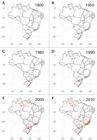
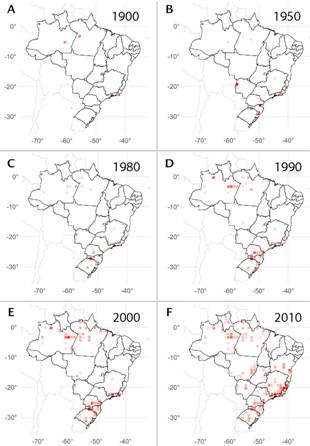
Temporal evolution of publication records of Ephemeroptera in Brazil. The color gradient represents the number of records on a logarithmic scale, with darker shades indicating higher concentration of records. Records are displayed cumulatively for six time intervals: (A) up to 1900; (B) up to 1950; (C) up to1980; (D) up to1990; (E) up to2000 (F) up to 2010.
Expansion through European and North American contributions (1901-1950) (Figs 1, 3, 4B)
During the second half of the 19th century, other European entomologists contributed to the study and knowledge of the Brazilian mayfly fauna, such as Francis Walker, Hermann August Hagen, and Alfred Edwin Eaton. Walker (1853) described three new species from Pará: Baetis albivitta Walker, 1853 [currently Hexagenia (Pseudeatonica) albivitta] (Fig 1F), Palingenia albifilum Walker, 1853 [Campsurus albifilum], and Palingenia latipennis Walker, 1853 [Campsurus latipennis] (Eaton 1871, Spieth 1941). Hagen (1861) “described” Palingenia curta Hagen, 1861 [Asthenopus curtus] and Palingenia umbrata Hagen, 1861 [nomen nudum] (Eaton 1871, Hubbard and Peters 1981), and Hagen (1888) described Campsurus amazonicus (now a junior synonym of A. curtus) and Euthyplocia burmeisteri. Finally, Eaton was responsible for the description of two species: Spaniophlebia trailae Eaton, 1881 and Euthyplocia anceps Eaton, 1883 (Campylocia anceps; Fig. 1C) (Needham and Murphy 1924). In sum, 14 species of mayflies were known from Brazil by the end of the 19th century. Despite the fact that most of them were described based on a limited series of specimens, with some badly preserved even by that time, 10 are still valid and well-recognized species (Figs 1A-C, E, F, 3, 4A).
In the first half of the 20th century, entomologists from the United States began to investigate the South American mayfly fauna, including material from Brazil, alongside a smaller group of European researchers. Among the latter, the Spanish Jesuit priest Longino Navás stood out for his prolific taxonomic activity, describing several new species from South America. His contributions to the Brazilian fauna, however, were modest compared to his work in other countries such as Argentina and Chile, with only nine species described between 1912 and 1936 (Navás 1912, 1916, 1934a, 1934b, 1936). Of these, four are now considered nomina dubia and three were later synonymized and are currently invalid names [for more details, see Demoulin (1955), Gillies (1990), Peters et al. (2005), Cruz et al. (2014), Molineri et al. (2015b), Mariano et al. (2023)]. One species, Thraulodes subfasciata Navás, 1934, has never been found since the original description. According to Traver and Edmunds (1967), this species may even belong to another genus.
The German entomologist Georg Ulmer was another European scientist with access to Brazilian material. Of the 111 mayfly species he described (Weidner 1964, Sartori et al. 2016), 10 originated from Brazil and were included in three detailed contributions (Ulmer 1920, 1942, 1943). Only one of these is currently considered a nomen dubium (Molineri et al. 2015b), and another-although presently treated as a junior synonym (Pescador and Peters 1990)-is, in fact, a distinct species and will soon be removed from synonymy.
The last European entomologist to contribute to the Brazilian fauna was Johannes-Antoine Lestage, who described Atalophlebia brieni Lestage, 1924 and subsequently erected Massartella Lestage, 1930 to accommodate it (Fig. 1G). This species, collected by Paul Brien at a site now within the Itatiaia National Park, was obtained during the Belgian biological mission to Brazil led by Jean Massart in 1922-1923 (Lestage 1924, Heizer 2008).
From this point onward, the main contributions to the study of Brazilian mayflies during the first half of the 20th century came from United States researchers (Fig. 3), with James G. Needham and Helen E. Murphy leading the way, followed later by a single contribution from Herman T. Spieth and others by Jay R Traver, who would continue to contribute well into the second half of the century.
The classic monograph on Neotropical Mayflies by Needham and Murphy (1924) was based largely on material from the Cornell University Entomological Expedition to South America (1919-1920), complemented by collections from Alfred E. Emerson in British Guiana, Edward Bruce Williamson in Central America and Colombia, and H. S. Parish near Belém, Pará. At the time, knowledge of Ephemeroptera in the Neotropics was extremely limited, with only scattered records from Argentina, Brazil, Central America, and Mexico, while vast regions such as the Guiana-Venezuela area and much of the Andes remained virtually unexplored. For Brazil, the study incorporated Parish’s material from Pará and Bradley’s specimens from Minas Gerais, Amazonas, and Mato Grosso, providing some of the first detailed records of several genera in the country.
The importance of this work lies in its synthesis of the then-known Neotropical fauna (35 genera and 127 species) and in the description of numerous taxa from Brazil, including 12 new species and a few genera, such as Baetodes Needham & Murphy, 1924 and Campylocia Needham & Murphy, 1924. By providing keys to adults and nymphs and comparing South American taxa with their Nearctic counterparts, Needham and Murphy’s contribution established the foundations for the study of Neotropical Ephemeroptera and marked a milestone in the understanding of the Brazilian fauna within a broader continental context.
Although primarily focused on material collected in Surinam by Dirk Cornelius Geijskes and deposited at the American Museum of Natural History, Spieth’s (1943) “Taxonomic Studies on the Ephemeroptera. III. Some interesting ephemerids from Surinam and other Neotropical localities” also provided valuable information on the Brazilian fauna. The study dealt mainly with collections from the Marowijne River system, but Spieth included comparative notes and additional specimens from other countries in northern South America. For Brazil, the paper reinforced the occurrence of some widespread taxa and included the description of a new species of Campsurus from Guyana (British Guiana at that time) and Brazil. Thus, although centered on Surinam, this contribution added significant distributional records and one new species for the Brazilian fauna.
It was during this same period that the first papers dealing with the South American Ephemeroptera fauna were published by Jay R Traver, regarded as “the first Ephemeroptera specialist in North America” (Peters and Peters 1975). While her first paper dealt with several new Ephemeroptera species from Venezuela, based on material collected by René Lichy (Traver 1943), her second contribution to the South American fauna was of great importance for Brazil. Traver (1944) can be regarded as the first paper dealing exclusively with the Brazilian Ephemeroptera fauna. Based primarily on nymphs and a few adults collected in Minas Gerais, São Paulo, and Rio Grande do Sul, Traver (1944) presents a taxonomic key for mayfly nymphs occurring in or near Brazil, provides detailed descriptions and illustrations of species from several genera (e.g., Euthyplociidae: Campylocia Needham & Murphy, 1924; Leptophlebiidae: Thraulodes Ulmer, 1919, Hagenulopsis Ulmer, 1920; Caenidae: Caenis Stephens, 1835; Leptohyphidae: Leptohyphes Eaton, 1882, Leptohyphodes Ulmer, 1919; Baetidae: Baetis Leach, 1815, Baetodes Needham & Murphy, 1924, Callibaetis Eaton, 1881), and discusses their morphological characters and ecological preferences. In addition, three new species are described, two of which are currently considered junior synonyms (Gillies 1990, Molineri and Emmerich 2010). Based now on material from South and Central America deposited at the Cornell University collection, including part of the material examined by Needham and Murphy (1924), Traver (1946) provides a contribution to the systematics of Leptophlebiidae (by that time a subfamily of Baetidae) from this area. The paper includes reexamination of types, new drawings and description of new species. Atopophlebia são-paulenseTraver, 1946 (currently Ulmeritus saopaulensis), along with two species of Polymitarcyidae also described by her, and a single species of Leptophlebiidae described by her student George F. Edmunds, who would become very important in the following decades, were the last species from this period described from Brazil (Figs 3, 4B).
Consolidation and the rise of South American researchers (1951-2000) (Figs 3, 4C-E)
The second half of the 20th century marks an important period in the taxonomic study of the Brazilian Ephemeroptera fauna, characterized by a growing number of researchers working on Brazilian material and, consequently, a significant increase in the number of described species. While in the previous period a total of nine authors, all foreigners, contributed to the description of 42 species (16 of which are now regarded as junior synonyms or nomina dubia-see above for more details), between 1951 and 1999 as many as 20 authors described 86 species, with only two later synonymized. During this time, especially in the United States and beginning with Jay R Traver, we can observe for the first time the continuous training of new specialists in the group. Over the decades, this group, which included George F. Edmunds, William L. Peters, Richard K. Allen, William P. McCafferty, Harry M. Savage, and Carlos R. Lugo-Ortiz, was responsible for the majority of Brazilian species described during this period. Importantly, this was also the first time that South American researchers appeared among the authors, including four Brazilian entomologists (Fig. 3).
From the 1950s through the 1970s, three authors were responsible for 20 of the 32 species described in the period: Traver, Edmunds, and Allen. Traver (1950) contributed with descriptions of Polymitarcyidae and, together with Edmunds, published two landmark papers that remain key references for the genera Thraulodes (Leptophlebiidae) and Camelobaetidius Demoulin, 1966 (Baetidae) (Traver and Edmunds 1967, 1968). Allen, in turn, dedicated much of his career to the study of Ephemerelloidea, describing 10 species of Leptohyphidae from Brazilian material. At the end of this period, two contributions deserve special mention: the description of Caenis cunianaFroehlich, 1969, the first Brazilian mayfly species described by a South American author, the Brazilian entomologist Claudio G. Froehlich; and the first of many papers by William L. Peters on South American Leptophlebiidae, in which he described a new genus and species from Brazil, Askola froehlichi Peters, 1969 (Froehlich 1969, Peters 1969).
The 1980s were marked by a revolution in the knowled ge of South American Leptophlebiidae, triggered by a series of publications led by Peters and his students (Fig. 4D). Altogether, 16 species of this family were described from Brazil during this decade (Savage 1982, 1986, Savage and Peters 1983, Domínguez and Flowers 1989). Knowledge of Brazilian Caenidae, particularly from the Amazon region, also increased significantly with Peter Malzacher’s seminal contribution “Caenidae aus dem Amazonasgebiet”, which included eight new species of Caenis and BrasilocaenisPuthz, 1975 from the Brazilian Amazon (Malzacher 1986). Finally, the description of a new Oligoneuriidae species from the state of Rio de Janeiro marked, after almost 20 years, the second mayfly species ever described by a Brazilian author: Lachlania santosi Pereira, 1987, the first species described by Sueli Pereira.
During the 1990s, additional papers by Peter Malzacher (Malzacher 1990, 1998) and by Manuel Pescador and George F. Edmunds (Pescador and Edmunds 1994) continued to expand knowledge of Caenidae and Oligoneuriidae in Brazil, respectively. As with Leptophlebiidae in the previous decade, the second half of the 1990s saw a revolution in the understanding of another family, Baetidae. Carlos R. Lugo-Ortiz and William P. McCafferty described numerous new genera and species of Baetidae across South America, including 18 new species from Brazil alone. Together with Sueli Pereira and Eduardo Domínguez-an Argentinian Ephemeroptera specialist who, beginning in 1982, transformed the study of the order in South America-this period also saw the emergence of the first two Brazilian researchers to earn doctoral degrees focusing on mayfly systematics. Maria José N. Ferreira earned her Ph.D. in 1999 at the Instituto Nacional de Pesquisas da Amazônia (INPA), under the supervision of Victor Py-Daniel, with the thesis “Systematics of Atalophlebiinae (Insecta: Ephemeroptera, Leptophlebiidae) of the Guiana and Brazilian Shields”. Elidiomar R. da Silva obtained his Ph.D. in 2002 at the Museu Nacional, Universidade Federal do Rio de Janeiro (UFRJ), under the supervision of Jorge Luiz Nessimian, with the thesis “Leptophlebiidae (Insecta: Ephemeroptera) occurring in the state of Rio de Janeiro: taxonomy and biological characterization of the nymphs”. In this single decade, 30 new species of Brazilian Ephemeroptera were described-nearly as many as in the entire 1950-1979 period, and only slightly fewer than during the whole first half of the 20th century. Five of these species were described by Pereira and/or Da-Silva, and one by Ferreira. Therefore, by the end of this period, a total of eight Ephemeroptera species had been described by Brazilian specialists working on the group (Fig. 4E).
Expansion and consolidation of Brazilian Ephemeropterology (2001-2025)
As with many other groups of aquatic insects in Brazil, the first decade of this century was a period of great importance for the study of Ephemeroptera in the country. At that time, five research groups were working on aquatic insects from a taxonomic perspective: in the North, the group led by Neusa Hamada (INPA); in the Central-West, the group led by Helena Cabette (UNEMAT); and in the Southeast, the groups led by Jorge Luiz Nessimian (UFRJ), Suzana Trivinho-Strixino (UFSCar), and Claudio G. Froehlich (USP, Ribeirão Preto). Although the leaders were not themselves Ephemeroptera specialists, their work was essential for broadening the study of the order in Brazil, both taxonomically and geographically. Through the projects they developed, a valuable collection of Ephemeroptera-often from areas never before surveyed-became available to a group of students who would, by the end of the decade, form the next generation of Brazilian mayfly specialists.
This second generation is represented by three researchers who, after Elidiomar R. da Silva, were the first to complete a Ph.D. in Ephemeroptera taxonomy within the same decade. Frederico F. Salles, after beginning his studies on Ephemeroptera taxonomy as an undergraduate under the guidance of Elidiomar R. da Silva, started his master’s degree in 2000 on Baetidae, co-supervised by Carlos R. Lugo-Ortiz-then a postdoctoral fellow at the Federal University of Viçosa (UFV). This collaboration yielded several results, including the description of new Baetidae species and genera between 2002 and 2004 (Salles and Lugo-Ortiz 2002, 2003a, 2003b, Salles et al. 2004b), and laid the foundations for the study of this family in southeastern Brazil (Salles et al. 2004c). Between 2002 and 2006, he developed his doctoral dissertation entitled “A ordem Ephemeroptera no Brasil (Insecta): Taxonomia e diversidade”. Among its most important outcomes-besides the description of numerous new species and illustrated keys for the identification of genera occurring in Brazil-his thesis produced the first comprehensive list of Brazilian Ephemeroptera. Salles et al. (2004a) reported 63 genera and 166 species for the country, showing that the Southeast and North regions were much better studied than the rest of Brazil.
Also at UFV, beginning in 2003 under the guidance of Dr. Paulo Sérgio F. Ferreira, Lucimar G. Dias conducted her master’s and doctoral studies on Leptohyphidae, which until then had been largely neglected in Brazil. Between 2005 and 2009, she described eight new species of this family, proposed identification keys, and presented a phylogenetic analysis of Tricorythopsis Traver, 1958. Rodolfo Mariano, in turn, completed his master’s degree and doctorate at USP Ribeirão Preto under the supervision of Claudio G. Froehlich, with a sandwich period at Florida Agricultural and Mechanical University (FAMU), in Tallahassee, USA, under the supervision of Janice Peters. His doctoral dissertation focused on a taxonomic revision of Thraulodes, during which he described six new species of Leptophlebiidae.
While Lucimar Dias established her career in Colombia, Frederico Salles and Rodolfo Mariano settled in two Brazilian states that had previously been neglected in terms of Ephemeroptera knowledge: Espírito Santo and Bahia, respectively. Alongside their appointments in teaching and research institutions, both began to supervise a new wave of specialists who started contributing to species descriptions by the end of that decade. Between 2001 and 2010, a total of 49 species of Ephemeroptera were described from Brazil. More important than the number of species itself-higher than in the previous decade-was the number of Brazilian specialists involved in the descriptions. Of all the species described during this period, only four were described exclusively by foreigners, eleven by Brazilian and foreign authors together, and 35 exclusively by Brazilians (Figs 3, 4F). Whereas in the previous period only three Brazilian authors had described eight species, in this decade 23 different Brazilian authors contributed to the description of 45 species. Among these, Rafael Boldrini, Paulo V. Cruz, Lucas R. C. Lima, Ericksen Raimundi, and Inês C. Gonçalves stand out. Now established in teaching and research institutions, they continue to study the group together with Frederico Salles, Lucimar Dias, and Rodolfo Mariano.
The next decade is a milestone in Brazilian Ephemeropterology. Practically one-third of all the species originally described from the country, 166 to be more precise, were described between 2011 and 2020 (Figs 3, 5). While established researchers continued describing new species, this period was strongly marked by the qualified and sustained training of a third generation of specialists. It was during this decade that the highest number of graduate students working on taxonomic aspects of Ephemeroptera emerged. Among the new researchers who contributed to species descriptions in Brazil are Márcia R. de-Souza, Luciana Belmont, Fabiana Massariol, Jeane M.C. Nascimento, Paula M. Souto, Kamila B. Angeli, and Rogério Campos. Most of them pursued both master’s and doctoral degrees focused on taxonomic aspects of the order between 2011 and 2020.
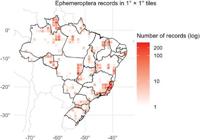
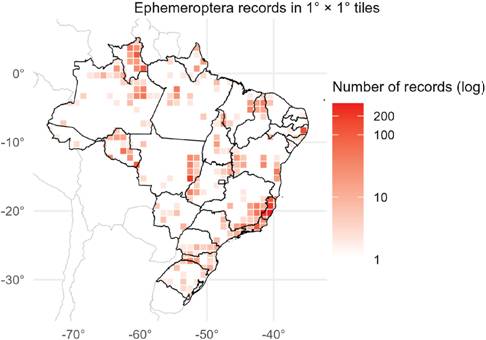
Spatial distribution of Ephemeroptera records in Brazil up to 2025, aggregated in 1° × 1° grid cells. The color gradient represents the number of records on a logarithmic scale, with darker shades indicating higher concentration of records.
Together with the increasing number of students, there was also the opportunity to develop projects on previously neglected taxa, diverse lineages, or groups that historically posed taxonomic challenges. In the second half of the decade in particular, studies became broader in both geographic and taxonomic scope. In the first half of the period, projects focused on genera such as Baetodes, Callibaetis Eaton, 1881, Camelobaetidius, Miroculis Edmunds, 1963, and Simothraulopsis Demoulin, 1966 (e.g., de-Souza et al. 2011, Boldrini et al. 2012a, 2012b, 2013, Cruz et al. 2014, 2017a, 2017b, Do Nascimento et al. 2017). In the second half, projects took on a larger scale, with families revised in a phylogenetic and global context, such as Oligoneuriidae, Euthyplociidae, Leptohyphidae, and Leptophlebiidae (e.g., Gonçalves 2015, Souto 2018, Massariol et al. 2019, Monjardim et al. 2020). This decade also coincided with highly productive collaborations with researchers at the Instituto de Biodiversidad Neotropical (IBN) in Argentina, especially Carlos Molineri. In total, 30 Brazilian species were described in partnership with researchers from this institution-27 of them with Molineri alone. Finally, underscoring Brazil’s relevance in the international Ephemeroptera community, the International Joint Meeting on Ephemeroptera and Plecoptera was organized in 2018 in Espírito Santo by Salles and Mariano (Salles and Sobrinho 2019).
Between 2021 and 2025, Brazil saw the description of 41 additional mayfly species (Fig. 3), sustaining the high productivity established in the previous decade and consolidating a mature, Brazil-led research community. The new taxa span multiple lineages, while authorship patterns underscore the continuity and breadth of the second and third generation of ephemeropterists, with occasional cross-border efforts. This pattern is fully consistent with the “autonomous stage” of South American Ephemeroptera taxonomy recognized by Domínguez and dos Santos (2014), in which the bulk of taxonomic output is driven by regional authors and supported by collaborative networks.
Fortunately, interest in the order in Brazil remains strong, and a fourth generation of specialists has begun to emerge. This linkage between established and emerging authors mirrors the process of knowledge transmission and consolidation of scientific tradition highlighted by Domínguez and dos Santos (2014), in which co-authorship networks play a central role in sustaining long-term taxonomic productivity. Although the number of described species has increased considerably since the publication of the first checklist in 2004-166 at that time versus 472 today-many challenges remain in a country like Brazil, where its large territory, heterogeneous habitats, and high biodiversity make it difficult to fully assess the true diversity of the order. Looking ahead, sustained progress will depend on maintaining research continuity, strengthening both national and international collaborations, and expanding surveys into poorly explored regions. As emphasized by Domínguez and dos Santos (2014), the continuity of funding, personnel training, and collaborative networks is essential to preserve this autonomous stage and avoid disruptions in the formation of new generations of specialists. These efforts, combined with the integration of morphological and molecular approaches, will be essential to refine taxonomy and achieve a more comprehensive understanding of the true diversity of Brazilian Ephemeroptera.
Diversity and distribution of Ephemeroptera in Brazil
Brazil covers approximately 8.5 million km2 and comprises six major terrestrial biomes: Amazonia, Cerrado, Atlantic Forest, Caatinga, Pampa, and Pantanal. Together, these regions occupy the entire national territory, with Amazonia alone representing nearly half (49.3%), followed by the Cerrado (23.9%), Atlantic Forest (13.0%), Caatinga (9.9%), Pampa (2.1%), and Pantanal (1.8%) (IBGE 2004; see also https://brasilemsintese.ibge.gov.br/). Despite this vast environmental heterogeneity, the distribution of taxonomic knowledge on mayflies (Ephemeroptera) is highly uneven, with a clear bias toward certain regions and biomes. Both the number of occurrence records and the known species richness reflect this imbalance, which is largely associated with the geographic concentration of research groups and sampling initiatives.
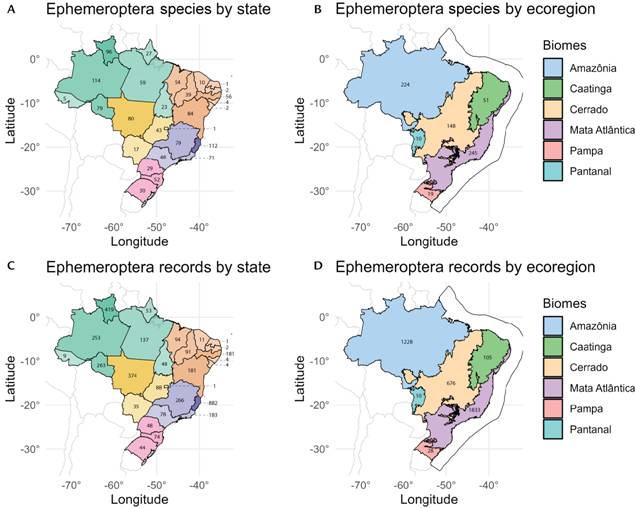
Historically, most early descriptions of Brazilian mayflies were based on material from Amazonia and the Atlantic Forest, which explains their prominence in early collections and species descriptions. These two biomes today still account for the majority of records: Amazonia holds ~1,228 records and ~224 species, whereas the Atlantic Forest has ~1,833 records and ~245 species (Figs 5, 7). With the emergence of Brazilian specialists, especially from the second and third generations of researchers, collection efforts expanded more consistently into other biomes. The Cerrado-larger than the Atlantic Forest and about half the size of Amazonia-long remained underexplored, with 676 records and 148 species (Figs 5, 7B-D), despite being recognized as a global biodiversity hotspot (Myers et al. 2000). Similarly, the Caatinga, slightly smaller than the Atlantic Forest and traditionally associated with low species numbers, was neglected until more recent efforts revealed unexpectedly high diversity (e.g., Cruz et al. 2011, Boldrini et al. 2012b, Mariano and Costa 2014, Lima et al. 2015, 2016a, Takiya et al. 2016, Nascimento et al. 2020).
The smaller biomes, Pantanal and Pampa, currently harbor the lowest species richness and number of records (Fig. 7B, D). Since the first descriptions in the early 20th century (Navás 1912, Needham and Murphy 1924), little progress has been achieved, with only 38 records and 29 species documented so far, leaving vast areas unsurveyed (Figs 5, 7B, D).

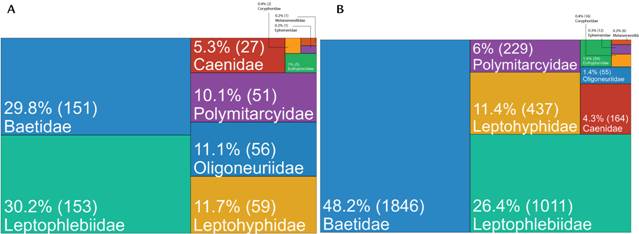
Treemaps of Ephemeroptera families in Brazil (May 2025). (A) Species richness: % of total species - number of species in parentheses; (B) records: % of total records (number of records in parentheses).
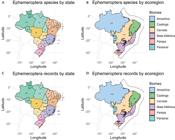
Ephemeroptera distribution in Brazil: (A) species richness per Brazilian state; (B) species richness (number of species) per biome; (C) number of Ephemeroptera records per state; (D) number of Ephemeroptera records per biome.
This uneven distribution of records is equally evident at the state level. Espírito Santo, one of the smallest Brazilian states, harbors 112 species based on 882 records (Fig. 7A, C). Remarkably, this richness is nearly equivalent to that of Amazonas-one of Brazil’s largest states-where 114 species are known from 253 records. Roraima also stands out, with 96 species and 419 records (Fig. 7A, C). At the other extreme, Paraíba and Rio Grande do Norte, both in the Northeast Region, remain scarcely studied, with only two and one species recorded, respectively, despite being located in an ecotonal zone between the Atlantic Forest and Caatinga, an area widely recognized for its high biological diversity.
However, a greater number of records is not always associated with higher species richness. Mato Grosso, for example, despite holding the third-largest number of records among Brazilian states (374), has fewer species (80) than some states that have been more thoroughly surveyed (Fig. 7A, C). This discrepancy is strongly linked to the concentration of collection efforts in just a few areas of the state (Salles et al. 2004d, Shimano et al. 2010, 2011, Raimundi et al. 2017). As shown in Fig. 5, sampling was heavily concentrated in a few areas, while vast portions of Mato Grosso remain virtually unexplored.
Overall, the geographic bias in species records across Brazil reflects the distribution of researchers, availability of resources, and asymmetries in collection effort (Shimano et al. 2013, Cardoso et al. 2015). In the Southeast Region, the concentration of specialists, major research centers, and easier logistics has led to the largest number of records and species descriptions. In the North, two distinct factors explain the prominence of Amazonas: first, historical collections that contributed to species descriptions until the late 20th century; and second, the role of Dr. Neusa Hamada and the National Institute of Amazonian Research (INPA), which since the early 21st century has trained new specialists and developed projects that expanded sampling of aquatic insects in the region. Roraima, in turn, shows high species richness partly due to Hamada’s early efforts, later reinforced by the establishment of Dr. Rafael Boldrini at the Federal University of Roraima (UFRR). A similar pattern can be observed in Rondônia following the settlement of Dr. Paulo Cruz at the Federal University of Rondônia (UNIR). In the Northeast, the states of Piauí and Maranhão have also seen recent increases in records and species richness driven by researchers such as Dr. Lucas Lima. Nevertheless, the Northeast as a whole remains underrepresented, with disproportionately few records relative to its vast area-nearly one-fifth of Brazil’s territory-and many states with virtually unknown faunas. While Bahia and Pernambuco are relatively better studied (both with 181 records), large portions of the region remain unsurveyed (Fig. 7C).
Assessing endemicity and species richness per family
Baetidae Leach, 1815 (151 spp.) (Figs 1A-B, 2C) and Leptophlebiidae Banks, 1900 (153 spp.) (Figs 1G, 2A) are the most diverse mayfly families in Brazil (Fig. 6A), with most of their species occurring in the Atlantic Forest biome (Salles et al. 2025a). They also harbor the highest numbers of endemic species: 102 and 101, respectively (Table 1). Although both families have a similar number of species, Baetidae accounts for a markedly higher proportion of occurrence records (48.2%; 1,846 records) compared to Leptophlebiidae (26.4%; 1,011 records) (Fig. 6B). Until the mid-2010s, knowledge of the distribution and diversity of many genera within these families remained limited, with taxonomic information largely restricted to the original species descriptions. Despite their high diversity, numerous undescribed species of both families remain stored in scientific collections or await discovery in the field, even in historically well-studied regions such as the North and Southeast.
Number of genera, total species and endemic species of Ephemeroptera families occurring in Brazil.
Over the past 15 years, nearly half of the known Brazilian diversity of Baetidae has been revealed through taxonomic and biogeographic studies on the genera Apobaetis Day, 1955, Callibaetis Eaton, 1881, Camelobaetidius Demoulin, 1966, and Cloeodes Traver, 1938. During this period, 48 new species were described and about 500 new records were added for Brazil (e.g., Boldrini et al. 2012a, 2014, Cruz et al. 2014, 2017c, Massariol et al. 2014, Salles et al. 2015, De Lima et al. 2023). Within Leptophlebiidae, 29 genera are recorded for Brazil, with Thraulodes (32 spp.) and Miroculis Edmunds, 1963 (25 spp.) being the most species-rich genera, together representing approximately one-third of the country’s species in this family (Salles et al. 2025a). Important taxonomic revisions of AskolaPeters, 1969 and Simothraulopsis Demoulin, 1966 (Do Nascimento et al. 2017, Campos et al. 2019) have revealed striking diversity in the Cerrado and Caatinga, suggesting that these families remain underexplored in such biomes.
Leptohyphidae Edmunds & Traver, 1954 is the third most diverse family in Brazil, represented by 59 species in nine genera (Fig. 6A), 54% of which are endemic (Table 1; Figs 1E, 2D). As in other families, most advances in knowledge have occurred since the 2000s, with C. Molineri playing a central role in describing new species and genera, and in reassigning species to new taxonomic combinations (Dias et al. 2005, Molineri 1999, 2001a, 2001b, 2001c, 2002, 2003, 2004, 2005, 2006, Molineri et al. 2015a, Salles and Molineri 2006). Despite these advances, further sampling is still required, especially in states where the family has not yet been recorded: Acre, Mato Grosso do Sul, Ceará, Rio Grande do Norte, Paraíba, Alagoas, and Sergipe (Salles et al. 2023).
Polymitarcyidae Banks, 1900 comprises 56 species (27.8% endemic) in seven genera in Brazil (Fig. 6A; Table 1). Campsurus is the most diverse genus, with 43 species (Salles et al. 2025; Figs 1D, 2B), and has been extensively studied, particularly in the North. Historically, the taxonomy of the family was confused; however, in the past two decades, significant progress has been made, with synonymies resolved, life stages described, phylogenetic analyses performed, and 32 new species described (Molineri et al. 2011, 2015b, 2015c, De-Souza and Molineri 2012, Molineri and Salles 2013, 2017, Cabral et al. 2022, Cruz et al. 2022, Pantoja et al. 2023, De Lima et al. 2025). These efforts filled critical biodiversity gaps, addressing both Linnean and Wallacean shortfalls.
Caenidae Newman, 1853, with 27 species (52% endemic) reported in Brazil (Fig. 7A; Table 1), has historically been neglected by local specialists. For decades, advances in Caenidae taxonomy came almost exclusively from European and Argentine researchers (e.g., Puthz 1975, Malzacher 1986, 1990, 1998, 2001, Molineri and Malzacher 2007). Over the last decade, however, Brazilian researchers have increasingly contributed by describing new species and life stages and by filling distribution gaps, particularly in the Northeast (Lima et al. 2015, 2016b, 2019, Angeli et al. 2016, Nascimento et al. 2021, 2022, 2023, Oliveira et al. 2025). Nonetheless, Brazil still presents striking Linnean and Wallacean shortfalls (Cardoso et al. 2011).
Oligoneuriidae Ulmer, 1914 occurs worldwide except in Oceania and the Australian regions. Seventeen species (80% endemic) in five genera are reported for Brazil (Table 1) (Salles et al. 2025a). The family poses taxonomic challenges due to the scarcity of diagnostic morphological characters in nymphs and adults, incomplete original descriptions, and a shortage of specialists. In this context, DNA barcoding has proven a valuable complementary tool, supporting the description of new species of Lachlania Hagen, 1868 and Oligoneuria Pictet, 1843 (Salles et al. 2014, Massariol and Cruz 2015, Massariol et al. 2016).
Euthyplociidae Lestage, 1921 is a small family distributed in the Afrotropical, southern Nearctic, Neotropical, and Oriental regions (Barber-James et al. 2008). In Brazil, all five recorded species (two endemic) belong to CampylociaNeedham & Murphy, 1924 (Salles et al. 2025a; Table 1; Figs 1C, 2E). This genus has a complex taxonomic history and contains the largest number of synonyms within the family. Recently, Gonçalves et al. (2017) conducted an integrative revision, describing new species and identifying distinct lineages based on molecular data. They highlighted, however, the need for additional collections and molecular studies, especially given the limited morphological characters and the absence of adult stages in some lineages.
Coryphoridae Molineri, Peters & Zuñiga, 2002, Ephemeridae Latreille, 1810, and Melanemerellidae Demoulin, 1955 are among the least diverse families, together representing less than 1% of Brazilian mayfly diversity (four species in total; Fig. 6A) and number of records (Fig. 6B). Coryphoridae includes a single genus and two species: Coryphorus aquilus Peters, 1981 (Fig. 2G), widely distributed across South America (also in Colombia, French Guiana, and Venezuela), and C. molineriiLima, Nascimento & Boldrini, 2018, endemic to the Brazilian Cerrado (Lima et al. 2018, Salles et al. 2025a). Ephemeridae is represented by a single species, Hexagenia (Pseudeatonica) albivitta (Walker, 1853) (Fig. 1F). This species has a wide latitudinal distribution (Mexico to South America; Hwang et al. 2008) and occurs in diverse environments, from high-altitude cold streams to warm lowland rivers (Domínguez et al. 2006). In Brazil, it is restricted to the Amazon and Atlantic Forest (Salles et al. 2025a). Melanemerellidae is a monotypic family represented by Melanemerella brasilianaUlmer, 1920 (Fig. 2F), endemic to Brazil. First described from Espírito Santo, without precise provenance data, it has the narrowest distribution among Brazilian mayflies, restricted to high-altitude areas of the Atlantic Forest (Silva and Mariano 2017).
Ephemeroptera taxonomy in Brazil
The taxonomic knowledge of Brazilian Ephemeroptera has undergone a remarkable trajectory over the past two centuries, moving from early descriptions by European naturalists in the 19th century to the establishment of a consolidated national community in the 21st century. Since the early 2000s, successive generations of Brazilian specialists have diversified the study of the order, both geographically and taxonomically; today, Brazil stands out as one of the global centers of Ephemeroptera research.
Currently, 472 valid species are listed for the country, distributed across 10 families and 81 genera, although estimates suggest that the true richness may be up to three times higher (Da-Silva and Salles 2024). Endemism is high across biomes, echoing patterns observed in other aquatic and terrestrial taxa, and several lineages are represented by species restricted to narrow geographic ranges. Databases such as the CTFB, EphemBrazil, and Ephemeroptera da América do Sul provide up-to-date information on taxonomy, distribution, and literature, facilitating comparative studies and data accessibility (Salles et al. 2023, 2025a, 2025b).
A central factor underlying these advances is the establishment of research groups on aquatic insects across multiple public universities and research institutes. While some groups are led by trained ephemeropterists, others are coordinated by specialists in different aquatic insect orders who nonetheless contribute to the taxonomy of mayflies. Importantly, these groups are distributed across all regions: from the North (Manaus-INPA, Porto Velho-UNIR, Boa Vista-UFRR, Belém and Santarém-UFPA, Porto Nacional-UFT) and Central-West (Barra do Garças-UFMT), to the Northeast (Salvador-UFBA, Ilhéus-UESC, Campo Maior-UESPI, Caxias-UEMA), Southeast (Assis-UNESP, Viçosa-UFV, São Mateus-UFES, Rio de Janeiro-UNIRIO, UFRJ), and South (Alegrete-IFFar).
In addition, numerous Brazilian groups focus on the ecology and biomonitoring of aquatic insects. Although taxonomy is not their primary aim, these studies routinely generate large amounts of Ephemeroptera material, especially nymphs, often collected in poorly explored areas. A long-standing tradition of collaboration between ecologists and taxonomists ensures that such material is made available for taxonomic studies, expanding the coverage of biomes and hydrographic basins. As a result, the geographic distribution of records has broadened considerably: while in 2004 most known species were restricted to a few areas in the South, Southeast, and North, today Ephemeroptera are documented across nearly all Brazilian states. Even so, only a handful of states can currently be considered well-sampled.
Another important aspect of this trajectory is the consolidation of collaborative networks. While earlier descriptions depended heavily on foreign authors, the current panorama is dominated by Brazilian researchers, with increasing integration into international partnerships (Fig. 3). This shift matches the transition from a pioneer and transitional stage to the “autonomous stage” of Ephemeroptera taxonomy in South America, as defined by Domínguez and dos Santos (2014), in which regional authors become the main drivers of taxonomic production and collaboration among them intensifies. These collaborations, along with links to conservation initiatives such as SALVE (ICMBio), highlight the importance of Ephemeroptera taxonomy not only for systematics but also for applied contexts such as biomonitoring and species conservation.
Future perspectives and gaps
Despite remarkable progress, significant gaps remain in the knowledge of Brazilian mayflies. The continental dimensions of the country and its environmental heterogeneity have led to uneven sampling efforts, with biomes such as the Caatinga, Pantanal, and Pampa still poorly studied. Similarly, some families remain scarcely investigated, and the immatures of many species and a few genera are little known, limiting their use in phylogenetic studies, as well as in ecological and biomonitoring programs. These gaps mirror broader patterns identified for freshwater research in Latin America, where taxonomy, species inventories, and knowledge of species distributions remain priority areas despite increased scientific productivity (Ramírez and Gutiérrez-Fonseca 2020).
The maintenance and expansion of scientific collections, as well as the adoption of integrative tools (morphology + molecular data)-especially for species delimitation and phylogenetic analysis-are critical for accelerating progress. In this context, the development and curation of DNA barcode libraries and other molecular datasets, particularly those based on authoritatively identified specimens, represent an essential complementary resource. Equally important is the digitalization of type specimens and the online availability of associated data. When linked to voucher specimens deposited in scientific collections, molecular data further enhance data reliability and long-term usability. Such initiatives not only protect scientific heritage against risks of loss, as evidenced by the 2018 fire at the Museu Nacional in Rio de Janeiro (De Almeida et al. 2021), but also broaden access for researchers and students across the country and abroad.
Perhaps the most decisive challenge, however, is human resources. The consolidation of Ephemeroptera research in Brazil over the past decades was possible thanks to the establishment of second- and third-generation specialists in public universities and research institutes. Ensuring that the new generation of taxonomists has the same opportunities to secure permanent positions and lead research groups will be crucial to sustain and expand this legacy.
In this regard, the quality of public higher education and graduate programs in Brazil, as well as the maintenance and strengthening of national and state-level funding programs-such as PROTAX CNPq, SISBIOTA Brasil, PPBio, and BIOTA FAPESP-play a determining role. Graduate training has been the main entry point for young researchers into taxonomy, and its continuity depends directly on public investment. Long-term support for postgraduate education, research grants, and institutional infrastructure is therefore essential to prevent the erosion of Brazil’s capacity for basic research. Sustained funding and institutional support have likewise been identified as key limiting factors for the long-term development of freshwater research across Latin America (Ramírez and Gutiérrez-Fonseca 2020).
On the other hand, prospects remain encouraging. The ongoing training of a new generation of ephemeropterists ensures continuity, while well-established collaborative networks provide fertile ground for expansion. In fact, the long-standing collaboration among Brazilian Ephemeroptera specialists has been a decisive factor in advancing the study of the order. This collaboration is evident in the integration of authors from different institutions and in the execution of broad research projects. One such example is the project “Diversity of Ephemeroptera (Insecta) of Brazil: expanding the frontiers of knowledge generation and dissemination,” funded by CNPq and involving much of the second and third generations of Brazilian specialists. Given the central role of mayflies as bioindicators, filling the remaining geographic and taxonomic gaps will not only advance systematics but also generate direct applications for conservation and the sustainable management of aquatic biodiversity in one of the most diverse countries on Earth.
ACKNOWLEDGEMENTS
We dedicate this contribution to the pioneers of Brazilian Ephemeropterology, whose efforts established the foundations of this field in the country: Claudio G. Froehlich, Sueli Pereira, Maria José N. Ferreira, and Elidiomar R. da Silva. We acknowledge the team managing the Taxonomic Catalog of the Brazilian Fauna (CTFB) and Fernando Z. Vaz-de-Mello (UFMT), area coordinator for Hexapoda, for their essential support. We are especially grateful to Michel Paiva Valim (MZUSP) and Walter Antonio Pereira Boeger (UFPR) for their constant availability in addressing our questions and requests. We are also sincerely grateful to Michel Sartori and Luke Jacobus for their careful evaluation and constructive comments, and to the Associate Editor, Dr. Ângelo P. Pinto, for his valuable contributions toward improving the quality of this manuscript.
LITERATURE CITED
-
Albutra QB, Ascaño CP II, Demayo CG (2017) Water quality assessment using macroinvertebrates along the mining area of Brgy. International Journal of Advanced and Applied Sciences 4: 99-103. https://doi.org/10.21833/ijaas.2017.011.015
» https://doi.org/10.21833/ijaas.2017.011.015 -
Angeli KB, Salles FF, Paresque R, Molineri C, Lima LRC (2016) Stage description, new combination and new records of Neotropical Brachycercinae (Ephemeroptera: Caenidae). Zootaxa 4088(2): 268-278. https://doi.org/10.11646/zootaxa.4088.2.8
» https://doi.org/10.11646/zootaxa.4088.2.8 -
Barber-James HM, Gattolliat JL, Sartori M, Hubbard MD (2008) Global diversity of mayflies (Ephemeroptera, Insecta) in freshwater. Hydrobiologia 595: 339-350. https://doi.org/10.1007/s10750-007-9028-y
» https://doi.org/10.1007/s10750-007-9028-y - Beutel RG, Friedrich F, Yang XK, Ge SQ (2013) Insect morphology and phylogeny: a textbook for students of entomology. Walter de Gruyter, Berlin, 531 pp.
-
Boeger WA, Valim MP, Zaher H, Rafael JA, Forzza RC, et al. (2024) Catálogo Taxonômico da Fauna do Brasil: setting the baseline knowledge on the animal diversity in Brazil. Zoologia 41: e24005. https://doi.org/10.1590/S1984-4689.v41.e24005
» https://doi.org/10.1590/S1984-4689.v41.e24005 -
Boldrini R, Cruz PV, Salles FF, Belmont EL, Hamada N (2012b) Baetidae (Insecta: Ephemeroptera) from northeastern Brazil. Check List 8(1): 88-94. https://doi.org/10.15560/8.1.088
» https://doi.org/10.15560/8.1.088 -
Boldrini R, Jacobus LM, Salles FF, Pes AMO (2013) The adults of Camelobaetidius janae Dominique & Thomas, 2001 and C. yacutinga Nieto, 2003, with a new synonym for C. leentvaari Demoulin, 1966 (Ephemeroptera: Baetidae). Zootaxa 3702(2): 150-158. https://doi.org/10.11646/zootaxa.3702.2.4
» https://doi.org/10.11646/zootaxa.3702.2.4 -
Boldrini R, Salles FF, Pes AMO (2012a) Review of the genus Camelobaetidius Demoulin (Ephemeroptera: Baetidae) with reduced terminal filament. Journal of Natural History 46(33-34): 2033-2073. https://doi.org/10.1080/00222933.2012.708447
» https://doi.org/10.1080/00222933.2012.708447 -
Boldrini R, Cruz P (2014) Baetidae (Insecta: Ephemeroptera) from the state of Rondônia, Northern Brazil. Boletim do Museu Integrado de Roraima 8(1): 1-9. https://doi.org/10.24979/bolmirr.v8i01.763
» https://doi.org/10.24979/bolmirr.v8i01.763 - Burmeister H (1839) Ephemerina. Handbuch der Entomologie 2(2): 788-804.
-
Cabral J, Salles FF, Mariano R (2022) A new species of Campsurus Eaton, 1868 (Ephemeroptera: Polymitarcyidae) from Brazil. Zootaxa 5213(3): 236-242. https://doi.org/10.11646/zootaxa.5213.3.2
» https://doi.org/10.11646/zootaxa.5213.3.2 -
Campos R, Mariano R, Calor AR (2019) Askola Peters 1969 (Ephemeroptera: Leptophlebiidae: Atalophlebiinae): an updated review under cladistics approach. Zoologischer Anzeiger 283: 69-92. https://doi.org/10.1016/j.jcz.2019.08.006
» https://doi.org/10.1016/j.jcz.2019.08.006 -
Cardoso P, Erwin TL, Borges PA, New TR (2011) The seven impediments in invertebrate conservation and how to overcome them. Biological Conservation 144(11): 2647-2655. https://doi.org/10.1016/j.biocon.2011.07.024
» https://doi.org/10.1016/j.biocon.2011.07.024 -
Cardoso MN, Shimano Y, Nabout JC, Juen L (2015) An estimate of the potential number of mayfly species (Ephemeroptera, Insecta) still to be described in Brazil. Revista Brasileira de Entomologia 59: 147-153. https://doi.org/10.1016/j.rbe.2015.03.014
» https://doi.org/10.1016/j.rbe.2015.03.014 -
Cruz PV, Boldrini R, Salles FF (2011) Apobaetis Day (Ephemeroptera: Baetidae) from northern Brazil: description of a new species and of the male imago of A. fiuzai Salles & Lugo-Ortiz. Aquatic Insects 33(1): 81-90. https://doi.org/10.1080/01650424.2011.572557
» https://doi.org/10.1080/01650424.2011.572557 -
Cruz PV, Salles FF, Hamada N (2014) Callibaetis Eaton (Ephemeroptera: Baetidae) from Brazil. Journal of Natural History 48(11-12): 591-660. https://doi.org/10.1080/00222933.2013.791883
» https://doi.org/10.1080/00222933.2013.791883 -
Cruz PV, Salles FF, Hamada N (2017a) Phylogeny of Callibaetis (Ephemeroptera: Baetidae) based on morphology of nymphs and adults. Zoologica Scripta 46(2): 138-149. https://doi.org/10.1111/zsc.12197
» https://doi.org/10.1111/zsc.12197 -
Cruz PV, Salles FF, Hamada N (2017b) Additions and corrections to the systematics of mayfly species assigned to the genus Callibaetis Eaton, 1881 (Ephemeroptera: Baetidae) from South America. Zootaxa 4231(4): 500-534. https://doi.org/10.11646/zootaxa.4231.4.2
» https://doi.org/10.11646/zootaxa.4231.4.2 -
Cruz PV, Salles FF, Hamada N (2017c) Four new species of Callibaetis Eaton (Ephemeroptera: Baetidae), nymphal description of Callibaetis (Abaetetuba) fasciatus (Pictet) and keys for South American species of Callibaetis Zootaxa 4250(3): 229-261. https://doi.org/10.11646/zootaxa.42450.3.3
» https://doi.org/10.11646/zootaxa.42450.3.3 -
Cruz PV, Molineri C, Hamada N (2022) Two new species and new records of Campsurus Eaton (Ephemeroptera: Polymitarcyidae) in Amazon. Zootaxa 5100(3): 435-444. https://doi.org/10.11646/zootaxa.5100.3.7
» https://doi.org/10.11646/zootaxa.5100.3.7 -
Da-Silva ER, Salles FF (2024) Ephemeroptera Hyatt & Arms, 1891. In: Rafael JA, Melo GAR, Carvalho CJB, Casari S, Constantino R (Eds) Insetos do Brasil: Diversidade e Taxonomia. Instituto Nacional de Pesquisas da Amazônia, Manaus, 2nd ed., 174-186. https://doi.org/10.61818/56330464c14
» https://doi.org/10.61818/56330464c14 -
De Almeida M, Pinto Â, Carvalho A (2021) Digitizing primary data on biodiversity to protect natural history collections against catastrophic events: the type material of dragonflies (Insecta: Odonata) from Museu Nacional of Brazil. Biodiversity Information Science and Standards 5: e75284. https://doi.org/10.3897/biss.5.75284
» https://doi.org/10.3897/biss.5.75284 -
De Lima CR, Cruz PV, Hamada N (2023) Additions and corrections to taxonomy of Apobaetis fiuzai Salles & Lugo-Ortiz, 2002 and Apobaetis kallawaya Nieto, 2006 (Ephemeroptera: Baetidae). European Journal of Taxonomy 879: 136-161. https://doi.org/10.5852/ejt.2023.879.2167
» https://doi.org/10.5852/ejt.2023.879.2167 -
De Lima CRT, Nascimento SRS, Andrade AL, Miranda MV, Lima LRC, et al. (2025) Three new species of Campsurus Eaton, 1868 (Ephemeroptera: Polymitarcyidae) and a list of Polymitarcyidae Banks, 1900 from Rondônia State, Brazil. Zootaxa 5584(4): 505-522. https://doi.org/10.11646/zootaxa.5584.4.3
» https://doi.org/10.11646/zootaxa.5584.4.3 - Demoulin G (1955) Éphéméroptères néotropicaux. Une synonymie probable: Atalophlebia axillata Navás = Massartella brieni (Lestage). Bulletin et Annales de la Société Royale Entomologique de Belgique 91: 59-60.
-
De Souza MR, Molineri C (2012) The adults and nymphs of Asthenopus angelae new species (Ephemeroptera: Polymitarcyidae) from Argentina, Bolivia, Brazil and Colombia. Zootaxa 3399: 45-52. https://doi.org/10.11646/zootaxa.3399.1.4
» https://doi.org/10.11646/zootaxa.3399.1.4 -
de-Souza MR, Salles FF, Nessimian JL (2011) Three new species of Baetodes Needham & Murphy (Ephemeroptera: Baetidae) from Espírito Santo State, Brazil. Aquatic Insects 33(2): 93-104. https://doi.org/10.1080/01650424.2011.576118
» https://doi.org/10.1080/01650424.2011.576118 -
Dias LG, Salles FF, Molineri C (2005) Macunahyphes: a new genus for Tricorythodes australis (Ephemeroptera: Leptohyphidae). Annales de Limnologie - International Journal of Limnology 41(3): 195-201. https://doi.org/10.1051/limn:20054130195
» https://doi.org/10.1051/limn:20054130195 -
Do Nascimento JM, Salles FF, Hamada N (2017) Systematics of Simothraulopsis Demoulin, 1966 (Ephemeroptera: Leptophlebiidae). Zootaxa 4285(1): 1-81. https://doi.org/10.11646/zootaxa.4285.1.1
» https://doi.org/10.11646/zootaxa.4285.1.1 - Domínguez E, Molineri C, Pescador M, Hubbard M, Nieto C (2006) Aquatic Biodiversity in Latin America: Ephemeroptera of South America. Pensoft, Sofia, 646 pp.
-
Domínguez E, Dos Santos DA (2014) Co-authorship network (and other contextual factors) behind the growth of taxonomy of South American Ephemeroptera: A scientometric approach. Zootaxa 3754(1): 59-85. https://doi.org/10.11646/zootaxa.3754.1.3
» https://doi.org/10.11646/zootaxa.3754.1.3 - Domínguez E, Flowers RW (1989) A revision of Hermanella and related genera (Ephemeroptera: Leptophlebiidae; Atalophlebiinae) from Subtropical South America. Annals of the Entomological Society of America 82(5): 555-573.
- Eaton AE (1871) A monograph on the Ephemeridae. Transactions of the Entomological Society of London 1871: 1-164.
- Eaton AE (1883-1888) A revisional monograph of recent Ephemeridae or mayflies. Transactions of the Linnean Society of London 3: 1-352.
- Edmunds GF Jr, Jensen SL, Berner L (1976) Mayflies of North and Central America. University of Minnesota Press, Minneapolis, 330 pp.
-
Edmunds GF Jr, McCafferty WP (1988) The mayfly subimago. Annual Review of Entomology 33: 509-529. https://doi.org/10.1146/annurev.en.33.010188.002453
» https://doi.org/10.1146/annurev.en.33.010188.002453 - Froehlich CG (1969) Caenis cuniana sp. n., a parthenogenetic mayfly. Studies on Neotropical Fauna and Environment 6(2): 103-108.
- Gillies MT (1990) A revision of the Argentine species of Callibaetis Eaton (Baetidae: Ephemeroptera). Revista de la Sociedad Entomológica Argentina 48: 15-39.
-
Gonçalves IC (2015) Filogenia e biogeografia de Euthyplociidae (Insecta: Ephemeroptera) e revisão taxonômica do gênero Campylocia Needham & Murphy, 1924. PhD. Thesis, Universidade Federal do Rio de Janeiro, Museu Nacional, Rio de Janeiro, 249 pp. http://objdig.ufrj.br/71/teses/829015.pdf [Accessed: 23/09/2025]
» http://objdig.ufrj.br/71/teses/829015.pdf -
Gonçalves IC, Takiya DM, Salles FF, Peters JG, Nessimian JL (2017) Integrative taxonomic revision of Campylocia (mayflies: Ephemeroptera, Euthyplociidae). Systematics and Biodiversity 15: 564-581. https://doi.org/10.1080/14772000.2017.1291543
» https://doi.org/10.1080/14772000.2017.1291543 - Grant PM (2001) Mayflies as food. In: Domínguez E (Ed.) Trends in research in Ephemeroptera and Plecoptera. Kluwer Academic/Plenum, New York, 107-124.
- Guérin-Meneville FE, Percheron A (1838) Genera des insectes, ou exposition détaillée de tous les caractères propres à chacun des genres de cette classe d’animaux. 1re série, Ordres et familles 6: 111.
- Hagen H (1888) Unsere gegenwärtige Kenntniss der Ephemeren. Stettiner Entomologische Zeitung 49(7-9): 221-232.
- Hagen HA (1861) Synopsis of the Neuroptera of North America, with a list of the South American species. Smithsonian Miscellaneous Collections, Washington, 1-347.
-
Heizer A (2008) Notícias sobre uma expedição: Jean Massart e a missão biológica belga ao Brasil, 1922-1923. História, Ciências, Saúde - Manguinhos 15: 849-864. https://doi.org/10.1590/S0104-59702008000300014
» https://doi.org/10.1590/S0104-59702008000300014 - Hubbard MD (1982) Catálogo abreviado de Ephemeroptera da América do Sul. Papéis Avulsos de Zoologia 34: 257-282.
- Hubbard MD, Peters WL (1981) Ephemeroptera. In: Hurlbert SH, Rodriguez G, Santos ND (Eds) Aquatic Biota of Tropical South America, Part 1: Arthropoda. San Diego State University, San Diego, 55-63.
- Hwang JM, Bae YJ, McCafferty WP (2008) A checklist of the burrowing mayfly family Ephemeridae. In: Hauer FR, Stanford JA, Newell RL (Eds) International advances in the ecology, zoogeography and systematics of mayflies and stoneflies. University of California Publications in Entomology 128, Montana, 159-172.
-
IBGE (2004) Mapa de Biomas e de Vegetação do Brasil. Escala 1:5.000.000. IBGE, Rio de Janeiro. https://geoftp.ibge.gov.br/informacoes_ambientais/vegetacao/mapas/brasil/vegetacao.pdf [Accessed: 09/07/2025]
» https://geoftp.ibge.gov.br/informacoes_ambientais/vegetacao/mapas/brasil/vegetacao.pdf -
ICMBio (2025) Sistema de Avaliação do Risco de Extinção da Biodiversidade - SALVE. Instituto Chico Mendes de Conservação da Biodiversidade. https://salve.icmbio.gov.br/ [Accessed: 08/07/2025]
» https://salve.icmbio.gov.br/ -
Jacobus LM, Macadam CR, Sartori M (2019) Mayflies (Ephemeroptera) and their contributions to ecosystem services. Insects 10(6): 170. https://doi.org/10.3390/insects10060170
» https://doi.org/10.3390/insects10060170 -
Jacobus LM, Salles FF, Price B, Pereira-da-Conceicao L, Domínguez E, et al. (2021) Mayfly taxonomy (Arthropoda: Hexapoda: Ephemeroptera) during the first two decades of the twenty-first century and the concentration of taxonomic publishing. Zootaxa 4979(1): 25-30. https://doi.org/10.11646/zootaxa.4979.1.6
» https://doi.org/10.11646/zootaxa.4979.1.6 - Lestage J-A (1924) Atalophlebia brieni sp. nov., Éphémere nouvelle du Brésil. Annales de la Société Entomologique de Belgique 64: 21-24.
-
Lima LR, Salles FF, Pinheiro U (2015) New records of mayflies (Ephemeroptera: Insecta) from Pernambuco state, northeastern Brazil. Check List 11(3): 1-7. https://doi.org/10.15560/11.3.1652
» https://doi.org/10.15560/11.3.1652 - Lima LRC, Knapp W, Docio L (2016a) New records of mayflies (Insecta: Ephemeroptera) from Bahia state, northeastern Brazil. Entomotropica 31(25): 212-220.
-
Lima LRC, Molineri C, Pinheiro U, Salles FF (2016b) Two new species of Caenis Stephens, 1835 (Ephemeroptera: Caenidae) from South America. Zootaxa 4170(1): 114-124. https://doi.org/10.11646/zootaxa.4170.1.5
» https://doi.org/10.11646/zootaxa.4170.1.5 -
Lima LRC, Molineri C, Vieira LM, Pinheiro U, Salles FF (2019) Phylogenetic analysis supports the monophyly of the South American mayfly genus Brasilocaenis Puthz, 1975 (Insecta: Ephemeroptera: Caenidae). Zoologischer Anzeiger 280: 78-94. https://doi.org/10.1016/j.jcz.2019.04.001
» https://doi.org/10.1016/j.jcz.2019.04.001 -
Lima LRC, Nascimento SRS, Boldrini R (2018) New species and new records of Coryphorus Peters, 1981 (Ephemeroptera: Coryphoridae) from Brazil. Zootaxa 4459(2): 395-400. https://doi.org/10.11646/zootaxa.4459.2.12
» https://doi.org/10.11646/zootaxa.4459.2.12 - Malzacher P (1986) Caenidae aus dem Amazonasgebiet (Insecta, Ephemeroptera). Spixiana 9: 83-103.
-
Malzacher P (1990) Neue Arten der Eintagsfliegen-Familie Caenidae (Insecta, Ephemeroptera) aus Südamerika. Studies on Neotropical Fauna and Environment 25: 31-39. https://doi.org/10.1080/01650529009360799
» https://doi.org/10.1080/01650529009360799 - Malzacher P (1998) Remarks on the genus Brasilocaenis (Ephemeroptera: Caenidae), with the description of a new species: Brasilocaenis mendesi Stuttgarter Beiträge zur Naturkunde, Serie A (Biologie) 580: 1-6.
- Malzacher P (2001) South and Central American Caenis species with rounded forceps tips (Insecta: Ephemeroptera: Caenidae). Stuttgarter Beiträge zur Naturkunde, Serie A 626: 1-20.
- Mariano R, Costa SS (2014) Ephemeroptera do Semiárido. In: Bravo F, Calor A (Eds) Artrópodes do Semiárido: biodiversidade e conservação. Printmídia, Feira de Santana, 69-81.
-
Mariano R, Gonçalves IC, Peters J (2023) The identity of Thraulodes limbatus Navás, 1936 (Ephemeroptera: Leptophlebiidae). Zootaxa 5315(5): 479-482. https://doi.org/10.11646/zootaxa.5315.5.4
» https://doi.org/10.11646/zootaxa.5315.5.4 -
Massariol FC, Cruz PV (2015) Oligoneuria (Yawari) anatina sp. nov. (Ephemeroptera: Oligoneuriidae) from the extreme north of Brazil. Zootaxa 4007(2): 242-250. https://doi.org/10.11646/zootaxa.4007.2.6
» https://doi.org/10.11646/zootaxa.4007.2.6 -
Massariol FC, Paresque R, Salles FF (2016) Species delimitation of Lachlania Hagen (Ephemeroptera: Oligoneuriidae) with description of two new species from Brazil. Zoosymposia 11: 121-134. https://doi.org/10.11646/zoosymposia.11.1.14
» https://doi.org/10.11646/zoosymposia.11.1.14 -
Massariol FC, Soares EDG, Salles FF (2014) Conservation of mayflies (Insecta, Ephemeroptera) in Espírito Santo, southeastern Brazil. Revista Brasileira de Entomologia 58(4): 356-370. https://doi.org/10.1590/S0085-56262014000400002
» https://doi.org/10.1590/S0085-56262014000400002 -
Massariol FC, Takiya DM, Salles FF (2019) Global classification and evolution of brushlegged mayflies (Insecta: Ephemeroptera: Oligoneuriidae): phylogenetic analyses of morphological and molecular data and dated historical biogeography. Zoological Journal of the Linnean Society 187(2): 378-412. https://doi.org/10.1093/zoolinnean/zlz031
» https://doi.org/10.1093/zoolinnean/zlz031 - Merritt RW, Cummins KW (1996) An introduction to aquatic insects of North America. 3rd ed., Kendall/Hunt Publishing Company, Dubuque, 862 pp.
-
Molineri C (1999) Revision of the genus Tricorythopsis (Ephemeroptera: Leptohyphidae) with the description of four new species. Aquatic Insects 21(4): 285-300. https://doi.org/10.1076/aqin.21.4.285.4512
» https://doi.org/10.1076/aqin.21.4.285.4512 - Molineri C (2001a) A new genus of Leptohyphidae (Insecta: Ephemeroptera). In: Domínguez E (Ed.) Trends in research in Ephemeroptera & Plecoptera. Kluwer Academic/Plenum Publishers, New York, 337-345.
- Molineri C (2001b) El género Tricorythopsis (Ephemeroptera: Leptohyphidae): nuevas combinaciones y descripción de nuevas especies y estadios. Revista de la Sociedad Entomológica Argentina 60: 217-238.
- Molineri C (2001c) Traverhyphes: a new genus of Leptohyphidae for Leptohyphes indicator and related species (Insecta: Ephemeroptera). Spixiana 24: 129-140.
-
Molineri C (2002) Cladistic analysis of the South American species of Tricorythodes (Ephemeroptera: Leptohyphidae) with the description of new species and stages. Aquatic Insects 24: 273-308. https://doi.org/10.1076/aqin.24.4.273.8236
» https://doi.org/10.1076/aqin.24.4.273.8236 -
Molineri C (2003) Revision of the South American species of Leptohyphes Eaton (Ephemeroptera: Leptohyphidae) with a key to the nymphs. Studies on Neotropical Fauna and Environment 38: 47-70. https://doi.org/10.1076/snfe.38.1.47.14031
» https://doi.org/10.1076/snfe.38.1.47.14031 - Molineri C (2004) Phylogeny of the Allenhyphes-Traverhyphes group (Ephemeroptera: Leptohyphidae), with new subgenera, species and combinations. Tijdschrift voor Entomologie 147: 197-220.
-
Molineri C (2005) Leptohyphodes inanis (Pictet) and Tricorythodes ocellus Allen & Roback (Ephemeroptera: Leptohyphidae): new stages and descriptions. Studies on Neotropical Fauna and Environment 40(3): 247-254. https://doi.org/10.1080/0165052041233127
» https://doi.org/10.1080/0165052041233127 -
Molineri C (2006) Phylogeny of the mayfly family Leptohyphidae (Insecta: Ephemeroptera) in South America. Systematic Entomology 31: 711-728. https://doi.org/10.1111/j.1365-3113.2006.00357.x
» https://doi.org/10.1111/j.1365-3113.2006.00357.x -
Molineri C, Emmerich D (2010) New species and new stage descriptions of Campsurus major species group (Polymitarcyidae: Campsurinae), with first report of silk-case construction in mayfly nymphs. Aquatic Insects 32(4): 265-280. https://doi.org/10.1080/01650424.2010.533131
» https://doi.org/10.1080/01650424.2010.533131 - Molineri C, Grillet M-E, Nieto C, Domínguez E, Guerrero E (2011) New species and records for the mayfly families Caenidae, Leptohyphidae and Coryphoridae (Ephemeroptera, Pannota) from Venezuelan Guayana’s uplands. Zootaxa 2750: 39-50.
-
Molineri C, Lima LRC, Knapp WD, Docio L (2015a) A new species of Amanahyphes Salles & Molineri, 2006 (Ephemeroptera: Leptohyphidae) from Bahia, Brazil. Zootaxa 3956(2): 288-294. https://doi.org/10.11646/zootaxa.3956.2.9
» https://doi.org/10.11646/zootaxa.3956.2.9 -
Molineri C, Malzacher P (2007) South American Caenis Stephens (Ephemeroptera: Caenidae), new species and stage descriptions. Zootaxa 1660(1): 1-31. https://doi.org/10.11646/zootaxa.1660.1.1
» https://doi.org/10.11646/zootaxa.1660.1.1 -
Molineri C, Salles FF (2017) Review of selected species of Campsurus Eaton, 1868 (Ephemeroptera: Polymitarcyidae), with description of eleven new species and a key to male imagos of the genus. Zootaxa 4300: 301-354. https://doi.org/10.11646/zootaxa.4300.3.1
» https://doi.org/10.11646/zootaxa.4300.3.1 -
Molineri C, Salles FF (2013) Phylogeny and biogeography of the ephemeral Campsurus Eaton (Ephemeroptera, Polymitarcyidae). Systematic Entomology 38(2): 265-277. https://doi.org/10.1111/j.1365-3113.2012.00656.x
» https://doi.org/10.1111/j.1365-3113.2012.00656.x -
Molineri C, Salles FF, Emmerich D (2015b) Revision of Campsurus violaceus species group (Ephemeroptera: Polymitarcyidae) with new synonymies and nomina dubia in Campsurus Eaton, 1868. Zootaxa 3920(1): 51-68. https://doi.org/10.11646/zootaxa.3920.1.3
» https://doi.org/10.11646/zootaxa.3920.1.3 -
Molineri C, Salles FF, Peters JG (2015c) Phylogeny and biogeography of Asthenopodinae with a revision of Asthenopus, reinstatement of Asthenopodes, and the description of the new genera Hubbardipes and Priasthenopus (Ephemeroptera: Polymitarcyidae). Zookeys 478: 45-128. https://doi.org/10.3897/zookeys.478.8057
» https://doi.org/10.3897/zookeys.478.8057 -
Monjardim M, Paresque R, Salles FF (2020) Phylogeny and classification of Leptophlebiidae (Ephemeroptera) with an emphasis on Neotropical fauna. Systematic Entomology 45(2): 415-429. https://doi.org/10.1111/syen.12402
» https://doi.org/10.1111/syen.12402 -
Myers N, Mittermeier RA, Mittermeier CG, Da Fonseca GAB, Kent J (2000) Biodiversity hotspots for conservation priorities. Nature 403(6772): 853-858. https://doi.org/10.1038/35002501
» https://doi.org/10.1038/35002501 -
Nascimento SRS, Cruz PV, Lima LRC, Lima CRT, Hamada N, Ale-Rocha R (2023) New species and records of Caenidae Newman, 1853 (Insecta: Ephemeroptera) from Rondônia State, Northern Brazil. Zootaxa 5339(3): 237-255. https://doi.org/10.11646/zootaxa.5339.3.2
» https://doi.org/10.11646/zootaxa.5339.3.2 -
Nascimento SRS, Cruz PV, Silva MSL, Firmino VC, Brasil LS, et al. (2021) Description of nymph of Brasilocaenis atawallpa Lima, Molineri, Vieira, Pinheiro & Salles, 2019 (Ephemeroptera: Caenidae) and notes on its taxonomic status. Zootaxa 5027(1): 136-144. https://doi.org/10.11646/zootaxa.5027.1.8
» https://doi.org/10.11646/zootaxa.5027.1.8 -
Nascimento SRS, Rodrigues JAO, Ale-Rocha R, Lima LRC (2022) New species and records of Caenidae Newman, 1853 (Insecta: Ephemeroptera) from Northeastern Brazil. Zootaxa 5133(1): 110-122. https://doi.org/10.11646/zootaxa.5133.1.5
» https://doi.org/10.11646/zootaxa.5133.1.5 -
Nascimento SRS, Lima LRC, Azevêdo CAS (2020) Leptophlebiidae Banks, 1900 (Insecta, Ephemeroptera) from Maranhão state, Brazil. Check List 16(3): 579-591. https://doi.org/10.15560/16.3.579
» https://doi.org/10.15560/16.3.579 - Navás L (1912) Neurópteros nuevos de América. Brotéria (Serie Zoológica) 10: 194-202.
- Navás L (1916) Neuroptera nova Americana. I Series. Memorie dell’Accademia Pontifica dei Nuovi Lincei (Roma) (2)2: 59-69.
- Navás L (1934a) Insectos suramericanos. Octava serie. Revista de la Real Academia de Ciencias Exactas, Físicas y Naturales de Madrid 31: 9-28.
- Navás L (1934b) Insectos suramericanos. Novena serie. Revista de la Real Academia de Ciencias Exactas, Físicas y Naturales de Madrid 31: 155-184.
- Navás L (1936) Insectos del Brasil. 5ª Serie. Revista do Museu Paulista 20: 721-734.
- Needham JG, Murphy HE (1924) Neotropical mayflies. Bulletin of the Lloyd Library 24 (Entomological Series 4): 1-79.
-
Oliveira LAD, Corrêa ADS, Lima LRC, Couceiro SRM (2025) Life stages of Brasilocaenis mendesi Malzacher, 1998 (Ephemeroptera: Caenidae) with redescription of male imago. Zootaxa 5692(3): 506-518. https://doi.org/10.11646/zootaxa.5692.3.4
» https://doi.org/10.11646/zootaxa.5692.3.4 -
Pantoja GM, Viana AD, Salles FF (2023) A new species of Campsurus Eaton, 1868 (Ephemeroptera: Polymitarcyidae) from the Doce River Basin, Brazil. Zootaxa 5352(1): 145-150. https://doi.org/10.11646/zootaxa.5352.1.6
» https://doi.org/10.11646/zootaxa.5352.1.6 - Pebesma E (2018) Simple Features for R: Standardized support for spatial vector data. The R Journal 10(1): 439-446.
- Pebesma E, Bivand R (2023) Spatial Data Science: With Applications in R. Chapman and Hall/CRC.
-
Pereira R, Goncalves C (2024) geobr: Download Official Spatial Data Sets of Brazil. R package, v. 1.9.1, https://CRAN.R-project.org/package=geobr
» https://CRAN.R-project.org/package=geobr -
Pescador ML, Edmunds GF Jr (1994) New genus of Oligoneuriidae (Ephemeroptera) from South America. Annals of the Entomological Society of America 87: 263-269. https://doi.org/10.1093/aesa/87.3.263
» https://doi.org/10.1093/aesa/87.3.263 - Pescador ML, Peters WL (1990) Biosystematics of the genus Massartella Lestage (Ephemeroptera: Leptophlebiidae: Atalophlebiinae) from South America. Aquatic Insects 12: 145-160.
-
Peters JG, Flowers RW, Hubbard MD, Domínguez E, Savage HM (2005) New records and combinations for Neotropical Leptophlebiidae (Ephemeroptera). Zootaxa 1054: 51-60. https://doi.org/10.11646/zootaxa.1054.1.6
» https://doi.org/10.11646/zootaxa.1054.1.6 -
Peters WL (1969) Askola froehlichi, a new genus and species from southern Brazil (Leptophlebiidae: Ephemeroptera). Florida Entomologist 52: 253-258. https://doi.org/10.2307/3493877
» https://doi.org/10.2307/3493877 -
Peters WL, Peters JG (1975) Eatonia No. 20, May 05, 1975. Eatonia 20. Available at: Available at: https://dc.swosu.edu/eatonia/20 [Accessed: 20/09/2025].
» https://dc.swosu.edu/eatonia/20 - Puthz V (1975) Eine neue Caenidengattung aus dem Amazonasgebiet (Insecta: Ephemeroptera: Caenidae). Amazoniana 5: 411-415.
-
R Core Team (2022) R: a language and environment for statistical computing. R Foundation for Statistical Computing, Vienna. Available online at: https://www.R-project.org/
» https://www.R-project.org/ -
Raimundi EA, Cabette HR, Brasil LS, Salles FF (2017) A new species of Miroculis Edmunds, 1963 (Ephemeroptera: Leptophlebiidae) from Cerrado-Amazonian forest transition zone, Brazil. Zootaxa 4299(2): 271-278. https://doi.org/10.11646/zootaxa.4299.2.7
» https://doi.org/10.11646/zootaxa.4299.2.7 -
Ramírez A, Gutiérrez-Fonseca PE (2020) Freshwater research in Latin America: Current research topics, challenges, and opportunities. Revista de Biología Tropical 68(Suppl. 2): 1-12. https://doi.org/10.15517/rbt.v68is2.44328
» https://doi.org/10.15517/rbt.v68is2.44328 -
Salles FF, Batista JD, Cabette HRS (2004d) Baetidae (Insecta: Ephemeroptera) de Nova Xavantina, Mato Grosso, Brasil: novos registros e descrição de uma nova espécie de Cloeodes Traver. Biota Neotropica 4: 1-8. https://doi.org/10.1590/S1676-06032004000200004
» https://doi.org/10.1590/S1676-06032004000200004 -
Salles FF, Boldrini R, Lima LRC, Alvim JB, Mariano R (2025a) Ephemeroptera in Catálogo Taxonômico da Fauna do Brasil. Available online at: Available online at: http://fauna.jbrj.gov.br/fauna/faunadobrasil/122 [Accessed: 07/07/2025]
» http://fauna.jbrj.gov.br/fauna/faunadobrasil/122 - Salles FF, Da-Silva ER, Hubbard MD, Serrão JE (2004a) As espécies de Ephemeroptera (Insecta) registradas para o Brasil. Biota Neotropica 4: 1-34.
-
Salles FF, Da-Silva ER, Serrão JE, Francischetti C (2004c) Baetidae (Ephemeroptera) na Região do Sudeste de Brasil: novos registros e chave para os gêneros no estágio ninfal. Neotropical Entomology 33(5): 725-735. https://doi.org/10.1590/S1519-566X2004000600010
» https://doi.org/10.1590/S1519-566X2004000600010 -
Salles FF, Fernandes OL, Boldrini R, Lima L, Lima M, et al. (2023) EphemBrazil: a curated online database and dashboard to explore the distribution of mayflies (Insecta: Ephemeroptera) from Brazil. Revista Brasileira de Entomologia 67: e20230064. https://doi.org/10.1590/1806-9665-RBENT-2023-0064
» https://doi.org/10.1590/1806-9665-RBENT-2023-0064 -
Salles FF, Lugo-Ortiz CR (2002) A distinctive new species of Apobaetis (Ephemeroptera: Baetidae) from Mato Grosso and Minas Gerais, Brazil. Zootaxa 35: 1-6. https://doi.org/10.11646/zootaxa.35.1.1
» https://doi.org/10.11646/zootaxa.35.1.1 -
Salles FF, Lugo-Ortiz CR (2003a) Nova espécie de Cloeodes Traver (Ephemeroptera: Baetidae) do estado do Rio de Janeiro. Neotropical Entomology 32(3): 449-452. https://doi.org/10.1590/S1519-566X2003000300011
» https://doi.org/10.1590/S1519-566X2003000300011 -
Salles FF, Lugo-Ortiz CR (2003b) Um novo gênero e espécie de Baetidae (Ephemeroptera) do estado de Minas Gerais, sudeste do Brasil. Iheringia, Série Zoologia 93(2): 201-206. https://doi.org/10.1590/S0073-47212003000200012
» https://doi.org/10.1590/S0073-47212003000200012 - Salles FF, Lugo-Ortiz CR, Da-Silva ER (2004b) Descrição da fêmea adulta de Americabaetis titthion (Ephemeroptera: Baetidae). Acta Zoológica Mexicana (20): 23-26.
-
Salles FF, Massariol FC, Angeli KB, Lima MM, Gattolliat JL, Sartori MS (2015) Revealing the diversity of Cloeodes Traver, 1938 (Ephemeroptera: Baetidae) in the Neotropics: description of eleven new species from Brazilian mountain ranges. Zootaxa 4020(1): 1-50. http://dx.doi.org/10.11646/zootaxa.4020.1.1
» http://dx.doi.org/10.11646/zootaxa.4020.1.1 -
Salles FF, Molineri C, Nieto C, Lima LRC, Dias LC, et al. (2025b) Ephemeroptera da América do Sul. http://ephemeroptera.com.br/ [Accessed: 07/07/2025]
» http://ephemeroptera.com.br/ -
Salles FF, Soares EDG, Massariol FC, Faria LRR (2014) Oligoneuria Pictet: phylogenetic analysis and description of three new species from Brazil (Ephemeroptera: Oligoneuriidae). Systematic Entomology 39: 223-241. https://doi.org/10.1111/syen.12048
» https://doi.org/10.1111/syen.12048 -
Salles FF, Sobrinho TG (2019) Preface: Proceedings of the XV International Conference on Ephemeroptera and XIX International Symposium on Plecoptera. Zoosymposia 16(1): 5-10. https://www.mapress.com/zs/article/view/zoosymposia.16.1.3
» https://www.mapress.com/zs/article/view/zoosymposia.16.1.3 -
Salles FF, Molineri C (2006) Amanahyphes saguassu, a new genus and species of Leptohyphidae (Ephemeroptera: Ephemerelloidea) from northern Brazil. Aquatic Insects 28(1) : 1-12. https://doi.org/10.1080/13682820500343180
» https://doi.org/10.1080/13682820500343180 -
Sartori M, Bauernfeind E (2020) Mayfly types and additional material (Insecta: Ephemeroptera) examined by F.-J. Pictet and A.-E. Pictet, housed in the Museums of Natural History of Geneva and Vienna. Revue Suisse de Zoologie 127(2): 315-339. https://doi.org/10.35929/RSZ.0022
» https://doi.org/10.35929/RSZ.0022 -
Sartori M, Gattolliat JL (2024) Ephemeroptera. In: Maasri A, Thorp JH (Eds) Identification and Ecology of Freshwater Arthropods in the Mediterranean Basin. Elsevier, Amsterdam, 283-309. https://doi.org/10.1016/B978-0-12-821844-0.00011-9
» https://doi.org/10.1016/B978-0-12-821844-0.00011-9 -
Sartori M, Kubiak M, Rajaei H (2016) An updated list of type material of Ephemeroptera Hyatt & Arms, 1890, deposited at the Zoological Museum of Hamburg (ZMH). ZooKeys 607: 49-68. https://doi.org/10.3897/zookeys.607.9391
» https://doi.org/10.3897/zookeys.607.9391 - Savage HM (1982) A curious new genus and species of Atalophlebiinae (Ephemeroptera: Leptophlebiidae) from the southern coastal mountains of Brazil. Studies on Neotropical Fauna and Environment 17: 209-217.
- Savage HM (1986) Systematics of the Terpides lineage from the Neotropics: definition of the Terpides lineage, methods, and revision of Fittkaulus Savage & Peters. Spixiana 9: 255-270.
- Savage HM, Peters WL (1983) Systematics of Miroculis and related genera from northern South America (Ephemeroptera: Leptophlebiidae). Transactions of the American Entomological Society 108: 491-600.
-
Shimano Y, Cabette HSR, Salles FF, Juen L (2010) Composição e distribuição da fauna de Ephemeroptera (Insecta) em área de transição Cerrado-Amazônia, Brasil. Iheringia, Série Zoologia 100: 301-308. https://doi.org/10.1590/S0073-47212010000400004
» https://doi.org/10.1590/S0073-47212010000400004 -
Shimano Y, Juen L, Salles FF, Nogueira DS, Cabette HSR (2013) Environmental and spatial processes determining Ephemeroptera (Insecta) structures in tropical streams. Annales de Limnologie - International Journal of Limnology 49(1): 31-41. https://doi.org/10.1051/limn/2013036
» https://doi.org/10.1051/limn/2013036 -
Shimano Y, Salles FF, Cabette HSR (2011) Ephemeroptera (Insecta) ocorrentes no Leste do Estado do Mato Grosso, Brasil. Biota Neotropica 11: 239-253. https://doi.org/10.1590/S1676-06032011000400021
» https://doi.org/10.1590/S1676-06032011000400021 -
Silva VA, Mariano R (2017) New record and distribution extension of Melanemerella brasiliana (Ulmer, 1920) (Ephemeroptera: Melanemerellidae) from Bahia, Brazil. Check List 13(3): 2155. https://doi.org/10.15560/13.3.2155
» https://doi.org/10.15560/13.3.2155 -
Souto PM (2018) Filogenia e biogeografia de Leptohyphidae (Insecta: Ephemeroptera). PhD. Thesis, Universidade Federal do Espírito Santo, Vitória, 202 pp. https://dspace4.ufes.br/items/e6afd378-30cc-4e44-8192-8a6f32f88e89/full [Accessed: 23/09/2025]
» https://dspace4.ufes.br/items/e6afd378-30cc-4e44-8192-8a6f32f88e89/full - Spieth HT (1943) Taxonomic studies on the Ephemeroptera. III. Some interesting Ephemerids from Surinam and other Neotropical localities. American Museum Novitates 1244: 1-13.
-
Takiya DM, Santos APM, Pinto ÂP, Henriques-Oliveira AL, do Lago Carvalho A, et al. (2016) Aquatic insects from the caatinga: checklists and diversity assessments of Ubajara (Ceará State) and Sete Cidades (Piauí State) national parks, Northeastern Brazil. Biodiversity Data Journal 4: e8354. https://doi.org/10.3897/BDJ.4.e8354
» https://doi.org/10.3897/BDJ.4.e8354 - Traver JR (1943) New Venezuelan mayflies. Boletín de Entomología Venezolana 2(2): 79-98.
- Traver JR (1944) Notes on Brazilian mayflies. Boletim do Museu Nacional, Nova Série, Zoologia 22: 2-53.
- Traver JR (1946) Notes on Neotropical mayflies. Part I. Family Baetidae, subfamily Leptophlebiinae. Revista de Entomologia 17: 418-436.
- Traver JR (1950) Notes on Neotropical mayflies. Part IV. Family Ephemeridae (continued). Revista de Entomologia 21: 593-614.
- Traver JR, Edmunds GF Jr (1967) A revision of the genus Thraulodes (Ephemeroptera: Leptophlebiidae). Miscellaneous Publications of the Entomological Society of America 5(8): 349-395.
- Traver JR, Edmunds GF Jr (1968) A revision of the Baetidae with spatulate-clawed nymphs (Ephemeroptera). Pacific Insects 10(3-4): 629-677.
-
Tubić B, Andjus S, Zorić K, Vasiljević B, Jovičić K, et al. (2024) Aquatic insects (Ephemeroptera, Plecoptera and Trichoptera) metric as an important tool in water quality assessment in hilly and mountain streams. Water 16: 849. https://doi.org/10.3390/w16060849
» https://doi.org/10.3390/w16060849 - Ulmer G (1920) Neue Ephemeropteren. Archiv für Naturgeschichte 85A(11): 1-80.
- Ulmer G (1942) Alte und neue Eintagsfliegen (Ephemeropteren) aus Süd- und Mittelamerika. Stettiner Entomologische Zeitung 103: 98-128.
- Ulmer G (1943) Alte und neue Eintagsfliegen (Ephemeropteren) aus Süd- und Mittelamerika. Stettiner Entomologische Zeitung 104: 14-46.
- Walker F (1853) Ephemerinae. List of the specimens of neuropterous insects in the collection of the British Museum. Part III - (Termitidae-Ephemeridae). British Museum, London, 533-585.
- Weidner H (1964) Die Entomologischen Sammlungen des Zoologischen Staatsinstituts und Zoologischen Museums Hamburg. Insecta II. Mitteilungen aus dem Hamburger Zoologischen Museum und Institut 61: 123-144.
- Wickham H (2016) ggplot2: Elegant Graphics for Data Analysis. Springer-Verlag, New York.
-
Wickham H, François R, Henry L, Müller K, Vaughan D (2023) dplyr: A Grammar of Data Manipulation. R package v. 1.1.4, https://CRAN.R-project.org/package=dplyr
» https://CRAN.R-project.org/package=dplyr -
Wilkins D (2023) treemapify: Draw Treemaps in ‘ggplot2’. R package v. 2.5.6, https://CRAN.R-project.org/package=treemapify
» https://CRAN.R-project.org/package=treemapify
ADDITIONAL NOTES
- ZooBank register
-
Data Availability Statement
Datasets generated or analyzed in this study are available from the corresponding author on reasonable request.
-
Funding
This work was supported by Conselho Nacional de Desenvolvimento Científico e Tecnológico (CNPq), through research productivity fellowships and grants to FFS (445578/2024-6, 408346/2023-0, and 309666/2019-8), LRCL (310205/2021-2 and 308854/2025-0), and RB (300728/2025-5); Fundação de Amparo à Pesquisa do Estado de Minas Gerais (FAPEMIG), under projects APQ 05461-18, APQ-01591-23 and APQ-03468-25 (FFS); Coordenação de Aperfeiçoamento de Pessoal de Nível Superior (CAPES), through a fellowship granted to JA under the Institutional Postdoctoral Program (PIPD 001).
-
Ethical Statement
Not applicable
-
AI Statement
Artificial intelligence tools were used solely to assist with language editing, formatting of the text and grammar.
-
How to cite this article
Salles FF, Lima LRC, Mariano R, Boldrini R, Gastaldo RB, Alvim J (2026) From a short flight to eternity: Ephemeroptera (Insecta) in the Taxonomic Catalog of the Brazilian Fauna-an overview. Zoologia 43: e25085. https://doi.org/10.1590/S1984-4689.v43.e25085
-
Published by
Sociedade Brasileira de Zoologia at Scientific Electronic Library Online - https://www.scielo.br/zool
Datasets generated or analyzed in this study are available from the corresponding author on reasonable request.