Disrupting the environmental continuum: a Neotropical fluviokarst cave system
Abstract
ABSTRACT: Neotropical fluviokarst systems are ecologically complex, yet the dynamics of benthic communities within their subterranean segments remain poorly understood. This study investigated how benthic macroinvertebrate communities vary along an epigean-hypogean-epigean gradient in a Neotropical fluviokarst system. Based on the River Continuum Concept, we hypothesized that surface (epigean) segments would exhibit a similar faunal composition, whereas cave (hypogean) environments would differ due to environmental filtering. A total of 744 individuals representing 52 invertebrate taxa were sampled from upstream, cave, and downstream segments of the Peruaçu River. Species richness was significantly lower in the cave than in the surface reaches, and faunal similarity across segments was below 50%, with greater similarity observed between upstream and downstream sites. Community composition differed markedly between epigean and hypogean habitats, as revealed by analysis of similarities (ANOSIM: R = 0.45, p = 0.02). Dissolved oxygen emerged as the strongest predictor of faunal composition, explaining 35% of the variation, while species richness was best explained by a combination of dissolved oxygen and pH. These results indicate that caves act as environmental filters, disrupting longitudinal ecological continuity by reducing species richness and altering community structure, likely due to limited organic inputs and stable yet extreme physicochemical conditions. This study highlights the critical ecological role of cave segments in structuring aquatic biodiversity and reinforces their conservation importance within fluviokarst systems.
KEYWORDS:
Benthic invertebrates; cave environment; ecology; Neotropical; PARNA
INTRODUCTION
Neotropical fluviokarst systems are highly complex ecosystems shaped by the interaction of geological, hydrological, and ecological processes. These environments are characterized by the chemical dissolution of limestone, which, when combined with fluvial dynamics, leads to the formation of distinctive features such as sinkholes, dolines, and subterranean rivers (Legrand and Stringfield 1973). Most subterranean habitats are associated with karst and fluviokarst landscapes (Simões et al. 2013, Ratton et al. 2018).
The hydrology of fluviokarst systems is notably dynamic, often marked by water infiltration and the disappearance of surface streams into sinkholes. This results in fluctuations in water levels, a phenomenon that is particularly pronounced in tropical regions where rainfall patterns are irregular and seasonal (Ratton et al. 2018). Such hydrological variability, combined with environmental heterogeneity in rivers-including differences in depth, substrate type, resource availability, and vegetation cover-creates a mosaic of microhabitats (Wantzen et al. 2006, Doretto et al. 2020). These environmental gradients along the river continuum influence the distribution, composition, and ecological functioning of aquatic communities (Monzón et al. 1991, Doretto et al. 2020).
The River Continuum Concept (RCC) is a foundational framework for understanding the structure and function of riverine ecosystems. It posits that the physical, biological, and ecological characteristics of rivers change gradually and predictably from headwaters to mouth (Vannote et al. 1980). Along this longitudinal gradient, shifts in community composition, energy flow, biodiversity, and ecosystem processes are expected to occur in response to changing environmental conditions (Hynes 1975, Doretto et al. 2020). However, this continuum can be disrupted by subterranean segments, such as cave passages. While surface river systems typically exhibit strong spatial heterogeneity that promotes ecological connectivity, subterranean habitats are characterized by reduced habitat complexity, limited energy inputs, and constrained environmental gradients (Pacioglu et al. 2021). These conditions suggest that caves may act as strong environmental filters, limiting species dispersal and altering community structure (Martins and Ferreira 2021). Although there is increasing recognition that subterranean reaches can modify both biotic and abiotic patterns along river networks (Scarsbrook and Townsend 1993, Taylor and Ferreira 2012, Sponseller et al. 2013), empirical assessments of how fluviokarst cave segments influence benthic community dynamics in Neotropical systems remain scarce (Pellegrini et al. 2018, Martins and Ferreira 2021). In particular, it is still poorly understood whether and to what extent these subterranean reaches disrupt longitudinal connectivity and reshape benthic assemblages downstream.
Among subterranean aquatic systems, including streams, groundwater, and interstitial habitats, environmental conditions are generally stable, characterized by permanent darkness, limited food availability, and reduced variability in physicochemical parameters (Culver 1982, Bonacci et al. 2009, Culver and Pipan 2009, Ratton et al. 2018). While such conditions promote ecological isolation, these habitats are not entirely disconnected from the surface. Their ecological structure largely depends on the degree of connectivity with epigean environments (Howarth 1983). In the absence of photosynthetic production, organic matter inputs from the surface are vital for sustaining hypogean communities, arriving via both abiotic (e.g., water flow, gra vity) and biotic (e.g., animal transport) pathways (Schneider et al. 2011, Souza-Silva et al. 2011).
The richness and spatial distribution of organisms in subterranean habitats are strongly influenced by resource availability, proximity to cave entrances, and the physicochemical characteristics of the water, all of which define species-specific tolerance thresholds (Ferreira and Martins 1998, Righi-Cavallaro et al. 2010, Simões et al. 2013, Pellegrini et al. 2018). Thus, the transition from epigean to hypogean zones in karst stream systems is marked by pronounced changes in both abiotic conditions and biological communities. As light availability declines and heterotrophy becomes the dominant metabolic pathway, the diversity and quantity of basal resources diminish, significantly impacting nutrient cycling and trophic dynamics (Borisov et al. 2021, Pacioglu et al. 2021). In addition, hydrogeological variables, such as soil permeability and the thickness of the vadose zone, play a critical role in shaping the distribution and persistence of subterranean invertebrate populations (Paran et al. 2004).
Subterranean organisms exhibit physiological adaptations to cope with low oxygen availability, including reduced metabolic rates and increased tolerance to anaerobic conditions (Malard and Hervant 1999). As such, dissolved oxygen is a key environmental factor shaping community structure in these habitats (Dole-Olivier et al. 2009). In epikarst systems-transitional zones between surface and subterranean environments-the micro-scale distribution of fauna is influenced by variables such as drip water discharge and nitrate (NO₃⁻) concentrations (Simões et al. 2013, Liu et al. 2017).
Despite their ecological significance, aquatic communities in subterranean systems remain poorly documented, in part due to the lack of standardized sampling protocols (Simões et al. 2013). Collecting these organisms requires specialized techniques, such as the use of fine-mesh nets and meticulous sediment sorting. Nevertheless, relatively few studies have examined how habitat characteristics influence the composition of benthic invertebrate communities in karst streams (Grubbs and Taylor 2004, Righi-Cavallaro et al. 2010, Reid et al. 2012, Simões et al. 2013, Liu et al. 2017, Pellegrini et al. 2018, Borisov et al. 2021, Pacioglu et al. 2021).
The aim of this study was to evaluate how spatial variation in the physicochemical characteristics of water across epigean reaches and the subterranean segment of the Brejal Cave fluviokarst system influences the composition, richness, and similarity of benthic macroinvertebrate communities, with particular emphasis on the role of the cave as a potential disruptor of longitudinal environmental continuity. Two hypotheses were proposed: (i) the composition of dominant taxa is expected to be similar between upstream and downstream epigean segments due to their structural similarity, including the presence of riparian vegetation and high inputs of allochthonous organic matter; and (ii) the structure of benthic macroinvertebrate communities is expected to vary along the epigean-hypogean gradient, as predicted by the River Continuum Concept, with shifts in species composition and abundance driven by changes in environmental conditions and resource availability, particularly the reduction in light and nutrient inputs within the subterranean segment.
MATERIAL AND METHODS
Study area
The study was conducted along a section of the Peruaçu River, encompassing two epigean stretches (one upstream and one downstream of a cave) and one hypogean stretch located within Brejal Cave. This area is situated within the Parque Nacional Cavernas do Peruaçu (PARNA), which is characterized by a prominent fluviokarst landscape and renowned for its extensive subterranean river systems (Piló 1997).
In the middle course of the Peruaçu River, the landscape is dominated by a canyon that harbors the region’s main cave system. This fluviokarst system includes a 17-kilometer-long canyon, with widths ranging from 50 to 150 m, along which the river alternates between sinkholes and resurgences, forming large caves that are part of the subterranean drainage network, such as Brejal Cave (Piló and Rubbioli 2002, Alarsa 2004).
Brejal Cave represents the first subterranean segment of the Peruaçu River’s fluviokarst system and is among the largest caves in the national park. Located at UTM coordinates 579,650E and 8,332,210N (Zone 23S), the cave extends over a horizontal projection of 1,420 m and a vertical range of 72 m (Piló and Rubbioli 2002). Its width ranges from 20 to 60 m, with an average ceiling height of approximately 30 m (Piló 1997). The cave entrance extends for about 100 m and culminates in a skylight beneath which a small patch of forest has developed.
Just a few hundred meters from the entrance, the river bed disappears beneath a large accumulation of boulders, indicating major roof collapses from an earlier phase of the cave system. Notably, the Peruaçu River sinks approximately 300 m upstream of the cave entrance and only reemerges within the cave. As a result, the upstream epigean stretch is physically separated from the hypogean segment by an inaccessible subterranean section of the river (Fig. 1).

(A) Sampling sites and cave development of Brejal Cave; (B) cave entrance near a resurgence; (C) sample taken inside the cave, close to the resurgence; (D) sample taken outside, in the stream. Photos by Ataliba Coelho and Rodrigo L. Ferreira.
Inside the cave, the river resurfaces roughly 200 m from the entrance, near the skylight located along the left wall. About 100 m further downstream, it converges with a secondary tributary from the right bank and continues its course through the main passage of Brejal Cave (Piló 1997, Piló and Rubbioli 2002). In this initial portion of the cave, the river flows in a meandering path. Coupled with the cave’s gentle gradient, this meandering pattern has favored the deposition of fine fluvial sediments along the floor, particularly on the banks of the subterranean stream (Alarsa 2004).
Data collection procedures
Biotic and abiotic data were collected in December 2006. Seasonal factors are recognized as potential drivers of variation in the physicochemical and biological parameters of subterranean streams. However, sampling was conducted in December because access to this cave becomes unsafe during periods of intense rainfall, as the deeply incised valley promotes rapid runoff and the occurrence of flash floods, which can be severe and potentially fatal within the cave. Consequently, sampling was deliberately scheduled immediately prior to the onset of the rainy season to characterize comparatively more stable communities (i.e., communities not yet affected by flood-driven disturbances typical of wetter periods) while also ensuring researcher safety. We acknowledge that restricting sampling to a single month represents a temporal limitation; therefore, the results should be interpreted within this specific seasonal context, with future multi-season surveys needed to evaluate the extent to which seasonal dynamics may interact with the spatial patterns observed. To minimize disturbance to the aquatic environment, sampling proceeded upstream, beginning at downstream sites. Physicochemical parameters measured included dissolved oxygen, pH, water velocity, and temperature, obtained using a dissolved oxygen meter, pH meter, flow meter, and thermometer, respectively (Allan and Castillo 2007). These variables were selected because they are widely recognized as key environmental factors influencing the composition and distribution of benthic macroinvertebrate communities.
A total of 24 sampling points were established: five in the upstream segment, five in the downstream segment, and 14 within the cave. Upstream and downstream sampling points were spaced at 50-meter intervals, while cave sampling points were spaced every 100 m. Equal spacing between epigean and hypogean points was not feasible due to the physical extension and internal configuration of the cave, as well as the limited availability of accessible upstream and downstream reaches adjacent to the cave entrance. The spacing adopted within each environment was therefore defined to maximize spatial coverage while maintaining environmentally comparable habitats. Physicochemical parameters and benthic macroinvertebrate samples were collected at the same predefined sampling points to ensure direct comparability between environmental and biological data. Each parameter was measured three times at each point, and the mean value was used for subsequent analyses.
Benthic macroinvertebrate sampling was conducted at 13 sites: six in surface habitats (three upstream and three downstream) and seven within Brejal Cave. Specimens were collected using a Surber sampler with a 30 × 45 cm sampling area. Within each sampling point, the sampler was placed on representative benthic areas of the streambed. No fixed position (e.g., mid-channel or margins) or predefined spatial pattern was adopted, as placement aimed to capture locally representative substrate conditions. The substrate was agitated for 60 seconds to dislodge organisms into the net. Collected material was immediately preserved in 10% formalin and stored in properly labeled plastic bags.
In the laboratory, sediment samples were washed through 2.0 mm and 0.25 mm mesh sieves. Macroinvertebrates were sorted and identified under a stereomicroscope to the lowest taxonomic level possible. Specimens were subsequently grouped into morphotypes for analysis. Species-level identification in subterranean and benthic communities is often constrained by the presence of immature stages, damaged specimens, and taxonomic impediments, particularly for Neotropical aquatic invertebrates. Morphotype-based approaches are widely used as reliable surrogates for species in ecological community analyses, especially when the objective is to compare structural patterns rather than conduct taxonomic revisions. This approach enables consistent and reproducible comparisons among sampling sites while minimizing biases associated with incomplete taxonomic resolution.
Statistical analysis
To assess potential differences in dissolved oxygen concentration, pH, flow velocity, temperature, and species richness among the upstream, cave, and downstream segments, the non-parametric Mann-Whitney U test was applied.
Faunal similarity was assessed using the Bray-Curtis index, which is appropriate for ecological community data because it incorporates species abundances and is not influenced by joint absences, which are common in benthic macroinvertebrate datasets. In contrast, variation in physicochemical parameters was analyzed using Euclidean distance, given that these variables are continuous and were normalized prior to analysis. Euclidean distance is suitable for quantifying multivariate environmental dissimilarities and is commonly applied in analyses relating environmental variation to biological patterns. These comparisons were performed across the upstream, cave, and downstream segments, as well as between epigean and hypogean environments. Differences in community composition among these regions were evaluated using Analysis of Similarities (ANOSIM). Additionally, metric multidimensional scaling (MDS) and bootstrap analysis with 95% confidence intervals were conducted to visualize dispersion patterns within and among regions (Clarke and Gorley 2015).
To examine the influence of environmental variables (dissolved oxygen, pH, flow velocity, and temperature) on benthic macroinvertebrate community composition (Bray-Curtis) and species richness (Euclidean distance), a Distance-based Linear Model (DistLM) was employed. The model used a forward selection procedure and the corrected Akaike Information Criterion (AICc) for variable selection. To visualize the strength and direction (positive or negative) of relationships between predictor variables and faunal patterns, a distance-based redundancy analysis (dbRDA) was performed (Clarke and Gorley 2015). All statistical analyses were carried out using PRIMER 7 software (https://www.primer-e.com).
Observed species richness (Sobs) was compared with species accumulation curves generated by five non-parametric richness estimators: Chao 1, Chao 2, Jackknife 1, Jackknife 2, and Bootstrap, also implemented in PRIMER 7. The Chao 1 estimator is based on abundance data and emphasizes the number of singletons and doubletons (species represented by one or two individuals), whereas Chao 2 uses presence/absence data, focusing on species detected in only one or two samples (uniques and duplicates). Jackknife estimators incorporate information on both abundance and rarity, while the Bootstrap estimator considers all species in the dataset, not only the rare ones (Magurran 2004).
Sampling sufficiency was assessed in terms of both bias and accuracy, following the methodology proposed by Brose et al. (2003). Sampling bias arises when certain elements of the population have a reduced likelihood of being sampled, potentially leading to over- or underestimation of species richness. Bias was calculated as the proportional difference between estimated richness (Sest) and observed richness (Sobs), using the formula: .
Inaccuracy (or imprecision) was measured as the squared proportional difference: .
To further evaluate the performance of each richness estimator, trend and accuracy were examined through linear regression analyses, in which observed richness (x-axis) was plotted against estimated richness (y-axis). An ideal (precise and unbiased) estimator would produce a slope (β) close to 1. In this context, bias was interpreted as the deviation of the regression slope from the expected value of 1, while precision was assessed by the coefficient of determination (R2) of the regression line (Sokal and Rohlf 1995, Brose et al. 2003).
Finally, we presented a representation of the morphotypes according to their spatial distribution along the sampling units in a shaded plot. Species composition was reordered in a cluster analysis using Whittaker’s Index of Association (Clarke et al. 2014). The sampling units were grouped with a cluster analysis utilizing the Bray-Curtis similarity index, by clustering of average similarity.
RESULTS
Water physicochemical parameters
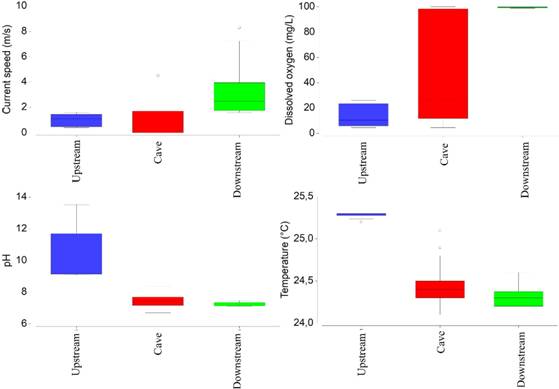
The values of dissolved oxygen, pH, water flow velocity, and temperature varied among the environments analyzed, including between the upstream and downstream external sites (Appendix 1). A progressive increase in mean current velo city and dissolved oxygen concentrations was observed from upstream to downstream. In contrast, pH and temperature exhibited a decreasing trend along the same gradient (Fig. 2). The physicochemical variables that showed statistically significant differences among the upstream, cave, and downstream regions are summarized in Table 1.
Means and standard deviations of physicochemical water variables measured in a karst stream with a subterranean section (Lapa do Brejal). The box extends from the first to the third quartile. The line in the box is the median. The whiskers are the min and max values.
Results of Mann-Whitney U tests comparing physicochemical water parameters (current speed, dissolved oxygen, pH, and temperature) and benthic macroinvertebrate species richness among upstream (UP), cave (hypogean), and downstream (DW) sections of a fluviokarst stream. Values represent mean values for each section. (U) Mann-Whitney test statistic, (Z) standardized test statistic, (p) significance level, (*) statistically significant differences (p ≤ 0.05), (N) number of samples in each section.
Dissolved oxygen concentrations exhibited substantial variability, ranging from 4.6 mg/L to 100.0 mg/L. The highest values (>95.0 mg/L) were recorded downstream of the cave and at the four innermost sampling points within Brejal Cave, progressing from downstream to upstream.
Flow velocity ranged from 0.0 m/s to 8.3 m/s. Velocities exceeding 3.5 m/s were recorded at the resurgence of the Peruaçu River, in a segment characterized by large collapsed blocks, as well as in the river’s secondary channel and after the confluence of both branches. All other measurements were below 3.0 m/s, and the majority of sampling points within the cave recorded a flow velocity of 0.0 m/s, indicating extremely slow water movement in the subterranean stretch of the Peruaçu River.
Water temperature exhibited a narrow range of variation (1.2 °C) across sampling points. The highest temperature (25.3 °C) was observed at four upstream locations, while the lowest (24.1 °C) was recorded in the river’s secondary branch. Downstream of the confluence, temperature values remained relatively stable. Values of pH ranged from 6.7 to 13.5, with the highest readings observed upstream. Notably, the highest pH value was measured at the point nearest the cave entrance, adjacent to the sinkhole where the Peruaçu River enters the cave system.
Variations in the structure of the benthic community
A total of 744 individuals, representing 52 morphospecies, were recorded across the sampled regions. The most morphospecies-rich groups were Diptera (14 morphospecies), Acari (10), and Trichoptera (7), followed by Ephemeroptera (4), Hemiptera (4), Coleoptera (3), Oligochaeta (3), Crustacea (2), Odonata (2), Mollusca (1), Nematoda (1), and Platyhelminthes (1). Five morphospecies were found exclusively within the cave environment (Fig. 5); however, none exhibited troglomorphic features indicative of strict adaptation to subterranean habitats.
Figures 3-5 provide an overview of species composition, spatial distribution, abundance, and mean species richness across the upstream, cave, and downstream regions. Among these regions, the upstream area of Brejal Cave exhibited the highest mean species richness, whereas the downstream region recorded the greatest total abundance. Statistically significant differences in species richness were observed between the upstream and cave regions, as well as between the downstream and cave regions (Table 1).

Overview of species composition, spatial distribution, abundance, and mean species richness: (3) Total taxonomic richness of benthic macroinvertebrates observed in the karst stream with a subterranean section of Brejal Cave. (4) Mean richness of benthic invertebrates observed among sampling sites in a karst stream with upstream sections (three samples), subterranean section (Lapa do Brejal, seven samples), and downstream sections (three samples) in the Peruaçu River Valley. The box extends from the first to the third quartile. The line in the box is the median. The whiskers are the min and max values. (5) Shadeplot depicting the composition and distribution of abundance of morphotypes observed in a karst stream with a subterranean section (Lapa do Brejal) in the Peruaçu River Valley. Sequence of morphotype names: Turbellaria sp. 1, Nematoda sp. 1, Oligochaeta sp. 1, Oligochaeta sp. 2, Oligochaeta sp. 3, Gastropoda sp. 1, Copepoda sp. 1, Ostracoda sp. 1, Hydracarina sp. 1, Hydracarina sp. 2, Hydracarina sp. 3, Hydracarina sp. 4, Hydracarina sp. 5, Hydracarina sp. 6, Hydracarina sp. 7, Hydracarina sp. 8, Pasitengona sp. 6, Oribatida sp. 3, Elmidae sp. 1, Elmidae sp. 2, Coleoptera sp. 3, Diptera sp. 4, Diptera sp. 6, Diptera sp. 7, Diptera pupa sp. 1, Diptera pupa sp. 3. Ceratopogonidae sp. 1, Chironomidade sp. 1, Chironomidade sp. 2, Chironomidade sp3, Chironomidade sp. 4, Chironomidade sp. 5, Chironomidade sp6, Baetidae sp. 1, Baetidae sp. 2, Trichorythidae sp. 1, Trichorythidae sp. 2, Hemiptera sp. 1, Hemiptera sp. 3, Naucoridade sp. 1, Naucoridae sp. 2, Odonata sp. 1, Odonata sp. 2, Trichoptera sp. 1, Trichoptera sp. 2, Trichoptera sp. 4, Trichoptera sp. 6, Trichoptera sp. 7, Hydropsychidade sp. 5, Hydropsychidade sp. 3.
Community composition also varied markedly among regions. In the upstream section, Diptera dominated the assemblage, comprising 50.4% of all individuals, of which Ceratopogonidae represented 71%. Other prominent taxa included Hydracarina (12.9%) and Trichoptera (11.6%). In the downstream region, species abundance was more evenly distributed, with no single taxon being dominant. The most frequent groups were Diptera (35.7%), Coleoptera (29.8%), and Trichoptera (11.6%).
The benthic community within the cave was compositionally distinct from those of the surface environments, with a notable dominance of Annelida (Oligochaeta), accounting for 48.5% of the individuals collected. Diptera and Coleoptera were also prevalent in the cave, comprising 18.8% and 12.5% of the sampled individuals, respectively (Fig. 5).
Similarity analyses revealed distinct faunal assemblages among the sampled regions. Quantitative similarity between sampling stations across the upstream, cave, and downstream environments was generally low (<50%), with the highest similarity observed between upstream and downstream communities. The ANOSIM analysis (R = 0.45, p = 0.02) identified two significantly distinct groups, effectively separating epigean and cave-associated fauna (Fig. 6), as shown by the clustering pattern and the associated bootstrap dispersion cloud.

Metric multidimensional scaling (MDS) showing group separation and dispersion around the mean (bootstrap ▲) for environmental variables (A) and fauna composition (Bray-Curtis similarity) (B) between epigean and hypogean environments in the Peruaçu River Valley. Blue colors represent the epigean environment, and green colors represent the hypogean environment.
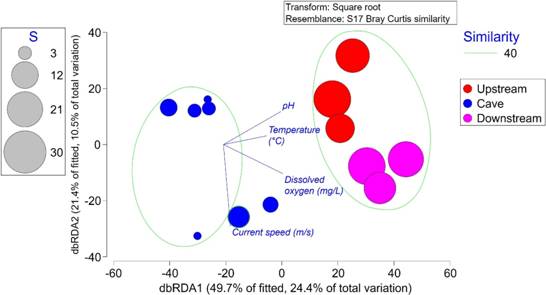
Distance-based linear modeling indicated that dissolved oxygen concentration was the most significant environmental predictor of species composition (R2 = 0.143, AICc = 108.7, Pseudo-F = 1.84, p = 0.03), as shown by the variation in the distance-based redundancy analysis. The dbRDA model accounted for 70% of the explained variation and captured 35% of the total variation in biological data across the first two axes (Fig. 7).

Distance-based redundancy analysis (dbRDA) relating environmental variables to benthic macroinvertebrate community composition in a karst stream with a subterranean section (Lapa do Brejal), Peruaçu River Valley. Samples are colored by stream section (upstream, cave, downstream), and bubble size is proportional to species richness (S). Arrows represent environmental variables. The green contour indicates the 40% Bray-Curtis similarity level, highlighting groups of samples with similar faunal composition.
In contrast, species richness was best explained by a combination of dissolved oxygen and pH, as indicated by the final DistLM model (cumulative R2 = 0.843, AICc = 36.872, p = 0.002), highlighting the importance of these physicochemical variables in structuring benthic diversity across the sampled gradient.
Assessment of sampling sufficiency
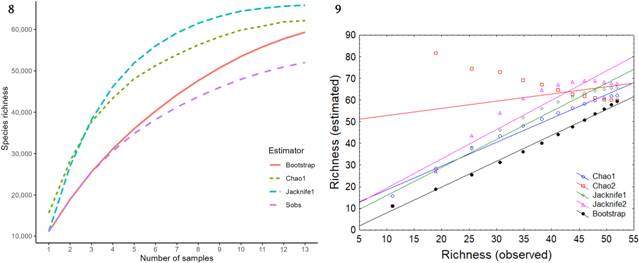
Species accumulation curves exhibited a slight tendency toward stabilization, with a maximum of 52 observed morphospecies across the 13 sampling stations, corresponding to 77% of the richness estimated by the Jackknife 2 estimator (67.6 species). The relationship between observed and estimated richness values is illustrated in Figs 8 and 9. Among the estimators evaluated, Chao 1, Jackknife 1, Jackknife 2, and Bootstrap showed the lowest residuals and bias, as well as the highest regression slopes (β) and coefficients of determination (r2): Chao 1 (β = 0.99, p < 0.001, r2 = 0.98), Jackknife 1 (β = 0.98, p < 0.001, r2 = 0.96), Jackknife 2 (β = 0.94, p < 0.001, r2 = 0.88), and Bootstrap (β = 0.99, p < 0.001, r2 = 0.99). In contrast, the Chao 2 estimator showed markedly lower performance (β = 0.256, p = 0.39, r2 = 0.065; Appendix 2).
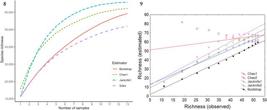
Relationship between observed and estimated richness values: (8) Observed species richness (Sobs), species accumulation curves based on five richness estimators, and associated measures of sampling bias and imprecision, following Brose et al. (2003). (9) Comparison of observed richness (Sobs) with species accumulation estimated by five different richness estimators, and assessment of sample precision through linear regression.
Rare species represented a substantial proportion of the dataset: 17% were singletons, 7% were doubletons, 28.8% occurred in only one sampling unit (uniques), and 26.9% occurred in only two sampling units (duplicates). In contrast, 45% of the species were recorded in three to ten sampling units.
DISCUSSION
Overall, our results revealed pronounced environmental and biological differentiation along the stream-cave gradient. Physicochemical conditions varied significantly among upstream, subterranean, and downstream sections, with dissolved oxygen and flow velocity emerging as the primary environmental gradients. A total of 52 morphospecies were recorded, with species richness highest in upstream reaches and total abundance greatest downstream, whereas the cave assemblage was compositionally distinct and largely dominated by Oligochaeta. Faunal similarity among sections was generally low, and multivariate analyses identified dissolved oxygen as the main predictor of community composition, while species richness was best explained by the combined effects of dissolved oxygen and pH. Species accumulation curves indicated that sampling efforts captured most of the estimated diversity, despite the high proportion of rare species observed.
The dominance of arthropod taxa (particularly insects) was anticipated, as these groups are among the most diverse and abundant components of aquatic invertebrate communities globally, in both surface and subterranean environments (Allan and Castillo 2007, Taylor and Ferreira 2012, Pellegrini et al. 2018). However, the total number of morphospecies recorded in any given study is influenced by the regional species pool, sampling effort, and local ecological conditions. In general, higher species richness is expected in regions with a more diverse regional pool and greater habitat heterogeneity (Allan and Castillo 2007).
Among the key ecological drivers, hydrological variability-particularly changes in water volume from headwaters to downstream reaches-has long been recognized as a primary factor structuring benthic assemblages in lotic ecosystems (Townsend et al. 1987, Wood et al. 2001, Smith et al. 2003, Righi-Cavallaro et al. 2010). In addition, water flow velocity and temperature are critical determinants of faunal distribution patterns in cave streams (Taylor and Ferreira 2012, Pellegrini et al. 2018). These variables directly influence fundamental ecological processes, including dissolved oxygen availability, organic matter deposition, and sediment accumulation on the streambed (Statzner and Higler 1986), thereby shaping species composition and spatial zonation along riverine gradients. Recent evidence further suggests that dissolved oxygen concentrations can vary systematically within subterranean systems as a result of differences in recharge sources and surrounding land-use practices, such as agricultural activities (Kamal et al. 2025), potentially enhancing spatial heterogeneity in cave streams. In the present study, dissolved oxygen concentration was the most important predictor of variation in species composition, while species richness was influenced by a combination of dissolved oxygen and water pH. These findings are consistent with previous studies that emphasize the central role of oxygen as a limiting factor for the survival and distribution of benthic macroinvertebrates, particularly in subterranean environments where water exchange and flow may be locally reduced, potentially restricting oxygen availability (Boulton et al. 2010, Dole-Olivier 2011). Values of pH, in turn, directly affect the availability of nutrients and metals in the water, influencing physiological processes and the tolerance of different taxa (Jacobsen and Encalada 1998).
The physical and chemical characteristics of streams are strongly shaped by geological and environmental factors that regulate water composition (Wetzel 2001, Allan and Castillo 2007). In the present study, pH and dissolved oxygen varied significantly among upstream, cave, and downstream sections, reflecting the combined influence of local geology and hydrological conditions along the stream-cave gradient. Higher pH values recorded in upstream reaches, particularly near the cave entrance, likely result from carbonate weathering typical of karst systems. Such physicochemical variation is known to affect aquatic communities, as low ionic concentrations and acidic conditions can reduce faunal richness, especially among environmentally sensitive taxa (Rundle et al. 1993, Dangles and Guérold 1999). Consistent with these patterns, species richness in our study was partly explained by pH in combination with dissolved oxygen, underscoring the importance of water chemistry in structuring benthic assemblages.
Dissolved oxygen emerged as the primary predictor of species composition in our system, consistent with studies demonstrating a positive relationship between oxygen availability and benthic richness (Strayer 1983). Although lotic environments generally exhibit higher rates of oxygen renewal than lentic systems due to continuous water flow, oxygen availability can vary substantially at local scales as a function of hydrodynamics, substrate characteristics, and organic matter accumulation. In stream ecosystems, oxygen may be periodically replenished through substrate disturbance, even in reaches with high organic loads and elevated temperatures (Owens et al. 1964).
Within the cave section of the stream, however, reduced flow velocity and the predominance of fine substrates likely limited substrate disturbance and constrained oxygen diffusion into the benthic layer, thereby favoring taxa tolerant of hypoxic conditions, such as Oligochaeta, which dominated the subterranean assemblage. Dissolved oxygen dynamics are further regulated by temperature, channel morphology, and flow velocity, which together control gas exchange with the atmosphere (Owens et al. 1964, Wetzel 2001). Consistent with this framework, current velocity and dissolved oxygen were strongly associated with the main ordination gradient in the dbRDA, clearly separating cave sites from surface reaches. Upstream and downstream sections characterized by higher flow velocity and turbulence generally exhibited elevated dissolved oxygen concentrations, whereas the cave stretch (dominated by slow-flowing or stagnant reaches) was associated with reduced oxygen availability and a distinct community composition. Collectively, these findings reinforce the role of hydrological and physicochemical gradients in structuring benthic macroinvertebrate communities along the stream-cave continuum, as steeper velocity gradients reduce the risk of hypoxia by enhancing oxygen diffusion in lotic systems (Owens et al. 1964).
In this context, the higher average species richness observed in the upstream region, despite its lower dissolved oxygen concentrations compared to the cave environment, suggests that resource availability may play a critical role in structuring macroinvertebrate communities. The elevated richness and abundance recorded in epigean habitats are likely attributable to increased inputs of allochthonous organic matter from riparian vegetation, including leaf litter and woody debris (Simões et al. 2013, Pacioglu et al. 2021). As Allan and Castillo (2007) note, such materials, in combination with physical features like branches, trunks, and rock formations, contribute to the formation of microhabitats that support a wide range of species with diverse ecological requirements.
Substrate heterogeneity is widely recognized as a key factor influencing species richness in lotic ecosystems, although it was not directly quantified in this study. Takeda et al. (1997) emphasized that invertebrate colonization within river channels is strongly mediated by sediment grain size and the availability of organic matter. Similarly, the River Continuum Concept (Vannote et al. 1980) highlights how longitudinal variation in habitat complexity and environmental conditions promotes species turnover and sustains high levels of biodiversity. Together, these processes may help explain the observed variation in species richness and should be explicitly considered in future investigations. Regarding taxonomic composition, a similar dominance of certain groups in the upstream and downstream regions was anticipated, given the comparable structural characte ristics of both areas. These include well-preserved riparian vegetation and substantial inputs of allochthonous organic matter, factors known to foster similar environmental conditions and, consequently, comparable benthic communities (Vannote et al. 1980, Allan and Castillo 2007).
The high frequency of Ceratopogonidae (Diptera) in the upstream region may reflect the influence of water retention caused by collapsed blocks at the cave entrance, which create conditions resembling those of lentic systems, such as reduced flow velocity, elevated water temperatures, and increased concentrations of organic matter. These environmental features correspond to the low dissolved oxygen levels recorded in this area. Ceratopogonidae are typical predators of lentic habitats enriched with decomposing organic material (Taylor and Ferreira 2012), which likely explains their local dominance. In contrast, although Hydracarina and Trichoptera are also predatory, they were less abundant. These groups generally require running, well-oxygenated, and clean waters to thrive (Pellegrini et al. 2018). Their reduced presence may be attributed to the altered hydrological conditions created by the blockage of flow at the cave entrance, rendering the environment less suitable for these taxa.
In the downstream region, taxonomic composition did not reflect the dominance of a single group. The presence of Diptera, Coleoptera, and Trichoptera aligns well with the environmental characteristics observed (high current velocity, elevated dissolved oxygen levels, and intermediate pH) indicative of a balanced lotic system (Allan and Castillo 2007). These taxa commonly occur in higher densities in stream sections characterized by riparian vegetation and consolidated substrates (Taylor and Ferreira 2012), both of which were present in the studied reach.
In contrast, the benthic community inside the cave exhibited a markedly different composition, dominated by Oligochaeta. This pattern is consistent with the detritivorous habits of this group and its known association with environments characterized by low dissolved oxygen concentrations (Callisto et al. 2000). The dominance of Oligochaeta may also be attributed to their physiological plasticity and ability to survive under extreme environmental conditions, traits commonly observed in taxa inhabiting oligotrophic subterranean systems (Dole-Olivier 2011). The scarcity of autochthonous resources in cave environments likely limits the occurrence of functional feeding groups such as scrapers, collectors, and predators, thereby restricting the diversity of taxa capable of persisting under such conditions (Boulton et al. 2010). Consequently, more stress-tolerant organisms tend to dominate the assemblage, benefitting from both low resource competition and reduced predation pressure (Strayer 1983).
In terms of aquatic community structure, this study highlights the influence of the hypogean compartment (Lapa do Brejal Cave) on the spatial continuum of the Peruaçu River, directly affecting faunal composition. As noted by Ratton et al. (2018), caves can function as ecological filters, limiting the downstream dispersal of many species originating from upstream epigean habitats. This filtering effect, driven by distinct physicochemical conditions and a pronounced decline in the input of allochthonous organic material, contributes to the distinct community composition observed between the epigean and hypogean sections.
The relatively low sampling bias observed among richness estimators that emphasize species rarity (e.g., uniques and duplicates) was expected, given the low frequency of rare species in the present dataset. These estimators operate on the principle that if species occurring only once (uniques) or twice (duplicates) are no longer being added with continued sampling, the likelihood of detecting additional rare species is low. Once all species are represented in at least two samples, the rate of species accumulation tends to plateau (Magurran 2004). However, aquatic environments, including those within cave systems, can exhibit pronounced microhabitat heterogeneity at local scales, associated with structural features such as fissures, fallen blocks, and spatial variation in substrate composition and resource availability. Although cave streams are generally more physically homogeneous than comparable epigean systems, localized habitat patches may still occur. This fine-scale heterogeneity can restrict the dispersal or detectability of rare species, thereby limiting their representation in individual samples (Pellegrini et al. 2018).
Obtaining a complete inventory of species within a local assemblage remains a considerable challenge. Comprehensive species lists are rarely the primary objective of ecological studies, which instead often emphasize particular taxonomic groups or focus on ecological processes involving the most abundant or functionally important species (Magurran 2004, Bicknell et al. 2014). These inherent sampling constraints are especially pronounced in subterranean aquatic ecosystems, where rare species are often difficult to detect (Pacheco et al. 2021). Despite these limitations, our study provides essential baseline information on community composition in an underexplored environment, contributing to the reduction of existing knowledge gaps. Our findings underscore that transitions into cave environments function as strong ecological filters. Consequently, the protection of these karst ecosystems requires the integrated conservation of both the cave system and its surrounding surface environments, as alterations in epigean areas can directly disrupt resource inputs and degrade the ecological integrity of the subterranean ecosystem.
ACKNOWLEDGMENTS
We thank the Parque Nacional Cavernas do Peruaçu for its support during the field research.
LITERATURE CITED
- Alarsa C (2004) Plano de Manejo do Parque Nacional Cavernas do Peruaçu - MG. Ibama, FIAT, CSD-GEOKLOCK e Engenharia Ambiental Ltda, São Paulo, vol. 1, 185 pp.
- Allan JD, Castillo MM (2007) Stream Ecology: Structure and Function of Running Waters. Springer Nature, Switzerland, 2nd ed, 450 pp.
-
Bicknell JE, Struebig MJ, Edwards DP, Davies ZG (2014) Improved timber harvest techniques maintain biodiversity in tropical forests. Current Biology 24(23): R1119-R1120. https://doi.org/10.1016/j.cub.2014.10.067
» https://doi.org/10.1016/j.cub.2014.10.067 -
Bonacci O, Pipan T, Culver DC (2009) A framework for karst ecohydrology. Environmental Geology 56: 891-900. https://doi.org/10.1007/s00254-008-1189-0
» https://doi.org/10.1007/s00254-008-1189-0 -
Borisov RR, Chertoprud ES, Palatov DM, Novichkova AA (2021) Variability in macrozoobenthic assemblages along a gradient of environmental conditions in the stream water of karst caves (Lower Shakuranskaya Cave, western Caucasus). Subterranean Biology 39: 107-127. https://doi.org/10.3897/subtbiol.39.65733
» https://doi.org/10.3897/subtbiol.39.65733 - Boulton AJ, Datry T, Kasahara T, Mutz M, Stanford JA (2010) Ecology and management of the hyporheic zone: stream-groundwater interactions of running waters and their floodplains. Journal of the North American Benthological Society 29(1): 26-40
-
Brose U, Martinez ND, Williams RJ (2003) Estimating species richness: sensitivity to sample coverage and insensitivity to spatial patterns. Ecology 84(9): 2364-2377. https://doi.org/10.1890/02-0558
» https://doi.org/10.1890/02-0558 -
Callisto M, Goulart M, Barbosa FAR, Rocha O (2000) Biodiversity assessment of benthic macroinvertebrates along a reservoir cascade in the lower São Francisco River (Northeastern Brazil). Brazilian Journal of Biology 65(5): 527-535. https://doi.org/10.1590/S1519-69842005000200006
» https://doi.org/10.1590/S1519-69842005000200006 - Clarke KR, Gorley RN (2015) PRIMER v7: User Manual/Tutorial. PRIMER-E, Ltd., Plymouth.
- Clarke KR, Gorley RN, Somerfield PJ, Warwick RM (2014) Change in marine communities: an approach to statistical analysis and interpretation. Primer-E, Plymouth, 3th ed, 262 pp.
- Culver DC (1982) Cave life: Evolution and Ecology. Harvard University Press, London, 189 pp.
-
Culver DC, Pipan T (2009) The biology of caves and other subterranean habitats. Acta Carsologica 38: 309-311. https://doi.org/10.3986/ac.v38i2-3.168
» https://doi.org/10.3986/ac.v38i2-3.168 - Dangles O, Guerold F (1999) Impact of headwater stream acidification on the trophic structure of macroinvertebrate communities. International Review of Hydrobiology 84(3): 287-297.
-
Dole-Oliver MJ, Malard F, Martin D, Lefébure T, Gibert J (2009) Relationships between environmental variables and groundwater biodiversity at the regional scale. Freshwater Biology 54: 797-813. https://doi.org/10.1111/j.1365-2427.2009.02184.x
» https://doi.org/10.1111/j.1365-2427.2009.02184.x -
Dole-Olivier MJ (2011) The hyporheic refuge hypothesis reconsidered: a review of hydrological aspects. Marine and Freshwater Research 62(11): 1281-1302. https://doi.org/10.1071/MF11084
» https://doi.org/10.1071/MF11084 -
Doretto A, Piano E, Larson CE (2020) The River Continuum Concept: lessons from the past and perspectives for the future. Canadian Journal of Fisheries and Aquatic Sciences 77(11): 1853-1864. https://doi.org/10.1139/cjfas-2020-0039
» https://doi.org/10.1139/cjfas-2020-0039 - Ferreira RL, Martins RP (1998) Diversity and Distribution of Spiders Associated with Bat Guano Piles in Morrinho Cave (Bahia State, Brazil). Diversity and Distributions 4(5/6): 235-241.
- Grubbs SA, Taylor JM (2004) The influence of flow impoundment and river regulation on the distribution of riverine macroinvertebrates at Mammoth Cave National Park, Kentucky, U.S.A. Hydrobiologia 520: 19-28.
-
Howarth FG (1983) Ecology of cave arthropods. Annual Review of Entomology 28: 365-389. https://doi.org/10.1146/annurev.en.28.010183. 002053
» https://doi.org/10.1146/annurev.en.28.010183. 002053 -
Hynes HBN (1975) The stream and its valley. Verhandlungen der Internationalen Vereinigung für Theoretische und Angewandte Limnologie 19(1): 1-15. https://doi.org/10.1080/03680770.1974.11896033
» https://doi.org/10.1080/03680770.1974.11896033 - Jacobsen D, Encalada A (1998) The macroinvertebrate fauna of Ecuadorian highland streams in the wet and dry season. Archiv für Hydrobiologie 142(1): 53-70.
-
Kamal K, Spellman P, Kim S (2025) Cave Diving Documents Spatial and Temporal Water Quality Variability in a Phreatic, Karst Cave System. Groundwater 63(5): 685-703. https://doi.org/10.1111/gwat.70006
» https://doi.org/10.1111/gwat.70006 -
Legrand HE, Stringfield VT (1973) Karst hydrology - A review. Journal of Hydrology 20(2): 97-120. https://doi.org/10.1016/0022-1694(73)90034-6
» https://doi.org/10.1016/0022-1694(73)90034-6 -
Liu W, Zhou C, Burnet JE, Brancelj A (2017) The effect of hydrological and hydrochemical parameters onthe microdistribution of aquatic fauna in drip water in the Velika Pasica Cave, Central Slovenia. Ecohydrology 10: e1835. https://doi.org/10.1002/eco.1835
» https://doi.org/10.1002/eco.1835 - Magurran AE (2004) Measuring Biological Diversity. Blackwell Publishing, Oxford, 256 pp.
-
Malard F, Hervan F (1999) Oxygen supply and the adaptations of animals in groundwater. Freshwater Biology 41: 1-30. https://doi.org/10.1046/j.1365-2427.1999.00379.x
» https://doi.org/10.1046/j.1365-2427.1999.00379.x -
Martins VM, Ferreira RL (2021) Environmental factors structuring the assemblage of aquatic insects in an epigean and hypogean stretch of a Neotropical karst stream. Marine Freshwater Research 72(7): 1027-1032. https://doi.org/10.1071/MF20229
» https://doi.org/10.1071/MF20229 - Monzón A, Casado C, Montes C, Jalón DG (1991) Organización funcional de las comunidades de macroinvertebrados acuáticos de un sistema fluvial de montaña (Sistema Central, Rio Manzanares, Espana). Lirnnetica 7: 97-112.
- Owens M, Edwards R, Gibbs J (1964) Some reaeration studies in streams. International Journal of Air and Water Pollution 8(8/9): 469-486.
-
Pacheco GSM, Pellegrini TG, Ferreira RL (2021) Cave lithology influencing EPT (Ephemeroptera, Plecoptera, Trichoptera) assemblages and habitat structure in south-eastern Brazil. Marine and Freshwater Research 72(10): 1546-1552. https://doi.org/10.1071/MF20359
» https://doi.org/10.1071/MF20359 -
Pacioglu O, Amărioarei A, Duțu LT, Plăvan G, Ițcuș C, et al. (2021) The structure and functionality of communities and food webs in streams along the epigean-hypogean continuum unifying ecological stoichiometry and metabolic theory of ecology. Aquatic Sciences 83: 63. https://doi.org/10.1007/s00027-021-00815-6
» https://doi.org/10.1007/s00027-021-00815-6 - Paran F, Malard F, Mathieu J, Lafont M, Galassi DMP, Marmonier P (2004) Distribution of groundwater invertebrates along an environmental gradient in a shallow water-table aquifer. In: Symposium on World Subterranean Biodiversity, CNRS, Villeurbanne, France, ISBN: 2-9525344-0-3.
-
Pellegrini TG, Pompeu PS, Ferreira RL (2018) Cave benthic invertebrates in south-eastern Brazil: are there ‘key’ factors structuring such communities? Marine and Freshwater Research 69(11): 1762-1770. https://doi.org/10.1071/MF18025
» https://doi.org/10.1071/MF18025 - Piló LB (1997) Caracterização regional do carste do vale do rio Peruaçu. O Carste 9(2): 22-29.
- Piló LB, Rubbioli E (2002) Cavernas do vale do Rio Peruaçu. Januária - Itacarambi, MG. In: Schobbenahus C, Campo DA, Queiroz ET, Winge M, Berbert-Born MLC (Eds) Sítios Geológicos e Paleontológicos do Brasil. DNPM-CPRM, 453-460.
-
Ratton P, Ferreira RL, Pompeu PS (2018) Fish community of a small karstic Neotropical drainage and its relationship with the physical habitat. Marine and Freshwater Research 69(8): 1312-1320. https://doi.org/10.1071/MF17167
» https://doi.org/10.1071/MF17167 -
Reid DJ, Scarsbrook MR, Wright-Stow AE, Houte-Howes KSS van, Joy K (2012) Water quality and benthic macroinvertebrate communities in karst landscapes of North Island, New Zealand: influences of water sources, habitat type and anthropogenic disturbances. New Zealand Journal of Marine and Freshwater Research 46(2): 263-277. https://doi.org/10.1080/00288330.2011.644856
» https://doi.org/10.1080/00288330.2011.644856 - Righi-Cavallaro KO, Roche KF, Froehlich O, Cavallaro MR (2010) Structure of macroinvertebrate communities in riffles of a Neotropical karst stream in the wet and dry seasons. Acta Limnologica Brasiliensia 22: 306-316.
- Rundle SD, Jenkins A, Ormerod SJ (1993) Macroinvertebrate communities in streams in the Himalaya, Nepal. Freshwater Biology 30: 169-180.
-
Scarsbrook MR, Townsend CR (1993) Stream community structure in relation to spatial and temporal variation: a habitat templet study of two contrasting New Zealand streams. Freshwater Biology 29(3): 395-410. https://doi.org/10.1111/j.1365-2427.1993.tb00774.x
» https://doi.org/10.1111/j.1365-2427.1993.tb00774.x -
Schneider K, Christman MC, Fagan WF (2011) The influence of resource subsidies on cave invertebrates: results from an ecosystem-level manipulation experiment. Ecology 92(3): 765-776. https://doi.org/10.1890/10-0157.1
» https://doi.org/10.1890/10-0157.1 -
Simões LB, dos Santos Ferreira TC, Bichuette ME (2013) Aquatic biota of different karst habitats in epigean and subterranean systems of Central Brazil - visibility versus relevance of taxa. Subterranean Biology 11: 55-74. https://doi.org/10.3897/subtbiol.11.5981
» https://doi.org/10.3897/subtbiol.11.5981 - Smith H, Wood PJ, Gunn J (2003) The influence of habitat structure and flow permanence on invertebrate communities in karst spring systems. Hydrobiologia 510: 53-66.
- Sokal RR, Rohlf FJ (1995) Biometry: The Principles and Practice of Statistics in Biological Research. W.H. Freeman and Company, New York, 3rd ed., 880 pp.
- Souza-Silva M, Martins RP, Ferreira RL (2011) Trophic dynamics in a neotropical limestone cave. Subterranean Biology 9: 127-138.
-
Sponseller RA, Heffernan JB, Fisher SG (2013) On the multiple ecological roles of water in rivernetworks. Ecosphere 4(2): 17. https://doi.org/10.1890/ES12-00225.1
» https://doi.org/10.1890/ES12-00225.1 - Statzner B, Higler B (1986) Stream hydraulics as a major determinant of benthic invertebrate zonation patterns. Freshwater Biology 16(1): 127-139.
- Strayer DL (1983) The effects of surface geology and stream size on fresh-water mussel (Bivalvia: Unionidae) distribution in southeastern Michigan, U.S.A. Freshwater Biology 13: 253-264.
- Takeda AM, Shimizu GY, Higuti J (1997) Variações espaço-temporais da comunidade zoobêntica. In: Vazzoler AEAM, Agostinho AA, Hahn NS (Eds) A planície da inundação o alto Rio Paraná: aspectos físicos, biológicos e socioeconômicos. Universidade Estadual de Maringá, Maringá, 157-177.
- Taylor ELS, Ferreira RL (2012) Determinants on the structure of an aquatic invertebrate community in a neotropical limestone cave. Revista Brasileira de Espeleologia 2: 1.
-
Townsend CR, Hildrew AG, Schofield K (1987) Persistence of stream invertebrate communities in relation to environmental variability. Journal of Animal Ecology 56(2): 597-613. https://doi.org/10.2307/5071
» https://doi.org/10.2307/5071 -
Vannote RL, Minshall GW, Cummins KW, Sedell JR, Cushing CE (1980) The River Continuum Concept. Canadian Journal of Fisheries and Aquatic Sciences 37(1): 130-137. https://doi.org/10.1139/f80-017
» https://doi.org/10.1139/f80-017 - Wantzen KM, Ramírez A, Winemiller KO (2006) New vistas in Neotropical stream ecology-Preface. Journal of the North American Benthological Society 25(1): 61-65.
- Wetzel RG (2001) Limnology: lake and river ecosystems. Academic Press, New York, 1006 pp.
- Wood PJ, Agnew MD, Petts GE (2001) Hydro-ecological variability within a groundwater dominated stream. Hydro-ecology: Linking Hydrology and Aquatic Ecology 266: 151-160.
ADDITIONAL NOTES
- ZooBank register
-
Data Availability Statement
All data generated and/or analyzed are included in this article.
-
Funding
This study was financed in part by the Conselho Nacional de Desenvolvimento Científico e Tecnológico (CNPq). RLF and MSS acknowledge support from CNPq under grant numbers 302925/2022-8 and 303434/2025-0, respectively.
-
Ethical Statement
This study did not involve live vertebrate animals and therefore did not require approval by an ethics committee. Field activities were conducted under collection permits issued by SISBIO/ICMBio (permit no. 43593).
-
AI Statement
No generative artificial intelligence (AI) tools were used in the writing, analysis, or preparation of this manuscript.
-
How to cite this article
De Oliveira IPMR, Bueno AP, De Souza PE, Souza-Silva M, Ferreira RL (2026) Disrupting the environmental continuum: a Neotropical fluviokarst cave system. Zoologia X: Y. https://doi.org/10.1590/S1984-4689.v43.e25045
-
Published by
Sociedade Brasileira de Zoologia at Scientific Electronic Library Online - https://www.scielo.br/zool
Appendix 1
Appendix 2
All data generated and/or analyzed are included in this article.