Egg parasitoids of Leptoglossus stigma (Hemiptera: Coreidae) in Brazilian guava crops, with description of a new Neorileya species (Hymenoptera: Eurytomidae)
ABSTRACT
In guava orchards, Psidium guajava Linnaeus, 1753 (Myrtaceae), significant damage is caused by bugs of the genus Leptoglossus Guérin-Méneville, 1831 (Hemiptera: Coreidae). Identifying the diversity of parasitoid wasps associated with leaf-footed bug eggs, particularly Leptoglossus stigma (Herbst, 1784), is essential for recognizing natural enemies and developing sustainable pest control strategies. Between March 2003 and April 2004, 1,132 eggs of L. stigma were collected in a guava orchard in São Paulo, Brazil. Of these, 657 were parasitized by three species: a new species of Neorileya Ashmead, 1904 (Eurytomidae), Hadronotus vitripennis (Masner, 1983), and Hadronotus sp., (near H. pennsylvanicus, Scelionidae). We describe Neorileya kavatii Schoeninger & Costa, sp. nov. (Hymenoptera: Eurytomidae), which caused 70% mortality in field-collected egg masses. Morphological data, DNA-barcode sequences, and images of diagnostic characters are provided to characterize the new species. Finally, we discuss the potential of N. kavatii sp. nov. as a biological control agent.
KEYWORDS:
DNA-barcoding; leaf-footed bug; natural enemies; Rileyinae; taxonomy
INTRODUCTION
Guava, Psidium guajava Linnaeus (Myrtaceae), is a fruit species native to the Neotropics, currently cultivated across tropical and subtropical regions worldwide (Risterucci et al. 2005, Souza-Filho et al. 2022). In Brazil, this crop holds subs tantial economic relevance, contributing significantly to the national fruit production. In the 2023/24 harvest, national output reached 583 thousand tons, with an estimated gross value of $250.5 million (IBGE 2024). The guava production chain supplies both the fresh fruit market and the processing industry, which manufactures sweets, pulps, jellies, and other derivatives (Landau et al. 2020). The state of São Paulo ranks as the second-largest national producer, with an output of approximately 90,000 tons in 2022 (IBGE 2022).
A diverse complex of insect pests is associated with guava cultivation, causing damage to leaves, branches, trunks, flower buds, and fruits (Souza-Filho 2021, Souza-Filho et al. 2022). Among these, three species of leaf-footed bugs (Hemiptera: Coreidae) are particularly prominent: Leptoglossus gonagra (Fabricius, 1775), L. stigma (Herbst, 1784), and L. zonatus (Dallas, 1852) (Mitchell 2000, Fernandes et al. 2015). In the region of Campinas, state of São Paulo, L. stigma is the predominant species attacking the crop (Amaral and Cajueiro 1977, MFSF personal observation). These coreids inflict damage by piercing leaves, flower buds, and fruits with their mouthparts. The depth of the puncture and the subsequent damage are contingent upon the insect’s developmental stage: while small nymphs feed superficially, adults penetrate more deeply into the fruit tissues, resulting in necrosis and deformities. Furthermore, the mouthparts of these insects may harbor the yeast Eremothecium coryli Kurtzman, 1995 (Saccharomycetaceae), which can be transmitted to the host plant during feeding, inducing a range of symptoms typically associated with tissue discoloration (Ingels and Haviland 2014, Souza-Filho 2021, Souza-Filho et al. 2022).
Currently, guava has no officially registered phytosanitary products for the chemical control of Leptoglossus spp. (Souza-Filho 2021). Starting in 2002, the Integrated Fruit Production (IFP) program was implemented in guava crops in Campinas, Brazil, introducing major changes in the management of diseases and insects. The IFP mandates an ecologically safe agricultural production system that guarantees the quality of the food produced (Boller et al. 1999). Within this system, natural pest control mechanisms are emphasized. To intensify the action of pests’ natural enemies, one of the first steps is to know what these enemies are. In this case, the natural enemies are parasitoid wasps. Due to their relative host specificity, effectiveness in locating hosts, and capacity to reduce pest populations, egg parasitoids have shown promise as efficient biological control agents in agricultural settings (Abram et al. 2020).
Neorileya Ashmead, 1904 (Hymenoptera: Eurytomidae) is a New World genus of egg parasitoid wasps comprising six described species. They parasitize the eggs of true bugs, primarily Coreidae, Pentatomidae, and Reduviidae (Hemiptera), including serious pests of several economic important crops, such as rice and soybean (Gates 2008). In Brazil, several records of Neorileya species exist within agroecosystems parasitizing coreids and pentatomids: Neorileya albipes Girault, 1913 was documented parasitizing eggs of Edessa meditabunda (Fabricius, 1794) (Pentatomidae) in lettuce, Lactuca sativa Linnaeus, 1753 (Asteraceae) (Favetti et al. 2013); N. ashmeadi Crawford, 1913 attacks Spartocera dentiventris (Berg, 1884) (Coreidae) in tobacco, Nicotiana tabacum Linnaeus, 1753 (Solanaceae) in the Rio Grande do Sul state (Santos et al. 2001, Canto-Silva and Romanowski 2003); N. flavipes Ashmead, 1904, described from Pará state, parasitizes eggs of: (1) Nezara viridula (Linnaeus, 1758) and Diceraeus sp. (= Dichelops sp.) (Pentatomidae) in soybean, Glycine max (L.) Merrill (Fabaceae), (2) N. viridula in cowpea, Vigna unguiculata (L.) Walp. (Fabaceae), in Piauí state (Paz-Neto et al. 2015); and (3) Spartocera lativentris Stål, 1870 on Solanum sisymbriifolium Lamark, 1794 in Porto Alegre, Rio Grande do Sul (Becker and Prato 1982); finally, an unidentified species, Neorileya sp., was recorded parasitizing eggs of Euschistus heros (Fabricius, 1798) and Piezodorus guildinii (Westwood, 1837) (Pentatomidae) in soybean fields in Mato Grosso do Sul state (Godoy et al. 2005).
Furthermore, Hadronotus Förster, 1856 (Hymenoptera: Scelionidae) is a cosmopolitan and diverse genus, whose species are egg parasitoids of various coreid hosts, especially Hadronotus pennsylvanicus (Ashmead, 1893), previously reported as Gryon pennsylvanicum Ashmead, 1893, that has been the focus of many biocontrol programs for agricultural pests, such as Leptoglossus spp. in North America (Masner 1983, Maltese et al. 2012, Boyle et al. 2024) and in Japanese Islands on squash (Yasuda 1998). In Brazil, we have the association of Hadronotus sp. and H. vitripennis (Masner, 1983) with eggs of Leptoglossus zonatus (Dallas, 1852) (Souza and Amaral-Filho 1999, Perioto et al. 2019), the latter species also being recorded in eggs of Thlastocoris laetus Mayr, 1866 (Coreidae) (Oliveira et al. 2023); and H. brasiliensis Costa-Lima, 1928 reported in eggs of an indeterminate coreid (Costa-Lima 1928).
Knowledge of the diversity of parasitoid wasps associated with true bug eggs, particularly those attacking the genus Leptoglossus, is crucial for identifying natural enemies and developing sustainable pest control strategies. In this study, we surveyed the parasitoid wasp fauna associated with eggs of the leaf-footed bug, L. stigma, in a guava orchard in Campinas, São Paulo, Brazil. Using an integrative taxonomic approach, we describe a new species of Neorileya and provide parasitoidism data from 50 egg masses of L. stigma collected between March and April 2004. Additionally, we discuss the potential of this new species for future biological control programs in guava orchards.
MATERIAL AND METHODS
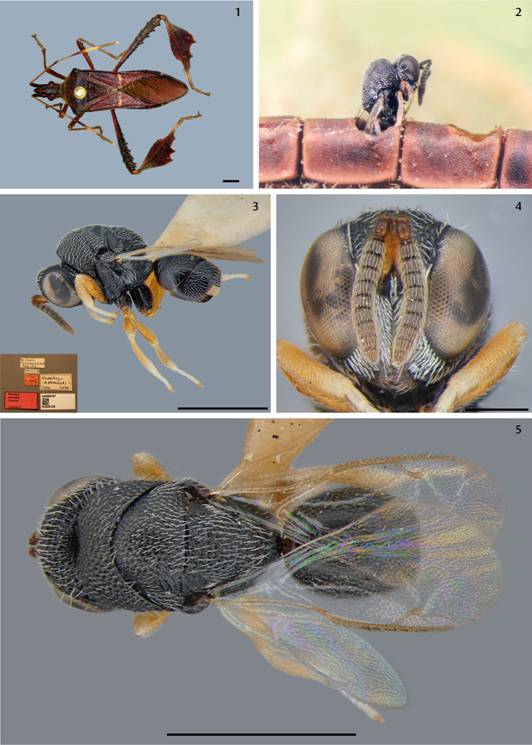
Weekly collections of guava leaves and stems with eggs masses of L. stigma (Fig. 1) were carried out in commercial guava crops (-22.9947°S, -47.1033°W) in the municipality of Campinas, São Paulo, between March 2003 and April 2004. The egg masses were taken to the Laboratory of Biological Control, at Instituto Biológico, Campinas, reared in glass tubes and maintained in a climate-controlled chamber at 25 °C, relative humidity above 60%, and a 12-hour L:D schedule until the emergence of leaf-footed bugs or their parasitoids. After the emergence of the parasitoid wasps (Fig. 2), they were captured with an entomological aspirator and preserved in 70% ethanol. In addition, adults of leaf-footed bugs were collected from the guava orchard and identified. Therefore, the association of eggs and adults was circumstantial, considering that only adults L. stigma were found in the guava orchard. Eggs and adults of the leaf-footed bug were identified using general and taxonomic references available (e.g., Allen 1969, Amaral and Cajueiro 1977, Fernandes and Grazia 1992, Mitchell 2000, Brailovsky 2014, Fernandes et al. 2015).
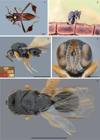
1, Leptoglossus stigma, female, dorsal: (2) Neorileya kavatii sp. nov., emerging from an egg of L. stigma bug; (3-5) Neorileya ashmeadi, lectotype female: (3) lateral habitus; (4) head, frontal; (5) dorsal. Fig. 2: provided by Heraldo Negri de Oliveira. Scale bars: 1, 3, 5 = 1.0 mm, 4 = 0.2 mm.
Parasitoids were examined using a Leica M205C stereomicroscope (Leica Microsystems GmbH, Wetzlar, Germany). Color images were taken with a Leica MC 190HD digital camera attached to the Leica stereomicroscope and the specimens illuminated with a Leica LED5000 HDI high-light diffused dome. The final high-resolution images were generated using the Leica LAS X software. Scanning electron micrographs were taken of uncoated specimens in low vacuum, with a Quanta 250 scanning electron microscope (FEI Company, Hillsboro, USA) at the Universidade Federal de São Carlos, São Carlos, São Paulo, Brazil. Final images were edited using Adobe Illustrator and Photoshop version 2024.
Specimens of Neorileya were identified to genus using the keys provided by Gates (2008). Specimens of Hadronotus were identified to genus using the key in Masner (1976) and the diagnosis in Talamas et al. (2021), and to species using the key in Masner (1983) and compared to holotype images made available by Talamas et al. (2017). The anatomical data (terminology) are consistent with the Hymenoptera Anatomy Ontology Portal, determined by using the proofing tool available through the Hymenoptera Glossary (HAO) and the literature that addresses the specific morphology of Eurytomidae (Gates 2008). In this study, the measurements and proportions of the structures are provided with the value of the holotype [in brackets], followed by the minimum and maximum variation ranges, if applicable.
DNA was extracted non-destructively from six females of Neorileya following the protocol in Wengrat et al. (2021). For amplification of the mitochondrial Cytochrome C Oxidase Subunit I (COI), we used primers FWPTF1 (5’-CCTGGTTCTTTRATTGGTAATGATC-3’) (Li et al. 2010) and LEP-R1 (5’- TAAACTTCTGGATGTCCAAAAA-3’) (Hebert et al. 2004). The concentration and reagents of the Polymerase Chain Reaction (PCR), as well as the thermocycling conditions, followed the protocol of Gariepy et al. (2014). The amplicons were observed after electrophoresis under ultraviolet light on a 1.5% agarose gel stained with SYBR Safe (Life Technologies). The subsequent purification of 10 μL of the final PCR product was performed using 1 μL of Exonuclease I (20 U μL-1) and 2 μL of FastAP™ thermosensitive alkaline phosphatase (1 U μL-1) (both from Thermo Fisher Scientific™). The purification conditions were 37 °C for 30 min, followed by 80 °C for 15 min. Bidirectional Sanger sequencing was performed at the Animal Biotechnology of the Escola Superior de Agricultura “Luiz de Queiroz” - ESALQ/Universidade de São Paulo - USP. Sequences were manually aligned and edited, when necessary, for 530 base pairs (bp) for FWPTF1/ LEP-R1 the primer set. The chromatograms of each of the individual sequences were checked, edited, and aligned to produce the consensus sequence in Geneious Prime 2022.1 (https://www.geneious.com). The presence of NUMTs (nuclear parallels of mitochondrial origin) was observed in MEGA X, following the steps described in Corrêa et al. (2017). Sequences were added to NCBI.
Specimens are permanently publicly deposited in the following repositories: IB-CBE, Coleção de Insetos Entomófagos “Oscar Monte” in Instituto Biológico, Campinas, São Paulo, Brazil (curator Valmir A. Costa); INPA, Coleção de Invertebrados do Instituto Nacional de Pesquisas da Amazônia, Manaus, Amazônia, Brazil (curator Marcio L. Oliveira); MZSP, Museu de Zoologia da Universidade de São Paulo, São Paulo, Brazil (curator Talita Roell); USNM, United States National Museum, Smithsonian Institution, Washington, D.C., USA (curator Michael Gates).
RESULTS
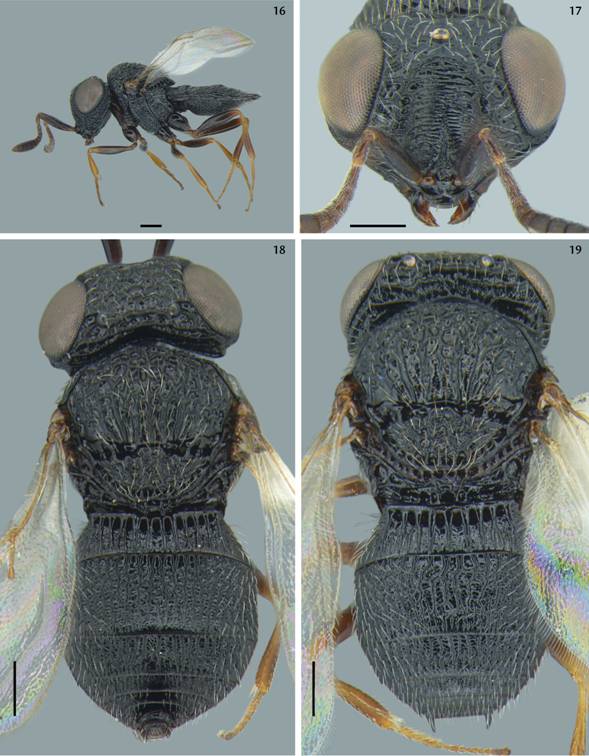
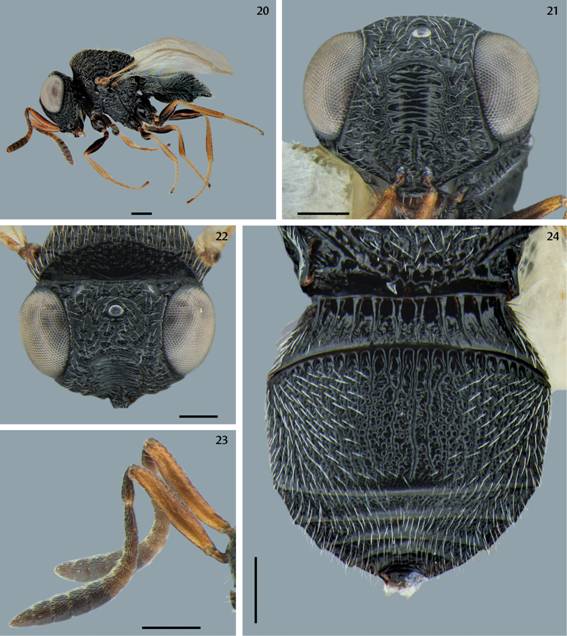
Between March 2003 and April 2004, fifty egg masses and fifteen adults of Leptoglossus stigma were collected in our survey. From a total of 1,132 eggs, 657 were parasitized by three species: Neorileya kavatii sp. nov. (Chalcidoidea: Eurytomidae), Hadronotus vitripennis (Figs 16-19) and Hadronotus sp.-near pennsylvanicus; Platygastroidea: Scelionidae (Figs 20-24). The latter was recognized as a species close to H. pennsylvanicus, based on the length of T2, about four times as long as T3 (Fig. 24). However, this species belongs to a species group that may require molecular data for species level analysis (E.J. Talamas, personal communication), which we were unable to generate for these specimens. Among the species of parasitoid wasps, N. kavatii sp. nov. corresponded to 71.69% of parasitized eggs, followed by H. vitripennis with 22.37%, and Hadronotus sp. with 5.94% (Table 1).
Parasitoidism of eggs of Leptoglossus stigma (Coreidae) by the Neorileya kavatii (Eurytomidae), Hadronotus vitripennis, and Hadronotus sp. (Scelionidae) in Campinas, São Paulo, Brazil, March/2003 to April/2004.
Based on morphological and molecular data we describe both sexes of the new species from eggs of L. stigma. Six sequences of COI were obtained for N. kavatii sp. nov., with 530 bp. The sequences that have been generated and deposited in the NCBI database for this parasitoid species are: PP782027, PP782028, PP782029, PP782030, PP782030, and PP782032.
TAXONOMY
Neorileya kavatii Schoeninger & Costa, sp. nov.
https://zoobank.org/B3973A3C-BF4B-4A81-AD54-3B395CEA5763
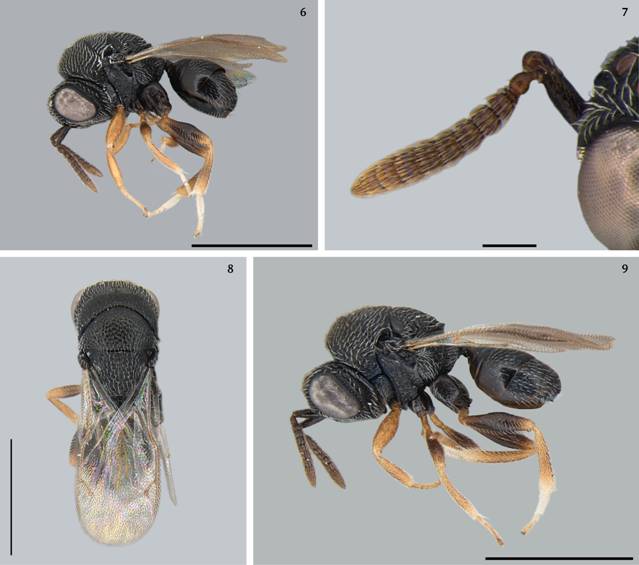
Diagnosis. This species can be distinguished from all other Neorileya by the combination of the following features: meso- and metafemora and metatibiae dark brown, except yellow tips (Fig. 6); scape black, pedicel and flagellomeres dark brown (Fig. 7); frontal depression transversely striate to reticulate (Fig. 11); ratio of eye height to width of supraclypeal area 0.6-0.7×; length of flagellum 0.7-0.9× head height.
Description. Female. Length [1.5mm] 1.5-2.0 mm (Fig. 6). Head, mesosoma, tegula, and petiole black; coxae, and metasoma dark brown; meta- and mesofemora and metatibiae dark brown, except yellow tips; protibia yellow; tarsi whitish; scape black, pedicel and flagellomeres dark brown; wings hyaline, venation light brown; ovipositor sheath light brown to yellow.

Neorileya kavatii sp. nov.: (6) lateral habitus, female; (7) antenna, female; (8) dorsal habitus, female; (9) lateral habitus, male. Scale bars: 6, 8, 9 = 1.0 mm, 7 = 0.2 mm.
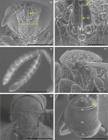
Neorileya kavatii sp. nov.: (10) head, frontal; (11) frontal depression; (12) antennae; (13) mesosoma, lateral; (14) mesosoma, dorsal; (15) gaster, dorsal. (Gt1) First gastral tergum, Gt2, Gt3, (iap) interantennal prominence, (isl) intrascrobal carina. Scale bars: 11 = 100 µm, 12 = 200 µm, 10, 14, 15 = 300 µm, 13 = 400 µm.
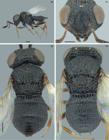
Hadronotus vitripennis: (16) lateral habitus, female; (17) head, frontal, female; (18) dorsal habitus, female; (19) dorsal habitus, male. Scale bars: 0.2 mm.
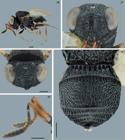
Hadronotus sp., near pennsylvanicus: (20) lateral habitus, female; (21) head, frontal, female; (22) head, dorsal, female; (23) antennae, female; (24) dorsal habitus, female. Scale bars: 0.2 mm.
Head. [1.2×] 1.2-1.3× as broad as high, subtriangular in frontal view (Fig. 10), striate to umbilicate. Ocellar triangle not elevated; anterior ocellus separated from frontal depression by transverse carina (Fig. 11, indicated by yellow arrow), distance between anterior ocellus and transverse carina [0.02 mm] 0.02 mm; POL/OOL/POO [0.2/0.07/0.07 mm] 0.2/0.06-0.08/0.06-0.08 mm. Frontal depression oval-shaped, elongated (Fig. 11), delimited by carina, transversely striate to reticulate; interantennal prominence roughly rounded and merging with fine intrascrobal carina, which extends to apex of frontal depression (Figs 10, 11). Eyes separated by [1.1×] 1.0-1.1× their height; supraclypeal area wide, with ratio of eye height to width of supraclypeal area [0.7×] 0.6-0.7× (Fig. 10), width of supraclypeal area indicated by a transverse line). Eye anteroventral facets slightly larger than superior and posterior facets. Malar space [0.4×] 0.3-0.4× eye height. Scape [3.2×] 3.2-3.7× as long as broad; [0.4×] 0.3-0.4× head height; flagellum 6-segmented (Fig. 12), length of flagellum [0.9×] 0.7-0.9× head height; Fl1 [0.9×] 0.7-1.0× as long as apical width and [1.0×] 0.8-1.0× as long as following flagellomere.
Mesosoma. Umbilicate foveate (Fig. 14). Pronotum [0.3×] 0.3-0.4× as long as apical width, with posterior margin concave (Fig. 14). Midlobe of mesoscutum [1.4×] 1.1-1.4× as long as broad, notaulus slightly indicated. Mesoscutellum [1.3×] 1.1-1.3× as long as broad, carinate apically, lateral panel of axilla reticulate, glabrate. Mesepisternum rugose-reticulate, mesepimeron smooth, glabrate (Fig. 13). Propodeum with primary costula incomplete medially, intercepted by metadorsellum submedially; secondary costulae turning to intercept metascutellum submedially, which are continuous with primary costula anteriorly; weak striae interconnecting secondary costulae with metascutellum and nucha; posterolateral propodeum moderately setose; callus carinate, setose. Fore wing [2.2×] 2.1-2.3× as long as broad, incompletely setose basally; basal and cubital setal lines present and distinct; submarginal vein [1.9×] 1.9-2.3× as long as marginal vein; marginal vein [1.0×] 0.9-1.2× as long as postmarginal vein; stigma [0.8×] 0.8-0.9× as long as stigmal vein; postmarginal vein [1.9×] 1.8-1.9× as long as stigmal vein + stigma. Metacoxa semiglobose, reticulate, [1.5×] 1.4-1.7× longer than broad. Metafemur weakly reticulate and moderately setose, [3.5×] 3.4-3.6× longer than broad, and [1.1×] 1.1-1.5× longer than tibia.
Metasoma. Gt1 shiny and smooth, except for a transversally punctate band, with transverse row of setae across dorsum anteriorly, Gt1 [4.3×] 4.0-5.7× as long as Gt2 and [0.4×] 0.4-0.5× as long as Gt3; Gt1-2 [0.4×] 0.4-0.6× as long as Gt3; Gt1-3 [2.8×] 4.7-6.0× as long as Gt4. Gt2 reduced, shiny and smooth. Gt3 punctate, evenly setose in laterodorsal region (Fig. 15); Gt4 reticulate, evenly setose; remaining terga uniformly setose and reticulate in dorsal view. Apex of syntergum rectangular with median carina separating cercus. Hypopygium reticulate; mucro slightly elevated and short with small median cleft, presence of long lateral setae; ovipositor sheath short with row of four lateral setae, apex with tuft of small setae.
Male. Length 1.6 mm (Fig. 9). Identical to female except as follows: POL/OOL/POO 0.2/0.04-0.05/0.03-0.04 mm. Scape 4.0-4.6× as long as broad, with indistinct ventral plaque extending almost entire length of scape. Metafemur 3.9-4.0× longer than broad. Gt1 2.2-4.0× as long as Gt2 and 0.4-0.5× as long as Gt3; Gt1-2 0.6-0.8× as long as Gt3; Gt1-3 2.8-3.9× as long as Gt4. Petiole distinct in dorsal view, 0.8-1.0× as long as broad, rugulose.
Material examined. Type material: HOLOTYPE. female. Brazil, São Paulo: Campinas, [22°54’23”S, 47°03’42”W], Ex ovo of Leptoglossus sp. on Psidium guajava, FC Marin, 08.iii.2004, (IB-CBE 008428) (MZSP). PARATYPES, 38 females, 28 males. BRAZIL, São Paulo: Campinas, [22°54’23”S, 47°03’42”W], Ex ovo of Leptoglossus sp. on Psidium guajava, MF Souza-Filho, iii.2003 (2 females, 1 male, IB-CBE 008408, 008427, 008426) (MZSP). Idem, but FC Marin, 28.vii.2003 (3 females, IB-CBE 008405, 008409, 008410) (MZSP). Idem, but MF Souza-Filho, 02.ii.2004 (1 female, 2 males, IB-CBE 008407, 008413, 008114) (MZSP). Idem, but FC Marin, 08.iii.2004 (1 female, IB-CBE 008430) (MZSP). Idem, but iv.2003 (3 males, IB-CBE 008423, 006269, 006263) (MZSP). Idem but MF Souza-Filho, iii.2003 (2 females, IB-CBE 007345, 008449) (MZSP). Idem but MF Souza-Filho, 22.iii.2004 (1 female,1 male, IB-CBE 007410, 007417) (MZSP). Idem but MF Souza-Filho, v.2003 (1 female, 2 males, 007408, 007508, 007513) (MZSP). Idem but MF Souza-Filho, iv.2003 (2 females, IB-CBE 006277, 006260) (MZSP). Idem, but iv.2003 (6 females, 5 males; IB-CBE 008447, 008448, 008451-008453, 008457-008459, 008462-008464) (INPA). Idem, but iii.2003 (1 female, 4 males; IB-CBE 008450, 008446, 008460, 008461, 008449) (INPA). Idem, but 01.iii.2004 (3 females, IB-CBE 008454-008456) (INPA). Idem, but v.2003 (1 male; IB-CBE 007513) (INPA). Idem, but iii.2003 (2 females, 1 male, IB-CBE 008418, 008419,008445) (USNM). Idem, but 22.iii.2003 (2 females, 1 male, IB-CBE 008395, 008396, 008403) (USNM). Idem, but iv.2003 (4 females,4 males, IB-CBE 007677, 008397, 008398, 008439, 008399, 008415, 008440, 008442) (USNM). Idem, but FC Marin, 29.ix.2003 (1 female, 2 males, IB-CBE 008420-008422) (USNM). Idem, but 02.ii.2004 (1 female,1 male, IB-CBE 008401, 008400) (USNM). Idem, but FC Marin, 12.iv.2004 (2 females,1 male, IB-CBE 008406, 008411, 008412) (USNM). Idem, but v.2003 (2 males, IB-CBE 008416, 008417) (USNM).
Known distribution. Brazil (São Paulo).
Etymology. This species is named after the late Ryosuke Kavati, MSc. (1953-2024), Agricultural Engineer with vast knowledge of guava production, among others. Kavati believed that fruit growing was an excellent profitability alternative for small rural properties and educated other colleagues about tropical fruit growing. He also generally supported farmers, with a special focus on family-based agriculture.
Remarks. Neorileya kavatii sp. nov. closely resembles N. ashmeadi in body length and shape, particularly in the length of the terga, and also shares the black tegula, a feature previously unique to N. ashmeadi (Figs 3, 5); but differs mainly in having meta- and mesofemora and metatibiae dark brown, except yellow tips (Fig. 6) (vs. meta- and mesofemora and metatibiae yellow with white tips in N. ashmeadi, Fig. 3); head subtriangular in frontal view (Fig. 10) and scape black and flagellomeres dark brown (Fig. 7) (vs. head ovate in frontal view, Fig. 4, and scape light brown with apexes dark brown and flagellomeres brown in N. ashmeadi). No significant intraspecific variations were observed.
Host. Leptoglossus stigma (Fig. 1).
DISCUSSION
In this study, we provide six molecular sequences of N. kavatii sp. nov., which complement the morphological evidence and contribute to a more robust identification of the species. Currently, public databases such as NCBI and BOLD include sequences only for N. meridionalis, and more recently, Zang et al. (2025) deposited molecular data for N. ashmeadi and N. flavipes, expanding the comparative framework within the genus. The acquisition and availability of sequences for N. kavatii sp. nov. are therefore relevant not only to confirm its specific distinctness but also to strengthen future phylogenetic analyses and species delimitation studies in Neorileya. A comprehensive phylogenetic analysis of the genus is currently being developed alongside its taxonomic revision, which includes comparisons of N. kavatii with previously described species (K. Schoeninger et al. unpublished data).
Among the seven previously known species of Neorileya, three had been recorded from Brazil: N. albipes, N. ashmeadi, and N. flavipes. However, there are few specific studies on their distribution and associations with hosts (De Santis 1989, Santos et al. 2001, Paz-Neto et al. 2015, Perioto and Lara 2024). Neorileya kavatii sp. nov. increases our knowledge of generic diversity for Brazil. Where host associations are known, representatives of Rileyinae s.s. attack cecidomyiid gall formers exclusively, with the exception of species of Neorileya, which are all apparently solitary endoparasitoids of exposed eggs of Tettigoniidae (Orthoptera) and eggs of Coreidae, Pentatomidae, and Reduviidae (Hemiptera) (De Santis 1979, 1989, Gates 2008).
Favetti et al. (2013) found that 86.3% of the 578 eggs of Edessa meditabunda (Pentatomidae) collected in lettuce crops in the state of Mato Grosso, Brazil, were parasitized by Telenomus podisi Ashmead, 1893, Trissolcus urichi Crawford, 1913 (Scelionidae) and Neorileya albipes (Eurytomidae), representing respectively 57.0%, 38.2%, and 4.8% of the emerged individuals. The data obtained suggest that N. kavatii sp. nov. could be a potential natural enemy for controlling Leptoglossus spp. in guava orchards, as this species accounted for over 70% of the parasitized eggs in our survey. For the first time, a percentage of parasitoidism of this magnitude is reported for a species of Neorileya. Previous studies have shown Neorileya’s parasitoidism percentage to be less than 5%, significantly lower than those of T. podisi and T. urichi (Godoy et al. 2005, Favetti et al. 2013). We also recorded the presence of Hadronotus vitripennis, responsible for 22.37% of parasitized eggs, and Hadronotus sp. near pennsylvanicus, responsible for 5.94% of parasitized eggs. Few studies document the biocontrol potential of Hadronotus in relation to Leptoglossus spp., although Souza and Amaral (1999) demonstrated 64% parasitoidism in L. zonatus eggs.
The high rates of parasitoidism observed in egg masses of Leptoglossus stigma in guava crops may have been directly influenced by environmental management practices. In this case, insecticides were not applied, and vegetation was regularly trimmed, allowing for easier movement within the plot. However, vegetation (cover plants between guava tree cultivation rows) was not completely removed; this vegetation provided shelter and food for other arthropods (beneficial or natural enemies of pests). Additionally, pruned branches of guava were left on the ground under the original tree’s canopy, similarly to how fruits were eliminated during thinning. This interaction is only successful in sustainable agricultural cultivation in which natural control mechanisms are stimulated and considered preventive measures (Boller et al. 1999).
Thus, both Neorileya kavatii sp. nov. and Hadronotus spp. are good candidates for use in future biological control programs aimed at controlling Leptoglossus spp.
ACKNOWLEDGMENTS
The authors are grateful to Laboratório de Ecologia Molecular de Artrópodes and Alberto S. Corrêa (USP/ESALQ) for support in molecular extractions, Luciana Bueno dos Reis Fernandes for support with SEM-micrographs and Heraldo Negri de Oliveira for providing Fig. 2; to Elijah Talamas for confirming the identifications of Hadronotus species and for his thoughtful review of the manuscript.
LITERATURE CITED
-
Abram PK, Mills NJ, Beers EH (2020) Review: Classical biological control of invasive stink bugs with egg parasitoids-what does success look like? Pest Management Science 76: 1980-1992. https://doi.org/10.1002/ps.5813
» https://doi.org/10.1002/ps.5813 - Allen RC (1969) A revision of the genus Leptoglossus Guerin (Hemiptera: Coreidae). Entomologica Americana 45: 35-140.
- Amaral Filho BF, Cajueiro IVM (1977) Observações sobre o ciclo biológico de Veneza stigma (Herbest, 1784) Osuna, 1975 (Hemiptera, Coreidae) em laboratório. Anais da Sociedade Entomológica do Brasil 6(2): 164-172.
- Becker M, Prato MD (1982) Natality and natural mortality of Spartocera lativentris Stal, 1870 (Heteroptera: Coreidae) in the egg stage. Anais da Sociedade Entomológica do Brasil 11(2): 269-281.
- Boller EF, El Titi A, Gendrier JP, Avilla J, Jörg E, Malavolta C (1999) Integrated production: principles and technical guidelines. IOCB/WPRS, Wädenswil, 2nd ed., 29 pp.
-
Boyle SM, Cornelius M, Talamas EJ, Straser RK, Wilson H, et al. (2024) Hadronotus pennsylvanicus (Hymenoptera: Scelionidae): a biological control agent for pestiferous leaffooted bugs (Hemiptera: Coreidae). Journal of Integrated Pest Management 15(1): 15. https://doi.org/10.1093/jipm/pmae007
» https://doi.org/10.1093/jipm/pmae007 -
Brailovsky H (2014) Illustrated key for identification of the species included in the genus Leptoglossus (Hemiptera: Heteroptera: Coreidae: Coreinae: Anisoscelini), and descriptions of five new species and new synonyms. Zootaxa 3794(1): 143-178. https://doi.org/10.11646/zootaxa.3794.1.7
» https://doi.org/10.11646/zootaxa.3794.1.7 -
Canto-Silva CR, Romanowski HP (2003) Population fluctuation, immature mortality and adult longevity of Spartocera dentiventris (Berg) (Hemiptera: Coreidae) on Nicotiana tabacum (Solanaceae). Neotropical Entomology 32(3): 399-406. https://doi.org/10.1590/S1519-566X2003000300003
» https://doi.org/10.1590/S1519-566X2003000300003 -
Corrêa AS, Vinson CC, Braga LS, Guedes RNC, Oliveira LO (2017) Ancient origin and recent range expansion of the maize weevil Sitophilus zeamais, and its genealogical relationship to the rice weevil S. oryzae Bulletin of Entomological Research 107: 9-20. https://doi.org/10.1017/S0007485316000687
» https://doi.org/10.1017/S0007485316000687 -
Costa Lima A (1928) Hadronotus brasiliensis, novo scelionideo parasito de ovos de um coreideo. Memórias do Instituto Oswaldo Cruz 21(Suppl. 1): 1-3. https://doi.org/10.1590/S0074-02761928000300001
» https://doi.org/10.1590/S0074-02761928000300001 - De Santis L (1979) Catálogo de los himénopteros calcidoideos de América al sur de los Estados Unidos. Comisión de Investigaciones Científicas, Buenos Aires, 488 pp.
- De Santis L (1989) Catálogo de los Himenopteros Calcidoideos (Hymenoptera) al sur de los Estados Unidos, segundo suplemento. Catalogue of the Chalcidoidea (Hymenoptera) of America south of the United States, second supplement. Acta Entomologica Chilena 15: 9-90.
-
Favetti BM, Krinski D, Butnariu AR, Loiácono MS (2013) Egg parasitoids of Edessa meditabunda (Fabricius) (Pentatomidae) in lettuce crop. Revista Brasileira de Entomologia 57(2): 236-237. https://doi.org/10.1590/S0085-56262013005000014
» https://doi.org/10.1590/S0085-56262013005000014 - Fernandes JA, Grazia J (1992) Estudo dos estágios imaturos de Leptoglossus zonatus (Dallas, 1852) (Heteroptera-Coreidae). Anais da Sociedade Entomológica do Brasil 21(2): 179-188.
-
Fernandes JA, Mitchell PL, Livermore L, Nikunlassi M (2015) Leaf-footed bugs (Coreidae). In: Panizzi AR, Grazia J (Eds) True bugs (Heteroptera) of the Neotropics. Springer, Dordrecht, 549-605. https://doi.org/10.1007/978-94-017-9861-7
» https://doi.org/10.1007/978-94-017-9861-7 -
Gariepy TD, Haye T, Zhang J (2014) A molecular diagnostic tool for the preliminary assessment of the host-parasitoid associations in biological control programmes for a new invasive pest. Molecular Ecology 23: 3912-3924. https://doi.org/10.1111/mec.12515
» https://doi.org/10.1111/mec.12515 - Gates MW (2008) Species revision and generic systematics of world Rileyinae (Hymenoptera: Eurytomidae). University of California Publications in Entomology 127: 1-332.
-
Godoy KB, Galli JC, Ávila CJ (2005) Parasitismo em ovos de percevejos da soja Euschistus heros (Fabricius) e Piezodorus guildinii (Westwood) (Hemiptera: Pentatomidae) em São Gabriel do Oeste, MS. Ciência Rural 35(2): 455-458. https://doi.org/10.1590/S0103-84782005000200034
» https://doi.org/10.1590/S0103-84782005000200034 -
Hebert PDN, Penton EH, Burns JM, Janzen DH, Hallwachs W (2004) Ten species in one: DNA barcoding reveals cryptic species in the neotropical skipper butterfly Astraptes fulgerator Proceedings of the National Academy of Sciences of the United States of America 101: 14812-14817. https://doi.org/10.1073/pnas.0406166101
» https://doi.org/10.1073/pnas.0406166101 -
IBGE (2022) Cidades e estados do Brasil. Instituto Brasileiro de Geografia e Estatística. https://cidades.ibge.gov.br/brasil/sp/pesquisa/15/1194 [Accessed: 13/05/2024]
» https://cidades.ibge.gov.br/brasil/sp/pesquisa/15/1194 -
IBGE (2024) Produção de goiaba. Instituto Brasileiro de Geografia e Estatística, Instituto Brasileiro de Geografia e Estatística, https://www.ibge.gov.br/explica/producao-agropecuaria/goiaba/br [Accessed: 29/09/2025]
» https://www.ibge.gov.br/explica/producao-agropecuaria/goiaba/br -
Ingels C, Haviland D (2014) Leaffooted Bug. Pest Notes (74168): 1-4. https://ipm.ucanr.edu/legacy_assets/PDF/PESTNOTES/pnleaffootedbug.pdf
» https://ipm.ucanr.edu/legacy_assets/PDF/PESTNOTES/pnleaffootedbug.pdf - Landau EC, Martins JLA, Silva GA (2020) Evolução da produção de goiaba (Psidium guajava, Myrtaceae). In: Landau EC, Silva GA, Moura L, Hirsch A (Eds) Dinâmica da produção agropecuária e da paisagem natural no Brasil nas últimas décadas: produtos de origem vegetal. Embrapa, Brasília, 2nd ed., 839-866.
-
Li Y, Xin Z, Feng G, Hu H, Niu L, et al. (2010) COI and ITS2 sequences delimit species, reveal cryptic taxa and host specificity of fig-associated Sycophila (Hymenoptera, Eurytomidae). Molecular Ecology Resources 10: 31-40. https://doi.org/10.1111/j.1755-0998.2009.02671.x
» https://doi.org/10.1111/j.1755-0998.2009.02671.x - Maltese M, Caleca V, Guerrieri E, Strong WB (2012) Parasitoids of Leptoglossus occidentalis Heidemann (Heteroptera: Coreidae) recovered in western North America and first record of its egg parasitoid Gryon pennsylvanicum (Ashmead) (Hymenoptera: Platygastridae) in California. The Pan-Pacific Entomologist 88: 347-355.
-
Masner L (1976) Revisionary notes and keys to world genera of Scelionidae (Hymenoptera: Proctotrupoidea). Memoirs of the Entomological Society of Canada 97: 1-87. https://doi.org/10.4039/entm10897fv
» https://doi.org/10.4039/entm10897fv -
Masner L (1983) A revision of Gryon Haliday in North America (Hymenoptera: Proctotrupoidea: Scelionidae). The Canadian Entomologist 115: 123-174. https://doi.org/10.4039/Ent115123-2
» https://doi.org/10.4039/Ent115123-2 -
Mitchell PL (2000) Leaf-footed bugs (Coreidae). In: Schaefer CW, Panizzi AR (Eds) Heteroptera of economic importance. CRC Press, Boca Raton, 337-403. https://doi.org/10.1201/9781420041859
» https://doi.org/10.1201/9781420041859 -
Oliveira SP, Acioli ANS, Silva WM, Pinheiro FS, Silva NM, Costa VA (2023) First Parasitism Record of the Eggs of Thlastocoris laetus Mayr, 1866 (Hemiptera: Coreidae) and New Host and Distribution Records for Hadronotus vitripennis (Masner, 1983) (Hymenoptera: Scelionidae). Entomological Communications 5: ec05027. https://doi.org/10.37486/2675-1305.ec05027
» https://doi.org/10.37486/2675-1305.ec05027 - Paz-Neto AA, Querino RB, Margaría CB (2015) Egg parasitoids of stink bugs (Hemiptera: Coreidae and Pentatomidae) on soybean and cowpea in Brazil. Florida Entomologist 98(3): 929-932.
- Perioto NW, Lara RIR, Cruz I (2019) Gryon vitripenne Masner (Hymenoptera: Platygastridae), new host-parasitoid association with Leptoglossus zonatus (Dallas) (Heteroptera: Coreidae) in corn crop and extension of geographic range. Revista Chilena de Entomologia 45(3): 445-449.
-
Perioto NW, Lara RIR (2024) Eurytomidae in Catálogo Taxonômico da Fauna do Brasil. PNUD, PNUD, http://fauna.jbrj.gov.br/fauna/faunadobrasil/7614 [Accessed: 24/05/2024]
» http://fauna.jbrj.gov.br/fauna/faunadobrasil/7614 -
Risterucci AM, Duval MF, Rohde W, Billote N (2005) Isolation and characterization of microsatellite loci from Psidium guajava L. Molecular Ecology Notes 5: 745-748. https://doi.org/10.1111/j.1471-8286.2005.01050.x
» https://doi.org/10.1111/j.1471-8286.2005.01050.x -
Santos RSS, Redaelli LR, Diefenbach LMG (2001) Ocorrência de parasitismo em ovos de Spartocera dentiventris (Berg) (Hemiptera: Coreidae) em cultura de fumo. Neotropical Entomology 30(4): 731-733. https://doi.org/10.1590/S1519-566X2001000400033
» https://doi.org/10.1590/S1519-566X2001000400033 - Souza CE, Amaral-Filho BF (1999) Ocorrência natural de parasitóides de Leptoglossus zonatus (Dallas) (Heteroptera: Coreidae). Anais da Sociedade Entomológica do Brasil 28: 757-759.
- Souza-Filho MF (2021) Manejo de pragas. In: Freitas GB, Borém A (Eds) Goiaba: do plantio à colheita. Editora Universidade Federal de Viçosa, Viçosa, 155-180.
- Souza-Filho MF, Souza JC, Raga A (2022) Pragas da goiabeira. In: Raga A, et al. (Eds) Manual de Entomologia. Agronômica Ceres, Ouro Fino, vol. 1, 237-248.
-
Talamas EJ, Thompson J, Cutler A, Schoenberger SF, Cuminale A, et al. (2017) An online photographic catalog of primary types of Platygastroidea (Hymenoptera) in the National Museum of Natural History, Smithsonian Institution. Journal of Hymenoptera Research 56: 187-224. https://doi.org/10.3897/jhr.56.10774
» https://doi.org/10.3897/jhr.56.10774 -
Talamas EJ, Bremer JS, Moore MR, Bon M-C, Lahey Z, et al. (2021) A maximalist approach to the systematics of a biological control agent: Gryon aetherium Talamas, sp. nov. (Hymenoptera, Scelionidae). Journal of Hymenoptera Research 87: 323-480. https://doi.org/10.3897/jhr.87.72842
» https://doi.org/10.3897/jhr.87.72842 -
Wengrat APGS, Coelho Junior A, Parra JRP, Takahashi TA, Foerster LA, et al. (2021) Integrative taxonomy and phylogeography of Telenomus remus (Scelionidae), with the first record of natural parasitism of Spodoptera spp. in Brazil. Scientific Reports 11: 14110. https://doi.org/10.1038/s41598-021-93510-3
» https://doi.org/10.1038/s41598-021-93510-3 - Yasuda K (1998) Function of the male pheromone of the leaf-footed plant bug, Leptoglossus australis (Fabricius) (Heteroptera: Coreidae) and its kairomonal effect. Japan Agricultural Research Quarterly 32(1): 161-166.
-
Zhang YM, Delvare G, Blaimer BB, Cruaud A, Rasplus JY, et al. (2025) Phasing in and out of phytophagy: Phylogeny and evolution of the family Eurytomidae (Hymenoptera: Chalcidoidea) based on Ultraconserved Elements. Systematic Entomology 50(4): 780-793. https://doi.org/10.1111/syen.12682
» https://doi.org/10.1111/syen.12682
ADDITIONAL NOTES
- ZooBank register
-
Data Availability Statement
All data generated and/or analyzed are included in this article.
-
Funding
This study was supported by the Fundação de Amparo à Pesquisa do Estado de São Paulo (FAPESP, grant 2020/16051-7, 2017/50334-3 and 2018/18965-6). Conselho Nacional de Desenvolvimento Científico e Tecnológico (CNPq, grant 152666/2022-2). Instituto Nacional de Ciência e Tecnologia de Hymenoptera Parasitoides (CNPq, grant 65562/2014-0).
-
Ethical Statement
This study did not involve live vertebrate animals and therefore did not require approval by an ethics committee. Field activities were conducted under collection permits issued by [IBAMA/SISBIO registration no.: 2811678, VAC] (permit no. 16338-1).
-
AI Statement
The English text correction was carried out with the assistance of Reverso and DeepSeek software, https://www.reverso.net and https://deepseek.com, respectively.
-
How to cite this article
Schoeninger K, Wengrat APGS, Souza-Filho MF, Perioto NW, Schwertner CF, Bueno RNS, Gates M, Costa VA (2026) Egg parasitoids of Leptoglossus stigma (Hemiptera: Coreidae) in Brazilian guava crops, with description of a new Neorileya species (Hymenoptera: Eurytomidae). Zoologia 43: e25056. https://doi.org/10.1590/S1984-4689.v43.e25056
-
Published by
Sociedade Brasileira de Zoologia at Scientific Electronic Library Online - https://www.scielo.br/zool
All data generated and/or analyzed are included in this article.
Data citations
Perioto NW, Lara RIR (2024) Eurytomidae in Catálogo Taxonômico da Fauna do Brasil. PNUD, PNUD, http://fauna.jbrj.gov.br/fauna/faunadobrasil/7614 [Accessed: 24/05/2024]